How shall I put it? Um, the industrial crown jewel of Germany is barreling toward a cliff with failing brakes in a crisis that could punch a hole in the entire nation’s economy. For the first time in its 87-year history, Volkswagen is considering factory closures in Germany—ground zero for its workforce and symbolic heart.
The source of this chaos? Volkswagen is choking on its EV pivot. With profits down 11.4%, margins crumbling to 5.6% for 2024 and a €17 billion price tag merely to stabilize, CEO Oliver Blume is running out of road. Meanwhile, over 120,000 workers are staring down 10% pay cuts, sparking protests that have already shut down production.
Volkswagen is primarily listed on the Frankfurt Stock Exchange, but it’s also available to American investors through American Depository Receipts (ADRs).
Volkswagen’s ticker symbol, VWAGY, represents the company’s ordinary shares trading over-the-counter (OTC) in the United States. For U.S. investors, VWAGY or VWAPY are likely the most straightforward options and/or via its holding company.
VWAGY: Represents ordinary shares with voting rights
VWAPY: Represents more liquid preference shares w/o voting rights
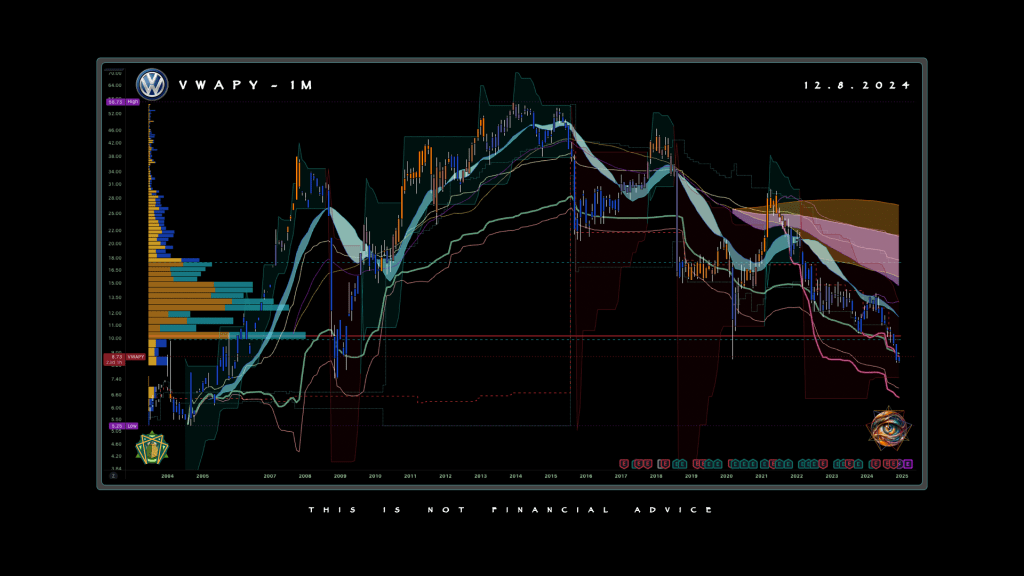
The monthly chart for VWAPY indicates a prolonged bearish trend. Price action is firmly below the Triple Differential MA Braid, as well as prior accumulation ranges, indicating more downward momentum to follow. Anchored VWAPs highlight the stepwise decline to the volume profile’s point-of-control. The widening gap between the moving averages underscores accelerating bearish sentiment. The volume profile teases potential support, but sustained weakness could lead to an irrecoverable breakdown. The lack of upward momentum suggests limited recovery in the short term, barring any major fundamental catalyst. Forecast: Continued downside could trigger a sharper decline toward multi-decade lows.
Volkswagen doesn’t have an electric “People’s Car,” and demand for EVs is falling short of rosy projections. Worse, producing EVs is a margin killer compared to their gasoline ancestors. Add Germany’s climate mandates—65% emissions cuts by 2030 and 15 million EVs on the road—and you’ve got a company stretched thinner than its profit margins.
Then there’s the China problem. Volkswagen is getting its teeth kicked in by Chinese EV makers who churn out cheaper, subsidized models while eating VW’s market share both at home and abroad. Germany’s big tariffs on Chinese imports? A band-aid on a gunshot wound when your core markets are eroding.
Trend Exhaustion pitchforks on the monthly chart reveal accumulation and distribution ranges coinciding with long-term anchored VWAP levels. Successive lower highs show bearish control, while price remains locked in a steep descending channel. Fibonacci color coding projects potential downside price and time target. Forecast: Given the persistent selling pressure, price is likely to retest $9 in the coming months.
The granularity of the daily chart reveals heightened volatility along a significant Euler range of the Trend Exhaustion (purple channel). The price is retesting the 21D moving averages, yet the liquidation events suggested by volume spikes at higher price points create a false sense of support. Forecast: Intraday bounces will tempt permabulls, but a sustained reversal is unlikely; daily volatility can increase, leading to sharp but short-lived moves.
The political fallout is already lighting fires. The IG Metall union is ready to turn protests into an industrial revolution, and Lower Saxony—a key Volkswagen shareholder—is panicking over the potential economic collapse of Wolfsburg. Factory closures would gut entire communities, turning stable jobs into ghost towns.
This isn’t just Volkswagen circling the drain. This is Germany’s auto sector—17% of its GDP—facing an existential reckoning. Blume’s only options? Reinvent the wheel or watch Germany’s industrial engine seize. Either way, it’s going to be messy.
Welcome to Family Feud: Chief Executive Edition, where the contestants aren’t merely families—they’re dynasties. Last Sunday’s evening game featured the Bidens squaring off against their eternal rivals, the Grand Old Party. The stakes, if they’re unworthy of Justice (much less of Qualified Immunity), may be worth at least the last frayed nerves of the American public. Ready or not, let’s play!
The prompt: “Name something a President would sacrifice to protect their legacy.”
Joe wakes and slams the buzzer, affirming, “Everything.” Survey says…?
Round One: Scandal in the Room
As the buzzer sounds in what feels like overtime, Joe Biden delivered what might be his ultimate wildcard—a Sonny Boy Sweetheart Pardon that covers (i.e. erases) over a decade of “potential” sins. Day 1 of 2014, the effective start date and the year the U.S. government started playing geopolitical Jenga in Ukraine, is coincidentally when Hunter began stacking his blocks of influence.
With one hand in Burisma’s till and the other dabbling in viral research through Metabiota, he and/or his closest associates “might” have made a killing, for all we will ever know.
The choice of 2014 as the starting line is like a game-show cheat code: a big glowing arrow pointing to when the family’s Ukrainian adventures really took off. Think of it as a DVR rewind button for investigators. “Oh, you want to know where to look? Here’s the timestamp.”
For years, Republicans have buzzed in with variations of the same answer: “Hunter Biden’s laptop!” They’re now giddy as Steve Harvey when a contestant blurts out something absurd. This time, they’re slobbering like Richard Dawson over a midwit daughter-in-law hoping land one on the scoreboard. The laptop, previously dismissed as a conspiracy theory, almost “resurfaced”.
If the DOGE jockeys have their way, the records will be memory-holed in the name of efficiency for another half-century or more.
Double Jeopardy: The Treaty Trap
Joe is betting the farm on this one, and swinging for the fences. The Constitution gives the President sweeping pardon power, but treaties like the Biological Weapons Convention are considered the supreme law of the land. Violating it comes with a specific penalty.
So, can a president pardon a violation of a treaty?
That’s a question for the Supreme Court, assuming they don’t start laughing (or nodding off) halfway through the opening arguments. Imagine the Chief Justice leaning into his microphone: “So, let me get this straight. You want us to decide if a pardon can erase international war crimes?”
Cue a collective nervous grin from Joe’s legal defense as the camera cuts to the successor, lounging in the audience with a bucket of popcorn, nodding sagely.
The Opponent’s Podium
Meanwhile, at the GOP’s podium, the buzzer is getting more action than a casino slot machine. Every time Hunter’s name comes up, Republican laser-eyes light up with easy answers like “two-tiered justice system!”
And then there’s Orange Julius himself, normally the main character in this type of melodrama. Unironically, he already floated the idea of pardoning Hunter himself, calling it “what a great father would do.” It’s a signature move for him, to turn a rival’s act of loyalty into an opportunity to make himself look magnanimous.
What could be more on-brand than making someone else’s scandal your own campaign ad, free of charge?
Final Round: The Kyiv Connection
Now comes the category so loaded, it might as well be titled, “Reasons Hunter’s Pardon Isn’t About Hunter.”
The buzzer hits, and answers like “Burisma,” “Bioweapons labs,” and “10% for the Big Guy” light up the board like a Christmas tree. Burisma wasn’t just a paycheck for Hunter; it was a liability with a direct line to his father’s vice-presidential office.
The bioweapons narrative is a geopolitical hand-grenade waiting to make a mess. And Joe’s role? Let’s just say his claim of never discussing business with his son plays like a contestant refusing to admit their buzzer doesn’t work. Unlike before, when Joe proudly announced that, “America is a country that can be summed up in a single word …“, the audience isn’t laughing anymore.
With $ Billions in U.S. aid flowing into Ukraine and cries of corruption growing louder, the pardon is the equivalent of Joe flipping the game board over and declaring himself the winner. But audacity is the name of the game for those who live above the law, where the rules are suggestions and the consequences are optional.
Congress, of course, will milk this scandal for every drop of political theater it can. Subpoenas will fly, hearings will drag on, and laughing news anchors will feast like hyenas. But the real stakes are far more existential. This is not a question of Hunter Biden dodging accountability, but a reflection of a deeper, darker truth.
Survey Says: Americans on Edge
In this round of Family Feud, the scoreboard isn’t just tilted—it’s in another dimension altogether. For those watching from the cheap seats, the game is not as entertaining as it is infuriating. Whatever the survey says, everybody already knows who will win and who will lose. What they’re less than ready to admit is that no matter which end of the political spectrum you might favor, there is only one forbidden word …
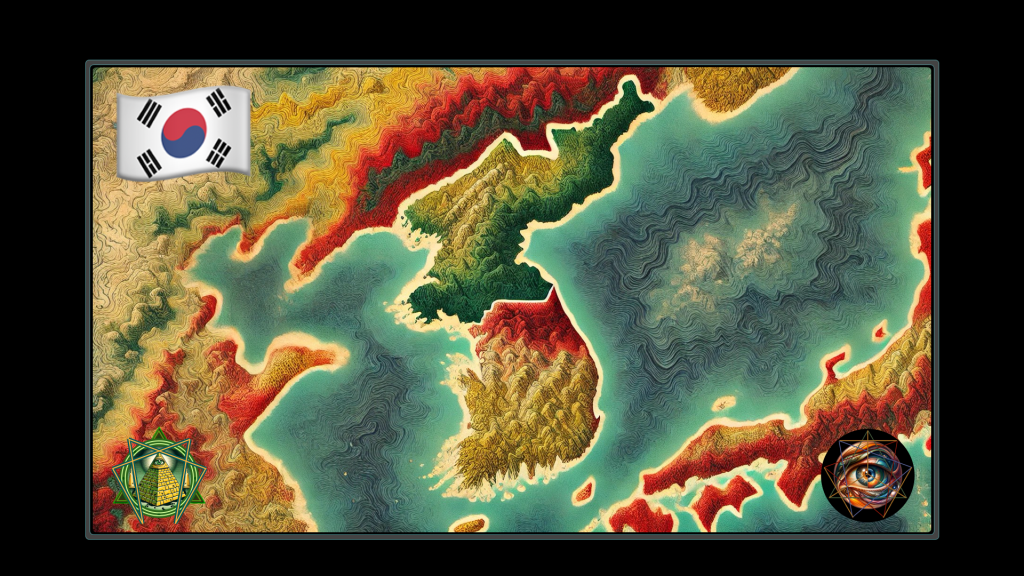
🇰🇷 South Korea’s political crisis unfolds like a Tae Kwon Do showdown outside Seoul’s swankiest rooftop bar, but the real stakes aren’t the fighters—it’s the ever fragile and seldom self-aware Will of the People. She is the proverbial unimpressed hot chick standing in the middle of the fray, wondering why everyone’s duking it out over her when she never even wanted to be here. The brawlers are drunk on power and grievance, and it’s becoming clear that what’s on the menu isn’t her benefit—it’s a cocktail of self-interest, served shaken and with a twist of instability.
🛡️ President Yoon Suk-yeol kicked things off by declaring martial law, claiming to defend the Will of the People from shadowy “anti-state forces” and the perennial North Korean bogeyman. But everyone knows the real enemy isn’t Pyongyang—it’s Yoon’s collapsing popularity, bruised by April’s electoral defeat and compounded by scandal. His gambit to invoke martial law was less about safeguarding the people and more about shielding himself from political extinction. The National Assembly saw through the charade, flipped Yoon onto his back, and reminded him that the Will of the People doesn’t tolerate drunk punches.
🎊 Then come the party mates—Yoon’s supposed allies—acting like sparring partners who’ve turned their gloves inside out. They’re urging him to step away from the fight altogether while circling the defense minister, who sheepishly offers his resignation like a peace token to an angry mob. Meanwhile, the opposition’s got the Will of the People in a bear hug, yelling, “We’ll save her!” as they slap impeachment papers on the table. Across the alley, labor unions are ready to crash the fight entirely, promising industrial strikes that could cripple the economy unless Yoon steps down. Will of the People, meanwhile, stands by, unamused, as it becomes evident that no one is actually fighting for her benefit—they’re just scrambling to claim her favor.
🥊 The Prize Fighters:
President Yoon Suk-yeol: Yoon’s martial law move was a Hail Mary disguised as a flying sidekick, but it reeked of desperation. He’s the guy who started the fight and now can’t even hold his stance. His party is abandoning him, the opposition is coming for his head, and even the Will of the People looks ready to disown him. Sentiment: Cornered 📉.
The National Assembly: Like a referee gone rogue, they blocked martial law unanimously and are now considering whether to let the ruling party bleed out or stabilize the situation. Sentiment: Strategic 🧐.
Ruling Party: These fair-weather friends are calculating how far they can distance themselves from Yoon without looking like traitors. Verdict: Politically bankrupt 📉.
Opposition Party: They’ve got impeachment papers in one hand and the Will of the People in the other, playing hero in the narrative while secretly eyeing the next election. Sentiment: Opportunistic 📈.
Labor Unions: They’re not here to fight—they’re here to shut the whole place down. With strikes scheduled for December 11, they’re a ticking time bomb 💣 in an already explosive situation. Sentiment: Unrelenting 🌊.
🌏 Geopolitical Spectators:
🇺🇸 The U.S. expressed “grave concern”, reiterated its “ironclad” alliance, and made it clear they were blindsided by Yoon’s antics.
🇯🇵 Japan watches like a nervous neighbor, fearing spillover instability.
🇰🇵 North Korea plays it close to the chest.
🦈 The Market Crowd:
The financial sharks aren’t in the fight—they’re nervously watching for scraps from the sidelines while the BoK plays bartender. “Here, take some liquidity,” they say, serving up a KRW 10 trillion stabilization fund and loosening repo collateral rules to calm the FX jitters. Yet, the Bank of Korea governor insists on no rate cuts despite the chaos, dropping the line, “Political certainty may have actually increased.” This otherwise strangely sage sentiment in a room that’s about to implode may actually be the smart money.
📈📉 KOSPI: Took a hit, dropping 2% at the open before recovering to close down 1.3%. Like a seasoned street fighter, it knows how to roll with the punches.
💸 KRW: Staggered on news of martial law but clawed back some dignity by midweek. USD/KRW ~1,412.10 on Wednesday, a far cry from Tuesday’s panic peak of 1,443.40.
🏦 BoK: The bartender everyone loves to ignore, signaling stability measures while refusing to overpour on rate cuts. Sentiment: Overwhelmed but determined 🎯.
📉 What’s Really on the Menu?
The Will of the People, theoretically the guest of honor, is being served up as a prop in everyone else’s act. Yoon’s flailing leadership has made her a prize to be claimed rather than a principle to be upheld. The opposition sees her as their ticket to power, while unions frame their strikes as her liberation. The markets are the only ones openly admitting that her benefit isn’t on the menu—they’re just trying to keep the kitchen from burning down entirely.
The daily chart of the KOSPI grapples along a persistent downtrend. Price action has been slammed down and held below major moving averages. The political backdrop creates the perfect storm for risk aversion. The chart screams instability, with little in the way of immediate relief.
The index’s 2% intraday plunge, followed by a partial recovery to close at -1.3%, is less a sign of resilience and more a reflexive twitch as investors brace for further chaos. Panic in the currency markets mirrors this: the KRW briefly hit 1,443.40 per USD before the Bank of Korea’s interventions calmed the waters.
The brawl isn’t about democracy or even stability—it’s about survival. Yoon is fighting for his political life, the opposition for dominance, and the unions for relevance. The Will of the People is stuck in the middle, watching with disillusionment. Regional democracies seem resilient, but they’re being stress-tested in ways that could scar them long after this fight is over.
📈 Cointegration:
The weekly chart (not shown) hums a different tune: an exhaustion of bearish momentum and the potential for a technical floor. In the end, the real victor may be apathy. If the Will of the People feels ignored long enough, she might just leave the bar altogether, leaving South Korea to clean up a mess of its own making.
The enhanced chart, with its intricate overlays of Fibonacci pitchforks, takes a nuanced view of Trend Exhaustion. Underlying structures from the weekly timeframe reveal a clash between long-term uptrend support against the inertia of recent declines.
The ominous slide toward the red channel’s lower boundary hints at a potential downside breakout. Yet this dark area of confluence, where key levels and trendlines separate like the upper jawbone of a gaping maw, also serves as a probable support zone. The overlapping pitchforks suggest that the KOSPI may be nearing the tail end of its descent, poised either for stabilization or even a recovery.
🧐 If the red channel holds as firm support, the KOSPI might transition from despair to cautious optimism. However, a failure at this level would open the trapdoor to further declines, especially if external shocks—think North Korea or a deeper-than-expected economic slowdown—add to the pressure.
The daily chart screams urgency, political uncertainty and investor anxiety. Yet the market appears to have priced in the chaos. The Bank of Korea’s liquidity injections and the stabilization of the KRW suggest that systemic risk is being managed, even as short-term nerves remain frayed.
At Palantir, the power isn’t distributed—it’s consolidated in a way that transforms shareholders into serfs. The company’s three-tiered stock structure serves as a near-perfect parallel to Saruman’s domination of Rohan. Here’s how the pieces fit:
Class A Shares:These are the “common folk” of Palantir’s hierarchy, akin to Theoden’s soldiers—brave, hopeful, and ultimately irrelevant. Public investors wieldone vote per share, a token gesture meant to mimic democracy without ever delivering it.
Class B Shares:Reserved for the insiders—founders, directors, and select venture capitalists—these shares are Wormtongue’s whispered manipulations in corporate form, granting10 votes per share. They carry enough weight to outvoice the masses and secure a stranglehold on decision-making.
Class F Shares:Here lies the true power, held exclusively by CEO Alex Karp, President Stephen Cohen, and Palantir co-founder Peter Thiel. Like Saruman himself, these three wield nearly50% of the company’s voting power. They’ve pledged to vote as a single entity, ensuring that no hostile takeover—or shareholder rebellion—can dethrone them.
Let’s do the math. Even if the founders’ collective ownership dips below 100 million shares, the Class F voting rights remain intact. This isn’t governance; it’s an unbreakable spell.
The Palantír and the Public’s Illusions
The company’s namesake isn’t just for show. Like the seeing stones of Tolkien’s legend, Palantir’s technology enables surveillance, prediction, and control. Governments and corporations rely on its data analytics to peer into everything from global security threats to consumer behavior. But just as Saruman used his Palantír to manipulate and mislead, Palantir’s founders have weaponized their stock structure to keep the public blind to their machinations.
Investors might feel they’ve joined a fellowship, united in a grand vision of long-term growth. In reality, they’re like Theoden under Wormtongue’s spell: technically in charge, but practically powerless. Major decisions—from corporate strategy to governance policies—are made by three men behind the curtain, immune to the accountability mechanisms that public markets were designed to uphold.
Why This Structure Should Terrify You
Palantir’s voting system is more extreme than the typical dual-class setups used by other tech giants. Companies like Google or Facebook might concentrate power among their founders, but Palantir’s triple-layer feudalism eliminates even the illusion of shareholder influence. Here’s why this matters:
1. Accountability Vacuum
With voting power locked away in the hands of Karp, Cohen, and Thiel, the public has no recourse for poor decision-making or ethical lapses. If Palantir’s leadership decides to pursue controversial partnerships or expand its data collection practices into murkier waters, there’s nothing shareholders can do to stop them.
2. Market Inefficiency
Institutional investors like BlackRock and Vanguard are already wary of Palantir’s governance. The structure discourages long-term investment, as it prioritizes founder control over market-driven checks and balances. This could stifle innovation and harm shareholder value in the long run.
3. Cultural Precedent
Palantir isn’t just a company; it’s a blueprint. If its founders successfully wield this structure to dominate public markets while sidelining investors, other tech firms could follow suit. Founder feudalism might become the new normal, and Wall Street could find itself overrun by a new generation of Wormtongues.
Is There a Gandalf in the Wings?
The story of Theoden didn’t end with his enslavement. Gandalf rode in, broke Saruman’s hold, and restored balance to Rohan. But in this modern allegory, where’s the White Wizard? Institutional investors have tried to play that role, pushing back against extreme multi-class structures like Palantir’s, but so far, their efforts have been fruitless. Regulators, too, seem unwilling—or unable—to intervene.
And so, the public remains in stasis, mesmerized by the promise of long-term growth while their ability to influence Palantir’s destiny is stripped away.
A New Dark Tower
The true tragedy of Palantir’s governance isn’t just its disregard for shareholder democracy; it’s the broader message it sends. In a world where data is power, the founders of Palantir have positioned themselves as unchallengeable lords of their domain. The company’s stock structure isn’t just a mechanism for control—it’s a signal that in the age of Big Tech, even the illusion of public accountability is an anachronism.
For investors still clinging to their Class A shares, remember this: Theoden woke up eventually, but only after a lot of damage was done. Don’t wait for your Gandalf.
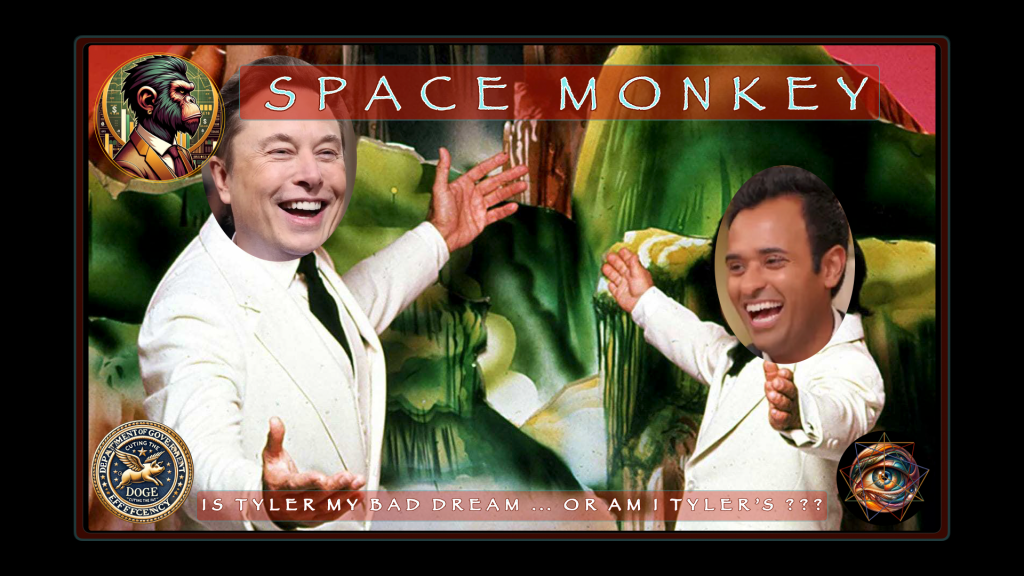
The seaplane buzzes low over the cerulean waters, its engine sputtering triumphantly as it arcs toward the lush shores of Fantasy Island. Waiting at the dock, arms crossed in his signature “visionary” stance, stands Elon Roarke, the enigmatic steward of the island, his crisp white suit gleaming in the sun. Beside him, practically vibrating with enthusiasm, is Tatu Ramaswamy, gesticulating wildly at the descending aircraft.
“De plane! De plane!” Tatu cries, hopping on the balls of his feet.
Elon Roarke, his piercing eyes hidden behind a well rehearsed smile, faintly chuckles. “Yes, Tatu, our guest has arrived. A man with a dream—or a fantasy—depending on how delusional you think he is.”
As the plane touches down, none other than Donald Trump steps out, his red tie flapping in the breeze like a ceremonial flag. He adjusts his MAGA hat with a flourish, scanning the landscape as if looking for a golf course.
“Welcome to Fantasy Island, Mr. Trump,” Roarke says with a slight bow. “I understand you’ve come to fulfill a bold fantasy. You wish to cut $2 trillion from the federal budget. An admirable dream.”
Trump puffs out his chest, his face beaming like a man who just declared bankruptcy and got away with it. “That’s right, Elon. The government’s too fat. It’s inefficient. Bigly inefficient! I want less waste, fewer regulations, more winning. And I hear you’re the guy who can make it happen.”
Tatu chimes in, flashing a toothy grin. “At Fantasy Island, every dream is possible, Mr. Trump. But as you know, every dream comes with a cost.”
Act I: The Forest of Red Tape
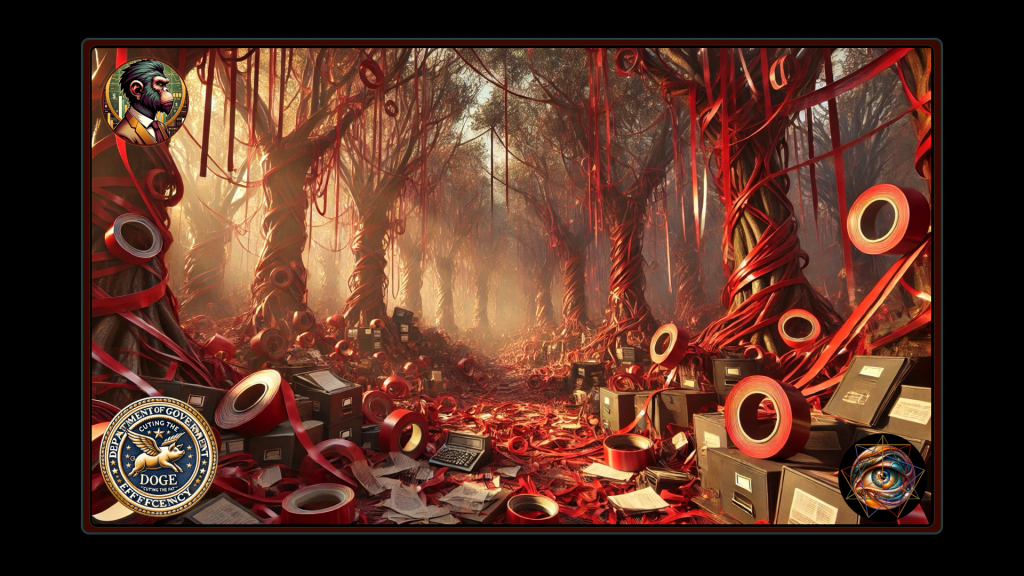
Roarke and Tatu lead Trump through the Forest of Red Tape, where bureaucratic vines twist around ancient government buildings, each labeled with the names of federal agencies: “Department of Education,” “Environmental Protection Agency,” “FDA.” The air smells faintly of printer ink and coffee left out too long.
“Here we house the discretionary spending programs,” Roarke explains as they step over piles of tangled regulations. “Defense, education, transportation. All ripe for cuts.”
Trump claps his hands together. “Perfect! Let’s chop, chop, chop!”
“Patience, Mr. Trump,” Roarke cautions. “The island doesn’t bend to simplistic solutions. Look deeper.”
He gestures toward a towering oak tree, its bark etched with the phrase Mandatory Spending. “Entitlements like Social Security and Medicare are the true titans here—65% of all government spending. If you wish to save $2 trillion, you’ll need to fell this tree.”
Trump recoils. “What? No way. Social Security? Medicare? Those are untouchable. I campaigned on protecting them! That’s like—like taking fries away from a burger. You can’t do it.”
Tatu raises a finger. “Ah, but Mr. Trump, without addressing mandatory spending, you’ll have to cut nearly every other program to the bone. Or worse, to nothing.”
Roarke leans in closer, his voice soft but commanding. “The island listens, Mr. Trump. It hears your intentions. But it also knows the limits of your ambition.”
Trump grumbles, adjusting his hat. “Fine. Let’s look at the other stuff.”
Act II: The Discretionary Desert
The trio arrives at the Discretionary Desert, where mirages of tanks, schools, and bridges shimmer in the heat. Each mirage represents a budget item, glowing faintly with its price tag: $874 billion – Defense, $137 billion – Transportation, $68 billion – Education.
Trump points at the defense mirage. “I’ll cut that!”
“Bold,” Roarke replies. “You’d be the first president to pull it off. But defense spending is… sticky. Touch it, and you’ll find your fingers glued to an army of lobbyists, contractors, and voters who think you’re weak on national security.”
“And Space Force!” Tatu adds enthusiastically. “Can’t forget Space Force! Didn’t you call it your ‘big, beautiful baby’?”
Trump waves dismissively. “Fine, leave defense. What about… the EPA? They clean stuff up, right? Can’t we cut that?”
Roarke arches an eyebrow. “Certainly. But consider this: millions of Americans rely on the EPA to manage lead contamination, clean water, and pollution. The island will ask, Mr. Trump—do you value clean air and water?”
Trump shrugs. “I’ll tweet something about it. Blame Biden. Next!”
Act III: The Cavern of Conflicting Interests
The mood darkens as they descend into the Cavern of Conflicting Interests, where stalactites drip with glowing subsidies and federal contracts. In the dim light, Trump notices Tesla logos glowing ominously.
“Hey, Elon,” Trump says, narrowing his eyes. “Aren’t those your contracts? NASA? Defense? How much government money are you getting, anyway?”
Roarke, ever composed, smirks. “Fantasy Island has its ironies, Mr. Trump. Yes, my enterprises benefit greatly from federal contracts. Nearly $15 billion, in fact. But you see, that’s the genius of the island. It forces us to confront our hypocrisies. Could you really cut government spending without cutting programs you yourself created?”
Tatu laughs nervously. “The island doesn’t like easy answers, Mr. Trump. It loves irony.”
Trump, for once, is speechless.
Act IV: The Chinese Puzzle Garden
The final stop on the tour is the Chinese Puzzle Garden, a maze of bamboo and mirrors. The deeper they go, the more distorted their reflections become. Trump stumbles upon an image of himself, flanked by Elon and the Chairman of the CCP, shaking hands in the shadow of Tesla’s Shanghai factory.
“What’s this?” Trump demands.
Tatu speaks softly. “China controls half of Tesla’s production, Mr. Trump. Their influence on Elon’s empire is significant. Should they choose, they could shut it all down. The island reminds us that no one is free of entanglements.”
Elon, now visibly sweating, tries to lighten the mood. “It’s all part of the fantasy, right? A little… creative tension?”
Trump mutters under his breath. “I don’t like this place anymore.”
Act V: Judgment Day, or The End of the Party
As the sun sets, the three men gather on the beach. The waves lap at the shore, and the plane waits in the distance.
“So, Mr. Trump,” Roarke says, his tone unusually serious. “Have you found your $2 trillion solution?”
Trump looks down, fiddling with his tie. “Maybe cutting government isn’t as easy as I thought. But hey, at least we tried, right?”
Tatu chimes in, ever the optimist. “It’s not about the destination, Mr. Trump. It’s about the journey—and what you learn along the way.”
Roarke chuckles softly. “Indeed, Tatu. Every guest on Fantasy Island leaves with a lesson, even if it’s not the one they hoped for.”
As Trump boards the plane, he looks back at Roarke and Tatu, a rare glimmer of humility crossing his face. “You know, Elon, maybe you’re not so bad after all. And you, Tatu… keep an eye on this guy. He’s dangerous.”
The plane roars to life, taking off into the twilight. Roarke watches it disappear, hands clasped behind his back.
“What’s next, boss?” Tatu asks eagerly.
Roarke smiles faintly. “The island never rests, Tatu. There’s always another fantasy to fulfill—and another lesson to teach.”
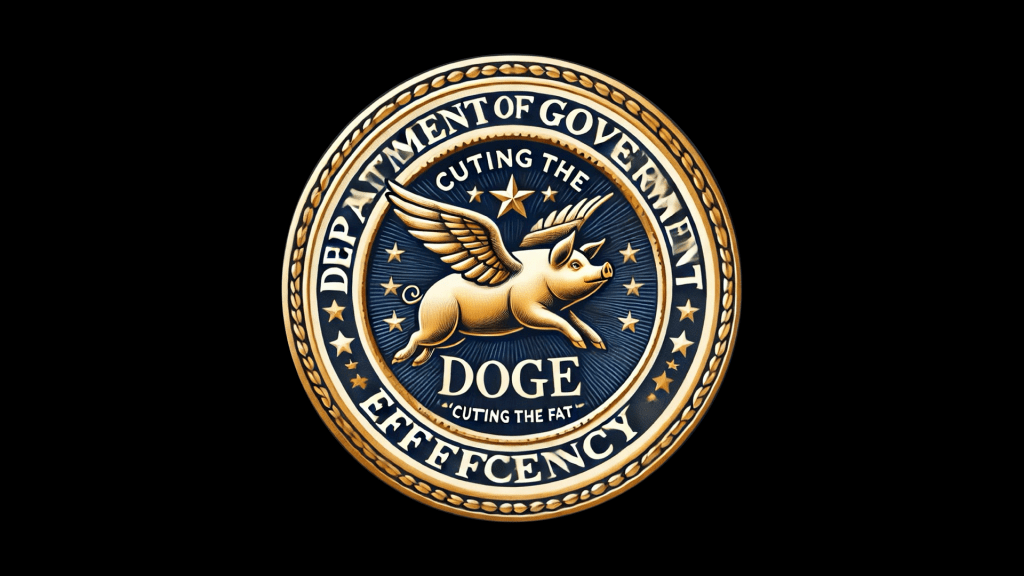
Take-Aways from the DOGE Manifesto
Musk and Ramaswamy’s Razor:DOGE isn’t a government agency—it’s a budget-slashing Austerity Cult disguised as a think tank, spearheaded by Elon Musk and Vivek Ramaswamy under Trump’s watch.
$2 Trillion or Bust:The mission? Ax $2 trillion in federal spending, targeting bloated regulations and inefficiencies. The problem? Most of the fat is marbled into mandatory programs like Social Security and Medicare, which account for 65% of the federal budget.
The Untouchables:Tackling Social Security and Medicare is like detonating a political grenade in a nursing home. Everyone agrees reform is needed, but no one wants to pull the pin.
Musk’s Double Game:Critics are sharpening their knives over Musk’s conflicts of interest, with $15 billion in government contracts and subsidies flowing through his companies, plus his deep ties to China. Can the butcher cut himself out of the carcass?
History Isn’t Encouraging:The Grace Commission, Thatcher’s efficiency reforms—sure, waste has been trimmed before, but not without blood, protests, and political martyrdom.
Doom or Discipline?:Supporters hail DOGE as a necessary fiscal intervention; detractors warn it could dismantle critical services. The truth? Probably both.
Small Wins, Big Blind Spots:Musk has Twittered about minor inefficiencies—misused office chairs, redundant agencies—but the trillion-dollar elephants remain untouched.
The Real Battle:DOGE’s success hinges on surviving an onslaught of lobbyists, political egos, and institutional inertia while delivering real cuts without torching the republic.
DOGE isn’t just a cost-cutting experiment—it’s a high-stakes game of financial Jenga, and the tower’s already leaning.
In the brutal coliseum of retail, where balance sheets decide the victors and losers, Target didn’t just stumble—it tripped over its own ideological shoelaces. The Q3 bloodbath wasn’t just about supply chains, price sensitivity, or macroeconomic pressures. The elephant in the room—the one mainstream analysts like WSJ, Benzinga, and Yahoo Finance conveniently ignore—is the glaring backlash to Target’s overzealous Woke marketing, which alienated a significant portion of its customer base.
Let’s break it down. Target’s decision to push LGBTQ+ merchandise—including controversial kids’ clothing—front and center during Pride Month wasn’t just a bold move; it was a corporate cannonball into cultural quicksand. The backlash, amplified by social media firestorms and customer boycotts, turned off middle (i.e centrist) America faster than you can say “rainbow onesies.” This misstep didn’t just dent revenue; it fundamentally tarnished Target’s brand trust, turning it from a shopping destination into a political battleground.
Walmart avoided the controversy entirely, doubling down on its essentials-driven model and widening its appeal to six-figure-income households—the Capitol elite of the consumer base. With U.S. same-store sales up 5.3% and a 22% boost in digital revenue, Walmart effectively siphoned off disillusioned Target shoppers, turning them into loyalists.
Meanwhile, Target’s Q3 earnings painted a grim picture. Adjusted earnings per share fell to $1.85—far below Wall Street’s $2.30 projection. Revenue floundered at $25.67 billion, a miss that had analysts scratching their heads but refusing to name the obvious: when you politicize your brand, you risk alienating your core customers. Instead, CEO Brian Cornell served up a bland soup of excuses—macroeconomic pressures, discretionary spending declines, and supply chain woes. All valid factors, sure, but they don’t explain the sheer magnitude of the 21% stock plunge, one of Target’s worst trading days in history.
Margins dropped to 27.2%, a sign of deeper internal struggles. Even promotions like Target Circle Week could only temporarily mask the damage. Outside these flash events, sales plummeted as price-sensitive customers sat on their wallets, wary of spending with a brand that no longer aligned with their values.
And then there’s Walmart, strolling through the same macroeconomic minefield unscathed. While Target grappled with discretionary weakness and cultural blowback, Walmart thrived on grocery dominance and strategic discipline. Its appeal to affluent households wasn’t just a fluke; it was a masterstroke, capturing customers who had grown weary of the culture wars and just wanted low prices and full carts.
Mainstream analysts continue to downplay the cultural backlash in Target’s earnings narrative. The official story is all about macroeconomics, logistics, and shifting spending patterns. But the truth is that Target’s stumble was self-inflicted. “Get Woke, Go Broke” may sound like a Twitter meme, but in this case, it’s an axiom with a billion-dollar price tag.
Target’s response? Slash prices and try to recover in time for the holidays. But the damage runs deeper than a bad quarter. The alienation of a core customer base isn’t easily fixed with clearance tags and rebranded shelves.
The takeaway is clear: in an era where cultural polarization drives consumer decisions, brands must tread carefully. The arena of retail isn’t just about operational efficiency and product quality anymore—it’s a battlefield of values. And in this fight, neutrality might just be the strongest weapon.
Target’s Q3 Performance: The Arena Claims Another Tribute
Adjusted EPS hit $1.85, a far cry from Wall Street’s $2.30 forecast—a bullseye missed by a mile.
Revenue stumbled to $25.67 billion, shy of the $25.90 billion consensus—call it a “rainbow fade.”
Comparable sales inched up by 0.3%, proving that modest gains don’t win arena battles.
Digital sales grew 10.8%, but total sales stayed flat—more a flicker than a beacon of hope.
Gross margin slipped to 27.2%, dragged down by cost pressures and inefficiencies, like dragging broken armor through the coliseum.
Challenges Facing Target: A Self-Inflicted Wound
Costs soared thanks to early inventory imports, an overreaction to a potential port strike that never struck.
Discretionary categories—apparel, home goods, and electronics—flopped, while essentials were nowhere to be found.
Price-sensitive shoppers circled only during promotions like Target Circle Week; outside that, crickets.
CEO Brian Cornell pointed to macroeconomic headwinds, but the rainbow-adorned aisles created cultural whirlwinds of their own.
Walmart’s Q3 Performance: The Victor’s Crown
U.S. same-store sales leaped by 5.3%, outclassing Target’s meager 0.3%—a true Career tribute in the retail arena.
Digital sales skyrocketed 22%, as Walmart doubled down on e-commerce dominance.
Walmart grabbed the high ground, gaining 75% of its growth from $100k+ households—an affluent demographic ditching Target’s ideologies.
Gross margin climbed to 24.2%, fueled by tight operations and clear strategy.
Consumer Behavior Trends: A Shift in the Winds
Post-pandemic spending swerved toward essentials and experiences like travel and dining—Target’s discretionary-heavy strategy found no takers.
Value-driven shoppers prioritized groceries and bargains over rainbow-themed trinkets and discretionary splurges.
Walmart’s grocery fortress kept it secure, while Target found itself marooned in its own product mix.
Target’s Strategic Adjustments: A Desperate Play
Full-year EPS guidance slashed to $8.30–$8.90 from $9.00–$9.70—a public surrender.
Aiming to lure shoppers with promotional pricing and flashy new products. But what happens when your promotions only draw protest signs?
Acknowledged the need to rethink spending categories, but will that include a cultural recalibration?
Market Reactions: The Fallout
Target’s stock plunged 21%, marking its third-worst day in history. Year-to-date, it’s bleeding out at -14.94%.
Walmart’s stock rose a quiet 0.67% after its earnings beat and remains the arena champion with a 64.19% YTD gain.
Analysts like Wells Fargo and Citigroup cut ties with Target, slapping it with downgrades.
Broader Industry Context: Winners and Losers in the Arena
Inflation magnifies the pressure on discretionary-focused retailers like Target, where excess inventory clogs the aisles.
Essential goods champions like Walmart seize the moment, hoarding market share and higher-income shoppers.
In the new Hunger Games of retail, operational efficiency and strategic alignment with consumer needs decide who survives the cornucopia.
Future Outlook: Betting on Tributes
Target pins its hopes on holiday promotions and discount strategy—but will it survive the backlash of “Get Woke, Go Broke”?
Broader trends favor essentials-focused warriors like Walmart over luxury dabblers like Target.
Walmart’s adaptability and pragmatic approach continue to set the gold standard in an increasingly ruthless retail landscape.
CNN, the erstwhile behemoth of cable news, now finds itself in the throes of a spectacular freefall. Once the star-studded nexus of celebrity anchors and polished “objectivity,” the network can now barely pull in a third of the audience it commanded eight years ago. Under new CEO Mark Thompson, the network (owned by Warner Brothers Discovery) is embracing a shiny new “digital-first” pivot — a transformation intended to modernize itself but that just might ultimately serve as its final requiem.
How did the network that once monopolized America’s news cycle end up on life support? The answer is part miscalculation, part hubris. CNN, which built a legacy on highly-produced broadcasts, has found itself outpaced by a new generation of news “content creators” operating semi-independently on platforms like YouTube, Substack, and TikTok. Its audience, disenchanted with carefully-filtered corporate infotainment, has decamped for unfiltered and direct perspectives.
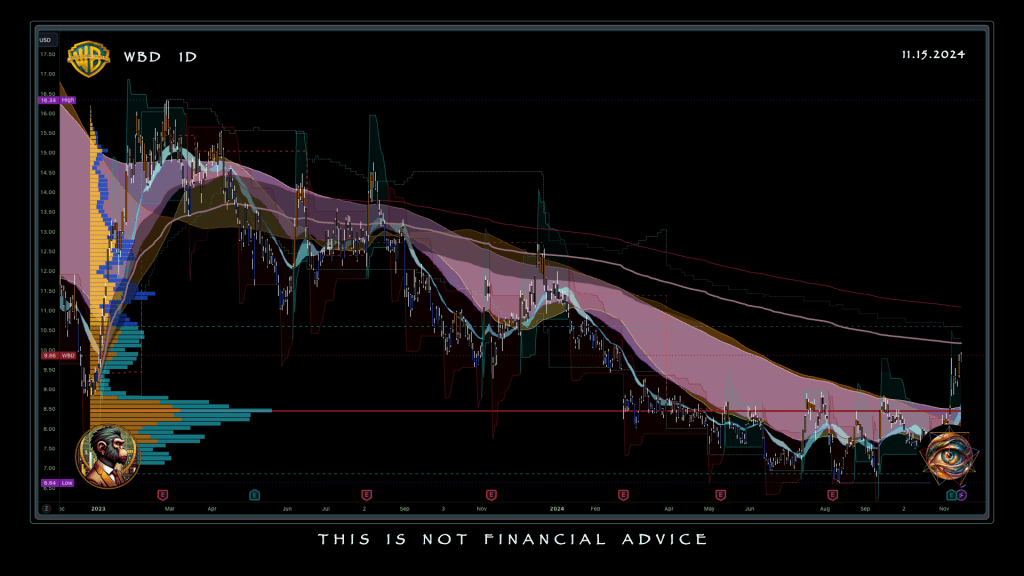
Today, CNN’s ratings plummet as quickly as its production costs rise, and even marquee anchors are watching their contracts slashed or frozen. The weekly stock price of its parent company (since March 2021) reflects this in undeniable terms.
Although the chart shows more than the CNN-effect alone (what does tell it you about the “value” of mainstream entertainment?) the magnitude of the crash (≈88%) is reminiscent of the periodic “corrections” in the Bitcoin price. The difference, of course, is that there will be no new All-Time High on the horizon.
Indeed, Mark Thompson’s restructuring plan is a corporate shell game to cut expenses — layoffs, fewer redundancies, and a streamlined newsroom supposedly geared toward digital growth. But this so-called “digital-first” maneuver is a flimsy rebranding of a network scrambling to salvage its relevance. Formerly astronomical contracts for star anchors are now under scrutiny, with no raises in sight. Even long-standing faces like Jake Tapper, Anderson Cooper, and Erin Burnett are facing the reality that their name recognition is no longer enough to keep the lights on.
The meat of the matter is that CNN’s high-overhead, celebrity-driven model simply can’t compete with the lean, direct model of independent media. Platforms like Substack and TikTok have proven that audiences are hungrier for authenticity than for anchors who read corporate-vetted scripts. Viewers don’t want seemingly “objective” news; for better or for worse, they want unfiltered perspectives from creators who aren’t beholden to boardroom-approved narratives.
BREAKING NEWS: These independent creators, unconstrained by layers of production teams and editorial oversight, have honed a direct line to audiences craving raw, unpolished commentary. For viewers weary of the network model, they are a refreshing alternative to corporate gloss, providing insights without the need to couch opinions in “neutral” language.
BROKEN NEWS: The emerging crop of news-mongers does not need boardroom approval to call out the Powers That Be, and they don’t care about cultivating a “trusted news source” brand. They speak openly, without worrying about the “balance” that such networks as CNN have tried (and failed) to sustain. Their allegiance is to their followers, not to fund managers and their anonymous shareholders.
Their success is no accident; it’s a rebellion.
Of course, if they become demonetized, their opaque loyalty to advertising dollars will come into sharper focus. Nevertheless, in this new ecosystem, for now anyway, it’s relatability that reigns supreme — and that’s precisely what CNN can’t replicate.
As if oblivious to the socioeconomic shift, Thompson’s digital overhaul will mean gutting production roles, overworking the skeleton crew left behind, and laying the burden onto correspondents and reporters. It has been widely reported that layoffs are looming. The production teams that once gave CNN its sleek, controlled aesthetic are being replaced by digital-savvy hires who are cheaper and quicker. As for the few legacy staff members that remain, they will be expected to individually take on the collective responsibilities of teams that no longer exist.
This isn’t innovation, but austerity, and it’s not only unsustainable, but also tone-deaf. Then again, so is the rest of the Warner Bros. slate of releases. A tired mix of sequels, adaptations far outnumber original productions, mirroring the parent company’s dearth of new ideas, and its plummeting market capitalization going into 2025. As the daily chart of the stock price shows, only one of the last six earnings reports has been positive, suggesting that something’s gotta give.
As if on cue, Chris Wallace, whose multimillion-dollar deal was intended to lend CNN an air of “serious journalism,” has jumped ship rather than accept a pay cut. Jake Tapper, locked into his $7 million contract, is another casualty of CNN’s diminishing allure. Even top talent can no longer expect the network to reward loyalty with security.
CNN’s downward spiral is hardly an isolated case. MSNBC, The Guardian, and other left-leaning media stalwarts are facing similar existential crises. MSNBC has reportedly lost half of its prime-time audience, and Comcast, desperate to stop the bleeding, is considering selling it off.
Meanwhile, The Guardian recently announced its departure from 𝕏, denouncing Elon Musk’s platform as “toxic”—an ironic twist, given their past endorsement of censorship to align political discourse.
This pattern isn’t a coincidence.
Audiences are abandoning legacy media because the brand of “objectivity” that network news once championed has morphed into hollow subjectivity. After years of hyper-partisan coverage, veiled narratives, and high-priced talking heads, viewers are no longer willing to trust the polished facades that media corporations have so painstakingly curated.
CNN’s downfall is an object lesson in Natural Selection. The network isn’t just losing the battle for ratings and market share; it’s losing cultural relevance. Thompson’s attempt to reposition it as “digital-first” won’t reverse the tide. The legacy media’s monopoly on discourse is over.
And as CNN’s influence dwindles, it will be the creators, the so-called “amateurs,” who will, both for better and for worse, shape the future of news delivery.
In an era where audiences prefer relatable voices over corporate refinement, CNN’s multi-million-dollar newsroom is a relic—a flashy dinosaur in a media landscape evolving toward accessibility and transparency. For audiences craving unscripted perspectives, me included, this shift is well-earned poetic justice. It is not, however, a guarantee of quality.
As the big networks fade, the revolution is already thriving in spare rooms, basements, and wherever creators speak their minds freely. The near term is obvious; CNN and its peers are the dinosaurs of this new era, and their extinction is inevitable. Farther out, though, one must wonder if the high-budget poor quality reportage will only be replaced by low-budget poor quality reportage.
For all their flaws, the dinosaurs once learned formal journalism, an education sorely lacking among most of their would-be replacements. Without standards, without rigor, we will be left with mere infotainment and no 4th Estate at all.
The growing focus on opinion over facts in mainstream media is deepening societal divisions and skepticism, while younger audiences increasingly rely on social media for news, challenging the relevance of traditional journalism. As these evolving habits reshape information consumption, media organizations are compelled to rethink their strategies for survival.
The modern media landscape is finally facing its existential challenge: the erosion of public trust. The mounting data indicate a consistent decline in confidence in the legacy mainstream news outlets, with audiences increasingly turning to alternative sources such as independent journalism and (for better and/or for worse) social media. This crisis has profound implications for how information will be disseminated and consumed, as well as for the shaping of public discourse.
As a case in point, the Ad Fontes Media Bias Chart paints a vivid picture of the contemporary landscape, showcasing the variety of “4th Estate Pillars” arranged according to their bias (Left to Right) and reliability (High to Low). Prominent news outlets — CNN, MSNBC, Fox News, and The New York Times — are all clustered in the middle to upper segments of the chart, indicating that they are relatively trusted. All too often, though, they tend toward analysis and opinion rather than factual reportage.
These financial powerhouses belie notable biases, sitting prominently towards either side of the partisan spectrum. They may not occupy the extreme ends, but their content often reflects ideologies that engender public polarization. They very intentionally exert a measurable influence on their respective audience, wielding their substantial resources to create a heretofore airtight echo chamber. Said bias, and their deep pockets, however, not to mention the inconvenient periodic leakage of the Truth, are the major contributors to the loss of public trust.
Recent surveys conducted by such organizations as Statista, Pew Research, and Gallup provide positively alarming insights into the current state of trust in mass media. Statista’s survey shows that the percentage of U.S. respondents who say they have “a great deal” or “a fair amount” of trust in mass media has dropped to 32%, while 39% have “none at all.” This decline in confidence, particularly over the last decade, suggests that many viewers are increasingly skeptical of mainstream outlets’ ability to report news without bias.
The Pew Research data highlight a generational gap in trust, particularly between younger and older audiences. Younger adults (aged 18-29) have seen a dramatic decline in trust in national news organizations. Notably, their trust in social media as an information source has approached parity with national news organizations.
Yikes!
While older generations still exhibit a preference for traditional media, younger people are indeed shifting away from it, favoring sources they deem more immediate and authentic. These data reveal a mainstream struggling to attract younger audiences which, as news goes, is not necessarily good. The enemy of their enemy may not be their friend, despite the apparently good intentions.
In reality, immediacy and authenticity are poor substitutes for accuracy.
It doesn’t take a genius to see that YouTube and/or 𝕏 are becoming the new echo chambers. Worse, the “content creators” are racing to the bottom in a popularity contest, so hurried are they get their “take” out first in hopes of going “viral”. Rarely do they take the time to script their output, and almost never do follow-ups or issue corrections.
Meanwhile, Gallup’s findings further emphasize the declining trend. Public confidence in newspapers and television news is at an all-time low, with only 16% of Americans saying they have confidence in newspapers and a mere 11% in television news by 2022. The consistent drop points to a structural problem: mainstream media’s perceived alignment with particular interests, as well as the overreliance on editorialized content, diminish credibility.
The Ad Fontes Media Bias Chart also provides insights into the ownership and control of major media outlets. On the left, conglomerates like Warner Bros. Discovery (CNN) and Comcast (MSNBC, NBC News) dominate, while on the right, Fox Corporation’s influence is extensive. This high degree of consolidation means that a small number of companies has significant control over the narratives presented to the public, reducing the diversity of perspectives available within mainstream media.
This consolidation is especially evident in left-leaning media (including the tech companies that own the social media platforms and AI chatbots), where a few major outlets dominate the landscape. This enables more consistent messaging (and/or censorship) and contributes to the homogenization of viewpoints, limiting (if not eliminating) critical debate. As of this writing, less than two weeks after the U.S. election of 2024, the hard data are not yet in on the loss of confidence of disappointed voters who didn’t see what was obvious to Independents and others.
On the right, major outlets like Fox News maintain strong influence but with slightly more diversity in ownership. Again, the concentration of financial resources among these few players fosters an environment where narratives are shaped to align with corporate or ideological interests, further eroding public trust. It is not unlikely that consumers who favor these sources are in for as much of a surprise as the their counterparts at the other extreme realized.
Naturally, the declining trust in mainstream media will drive ever greater numbers toward alternative platforms. These include a few actually independent (i.e. investigative) journalists and/or decentralized media. The majority, however, will probably settle for mere “influencers”. This fragmentation of media consumption will create an environment where the public continues to seek out information that reinforces their pre-existing beliefs, deepening political and social divides.
A commitment to transparency and fact-based reporting could begin to rebuild trust in journalism.
If they hope to stay in business, major media outlets must acknowledge the changing habits of younger audiences, who truly comprise the future. As their viewers lose confidence in them, advertising revenue and business models based on subscriptions and sponsorships will also decline. Worse still, while engaging with the new demographic demands innovations that focus on digital platforms and on-demand content, similar to the personalized nature of social media feeds, such strategies will do nothing to reverse an even more serious downtrend, namely that of attention spans.
In this shifting and fragmented landscape, the importance of media literacy cannot be overstated.
With the rise of decentralized news sources, misinformation will only increase. The observable media trust crisis reflects a fundamental shift in how people perceive and interact with information. On one hand, it’s encouraging to see the giants of yesteryear lose market share. On the other, the majority of consumers are as passive as ever, and seem more eager to be satisfied than to level up themselves.
Yet another data point deserves further scrutiny. As the wider world becomes socially fragmented and increasingly multipolar, the disclosure of previously suppressed information will inevitably result. Those who do their own investigating know well the lies that keep the status quo afloat. Yet, when more and more of the Truth comes out, will the public be able to handle it?
4B or not 4B … that is the question. Kidding aside, Aristophanes knew a good joke when he saw one. In his play from ±411 BCE, Lysistrata, the contemporary women decide to withhold intimacy from their husbands until they agree to end the seemingly endless Peloponnesian War. Think of it as the world’s oldest case of “Not tonight, dear; I’m trying to end a decades-long military conflict.”
SPOILER ALERT: In the play, it works. Peace is brokered not by the Athenian assembly but by frustrated husbands with unmet needs. In reality, of course, Athens was ultimately defeated at sea by Sparta, which led to its capitulation and the tearing down of its walls. Not to distracted by the facts, however, the play suggests an idea of Sisterhood as a powerful force capable of enacting political change. Nearly 2400 years later, Spike Lee adapted the story in his film Chi-Raq, reset in the gang wars of Chicago’s South Side.
Enter the 4B Movement, Stage Left, a modern twist on this classic satire—but this time, the joke’s on the comedians. Named after four Korean words that mean “No Dating,” “No Sex,” “No Marriage,” and “No Children,” this South Korean-born movement takes abstinence to new heights. They claim they’re finished with the patriarchy, with society’s expectations, and definitely with male approval. Now, like any great export, 4B is cropping up in America. And it’s not just about “down with patriarchy” anymore—it’s a political stand against the supposed rollback of abortion rights (masquerading as “women’s health”) and the rise of MAGA machismo.
How does 4B work, exactly? Mostly by swearing off every expectation society has ever laid on women. No dating? Check. No marriage? Check. No effort to be attractive? Check. Some even shave their heads and post videos of the transformation, as if to say, “Take that, patriarchy—and here’s the buzzcut to prove it.” Forget “self-care Sunday”; this is the full-time job of NOT caring.
Since the reversal of Roe v. Wade, many feminists fear a return to stricter abortion policies. The movement’s proponents envision a future where Project 2025 and other political forces further limit reproductive rights. Critics argue that foregoing relationships and family formation isn’t necessarily a solution to these concerns. Indeed, most conservative commentators are not only unfazed, mocking the movement as counterproductive, they openly welcome it.
But here’s where it gets ironic. By rejecting society’s mandate to “look good” or date men, 4B feminists are rebelling in a way that starts to feel…kind of conservative. They’re opting for what looks suspiciously like celibate independence. They’re rejecting what modern feminism once fought for—freedom to choose, freedom to flaunt, freedom to be seen. This isn’t the feminist movement of the ’70s; it’s more like radical self-denial wrapped in an abstinence pledge.
Feminist detractors worry that abstinence doesn’t exactly “stick it to the man” so much as avoid him altogether. Meanwhile, conservatives are thrilled, watching women self-isolate into a kind of voluntary convent. “Sure,” they think, “reject marriage and family! Leave more husbands, babies, and tidy suburban kitchens for us.” Even conservative writers are jumping in, publishing op-eds with thinly-veiled smirks about how this movement won’t have the desired impact on society, reproductive rights, or the high-school prom scene.
Now, with Roe v. Wade overturned and abortion rights on the ropes, some American 4B enthusiasts see abstinence as the ultimate political leverage—an argument in favor of female autonomy that doesn’t just go against the patriarchy but ignores it altogether. Yet as The New York Times pointed out in its recent op-ed, “A Sex Strike is a Losing Strategy for American Women,” there’s a flaw here: avoiding relationships may do less to empower women and more to encourage quiet isolation. Who’s left to influence policy if everyone’s sitting out the game?
Let’s back up. Why did 4B take off in South Korea to begin with? Because South Korea has its own special cocktail of economic stress, social expectations, and, lately, an inverted gender war. President Yoon Suk-yeol rode to victory on a platform that dismissed gender inequality as a myth, triggering waves of anger and frustration among Korean women. Korean men, meanwhile, are echoing a sentiment Americans recognize well: “What about our struggles?” Sound familiar? Think Gamergate, but with government backing. For Korean feminists, taking a stand isn’t just symbolic—it’s self-defense.
But as South Korea’s birth rate plummets and movements like 4B gain visibility, critics argue that the ultimate casualty is, well, liberal women. Conservatives point out that the 4B Movement is a harbinger of doom for societies that embrace it, citing South Korea’s demographic decline as proof that feminist extremism kills not only romance but also entire economies. They also promise to reproduce with the growing number of women who reject feminism for the suicide-pact that it is, intending to create more children, not fewer.
Meanwhile, American 4B feminists wrestle with the movement’s identity crisis (if not their own). The USA has its own complex layers of identity politics, with MAGA adherents hailing traditional values that some women genuinely support. With the recent election now fully in the rear-view mirror, Donald Trump has proven to have a dedicated female base who see him as a defender of the “real America,” complicating 4B’s appeal stateside. The movement may resonate with those alienated by today’s politics, but it risks a division that not only alienates men but also confounds would-be allies. And while abstaining might sound good on TikTok, for the millions of American women who value family or tradition, it’s a non-starter.
In the end, 4B poses a question for modern feminism: does self-imposed isolation serve as real empowerment, or does it merely take the ball and go home? Left-leaning critics worry that the movement could push society toward a gender standoff where nobody wins. 4B’s proponents envision a future where autonomy comes at the price of voluntary withdrawal, while its sympathetic detractors see a lonely wasteland of unfulfilled partnerships and missed connections. Cooler heads, mine included, see it as a Nothing Burger, a game in which those who play will lose, and those who don’t will breed the losers into the dustbin of history.
In the sterile world of corporate America, Denise Prudhomme’s 60 years of life did not rise to the level of tragedy, and her passing was briefly barely more than a dark sitcom. At around 7 a.m. on the morning of August 16th, Denise scanned her badge at Wells Fargo, for the last time very much as she had countless times before, and entered Tempe’s local Temple of Corporate Finance, a sprawling labyrinth of cubicles and glass partitions. There, perhaps with a warm cup of coffee in one hand and a cool mouse in the other, as she settled in for her daily toil, she died.
And nobody noticed.
For four days, until the 20th, Denise’s lifeless body slumped across her desk, burning the midnight oil so to speak. The office building hummed with mechanical whirrs and the faint echoes of remote work for, alas, the physical presence of employees had been reduced to a trickle following 2020’s biohazard of mysterious origin. Three floors above the heart and major arteries of office life, the anonymity of corporate existence reached its anticlimax.
Wells Fargo — a titan among Wall Street banks — navigates through crises, regulatory scrutiny, and market fluctuations with singular focus: profitability. If anything, Ms. Prudhomme’s dedication to onsite retirement may prove to be a leading indicator of the sacrifices more American workers can be expected to make before this decade ends. Beneath the bank’s stalwart exterior lies a heroic story of the drive for efficiency irrespective of any human cost, a story of the bottom line above all.
Indeed, Wells Fargo’s impressive stock performance since the beginning of 2023, a (+/-) 42% bump, is no accident.
Rather, it proves the strategic acumen of the board and executive management in these tense times. For example, the divestiture of its commercial real estate loan servicing unit to Trimont is a stroke of genius. The pivot streamlines operations and reduces exposure to volatile markets to refocus on more profitable core areas. By shedding non-core assets and personnel to concentrate on the high-margin divisions instead, Wells Fargo’s leadership is not merely surviving, but thriving.
The appointment of Alex Douklias as Vice Chair of Corporate Banking is another example of this brand of forward-thinking. With an eye on expanding services for large corporate clients, Douklias cements the bank’s leadership in this lucrative sector. For shareholders, these moves signal a commitment to delivering long-term value while maximizing profits.
Operational excellence is not just a buzzword at Wells Fargo; it’s the lifeblood of the bank. Consider the weekly chart of the stock price. My custom indicator, the Triple Differential Moving Average Braid, shows a well-established uptrend, with shorter-term averages consistently above their longer-term cousins. Such an alignment suggests bullish momentum.
However, as the stock price approaches overbought territory, indicated by the shrinking gap between the moving averages, the potential for a downside Mean Reversion rises. The more recent Point-of-Control of the Volume Profile, established by the 2021 lows, currently aligned with the bottom of the Braid, makes an obvious technical target.
While the boardrooms buzz and the stock market rewards the executives’ vision, Denise Prudhomme reflects the quiet desperation necessary to that sustain these titans. Her almost unnoticed departure is not a bug in the system, but a feature. A corporation as vast as Wells Fargo must focus on the greater good: the profitability and efficiency of the entire operation. Sometimes, this means that individuals are overlooked.
It’s not negligence, as some employees have asserted, but the reality of operating at scale decade after decade for over a century and a half.
The daily chart presents a zoomed-in perspective on the same story, with the indicators appearing slightly different on account of the lower time-frame. While the Braid still looks bullish, the shorter-term averages are converging and even crossing, signaling a potential consolidation, correction or even trend exhaustion. The daily Volume Profile suggests a heavy resistance at the high, making the recent move more significant to long term investors. The Point-of-Control again makes a juicy medium term-target for short-sellers, who of course will have tactics of their own for such trades.
In other words, a retracement near to the current daily Point-of-Control should surprise no one, and even be expected before any further price appreciation. Yet, such a move might also be a stutter step down to the potential Mean Reversion on the weekly timeframe, shown above, and last correspondingly longer.
The fact that Wells Fargo’s operations continued seamlessly, however, even with this blip in the news cycle unfolding on local channels nationwide, is a testament to its fixture status in the financial scenery. The machine kept running, profits kept flowing, the bank continued to deliver value to its shareholders, and nothing skipped a beat.
Again, the divestiture of the CRE loan servicing unit — along with nonessential personnel — admirably exemplifies this proactive belt-tightening. Employees are not the only ones making sacrifices, either. For their part, the board and the executive team fearlessly face market volatility, angry customers and spooked employees to make those tough calls that keep Wells Fargo not just competitive, but profitable.
Of course, there will always be those who argue that the human cost is too high, that the focus on efficiency and profitability comes at the expense of the people who make it all possible. Yet others argue the opposite, that the focus on people over profit is ultimately unaffordable, and indeed many can be profitably automated away. If anything, it’s a reminder that in the pursuit of growth, not every worker ant is supposed to have a happy ending.
Ergo, the trend of on-site retirements may therefore be expected to increase in coming years, especially as the ever-louder return-to-work imperatives grow teeth.
As expected, the company’s response was generously stoic: “We are deeply saddened by the tragic loss of our colleague at our Tempe office. Our thoughts and prayers are with their family and loved ones during this difficult time. Counselors, through our Employee Assistance Consulting service, are available to support our employees. We are fully cooperating with the Tempe Police Department in their investigation and will direct all further questions to them.”
Further, since disinfecting the air literally erases the stench of death, they assured their upset employees that the office had been “thoroughly cleaned.” Considering that it was the smell, not the sight or sound and not the undelivered work-product, that first attracted employees’ attention, the gesture is not only humane, but professional. Of course, no amount of bleach will wipe away those profits.
Despite investor satisfaction, though, several employees were quick to bemoan their supposed sour grapes. One even said “It’s really heartbreaking and I’m thinking, ‘What if I were just sitting there? No one would check on me?’”, adding, “To hear she’s been sitting at the desk like that would make me feel sick … and nobody did anything. That’s how she spent her last moments.”
Such self-importance will have a short shelf-life as the economy forces these entitled social insects to show their real instincts for what they are. Let’s not forget that the 16th was a Friday … it’s not as if the building was even open most of the time in question. Surely if the complainers had noticed something fishy in Denmark sooner, so to speak, the local money changers would have hosed down the stalls that much quicker. The math is simple; bodies are bad for business.
When it comes to employees’ list of wishes, let’s just say: Fear the Working Dead!
To be sure, Denise’s unceremonious exit was a product of corporate culture, where human beings are routinely reduced to ID numbers and email addresses, where presence is measured by a green dot on a screen rather than by genuine interaction. Then again, considering how much time these so-called human beings spend on their phones talking to nobody, the loss can be measured as a fraction of Ms. Prudhomme’s relatively insignificant annual income; the company will probably save money, even after expenses. Her passing was almost perfectly unobtrusive, unimportant until it became a logistical problem to solve, a line item on a corporate report. Her workload will be surreptitiously distributed between her erstwhile colleagues, if it hasn’t been already, and her position, though advertised, will most likely go unfilled.
Wells Fargo is not a small-fry podunk bank for dust farmers, but an institution with millions of stakeholders and billions of dollars in assets globally. Decisions made in its boardrooms affect not just employees, but shareholders, clients and even the financial markets. Denise’s flash-in-the-pan rise to temporary fame is not the story of the bank. The Wells Fargo story is one of resilience, strategic foresight, and relentless pursuit of profit. It’s the story of a bank that continues to adapt, to evolve, and to thrive, even in the face of death.
As the proverb says: “The Dog Barks; the Caravan Moves On.”
As the postmodern Babel of the Midwest, Chicago sits precariously at the edge of a profound and irreversible paradigm shift. Once a city of ambition and industry, today its towering achievements cast long, wavering shadows over streets marred by decay and desperation, fueled — let’s be truthful, shall we? — by over a century of corruption. At the heart of this unraveling metropolis stands the Chicago Mercantile Exchange, or CME. Founded in 1898 as the Chicago Butter and Egg Board, the exchange is the last link to the financial might of this city nearly stripped of its fast fading glory. A symbol of Chicago’s past dominance, it remains (for now) a key player in the global financial arena, even as the city that birthed it furiously digs an illiquid grave beside Lake Michigan.
From inner Winnetka to outer Wilmette, the decline has been no overnight affair. Looking back on the unhallowed Covid Project, Chicago was among several perfect targets for a global tremor that could shake loose its foundation stones locally, already hollowed as it was by years of neglect and mismanagement.
Whereas the global fallout from the pandemic fracas was predictably severe, it was the city’s “irresponse” — for what else can it be called? — that set the stage for its final act. Having invited a mixed migrant army within their sphere of association, Chicago’s leaders then funneled hundreds of millions of dollars into subsequent social services suspiciously missing measurable ROI targets that left a plentiful lack of much-needed money either for the crumbling infrastructure or its resident institutions that had long been its financial spine. The coffers, already a tinny sounding tummy, now ring dangerously dry.
At a time when more conservative cities would shore up their defenses, Mayor Brandon Johnson’s administration — wrestling a $30 billion pension shortfall and a city circling the drain — instead proposes an $800 million tax hike. It’s a bold move that certainly threatens to drive out the very businesses keeping the city’s economy commodified. The CME, although not the only institution feeling the pressure, surely sticks out in this game of business brinksmanship.
If the Exchange joins the exodus of firms fleeing the Windy City, the shock wave could not only blow Beverly from the Loop to South Lawndale, but reverberate statewide to boot … and a potential CME departure is but one ingredient in a more complex stew of volatility.
Chicago’s streets, since before Capone the very setting of opportunity and promise, now tell a different story — one of public disillusionment. The pandemic bugaloo laid bare the city’s already torn social fabric. As quasi-organized crimes from scams and scandals to violence and property destruction surge and evolve, Chicago’s defenses crumble and residents are left wondering if there is any leadership upstanding enough to pull it back from its beleaguered brink.
The city’s financial woes are merely the outer skin of a pungent woke onion that, the more your vexed peeling stings it, viciously bites back at investigation. Long-time residents feel abandoned by a system more concerned with political optics than with lasting tangible solutions to their genuine problems. The humanitarian crisis created by their leaders, ostensibly to expand their influence ahead of growing no-confidence among erstwhile constituents, exacerbates the feelings of neglect.
Resources that could have been used either to repair the infrastructure or to fund essential services were instead diverted to support the influx of newcomers. While the moral argument for aiding those in need is undeniably strong, the inevitable buyer’s remorse of socialism is arguably stronger, considering its well-documented toll. The practical implications leave Chicagoans questioning the city’s priorities, when they could instead simply have answers if they thought for themselves. They were intentionally miseducated to begin with, however, and trained to outsource their thinking. As surely as ROI is fractal, opportunity costs compound.
Indeed, this tragic tension between ideals and reality is nothing new for Chicago. The city has always been a microcosm of the broader American experiment, a place where the best and worst of the nation’s ambitions collide. The 1968 Democratic National Convention in Chicago was the epicenter of political and social unrest, as the city turned into a battleground. The streets ran with the same tension and anger that pulses through them today, with scenes of chaos broadcast across the country.
Mayor Richard J. Daley, with his iron-fisted approach, sought to maintain order by any means necessary, and in doing so deepened the divide between the government and the governed. The “Battle of Michigan Avenue” became a symbol of the era, a moment when the American dream looked ready to buckle under the weight of its contradictions. Inside the convention hall, the Democratic Party was fracturing, unable to reconcile its internal divisions over the Vietnam War and civil rights … i.e. the age-old free-lunch problem. Outside, the city was burning, both literally and figuratively, as once again, a generation of young Americans was duped into marching to demand change instead of making it themselves.
Fast forward to today, the eve of the 2024 Democratic National Convention as I write this, and while the faces and issues have changed, the underlying tensions are eerily similar. Tensions from global warming to outright hot war in the Middle East echo the unrest of 1968, albeit through a postmodern lens. Security is at a fever pitch, pallets of bricks have been discovered and removed, while nearby business have wisely boarded-up their windows in advance of advertised unrest. Social media, a largely misunderstood digital battleground, is poised to amplify any grievance and turn every local outburst into a meme or movement if possible.
While the tools of dissent and control have evolved, the world watches as Chicago and the DNC alike struggle to figure themselves out. Amid the madness, the CME remains a cool-headed player, though its role as a commodities arbiter is easily overlooked by laypersons. So, while the city burns around it like the premonition of a Fire Sale, the venerable exchange operates within, and even imposes some amount of order upon, the rising volatility. It is the leading indicator to watch.
Unlike the street-side dysfunction, CME Globex, the exchange’s trading interface, transacts with the precision and speed that modern market makers demand. Yet, this pillar of stability is not immune to such historic stressors. The proposed tax hikes, coupled with the ongoing descent into disorder, threaten to drive the CME away from the city that has been its home for over a century. If the CME leaves, it won’t just be a loss for Chicago—it will be a sign that the city’s best days are truly past.
While the exit of other major firms like Citadel and Guggenheim has already shaken the financial ecosystem, the loss of the CME would be the death blow that signals to the world that Chicago is effectively closed for business. The ripple effect would be felt from O’Hare to as far as Traverse City, Bad News Bears for all as otherwise uncorrelated local economies heretofore unknowingly reliant on high earners in commodities and derivatives trading collapse and leave behind cityscapes of desolate storefronts and empty offices reminiscent of Seattle or Santa Monica.
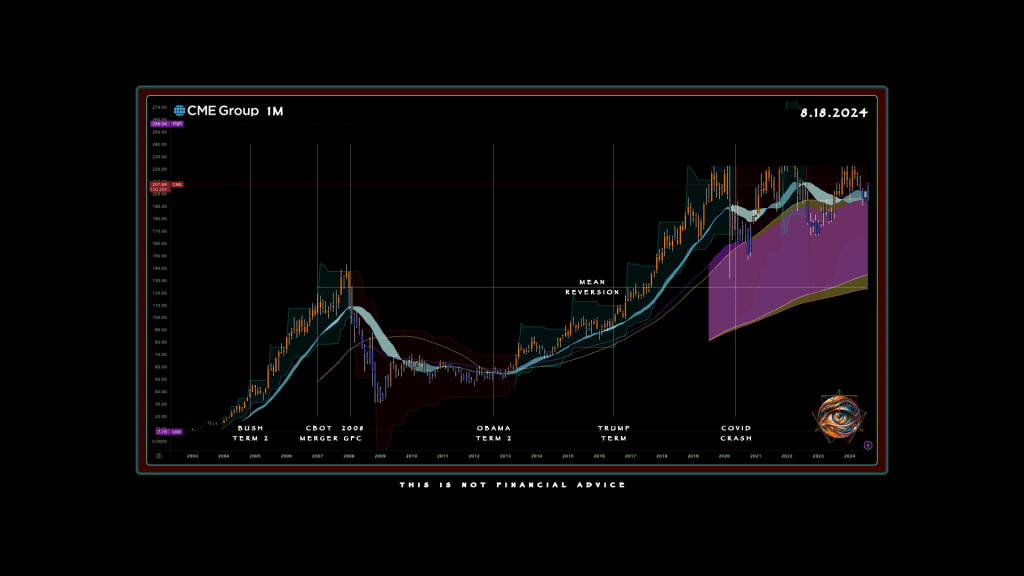
Protests against Mayor Johnson’s policies seemingly echo the Israelites’ cries in the wilderness — voices rising in desperation as they confront a leadership either unwilling or unable to guide them to safety. The CME, though largely insulated from the daily turmoil, is not untouched by the direction the city’s leadership takes. My lower timeframe chart-work suggests that decisions made in the coming months will determine the future of the exchange and, in turn, of Chicago itself.
As traders are wont to say, “Show me the chart and I’ll tell you the news!”
The parallels between 1968 and today are striking, with the critical difference being the stakes’ unprecedented hight. While in 1968 the battle was for the ideals of a nation, today it is for the city’s very survival. The CME, while not on the frontline of the battle, per se, remains a key player, its fate tied to that of its namesake host. Decisions made by the city’s leaders in the coming months will doubtlessly determine whether Chicago can pull back from the brink, or if it joins the ranks of history’s fallen city-states.
Verily, the departure of the CME would be a major economic blow. As one of the world’s largest financial exchanges, it is a massive employer and contributor to Chicago’s economy. Any actual relocation will lead to job losses, not just directly from CME but from related financial services firms and support industries. The speculative impacts of a CME relocation to Texas would also include further erosion of tax revenues for both Chicago and Illinois in favor of the new host state, while cementing the latter’s growing reputation as a business-friendly financial hub.
While Texas Governor Greg Abbott has expressed bemused interest in CME Group relocating to Texas — who wouldn’t, right? — note that as of now, this angle is purely speculative. The CME has not announced any plans to move, officially or unofficially. Although my charts of CME Group’s stock price indicate trend exhaustion and a potential mean reversion, any actual relocation in the real world would be a complex, multi-year process involving many stakeholders, as well as careful consideration of the impacts on the company and the broader financial markets.
The future of Chicago, like that of the CME, hangs in the balance. The choices made in the coming weeks will determine whether the city, and indeed the region, can reclaim its status as a beacon of American ingenuity and resilience, or whether it will fade into obscurity, a relic of a bygone era. The CME, the last great pillar of a once-mighty edifice, may yet stand firm — but only if the citizens find the courage to support leaders who challenge them instead of promising easier living. Chicago’s ultimate fate remains uncertain, but its unwritten future is rapidly shrinking and sooner than later we will know which way the wind blows.
Money laundering is the process by which criminal actors disguise the illicit origin of funds in order to funnel them into the legitimate banking system, increasing transferability and flexibility while reducing the risk of prosecution, seizure, or theft from other criminals. As financial infrastructure evolves and regulations tighten, the elusive figures behind money laundering operations continually adapt and innovate to stay ahead. However, throughout the processes and schemes engineered by Professional Money Launderers (PMLs), Open-Source Intelligence (OSINT) investigators can still uncover suspicious transactions, relationships, and other indicators of illicit behavior.
The secretive world of money laundering employs a variety of mechanisms and networks to conceal the spoils of criminal actors. This brief analysis of PMLs describes the methods they use to thrive as well as key tools and approaches to expose and stop them. Although money laundering schemes are often complicated, they always involve a Logos of three core inputs, or sources:
PLACEMENT – money obtained through criminal activity is moved into the legitimate financial system.
LAYERING – the origin of the money is disguised by moving it between multiple accounts.
INTEGRATION – the money is redelivered to the criminal in such a way that it appears legitimate.
In much the same way that traditional businesses rely on accountants, Organized Crime Groups (OCGs) rely on third-party professionals to handle their illicit funds. As a service, PMLs launder the proceeds of their crimes for a commission or fee. Criminals, whether working solo or in union, may rely on PMLs either due to a lack of in-house expertise or to put distance between themselves and their funds.
Apathetic to, or deliberately ignorant of, the origin of the funds, PMLs tend to launder money through multiple jurisdictions on behalf of their “elite clientele”, being anyone with the motive and sufficient funds. To do so, PMLs rely on their own specialized knowledge and expertise to exploit legal loopholes, and they find other opportunities and venues for diversification as well, ultimately to preserve the proceeds from illegal enterprises and legitimize them for use in legal ones.
The many and varied techniques of laundering illicit funds have made it difficult, historically, for investigators to follow their movement, and therefore to prosecute offenders. Investigating money laundering poses puzzles and problems to “white hats” across such industries as law enforcement, government, and traditional finance (“trad-fi”) . To successfully disrupt laundering operations, they require the technical tools to get the right intelligence to ensure that they understand how money flows, and the legal tools to take timely enforcement action.
The number of people who effectively understand the first tool-set is small, the number who understand the second set is arguably smaller (especially when you factor in corruption, see below), and their cross-section is almost nonexistent, given the speed at which the competition innovates.
PMLs (be they black, grey … or off-white) market themselves almost exclusively through word of mouth and utilize shadow accounting systems that contain detailed records with code names. PMLs may work on their own, or as part of a Professional Money Laundering Network (PMLN). Moving up the food chain, a consortium of such networks is known as a Professional Money Laundering Organization (PMLO), which you can expect to see at the transnational level.
A detailed example is given in the piquant anecdotes in my video Currency Racketeering & The Bullish Case for CBDCs, adapted from “Shantaram” by Gregory David Roberts . Although it’s highly stylized, like all my videos, it is nevertheless worth watching for serious students of transnational capital flow via black markets and/or fans of “Monkey Thieves”. For whatever reason, it’s banned in India, despite falling under YouTube’s Fair Use clauses.
PMLs use whatever mechanisms, organizations, and networks they require to move funds, usually during the placement and layering stages of the laundering cycle. These include transport, “Mules”, virtual currencies and proxies. Tracking capital flow through these mechanisms, however, is a resource-intensive effort. In recent years, heavy investment by investigators in AI and ML-driven tools aims to alleviate manual burdens by automating many of the key steps.
TRANSPORT
Money transport and cash controller networks assist criminals that generate substantial amounts of cash. These controller networks receive and transfer illicit funds internationally while charging a processing fee. Cash controllers substitute illicit proceeds for legitimate goods through an account settlement system for many OCGs.
Cash controller networks orchestrate the laundering of the proceeds of crime for multiple OCGs, with unwitting customers’ bank accounts being used to swap illicit funds for their legal funds. Alternatively, funds may be transferred in physical cash and channeled into the financial system through the purchase of goods like second-hand vehicles, spare parts, and equipment. When working internationally, accounting settlement systems may be used to balance money amongst several customers and keep money in the same jurisdiction to avoid riskier cross-border transfers.
MULES
PMLs recruit networks of money “Mules”. These individuals are paid to transfer money through their personal bank accounts and wire it to other accounts. Mules are typically recruited unknowingly through job advertisements for positions like “transaction managers,” or knowingly through social media under the guise of get-rich-quick schemes. PMLs may manage their Mule network themselves or employ a manager, known as a “Herder”.
When dealing with physical cash, Mules are frequently recruited from underserved communities or countries with struggling economies. They are incentivized with cash payments and free travel. Besides my video on the Indian Rupee, the Gold Mafia docuseries produced by Al Jazeera in 2023 is another excellent deep dive into the human sea of operatives and physical incentives.
On the other hand, when washing money digitally, herders seek Mules who appear legitimate, such as students and young employees with established bank accounts. While a single Mule transferring a small amount of funds may appear to be a low-level offender, OCGs can tap into networks of hundreds of them to move significant sums of cash. The bank scene in Denis Villeneuve’s 2015 film “Sicario” briefly features a high-level Mule-hunt, beyond the scope of any OSINT investigator but narratively useful to understanding the potential scope and scale. Mule networks have even been known to establish companies that appear as legitimate businesses but exist only to employ at scale, as well as to facilitate the sale of illicit goods through online stores.
VIRTUAL CURRENCY
With many criminals looking to cryptocurrencies for “work-arounds”, PMLs also create “off-ramps” that enable them to cash out their proceeds into fiat currency. The latter are those issued by governments (literally “by decree”) that is not supported by any tangible asset (i.e. gold), including the euro, the British pound, and the US dollar. While cryptocurrency, by contrast, has been a Wild West so far, the long arm of the law is coming to town.
PMLs transfer essentially virtual currencies through a chain of so-called “digital wallets” for layering. The funds may be split up during transfer, mixed with other illicit funds, and sometimes legitimate funds, too, to hide the trail. With the digital trail masked, funds can be sent to their final digital wallet destination, liquidated, and transferred to exchanges and banks to be withdrawn in cash. The bank accounts used commonly belong to recruited Mules who then redistribute the funds among various criminals.
PROXIES
Some PMLs utilize proxy networks, a banking service that relies on multi-layered transfers to obfuscate the trail of the financial flows heading to their final destination. Proxy networks develop multiple layers of shell companies in many jurisdictions, which exist purely to redistribute and mix funds from a myriad of sources in order to make a client’s funds untraceable. PMLs identify loopholes and other possible purposes for payments that provide a veneer of legitimacy to the transactions.
During the proxy network processes, funds are transferred to accounts opened in the name of shell companies, often using legal entities. If the illicit proceeds were cash, controllers deposit it into the shell companies’ accounts. Such funds are then moved through a complex chain of accounts and mixed with other clients’ funds. From there, they are transferred under fictitious contracts, loan agreements, consultancy services, or investments to other companies controlled by the PML. Finally, the funds are returned to accounts controlled by the PML’s clients, or else goods and services are otherwise purchased on their behalf.
PMLs not only manage funds, many also facilitate large-scale tax evasion schemes, leveraging several layers of shell companies between the importer and the producer of goods. At the final stage, funds are transferred to corporate bank cards, followed by subsequent cash withdrawals. The number of shell companies and personal bank accounts involved may exceed several thousand, limiting detection and diversifying possible losses.
It is estimated that roughly $2 trillion US dollars are laundered every year and that institutions spend hundreds of billions each year on financial-crime compliance and investigations. To make an impact on money laundering at scale, investigators, whether in government, journalism or private practice increasingly leverage automated tools to investigate those with suspected links to illicit funds.
Perhaps the greatest challenge to those affected by finance-sector OCGs, namely the legitimate daily users of a currency, are the lawmakers themselves, many of whom have not only the motive and the opportunity, but even unique means of malfeasance.
While corruption is beyond the scope of money laundering techniques, per se, a number of the tools in use by law enforcement are becoming more widely available to investigative journalists, with and without accredited degrees. One notable example is The Pandora Papers , the 2021 leak of almost 12 million documents by the International Consortium of Investigative Journalists (ICIJ). The details, worthy of a look as they may be, more generally indicate that governments will always need oversight from nongovernment actors.
THE OSINT ANGLE
Money laundering is an ever-pervasive plague upon governments and other financial institutions, internally and externally, across the globe. Besides the vast human networks involved in money laundering, the overwhelming transaction volumes make manual investigation techniques unfeasible. They can no longer keep pace with the velocity and scale of bad actors. The emergence of AI/ML-driven automated OSINT solutions, however, opens new doors, providing investigation teams with the platform tools they need to detect and disrupt money laundering activities in real time.
One way is to incorporate automated fraud and risk signaling solutions that assess public data in individuals’ and businesses’ digital footprints. By building this functionality into existing systems via an Application Programming Interface (API), investigators are identifying patterns and anomalies that otherwise go unnoticed by legacy methods.
The automated pattern-recognition abilities of Large Language Models (LLMs) and other cybersecurity-related tools make it possible to comb through a vast array of public data, such as consumer records and social media, and to quickly generate comprehensive, court-ready reports on high-risk individuals and businesses.
Investigators are no longer constrained by labor-intensive research involving internet searches for data like business filings or social media content. Instead, they can target the most relevant information, allowing them to reach more informed conclusions much faster. The elimination of manual processes enables investigators to optimize their inquiries and to concentrate on detecting the leading indicators of money laundering.
Give me your sneaky, your sly, Your huddled masses yearning to pay no taxes, The artful dodgers of Justice’s watchful eye.
Send these, the undocumented, tracks redacted to me. I wink my lamp beside the hidden door.
Here, in the shadows where the wild cards play, Where identities shift like desert sand, They stand, a nation of the no-work visa, Bribing patrol squads with a silent, swift hand.
“[redacted],” they whisper, ‘twixt fence-links woven tight, Nurtured by the watchful drones that by night do creep.
Seeking shadows in the vast and starry night, They dream of lands where they can safely sleep,
While, beyond crumbling alleyways, the statue of [redacted], Mere survival is a game played with corruption and luck.
Here, they navigate the new urban kingdom. On crooked streets leading nowhere they run, yet often amuck.
So come, ye crafty, to this land so broad, so wide, Where the brave may hide, and in hiding, forget to rise.
Here they stand in a shadowed, shifting tide, Till dawn or justice find them, and they meet their compromise.
“Who is the rebel against law and order, the legislator ordaining or the citizen resisting unconstitutional measures? It is the unprincipled minister who artfully innovates on the custom of governing, the ambitious senator whose self is his God, the faithless magistrate who tramples on rights which he has sworn to protect. These are the men who by perverting the purposes of government destroy its foundation, bring back society into a state of war, and are answerable for its mischievous effects.”
– William Emerson, Sermon, 1802
Nullification is the inherent duty of individuals to invalidate and resist any and every government action shown to be unconstitutional or unjust. This principle is rooted in the belief that all government power derives from the consent of the governed; therefore, when a government oversteps its mandate, individuals retain their sovereignty to act as checks on its authority.
Historically, the idea has been championed by US Presidents Thomas Jefferson and James Madison, for nullification emphasizes that the Constitution represents a compact among the people, any breach of which by the government warrants the rightful resistance of its citizens to protect their intrinsic freedom and its sovereign rights.
This fundamentally American doctrine asserts that the Constitution is NOT an instrument for the government to restrain the people, but one for the people to restrain their government, literally an insurance policy against the hazard that it may unjustly harm or endanger them.
The duty to resist usurpation of power by anyone, in any office, is painfully relevant today, and not because of any election season. We see it on display across several contemporary movements, in varying degrees, as more and more individuals are separately forced to resist overreach.
Consider the array of government misconduct regarding gun control, land management, medical mandates, surveillance and, of course, whistle-blowers.
Tragically, individuals who work in local, state and federal offices inevitably attempt to expand their scope and power. Since, however, nongovernmental civilians hold ultimate sovereignty, it is also necessarily their own inseparable responsibility to nullify unconstitutional actions as the crucial maintenance of their freedom.
If they ignore this, or shrink from it, whether through laziness or fear, then they risk harming many more than just themselves.
The doctrine that arbitrary power must be resisted is the driving force behind individual acts of defiance, both against unjust laws (i.e. those beyond the consent of the governed) and/or those unjustly applied (i.e. lawfare). Notably, individuals across various states have refused to comply with federal gun control measures, asserting their duty to self-defense and its protection under the Second Amendment. This form of resistance is not only a right but a vital obligation to prevent the erosion of fundamental freedoms that are easily lost and only regained at great cost, if ever.
Similarly, resistance to federal healthcare mandates, including the Affordable Care Act, has seen individuals and groups challenge its provisions through legal and grassroots means, emphasizing their duty to safeguard medical autonomy over bureaucrats’ attempts to usurp it.
Moreover, the concept of jury nullification, where jurors acquit defendants despite evidence of legal guilt because they believe the law itself is unjust, underscores the enduring belief in individual duty to resist government actions that overstep constitutional boundaries. This practice allows individuals to directly impact the enforcement of laws they consider oppressive, embodying the principle that upholding justice may sometimes require defying statutory decrees.
The relevance of nullification today underscores a persistent distrust in centralized power and a reaffirmation of individual rights and duties. As local, state and federal government officers openly attempt to usurp power, this principle is a reminder of the necessity for checks and balances, ensuring that power remains ultimately with you, who are otherwise unaffiliated with your government. This enduring principle from the American Revolution continues to inform and inspire modern resistance to government overreach, a living safeguard of individual liberty against institutional (i.e. inhuman) and inhumane threats.
The duty to resist is deeply embedded in the philosophical underpinnings of the American legal tradition. The writings of Thomas Jefferson, James Madison, and other founding figures emphasize that when a government becomes destructive of the ends for which it was established — namely, to secure the unalienable rights of life, liberty, and the pursuit of happiness — it is not just the right but the duty of the people to alter or abolish it. This is not a call for anarchy, but for a vigilant citizenry that holds its administrators accountable as such.
If you survey contemporary society, you will see nullification practiced by those few individuals with the courage to stand up against any laws and regulations that demonstrably infringe on our constitutionally protected rights. From whistleblowers exposing the misconduct of government officials (of any branch or rank) to activists challenging unjust laws, the spirit of nullification is alive, though arguably unwell. Indeed, the fewer individuals volunteer for this duty, the greater the cost and risk they are forced to bear.
Nowhere is this more obvious than in the normalization of criminal plea bargaining, which is almost always evidence that the State has no case … if it could win in a jury trial, then why would it not seek convictions without offering deals instead?
Ultimately, nullification is a suspiciously fragile aspect of American jurisprudence, emphasizing that individuals are the last line of defense of their own freedom. By resisting unconstitutional laws and government actions themselves, they uphold the foundational principles of liberty and justice, ensuring that government remains a servant of the people, not their master.
Habitual critical thinking about law and procedure, as far as self-representation in court, if necessary, uniquely empowers individuals to take control of their own legal matters and to most effectively protect human rights, including their own.
“Let us remember that if we suffer tamely a lawless attack upon our liberty, we encourage it and involve others in our doom.” – Samuel Adams, Boston Gazette, October 1771
In the postmodern “El Dorado,” of the 2020s, where gold isn’t just a shiny metal but the lifeblood of a shadow economy, Al Jazeera’s Investigative Unit has done what governments can’t — or won’t — do: expose the dirty dealings that turn gold into the universal laundromat for the world’s filthiest money.
Through thousands of confidential documents and exclusive interviews with whistleblowers from within the criminal organisations, investigators obtain the blueprints of billion-dollar money laundering operations that service the political elite. And the investigation leads to the highest offices of southern Africa.
The four-part series, “Gold Mafia,” delves deep into the underbelly of the gold trade, revealing the sinister symbiosis between criminals and the political elite. “Gold Mafia” isn’t just a docuseries; it’s a revelation of how deep the rot goes in the global gold trade. It exposes a world where wealth and power are intertwined with crime, and where the line between politician and gangster is razor-thin.
Watch the full series and prepare to see gold in a whole new light:
Imagine waltzing into a secret meeting with a suitcase full of dirty money, knowing the guy across the table has a diplomatic passport and a get-out-of-jail-free card. Watch as undercover operatives pose as gangsters with a billion-dollar problem — black money that needs a deep clean. Enter the Gold Mafia, who offer their unique services with the Reserve Bank of Zimbabwe acting as the world’s biggest washing machine. Forget Swiss banks; the real action is in Zimbabwe, where government officials moonlight as money launderers. It’s like watching the worst kind of magic show, where the trick isn’t pulling a rabbit out of a hat but making millions disappear and reappear as shiny, untouchable gold.
Episode 2 – Smoke & Mirrors
Premiere Date: March 30, 2023
Meet Mo Dollars, South Africa’s answer to Houdini, who turns illicit cigarette profits into gold. The trick? A labyrinth of shelf companies and fake invoices that make Enron look like a kid’s lemonade stand. When the Gold Mafia’s operation outgrows its back-alley roots, they go corporate, infiltrating banks and government departments. The undercover team strikes a deal with a rival mafia promising access to Zimbabwe’s executive power, proving once again that in this game, it’s not about what you know, but who you can buy.
Episode 3 – El Dorado
Premiere Date: April 6, 2023
Dubai—the glittering oasis where dirty gold goes to get clean. Here, the Gold Mafia’s HQ operates like a high-stakes boardroom where diplomats broker billion-dollar deals. Ambassador Uebert Angel plays the role of the slick middleman, arranging a meeting between our undercover team and Zimbabwe’s President Mnangagwa. The catch? A hefty bribe to sweeten the deal. The message is clear: in the world of gold laundering, every door opens if you have enough cash.
Episode 4 – Have The King With You
Premiere Date: April 14, 2023
The final act brings a Shakespearean twist as the noose tightens around South Africa’s top money launderers. Betrayal, threats, and paranoia run rampant. The undercover operatives face the ultimate test as the Gold Mafia boss warns of deadly consequences for those who break their code of silence. With political connections as their shield, the Gold Mafia bosses continue to lure in business, promising safety and security under the wings of the continent’s leaders. As one mafia boss ominously advises, “When you work, you must always have the king with you. The president.”
Once upon a time, in the shining City on the Hill, a silent Shadow ever so slowly emerged — at first strangling all mirth as it gradually engulfed every edifice and every corner — until at last it boldly threatened to extinguish even the People. It did not ride in resplendent on a pale horse to reap them outright; instead, like a virus it seeped through their screens, a toxic leak latching onto the ever-suggestible and unsuspecting host-minds of their most ardent keyboard warriors. Eventually, historians gave it a name: Cancel Culture.
Imagine being the underdog in a neighborhood boxing ring, challenging a global bully who’s come to your town to seize control of the schools and the hospitals … and the banks. In the red corner, you have government agencies, armed with their regulatory hammers and fiscal carrots. In the blue corner, the tech giants and their army of algorithms stand ready to shadowban your free speech into oblivion. The green corner features academic institutions and NGOs — high priestesses of the postmodern orthodoxy — chanting their incantations of “safety” and “order” while sharpening the knives of censorship.
The stakes are high in this twisted circus … and your opponent?
The more observant among you already recognize the Censorship Industrial Complex, a three-headed hydra spewing control, compliance, and conformity. This unholy trinity of government, corporate, and academic power is Hell Bent for Leather on curating your thoughts and conversations. The rest of you merely sense, involuntarily, that something is lost, never to return.
Could the near future possibly get any more dire?
Before you rush to answer that we can’t get any farther up Shit Creek, don’t forget the yellow corner. Your family and, worse, your family’s family, wields the most insidious weapons of all. As always, the weaker members of a society en masse attacking its stronger members is a leading indicator that it will not survive, and that its population is in mortal peril. The historical precedents of families actively betraying each other in tense times are unsettling, to put it mildly. Such is the domestic vector of how civil rights lead to civil wars and, worse, to cultural revolutions.
Government Agencies: The Surveillance State’s Puppet Masters
Like Erin Brockovich stepping into a town long poisoned by hidden contaminants, picture yourself waking from the American Dream only to find yourself desperate, depressed and clueless. As you ween yourself of the poisons of your private life, you come to find that the true source of the malaise is a pervasive web of public power pushing not only your most sensitive buttons, but others’, too.
Amid the mental fog, government agencies cloak their surveillance operations in the guise of national security and public safety — precisely in order to ensure the opposite, for without a crisis their mandate is obsolete. Thus, by manufacturing evergreen crises, they hope to position themselves as the sole solution bringers. However, the only thing shrinking faster than their ability to monopolize mass media is their actual influence on events.
Although webs are a legitimately messy waste of time, your most precious resource, the actual threat is their maker. Below is an utterly incomplete list of relevant government agencies. For a longer list, you have only to pull on any of these sticky strands and your curiosity will propagate outward to alert the others to your presence … and possibly even acquaint you with the Spider.
Begin your descent with:
Department of Homeland Security (DHS): This creature was hatched in the immediate aftermath of 9-11, as if in anticipation of the 2020s. Since 2018, its newest wing, the Cybersecurity and Infrastructure Security Agency (CISA) has been tasked with understanding, managing, and reducing risks to essential systems. In 2021, CISA assumed control of the .gov top-level domain (TLD) from the General Services Administration, allowing the agency to manage the approval of .gov domains and operate the TLD Domain Name System nameservers. In this era of misinformation, disinformation, and malinformation, CISA also partners with social media companies to develop and promote accurate, “authoritative” information, particularly during elections.
National Science Foundation (NSF): NSF investments have given the world Doppler radar, bar codes, the modern Internet, web browsers, MRI, laser eye surgery, DNA analysis and synthetic biology. Many new technologies, like generative artificial intelligence and wearable sensors, present both risks and opportunities for cybersecurity. The NSF supports the full range of critical and emerging technologies, including the key focal areas of the “CHIPS and Science Act of 2022.” However, cybersecurity requires more than merely strengthening infrastructure. Thus, in order to rapidly transform NSF-funded research done across the U.S. into impactful products, services and solutions, the agency created its first new directorate this century — Technology, Innovation and Partnerships.
State Department: As it strives to appear as the global peacemaker, the State Department pours resources into tools designed to stifle dissent abroad while promoting democracy with the same doublethink that Ms. Brockovich encountered from corporate lawyers spinning toxic sludge into harmless silt. Unless it plans to bribe you or otherwise undermine your sovereignty, the Sunday morning talk-show circuit is as close as you will likely come to hearing from its mouthpieces, which would only be yet another waste of your precious time.
Department of Justice (DOJ) and Local Law Enforcement (DAs & Judges): The DOJ’s increasing involvement in online discourse crafts legal arguments to suppress inconvenient truths under the guise of public safety. In fact, it’s this very wing of the Beast that has recently turned “lawfare” into a household word. Local law enforcement agencies and judicial officers play pivotal parts in these censorship practices. Again, just as Erin Brockovich’s experiences with local judges convinced her to see through the corporate smokescreen and smell the bullshit, if your luck is merely normal, then your turn to do likewise is coming, if it hasn’t already.
The Faceblock/MeTube and LinkedOut/ChubStack Consortia: The “Mean Girls” of the Digital Playground
Social media companies today deploy oodles of algorithms buttressed by battalions of barely human moderators whose day-job it is to shadowban, de-platform and censor those pesky dissenting voices (including yours?) for the sake of “community” standards. Is this plot becoming a bit too familiar, or maybe even annoyingly predictable?
How much do you use and/or depend on the following:
Facebook, 𝕏, YouTube (i.e. Alphabet): These platforms are the modern-day gatekeepers of public discourse. Their opaque algorithms and human moderators enforce the ever-shifting community standards, conveniently aligned with “the Message”. The less you pay to use these platforms, the more you are the product. The more you rely on them to monetize your voice, the less the words will be your own.
LinkedIn, Substack, et al.: LinkedIn is more than just a professional networking site; it’s a platform where discussions on controversial topics are closely monitored and moderated. The annoying echo of tightly controlled corporate communications reminiscent of “Erin Brockovich”, “Michael Clayton”and/or “The Insider” is proof that you are in an echo chamber. Lacking the pretense of professionalism that LinkedIn once had, Substack is no better. Literally anyone can anonymously get you banned from these sites, and have your profile (with potentially years of attached work) removed. What you come to find is a slew of writers promising the moon and stars behind a subscription paywall.
Ask yourself: would you pay YouTube content creators monthly to watch more than the first two minutes of their videos? If not, then the Substack business model is little more than the one-way mirror in an interrogation room, where everything you say can and will be used against you. Admittedly, exceptions exist (here, there and everywhere), but the overwhelming majority of writers are mere opinion jockeys without any technical edge.
Other, smaller tech firms, eager to prove their loyalty to the powerful, are also busy pumping their stock price by developing new tools to sniff out, and snuff out, anything that smells like dissent. Like Ms. Brockovich’s foes, who hid behind corporate obfuscation and legalese, yours have a counter for every objection that you can think (or dare) to raise, and a louder voice, too. There is still a way to fight the good fight, but your tactics must adapt to a world that barely remembers the movie-version of her 20th century exploits, now more than a generation ago.
Universities and Think Tanks: Postmodern Praetorian Guards
Academia and think tanks have, for aeons, been the intellectual vanguards in the gradual war against freedom of speech. Nowadays, these ivory towers provide a patina of pedigree that almost make the Censorship Industrial Complex look respectable on those aged-out late-night comedy shows.
Stanford Internet Observatory: These digital hall monitors collaborate with social media giants to craft strategies for detecting and neutralizing “harmful” content, echoing the experts Ms. Brockovich exposed for their corporate-funded biases.
Atlantic Council’s Digital Forensic Research Lab: This think tank operates like a detective agency that dissects designated disinformation campaigns in the digital engagement space, including those related to the Russia-Ukraine conflict, Chinese expansion strategies, and regional disinformation in places like West Africa and Sudan. By building a network of forensic analysts known as DigitalSherlocks, DFRLab tracks events in governance, technology, and security in order to create a new model of expertise adapted for real-world impact.
World Economic Forum (WEF): The WEF champions global initiatives to regulate online content, promoting policies that blur the lines between protecting public interest and imposing restrictive controls on speech.
Council on Foreign Relations (CFR): Dubbed the “Mothership”, the CFR engages in extensive research and policy recommendations on managing information in the digital age, supporting efforts to combat the free flow of information.
Universities: It is well-known by now, via Noam Chomsky of the Massachusetts Institute of Technology (MIT) and others, that universities are the ovens where the wedding cake of Manufactured Consent is baked. However, even most of the more informed worker bees around the water cooler are unaware of institutions like Syracuse University, or the New School. These hubs for interdisciplinary “research” into misinformation are quietly funded to develop tools for squashing dissent, which goes beyond mere “study” by any stretch.
NGOs: Virtue Signalers of the Social Justice War
In her namesake movie, Erin’s moral compass drives her to fight against corporate Goliaths. In a sly reversal that has duped the mainstream, though, various NGOs today similarly justify a overtly matriarchal censorship agenda. They frame themselves as concerned mother hens, f course, and their cause as a noble crusade to protect society from its own harmful content. Your freedom is merely a line-item expense them.
Electronic Frontier Foundation (EFF): Traditionally a defender of free speech, the EFF now walks a tightrope, endorsing moderation efforts that easily tip into censorship, compromising with powerful interests against the need for public support.
Global Disinformation Index (GDI) and NewsGuard: These watchdogs label and blacklist “misinformation,” guiding advertisers away from non-compliant media outlets, wielding economic power as a censor’s tool, applying financial pressure where needed.
Cyber Threat Intelligence League (CTIL): This group collaborates with government agencies to craft sophisticated moderation frameworks and algorithms, ensuring no “harmful” thought slips through the digital net.
Freedom House: International NGOs that advocate for democracy and political freedom, like their government counterpart the NED, necessarily support policies aligned with censorship, as always under the guise of combating misinformation. Freedom House is no exception, however its name itself is an instance of malinformation, making it worthy of consideration.
This list is incomplete, of course. To extend it, simply subject yourself to (ideally the end of) “informative” programs on public broadcasting (NPR, et. al.) and listen for the list of donors. Civilians can hold these organizations accountable for their influence on public discourse and protect truly free speech only by insisting on it in practice themselves.
Punditry: The Image of Influence
Just as Erin Brockovich faced off against powerful individuals in her fight for justice, there are key figures today who shape and defend the Censorship Industrial Complex, wielding significant influence over public discourse.
Renee DiResta: A pivotal figure in content moderation debates, Ms. DiResta numbers among the coven of high priestesses of digital censorship, advocating for ever stricter controls over online content. Perfectly aligned with her private counterparts’ consensus, she calls misinformation her foe and bridges the gap between academia and government, cementing her role as an influencer in the digital arena.
Rachel Maddow, The View, CNN, etc.: Media personalities and outlets like Rachel Maddow, The View, and CNN often play dual roles in this complex. They have so successfully replaced the Fourth Estate that nowadays many modern folks have never even heard of it. On one hand, they vehemently report on instances of censorship and free speech issues, while on the other, they support censorship efforts that align with their editorial stance even more vehemently. Thus, and not by any accident, they contribute to the suppression of dissenting viewpoints while effectively widening other cultural rifts (health, gender, etc.) in the process.
Iconoclasts: It is increasingly fair to think that targets for cancelation have more newsworthy content to report than most other sources, at least if you prefer to get your news from the frontline and not from analysts severed from events, or from pundits twice removed. Individuals as diverse as Andrew Napolitano and Tucker Carlson, or Bret Weinstein and James Corbett have consistently criticized the growing influence of the Censorship Industrial Complex. Their work and many others’, in its various forms, continues to shed light on the dangers of conflating misinformation with legitimate dissent. Can you see what they have in common, despite their obvious differences and/or their influence on public discourse? It is the most reliable filter to critically engage with and to support those who risk it all to defend free speech.
Industrial Scale Tactics
The Censorship Industrial Complex employs an obscene variety of tactics to maintain its stranglehold on public discourse, blending technology and human oversight in a seamless and unseemly web of control.
ALGORITHMIC MODERATION: Social media platforms deploy sophisticated algorithms to automatically flag and remove content that violates their guidelines. These digital overseers scan for forbidden keywords and phrases, operating with the loveless, insect-like efficiency of a Kafkaesque patent clerk in an Orwellian nightmare.
HUMAN REVIEW: When algorithms aren’t enough, human moderators step in to assess flagged content. Not your average Rockwell soda slinger, this stultifying human touch adds a veneer of fairness to the narrative’s’ tight leash. The underlying agenda remains the same, and if you just shut up about it already, then we can all get back to work, OK?
PUBLIC PRIVATE PARTNERSHIPS: Programs like CISA foster maternally close collaboration between government agencies and private companies, creating a seamless interface for monitoring and controlling online discourse. These partnerships ensure that resources and expertise flow freely between the public and private sectors.
FUNDING & GRANTS: Government agencies bankroll research and development efforts, guiding a steady stream of innovations to enhance content moderation. This financial backing keeps the wheels of censorship turning smoothly, quietly, and in one direction. Most citizens lack basic financial literacy (i.e. what is money?), and are certainly not “allowed” to know that, thanks to trickle-up economics, they are funding their own suppression.
INFLUENCE PEDDLING: During the recent pandemic, for example, any content questioning the official narratives first on personal protective equipment (PPE) and later on vaccines was swiftly targeted for suppression. Organizations like CTIL used tools like Zetalytics to track and counteract skepticism, painting dissenters as threats to public health.
CANCEL CULTURE: Content critical of government actions, especially if it transcends mere complaint to express alternative political views, is singled out for suppression. These nefarious practices raise grave concerns about the government’s basic mandate amid the erosion of democratic discourse, since dissent is fundamentally a risky act of service that should be protected.
By understanding these ways and means, you can develop strategies first to protect yourself (and your family) and then to challenge unjust censorship practices for the sake of those not yet able to do so for themselves.
The Matrix of Public and Political Pushback
The Censorship Industrial Complex has (finally!) sparked a fierce debate, drawing criticism and support from various quarters. Knowledge and direct action — advocating for transparency and accountability — are the thorny uphill pathway to freedom. Alternatively, you can elect to do the bare minimum, or nothing at all.
Free Speech: Critics argue that the complex’s activities pose a severe threat to free speech, a fundamental pillar of democracy. To suppress dissenting views undermines not only the principles of respectful discourse but, worse, the intellectual freedom necessary to ensure that the best ideas rise to the top in a meritocracy.
Political Manipulation: The growing and reasonable fear that content moderation is being used as a political tool to silence opposition and shape public opinion is only proven by the fact that “lawfare” is now in the mainstream vocabulary. The involvement of government entities in content moderation raises profound legal and ethical questions, particularly regarding the imbalance between the survival of the Deep State (another mainstream term that used to be esoteric), the threats to public safety and the all-important and all-but-forgotten individual rights.
Government Influence: In order to circumnavigate constitutional protections, government agencies blur the line between private action and state censorship. They exert soft pressure on private companies to censor unwanted content on their behalf, effectively bending the law without breaking it.
Legal Scrutiny: Revelations from sources like the “Twitter Files” have led to legal challenges and public outcry, highlighting the murky waters of government-influenced censorship. Meanwhile, recent headlines of presidents and/or their sons becoming felons further erode confidence in the wisdom of the judiciary or the reliability of it procedures.
Transparency: The growing demand for greater transparency in content moderation decisions, including the criteria used and the extent of government involvement, is met first with indifference, then with silence. What comes next is up to whomever takes up the cause.
Accountability: Ensuring fair and consistent content moderation requires robust accountability mechanisms, including but not limited to independent oversight and avenues for appeal. Do not expect any of this to be done for you, nor to exist in future generations if you do not secure it yourself.
Summation: The Cost of Silence
As we witness the systematic manipulation of public opinion, with its collateral erasure of dissenting voices, it’s crucial to become critically aware and increasingly vigilant, and possibly even to upskill for mere survival. The complex web of government agencies, tech giants, academic institutions, and NGOs forms a formidable network that threatens to undermine the very foundations of freedom, and indeed civilization itself. Cancel culture, its most modern manifestation, discourages open dialogue and critical thinking. Instead, it fosters conformity and suppresses the diversity of thought essential for an informed citizenry.
Does that look like a future that you want for your grandchildren, or for theirs?
If not, than it’s imperative that you, yes you, recognize this regime and advocate for transparency, accountability, and the protection of free speech, even if such actions imperil you personally. When the peril finds you, remember to take another look at that yellow corner (family and in-laws), and check for weapons. If you participate in this digital society, then your awareness and engagement are paramount. Only you, not the State, can secure a more informed and resilient society, able to withstand the pressures of censorship and protect its fundamental freedoms, and only by becoming a member of one.
Roll over Ronnie, Hollywood has a new would-be Pretender to the Throne. The most recent episodes of the geopolitical s(h)itcom have featured the Clooney Foundation for Justice (CFJ) taking the stage. Its celebrity frontman aims to slither into the United States’ ongoing (losing) information war against Russia over its evolving Special Military Operation in Ukraine. Yet the real world is no TV courtroom melodrama; it’s 6D chess with international law and media narratives as pawns. George and his Foundation seemingly fancy themselves its Dark Knights, targeting Russian media personnel through the International Criminal Court (ICC), passively accusing them of inciting genocide.
Its aim? To scare off anyone with the audacity to report for RT and Sputnik!
Picture it, Glitter Gulch’s glitziest geeks and geezers rubbing bony elbows with their political idols, all under the watchful gaze of an unimpressed American public. Downtown LA turned into a staged ritual, featuring President Joe Biden and former President Barack Obama headlining a fundraiser at the Peacock Theater. With George Clooney and Julia Roberts adding a touch of faded stardust, the night was more of a wannabe Oscar gala than a substantive political rally.
In a Hollywood humiliation ritual reminiscent of John Cena’s recent rising cloak and sinking dagger show, Jack Black, costumed as a Tolstoyan Sad Clown, aimed to deliver more comic relief than his host, but was ultimately upstaged by the President’s handler, the other President.
With hardly any advertising and no product to peddle, per se, their unnamed opponent recently set staggering donation records, enough to fund the next Disney megaflop, were he so inclined.
Meanwhile, ticket prices ranged from $250 for the nosebleed seats to a cool half-mil to plant your ass near Joe. The take on the night was estimated at a meager $30 million for his flatlining re-election war chest, a pitiful sum amounting to little more than pocket change considering what the event “cost” to produce. Those who know their way around the ‘hood, of course, also know that the big winners are the boomer era owner/operators of the private, secure street-level parking lots, and the young hustlers lucky enough to work the valet lot at the Peacock’s exit, each a master cash magnet in their own right.
Shhh … it’s all a big write-off anyway.
Inside the theater, sheltered from the real world without, the atmosphere was positively electric, with supporters hanging on every word, as if waiting for the miracle. One starry-eyed attendee, as she made her low-budget entrance, gushed through her surgical mask, “Hearing them talk about the issues is very important.” She elatedly described eavesdropping on scripted discussions of border policies with the Obamas as if it were as mainstream as chatting with her girlfriends over midweek brunch about the latest hair-loss hacks and sex tips for seniors.
Her goateed husband was visibly underwhelmed.
Meanwhile, no big city blockbuster can be complete without its proletariat protest scene, and the City of Angels did not disappoint. Outside, a pro-Palestinian mob, masked and ready for a photo-op, abandoned multiple posts at nearby universities and colleges for the evening to stage its PR sit-in at the Peacock’s mouth.
As they locked their spindly arms in a dramatic display of unity, this bored ape could not help but notice that these lost souls were more concerned about Gaza’s air quality than their own.
Alas, the masks are just a bit of show for the occasion, especially when bathed in direct sunlight. If, that is, you courageously “believe the science” about pathogen destruction in the real world, and/or the benefits of vitamin D. Otherwise, vaxx-up and pack yourself into the next multimedia protest spectacle like a sardine and signal the virtue in your heart for all the cameras and the world to see. After all, Major Grom isn’t streaming in to save anybody.
Hypocrisy, or commitment? Do the dedicated street-performers here deserve acting awards of their own … or will these me-toos, wannabes and runners-up become next season’s washed out castaways, forgotten like so many Black Dahlias? It’s one big Gong Show, and while you don’t get to book the acts, you do get to be the judge.
Allegations and Accusations
Away from the glitz and glamour, the CFJ’s Docket initiative faces significant criticism from Russian officials. Maria Zakharova, the able spokeswoman for the Russian Foreign Ministry, accused it of “hounding” Russian journalists by pushing for secret arrest warrants against them. Ms. Zakharova claimed the foundation’s actions were politically and ethnically motivated, describing them as a “judicial safari” targeting Russian media figures.
She calls this out as nothing less, or more, than an attempt at suppression wrapped in the noble cause of justice. Much like Clooney’s ill-fated portrayals of Batman (yes, plural), this move reeks of a flashy, costly and out-of-touch attempt to be relevant. Outside the echo chamber where it’s produced, it fails to resonate with a multipolar world that has moved on. According to Ms. Zakharova, these are psychological warfare tactics aimed at dividing and weakening Russian media.
The Clooney Foundation’s Lawfare
Anya Neistat, the legal director of the Clooney Foundation’s Docket initiative, spilled the caviar to Voice of America, stating that journalists who refer to the Kyiv regime as Nazis (despite their obvious affiliation with the Azov Battalion, not to mention their tattoos), are in the crosshairs for ICC charges. George now denies that his Foundation intended to seek the arrest of Russian journalists, stating that “someone” had misspoken.
This isn’t about free speech, though, or even mis-speech; it’s about who controls the narrative, for how long, and at what cost.
Ms. Zakharova was quick to make this point, noting George’s history of picking pet causes coincidentally in alignment with American international interests. Do any of this bored ape’s readers remember George’s 2012 handcuffed photo-op over Darfur? He remembers watching it on RT. So, this is merely another chapter in a well-worn playbook — Ocean’s 81, if you will — slick on the surface but lacking a genuine twist.
Recent admissions from The Atlantic, in tandem with those from the Royal United Services Institute (RUSI), that Russia is winning the information war might explain why the collective West, via its “celebrity proxies”, now resorts to this pettiest form of lawfare.
If you can’t win fair and square, why not use the law to attack your enemy? It’s a tried-and-true strategy in the West, especially dear to those on the Left, that aims to ruin lives for the crime of promoting alternative viewpoints on a major global conflict. My family is a victim of this cowardly tactic, as are many families in the post-Covid era.
They want you to be afraid …
Thus, high-profile Russian media figures might become forced to avoid ICC member states to dodge potential arrest. As if in xenophobic harmony, the US State Department just issued stern warnings to all Americans to avoid travel to Russia for any reason, citing every conceivable risk except exposure to the truth of a larger world. The word is out via its proxy mainstream media monolith. Meanwhile, lesser-known international journalists (including podcasters and YouTubers) might not see the risk and continue their work, unaware of the looming threat — pawns in a game they don’t even know they’re playing.
The Clooney Foundation’s Real Agenda
So, given the precedents and the circumstantial evidence, what is the Clooney Foundation really up to? By focusing its lawfare on RT and Sputnik’s foreign employees, and those working in ICC-compliant states, it’s not promoting a free press, that’s for sure. On the contrary, it’s attempting to sanction Russian media with surreal similarity to the economic sanctions waged by the ECB and others.
There’s also likely some level of collusion with the alphabet soup of intelligence agencies, the TLAs of the PTB, as the Foundation hasn’t been transparent about its donors.
By leaning on George’s and Amal’s celebrity status, the bankers and the spooks hope to attract attention and funding, yet the legitimacy of their cause remains murky. Like a naked emperor, the public only sees old George hoping to don Batman’s cowl once more, as if crepuscular star power can somehow distract from a lack of substance, but this crusader’s identity is no guarded secret.
The Problem with Celebrity Activism
The Clooney Foundation’s clumsy attempt to insert itself into geopolitics is emblematic of a larger issue: the increasingly common, yet often misguided, involvement of celebrities in complex political matters. Even generously (i.e. naively) assuming that George, and actors like him, might have good intentions, their superficial understanding of intricate issues and reliance on star power often leads to counterproductive outcomes. It only worked for Ronald Reagan because the public was more credulous, and information was more easily controlled.
The world is moving on from celebrity influencers’ flashy campaigns that prioritize headlines in favor of informed, nuanced engagement, indeed, of genuine solutions to pressing problems that challenge us all.
Rock stars and movie gods, with their vast platforms, can raise awareness, but their influence can not only distort reality, but is expressly intended to do so. They aim to shift public attention in the short term, but lack the genuine expertise and sustained commitment necessary for actually beneficial change. Worse, their involvement overshadows the work of more qualified activists who toil diligently, away from the spotlight and often at great cost to themselves, to effect meaningful progress toward it.
Take, for instance, Robert De Niro’s recent involvement in a Biden/Harris campaign event outside the Manhattan courthouse where former President Donald Trump was on trial.
Bob, alongside former Capitol Police officers Harry Dunn and Michael Fanone, used the event to defame Donald Trump (a crime, incidentally, when done to private citizens), calling him “guilty” (before any verdict, disputed or not, was handed down) and a “clown.” His unscripted, impassioned remarks drew both applause and ire. More appropriately, though, his recent stunt of staring at goats also cost him the National Association of Broadcasters (NAB) Leadership Foundation’s Service to America Award.
We are a very long way indeed from Kansas, that bygone era when the late Marlon Brando declined his Best Actor Oscar in protest of Hollywood’s treatment of the Native American peoples, sending Sacheen Littlefeather to the ceremony to refuse the award on his behalf.
Dank Brandon: The Ironic Evolution of Biden’s Persona
And then there’s Dark Brandon, a meme born of derision and rebranded into a badge of veiled approval. Once a mocking chant from the fringes, “Dark Brandon” has morphed into a symbol of resilience for Biden supporters. He captures the absurdity and the chaos of modern political discourse perfectly, consonant with the SoCal spectacle, palm trees and all, where reality blurs into prenuclear performance art.
Joe, who seems more at home in the role of a statesman among celebrities than in the gritty, actual, political arena of his day job, embraces this ironic godlike heroism.
“Dank” Brandon, though, is the ultimate flex: a concoction of my own making, a chaser to swallow along with the admission that, in the theater of politics, image trumps substance. In case you forget that that’s the way the game is played, remember that the Peacock Theatre is primarily a sports venue. The downtown LA fundraiser is thus another episode where the boundaries between gaming, governance and entertainment dissolve, and where the line between Joseph Biden, the real man, and “Dank” Brandon, the cheap-faked demigod, blurs into a single, (temporarily) marketable product.
Taco trucks and pro basketball are the bread and circuses of post-productivity capitalism and Hollywood, the precise point in spacetime where I was born (a deadly day of dangerous minds), is its parasitic postmodern Pompeii.
Legal Protections for Journalists Under International Law
Unfortunately for George (and/or his TLA handlers), while his targets lack a Soviet-style Superman to fly in and defy the billionaire “philanthropists” of the West, they are not without recourse. Several ways and means of higher justice exist for journalists around the world, and not merely those fortunate enough to hail from such “superpowers” as the USA or the Russian Federation.
Civilian Status: Journalists are considered civilians, protected under Article 79 of Additional Protocol I to the Geneva Convention.
Identification Cards: Provided to attest their status as journalists.
Customary International Law: Recognizes civilian status and protection from attacks.
Freedom of Expression: Protected under Article 19 of the ICCPR.
Arbitrary Detention and Unfair (or lack of any) Trial: Protection against arbitrary arrest and the right to a fair trial.
Prohibition of Enforced Disappearance: Journalists are protected from enforced disappearance.
UN Security Council and General Assembly Resolutions: Emphasize protection and condemn attacks on journalists.
UN Plan of Action: Aims to create a safe environment for journalists.
Another irony not lost on this bored ape, as he orbits this imperiled skidmark, is the great gulf, intellectually, from West to East, regarding hero worship. You can probably name, if you think about it, at least one Eastern European fairy tale and/or war story, not to mention science fiction novels aplenty. How many superheroes, created by Russian authors for Russian readers, do you know?
The subtle factor that makes the modern superhero so culturally subversive as a genre, compared to its contemporary Spartan counterpart, is its reliance on the virtue of unique strangers. Only victims need saviors, after all. The greater question, however, is what will happen to a society of spaced-out soyboys when it pokes the Bear beyond the point of no return.
Potential Consequences for Russian Journalists
Behind the scenes, George’s absent wife, Amal, and her own pro-Palestine pet project, have driven a spoke in the wheels of his erstwhile frictionless friendship with Joe, but not one large enough to cancel the scheduled re-union with his five-time on-screen heartthrob. A cynical analyst, if he gave a shit, might speculate at greater length than one run-one sentence on how Mrs. Clooney’s absence was a deliberate acknowledgment of, and capitulation to, the necessary illusion that George and Julia are a real thing, like Bennifer or Brangelina used to be … but not this sublunar explorer.
So what, right? Well, before you get fidgety and grab the remote, real journalists without A-list celebrities in their contacts have already lost their lives during the last year.
Not mentioning their names (yet again, ad nauseam) is a greater show of respect than of forgetfulness, but they are secretly more dearly missed than many of their redundant survivors. Reportage that matters is a risky business, and far short of the ultimate price, several other hazards potentially await its purest purist practitioners, whether they enjoy state sponsorship or not.
Criminal Charges: They may face severe public charges like “incitement to genocide” and/or “propaganda of aggressive war”.
Secret Arrest Warrants: The risk of unexpected molestation and even arrest while traveling is not without precedent.
Extradition / Prosecution: Trials in deliberately punitive jurisdictions that issue or enforce these warrants are unimaginable to those who haven’t experienced them, and competent legal representation is often either unavailable or hard to find.
Travel Restrictions: Official and/or self-imposed limits on international travel to avoid arrest are an invisible but palpable noose.
Blacklisting: Worse than the threat of loss of any particular position and its immediate income is the threat to their reputation, to their ability to work in the future, or to be seen and heard.
Erosion of Press Freedom: The chilling collateral effects on journalistic integrity, already well underway, should need no further elaboration by now.
My forward-looking regular readers can see, without my having to construct it for them, the enneagram implicit in the foregoing six-fold arrangement. They will also appreciate the following logos of strategic countermeasures built into this, or any, threat matrix.
If you have no idea what I mean by any of that, you’ve come to the right place … subscribe for a whole lot more to come.
Russian Countermeasures
Much to the Clooney Foundation’s chagrin, of course, is the fact that Russia is no damsel-in-distress. To counter the escalation, Russia will easily employ relevant, transferable strategies, some more obvious than others. Just spit-ballin’, these three leap readily to mind:
1. Raise Salaries: Offer higher pay and/or other discretionary benefits in the seller’s market of at-risk employees to retain the top-tier talent. 2. Fast-Track Citizenship: Provide a clear path to citizenship for BRICS-based media personnel, and possibly even incentivize some of the more qualified Western asylum seekers to “defect”. 3. Recruit Sustainably: Create a robust recruitment pipeline for RT and Sputnik, sweetened by scholarships at leading Russian universities involving part-time work at these media outlets.
By implementing these and other attractively proactive countermeasures, Russia can and will adapt to the hostile, asymmetric legal battleground to ensure that its media operations may continue unimpeded.
Moreover, Russia is no longer the sole superpower when it comes to so-called “alternative” news outlets as it was a decade ago, when RT’s DC-based correspondent, Liz Wahl, resigned on-air to protest its actions in — where else? — Ukraine. Where is she now, the crickets ask, or her co-anchor Abby Martin? Meanwhile, the number of foreign-based english-language news outlets from the “global South” only grows.
The Clooney Foundation’s latest gambit in the global information war blends would-be lawfare with media spectacle to create an unoriginal, low-value, high-budget psyop. As the geopolitical drama unfolds, one can only watch and wonder, who will make the next big blunder in the media circus? George, much like his Bruce Wayne / Danny Ocean hybrid persona, seems to be banking on outdated tactics, not realizing that the world is no longer captivated by his once-mesmerizing charm.
Ironically, like the co-star villain in his ill-received Batman outing, he might have parlayed his starpower into political office, maybe one even higher than Governor, but his time has come and gone. Nowadays, the reluctant political superhero that America believes it wants and needs, if anybody, is Dwayne “the Rock” Johnson.
So, as the circus packed up its cotton candy machines, its costume department and its Ticketmaster tollbooths, these ongoing misguided celebrity interventions again underscore the need for a deeper understanding and more genuine, informed engagement between average Joes. Instead, however, the stars, as if allergic to vitamin D, all faded in the sanitizing light of the following morning, but not before Dank Brandon, like Marilyn Monroe as the Runaway Bride, was dizzily whisked back aboard Air Force One, leaving behind the LA razzmatazz to dodge the gritty responsibilities of governance and the crumbling economy on which they depend. After all, he needs a nap before his first (and only?) big debate, and maybe another bowl of doctored ice cream, with sprinkles.
On an entirely private but not unrelated note, since you made it this far, how do you like the accompanying artwork?
Buckle up for a hard landing, literally, because if this was not an accident, it could just be the Archduke Ferdinand 2.0 moment that none of my readers wants to see. The geopolitical stunt-copter just claimed its latest victim this last week, and the dust has yet to settle. Iranian President Ebrahim Raisi, along with his foreign minister and other key dignitaries, took an unscheduled terminal descent, courtesy of … who knows? Iranian State media confirmed the crash overnight, and the repercussions have been sending shockwaves far beyond the Middle East.
Iran is more than a regional player, or a defunct, backward country of savages; it’s a shadow power with a history spanning millennia.
A stalwart ally of Russia in its Special Military Operation in Ukraine, Iran’s support has been pivotal. From kamikaze drones to military advisers, Iran is bolstering Russia’s capabilities in no small way. This burgeoning Russo-Persian bromance might soon solidify into a military alliance, reshaping regional dynamics and beyond. Many of their other interests align, including peace and regional stability, which poses a threat to those whose interests diverge, particularly the Axis of the USA, the UK and Israel.
Mr. Raisi’s untimely death comes hot on the heels of an assassination attempt on Slovakia’s Prime Minister Robert Fico. Shot at close range, Mr. Fico survived and is in stable condition. According to pro-Western media his attacker, a fervent pro-Ukrainian, targeted Mr. Fico for his Kremlin-friendly stance. Although Slovakia’s split from the NATO cheerleading squad highlights Europe’s internal fractures, those with a more worldly take on things (including Robert Fico himself) attribute it to his opposition to the recent WHO Treaty.
That was clearly a deliberate and premeditated act, whereas this more recent event is quite literally, well, cloudy. Picture this: from a trio of helicopters, the one packed with the high-ranking officials vanishes into the treacherous mountains of East Azerbaijan Province, with no survivors … while the other two land safely at a nearby mine. Officially, Iran is blaming inclement weather.
Unofficially, whispers of foul play are echoing in the corridors of power … and why let a good conspiracy theory go to waste, right?
Iran and Israel have recently been exchanging unpleasantries via missile strikes, ergo Israel had to quickly and loudly deny any involvement. “It wasn’t us,” they proclaim. It might be more accurate for them to say “We want him, and most of the rest of you, dead, and we’re trying to destroy you … just not today.” That is, of course, not how diplomacy works, nor should we expect a complete understanding of these events soon enough to prevent whatever fallout they produce.
On that cynical note, the very public display of ballistics is a fart in the wind compared to recent unconfirmed reports of a thwarted nuclear exchange.
The louder Israel shouts, the more suspicious it gets. In the high-stakes game of international politics, denials are often all the confirmation needed. There has been speculation of an inside job, perpetrated by Azerbaijan, but this seems as plausible as Russia bombing the Nordstream 2 pipeline. Oddly, the verifiable weather is such a credible cause that the denials seem particularly overblown.
While Mr. Raisi was not without his detractors at home, earning him vile monikers among dissidents, this is being exaggerated for effect by a propaganda machine that ignores worse accusations against the Bush and Clinton families, among others. It is not my place to defend any politician’s reputation; my remarks are meant to objectify the perspective rather than to identify with any faction. And yet the public reaction I have observed among Americans, who often trivialize the suffering and death of others, is shameful.
For now the wisest course of action is to watch, and wait for a response, which will be slow and indirect. Westerners tend to be impatient, giving them a significant disadvantage in the information arena of the wars they are waging in Asia, whether with bullets, bullion or bad loans. Another major cultural difference is that Asian nations (including Russia) see victory as imposing the terms of the peace, whereas the Western strategist defines it as the destruction of his enemies.
This also explains their different time horizons in war.
Israel is actively denying involvement ironically because bad weather is its best and only alibi. The question of who benefits from this is complicated, and the answer once again depends on time. In the short run, the disturbance seems to favor Iran’s external enemies, most of whom understand little to nothing about its internal power structure nor the likely successor … not of the President, but of the aging, unelected Supreme Leader into whose slippers Mr. Raisi was poised to step.
Although beyond the present scope, in the long run it is not unlikely that Mr. Raisi will be viewed as more moderate than his successors, and better prepared.
Meanwhile, the International Criminal Court (ICC) continues to flail in the shifting winds of global politics. The Court just issued arrest warrants for Benjamin Netanyahu and Hamas leaders, and in the same 24-hour span. Coincidence? This bored ape thinks not. The Middle East is a powder keg right now, and these events are interconnected. Ironically, the Biden administration, which supported the ICC’s warrant against Vladimir Putin, now claims the court has no jurisdiction over his pal Bibi.
Hypocrisy? Absolutely. Surprising? Not at all.
The Court’s struggles are a leading indicator of the fracturing unipolar world order, a relic of the not-so-good-old-days when the USA called the shots via the preeminence of the Petrodollar. After the Cold War, it briefly stood unchallenged, dictating terms to the rest of the world instead of using its power for the greater good. Those halcyon days of wasted opportunity are now spent.
The geopolitical landscape today is multipolar, with Turkey, Iran, Saudi Arabia and other up-and-comers, not to mention the BRICS nations, challenging the Western Bloc.
Because this event unfolds amidst such global upheaval, whether accidental or not, the many players in the Grand Game will attempt to take advantage of the situation before their rivals do. In this case, even if it is an act of God, the effect is virtually the same as an assassination. Whether the fall of Iran’s president was an accident or not, whatever happens as a result won’t be.
Remember when Pakistan’s first female president suggested Osama bin Laden had died of kidney failure? She was gunned down shortly after, and then the US “found and killed” the fugitive terrorist. Mr. Raisi’s death fits this pattern. There’s a war raging between Israel and Hamas, with Hezbollah and the Houthis also involved. And in the midst of this chaos, someone possibly decided to make a decisive play in this high-stakes game of life-and-death.
So, what does all this mean?
The unipolar dominance of the United States is over, as is the “End of History” that it prophesied in the 1990s. That was never realistic, and within a generation it has been replaced by a multipolar world brimming with rivalries and alliances. Navigating these choppy waters will be hard enough for captains, so be careful which boats you board.
The helicopter crash that claimed Mr. Raisi’s life is more than just unfortunate; it is yet another frightening indicator of risk in these tense times. I keep imagining myself in that chopper, straining to maintain composure and make my peace with God, which only proves that I’m still breathing. In reality, the show is in the early acts, and we’re all along for the unprecedented thrill-ride of human history as this geopolitical helicopter spirals toward chaos in the clouds.
When faced with increasingly pervasive and direct surveillance, how can peaceful individuals turn the tables on predatory practices to safeguard their privacy in an interconnected society?
This essay is the practical sequel to the theory implied in “Four Wolves and a Rabbit”. As stated there, although it can be played on a checker board, it has direct application in the real world. That brief exploration of game theory was an introduction to professional surveillance methods and, more importantly, how to mitigate or evade them. What follows here is an example, drawn from my lived experience.
In an era of increasing technological sophistication, the intersection of privacy rights and surveillance is a touchstone for societal and legal discourse. Although I am a hunter and gatherer of intelligence, my motivation to acquire the skillset was not merely commercial, as it might have been for — shall we say? — a locksmith. Actually, depending on location, business model and client base, most people can make a more comfortable living by installing or defeating physical locks than they can by discovering what is lost and/or hidden by human hearts and minds.
A PREDICAMENT
My interest in the OSINT trade was initially inspired by an affirmative defense of eroding civil liberties but, on account of other skills I’d already acquired over the years, it branched out first toward IoT (internet-of-things) and then to Fintech in its search of commercial application. However, when I noticed a suspicious driver conspicuously following my left flank recently, neither circuit boards nor financial fraud were the first thing to cross my mind.
Indeed, although I was not surprised or scared to be tailed by a fellow Private Investigator (PI, a recurring acronym in this narrative), I was rightfully angry since I was driving my wife’s car … she was the prey!
Naturally, I confirmed the tail before hopping to conclusions. I would not have seen it if I had been the passenger, of course, nor would my wife have recognized the signs if she had been the driver. Yet experience shows that the most interesting things happen precisely where luck collides with preparation.
By degrees, this essay aims to introduce the lay-person to retail counter-surveillance, albeit indirectly, leaving room to run. First, however, unless you or yours have been stalked before, there is a case to be made for enhanced situational awareness in mundane urban environments, which I regret because it’s a case that should make itself. Eventually it will, when its sorry lack claims enough victims.
Let that land …
No matter how urgently one advocates for awareness, though, without help and constant coaxing, average people tend to learn the hard way, and subaverage people make it even harder still. On a more recent occasion, a related circumstance forced us to dip into our Private Insurance (PI) and sell some Krugerrands to pay for emergency Professional Insight (PI), which is never inexpensive. There, too, in the parking lot of the local coin shop, she saw no reason to treat the errand any differently than a trip to Starbucks or Chipotle Grill.
She’s learning, and you can, too.
THE PEN
Although the legal landscape governing surveillance by PIs is complex, and varies by jurisdiction, laws everywhere (in the Western world) generally agree that it must be conducted fairly, transparently and with the subject’s rights firmly protected. Trespassing, harassment, or unauthorized data collection are expressly illegal, and can lead to a range of consequences from civil liability for invasion of privacy to stickier criminal charges.
To adhere to legal boundaries concerning physical surveillance, PIs must first ensure that they have legitimate grounds, and are often required to obtain necessary permissions, especially when monitoring individuals in private spaces or sensitive situations. Trespassing on private property, installing cameras or listening devices without consent, and following individuals too closely can cross into illegal territory, leading to charges of harassment or stalking.
Such tactics can and should result in criminal charges, civil lawsuits for invasion of privacy, and potential professional consequences such as the revocation of a PI’s license. The not-so obvious reason is that, unbeknownst to the public at large, law enforcement personnel are held to the same standard, although their far-too frequent crimes are much more difficult to prove in practice.
Clients who hire PIs also bear responsibility for their ethics and intentions, and are ill-advised to outsource any potential bad deeds of their own, even to the willing. Any negligence (or nepotism) of theirs can compromise the legal standing of private surveillance, and reflect ethically and legally back upon them. As the motive behind the means, they must hire operators who respect both the letter and the spirit of the law.
Fortunately, a higher percentage of PIs respect legal limits than do their counterparts in law enforcement itself, who privately use qualified immunity the way surgeons use disposable gloves.
These are the murky waters of physical surveillance, and PIs lurk online, too. Therefore, arming yourself with the legal tools and technical tactics to dodge their prying gaze means, first, even before understanding your adversary, surveying the battleground itself. In the real world, the advantage goes to whomever uses the terrain best, and the contest is always fluid.
As tempting as it might be to think of this as a game of cat-and-mouse, regular readers of my work already know why I refer to the physical action space of surveillance as The Pen. If your senses leave you feeling cornered, then the feline analogy is a luxury that you cannot afford, since cats don’t hunt in packs.
THE WOLVES
Can you imagine the fabric of your life, your basic everyday hustle and bustle as a vast, sunlit field? If so, then you might be on the menu, for what now appears as a field is, in fact, a Pen. That is how hunters, human or otherwise, see the field, after all, which is to say that victimhood is a voluntary state of mind, regardless of victory or defeat.
How YOU see it is a matter of choice, of course, yet once you verify that you are a target, ignoring the scrutiny upon you can be dangerous since it belies intent, whether or not you know whose.
In effect, PIs are a pack of keen-eyed Wolves that blends seamlessly into the tall grass, foot soldiers in a landscape of surveillance capitalism, each employing their own subtle tactics to track and understand the Rabbit (you, or another) without disturbing the peace in the Pen.
The Wolves are stealthy, though, and don’t just watch, They move, on multiple fronts, quietly and with purpose. These are not isolated incidents but a coordinated pack effort, painting a picture of your habits and secrets.
Telephonic surveillance is not out of the question, of course, and not just during calls. That digital appendage of yours can betray you with each benign buzz and every creepy click, or with those randomly untimely battery drains. Glitches are the whispers hinting that you might have company.
Do not be surprised to find Wolves conducting banter-based surveillance, either — idle strangers with an unhealthy interest in your unremarkable life, casually fishing for tidbits like a well-meaning but senile old aunt at a family reunion. As they purposefully weave through your day, seemingly disguising disinterest, they are “data mining” for flecks of golden dust in your leaden responses … or others’.
And what long noses those Wolves have, too; all the better to sniff around your waste bin.
If documents about yourself that not even your intimates are aware of should return suddenly to haunt you like the Ghost of Christmas Past, then cue the dramatic music and get ready for fight or flight. Those aren’t just any old papers, after all, but the breadcrumbs left by someone piecing together the puzzle of your life, perhaps overstepping those blurry lines of legalese.
1. PLAN & DIRECT
The first step is to see the Pen for what it is, unapologetically and in its entirety. Understanding every corner where a Wolf might hide. Learn the tools of the trade — the techniques and technologies that they all use to stay upwind from a Rabbit. Don’t worry about evasion or other countermeasures, not yet. Just map the terrain, from the physical to the digital … to the emotional.
2. COLLECT
Next, gather specific environmental cues, i.e. how the local Wolves mark their territory, depending on their specializations. Like you, they leave signs of their presence, and of their passing — droppings, to press the analogy. Oddly situated vehicles are an obvious example. Strangers with an unusually good memory for details may be less obvious, especially if you tend to be agreeable and/or speak too freely. Note every rustle in the grass, every odd reflection of light during the collection phase; no detail is unimportant. Identify the white spaces around you, for they may prove to be the most pivotal of places later.
4. PROCESS
Now, categorize those whispers among the grass, each shadow in the trees. Select and arrange your findings into a coherent guide to the Wolves’ behavior, a Field Manual, if you will. This step involves crafting a clear, accessible depiction of the surveillance ecosystem, from the blunt snout of a camera lens or the pointed tips of a covert microphone to the schedules of your mail delivery, your trash pick up … or that friendly milkman.
5. ANALYZE
Here, the effectiveness of each Wolf, and each method, is evaluated, not just how they hunt, but where … urban jungles, rural expanses, online? What strategies do the Wolves use in their preferred terrain, and how might they react if flushed out? This is where patterns emerge, and the behavior of the pack becomes predictable. Remember those white spaces? Those transitional zones are where evasions are most effective, and where traps are most effectively set.
7. DISSEMINATE
Share your knowledge of lupine lore and of the Pen — pay it forward far and wide. It could be a series of detailed videos or articles, such as this, or a comprehensive guide, depending on how the Rabbits in your network prefer to consume their content-carrots. Not only will you be helping others in need; your own claws will grow to make a better digger of you, and those fabled little Rabbit fangs of yours might sprout, too.
8. FEEDBACK
Finally, figure out if your evaluation of the Pen resonates with other possibly bewildered Rabbits in your network — and even with some of the Wolves. Yes, you read that right. Interviewing a few and, in some cases, possibly even hiring one can only make you a more informed individual. Also, integrating the opinions of legal eagles and the actionable insights from the more seasoned hares can refine and perfect your perspective of the Pen.
THE RABBIT
When you feel the hairs on the back of your neck stand up from the prick of unseen eyes on your skin, you might be the star of your very own spy flick. If so, the stakes are real, and the audience is unfriendly. Congratulations on opening your eyes.
Now what?
First, breathe. Panic is the cologne of the hunted; it smells like shit and it gives you away. Stay cool, stay sharp. From now on, unless and until you are certain that the threat is no more, every move you make must be calculated.
THEY ARE NOT REAL WOLVES — THEY WILL NOT EAT YOU.
Their primary goal is to acquire information, which they cannot do if they are detected. That is their weakness, and your advantage. They, too, are hiding, after all, with both their reputation and their livelihood on the line.
So, document every brush with the bizarre. The unfamiliar SUV that’s a little too fond of your street, or a phone that might listen more than it speaks, these notes are your first line of defense, the rough sketches of your map of the Pen. Gobble up those details and finish that Rabbit’s crash-course Field Manual to dodging (and eventually hunting) Wolves in the wilds of the postmodern surveillance savannah.
Change it up, too, be unpredictable. If you normally grab coffee at 8 AM, throw a curveball — maybe one at noon instead, or a slow breakfast at a cafe you don’t like. Your surveillance detail will sidle up alongside of you, adjusting to your new rhythms. This dance is your chance to flush the Wolves out so, instead of fleeing; zig where you normally zag, and ID your targets.
Electronic eyes and ears might be harder to spot, but they do leave traces. Unusual data spikes are a clue, or rapidly draining batteries. Encryption is your best friend here, your cloak to their dagger. Also, if you haven’t begun already, assume that your devices are listening to you, and be selective (and even dynamically misleading) in your speech.
Reportage is key.
Let the cops know of your unwanted fans. Police can shine the spotlight onto those who shadow you. If a PI turns your hum-drum daytime drama into an episode of a bad detective series, your lawyer might just write them off the show. Nothing scares a Wolf like a sharp subpoena.
Finally, team up (more on that below). There’s safety in numbers, obviously, but greater insight, too. Four eyes can see more than two, and six see even more than four. A wingman or two can dissuade the more opportunistic tails out there and/or give you a perspective on your paranoia, to discern if you’re really a person-of-interest or just over-caffeinated.
No matter what, though, do not ignore your instincts, which you have for a reason — if you feel uneasy, trust yourself that something might be wrong, and act accordingly.
Never forget that the way of Personal Incentive (PI) is as universal as it is unreliable. The superior Way of the Rabbit is run by virtue of Preemptive Initiative (PI). With that as your dagger to their cloak, maybe, just maybe, the Wolves will have bitten off more than they can chew.
COUNTERMEASURES
I discuss the surveillance predicament in terms of the Pen, the Wolves and the Rabbit because it grounds the subject (potentially you) thematically in a contest decided not by strength but by information. The description is static, though, whereas the reality is fluid, ergo some indication of concrete practical steps is needed.
As a flowchart, the enneagram synthesizes dynamism and coalescence, making it useful in this case, too. It unites the disparate elements of a process into a system of three sources — the Logos — and six steps, which I will briefly enumerate.
Again, my purpose here is to instruct Rabbits to counter a certain class of Wolf pack tactics. If instead — let us say — it were to train novice PIs to work together to avoid detection, the six steps would be entirely different, even with a similar Logos.
Furthermore, each particular step is described in broad terms. The treatment is not exhaustive, but suggestive.
The point, as I alluded above, is that each of these is worthy of longer form content, be it a separate post (blog or video), for example, or a chapter of a book. Of course I hope to fill in some of those blanks myself, however the field is a Pandora’s Box. Once opened, your best bet is to go where your curiosity takes you, and not to seek a prescribed path.
My own subjective areas of interest (above) lie more in points 1, 5 and 7, however your own situation may leave you with a different focus or set of needs.
1. SURVEILLANCE DETECTION ROUTES (SDRs)
Vary your schedule as much as possible and avoid convenient navigation; take the long way. Surveillance teams may set up shop along a route that you frequent. By casually altering your habits, your movements become less predictable. I keep mentioning those white spaces for a reason and, depending on your routines, red spaces may also be available to you, filters and bottlenecks that limit your tail’s passage.
One idea is to visit a mundane well-lit, high-visibility location for 10-15 minutes, like a donut shop, then drive in a small circle back to the same place and stay awhile longer. A second idea is to randomly exit and reenter the same freeway … more than once. Yet a third idea is to throw out your trash, especially your paper recycling (pre-shredded, of course) on the morning of collection, not before.
Game it out, and have some fun.
2. DISGUISE & DECEPTION
Conduct a wardrobe change in a secluded place. This could be as simple as ditching a coat, donning on a hat, or changing your shoes … or not. A good surveillance team will note your footwear; now you know. If you think you may need to run, consider wearing sandals to begin and changing into shoes before the chase. Reversible coats are ideal, and wearing removable layers is a fine substitute in many situations.
The challenges of video surveillance are greater and more subtle, especially if you factor in CCTV feeds and sophisticated software. Operators can scroll between locations, or forward and backward in time, and even learn to recognize your stride. Your options will depend on who is watching you. Circumstantial make-up or prosthetics are ill-advised, especially if your tail is official, and only a matter of last resort.
If you have nothing to hide, then standing in plain sight may be your safest choice.
4. ELECTRONIC / DIGITAL FOOTPRINT
“Bugs” emit electromagnetic radiation, usually radio waves. TSCMs (Technical Surveillance Countermeasures) sweep for them with an appropriate detector, a device that measures the strength and direction of their RF signals. If you are a standing target, though, maybe managing a business or other sensitive operation, then SDSs (Surveillance Detection Systems) are your analog to SDRs, digital watchdogs built to warn of potential intrusions by sensing unusual behavior.
Similarly, WIDS (Wireless Intrusion Detection Systems) safeguard wireless networks by identifying unauthorized devices attempting to breach your digital perimeter. Your data is your digital DNA — unique, private, and valuable. Strong passwords, encryption, and secure networks are your digital deadbolts. If needed, signal jammers and lens detectors can further help you to maintain your privacy.
In the digital age, paranoia is the new pragmatism; the less you leave behind, the less there is to find.
5. EVASION
Avoid risky locations, of course, and be more discreet and circumspect than those around you. Common sense will not be enough, though, in the moment of evasion, which is why you made such tasty Wolf jerky from all that raw data. And it is merely a moment that you will have, so plan ahead. Assuming that your tail is working as a team, you will be easily reacquired if you choose your time and place at random … so don’t.
Challenges vary if you are on foot or if you are driving. (Even worse would be if you are a passenger, but that’s a highly specialized problem of its own.) In either case, keep your cards close to your chest, and don’t tell on yourself before you make your move. Meanwhile, use that vast, sunlit field of your basic everyday hustle and bustle as background noise to keep prying eyes and ears at bay.
Even more than risky locations, avoiding risky (i.e. unpracticed) moves is a tactic that should need no explanation.
7. COUNTERSURVEILLANCE
In this game of hide and seek, where your privacy is the prize, winning means ensuring that your private life remains just that—private. Although there are, of course, apps and devices to detect bugs, GPS trackers, or hidden cameras, reliable countersurveillance requires a complete lifestyle adjustment based on situational awareness, and up-to-date knowledge of professional practices. At a minimum, start browsing websites that market such products (but resist the temptation to buy toys that you don’t need), to understand your adversary.
Online forums, privacy advocates and specialized newsfeeds can provide valuable insights and updates on the latest in privacy technology and surveillance tactics. Keeping an open mind will be difficult, but vital; again, map your threat-vectors, especially the emotional. Worse, there is no substitute for initiative here, and laziness is the enemy. Teamwork mitigates the workload, if you are blessed with motivated people in your midst — training your family to care can be a blessing or a curse, depending on how you present it to them. It’s such an unpredictable journey, so full of discoveries (many of them unpleasant), that generalities are the extent of the present survey.
Most importantly, though, remember that the pinnacle of countersurveillance is not mere evasion, but the gathering of intelligence of your own.
8. PROFESSIONAL INSIGHT
If you suspect that more sophisticated surveillance methods are at work against you, then consider fighting fire with a ton of bricks. Hiring a counter-surveillance expert is the unbeatable move, but just as with disguise or evasion, extremes should be avoided. They can equip and train you to detect electronic surveillance devices, and even provide more advanced counter-surveillance services if needed.
Although vetting is a separate subject unto itself, first be prepared for a battery of of tough questions. If you have been filtering your problem through the Intelligence Cycle (have you tested my free Custom AI Tool?), then you should already know a lot about who is watching you, as well as how (as in where and when), and why (what is their definition of success?). The specific Logos will dictate what kind of professional you should seek, and exactly what questions you should be asking each other.
It’s all-too easy here to say “choose wisely”, which is always difficult for lay-persons to do when hiring specialists — of any kind, including plumbers — therefore my advice instead is to figure out your limits in advance to avoid surprises.
Countersurveillance measures are those taken to prevent, detect, and mitigate unwanted surveillance activities. Remember, though, that while these can help you to proactively manage the irritant, you must act within the law and especially avoid causing harm to others.
Once you cross that Rubicon, among other disavowed hazards, then you are no longer practicing countersurveillance, and risk drawing attention to yourself in the process of whatever you’re doing instead.
The one and only aim is to inform yourself, not to remove adversaries. Strictly speaking, the Wolves are not your true opponent; they’re just doing a job. Like plumbers, ironically, they are worthy of every professional courtesy, even if you compete against them. It is their client, after all, who matters.
Most importantly, though, making enemies gives you no new information.
Joe Biden’s campaign just dropped a job listing that’s basically a meme unto itself: “Content and Meme Pages Partner Manager.” Yup, he wants a meme guru to manage all that spicy content coming from his campaign HQ in Wilmington, Delaware and, for this opportunity, even I would come out of retirement. So, whatever else it is, consider this essay my application for the gig.
In the interests of Diversity, Equity and Inclusion, or of producing the best product via Free Market competition, I encourage literally EVERYBODY to apply, ideally in the same week. Instead of accusing me of stealing your shot, learn more for yourself at:
Biden’s campaign has become one of those hopeless romantics from _He’s Just Not That Into You_. You know … the ones who think every double tap, every DM, every comment with a fire emoji means true love. The campaign, in this romper-room rom-com gone wrong, is that lovesick person trying to slide into Gen Z’s DMs, not realizing they’ve already been left on read.
Check out this all-star guest list … imagine the banter at that captain’s table!
To be fair, the campaign is on life-support, which is where I would come in and save the day (if not the patient / voter). I mean, if you were still undecided, would a night out in Hollyweird as the Odd Couple in an Ocean’s 8 heist sway you to betray your own long term self-interest? If your answer is YES, then stop reading this immediately, dig deep and pony up your 10% for the Big Guy.
The job listing, filled with boomer optimism, says that Joe needs a homie to “initiate and manage day-to-day operations in engaging the internet’s top content and meme pages.” Nothing says “we get you” like an octogenarian president hiring someone to flood your feed with cringe memes of him with laser eyes, right? Wrong. Admitting he has a problem is the first step to recovery.
By hiring me, Joe and Kamala will give to the Liberals the weapon they sorely lack, humor. There is nobody on his team who understands the language of the youth, or their plight, so selling the same old lie won’t work. Unlike Orange Man, I have truly original ideas that connect with folks on multiple levels, as you can see.
I alone have the imagination to bring to the DNC what it so desperately needs in this, its darkest hour: a new set of lies!
Let’s be real, OK? “Engaging the internet’s top content and meme pages” — sounds like a Black Mirror episode. Campaigns don’t win with memes; au contraire, they usually lose when they try too hard. It’s like that one friend who thinks he can go viral by doing the Renegade but just ends up embarrassing himself. Joe is that guy in the rom-com who believes that by copying the cool kids, he’ll become cool, too.
Spoiler alert: he won’t.
Far too many campaigns saw the meme magic around Trump in 2016 and thought memes made the man. Wrong. Trump is a walking, talking meme — for better or worse, he has Main Character Syndrome — the memes were just a side effect. Joe isn’t that guy. But like that rom-com character who doesn’t get the hint, his campaign is out here thinking a meme manager will make him hip and happening.
You can’t just co-opt Trump’s mojo . . .
. . . but I can, and that’s the point. Pick me!
The Biden-Harris campaign is bleeding Gen Z support like a post-Roe-v-Wade back-alley operation gone sideways, with recent polls showing Trump ahead by 11 points among 18-34-year-olds. Even the usual Democratic-leaning youths are ghosting Joe, upset over his support for Israel’s genocide against Gaza and his threat to ban TikTok unless it sells to an American company. Gen Z sees their fave app under attack, and Joe’s awkward attempt to win them over with memes just looks desperate.
It’s like trying to win your crush back with a bad TikTok dance … super-cringe.
Ironically (or not), his job postings on LinkedIn and Daybook have already sparked a chain reaction, a meme wave of its own. Conservatives are roasting Joe for trying too hard; liberals are face-palming at the whole damned thing. It’s like those viral fails where someone’s grand romantic gesture gets turned into a meme-fest for all the wrong reasons.
Remember “Dark Brandon”? Born from a misheard “Fuck Joe Biden” as “Let’s Go, Brandon,” Biden’s campaign embracing this meme is like laughing along with the bullies, hoping they’ll accept you. It’s the rom-com equivalent of the character who thinks he’s in on the joke, but he’s actually the punchline.
Without me, Joe is gonna have to pull off another shenanigan. Those leave loose ends, though, and take plenty of bribe money to set up. By hiring me, it can all be above board. Of course, since it’s a temp job, I’m gonna need to come on as a consultant / contractor and not some flunky snot-nosed intern ready to grab ankle, but as long as my price is met, I’ll gladly pay my fair share in taxes.
This meme manager gig, along with roles for a “youth spokesperson” and “influencer manager,” is a transparent attempt to win back the youth vote. (Personally, I’d also like to be considered for the “Rapid Response Spokesperson” on the Communications team … wouldn’t you?) It’s amusing, but also kinda like watching your grandpa try to Floss — funny, but mostly awkward and a little sad. Worse, if you hire the wrong guy, it’ll be like thinking you’ll impress your crush with a viral dance but ending up in a “Top 10 Cringe Fails” compilation instead.
Gen Z sees through the BS. They’re not gonna be swayed by memes when their real issues are ignored, and I don’t mean TikTok or Gaza. It’s like that rom-com moment when the character realizes he needs to be real — but it’s often too late.
Hiring just any old meme manager won’t win this election. It’s a hollow gesture from a campaign struggling to vibe with the very group it’s desperate to impress. Dark Brandon might shoot lasers from his eyes in meme-land, but IRL, it’s gonna take more than digital stunts to win hearts.
Just like in the rom-coms, true connection can’t be faked. Gen Z’s just not that into you, Joe. To win, you must hire me to transform your public image from angry Dark Brandon to cool Dank Brandon. Let’s do this!
By installing an ingenue CEO, the grand old dame of American eateries, Cracker Barrel, has sailed its once sturdy ship of comfort food straight into an iceberg of irrelevance. It’s a story of ambition and miscalculation, remarkably reminiscent of the final, ill-fated voyage of the Titan submersible. Let’s dive in, shall we?
Julie Felss Masino, the girl boss who thought she could navigate Cracker Barrel away from the treacherous territory of modern consumerism, embarked on her journey with a blend of youthful overconfidence and a plucky lack of foresight. Ms. Masino, much like OceanGate’s DEI-inspired CEO Stockton Rush, believed that she could boldly repurpose a modified video-game controller to steer the old ship into new, uncharted waters. By ignoring the boring middle-aged white men along the way — both those with the experience to know better, and those who comprise the customer base — she has instead steered the company straight into the abyss.
Masino’s declaration of irrelevance on a recent investor call was akin to that sinking moment when Titan lost contact with its surface vessel for the last time. It was a brutally honest pronouncement, boldly served and utterly catastrophic. The market’s response was as unforgiving as Leviathan, swallowing the company’s value in one satisfying gulp and asking for seconds.
Investors, like the families of those aboard the Titan, watched in horror as Cracker Barrel’s stock price plummeted into the void, losing 25% of its value in a matter of days.
The Titan submersible, a marvel of modern engineering — or so its investors were led to believe — descended into the deep, dark ocean, aiming to explore the haunted remains of the Titanic. Instead of triumph, it met with cold, dark reality. Similarly, Ms. Masino’s decision to announce Cracker Barrel’s waning relevance was like the captain declaring to the Board, “Folks, we’re going under.”
Cracker Barrel, once the heart and soul of road trips across the U.S. (a dying pastime for related and unrelated reasons), is shedding locations faster than the waters of a spent tsunami returning to the sea.
With four more closures this year — Sacramento, Santa Maria, Medford, and Columbia — joining last year’s Oregon trio, this country-themed relic is circling the drain. CEO Julie Felss Masino has only been in the captain’s chair for nine months, and already she’s facing a rainbow implosion. In a starkly honest investor call, she flat-out admitted, “We’re just not as relevant as we once were.”
This confession torpedoed the stock to a humiliating $45.35, below its Covid lows, to prices not seen in over a decade. As if to rub single-serving salt-and-pepper into the wound, the yearly dividend was slashed from $1.30 per share to a meager 25 cents.
In a last-ditch effort to bring the “good ol’ days” back to life, Cracker Barrel is throwing $700 million at the problem.
The menu is getting that much-needed facelift you’ve been demanding, with new offerings like premium savory chicken and rice, slow-braised pot roast, and hashbrown casserole shepherd’s pie. Surely that will lead the stock price in to a V-shaped recovery, right? Wait for it: these dishes are set to debut this fall. There’s even an exciting “experimental phase”, aimed at gauging customer reaction, featuring the roll-out of green chili cornbread and banana pudding in over 10 locations!
The plan is bold and clear: diversify the menu to appeal to a broader, less discriminating palate. But will these changes be enough to win over the finicky younger crowd while keeping the traditionalists happy? This bored ape thinks it’s gonna take more than bananas to whip today’s crowds into a frenzy.
To satisfy investors’ neglected appetite, crypto gift certificates are a no-brainer. It’s a culinary tightrope walk that can only be stabilized by the balance beam of NFTs, right? Chicken and Rice are not the only catalysts, either.
Cracker Barrel’s pricing strategy is about to get an even more major shake-up, too.
Currently, about 60% of its restaurants fall into the lowest cost tier, but Ms. Masino plans to realign prices with local economic conditions. The goal is to raise prices in wealthier areas and lower them in less affluent regions. For example, some stores in metro areas with an average household income of $55,000 are in the same pricing tier as those where the average is $90,000.
This Robin Hood pricing strategy is under review, aiming to capitalize on the inefficiencies created by the economic mismatch; adjustments are on the horizon that could threaten industry stalwarts like Ruth Chris and Wolfgang Puck.
Up to 30 stores are set for a significant remodel next fiscal year. The new look will feature a fresh color palette, updated lighting, more comfortable seating, and simplified decor and fixtures. The idea is to refresh the brand’s image while maintaining its signature rustic charm. This facelift aims to attract a new generation of diners who are more likely to Instagram their meal than reminisce about family road trips.
Additionally, new locations opening in fall 2025 will be about 15% smaller. This downsizing reflects a strategic shift in restaurant design, pretending to create a more intimate dining experience while possibly cutting those CRE costs.
Financially, Cracker Barrel is in the ICU. Analysts predict a quarterly earnings decline of 53.7%, with revenues expected to hit $826.55 million, down 0.7% from last year. Over the past month, Cracker Barrel’s shares have tanked 24.8%, starkly contrasting the Zacks S&P 500 composite’s +4% change. The company’s Zacks Rank #5 (Strong Sell) suggests that Wall Street has little faith in its near-term prospects.
Cracker Barrel isn’t the only classic American chain in icy hot water. Red Lobster recently filed for Chapter 11 bankruptcy protection after closing nearly 100 restaurants, blaming explosive lease and labor costs. Speculators are blaming the Endless Shrimp. This year so far, 35 “underperforming” Applebee’s locations have imploded, continuing a trend of closures trailing back to 2017. Verily, the dining landscape is underwater, with familiar chains struggling to shake off the rust.
Cracker Barrel’s past controversies haven’t helped, either. First, the company’s anti-LGBT policies of the 1990s came back to bite them on the ass with the progressives. Then, the recent backlash over rainbow-colored rocking chairs during Pride Month has polarized the traditional core customers. It’s a cultural balancing act absurdly akin to an old-school waitress racing with an overloaded tray through Sunday morning rush hour after Service.
Despite these hurdles, Cracker Barrel’s leadership remains cautiously optimistic. Then again, what options do they have? The company’s plan involves not just menu innovation and pricing adjustments but also a significant brand overhaul. However, Truist analyst Jake Bartlett’s skepticism highlights the uncertainty: “They announced a plan for a plan, but they didn’t give investors enough information to judge whether reinvesting in the stores was a credible plan to address the traffic losses.”
The restaurant’s broader strategy — to modernize the menu, pricing, and experience — aims to claw its way back to some semblance of relevance in a competitive, no-nonsense market that is waking up from woke. But these changes will be a slow burn, like the new braised pot roast, with tangible benefits expected only in late 2026 and 2027. Until then, Cracker Barrel must survive a turbulent business environment, striving to regain its former glory while adapting to the ratcheting tension of the wider market dynamics.
At the bottom of the story, Cracker Barrel, like the Titan, is a symbol of ambition meeting its limits. The CEO’s bold declaration of irrelevance was as catastrophic as the sub’s fatal Father’s Day dive. Both stories remind us that the seas of business and exploration are perilous, demanding respect, preparation, and a deep understanding of one’s audience and environment. Ms. Masino, like the liquidated Stockton Rush, believed that she could pilot the treacherous waters of modern consumerism with bold moves and honest admissions. Both are tales of hubris, leadership, and the crushing weight of reality.
Among traditional games, “Four Wolves and a Rabbit” stands out not just for its entertainment value but also for its potent educational capabilities. This intriguing and cunningly simple checkers variant is particularly suited for those young strategists who revel in intellectual challenges and complex, asymmetric problem-solving. Although it is an excellent choice for parents looking to enrich their children cognitive and strategic thinking skills, it’s also fun for the parents themselves, making the game as interactive as it is educational, enriching more than just the mind.
DESCRIPTION
The game unfolds on a standard 8×8 checkers board renamed “the Pen”, whose 64 squares represent the confined space within which the strategic drama between predators and prey plays out. At one end of the Pen, the Four Black Wolves line up on the dark squares of the back row, poised to strike. Opposite them, a lone White Rabbit contemplates its perilous path, readying to run the gauntlet.
MOVEMENT
Wolves: Limited to a forward march, Wolves can only advance diagonally to an adjacent empty square within the Pen. This movement simulates the Wolves slowly tightening the noose around the rabbit, strategically limiting the Rabbit’s options.
Rabbit: In contrast to the wolves, the Rabbit has the agility to move both forward and backward diagonally. This ability represents the rabbit’s wily attempts to find gaps and dodge between the advancing threats, reflecting its struggle to escape the confines of the Pen.
SURVIVAL
Wolves: The pack aims to completely corner the Rabbit within the Pen, blocking all possible escape routes, effectively confining it to a section of the board. The Wolves cannot eat until the Rabbit runs out of moves.
Rabbit: The Rabbit must dodge the noose by slipping past the Wolves and reaching the freedom that lies beyond the far side of the Pen. Achieving this requires the Rabbit to misdirect through the Wolves.
GAME PLAY
The Rabbit moves first, reflecting its initial dash for freedom. The Wolves follow, each turn representing a calculated move to further restrict their quarry’s options.
The Pen, with its strategically limiting action space, is the medium in which the unfolding chase ensues. There is no capturing, only maneuvering, as each player tries to outwit the other within the confines of the Pen.
The endgame, of course, is reached when the Rabbit manages to break past the Wolves and step out of the Pen, or when the Wolves successfully confine the Rabbit, making any further movement impossible.
Renaming the board as “the Pen,” emphasizes the metaphor of strategic contest for territory and freedom, grounding the thematic experience for players as they engage in this otherwise abstract contest.
STRATEGY
Rabbit: Maintaining a position towards the center of the Pen as long as possible is advisable, maximizing maneuverability and keeping escape routes open. The Rabbit must actively engineer and then exploit a misalignment among the Wolves, using their fixed forward movement to its own advantage.
Wolves: It is critical to advance in a formation that efficiently covers the diagonal paths, slowly shrinking the rabbit’s viable territory within the Pen. Forming a staggered line can be effective, creating a net that eliminates the Rabbit’s options.
BENEFITS OF PLAY
Enhance Cognitive Skills: This game demands foresight and planning. Players must think a few moves ahead, stimulating problem-solving and decision-making skills. Such mental training is invaluable, fostering a mindset that thrives on anticipating outcomes and strategizing accordingly.
Develop Strategic Thinking: Players must continuously adapt their strategies based on the evolving game state. This dynamic encourages a flexible mindset, which is highly transferable to adult challenges.
Promote Spatial Awareness: Manipulating spatial relationships is crucial. Both players improve their ability to visualize movements and consequences, skills that are essential in most STEM fields, and elsewhere.
Improve Concentration: The pace and complexity require undivided attention and patience, valuable virtues in a high-velocity world. Engaging in this game promotes these qualities, which are crucial for achieving more important long-term goals.
Foster Interaction: Despite being a competitive, the game provides a platform for meaningful interaction. It encourages discussing tactics and rules, fostering communicative abilities and patience in listening to others’ perspectives and strategies.
Build Emotional Resilience: Learning to cope with the game’s inherent challenges can help young players develop resilience and adaptability. These experiences teach managing both triumphs and setbacks gracefully.
IMPLICATIONS
Although “Four Wolves and a Rabbit” can be played on an ordinary game board atop a table among friends and family, it has direct application in the real world. Similar remarks have been made of other board games that more overtly simulate war, such as Chess or Gō.
This apparently simpler game finds its ultimate expression in the subtler fields of investigation and intelligence. In short, this brief essay on game theory serves as an introduction to professional surveillance methods and, more importantly, how to mitigate or evade them.
Although I first learned this game in childhood, it was not until I played it as a man, for real, that I fully understood it.
“You may abandon your own body, but you must preserve your honor” – Miyamoto Musashi
The Dokkodo, or “The Way of Walking Alone,” is more than a testament to the formidable intellect and spirit of Miyamoto Musashi. It is a standard for the solitary warrior in pursuit of individual excellence. Days before his death, instead of contemplating his life’s regrets, or the falling of the cherry blossoms, the undefeated duelist instead wrote the Dokkodo by hand for his closest pupil.
Musashi was writing the first self-help guide for high achievers.
Its 21 short precepts guide us toward and along the path to discipline and self-mastery, to a unique approach to sharp living. They range from the profundity of, “Do not, under any circumstances, depend on a partial feeling”, to the simplicity of, “Do not fear death.”
The vital importance of honor in particular is stressed when faced with the most fearsome of questions. In warrior culture, where the flesh is merely a vessel for Will, the body may fall in battle but honor, once lost, is a citadel forever breached.
The Dokkodo – a Metamodern Reading:
Life is not a cherry-pickers’ buffet
Pleasure is fleeting; chase something better, like victory
Half-hearted efforts lead to half-baked results; go big, or go home
It’s not about you
Desires are like quicksand; stand firm on solid ground
Regrets are for people who won’t level up
Jealousy is a zero-sum game; focus on your own game
Nothing lasts; adapt and move on
Whining is not a strategy; winning is
Emotions are wild horses; learn to ride or be trampled
Preferences are cages; be free
A true warrior can thrive anywhere
Hunger for success, not for snacks
Dump the dead weight
Question everything; blind faith blinds
Travel light; hoarding is for losers
Do not over-train
Fear is a worse enemy than death
Self-reliance is your true deity
Your word is your coin
Above all, serve your purpose
The Dokkodo is an intriguing masterclass in strategy, life, and art that, like William Blake’s “Proverbs of Hell” is as open to interpretation as there is time for reflection. It will not spoon-feed any wisdom to you, and instead demand that you bring your own genuine experience in order to rise to its challenge.
SACRIFICE
The body is but a pawn, a piece inevitably to be surrendered. Honor, however, is the king on the chessboard of virtue.
IMPECCABILITY
Honor guides like the North Star, a constant beacon amidst life’s tumultuous seas, a steadfast companion through the darkest of nights.
LEGACY
History remembers not the details of one’s demise but the legacy left behind. A warrior’s true immortality is etched not in stone, but in the annals of virtue.
INNER STRUGGLE
The greatest battle is fought silently in the valley between your ribs, and in the desert between the ears. Will you stand guard over your honor, even when the enemy is within?
SELF-REFLECTION
To preserve your honor is a testament to Will, a portrait you paint with the brushstrokes of choice and action. In the mirror of life, what do you see — a visage marred by compromise or one radiant with integrity?
SERVICE
Life is a brief quest in pursuit of the highest virtues; outgrow the physical realm, and into the that of Spirit.
Legal defense is no different, though it can involve complex concepts that require a nuanced knowledge of precedent and/or procedure. Often enough, though, one needs only simple discovery tools to challenge the plaintiff’s evidence, and highlight any weaknesses in the allegations.
FACTUAL ALLEGATIONS
Defense must based on concrete facts rather than abstract legal theories. Provide parallel case studies where factual allegations made a significant difference in the defense’s credibility.
EFFECTIVE PLEADING
Defenses must be pleaded with enough detail to inform the plaintiff and the court of the nature of the defense. Show in detail how the plaintiff’s actions contributed to the harm.
AVOID POOR COUNSEL
Beware of relying on unverified sources, including anonymous online legal forums and especially AI. Though not useless, they are not a source of reliably accurate, jurisdiction-specific advice.
DISCOVERY
Use the tools of the trade, such as interrogatories, depositions, and requests for documents to gather supporting evidence. Weaknesses in the plaintiff’s case tend to corroborate the defendant’s claims.
TRANSFORMATIVE SLANT
A well-constructed defense can change the story from the plaintiff’s perspective to the defendant’s, putting the plaintiff on the back foot. Rather than merely negate liability, prepare the ground to assert counterclaims.
ELEMENT-SPECIFIC PROOF
Each defense has unique elements that need specific evidentiary support. For example, defenses like Absolute Immunity, Qualified Immunity or Unconscionability have specific legal criteria that must be met, demanding a thorough understanding and careful argumentation.
Consider developing a comprehensive list of defenses, from Duress and Estoppel to Self Defense in tort cases, and understanding the contexts in which they do and do not apply. How courts have interpreted these elements in past cases is crucial for effectively asserting and proving them.
Adherence to local court rules, such as deadlines for filing certain motions or specifics of evidence presentation, is no less important. Furthermore, each state will have different interpretations and applications of defenses.
The overarching theme is to transform defense into offense. By effectively using affirmative defenses, a defendant can put the plaintiff on the defensive, changing the dynamics of the legal battle.
Have you ever bought or sold stocks or cryptos based on market sentiment? Fear not, for this is no survey; I honestly could not care less what you buy, or why. If I did, as you will see, then there could be no more crude method of learning anything useful.
Since I already keep a finger on the pulse of global capital flow via Tradingview, sentiment occurs to me as an afterthought, despite being its Prime Mover. There are a few key problems with sentiment analysis as the backbone of a trading strategy. Surely the greatest among these are Subjectivity and Delay.
As a tool in behavioral finance and econometrics, sentiment analysis employs a range of sophisticated methods tailored to specific research objectives and data availability. En masse they inform of their underlying principles, mechanisms and applications in divining market sentiment. In this first of a three part investigation, the evolution of sentiment analysis as a crystal ball for predicting market dynamics is met with a healthy degree of skepticism, although its other uses are admitted.
Without further fuss, most large market moves are predicated by the Bandwagon Effect, which is to say that all what we ever “see” is the Dumb Money. The Smart Money is effectively invisible, at least to retail eyes, and requires organs sensitive to VOLUME, VOLATILITY and TREND EXHAUSTION. Fortunately, those three are more reliably lured into the light of measurement than real-time order flow.
In other words, rather than sympathize with the majority, who are always late to the party, I strive to align with the Market Maker.
Of course I did not arrive at that idea early. Worse, my trading career began with crypto after the Covid Crash of March 2020, which is to say that it was a time when the fundamentals exploded and sentiment was “divided”, to put it mildly. There has probably never been a worse time in human history to learn to read price charts and dabble in swing trading.
Nowadays I perform a spontaneous ad hoc sentiment analysis by simply scanning the thumbnails in social media without actually clicking any of the bait … laser eyes tell a lot, most of it misleading. As it turns out, I am practicing what specialists call Principal Component Analysis (PCA), the blended smoothies at the data analytics bar. In the hands of a pro, such clever concoctions are supposed to coax the spirit of the market’s mood swings, giving traders the buzz they need to make those big bets.
Your mileage may vary …
Composite sentiment indices amalgamate various metrics into a single supposedly “robust” indicator to reduce dimensionality and extract key features from the data. The idea is to sharpen the tool by integrating diverse measures, thereby constructing an index that selects sentiment-related variables and validates its predictive power and relevance to market conditions.
The typical finished product, the retail eye-candy that every Noob sees, is some version of the Fear and Greed Index, originally created by CNN.
Now that I have developed my own trading Edge, my informed opinion is that it is deliberately designed to part the Dumb from their Money. To my eye, at least, the scale is presented backwards — with Fear at 0 in red and Greed at 100 in green — more as if to induce sentiment than to gauge it.
For exactly that reason, I and other experienced traders tend to avoid those colors in price charts altogether, at least for the candlesticks. Mine, in fact, are coded not to show price action as “bullish” and “bearish” (which are not strictly defined anyway) merely by rising and falling, but instead to show cycles of Accumulation and Distribution, in yellow and blue respectively.
With all the throat-clearing done, the recipe for the Secret Sauce now follows, with its three ingredients and six steps.
Surveys and Questionnaires
As I mentioned, surveys are a vintage method, very old school, but a charming fine wine for the right occasion. It has a recipe of its own, of course, which is beyond my present scope. The process is bit more complex than straight up asking people, “How do you feel about the market today,” but not much.
Then, with a pinch of psychometrics and a dash of factor analysis, these sentiments are distilled into a potent brew that ostensibly can predict market waves — though beware, it might sometimes taste a bit off due to stale data! Because a greater hazard arises from relying on unqualified opinions, this method is best reserved for where the stakes are lowest.
There are a few key technical challenges of effective survey writing itself. Overcoming them will not only make you a better data harvester, but a better analyst, too.
The first hurdle involves accurately capturing a diverse range of opinions without bias. Getting a representative sample size can be problematic, especially if quality matters. The greatest challenge is to manage the temporal gap between the expression of some sentiment and its subsequent analysis.
Good data has a shelf life. Ironically, the best thing about spoiled data is the shitty smell, because otherwise you might consume it. Even bad data has its uses, as we will see.
Lexicon-Based
Imagine designing a trading strategy (or a marketing campaign, for that matter, or one for political office) on the more solid foundation (… NOT!) of emojis!
Following the taster flight of bland surveys comes the hipster of sentiment analysis, as the lexicon aims to assign a score to a variety of predefined sentiments with its own private handy-dandy dictionary.
Techniques such as the VADER (Valence Aware Dictionary and sEntiment Reasoner) algorithm blend quantitative and qualitative methods to dynamically score words. It can adjust for grammatical rules and syntactical context like sentence structure, of course, and even basic word modifiers.
While highly interpretable, the algorithm is confounded by context and flat out fails with polysemy, which is a fancy way to say that VADER is helpless in the face of puns or double-entendre.
Machine Learning
If the lexicon is not a Sith Lord but a glorified protocol droid, like C-3PO, then the next level of functional sophistication would be R2D2, or machine learning.
Like the bouncers at the club, deciding which emotions pass through the velvet rope into the prediction models, from the quaint Naive Bayes to the swanky deep learning architectures like Long Short-Term Memory (LSTM) networks, these are the droids you’re looking for to spot more subtle mood swings in financial narratives.
Additionally, feature extraction techniques like bag-of-words and TF-IDF (Term Frequency-Inverse Document Frequency) are used to convert raw text into structured formats that these droids can process, with LSTMs and CNNs (Convolutional Neural Networks) focusing on capturing sequential and spatial dependencies in the data.
Now that I have developed my own trading Edge, my informed opinion is that it is deliberately designed to part the Dumb from their Money. To my eye, at least, the scale is presented backwards — with Fear at 0 in red and Greed at 100 in green — more as if to induce sentiment than to gauge it.
For exactly that reason, I and other experienced traders tend to avoid those colors in price charts altogether, at least for the candlesticks. Mine, in fact, are coded not to show price action as “bullish” and “bearish” (which are not strictly defined anyway) merely by rising and falling, but instead to show cycles of Accumulation and Distribution, in yellow and blue respectively.
With all the throat-clearing done, the recipe for the Secret Sauce now follows, with its three ingredients and six steps.
Surveys and Questionnaires
As I mentioned, surveys are a vintage method, very old school, but a charming fine wine for the right occasion. It has a recipe of its own, of course, which is beyond my present scope. The process is bit more complex than straight up asking people, “How do you feel about the market today,” but not much.
Then, with a pinch of psychometrics and a dash of factor analysis, these sentiments are distilled into a potent brew that ostensibly can predict market waves — though beware, it might sometimes taste a bit off due to stale data! Because a greater hazard arises from relying on unqualified opinions, this method is best reserved for where the stakes are lowest.
Where machine learning was the R2D2 of the pack, the HAL-9000s of this Space Odyssey are the Deep Learning Models. BERT (Bidirectional Encoder Representations from Transformers) and his cousin FinBERT, a financial sector-specific adaptation, are savvy enough to select the not-so-secret cues buried in technical reports. No nuance is too minor, no inference too intricate.
These Market Moriartys leverage transformer architectures that prioritize pure context.
Pretrained on extensive text corpora and fine-tuned for specific applications including sentiment analysis, BERT and FinBERT are built to interpret complex language and contextual subtleties in investor communications as well as quantitative data, enabling them to analyze intricate financial documents. The chances are fairly good that if you subscribe to a uniform daily report such as Newsquawk or Bloomberg, then you are already reading FinBERT output, possibly unbeknownst.
Natural Language Processing
We are fully through the Looking Glass now, where everything just might be a simulation after all. Next-generation Natural Language Processing (NLP) creations can quickly crunch numbers and even passably parse speech to rapidly extract even the emotional undercurrents from rivers of text. One of the musical price action forecasts on my YouTube channel features a humorous example of the process … for mature audiences.
This slide reproduces the thumbnail, and also functions as a link. Please watch it and leave critical feedback.
“Ex Machina” is a fine fictional example, albeit a bit hyperbolic, of an algorithm that can turn the raw data in financial news, social media, and corporate disclosures into market insights as smoothly as turning grapes into wine … or truth into bullshit, choose your own adventure. Sentiment is then “extruded” through approaches ranging from simple frequency counts of sentiment-indicative words to more complex syntactic constructions that consider negations and modifiers, further enhancing the depth of the analysis.
Statistical Methods
Nothing can be more sophisticated than NLP, making mere statistical methods (even advanced specimens) seem perhaps a bit anti-climatic by contrast. The essential difference, however, is qualitative, in that they require no 21st century technology and their results are transparent and reproducible, at least in theory.
The statistical methods of sentiment analysis vis-a-vis price action and volatility forecasting rely heavily on Regression Analysis, particularly Vector Autoregression (VAR) and Error Correction Models (ECMs), to predict how sentiment will influence market outcomes. Regression models manage the dynamic relationships between time series data, such as sentiment scores and stock prices, and can reveal causality and the lag effects of sentiment on market movements.
There it is … full spectrum sentiment analysis, encapsulated within a simple enneagram!
Statistically, it is no accident that I rely more heavily on the enneagram for discretionary data analysis than I do on anything containing a microchip. Having proven itself in both psychometric and mechanical domains, its experimental use in behavioral finance pattern recognition is so far bearing juicy fruit indeed, especially in one key competency, being correlative analysis.
Browse my growing body of uniquely original work on the enneagram if you are curious.
Of course, there are other methods, which are more properly hybrids and/or tangents. Notably, VOLATILITY modeling (subscribe for more content on this obscure discipline) and Granger causality tests quantify relationships and assess the predictive power of sentiment indicators on financial variables, supposedly validating the effectiveness and reliability of sentiment measures. Again, though, these may be considered PCAs (Principal Component Analysis), which brings us full circle.
With that, it is time to close this out, however the next installments will continue this line of inquiry, with increasing focus on technical trading. First, in part two, I will demonstrate how the enneagram can guide the construction of better surveys, and unravel how CNN’s well-known Fear & Greed Index is made. Finally, in part three, I will survey and evaluate some of the available technical indicators on Tradingview that visually display Fear & Greed on live price charts.
Anyways, speaking of statistical methods, since predicability bores me, in lieu of a summary I will close out with an amusing and relevant sidebar.
“How to Lie with Statistics”, by Darrell Huff, serves as a timeless reminder that numbers, while seemingly objective, are as malleable as Play-Doh in the hands of those with an agenda. Published in 1954, it’s a must-read for anyone looking to sharpen their critical-thinking skills against the spin doctors of statistics.
Far from a dull academic text, it’s more of a sprightly guide through the murky swamp of statistical manipulation, spruced up with breezy illustrations and enough dry wit to leave you with a satisfied smirk. Huff, a journalist rather than a mathematician, was the ideal rogue to unveil how statistics become twisted. His book explores various tricks of the trade, such as confusing correlation with causation — i.e. blaming roosters for the sunrise — or using creative graphics to exaggerate minor differences to absurd proportions.
It was the go-to staple in my college days, perhaps because it teaches skepticism, a critical skill when wading through the modern data deluge. The switch from Irving Geis’ original illustrations to Mel Calman’s cartoons in the UK edition adds a layer of intrigue, suggestive of a shift in how statistics’ deceptive powers were viewed from one side of the pond to the other — less formal, more accessible, and pointedly humorous. Today, the book’s living lessons are more relevant than ever, proof that while figures never lie, liars often figure.
The Enneagram’s original purpose as a universal language transcends personality types to reveal fundamental laws governing reality. From cosmology to daily challenges, the interplay of affirming, denying, and reconciling forces influence every process and foster intentional transformation. How ancient educational principles illuminate the path to inner freedom, helping to decode life’s complexities through structured thought and authentic expression, is discussed herein.
Whenever and wherever we survey the natural world, around us or within us, we see nonrandom patterns at work, not only in objects but also in events. There have always been individuals among us consumed by the wish to understand these patterns, to be able to gaze upon the world and read its laws plainly, in effect to know the future. You might even be one of those individuals yourself.
Attempts to understand these patterns comprise the foundation of learning since time immemorial, with mixed results. The Law of Three — a fundamental principle in countless traditions — describes the evolution of mutually opposing forces. In the context of inner being, it reminds us that every challenge (affirmation) meets its obstacle (denial), and through their interaction, a new way (reconciliation) emerges. This idea equips us with the foresight to anticipate the flow of life’s challenges and enable us advantageously to navigate inevitable conflicts.
The Enneagram is inarguably the most useful tool to any teacher or any student, no matter the discipline. One of my aims is to prove just that. Through this lens, the ‘what, how and why’ of anything you care to observe comes into surprising focus. Tragically, however, many modern misunderstandings have arisen since the symbol was re-introduced to the public approximately a century ago, chief among them that the enneagram is a system of personality types.
It is best to look on it and think of it as the fundamental hieroglyph of a universal, objective language.
At first, this complicated diagram may be daunting or imposing. Comprising three geometrical figures – a circle, a triangle and an irregular hexad – each element symbolizes a universal law. When these laws are known and understood, what once looked random will look orderly, even trivial.
Trivial?
I use the word in its medieval sense of ‘rudimentary’ since it fits the context so perfectly. Method and guidance, each, are indispensable to correct education. In order to demonstrate this, I will apply the classical method of the three-way path, known by its Latin name, the Trivium.
GRAMMAR – LOGIC – RHETORIC
The laws informing the construction of the enneagram are the Law of One, the Law of Three and the Law of Seven. As a whole, it symbolizes the union of these three laws. I will defer for another time a detailed discussion of the Law of Seven.
For now, the Law of One may be stated thus:
ALL IS ONE
Unity is not something that our sense organs are designed to perceive. We naturally distinguish one thing from another, although we seldom, if ever, ponder the laws on which this division is based. As a result, many of our perceptions and impressions are effectively random.
This alone inspires a need for method, hence my choice of the Trivium. The relevant Wikipedia article includes Sister Miriam Joseph’s description, although I do not consider it to be a primary source, per se, reads:
“Grammar is the art of inventing symbols and combining them to express thought; logic is the art of thinking; and rhetoric, the art of communicating thought from one mind to another, the adaptation of language to circumstance.”
Of course I have my reservations and additions to these formulations, which are for most intents and purposes decent enough for a start. Thus I will use them as a point of departure, not arrival. So, while my application of these three Latin concepts to the Law of Three may seem overly informal, I doubt it will inspire controversy.
GRAMMAR
The Grammar of the Law of Three is straightforward. By convention, the Law of Three is depicted by a triangle, usually equilateral. One advantage of symbols over words is that — by design — they transmit the ideas of unity and the laws of its division across cultures and over time with minimal distortion. Some amount is virtually inevitable, though.
Another advantage is that, by means of symbols, some of the inevitable distortion may be deciphered and decoded, so to speak.
Attempts to codify such impressions and ideas are nothing less than a striving to perceive a nonrandom world and exist there. This is where Intentional Fruition meets method. Indeed, if we knew and understood the laws of Creation, our best wishes, more often than our worst ones, might well become realities.
Grammar may be trivial, yet Creation is not. Any tool that enables accurate depiction of the ‘what, how and why’ of the unfolding of any process is a treasure. A Grammar of the Law of Three is only one among several.
Grammar, in the context of individual transformation, acts as the foundation for understanding the symbols and signs that populate our inner and outer worlds. It is the code, if you will, for recognizing patterns and narratives we tell ourselves, and the narratives told by society. By identifying these symbols — be they emotions, thoughts, or external cues — we begin to understand the battlefield of our own existence. This understanding is crucial, for it allows us to navigate through life’s complexities with logic.
LOGIC
The Logic of the Law of Three is also straightforward, if less apparent. Meanwhile, the proposed description of logic as the ‘art of thinking’ is made of entirely undefined terms.
It may not be wrong exactly, but in a world where trash may pass for art and daydreams pass for thought, it may not necessarily be right, either. With grammar comes the ability to symbolize ideas and combine them – with logic, the ability to analyze impressions and relate them.
And yet what is logic, the thing itself?
I would not presume to have the final word on the subject or to spoil the mystery even if I could, but even that much is a good start – the WORD. Experience tells me that logic is roughly the same as having ‘access to the LOGOS’, which translates as more than merely WORD. LOGOS is the law – the proposition, the statement of how things are – for a start.
The triangle is the symbol of the LOGOS within the enneagram, a sign denoting that some force of law is at work. Scholars have always struggled to formulate a concise statement of this otherwise simple Greek word, LOGOS. Whereas it is challenging enough to compare the merits of someone else’s attempts, the real pay-off results when you try to do so yourself.
Since it is relevant, tangential and trivial (an unusual coincidence of adjectives in praise), I shall paraphrase Heraclitus:
1. “The LOGOS is eternal yet humanity proves unable to understand it, both before hearing of it and even after the first telling. All things agree with the LOGOS, yet men and women are like babes when they experience my words and deeds, though I distinguish each by its nature and tell exactly how it is. They fail to notice what they do when they are awake as fully as they forget themselves when asleep.”
2. “Although the LOGOS is universal, most individuals live as if they had their own private understanding.”
3. “Do not take my word for it. The LOGOS says that all things are one. It is wise to agree.”
I intend to build my telling of the Law of Three on a similar foundation. I, too, have three impressions to share. Mine are concerned with the ‘what, how and why’ of processes as they arise and unfold in the real world, on any and all scales.
Processes are a union of three distinct, though complementary forces, which are Affirming, Denying and Reconciling. Staying true to the method of the Trivium, I will employ a symbol to denote each, respectively.
The use of symbols is preferred over the use of names since the latter change with context and depth of focus, among other variables. The former may be applied universally and at any time. Also, the practice reminds the seeker to look for all three forces in any process, which may be more opaque to some than others – especially the third, or Reconciling.
As the examples become more specific, the relativity of names becomes less confusing. Generally speaking, mankind is born ‘third-force blind’. So, too, is the rest of the animal kingdom, for that matter.
This cognitive hurdle may be surpassed with proper preparation and instruction. The same may not be said of the rest of the animal kingdom. No amount of method and guidance will impart rhetorical ability to an animal.
How and why this is so is connected to the Law of Three and may be explained by it, but that is another story for another day.
Again, the forces themselves may be described by different names. Common synonyms for Affirming include positive and active, or, even, Yang or the Father. For Denying, other common names include negative and passive, or even, Yin or the Son.
The experience of these two forces, Affirming and Denying, whether internally or externally, is known to anything that breathes, whether animal or vegetable. At a minimum, we, the living, tend to notice the difference between pleasant and unpleasant – sometimes even the polarizing effect this has on our attention and our efforts, too. In practice, though, the assumption that pleasure is positive and pain is negative, this presumptive confusion of terms, may be tragically misleading.
A more complete perspective includes a third point of reference, without which the linear existence limited to positive and negative is literally flat, two-dimensional. In general, the elusive third force is manifest in the medium or in the result of a process or product under consideration.
This ‘third dimension’ introduces relativity, without which positive and negative forces may be difficult to distinguish correctly. No less important to the cause of Human Potential and Intentional Fruition is the experimentally verifiable fact that without some other force at work, positive and negative impulses tend to cancel one another out, producing nothing. Synonyms for the third, or Reconciling, force include ‘Neutralizing’, ‘Harmonizing’ and ‘The Holy Spirit’.
This idea of three forces may be described otherwise, based on a slightly different observation, on a slower, possibly atemporal frame of reference – as more of a snapshot.
Products and predicaments are triadic. They unfold from exactly three interdependent sources. With the right method, all three may be recognized.
By now, though, some simple and concrete examples are necessary.
Because we often try to ‘do’ things, to exert our will to rearrange the world, we notice that the world pushes back. This is obvious when we try to make, or break, any habit. Suppose that most nights you tell yourself to get right out of bed tomorrow when your alarm clock rings but then, instead, each morning you ‘snooze’ for 20-30 minutes.
How can you free yourself from the cycle and make a new habit? Or, suppose you wish that you could quit smoking or drinking alcohol. How can you free yourself from the cycle and break the old habit?
Can you see what is missing? The wish to change, no matter how powerful it may be, will not exceed the force of inertia. At most, it will be equal to the resistance (and even that is unlikely) and will yield only temporary and/or illusory gains.
The wish is spent overcoming the inertia.
Without introducing a third force, nothing new will result. In practice, that third force may be one of several things, depending on the circumstances. One possibility is to work with a partner to overcome the impasse.
Options vary, especially if you know of them.
An altogether different example might help to clarify the cooperation of the three forces. Consider a hammer and a nail – the hammer constitutes an active force in relation to the passive nail. Furthermore, they could easily be a rock and a wooden peg, or power drill and a lag screw, even a stapler and a staple; the principle is the same.
The objects in question are irrelevant to studying how the law operates – their relation to one another is what matters, which may be codified by the symbols (+)and (-).
Can you see what is missing?
In this case it is wood (or possibly paper, where staples are concerned). Without it, the other elements would have no medium (0) to join them and make them useful. The complete triad may be pictured as:
HAMMER (+), NAIL (-), WOOD (0)
Once more, an altogether different example might help. This time consider an ordinary game, from Mahjong to Monopoly or from billiards to baseball; which one makes no difference. Any game may be triadically pictured as:
PLAYERS (+), EQUIPMENT (-), RULES (0)
From the partial (i.e. subjective) point of view of one of the players, it might seem that “I” am the active, or positive, force and that my opponent, “the other”, is the negative force. Heraclitus might call this perspective out as ‘having one’s own private understanding’. Not to put too fine a point on it, but the Greek word for that predilection is idiot.
Any player (+) is active, whether in a game of solitaire or king-of-the-hill. The equipment (-) may be a tile or a table, a ball or a stick –- that which is ‘acted upon’, the “direct object” in grammatical terms -– it might be a basement or a stadium. The result is determined by the rules (0), which impart form and meaning to the players’ (+) actions.
Logic serves as our strategy, the method by which we organize our thoughts and plans to engage with the challenges we face. It’s about applying critical thinking to dissect problems, to see beyond the surface and understand the underlying mechanisms at play. This strategic approach enables us to anticipate challenges, formulate solutions, and move forward with purpose and clarity. It’s the spear that pierces through illusion, guided by the shield of our discernment.
RHETORIC
Information and language may be served by logic and grammar, however something more is needed for the expression of will. Here, too, “the art of communicating thought from one mind to another, the adaptation of language to circumstance”, has merit but still fails to satisfy.
Rhetoric is the volatile art of effective communication, the means by which we express our inner findings and influence the world. This is especially evident whenever its techniques and practice are reserved for specially designated classes. It is about presenting our ideas, desires, and boundaries authentically and persuasively. It is an almost magical endowment, but without virtue it leads to untruth, slavery and ruin, eventually but predictably.
The Law of Three clarifies the situation.
Triads are of finite variety and may be qualified by the order of the application of forces. The variety of triads, or of processes, is independent of their magnitude. You can find instances of growth or decay on any scale, from the smallest to the largest, and they will unfold nonrandomly.
Growth and decay are not the only types of process that occur, of course. This may come as a surprise to readers who assume that the enneagram is a set of personality types and think no more about it. Processes, too, are typical, in accord with the LOGOS.
There are exactly six permutations of three forces. The implications of this idea to the study of Human Potential and Intentional Fruition are as subtle as they are enormous. I can only reparaphrase Heraclitus: Do not take my word for it.
Ultimately, whether large or small, partial or impartial, only six types of events ever really happen. If you are wondering what those six types may be, then you might have a taste for mystery and benefit from subscribing for more, and asking questions. I promise not to disappoint. After all, your questions are an ideal framework for any description of the six processes that I can offer.
Meanwhile I wish to relate the Law of Three to the Law of One, which was stated above, even if only by analogy. What joins these domains to our own and others is the idea of scale.
Unity is too vast to encompass from a lowly frame of reference such as ours. Similarly, the Law of Three is almost imperceptible and only slightly denser. Our frame is even denser and grittier still, as are the even lower layers.
Unity is so opaque to our senses that we do not notice how we constantly carve it up or even where we come from. At the top, so to speak, there is one law, and it applies from top to bottom. Below, there are more laws, but they ramify only downward.
Take a few moments to fully digest this, for it bears directly on Human Potential: Where there are more laws there is less freedom, and there are fewer laws ‘Above’. I will add that true Creation is rare and, unlike Evolution, it is not a bottom-up process. Rather, it is the ultimate (or perhaps primordial) and purest form of Freedom.
The foregoing are impressions, echoes of the Law of Three, but not an explicit statement. Nevertheless they bear repetition. This much has been established for ‘worlds’ of different sizes:
1. Processes are a union of three distinct, though complementary, forces, equal in magnitude and opposite in direction, which are Affirming (+), Denying (-) and Reconciling (0); mankind is born ‘third-force blind’.
2. Products and predicaments unfold from exactly three interdependent sources; with the right method all three may be recognized.
3. Triads are of finite variety and may be qualified by the order of the application of forces; there are exactly six permutations of three forces.
The statement of the Law of One indicates how the laws in one ‘world’, so to speak, might ramify and operate in another, might cross pollinate, ultimately creating ‘worlds within worlds’. Triads are a vector, though, and a consequence of cognitive fragmentation, not a law unto themselves. The statement of the Law of Three that connects it to the foregoing and to the Law of Seven (forthcoming) may be made thus:
THE HIGHER AND THE LOWER
BLEND IN ORDER
TO ACTUALIZE THE MIDDLE
To master ourselves and our passing place in the world through these principles, we may begin by mapping our internal landscape with the grammar of our psyche, using logic to strategize our path forward, and eventually employing rhetoric to manifest a vision into reality. The Law of Three teaches the structure of action and adaptation, but NOT the rhythm. Being a universal flowchart, the Enneagram is a compass that can guide one through complexities … if you can read it.
The true conquest is not over the outside world, but over the limitations and conflicts within. The ultimate aim is self-mastery, leading to a state of harmonious knowledge, being and action. With method and guidance, one can learn not only to read the enneagram, but to write with it … literally to compose scenarios of intentional fruition in the real world.
I know because I have done so myself.
The reason I endeavor to set all this down is threefold. First, it will hopefully clarify, if not ‘trivialize’ other soliloquies and designs in my future writing(s). Second, it establishes a practical method. Third, these data are tragically absent from nearly all instruction of the enneagram, to my curious consternation.