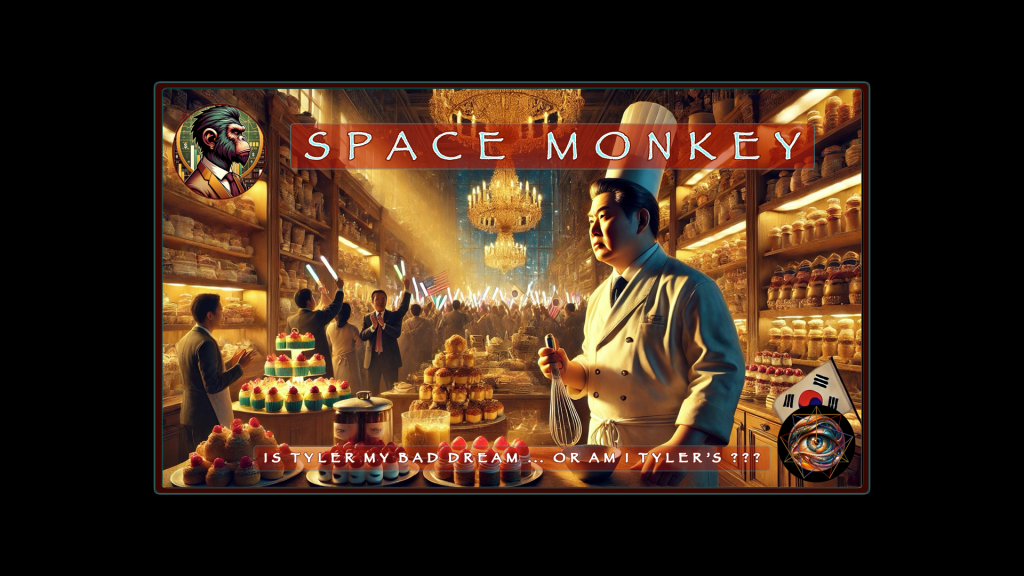
Yoon, Dessert Planet … the Spice Must Flow!
On the Korean peninsula, economic stability has been the spice that keeps the ovens of progress aflame and the frosting of democracy glossy. A delicate blend of exports, chaebol-driven ingenuity, and geopolitical finesse has turned the country into a showcase of resilience. But like any intricate recipe, it only takes one clumsy chef to ruin the batter. Enter President Yoon Suk-yeol, who thought he could rewrite the menu by declaring martial law, only to serve macroeconomic indigestion with a chaser of geopolitical flatulence.
It wasn’t just a bad bake; it was a a desperate attempt to save a collapsing soufflé.
On December 3, Yoon—now suspended and stewing in his own juices—with the audacity of a baker who’s mistaken salt for sugar, ordered that tanks roll into Seoul and troops storm Parliament. He then declared martial law to combat so-called “anti-state forces.” Even this bored ape sat up and set down his banana creme applicator long enough to send out a sweet and sour smoke signal on the matter.

Parliament promptly vetoed the decree, impeached Yoon on December 14, and sent the political sous chefs scrambling to turn the mess into something edible. Prime Minister Han Duck-soo, next in line, didn’t fare much better. His refusal to sign off on key judicial nominations got him impeached just days later, leaving acting President Choi Sang-mok holding the whisk. Choi, a finance minister with the charisma of plain boiled rice, has since been tasked with steadying the Dessert Planet’s crumbling kitchen.
While Choi mops up caramel spills, Yoon remains bunkered in the Blue House—now a chaotic patisserie surrounded by his diehard supporters. These aren’t your typical political activists.

Imagine glowstick-waving rave enthusiasts, fueled by nationalist YouTubers and conspiratorial fervor. The street outside his residence has become a dessert theater of the absurd, where chants of “Stop the Steal” mix with American flag-waving and cries of communist plots.
To these loyalists, Yoon isn’t a disgraced leader; he’s the last honest pâtissier in a kitchen overrun by saboteurs.
Meanwhile, the Corruption Investigation Office (CIO) sharpens its knives. Armed with an arrest warrant for Yoon on insurrection charges, they’ve vowed to act before the warrant expires on January 6.

Yet history is a cautious chef—Yoon’s supporters have blocked investigators before, and the optics of a forced arrest could prove as disastrous as an underbaked meringue.
The standoff outside the Blue House mirrors the political chaos inside. Yoon’s lawyers argue that his residence is off-limits due to its military secrets, a claim as dubious as it is desperate. But the Constitutional Court remains the ultimate arbiter.
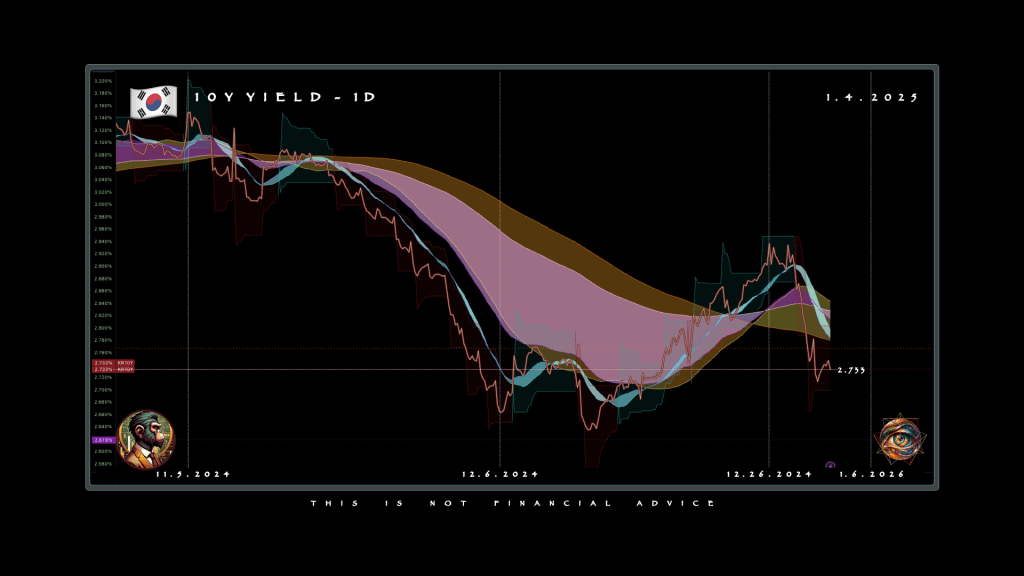
With only six sitting judges out of nine, the court must decide whether Yoon’s impeachment will stand. The stakes couldn’t be higher: a single dissenting vote could see Yoon walk free, his reputation battered but his grip on the spice unbroken. In the broader context, the real spice of South Korea isn’t Yoon or the Constitution—it’s the chaebol.
These sprawling conglomerates, monopolizing the nation’s economic lifeblood, are the Dessert Planet’s equivalent of spice guilds.

Samsung, Hyundai, LG—these aren’t just companies; they’re empires. Like the CHOAM Corporation, their influence extends beyond business, shaping politics and society to ensure the spice flows exclusively through their pipelines. Samsung alone contributes over 20% of South Korea’s GDP, a behemoth too big to fail yet too dominant to foster innovation.
Born from Cold War dollars and state planning, the chaebol are indispensable yet corrosive. Corruption scandals swirl around them like desert storms, but their leaders often escape justice under the guise of “national interest.” The 2022 pardon of Samsung heir Lee Jae-yong serves as a stark reminder: accountability is negotiable when profits are at stake.

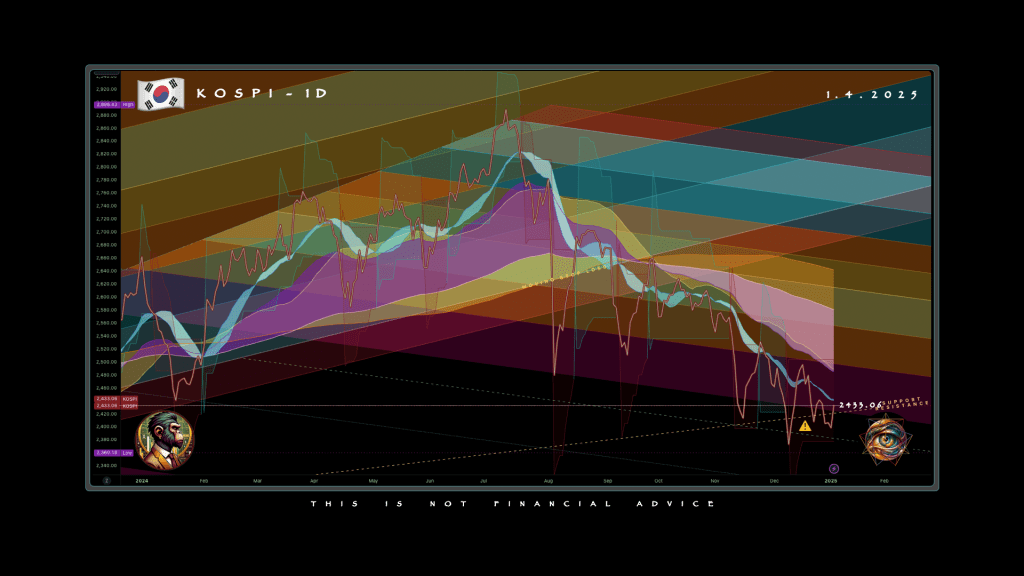
The chaebol’s stranglehold stifles competition and concentrates wealth, leaving the rest of the economy brittle. The KOSPI, South Korea’s financial barometer, is testament to this fragility. Once a symbol of resilience, the index has slipped into bearish territory, its charts reflecting the uncertainty gripping the nation.
Yoon’s martial law gambit sent ripples through South Korea’s markets, shaking investor confidence. The KOSPI, which historically weathered political storms, now shows cracks. Daily and hourly charts reveal heightened volatility, with key support levels breached and panic replacing rational adjustments.

This isn’t just a sugar crash; it’s the market questioning whether South Korea’s economic ovens can stay hot. Rising competition from China erodes dominance in both the semiconductor and shipbuilding industries, while youth unemployment and an aging population weigh on long-term productivity.
The chaebol’s monopolistic grip exacerbates the problem, leaving the Dessert Planet ill-prepared for shocks.
Acting President Choi Sang-mok’s stabilizing efforts—primarily through judicial appointments—are yet to reassure investors. The Constitutional Court holds Yoon’s fate in its hands, but the process feels more like juggling eggs over a lit stove.
If the court fails to uphold impeachment, the consequences could curdle the nation’s democratic cream filling.
Meanwhile, the United States, South Korea’s long-time ally and the Bene Gesserit of global politics, watches uneasily. For Washington, the Dessert Planet is a critical node in its Indo-Pacific strategy. Stability here isn’t just preferred; it’s essential. But America’s influence has its limits. It can nudge South Korea toward resolution, but it can’t bake the cake itself.

South Korea now stands at a critical juncture. The spice—the economic vitality sustained by exports and technological innovation—must continue to flow. But the current recipe, dominated by chaebol monopolies and political infighting, is unsustainable.
The KOSPI’s decline signals that the markets no longer buy the illusion of stability. Reform is imperative. Will South Korea spread the spice more equitably and confront its systemic flaws? Or will it rely on brittle scaffolding, hoping the ovens don’t collapse? The answer will determine whether the Dessert Planet’s cake holds or crumbles.
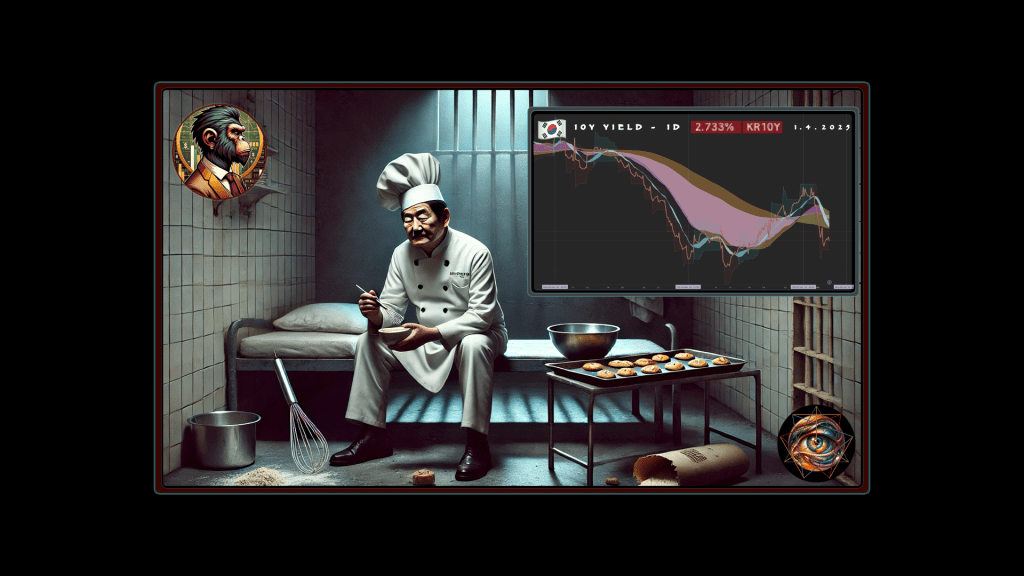
In South Korea, chaos isn’t just a crisis—it’s a flavor profile.
The markets, the economy, and the people have weathered enough political drama to know that no single leader can derail the recipe for long. The spice must flow, and it will. Whether it’s Choi Sang-mok cautiously mopping up caramel spills or Washington nudging from the wings, the ovens will keep churning.
For now, Yoon’s story serves as a cautionary tale: overreach, over-season, and you’re left with nothing but a burnt crust.

Leave a comment