
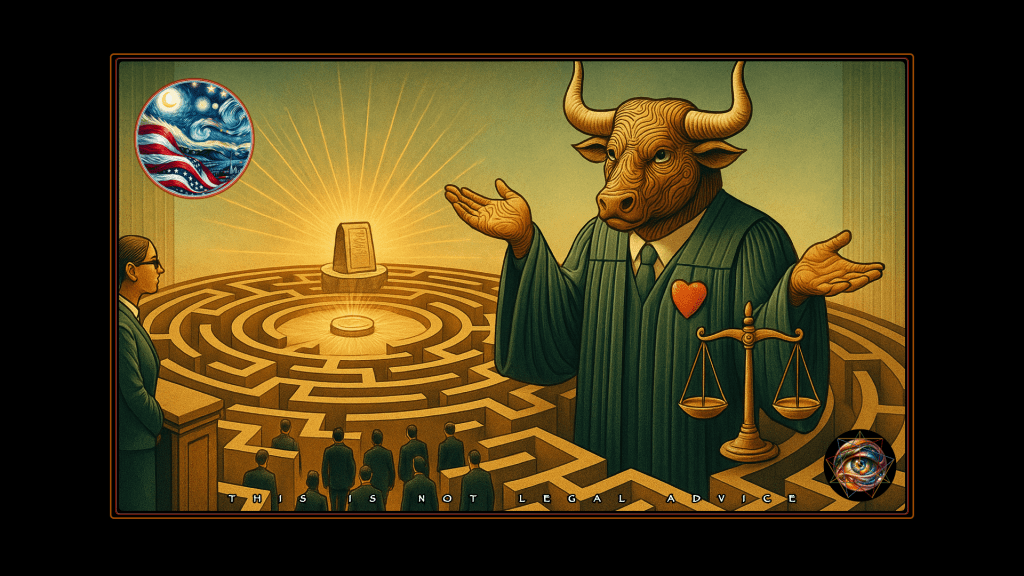
The robe is not fashion. It is erasure. It covers the body and flattens the person until only the office remains. Authority is what the eye is trained to see. Humanity is what the robe hides. Yet beneath it, a heart still beats, carrying centuries of expectation.
Long before lawyers, there were Judges. In the Old Testament, their task was direct petition and final word. No advocates. No buffers. Their decisions were outcomes, not arguments. Priests and scribes rose later to insulate rulers from constant pleas, but the archetype of the solitary judge endured. That inheritance still lives in the robe.
To stand before it without counsel is to enter a labyrinth. Corridors twist. Doors close. Words that worked yesterday fail today. The danger is not just getting lost. The danger is becoming the monster in the eyes of the one who wears the robe.
To the Pro Se Litigator, the judge looms as Minotaur—terrifying, unpredictable, ruling each passage of the maze. To the judge, the Pro Se Litigator is the Minotaur—an intruder who bypassed the professional buffer, an irritant in chambers designed for translation and control. Each sees the other as monster. Neither has reason to grant recognition first.
The robe’s purpose is to depersonalize. It tempts the judge to see caricature. It tempts the Litigator to strike at shadows. Fail here, and the Litigator is written off as nuisance. Filings vanish. Credibility dies. The case collapses long before judgment is entered.
The Thread is the only escape. In myth, it was Ariadne’s gift, orientation in a maze. Here, it is the act of seeing before being seen. The robe conceals, but the heart leaves traces—in gesture, in pace, in silence, in choice. Those traces are the line. Follow them, and the labyrinth becomes navigable. Miss them, and the maze swallows the case whole.
This craft is not doctrine. It is skill: reading signals, controlling tempo, timing objections, shaping records, securing orders. Every encounter with the robe produces data. Every trace is a chance to shift from Straw Man to participant. The Litigator who sees first forces recognition. The Litigator who waits remains unseen.
The Minotaur is never only one side of the room. Both carry fear of intrusion. Both fight for recognition. What separates outcome from oblivion is orientation.
Follow the Thread or be lost. See, in order to be seen.
The courtroom is contested ground. It looks chaotic, full of turns and obstructions, but its movement is not random. Every encounter follows a sequence. Each stage carries its own pressure. Survival depends on working with that current, not against it.
Cases do not advance in one linear motion. They stumble forward and backward in a series of unequal steps. First comes the surge, then constraint. Corridors narrow; options cut away; clarity is forced. Contact strikes, and closure follows, only to feed the next round. Skip one step and the others fail. This is not a rhetorical invention, or a personal anecdote, but cycle that unfolds every time the robe is engaged.
The Enneagram is the Thread, Ariadne’s gift that keeps orientation true when the corridors turn hostile. It does not grant the necessary emotional fortitude—especially by the Pro Se Litigator—but direction. Each step is linked to the next by a nonlinear design, confirmed not by necessity but by experience, that holds even when the walls shift. With it, he escapes the Straw Man caricature and becomes an operator. What the Robe obscures, the Thread untangles.
Lose it, and the maze digests filings, arguments, and presence alike.

Plan & Direct
A judge does not wait for improvisation. Preparation is measured the moment the case begins. What enters the courtroom first is not argument but intention, and intention left undefined collapses before it reaches the bench.
Planning means fixing a single aim. Time bought. A ruling forced. A record built. A delay secured. Each is possible, but not all at once. Scatter the aim and the judge reads weakness. Disorder is punished quickly, and divided intention is the easiest disorder to exploit.
Direction follows. It is not enough to know the goal; the strike must be shaped in the language a judge understands. Prosecutors on the bench read filings for order and punishment. Civil lawyers prize procedure and record. New judges prove control; veterans preserve efficiency. To plan without factoring this inheritance is to stumble blind into the corridors.
This first surge is not persuasion. It is orientation. The Thread is first gripped here—intention aligned with terrain. Without it, the Pro Se Litigator becomes caricature before a word is spoken.
A stray entrance can mean a lost case.

Collect
A judge is always signaling. Most signals are unintentional. Collection begins here.
Start with the past record. Rulings, transcripts, interviews, stray remarks in print. Each exposes bias. Some judges punish delay. Others worship precedent. A few indulge fairness but despise inefficiency. Collect this residue before the first filing; it is the baseline of their temperament.
Next is reconnaissance. Sit in the gallery before your case is called. Watch how the judge controls the room. Do they cut off lawyers mid-sentence or let them run long? Do they test with questions or sit silent? Do they reward brevity or punish anything that drifts? These habits are predictable once seen.
The last layer is live contact. Every pause, gesture, and shift of pace is a signal. A pen moving. Eyes narrowing. Shoulders turning away. None of it appears in the transcript. All of it matters.
To collect is not to guess. It is to assemble the traces into orientation. Without it, the Litigator is blind to preference and exposed to traps already laid. Gather the signals to gather advantage; miss them, and collapse follows.
Process
A judge leaks signals constantly, most of them misleading. Some frown while thinking, not judging. Some smile before they cut. Both mislead. Without processing, the Litigator mistakes theater for truth and walks straight into the trap.
Raw collection is noise. Processing turns it into orientation.
In practice, this ties cues to outcomes. Bench rulings demand filings that cut fast and clean. Deferred rulings invite parting words that frame the record long after the hearing ends. Each pattern requires calibration. The unprocessed Litigator who treats every courtroom the same pays for it.
This is where orientation becomes real. The enneagram threads fragments into a working map. Processing does not explain personality; it exposes leverage. What matters is not the judge’s mood but the function hidden behind it.
Failure here is fatal. Noise overwhelms. Signals cross. The Litigator confuses patience with leniency, silence with consent, routine with mercy.
Filter. Cut. Keep only what drives forward. The rest is bait, and it will be used against you.

Analyze
Ask yourself a single question: what does this judge protect?
Every judge protects something. Some guard the dignity of the court above all else. These judges react sharply to disorder: raised voices, missed deadlines, wandering argument. They punish disruption more than weakness on the merits. Others protect efficiency. Their rulings come quickly, their patience is thin, and they bristle at repetition. Still others protect precedent, treating the case as another brick in the wall of law; they demand citations, continuity, and fidelity to prior holdings. And some protect themselves—their reputation, their image on appeal, their standing in the community. They hide this motive beneath formality, but it shows in cautious language, in rulings hedged with citations, in the refusal to be pinned down.
Find the defended ground and strategy aligns. Miss it, and filings are wasted, rulings turn hostile, standing erodes.
To analyze is to identify which of these defenses is dominant. Misread it, and every move misses the mark. Treat an efficiency judge as though they value fairness, and your filings will be seen as delay. Treat a precedent-driven judge as though they care about narrative, and your story will land as noise. Misdiagnose a self-protective judge as a bold one, and you’ll push into traps designed to humiliate you. The cost of error is not just losing motions, but losing standing as a participant.
Analysis is where strategy compresses into leverage. The wide net of collection and the filters of processing must now collapse into torque—the pressure point that moves the case. This is not philosophy. It is survival. The Pro Se Litigator cannot afford to treat the judge as an enigma. He must treat the judge as a defender of something specific, something knowable, something exploitable.
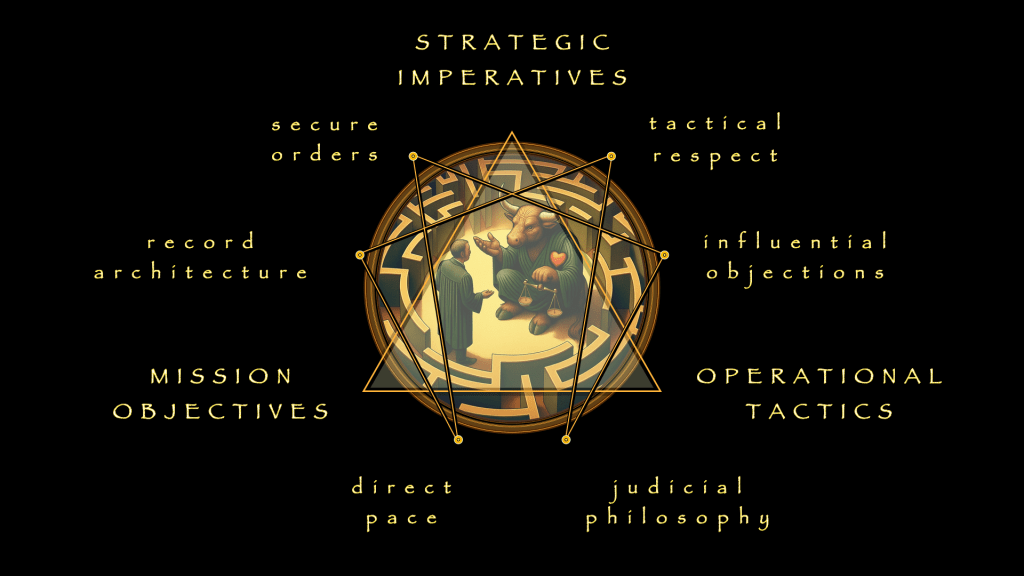
Here the Thread winds into a tighter loop of Six Strategic Imperatives. Each is a lever that reveals whether the Litigator has understood what the judge holds dear. Each provides a chance to turn that defense into usable ground.
Tactical Respect
Respect is control. Courtesy is camouflage. Posture and tone outweigh argument, because they signal whether the Litigator understands the field he is standing on. Tactical respect acknowledges authority without surrender. It is discipline in form that preserves freedom in substance.
The Litigator rises, voice steady, papers in order. He does not interrupt. When given the floor, he delivers with precision. This posture signals competence without provocation. Lose the Thread and respect mutates: weakness invites dismissal, arrogance invites sanction.
- Respect is posture, not manners.
- Form disciplines the fight.
- Misfire and the judge writes your role.
Respect frames the stance, but Judicial Philosophy decides how that stance is read. One is posture, the other is lens. Without respect, philosophy dismisses you as noise; without philosophy, respect is empty form. Together, they set the conditions for how every argument is received.
Influential Objections
An objection is influence. Nothing else. It seizes the room for a moment, forces the judge to acknowledge presence, and leaves a mark on the record. Objections shape tempo, redirect attention, and preserve ground.
Opposing counsel strays into speculation. The Litigator rises: “Objection, speculation.” Even overruled, the pause marks control. The line is drawn, the tempo reset. Used sparingly, objections display command. Overused, they betray desperation. Lose the Thread and objections become noise—stripped of weight, punished as disruption.
- Objections are levers, not alarms.
- Timing is weight.
- Overuse erases credibility.
Objections seize influence in the moment. Orders secure it in writing. One interrupts; the other endures. Without objections, the fight drifts. Without orders, the gains dissolve.
Judicial Philosophy
Every judge carries a philosophy, whether admitted or denied. Some are textualists, bound to the words on the page. Others are pragmatists, weighing outcome over doctrine. Some cloak themselves in precedent, tracing every move to what came before. Others guard fairness as the higher law. Philosophy is the lens through which respect is read and every argument is weighed. To miss it is to argue in the wrong language.
A Litigator cites moral fairness before a judge steeped in textualism. The words fall flat; the ruling cuts against him. Another Litigator, before a pragmatist, leans on citations alone and is dismissed as tone-deaf. Philosophy does not have to be agreed with, but it must be recognized. Lose the Thread and philosophy becomes a blind filter—your strongest points treated as irrelevant, your presence diminished to noise.
- Philosophy is the lens, not the law.
- Argue in the judge’s language, not yours.
- Recognition is survival; agreement is optional.
Judicial Philosophy interprets stance. Respect projects it. One is lens, the other posture. Together they decide whether the Litigator is treated as participant or nuisance.
Direct Pace
Pace is power. Judges set tempo, but the Litigator can seize it through voice, silence, and timing. Rushed speech signals fear of interruption. Measured pacing forces attention and signals control. The judge reads tempo as discipline.
Opposing counsel fires arguments in rapid bursts. The Litigator waits, then answers slowly, each point deliberate. The contrast shifts the room. The judge reads calm, not panic. Lose the Thread and pace mutates: hesitation looks like fear, overdrive looks like panic, and the judge closes bandwidth.
- Tempo communicates discipline.
- Silence is weapon, not absence.
- Loss of pace is loss of standing.
Pace creates rhythm; record preserves it. Without pace, the record collapses. Without record, pace dies at the close of hearing. Together they extend control beyond the moment.
Record Architecture
The record is the weapon that outlasts the fight. Hearings end, judges rotate, memories fade, but the transcript and filings endure. A strong record is leverage on appeal, a blade carried forward into the next arena. A weak record kills the case before the higher court even sees it.
The Litigator objects to hearsay. Overruled, the judge waves it aside, but the words are locked into the transcript. Months later, that single line reopens the fight. Without it, the issue is gone forever. Lose the Thread and the battle dies unrecorded—the higher court sees nothing to correct, nothing to contest.
- The record endures; rulings fade.
- What is not captured never happened.
- Appeals are wars fought on paper.
Respect gains the ear. The record makes it permanent. Without one, the other dissolves. Together they turn presence into force.
Secure Orders
An order is the battlefield map. Signed, it dictates the terrain for every move that follows. Arguments fade, objections pass, even rulings blur—but the order fixes the outcome in binding language. Securing it is not clerical work; it is command over how the fight is remembered and enforced. Fail to secure it, and the judge—or opposing counsel—rewrites the battle in their words, not yours.
The Litigator hands up a proposed order the moment argument closes, drafted in the judge’s style but tightened to his advantage. The judge signs it with barely a glance. Weeks later, that page decides a motion before it is even argued. Without it, the ruling floats—half memory, half myth—ripe for exploitation. Lose the Thread and orders become someone else’s weapon, reshaping the field against you.
- Orders are maps, not notes.
- Precision locks the field.
- Every gap is seized by the other side.
Objections win the moment. Orders win the aftermath. One is shock; the other is consolidation. Together they turn interruption into permanence.
The Six Strategic Imperatives form a sidebar within Analysis—a smaller loop nested inside the larger cycle. Each operates like a field test, turning signals into leverage at closer range. They do not replace the main sequence; they refine it. Respect, objections, philosophy, pace, record, and orders together show how the enneagram winds and unwinds the Thread, forcing the intrepid Litigator to prove control not once, but at every fractal step within a step
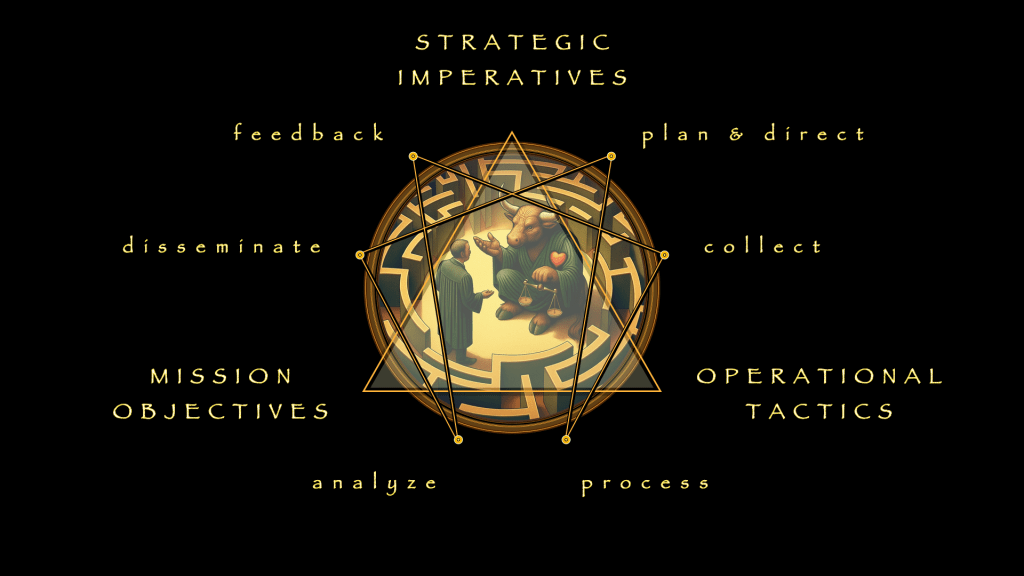
Analysis showed how one step of the cycle opens into its own chamber. Respect, objections, philosophy, pace, record, and orders were not detours but a smaller loop repeating the larger design. Each functioned as a test—posture, influence, lens, rhythm, permanence, anchor. With that loop complete, the frame widens. The Intelligence Cycle now shows the ground already covered—planning, collecting, processing, analyzing—and the ground still ahead: dissemination and feedback.
Each stage leaves a mark. Planning fixed goals. Collection built a file of signals. Processing stripped noise from leverage. Analysis revealed what the judge protects. Two steps remain: outward broadcast and return signal. Together they close the loop.
The sidebar enneagram of imperatives previewed how the cycle behaves under pressure. Both diagrams share six unequal steps, a split between tactics and objectives, and a rhythm driven by tension rather than choice. They differ in scale but are cognitively synonymous: one governs the moment, the other the case entire.
The two enneagrams differ in scale but not in logic. The Intelligence Cycle governs case architecture; the Strategic Imperatives govern combat inside a single exchange. One maps preparation, contact, and return; the other tests posture, influence, rhythm, and permanence in real time. Their geometry is identical: six unequal steps, tension forcing movement, the Thread binding sequence into order.
Any point of the Intelligence Cycle could be opened the same way, each hiding its own loop of imperatives. For now only Analyze is expanded, but the pattern holds everywhere. Respect mirrors planning, objections mirror collection, philosophy mirrors processing, pace mirrors analysis, record mirrors dissemination, and orders mirror feedback. This synonymy makes the model portable—across moments and cases, trial and appeal, any forum where judgment is rendered. Every chamber hides its own loop. The Thread holds at every scale.
The mapping is direct. Respect is planning in form. Objections are collection at speed. Philosophy is processing through the judge’s lens. Pace is analysis in time. Record is dissemination in hard copy. Orders are feedback set in writing. Two patterns, one logic.
For the Litigator, this offers method. Zoom in to regain control when pressure overwhelms. Zoom out to locate position when the case drifts. Compression and expansion without losing the Thread turns disorientation into direction.
The pattern holds at both scales. Used this way, it does not decorate the fight—it governs it.

Disseminate
Dissemination is contact. Every word, every page, every pause enters the judge’s filter. Nothing leaves the Litigator’s hand without being received, reshaped, and weighed. The danger is assuming transmission equals control. A signal that is not tuned to its receiver scatters and returns as damage.
Tone is the first filter. Some judges punish casual phrasing. Others dismiss ornamental legalese. A message that lands outside their range is treated as noise. Dissemination is not mimicry; it is adaptation. The language must meet the judge without surrendering substance.
Structure is the second filter. Some judges demand timelines, the case laid out as sequence. Others demand precision, citations stacked and cross-referenced. Still others respond to narrative cohesion, fairness carried in story form. Choose the wrong frame and the court loses patience before the argument begins.
Orders are the decisive form of dissemination. A proposed order drafted in the judge’s style does more than save their time. It seizes authorship of the ruling. It locks anchors that resist later drift. To neglect this moment is to allow the judge’s pen to redefine the case in words that cannot be undone.
Dissemination is the visible proof of orientation. If the Thread has been held, the message carries. If not, the gaps appear instantly. A judge will fill those gaps, and never in the Litigator’s favor.
Leave no gaps. Every gap is judgment already lost.

Feedback
Feedback is not limited to judgments. Every action of a judge is signal, whether deliberate or not. To treat rulings alone as the measure is to miss the deeper intelligence. The Pro Se Litigator must read the whole spectrum: the timing of a decision, the language chosen to justify it, the tempo of questions, even the absence of comment where response was expected.
Consider rulings themselves. A decision issued from the bench is a demand for efficiency—tight filings, direct argument, no waste. A decision held under submission may reward patience, but it also signals leverage: the judge retains control by delaying outcome. Each style instructs the Litigator on how to prepare the next move.
Language in orders carries its own weight. A clipped order signals the judge’s refusal to waste energy on narrative. An expansive one may reveal what the judge values most in the record. A cautious or evasive order, heavy with citations, may show concern for appeal. The words are more than decoration; they are exposure of the judge’s priorities.
Courtroom management is feedback in motion. Interruptions show a need to control. Questions reveal what is unresolved or what the judge intends to spotlight for the record. Silence is its own ruling—it marks what the judge will not legitimize with attention. Each act shapes the Litigator’s next step more than the statute itself.
Consistency is another form of signal. Judges rarely invent new habits; they repeat themselves. The pace of hearings, the threshold for objection, the degree of tolerance for narrative—once spotted, these patterns are durable. Inconsistency is feedback as well: it warns that external pressure, fatigue, or hidden priorities have entered the field.
Feedback accumulates. It does not close a case but opens the next phase of orientation. The Thread binds these signals together, turning scattered impressions into a workable map. The Litigator who fails to integrate feedback is forced to relearn the same lesson at higher cost.
Every signal is instruction. Ignore it, and the judge writes your role for you.

Judgment never arrives clean. A ruling, a silence, a gesture—each carries more than outcome. It carries signal. Before the case can close, those signals must be turned inward as tests of readiness. The questions that follow are not rhetorical. They are pressure drills. Each forces a choice between control and collapse. Each demands an answer that could survive exposure in the record.
Six Socratic Questions:
- Is my plan calibrated to this judge’s known tendencies, or am I running a template that collapses under scrutiny? What happens if the first ruling exposes that I never studied this judge at all?
- Does my stance signal controlled respect without surrender, or does it drift into weakness on one side and provocation on the other? How will the judge punish me if I mistake deference for submission or edge into arrogance?
- Are my responses disciplined and tactical, or have I allowed emotion to contaminate the record where it cannot be erased? If the transcript is read on appeal, where will my loss of control show most clearly?
- Have I structured my case as a coherent narrative the judge can track, or am I forcing them to wade through disorder they will punish? What breaks first if the judge stops following my story—my timeline, my credibility, or my chance of being heard?
- Is every move shaping a durable record for appeal, or am I leaving scattered fragments that die in the transcript? If I lose today, what evidence will remain tomorrow to prove the fight was real?
- Am I executing with discipline that can be measured, or am I improvising under pressure without control? When the pressure peaks, what will expose me first—hesitation, overreach, or collapse of sequence?
The courtroom is not neutral ground. It is a labyrinth built on ritual, history, and human limits. The judge is not a machine. The Pro Se Litigator is not a ghost. Each sees the other as a monster until proven otherwise. The encounter begins in fear and suspicion, and it ends only if recognition is forced.

This is not new. Long before lawyers, petitioners faced judgment without buffers. The Old Testament Judges ruled directly, without advocates to shape the quarrel. Their decisions were outcomes, not arguments. Modern judges inherit that lineage, but centuries of insulation have shifted expectation. Lawyers became the translators. The robe became a shield. What it did not erase was the heart beneath. To face a judge without counsel is to revive the oldest petition—one that strips the system back to its bones.
The danger is caricature. The Pro Se Litigator is the easy Straw Man: disorganized, emotional, disruptive. Once cast in that role, he is dismissed before the case is even heard. This is what the labyrinth devours. Not just filings or arguments, but presence itself. Losing a case is survivable. Losing recognition as participant is not.
The Thread prevents collapse. It ties each step of the cycle into the next, keeps orientation true when the walls shift, and forces the judge to see a human operator where they expected a nuisance. With it, the Litigator does not escape the labyrinth by chance. He redraws it with every move.
This contest is not about strength or faith in fairness. It is about navigation. The Litigator who learns to see before being seen creates the chance of recognition. That chance is survival. Without it, nothing remains but noise.
See. Record. Orient. Advance. Fail, and the judge never saw you at all.


Leave a comment