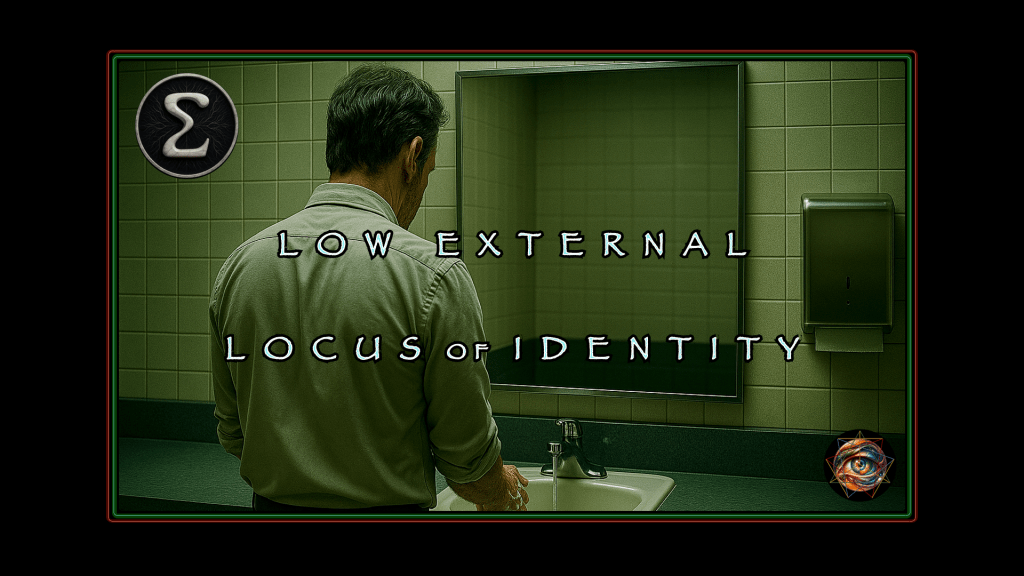
The Compass and the Frame
Most people navigate identity using maps they did not create. Group norms, reputation systems, and cultural scripts form the terrain. Status provides direction, and belonging exerts gravity. The route is pre-ordained; the task is to follow it efficiently.
These maps do not exist merely as abstractions. They show up as everyday scripts: dress codes, feedback loops, market trends, rituals of inclusion and exclusion. They are built from aggregated approval and maintained through tacit enforcement. Most follow the map not because they trust its accuracy, but because deviating from it is socially costly.
An individual with a low external locus of identity rejects such maps. This person moves through life with a compass—quiet, internal, and unwavering. The coordinates are not drawn from popularity or proximity. They arise from within. This does not imply ignorance of external signs. It reflects strategic disregard. The signs may be legible, but the destination is hollow.
Their stance does not represent rebellion for its own sake. It does not signal contrarianism or social ineptitude. It reflects navigation by a different metric: velocity over coordinates, coherence over consensus. The compass does not shift with collective moods. It maintains alignment, even when the world tilts.
That steadiness becomes the signature. It does not express a posture of resistance—it reveals a refusal to drift.
Origins of Alignment
This internal reference typically develops in one of two ways.
The first path arises through forced individuation, often produced by estrangement. The individual discovers that external validation is erratic, unclear, or actively hostile. Feedback arrives as distortion. Praise turns to mockery. Precision is met with misinterpretation. Over time, the need for affirmation is not merely suppressed—it is severed. The person learns to generate meaning without witnesses.
The second path forms through epistemic clarity. This version does not result from trauma, but from observation. The individual studies the machinery of group behavior: the incentives behind opinions, the churn of cultural fashion, the economics behind status exchange. Once they see the machinery, they decline participation. They refuse, not from fatigue or despair, but from structural objection.
In both paths, the result remains the same. The ego stops reaching for mirrors. It turns inward and moves by internal magnetism.
Non-Performative Emotional Logic
To those on the outside, this individual may appear emotionally muted, distant, or impenetrable. The misreading stems from an error in social modeling. Most people are trained to interpret emotional presence as performance. Where there is no visible enactment, they assume absence.
This person does not perform affection for optics. They do not signal distress to create bonds. They do not offer narrative as proof of feeling. Their emotional architecture is often complex, but it is not curated for social consumption.
In many contemporary settings, emotion functions as currency. It is broadcast to elicit response, forge alliance, or build leverage. Social media platforms reward this exchange explicitly; institutional cultures imitate the same dynamic through staged vulnerability, tokenized empathy, and rehearsed enthusiasm. Under such conditions, emotional expression becomes performative instinct. Presence becomes theater.
This person refuses the stage. They do not signal loyalty through affect. They do not trade attention for disclosure. Their inner state exists independent of optics. They reserve expression for rare moments of symbolic precision. Bonds emerge through mutual fluency, not exposure. Proximity alone does not qualify.
When they do express emotion, the delivery is exacting. It may appear as code, art, theory, or design. The chosen medium prioritizes fidelity over visibility. Their goal is not recognition; it is accurate transmission. To understand them requires decoding, not witnessing. Most lack the patience to decode.
This is not emotional absence. It is emotional discipline.
Professional Sovereignty
In professional environments, this individual often becomes a friction point—not through failure or incompetence, but through refusal to bend to invisible norms.
They may excel in systems that reward clarity, abstraction, and pattern recognition. Fields structured around logic, independent analysis, or technical rigor may offer partial shelter. Yet the moment politics outweigh structure, dissonance sets in. In cultures that prioritize optics over outcomes, they create discomfort.
The discomfort begins subtly. They do not participate in morale theater. They do not mimic leadership gestures to earn credibility. They do not translate identity into slogans. The rituals of contemporary workplaces—team-building charades, corporate storytelling, synthetic enthusiasm—fail to enlist them.
They do not resist collaboration. They resist choreography. Their compass does not orient toward symbolic compliance. The language of branding, values alignment, and mission-driven synergy reads as distortion. The signals are not merely wrong; they are incoherent.
When compelled to participate in this choreography, the dissonance becomes physical. Feigned enthusiasm produces fatigue. Posturing triggers contempt. Ritualized inclusion feels like erasure. To preserve internal coherence, they detach—not dramatically, not vindictively, but quietly.
This detachment is rarely interpreted correctly. It is seen as arrogance, disengagement, or disloyalty. Managers view them as poor culture fits. Colleagues perceive them as aloof or difficult. But their loyalty is not absent; it is misaligned.
Their allegiance belongs to structure, not theater. If a system is logically sound and ethically intact, they will serve with unshakeable precision. If a mission reveals integrity, they will commit beyond expectation. But if the structure collapses into image management and peer signaling, they withdraw—without announcement and without negotiation.
Misread Misfits … By Design
Because they refuse the social mirrors that others rely on, they are routinely misunderstood. The misinterpretation is not accidental; it is systemic. Others do not know how to read a person who does not solicit being read.
In unfamiliar groups, they are immediately misclassified. Some call them aloof when they simply lack outward referentiality. Others call them uncooperative when they decline symbolic gestures. Some call them arrogant when they refuse to diminish themselves for the comfort of others.
These judgments rarely result from observation. They arise from projection. This person’s presence acts as a reflective surface, but not a mirror. Others see themselves more clearly in the contrast, and they often resent what they see.
In moments of institutional confusion, they are sometimes called upon. Their clarity becomes useful when consensus fails, when leadership fractures, or when no one else will speak plainly. However, that clarity does not translate into social capital. After the crisis, they are set aside—too blunt, too rigid, too unyielding for the day-to-day rituals of cohesion.
They do not advertise themselves as safe. They do not signal availability. They do not compete for belonging.
Their posture functions as negation. It rebukes the social contract of approval-seeking. Even without articulation, their presence issues an unspoken invitation: You are not required to mirror anyone.
That idea alone destabilizes most rooms.
Neurodivergence
This orientation is seldom philosophical. Most often, it is neuroplasticity in action. A low external locus of identity stems from structural resistance to social mirroring. While neurotypical identity formation relies on feedback, modeling, and social reinforcement, neurodivergent identity often emerges through internal coherence testing.
The individual does not absorb norms instinctively. They analyze them. They do not conform reflexively. They assess, critique, and often reject. For those with autism spectrum traits, ADHD, or other non-normative cognitive types, the social world is not a default map—it is an environment requiring translation.
Identity becomes internally constructed architecture. It is built from introspection, pattern recognition, or symbolic logic. It does not stabilize through group reflection. It stabilizes through clarity.
This often creates tension in social settings. The person may mask—adopting roles to minimize friction. They may script interactions or simulate reactions. However, masking is costly. Over time, it collapses. The nervous system begins to reject the labor of pretense.
Eventually, many stop mirroring. They stop not out of resistance, but out of biological necessity. The cost of simulation exceeds its reward. The compass becomes more than a metaphor; it becomes a stabilizing tool for regulating meaning, sensation, and action.
This is not just about difference in cognition. It is about structural incompatibility with environments that require performance to confirm worth.
Sensory Demands and Social Dislocation
To individuals of this neurotype, authenticity is not a virtue. It is a sensory requirement. Social falseness does not feel neutral—it registers as dysregulation.
Pretending generates physiological distress. Consensus culture produces constriction. Surface alignment feels like suffocation. They do not resist for attention or control. They resist because their nervous system demands coherence.
They require solitude not for withdrawal, but for recalibration. In solitude, the signal returns. Precision restores balance. Ambiguity dissipates.
They need clarity the way others need affirmation. They need autonomy the way others need connection. Their psychological circuitry cannot reconcile contradiction in performance. When forced to participate in symbolic gestures that contradict their internal compass, they fragment.
In overstimulated cultures—where speed, spectacle, and social theater dominate—this becomes a liability. They do not entertain. They do not posture. They do not project belonging.
And yet, when noise overwhelms a system, they remain clear. They do not pivot with every trend. They do not seek consensus before acting. They carry direction under pressure, and that direction is not up for negotiation.
Dangerous Clarity
This disposition is not heroic. It extracts a cost, often quite heavy.
It isolates. It generates chronic misinterpretation. It triggers punishment in systems that reward obedience. It renders the person invisible when visibility requires performance.
However, when integrated, it grants something rare—dangerous clarity. The ability to speak without permission. The ability to hold direction without polling the room. The ability to act without first being seen.
This clarity disorients institutions. It disturbs collectives. It threatens systems of soft coercion and psychological conformity.
They do not bend. They do not chase. They do not collapse.
Their identity does not mirror others. It casts a shadow. And in time, that shadow becomes something else—not just refusal or stillness or sovereignty—but a force of alignment for those who have never seen a compass work in real time. When enough shadows fall in parallel, something resembling structure appears—something without consensus, without signaling, without permission.
It does not look like a movement, but like a mass that cannot be moved.

Leave a comment