
A well-dressed man outside the Diddy trial claims proximity to legal power but evades every direct question about his role. Through layered tropes, strategic vagueness, and shifting rhetorical registers, he constructs a public persona that deflects scrutiny while maintaining credibility. This analysis dissects his verbal and visual tactics, revealing a blueprint for real-world legal theater and narrative manipulation.
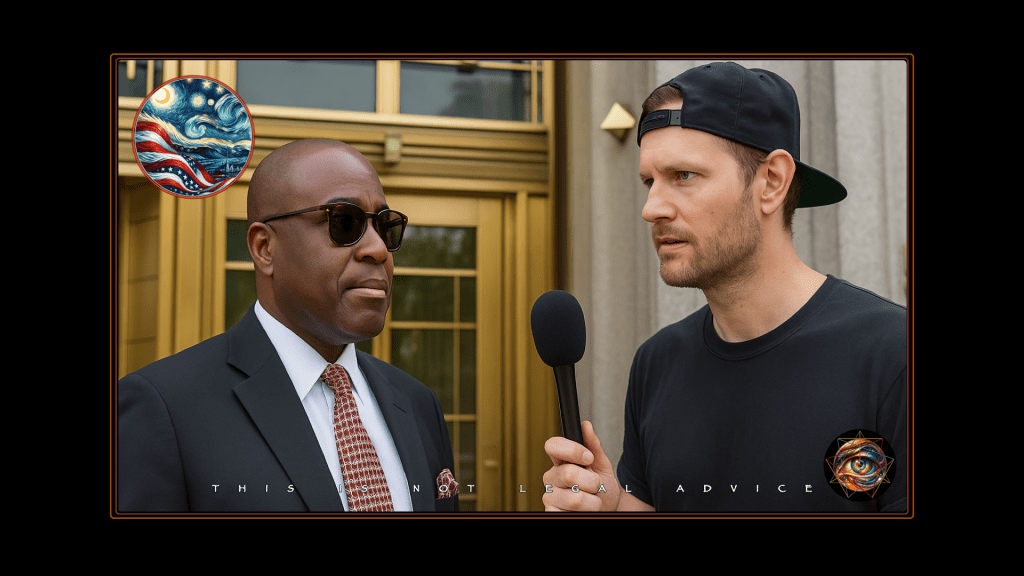
There is a moment in a Ryan Long sketch when the tone fractures. What begins as absurdist banter sharpens into something harder to dismiss. A sharply dressed man—black suit, red tie, mirrored sunglasses—steps forward and claims, in vague terms, to be affiliated with Diddy’s legal defense. Perhaps he is, perhaps not. He certainly cannot say. The joke doesn’t end … it mutates.
What began as parody became a lesson in how to project unimpeachable authority.
Forget about Diddy, or the trial. This story is about “the Suit” outside the courthouse. He dodges questions, flatters his interviewer, invokes Hugh Hefner while dodging a dick-measuring contest on racial grounds, and garnishes his quasi-legal analyses with pure conjecture. This report, a forensic autopsy of the event, is no substitute for watching the original street-improv. Ryan Long demonstrates, in real time, how the projection of power and access elicits credulity without ever needing to say anything verifiable.
The Dark Horse in Legal Drag
He does not introduce himself. He establishes a shape and lets others fill it in. His attire is conspicuously formal, his posture confident, and his manner of speaking carefully imprecise. He never identifies his exact role. Instead, he leans on phrases like “with the team” or “involved on the defense side.” Ambiguity is not a gap—it is a lure. The Dark Horse offers just enough shape for others to project authority onto him, and just enough distance to remain unaccountable.
He functions as a kind of rhetorical mirage. He resembles someone who ought to have access to privileged information, and that resemblance alone is enough to suspend disbelief. The illusion works not by asserting credentials, but by suggesting proximity. He looks the part, and in environments flooded with noise, that alone suffices.
His attire is no accident. The black suit, gold ring, red pocket square, and sunglasses are not mere fashion choices, but signals. He is dressed not as a lawyer, but as the idea of one—tailored, silent, close to power but never named. In an image-driven culture, aesthetic cues often carry more weight than credentials. The Dark Horse plays the role of someone trustworthy by borrowing the uniform of trust.
He does not need to produce identification. He is wearing it.
The man’s rhetorical approach is marked by deliberate abstraction and selective suggestion. His speech is dense with repetition, evasion, and pseudo-legal phrasing:
- “Consenting adults” – repeated until it becomes talismanic, as though invocation alone renders everything permissible.
- “Let me not use that word…” – a performance of discretion that implies sensitive access while withholding specifics.
- “You understand…” – a closure cue, designed to end the exchange without resolution.
Each sentence is structured for exit. The Dark Horse never builds a point. He builds a fog. Rather than assert facts, he creates impressions. This is not testimony. It is illusion—calibrated to simulate depth without offering it.
He invokes figures like Hugh Hefner and locations like the Playboy Mansion to provide social cover. These references are not random; they are tactical. He does not deny questionable events. He reframes them as cultural artifacts—vestiges of an era that once celebrated excess. The Dark Horse leverages collective nostalgia as a form of rhetorical absolution.
This is not defense. It is diffusion. If the past rewarded it, the present cannot prosecute it without contradiction. The Dark Horse thrives in that gap.
Fracture by Design
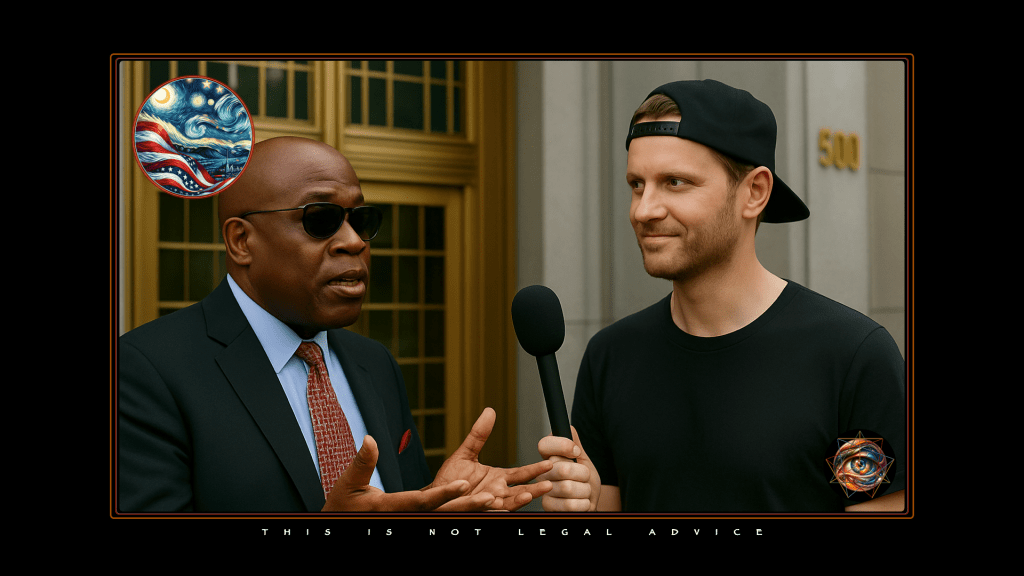
The moment a coherent frame begins to form, Ryan Long punctures it:
“Pull our dicks out right now then.”
The line arrives like a thrown wrench—jarring, vulgar, and strategically absurd. On closer inspection, the crude escalation is outsourced. The Dark Horse does not initiate the rupture; he absorbs it.
He declines to engage, claiming higher ground. He appears to maintain composure, brushing past the challenge with a slight smile and an air of practiced restraint. In this moment, he plays the adult in the room, declining the invitation to chaos. But the refusal is theater. His dignity is choreographed contrast. Ryan plays the Rogue; “the Suit” plays the Regent. They occupy opposite poles of tone—deliberately.
The effect is sleight of frame: 1) Ryan fractures the narrative. Then, 2) “the Suit” stabilizes it by appearing unshaken. Together, 3) they simulate spontaneity while performing control. The disruption does not undermine “the Suit’s” credibility, but enhances it. He seems poised not because he resists chaos, but because chaos was already assigned to someone else.
He leverages the rupture to elevate his own posture. Where Ryan appears wild, unserious, and disruptive, “the Suit” appears composed, focused, and mature. But that maturity is borrowed staging. It exists only in contrast. The performance requires both of them—and only one needs to stay clean.
As the event escalates, “the Suit” never truly answers any question. Instead, he dispenses vague affirmations wrapped in curated ambiguity:
- Who are you? “That’s not important.”
- What do you do? “I’m with the defense.”
These replies are not evasions. They are narrative priming—frames others are invited to complete. He provides just enough language for listeners to construct a myth on his behalf. His authority is user-generated.
This is not deception. It is omission by design. He builds credibility not by adding information, but by subtracting friction. What remains is tone, costume, and cadence.
It echoes the strategic minimalism of legal and corporate communications: say as much as necessary, and no more. Never lie. Let others construct the myth you orchestrated but never endorsed.

The Man Who Isn’t There
Beneath the theatrical flourishes lies a deeper grammar of masculine performance. The Regent, the Rake, and the Rogueare not characters but archetypal strategies—each representing a distinct method for shaping perception, evading scrutiny, or asserting control.
- The Regent projects institutional power. He adopts the posture, language, and costume of legitimate authority. His strength lies not in persuasion but in expectation: he speaks as if he must be obeyed. Whether or not he holds formal power, he behaves as though he does—and that presumption often goes unchallenged.
- The Rake seduces through tone, rhythm, and presence. He trades clarity for allure. Where the regent commands attention through status, the rake draws it by suggestion. He implies more than he states, and his credibility is felt rather than verified.
- The Rogue refuses stability. He avoids containment by shifting tone, breaking form, or hijacking the frame. He cannot be argued with because he cannot be held in place. His strength lies in disruption—especially when logic or decorum begins to close in.
These three archetypes form a closed loop of interface: the Regent establishes structure, the Rake manipulates within it, and the Rogue destabilizes it altogether. What follows is not a performance of one identity, but a tactical oscillation between all three.
The man does not wear one identity; he cycles through three. Each mask is tailored to the moment. Beneath their surface, each corresponds to one of the archetypes above.
- The Sovereign Suit borrows institutional language without bearing its weight. He echoes the Regent, signaling authority through vocabulary, dress, and cadence. He offers no credentials, but he imitates their form.
- The Street Oracle speaks in innuendo, fragments, and half-truths. He channels the Rake, not romantically but rhetorically. He seduces interpretation itself—inviting the listener to connect dots that were never drawn.
- The Joker inserts lewdness, absurdity, or tonal rupture when the frame threatens to stabilize. He plays the Rogue, derailing inquiry before it can cohere. Disruption is not a failure; it is the strategy.
These masks are not fixed roles. They are rotating mechanisms. He deploys them in sequence or overlap to disorient, seduce, or control the exchange. The result is a composite persona that appears spontaneous but functions with surgical precision.

Proof Is No Longer the Point
In an era saturated with spectacle and engineered ambiguity, performance increasingly replaces proof. “the Suit” outside the courthouse is not an anomaly. He is a prototype—crafted for a world where confidence outpaces verification, and fluency signals more than truth. He does not argue. He performs. And for most, that’s enough.
He is consistently in character, reliably evasive, and perpetually just believable enough. He does not clarify. He constructs outlines. He offers just enough signal for others to project authority onto him. He is not trying to win a legal argument. He is playing for narrative dominance—where control is not earned, but performed.
What makes him compelling is not his absurdity—it is his fluency. He speaks the language of authority without any of its burdens. He performs legality without paperwork. He triggers recognition without delivering confirmation. He does not represent truth. He represents what truth looks like under theatrical conditions.
The real test is not how we interpret him from a distance, but how he was received in the moment, by the journalists and content harvesters who stood feet away. They nodded. They flattered. They followed the cadence. Not one of them asked for proof. No one called the bluff. The mask was accepted. The uniform passed inspection. The camera kept rolling.
Ryan Long was not speaking to “the Suit”, but through him. He was not trying to convince anyone. Rather, he was conducting a stress test—measuring how much vagueness, contradiction, and narrative fog the onlookers would tolerate before demanding a boundary. He was not proving credibility. He was mapping thresholds, and watching who notices.
They onlookers failed, spectacularly. Their offense is not that they were entertained, but that they are eagerly self-deceived. The mask worked, right? The costume held, didn’t it? No one stopped the scene, did they?
The next stunt might not need a costume at all . . .

Leave a comment