The Six Meticulous Moves are not a set of tools or tricks, but a disciplined interaction with any space you inhabit—a hotel room, a meeting table, a crowded street—a set of resources waiting to be assigned a role. Each distills a repeatable means of shaping the environment so that it works for you, without drawing attention to you. The emphasis is on precision, timing, and intent, turning scarcity from a limitation into an advantage. As the skillset matures, it stops feeling like a hack and becomes the natural way you operate. The result is a quiet, durable form of preparedness that works long before anyone else realizes it is in play.
Objectives Over Objects
Craft turns any room into a toolbox and any object into an accomplice. The discipline begins with an objective and ends with controlled effects, ideally while the environment and/or its inhabitants believe that nothing changed. Curiosity supplies momentum because each solved constraint teaches the hands a repeatable move. Objectives govern tools and not the reverse. Mission clarity compresses time because selection narrows to actions that produce the end state. Operators who anchor on gear chase shape over effect while those who anchor on outcomes recruit the room itself into their service. Scarcity strengthens timing because delay only strengthens opposition.
A quiet scan locates capability rather than things. Every environment carries its own set of levers. Some are visible, some are hidden, and some only appear when you look with the right intent. A man who can see those levers before anyone else is never entirely at the mercy of circumstance.
You step into a hotel room after a long day. Without thinking, you clock the door’s swing, the way the curtains hang, the hum of the air unit. A plastic coat hanger can bridge a gap in the latch. The desk chair can block an intrusion without marking the carpet. None of this feels like paranoia; it is simply knowing what the room can do for you before you need it.
In a crowded café, you choose a seat where the glare off a framed picture hides your hands from anyone glancing over. You watch the flow of people, noting the predictable pauses in their movement when the espresso machine hisses. Even in a public place, there are pockets of cover, angles of approach, and rhythms you can ride without effort.
At an airport, you test the acoustics with the click of your heel, hearing how sound travels under the canopy. You find the column that hides you from the check-in counter while still giving you a clean view of entrances and exits. You notice the reflective glare of the windows, good for checking the movement behind you without turning your head.
Resources are everywhere: the clothing on your body, the furniture within reach, the fixtures embedded in the walls, the forces of light, heat, airflow, and sound. Most men wait until they need something before they look for it. The better approach is to assign potential roles now, in calm, so they are ready under pressure.
Raw Material Is Everywhere
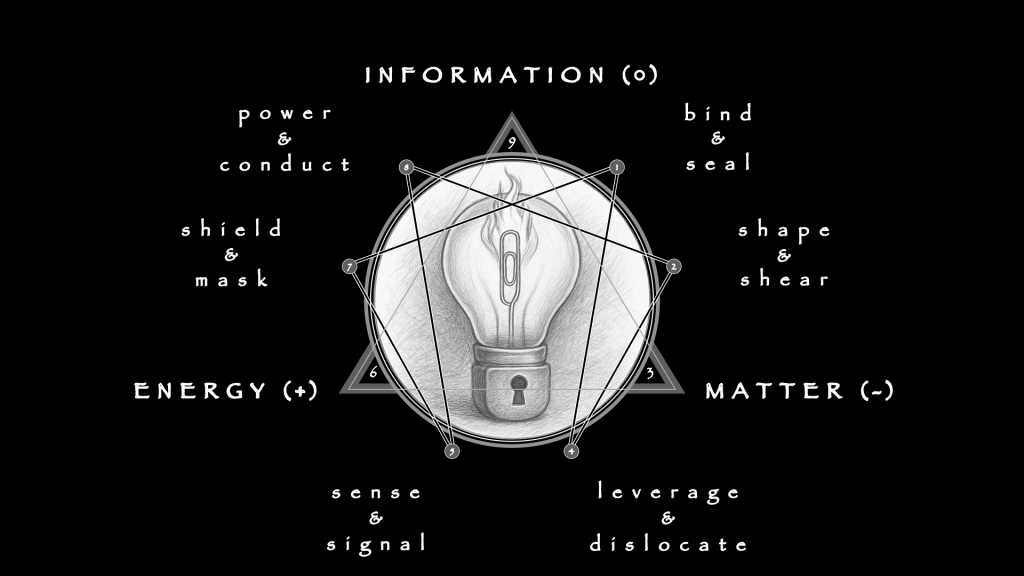
From this habit evolved a compact skillset—simple in appearance, exhaustive in application, the Six Meticulous Moves, and it reduces every environmental challenge to a handful of repeatable patterns. Core function identification comes first because function defines success criteria. Learn them, and you can make almost any space work in your favor without showing your hand.
- Bind & Seal: Assign friction, compression, adhesion, and interlocking geometry to hold, clamp, lash, and weatherproof. Joints survive load because contact and direction match the threat.
In an airport lounge, a folded boarding pass wedges a rattling vent so it stays silent during your call. Anything that can change shape can change role—your grip on problems improves when you see their pressure points before they fail. - Shape & Shear: Deliver separation by edge, abrasion, or cyclic stress so barriers grant access without spectacle. Edges emerge from metal, ceramic, glass, or tensioned fiber when patience meets pressure.
Breaking down a stubborn shipping box, you score it with a room key so it folds neatly for disposal without attracting attention. Precision beats force; in most systems, the exact cut at the right time outperforms a bigger tool at the wrong one. - Leverage & Dislocate: Convert span, torque, fulcrum, pulley, and drag into motion that favors you. Space obeys handles and anchor points when vectors align.
When shifting a heavy coffee table, you slide it on a folded blanket rather than dragging it across the floor. The world rewards those who can spot the hidden hinge in a situation—shift that, and the rest moves without strain. - Sense & Signal: Extend perception and communication through contrast, magnification, reflection, rhythm, code, and conductivity. Information moves farther and faster than bodies.
You track the progress of a friend arriving at a bar through the reflection in a darkened window, without needing to turn. Extra awareness is free advantage—when you train your senses to read more than they are told, you stay ahead without moving faster. - Shield & Mask: Steer light, sound, heat, and trace so presence reads as quiet. Terrain becomes baffled, backstopped, or opaque on schedule.
In a meeting, you sit with your back to a sunlit window, forcing others to adjust their eyes before reading your expression. Control how and when you are noticed, and you choose which parts of you are real in their eyes. - Power & Conduct: Route energy and flow across bridges that close circuits, equalize pressure, or buffer impact while failure remains recoverable.
A rolled-up magazine cushions a door’s slam, absorbing force without damage. Influence often comes from redirecting momentum, not generating it—own the flow, and you own the outcome.
Preparation begins before there is any visible motion. You map the terrain in your mind, noting where resistance will appear and where you can move freely. A man who knows the boundaries he will honor can bend the rest of the environment without breaking stride. In practice, this might mean walking into a negotiation already knowing which points you will concede and which cannot be touched, all wrapped in a conversation that never feels staged.
Raw material is everywhere, if you know how to take it without disturbing the surface. A slip of receipt paper with a phone extension, a rough measurement made by pacing a hallway, or a momentary glimpse of a schedule on someone’s screen can all be gathered without pause. The value lies in leaving no signal that anything was taken, so the path remains open for the next pass.
Tactical Creation
Order matters as much as content. Once collected, the pieces need to be placed where they can be reached in seconds. A note that cannot be found when it is needed might as well not exist. This is why seasoned operators keep their resources in consistent mental and physical locations, whether that means a dedicated pocket for a travel document or a specific format for quick-reference notes.
Every method requires testing. You measure the result against the intended effect rather than the story you prefer to tell yourself. If a conversation yielded less than expected, you ask whether the gap came from your timing, the tools you used, or a habit you failed to adjust. This approach removes ego from the analysis and keeps attention on results that matter.
Delivery is its own discipline. Sometimes the right play is to hand the information over cleanly. Other times, the wiser choice is to embed it within something innocuous so it reaches its target unnoticed. The principle is the same whether you are passing a key detail in a casual meeting or guiding a team toward a decision without announcing your role in it.
Nothing is ever final. What worked once will face different pressures the next time. Weak elements are stripped away, strong ones are reinforced, and the entire approach is tightened for speed and resilience. The aim is to build methods that withstand more attention and more stress with each iteration.
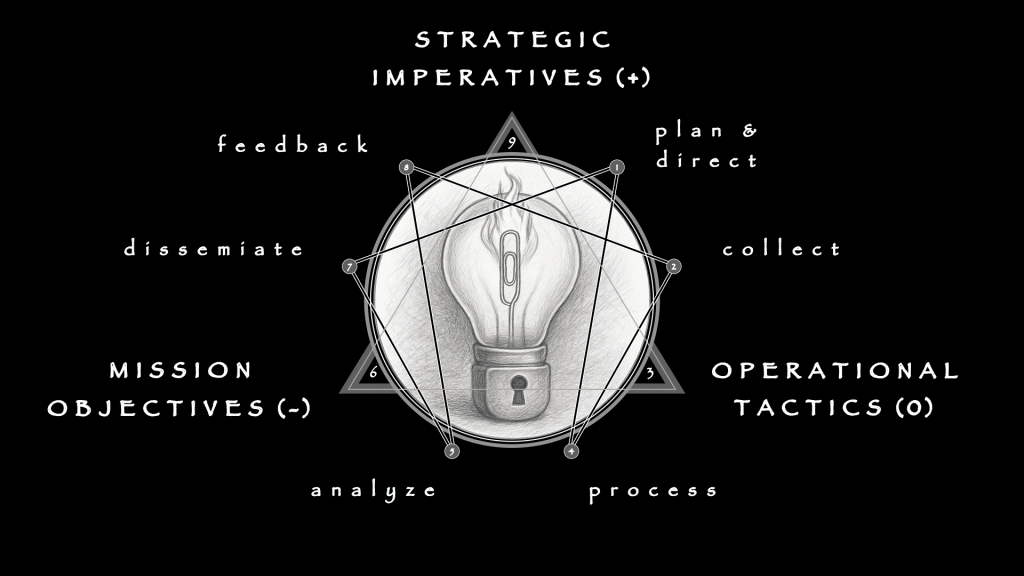
One good model (there are others) is the Intelligence Cycle. Furthermore, the enneagram encodes asymmetry, choke points, and random real-world interference. Together, they are not a cinematic ritual but a sober practice, a field grammar drawn from how intelligence work actually succeeds or fails:
- Plan & Direct: Gamify mappable scenarios, including likely constraints and explicit legal boundaries.
- Collect: Salvage tool-able debris, measurements and timings, as well as identities and signatures from live spaces without disrupting them.
- Process: Sort the haul into labeled modules aligned to the Six Meticulous Moves so retrieval beats invention.
- Analyze: Measure failures and frictions against mission end states, not ego.
- Disseminate: Create compact and/or coded playbooks with red‑team observations for trusted nodes with trace discipline.
- Feedback: Close loops with after‑action notes, equipment swaps, and cadence adjustments until tactics survive time, scrutiny, and turnover.
Legal jurisdiction, site policy, and safety invariants must govern every move. Evidence discipline prevents residue, damage, and unintended hazards once the moment passes. Escalation control preserves options because cleverness that invites force converts victory into liability. The doctrine stays useful because results matter more than display.
Preparedness has precisely nothing to do with accumulating more equipment. It begins with the ability to look at what you already have and see more roles than it was designed to play, but it doesn’t end there. The man who can make his surroundings serve multiple purposes is never overburdened and never caught waiting for the perfect tool to appear.
This manner of security cannot be bought in a package or stored on a shelf, for it exists only in the decisions you make, the habits you maintain, and the adjustments you execute without hesitation. Your mileage will vary; count on it, and practice accordingly. A product may give the appearance of safety, but only awareness and adaptability can sustain it when circumstances shift. You create security by reducing the need for reaction, by shaping conditions so that threats never have the angle they expect.
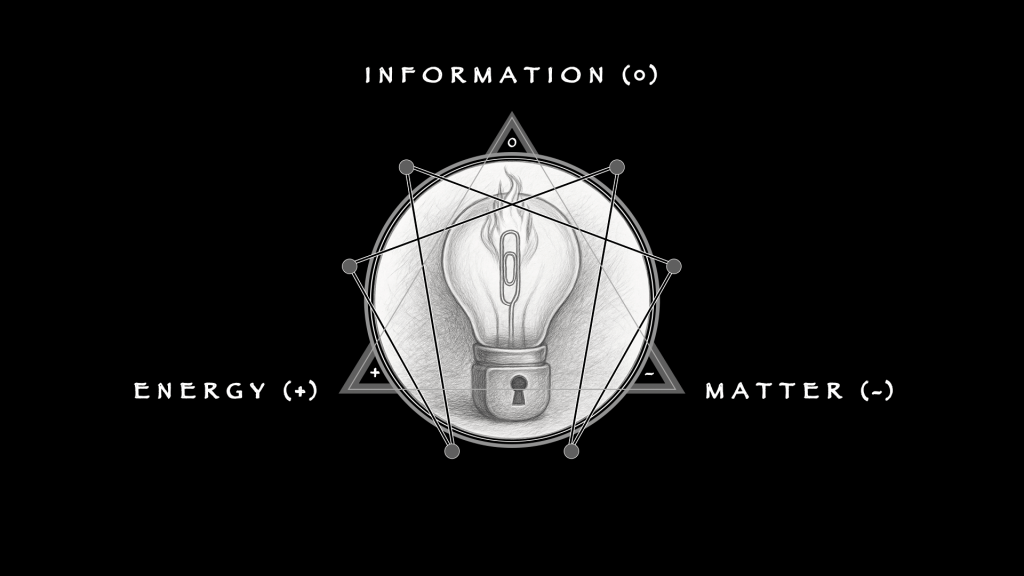
Preparedness is not an inventory; it is a way of seeing. Creation, the 321 triad, begins with reconciliation, and that means perception before action. The coat hanger, the desk chair, the schedule board do not announce themselves as tools until the eye stops seeing them as fixed objects and starts seeing their roles. Angles of light become veils, the hum of a vent becomes a signal, the contour of a handle becomes a grip point. Reconciliation is not invention but recognition—the discipline of noticing function before the need arises. This is why those who practice it look calm: they are not scrambling for options later because the medium has already been folded into readiness.
Denial follows, and here the tone hardens. Constraints assert themselves: the hinge resists, the lock holds, the weight pulls against your arms. Scarcity refuses abundance and strips away the fantasy of perfect tools. This is not punishment but form-giving. A hinge that refuses easy pressure teaches you where leverage lives. A tight corridor denies maneuver and forces economy of motion. Scarcity compresses time, sharpens judgment, and clears out indulgence. To work with denial is to let resistance do the editing, cutting away what will not stand under load. This is why seasoned operators are not dismayed by limits; they recognize that denial is the shaping force that keeps preparedness from dissolving into clutter or gadgetry.
The warrior ethos, the “One mind, any weapon” mindset in particular, is another example of creativity under constraint. I recommend the Dokkodo, or “The Way of Walking Alone,” as an utterly brief and intriguing masterclass in strategy, life, and art. You can read my metamodern version in less than two minutes. It is also a 321 triad, but it will not spoon-feed any wisdom to you, and instead demand that you bring your own genuine experience in order to rise to its challenge.

Preparedness is not paranoia, not an obsession with gear, but a consequence. This is why it cannot be bought, and must be practiced. Only then does affirmation arrive, quickly, decisively, as the lawful effect of all that preceded it. Reconciliation supplied the perception, denial imposed form, and now the action, the Move, completes the sequence. Affirmation is never improvisation in the casual sense—it is the last note of Creation, the moment when the field itself yields to form. The room is unchanged, yet it has been recruited into your service.
The Six Meticulous Moves are not tricks layered on top of life, but the living architecture of Creation itself, teaching the hands to turn scarcity into structure and perception into durable advantage.
No Time to Spare
Scarcity is not a handicap. It is the denying force that keeps form honest. Every hinge that resists, every corridor that narrows, every shortage of time or tools is not loss but metronome. Constraints set the tempo. Without them, preparedness drifts into indulgence, more gear, more clutter, more delay. Denial compresses and sharpens. It is the reason timing exists at all, because only against resistance does rhythm emerge.
The rhythm scarcity imposes is exact and unforgiving. A man with five options lingers. A man with one strikes in time. Scarcity strips away the illusion of infinite choice and forces sequence to appear. To face limits is to discover cadence, and cadence is what lets affirmation land as effect instead of noise. A slammed door softened by a rolled magazine or a pause held in a negotiation—each is a note struck on cue because scarcity pressed the interval.
When scarcity becomes the engine, preparedness stops being a stack of tricks. It becomes a transferable habit. Mediate the environment, accept denial as structure, and affirm only when timing makes the move inevitable. Scarcity drives timing, timing drives effect, effect resets the field. The disciplined operator treats scarcity as his cloak, and his clock. When he carries less, he decides more. What others fear as lack becomes the law that sustains advantage.
Skill acquisition accelerates to take-off velocity when hands move on a clock. Short drills teach recognition, setup, and teardown until the room yields function on demand. Repetition under calm pressure builds automaticity that survives noise. Documentation preserves gains because memory decays without artifacts.
- Which three environments warrant your first drill cycle, and what cover narratives keep practice invisible in each?
- Which two of the six moves feel underdeveloped in your habits, and which innocuous items close those gaps without visible bulk?
- What verification ritual confirms builds before commitment while preserving deniability on teardown?

Leave a comment