Having feelings is hazardous enough. Expressing them without restraint can be ruinous. A shouted insult in a parking lot, a casual call to police, or a letter repeating accusations already dismissed are not private eruptions. Each is an act with consequence, chosen because the weight falls elsewhere. Women who scream in public, who accuse without proof, and who turn narrative into weapon are practicing a tactic that can be summarized simply: mouth now, consequences later. What once passed as indulgence now operates as cancerous infrastructure.
The proper term for this unfortunate behavior is Malice.
The word does not mean casual spite, but points to the forensic categories used in law. Express malice refers to deliberate intent to injure. Implied malice refers to conscious disregard of foreseeable harm. Actual malice refers to reckless disregard for truth, the standard that reshaped American defamation law. When these doctrines are applied to the daily gender tactics now treated as normal, the record becomes clear. Fe-Malice is not merely a metaphor, but genuine iron in the system, gritty, cumulative and corrosive.
For example, a man drags his garbage can back to the curb at dusk. His uninformed neighbor shouts “abuser” loudly enough for the block to hear, and the word detonates on contact. Children playing on bicycles stop and stare. A passing couple hears the accusation and shakes their heads. The police arrive minutes later. Officers interview the man, they scan the yard, they inspect the house for signs of violence, and they find nothing. They leave, but the call is logged. The system records another “domestic disturbance,” even though no such disturbance occurred. The accusation evaporates, but the residue remains in databases that last for decades. The man later applies for a professional license, and the background check flags the call. A promotion is delayed, and the record remains part of the file forever.
Neighbors continue to whisper even after the facts are clear.

This is not catharsis. This is not venting. This is the deliberate use of language as a weapon. In defamation doctrine, such an act is slander per se. An accusation of criminal conduct is considered inherently damaging and requires no proof of damages. The speaker knew the effect of the word and used it anyway. The act satisfies the definition of express malice because it shows deliberate intent to injure reputation.
The tactic extends beyond the street and into the courtroom. Custody petitions are padded with boilerplate abuse allegations. The allegations are copied and pasted from templates, repeated so often that judges skim them without surprise. Lawyers shrug because they see the pattern daily. Fathers spend their savings defending themselves against charges that are rarely proven. Even when the claims fail, the consequences endure. The father loses time with his children, is granted supervised visits, and suffers years of suspicion. The children absorb the impression that their father is dangerous, and the relationship deteriorates. The process works because privilege protects allegations inside pleadings. Yet the same claims reappear outside the courtroom in school meetings, emails to administrators, and community gossip. Once repeated in those channels, privilege no longer applies, and the same claims reopen liability.
The system tolerates this behavior because it is routine, but the harm compounds with every cycle.
Such is implied malice. The harm of false allegations is well known to courts, yet the system continues to process them as if they were fact. Eighty-five percent of custody defaults still fall to mothers. The doctrine of “tender years” has been declared obsolete, but its shadow remains. Courts could sanction the tactic but rarely do. The system disregards foreseeable harm because addressing it would require confronting the bias that sustains its routines. The children pay the price, but the tactic endures.
The workplace supplies another domain. Handouts and presentations lament a “pay gap” as if the ledger runs in only one direction. The chart highlights male advantage in boardrooms but omits the male disadvantage in trenches, on scaffolds, and in mines. Men dominate the extremes. Women cluster in the middle. The reality has always been variance, not uniform advantage. Yet the graphic shows only the top half, and the story is told as if it were comprehensive. In offices, employees are required to attend sessions built on these charts, and dissent is discouraged. Men who point to missing data risk reprimand or demotion. The message is clear: repeat the half-truth or remain silent.
In legal posture, this is actual malice. A half-truth knowingly presented as a whole truth qualifies as reckless disregard for accuracy. The pattern is repeated in slides, slogans, and press releases. Each one is framed as fairness, but each one erases the costs borne by the other half of the distribution. In a courtroom, omission of known facts is not treated as oversight. Omission of known facts is treated as malice.
The classroom illustrates the same posture in a different form. Boys are medicated into compliance and suspended for energy. Their traits are pathologized as disorders when in earlier generations the same traits were disciplined into strength. Teachers are overwhelmingly female, counselors are overwhelmingly female, and administrators are overwhelmingly female. The result is a generation of boys trained not to become men but to treat themselves as problems. The cost emerges over decades: higher dropout rates, increased risk of suicide, and diminished entry into skilled trades. Each of these outcomes has been documented repeatedly, but the institutional choice continues unchanged.
One boy wrestles with a friend in the yard. The scuffle is ordinary, but the report classifies it as “violence.” A girl screams obscenities at a teacher. The same staff files it under “trauma.” The asymmetry is plain. Boys are punished as threats. Girls are excused as victims. The pattern repeats year after year despite abundant evidence of harm. That is systemic implied malice because the institutions know the damage and persist in ignoring it. The decision to continue classifying normal behavior as disorder is conscious disregard of foreseeable harm.
The bureaucracy adds another layer. A property manager circulates a letter that launders gossip into letterhead. The letter repeats accusations already dismissed by police. It claims threats, theft, and violence that law enforcement investigated and found unfounded. The dismissal does not matter. The republication extends the life of the lie. The letter becomes an official notice. The rumor is hardened into policy. Tenants whisper, staff treat the accused as a problem, and the allegation lives on in files long after it was disproven. The lifecycle of gossip is clear: a whisper becomes an email, the email becomes a notice, the notice becomes a record. Each step multiplies the harm, and each step creates liability.

This is libel. In defamation doctrine, republication carries the same liability as origination. A manager who repeats a falsehood with knowledge of dismissal assumes full liability for the damage. The malice compounds: once in the act of initial falsehood, again in the act of repetition after falsity has been established.
The record of Fe-Malice can be catalogued as a ledger rather than a rant. Each count carries weight on its own, and together they establish a pattern that no institution can plausibly ignore:
- Express malice: the scream of accusation hurled in public, chosen to injure in the moment
- Implied malice: custody petitions padded with lies, tolerated and rewarded by courts
- Actual malice: statistics that erase the male dead and discarded while claiming fairness
- Systemic malice: classrooms that medicate boys into failure while disguising neglect as care
- Institutional malice: letters and notices that launder gossip into official policy
- Cultural malice: media that canonizes single mothers and caricatures fathers as clowns
Each entry satisfies a distinct legal threshold. Each is actionable when documented. Together they prove that the pattern is not anecdote but structure.
Defamation doctrine clarifies the boundaries. Slander consists of spoken accusations, transient but devastating. Libel consists of written or published falsehoods, permanent and repeatable. Certain statements fall into per se categories, such as allegations of crime, incompetence, disease, or sexual misconduct. These categories are considered damaging on their face and do not require proof of damages. A successful claim requires falsity, publication to a third party, identification of the target, fault, and harm. For public figures or matters of public concern, actual malice must be shown. For private individuals, negligence suffices.
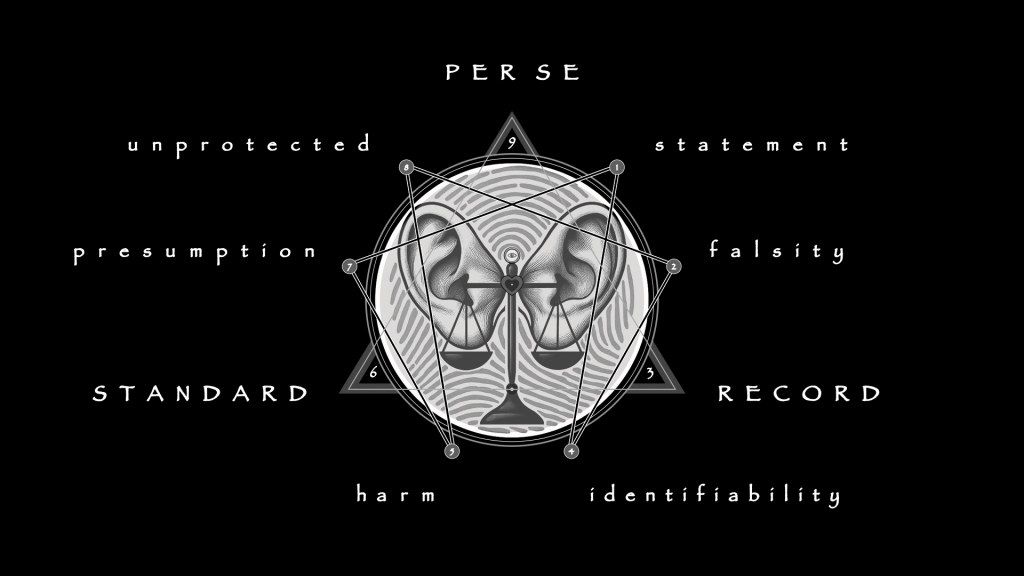
Defenses are predictable. Defendants will claim truth, opinion, privilege, or consent. Each defense has its counter. Truth must match the sting of the statement. Opinion that implies undisclosed facts remains actionable. Privilege evaporates when malice is shown. Consent collapses when scope is exceeded. Retractions mitigate only when they are timely and prominent. None of these defenses shield conduct when evidence of malice is present.
These doctrines are not abstract. They map directly onto the composites already described. The driveway scream, the custody filing, and the property manager’s letter each meet the elements of publication, falsity, identification, and harm. Each qualifies as defamation per se. Each clears the bar for liability. The evidence does not consist of anecdotes. The evidence consists of patterns repeated with knowledge of consequence.
The slope of Fe-Malice steepens as the pattern accumulates. What appears at first to be isolated antics—screaming in stores, boilerplate in custody files, or gossip laundered into official notices—are not marginal events. Each is a point on a demand curve. Every case that relies on gender-affirmative justice adds load to the system and incentivizes the next. The slope becomes steeper. The caseload multiplies. Police resources are drained. Courts become clogged with repetitive disputes. Communities fracture under constant suspicion.
The strategy of mouth first and consequences later no longer functions as indulgence. Every phone camera now operates as an affidavit. Every viral outburst can be entered as a deposition. Every letter that republishes dismissed allegations is libel with malice. Reckless expression becomes evidence. The cultural indulgence of female malice becomes a prosecutable record.
The demand curve bends upward more sharply with every year. What once seemed niche becomes common. What once seemed private becomes public record. Gender-affirmative justice feeds its own caseload, because each precedent encourages the next. Institutions that indulge malice today find themselves overwhelmed tomorrow. When accusations accumulate faster than evidence, the law itself risks inversion. Malice becomes mistaken for justice, and accusation becomes indistinguishable from proof.
Cultural correction is not cruelty. Slut-shaming once stabilized reckless behavior by imposing cost where risk was ignored. The practice imposed restraint that benefited men, women, and children. In the same way, female accountability in court now stabilizes cultural markets by punishing reckless accusation. Without it, Fe-Malice corrodes schools, courts, neighborhoods, and families. Without it, malice becomes jurisprudence.
Fe-Malice is would-be iron law that, left unchecked, becomes structure. The pattern becomes policy. Policy becomes culture. Culture becomes collapse. The warning is plain: accountability imposed now prevents correction imposed later. The record is ready. The question is whether institutions will act before collapse makes the choice for them.

Leave a comment