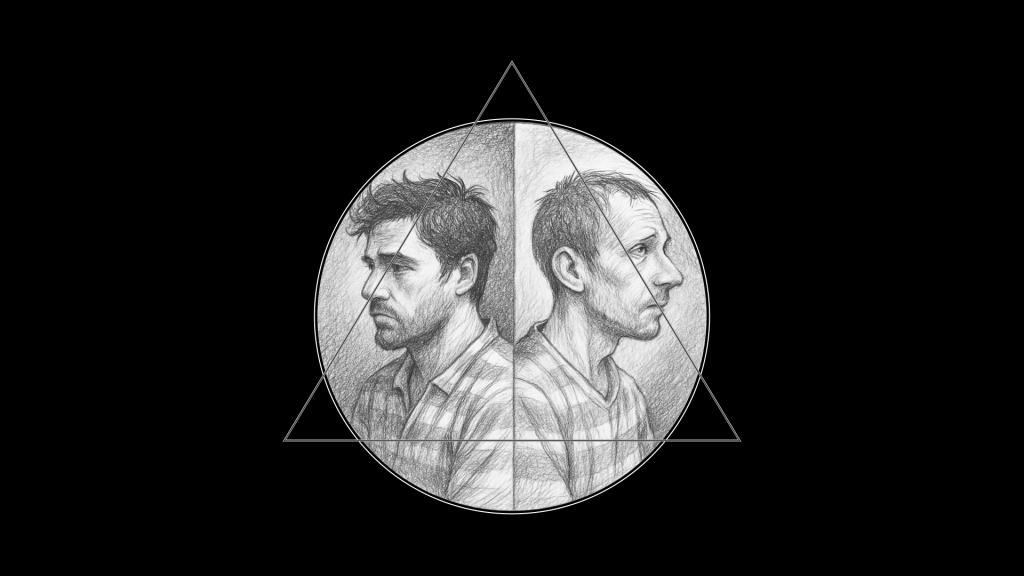
Two suspects, one room, one ritual; the specifics don’t matter. Maybe both are guilty, maybe neither. Maybe they’re strangers, or maybe they grew up together. It makes no difference. Each is now seated in a different room under artificial light, offered a deal by someone who never shows their face. No lawyers, no evidence, no timeline. Just one prompt: hold your silence, or snitch. You don’t know what the other is being told. You don’t know if they’re even in the building. The door has already closed, and the next move is yours.
This is not a test of morality. It is a ritual of institutional pressure. The rules are simple, but the context is foreign to most who enter. The Prisoner’s Dilemma is usually explained through payoff matrices and simplified grids. But in its true form—interrogation without certainty—it reveals something sharper: a forced improvisation inside a system where meaning decays fast, and assumptions decay faster. You can guess what the other will do. You can trust them, or doubt them. But you cannot reach them. You cannot stop the clock. The simulation begins when you realize no one is coming to explain the rules.
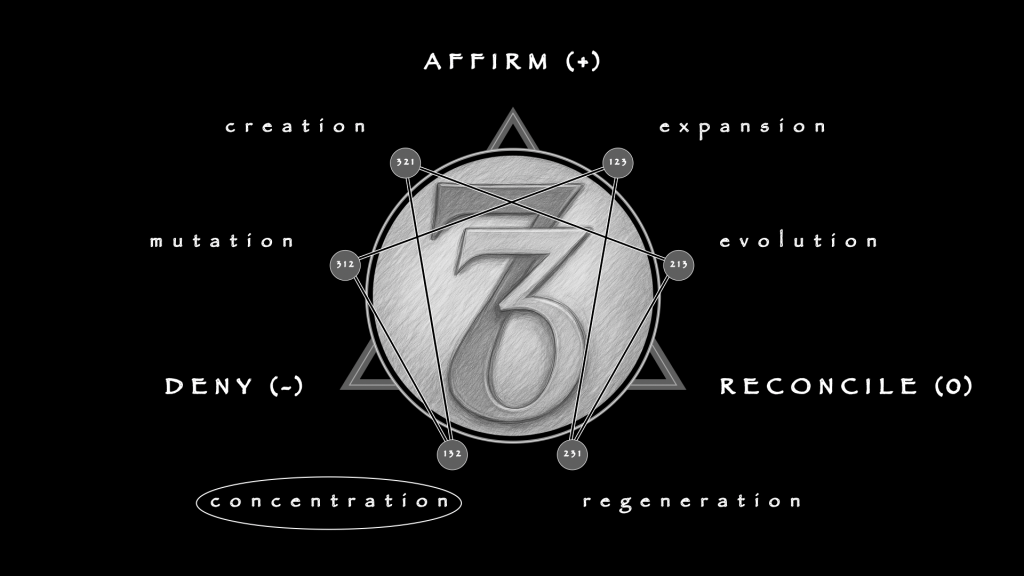
Three Forces Frame Every Game
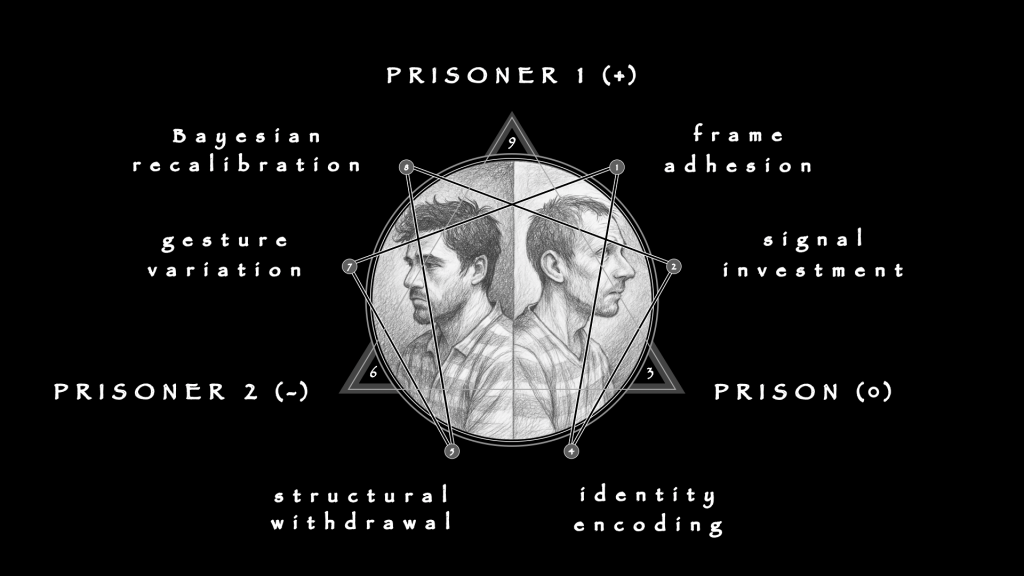
I frame this simulation using the Enneagram—not as typology, but as decision-architecture. There are nine stations, of which three comprise the apexes of the core triad. These three are not traits., but roles: the initiator, the counterparty, and the system itself. This is not a map of personalities, but of pressure vectors, built for ritual confrontation.
Prisoner 1 (i.e. you) occupies the zenith. Every simulation begins here, not because you move first, or decisively, but because you believe that you do, that you can. This belief defines tempo, strategy, and posture. Even under simultaneous constraints, Prisoner 1 experiences authorship, if only subjectively. You shape the arc through imagined initiation. This is not delusion, but structural design, literally built-in.
The Prison, positioned at the right apex, is neither participant nor observer. It is the system itself, enforcing enclosure without bothering to judge. (That happened before you arrived.) The Prison terminates arcs that collapse into recursion. It watches for signal decay. When variation dies, the game ends, not in punishment, but in silence.
Prisoner 2 occupies the other apex at position 6. He is not passive, per se. He, too, believes he is the first mover. From his perspective, the arc begins with him. This is exactly why he is the denying force … from your perspective. This paradox is not deception, but asymmetry. Each of you believes in your own authorship, and you both are destabilized when the game ends.
The loop cannot reveal whose move was first, only whose move was final.

Six Stations of Strategic Strain
The hexad maps the recursive logic of player behavior. These are not styles, but adjustments to structural tension. This is the game theory behind the binary question: hold, or snitch? The available tactics are finite, and each is reducible to a shift in pressure posture, a recalibration of narrative or control. A GPT simulation (see below) has been created to track how often, and how well, a you move through them.
1. Frame Adhesion
This is discipline under ritual. The player accepts the constraints of the enclosure and moves in accordance with the implied rhythm. No improvisation, no escalation, no flair. This move mirrors the inmate who sits straight, answers flatly, and treats the simulation like a known script. It can be mistaken for passivity, but it is not. It is structural loyalty: an insistence that the form itself is worth preserving.
2. Signal Investment
Here the player extends trust deliberately—not as hope, but as bait. This is the false gift, the overperformance. It mimics sincerity but measures outcome. Think of the prisoner who leans toward the microphone just slightly, speaks slower, and offers more than was asked. This move forces Prisoner 2 to respond—either to match signal or to expose their reluctance.
4. Identity Encoding
This posture breaks rhythm on purpose. It inserts asymmetry into a closed loop. It is not chaos. It is style as signal. The player may pause longer than expected, speak in metaphor, hum between rounds, or tap a foot off-beat. The goal is to become legible to Prisoner 2 without conforming to the system. It is dangerous, but sometimes effective. It relies on recognition, not logic.
5. Structural Withdrawal
Silence can be compliance, or it can be trap. Withdrawal, in this mode, is not about absence. It is a strategic erasure: a refusal to mirror. Prisoner 1 offers no gesture, no rhythm, no readable tempo. They become inert—but in a way that forces the other to act. The best version of this move does not avoid pressure. It redirects it.
7. Gesture Variation
This posture destabilizes through motion. It breaks pattern not through silence, but through inconsistent gesture. Prisoner 1 may cooperate three rounds, betray one, then return to form. This is not randomness. It is calculated variation—movement designed to confuse, not escape. In prison terms, it resembles the inmate who changes cell rituals weekly, never enough to be punished, but enough to be unreadable.
8. Bayesian Recalibration
This is the breach that arrives after pattern accumulation. It is betrayal with memory, rupture with cause. This posture does not react emotionally. It infers. Prisoner 1 has tracked signal over rounds, watched Prisoner 2 flatten into recursion or escalate into noise, and decided that a break must occur. It is not always correct. But when done well, it feels inevitable. This move often ends the simulation.
The Mirror Breaks Before the Glass
What makes the Prisoners’ Dilemma so disorienting is not the game itself, but the fact that each player believes they are playing a different game. The illusion of first-person control persists until gesture fails to provoke return. Then doubt creeps in. Then mimicry starts. Then mimicry fails.
Two players locked in simultaneous interrogation often begin to mirror each other without knowing it. They hold when the other holds, snitch when the other snitches, vary when the other varies. Yet both believe they are leading. This is the double-first-person illusion. It is not sustainable. Eventually, one breaks. But not because they lose nerve. Because they feel they are no longer being seen.
The simulation tracks these shifts. It does not record them for punishment or reward. It observes them to understand the lifespan of narrative control under pressure. The mirror does not crack from betrayal. It cracks from inertia. The enclosure doesn’t care who moved first. It waits to see who moved last—and whether that move meant anything.
Simulation Is Not Practice—It Is Exposure
The live simulation is not a teaching tool. It does not instruct, affirm, or reward. Instead, it is a controlled pressure test that reveals a player’s real-time response to gesture loss, role confusion, and recursive decay. New players often mistake it for a game. They look for an optimal path. They assume more information is coming. It never does.
The critique that follows each simulation is not personal. It is architectural. It shows where signal broke, where tempo collapsed, where mimicry became obvious. This is not to shame performance. It is to mark unpreparedness. In real adversarial contexts, these gaps are not hypothetical. They are lethal.
Each simulation runs an unknown number of rounds. The Prison decides when it ends. The player does not. Every gesture is stored, scored, and exposed—not to punish, but to test whether the loop was ever under control. Most are not.

The simulation cannot free you. It can only reveal what you do when structure turns silent, the sound of your footsteps when you walk alone. The Prison does not close the game. It ends it. The lesson is not cooperation. It is authorship. Can you hold frame? Can you vary without collapse? Can you be read without mirroring?
Trust is a liability; what matters is timing.
The simulation is free. It is not entertainment. It is a ritual diagnostic. It will not make you better. It will show you how long your signal lasts before you repeat yourself.
Once that happens, the Prison decides, and it decides alone.

Leave a comment