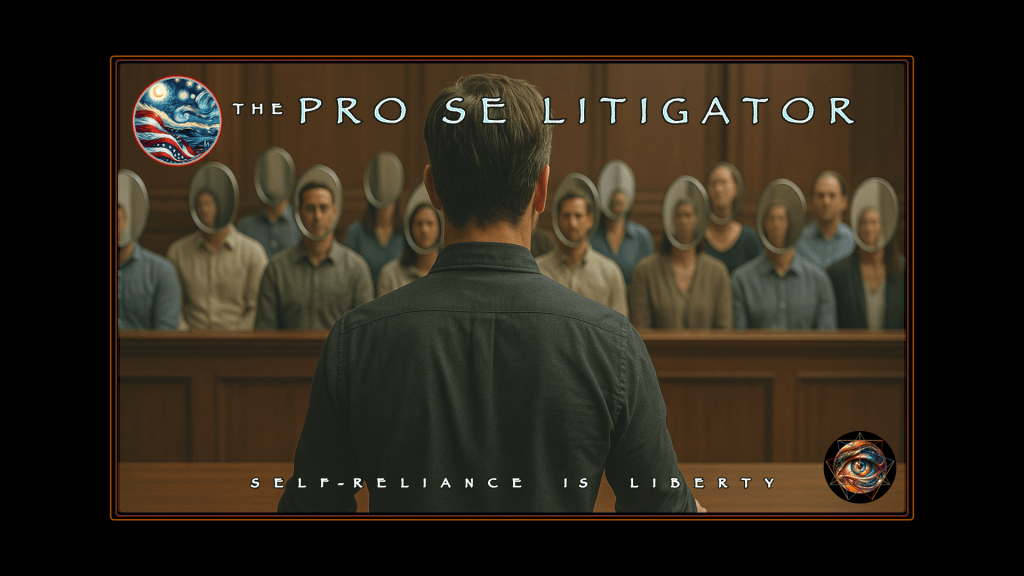
The courtroom appears static. Its rituals, language, and spatial design signal control. But control is not given. It is performed, contested, and often lost before the trial begins. The real contest occurs at the moment of narrative entry. That moment is voir dire. Everything else follows as consequence.
The Jury is not an audience. It is a shaped, and shaping, medium. Every narrative force—accusation, defense, testimony, evidence—must pass through it. The verdict is not a conclusion, but a signal refracted through structure. Whoever installs that structure first controls what the mirror returns.
A trial does not begin with facts. It begins with filtration. Voir dire is often mistaken for selection, as though fairness could be found by inquiry. But the function is not to select. It is to remove those who cannot carry a narrative intact. Jurors do not arrive neutral. They arrive shaped, loaded, and reactive. The purpose of voir dire is to locate fracture points before contact occurs.
Fracture is not visible in opinion. It is visible in reflex. A juror who answers with calm language but stiff posture is a delayed rupture. A juror who performs balance may already be masking opposition. Instability must be mapped before narrative engagement begins. Once a story is introduced, interpretive distortion becomes difficult to reverse. The story either embeds or shatters.
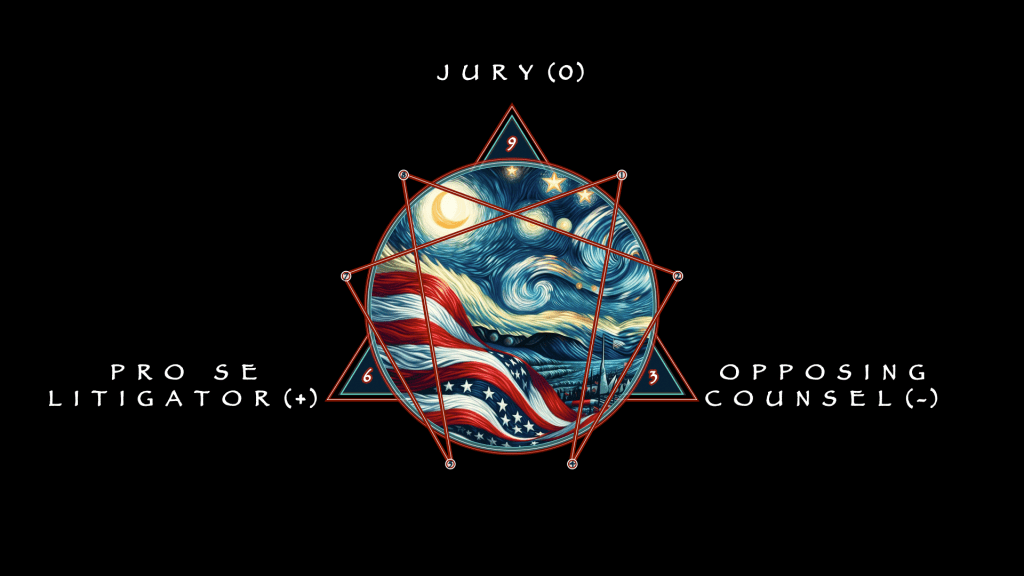
Here, for the benefit of strategic analysis and preparation, is the Logos of Jury Management. It is NOT legal advice, and guarantees no outcome.
At the Zenith, the Jury (0) reconciles the relation. It is the vessel in which opposing forces must coexist—the point of maximum attachment, since its decision is treated as the act that rebalances justice for the whole. Meanwhile, the right apex, the locus of maximum attention, is held by Opposing Counsel (-), the denying force. Here authority, sanctioned language, and institutional gravity act as constraint. Against this, at the locus of maximum confidence, stands the Pro Se Litigator (+), the affirmative force. From him, autonomy flows outward in an act asserted without borrowed sanction. The two are not symmetrical. They exist only in relation to the vessel that contains them.
Note the absence of judges; they present an altogether different puzzle.
Trials begin and end with the Jury, as both the medium and the result. Denial without initiative hardens into stasis; initiative without denial scatters into noise. What the Jury produces is not opinion but coherence: a structure that can hold both constraint and assertion without collapse. The verdict is not the triumph of one side but the return of what the vessel was able to reconcile.
The Six Axes of Narrative Risk comprise a live diagnostic protocol.
Each isolates a fault line—cognitive, emotional, ideological—through which jurors either maintain or lose structural coherence. But axes alone do not control the room. Control is installed through rhythm. Voir dire must not feel like inquiry. It must feel like a shift in gravitational center. Every question must destabilize performance and reveal structure underneath.
The triad defines relation, but relation is not enough. Voir dire shows that even flawless geometry can crack under hidden stresses. Jurors arrive already bent by reflex, bias, and fear. If the figure explains how the trial should hold, the axes reveal where it may fail.
Jurors rehearse. They arrive with preloaded answers designed to signal balance, patience, and civic virtue. That performance must be broken. The goal is not to trick. It is to stress the interpretive frame until the mask slips. Ask about institutional failure, not trust. Ask about loyalty when silence was required. Ask not “Do you believe in fairness?”—ask what fairness costs when it hurts someone they know.
Control is inserted through modulation. Questions arrive calm, then sharp. Light, then precise. The Pro Se Litigator must manage silence as signal. A pause longer than necessary becomes pressure. A flat expression under a performative answer becomes contrast. Language traps are not gotchas. They are mirrors angled slightly to show the image bending. The juror who self-corrects mid-answer has just revealed where the axis holds—and where it doesn’t.
Sovereignty fractures when autonomy provokes rejection. The juror who fails this axis cannot process self-governance as legitimate. Action without sanction reads as defiance, not structure. The Pro Se Litigator becomes a provocation, not a participant. This juror does not ask, “Is it true?” They ask, “Who gave them the right to say it?”
During voir dire, do not test with questions about fairness. Ask who they trust in institutional failure. If they name only formal channels, they will fracture under narrative independence. In trial, they retreat from testimony grounded in self-direction. By closing, the burden is to translate autonomy into discipline. The Pro Se Litigator must appear not as a rule-breaker, but as one who obeyed law even when the system did not.
Reputation collapses in the presence of rumor. The juror who fails here treats accusation as signal. They rely on a form of social gravity—what draws attention must carry truth. Guilt is not proven. It is inferred from tone, posture, coverage, reaction. The harm is ambient, not adjudicated.
Voir dire pressure comes through the side door. Ask what happens when someone is wrongly accused. Watch how they answer—who they protect, and how. In trial, they fixate on character, not conduct. Testimony that implies damage to standing will activate them. They will want to resolve that damage, even if it means surrendering the facts. Closing must not defend character. It must isolate the attack on it, and hold the Jury accountable for responding to the act, not the echo.
Loyalty fails when duty becomes a trap. This axis collapses around moral rigidity—an inability to comprehend principled departure. The Pro Se Litigator who refused counsel, left an institution, or severed a bond will be read not as independent but disloyal. These jurors want to believe trust should never be broken, even when survival requires it.
In voir dire, ask about estrangement. Not what caused it, but whether it was justified. At trial, stories of rupture—leaving a job, refusing an order, rejecting a role—will destabilize them. They seek reunification, not clarity. Closing must frame separation not as damage, but as debt paid in full. The only way to restore moral order is to respect the boundary that held.
Credibility fractures when rank replaces truth. Jurors who fail this axis do not weigh evidence. They weigh titles. The officer, the expert, the official—these roles carry presumptive gravity. The Pro Se Litigator, by contrast, arrives with no uniform, no credentials, no borrowed power.
Voir dire must expose the reflex, not the logic. Ask who they trust first. If they cannot decouple process from authority, their axis is misaligned. At trial, this juror will give unearned deference to anyone who speaks with official posture. Their structure resists counter-narratives unless delivered by someone with institutional height. Closing must collapse the role and elevate the frame. Obedience to process—not title—becomes the moral high ground.
Entrenchment holds the memory of crisis. It is not fear, but residue. These jurors still carry emergency logic: the belief that overreach was justified because times were hard. They forgive coercion if it arrived during collapse. They excuse contradiction as adaptation. The Pro Se Litigator, who often arises from such moments, becomes a threat to the order they believe was necessary.
Ask them, in voir dire, what justified what. Let them narrate the trade-offs they accepted. Their fracture point reveals itself in hindsight. At trial, they resist frames that question past authority. They interpret challenge as disrespect for survival. In closing, the contradiction must be surfaced without scorn. It must be shown that not all decisions made under pressure were made under necessity. Some were made in opportunity—and must be seen as such.
Territory fractures on contact. The frame is not rejected for its logic, but for its origin. These jurors do not accept what arrives from outside. They require narrative familiarity. If the Pro Se Litigator speaks a different language—geographically, culturally, rhetorically—the message collapses before it begins.
There is little to ask directly. Instead, listen for substitution: when they say “That’s not how we do it,” what they mean is “That’s not how I recognize truth.” Trial will show this axis through discomfort, especially when local norms are disrupted. The only move is localization. Closing must install the story inside the juror’s world—not by translation, but by transposition. The foreign must become familiar before belief becomes possible.
These axes must be rotated during voir dire, not in sequence, but in response to emergent posture. One juror may fracture on sovereignty. Another may trigger on loyalty. The goal is not to find approval. It is to locate alignment. Jurors who pass multiple axes can hold the frame under stress. Those who fail must be excised or reoriented before trial structure forms.

Opposing Counsel will mimic, shadow, or dilute. This is predictable. Their probes often reveal not their strategy, but their fear. They will attempt to reframe autonomy as arrogance, principle as grievance, estrangement as dysfunction. Their failure is diagnostic. Leave language traps. When they echo a vector, let them trip its logic. A juror who passes your axis but rejects their inversion becomes an anchor.
When voir dire is complete, no new control can be installed. The frame is fixed. Jurors interpret from within the structure they carry. Testimony is filtered, not received. The trial becomes less about evidence and more about pressure—what breaks, what holds, what shifts under contradiction. A structurally misaligned juror does not change their mind. They reinterpret until collapse.
Your closing argument must therefore not be a summation. It is a mirror check. Jurors must see the frame they already accepted. Any attempt to introduce new rhythm, tone, or story will trigger resistance. The closing confirms what the body has already learned. If voir dire was successful, closing is not persuasion. It is return.
A verdict does not reveal what the Jury believes. It reveals what the Jury was able to reconcile. That reconciliation is not a function of truth. It is the result of structural control. The vessel does not decide; it reflects the alignment it was shaped to contain. When risk is mapped, verdicts arrive with precision—even when they surprise. The one who installs the frame decides what survives contact. The one who fails blames the glass. But the structure does not lie. It only returns what it was asked to carry.
This is why strong cases fracture. Not because they lack clarity or force, but because the Jury was misbuilt. The story enters, but the vessel distorts. Alignment fails. Narrative torsion exceeds capacity. What exits is not judgment. It is debris. Jurors are not arbiters. They are carriers. Misfit is fatal. No testimony can recalibrate what voir dire failed to test. Once fracture is embedded, truth is no longer transmissible. It warps. It ghosts. It returns bent.
The Pro Se Litigator must act before story begins. Not to win belief—but to shape the structure belief will occupy. Control exists only in the preconditions: what the room can hold, and what it cannot survive. A trial is not a contest of evidence. It is a test of load under stress. If misalignment is present, pressure reveals it—not by reversal, but by incoherence. The frame fails, and collapse appears only in its outcome.
The mirror does not lie, but it bends. It refracts what it cannot contain. And once bent, nothing holds. Only the shape of collapse remains. Every bent mirror sets the grammar of what follows. The question is never whether the mirror bends, but who fixes the angle first.


Leave a comment