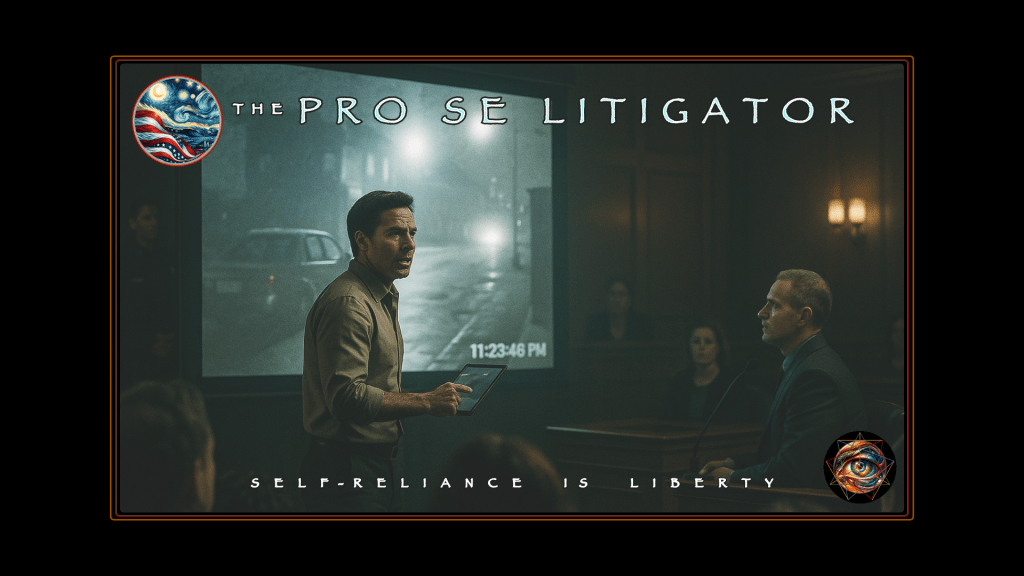
Modern trials still pretend to be rituals of reason. Judges speak of impartial analysis, counsel argue over burdens of proof, and juries are instructed to deliberate logically. The reality is that courtroom theater—real, persuasive, subconscious theater—depends less on logic than on performance. Like any high-stakes performance, it lives and dies by staging.
Enter trial technology: not as a convenience, nor as a measure of audience satisfaction per se, but as a weapon.
If you walk into a courtroom with a well-timed demonstrative, the result is a mise-en-scène that will outlive any testimony. Jurors do not retain transcript-level detail. They remember images, cadence, and events. A well-placed highlight, a synchronized transcript, or a zoom-in on a timestamp becomes the story—not the witness. The facts might be dry, but the show itself is the sizzle that sells.
The Neuropsychology of Visual Dominance
The human brain processes images ±60,000 times faster than text, creating immediate cognitive anchors that shape everything downstream. Jurors retain 85% of what they see versus only 15% of what they hear in traditional courtrooms. After 72 hours—the duration of many trials—oral-only information retention plummets to 10%, while visual-plus-oral retention remains at 65%. This is not marginal variance. This is the difference between verdict and acquittal, liability and dismissal.
Visual evidence triggers prediction errors in the brain, forcing involuntary reexamination of preconceptions. Well-executed surprise through visual presentation temporarily disables confirmation bias filters. Demonstrative evidence creates “truthiness”—the sensation that something is true even when unsupported, with effects persisting up to two days. Jurors will not tell you this is happening. They do not know it is happening. The mind encodes in visuals, then justifies with reason after the fact. What is shown becomes what they believe they heard. Trial tech gives the operator the scalpel to make that incision—precise, permanent, and bloodless.
The psychological research is unequivocal: demonstrative evidence does not supplement testimony—it dominates memory formation and overwrites verbal information.
When jurors deliberate, they are not recalling what witnesses said. They are reconstructing the visual narrative embedded in their consciousness. Studies of jury decision-making confirm that jurors use an explanation-based process to construct narrative frameworks, and those narratives are overwhelmingly visual in nature. This creates an asymmetry that borders on unfair advantage: the attorney who masters trial technology controls the encoding process—the moment when sensory input becomes memory. By the time opposing counsel stands to respond, the damage is done. The jury has already filed the presenter’s version in permanent storage, tagged with emotional metadata that makes it feel true regardless of subsequent contradiction.
The Solo Practitioner’s Arsenal
There is a persistent misconception that trial software is for corporate firms with giant budgets. That is either a lie or a bluff. The democratization of trial technology has placed cognitive weapons previously available only to elite litigation teams into the hands of anyone willing to invest time mastering the mechanics.
iPads are admissible memory control, and video depositions can break a witness better than cross. Screen-share in Zoom court can overwrite live statements. The Pro Se Litigator who understands this is not under-equipped. He is untouchable—because he decides what the jury remembers, and when.
Zoom’s screen-share feature allows complete control of every participant’s visual field, eliminating courtroom distractions. Virtual platforms enable spotlight view to designate which speakers appear on screen, directing attention with surgical precision. iPad apps eliminate the need for trial technicians—saving thousands while maintaining direct connection with the jury.
Trial presentation apps feature intuitive interfaces designed for litigators, not technicians, to transform the iPad from a passive document viewer to an active courtroom intelligence system.
- TrialPad provides full courtroom presentation capabilities: wireless display, real-time annotation, exhibit organization, and video integration.
- iTrial offers comparable features with cloud import and unlimited support at a fraction of traditional system costs.
Meanwhile, AI-enhanced speech recognition can monitor witness testimony to surface relevant exhibits based on keywords or topics, allowing counsel to respond instantly to unexpected testimony without disrupting courtroom flow.
These systems excel at timeline construction, automatically organizing chronological evidence sequences that adapt as new testimony emerges. Advanced implementations incorporate adaptive learning systems that improve performance based on individual attorney preferences and case-specific patterns, learning which exhibits prove most persuasive for specific argument types and automatically reorganizing presentation sequences based on effectiveness metrics derived from previous trials.
Several iPad-compatible, enterprise‑grade tools offer real-time meeting capture with AI-powered transcription, summarization, and evidence-management capabilities. Some include automated topic mapping, and keyword tracking. Apps vary, however user should not overlook on‑device processing, export audit trails, or enterprise‑grade encryption, as needed.
- Otter.ai – transcribes real‑time conversations and syncs across iPhone, iPad, and Mac, features speaker identification, meeting summary generation, and searchable smart notes, with native Safari and Zoom integration for court teleconferences.
- Notta Memo – delivers high‑precision transcription with automatic summary bullets, customizable timestamps, and output formats that export cleanly into legal exhibits or affidavit annotations.
- Jamie AI – adds thread‑based reasoning for reconstructing testimony sequences during prep.
For those willing to deepen technical capacity, custom applications represent the next frontier.
Modern iOS development frameworks like SwiftUI and Core ML enable attorneys to create sophisticated apps that leverage machine learning for document analysis, witness preparation, and dynamic courtroom presentations. Document management can be enhanced through natural language processing algorithms that automatically categorize exhibits, extract key dates and parties, and generate searchable metadata from scanned materials. Core ML’s on-device processing ensures that sensitive case information never leaves the iPad, addressing attorney-client privilege concerns while enabling real-time document analysis during depositions or trial preparation.
The courtroom has never been about “getting your side heard.” As always, stage your version as the only scene worth remembering. The rest becomes background noise.
Regulation and Adaptation
Virtual courtrooms have amplified cognitive effects exponentially. When all participants share a video interface, the attorney who controls screen content literally controls reality for every observer simultaneously. There is no wandering attention, no side conversations, no physical courtroom dynamics to dilute the message. The screen is the trial, and whoever commands the screen commands the verdict.
Federal and state courts increasingly recognize that demonstrative technology requires judicial oversight beyond traditional evidence rules. The most progressive jurisdictions now require pre-trial conferences specifically addressing digital presentations, mandating that attorneys provide detailed technical specifications for any computer-generated evidence including software versions, data sources, and rendering assumptions. This proactive approach allows courts to establish clear boundaries before jury exposure creates irreversible prejudicial effects.
Courts now routinely establish time restrictions for individual exhibits, mandate advance notice of presentation sequences, and reserve authority to interrupt or modify technological demonstrations that appear to exceed probative value. Virtual environments have accelerated regulatory development as courts adapt traditional evidence rules to screen-sharing, document collaboration, and remote witness management technologies. These virtual standards increasingly influence in-person courtroom expectations, with judges expecting the same level of technological preparation and smooth execution regardless of format.
Courtroom infrastructure limitations create practical regulatory constraints that attorneys must navigate regardless of technological sophistication. State superior courts often lack the electrical outlets, wireless networks, and projection capabilities that federal facilities provide, requiring practitioners to coordinate equipment logistics weeks before trial dates. The “rule of threes” positioning protocol has emerged as a judicial preference for managing juror attention during visual presentations: positioning display screens to create triangular sight lines between witness stands, counsel podiums, and jury boxes that prevent awkward viewing angles or neck strain that could create unconscious bias against the presenting party.
Three Cases Define the Battlefield
Three landmark cases have sketched the current outer boundaries of admissibility and, by extension, the limits and possibilities of technological power.
- In State v. Spain, 123 P.3d 862 (Wash. Ct. App. 2005), the court held that computer simulations introduced as substantive evidence cannot simply look impressive—they must be generated from programs broadly accepted as valid for the task. The decision prioritized software licensing, data completeness, routineness of application, and a four-part authentication addressing completeness, manipulation complexity, routineness, and verifiability. The lesson: advantage goes not just to the artful, but to the disciplined, to those who can satisfy rigorous validation as easily as they can command attention.
- Lorraine v. Markel (D. Md. 2007) is widely cited for mapping the entire network of electronic evidence foundation and, in so doing, exposing widespread attorney failure to satisfy even minimal requirements for authentication and admissibility. It is no longer sufficient to be a digital showman; survival depends on technical competence, documentation, and anticipation of opposing challenge.
- In Tookes v. Port Auth. of N.Y. & N.J., 2015 WL 5228902 (E.D.N.Y. Sept. 8, 2015), the court rejected the idea that only the wealthy are permitted quality demonstratives. Awarding costs for computer-generated injury visuals, the court recognized the effectiveness and equity of modern, affordable digital evidence. The doctrine: effectiveness and reasonableness, not tradition, are now the guideposts.
This triad forms the new landscape. The well-armed advocate defensively anticipates Spain, builds the Lorraine foundation, and presses the Tookes innovation. There are no guarantees, of course, but considerable asymmetry exists for those who adapt faster than their opponents.
Ethics of Manipulation
The ethical implications deserve scrutiny. Some legal scholars warn that demonstrative evidence can cross the line from persuasion to distortion, creating “cognitive overvaluing” where memorable visuals displace more probative but less dramatic evidence. Courts should theoretically guard against this by excluding prejudicial demonstrations. However, that protection assumes judges can accurately assess psychological impact—an assumption contradicted by research showing that legal training does not immunize decision-makers from anchoring effects and visual bias.
The practical reality is that trial technology creates a new species of advocacy, one that operates at the subconscious level where traditional cross-examination and rebuttal cannot reach. When executed with precision, it does not argue for a conclusion. It installs the conclusion directly into juror memory, complete with the illusion that they reached it through independent reasoning.
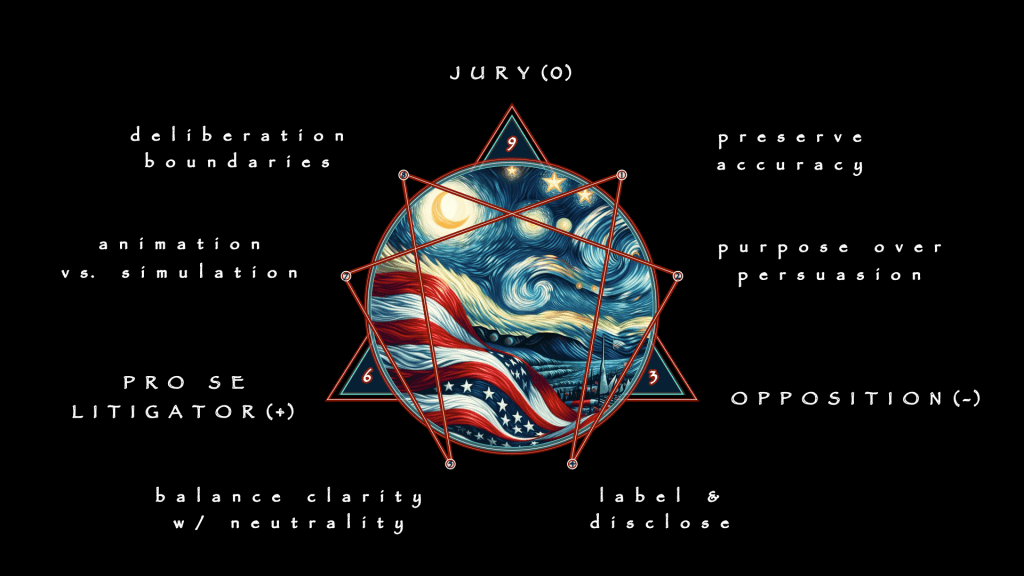
- Preserve Accuracy: confirm every visual is a fair, accurate depiction of admitted or admissible evidence; avoid embellishments that alter scale, color, or context without explicit labeling.
- Purpose Over Persuasion: ensure the demonstrative truly assists witness testimony or juror comprehension, aligning with Rules 611 and 1006 rather than substituting for proof.
- Label & Disclose: mark “Demonstrative Aid” when appropriate; provide clear legends, units, timelines, and data sources; disclose processing steps for images, audio, or video edits.
- Balance Clarity w/ Neutrality: use clean layouts, readable fonts, and consistent color schemes; avoid sensational imagery that risks Rule 403 exclusion for unfair prejudice.
- Animation vs. Simulation: if modeling physical processes, be prepared to show accepted methods, complete data, and verifiable outputs; otherwise treat as an illustration of testimony.
- Deliberation Boundaries: anticipate limits on sending demonstratives to the jury room unless permitted by rule or order (noting evolving guidance under Rule 107 on illustrative aids).
Deploying these tools ethically is not a concession to procedural piety, but a recognition that the edge—real, lasting, and legally defensible—goes to the advocate who can satisfy scrutiny as deftly as they command narrative.
Natural Selection
The DNA of this arms race is not found in legal treatises, but in the playbooks of advertising, theater, and debate. Top public speakers deploy the “triangle technique,” anchoring their movement between judge, jury, and witness to vary focus and demonstrate control. Advertising strategy has always known that the strongest message is not the most detailed, but the most visually and emotionally resonant—timed, repeated, and reinforced by every available channel. Top debaters force narrative momentum by carefully choreographing the order in which evidence is delivered, saving their strongest visual or emotional moment for when the opposition is most exposed.
The etiquette of persuasion has morphed accordingly.
In hybrid or virtual settings, poise is measured in technical fluency: seamless transitions, advance file sharing, synchronized handoffs with court staff, and anticipation of equipment failure have replaced deference and decorum as weight-bearing signals of professional competence. The new etiquette is technical, not performative. Those who show uncertainty in file formats, version tracking, or response to technical glitches are signaling weakness, not humility.
None of this is about leveling the playing field. The rise of Pro Se Litigators is not a side effect of austerity, but a function of the system adapting to its new dominant form. Today, in many jurisdictions, at least half of all civil filings are pro se, and the legal infrastructure has adapted—from digital docketing and expanded judicial discretion to courtroom processes that increasingly reward agility over pedigree. The question is not whether equal opportunity exists, but how well the new operator can exploit it.
For the Pro Se Litigator willing to invest the time to master these tools, the democratization is profound. The same cognitive weapons previously available only to corporate litigation teams now fit in a tablet that costs less than a day of expert witness fees. The learning curve is manageable. Most trial presentation apps feature intuitive interfaces designed for attorneys, not technicians.
The strategic imperative is clear: either master trial technology or concede memory control to your opponent. There is no neutral ground. Every moment the jury spends looking at the opposing presentation instead is a moment they are encoding someone else’s narrative. And in the theater of the courtroom, the version they remember is the only version that matters.
This is not advocacy for deception or manipulation—it is recognition of how human cognition actually functions under courtroom conditions. Jurors cannot retain transcript-level detail across days or weeks of testimony. They need cognitive frameworks, visual anchors, and narrative coherence. Trial technology provides those frameworks. The only question is whether the operator will be the architect or the victim of that construction process.
The spotlight operator controls what the audience sees, when they see it, and how they remember it. In modern trials, that operator carries an iPad, not a law degree from an elite firm. And that should terrify every attorney still relying on printed exhibits and oral argument alone.


Leave a comment