The Invisible Edge
The middle-class man today operates inside a surveillance apparatus that his grandfather could not have imagined. Algorithms track his purchases, his commute, his digital footprints. Employers monitor his productivity metrics in real time. The state maintains databases that cross-reference his income, his property, his associations. Social media platforms archive every public declaration, every photograph, every minor opinion that seemed harmless at the time. This infrastructure creates exposure that cannot be fully avoided, but it can be managed through strategic control of what remains visible.
Visibility functions as a tax on capability. The man who advertises physical competence through clothing, speech patterns, or online content invites testing from strangers who need to establish their own position in a collapsing hierarchy. The man who signals financial success through consumption choices, residential location, or casual remarks becomes a target for grifters, resentful peers, regulatory attention, and family members whose emergencies always arrive at the moment his savings become known. Display of strength or wealth in contemporary conditions resembles carrying raw meat through a dog park. The environment punishes transparency.
The alternative requires internalizing a behavioral pattern that most men find intolerable. Genuine capability must migrate beneath a surface that reads as unremarkable, even slightly incompetent, to casual observers. This is not modesty. Modesty still signals awareness of status games and implies participation in the same ranking system that governs the visible majority. The posture described here operates differently, as a kind of studied disinterest in being legible at all.
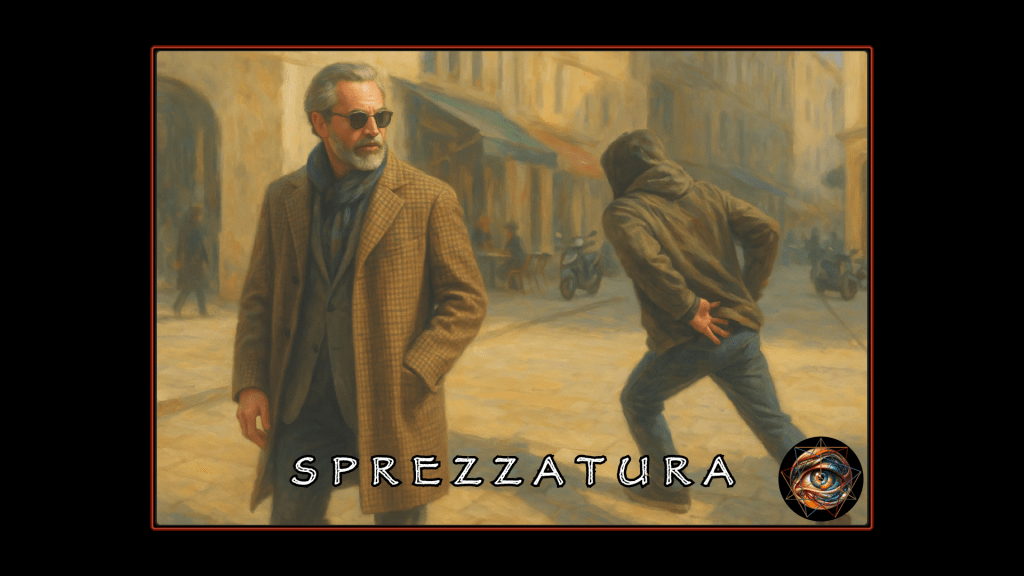
Baldassare Castiglione wrote “The Book of the Courtier” (1528) for Italian aristocracy navigating courts where minor social errors ended bloodlines. His central concept, Sprezzatura, demanded that art never appear as art, that skill never show as skill, that difficult acts seem accidental. Visible strain announced dependence on favor or outcome. The courtier who sweated through performances degraded his position through transparent need.
The relaxed exterior communicated surplus capacity to allies while informing rivals that any contest would unfold on terrain already mastered. The performance required relentless private rehearsal precisely to appear incapable of rehearsing. Mastery concealed its scaffolding because visible architecture invited attack.
Power rests less on raw capability than on management of perception under pressure. The figure who controls visible reactions to strain, risk, and insult exerts leverage over how situations get interpreted. Difficult tasks performed with mild interest begin to feel like natural extensions of an established order. That illusion, repeated over time, converts contingency into destiny.
Violence Without Signature
Training in combat systems delivers survival advantage as institutional protection erodes. Police arrive after events conclude. Legal systems punish defenders nearly as enthusiastically as aggressors. The man who can handle himself possesses an asset that matters more each year as social trust fragments and public spaces become contested terrain.
That asset loses value the moment it becomes publicly known. The visible martial artist attracts challenges from strangers testing themselves, criminals who escalate preemptively to weapons, legal systems that treat trained fighters as inherently culpable. Online documentation creates discoverable evidence prosecutors use to argue premeditation. Gym photography, tournament results, casual sparring mentions all feed data trails that transform self-defense into aggravated assault during jury deliberation.
Historical fencing masters taught sprezzatura as technical principle. Removal of parasitic tension from movement. Visible effort—tensed shoulders, heavy breathing, grimacing—signals lack of mastery. The practitioner drills techniques until unnecessary muscular engagement disappears. The perfect parry looks casual because geometric efficiency replaces force.
Filipino Martial Arts systems like Kali developed for actual interpersonal violence with weapons of opportunity: sticks, blades, bottles, chairs, pens. The training assumes no rules, no referees, no guaranteed survival. Sprezzatura becomes operational necessity rather than aesthetic preference.
The dangerous man cultivates baseline movement containing no combat tells. No martial arts clothing outside training facilities. No conversations referencing fighting except with trusted partners in private. No social media presence connecting name to violence, even controlled violence inside rulesets. The exterior suggests someone who would call police, flee, or negotiate rather than engage.
Situational awareness operates identically. The man scanning for threats, positioning strategically in public spaces, maintaining readiness through posture often signals vigilance through unconscious tells. Predators read those signals and either avoid him or escalate immediately. Training identical scanning patterns while body language projects distraction or mild confusion allows threat assessment to happen behind ordinariness.
Performance extends beyond the physical encounter. When deployment becomes unavoidable, training the face and breath to remain apparently terrified rather than controlled ensures witnesses remember a reluctant participant. The gap between actual capability and visible identity becomes tactical advantage that compounds across time. Legal proceedings favor the man whose entire digital history contradicts the prosecution narrative.
Capital Without Footprint
The middle-class man building wealth navigates systems designed to identify, track, and extract at every threshold. Tax authorities cross-reference databases. Banks report transactions above arbitrary limits. Lifestyle inflation broadcasts rising income to neighbors, family, and colleagues who recalibrate expectations and demands accordingly.
Financial competence that remains invisible enables optionality that visible wealth destroys. The man driving a fifteen-year-old truck while accumulating assets maintains appearance of someone living close to his means. Family members do not request loans. Friends do not suggest expensive group activities. Employers do not assume he can weather salary freezes. Neighbors do not benchmark their status against his consumption.
This is not frugality as virtue. Frugality becomes performance, signaling moral superiority or discipline. The pattern here involves spending deliberately on capability, security, and genuine satisfaction while refusing expenditure on status communication to observers who cannot help and will not protect.
Retail investors telegraph positions through social media validation-seeking, public celebration of wins, lamentation of losses. Institutional capital exploits that legibility systematically. The sophisticated trader removes emotional signaling from execution entirely. No position announcements. No financial discourse on platforms where identity remains traceable. Trading activity happens in darkness while public persona maintains neutrality.
Market sentiment indices function as extraction tools rather than analytical instruments. These aggregated metrics track junk bond spreads, put/call ratios, volatility measures, safe haven demand, momentum indicators, and price strength. The composite packaging encourages retail behavior benefiting institutional positioning. Fear gets coded red at zero. Greed gets coded green at one hundred. The visual presentation induces buying at tops and selling at bottoms.
Counter-sentiment positioning becomes systematic practice. Accumulation happens during Fear cycles when retail sells. Distribution happens during Greed cycles when retail buys. Emotional neutrality during volatility that causes peer panic separates those reading what markets do from those reacting to what markets feel like.
Volume analysis and volatility patterns reveal institutional activity that sentiment surveys cannot capture. Retail focuses on price direction. Institutions track flow. Reading accumulation and distribution through volume spikes rather than price moves operates from entirely different perceptual framework. Decision-making becomes illegible because the variables observed remain invisible to most participants.
Statistical literacy functions as defensive weapon. Financial media, analyst ratings, and public market commentary employ numerical manipulation serving institutional interests. Developing sensitivity to how data presentation creates false narratives becomes essential. Sampling bias, temporal framing, visualization tricks, and selective summarization all appear in reporting designed to move retail capital into positions that institutional players need liquidity to exit.
Corporate structure creates opacity that W-2 employment cannot match. Income routed through LLCs, S-corporations, or trusts generates jurisdictional complexity making actual financial position difficult to assess from outside. The question “how much do you make” stops having simple answers.
Asset class selection determines visibility gradients. Luxury watches, German sedans, and downtown condos scream. Bitcoin in cold storage, farmland held through land trusts, and whole life insurance policies structured as banking instruments hold equivalent value in forms most observers cannot recognize or access through legal discovery. Invisible wealth enables liberty that conspicuous consumption destroys.
The financially secure man who appears middle-class quits jobs that become intolerable without explaining himself. He relocates when conditions deteriorate. He declines social obligations that waste time without requiring the excuse of poverty. His position grants freedom precisely because that position remains hidden from most people in his life.
The Psychological Threshold
Sprezzatura as sustained practice demands psychological transformation most men cannot complete. The strategy requires accepting being underestimated, overlooked, dismissed by people whose opinions seem to matter in the moment. The training partner mocking old gym clothes. The colleague assuming lack of ambition because career goals never surface in conversation. The family member treating you as financially unsuccessful because trappings of success remain absent.
Those judgments create social pressure breaking most attempts at invisibility. Human neurology remains wired for status signaling, for dopamine hits following external validation. The man training combat sports wants recognition for that training. The man building wealth wants acknowledgment of discipline and intelligence. Denying those impulses over years produces specific alienation from consensus reality.
Successfully internalizing sprezzatura means operating from reward structure peers cannot access or understand. External validation stops functioning as primary mechanism. Opinion of the uninitiated becomes background noise. Progress gets measured through private metrics: capability expanding, optionality increasing, vulnerability decreasing. The visible world continues status competitions while infrastructure gets built beneath detection thresholds.
Edge accumulates precisely because the pattern cannot scale. Sprezzatura collapses the moment it becomes common. Value derives entirely from asymmetry. Most men telegraph capabilities, ambitions, financial positions through countless micro-signals that trained observers read effortlessly. That legibility makes them predictable. Predictability makes them exploitable.
The man controlling his surface while developing genuine capability underneath operates in different category entirely. He appears ordinary until circumstances demand otherwise, then returns to ordinariness before observers fully register what occurred. Adversaries attempting extraction or challenge discover resistance they failed to anticipate from targets they misread. Opportunities appear because gatekeepers underestimate preparation or resources.
The final transformation involves severing connection between capability and identity. The dangerous man does not think of himself as dangerous. The financially secure man does not think of himself as wealthy. Competence becomes tool set rather than personality. This psychological distance prevents ego attachment that leads men to defend self-image through displays compromising their position.
Training happens in private. Results remain invisible until deployment becomes necessary. The aftermath erases evidence that capability ever existed. The man skilled in violence appears shaken by the encounter he controlled. The man secure in capital appears concerned by market volatility he exploited. Reality gets managed not through deception but through disciplined suppression of signals that would narrow the gap between what you can do and what others believe you can do.
Most men will never attempt this because the cost in foregone status feels intolerable. Those who sustain it over years discover that invisibility, properly deployed, functions as ultimate asymmetric advantage in a world rewarding transparency with extraction and punishment. The majority performs capability loudly while achieving little. The minority conceals capability completely while building positions that persist across decades. Edge belongs to those willing to be misunderstood by everyone who lacks the training to see what hides in plain sight.


Leave a comment