
A masterpiece of long-form fiction imposes severe formal constraints and refuses to violate them for comfort or convenience. It distributes moral complexity across incompatible perspectives without declaring a winner. Structure functions as argument rather than decoration, forcing the reader to inhabit difficulty rather than observe it from safe distance. The ending transforms understanding rather than summarizing, leaving the reader implicated rather than instructed. Below is one such example, along with five others that occupy different vertices in the same geometry.
- Burr (1973), by Gore Vidal
- Shibumi (1979), by Trevanian
- Winter’s Tale (1983), by Mark Helprin
- Perfume (1985), by Patrick Süsskind
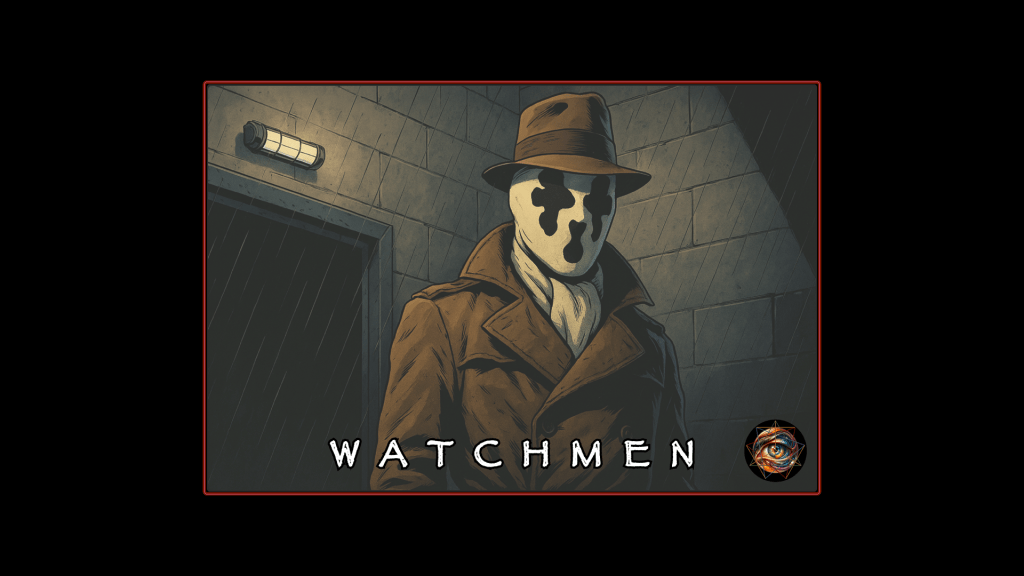
- Watchmen (1987), by Alan Moore and Dave Gibbons
- Shantaram (2003), by Gregory David Roberts
These comprise the test-bed for my work on Advanced Prompting for Novelists. Each reveals exactly where LLMs will drift from moral pressure toward convenient mediocrity unless constrained by formal discipline. A prompting system that cannot replicate these standards produces only surface fluency that quietly replaces corrosive unreliability with honest memoir, restraint with banter, or grotesque precision with therapeutic sentimentality. This narrative niche of machined writing pairs well with my earlier Refusal-Based Prompting method, better explaining how it can defend Story-law against a model’s tendency to smooth, explain, and comfort.
Watchmen presents heroism as historical residue rather than straightforward ideal. The story unfolds in an alternate 1985 where masked vigilantes have been legislated out of public life, nuclear war feels imminent, and the United States extends its power through costumed deterrence and geopolitical brinkmanship. Former heroes drift through this landscape as symbols of an age that no longer trusts them, yet has not fully released them.
The book treats that dissonance as psychological and political problem. Former vigilantes struggle with boredom, impotence, and nostalgia once the Keene Act removes their license to operate. Heroism becomes inseparable from questions concerning masculinity, aging, and professional worth, since the mask now signifies refusal to accept obsolescence. Costumed identity functions as a coping mechanism for individuals who cannot tolerate the discovery that their personal myth of rescue never had jurisdiction over structural violence itself.
Adrian Veidt decides that only an engineered catastrophe can break the Cold War’s deadlock. His plan operates like a surgeon’s knife applied to a social body: deliberate trauma intended to reset immune responses that have turned destructive. The scheme hinges on a single, spectacular act of pseudo-alien aggression that destroys New York and convinces rival superpowers to unite against a fabricated external threat. Millions die so that billions might live. The engineered alien becomes a false god whose worship demands both mass death and perpetual deception.
The narrative distributes its surviving figures across incompatible ethical positions, each contaminated by internal contradiction. Rorschach’s refusal to compromise honors individual lives while courting the annihilation that Veidt’s plan forestalls. Doctor Manhattan perceives time as fixed totality, which drains ordinary concepts of responsibility of their urgency. Nite Owl’s exhausted pragmatism accepts complicity as the price of survival. The text constructs a moral maze that offers no exit, only the choice of which wall to face while trapped inside.
A strict nine-panel grid governs most pages and creates visual tempo that supports intricate cross-cutting and parallelism. The grid functions as both prison and clock, constraining movement while marking duration with the precision of a metronome governing an execution. Repeated compositions and mirrored layouts teach the reader to notice echoes in framing and gesture, which turns reading into pattern recognition and then complicity. The reader learns to see connections that the characters cannot perceive.
Each issue concludes with materials that simulate the paper trail of this alternate America: book excerpts, business memos, psychiatric reports. These inserts ground the superhero plot inside a network of corporate interests, military research, and sensationalist media coverage. The embedded pirate comic, “Tales of the Black Freighter,” operates as grotesque allegory of Veidt’s project, following a sailor who commits escalating atrocities in the belief that he prevents a worse disaster, only to discover that he has become the monster he fears.
Watchmen functions as critique of the superhero genre, reflection on American imperial power, and examination of narrative as technology of consent. Costumed figures who once reassured readers that individual bravery could repair social failure now appear as instruments of state violence, private obsession, or corporate mythology. The most unsettling achievement lies in the way the text implicates the reader in the final calculus.
The public that consumes such stories has ratified Veidt’s logic. Every reader who closes the book and accepts the peace they inhabit rather than demanding the truth that would unravel it has become complicit in the conspiracy’s continuation. Watchmen does not offer redemption through awareness. It offers only the cold recognition that the reader was always part of the mechanism, that consumption of the narrative constitutes participation in the very systems of organized deception and sanctioned violence the text claims to expose.


Leave a comment