A masterpiece of long-form fiction imposes severe formal constraints and refuses to violate them for comfort or convenience. It distributes moral complexity across incompatible perspectives without declaring a winner. Structure functions as argument rather than decoration, forcing the reader to inhabit difficulty rather than observe it from safe distance. The ending transforms understanding rather than summarizing, leaving the reader implicated rather than instructed. Below is one such example, along with five others that occupy different vertices in the same geometry.
- Burr (1973), by Gore Vidal
- Shibumi (1979), by Trevanian
- Winter’s Tale (1983), by Mark Helprin
- Perfume (1985), by Patrick Süsskind
- Watchmen (1987), by Alan Moore and Dave Gibbons
- Shantaram (2003), by Gregory David Roberts
These comprise the test-bed for my work on Advanced Prompting for Novelists. Each reveals exactly where LLMs will drift from moral pressure toward convenient mediocrity unless constrained by formal discipline. A prompting system that cannot replicate these standards produces only surface fluency that quietly replaces corrosive unreliability with honest memoir, restraint with banter, or grotesque precision with therapeutic sentimentality. This narrative niche of machined writing pairs well with my earlier Refusal-Based Prompting method, better explaining how it can defend Story-law against a model’s tendency to smooth, explain, and comfort.
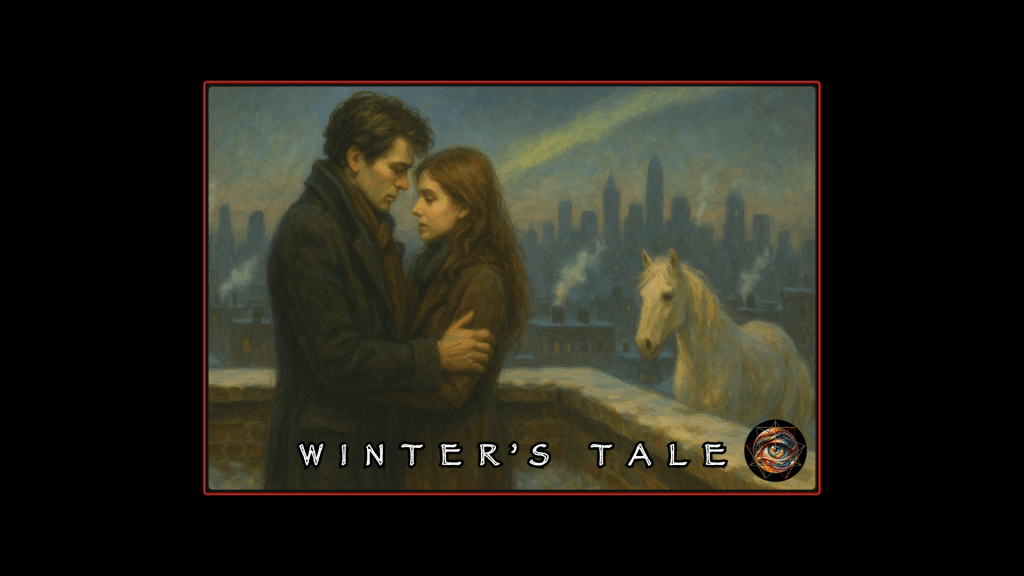
Peter Lake begins as a hunted thief on the icy edges of a New York that is already half-legend. He grows into a mechanic and burglar pursued by Pearly Soames. One winter night he meets Beverly Penn, a brilliant young heiress dying of consumption, and falls into an impossible love story suspended between poverty and privilege. Around them move a white horse that may be an angel, a village in the clouds, and a New York that folds time until the millennium presses against the Gilded Age.
The novel treats New York as both real place and living myth.
Helprin’s language is lush, sometimes baroque, yet anchored by concrete images. Long sentences and metaphors of light, ice, and fire push to the edge of excess, then are pulled back by sharp dialogue or sudden physical danger. The prose operates like a suspension bridge: ornamental cables strung between brutal steel supports, beautiful precisely because it must bear weight across empty air.
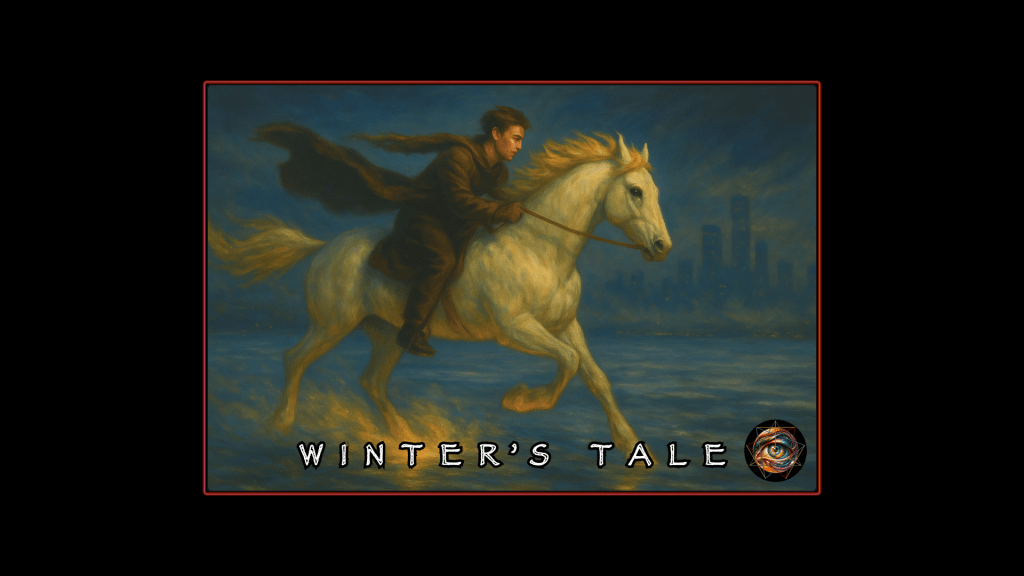
The constant presence of cold, hunger, and cruelty keeps the magic from feeling weightless. Miracles matter because they arrive in a world that can kill you with a winter wind. Helprin prefers screw threads, axle grease, and smoke over abstraction. Time in the novel does not proceed in a straight line. The story folds the Gilded Age and the millennium into a single structure. Characters fall forward across decades, or reappear in echoes, as if the city refuses to release certain unfinished tasks. The frozen Hudson functions as temporal device and moral reckoning simultaneously.
Justice appears as an alignment between times, the moment when a debt from one era finally meets recognition in another. Peter treats earlier events as obligations rather than nostalgia. The novel hints that a city cannot be perfectly just in any static sense. It can only move toward or away from justice while individuals attempt to hold certain lines across generations.
The love between Peter and Beverly balances on a razor’s edge. A dying heiress and a hunted thief could easily slide into melodrama. Helprin leans into the heightened romance rather than defusing it. The novel surrounds the lovers with harsh facts: tuberculosis, police pursuit, hunger, class hostility.
Beverly’s illness reframes the question of miracles. If the story simply cured her, the metaphysical structure would deflate. The narrative treats her death as fixed while insisting that its meaning remains negotiable. Sentiment becomes dangerous only when it denies mortality. When it faces mortality directly, sentiment turns into courage.
The quest for a just city surfaces in both debates and quiet acts. Helprin never offers a program or ideology as solution. He returns to concrete institutions: newspapers that try to tell the truth, courts that occasionally function, poor neighborhoods that build mutual aid. Peter’s skills tie him to infrastructure rather than rhetoric. The city grows through arrival and displacement. The novel honors striving without romanticizing it. Tenements and freezing docks do not erase hope, yet they make every hope costlier.
Winter’s Tale continues to feel unlike most urban fantasies. Later city-myth novels adopt self-awareness or explicit magic systems. Helprin commits to sincerity and refuses schematic explanation. The city has moods that resist cataloging. The horse remains mysterious. Time bends without offering rules.
That refusal challenges contemporary reading practices. The reader who finishes Winter’s Tale and dismisses it as sentimental has chosen ironic distance over the harder work of maintaining faith in beauty as a force that can reshape cities. Helprin offers no protection against that dismissal. He insists that certain commitments require risk, that meaning carved from indifferent universe demands vulnerability, and that the alternative to sincere engagement is cowardice dressed as taste.

Leave a comment