
A masterpiece of long-form fiction imposes severe formal constraints and refuses to violate them for comfort or convenience. It distributes moral complexity across incompatible perspectives without declaring a winner. Structure functions as argument rather than decoration, forcing the reader to inhabit difficulty rather than observe it from safe distance. The ending transforms understanding rather than summarizing, leaving the reader implicated rather than instructed. Below is one such example, along with five others that occupy different vertices in the same geometry.
- Burr (1973), by Gore Vidal
- Shibumi (1979), by Trevanian
- Winter’s Tale (1983), by Mark Helprin
- Perfume (1985), by Patrick Süsskind
- Watchmen (1987), by Alan Moore and Dave Gibbons
- Shantaram (2003), by Gregory David Roberts
These six works are the test cases for my essay on Advanced Prompting for Novel Writers. Each reveals exactly where LLMs will drift from moral pressure toward convenient mediocrity unless constrained by formal discipline. A prompting system that cannot replicate these standards produces only surface fluency that quietly replaces corrosive unreliability with honest memoir, restraint with banter, or grotesque precision with therapeutic sentimentality. This narrative niche of machined writing pairs well with my earlier Refusal-Based Prompting method, better explaining how it can defend Story-law against a model’s tendency to smooth, explain, and comfort.
Lin arrives in Bombay with a fake passport and a desperate need for reinvention. An escaped Australian convict, he is adopted by Prabaker, a taxi driver who guides him into the city’s chaos. Through Prabaker, Lin finds his way into the slum, where he learns Marathi and runs an improvised clinic. His life expands: into Leopold’s Café, into a love affair with Karla, into the orbit of Khaderbhai, a mafia don and philosopher, and finally into an Afghan guerrilla camp.
The novel tracks his swings between altruism and crime as he hunts for forgiveness and belonging. That search produces a massive narrative using confessional first-person voice. The length allows for tangents and philosophical conversations. That expansiveness suits a character addicted to drama and meaning.
Bombay functions as an information system that constantly reads and repurposes Lin. The slum scenes operate as initiation into a surveillance structure that does not look like one. Every alley carries gossip and diagnostic knowledge. When Lin starts the clinic, he becomes a node in that mesh. People bring him injuries along with news and loyalties.
The clinic functions simultaneously as altruistic project and as test-bed for logistics later deployed in Afghanistan. Official India appears slow and corrupt. Informal India runs on velocity and memory. Lin’s fluency in Marathi makes him valuable precisely because he can move between worlds.
Lin constantly tells stories to control context. He lies to officials and to himself, yet writes as if narrating in the past tense purifies those lies. The book invites experience of confession as transparency, although the structure rewards his worst impulses with further adventures. The lush style and philosophical dialogues aestheticize choices that, stripped of rhetoric, would look like participation in organized crime and foreign war.
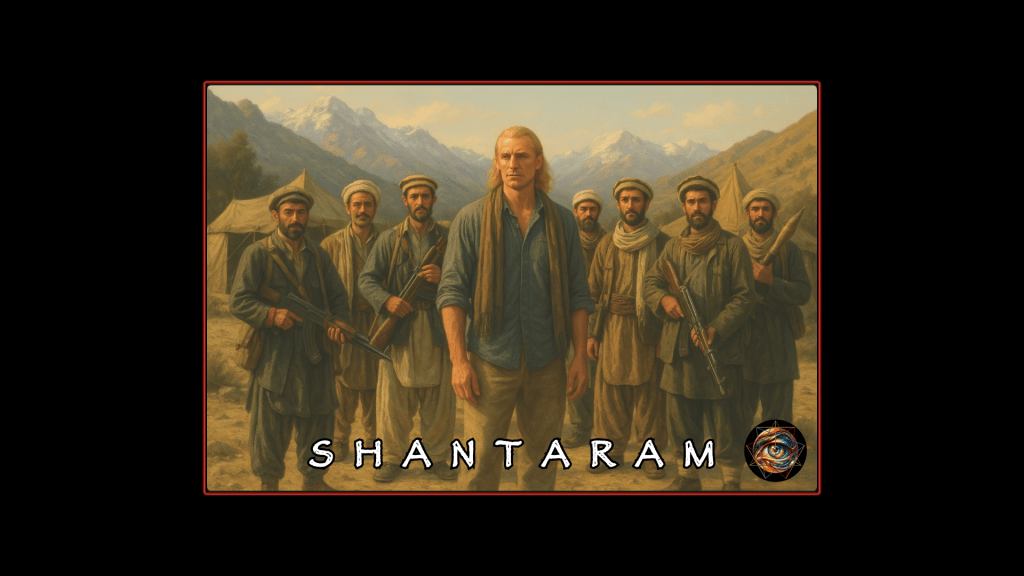
Lin is a man repeatedly drawn to situations that allow him to feel necessary and noble under fire. The book insists that the only sufficient setting for his remorse is a city of millions and a war in the mountains.
Prabaker, Karla, and Khaderbhai all recruit Lin through his terror of being abandoned and unseen. Prabaker offers unconditional welcome and a language. Karla offers mystery and selective honesty. Her refusal to resolve into a clear romantic script keeps Lin circling her. Khaderbhai offers structure and a theory of history. He turns Lin’s urge to repay kindness into organized service, wrapping every task in the language of justice and loyalty.
The Afghan campaign shows how those cords twist together. The men who die on those marches prove that accepting Khaderbhai’s story means accepting that your life can be spent like ammunition. Lin’s horror arrives late because the emotional contracts that led him there felt so human.
The book asks its audience to inhabit Bombay through the eyes of a white, English-speaking fugitive who narrates from a position of retrospective control. Lin learns Marathi and treats his neighbors, which grants him partial insider status. The slum cannot answer him on its own terms, because the narrative filter never leaves his consciousness. Friends die; the neighborhood burns and rebuilds; then the story moves on. The Afghan fighters receive similar treatment. Their pain is real, yet shaped by the needs of Lin’s arc.
The question is how the novel’s success as sensory, immersive epic demonstrates the power and limits of Western, male, first-person redemption narrative in global fiction.
What keeps the novel from tipping into self-caricature is the persistent friction between Lin’s self-image and ground-level reality. His language rises to aphorism and spiritual declaration, yet what happens is messier: the clinic is both selfless and ego-feeding; the mafia is both refuge and trap; his love for Karla is both genuine and tangled up with his need to save her. The book repeatedly undercuts him with loss and betrayal.
Shantaram is not the story of a criminal who becomes a saint. It is the story of a man who keeps trying to grow into a better self and keeps discovering how much of his darkness travels with him. The novel holds genuine compassion, vanity, political naivety, and hard-earned wisdom in the same frame without resolving them. The reader who finishes the book admiring Lin without recognizing how thoroughly the narrative has orchestrated that admiration has learned exactly what the book teaches regarding the seductive power of redemption stories.


Leave a comment