A masterpiece of long-form fiction imposes severe formal constraints and refuses to violate them for comfort or convenience. It distributes moral complexity across incompatible perspectives without declaring a winner. Structure functions as argument rather than decoration, forcing the reader to inhabit difficulty rather than observe it from safe distance. The ending transforms understanding rather than summarizing, leaving the reader implicated rather than instructed. Below is one such example, along with five others that occupy different vertices in the same geometry.
- Burr (1973), by Gore Vidal
- Shibumi (1979), by Trevanian
- Winter’s Tale (1983), by Mark Helprin
- Perfume (1985), by Patrick Süsskind
- Watchmen (1987), by Alan Moore and Dave Gibbons
- Shantaram (2003), by Gregory David Roberts
These comprise the test-bed for my work on Advanced Prompting for Novelists. Each reveals exactly where LLMs will drift from moral pressure toward convenient mediocrity unless constrained by formal discipline. A prompting system that cannot replicate these standards produces only surface fluency that quietly replaces corrosive unreliability with honest memoir, restraint with banter, or grotesque precision with therapeutic sentimentality. This narrative niche of machined writing pairs well with my earlier Refusal-Based Prompting method, better explaining how it can defend Story-law against a model’s tendency to smooth, explain, and comfort.
Nicolai Hel begins as a stateless child in Shanghai and comes under the protection of General Kishikawa. The general introduces him to Gō and to shibumi, a form of quiet perfection that emerges only after long refinement. War and defeat channel Hel into successive roles as prisoner, asset, and deniable operative. By the novel’s present day, he has withdrawn to a Basque estate. A multinational energy consortium known as the Mother Company decides that Hel must either serve its interests or die.
Trevanian’s novel operates on an ambitious scale. It spans Shanghai under Japanese occupation, postwar Tokyo, the Pyrenees, and Middle Eastern operations. The novel functions simultaneously as bildungsroman, political thriller, philosophical meditation, and quasi-satirical tragedy.
General Kishikawa models honor that accepts responsibility without dramatics. He introduces Hel to shibumi as an ideal that cannot be chased directly, describing a quality of presence that carries authority without aggression. Years later, when a Soviet war crimes tribunal prepares a show trial to dishonor the general, Hel spares his mentor by killing him.
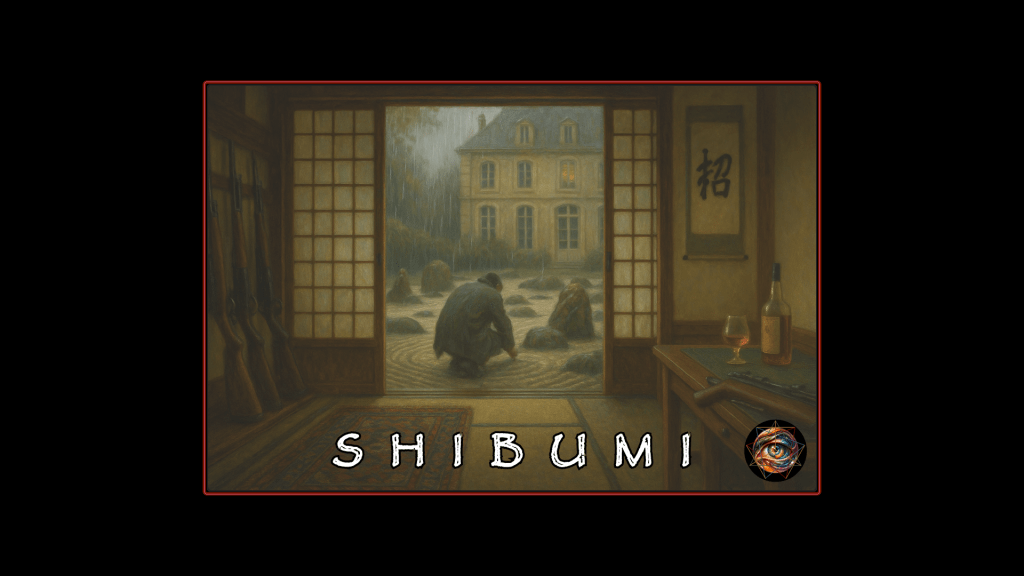
Gō master Otake-san directs the raw material of Hel toward discipline through concentration, and discovers his pupil’s ability to enter mystic transport. Otake delivers a prophecy: true danger will come not from exceptional enemies but from persistent mediocrity. The mountain village household in Hiroshima prefecture maintained by Otake represents everything shibumi promises—quiet cultivation, aesthetic precision—until Little Boy erases it. Hel’s Basque retreat attempts to reconstruct what modern technology destroyed.
Trevanian’s dialogue distinguishes the novel from standard thriller work. Conversations between Hel and Hana crackle with wit and philosophical weight. Hel’s exchanges with his Basque neighbors, especially Le Cagot, reveal character through voice. Verbal sparring with enemies displays how language functions as diagnostic tool. Hel evaluates his opponents through speech patterns, recognizing stupidity or threat in syntax.
These conversations never feel like information dumps. Characters interrupt, misunderstand, deflect. Hel’s explanation of shibumi, his musings on Gō strategy, his dismissals of bureaucratic thinking—all reveal a mind that processes the world through aesthetic and ethical categories simultaneously.
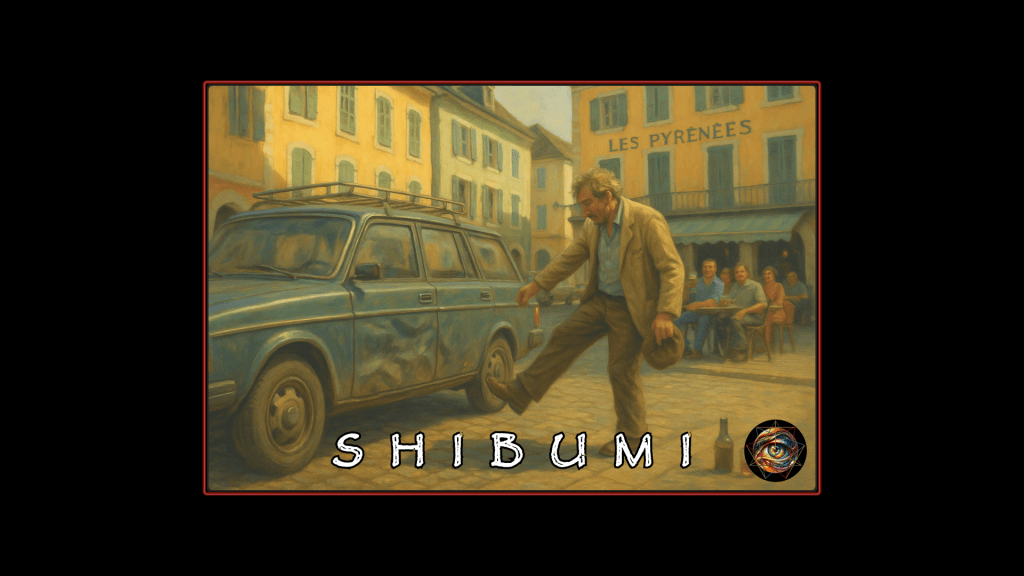
Trevanian’s handling of violence operates through precision rather than spectacle. Each action set piece—the assassination aboard the airliner, escaping the cave, the final showdown—unfolds as a problem in spatial awareness. Hel evaluates angles, distances, materials, and timing. The fictional discipline of naked/kill allows him to transform ordinary objects into lethal advantage, forcing attention to environment rather than choreography.
The prose withholds technical detail while maintaining clarity. A threat appears; Hel evaluates the geometry; the scene resolves with decisive action. That economy produces tension without false drama. Violence feels consequential because it emerges from genuine danger. Action sequences function as character revelation, since Hel’s approach to combat mirrors his approach to everything else.
The Japanese term shibumi derives from shibui, which originally meant astringent. By the Edo period, it praised anything beautiful by being precisely what it should be: understated, refined without pretension. Kishikawa expands it into a philosophy concerning understanding rather than information, eloquent silence, spiritual tranquility that remains active. Hel attempts to live this principle in his surroundings, habits, and relationships.
The Mother Company’s surveillance apparatus represents everything shibumi opposes. Intelligence agencies appear as subcontractors for corporate interests. The novel’s antagonists are loud, clumsy, and mediocre. Excellence faces threat not from worthy rivals but from bureaucratic weight that grinds without awareness.
Shibumi presents a model of mastery that rejects expansion and accumulation. The goal is a life shaped so precisely to internal standards that external recognition becomes irrelevant. Trevanian makes that ideal alluring while acknowledging its costs. Hel’s isolation protects his code but ensures that when he dies, the transmission of shibumi dies with him.
The novel ends with no neat resolution. Hel survives the immediate threat and returns to his mountain. The reader finishes with the knowledge that the machinery of mediocrity will grind on, that private excellence offers beauty without protection, and that maintaining integrity inside systems designed to reward noise and compromise requires choosing loneliness over influence. Shibumi achieves tragedy not through death but through the recognition that what matters most cannot be defended, only practiced until it disappears.

Leave a comment