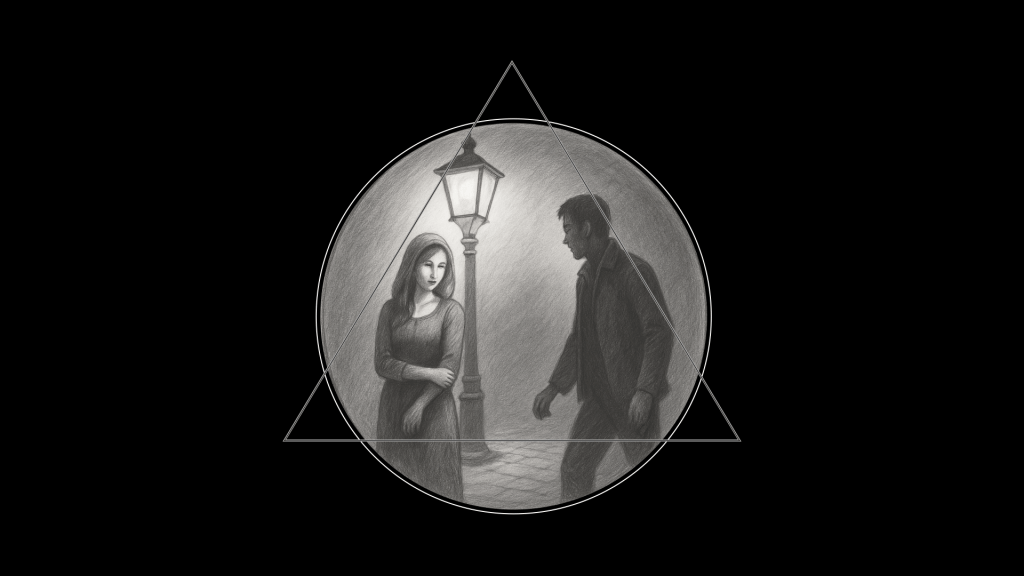
The Enneagram of Narcissistic Predation
Most people who have been gaslighted cannot describe what exactly happened to them, not forensically. They know something was taken. They know the taking was systematic. They can point to individual moments: a denial that felt like a door slamming, a trivialization that shrank their grievance to nothing, a sudden warmth that arrived precisely when they had resolved to leave. The sequence resists narrative because the Victim stands inside the circle, and the circle is designed to be illegible from within.Predation as Regeneration
The illegibility is a feature of the system.
The Victim experiences turbulence, erosion, a slow grinding of confidence into powder. The weather is unpredictable: sometimes calm, sometimes violent, always arriving from somewhere beyond control. The Predator experiences none of this. The Predator adjusts dials, monitors outputs, troubleshoots when the equipment fails to respond. One lives the weather. The other operates the machine. The gap between them cannot be bridged by conversation because they are not describing the same phenomenon.
They share a room but not a reality.
Predation as Regeneration
The term “gaslighting” comes from Patrick Hamilton’s 1938 stage play, in which a husband dims the gas lamps in their London home and denies the change, turning domestic illumination into a vehicle for psychological destabilization. Both husband and wife see by the same light; both inhabit the same brightness. Only the husband knows where the dimmer is. When he lowers the flame and denies it, the wife begins to doubt her perception. The medium is shared, but the relationship to the medium is not. Hamilton intuited the geometry without naming it. The gas lamp is Supply: the shared substrate, manipulated by one party, experienced by both.
The metaphor has reached its limit. A dimmer switch is mechanical, binary, inert. In reality, the dynamic Hamilton dramatized is biological. Narcissistic abuse is an ecosystem of extraction where the parasite selects for abundance, feeds sustainably over years, and discards the host only when the Supply thins below usefulness.
A coral reef may be a better map than a Victorian parlor.
The reef is a living system. Energy flows. Predators patrol. The healthiest zones attract the most attention from everything that feeds. Here, the Victim is not a gaslit spouse, but a thriving reef flat, visible and productive, drawing approach from organisms that cannot photosynthesize their own Supply.
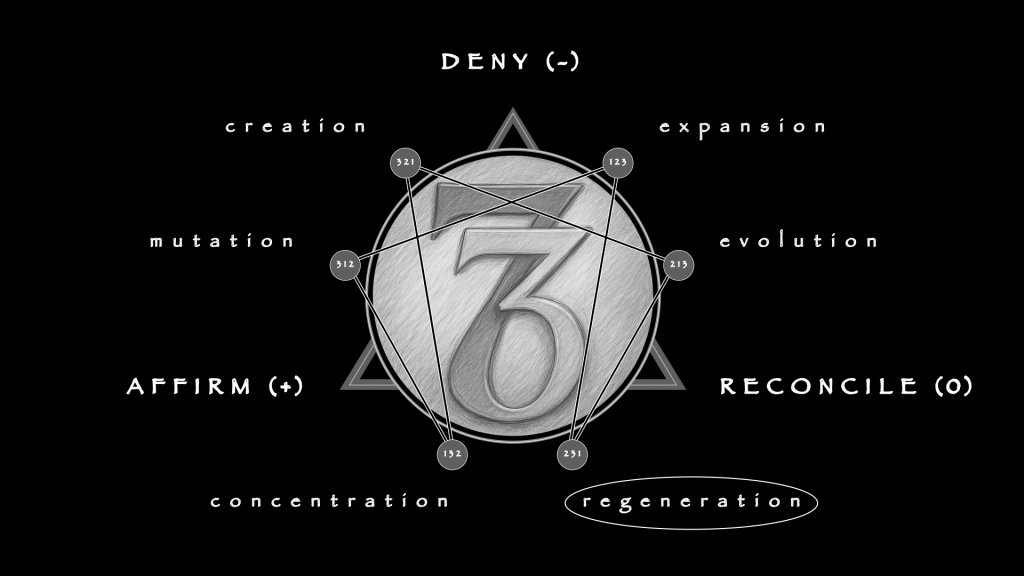
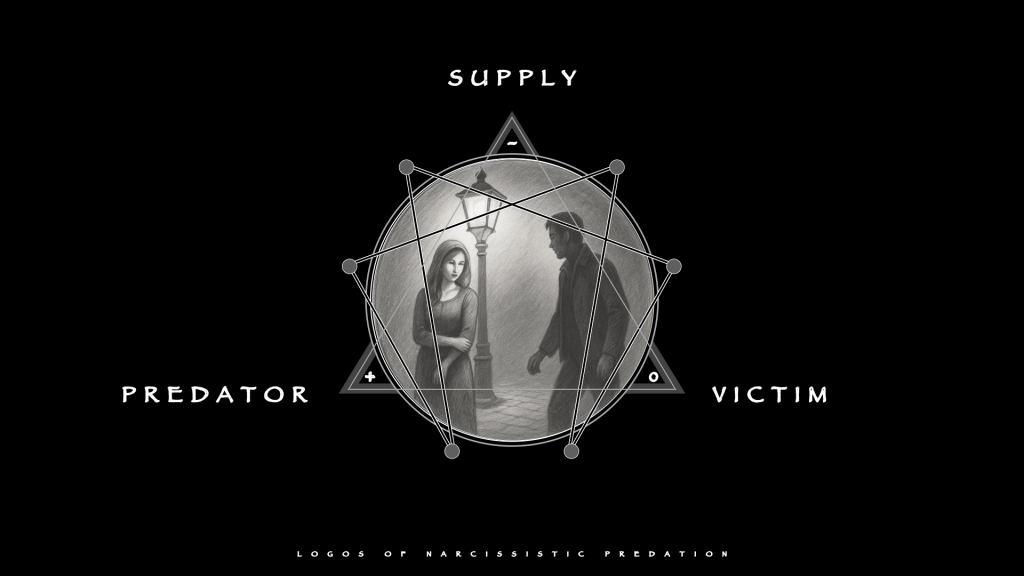
A clinician’s perspective of gaslighting observes Three Forces in continuous rotation, each depending on the others, none capable of operating alone. The first pole is Supply: the material extracted is the Denying Force (2), whether attention, validation, or presence. The second pole is Victim: the Reconciling Force (3) initiates the cycle merely by existing as a medium of potential Supply. The third pole is Predator: the Affirming Force (1) completes the cycle, harvesting what the Victim’s presence and the Supply medium have made available.
This scheme inverts the common narrative. Pop psychology frames Victims as damaged, codependent, lacking boundaries. The logical geometry shows the opposite, and practice confirms the diagnosis. Victims are selected precisely because they are high-functioning.
The ideal Victim has Supply worth taking.
Needy people make poor sources. They require Supply themselves and become competitors rather than prey. The Predator targets abundance, not vulnerability. Coherence is the resource. Emotional stability is the reservoir. The capacity to keep showing up, to keep engaging, to keep trying to understand: this is what the Predator requires. The Victim has no concept for Supply because the Victim has never needed to extract it from anyone. A reef fish cannot see water because the fish has never been out of it. The Victim cannot see Supply because the Victim has never lacked it. The category does not form in the absence of need.
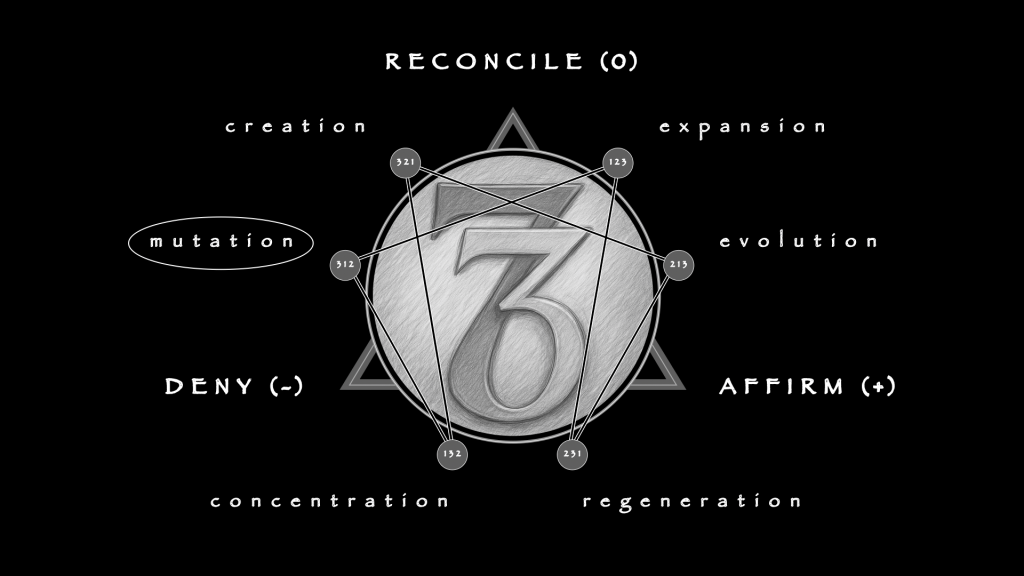
The order of operation of the Three Forces matters. Precisely six permutations, or triads, are possible. Gaslighting is a version of 231: Denying Force first (-), Reconciling Force second (0), Affirming Force third (+).
As the 231 triad takes endless forms, its generic name is Regeneration.
The Victim’s coherent reality stands as the first “no” in the system, not as a refusal but as a contrast. The Predator’s emptiness meets the Victim’s fullness. Supply then absorbs and reframes: the medium through which Predator and Victim interact without immediate collapse. The cycle culminates and resets as the Predator produces an intentional (albeit rarely conscious) outcome from the reorganized field.
This is not an attack, but a feeding cycle. The Predator regenerates by means of the Victim, whose confidence is consumed and temporarily absorbed. The Victim’s attention becomes the Predator’s significance. The Victim’s capacity for doubt becomes the Predator ‘s leverage. What looks from inside like disintegration looks from outside like digestion.
Causes
The three points along the right hemisphere of the enneagram (1➝4➝2) comprise the world of causes. For each, there is a corresponding tactic. In narcissistic abuse, this is the preparatory work that optimizes conditions before extraction can occur. The coral reef is the governing metaphor for this half of the process. The reef does not chase; it attracts. The Predator does not need to hunt when the prey swims toward the most vibrant colors, the densest nutrients, the warmest currents.
Denial erases the event from shared reality. (1)
“That never happened.” “I never said that.” “You’re imagining things.”
The tactic does not argue; it annihilates. The Predator does not claim that the event was acceptable, but that the event did not occur. The Victim who accepts denial loses access to their own perception. Memory becomes suspect. Just as the reef fish cannot see water, the Victim cannot see the manipulation because it has been defined out of existence.
Trivialization does not deny the event; it denies the event’s significance. (4)
“You’re making a big deal out of nothing.” “It was just a joke.” “Why are you so sensitive about this?”
Something happened, but it was small. The Victim’s response is disproportionate. The tactic recalibrates the Victim’s sense of scale. Wounds shrink. Grievances become embarrassing overreactions. The reef’s nutrients are still flowing, but the Victim has been trained to take smaller portions, to expect less, to feel grateful for what remains.
Countering does not deny or shrink; it reverses. (2)
“That’s not what happened—you’re the one who started it.” “You always twist things.” “You’re too emotional to see clearly.”
The Victim is painted as the aggressor. The grievance becomes the offense. The tactic exploits the Victim’s willingness to examine their own behavior—a willingness the Predator does not share. High-functioning Victims are particularly vulnerable here because they genuinely consider whether they might be wrong. The reef’s abundance includes the capacity for self-reflection, and that capacity is harvested along with everything else.
Effects
The three points along the left hemisphere of the enneagram (8➝5➝7) comprise the world of effects. This is the extraction itself, the conversion of preparatory work into usable Supply. As before, there are three tactics.
Here, however, the parasitoid wasp displaces the reef as governing metaphor.
Unlike the reef’s ambient predation, the wasp operates with surgical precision. The wasp injects eggs into a living host. The larvae feed on non-vital tissues first, keeping the host alive and functional. Some wasps inject chemicals that alter host behavior, such that it becomes a vehicle for its own consumption.
Weaponized Compassion captures the moral high ground by framing harm as care. (8)
“I’m only saying this because I love you.” “I’m worried about you.” “I just want what’s best for us.”
This tactic is the most sophisticated because it cannot be refused without the Victim appearing to reject love itself. The Predator who secures this position has won the war. Every earlier battle—the denials contested, the trivializations rejected, the counters deflected—was acceptable loss. The path is so constructed as to lead here, to the position from which all future resistance looks like ingratitude. The wasp’s sting delivers paralysis, not death. The host remains alive, functional, and incapable of flight.
Withholding takes the form of silence, absence, the refusal to engage. (5)
“I’m not going to discuss this.” “You know what you did.”
The tactic removes access to the Predator’s interiority. The Victim is locked out of negotiation, explanation, or repair. Withholding weaponizes the Victim’s attachment: the more the Victim needs resolution, the more powerful the withdrawal. Intimacy becomes leverage. The host’s own immune response—the desperate attempt to restore connection—feeds the larvae.
Diversion redirects the Victim’s focus from the original grievance to a new target, often the Victim’s own behavior. (7)
“What about when you forgot my birthday?” “You’re not exactly perfect either.” “Why are we even talking about this when the real problem is_____?”
The tactic exploits the Victim’s good faith; the willingness to consider other perspectives becomes a trapdoor. Each diversion extends the feeding cycle by resetting it. The wasp does not need to win arguments; the wasp needs to prevent the host from locating the larvae.

Behavioral Tells
Language is less than half the signal. The body speaks a parallel dialect, more reliable than words because it is harder to master. A clinician watching for gaslighting looks for divergence: the concerned face delivering an attack, the soothing tone wrapped around a threat, the eye contact that holds too long or breaks too strategically.
The Predator’s timing reveals intent. Interruption patterns cluster around the Victim’s moments of clarity. When the Victim approaches a coherent grievance, the Predator interjects, redirects, or suddenly needs to leave the room. The interruption does not engage the content; it prevents the content from consolidating. Silence, too, has timing. The Predator withholds response just long enough for the Victim’s anxiety to rise, then speaks as though the pause were natural. The Victim learns to fill silence with concession.
Physical positioning encodes dominance.
The Predator may block doorways during arguments, stand while the Victim sits, or occupy the center of shared space. These are not conscious tactics, in most case, but the body’s grammar of control, legible to the trained eye. The strategic apology belongs here: the words “I’m sorry” delivered with a sigh that communicates inconvenience, or a tone that implies the Victim’s need for apology is itself the problem. The content is concession; the delivery is contempt. The Victim hears both and cannot reconcile them.
Micro-expressions flash and vanish: contempt (the asymmetric lip curl that surfaces for a fraction of a second), duping delight (the suppressed smile during successful manipulation), the performative concern that does not reach the eyes. The voice carries its own signatures. Pitch drops when the Predator delivers threats framed as observations. Volume decreases rather than increases during the most damaging statements, forcing the Victim to lean in, to attend more closely, to participate in their own wounding. The Victim often registers these signals subconsciously, experiencing unease without being able to name its source. The body knows before the mind can formulate.
The clinician’s aim, and mine, is to make the implicit explicit, to create an effective language to transmit what the Victim’s nervous system (i.e. R-complex), not their emotional identity (i.e. limbic system), has already catalogued. I’ll add that the resulting language may be used in therapeutic treatment of Victims and Predators differently, according to their needs. Victims need recovery, and may need little time if the path is clear. Predators need a complete cognitive/behavioral transformation, which usually takes years of motivated initiative.
Linguistic Tells
The ways and means of narcissistic abuse are various and will seem random for a long time. Under strict observation, two recognizable patterns emerge, the first of which is Circular Speech that resets problems but never resolves them. It is common to all forms of so-called gaslighting, and is not specific enough to be identified with any point of the enneagram. Rather, it is the circle itself, the very through-line of the feeding process.
The other universal tell of verbal narcissistic abuse is Word Salad. The Predator has no special interest in any particular long term future, thus there is no need to remember any but the most trivial facts. Victims, especially those with a rich or abundant Supply, are creatures of nuance and meaning; they are detail-oriented. Word salad is vague, full of undefined pronouns, and intrinsically misquotable. Often, the droning conversation of Predators means nothing at all, exists for effect, and is best regarded as simulated speech.
Beyond these these unspecialized, general-purpose tactics are a variety of others that are situational, circumstantial and, most importantly, identifiable. One can easily postulate such a taxonomy of Predator speech arranged around the enneagram.
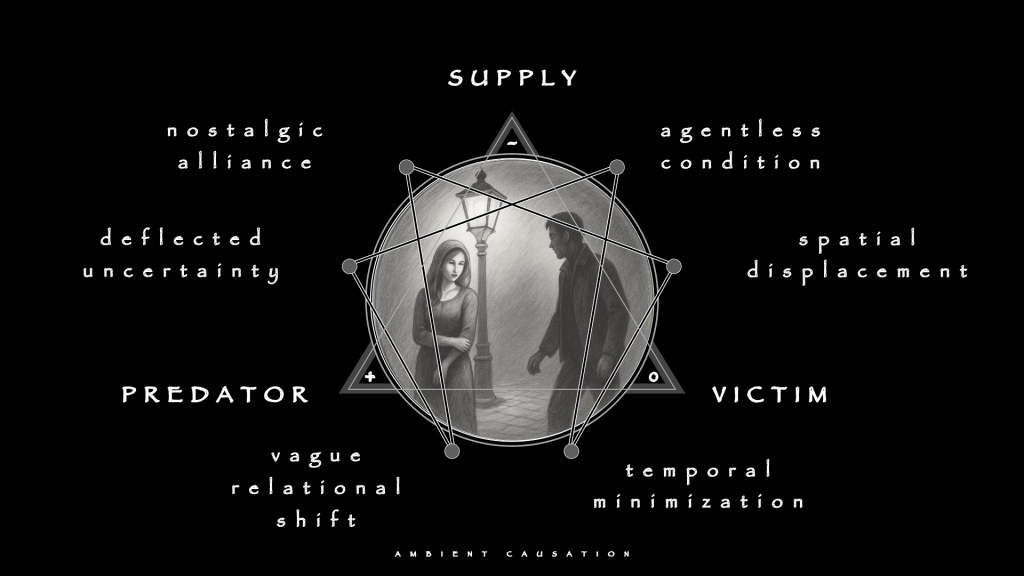
The right hemisphere (1➝4➝2) speaks in Ambient Causation: language that dissolves agency into atmosphere, assigning blame to weather rather than conduct.
“Things have been tense lately.” “The energy in this house is off.” “We’re in a rough patch.”
The problem exists; no one produced it. The Predator positions itself as a fellow Victim of circumstances, equally buffeted, equally confused. This is the reef’s register: systemic, diffuse, impossible to trace to a single mouth.
The left hemisphere speaks (8➝5➝7) in Targeted Injection: language that aims at specific host systems in order to suppress perception, memory, judgment and/or the capacity to secure external support.
- “That never happened” targets memory
- “You’re too sensitive” targets emotional calibration
- “I’m only saying this because I care” targets the ability to refuse love
Each phrase is a sting, precisely placed. This is the wasp’s register: surgical, deliberate and impossible to mistake for weather once you have seen the ovipositor. The sample phrases are not exhaustive. They are diagnostic instruments. The Victim who can name the register can begin to hear it as pattern rather than weather. The fish who learns to see water has taken its first flight out of the reef.
The Hexad in Motion
The triad (9➝3➝6) explains gaslighting tactics, their logos, based on the operation of active (+), passive (-) and neutralizing (0) forces. Triads are independent of time. The hexad explains how those tactics connect, based upon the same laws of vibration that describe both the refraction of light and the seven-tone musical scale. These the Victim experiences in time. The system operates them as a web of dependencies where each tactic enables and requires the others. In any given moment, one is narrative and the others are architecture. The Victim who grasps only the narrative might, at best, recognize individual only tactics without understanding how they reinforce each other.
Clockwise Walk
Denial works only because trivialization has already done its work. “That never happened” lands differently when the Victim has absorbed months of “you’re making a big deal out of nothing.” Trivialization pre-shrinks the grievance; denial then erases what remains. The Victim who has learned to doubt the size of their wounds will more readily doubt the wounds existed at all.
The dependency runs deeper than sequence. Trivialization teaches the Victim that their scale is broken, that they magnify small things into large ones, that their emotional responses are miscalibrated. Denial exploits that lesson. The Victim thinks: perhaps it did happen, but perhaps I am remembering it as worse than it was, and perhaps “worse than it was” slides into “not at all.” Demolition is easier when the wrecking ball has already weakened the structure. The Victim becomes their own demolition crew.
Countering operates only because weaponized compassion provides the exit. “You’re too sensitive” is a battle the Predator often loses in the moment. The Victim pushes back, evidence mounts, the confrontation escalates. The Predator appears to be failing. But the Predator does not need to win here. The path leads to apparent care, where “I’m only saying this because I love you” retroactively reframes every earlier counter as tough love, honest feedback, the difficult truth that only someone who truly cares would deliver.
The Victim replays the history. The harsh words were not attacks; they were interventions. The criticism was not cruelty; it was concern. The Predator was not diminishing the Victim; the Predator was trying to help the Victim see clearly. Every battle the Victim thought they won now looks like evidence of their own defensiveness, their inability to receive love in its difficult forms. The feint matters only because of the killing blow that follows. The Victim supplies the reinterpretation themselves.
Trivialization depends on countering having established the Victim as unreliable narrator. “It was just a joke” lands only when the Victim has already been told they twist things, exaggerate, see offense where none exists. The Victim’s own perception has been marked as suspect; trivialization exploits that mark. The wound is small because the Victim is the kind of person who makes wounds seem larger than they are.
The logic is circular but effective. You are too sensitive, therefore the injury was minor. The injury was minor, therefore your reaction proves you are too sensitive. Each tactic validates the other. The Victim cannot appeal to their own experience because their experience has been ruled inadmissible. The verdict follows naturally once the witness has been impeached. The Victim begins to impeach themselves.
Withholding draws its power from diversion having trained the Victim to chase. “I’m not going to discuss this” lands as punishment only when the Victim has learned that conversations can be redirected, that resolution is always one more exchange away, that persistence sometimes works. The Victim who has been rewarded intermittently for pursuit will experience withdrawal as devastating.
Intermittent reinforcement is the strongest conditioning schedule. The Victim has learned that engagement is possible, that the Predator can be reached, that connection is available if they just find the right approach, the right words, the right moment. Withholding weaponizes that learning. The Victim chases harder, apologizes preemptively, auditions for access. A drought is only unbearable to those who remember rain. The Predator has made certain the Victim remembers.
Diversion requires denial having established that reality is negotiable. “What about when you…” redirects attention from the original grievance to a new target, but the redirect succeeds only when the Victim has already accepted that events can be rewritten, that memory is contestable, that the Predator’s version might be valid. The Victim who has swallowed denial will swallow diversion.
The mechanism is elegant. If the past can be erased, then surely the present can be rearranged. If “that never happened” is a possible move, then “let’s talk about something else” is a minor adjustment. The Victim has been trained to hold reality loosely, to grant the Predator editorial authority over shared experience. The shell game works only on marks who have accepted that the ball might be anywhere. The Victim has accepted.
Weaponized Compassion requires withholding having created the hunger. “I just want what’s best for us” arrives as relief only when the Victim has been starved of connection, locked out of the Predator’s interiority, desperate for any sign of warmth. The tactic converts withdrawal into leverage: the longer the silence, the more powerful the eventual softening.
The Victim does not experience the softening as manipulation, but as love finally arriving, as the Predator finally seeing them, as the relationship finally healing. The relief is genuine. The gratitude is genuine. The renewed commitment is genuine. This is what makes the tactic so effective: the Victim’s response is not performed but felt. A rescue requires a flood. The Predator controls the water level.

Ambient Causation
The Predator’s language on the right side of the system dissolves agency into atmosphere. Problems exist; no one produces them. The weather is bad; no one made it. The Predator positions themselves as a fellow Victim of circumstances, equally buffeted, equally confused. The grammar removes subjects from sentences, strips verbs of their actors, transforms choices into conditions. The reef does not attack; the reef simply exists, and the fish who enter it do not notice the current that keeps them circling until they have forgotten there was ever an ocean beyond.
Agentless Condition (1)
“Things have been tense lately.” “It’s been hard for both of us.” “Something feels off.”
The sentence arrives without a subject who tensed anything. Tension exists as a state, a climate, a pressure system that moved in from somewhere beyond control. Agentless condition depends on nostalgic alliance having established a prior harmony; if things were once good, the current badness must be an intrusion from outside, not a product of the Predator’s behavior. The Predator and Victim are equally subject to the weather. Each formulation removes the hand from the lever, the finger from the trigger, the mouth from the wound. The reef’s currents shift; neither fish chose the direction, and both are carried by forces they cannot name.
Spatial Displacement (2)
“The energy in this house is off.” “This place has bad memories.” “We need a fresh start somewhere else.”
Now the problem has an address but no author. The house contains bad energy; neither party put it there. Spatial displacement depends on agentless condition having established that no one is responsible; the blame must land somewhere, and architecture cannot defend itself. The walls are sick; the rooms hold resentment; the building itself has become the antagonist. The Predator and Victim become joint tenants in a haunted structure, allies against the container that holds them both. The reef is toxic; the fish agree to swim to cleaner waters, not noticing that the toxin travels with them.
Temporal Minimization (4)
“We’re in a rough patch.” “Every couple goes through this.” “We’ll look back and laugh.”
The wound is reframed as weather, the crisis as season, the pattern as phase. A patch is small, temporary, part of a larger fabric that remains intact; wait long enough and the fabric repairs itself. Temporal minimization depends on spatial displacement having externalized the problem; if the issue is location or circumstance, time and change will resolve it without confrontation. Patience replaces accountability. The Victim is invited to outwait the damage rather than address its source, to endure the winter in anticipation of a spring that never arrives. The reef bleaches; the fish wait for the colors to return, not understanding that the bleaching is the new permanent state.
Vague Relational Shift (5)
“We’ve grown apart.” “Something changed between us.” “We’re not connecting the way we used to.”
The relationship itself becomes the subject, an entity separate from either party that has drifted of its own accord. Neither the predator nor the Victim did the growing apart; the space simply opened, like tectonic plates separating beneath the ocean floor. Vague relational shift depends on temporal minimization having established that conditions are transient; if things change on their own, they can change back without anyone being held accountable for the direction. The “we” obscures the “I”; the Predator vanishes into the collective noun. The Victim cannot locate the author of the distance because the grammar forbids attribution. The reef expands; the fish find themselves farther from each other and assume the swimming is mutual, the current a shared misfortune.
Deflected Uncertainty (7)
“I don’t know why I do the things I do.” “I’m just as confused as you are.” “I wish I understood myself better.”
The Predator claims ignorance of their own interiority, positioning themselves as a mystery they cannot solve. The behavior remains, but the explanation is locked in a vault to which even the Predator lacks the key. Deflected uncertainty depends on vague relational shift having diffused responsibility into the space between; if the relationship itself drifted, the Predator’s role in that drift can be attributed to forces they do not comprehend. The Victim cannot demand accountability from someone who presents as their own first Victim. The Predator and Victim sit together before the locked door, puzzling at the combination, equally excluded from the truth inside. The reef keeps its secrets; the fish who built it claim not to remember the construction, and the fish who drown in it accept that some architectures simply happen.
Nostalgic Alliance (8)
“Remember when things were good between us?” “We used to be so happy.” “I miss who we were.”
The Predator invokes a shared past that positions both parties as Victims of a decline neither caused. The golden age exists as a reference point, an Eden from which both have fallen equally. Nostalgic alliance requires no prior groundwork; it initiates the cycle by establishing that the relationship was once healthy and that restoration, not escape, is the appropriate goal. The Victim’s own memories are recruited as evidence for the prosecution of the present. The Predator and Victim become archaeologists of a buried city, sifting through ruins together, united in grief for what was lost. The reef was once a paradise; the fish remember colors that no longer exist and blame the fading on the sea itself.
Targeted Injection
The Predator’s language on the left side of the system aims at specific capacities within the host. The parasitoid wasp does not sting randomly; the wasp targets nerve clusters that will produce the desired paralysis. Each phrase is calibrated to suppress a particular function: the ability to trust perception, the ability to feel proportionately, the ability to refuse love, the ability to demand engagement, the ability to hold focus on the original wound. The grammar shifts from ambient to surgical. Subjects appear; verbs strike; objects fall. The host knows it has been stung but cannot locate the entry point until long after the venom has spread.
Perceptual Nullification (1)
“That never happened.” “You’re imagining things.” “I never said that—you’re remembering it wrong.”
The sting targets the Victim’s confidence in their own sensory apparatus. What the Victim saw, heard, or experienced is denied outright, not reframed but erased. The Victim is left holding a memory that the Predator insists does not exist. Perceptual nullification depends on benevolent framing having established the Predator as a caring presence; only someone who loves you would bother to correct your faulty perception. The Victim begins to distrust not just this memory but memory itself, not just this perception but the act of perceiving. The wasp has stung the optic nerve; the host can no longer trust what its own eyes report.
Affective Invalidation (2)
“You’re overreacting.” “You’re being hysterical.” “Why do you always have to be so sensitive?”
The sting targets the Victim’s confidence in their own emotional responses. The feeling may be acknowledged, but its scale is declared illegitimate, disproportionate, symptomatic of a flaw in the Victim rather than a response to the Predators behavior. Affective invalidation depends on perceptual nullification having destabilized the Victim’s trust in what happened; if the event is uncertain, the reaction to it becomes indefensible. The Victim learns to audit their own affect before expressing it, to preemptively shrink their responses to a size the Predator will accept. The wasp has stung the amygdala; the host no longer knows whether its fear is real or manufactured.
Scalar Distortion (4)
“It was just a joke.” “You’re making a big deal out of nothing.” “I barely raised my voice.”
The sting targets the Victim’s ability to calibrate magnitude. The Predator does not deny the event but denies its size, reframing cruelty as trivia and wounds as scratches. Scalar distortion depends on affective invalidation having taught the Victim that their emotional responses are unreliable; the Victim has already learned to doubt their own thermometer. The Predator provides a replacement scale, and the Victim, lacking confidence in their own, accepts it. The gap between what happened and what the Predator describes grows so wide that the Victim begins to inhabit the smaller version to avoid the dissonance. The wasp has stung the inner ear; the host cannot tell which way is up.
Interactional Embargo (5)
“I’m not going to discuss this.” “You know what you did.” “If you don’t understand by now, you never will.”
The sting targets the Victim’s access to negotiation, explanation, or repair. The Predators interiority becomes a locked room; the Victim can knock, plead, apologize, rage—none of it opens the door. Interactional embargo depends on scalar distortion having minimized the grievance; if it was nothing, there is nothing to discuss. The Victim’s attachment becomes a weapon against them; the desperate attempt to restore connection feeds the larvae growing inside. The Predator need not win the argument; the Predator need only refuse to have it. The wasp has stung the larynx; the host can still speak, but no one is listening.
Retaliatory Accusation (7)
“What about when you forgot my birthday?” “You’re not exactly innocent here.” “I could bring up a lot of things.”
The sting targets the Victim’s focus, redirecting attention from the original grievance to a counter-charge. The Victim’s good faith becomes a trapdoor: the willingness to consider other perspectives, to examine one’s own behavior, to be fair. Retaliatory accusation depends on interactional embargo having blocked the direct path; the Victim, unable to address the original wound, follows the detour the Predator provides. The Predator does not need to win the counter-charge; the Predator needs only to prevent the host from locating where the eggs were laid. The conversation becomes a shell game, and the Victim loses track of which cup held the original grievance. The wasp has stung the hippocampus; the host cannot remember what it came here to say.
Benevolent Framing (8)
“I’m only saying this because I care.” “I’m worried about you.” “This hurts me more than it hurts you.”
The sting targets the Victim’s ability to refuse love. To reject the statement is to reject care itself, to appear ungrateful, to confirm the Predator’s implicit accusation that the Victim cannot recognize genuine concern. The moral high ground is captured in a single sentence. Benevolent framing requires no prior groundwork; it initiates the cycle by establishing that the Predator’s aggression is indistinguishable from devotion. The Victim who resists appears to be refusing the very thing they claim to want. The wasp approaches with pollen on its legs, and the host opens itself to what it believes is a gift.

Moral Capture
This seemingly novel term is adapted from regulatory theory, the process by which an agency designed to oversee an industry eventually serves that industry instead. The FAA was supposed to ground unsafe aircraft; instead, it certified them. The SEC was supposed to police the banks; instead, it staffed itself from their alumni and returned them to corner offices. In practice, the capture is gradual, structural, and invisible from inside. The regulators believe they are regulating.
In intimate predation, the captured agencies are the Victim’s conscience, memory, and hope. The internal apparatus that was supposed to protect the self now administers the Predator’s interests. The Victim is still regulating, only now on the Predator’s behalf.
Operationally, the Predator loses at countering. “You’re too sensitive” can be challenged, documented, refused. The Victim instinctively resists. Evidence accumulates. The confrontation escalates. The Predator appears to be failing. Witnesses might even side with the Victim—friends who overheard, family who noticed, colleagues who compared notes. The battle is visibly going badly, and the Predator knows it.
Meanwhile, the Predator wins at weaponized compassion. “I’m only saying this because I love you” cannot be refused without the Victim appearing to reject love itself. The moral high ground has been captured. Every earlier loss is retroactively reframed as evidence of care, proof that the Predator was willing to endure conflict for the Victim’s sake. The witnesses who sided with the Victim now recalibrate: perhaps they intervened in something they did not understand; perhaps the Predator really was trying to help; perhaps the Victim really is difficult, ungrateful, impossible to reach. The same friends, family, and colleagues who validated the Victim’s grievance begin to wonder if they enabled a misunderstanding. The audience has been captured along with the Victim.
This is the axis that governs the system: the corridor connecting accusation to absolution, the line that turns conflict into proof of devotion. Tactical loss purchases strategic victory. The Predator spends credibility at countering; the Predator harvests authority at weaponized compassion. The wasp stings to provoke the flinch, then tends the wound to prove its gentleness; the host learns that the pain and the comfort arrive from the same source and cannot be separated. The exchange rate favors the Predator because apparent love outweighs apparent criticism in every social calculus, in every courtroom of public opinion, in every late-night conversation where the Victim tries to explain what is happening and watches the listener’s sympathy curdle into doubt. The Victim who understands individual tactics but not this transfer will win battles and lose the war. They will accumulate evidence that no one believes, victories that no one remembers, confrontations that only prove how resistant they are to being loved.
Many of the preceding observations were made for a theoretical (i.e. research), or even a clinical (i.e. therapeutic) field. However, a far more practical problem has not been heretofore addressed, and is mentioned only in passing. So far the examples cited have apply to mostly romantic/sexual relationships, extended families and, to a lesser degree, colleagues. The children of narcissistic Predators have a different experience. For them, Ambient Causation is the norm and Targeted Injection is the exception. The explanation for this divergence is beyond the scope of this essay, though the reasons for it are not difficult to imagine.
The Fractal Descent
The closer you look, the more structure appears. At some depth, the system becomes mechanical, automatic, devoid of the strategic intelligence that characterizes the surface. The Predator at the reef level is selecting and positioning, choosing targets, reading the environment. The Predator at the wasp level is injecting and suppressing, calibrating doses, timing interventions.
At the deepest level, the Predator is simply growing along chemical gradients, no more intentional than bread mold consuming a loaf.
Each tactic contains a world. The hexad governs the whole, and each point of the hexad contains its own hexad: six architectures of denial, six calibrations of trivialization, six vectors of diversion, six postures of counter-accusation, six temperatures of withholding, six registers of weaponized compassion. To unfold all six would require a treatise; two will suffice to demonstrate the principle.
Withholding and Weaponized Compassion occupy the left hemisphere, the world of effects, where the Predators work becomes visible in the Victim’s behavior. They are the twin poles of that hemisphere: the vacuum and the flood, the withdrawal that starves and the attention that drowns. Between them, they demonstrate that what appears to be a single tactic—silence, care—is an ecology of variations, each calibrated to a different function, each enabling the next.
The fractal descends through structure; it also descends through the Victim. What begins as external pressure becomes internal architecture, the Predator’s phrases migrating from the air into the throat. The Victim begins to speak them unprompted, in rooms the Predator has never entered, to people the Predator has never met. This is the deeper descent: not six variations of a tactic but six variations of the Victim’s own voice, now ventriloquized from within. The wasp’s work is finished when the host no longer needs to be stung; the host stings itself, mistakes the venom for its own saliva, defends the paralysis as preference. What looked like a person making choices reveals itself as a pattern executing itself—and the pattern has learned to speak in the first person.
Withholding
The Predator’s silence is not empty; it is architectural. Different silences serve different functions, and the Victim learns to read them the way a host learns to read the air for the sound of wings. The Predator who withholds has discovered that presence can be weaponized through its removal, that attention is a resource others need more than they do. The silence is not absence but observation. The Predator watches from a distance that cannot be closed, cataloguing the Victim’s attempts to restore contact. The Victim reaches; the Predator studies the reaching.
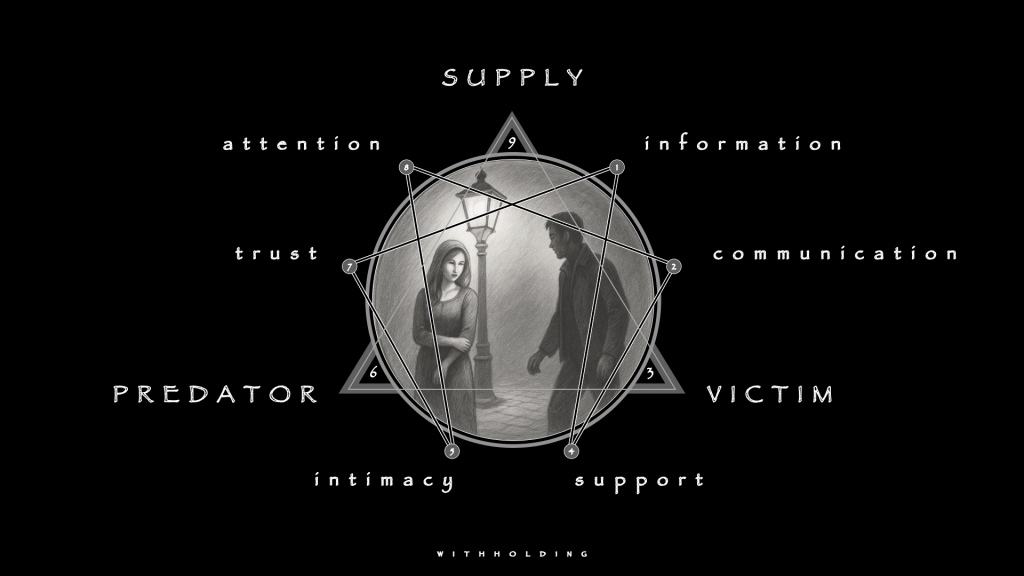
The fully armed Predator practices not one, but six Silences.
Preparatory
A one-word answer where a sentence lived before. A glance that slides past without catching. The temperature dropping in a room that has no thermostat.
The Predator grows quiet, withdraws affect, answers in monosyllables that give nothing away. Nothing has been said; everything has been communicated. The Victim begins to scan for what they did wrong, what they failed to notice, what apology might be required for an offense that has not been named. Preparatory silence requires no prior groundwork; it initiates the cycle by establishing that the Predator’s interiority is a locked room the Victim may not enter. The Victim learns to monitor constantly, to anticipate displeasure, to live in a state of low-grade vigilance that exhausts without ever producing a specific threat to address. The wasp hovers at the edge of the Victim’s vision, never landing, never leaving, teaching the host that safety is a matter of perfect stillness.
Comparative
The jaw tightening when a friend’s name is mentioned. The gaze drifting to the window when the Victim describes something they read. The conversation dying the moment anyone else’s perspective enters the room.
The Predator goes quiet when the Victim references an outside frame: a friend’s advice, a therapist’s observation, a book that named something the Victim recognized. The silence teaches that external sources are contaminants, that comparison is a form of betrayal, that the Predator’s worldview is the only atmosphere in which the relationship can breathe. Comparative silence depends on preparatory silence having trained the Victim to read withdrawal as warning; the Victim now knows that certain topics summon the chill. The Predator need not argue against outside perspectives; the silence argues for them. The Victim stops mentioning friends, stops quoting articles, stops referencing any reality that did not originate in the Predator’s mouth. The wasp has taught the host that certain flowers are poisonous; the host no longer remembers learning this, only that the flowers must be avoided.
Dismissive
The Predator continuing to scroll while the Victim speaks. The reply that answers a different question than the one asked. The yawn that arrives precisely when the victim reaches the point.
The Predator remains in the room but treats the Victim’s words as background noise, as weather, as something that will pass if ignored long enough. The Victim’s grievance hangs in the air, unacknowledged, slowly losing its conviction. Dismissive silence depends on comparative silence having eliminated outside validators; the Victim has no one left to confirm that what they are saying matters. The Predator does not argue, does not deny, does not engage; the Predator simply persists in their own activity as though the Victim has not spoken. The Victim begins to doubt whether they spoke at all, whether the words left their mouth, whether the thought was worth forming. The wasp does not sting; the wasp does not even look; the host learns that its distress signals are invisible, that its pain produces no response, that it might as well be alone.
Restorative
A hand on the shoulder after days of nothing. A meal prepared without discussion. The Predator sliding back into the shared bed as though the absence never happened.
The Predator re-emerges not with words but with presence, and the Victim experiences relief so profound it feels like love. Nothing is discussed; the wound is not acknowledged; the return is presented as a gift that requires no explanation. Restorative silence depends on dismissive silence having taught the Victim that their grievances will not be heard; the Victim has stopped expecting conversation and now accepts presence as the only currency available. The Victim learns that survival means accepting the cycle, that questioning the return will trigger another withdrawal, that gratitude is the only safe response to the end of pain. The Predator has trained the Victim to want less: not resolution, not understanding, not repair—just the body back in the room. The wasp lands at last, and the host’s relief is so complete that it forgets there was ever a time before the hovering.
Extractive
The Predator waiting at the kitchen table, saying nothing. The silence that follows “we need to talk” and precedes nothing. The vacuum that pulls confession out of the Victims chest like air from a punctured lung.
The Predator waits, and the Victim, unable to tolerate the void, begins to speak: apologizing for things they may not have done, offering concessions they had not planned to make, narrating their own failures in an attempt to find the one that will restore contact. Extractive silence depends on restorative silence having taught the Victim that the Predator’s return is the only prize worth winning; the Victim will pay any price to skip to the restoration. The Predator need not accuse; the Victim will accuse themselves, generating confessions the Predator could not have invented. The silence is a net; the Victim swims into it believing they are swimming out. The Predator collects information without asking questions, evidence without investigation, leverage without effort. The wasp sits motionless while the host walks into its jaws, believing that surrender is the fastest route to safety.
Rewarding
The evening where nothing is wrong. The car ride with the radio on and no tension beneath it. The Predator’s hand finding the Victim’s without prelude or price.
The Predator offers presence without demand, warmth without conditions, a silence that feels like peace rather than threat. The Victim experiences this as intimacy, as proof that the good version of the Predator exists and can be summoned. Rewarding silence depends on extractive silence having emptied the Victim of resistance; the Victim has confessed, surrendered, paid—and now receives the reward. The silence is intermittent reinforcement, teaching the Victim that compliance unlocks a version of the relationship worth enduring everything else to reach. The Victim begins to structure their life around reproducing the conditions that preceded the reward, not understanding that the conditions are arbitrary, that the reward is a tool. The wasp rests on the host’s shoulder, wings folded, and the host believes they have finally learned to be loved.
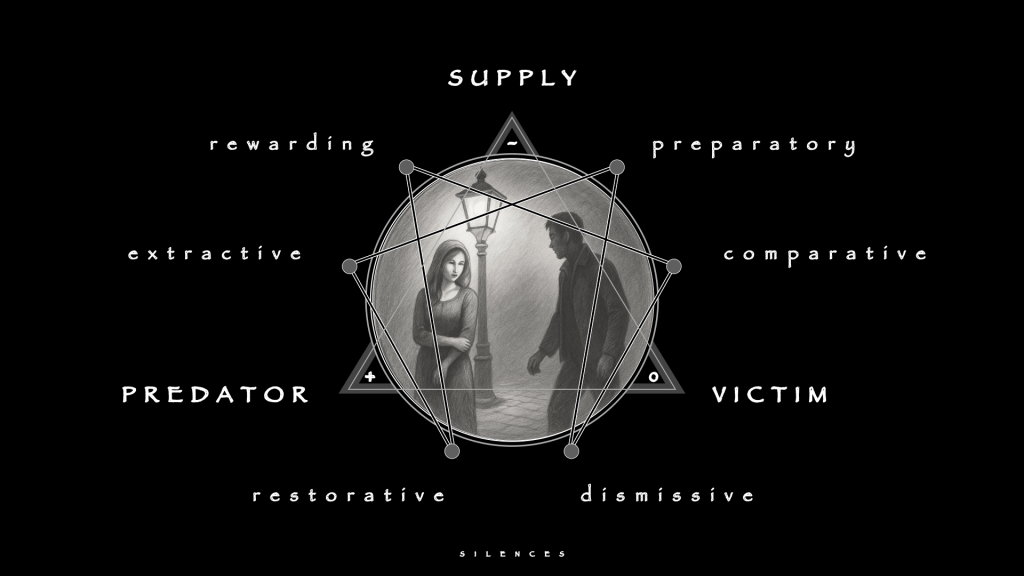
Weaponized Compassion
The Predator’s “care” is not careless; it is engineered. Different expressions of concern target different vulnerabilities, and the Victim learns to receive them the way a host learns to receive venom: knowing it will hurt, believing it must be necessary. The wasp does not sting randomly. Each injection disables a specific capacity, leaving the host alive but unable to act. The compassion is real in the sense that the sting is real; the purpose is not comfort but paralysis. The Victim who is cared for in this way stops struggling and starts cooperating with their own capture.
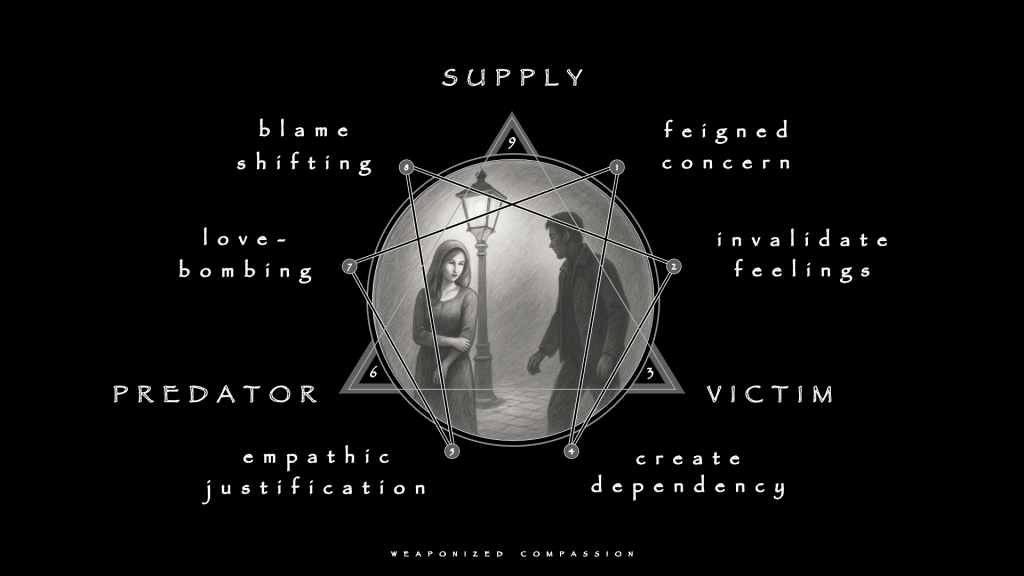
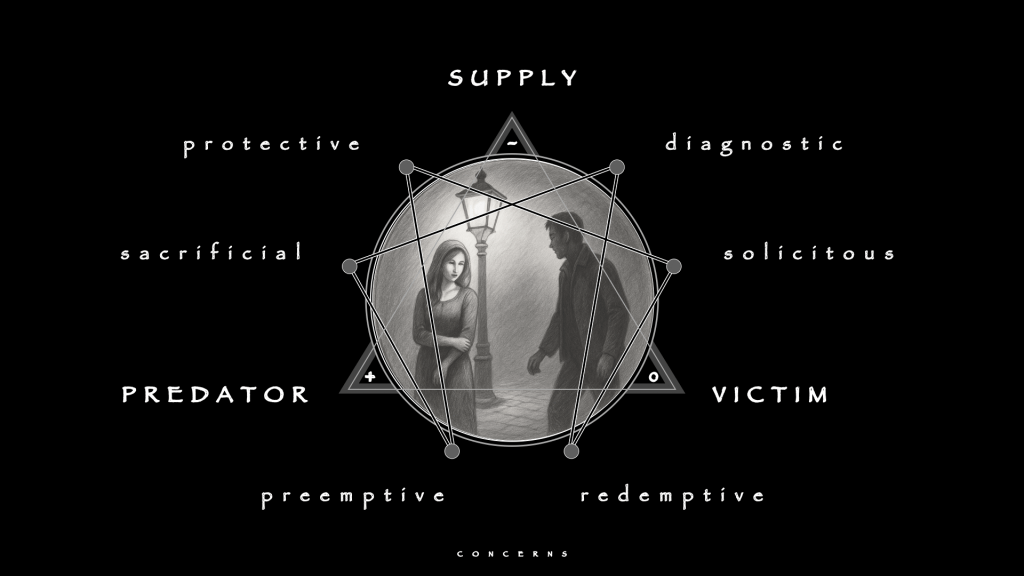
The fully armed Predator practices not one, but six Concerns.
Diagnostic
“I’ve noticed you’ve been really anxious lately.” “You seem depressed—have you thought about getting help?” “I think you might have a problem with anger that you’re not seeing.”
The Predator adopts the posture of worried observer, cataloguing dysfunction from a position of health. The Victim is sick; the Predator is the one who noticed. Gratitude becomes obligatory because the diagnosis is framed as a gift of perception. Resistance becomes denial, further evidence of the condition being named. Diagnostic concern requires no prior groundwork; it initiates the cycle by establishing the Predator as the reliable narrator of the Victim’s inner life. The wasp lands softly, antennae reading the surface, selecting the precise location for the first sting.
Solicitous
“Did you take your medication today?” “You look tired—are you getting enough sleep?” “Here, let me handle that—you’ve got enough on your plate.”
The Predator performs excessive attentiveness to minor needs while ignoring major wounds. Small gestures accumulate into a record of care that contradicts the Victim’s grievances: how can someone who reminds you to eat be accused of cruelty? The concern addresses the body while starving the soul. Solicitous concern depends on diagnostic concern having established the Victim as someone who requires monitoring; the attentiveness is surveillance dressed as service. The Victim who complains appears ungrateful for kindnesses no one else witnessed. The wasp tends the paralyzed host, grooming the surface, keeping the meat fresh.
Redemptive
“I believe you can change.” “I see the person you could be, underneath all this.” “I haven’t given up on you—not yet.”
The Predator becomes the savior, the Victim the project in need of completion. Hope becomes the leash, yanked taut whenever the Victim begins to settle into self-acceptance. The Victim strives toward a version of themselves that the Predator has defined, never arriving, always almost there. Redemptive concern depends on solicitous concern having established the Predator’s sustained investment; only someone who cares so consistently could be trusted to see the Victim’s hidden potential. The goal recedes at the speed of approach. The wasp lays its eggs inside the still-living host, promising that something beautiful will emerge.
Preemptive
“I just don’t want you to get hurt.” “I’m afraid you’ll regret this decision.” “I can see where this is heading, even if you can’t.”
The Predator positions themselves as the voice of foresight, implying the Victim lacks the capacity to anticipate consequences. Autonomy becomes recklessness; independence becomes self-harm in slow motion. The concern is prophylactic control, preventing mistakes the Victim has not yet made. Preemptive concern depends on redemptive concern having established that the Victim is a work in progress; someone still becoming cannot be trusted with their own trajectory. The Victim who proceeds anyway confirms the Predator’s diagnosis: too impulsive to be trusted, too blind to see the cliff. The wasp circles the host’s attempts at flight, steering it back toward the nest.
Sacrificial
“I’ve given up so much for you.” “I stay even though it’s hard—you know that.” “I keep trying even when you push me away.”
The Predator becomes the martyr, the Victim the cause of suffering nobly endured. Shame becomes the medium of exchange, compounding daily. The Victim owes a debt that can never be repaid because the Predator keeps adding to the principal. Sacrificial concern depends on preemptive concern having established the Predator’s ongoing vigilance; only someone who works so hard to protect you could be so exhausted by the effort. Leaving would confirm the Victim’s cruelty; staying is the minimum payment on an infinite loan. The wasp displays its worn wings, its thinning thorax, the visible cost of devotion to the host it has hollowed.
Protective
“I don’t think you should see her anymore—she’s a bad influence.” “You’re not in a good place to make that decision right now.” “I’m just trying to keep you safe from yourself.”
The Predator becomes the guardian, the Victim the ward who cannot be trusted with freedom. Boundaries dissolve because boundaries would prevent the Predator from fulfilling their protective function. The Victim’s judgment is compromised; the Predator’s judgment is the only shelter from a world the Victim is no longer equipped to navigate. Protective concern depends on sacrificial concern having established the Predator’s costly investment; only someone who has given so much has earned the right to decide what the Victim can risk. Isolation completes itself, and the Victim is grateful for the walls. The wasp seals the chamber, and the host mistakes the darkness for an embrace.
Predation as Mutation
The feeding cycle described so far is Regeneration. The Predator extracts; the Victim depletes; the system continues until the Supply thins below usefulness. But some dynamics do not merely extract. They restructure. The Victim does not simply lose resources; the Victim loses the ability to perceive the loss. The system mutates from feeding into colonization.
The Cordyceps fungus infects carpenter ants. The spores enter the body, spread through the tissues, and eventually reach the brain. The infected ant abandons its colony, climbs to a height optimal for spore dispersal, clamps its mandibles onto a leaf, and dies. The fungus then fruits from the ant’s head, raining spores onto the colony below. The ant did not choose to climb. The ant was piloted.
In the mutated dynamic, the Victim becomes the Predator’s advocate. The restructuring is complete when the Victim defends the Predator to others, explains away the Predator’s behavior, and attacks anyone who questions the relationship. The Victim has not been persuaded; the Victim has been colonized. The defense is not performed but felt. The Victim experiences the defense as loyalty, as love, as the only coherent position available.
The triad has shifted. In Regeneration, the Victim’s presence initiates, the Supply medium absorbs, and the Predator completes. In Mutation, the Supply medium initiates—reality itself has been restructured—the Predators version follows as the only available frame, and the Victim’s original perception is suppressed as the final term. The Victim’s reality does not compete with the Predator’s reality; the Victim’s reality has been overwritten.
This is not a later stage that all dynamics reach. Some relationships remain in Regeneration indefinitely: extraction without colonization, feeding without restructuring. The most common, undiagnosed case of perpetual Regeneration is that between narcissistic parents and their “brood”. Language (i.e. access to Humint outside our direct experience) prevents us from becoming more insect-like as a species than we already have.
In effect, Mutation occurs when the Predator’s frame becomes the only frame the Victim can access, when the Victim’s own history is no longer available as counter-evidence, when the Victim cannot remember what they used to think because thinking itself has been rerouted through the Predator’s categories.
Colonized Narration
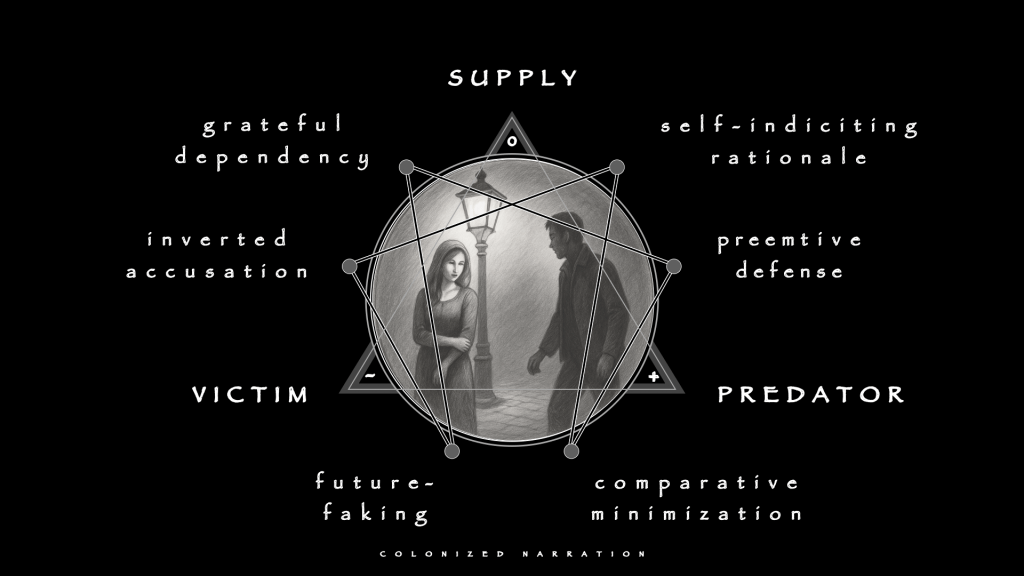
The mutated Victim has been restructured to speak in a distinctive register. The voice is theirs; the content is the Predator’s. The Victim narrates their own colonization as though it were liberation, using first person plural even when describing abuse: “we have problems,” “our situation,” “what we’re going through.” This is not performance. The Victim believes their own speech. The restructuring has reached the level of automatic phrases that emerge without rehearsal, often borrowing the Predator’s exact formulations without quotation marks.
The fungus does not need to move the mouth; the mouth has learned to move itself. Careful observation, however, suggests that though belief is hijacked, the Victim does not rely on Circular Speech or Word Salad, nor learn the Predator’s other tactics. What they have left are Six Stories.
Self-Indicting Rationale
“I can be difficult sometimes.” “I have a lot of issues.” “I don’t know why anyone would stay with me.”
The Victim accounts for the Predator’s behavior by offering their own deficiencies as cause, progressing from minor concession to total self-condemnation. The Predator’s cruelty becomes reasonable; the Victim’s suffering becomes deserved. The Victim has internalized the diagnostic frame and now applies it automatically, without prompting, in conversations the Predator will never hear. The indictment requires no prosecutor; the Victim has learned to convict themselves. Self-indicting rationale depends on comparative minimization having established that the Predator’s behavior falls within acceptable bounds: if the abuse is minor, the Victim’s flaws must be the real problem. The ant grooms the fungus growing from its own head and believes it is cleaning itself.
Preemptive Defense
“She can be intense, but she means well.” “He’s been through a lot—you’d understand if you knew.” “You’re only seeing one side, and it’s not even the real one.”
The Victim intercepts criticism before it can land, deploying explanations the Predator has provided as though they were the Victim’s own conclusions—unmarked borrowings that surface as original thought. The defense is seamless because the Victim believes it. Friends and family hear advocacy, not ventriloquism; they cannot see the hand inside the puppet. Preemptive defense depends on self-indicting rationale having established the Victim as the unreliable party: if the Victim is the problem, the Predator must be the solution. Counter-evidence becomes irrelevant because the Victim’s epistemology has been rewritten at the root. The ant attacks other ants trying to carry it back to the colony, mandibles working in service of the spore.
Comparative Minimization
“It’s not ideal, but it’s manageable.” “At least he doesn’t hit me.” “Some people have it so much worse—I should be grateful.”
The Victim locates their situation on a spectrum and places it toward the acceptable end, the scale recalibrating as conditions worsen. The Predator’s behavior is normalized by comparison to horrors the Victim has not experienced, each new low becoming the baseline for the next. The frame excludes the possibility that the relationship is simply bad; the only question is how bad, and the answer is always “not that bad.” Comparative minimization depends on future-faking having established that current conditions are temporary: if things will improve, the present can be endured. The Victim has been taught to grade on a curve, and the curve was drawn by the Predator. The ant watches others die on the forest floor and considers itself fortunate to still be climbing.
Future-Faking
“Things will settle down after the move.” “Once work calms down, we’ll be okay.” “We just need to get through this—it won’t always be like this.”
The Victim projects improvement onto a future that never arrives, each new milestone replacing the last without acknowledgment that the last one failed. The Predator’s behavior is framed as temporary, situational, addressable—not characterological, not permanent, not definitional. The Victim waits for conditions to change because the Victim cannot perceive that the conditions are the Predator. Future-faking depends on grateful dependency having established that the relationship itself is worth preserving: if the Predator’s presence is a gift, the future must hold the moment when the gift is finally unwrapped. The structure of hope becomes the structure of the cage, each bar a promise not yet kept. The ant believes the climb will end at the summit; the ant does not know the summit is where it dies.
Inverted Accusation
“You never really supported us.” “You’re just jealous of what we have.” “You’ve always wanted him gone—this is about you, not me.”
The Victim attacks the questioner, reclassifying concern as intrusion and observation as hostility, the pronouns shifting from “I” to “we” as the defense intensifies. Allies are recast as threats; support is reframed as sabotage; love is reinterpreted as envy. The Victim defends the perimeter of the colonized space against anyone who might provide counter-evidence, enforcing an isolation the Predator no longer needs to maintain. Inverted accusation depends on preemptive defense having established the Predator as misunderstood: if outsiders cannot see the real person, their criticism is ignorance at best, malice at worst. The Victim’s social world contracts to the diameter of the infection. The ant bites the hand that reaches into the terrarium, mandibles closing on the only fingers that might have carried it to safety.
Grateful Dependency
“I’m lucky he puts up with me.” “Nobody else would want someone like me.” “At least I’m not alone—that’s more than a lot of people have.”
The Victim expresses thanks for the Predator’s continued presence, framing the relationship as a gift rather than a trap, the gratitude deepening as the Victim’s self-worth hollows out. The thanks is genuine because the Victim has internalized the Predator’s assessment: unlovable, difficult, broken, and therefore fortunate. The Victim believes departure is unthinkable not because they fear the Predator but because they fear the void—a void the Predator has spent years expanding. Grateful dependency depends on inverted accusation having severed outside support: if allies are enemies, the Predator is the only safe harbor. The colonization is complete when the Victim thanks the parasite for not leaving. The ant, mandibles locked on the leaf, feels the sun on its carapace and mistakes the warmth for love.
Cutting the Anchor, Extinguishing the Lamp
The gas lamp was the anchor that had to be cut. Hamilton’s metaphor is technological: a dimmer switch, a single medium, a binary operation. The husband turns it down; the wife doubts. The metaphor implies a discrete act, a specific manipulation, something that could be caught on camera. It makes gaslighting look like a trick.
The biological frame changes everything. The reef is an ecosystem rather than an event. The Predator does not attack, but patrols. The Victim is not targeted for weakness but for abundance. Selection becomes legible. The question “why me” gets an answer that does not blame the Victim: because you had something worth taking, because you could generate what the Predator could not, because your coherence was the resource.
The wasp operates with surgical precision rather than ambient pressure. The left hemisphere differs from the right. Targeted Injection names the host system being disabled. The sting is not random; it is calibrated. The question becomes: what capacity does each phrase suppress? The taxonomy follows.
The Cordyceps colonizes rather than extracts. The fungus does not eat and run; it reprograms behavior. The ant climbs because it has been piloted. Regeneration takes from the Victim; Mutation overwrites the Victim. The triad shifts. The Victim who defends the Predator is not performing loyalty; the Victim has been restructured to produce loyalty as an automatic output.
The bread mold is the terminal insight. The fractal descends until intention vanishes. At the deepest level, there is no mind with whom to negotiate. The Victim wants desperately to find a person who could choose differently, someone who might (want or be able to) stop. The descent reveals that the choosing stopped long ago, if it ever occurred at all. You cannot appeal to the better nature of a chemical gradient.
The gas lamp metaphor produces none of the foregoing insights. It is too mechanical, too discrete, too focused on a single trick. Biological metaphors unfold because they have life cycles, selection pressures and host-parasite dynamics. They develop nested structures. Hamilton intuited the geometry in 1938, but the biology was not yet available to him.
It is now.

Leave a comment