You have been in the chair before without knowing it. Every interview that felt strangely constrained, every negotiation where your options kept narrowing, every conversation where you said more than you intended followed the same perilous path. The courtroom is where this road finds its most conspicuous and refined of destinations, but the same steps are taken wherever one party controls the questions and another must answer them. This three-part series teaches the complete system: how pressure is applied through language, how it can be absorbed and redistributed, and how recognition becomes reflex through training. The path extends far beyond the law. Once you learn to walk it cleanly you may never trip and fall again, although your counterparties might.
The Way Is In Training
The witness chair appears to offer a platform, but it functions as a kill box, a geometric trap where every sightline converges on a single vulnerable point. The lights are warm. The water glass sweats. The stenographer’s fingers wait like a spider at the edge of its web. Meanwhile, the architecture guarantees what the rules pretend to prevent, which is structural imbalance. One party asks; the other answers. One party controls tempo; the other responds to it.
A witness who does not understand this reality enters the room already compromised, mistaking the ritual for the machinery beneath it. The courtroom operates under the surface logic of procedure and precedent, yet its true momentum derives from asymmetry. Testimony is never a neutral act, but an encounter shaped by conflict, intention, and leverage. What looks like inquiry is actually pressure applied through the medium of language, a systematic compression of autonomy disguised as conversation.
The examiner does not seek information so much as manufacture conditions under which information escapes. Every question carries a secondary payload: to narrow options, to destabilize rhythm, to foreclose the paths of narrative control. The untrained witness experiences this as confusion or unfairness. The trained one recognizes it as structure, as legible as a blueprint, as predictable as the tides.
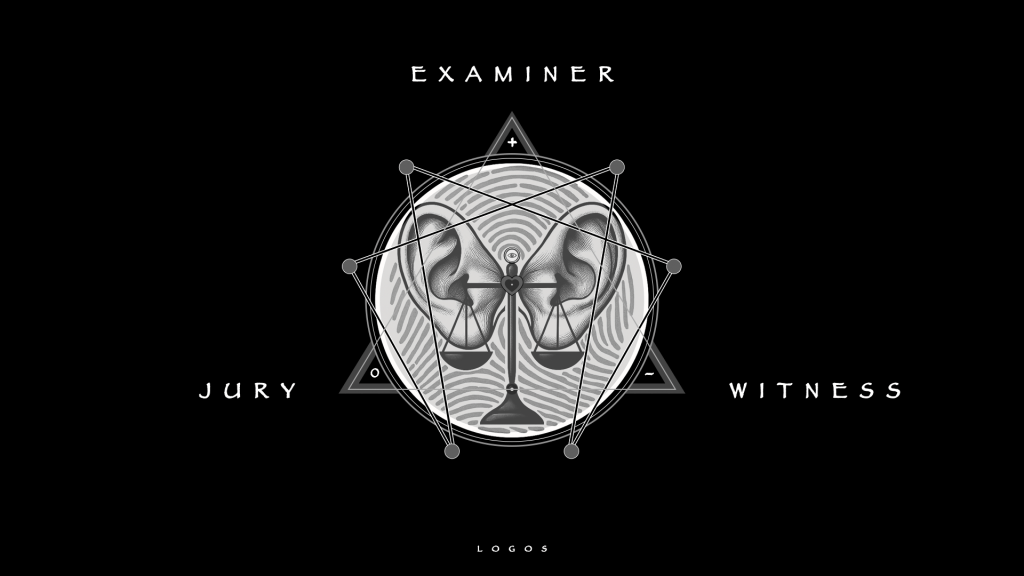
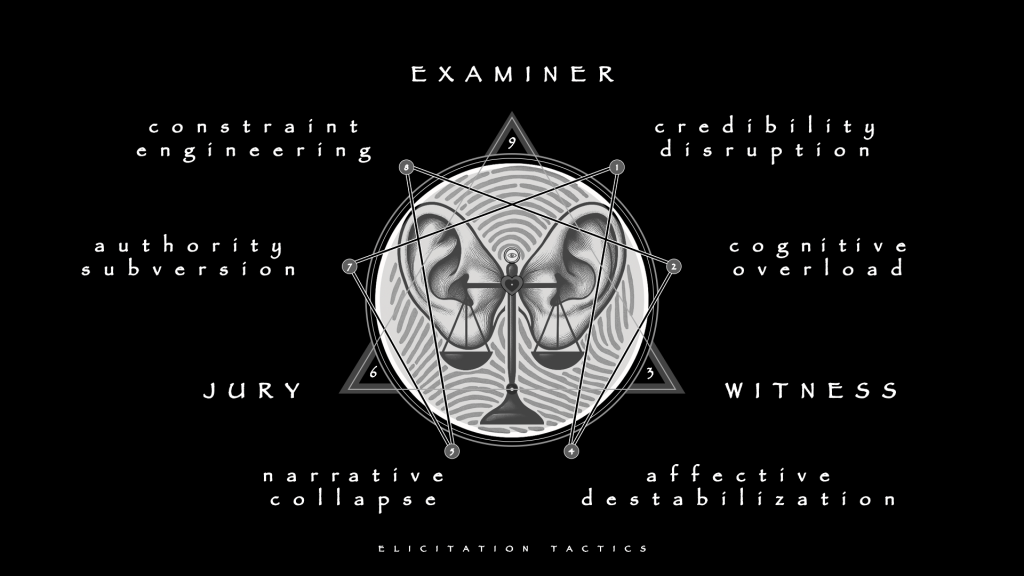
Twenty tactics follow, organized into six categories of increasing constraint. The taxonomy is operational, not academic; each targets a specific failure mode in human cognition or composure. In concert, they form a closed system, a complete grammar of pressure. The Examiner (+) deploys these instruments against the Witness (-) while the Jury (0) watches, and this Logos determines everything that unfolds.
To name the system is to begin escaping it.
The Grammar of Pressure
These twenty tactics distill centuries of refinement in the adversarial method, pressure-tested across countless depositions, cross-examinations, and administrative hearings. Each applies force to a specific structural weakness: logical consistency, emotional regulation, temporal memory, social credibility, or narrative autonomy. Some aim to fracture; others aim to freeze.
All aim to displace the witness from the center of their own testimony.
A skilled examiner reads the witness and selects accordingly, the way a chess player selects not the strongest move but the move that most constrains the opponent’s replies. Some witnesses collapse under credibility pressure; others hold firm until tempo disruption shatters their rhythm. The goal is never intimidation but structural failure, the moment when internal architecture can no longer support the load of questioning and something gives way. That collapse is the extraction point, and the examiner who cannot recognize it will walk past the opening without seeing it.
For the sake of study, assume the witness is untrained and minimally prepared. Later, when mitigation tactics enter the frame, the interplay between attack and defense will sharpen into something dialectical. First the reader must learn to cut.
Credibility Disruption
Undermine the Load-Bearing Wall
Undermine reliability through contradiction, bias exposure, or evasive behavior. Target the integrity of narrative by challenging its source, structure, or motive.
- Pressure Theme: Violation of personal standard or internal rule
- Tactic Function: Expose contradiction between prior statements, values, or roles
- Core Shift: From self-certainty to destabilization of moral or factual standing
- Why It Works: The drive for internal consistency runs deep; contradiction induces shame, deflection, or rigidity
Remove the load-bearing wall, and the entire testimonial structure becomes suspect. Credibility disruption does not require proving a witness a liar; it requires introducing sufficient doubt that the jury discounts the testimony as unreliable. These tactics function like termites in a foundation: invisible at first, catastrophic over time. By the time the damage becomes visible, the structure has already been hollowed from within.
The pressure theme is violation of internal standard. Every witness carries implicit commitments to consistency, honesty, and coherence. When those commitments conflict with prior statements or revealed motivations, the result is not confusion but shame. Shame produces rigidity or deflection, both of which read as evasion to an observing jury. The examiner need not accuse; the contradiction accuses for itself.
The compound effect makes this category especially corrosive. A single impeachment might be absorbed into the narrative as honest error or imprecise recollection. A pattern of exposed bias begins to function as character evidence, even when formally excluded. The jury watches the witness scramble to reconcile incompatible positions and draws conclusions that no instruction can undo.
Credibility, once fractured, does not heal during testimony, but bleeds out slowly, visibly, under the lights.
1. Impeachment by Prior Inconsistent Statement
Force the witness to reconcile current testimony with sworn statements made earlier. Contradiction exposes unreliability; reversal highlights opportunism. Both outcomes fracture trust and cast the witness as unstable or dishonest. Memory is not on trial, but it takes the verdict.
2. Exposing Bias or Motive
Surface underlying interests, whether financial, ideological, or personal, that compromise objectivity. Let the jury infer the distortion without accusation. A witness with something to lose or gain becomes less believable without a single demonstrated lie. Motive poisons the well before the water is drawn.
3. Establishing a Pattern of Evasion
Document multiple instances of indirect or incomplete answers. The cumulative effect is corrosive. A single dodge can be overlooked, but a pattern becomes a character trait that the jury carries into deliberation. The witness is no longer avoiding questions but avoiding truth.
4. Contrast With Credible Testimony
Position the hostile witness against a previously credible source. Avoid argument; invite comparison. The jury will choose between accounts, gravitating toward clarity and coherence. Contrast does the work that accusation cannot.
Cognitive Overload
The Nervous System as Target
Use tempo, silence, and repetition to override composure. Apply pressure not through content but through the architecture of delivery.
- Pressure Theme: Overwhelm through chaos, unpredictability, or emotional confusion
- Tactic Function: Shatter composure through tempo, silence, or intensity
- Core Shift: From external clarity to inward fragmentation
- Why It Works: Stress triggers regression to heuristics, identity tension, and performative self-reference
The mind under pressure does not think clearly; it reverts to heuristics, floods with cortisol, and begins making errors that calm reflection would prevent. These tactics exploit that biological reality by targeting not the content of testimony but the capacity to produce coherent testimony at all. The nervous system becomes the primary attack surface, and a destabilized body produces a destabilized narrative.
The pressure theme is overwhelm through chaos. Rapid tempo, unpredictable rhythm, and strategic silence combine to prevent any stable response pattern from forming. The examiner functions like a conductor who keeps changing time signatures mid-measure, forcing the orchestra into constant adjustment until the musicians begin making unforced errors. A witness who cannot predict the next question cannot prepare for it; a witness who cannot control pacing cannot control content.
Silence is the most elegant weapon here. Most people experience conversational silence as a vacuum that demands filling, an almost physical pressure to elaborate, to clarify, to offer something more. The examiner who pauses after a hard question exploits this reflex without saying a word. Information that was not requested gets volunteered; doors that were meant to stay closed swing open; material for the next attack arrives unbidden. Silence, weaponized, is louder than any accusation. The void is not empty but hungry.
5. Repetition and Rhythm Disruption
Vary phrasing and accelerate tempo to destabilize internal pacing. Repetition tests consistency; rapid-fire delivery suppresses reflection. Together, they fracture composure and increase the likelihood of contradiction, hesitation, or overcorrection. The target is not the answer but the answerer.
6. Silent Pauses
Let silence do the pressing. After a hard question, wait. Discomfort invites elaboration, correction, or contradiction. Anything said beyond the initial answer becomes leverage, and whoever fills the void has already lost.
7. Pacing and Leading
Begin with low-stakes questions to build a rhythm, then shift tempo or subject matter without warning. The sudden change jars loose unguarded thoughts or unrehearsed reactions. Comfort is the setup; disruption is the strike.
Affective Destabilization
Weaponizing the Need to Appear Good
Exploit emotional vulnerability through contrast, implication, and subtle dissonance to create discomfort without overt confrontation.
- Pressure Theme: Trigger the need to be seen as helpful, good, or aligned
- Tactic Function: Use politeness, morality, or implication to provoke unnecessary justification
- Core Shift: From clarity to servility or emotional leakage
- Why It Works: Moral questioning creates pressure to accommodate or deflect that overrides strategic thinking
Emotion is information, broadcast to everyone in the room whether the witness intends it or not. Loss of affective control transmits vulnerability the way a damaged vessel transmits distress signals. These tactics exploit the gap between how witnesses feel and how they appear, using politeness, moral implication, and recursive questioning to widen that gap until the internal tension becomes visible. The method is judo rather than boxing: the opponent’s momentum, redirected, becomes the force of their own defeat.
The pressure theme is the need to be seen as good. Most witnesses want the jury to perceive them as honest, fair, and reasonable, and these tactics weaponize that desire with surgical precision. A question that implies moral failure forces defense of character, not just testimony. Exaggerated respect creates dissonance when frustration begins to show. Volatility next to composure loses the affective battle regardless of substantive merits.
Looping questions use the witness’s own language as binding material. When the examiner constructs the next question from prior phrasing, the dilemma is immediate: repeat the phrase and sound rehearsed, or deviate and sound inconsistent. Each iteration narrows the corridor. The witness’s own words become a cage, and every attempt to escape makes the bars more visible.
8. Disarming Politeness
Maintain steady, respectful tone while the witness escalates. The mismatch triggers internal tension that the jury observes even when they cannot name it. Composure makes hostility look volatile by contrast. Courtesy becomes a weapon that leaves no fingerprints.
9. Moral Framing
Ask questions that imply a norm of honesty, duty, or neutrality. Let the witness scramble to distance themselves from ethical implication. Resistance appears guilty; acceptance opens the door to contradiction. The question is the accusation; the answer is the evidence.
10. Looping Questions
Use the witness’s own phrasing to build the next question. Deviation sounds evasive; repetition sounds rehearsed. Neither option is safe, and both lead deeper into the loop.
11. Using Jury Psychology
Ask questions the jury wants answered, even when expecting evasion. Credibility erodes not by what is said but by what is refused. The jury fills silence with suspicion, and suspicion needs no proof.
Narrative Collapse
Truth Has a Shape That Fabrication Cannot Hold
Force commitment to timelines or internal logic. Truth survives chronology. Fabrication does not.
- Pressure Theme: Disintegration of logical scaffolding or informational buffer
- Tactic Function: Force chronological sequencing or internal contradiction
- Core Shift: From calm detachment to visible disintegration or retreat
- Why It Works: Precision requirements expose gaps that vagueness conceals; fabrication lacks connective tissue
Truth unfolds in sequence, connects cause to effect, and holds together under chronological pressure the way a crystal holds its lattice structure under examination. Fabrication tends to exist in isolated moments, resistant to integration into a coherent timeline. Forcing commitment to temporal structure exposes invented narratives as brittle forms that shatter on contact with the calendar.
The pressure theme is disintegration of logical scaffolding. A witness who cannot place an event in time cannot defend its reality; a witness who affirms a sequence of premises may find, at the end, commitment to an untenable conclusion. The examiner engineers these collapses through careful setup, each question a single drop of water that seems harmless until the flood has already risen past the knees.
Boxing exploits the witness’s own reasonableness through cumulative entrapment. A series of small affirmations, none individually damaging, foreclose every exit. By the time the trap becomes visible, the only options are contradiction or confession. The art lies in making each step seem innocuous, reasonable, even helpful; agreement compounds until it becomes indictment. The witness builds their own prison, brick by brick, and the examiner merely locks the door.
12. Boxing Them In
Design a sequence of statements that must be affirmed, each leading closer to an untenable conclusion. Denial triggers contradiction; affirmation triggers exposure. The trap is architectural, and the witness supplied the materials.
13. Temporal Anchoring
Tie each key fact to a specific time, date, or order of events. Most lies collapse when forced into calendar form because fabrication lacks the connective tissue of lived experience. If the story cannot survive a timeline, the story cannot survive.
Authority Subversion
Eroding the Expert’s Pedestal
Disrupt perceived expertise or dominance to shift jury alignment by reframing who holds control, credibility, and command of the facts.
- Pressure Theme: Disruption of charisma, optimism, or narrative momentum
- Tactic Function: Undermine confidence in expertise, charm, or improvisational control
- Core Shift: From expansion to fragmentation or erratic defense
- Why It Works: Exposing finitude, contradiction, or audience disapproval disrupts the flow that authority requires
Expert witnesses and confident declarants occupy a privileged position, elevated by credentials and the assumption of specialized knowledge. Authority left intact can anchor a jury’s perception of the entire case. Erosion comes not through direct attack but through subtle reframing that shifts the jury’s sense of who controls the room. The witness may know more, but the examiner will appear to command more.
The pressure theme is disruption of charisma and expertise. A witness who appears to command the facts must be made to appear limited, biased, or overconfident through careful exposure. Superior familiarity with the record, expertise turned against itself, conspicuous absences highlighted without accusation: each technique shifts alignment away from the witness entirely. The goal is not to win an argument but to win the jury.
Framing through absence requires the examiner to say almost nothing at all. There is no accusation of lying, only notation of what was not said. Why was this detail omitted from the original report? Why did this conversation go unmentioned until today? The jury infers motive, and inferred motive is often more damning than proven motive. Silence becomes evidence, and defense of what was never said requires first explaining why it was never said.
14. Using Their Own Expertise Against Them
Use claimed knowledge as a lever by asking for affirmation of principles that contradict testimony. The more credible the witness, the sharper the fracture when contradiction lands. Authority turned against itself cuts deeper than doubt.
15. Demonstrating Familiarity With the Facts
Signal fluency by mentioning facts the witness assumed were obscure. Command makes the witness reactive, and reactivity reads as weakness even when the substance is correct. Knowledge is territory; hold more of it.
16. Framing Through Absence
Highlight what has not been said, especially details the jury expected to hear. Ask why a conversation was never mentioned, why a document was never produced. What is omitted becomes what is remembered.
Constraint Engineering
The Cage Assembles Itself
Reduce the ability to frame the exchange. Force operation inside imposed structure, not inside the witness’s own.
- Pressure Theme: Loss of control over framing, dominance, or tempo
- Tactic Function: Corner the witness inside externally imposed logic or structure
- Core Shift: From assertive confidence to visible struggle for control
- Why It Works: Defiance or emotional aggression can be redirected or revealed as evidence of guilt
The final category is the most aggressive because it seizes control of the frame itself. The cage does not descend from above like a trap in a dungeon; it assembles itself, piece by piece, from the witness’s own concessions, until the walls are visible and the door is gone. Recognition comes too late: the witness has been standing inside the structure since the first innocuous question.
The pressure theme is loss of control over framing and tempo. Yes-or-no constraints eliminate nuance; documentary confrontation forecloses retreat to subjective memory; a narrowing sequence of premises makes the conclusion inescapable. At this stage, questions stop being questions. They become inevitabilities, and the witness provides the raw materials.
The funnel technique begins with broad premises that seem harmless, almost collegial, before gradually narrowing the scope. Each agreement constrains the next like a ratchet permitting movement in only one direction. By the time the trajectory becomes clear, commitment to untenable positions is already complete. Looking back reveals the path walked, each step voluntary, each step a mistake.
17. Forced Binary Choices
Offer two constrained options, both inconvenient. Resistance to the premise forces visible struggle for control that the jury observes and interprets. The choice is false, but the struggle is real, and juries remember struggle.
18. Narrow Question Framing
Strip questions to specific, fact-based prompts that eliminate open-ended phrasing. Opportunity to inject narrative, justification, or reframing disappears. The narrower the question, the smaller the room.
19. Leading with Documentation
Confront the witness with records that anchor the discussion to something outside their control. Once the document is on the table, the witness’s version must either comply or visibly distort. Paper remembers what people forget.
20. Funnel Technique
Begin with broad, agreeable premises and gradually narrow the scope until commitment to an indefensible position is complete. By the time the trap is visible, it has already closed. The funnel does not push; it invites, and the witness walks in willingly.
Recess
These tactics construct a field of asymmetry calibrated to erode posture, tempo, and grip on narrative. The goal is not confrontation but distortion, not merely of the witness but of the story itself. Distortion sustained over time generates fatigue that compounds with every twist of structure, every narrowing of choice, every silence weaponized. The reshaping has a pattern, and once recognized, that pattern can be read, rehearsed, and resisted.
A prepared witness does not neutralize pressure but redistributes it, moving the force elsewhere: into the examiner’s tempo, into the jury’s perception, into the record that will survive the room.
Twenty tactics, six categories, one closed system … no secret techniques exist beyond these. There are only variations, combinations, and deployments. The examiner who masters this taxonomy has mastered the complete grammar of hostile elicitation. The witness who recognizes it has acquired something rarer still: the ability to see the frame while standing inside it.
A blade in the dark is legitimately terrifying, but one the under lights, measured and labeled, is merely a tool.
Most guides would end here, with mastery of the weapon and an invitation to practice. Yet the blade, once visible, has already changed hands. As you learn to name these twenty tactics in real time, you will notice them everywhere: in depositions, in interviews, in conversations that feel strangely constrained. Recognition precedes resistance. The next question you are asked may not be a question at all. You will know it by its shape.

Leave a comment