You have been in the chair before without knowing it. Every interview that felt strangely constrained, every negotiation where your options kept narrowing, every conversation where you said more than you intended followed the same perilous path. The courtroom is where this road finds its most conspicuous and refined of destinations, but the same steps are taken wherever one party controls the questions and another must answer them. This three-part series teaches the complete system: how pressure is applied through language, how it can be absorbed and redistributed, and how recognition becomes reflex through training. The path extends far beyond the law. Once you learn to walk it cleanly you may never trip and fall again, although your counterparties might.
How Not to Break
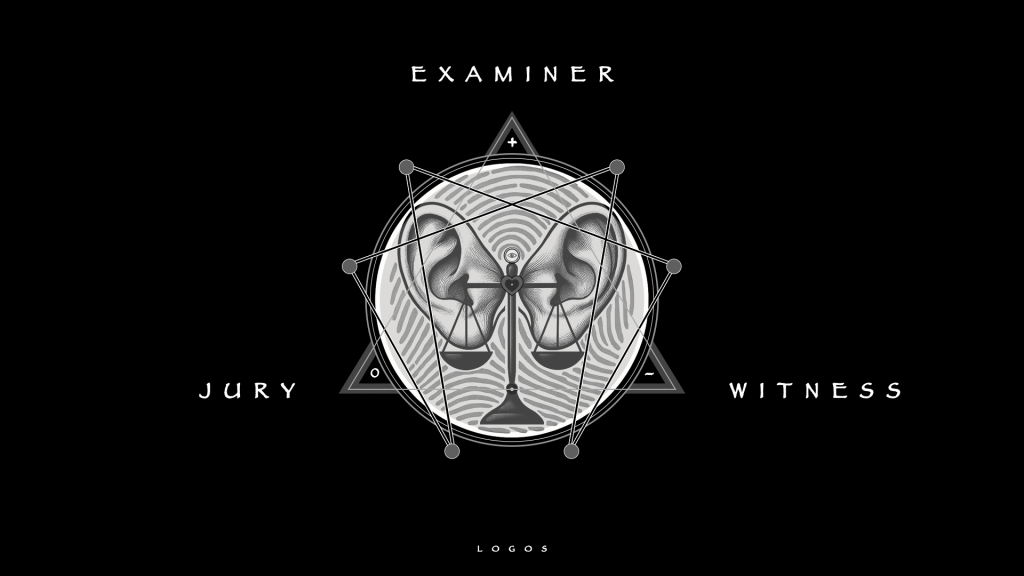
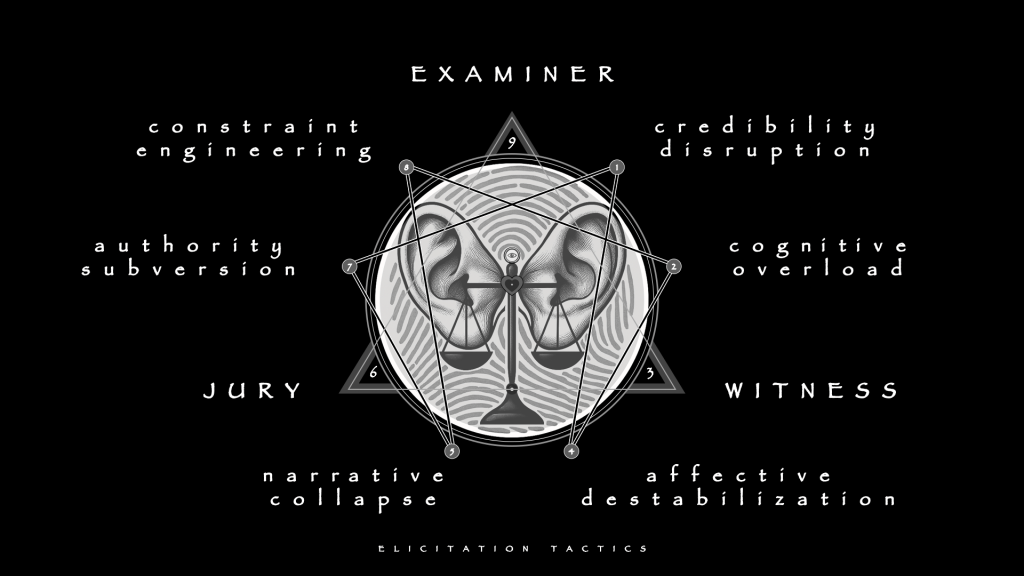
The courtroom appears balanced, but that symmetry is visual rather than structural. Pressure flows in one direction. The witness chair receives; it does not project. Twenty tactics exist to collapse witness autonomy, each targeting a different failure mode in cognition or composure. The result is not merely exposure but disorientation, the systematic unmooring of a person from their own narrative. The Examiner (+) constructs; the Witness (-) inhabits. The geometry favors the architect.
What follows begins with the body under pressure and the mind reaching for structure. The goal is not to argue your way free. Argument is, after all, precisely what the examiner wants, because it opens surface area, extends exposure, and multiplies the angles of attack. The goal, therefore, is to hold your shape while the frame closes in.
Shape is not rigidity but the disciplined maintenance of posture, tempo, and boundary under conditions designed to dissolve all three.
Twenty countermeasures map to twenty tactics. Blocking the attack is not possible; however, to absorb it, redistribute it, and return to neutral before the next question lands is possible. Mastery does not produce an unshakeable appearance but a calm one, which is the only credibility that survives cross-examination. Learn to hold, or break. The chair does not offer a third option.
Every answer is a vector, and direction matters more than content. A witness who understands this treats each response as a controlled emission, shaped and limited and pointed precisely where it needs to go. The examiner wants sprawl; the witness provides containment. The examiner wants reaction; the witness provides calibration. These are not personality traits but skills that can be drilled until they become instinct. Recognition is the first layer of defense, countermeasure selection the second. What remains after both is the substrate beneath: reflex.
First, you must learn to parry.
Credibility Disruption
Deny the Fracture Any Surface
Credibility is not declared; it is demonstrated through consistency, composure, and restraint. Prevent the crack from propagating.
- Resistance Theme: Controlled acknowledgment of complexity without retreat
- Counter Function: Clarify discrepancies, anchor statements in personal observation, refuse contestable interpretation
- Core Shift: From defensive scrambling to composed precision
- Why It Works: Acknowledgment without collapse signals confidence; juries read restraint as integrity
A single crack in credibility spreads like a fracture in ice: invisible at first, then suddenly everywhere, then collapse. Attacks on reliability do not need to prove a witness a liar; they need only introduce enough doubt that the jury begins to discount everything said. Seal each potential fissure before pressure can exploit it, because once the fracture propagates, no testimony can outrun it.
Controlled acknowledgment is the core discipline. Confronted with prior inconsistency, the untrained witness denies, deflects, or freezes, and each response accelerates the damage. The trained witness clarifies without retreat, acknowledges connections without defensiveness, and anchors every statement in personal observation rather than contestable interpretation. Threading a needle while someone shakes the table requires having threaded it a thousand times before.
When the examiner positions you against a previously credible witness, the temptation is to dispute the other account. Resist that. Disputation looks like desperation and opens new attack surfaces. Confine yourself to your own observations and let the jury reconcile the accounts without assistance. Responsibility extends only to what was seen; carried with precision, it weighs less than it appears.
1. Impeachment by Prior Inconsistent Statement
Review all prior statements before testimony. Confronted with a discrepancy, do not deny reflexively but clarify without retreat: “That may not have been clear in my earlier statement. What I meant was…” Correction performed calmly becomes consistency demonstrated.
2. Exposing Bias or Motive
Acknowledge relevant connections without defensiveness. Reframe your role as observational rather than personal: “Yes, I know the party, but my statement reflects what I observed, not how I feel.” Proximity is not contamination unless you let it become contamination.
3. Establishing a Pattern of Evasion
Avoid “I don’t recall” unless strictly true. When uncertain, say “To the best of my knowledge…” and deliver short, direct answers that leave no room for reinterpretation. Brevity reads as confidence; sprawl reads as hiding.
4. Contrast With Credible Testimony
Do not directly dispute another witness. Anchor your statements in personal observation: “I cannot speak to what they said. I can only speak to what I saw.” Your lane is your fortress.
Cognitive Overload
Metabolic Sovereignty Over Response Timing
Decouple response rhythm from attack rhythm. No obligation exists to match the examiner’s speed, fill their silence, or follow their tempo.
- Resistance Theme: Ownership of the pause and the breath
- Counter Function: Treat each question as isolated; starve the urge to elaborate
- Core Shift: From reactive synchronization to deliberate pacing
- Why It Works: The examiner’s tempo control depends on the witness matching it; refusal to synchronize neutralizes the weapon
The examiner who controls tempo controls the witness the way a current controls a swimmer who has stopped kicking. Rapid questions compress thinking time; strategic pauses create pressure to fill silence; repetition destabilizes confidence in prior answers. The nervous system is the target, not the testimony. Countermeasures must therefore sever the synchronization that makes tempo control possible.
The body wants to synchronize with the questioner because social rhythm is deeply wired, and the examiner knows it. Override this reflex by treating each question as an isolated event requiring its own breath, its own calibration, its own deliberate response. A pause before answering is not hesitation but ownership. The pause belongs to you, not to the examiner. Take it. Use it. Let the nervous system catch up to the mind before the mouth opens.
Think before you speak.
Silence is the examiner’s most elegant weapon, but it is also the most easily neutralized. A witness who has answered owes nothing more; the discomfort of a silent courtroom belongs to everyone in the room, not just to the person in the chair. Let it sit. The urge to elaborate, to clarify, to offer something more is the urge to hand the examiner free material. Starve that urge until it dies.
5. Repetition and Rhythm Disruption
Control the tempo by taking a breath before answering. If a question is repeated, respond calmly: “I have already answered that to the best of my ability.” Their repetition is not your problem. Instead, your consistency is your shield.
6. Silent Pauses
Resist the urge to fill silence. If you have answered, stop. The void belongs to the examiner, not to you. Let them figure out what to do with it.
7. Pacing and Leading
Stay alert to tone shifts, because easy questions may precede hard ones without warning. Keep attention constant even when the rhythm seems relaxed. The lullaby precedes the strike.
Affective Destabilization
Signal Compression as Armor
The courtroom reads affect like a seismograph, ergo control what you emit, not what you feel.
- Resistance Theme: Expressive economy and calibrated transmission
- Counter Function: Respond to content rather than tone; state rather than justify; correct once and stop
- Core Shift: From emotional leakage to controlled broadcast
- Why It Works: Affect is data; compression denies the examiner material to exploit or amplify
Emotion in the courtroom is not private; it is broadcast, read by the jury the way a thermal camera reads heat signatures through walls. A flicker of irritation, a sharpened tone, a visible swallow: these are data points collected without conscious awareness. The gap between feeling and appearance is the attack surface. Close it by regulating expression rather than suppressing experience, controlling the signal without pretending the feeling does not exist.
The examiner’s politeness is strategic; yours must be structural. The examiner’s moral framing is a trap, and recognition is the only exit. When a question implies wrongdoing, the untrained witness justifies, explains, contextualizes, and each response extends the exposure window. The trained witness states: “I followed procedure as I understood it at the time.” No performance of innocence. No wounded dignity. No invitation to follow-up. The statement lands, and the witness returns to baseline.
Looping questions use your own phrasing as binding material, so listening carefully becomes essential. Consistency of language is your ally, and deviation under pressure becomes evidence of uncertainty. If your words are taken out of context, correct once, firmly, briefly. Do not relitigate. The correction is the record; further argument is the trap. The loop breaks when you stop feeding it.
8. Disarming Politeness
Never match the examiner’s tone. Instead, maintain your own. Respond to content rather than demeanor, and keep delivery clean and posture still. Warmth borrowed is warmth owed.
9. Moral Framing
Do not accept loaded premises. If a question implies wrongdoing, redirect without justifying: “I followed procedure as I understood it at the time.” The accusation lives in the question; do not let it move into your answer.
10. Looping Questions
Listen to how your own words are reused and maintain consistency of phrasing. If taken out of context, correct firmly but briefly, then stop. Every elaboration feeds the loop.
11. Using Jury Psychology
Speak plainly and avoid jargon. Maintain eye contact with counsel rather than the jury, because authenticity emerges from precision, not performance. The jury sees what you emit, so emit only what you choose.

Narrative Collapse
Honest Approximation Survives Where False Precision Dies
Preserve flexibility without appearing evasive. Commit to what you know. Qualify what you approximate. Refuse what you cannot verify.
- Resistance Theme: Bounded commitment and defended limitation
- Counter Function: Reintroduce complexity before the box seals; frame uncertainty as uncertainty
- Core Shift: From fabricated precision to defended limitation
- Why It Works: Approximation stated as approximation cannot be impeached; false precision invites destruction
Truth has a skeleton that holds together across time, connects cause to effect, and survives the pressure of sequencing. Forcing commitment to timelines and logical chains constructs traps from that very structure. Preserve flexibility without appearing evasive by honoring the skeleton without inventing bones that do not exist.
Memory is not a recording but a reconstruction performed under present conditions. A witness who invents precision to satisfy the examiner has handed over a weapon with the safety off. When unsure of exact times, frame honestly: “I do not recall the exact time, but I remember it occurred after the meeting concluded.” Approximation stated as approximation cannot be impeached, whereas fabricated precision, stated as fact, invites annihilation.
Boxing requires vigilance across the sequence because the examiner secures a series of small affirmations, none individually damaging, that together foreclose every exit. Feel the walls rising and introduce complexity before the box is sealed: “That depends on the specific context.” This is not evasion but accuracy, which is the only defense that survives the appeal. Sensing the corridor narrowing demands stopping before reaching the dead end.
12. Boxing Them In
If the logic feels too clean, it may be engineered. Reintroduce complexity: “That depends on the specific context.” False simplicity is the trap; true complexity is the escape.
13. Temporal Anchoring
Anchor testimony to approximate times only when confident. If unsure, frame honestly: “I do not recall the exact time, but I remember it occurred after that event.” What you admit to not knowing cannot be used against what you do know.
Authority Subversion
Defended Limitation Holds Where Overreach Collapses
Scope control protects authority better than assertion. The expert who claims precisely enough is less vulnerable than the expert who claims too much.
- Resistance Theme: Bounded expertise and absorbed surprise
- Counter Function: Narrow assertions to defensible territory; absorb new facts without flinching; describe process rather than defend omission
- Core Shift: From overextended authority to bounded expertise
- Why It Works: Qualifiers signal sophistication; absorption signals control; procedure depersonalizes gaps
Expertise invites attack because expertise implies comprehensive knowledge. That implication is a trap. Claiming too much creates more vulnerability than claiming precisely enough. Preserve credibility through humility rather than assertion, through scope control rather than scope expansion. The fortress with smaller walls holds longer than the fortress that tries to enclose everything.
An expert who appears surprised by a fact the examiner introduces has lost control of the information environment; one who absorbs the fact without flinching has retained it. When confronted with unexpected detail, do not feign surprise or attempt to bluff. Stay composed: “That may be accurate, though I did not have access to that information at the time.” The acknowledgment is not retreat but boundary maintenance, the clear marking of what was known and what was not.
Advance preparation is essential because the examiner will weaponize what was not said. Know what you did not say and why. When asked why a detail was omitted from an earlier report, avoid speculation: “I was asked different questions at the time” or “That detail did not seem relevant then.” You are not defending an omission; you are describing a process. If the process is impersonal, then the omission is, too.
14. Using Their Own Expertise Against Them
Avoid absolutist claims and use qualifiers that reflect genuine nuance: “In most cases, that would apply, but this situation was different.” The hedge is not weakness but fortification.
15. Demonstrating Familiarity With the Facts
Do not feign surprise or attempt to bluff when the examiner introduces unexpected detail. Absorb the new information without visible reaction, because reactivity reads as weakness even when the substance is correct.
16. Framing Through Absence
Prepare for omissions to be weaponized. If asked why something was not mentioned earlier, avoid speculation: “I was asked different questions at the time.” Procedure explains gaps, which require no apology.
Constraint Engineering
Redefining the Frame Reads as Precision
Preserve narrative autonomy without appearing combative. Fighting the frame looks evasive; redefining the frame looks precise. The difference lies not in resistance but in register.
- Resistance Theme: Premise refusal and calm redefinition
- Counter Function: Reject false binaries; clarify before answering; maintain trajectory awareness
- Core Shift: From compliance or struggle to composed insistence on accuracy
- Why It Works: The examiner expects compliance or visible resistance; calm redefinition offers neither and reads as precision
The final category of attack seizes control of the frame itself, forcing operation inside a structure designed for failure. Preserve narrative autonomy without appearing combative, because the jury cannot distinguish between fighting a trap and hiding the truth. Redefining the frame reads as precision; fighting the frame reads as guilt. The difference lies not in the resistance but in the register.
Premise refusal is the core discipline. When offered a forced binary, reject the binary rather than choosing within it: “Neither option fully describes the situation.” When offered a yes/no question that misrepresents meaning, clarify before answering: “That is not a yes or no question. If I may clarify…” The examiner expects compliance or visible struggle. Calm redefinition frustrates by offering neither. The jury sees a witness who insists on accuracy, which is more sympathetic than obstruction.
The funnel technique demands awareness across time because each question seems innocuous while the trap emerges only in retrospect. If premises begin to feel like a narrowing corridor, pause. Ask whether agreement to the next statement will foreclose an exit that may be needed. The walls of a funnel touch only if you keep walking. Stop walking.
17. Forced Binary Choices
Reject the premise if both options are flawed: “Neither option fully describes the situation.” State your own framing rather than selecting from theirs. Refuse the menu; order off it.
18. Narrow Question Framing
If the yes/no structure misrepresents meaning, say so before answering: “That is not a yes or no question. If I may clarify…” Accuracy precedes compliance.
19. Leading with Documentation
If presented with documents, review them fully before responding and do not assume context. If unclear, say “I would need to read the full document to respond accurately.” The paper is patient; your credibility is not.
20. Funnel Technique
Stay alert as questions narrow. If you feel the walls rising, pause and ask whether the premises still reflect your intent before agreeing to the next step. The funnel has no power over those who stop walking.
Counterpoise
Composure under pressure is architecture, the deliberate construction of response patterns that hold their shape when the frame begins to close. This not luck, nor personality, nor even character revealed under stress, per se, but preparation deployed through them.
Precision under duress emerges from practiced constraint, the preloaded discipline of posture, tone, and brevity. What appears calm is actually coordinated; what holds is preparation, not character. Each countermeasure corresponds to a predictable point of failure, and each one answers a tactic not with defiance but with structural quiet: the answer that neutralizes without inviting more, the silence that concedes nothing, the clarification that closes rather than opens.
Pressure cannot be eliminated. It can, however, be redistributed. Absorbing a tactic and returning to baseline moves the force elsewhere: into the examiner’s tempo, into the jury’s perception, into the record that will survive the room. Redistribution is the only form of control available to someone who did not choose to be in the chair.
So far, twenty tactics have met twenty mirrors. Once recognized, the pattern can be read, rehearsed, and embodied. What remains is not instruction but installation: the training that converts recognition into reflex, knowledge into posture, and understanding into an instinctive stillness to hold when pressure rises. The geometry has been described. Calibration comes next.

Leave a comment