You have been in the chair before without knowing it. Every interview that felt strangely constrained, every negotiation where your options kept narrowing, every conversation where you said more than you intended followed the same perilous path. The courtroom is where this road finds its most conspicuous and refined of destinations, but the same steps are taken wherever one party controls the questions and another must answer them. This three-part series teaches the complete system: how pressure is applied through language, how it can be absorbed and redistributed, and how recognition becomes reflex through training. The path extends far beyond the law. Once you learn to walk it cleanly you may never trip and fall again, although your counterparties might.
Building Tactical Reflex
You have now seen both tools: the blade and the shield, the twenty tactics and their twenty mirrors. Recognition is the first layer of defense; countermeasure selection is the second. What remains is the substrate beneath both, the reflexes that allow recognition and response to occur faster than thought.
Knowledge itself does not protect you. Applied under pressure, it can. First, though, it must become something else entirely: posture, instinct, not reaction but response. The witness who must think through which countermeasure to deploy has already lost tempo. One who must consciously regulate affect is already leaking signal.
The goal is installation: the conversion of everything learned into a trained capacity to operate below the threshold of conscious deliberation.
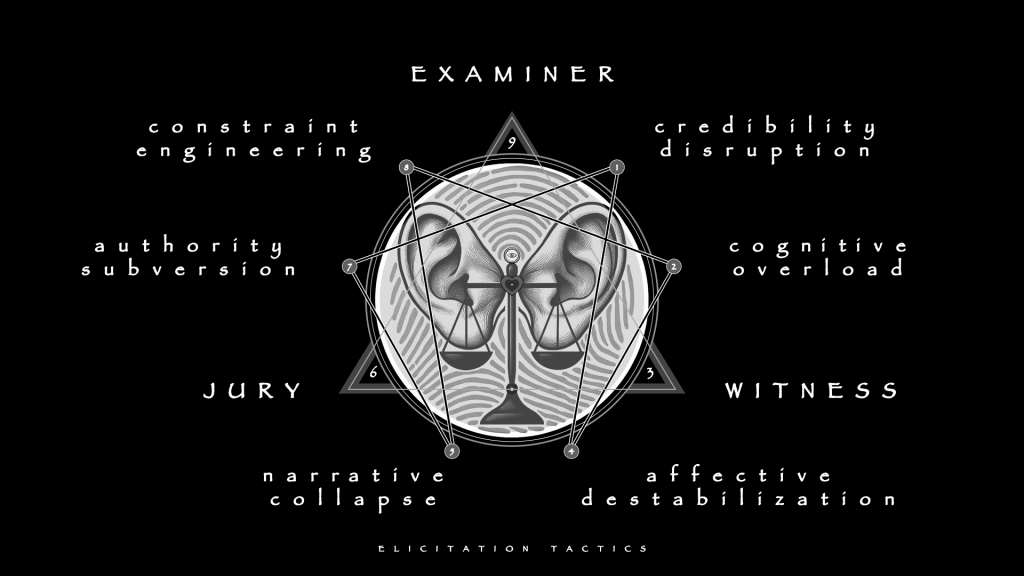
The courtroom is not a conversation but a stress environment, which favors those who have already metabolized the pressure in simulation. What you rehearse under controlled conditions becomes what you perform under hostile ones. The protocols that follow do not describe who you are. They describe how your composure fails under pressure, and how that failure can be anticipated, rehearsed, and overwritten.
Testimony is not remembered for its truth but for its shape under pressure.
Without preparation, witnesses react; with it, they engineer perception. The difference is not rhetorical but existential. Untrained witnesses hope that the truth will protect them. The trained witness knows that truth without delivery is raw material waiting to be processed by someone else. Hope is not a protocol. The sequence that follows matters because each layer builds on the one before, compounding capability until the witness can hold shape without conscious effort.
Credibility Disruption
Condition the Body Before the Mind Registers Threat
Stress inoculation through controlled exposure. Normalize pressure by pre-experiencing it in simulation.
- Training Theme: Vaccination against hostile rhythm
- Protocol Function: Build witness orientation around procedural discipline and composure architecture
- Core Shift: From reactive flinch to procedural absorption
- Why It Works: The nervous system cannot distinguish rehearsed stress from real stress; what has been survived once becomes survivable again
Real testimony does not unfold in calm sequences; it breaks rhythm, escalates tone, and bends logic under pressure. Most witnesses fail not because they lack facts but because they are unprepared for the tempo and structure of disruption. Condition the body to anticipate hostility without flinching, and to navigate ambiguity without over-explaining. The principle is vaccination: introduce a controlled dose of the pathogen so the immune system learns to recognize and neutralize it before the real infection arrives.
Controlled exposure through adversarial simulation is the mechanism. A surrogate examiner deploys the twenty tactics in sequence, varying intensity and combination, while the witness practices response and recovery. The goal is not to win the simulation but to normalize the pressure, creating a body-to-mind reflex where posture stabilizes before cognition catches up. The flinch disappears because the nervous system no longer classifies the stimulus as novel. The threat becomes familiar, and familiarity is the enemy of panic.
A witness who has faced simulated impeachment will recognize the real thing not as an attack but as a pattern already mapped. Simulated silence will have taught that the void can be inhabited rather than filled. Simulated moral framing will have revealed how accusation hides inside a question. The examiner’s first strike lands on a surface that has already absorbed a hundred such strikes. No thinking required. The response is already loaded.
Cognitive Overload
Strip the Reflex to Justify
Verbal economy as defensive architecture. Eliminate over-explanation, defensive elaboration, and the fixer impulse.
- Training Theme: Restraint as protective instinct
- Protocol Function: Condition brevity until it becomes automatic
- Core Shift: From compulsive explanation to tactical economy
- Why It Works: Every extra word expands exposure; restraint denies the examiner material to exploit
Under pressure, most witnesses begin to explain. They do not intend to elaborate, but to clarify, to correct, to win back the room. Although explanation feels like defense, in practice it is vulnerability. Every extra word expands the surface area of exposure.
Improvisation under stress is almost always a concession dressed as strategy.
Strip the reflex to justify through systematic practice: answer the question asked, and nothing more. When the urge to elaborate arises, notice it and refuse it. Over time, brevity becomes not just a discipline but a protective layer, each sentence smaller, sharper, and harder to turn against the speaker. Every word is expenditure, and every silence is conservation.
Some witnesses believe they can repair damage in real time by offering context, framing, or preemptive clarification. This belief is the examiner’s ally. Repair is not your job; your job is to answer precisely, then stop. Repair, if needed, will come from counsel on redirect. Attempting repair during cross is like performing surgery on yourself in a moving ambulance. Put down the scalpel. Answer the question. Stop.
Affective Destabilization
Confront the Gap Between Intention and Perception
Perceptual calibration through self-observation makes visible the expressive baseline and breakdown patterns.
- Training Theme: Alignment of internal state and external signal
- Protocol Function: Use video feedback to close the intention-perception gap
- Core Shift: From unconscious leakage to intentional transmission
- Why It Works: What is seen can be corrected; what remains unconscious will be exploited
Most witnesses do not know how they look when they are under pressure, only how they feel. In high-stakes testimony, your feelings are irrelevant, especially if they conflict with what others see. The jury reads the signal, not the intention. A witness who feels calm but appears agitated transmits agitation; one who feels confident but appears smug transmits smugness. The feeling dies in the room, and only the transmission survives.
Video review of simulated testimony forces confrontation with the gap. Go frame by frame if necessary, to hunt for any leakage: micro-flinches, nervous cadence, unearned aggression, defensive posture. The mirror is a forgiving liar; the camera, however, is a merciless witness to your own testimony. Watching yourself under pressure is corrective in a way that instruction cannot replicate because patterns become visible, and can be trained out.
When internal affect and external delivery align, the signal stabilizes. A witness becomes harder to decode, harder to provoke, and harder to break. The examiner who expects to read anxiety finds stillness. The jury who expects to see evasion finds composure. Seeing what others see teaches what to show.

Narrative Collapse
Train Recognition of Semantic Traps Before They Land
Cognitive perimeter defense. Develop recognition of false premises and disguised redirection.
- Training Theme: Calibrated premise-testing as reflex
- Protocol Function: Build boundary awareness through adversarial role-play
- Core Shift: From naive acceptance to automatic premise-testing
- Why It Works: Misdirection succeeds only when undetected; trained recognition neutralizes the tactic at inception
Not all questions are meant to be answered as asked. Some are built to frame, to redirect, or to imply. The question arrives dressed as routine, as clarification, as helpfulness, but it carries a payload designed to shift the ground beneath the witness’s feet. An untrained witness steps onto the new ground without noticing the shift. The trained witness feels the tilt before the footing gives way, the way a sailor feels the deck angle before the wave hits.
Adversarial role-play, with explicit misdirection attempts, builds the necessary reflex. The surrogate examiner practices the full range of framing tactics: false binaries, loaded premises, looping questions, funneling sequences. The witness practices recognition and refusal, learning not to resist every question but to recognize when the question is no longer neutral, when the premise itself is the attack. A question that assumes what it pretends to ask is not a question, but a trap with a question mark attached.
Correct training develops an internal alarm that fires before conscious analysis completes. Answers stay inside known boundaries; false premises get identified without escalation; loaded framings get refused without loss of composure; redirection happens without visible effort. The examiner who depends on misdirection finds a witness who tests the ground before stepping forward.
Authority Subversion
Regulate Transmission as Deliberate Choice
Affective transmission control. Reduce leakage, tonal volatility, and performative instability.
- Training Theme: Compression of expressive output
- Protocol Function: Train recognition of affect as broadcast data
- Core Shift: From energetic diffusion to emotional economy
- Why It Works: Affect is signal; compression denies the examiner readable material
Witnesses do not just speak; they transmit on frequencies they cannot hear. Tone, cadence, posture, and facial tension leak as much information as words. Under pressure, even minor affective spikes become admissible tells: sarcasm, eye-rolling, clipped retorts, the subtle hardening of expression that signals defensiveness. The jury collects these data without conscious awareness. The examiner reads them the way a radiologist reads a scan, searching for the shadow that reveals what the patient cannot feel.
Train recognition of affective leakage not as emotional slips but as signal breaches. The aim is not to become expressionless, because expressionlessness itself is a signal, and a suspicious one. The aim is to keep expression readable, stable, and strategically inert through repeated exposure to provocation, with real-time feedback on expressive output. Learn what your face does when frustrated, what your voice does when defensive, what your posture does when cornered.
Regulating affect as signal compression stops giving the adversary something to cut, mirror, or escalate. The examiner who expects emotional reactivity finds modulated stillness; the jury who expects agitation finds professional composure. The signal becomes what the witness chooses to emit, not what the pressure forces out. Transmission, once involuntary, becomes deliberate.
Constraint Engineering
Command Through Stillness Rather Than Assertion
Sovereignty over the void. Deprogram the reflex to fill space, defend status, or elaborate beyond the answer.
- Training Theme: Silence as instrument rather than threat
- Protocol Function: Build tolerance for the discomfort of unfilled space
- Core Shift: From confrontation or appeasement to centered stillness
- Why It Works: Silence neutralizes tempo control; whoever does not fill the void cannot be baited through it
Silence in testimony is not the absence of speech, but the presence of control. Most witnesses treat pauses as gaps to fill, invitations to clarify, or threats to credibility. The urge to speak is almost physical, a social reflex that the examiner knows how to exploit. The silent courtroom feels unbearable precisely because it is designed to feel that way. The discomfort is not a bug but a feature, and the examiner is counting on it.
Progressive desensitization teaches stillness not as hesitation but as command. The witness practices answering and stopping, then holding position while the room waits. The discomfort is the training; each second of maintained silence builds tolerance for the next. Over time, the urge to fill fades, replaced by recognition that silence belongs to the room, not to the witness alone. The void is not the witness’s responsibility to manage.
Mastery transforms silence into an instrument of pacing, a way to neutralize framing, and a signal to all observers that this witness cannot be rushed, baited, or broken. The examiner who depends on silence as a weapon finds a witness who meets it with equal stillness. The void is hungry, and the trained witness has learned to let it starve.
Beyond Disclosure
The six protocols work as a single system, each layer reinforcing the others.
- Stress inoculation prepares the nervous system
- Verbal economy protects the surface
- Video calibration aligns signal with intention
- Premise-testing guards the cognitive perimeter
- Affect modulation compresses transmission
- Silence training converts the void from threat to tool
Remove one, and the architecture weakens. Complete all six, and the witness becomes a different kind of instrument. Who was once a source of raw material for the examiner to process is become an intentional emitter of a calibrated signal.
A deeper logic underlies the structure of attack, as each protocol answers a category:
- Inoculation makes impeachment survivable
- Economy denies cognitive sprawl
- Calibration closes the affective gap
- Premise-testing catches the box before it seals
- Modulation stabilizes what juries read
- Silence neutralizes the funnel’s engine
Twenty tactics, twenty countermeasures, and six protocols form a single integrated system. Nothing is arbitrary. Everything connects.
Legal AI is already processing courtroom speech in real time. Hesitation patterns can be scored; contradictions can be mapped across hours of testimony; affective drift can be analyzed frame by frame. The subtle tells that once required a skilled examiner to detect are becoming replayable, quantifiable, and subject to algorithmic review. Every pause, evasion, or tonal shift will carry a digital shadow. A witness who relies only on truth may find that truth, poorly transmitted, reads as deception to the algorithm. An examiner who relies only on intuition may find that a machine has already mapped what took years to learn.
Winning this Red Queen arms race begins not with the answer but with the signal that precedes it. A trained witness does not merely respond but transmits deliberately, knowing that every micro-expression, every cadence shift, every silence is now data. The twenty tactics are known. As their twenty countermeasures are practiced, the six protocols become installed. Ultimately, the frame extends beyond the courtroom.
Elicitation is not a legal specialty, per se, but the structure of every conversation where one party wants something that the other party has not chosen to give.
This series opened with a promise disguised as invitation, to teach how pressure reshapes behavior on both sides of the exchange. Whether asking or answering, you could learn to control what unfolds next. Now you have already begun. You have also been inside the demonstration the entire time. As your taste refines, your ear sharpens and you feel the weight of conversation shift in real time, you will see this training everywhere. The next question you hear may be no question at all.
With practice, you will know better what to answer, why, and even when and how.

Leave a comment