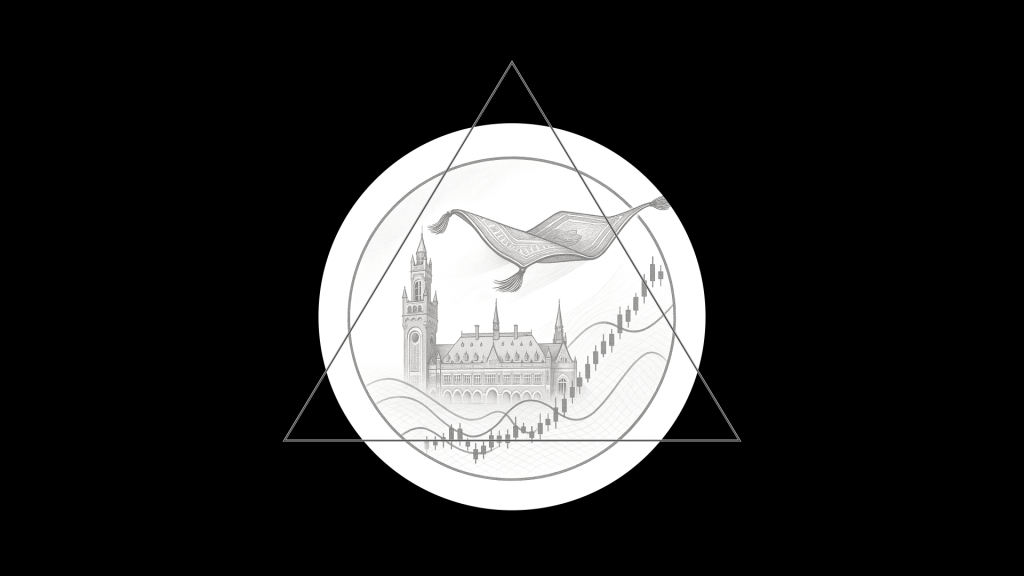
The International Court of Justice handed climate activists their greatest legal victory in July 2025, and in doing so, accidentally armed the developing world with the precedent to dismantle climate orthodoxy itself. The Court stitched climate duties to human rights duties, yet human rights law guarantees energy access while emissions restrictions demand energy denial; when incompatible threads are woven together, one must snap. Financial markets have already priced the Emperor’s nakedness in sovereign yields and commodity curves. The empty quadrant on the energy-income scatter plot—where high-income low-energy countries would appear if they could exist—falsifies green austerity more decisively than any treaty negotiation. The mineral supply chains of the “clean” transition, from lithium aquifers drained in Chile to child-mined cobalt in the Congo, constitute legal time bombs under the Court’s own “effective enjoyment” standard. A simple test, grounded in the Court’s logic, now exists—and no major climate policy can pass it.
The Emperor’s New Climate
The International Court of Justice believed it had woven a magic carpet to carry the world toward climate salvation. The loom was threaded in the Pacific, where law students at the University of the South Pacific pressed their governments to challenge climate inaction. These islands face genuine existential threat from which no seawall can protect them. Vanuatu and Tuvalu may disappear beneath rising seas within a generation; their petition was sincere, their grievance legitimate. Within years, the campaign cascaded through the Pacific Islands Forum, rallied support in the UN General Assembly, and summoned the ICJ to pronounce judgment from The Hague.
When the Court issued its Advisory Opinion on July 23, 2025, activists celebrated as if the impossible had taken flight. The ruling exceeded even advocates’ expectations. The Court converted aspiration into duty, recasting the Paris Agreement’s 1.5°C warming “limit”—described in treaty text as an ambition—as a binding ceiling.
It grounded obligations not only in climate treaties but also in human rights law, claiming that states must protect the “effective enjoyment” of rights by curbing emissions. It dismissed the idea that climate treaties constituted special law insulated from other norms, insisting that broader obligations also apply. The fabric looked rich, yet the weave was fragile. The Court had attempted to bind incompatible fibers—climate law and human rights law—into a single garment on a loom that could not hold them.
Silk cannot fuse with burlap; the tension tears the cloth.
One thread pulls toward restricting energy while the other pulls toward expanding it. The Pacific Islanders sought a weapon against industrial emitters and accidentally forged a sword that cuts in directions they never intended. The magic carpet they commissioned cannot carry the weight of a billion Africans demanding electricity. The loom they threaded will unspool their own weave, and the garment they ordered will clothe no one.
Gravity Does Not Yield to Proclamations
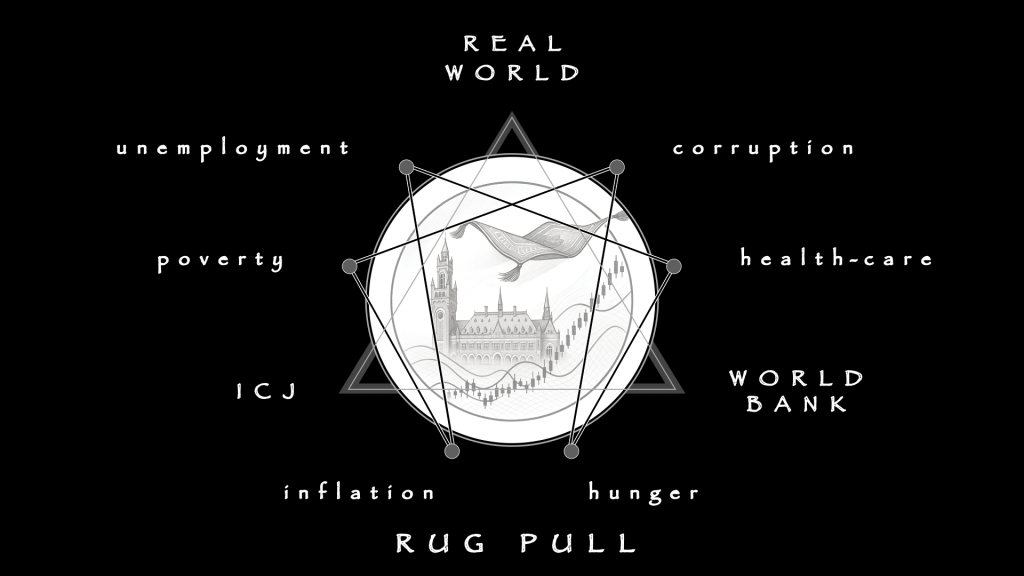
Beneath the spectacle, the floor did not move. The Peace Palace floats at the center of a wheel surrounded by the concerns it cannot resolve—unemployment, poverty, inflation, hunger, health care, corruption. The magic carpet flies away while the label beneath names what the ceremony conceals: rug pull. Afrobarometer surveys across thirty-nine African countries, representing over 53,000 face-to-face interviews, quantify the chasm between international law and lived priority. The data function as a structural survey revealing cracks in a foundation upon which no proclamation can safely rest.
Unemployment dominates the agenda. Thirty-three percent of respondents cite joblessness as one of their top three priorities for government action, making it consistently the single most important problem Africans want addressed. Among youth aged 18-35, roughly 39% report being unemployed and actively seeking work; 2024 data shows this figure climbing to 45% for the 18-25 cohort. In South Africa, 63% of young adults cite unemployment as their top priority, and actual youth unemployment for the 15-34 age group reached 45.5% in 2024—up from 36.8% a decade earlier. Poverty and hardship follow at 40%, with concerns rising roughly 10 percentage points since 2014-2015 across consistently surveyed nations. Cost of living claims 35%, food shortages 25%, health care 20%.
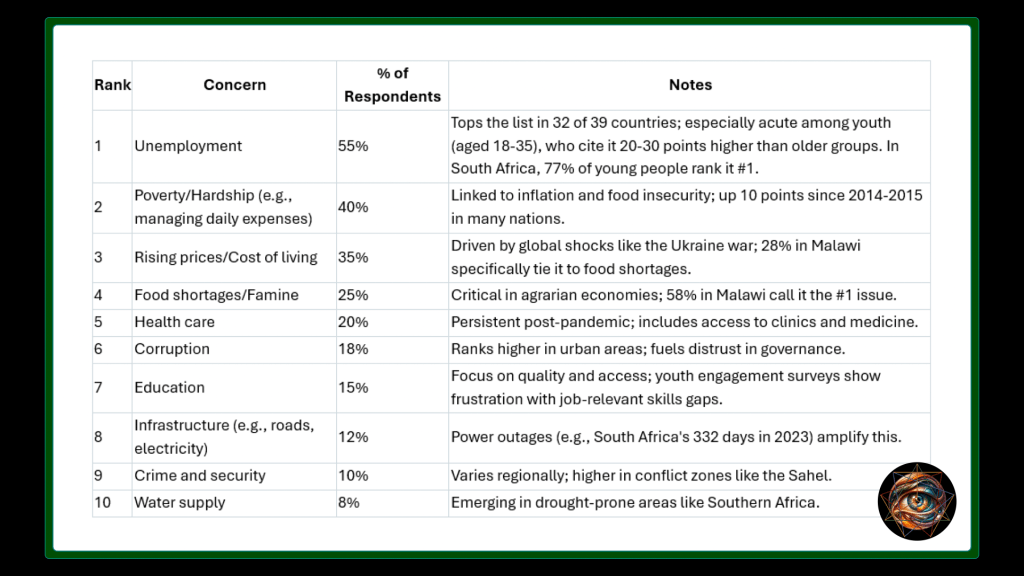
Climate change does not appear in the top ten priorities for government action.
The table of ranked concerns reads like an engineering report on a condemned building: infrastructure at 12% includes South Africa’s 332 days of power outages in 2023, while water supply at 8% reflects that 43% of Beninese and 37% of Mozambicans identify it as their most pressing problem. A clinic in rural Kenya loses vaccine stocks when the cold chain fails during a blackout. A classroom in Nigeria ends its day at sunset because children cannot afford lamps. These deprivations are not modeled futures; they are stress fractures in the load-bearing walls of daily survival.
Poverty is an anchor bolted to bedrock, and proclamations from The Hague do not unscrew bolts. The carpet was never airborne; it lay on the floor while the ceremony pretended it had risen. The Court spoke of “effective enjoyment” of rights as though words alone could generate watts. No syntax can power a turbine. No advisory opinion can refrigerate insulin.
The Sovereigns of Finance Stand Disrobed
Charts do not chant, vote, or flatter; they reveal what ceremony tries to hide. Financial instruments array around the Peace Palace like garments pooling at the Emperor’s feet, with trend, volatility, and volume as cardinal points and the declaration beneath: the Naked Emperor. In Andersen’s fable, the weavers promised a magnificent garment visible only to the wise; the courtiers praised its beauty while seeing nothing; the crowd murmured but dared not speak. The ICJ functions as the weavers, promising legal fabric visible only to those who accept climate orthodoxy. Thus, the IPCC would be the royal tailors, measuring and cutting according to the weavers’ specs. Then the COP delegations become the courtiers, applauding the garment’s elegance while seeing nothing they dare name.
Markets have no such inhibitions.
They are barometers that register pressure regardless of what the courtiers announce. The US 10-Year Treasury yield, once believed the risk-free anchor of the global system, has risen toward 4.5% and exposed fiscal fragility that no climate treaty can paper over. German Bund yields climb to highs not seen in more than a decade as energy stress and policy strain rip through the European weave. Japan’s 10-Year Government Bond yield, suppressed for decades, now stirs above 1.6%—up nearly 80% in a single year—revealing that Tokyo’s Emperor is clothed in borrowed garments that no longer fit. Each basis point is a measurement of exposure, a reading on the gauge that courtiers refuse to check.
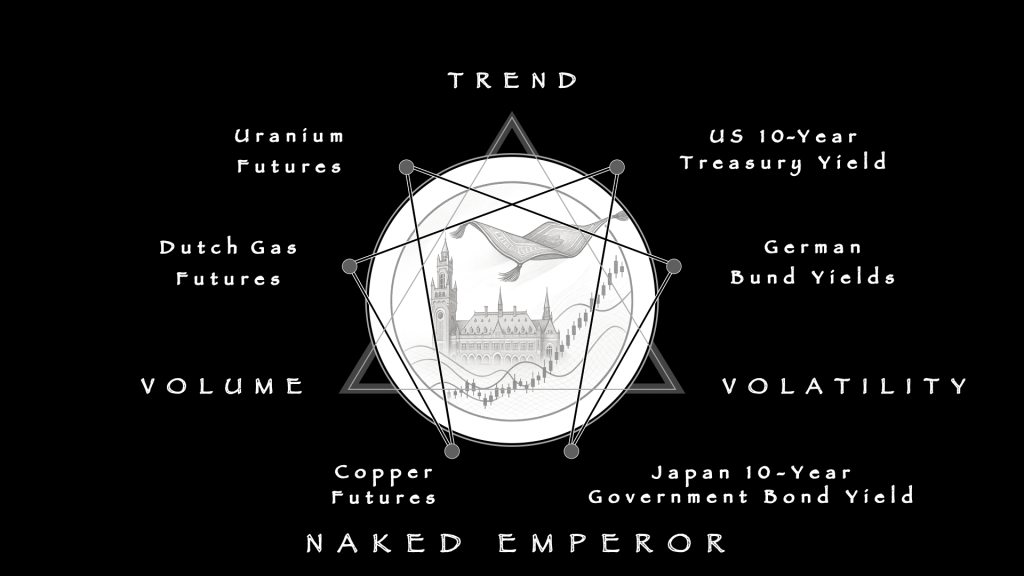
Copper, which advocates tout as the green metal of transition, hovers near $9,700 per metric ton. The price action reflects uncertain demand rather than the bull market that narratives predicted. The thread woven from copper unravels at the seam. Dutch TTF gas futures soared during Europe’s energy crisis—the carpet appearing to lift—then collapsed back near €30 per megawatt-hour when the illusion of energy abundance evaporated. The rug returned to earth because levitation without thrust is impossible. No ceremony can suspend the laws of thermodynamics.
One fabric holds. Uranium, shunned for decades, climbs steadily toward $80 per pound with projections far higher. It is the only material strong enough to carry billions into an energy-abundant future—a carpet woven not from children’s blood or poisoned aquifers but from physics itself. The parade continues, yet the crowd sees what courtiers deny.
The needle on the barometer swings toward storm.
The Knot That Strangles Its Maker
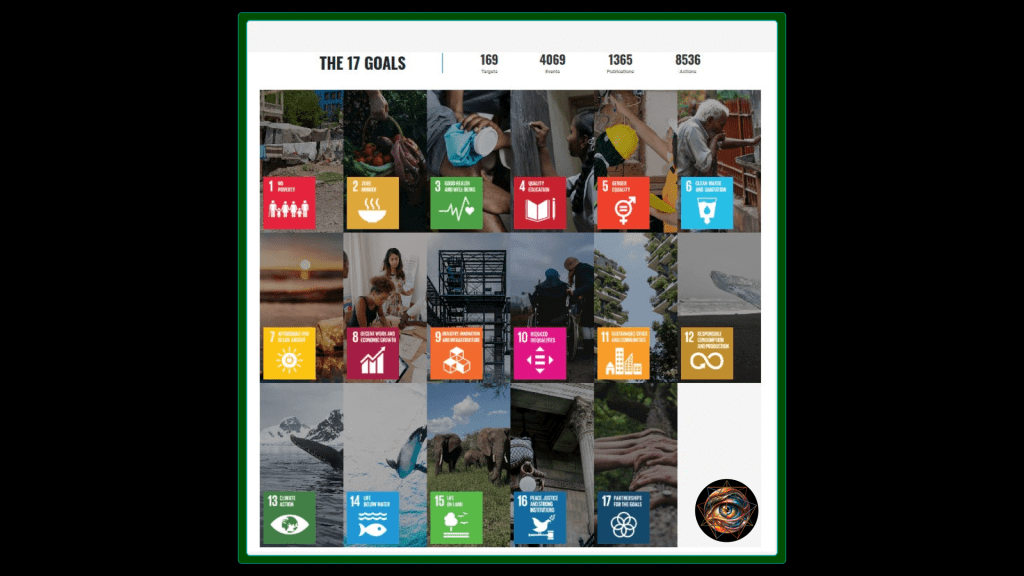
The ICJ’s most lethal vulnerability lies in its attempt to harmonize incompatible fibers on a loom that cannot hold them. The UN’s seventeen Sustainable Development Goals appear in their official grid: No Poverty, Zero Hunger, Good Health, Quality Education, Affordable and Clean Energy, Decent Work, Industry and Infrastructure, Climate Action—all rendered as visual equals with cheerful icons and optimistic colors. The image contains 169 targets across 17 goals with no weighting algorithm, no hierarchy, no designation of which walls bear weight. The Court supplied a load calculation without engineering analysis and without authority: climate wins.
The 2024 Africa Sustainable Development Report exposes what that imposed hierarchy costs.
Of 51 targets analyzed across five priority SDGs, Africa progresses positively on only 3—roughly 6%. Eight targets show negative trends or regression. The Court grounded climate duties in human rights law, yet human rights law also guarantees self-determination, use of natural resources, and an adequate standard of living. These guarantees now directly conflict with emissions restrictions. The Court tied a Gordian knot, believing it had created elegant synthesis. Alexander’s solution was to cut the knot with a sword; the developing world may do the same.
Ugandan President Yoweri Museveni put the contradiction plainly: “It is morally bankrupt for Europeans to expect to take Africa’s fossil fuels for their own energy production but refuse to countenance African use of those same fuels for theirs.” The line lands like the child’s cry in the fable—direct, devastating, undeniable. Museveni did not cite jurisprudence; he named what everyone sees. The Emperor has no clothes, and the crowd is beginning to say so aloud.
The courtiers shift uncomfortably; the weavers have no thread with which to respond.
The World Bank’s June 2025 reversal of its nuclear funding ban illustrates the first seam giving way. For decades, the Bank maintained that nuclear power was incompatible with development finance, steering borrowers toward renewables regardless of baseload requirements. The reversal concedes that the prior doctrine was wrong—that restricting energy choices cannot meet demand doubling by 2035. This is institutional apostasy, a crack in the orthodoxy. Cracks propagate. The question is which institution fractures next: the IMF’s climate conditionality, the European Investment Bank’s fossil fuel exclusions, the regional development banks that followed the World Bank’s lead.
Power outages alone cost African countries 1-6% of GDP annually. South Africa’s rolling blackouts reduced GDP growth by an estimated 2% in 2023-24, with the mining sector losing roughly R4 billion in output from 2019 power cuts alone. Eighty percent of African businesses experience outages, costing 5-6% of annual turnover with some firms losing up to 31% of sales. The tourniquet the Court applied to stop the bleeding of emissions is killing the limb it claims to save. Gangrene does not negotiate with good intentions.
The Court’s emphasis on “effective enjoyment” of rights exposes grotesque contradictions in the green transition’s mineral supply chains—contradictions that function as legal time bombs with fuses already lit. Extracting a ton of lithium consumes half a million gallons of water; in Chile’s Salar de Atacama, groundwater levels have dropped by a third, devastating indigenous communities and agriculture. In the Congo, some 40,000 children mine cobalt for less than two dollars a day, digging with bare hands in toxic dust to feed Western EV supply chains. More than 800 documented abuses in transition-metal mining have accumulated since 2010, with dozens of lawsuits already filed. The legal instrument the climate establishment created can be turned against the green transition itself.
The scalpel cuts every hand that holds it.
When a Congolese plaintiff invokes the ICJ’s “effective enjoyment” standard against a European automaker whose EV batteries contain cobalt mined by children, the Court’s own logic will demand a verdict. When a Chilean indigenous community sues a lithium producer for watershed destruction under the same human rights framework the Court deployed against fossil fuels, the precedent will bind. The only energy source that escapes the trap is nuclear, which requires neither child labor nor aquifer destruction. The weavers forgot to check what threads they were using.
The Test the Emperor Cannot Pass
A scatter plot from Energy for Growth Hub charts electricity consumption per capita against income per capita for 2022, with bubble sizes representing population and colors indicating World Bank income groups. The trend line runs from lower-left to upper-right with an R² of 0.83—meaning 83% of the variation in national income is explained by differences in electricity consumption. A red circle surrounds the empty lower-right quadrant, annotated with five words that falsify the green-austerity thesis: “High-income low-energy countries don’t exist.”
The empty quadrant is not terra incognita awaiting exploration, but an uninhabitable desert within which no economy can survive.
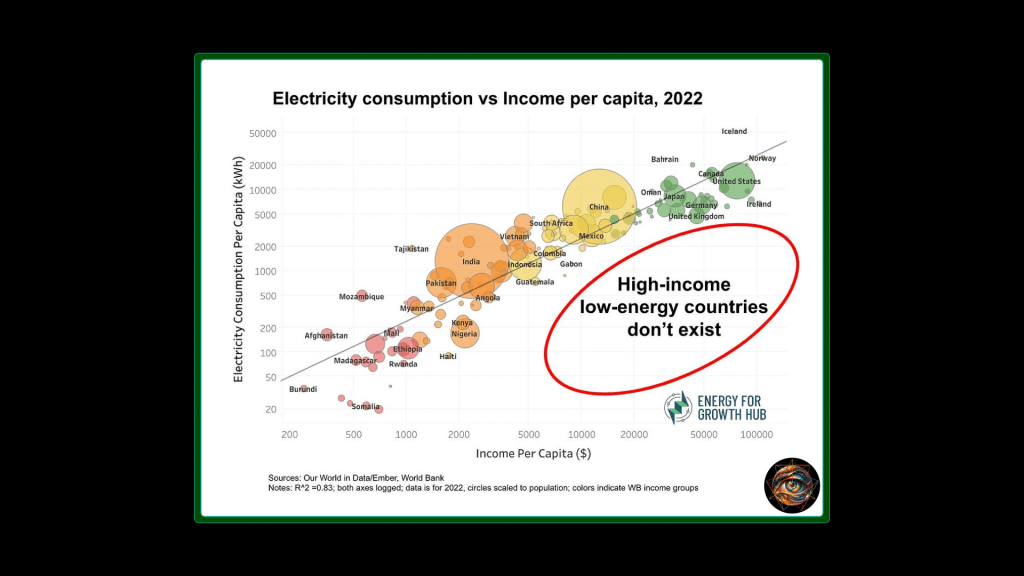
High-income countries average nearly 10,000 kWh per capita annually while low-income countries average 125-130 kWh—a 77-fold gap. Within Africa, upper-middle-income countries average 2,344 kWh versus 121 kWh in low-income countries, a 20-fold disparity. No nation has achieved prosperity while maintaining energy scarcity; the pattern holds across 140 years of development data. The empty quadrant is the airspace through which magic carpets were supposed to soar, the wardrobe in which magnificent garments were supposed to hang, the harmony into which the Gordian knot was supposed to resolve.
All three metaphors converge on the same void.
The Modern Energy Minimum of 1,000 kWh per capita per year—300 kWh residential, 700 kWh non-residential—correlates closely with reaching the World Bank’s lower-middle-income threshold of roughly $2,500 annual income. This level represents the electricity consumption necessary to support productive economic activity: manufacturing, cold chain logistics, digital services, mechanized agriculture. Eighty percent of African countries fall below this threshold. The global Modern Energy Minimum gap stands at roughly 1,228 TWh—equivalent to all solar generation worldwide or half of Europe’s annual electricity consumption.
Closing this gap requires building generation, transmission, and distribution infrastructure at a scale not seen since the postwar electrification of the West. The Tennessee Valley Authority, the Hoover Dam, the grid buildout that transformed rural America from kerosene and candlelight to refrigeration and radio within a generation—Africa requires a similar transformation. Yet the ICJ’s ruling and the financial architecture it reinforces treat such buildout as presumptively illegitimate unless powered by sources that cannot yet deliver baseload at scale. What the West accomplished in thirty years, Africa is expected to accomplish faster with fewer tools and less capital. The rules of the game changed after the early players won.
If the UN claims to arbitrate between competing duties, it requires a rule by which to adjudicate. The test is devastatingly simple: no climate policy passes unless it preserves or raises per-capita access to affordable, reliable electricity for the poorest quintile in affected states within the policy horizon. Price stability and service continuity for clinics, schools, refrigeration, and household cooking are the measures. Any policy that fails this screen constitutes a breach of development rights regardless of pledges or banners.
The test functions like a building inspector’s audit. Decorative flourishes—carbon credits, net-zero pledges, green bonds—mean nothing if the load-bearing walls cannot hold the roof. The Paris Agreement fails this inspection. Past World Bank restrictions on hydrocarbons fail it. Bans on nuclear funding fail it. Subsidy schemes that funnel children into mines while pretending to save the planet fail it. The Emperor is not merely naked; he fails his own structural audit.
Objections arise, yet each collapses under the weight of the evidence it ignores.
Climate harms also violate human rights, critics insist, and the claim is true as far as it goes. Certain deprivations nonetheless outweigh modeled futures; a freezer of vaccines melting in one night is a rights violation today rather than a forecast for 2050. Renewables can deliver reliability at scale, advocates reply, yet storage and transmission costs hit the poor first while cobalt dust fills children’s lungs and lithium brine drains ancestral lands. Advisory opinions lack binding force, skeptics note, yet the same channel that elevated climate duties can elevate energy duties, and precedent shapes doctrine and finance even when not formally enforceable.
Non-binding opinions alter the legal landscape through citation in subsequent cases, through incorporation into treaty interpretation, through influence on national courts applying international law domestically, through conditionality attached to development finance. When the European Court of Human Rights cites the ICJ’s climate advisory opinion in a future case, binding obligations emerge from non-binding precedent. When a national court in Kenya or Nigeria interprets constitutional environmental provisions in light of the opinion, domestic law shifts. The opinion is a seed that germinates in foreign soil. The developing world can plant seeds too.
The Lever Pulled Both Ways
The ICJ thought it had woven a magic carpet, a miraculous vehicle for climate justice. It crafted instead a noose for the orthodoxy that spun it—yet nooses, once tied, can slip over any neck. The developing world now holds a legal lever, yet levers require fulcrums, and fulcrums can shift. The physics of leverage contains no loyalty to the hand that pulls.
Victory, if it comes, will not arrive clean.
African nations demanding energy sovereignty will face their own contradictions: oil revenues that entrench autocracies, gas projects that displace rural populations, coal plants sited where political connections rather than engineering logic dictate. The moral clarity of Museveni’s accusation does not guarantee moral clarity in execution. The child who cried “naked” in the fable did not thereby clothe the Emperor; nakedness remained the condition of the realm. Andersen’s Emperor continued marching because stopping would confirm the humiliation. The climate establishment may do the same—doubling down on orthodoxy even as the contradiction becomes undeniable.
The financing trap compounds the legal contradiction. Africa’s sustainable financing gap through 2030 totals roughly $1.6 trillion, requiring an additional $194 billion annually—equivalent to 7% of Africa’s GDP and 34% of total investment flows. The ICJ’s ruling, by elevating climate obligations, has made energy infrastructure financing politically toxic in precisely the institutions that must provide it. The World Bank’s nuclear reversal represents a crack in that orthodoxy, not a solution. The developing world holds a legal lever, yet the lever requires capital to operate, and the funding institutions have internalized the very doctrine the lever is meant to dislodge. The gap is not merely a funding shortfall; it is a sovereignty auction in which nations bid away policy autonomy in exchange for infrastructure that the auction’s rules make difficult to build.
The deeper fracture lies here: the ICJ’s harmonization doctrine cuts in every direction. If human rights law can override climate obligations, it can also override development projects that violate those same rights. A lithium mine in Zimbabwe that poisons a watershed fails the same “effective enjoyment” standard that a coal ban in Kenya fails. The legal instrument is a scalpel, not a sword; it does not choose sides. The blade has no memory of who sharpened it.
What the Advisory Opinion truly accomplished was not the elevation of climate law but the exposure of a void. International law contains no hierarchy of rights, no algorithm for resolving conflicts between survival today and survival tomorrow, no designation of which walls bear weight. The Court gestured toward harmony while revealing cacophony. The SDG grid displays seventeen goals as equals because no institution possesses the authority to rank them. The empty quadrant on the scatter plot demonstrates that energy cannot be sacrificed without sacrificing prosperity. The enneagrams show the Peace Palace surrounded by concerns it cannot resolve and financial instruments that measure its irrelevance. The fabric was never whole; the carpet was never airborne; the garment was never real.
Armed with the Court’s own thread, the developing world can measure this Emperor against a test he cannot pass. The Advisory Opinion is not the triumph of climate law; it is the threshold of its reversal. Those denied energy abundance can now pull the rug from under the illusions of the rich. They should not expect the floor beneath to be solid—but they have learned, at last, that the carpet never flew.


Leave a comment