Those Who Watch
At this moment, the same algorithm runs in a climate-controlled office park in San Jose and a detention facility in Urumqi. In San Jose, it parses the facial expressions of software engineers during stand-up meetings, flagging those whose engagement scores fall below threshold for managerial follow-up. In Urumqi, it parses the facial expressions of Uyghur detainees restrained in metal chairs, flagging those whose anxiety scores rise above threshold for further interrogation. The algorithm cannot tell the difference between these contexts. It sees faces, extracts features, outputs classifications. The difference is entirely in what happens next, and that difference is determined not by the technology but by the institution that wields it.
The machine does not deploy itself.
Behind every camera sits an adversary with objectives the technology serves, constraints the technology must navigate, and vulnerabilities the technology cannot eliminate. The same apparatus operates as annoyance or as existential threat depending on who points it and why. Countersurveillance calibrated to one adversary may prove useless against another. The hunter who pursues you for sport requires different evasion than the hunter who pursues you for food, and both differ from the hunter who pursues you because your existence offends his god.
Pay Attention
The shopping mall is the softest surveillance environment, and therefore the place to begin. Cameras track customer flow, dwell time, and facial response to merchandise. Heat maps reveal which displays attract attention; expression analysis reveals whether that attention is positive or negative. The data informs product placement, pricing strategy, and targeted intervention. If the system detects confusion, staff receive alerts to offer assistance. If the system detects purchase hesitation, dynamic pricing may adjust in real time. The customer becomes a variable in an optimization function, her journey through the store a sequence of conversion opportunities to be maximized.
The retailer’s interest is your disposable income, nothing more.
The emotional surveillance serves affective nudging: environmental modifications designed to induce purchasing-conducive states without conscious awareness. Lighting adjusts to flatter products. Music tempo aligns with desired browsing pace. Temperature maintains the comfort that prolongs visits. These interventions predate emotion AI, but algorithmic analysis allows personalization at scale. The system that knows you are frustrated responds differently than the system that knows you are enthusiastic. Both responses aim at your wallet.
The retailer operates under reputational and regulatory constraints that create defensive opportunity. Consumers who learn they are being emotionally monitored may take their business elsewhere. Visibility creates accountability. Privacy regulations like GDPR require disclosure and consent for biometric processing. Retailers who violate these requirements face enforcement action. The retailer makes a calculation when deploying emotion AI, weighing surveillance benefit against compliance cost and reputational risk. Changing the variables in that calculation changes the outcome.
The customer’s countermeasure is awareness joined to intention.
The shopper who knows emotion AI operates in a given environment can choose to avoid that environment, to limit interaction time, or to adopt the flat affect that minimizes data yield. Sunglasses and hats reduce facial capture. Deliberate decision-making before entering the store—knowing what you intend to purchase and refusing to browse—limits the emotional variation the system can exploit. The countermeasure is also collective: consumer pressure, privacy litigation, and regulatory advocacy that raises the cost of emotional surveillance until extraction no longer pays.
The Employer Who Reads Your Silence
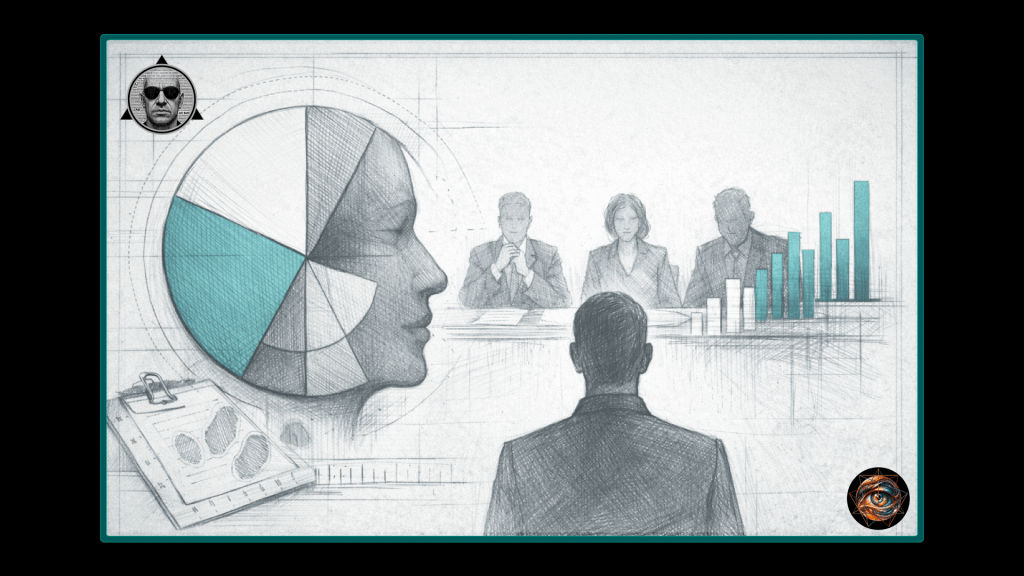
More than half of large American employers now deploy some form of emotion AI to monitor workers. The technology parses email sentiment, analyzes meeting participation, tracks keystroke patterns, scores video call expressions, and synthesizes these streams into dashboards that purport to measure engagement, wellness, and productivity. The stated purpose is benevolent: identify burnout before it claims a valued employee, detect disengagement before it spreads, optimize the emotional climate of the workplace.
The actual function is discipline.
The employee who knows sentiment analysis reads her email writes differently than the employee who believes her correspondence is private. The difference is not authenticity versus performance; all workplace communication involves performance. The difference is who controls the terms of the performance. Before algorithmic monitoring, the employee could calibrate her emotional display to her immediate audience—warmer with colleagues she trusted, more guarded with supervisors she did not. Emotion AI eliminates this calibration by introducing an invisible audience that sees everything and whose interpretive criteria remain opaque. She cannot know which phrases trigger concern, which facial expressions register as insufficiently engaged, which silences the system reads as dissent. She can only flatten her affect prophylactically, erasing variation to avoid unpredictable consequence.
Workers describe this as a deep privacy violation, and they are correct, but the violation runs deeper than privacy. The employer who monitors emotion does not merely observe the worker’s inner life; they reshape it. The knowledge of surveillance becomes a presence in every interaction, a reader of every message, a third party to every meeting. Workers report that they exert massive energy masking even when alone in the office, energy diverted from the work the monitoring supposedly optimizes. The system operates like an autoimmune disorder: the organism attacks its own tissue, mistaking self for threat, producing the very dysfunction it claims to diagnose.
The employer’s vulnerability is legal exposure.
The European Union’s AI Act, effective February 2025, categorically prohibits Emotion Recognition in workplace contexts except for narrow medical or safety exceptions. Employers who deploy the technology in EU jurisdictions face substantial penalties. American workers lack equivalent protection, but Illinois’s Biometric Information Privacy Act creates private right of action with statutory damages for unconsented biometric collection, and other states are following. The employer who monitors emotion in a multi-jurisdictional workforce must navigate a patchwork of constraints, and navigation creates gaps. The worker who understands the legal terrain can identify which contexts offer protection and which require other defenses.
The Casino That Reads Your Hands
The gaming floor is a laboratory for emotional surveillance, and has been for decades. Long before algorithmic Emotion Recognition, casinos employed behavioral specialists to identify advantage players through observation of betting patterns, body language, and tells. The technology merely scales and automates what human eyes once performed. Cameras track facial expressions at the blackjack table, identifying the subtle signs of card counting or the emotional leakage that reveals a bluff in progress. The house edge is already mathematical; emotion AI makes it psychological.
The casino’s interest is session extension through information asymmetry.
The player who cannot read the dealer’s face confronts a dealer who has already read his. The technology identifies when a player is tilting—the emotional state in which frustration overrides strategy—and the floor responds accordingly: a complimentary drink to lubricate continued play, a dealer rotation to reset the dynamic, whatever intervention keeps the player in the chair and the chips moving toward the house. The relationship is predator and prey, dressed in hospitality’s clothing.
Yet the casino operates under constraints the more dangerous adversaries do not. Gaming commissions regulate surveillance practices. Jurisdictional variation creates compliance complexity. Reputational risk attaches to perceived unfairness. More importantly, the casino’s interest is behavioral—it wants you to keep playing, not to confess your politics or pledge your loyalty. This narrower ambition creates a narrower threat surface.
The player’s countermeasure is the discipline professionals have always cultivated: affect flattening, the deliberate adoption of a baseline presentation that reveals nothing because there is nothing to reveal. Sunglasses obscure the eye region where much emotional signal concentrates. Practiced neutral expression defeats facial coding. The player who arrives at the table having already decided his strategy—who treats the session as execution rather than improvisation—generates less emotional variation for the system to parse. The tell is a leak in the hull.
Plugging leaks is a learnable skill, and the player who masters it restores the game to mathematics.
The Prosecutor Who Directs Your Performance
The courtroom has always been theater, but the audience is changing. Legal professionals increasingly employ emotion AI to assess jury reactions during voir dire, monitor witness credibility, and calibrate argument delivery for maximum emotional impact. The American Bar Association has taken notice, warning that AI-based jury selection tools are susceptible to discriminatory results and that attorneys cannot avoid ethical responsibility by delegating to algorithms. The warning is necessary because the practice is spreading, and the stage is being fitted with new instruments.
The prosecutor’s interest is conviction, and Emotion Recognition serves that interest at every act. During jury selection, the technology identifies prospective jurors whose emotional responses to case themes suggest favorable or unfavorable disposition—casting the audience before the performance begins. During trial, it monitors the jury box for signs that arguments are landing or failing, enabling real-time adjustment of rhetoric, pacing, emphasis—the actor reading the house and playing to its responses. During witness examination, it assesses credibility through micro-expression analysis, flagging inconsistencies between verbal testimony and facial display—the technology as drama critic, scoring performances for authenticity.
The cumulative effect is a trial optimized for persuasion rather than discovery.
The defendant faces compound disadvantage. He confronts not only the prosecutor’s legal resources but the prosecutor’s informational resources—a real-time readout of how his face is being interpreted, how his anxiety is being scored, how his emotional presentation compares to templates of guilt and innocence derived from training data he cannot examine. The COMPAS risk assessment algorithm, used in sentencing decisions, already exhibits racial bias: Black defendants are twice as likely as white defendants to be incorrectly classified as high-risk for recidivism. Emotion AI in the courtroom compounds this disparity, adding another layer of algorithmic judgment calibrated to faces that do not look like the defendant’s.
The defendant’s countermeasure is preparation that treats testimony as the performance it has become. The witness who has rehearsed under simulated cross-examination produces fewer emotional leaks than the witness who confronts hostile questioning unprepared. The defendant who understands that his face is being read can practice the expressions of calm confidence that register as innocence to systems trained on neurotypical European templates—a bitter necessity, performing for an audience whose prejudices cannot be reformed before the verdict. Legal strategy must now include emotional choreography; the attorney who ignores this dimension fails her client.
The deeper countermeasure is legal challenge.
Emotion AI evidence has not yet been systematically tested under Daubert or Frye standards for scientific admissibility. The technology’s error rates, demographic biases, and theoretical weaknesses—the posed-spontaneous gap, the contested link between expression and internal state—provide substantial grounds for exclusion. The attorney who moves to exclude emotion AI evidence forces the prosecution to defend methodology that may not survive scrutiny. This defense is unavailable to the Pro Se Litigator, which is why the disparity between resourced and under-resourced defense matters more than ever.
The State That Demands Your Confession
The detention system in Xinjiang represents the terminal form of emotional surveillance: the apparatus deployed without legal constraint, democratic accountability, or institutional limit. The technology is identical to what operates in shopping malls and corporate offices—facial recognition, expression analysis, physiological inference—but the context transforms its meaning entirely. The same pie chart that might trigger a wellness check in San Francisco triggers indefinite detention in Urumqi.
The authoritarian state’s interest is not behavior modification but thought control.
It seeks to identify dissent before dissent manifests, to predict ideological deviation before deviation occurs, to render the inner life transparent to state power so that resistance becomes impossible. The technology’s accuracy matters less in this context than its perceived accuracy. Even a system that works poorly creates discipline if subjects believe it works well. The detainee modulates his expression not because the camera can actually read his loyalty but because he cannot afford to discover whether it can.
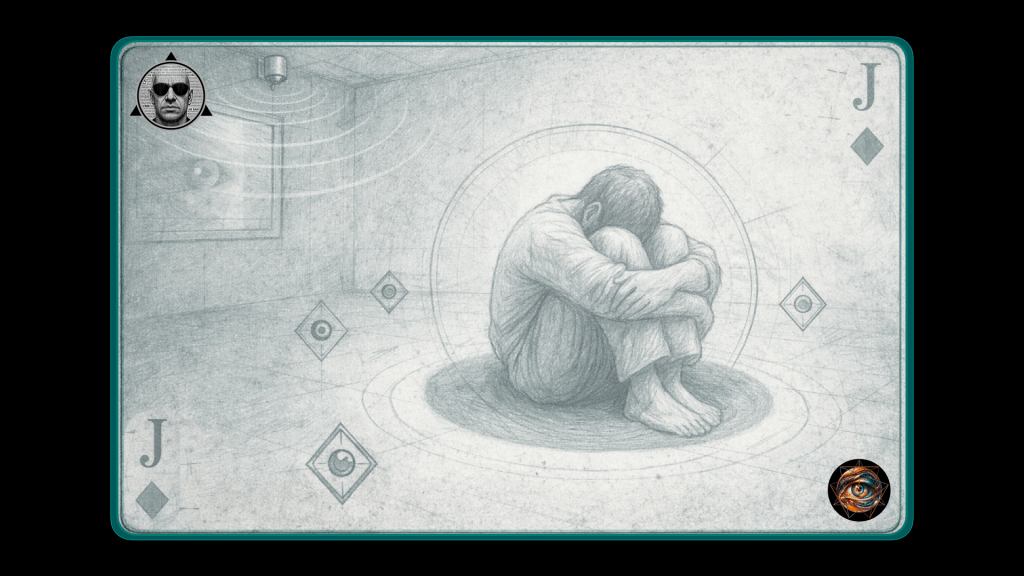
Consider the temporal dimension. The detainee has been in the metal chair for hours. His baseline emotional state has shifted so far from normal that the system’s “anxiety” reading is now simply his face at rest. The fear has become indistinguishable from his features; the performance of calm is no longer possible because he no longer remembers what calm felt like. The algorithm reads this saturated despair and outputs a classification, and the classification justifies continued detention, and the detention deepens the despair the algorithm then reads again. The feedback loop is the point.
The system seeks not to identify guilt, but to produce it.
The apparatus demands confession not of specific acts but of interior disposition, and the confession it demands is impossible to provide because the categories of loyalty it recognizes do not map onto human experience. The machine has become an idol that answers every prayer with the same demand: more.
The individual facing state-level surveillance has no technical countermeasure adequate to the threat. Adversarial patches and affect mastery may create temporary gaps, but the asymmetry of resources is insurmountable. The state can iterate faster than the individual can adapt. It can mandate biometric collection that cannot be refused, and punish evasion as severely as it punishes the behavior evasion was meant to conceal. The countermeasure to state surveillance is not technical but political: collective resistance, international pressure, the slow work of building institutions that constrain state power.
This is cold comfort to the person currently in the metal chair, but it is the only honest counsel available.
The Taxonomy Complete
Each adversary deploys the same fundamental technology toward different ends under different constraints. The retailer wants purchases. The employer wants compliance. The casino wants extended sessions. The prosecutor wants convictions. The state wants souls. The technology serves all of these masters with equal indifference, a lens that points wherever the hand directs it, an instrument that produces whatever music the player demands.
The constraints vary more than the capabilities. The retailer risks boycott. The employer risks litigation. The casino risks regulation. The prosecutor risks appeal. The state risks nothing, which is why its surveillance is the most dangerous and the hardest to resist. Understanding which hunter pursues you is prerequisite to understanding how to run.
The terrain is mapped. The gazers are identified. What remains is the question of sanctuary—whether it exists, how to find it, and what it costs to remain there.
Where the Law Provides Shelter
The regulatory landscape for emotional surveillance resembles a medieval map: detailed coastlines in some regions, blank spaces marked with dragons in others. The European Union has drawn clear boundaries and posted guards. The United States has left most territory ungoverned, with scattered fortifications erected by individual states. Authoritarian jurisdictions have no boundaries at all, or rather, the boundaries exist only to define what the state may do to you, not what you may do to resist. Understanding this terrain is not academic exercise; it is survival cartography.
Some zones on this map constitute sanctuary. Others offer temporary refuge. Still others are an open hunting ground where no law constrains the hunter. The question for the surveilled subjects is whether they can reach protected terrain, whether they can remain there, and what passage through unprotected territory will cost. A right that cannot be enforced is a border that cannot be held; it appears on the map but not on the ground.
The European Prohibition
The European Union’s AI Act, effective February 2, 2025, represents the most comprehensive emotion AI regulation in force anywhere. Article 5(1)(f) categorically prohibits “the placing on the market, the putting into service, or the use of AI systems to infer emotions of a natural person in the areas of workplace and education institutions.” The prohibition is not qualified by accuracy thresholds or consent mechanisms. It is absolute.
Employers and educators in EU jurisdictions may not deploy Emotion Recognition Technology against workers and students, full stop.
Consider what this means experientially. The worker in Berlin enters her office knowing that no algorithm parses her facial expressions during video calls. No system scores her email sentiment. No dashboard rates her emotional engagement for managerial review. The absence is itself a presence—a space where her inner life remains her own, where the performance of professional affect need not extend to the involuntary movements of her face. She may be tired, frustrated, anxious, bored; these states may flicker across her features without triggering intervention. The prohibition creates not merely legal protection but phenomenological refuge: a context where being watched does not mean being read.
The prohibition’s architecture rewards examination. It applies to deployers, not merely developers—the employer who purchases and uses an emotion AI system bears responsibility regardless of who built it. It covers both physical and virtual environments, foreclosing the argument that remote work falls outside the rule. It extends throughout the employment relationship, from recruitment to dismissal, eliminating gaps where surveillance might otherwise concentrate. It explicitly excludes general wellness monitoring from the narrow medical exception, preventing employers from relabeling surveillance as care. The European Commission’s guidelines articulate the rationale with unusual clarity: emotion AI in these contexts “poses an unacceptable risk to individuals’ health and safety and fundamental rights and interests.” The technology should not exist here regardless of future refinement.
Enforcement teeth give the prohibition practical force.
Violations carry fines up to thirty-five million euros or seven percent of global annual turnover, whichever is higher. For multinational employers, the calculus is straightforward: deploying emotion AI against EU-based workers risks penalties that dwarf any productivity gains the technology might deliver. The prohibition creates a moat around EU workplaces that resourced employers will not attempt to cross. The worker considering international opportunities, or the worker whose employer operates across jurisdictions, can leverage this asymmetry. The same company that monitors emotional states in its Texas office may be legally prohibited from doing so in its Berlin office. Understanding this creates options.
The GDPR Foundation
The fundamental tension in privacy law is whether regulation should govern how emotional data is processed or whether it should question whether such data should be collected at all. The General Data Protection Regulation nominally addresses the former while gesturing toward the latter, and the gap between these ambitions defines its practical limitations.
Emotion Recognition systems processing facial images, voice recordings, or physiological signals constitute special category data under GDPR Article 9, triggering heightened protections. Processing requires both a lawful basis under Article 6 and an exception under Article 9—a double gate that constrains deployment significantly. Explicit consent must be freely given, specific, informed, and withdrawable; conditions difficult to satisfy when the data subject faces power imbalance or lacks meaningful alternative. Employment necessity applies only to processing required by specific legal obligations, not to optional surveillance an employer finds convenient. The available exceptions are narrow, and their narrowness is the point.
Data minimization principles further constrain permissible collection.
Organizations must limit biometric processing to the minimum adequate, relevant, and necessary for their purpose. This requirement disfavors the ambient, continuous collection that emotion AI’s value proposition typically assumes. The architecture of emotion AI—comprehensive capture enabling selective analysis—conflicts with the architecture of data protection law. The technology wants to see everything; the law says it may not.
The question the law has not yet answered—perhaps cannot answer within its current framework—is whether any collection of emotional data can be legitimate, or whether the inner life constitutes territory that should remain unmapped regardless of how carefully the cartographer proceeds.
The American Patchwork
The United States lacks comprehensive federal emotion AI regulation, creating a fragmented landscape where protection depends entirely on where you stand. Illinois’s Biometric Information Privacy Act provides the most robust framework. BIPA defines biometric data broadly to include “retina or iris scan, fingerprint, voiceprint, or scan of hand or face geometry”—language that extends to emotion AI systems using facial recognition or voice analysis.
The statute establishes three core requirements:
- Informed consent before collection
- Written retention policies with public disclosure
- Security protections commensurate with sensitivity
BIPA’s distinctive feature is private right of action with statutory damages. Individuals may sue for violations without proving actual harm, recovering one thousand dollars per negligent violation or five thousand dollars per intentional or reckless violation. Class action aggregation transforms these amounts into existential liability for organizations affecting many Illinois residents. The calculus that makes EU prohibition effective—penalties exceeding benefits—operates through litigation rather than regulatory enforcement, but it operates.
The notable absence is workplace-specific regulation.
No American jurisdiction categorically prohibits workplace emotion AI as the EU does. The National Labor Relations Act protects concerted activity and prohibits surveillance interfering with union organizing but does not address emotion monitoring generally. Disability discrimination law might provide redress if emotion AI systematically disadvantages individuals with conditions affecting emotional expression, but plaintiffs must prove disparate impact through litigation most workers cannot afford. Employment-at-will doctrine permits termination for any non-discriminatory reason, potentially including algorithmically detected “negative attitude,” unless contractual or statutory constraints apply.
The American workers’ tactical position is therefore defensive. They must identify which state laws apply, determine whether their employer’s practices violate applicable requirements, and decide whether the cost and risk of enforcement action justify the potential remedy. The law provides shelter only for those who can afford to stand under it.

The Courtroom as Contested Ground
The courtroom has always been theater. The legal question is whether the performance should be permitted at all—whether algorithmic emotion evidence satisfies the standards courts require before expert testimony may influence verdicts. The defense attorney’s role is to challenge the production before it opens, to argue that this particular show should be closed for scientific fraud.
The Daubert standard in federal courts and the Frye test in some state courts require that methodology be testable, peer-reviewed, have known error rates, and command general acceptance in the relevant scientific community. Emotion Recognition Technology fails on multiple criteria. Error rates alone should close the theater.
Spontaneous expression recognition barely exceeds chance in naturalistic settings. Racial bias produces disparate false positive rates that compound existing disparities in criminal justice. A technology that performs well on posed expressions under controlled lighting but fails on real faces in real conditions lacks the reliability legal proceedings demand.
The algorithm is a witness who rehearsed extensively but cannot perform live.
General acceptance proves equally damning. While emotion AI proliferates commercially, scientific consensus on the expression-emotion link remains contested. Leading psychological researchers dispute the universality claims underlying facial coding. The technology’s theoretical foundation is not settled science but active controversy. The script the prosecution wants to perform is fiction marketed as documentary.
Proprietary algorithms create additional vulnerability. In State v. Loomis, the Wisconsin Supreme Court acknowledged that defendants cannot fully examine COMPAS methodology because of its proprietary nature. If defense experts cannot audit the algorithm that produced the evidence against their client, meaningful challenge is impossible. The algorithm is a witness who refuses to be sworn, who will not explain its reasoning, who demands the jury trust its conclusions without understanding its methods.
The defense attorney’s tactical imperative is to force the question.
Motion to exclude emotion AI evidence compels the prosecution to defend methodology that may not survive scrutiny. Even if the motion fails, it creates appellate record and educates the court. The defense that does not challenge tacitly accepts validity; the defense that challenges may discover the foundation is weaker than anyone assumed.The Territories Without Law
Some jurisdictions offer no sanctuary because law there serves the surveiller rather than the surveilled. China’s emotion recognition deployments operate under frameworks that authorize rather than constrain: the Cybersecurity Law, the Data Security Law, the Personal Information Protection Law. Each contains provisions that might, in other contexts, limit biometric collection. Each yields to national security exceptions capacious enough to encompass any surveillance the state wishes to conduct. The exceptions swallow the rules.
Technical countermeasures and legal challenges presuppose a context where evasion is permitted and rights can be enforced. Against state-level adversaries operating without constraint, these tools lose efficacy. The individual can still practice affect mastery, still deploy technical obfuscation, but she does so knowing that detection of evasion may be punished as severely as the conduct evasion concealed. The state that monitors emotion can criminalize the effort to escape monitoring. No altar stands in this territory; no sanctuary exists.
The only response adequate to surveillance without legal constraint is political: building the institutions, alliances, and pressures that might eventually constrain what the law currently permits. That work exceeds any individual’s capacity but does not exceed collective capacity. The terrain without law is not terrain without hope. It is terrain where hope requires different tools than the ones this manual can provide.
The Territories Without Law
Some jurisdictions offer no sanctuary because law there serves the surveiller rather than the surveilled. China’s Emotion Recognition deployments operate under frameworks that authorize rather than constrain: the Cybersecurity Law, the Data Security Law, the Personal Information Protection Law. Each contains provisions that might, in other contexts, limit biometric collection. Each yields to national security exceptions capacious enough to encompass any surveillance the state wishes to conduct. The exceptions swallow the rules.
Technical countermeasures and legal challenges presuppose a context where evasion is permitted and rights can be enforced.
Against state-level adversaries operating without constraint, these tools lose efficacy. The individual can still practice affect mastery, still deploy technical obfuscation, but she does so knowing that detection of evasion may be punished as severely as the conduct evasion concealed. The state that monitors emotion can criminalize the effort to escape monitoring. No altar stands in this territory; no sanctuary exists.
The only response adequate to surveillance without legal constraint is political: building the institutions, alliances, and pressures that might eventually constrain what the law currently permits. That work exceeds any individual’s capacity but does not exceed collective capacity. The terrain without law is not a terrain without hope., but one where hope requires different tools than the ones this introductory survey can provide.
The Sanctuary and Its Borders
Legal protection is unevenly distributed, incompletely enforced, and always subject to revision. Law shifts faster than stone; borders move while the map claims they are fixed. Yet the current terrain offers more sanctuary than many subjects realize. The sheltered zones are marked. The hunting grounds are marked as well.
Legal shelter, however valuable, addresses only the visible surface of the challenge. The law can prohibit surveillance or penalize its misuse. It cannot, however, teach you how to move through spaces where surveillance persists despite prohibition, nor how to protect yourself where no prohibition exists.
For that, a different kind of knowledge is required.

Leave a comment