
The richness of John le Carré’s narratives and characters has made his work highly adaptable for film and television. The complexity of his stories provides ample material for screenwriters and directors to craft compelling visual narratives. His novels have captivated readers and filmmakers alike for decades. Several key factors that set them apart in the spy fiction genre:
- Authenticity and Realism: Le Carré drew heavily on his own experiences as a British intelligence officer, lending his stories a level of authenticity rarely found in spy fiction. His portrayal of the intelligence world as bureaucratic, morally ambiguous, and often mundane contrasted sharply with the glamorous depictions in works like James Bond. This realism resonated with readers seeking a more nuanced view of espionage.
- Intricate Plots: Le Carré’s novels feature meticulously crafted, labyrinthine plots that challenge readers to piece together complex puzzles. His stories often involve layers of deception, double-crosses, and hidden motivations, rewarding attentive readers with satisfying resolutions.
- Complex Characters: Le Carré’s characters are multifaceted and deeply human. His protagonists, like George Smiley, are often middle-aged, unglamorous figures who rely on intellect rather than physical prowess. These flawed, relatable characters grapple with moral dilemmas and personal struggles, adding psychological depth to the narratives.
- Literary Merit: Despite working within the spy genre, le Carré’s writing is celebrated for its literary quality. His prose is elegant and precise, with rich character development and thematic depth that elevates his work beyond typical genre fiction.
- Political and Social Commentary: Le Carré used his novels as vehicles for astute commentary on global politics, institutional corruption, and the human cost of ideological conflicts. His work often critiqued both Western and Eastern bloc policies during the Cold War and later addressed issues like corporate greed and the war on terror.
- Psychological Tension: Rather than relying on action sequences, le Carré builds tension through psychological warfare, interrogations, and the constant threat of betrayal. This cerebral approach creates a palpable sense of paranoia and suspense that keeps readers engaged.
These elements combine to create stories that are intellectually stimulating, emotionally resonant, and thematically rich, appealing to a wide range of readers and viewers beyond traditional spy fiction enthusiasts. Le Carré’s ability to blend genre conventions with literary craftsmanship and incisive social commentary has secured his place as one of the most respected authors of the 20th and early 21st centuries.
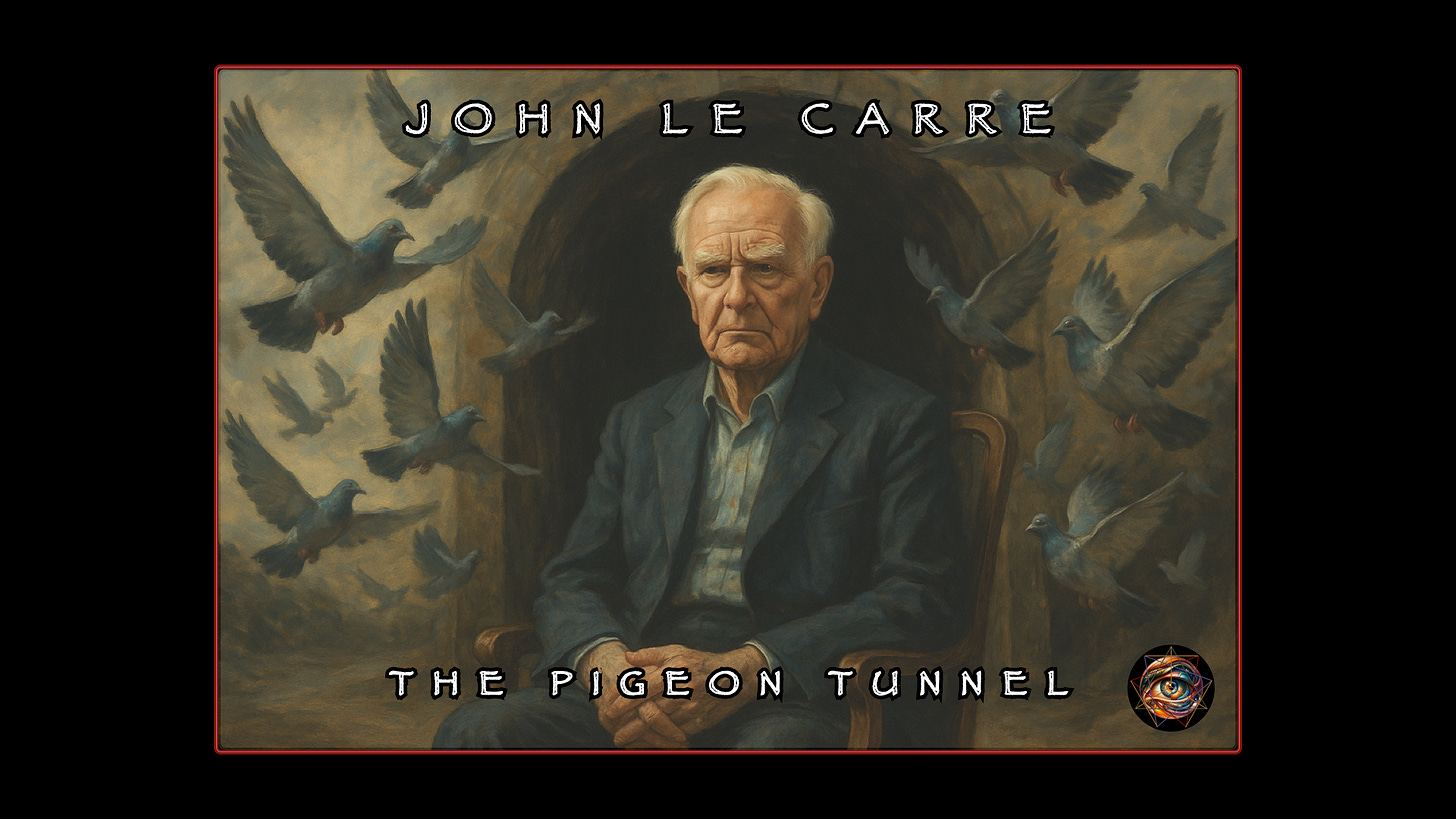
“The Pigeon Tunnel” (2023) takes its title from a memory le Carré carried for decades: a Monte Carlo casino where wealthy patrons shot pigeons released from a tunnel toward open sky. The birds that survived would return to the tunnel and wait to be launched again. Le Carré understood this as a metaphor for his father, for himself, for the sources he ran as an intelligence officer, and for the characters he sent through his novels. Errol Morris structures his documentary around that image, and the result is less a biography than a study of self-construction as survival mechanism.
Morris filmed these conversations in what would become le Carré’s final extended interview before his death in 2020. The timing matters. The Interrotron—Morris’s device that forces subjects to look directly into the lens while seeing the interviewer’s face—transforms the exchange into something le Carré spent decades writing: the interrogation scene, the debrief, the moment when a handler sits across from an asset and tries to separate fabrication from intelligence. Now the novelist occupies that chair himself, performing confession and evasion in the same gesture, flying one last time toward the light.
The documentary invites comparison with Morris’s earlier portraits of powerful men who shaped American catastrophe. Robert McNamara in “The Fog of War” offered something approaching contrition for Vietnam—late, insufficient, yet legible as remorse. Donald Rumsfeld in “The Unknown Known” offered nothing; he slid through Morris’s questions like oil across glass, smiling at his own evasions, treating language as a tool for obscuring rather than revealing. Le Carré occupies a third position. He never operated at their scale of consequence; he was a minor operative who became a chronicler of the system that produced such men. His guilt is quieter and stranger—the guilt of a storyteller who built an elegant career from burned agents and broken marriages. Where McNamara confessed and Rumsfeld deflected, le Carré performs confession while acknowledging that performance is all he has ever known. Morris finally encountered a subject whose self-awareness matches his own methods, and the result plays less as exposé than as duet between two masters of controlled disclosure.
The reenactments that punctuate the film divided critics, some finding them intrusive distractions from le Carré’s formidable presence. That objection misses the point. Morris uses dramatized sequences throughout his career to reconstruct events and locate truth; here he deploys them to demonstrate that le Carré’s memories were already fictions, already shaped into narrative form, already performances refined across decades of interviews and memoirs. The documentary does not peel back a mask to reveal the man beneath. It shows that the mask extends all the way down, that David Cornwell constructed himself as carefully as he constructed George Smiley.
The deepest wound in the film belongs to Ronnie Cornwell, le Carré’s father—a con man, a bankrupt, a charmer who abandoned his son and taught him that identity is something tailored rather than inherited. Le Carré returns to Ronnie obsessively, not to exorcise him but to acknowledge that the fabulist father made the novelist son possible. The pigeon tunnel was always home.
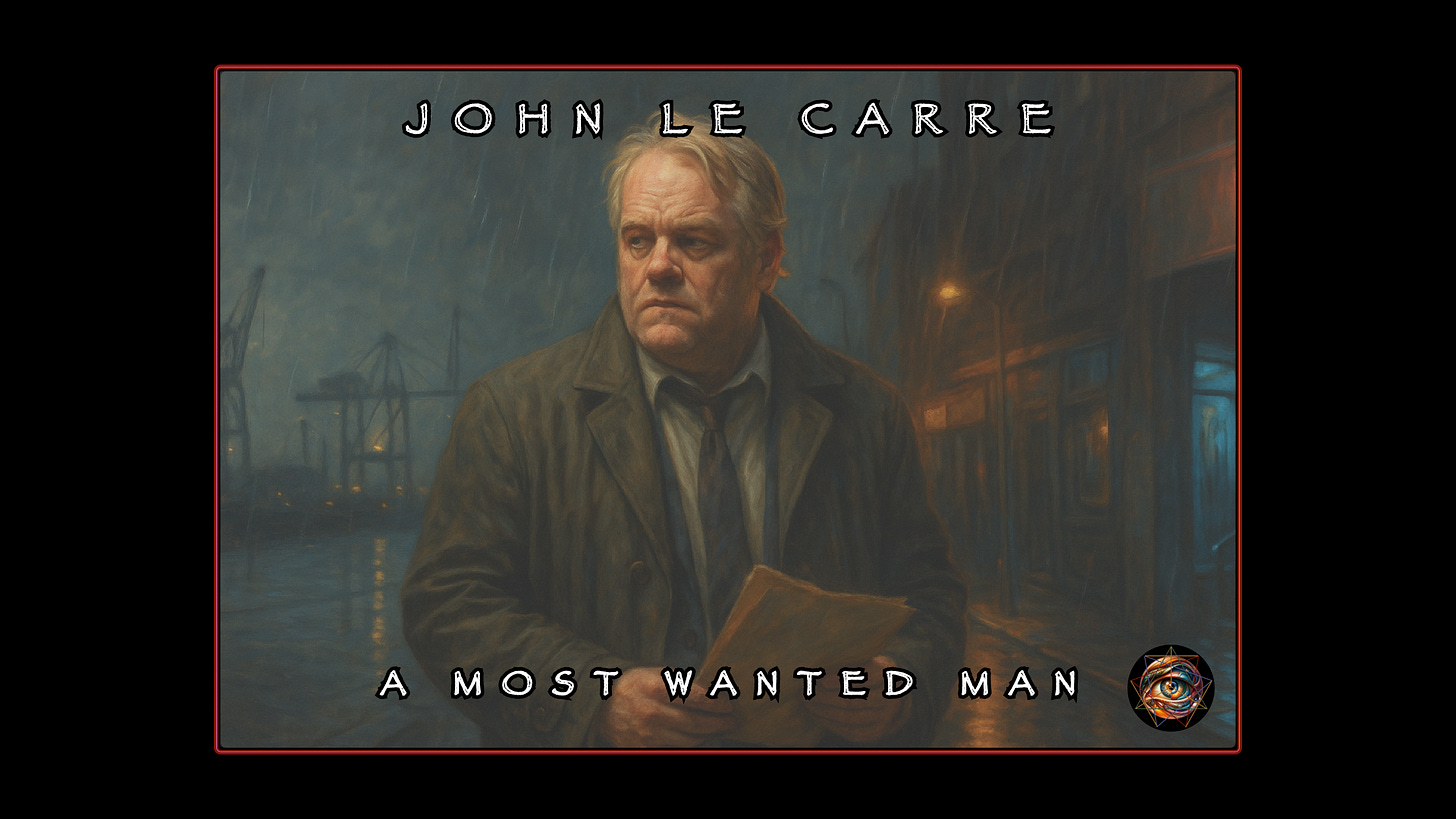
“A Most Wanted Man” (2014) opens in a Hamburg that Anton Corbijn has stripped of every visual pleasure spy films typically offer as compensation for moral complexity. The director came from music photography and videos—Joy Division, Depeche Mode, U2—and his feature work treats stillness and negative space as primary instruments. Here he renders the city as architectural residue of catastrophic failure, the place where the 9/11 hijackers plotted undisturbed, now holding its breath against the next disaster it will fail to prevent. Docks and container yards dominate the frame, spaces designed for throughput rather than dwelling, for processing cargo rather than seeing persons. The ugliness is deliberate, anti-cinematic, a refusal to let the audience settle into the comfortable rhythms of genre. Bachmann will try to practice an artisanal craft in this industrial zone, and the landscape announces from the first frame that such work no longer has a home.
Issa Karpov arrives in this grey city like a wounded animal seeking shelter. Grigoriy Dobrygin plays him as feral, frightened, a man whose body remembers torture before his mind can articulate it. He carries a claim to money laundered through a private bank—his brutal father’s fortune—and a desire to give it away, to cleanse himself through charity. Issa is not a terrorist; he is a traumatized man seeking refuge and perhaps redemption. The machinery of counterterrorism cannot parse this distinction. It processes him as it processes everyone: as potential asset, potential liability, never as person. The film’s moral weight rests on whether any institution designed to sort threats can recognize a human being standing in front of it.
Günther Bachmann believes it can, if given time. Philip Seymour Hoffman plays him as a man who has built his career on patience, on the slow cultivation of trust within Hamburg’s Muslim community, on the unglamorous work of relationships that might eventually yield intelligence worth having. He sees in Issa an opportunity to turn a damaged man into a willing asset who can expose a significant financier of terrorism—legally, carefully, without the blunt instrument of rendition. Bachmann’s method requires faith that the system will let him finish what he starts.
Robin Wright’s Martha Sullivan represents the counterargument. She plays the CIA liaison as a species of institutional vacuum, smiling and professional, absorbing other people’s patient work and converting it into outcomes that can be reported upward. Sullivan is not villainous; she is something more chilling—a functionary who has internalized expedience so completely that human cost no longer registers as data. The alliance between German patience and American extraction is parasitic from the start, and the film traces the slow realization that Bachmann’s careful architecture exists only at the pleasure of partners who do not share his values.
Le Carré argued throughout his post-Cold War novels that the War on Terror inherited the pathologies of the earlier conflict without its ideological justifications, that the machinery continues because continuation is what machinery does. “A Most Wanted Man” dramatizes this thesis through the grinding collision between methodologies, between those who believe the work matters and those who believe only the metrics matter. Hoffman embodies the former with a weariness that feels earned across decades rather than performed for the scene. He died months before the film’s release, and that knowledge shadows every slumped shoulder and cigarette drag with retrospective grief. We watch a man running out of time, and we cannot fully separate the character’s depletion from the actor’s, the fiction’s tragedy from the loss that followed it into the world.
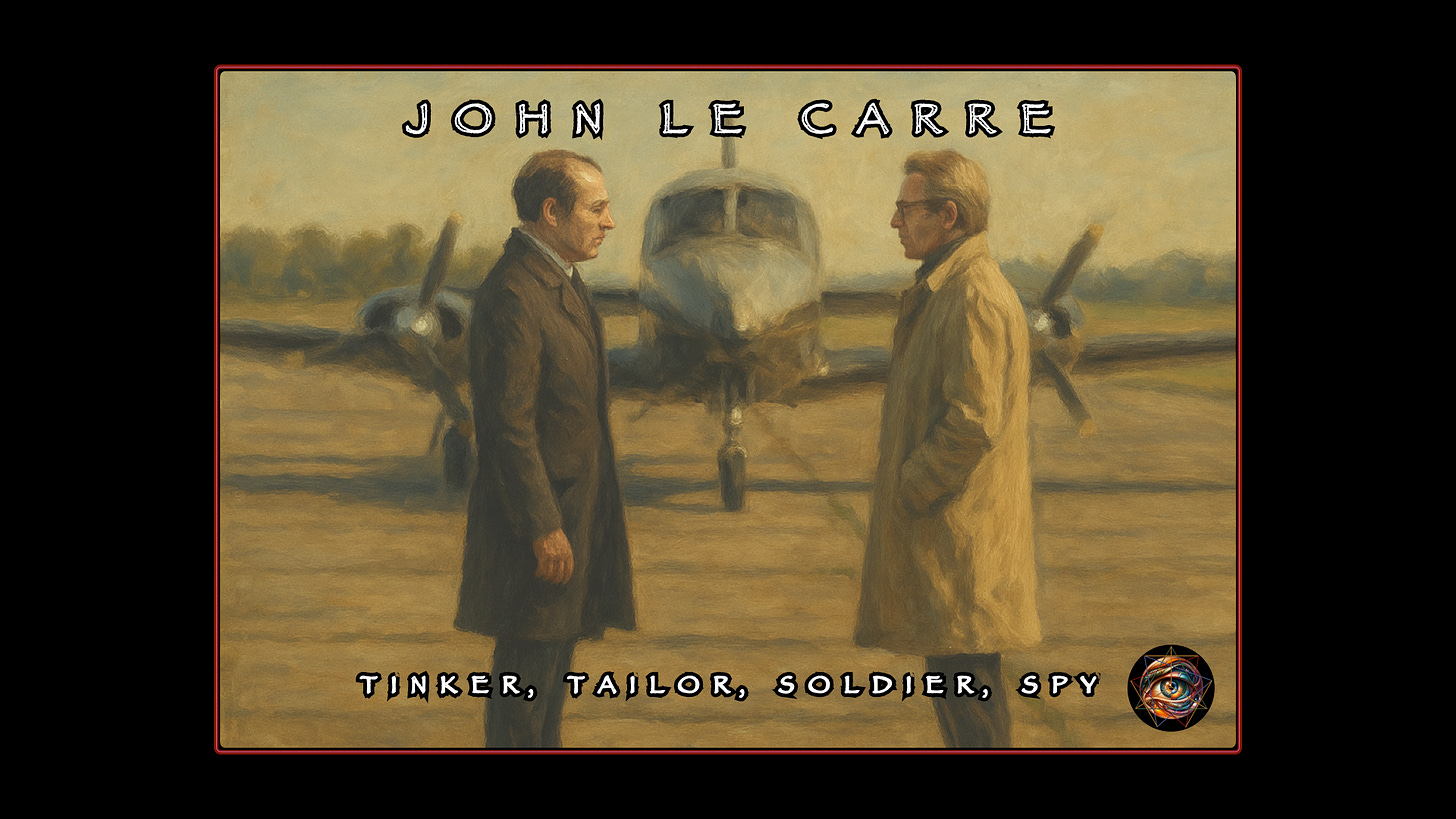
“Tinker Tailor Soldier Spy” (2011) presumes a specific audience: viewers old enough to remember the Cold War as lived experience rather than historical backdrop, literate enough in le Carré’s world to navigate without hand-holding, and sufficiently attuned to British acting royalty to register the weight each face carries onto the screen. Gary Oldman, Colin Firth, John Hurt, Toby Jones, Mark Strong, Ciarán Hinds, Benedict Cumberbatch—these are not merely performances but accumulated careers, decades of craft compressed into glances and silences. The casting matters because the film concerns professionals who have spent decades learning to suppress legible emotion; only actors with equivalent depth can render that suppression visible. Oldman’s stillness registers as choice rather than limitation because we know what he is capable of withholding. Firth’s Haydon charms with a warmth we sense is technique before we know to suspect it. The casting does not ornament the film; it is the film’s argument made flesh.
The Christmas party haunts the narrative long before we understand why. Alfredson returns to it in fragments: the Circus gathered in rare celebration, professionals briefly human, Control presiding over his kingdom in its final hours. We glimpse Ann Smiley across the room—a beauty in red, magnetized toward someone other than her husband. The scene feels elegiac before we have language for the elegy. Something has already been lost; the flashback structure tells us so. We watch Smiley watching without seeing, and we sense that his blindness is not stupidity but the ordinary blindness of a man who cannot yet imagine how completely he has been outmaneuvered.
Tomas Alfredson builds the mole hunt from fragments dropped without context: a botched operation in Budapest, a pair of glasses left on a desk, a Soviet defector whose testimony may be disinformation. The film treats its audience as analysts, expecting them to assemble architecture from implications. This refusal to explicate generates paranoia as formal experience; we feel the instability because the film denies us solid ground. Oldman’s Smiley anchors this strategy through negative space. He speaks rarely, reacts minimally, holds his body in institutional self-effacement. The performance is built from absences—the emotions that surface only in a tremor of the hand, the wife who exists only as wound. His stillness becomes gravitational, a void around which the Circus orbits.
Hoyte van Hoytema’s cinematography extends this logic into the visual field. The palette is institutional beige, tobacco stain, fluorescent diminishment. 1970s London appears as a place where light itself has lost conviction, where corridors lead to committee rooms that lead to further corridors. The Cold War carries no glamour here, only the exhaustion of a bureaucracy surviving on inertia, an agency that has forgotten why it exists and cannot admit the forgetting. The mole hunt becomes archaeological excavation into institutional rot, an attempt to recover purpose that may never have existed.
Love is the weapon that pierces this numbness. Bill Haydon seduced Ann Smiley not incidentally but operationally; Karla understood that Smiley’s one visible attachment was his wife, and Karla sent Haydon to poison it. The affair is tradecraft, designed to cloud Smiley’s judgment should suspicion ever drift toward the mole. Peter Guillam suffers a quieter version of the same calculus. The film shows him severing his relationship with a male partner to remain useful during the investigation—a small amputation performed in near-silence, the cost absorbed in private. Guillam is the younger generation, the Circus’s future, and the institution has already taught him to cut away whatever leaves him exposed. Love in this world is always vulnerability, always the soft tissue where the knife finds entry.
The Christmas party returns near the film’s end, and now every frame reads as evidence. Haydon and Ann together, Smiley peripheral, the celebration revealed as crime scene. The footage has not changed; we have changed. Alfredson has taught us to parse images the way Smiley reads files—gesture, proximity, the angle of attention—and now we cannot unsee what the earlier viewing obscured. There is something almost cruel in this construction, a formal rhyme with Karla’s method. We, too, were manipulated by what we wanted to believe, and the recognition arrives only after the damage has become irreversible.
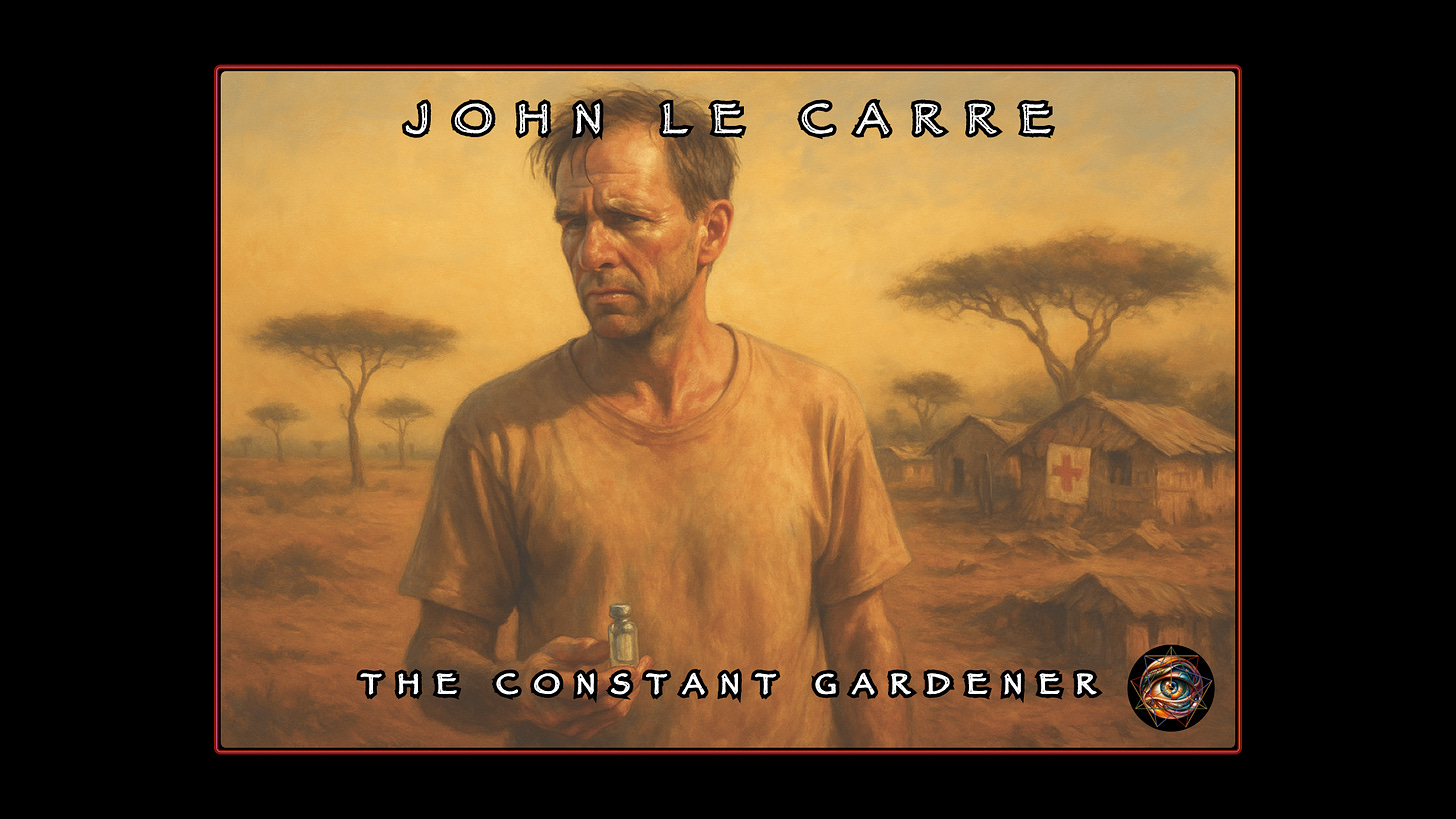
“The Constant Gardener” (2005) answers a question le Carré’s career had been circling since the Wall fell: what becomes of espionage when ideology evaporates? The Cold War was never really about communism versus capitalism; it was about the protection of interests through strategic information management, the cultivation of assets, the elimination of liabilities, and the deployment of plausible deniability as institutional armor. When the Soviet Union collapsed, those methods did not disappear. They migrated. The intelligence apparatus that once surveilled dissidents now serves corporate clients, and the same tradecraft that ran agents in East Berlin now suppresses whistleblowers and ensures inconvenient data never reaches publics who might object.
Justin Quayle discovers this continuity through the murder of his wife. Tessa had been investigating a pharmaceutical company conducting lethal drug trials on Kenyan patients, using populations with no legal recourse as disposable test subjects, burying the dead, falsifying the data. When she became a liability, she was eliminated with professional efficiency indistinguishable from anything le Carré attributed to Moscow Centre in his earlier novels. The killers are not ideologues; they are contractors, deniable assets, instruments of a system that operates without flags. The British High Commission knows; the Foreign Office knows; everyone knows and no one acts, because acting would disturb arrangements that benefit powerful institutions on multiple continents. Multinational corporations have inherited Cold War infrastructure—shell companies, complicit governments, mechanisms for making problems vanish—and deployed it in service of profit rather than ideology.
Fernando Meirelles brought a visual grammar to this material that shattered le Carré adaptation conventions. Fresh from “City of God,” he imported handheld cameras, jump cuts, and color grading that lurches between saturated and bleached. The typical le Carré film is composed and deliberate, all muted palettes and careful geometry; Meirelles broke that mold, and the fractured style mirrors Justin’s psychological disintegration as he moves from diplomatic numbness to desperate clarity. The frame itself becomes unstable ground, refusing the viewer any safe perch from which to observe. César Charlone’s cinematography contrasts Kenyan slums—visceral, chaotic, alive—with the sterile geometries of corporate and diplomatic offices, making visible the distance between those who make decisions and those who absorb their consequences.
Ralph Fiennes plays Justin as a man who has cultivated willful ignorance as survival strategy. He is an amateur in a le Carré narrative, a gardener in both literal and metaphorical senses, tending a miniature enclosure of order while chaos seethes beyond the hedge. Tessa’s death forces sight upon him. Rachel Weisz exists primarily in fragments—flashbacks, memories, other people’s testimony—and we reconstruct her alongside Justin, experiencing his grief as epistemological crisis rather than mere sentiment. The film becomes an education in seeing what was always visible.
Le Carré wrote in the novel’s afterword that his story was tame compared to actual pharmaceutical predation in Africa. The film carries that self-indictment forward, confessing through Meirelles’s visual chaos that fiction cannot contain the scale of the crime it depicts. Justin’s final choice—to return to the site of Tessa’s murder, knowing what awaits—is not heroism but refusal: refusal of the garden, refusal of blindness, refusal to let the machinery process him into silence.
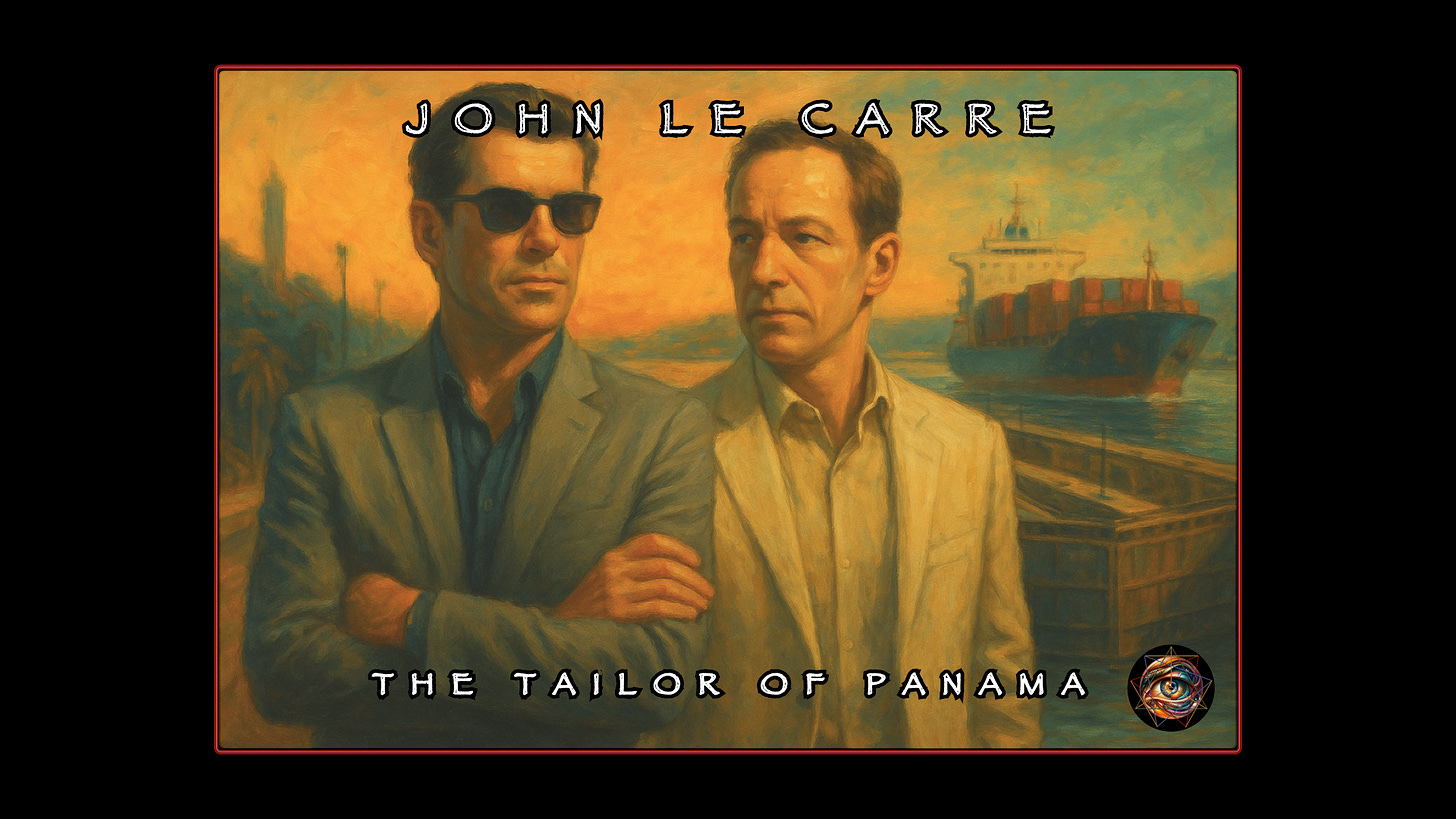
The Tailor of Panama (2001) occupies an unusual place among John le Carré adaptations. The film treats espionage not as heroics but as machinery for fabricating stories that institutions mistake for reality in post-handover Panama, where Cold War certainties have dissolved while habits of leverage and interference persist. Espionage here functions less as security than as a means to convert anxiety into policy.
Harry Pendel, played by Geoffrey Rush, sits at the center of this system of invention. A former small-time criminal, he has cut and pressed a respectable persona as a high-end tailor in Panama City. His clients include politicians, bankers, and figures tied to the Canal. His fabricated Savile Row pedigree and practiced discretion attract MI6 agent Andy Osnard, a disgraced operative parked in Panama as punishment. Osnard recognizes fabrication and debt and converts Harry’s vulnerabilities into an asset pipeline.
The supposed intelligence that follows barely qualifies as information. Cornered by debt, Harry assembles reports from fragments: a traumatized friend, memories of resistance to Noriega, and anxiety over the Canal’s future. These scraps become a fictional resistance movement and a fabricated plot around renewed control of the Canal. Osnard packages the story for superiors who already fear strategic slippage after the Torrijos–Carter Treaties and the 1999 handover. The film frames intelligence as a market in which demand precedes supply and in which prized reports confirm prior suspicion, a logic that anticipates later interventions built on politicized readings of risk.
John Boorman’s tonal strategy amplifies that critique. Noir elements, caustic comedy, and domestic melodrama jostle for space, often within a single sequence. Harry conducts ghostly conversations with Uncle Benny, a dead mentor whose imagined presence polices his conscience, while the camera lingers on Marta’s scars and Mickie’s unravelling. Some reviewers treat these shifts as structural weakness that diffuses emotional impact. The dissonance instead functions as diagnosis, capturing a world in which buffoons in suits make decisions that leave bodies broken and in which farce and atrocity share the same frame.
Casting provides a final layer of argument. Pierce Brosnan arrives straight from his tenure as James Bond and plays Osnard as a deliberate inversion of that icon. The familiar charm remains yet serves predation, financial scheming, and an absence of loyalty. Audience memory of Bond turns toxic, since the same grin and posture now front an operative who treats allies, lovers, and locals as disposable instruments. Rush counters with a performance steeped in shame and belated conscience, a man who realizes too late that his flair for invention cannot be separated from the harm it enables.
Location shooting keeps this satire grounded. Humid streets, financial districts, bars, and the intimate geometry of the tailor’s shop create a Panama that functions as a node in capital and intelligence networks and as a place where Harry’s family, Marta, and Mickie absorb consequences manufactured elsewhere. The Tailor of Panama ultimately examines how stories tailored to institutional fear travel upward as intelligence, return downward as policy, and reshape private lives along with the destinies of states.
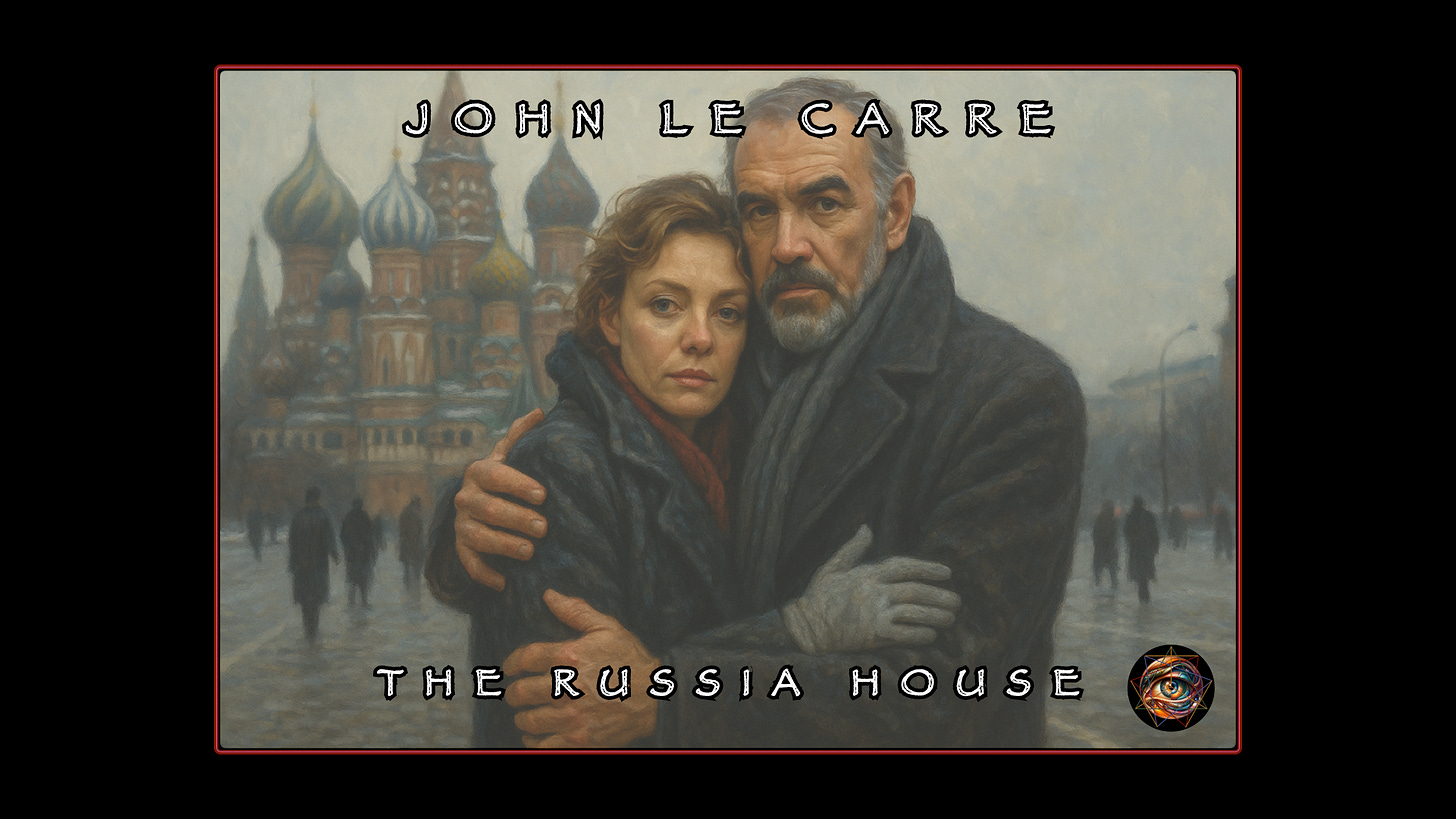
“The Russia House” (1990) arrived at a moment of vertiginous historical collapse. Fred Schepisi began shooting in Moscow and Leningrad while the Cold War was actively dissolving; by the time the film reached theaters, the Berlin Wall had fallen and the ideological architecture that sustained le Carré’s early masterpieces was rubble. The production became an artifact of transition, a spy thriller whose premises were disintegrating in real time. That instability suffuses every frame, transforming what might have been a conventional adaptation into something stranger—an elegy for a genre, filmed at the hour of its obsolescence.
Tom Stoppard’s screenplay solves a problem that defeats most le Carré adaptations: how to render internal states cinematically without voice-over or clumsy exposition. Stoppard writes dialogue that circles its subjects, that approaches meaning obliquely, that lets characters talk past each other until suddenly they don’t. The first act refuses to anchor the audience. A manuscript arrives; British and American intelligence descend; Barley Blair is retrieved from a Lisbon jazz bender and deposited into interrogation rooms. The editing fractures chronology, intercuts locations, withholds context. We experience Barley’s disorientation as formal structure rather than explained psychology, assembling the situation from fragments because that is how anyone caught in the machinery of state security would experience their own sudden visibility. This early fragmentation earns the later stillness; by the time Barley walks with Katya through autumn streets, the audience has learned to parse silences and treat duration as information.
Sean Connery carries the weight of his iconography into the role, and the film knows it. The original Bond—avatar of Cold War certainty, of martinis and decisive action—now plays a dissolute publisher who refuses the hero’s part and chooses love over institutional loyalty. Connery’s Barley is a man already ruined by English propriety, a functioning alcoholic who has exchanged ambition for jazz and whiskey and shambling integrity. When Katya Orlova appears, Barley responds not as an asset-in-training but as a man who has finally encountered something real. Michelle Pfeiffer plays Katya without sentimentality, as a woman who has calculated the costs and accepted them. Their romance inverts every expectation the genre establishes; where le Carré’s novels treat love as vulnerability and operational liability, this film builds an argument that loyalty to a person can outweigh loyalty to a state.
The lakeside mansion scene exposes the machinery that Barley will ultimately refuse. Roy Scheider plays Russell, a senior CIA officer, with the menace of a man who wears affability as operational cover. The setting whispers power: manicured grounds, leather chairs, old money architecture. Reasonable men in comfortable rooms assess risk and advantage, treating Barley’s soul as a variable in calculations he will never see. They seek not truth but an acceptable distribution of uncertainty across which to place their bets. Barley sits among them and understands that the institution has absorbed him, that his choices have already been bounded by decisions made in rooms like this by men who will never face the consequences. Scheider’s Russell requires no villainy; he is a functionary of empire, professionally converting human complexity into actionable intelligence. That is the horror.
The slowness that divided critics is inseparable from these structures. The romance needs duration to become credible; Stoppard’s screenplay needs patience to unfold its oblique logic; the historical moment needs space to breathe its exhaustion and tentative hope. “The Russia House” refuses the rhythms of thriller mechanics and earns its ending—Barley’s quiet sabotage of the very system that sought to deploy him, his choice of opacity over legibility, of love over the cold machinery of states.

Leave a comment