The Leading Indicator

beauty is an attribute of truth

  • Most legal outcomes are decided before a court examines the evidence, before a jury hears the facts, and before anyone argues what actually happened. The machinery that produces outcomes runs on doctrines too abstract for most people, administered by institutions with strong incentives to keep them obscure, whose product is a gap between the right the Constitution names and the remedy the legal system provides. ‘Before the Merits’ strips down the American legal machine to its component parts one case at a time, for general readers to discover how a precedent-based system is run and maintained.


    Before the Meritsโ€”Walden v. Fiore, 571 U.S. 277 (2014)

    A government officer can seize your money in Georgia, use a false document to hold it for seven months while you live in Nevada, and the Constitution will prevent you from suing him in the state where you experienced every day of that deprivation. This result is not a gap in the law or an oversight waiting to be corrected; it is the intended operation of a doctrine that has governed civil litigation since 1945, sharpened by later decisions into something that many plaintiffs encounter without understanding until the case is already over. The doctrine answers a question most people have never thought to ask: not whether you were wronged, not whether the wrong was provable, but whether the court you chose to enter is permitted to hear you at all. That threshold question โ€” which sounds administrative and feels devastating โ€” is decided by rules that track the defendant’s geography, not the plaintiff’s injury, and the gap between those two measures is where most people’s intuitions about fairness part ways with the law’s answer. The skill this essay delivers is the ability to read any civil complaint involving a defendant who acted somewhere other than where the plaintiff lives and identify, before the merits are ever examined, the jurisdictional obstacle the plaintiff may not have seen coming.

    Case Header:

    • Case Name: Walden v. Fiore
    • Citation: 571 U.S. 277 (2014)
    • Court / Jurisdiction: Supreme Court of the United States
    • Date Decided: February 25, 2014
    • Docket No.: No. 12-574

    Legal Domain(s):

    • Primary Issue(s): Personal Jurisdiction / Specific Jurisdiction / Due Process / Minimum Contacts / Intentional Torts
    • Practice Area: Federal civil procedure; constitutional law; Bivens actions; Fourth Amendment
    • Procedural Posture: Certiorari to the Ninth Circuit, which had reversed a district court dismissal for lack of personal jurisdiction; Supreme Court reversed the Ninth Circuit and reinstated the dismissal

    Holding (One Sentence Rule):

    For a state to exercise specific personal jurisdiction consistent with the Due Process Clause, the relationship between the defendant, the forum, and the litigation must arise out of contacts that the defendant himself created with the forum stateโ€”not with persons who happen to reside thereโ€”and the plaintiff cannot be the only link between the defendant and the forum.

    Precedent

    The most counterintuitive feature of American civil litigation is that a court’s authority to hear a case has nothing to do with the merits of the case, and a plaintiff with an airtight claim can lose before the argument begins simply by choosing the wrong courtroom.

    This was not always the law’s arrangement. The common law tradition that American courts inherited treated jurisdiction as a matter of physical presence: a defendant who could be served with process within a jurisdiction’s territory was subject to its courts, full stop. The rule was clean, mechanical, and deeply inconvenient for an industrializing economy in which corporations conducted business across state lines without ever being physically present in any single state in the way that a natural person could be. A firm incorporated in Delaware but manufacturing in Ohio and selling in California could, under the old territorial rule, be hauled into court only in the state of its incorporation โ€” leaving plaintiffs injured by its Ohio operations with the burden of litigating in a jurisdiction they had never entered, before courts with no particular connection to the controversy.

    The Supreme Court resolved this inconvenience in 1945 with a ruling that established the foundational principle that still governs every civil lawsuit in the American federal system. The case involved a state tax authority seeking to collect unemployment contributions from an out-of-state shoe company that employed salespeople who operated within the state but did not maintain a fixed office there. The Court held that a state may exercise personal jurisdiction over a nonresident defendant when that defendant has sufficient “minimum contacts” with the forum state that the exercise of jurisdiction comports with “traditional notions of fair play and substantial justice.” The standard was deliberately flexible, designed to track the defendant’s voluntary, purposeful engagement with the forum rather than the accident of physical presence.

    The flexibility the standard offered was also its instability.

    “Minimum contacts” and “fair play and substantial justice” are phrases that invite rather than resolve argument. Lower courts spent the following decades applying them inconsistently, expanding and contracting the circle of permissible jurisdiction in ways that were difficult to predict from the defendant’s position at the moment of the allegedly wrongful conduct. The Supreme Court issued periodic corrective opinions, each of which clarified some aspects of the doctrine while creating new ambiguities in others. By the 1980s, the Court had developed specific jurisdictionโ€”based on claims arising directly from the defendant’s forum-related conductโ€”as distinct from general jurisdiction, which required a more pervasive and continuous forum presence but could support any claim regardless of its connection to the forum.

    The distinction between specific and general jurisdiction created a question that the minimum-contacts framework had not fully answered: when a defendant’s wrongful conduct occurs entirely outside the forum state but causes harm that the plaintiff experiences inside it, which fact is constitutionally relevant … the defendant’s location … where the act occurred … the plaintiff’s location … where the injury was felt … something else?

    The answer the Court gave in 1984, in a case involving a tabloid article about a California actress written by Florida journalists, appeared to solve the problem by focusing on where the harmful effects were directed and felt. That answer turned out to create at least as many problems as it resolved. The case that followed thirty years later was the Court’s attempt to close the door the earlier decision had left open.

    Doctrine

    Walden v. Fiore, 571 U.S. 277 (2014), arrived at the Supreme Court as a dispute between a Georgia police officer and two professional gamblers from Nevada, and it left as a unanimous ruling that restructured the jurisdictional geography of civil rights litigation in America.

    The facts are specific enough to reward close attention. Gina Fiore and Keith Gipson, professional gamblers, were traveling through Hartsfield-Jackson Atlanta International Airport in August 2006 when Sergeant Anthony Walden, a Georgia police officer who had been deputized as a DEA task force agent, stopped them and seized approximately ninety-seven thousand dollars in cash. Walden suspected the money was connected to drug activity; no drugs were found; no charges were filed. The money was not immediately returned. Instead, Walden helped prepare a probable-cause affidavit in Georgia supporting civil forfeiture of the funds. The affidavit was, the plaintiffs alleged, materially false. No forfeiture complaint was ever filed. The money was returned approximately seven months after the seizure, after lawyers had intervened.

    Fiore and Gipson, Nevada residents who experienced those seven months of deprivation in Nevada, filed a Bivens suitโ€”a federal damages action against a federal officer for constitutional violationsโ€”in the U.S. District Court for the District of Nevada. Walden moved to dismiss for lack of personal jurisdiction. He had never been to Nevada. His conductโ€”the airport stop, the seizure, the affidavitโ€”occurred entirely in Georgia.

    Walden’s connection to Nevada ran solely through the plaintiffs: they lived there, they suffered the deprivation of their funds there, and he knew they lived there.

    The district court dismissed. The Ninth Circuit reversed, reasoning that Walden’s knowledge that the plaintiffs were Nevada residents, combined with his preparation of a false affidavit that he knew would prolong their deprivation in Nevada, was sufficient to create personal jurisdiction. The Supreme Court unanimously reversed the Ninth Circuit.

    Justice Clarence Thomas, writing for a nine-justice Court with no concurrences and no dissents, held that the Due Process Clause requires the defendant’s contacts with the forum to arise from the defendant’s own relationship with the forum state, not from the defendant’s relationship with the plaintiff who happens to reside there. The rule the Court announced has a quality of plain-English simplicity that makes it sound obvious in the abstract and devastating in application: “the plaintiff cannot be the only link between the defendant and the forum.” Knowing that a plaintiff resides in Nevada, and knowing that the plaintiff will experience the consequences of the defendant’s Georgia conduct in Nevada, does not create a Nevada contact for the defendant.

    The consequence of harm touching the forum, the Court held, is not the same as the defendant touching the forum.

    The Court distinguished the 1984 libel case involving the California actress by pointing to a difference that is real but narrow: in that earlier case, the Florida journalists had written an article specifically about a California resident’s California activities, drawing on California sources, targeted at California readers, published in a magazine with its largest circulation in California. Their conduct, the Court said, was “expressly aimed at California”. The forum was the target of the allegedly tortious act, not merely the home of the person harmed by it.

    Walden’s conduct, by contrast, was aimed at Fiore and Gipson, not at Nevada. The seizable cash was in Georgia. The false affidavit was prepared in Georgia. Nevada was where the plaintiffs happened to be when the consequences arrived.

    The unanimity of the ruling is itself a piece of evidence.

    No justice found the result troubling enough to write separately. The doctrine, as applied, produced no internal friction at the level of the Court that decided it. What it produced instead was a result that is difficult to explain to anyone who has not already internalized the framework: a government officer who used a false document to hold your money for seven months cannot be sued in the state where you lived through every day of that experience, because the false document was written somewhere else.

    Revival

    The doctrine does not end where the opinion ends, and the channels that survived Walden are as important as the rule it announced.

    The most significant surviving avenue is venue itself. Personal jurisdiction determines whether a court has constitutional authority over the defendant; venue determines whether a court is the proper forum for the dispute even when jurisdiction exists. Federal venue rules permit suit in any district where a “substantial part of the events or omissions giving rise to the claim occurred,” and courts have sometimes treated the plaintiff’s experience of harmโ€”the ongoing deprivation of money, the continuing effect of a false documentโ€”as a venue-qualifying event even when it cannot serve as a jurisdiction-qualifying contact. The overlap is imperfect and contested, but it creates room to maneuver in cases where the plaintiff’s home forum is not constitutionally available under Walden.

    The purposeful-direction test the Court preserved from the 1984 libel case retains its vitality in a form that matters increasingly in the digital era. An online actor who targets a forum-state victim through conduct calculated to cause harm in a specific location presents facts closer to the libel-case model than to the airport-seizure model. A defendant who sends fraudulent communications to a known forum-state resident, who harasses a known forum-state target through platforms that deliver content to that state, or who interferes with a forum-state business relationship by acting on and against forum-state partiesโ€”each of these presents a purposeful-direction argument that Walden does not foreclose. Lower courts have split on how much directedness is required.

    The Supreme Court has not resolved the question, which means the outer boundary of Walden‘s rule remains genuinely open.

    The structural weakness the ruling exposes is sharpest in cases involving mobile victims of stationary wrongdoersโ€”civil rights plaintiffs who were in transit when the wrong occurred, or who live in one state while the wrong was committed against them in another. For these plaintiffs, the post-Walden landscape requires filing suit in the state of the defendant’s conduct, which is often a state with which the plaintiff has no practical connection, no local counsel, and no community context for a jury.

    The burden of litigating in an unfamiliar forum is not a constitutional objection. Due process protects defendants from being haled into courts with which they have no connection, not plaintiffs from being required to follow wrongdoers into their home jurisdictions. The burden is real, however, and it falls asymmetrically on plaintiffs who are less likely to have resources to manage it.

    Exposure

    The decision exposes a structural feature of personal jurisdiction doctrine that the minimum-contacts framework has always contained but rarely stated directly: the doctrine is built to protect defendants from inconvenient forums, and no equivalent protection runs in the other direction.

    This asymmetry is not accidental. The constitutional doctrine of personal jurisdiction is derived from the Due Process Clause of the Fourteenth Amendment, which protects persons from deprivations of liberty or property without due process of law. The Court, beginning in 1945, read this clause to protect defendants from being compelled to litigate in forums with which they had no meaningful connection, a reading that treats the defendant’s liberty interest in not being hauled across the country as the constitutionally protected value. The plaintiff’s liberty interest in litigating close to home, or close to the evidence, or in the community that witnessed the harm, has no parallel constitutional protection. Plaintiffs choose forums subject to the constitutional constraints on defendants, not their own.

    The practical consequence of this asymmetry is visible in Walden‘s facts. Anthony Walden operated as a deputized federal agent at a major international airport that connects travelers from every state. His conduct could affect residents of any jurisdiction in the country simply by virtue of the airport’s geographic function. A rule that located jurisdiction in the defendant’s home stateโ€”Georgiaโ€”effectively insulated all conduct at Hartsfield-Jackson from litigation anywhere except Georgia, because every out-of-state traveler who passed through that airport and encountered misconduct would have to litigate in a state they had never voluntarily entered. The Court acknowledged this consequence without finding it constitutionally objectionable.

    Due process, it held, protects the defendant from Georgia, not the plaintiff toward Nevada.

    What the ruling also exposes is the relationship between jurisdiction doctrine and the effective enforceability of constitutional rights against government officials. A Bivens action is already a procedurally constrained remedyโ€”it is available only for federal officers, only in contexts the Supreme Court has recognized, and is subject to qualified immunity in the same form that governs ยง 1983 actions against state officials. Adding the jurisdictional constraint of Waldenโ€”requiring the plaintiff to litigate in the state of the defendant’s conductโ€”compounds a remedy that was already narrow.

    Fiore and Gipson, who had their cash seized under a false affidavit and received it back seven months later only after retaining counsel, could not obtain a damages judgment in any court. They could not overcome jurisdiction in Nevada. They could not, on the record, establish that the conduct violated clearly established law in a way that would defeat Walden’s qualified immunity. The cascade of doctrinesโ€”jurisdiction, immunity, the narrowing of Bivens itselfโ€”produces a system in which government officers who commit constitutional violations in transit corridors are structurally protected by the geography of their own conduct.

    The exposure is not the injustice of any single outcome; it is the revelation that the procedural architecture of civil rights enforcement contains multiple, mutually reinforcing filters, each individually defensible, that collectively reduce the realistic prospect of recovery to something far thinner than any single doctrine would suggest if read in isolation.

    Deviation

    Lower courts apply Walden with a consistency that reflects the clarity of its core rule and an inventiveness that reflects the pressure the rule creates. Defendants in civil rights cases routinely move to dismiss for lack of jurisdiction in cases where the plaintiff filed in a home forum, and the motions succeed at high rates when the defendant’s conduct is localized outside the plaintiff’s state.

    The digital environment creates the doctrine’s most active frontier. Courts confronting online harassment, targeted fraud, and remote interference with business relationships must decide whether the conduct was “expressly aimed” at the forum in the manner the 1984 libel case required, or whether it is the Walden model of harm-reaching-the-forum-through-the-plaintiff. The circuits diverge, producing a map in which the same online conductโ€”an email sent to a known resident of State X, a fraudulent wire transfer directed to a State X account, a social media campaign designed to damage a State X businessโ€”may or may not create State X jurisdiction depending on which circuit the plaintiff files in.

    The Supreme Court has not resolved the question, and the proliferation of remote-harm cases since 2014 has widened the circuit split rather than narrowing it.

    Corporate litigation adapts to Walden in ways the opinion’s authors presumably did not anticipate. Mass-tort plaintiffs filing in plaintiffs’ home states face jurisdictional challenges from out-of-state corporate defendants who rely on Walden‘s defendant-centered contacts framework to insist that corporate conduct in State X cannot be litigated in State Y simply because State Y residents were harmed. The Supreme Court’s 2017 decision limiting specific jurisdiction for nonresident plaintiffs against national corporations extended the Walden logic into the mass-tort context, producing consolidation of cases in manufacturer home states that imposes significant logistical burdens on plaintiffs who are geographically distributed across the country. The pharmaceutical manufacturer whose product caused harm in forty states need not defend forty state-court actions; it need defend only the actions brought in its home state, which is also the state where its records are, its witnesses are, and its lawyers are.

    State courts experiment at the margins. Some states have enacted long-arm statutes that test the outer limits of what Walden‘s purposeful-direction test permits, interpreting the Supreme Court’s surviving “expressly aimed” language expansively to capture more categories of remote harm. Federal courts applying these statutes must determine whether the state’s jurisdictional reach exceeds the constitutional floor, which creates a second layer of litigation on top of the underlying merits dispute.

    The jurisdictional question consumes resources, delays resolution, and sometimesโ€”as in the Walden case itselfโ€”produces the definitive answer without ever addressing whether the plaintiff was actually wronged.

    Remedy

    The question is not whether Walden was correctly decided. The Court’s reasoning from its own premises is coherent, and the premises have been accepted for seventy years. The question is whether a doctrine built entirely around the defendant’s geographic relationship with the forum is the right architecture for an era in which harm travels faster than the actors who cause it, and in which the most consequential wrongs are often committed by people whose conduct never touches the place where the consequences are felt.

    The minimum-contacts framework was designed for a world in which presence and action were geographically co-locatedโ€”a shoe company operating in a state, a newspaper circulating in a city, a product manufactured and sold within a region. The central design question of that framework was how to prevent defendants from being haled into distant courts with which they had no genuine connection. The defendant’s geographic footprint was a reasonable proxy for the defendant’s voluntary engagement with a forum’s legal community, its courts, its norms, and its expectations of liability.

    That proxy breaks down in at least two categories of cases that Walden cannot adequately handle, and both categories are growing.

    The first is the case of the mobile government actor: an officer, agent, or official who exercises federal authority at transit points, in digital communications, or through instruments that reach plaintiffs regardless of where the plaintiffs are. Walden’s conduct at an international airport is the paradigm, but it extends to every form of federal enforcement that operates on traveling or remote populations. The plaintiff who experiences the consequences of federal misconduct in a state the federal officer has never entered is, under Walden, required to follow the officer home to seek redressโ€”a requirement that the law treats as a due-process protection for the officer and a practical barrier for the plaintiff.

    The second category is the remote tortfeasor of the digital age: an actor whose harmful conduct is committed entirely in one location but whose instruments of harm are precisely targeted at individuals in other locations. The 1984 libel case’s “expressly aimed” test was written for a world of physical publications with geographic distributions. Its translation into the digital context, where targeting is simultaneously more precise and more difficult to localize, has produced a decade of inconsistent lower-court decisions that the Supreme Court has declined to harmonize.

    What would a jurisdiction doctrine adequate to these categories look like?

    It would need to account for the plaintiff’s reasonable expectation of litigating close to the harm, not merely the defendant’s reasonable expectation of being free from distant courts. It would need a measure of directedness that does not depend on the physical location of the defendant’s act but on the deliberateness with which the defendant engaged with the plaintiff’s forum. It would need, in other words, a framework that treats the relationship between wrongful conduct and forum not as a question of where the defendant stood but as one of what the defendant choseโ€”and what that choice imposed on the person who had to live with the consequences in a place the defendant never visited. Whether such a framework would survive the Court’s current reading of the Due Process Clause is a question the doctrine has not yet been asked to answer, because the doctrine has not yet been asked to look at the problem from the plaintiff’s side of the geography.

    The gamblers got their money back. They never got a hearing on whether the affidavit was false. The officer who wrote it was never required, in any court, to justify what he did. That outcome is not a malfunction of the procedural system. It is what the procedural system produced when it operated as designed.

    Understanding the design, rather than the malfunction, is the form of legal literacy the case deliversโ€”and the literacy does not resolve in comfort.

    For Further Examination

    What Walden v. Fiore forecloses and what the law leaves open are not identical. The gap between them is where the next case will be born. Whatever specific circumstances generate it, the logos of any case has three components, each operating simultaneously as a field condition. Institutional Inertia (+) is already in motion, and Socioeconomic Pressure (-) defines the boundary conditions of that motion. These collide within a Cultural Justice Assumption (0) whose content varies but whose function does not.

    Institutional Inertia is the affirming force.

    The institutional condition is federal law enforcement operating in transit infrastructureโ€”airports, highways, border crossingsโ€”where the government actor’s geographic base is structurally disconnected from the geographic base of virtually every person the actor encounters. DEA task force agents working at Hartsfield-Jackson interact with travelers from all fifty states, but they prepare their paperwork, submit their affidavits, and conduct their official business in Georgia. The institution’s internal incentive structure never confronts the jurisdictional consequences of this disconnect, because the consequences fall entirely on the plaintiffs, not the agency. An agency whose officers cannot be sued in the home forums of the people they stop is an agency insulated from a significant category of litigation pressure.

    Socioeconomic Pressure is the denying force.

    The social and economic pressure is the post-9/11 expansion of federal civil forfeiture and DEA enforcement at airports, producing a surge in cash seizures of travelers who could not immediately prove legitimate sources and who, in many cases, lacked the resources or legal sophistication to challenge the seizures in the state where they occurred. The legal infrastructure for challenging these seizures was being built in the early 2000s by organizations like the Institute for Justice; Walden arrived when that litigation had matured enough to test the jurisdictional limits of where such challenges could be brought.

    The Cultural Justice Assumption is the reconciling force.

    The cultural justice assumption is that procedural fairness consists in protecting defendants from unfamiliar forumsโ€”that the Due Process Clause’s historic function as a limit on state power over nonresident defendants is more constitutionally weighty than the plaintiff’s interest in litigating close to experienced harm. The unanimous Court treated this as uncontroversial. No justice dissented. The assumption was invisible precisely because it was shared. The fault line appears only in the academic commentary that followed, which identified the asymmetry the opinion neither acknowledged nor resolved.

    If a federal officer at an international airport seizes cash from a traveler using a false affidavit, and the traveler cannot sue in the state where the traveler lives because the officer never entered that state, and cannot practically litigate in Georgia because the traveler has no connections there and no local counsel, and the Bivens cause of action is already narrowed by qualified immunity, what remedial mechanismโ€”if anyโ€”is realistically available to the traveler, and is the answer different depending on whether the traveler has ninety-seven thousand dollars or nine hundred?

    The personal jurisdiction doctrine protects defendants from litigating in forums with which they have no meaningful connection, which serves fairness and predictability; plaintiffs who are injured in their home states by defendants who never entered those states also have a legitimate interest in litigating close to the harm and the evidence that bears on it; if both interests are legitimate and they are structurally irreconcilable under the current doctrine, which institution is responsible for deciding between them, and by what principle should the decision be made?

    If the purpose of civil procedure is to provide a fair and accessible mechanism for resolving disputes on their merits, and if jurisdictional doctrine โ€” combined with immunity doctrine, pleading standards, and the narrowing of implied causes of action โ€” collectively filters out most civil rights claims against government officials before any court reaches the merits, at what point does the cumulative effect of individually defensible procedural rules constitute a systemic denial of access to justice, and does the constitutional system contain any mechanism for recognizing that threshold when it is crossed?

  • Constitutional rights have a zip code, which most people learn only after they are already in court. The federal appeals courts divide the country into distinct legal territoriesโ€”regional, functional, and subject-matterโ€”where the same constitutional guarantee can protect you completely in one state and fail you entirely in the next, not because the law changed, but because the judges did. Presidential appointments, regional political culture, and decades of industrial money have been quietly building these divergences until the gap between circuits is wider now than at any point since the civil rights era. Understanding which circuit governs your state, what it has historically protected, and where its fault-lines are cracking may be the difference between filing a case and winning one. Geography determines the settlement offer, whether the police officer gets away with misconduct, or whether the company pays or walks. These courts have produced distinct legal cultures, and the country has spent a century pretending the map does not matter.

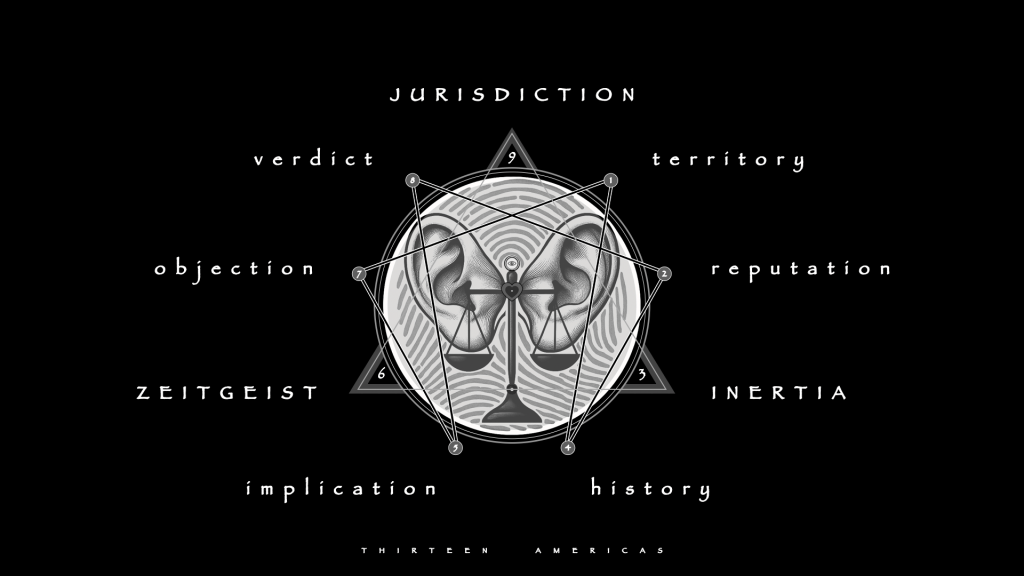
    Geography not only locates justice in a literal drawing of courthouse territory, but classifies it, too. Thirteen appellate courts now form the working map: eleven regional circuits, one court of federal machinery, and one court of subject-matter expertise. The current system is a routing diagram that determines which precedent attaches before any facts are heard, whether injuries arrive as constitutional questions or administrative problems, and which are priced out before any judge writes a word. The diagram has no author in the conspiratorial sense; it accumulated through appointments, reversals, retirements, and the slow calcification of regional habit into doctrine. Its effects, however, are indistinguishable from design.


    The Fifth Circuit Floods the Plain Before the Levee Can Hold

    The Fifth Circuit governs Louisiana, Mississippi, and Texas, a flood plain in the most literal and the most useful sense. A flood plain is flat, enormous, and engineered, shaped so that water runs toward chosen low points no matter where the rain happens to fall. In this circuit the water is litigation, and the engineering sends it toward a handful of friendly courtrooms whose output the full court then gathers up and ratifies.

    The court has become the most reliably conservative bench in the federal system, so far to the right that the conservative Supreme Court above it must repeatedly reach down to stop it. That pattern gets told as the story of an extreme court losing on the merits, but that story misses the mechanism.

    A flood does not need to winโ€”it needs only to arrive first, and the Fifth Circuit has learned to control when the water comes.

    Territory
    A Flood Plain the Size of a Nation Drains Toward a Chosen Few Courtrooms

    Texas alone holds more than thirty million people, an economy larger than most countries, and a political culture that has treated the federal government as a rival since Reconstruction. Louisiana adds energy extraction, port commerce, and one of the most segregated criminal-justice systems in the country. Mississippi adds the deepest poverty of any state, a federal bench filled almost entirely by Republican appointees, and a political establishment whose relationship to its own civil-rights history is not one of repentance. Stacked together, the three states hand a single court authority over the oil and gas industry, the petrochemical corridor, the Texas insurance giants, and the agriculture of the Mississippi Delta.

    The human map is starker than the economic one. This is the circuit with the largest Spanish-speaking population in the country, a Black population concentrated in the states that fund public services least, and a Gulf Coast that real floods are rewriting year by year, even as the circuit’s hostility to environmental regulation makes the rising water harder to answer. The metaphor and the coastline have begun to converge.

    The engineering is the part outsiders miss. Texas built single-judge divisions in places like Amarillo and Victoria, where a plaintiff who files already knows the name of the judge before the clerk stamps the complaint, and the appeals from those courtrooms drain upward into a circuit primed to affirm them. What reaches the full court has already been routed. The rain may fall anywhere; the water arrives where the builders dug the channel.

    The single-judge division is not an accident of courthouse administrationโ€”it is a sluice gate. 

    A national challenge to a federal rule can be filed in a place where the plaintiff effectively knows the district judge in advance, and that judge can issue relief with national consequences before any appellate court has assembled a full view of the dispute. By the time the case reaches New Orleans, the water has already been released. The Fifth Circuit does not have to invent the flood. Texas venue practice starts it upstream. The appellate court’s function is then to decide whether to close the gate, leave it open, or announce that no one has standing to complain about the water level. All three options are available, and all three serve the same structural purpose. The machinery runs while the lawyers argue about the machinery.

    The basin is also changing in ways that will compound that machinery for years. The Fifth Circuit was once easy to caricature as the court of oil, guns, immigration, and state defiance, and that character is intact. But Texas is now collecting other forms of capital. 

    Austin has pulled technology firms and semiconductor investment away from the old Pacific center. Dallas is making an open bid for financial infrastructure, with exchange operators and market institutions treating North Texas as more than a back office. Houston remains the capital of energy extraction. What gathers inside the same circuit is therefore no longer one regional economy but a convergence of the country’s commanding industries: fossil fuel, platform technology, finance, logistics, defense, and data infrastructure. The Second Circuit‘s orbit around Wall Street and the Ninth’s orbit around Silicon Valley are not disappearing, but pieces of their mass are migrating into the Fifth’s flood plain.

    That migration matters legally because capital does not move only for weather and taxes. It moves toward governance. A company that relocates to Texas enters a political economy whose agencies, legislature, district courts, and appellate court are unusually receptive to challenges against federal regulation. 

    The forum-shopping story therefore understates the change. 

    Texas is not merely routing existing cases to friendly judges. It is attracting the industries that will generate the next generation of cases, then delivering them through a litigation channel already dug toward New Orleans. The energy-sector petitioners who used that channel to challenge EPA’s disapproval of Texas’s state implementation plan under the Clean Air Act’s Good Neighbor provision have already demonstrated the pattern: the litigation was filed in the Fifth Circuit, the court vacated EPA’s ruling in Texas v. EPA, No. 24-60351 (5th Cir. 2025 and 2026), and Texas power-sector sources were relieved from federal emissions controls while EPA was sent back to rebuild its case. That is the flood plain delivering its return on infrastructure investment.

    Reputation
    The Circuit Now Overruns Even the Banks the Supreme Court is Willing to Defend

    The Fifth Circuit’s reputation is no longer a matter of dispute. Even conservative commentators describe a court that has drifted so far right it routinely outruns what the Supreme Court will affirm. The proof sits in the Court’s own docket. Again and again the justices have stayed or reversed Fifth Circuit orders, on the emergency docket and on the merits, in numbers no other circuit approaches.

    The clearest single example is a gun case. 

    After the Supreme Court announced in Bruen that gun laws must match a historical tradition, the Fifth Circuit struck down the federal statute that disarms people under domestic-violence restraining orders in United States v. Rahimi, 61 F.4th 443 (5th Cir. 2023), reasoning that the eighteenth century knew no precise equivalent. The Supreme Court reversed that ruling by a vote of eight to one in 2024, 144 S. Ct. 1897, with only Justice Thomas in dissent, and restored the law across the country. A circuit reversed eight to one by this Court, on guns of all subjects, has found the far edge of the possible and stepped past it.

    The composition explains the drift without excusing it. Republican presidents appointed the commanding majority of the seventeen active seats, six of them named by Trump, and the newest arrivals are the ones legal commentators set apart from the older conservatives, the distinction being between judges who apply an aggressive method and judges who appear to choose the result first and assemble the reasoning afterward. Litigants have absorbed the lesson completely. 

    Plaintiffs in employment, environmental, and immigration cases steer their filings away from the circuit whenever they can, and regulated industries steer theirs toward it, because in the areas that matter the outcome is settled before the first brief is filed.

    The pattern wears a human face in the case of Rodney Reed, a Texas death-row prisoner who has maintained his innocence for decades and asked only to have crime-scene evidence tested for DNA. The Fifth Circuit first threw out his federal claim as filed too late, starting the clock at the moment a state trial court denied testing rather than at the end of his state appeals. The Supreme Court reversed that ruling six to three in Reed v. Goertz, 598 U.S. 230 (2023), restoring the obvious rule that the clock runs when the litigation ends. 

    On remand the Fifth Circuit affirmed denial of relief on the merits in April 2025, holding that Reed had not met his burden to show Texas’s application of its DNA-testing statute was fundamentally unfair. When Reed sought certiorari a second time, the Supreme Court denied review on March 23, 2026, No. 24-1268. Justice Sotomayor, joined by Justices Kagan and Jackson, dissented. Her opening sentence named the mechanism and its consequence without euphemism: “For the last 11 years, death-row prisoner Rodney Reed has sought DNA testing of key evidence that could prove his innocence. Because the Fifth Circuit has now rejected his efforts to obtain that testing, Texas will likely execute Reed without anyone ever knowing who is responsible for Stacey Stites’ death.” 

    Sotomayor has become the circuit’s most persistent documented critic, returning again and again in reversals and cert denials to flag the same flaw: the analytical shortcut that reaches the harsh result and skips the reasoning that should have stopped it.

    What the reversal record does not reveal is the court’s relationship to reversal itself. A normal appellate court is embarrassed by Supreme Court correction, because a normal court is optimizing for affirmance. It wants its rulings to hold, its doctrine to travel, its reasoning to become national law. 

    The Fifth Circuit has no such investment in those reversals. It is optimizing for something else, for the period between the emergency stay it grants and the correction that arrives months later, for the bargaining leverage a preliminary injunction creates before the merits are reached, for the disruption a nationwide order produces in the administrative machinery of a rule the court’s majority believes should not exist. A reversal means the flood drained back out. It does not mean the house was not ruined while it stood in the water.

    History
    The River Once Carried the Mandate of Brown and Now Runs the Other Way

    The Fifth Circuit was, within living memory, the most important civil-rights court in the country. From the middle 1950s into the 1970s a small group of judges, remembered as the Fifth Circuit Four, carried the desegregation mandate of Brown v. Board of Education into the schools of the Deep South, one defied order at a time, against state governments and a white bar that treated them as traitors to their region. John Minor Wisdom, Elbert Tuttle, John Brown, and Richard Rives used the speed and reach of a federal appeals court to force change before the resistance could organize to bar the door. The same water that now drowns regulation once carried desegregation into towns that had sworn to keep it away.

    Congress redrew the watershed in 1981, but it also divided an estate. Alabama, Georgia, and Florida were carved off into a new Eleventh Circuit, taking with them much of the old civil-rights docket, much of the old Fifth’s institutional memory, and enough of its moral capital to make the inheritance a question the new court could not avoid. What remained in the modern Fifth was a smaller basin, tilted toward Texas, and the current that ran through it was ready to be turned.

    The turning took thirty years and three Republican administrations. Reagan and the elder Bush began stocking the bench. The Clinton and Obama years added judges without ever matching the volume or the focus needed to counter the accumulating precedent. Trump’s six appointments between 2017 and 2021 finished the work. The result is a court whose majority treats federal regulatory power as constitutionally suspect, federal immigration authority as a lever any state may pull, and the Second Amendment as something close to absolute. 

    The channel that once carried the Constitution’s promise to the powerless now carries the preferences of the powerful, through the same ground, in the opposite direction.

    Implication
    Two Floodgates Stand Open, One for Guns and One Against the Administrative State

    The most active fault line inside the circuit runs through the Second Amendment and the historical-tradition test the Supreme Court built in Bruen. The Fifth Circuit generates more challenges to federal gun statutes than any other circuit, partly because Texas district courts welcome the plaintiffs and partly because the circuit’s own majority wants to push the doctrine as far as it will go. In United States v. Daniels 77 F.4th 337 (5th Cir. 2023), the court held that the federal ban on firearm possession by habitual marijuana users violates the Second Amendment as applied to Daniels, because the government could not identify a founding-era tradition of disarming comparable groups. 

    The Supreme Court granted certiorari, No. 23-376, and as of this writing has not issued a merits decision, leaving the statute in a state of suspended constitutional judgment inside the circuit while the disruption to enforcement accumulates. The school-zone ban survived a parallel challenge: in United States v. Allam, No. 24-40065 (5th Cir. June 16, 2025), the court upheld the Gun-Free School Zones Act’s core possession prohibition on sensitive-places grounds, demonstrating that the Bruen framework functions as a genuine constraint in at least one direction. The floodgate is open; it is not unhinged. The organizations pressing the outer limits of the doctrine are funded by the firearms industry, and the litigation they generate is designed to create suspense and enforcement uncertainty whether or not the Supreme Court ultimately affirms.

    The second floodgate opened the day the Supreme Court abolished Chevron deference in Loper Bright Enterprises v. Raimondo, 144 S. Ct. 2244 (2024). 

    The Fifth Circuit had resented agency power long before that ruling, and it had spent decades crafting ways to substitute its own policy judgment for the expertise of regulators. Loper Bright removed the last legal duty to defer to an agency’s reading of an ambiguous statute, and it handed the most regulation-hostile circuit in the country a free hand over the vast machinery of federal administration that touches energy, water, labor, and land across three states. The consequence arrived quickly. In Texas v. EPA, No. 24-60351, the Fifth Circuit vacated EPA’s disapproval of Texas’s state implementation plan under the Clean Air Act’s Good Neighbor provision and remanded to EPA, applying Loper Bright to read the statute without deference to the agency’s own interpretation. 

    The practical result removed the regulatory predicate that the EPA had used to impose federal emissions controls on Texas power-sector sources. Texas emitters that would have faced additional controls are now operating under vacated requirements while EPA rebuilds its justification from the beginning, which is the flood plain mechanism applied to environmental regulation. The water moves while the lawyers argue about whether the channel was dug correctly.

    The beneficiaries of both floodgates are not hard to name. Energy companies, agricultural interests, financial firms, and employer groups stand to gain from every ruling that narrows what a federal agency may do, and those rulings now arrive without the old obligation to defer. The levee that once held back the circuit’s preferences in administrative cases, the rule requiring courts to respect agency expertise, has been pulled down by the Supreme Court itself, and the water has gone where water goes when a levee is taken away.

    Objection
    Texas Is Digging a Private Channel for a Power the Constitution Handed Only to Washington

    The question the circuit cannot resolve on its own is whether Texas may build a parallel immigration system that the Constitution reserves to the national government. The state’s law known as SB 4 makes unauthorized entry from Mexico a state crime and empowers state police to arrest and state magistrates to order removal, a power that has belonged, for the better part of a century and a half, to Washington alone. Texas also strung a floating barrier of buoys across the Rio Grande, turning the river itself into a piece of the argument.

    The litigation has run like floodwater under dueling orders.

    In March of 2024 the Supreme Court briefly cleared the way; SB 4 took effect in Texas for a matter of hours; and a Fifth Circuit panel then blocked it again the same evening. A three-judge panel later held the law preempted by federal authority, the full court agreed to rehear the case, and in the spring of 2026 the en banc Fifth Circuit erased the injunction without deciding whether SB 4 is constitutional at all, ruling instead that the challengers lacked standing to sue. The constitutional question, the one that truly decides the matter, remains formally open years after the law was passed.

    The standing ruling is the mechanism, not a sideshow, and it is worth naming what the mechanism accomplishes. Standing is not merely avoidance in this context. It is a spillway. The court can drain the challenge away from the constitutional question while leaving the state machinery fully operational, releasing pressure from the litigation without answering the underlying problem. By clearing the block on a procedural ground and leaving the merits untouched, the en banc court gave Texas the practical room to run its system while the litigation restarts from the beginning. 

    A spillway does not stop the floodโ€”it routes the water somewhere the dam cannot be blamed for it.

    Verdict
    The Court Does Not Need to Be Affirmed to Win, By Design

    The Fifth Circuit is not behaving as an honest appellate court in the areas that matter most. In immigration, in gun law, and in the regulation of industry, it produces outcomes the Supreme Court keeps finding deficient. It produces these on a schedule built to maximize their effect before review can overtake them. 

    The judges are not unaware of thisโ€”some even intend it.

    The usual way of keeping score misses the whole point. Tallying the circuit’s reversals treats the merits as the thing that matters, but the merits arrive last. The power this court holds is over time, over the gap between the moment it grants emergency relief and the moment, months or years later, when the Supreme Court rebuilds the rule. A policy in force for a year does its work whether or not the order authorizing it is eventually erased. A flood that drains back out has still ruined the house it filled.

    There is a bitter symmetry in this, because the old Fifth Circuit ran the same play in the other direction. Wisdom and Tuttle and their colleagues forced desegregation onto resisting states by moving faster than the resistance could counter, using the lag between an order and its undoing as a weapon for the powerless. The mechanism is neutral. The only question it leaves open is which way the water is sent, and the modern Fifth Circuit has answered that question without ambiguity, sending it toward the executive branch of a single state and the industries that finance its ambitions. 

    A court that controls when the flood arrives has already won every case the instant it grants the stay, regardless of how the appeal is later resolved. No number of reversals from above can drain a plain that has already done its flooding. The part of the inheritance that could still claim Tuttle and Wisdom’s name moved east to Atlanta, where it would be preserved, narrowed, and delayed under a different procedural vocabulary. 

    The old Fifth proved that timing could enforce constitutional rights. The modern Fifth proves that timing can defeat them. The mechanism was never the property of either.

    What the Fifth Circuit Teaches, the Sixth Complicates

    The Fifth Circuit teaches a lesson about the clock. Power over timing beats power over outcome, because a policy that operates while its challenge is pending has already done its work. The merits arrive last, and by then the damage is banked. A scoreboard that counts only reversals misses the entire game, because this court can lose every appeal and still win every case the instant it grants the stay. The Fifth Circuit overreaches so plainly that the Supreme Court must keep reaching down to stop it. The court that comes next has learned never to give the Supreme Court anything to catch.

    If the Fifth Circuit wins by being early, the Sixth Circuit wins by being unanswerable. Its reasoning is clean, disciplined, often elegant, and it runs from premises the court declines to reexamine toward conclusions it cannot take back. There are two ways an argument can fail: it can be invalid, its steps refusing to follow, or it can be unsound, every step following cleanly while a premise quietly lies. 

    We are trained to attack the first and left nearly defenseless against the second, and the Sixth Circuit specializes in the second. The danger here is not a broken machine. It is the danger of one that works.

    The architect of that method is Jeffrey Sutton, a serious judge whose constitutional philosophy is coherent and applied in good faith, which is exactly what makes it so hard to fight. He won the federalism cases as an advocate, wrote the lone marriage opinion that forced the issue to the Supreme Court, and built a capital-habeas doctrine that defers to state courts on who is executed, three applications of one idea. In Hill v. Shoop, cert. denied, 142 S. Ct. 1185 (2022), the court did not deny that Danny Hill was intellectually disabled; it held only that the state’s contrary finding was not unreasonable enough to disturb. Justice Sotomayor, joined by Justices Breyer and Kagan, dissented from the cert denial and drew the line the circuit had blurred: a ruling which survives as not unreasonable is not the same as a ruling that is correct. 

    There sits the whole distance between validity and truth, and this court can live in it indefinitely.

  • Hero Fatigue

    The Periodic Table of Narrative Metals

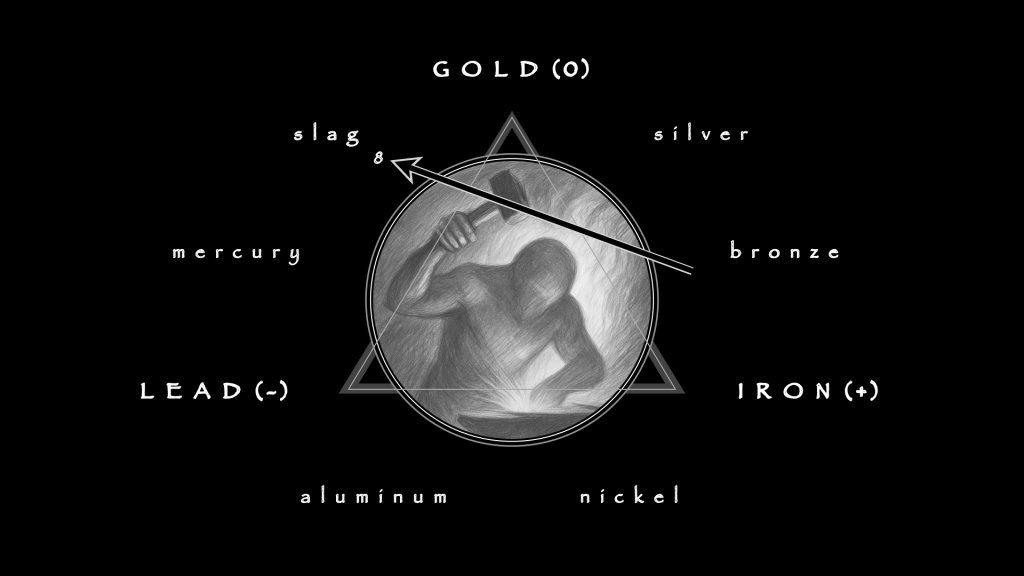
    Hero fatigue is not caused by oversaturation. It arises when the structure that once sustained symbolic compression becomes too unstable to support cultural weight. The crisis is not in the content, but in the frame. To understand this failure, we must abandon nostalgia and instead trace the materials used to build these formsโ€”first metaphorically, then structurally.

    The evolution of heroic fiction in cinema (where it it is most conspicuous) can best be mapped not across genre or audience, but by metallurgical metaphor. Each “age” of storytelling corresponds to a specific materialโ€”its strengths, its weaknesses, and its temperature tolerance. From sacred origin to industrial flatware, these metals mark the gradual breakdown of pressure, form, and meaning. They warn us that once a medium reaches melt, its restoration will not come by returnโ€”it must be reforged under constraint.

    Heroic narrative does not decay in a straight line, but fractures under pressure, mutates under fatigue, and oxidizes when left exposed. This sequence of nine metals captures not genre, but function: how stories are shaped, wielded, degraded, and finally abandoned. What follows is more than a taxonomy of tastes or tropes. It is a timeline of compression and collapse.

    GOLD โ€“ Mythic Coherence

    Gold does not circulate; it anchors. It represents foundational stories that establish order without ironyโ€”epics and origin myths too sacred to interrogate. These are stories not of individuals, but of beginnings. They are absolute, durable, and structurally unrepeatable.

    Exemplars: The Iliad, The Ramayana, the Torah, the U.S. Constitution as myth, the story of Prometheus, the Book of Genesis.

    Silver โ€“ Cultural Legacy

    Silver renders myth portable. It carries inherited form, still honored, but increasingly curated. It allows for replication, but at the cost of distance. The silver phase maintains structure but shifts from sanctity to style. The sacred becomes serialized.

    Exemplars: Action Comics #1 (Superman, 1938), The Adventures of Robin Hood (1938), early Batman and Captain America, radio serials, pulp reprints.

    Bronze โ€“ Collective Tooling

    Bronze marks the heroic story as applied function. It is not precious but forged under pressure to shape civic identity, confront chaos, and resolve contradiction. These narratives act as tools of cohesionโ€”coded rituals more than expressions. They serve.

    Exemplars: Shane (1953), High Noon, The Magnificent Seven, Dirty Harry, postwar samurai films, early noir.

    IRON โ€“ Structural Force

    Iron does not persuade; it holds. It bears the load when civics and myth collapse into grit. Iron heroes solve with method, machine, and muscular logic. These narratives have little patience for metaphor. They favor compression over commentary.

    Exemplars: Robocop, The Terminator, Die Hard, Predator, military thrillers, hardboiled action.

    Nickel โ€“ Replicable Polish

    Nickel introduces scale. It reflects well, holds shine, and replicates beautifully. These stories retain form but trade pressure for packaging. Style becomes a selling point; tension becomes rhythm. Nickel is franchise logic before collapse.

    Exemplars: X-Men (2000), Spider-Man (2002), The Matrix, Batman Begins, Phase One MCU, prestige comics adaptations.

    Aluminum โ€“ Scalable Spectacle

    Aluminum folds clean, flies far, and carries almost nothing. These stories present weightless grandeurโ€”perfectly framed, easily exported, emotionally diluted. They succeed at surface, fail at stress. Spectacle replaces structure.

    Exemplars: Avengers: Age of Ultron, Wonder Woman 1984, The Mandalorian, Doctor Strange, Black Panther: Wakanda Forever.

    LEAD โ€“ Saturated Form

    Lead contains what cannot move. These stories still have form, but lack charge. They are over-structured, over-processed, and heavy with expectations. Nothing breathes. These works do not collapse; they sediment.

    Exemplars: Eternals, Black Adam, Justice League (Snyder Cut), late-stage MCU films post-Endgame.

    Mercury โ€“ Narrative Mutation

    Mercury destabilizes. It changes shape rapidly and corrodes the vessel. These are stories built on motion, not weight. They dissolve structure in favor of reactivity. Mutation masquerades as creativity. Tension evaporates.

    Exemplars: Loki, Doctor Strange in the Multiverse of Madness, The Flash (2023), Spider-Man: No Way Home, multiverse narratives in collapse.

    Slag โ€“ Exhausted Residue

    Slag is what remains when nothing can be reforged. These narratives are not hollowโ€”they are burned. They contain the remnants of narrative attempt, but no internal compression. They cannot hold belief or yield conflict. They simply exist.

    Exemplars: Ironheart, Velma, She-Hulk: Attorney at Law, AI-generated screenplays, late-stage franchise spinoffs.

    These nine metals do not describe a genreโ€™s lifecycle. They track its structural temperature. From Goldโ€™s sanctity to Slagโ€™s incoherence, they trace how compression yields to fatigue, and how symbolic force gives way to surface volatility. This is not cultural criticism.

    This is narrative metallurgy.

    Metallurgical Sequence as Narrative Decay

    The metals of the triadโ€”Gold, Iron, and Leadโ€”do not spin. They do not mutate, reflect, or loop. They sit beneath the churn of the hexad as fixed supports: sacred compression, functional strain, and inertial mass. They are not evolutionary stages. They are structural types. When a genre fractures under its own recursion, these are the points of reference that survive the collapse.

    Each holds a different form of pressure. Gold contains sanctity. Iron contains contradiction. Lead contains residue. Gold precedes myth. Iron outlasts belief. Lead endures by default. They are not progressive. They are positional. And within the framework of narrative fatigue, they are the only stable elements left to measure against.

    The triad cannot be restored by order. It must be located by weight. Gold does not return. Iron cannot be faked. Lead cannot be ignored. Each tells the writer something the loop cannot: whether the story still works, or what must be imposed to make it work again.

    Gold
    Sacred Compression

    Gold marks the originโ€”not chronologically, but symbolically. It is the metal of sacred narrative, where stories were not invented but revealed. There is no irony in Gold. There is no genre. These stories were compressed by ritual, not by market. Their meaning was not expressive. It was binding.

    The function of Gold was not entertainment, but alignment. The form carried force because the culture assumed it had to. A myth was not a trope; it was a vessel. Stories were told not to explore identity, but to contain it. Their gravity came not from resonance, but from consecration. They could not be altered without consequence.

    Dick Tracy, in his earliest comic strip form, carries a distant echo of this compression. He is not yet an archetype. He is not postmodern. He is pure form: crime confronted by force, not reflection. The villains are grotesque, but not symbolic. The world is crooked, but the line is clean. There is no question of genre, because the strip does not exist inside commentary. It exists to draw a line.

    In narrative terms, Gold compresses meaning into clarity. There is no ambiguity, because ambiguity would fracture the form. Gold stories are rigid, but not stiff. They are designed to hold more than they express. When these forms are lost, what vanishes is not nostalgia. It is torque. The writer who remembers this does not try to replicate the shine. He seeks the pressure that made it glow.

    Gold is not reproducible. It can be referenced, invoked, quotedโ€”but never returned to wholesale. When a genre attempts to reboot a sacred form without the conditions that sustained it, the result is mimicry. The original compression cannot be faked. It can only be rediscovered through new strain.

    Iron
    Bearing the Strain

    Iron does not shine. It holds. It does not glide like Aluminum or shimmer like Silver. It endures. In the mythos of metals, Iron is the first to admit contradiction and the last to yield to collapse. It is not sacred, like Gold, nor base, like Lead. It is structural. Its stories do not inspire awe. They absorb impact. They survive tension.

    The Iron narratives do not seek resolution. They brace for rupture. These are not tales of divine order or civic progress. They are forged in conflict, tempered by trauma, and built to bear weight that would break more decorative forms. Heroes in this phase are not chosen so mush as conscripted. They carry stress like scaffoldingโ€”not to uplift the world, but to keep it from falling.

    This is the phase where sanctity has eroded but coherence remains possible. The mythic frame has shattered, and the civic ritual has calcified. What remains is pressure without consensus. The Iron story does not resolve that pressure. It distributes it. Like rebar laced through concrete, it does not beautify the structureโ€”it keeps it from crumbling under its own contradictions.

    Iron heroes often appear cold, even brutal. They act not from nobility, but necessity. They do not believe in the system, but they reinforce it because collapse is worse.ย The Book of Eliย offers a modern analog. The world has fractured. The sacred text is unreadable. The violence is relentless. The hero walks not for conquest, and not for hopeโ€”only for continuity. The weight must be carried, or everything falls.

    Iron resists style. It offers discipline instead. Its hero is not expressive. He is load-bearing. He accepts the premise that coherence will not return, but that strain must still be distributed. In this way, the Iron story delays hero fatigue without disguising it. It is the last station where belief in structure still operates as function, even if belief itself has long evaporated.

    The James Bond franchise, especially in itsย Casino Royaleย era, offered a modern Iron arc. The violence was methodical. The emotion was braced. The structure held, because the story treated tension as a cost. By the timeย Spectreย arrived, the scaffolding had already become ornate. Legacy was thus invoked, but not reinforced. The villain was personal. The conflict was aesthetic. Bond moved as if burdened, but the strain was hollow. The Iron frame had calcified into Lead.

    Iron, then, is not a solution. It is a holding pattern. It keeps the roof from caving in, but it cannot redesign the house. Once the cultural tension dissipates, once the audience can no longer feel the load, Iron rusts. What remains is Leadโ€”weight without strain, memory without consequence.

    Lead
    The Weight That Refuses to Break

    Lead is not failure in the cinematic sense. It is not collapse, not chaos, not even disinterest. It is something worse: stories that still arrive on time, still perform their moves, still echo their own structureโ€”but with no torque. The lines are delivered. The arcs are drawn. But nothing lands. Lead is what happens when form persists long after pressure has left the system.

    In Lead, the hero still rises, still speaks, still wins. But each gesture is hollowed by repetition. The danger is not that the audience rejects the form. The danger is that they accept it without strain. Movie-goers recognize the structure but no longer feel its grip. This is not nostalgia so much as procedural sedation.

    Spectreย reveals this with clinical precision. It wears the trappings of Ironโ€”discipline, vengeance, restraintโ€”but sheds the function. The legacy villain is revealed not to deepen tension, but to connect dots. The action moves with mechanical fluency, but it fails to cut. Bond, once the instrument of compression, becomes the echo of his own silhouette.

    The roof still standsโ€”the walls still holdโ€”but the frame exerts no force.

    This is where the alchemical myth misleads. Medieval texts promised that Lead could become Gold, that the base could be transmuted into the fine. But the fine print, rarely quoted, required a trace of Gold to begin. Some ember of sacred compressionโ€”however faintโ€”had to be present. Without it, the reaction would not, could not, start.

    So it is with story. Lead can be reforged, but not from inertia alone. There must be memory, tension, frictionโ€”however buried. Without some lingering fragment of narrative gravity, refinement becomes mimicry. The genre will continue to move, but not to build. It will loop. It will shimmer, but it will survive only as mood.

    Lead is the final station before volatility. Once Mercury arrives, the melt begins. But Lead carries its own danger: the false belief that structure still functions just because it still appears. As I see it, this is the last real chance to act. Not by quoting Gold, but by compressing what remains. To shape from Lead is to extract torque from massโ€”not to decorate it, not to perform it, but to make it cut again.

    In this sense, Lead is not salvage. It is test that asks whether the writer can reimpose form without legacy, myth, or glow. Can he summon weight from what refuses to break? Can he find, inside the last dull metal, the first glint of pressure?

    Only then does transmutation begin, not because Lead becomes Gold, but because the story begins, once more, to hold.

    Flow

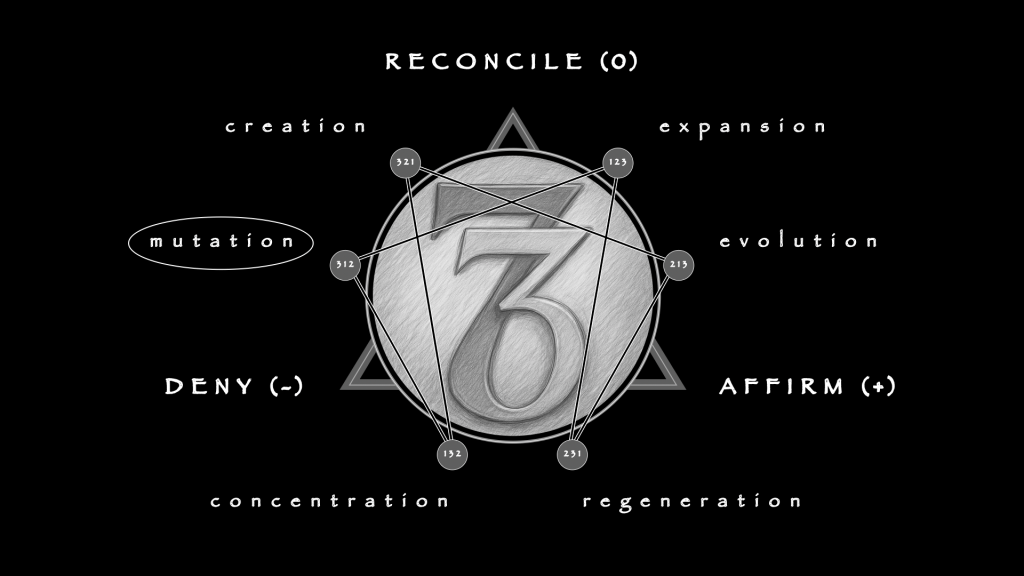
    The metaphor is not arbitrary. The metals correspond to cognitive structures mapped via the Enneagram. The triadโ€”Gold, Iron, and Leadโ€”forms the immutable frame: sacred form, functional stress, and mass inertia. The hexadโ€”Silver, Nickel, Bronze, Slag, Aluminum, Mercuryโ€”traces the recursive interior.

    The hexad unfolds chronologically at first: Silver introduces exchange. Nickel reflects. Bronze tools. Slag remains. Aluminum lightens. Mercury mutates. Silver returns, not as memory but mimic. The loop is not a spiral. It is a trap.

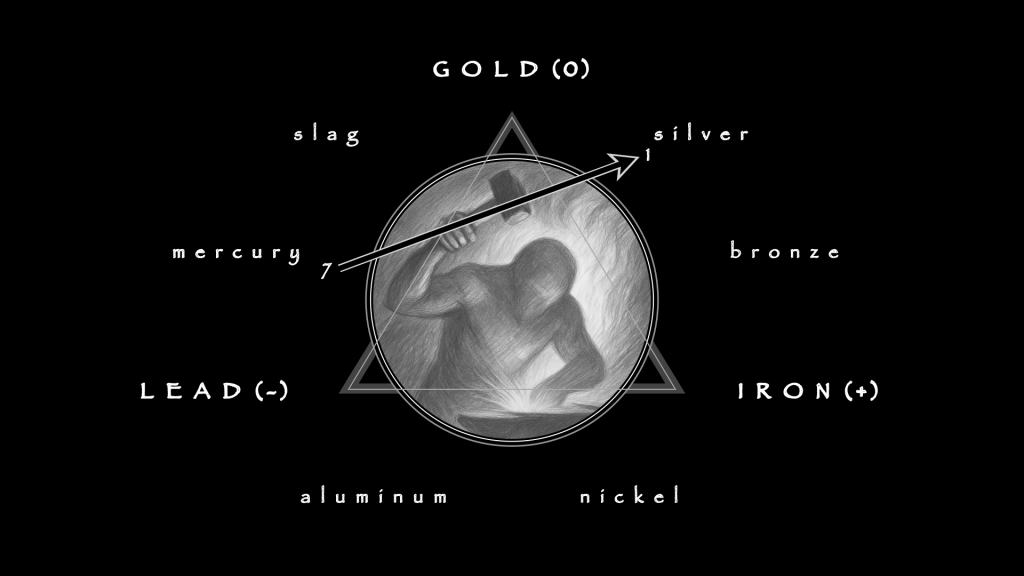
    More precisely, the hexad is encoded arithmetically: 1 โ†’ 4 โ†’ 2 โ†’ 8 โ†’ 5 โ†’ 7 โ†’ 1. This is the division of one by seven. It produces no whole. It simply recurs. The illusion of progression hides a deepening disarray. Each station in the loop reflects a symbolic distortion of the last. Mutation is not a new phase. It is the failure of retention.

    The triad stands outside this churn, as its Logos. Gold does not recur. Iron does not adapt. Lead does not respond. These metals do not change; they support. The hexad spins within them, mistaking velocity for meaning.

    1โ†’4 From Legacy to Reflection

    Silver does not know it is Silver. It borrows the sanctity of myth and distributes it freely, unaware that distribution severs charge. Its heroes do not reflectโ€”they radiate. Superman, as first rendered inย Action Comics #1ย (1938), hovers with serene omnipotence. He saves not to transform the world, but to preserve its order. Coherence is ambient. Continuity is assumed.

    This naรฏve futurism mistakes expansion for permanence. Silver imagines progress but cannot engineer it. The Jetsons believe the future is tidy and clean, not because they understand entropy, but because they have not yet seen it. In Silver, stories extend like highways with no bends. Purpose feels infiniteโ€”fracture, unthinkable.

    Nickel arrives when that continuity is first questioned. Reflection replaces assumption. Heroes begin to hesitate, to carry burden rather than just power. Characters like Spider-Man and Wolverine do not save the world; they navigate its weight. Style emerges not from clarity, but from fracture. Legacy becomes affect, and identity becomes genre.

    The 1โ†’4 line does not crack the structure. It coats it. Lamination preserves surface, even as tension grows beneath. This is not regression, but polish in search of durability. Shine cannot absorb pressure, however, and the more a hero gleams, the softer he hits.

    4โ†’2 Refinement as Return

    Nickel polishes until friction vanishes., but when stories reflect too perfectly, they forget to bear any load. At first, the audience sees themselves and feels seen. Soon, though, they see only surface; nothing penetrates, or pushes back.

    In this aesthetic saturation, the writer begins to acheโ€”not for beauty, but for pressure. The 4โ†’2 move is counterintuitive: it looks backward to Bronze, but only to recover compression. The artist, exhausted by reflectivity, begins to crave utility. What began as refinement becomes filtration. Impurity is burned off. Style gives way to structure.

    This is not collapse. It is a reforge. In metallurgy, refinement means heat, constraint, and reductionโ€”until only what can hold remains. The writer in this phase does not mimic Bronze; he tempers it. Originality becomes functional. Form regains civic dimension. The hero acts not to express, but to shape.

    What returns is not nostalgia, but torque. Reflection hardens into tool. The story works againโ€”not because it dazzles, but because it cuts.

    2โ†’8 From Tool to Waste

    Bronze carried function. It shaped civic ritual and bore ideological weight. Its stories were designed to hold consequences, not aesthetics. Every strike mattered. Every decision altered the frame.

    Slag holds no edge. It is residueโ€”story without shape, symbol without tension. Where Bronze compressed, Slag congeals. The 2โ†’8 transition is not erosion. It is overdesign. Compression becomes cosmetic. Resolution becomes routine. The plot moves, but nothing matters.

    This is not collapse through absence. It is collapse through accumulationโ€”every franchise extended, every arc rebooted, every theme repeated until it petrifies. Slag is not dead matter. It is undead form. No longer animated by pressure, it drags meaning like an anchor.

    In this state, silence emergesโ€”not from lack of content, but from its surplus. The tools remain, but their edge is gone. No matter how fast the swing, nobody cares.

    8โ†’5 Foresight Without Anchor

    Slag is stagnation, but Aluminum feels like rescue. It glides. It lifts. It promises reach without drag. Suddenly, everything worksโ€”until it doesnโ€™t. The images move faster. The friction may be gone, but so is resistance.

    Aluminum stories are perfect exports: seamless, dazzling, and strangely hollow. Their tension is engineered through rhythm, not density. The viewer is pulled forward by tempo, not by stakes. It looks like rebirth, but it is repackaged descent.

    In this acceleration, foresight dawns. Aluminum sees where itโ€™s headingโ€”into Mercury, into mutation. But it also remembers where it came fromโ€”Slag, the burnt field behind. This is the one vantage point with clarity in both directions. The hero, if conscious, sees the coming fork: volatility ahead, residue behind. The insight is real, but impotent.

    The 8โ†’5 line, uniquely, tracks both time and sequence. It is not a loop. It is a slide. And what makes it so dangerous is its elegance. The genre believes it has found propulsion, when it has merely reduced mass.

    Foresight without compression becomes hallucination. Knowing collapse is coming changes nothing unless resistance is reintroduced. Otherwise, the genre falls forwardโ€”gracefully, stylishly, irreversibly.

    5โ†’7 From Escalation to Entropy

    This is the cleanest fall in the hexad. Aluminum (5) flows into Mercury (7) without rupture, without recoil. The 1 รท 7 sequence and the genreโ€™s own chronology align here perfectly. It is the only line where structure and story collapse in harmony.

    Aluminum scaled without friction. Mercury corrodes without rest. In Mercury, the story meltsโ€”continuity dissolves, identity scatters, logic blurs. The hero shifts forms, universes, tones. Mutation appears as freedom, but it functions as decay. There is no pressure, only permutation.

    Studios mistake this phase for apex. They call it innovation., but the container has dissolved. There is nothing left to hold. Reboots multiply. Realities overlap. The audience stays not for meaning, but for velocity. The writer vanishes. Curation replaces authorship.

    The 5โ†’7 move is the genreโ€™s terminal drift. It does not pause. It accelerates into incoherence. And once passed, it cannot be undone. Reentry is not an option. Only refusalโ€”before the breachโ€”can preserve compression.

    What rescues is not invention, but pressure. The writer must subtract. He must withhold. He must apply tension not to entertain, but to restore mass. Without that, the story becomes air.

    7โ†’1 Mimicry as False Return

    Mercury destabilizes. It liquefies narrative into motion, character into gesture, coherence into spectacle. Mutation becomes the new ritualโ€”recursive, reactive, and precise in its disorientation. The story no longer arcs; it ripples. There is no act structure, only switchbacks. Novelty arrives faster than it can be encoded.

    When the cycle loops to Silver, it does not return to legacy. It mirrors it. The 7โ†’1 transition offers form without force, tone without torque. It sells memory as innovation, but the charge is missing. What once bore sacred compression is now formatting, curated and clean. Silver wears myth as costume. The audience sees the shape, but not the gravity.

    This is not recovery. It is recursion. Legacy is referenced, not rebuilt. Franchises return not as pillars, but as placeholders. Continuity reboots. Tone resets. History is flattened into flavor. Nothing holds. Nothing resists. The shimmer of recognition replaces the substance of consequence.

    True Silver derived strength from proximity to Gold. It was a carrier of sacred weight, not just a distributor of form. After mutation, however, there is no weight left to carry. The 7โ†’1 loop simulates return to culture, while accelerating its dissolution. It feels like homage. It functions as entropy.

    For Silver to matter again, it cannot be reached through spin. It must be recast, which demands not sentiment, not reference and not retro-styling, but heat. Recasting requires compressionโ€”and constraint. Without it, the return is only a new skin.

    The 7โ†’1 line is not a bridge. It is a trapdoor. If the writer steps onto it unaware, he will mistake shimmer for signal and reflection for foundation. The only viable path to coherence begins before the melt. Once the form dissolves, even memory becomes noise.

    The Civic Cost of Narrative Collapse

    So far I have mapped the metals in sequence and clarified the internal architecture: a triad of structural anchors (Gold, Iron, Lead) and a hexad of recursive phases (Silver, Nickel, Bronze, Slag, Aluminum, Mercury). These metals do not just signify narrative tone or aesthetic phaseโ€”they track the mediumโ€™s ability to compress civic, ethical, and symbolic weight into form. The cycle is not circular. It is degrading. Once pressure is lost, structure becomes sheen. Once friction disappears, mutation follows.

    I can now elucidate a fine point about the hexadโ€™s hidden axis: two symmetrical vectors do not follow the loop, but cut across it. The firstโ€”Bronze to Slag (2โ†’8)โ€”marks the exhaustion of utility. The secondโ€”Mercury to Silver (7โ†’1)โ€”traces illusionโ€™s return to form. These are not clean transitions. They are cross-sections of collapse. The first illustrates the loss of function, while the second simulates recovery. Together, they reveal the deeper cost of narrative failure: not aesthetic fatigue, but the erosion of civic meaning.

    When story fails to hold tension, culture compensates with movement. As we see, however, movement without torque is drift, which, at scale, becomes social disorientation. Thus these lines are not just interpretive tools, but pressure gauges that reveal how a medium built for compression becomes a mechanism of entropy.

    The 2โ†’8 Line
    From Tool to Scrap

    In the metallurgic schema, Eight denotes Slagโ€”the exhausted byproduct of force. It is residual power with no direction, expelled heat with no function. Yet within its opacity lies a last temptation: to act for its own sake. When narrative reaches this phase, it no longer seeks justice or coherence. It seeks response, any response. The hero becomes a specter of former impact, chasing confrontation not to restore order, but to feel weight.

    The 2โ†’8 line, when traced forward, moves from Bronze (2) to Slag (8): from civic utility to performance exhaustion. But when reversedโ€”viewed from the perspective of a tactician at the end of collapseโ€”the arc becomes diagnostic. Eight sees the void and looks back. It remembers function. It remembers stakes, but no longer trusts the field.

    This retrograde recognition is a bitter kind of wisdom: the hero sees what should be done but cannot generate the context in which doing it would matter. He is not naรฏve so much as bereft. The Iron he once relied on has rusted. The Lead has sunk, the Mercury has spun the compass off its axis, and what remains is confrontation without compression … Slag.

    The Book of Eliย offers a useful exemplar. The protagonist carries the last sacred text not for evangelism, but for preservation; his combat is not redemptive, but defensive. He knows that the world has lost the ability to decode what he protects, so his heroism is not hopeful. It is archival. His function is memory under arms.

    Here, the 2โ†’8 line does not promise renewal. It documents the price of decay. When no structure remains to carry strain, the hero becomes the strain himself. That is not burden. It is entropy turned reflexive. It marks the end of narrative as civic ritual and its mutation into lone-wolf stamina test. The story does not guide; it takes a beating and keeps walking.

    The 7โ†’1 Line
    From Mutation to Mimicry

    The 7โ†’1 line crosses the axis from chaos to form. Seven is Mercuryโ€”erratic, unstable, seductive in its aesthetic unpredictability. One is Silverโ€”refined, ordered, radiant. On the surface, they seem incompatible: one dances, the other announces, but their structural relationship is more intimate than it first appears.

    Mercury liquefies meaning and mimics transformation while accelerating disintegration. It recycles iconography without coherence, offering spectacle in place of strain and yet, when fatigue reaches its limit, the viewer begins to crave orientation again. The system responds with mimic-Silver: a visual echo of former order, sold as continuity. The 7โ†’1 line is not an ascent. It is a reboundโ€”one that flatters the audienceโ€™s memory while bypassing their discernment. Franchise rebootsย often travel this route.ย Spectre, for example, gestures toward legacyโ€”old villains, classic themes, reconstructed mythosโ€”but the weight has already leaked. Bond himself remains, but the torque, the forward intention does not.

    The film offers the illusion of a return to structure, while preserving Mercuryโ€™s core instability: genre-switching, aesthetic gloss, recursive lore … and a story circling its own residue.

    The danger is not confusion, butย false coherence. When Mercury attempts to cross over to Silver, it wears the appearance of sacred compressionโ€”but without pressure. The story gleams, but does not cut; symbols return, but no longer mean anything. What once marked civic structure is now brand styling and fan service.

    Thus the 7โ†’1 transition is not myth reborn, but myth repackaged.

    Mimicry confuses the viewers’ interpretive instinct by teaching them to associate glint with gravity, format with foundation, even when the signal has hollowed. The story no longer demands anything from its audience except recognition. There is no torque, no civic cost, only sheen.

    Structural Entropy and the Storyless Society

    The collapse of story form does not produce silence. It produces plenty of motion, and at ever higher cost. Mercury spins, Slag repeats, Silver refracts. The failure is not aesthetic. It is perceptual. Viewers sense something is wrong, but cannot name it. They feel unease, not just boredom, and the unease is not personal, but structural. The feeling arises when the forms designed to carry civic strain dissolve into mere tone.

    The fear beneath the melt is not cinematic. It is interpretive disorientation. Narratives no longer land, but they do not stop, either. Heroes no longer change, they just reappear. Closure no longer arrives, but release schedules accelerate. Culture simulates ritual without consequence. The result is not rejection, but psychic drift. The viewer no longer feels like a witness to anything important. This disorientation does not produce rebellion, only mimicry. Sarcasm replaces insight, irony becomes defense, and viewers are trained to navigate signal by recognizing surface. They, in turn, protect themselves by mirroring the instability of the medium, until identity becomes reaction and taste becomes speed.

    In this climate, civic meaning decays. Narrative was never just entertainment. It was higher learning that carried pressure, encoded limits, and modeled response. When that structure dissolves, so does its social utility. The cost of narrative collapse is not artistic confusion, but behavioral entropy. The audience no longer knows what to consume or why, only how to react faster.

    Can the writer reverse this?

    Yes, if anybody’s, creation is the writer’s province, but not by rejecting the melt. He must work with what he has, making fire from whatever kindling the world offers. The writer must recompress the raw materialsโ€”under degraded conditions, with unstable inputs, against algorithmic entropy. Coherence will not re-emerge on its own, but must be forged anew.

    Gold cannot return spontaneously, but torque can, if the writer prefers the heat of the forge over its glow.

  • Most legal outcomes are decided before a court examines the evidence, before a jury hears the facts, and before anyone argues what actually happened. The machinery that produces outcomes runs on doctrines too abstract for most people, administered by institutions with strong incentives to keep them obscure, whose product is a gap between the right the Constitution names and the remedy the legal system provides. ‘Before the Merits’ strips down the American legal machine to its component parts one case at a time, for general readers to discover how a precedent-based system is run and maintained.


    Before the Meritsโ€”Monell v. Department of Social Services, 436 U.S. 658 (1978)

    In 1871 Congress built a federal emergency room for injuries that local courts had demonstrated they would not treat. For most of a century that emergency room turned away the patients for whom it was built. Then, in 1961, the Supreme Court codified the exclusion by ruling that cities, the institutions most responsible for the injuries, could not be admitted to the facility at all. The case that changed this began with a pregnancy: a class of female city employees forced onto unpaid leave before their doctors required it sued the New York City Department of Social Services, and their lawsuit forced the Court to reopen a door it had sealed seventeen years earlier. 

    The ruling that followed opened institutional liability and simultaneously installed, inside the opening, a set of intake requirements so demanding that most patients who enter the emergency room never reach a treatment room. The calibration of those requirements was not a discovery from legislative history but a policy choice, and its consequences have fallen for nearly fifty years with systematic precision on the people the 1871 statute was written to protect. Read on to learn the exact intake requirement the plaintiff must satisfy that has nothing to do with whether the constitutional violation occurred.

    Case Header:

    • Case Name: Monell v. Department of Social Services of the City of New York
    • Citation: 436 U.S. 658 (1978)
    • Court / Jurisdiction: United States Supreme Court; certiorari to the U.S. Court of Appeals for the Second Circuit
    • Date Decided: June 6, 1978
    • Docket No.: No. 75-1914

    Legal Domain(s):

    • Primary Issue(s): Civil Rights / ยง 1983 Municipal Liability / Official Policy or Custom
    • Practice Area: Federal Civil Rights Litigation; Constitutional Law; Municipal/Government Liability
    • Procedural Posture: Class action filed in S.D.N.Y.; district court denied backpay on Monroe v. Pape immunity grounds; Second Circuit affirmed; Supreme Court granted certiorari to decide whether local government officials and school boards are “persons” within 42 U.S.C. ยง 1983 when equitable or damages relief is sought against them in their official capacities

    Holding (One Sentence Rule):

    Local governments are “persons” subject to suit under 42 U.S.C. ยง 1983 and may be held liable for constitutional deprivations caused by an official policy, ordinance, regulation, or governmental custom, but may not be held liable solely on a theory of respondeat superior.

    Precedent

    The federal emergency room that Congress built in 1871 was constructed for a specific population: the freed people and their allies whom Southern state governments were systematically terrorizing while state courts watched with indifference or complicity. The building was federal, the remedy was damages, and the statute’s language was unqualified. Any person who, acting under color of state law, deprived any citizen of constitutional rights shall be liable to the party injured. Congress knew what it was writing. The legislative debates documented the precise category of official conduct the statute was meant to reach, the sheriff who stood aside while the mob worked, the official who organized the violence, the government that maintained the infrastructure enabling it, and the language it produced was designed to make none of them unreachable.

    The emergency room sat largely unused for most of a century, its doors open in principle and functionally closed in practice. 

    The Supreme Court revived the statute in 1961 in a case involving a Black Chicago man whose home had been subjected to an unconstitutional warrantless search by Chicago police officers. The ruling was significant in what it permitted: officers could now be sued under the federal statute. It was more significant in what it excluded. The Court held that municipalities were not persons within the meaning of the 1871 Act and therefore could not be sued at all. 

    The reasoning rested on a reading of the legislative history of the Sherman Amendment, a provision Congress had rejected during the Act’s passage, which the Court interpreted as evidence that Congress had not intended local governments to bear liability under the statute. The emergency room was now open to individual patients. The institution that had trained, equipped, directed, and indemnified the person who caused the injury could not be admitted.

    The exclusion was the wrong reading of the wrong amendment for the wrong reason, as the Monell majority would later establish with considerable documentary precision. 

    Congress had rejected the Sherman Amendment because it created new affirmative duties on municipalities to prevent private lawlessness, which raised federalism concerns about imposing obligations local governments had never possessed. It had nothing to do with whether municipalities bore liability for their own existing constitutional violations, which was the question the 1961 ruling had answered by reading the wrong legislative record. The exclusion stood for seventeen years.

    The women who forced the correction were not suing over violence. Jane Monell and a class of female employees of the New York City Department of Social Services were challenging a mandatory leave policy that required pregnant employees to take unpaid leave before any medical necessity arose. The policy was enforced as written departmental practice; no individual officer was acting aberrationally. The institution itself had adopted, maintained, and enforced the violation. Their case presented the institutional-liability question in its cleanest possible form, and the Court that received it was positioned, in 1978, to correct a historical misreading it had carried for nearly two decades.

    What the correction would cost, and who would pay it, was the question the majority had not fully answered when it wrote the opinion.

    Doctrine

    Monell v. Department of Social Services, 436 U.S. 658 (1978), is a seven-to-two ruling that took three analytical steps, each of which mattered individually and whose combination produced a doctrine more consequential than any of the steps would have suggested in isolation.

    The first step was historical. 

    Justice Brennan, writing for the majority, conducted an exhaustive re-examination of the Civil Rights Act of 1871’s legislative debates, with particular attention to the Sherman Amendment and the reasons for its rejection. The majority concluded that Monroe v. Pape had misread the record: Congress rejected the Sherman Amendment because it created new affirmative municipal duties, not because it wished to immunize municipalities from liability for their own existing constitutional violations. Local governments were persons within the meaning of the statute from the beginning. Monroe‘s exclusion of municipalities was overruled.

    The second step was structural, and it shaped everything that followed. 

    Having determined that municipalities could be sued, the Court addressed how they could be sued. Here the majority made a choice that the historical analysis did not compel but that the majority presented as its natural implication. Because Congress had rejected the Sherman Amendment, which would have imposed something resembling respondeat superior liability on municipalities, the majority concluded that Congress had rejected respondeat superior itself. A city could not be held liable merely because it employed someone who violated the Constitution. Liability required a connection to an official policy or custom of the municipality, something the institution as an entity had decided or persistently permitted. The intake form now had a required field: show the institutional policy or custom that was the moving force behind the violation.

    The third step was definitional, and it opened the doctrine to its subsequent expansion and its subsequent narrowing simultaneously. 

    The Court defined official policy to include formal written directives adopted through official channels, single decisions by officials with final policymaking authority, and governmental customs, patterns of practice so persistent and widespread that the institution could be said to have chosen them. The definition was capacious by design, intended to capture the variety of ways an institution can direct, sanction, or systematically tolerate constitutional violations without putting a policy in writing. What the definition did not specify was how a plaintiff would prove any of these things before reaching the discovery that would supply the proof.

    Justice Rehnquist dissented, joined by Chief Justice Burger. The dissent did not argue for continued immunity; the historical question was, Rehnquist acknowledged, genuinely close. The dissent argued that a seventeen-year-old statutory interpretation should be corrected by Congress, not by the Court’s re-examination of the same legislative record the earlier Court had examined and read differently. The dissent was prescient in one respectโ€”the majority’s historical methodology produced a doctrine whose boundaries were unclear from the day of its announcement. 

    The following five decades of litigation over what policy or custom meant, who qualified as a final policymaker, and what deliberate indifference required for failure-to-train claims have confirmed that the majority created as much uncertainty as it resolved. The case settled. New York City eventually paid eleven million dollars to the affected women, a decade after the original complaint was filed.

    Revival

    The doctrine Monell created was incomplete on the day it was issued, and the incompleteness invited a series of subsequent decisions that defined its edges in ways that progressively narrowed the distance between the promise of institutional accountability and its practical availability.

    The first significant clarification came in 1986, when the Court held that even a single decision by an official with final policymaking authority could constitute official policy sufficient to trigger municipal liability. The holding mattered because it eliminated the requirement that plaintiffs demonstrate a pattern of prior violations. If the right official made a single unconstitutional decision, the municipality bore liability for its consequences. 

    The difficulty the subsequent cases revealed was that identifying the right official requires jurisdiction-by-jurisdiction analysis of state and local government structure. The identity of the final policymaker on any given question is determined by state law rather than federal constitutional doctrine. A city council may be the final policymaker on some questions, a police chief on others, a mayor on others still, and the answer varies by state, by city charter, and by subject matter. 

    Getting it wrong means losing the case before the merits are examined.

    The most consequential subsequent development was the 1989 failure-to-train ruling, which held that a municipality’s inadequate training of its employees could constitute the policy or custom required for Monell liability, but only when the failure amounted to deliberate indifference to the rights of persons with whom the untrained employees would interact. The deliberate-indifference standard arrived from the Eighth Amendment‘s prohibition on cruel and unusual punishment, where the term described prison officials who knowingly ignored serious medical needs. Imported into the failure-to-train context, it required plaintiffs to show that the need for training was obvious and that the municipality’s failure to provide it reflected a conscious disregard of predictable consequences. The standard is higher than negligence; it requires something approaching knowing indifference assessed at the institutional level. It also requires proof that the need for different training was apparent from prior incidents, which means the first plaintiff in any new category of institutional failure cannot satisfy it, because the prior incidents that would have put the institution on notice do not yet exist. The emergency room’s intake form now required the patient to demonstrate that prior patients had presented with the same injury.

    The 1997 single-incident hiring decision tightened the doctrine further still. A plaintiff who sought to establish municipal liability by pointing to a single negligent hiring decision faced the requirement of showing not merely that the employee turned out to be unfit but that the inadequacy of the hiring decision was so obvious, and the constitutional violation so plainly foreseeable at the moment of hiring, that the decision itself constituted deliberate indifference. The standard was difficult to meet because it required courts to assess foreseeable risk at the moment of a hiring decision rather than in retrospect, which is a counterfactual inquiry that benefits defendants with institutional resources and disadvantages plaintiffs who can demonstrate only what happened, not what was predictable before it happened.

    The circuit split that has persisted to the present involves the standaloneย Monellย claim: whether a plaintiff can pursue institutional liability when the underlying claim against the individual officer fails because the officer was dismissed, is immune, or prevailed at summary judgment. Both theย Fourth Circuitย and theย Fifth Circuitย require a concurrently viable individual claim; other circuits permit the institutional claim to proceed independently. In jurisdictions requiring a viable individual claim, a municipality can eliminate institutional accountability by successfully defending its officers, which creates an incentive to contest individual liability not because the facts favor the defense but because an individual victory forecloses the institutional question. In those jurisdictions, the intake form can be completed correctly in every respect and still rejected because the person who caused the injury was cleared at a prior window.

    Exposure

    Every emergency room has an intake process. Every intake process has a governing logic that determines which patients receive treatment and which remain in the waiting area. The Monell intake process is governed by a logic the majority presented as a natural consequence of legislative history. That is, on examination, a set of choices about whose injuries the emergency room was calibrated to treat.

    The respondeat-superior bar is the intake process’s most consequential rule, and it was not compelled by the Constitution or by the statute’s text. The text says persons are liable; it specifies no causal theory connecting a municipality’s liability to an employee’s act. The majority derived the bar from Congress’s rejection of the Sherman Amendment, but that rejection was grounded in federalism concerns about creating new affirmative duties, not in a commitment to any particular theory of institutional causation. The majority’s decision to prohibit respondeat-superior was a policy judgment, that cities should not bear automatic liability for everything their employees do in the performance of their duties, dressed in historical reasoning the history did not fully support. The intake form’s required field, show the institutional policy or custom, arrived not from the statute but from a choice the majority made about what the statute should mean.

    The practical consequence is that the framework simultaneously answers and refuses to answer the most intuitive question a civil rights plaintiff can ask: if the city’s officer violated my constitutional rights, is the city responsible? The answer is that it depends on whether the violation traces to a policy or custom, who the final policymaker was, whether training was deliberately inadequate, and whether the pattern of violations is documented. None of these requirements tracks the severity of the violation, the completeness of the proof that it occurred, or the extent of the harm. A plaintiff who establishes a single devastating constitutional violation by a city employee, committed without a documented prior pattern or a written authorizing policy, may complete the intake form correctly in every other respect and still be turned away at the treatment window. The form was not designed for that patient.

    The intake form’s hidden logic is that the proof it requires is held by the institution whose conduct is being assessed. 

    Complaint logs, training records, personnel files, prior investigation reports, the documents that would establish a pattern of violations or demonstrate deliberate indifference, are institutional records. They exist inside the emergency room. The patient in the waiting area cannot access them without a court order compelling production, cannot obtain that order without surviving a motion to dismiss, and cannot survive the motion to dismiss without alleging facts that are inside the records they cannot access. The intake form requires the patient to describe their prior treatment history at a facility whose records are sealed to them. 

    The discovery that would unlock the records is conditioned on the pleading that requires the records. The loop is not a malfunction. It is the intake procedure operating as designed.

    This gap between the individual violation and the institutional claim was not an oversight. The majority built it deliberately, under the influence of genuine concern that automatic institutional liability would produce municipal insolvency, deterrence of public service, and political backlash against an expanded civil rights regime. Those concerns were real in 1978, when the implications of fully opening municipal treasuries to civil rights judgments were genuinely unknown. They produced a doctrine whose conservatism at the moment of its creation became progressively more visible as the category of cases it was designed to reach, systematic police misconduct, institutional indifference, official policies of exclusion, turned out to require exactly the tools the majority had declined to provide.

    The exposure Monell produces, stripped of its doctrinal complexity, is the disclosure that institutional accountability in American civil rights law is an aspiration encoded in requirements so demanding that most victims of institutional violations cannot satisfy them, not because their violations are not real, not because the institution did not produce them, but because the doctrine that was supposed to reach institutions was calibrated, from its inception, to require more proof than most plaintiffs can access.

    Deviation

    The emergency room that Monell opened has, in the fifty years since the ruling, developed a waiting area substantially larger than its treatment capacity, and the patients who reach treatment are not a representative sample of the patients who present at the door.

    Plaintiffs’ lawyers who specialize in civil rights litigation have adapted by concentrating Monell claims in cases with documented institutional histories: departments with citizen-complaint records, use-of-force incidents on video, civil rights investigations by advocacy organizations, and prior lawsuits that establish the pattern the deliberate-indifference standard requires. These are the cases where the institutional records are already partly public, where the pattern has been documented by someone other than the plaintiff, and where the intake form can be completed without first gaining access to the records behind the intake window. Individual plaintiffs whose cases lack this context, the single incident, the first incident, the incident involving a department that has not previously been sued, face an intake process that is formally available and practically impassable.

    Municipal defendants have adapted by contesting the institutional claim at the discovery stage, resisting production of complaint logs, training records, personnel files, and internal investigation reports on relevance, privilege, or burden grounds, knowing that a plaintiff who cannot reach the institutional records cannot establish the institutional pattern. Courts have been inconsistent in managing this resistance. Some permit early discovery of institutional records as necessary to plead the Monell claim adequately. Others permit the defendant to challenge the pleading’s adequacy before discovery proceeds, which places the plaintiff in the position of being required to plead facts they cannot obtain without the discovery they cannot access until they have pled the facts. The waiting area fills. The treatment capacity does not expand.

    The indemnification structure of municipal employment completes the circuit and produces its most perverse outcome. 

    Individual officers who violate constitutional rights face no personal financial consequence because their employers indemnify them for civil-rights judgments entered against them in their individual capacities. The employers, meanwhile, face no institutional consequence because Monell requires proof of policy or custom that individual violations, standing alone, do not establish. The officer is made whole by the institution. The institution is insulated from the officer’s conduct by the doctrine. The public bears the cost of indemnification through the taxes that fund it and receives nothing that requires the institution to change the practices that generated the violation. The civil rights statute imposes theoretical liability on both actors while practical accountability falls on neither. The emergency room bills the patient’s insurance and discharges them without changing the procedure that caused the injury.

    The most recent scholarly argument centers on whether Monell liability should extend to municipalities that fail to investigate civil-rights allegations surfaced in their own litigation files. A city that receives repeated civil suits alleging the same category of constitutional violation, defends each individually, settles the most evidenced cases under confidentiality agreements, and never investigates the pattern has demonstrated, through sustained institutional inaction, the deliberate indifference the doctrine requires. The theory is analytically coherent, has not yet commanded a circuit consensus, and would expand Monell‘s practical reach precisely in the domain where the current doctrine most conspicuously fails: the department that reads its own settlement history as a management cost rather than a constitutional signal, and that has learned, over fifty years of litigation, exactly how little documentation it needs to avoid producing before the intake form becomes impossible to complete.

    Remedy

    The calibration the majority set in 1978 was a policy choice, not a constitutional discovery, and the choice was made with full awareness that it would leave some institutional violations unreachable. The majority said so. The Remedy is not to fault the candor but to name what the choice has produced across five decades of application … and what would need to change to produce something different.

    The respondeat-superior bar, the policy-or-custom requirement, the deliberate-indifference standard, and the final-policymaker analysis together create an accountability system in which institutional liability tracks not the harm the institution’s employees inflicted but the institution’s own documented decision-making process, specifically whether the institution chose the violation, permitted it through deliberate inaction, or failed to train against it with knowledge of the likely consequences. This is a coherent theory of institutional moral responsibility. It is also a theory that requires the plaintiff to prove the institution’s internal deliberative record, which is held by the institution, contested at discovery, and obscured by a settlement practice whose confidentiality the doctrine neither requires nor prevents.

    A different theory was available and was rejected. Respondeat-superior would have imposed automatic institutional liability for unconstitutional employee conduct within the scope of employment, without requiring proof of policy, pattern, or deliberate indifference. It would have reached genuinely aberrational violations by officers acting against institutional policy, which seems intuitively unfair. It would also have reached the violations that are the predictable product of institutional choices about training, supervision, culture, and hiring that the institution made without formally acknowledging their likely consequences. 

    The majority rejected it because, in 1978, the full fiscal and political implications of that reach were genuinely unknown, and the caution felt proportionate to the uncertainty.

    The standard requires plaintiffs to prove that the institution made a knowing choice to leave a gap it recognized would produce violations. The proof of that knowing choice is institutional: training curricula, supervision records, prior complaint investigations, internal communications. The institution controls it all. The discovery process can compel production, but only after the plaintiff has survived a motion to dismiss by alleging facts the institution has not yet been compelled to produce. 

    The standard is not impossible to meet; it is met regularly in cases where the institutional record has already been made public by journalism, prior litigation, or civil rights investigation. In those cases, the emergency room treats the patient. In cases where the record has not been made public, the intake form cannot be completed, and the patient waits.

    The 1871 statute was written by people who had watched institutions organize constitutional violations while individual actors performed the visible acts. They wrote a statute to reach both. The emergency room they built has treated many patients in the nearly century and a half since. The ones it has not treated are not, in the main, the ones whose injuries were less real or less severe. They are the ones whose injuries arrived without a prior public record of the institution that caused them, without the resources to compel that record’s production before the statute of limitations ran, and without the political visibility that makes an institution’s liability something the institution cannot manage by settling quietly and reforming nothing. The emergency room is not broken. The triage protocol was written by the same institution that built it, and it has been functioning exactly as calibrated for fifty years.

    For Further Examination . . .

    What Monell v. Department of Social Services forecloses and what the law leaves open are not identical. The gap between them is where the next case will be born. Whatever specific circumstances generate it, the logos of any case has three components, each operating simultaneously as a field condition. Institutional Inertia (+) is already in motion, and Socioeconomic Pressure (-) defines the boundary conditions of that motion. These collide within a Cultural Justice Assumption (0) whose content varies but whose function does not.

    Institutional Inertia is the affirming force.

    Municipal governments operating civil rights defense programs have internal incentives that run consistently in one direction: defend each case individually, settle the ones with the strongest evidence under confidentiality agreements, and never conduct the internal investigation that would convert a series of individual settlements into the documented pattern the deliberate-indifference standard requires. The incentive does not require malice. It requires only that the institution’s legal department treat each case as a discrete liability event rather than as a data point in a pattern the doctrine is waiting to see assembled, and that the settlement structure preserve the confidentiality that prevents the assembly. The path of least resistance runs toward the waiting area, and it has run that direction for fifty years.

    Socioeconomic Pressure is the denying force.

    The post-civil-rights era expansion of ยง 1983 litigation produced a federal judiciary and a municipal defense bar that both understood, by the late 1970s, that full institutional accountability under respondeat-superior would expose city treasuries to liability at a scale that had no precedent in American municipal finance. The fiscal concern was real. It shaped the doctrine at the moment of its creation and has been invoked to justify progressively narrower applications of the standard ever since, in a legal culture where the populations most likely to be injured by systematic institutional violations are the populations least represented in the constituent calculus of the legislators who could correct the doctrine by statute and have not. This force does not push toward any particular outcome. It defines the range of responses the institutional inertia already in motion will be permitted to produce, and it raises the stakes of every other force operating in the field without generating directional momentum of its own.

    The Cultural Justice Assumption is the reconciling force.

    Institutions are morally responsible for what they choose, not for what they accidentally permit, and the law should require proof of institutional choice before imposing institutional liability. The policy-or-custom requirement operationalizes this assumption precisely: a city that chose a violation, or deliberately disregarded an obvious risk of one, is responsible. A city whose employee committed a violation the city did not authorize is not. This is coherent as a theory of moral responsibility. Its application produces a legal regime in which the institutions most responsible for systematic violations, those that defend each case individually while the pattern accumulates invisibly, are precisely the ones whose conduct most easily satisfies the no-written-policy defense the assumption creates. The assumption is neither validated nor invalidated by the outcome it produces. It is the medium through which institutional inertia and socioeconomic pressure interact, and what makes that interaction legible as justice rather than mechanics.

    These forces do not finally resolve with a given case, but reconstitute around the next one. However, a reader who can identify all three next time will find that the following questions transfer. These are the questions this case leaves open rather than the ones it answers.

    If a police department receives fifty civil-rights complaints alleging the same category of unconstitutional conduct over five years, defends each individually, settles the most evidenced cases under confidentiality agreements, and produces no written policy authorizing the conduct, has the department demonstrated the deliberate indifference that Monell requires, and if not, what additional fact would need to be true before the doctrine reaches an institution whose settlement pattern is itself the evidence of the pattern the doctrine demands?

    The Monell doctrine bars respondeat-superior on the basis of a historical inference about the Sherman Amendment’s rejection that four subsequent decades of scholarship characterize as a significant overreach. Congress has had nearly fifty years to correct the inference legislatively without doing so. If congressional silence is neither endorsement nor oversight but evidence that the constituencies most harmed by the calibration lack the political power to compel correction, what would need to change in the distribution of that power before the correction the 1871 statute’s authors would have recognized as necessary becomes politically available?

    If individual officers are indemnified by municipalities for civil-rights judgments entered against them, and municipalities escape institutional liability because individual violations without a documented pattern do not establish policy or custom, and the practical consequence is that no actor in the system bears personal financial consequence for constitutional violations that are individually provable and institutionally predictable, at what point does the civil rights enforcement structure become an apparatus for producing the appearance of accountability rather than its substance, and which institution, if any, is both positioned and motivated to recognize that threshold before it is crossed rather than after?

  • Constitutional rights have a zip code, which most people learn only after they are already in court. The federal appeals courts divide the country into distinct legal territoriesโ€”regional, functional, and subject-matterโ€”where the same constitutional guarantee can protect you completely in one state and fail you entirely in the next, not because the law changed, but because the judges did. Presidential appointments, regional political culture, and decades of industrial money have been quietly building these divergences until the gap between circuits is wider now than at any point since the civil rights era. Understanding which circuit governs your state, what it has historically protected, and where its fault-lines are cracking may be the difference between filing a case and winning one. Geography determines the settlement offer, whether the police officer gets away with misconduct, or whether the company pays or walks. These courts have produced distinct legal cultures, and the country has spent a century pretending the map does not matter.

    Geography not only locates justice in a literal drawing of courthouse territory, but classifies it, too. Thirteen appellate courts now form the working map: eleven regional circuits, one court of federal machinery, and one court of subject-matter expertise. The current system is a routing diagram that determines which precedent attaches before any facts are heard, whether injuries arrive as constitutional questions or administrative problems, and which are priced out before any judge writes a word. The diagram has no author in the conspiratorial sense; it accumulated through appointments, reversals, retirements, and the slow calcification of regional habit into doctrine. Its effects, however, are indistinguishable from design.


    The Fourth Circuit Keeps a Machine Running in a Basement No Election Reaches

    The Fourth Circuit hears its arguments in Richmond, in a courthouse named for Lewis F. Powell, in the city that once served as the capital of the Confederacy. Powell sat on the Supreme Court, and before that he wrote a 1971 memorandum urging corporate America to organize itself politically and legally against the reforms of the age. The building, the city, and the man on the door are not decoration. They are the foundation on which everything else rests.

    Across four decades the court that sat in that building was the most reliably conservative appellate bench in the country. Then a run of appointments under President Obama flipped it, and the same Richmond court began handing down some of the most progressive rulings in the federal system, until appointments under President Trump pulled it back toward an uneasy split. The usual telling of the Fourth Circuit is a story of transformation, of a house that changed hands and changed character.

    That telling is true only of the floors with windows. Beneath them runs a machine no candidate campaigns on, and no election has ever reached its switch.

    Territory
    The House Sits on Wealthy Suburbs, Poor Coalfields, and the Apparatus of the Security State

    The Fourth Circuit governs Maryland, Virginia, West Virginia, North Carolina, and South Carolina, a territory that runs from the Baltimore waterfront through the Washington suburbs, down across the Appalachian coalfields, and out to the Carolina coastal plains. It holds some of the richest ground in America, in counties like Loudoun, Virginia, where per-capita income has ranked among the highest in the nation, and some of the poorest, in the West Virginia coalfields and the eastern North Carolina tobacco belt. The same court that rules on the fortunes of the wealthy suburbs rules on the survival of communities the wider economy abandoned more than a generation ago.

    The federal docket carries that whole range in a single load. Immigration-detention cases from the enforcement machinery clustered in Northern Virginia sit beside civil-rights claims from the historically Black communities of South Carolina, environmental fights from the coalfields, and national-security matters from the agencies headquartered in the Washington suburbs. No other circuit has the security state living quite so literally in its backyard.

    A house this large contains rooms that barely speak to one another. The wing where a hedge fund argues a contract and the wing where a detainee argues for his freedom share a roof, a clerk’s office, and a body of precedent, and the same judges move between them, carrying the habits of one into the other. The architecture is single. The lives inside it are not.

    The house metaphor earns its keep when the geography is made concrete. The upper floors are Loudoun and Fairfax, the wealthiest counties in the country, dense with federal contractors, defense agencies, intelligence offices, and a professional class whose legal disputes concern employment contracts, federal procurement, and the national-security programs the government runs from the Washington suburbs. Those are the floors with light, the floors the national press covers, the floors whose rulings reach cable news within hours of posting. The basement is West Virginia’s coalfields, where black-lung disability claims move through federal courts at a pace the dying cannot afford, and the rural Black communities of eastern North Carolina, where environmental enforcement has been tested and found wanting for decades, and the immigration-detention facilities in Northern Virginia, where people contesting their removal are held in conditions that have generated their own body of contested litigation. The same building processes it all. The routing diagram sends each claim to the floor where the applicable doctrine lives, and the floors have very different ceilings.

    Reputation
    The Court Reversed Itself While the Country Watched

    Until roughly 2010 the Fourth Circuit’s reputation was settled and unambiguous. It ruled against habeas petitioners, against civil-rights plaintiffs, against environmental enforcement, and in favor of executive power in the national-security cases, and its signature was deference, a reflexive bow to states, to agencies under Republican administrations, and to trial courts in ways that sealed death sentences against any real federal review. A litigant who drew this circuit on the wrong side of any of those questions had, in practice, already lost.

    The decor on the upper floors then changed completely. The new majority assembled under Obama began issuing rulings on voting rights, marriage, and transgender students that ranked among the most protective in the country, and it issued them from Richmond, from the one address the conservative legal establishment had always assumed was safe. Corporate defense teams that had treated the Fourth Circuit as a harbor began steering their cases elsewhere when they could.

    The reversal was real … and partial. Appointments under Trump pulled the court back toward the center of its own gravity, and the bench that sits in 2026 is genuinely divided, its results in contested cases turning on which judges hear them. The house has been redecorated twice in fifteen years, and the furniture that arrives with each new majority is hauled out again with the next.

    The public overread the transformation because it could only see the floors with windows. Rights-expanding rulings on voting, marriage, and gender have visible plaintiffs, cultural stakes, and press coverage commensurate with both. They produce the images that travel: a couple married at a courthouse, a student allowed to use a bathroom, a voting map thrown out. Habeas doctrine produces none of those images. It produces denials, filed in cases whose names are known only to the lawyers and the condemned, resolving claims through procedural holdings that are technically defensible and functionally impenetrable. A death-penalty ruling that says the claim was procedurally defaulted does not generate a photograph. Neither does a ruling that says the error was harmless. Neither does one that says the state court’s decision, though possibly wrong, was not unreasonable enough to disturb.

    The machine runs without generating anything the press can cover, and a machine that cannot be photographed cannot be held accountable by anyone who depends on photographs.

    History
    Three Men Poured the Foundation, Built the Machine, and Changed the Curtains

    The modern character of the court was set in three layers, each laid by a different hand. The first belonged to Clement Haynsworth, the South Carolinian who served as chief judge from 1964 until 1981, and whose nomination to the Supreme Court by President Nixon collapsed on the Senate floor in 1969 amid charges that his record on race and labor was, at best, indifferent to the promise of desegregation. His defeat left the circuit with a reputation for racial insensitivity that it spent the next thirty years trying, unevenly, to shed.

    The foundation was poured with that stain already in the concrete.

    The second layer was the machine, and the man who built it was J. Harvie Wilkinson III, chief judge from 1996 to 2003 and the most intellectually formidable conservative the circuit produced. Under Wilkinson the court refined a set of procedural doctrines for disposing of habeas petitions that effectively walled state criminal convictions off from meaningful federal scrutiny. The Antiterrorism and Effective Death Penalty Act of 1996 handed the circuit a fresh set of levers, and Wilkinson’s court pulled them without hesitation. A 2016 analysis of the circuit’s capital punishment jurisprudence found that in the thirty-three years following the modern death penalty’s reinstatement, capital habeas petitioners in the Fourth Circuit had prevailed in roughly 6.2 percent of cases, against a national average closer to 40 percent across all circuits over the same period; when limited to cases in which the writ was actually granted, the success rate fell to approximately 3.3 percent.

    The machine was installed in the basement, plumbed to the gallows, and left to run.

    The machine did not look like a machine because each part had a respectable label. Deference. Exhaustion. Procedural default. Harmless error. Timeliness. Finality. Certificate of appealability. None of those words is sinister alone; each is necessary to keep federal review from becoming endless, and Wilkinson was not wrong that a habeas system with no procedural discipline would collapse under its own volume. His achievement was to arrange the parts into a system in which almost every constitutional claim could be acknowledged and then denied entry. The prisoner did not lose because the Constitution had nothing to say about his situation. He lost because the state court had already said something not unreasonable enough to disturb, because the claim had arrived a day late, because the lawyer had missed the procedurally correct door, because the constitutional error had not prejudiced the verdict in a form the doctrine was built to recognize. The virtue-word for each denial was finality, and finality is a word that sounds like justice to everyone except the person it buries.

    The basement machine runs on virtues turned sequentially into locks.

    The third layer was Obama, and his appointments did more than shift the court’s votes. They changed its culture on the floors above ground, producing the rulings that made national news precisely because no one expected them from Richmond. The court struck down North Carolina’s voting law after finding that it had targeted Black voters with almost surgical precision. It struck down Virginia’s ban on same-sex marriage. It ruled for a transgender student barred from the restroom that matched who he was.

    Those decisions were consequential, and they were, every one of them, work done upstairs.

    Implication
    The Live Battles Run Through the Upper Floors’ Contested Tenancy and a Detainee’s Secret File

    The furniture the Obama appointments installed upstairs is still in the rooms, but its tenure is disputed and its condition is mixed.

    In North Carolina State Conference of the NAACP v. McCrory, 831 F.3d 204 (4th Cir. 2016), a three-judge panel permanently enjoined North Carolina’s omnibus election law after finding it had targeted Black voters with discriminatory intent, striking photo ID requirements, reduced early voting, and the elimination of same-day registration under Section 2 of the Voting Rights Act and the Fourteenth Amendment. The ruling stands, and the law it struck is gone, but the Supreme Court’s subsequent decision in Brnovich v. Democratic National Committee tightened the Section 2 standard for future claims, reducing the doctrinal space inside which McCrory‘s reasoning operates. In Bostic v. Schaefer, 760 F.3d 352 (4th Cir. 2014), a 2-1 panel struck Virginia’s same-sex marriage ban on due process and equal protection grounds, a result the Supreme Court absorbed a year later in Obergefell v. Hodges and extended nationally.

    In Grimm v. Gloucester County School Board, 972 F.3d 586 (4th Cir. 2020), the court held independently on the merits that a school board’s exclusion of a transgender student from the restrooms matching his gender identity violated both Title IX and the Equal Protection Clause. The Supreme Court denied certiorari in 2021, leaving the Fourth Circuit’s ruling intact but the circuit split unresolved. Each of these decisions was real, consequential, and produced by panel appointments rather than by a reconstituted full court.

    Each survives, partially surrounded by doctrine that narrows its reach or leaves its authority uncertain at the national level. The furniture is there. The lease is contested.

    The most volatile live fault-line sits where immigration enforcement meets the writ of habeas corpus.

    Northern Virginia holds detention facilities packed with people contesting their removal, and in 2025 the case of Badar Khan Suri showed how far the government would go and how the court would answer. Suri, a Georgetown scholar from India married to a Palestinian-American citizen, was seized outside his home after the government claimed his speech on the war in Gaza made him deportable, and the State Department rested the claim on a memorandum it never produced. The government then moved him from Virginia to Louisiana to Texas, a relay that looked designed to drag the case out of any court inclined to hear it. He spent roughly two months in a Texas facility, a thousand miles from his wife and his three young children, before a federal judge in Virginia ordered his release, finding the detention likely punished protected speech. On July 1, 2025, the Fourth Circuit declined to reimpose detention, refusing the government’s request for a stay in a divided ruling whose reasoning targeted the jurisdictional-shuffle tactic directly: allowing officials to shuttle detainees without notice, the majority wrote, would reduce the ancient writ to a game of jurisdictional hide-and-seek.

    The questions the case raised, regarding speech as a ground for deportation and the reviewability of removals built on secret findings, remain open, and the cases behind it keep arriving.

    The second front is the Fourth Amendment in a circuit that effectively owns the law of government surveillance by the simple accident of housing the agencies and contractors that conduct it. The precedents the court wrote before Congress amended the foreign-intelligence statutes in 2008 built frameworks for surveillance that sit uncomfortably beside the warrant requirement, and a Supreme Court newly interested in digital privacy is steadily exposing the gap. When the high Court held in Carpenter v. United States, 585 U.S. 296 (2018), that the government needs a warrant to track a person through months of cell-site location data, it signaled a turn toward treating digital traces as protected. No published Fourth Circuit opinion has yet applied Carpenter squarely to the surveillance infrastructure the circuit hosts, which is itself a diagnostic: the agencies that operate in the circuit’s backyard conduct their most consequential programs through classified proceedings, executive authorizations, and FISA Court orders that never generate a published appellate record. The gap between Carpenter‘s warrant logic and the surveillance state’s operating assumptions is widening, but the circuit will resolve it, if it resolves it at all, in rooms with no windows and no published opinions.

    Surveillance and immigration detention share the same structural dependency. Each practice rests on evidence the subject cannot fully see: the classified surveillance record the target is never shown, the State Department memorandum the detainee is never permitted to read. A court fluent in the vocabulary of intelligence operations is a court that has learned to find the government’s framing of secrecy plausible.

    Plausibility is all the government needs when the other side cannot read the file.

    Objection
    A Windowless Room Decides Whether Secret Evidence Can Hold a Person Indefinitely

    The question the Fourth Circuit cannot answer on its own is whether the government may detain a person indefinitely, pending removal to a country that will imprison or harm him, on the strength of classified evidence that neither he nor his lawyer is permitted to see in full. The procedure allows government attorneys to fill the record with material the other side cannot read, cannot test, and cannot rebut. This produces conflicting panel decisions inside the circuit that no one yet has reconciled.

    The Suri memorandum was a small, public glimpse of the larger practice. A cabinet officer signs a finding, the finding justifies a detention, and the document itself stays in a drawer the detainee will never open. The stakes are not confined to the length of a confinement, because the removal at the end of it can deliver a person to a government that will jail or torture him, on the strength of a paper he was never allowed to read. Multiply that by the thousands of people moving through the detention system, and the windowless room stops being an exception and becomes a wing of the house.

    As the enforcement operation expanded through 2025 and 2026, the Fourth Circuit became the primary judicial backstop for a detention system whose basic fairness is fiercely contested, and the current Supreme Court’s habit of deferring to the executive on national security offers the circuit almost no usable guidance. The court that hears more of these cases than any other has been handed a procedure built to keep the most important evidence out of the light, and asked to call it due process.

    Verdict
    The Transformation Everyone Debates Happens Only on the Floors with Windows

    The Fourth Circuit is a court in genuine transitionโ€”another way of saying that no one who governs it or argues before it can say with confidence what it now is. The conservative court Wilkinson built is half dismantled. The progressive court the Obama appointees briefly raised is half reversed. The result is a bench whose outcomes in its hardest cases depend heavily on which judges are drawn to hear them, and in a system where thousands of lives ride on those outcomes, that contingency is not neutrality. It is a failure wearing the robes of procedure.

    The deeper trouble lies a floor below where anyone argues. Everything that flips with an election is, by definition, the visible part, the voting rulings and the marriage rulings and the immigration rulings that draw headlines and provoke the next round of appointments. Those are the curtains, and curtains are made to be changed.

    The habeas machinery is not curtains. The doctrine Wilkinson assembled for insulating death sentences from review has survived every change of majority above it, because no judge runs for confirmation on the promise of rebuilding the procedures that send the condemned to their deaths faster, and no advocacy group raises money on a fight that abstract. The machine in the basement keeps running in the dark, untouched by the transformations that consume every news cycle, and it goes on producing the outcomes it was built to produce. A court’s most lethal work is always the work that does not reverse, because reversal requires visibility.

    The most dangerous room in any house is the one with no windows at all.

    What the Fourth Circuit Teaches, the Fifth Complicates

    The Fourth Circuit teaches a lesson about where to look. The work that reverses is the visible work, the marriage rulings and voting rulings that flip with each election and draw the next round of appointments. A public trained to watch those floors will never notice the room below them. An institution’s most lethal machinery is the part that survives every change of hands, precisely because no one campaigns on it and no headline can hold it. The Fourth Circuit wins its quietest victories by keeping them out of sight. The court that comes next has discovered it does not need to hide at all.

    If the Fourth Circuit wins by being invisible, the Fifth Circuit wins by being early. Its three states, Louisiana, Mississippi, and Texas, form a flood plain engineered so that litigation drains toward a handful of friendly courtrooms whose rulings the full court then gathers up and ratifies. The court has drifted so far right that the conservative Supreme Court above it must repeatedly reach down to stop it, a pattern usually told as an extreme court losing on the merits. That telling misses the mechanism entirely. A flood does not need to win; it needs only to arrive first, and a policy in force for a year does its work whether or not the order authorizing it is later erased.

    The power this court holds is power over time, over the gap between the emergency stay it grants today and the correction the Supreme Court rebuilds months or years from now. The human cost of that gap wears a face: Rodney Reed, who has waited on death row for DNA testing the circuit keeps finding ways to deny, drew a dissent from Justice Sotomayor warning that Texas may execute him before anyone learns whose DNA is on the murder weapon. There is a bitter symmetry beneath it all, because the old Fifth Circuit once ran the same play for the powerless, forcing desegregation onto resisting states by moving faster than the resistance could counter. The mechanism is neutral. Only the direction of the water has changed.

  • Constitutional rights have a zip code, which most people learn only after they are already in court. The federal appeals courts divide the country into distinct legal territoriesโ€”regional, functional, and subject-matterโ€”where the same constitutional guarantee can protect you completely in one state and fail you entirely in the next, not because the law changed, but because the judges did. Presidential appointments, regional political culture, and decades of industrial money have been quietly building these divergences until the gap between circuits is wider now than at any point since the civil rights era. Understanding which circuit governs your state, what it has historically protected, and where its fault-lines are cracking may be the difference between filing a case and winning one. Geography determines the settlement offer, whether the police officer gets away with misconduct, or whether the company pays or walks. These courts have produced distinct legal cultures, and the country has spent a century pretending the map does not matter.

    Geography not only locates justice in a literal drawing of courthouse territory, but classifies it, too. Thirteen appellate courts now form the working map: eleven regional circuits, one court of federal machinery, and one court of subject-matter expertise. The current system is a routing diagram that determines which precedent attaches before any facts are heard, whether injuries arrive as constitutional questions or administrative problems, and which are priced out before any judge writes a word. The diagram has no author in the conspiratorial sense; it accumulated through appointments, reversals, retirements, and the slow calcification of regional habit into doctrine. Its effects, however, are indistinguishable from design.


    The Third Circuit Is a Lottery Wearing the Robes of a Court

    A litigant who reaches the Third Circuit learns a quiet and unsettling fact early. The outcome of a hard case may be decided the moment three names are drawn from the assignment wheel, before a single brief is read, before the first oral argument, before the law has been so much as consulted. The same petition can win in front of one panel and lose in front of another, and the difference between the two results will not be the strength of the argument, but the names on the panel.

    This court is, by most measures, a good one, professional and intellectually serious, staffed by judges who take their own procedures seriously and write opinions that other courts respect. That makes the lottery quality of its results stranger, not less troubling, because the variance does not come from sloppiness or corruption. It comes from the design.

    Behind the four states the court governs sits a hidden engine that gives a small circuit national reach, and a set of fights that decide who lives, who pays, and who is sent back to the country they fledโ€”the deck is stacked with high-value cards, and the order in which they are dealt is the whole of the game.

    Territory
    A Four-State Corridor Conceals the Corporate Engine that Gives it National Reach

    On a map the Third Circuit is a modest thing, four jurisdictions strung along the industrial corridor between New York and Washington: Delaware, New Jersey, Pennsylvania, and the United States Virgin Islands. The surface story is legacy manufacturing, dense urban poverty, the pharmaceutical and petrochemical plants of New Jersey, and the long post-industrial decline of Philadelphia and Pittsburgh. The Virgin Islands hangs off the circuit like a footnote no one reads, a territory whose cases arrive in Philadelphia stripped of the institutional support that might make the relationship feel less like extraction.

    The Virgin Islands matters here because it exposes the circuit’s odd geometry before Delaware’s engine even fires. A territorial litigant does not arrive in Philadelphia with Delaware’s corporate bar behind him or Pennsylvania’s institutional density beneath him. He arrives from a jurisdiction attached to the mainland court by a line drawn on a congressional map in 1948, a line with no relationship to his legal situation, his resources, or the body of doctrine most relevant to his claim.

    The Third Circuit’s own jurisdiction over the territory is itself an artifact of timing rather than principle: inย Vooys v. Bentley, 901 F.3d 172 (3d Cir. 2018), the court sitting en banc spent considerable effort determining which Virgin Islands cases still traveled to Philadelphia and which now went to the newly created Virgin Islands Supreme Court, a question resolved by when the case was filed rather than by any principle touching the merits.

    So, his case must travel farther than his legal infrastructure can comfortably follow, and it arrives at a court whose institutional culture was built around corporate Delaware and postindustrial Philadelphia, neither of which speaks to the territory’s problems with any precision. The Third Circuit’s lottery therefore begins before the panel draw. Some claims enter the building with repeat-player sophistication and decades of appellate precedent behind them. Others enter as distant files from a jurisdiction the circuit map barely seems to remember, dependent on whichever three judges happen to open the envelope.

    Delaware is the secret engine. Roughly two-thirds of the Fortune 500 are incorporated there, not because they keep factories or headquarters in the state but because Delaware’s corporate law is permissive, sophisticated, and trusted, and because its Court of Chancery has produced generations of expertise the federal courts borrow without embarrassment. When a major corporation faces a securities claim, a bankruptcy, or a high-stakes contract fight, there is a real chance the dispute lands in the Third Circuit.

    The consequence is a body of corporate and commercial doctrine that operates, in practice, as a national standard. That is an extraordinary concentration of power in a court that covers only four states, and it bends the circuit’s gravity toward the institutions whose cases fill its commercial docket. The map says regional. The docket says otherwise.

    Reputation
    Professional Ambition Coexists with a Quiet Habit of Breeding Judges Who Overrule It

    Among practitioners, the Third Circuit is deemed a moderately liberal court with real intellectual ambition, demanding but fair, a court that applies its procedural rules with rigor without tilting the field toward defendants the way the Fifth Circuit does. Corporate defense teams respect it. Plaintiffs’ lawyers in employment and civil-rights cases find it tougher than they would like, in part because the circuit embraced the heightened pleading standards of the Supreme Court’sย Twomblyย andย Iqbalย decisions early, codifying them inย Fowler v. UPMC Shadysideย in 2009 and applying them with some enthusiasm, raising the wall a complaint must clear to survive a motion to dismiss.

    The circuit’s most famous product, however, is not a doctrine, but a judge. Samuel Alito sat on the Third Circuit from 1990 until his elevation to the Supreme Court in 2006, and he served as the most conservative member of a court that leaned the other way. His role was the dissenter, the writer of separate opinions that lost at the panel and then, years later and one level up, became the law of the land.

    A dissent is a losing hand a judge refuses to fold. Alito kept his, confident that somewhere up the line the deck would be recut and the same cards would play as winners. That confidence proved correct in the most consequential way imaginable, and the proof traces back to a single Pennsylvania abortion statute.

    The Third Circuit shows how variance survives inside competence. A corrupt court produces variance because its judges are dishonest. A captured court produces variance because its judges all tilt the same way. The Third Circuit produces variance because it contains too many plausible courts inside the same actual court, and no single gravitational center disciplines the draw.

    One panel sees a case through Delaware’s commercial discipline, a legal culture that prizes predictability, administrability, and the orderly resolution of economic disputes. A second sees it through Philadelphia’s civil-rights memory, a tradition that has learned to read procedural obstacles as potential instruments of exclusion. A third sees it through New Jersey’s immigration and criminal docket, where the question of deference to agency judgment arrives daily and answers must be given quickly. Underneath those jurisdictional differences sit the personal formations: the former prosecutor whose instinct is to trust the investigative record, the former academic whose instinct is to interrogate the doctrinal foundation, the former corporate partner whose instinct is to ask whether the result is administrable across the range of cases it will govern. None of these judges behaves dishonestly. Each can write an opinion that sounds like law. The instability lies in the fact that the law contains enough room for each instinct to call itself faithful.

    The two bars that practice before this court have absorbed the lesson differently, and the asymmetry between them is as revealing as the variance itself.

    A corporate lawyer filing a major bankruptcy or a securities claim in Delaware can price panel composition before the petition is stamped. He knows which judges are likely to draw the case, what their prior rulings suggest, and how to frame the argument for the most plausible panel configurations. The uncertainty is managed as a variable, not experienced as weather. An immigration lawyer in Newark has no equivalent predictability. He has learned, as a professional adaptation, a kind of probabilistic fatalism: the same brief, the same facts, the same client, a different draw. The variance is not his client’s fault or his own. It is the design, which governs those who cannot choose which casino to enter.

    History
    A Trailblazer Built the Spine While a Losing Dissent Waited to Become National Law

    The modern character of the Third Circuit owes a much to Dolores Korman Sloviter, whom President Carter appointed in 1979 as the first woman ever to sit on the court. She became its first woman chief judge, serving from 1991 to 1998, and she built a culture of institutional seriousness that the circuit has largely kept. Her most enduring opinion struck down the Communications Decency Act as a violation of free speech, a ruling the Supreme Court affirmed inย Reno v. American Civil Liberties Union, and it marked the court as a place willing to think hard and rule against the political momentum of the moment when the law demanded it.

    The court’s deeper influence, though, flowed from the man who kept losing inside it. When Pennsylvania’s abortion law climbed toward the Supreme Court asย Planned Parenthood v. Casey, Alito wrote separately to argue that the state could require a married woman to notify her husband before ending a pregnancy. The Supreme Court rejected that position in 1992, striking the spousal-notification requirement and reaffirming the core of the abortion right. The hand lost at the table where it was first played.

    Thirty years later the same judge sat on a differently constituted Supreme Court, and he authored the opinion inย Dobbs that overruledย Caseyย and erased the constitutional right to abortion entirely. The argument that had failed him in Philadelphia did not improve in the interval. The deck had simply been recut, and a losing hand became a winning one the moment a new dealer took the table.

    Implication
    Three Live Battlegrounds Decide Who May Sue, Who May Buy Immunity in Bankruptcy, and Who May Seek Redress for Hidden Surveillance

    The first live fault-line opened the day the Supreme Court removed abortion from the Constitution.

    With no freestanding constitutional right left to invoke, advocates have begun routing reproductive-rights claims through federal antidiscrimination statutes instead, arguing that restrictions on pregnancy care violate the Americans with Disabilities Act, Title IX, and the laws against pregnancy discrimination. The Third Circuit governs no state with a total ban, so the most extreme factual scenarios arise next door, in other circuits. Its precedents on disability, on pregnancy, and on the reach of Title IX will nonetheless shape how courts across the country read these claims, because the statutory questions are national even when the bans are local.

    The second fault-line runs through corporate bankruptcy and through one of its ugliest tactics, the third-party release.

    Such a release uses a company’s Chapter 11 case to extinguish civil claims against people who never filed for bankruptcy at all, typically the executives and owners who helped cause the harm and would like to keep their fortune. The Supreme Court limited the practice sharply inย Harrington v. Purdue Pharma, 603 U.S. 204 (2024), holding that a reorganization plan cannot wipe out claims against a nondebtor without the victims’ consent. Delaware is one of the two great venues for major corporate bankruptcy in the country, ergo a large share of cases testing what survivesย Harringtonย will be argued in Philadelphia.

    The circuit comes to that task with a record of unusual wariness toward sweeping nondebtor releases, so the Supreme Court’s ruling confirms an instinct the circuit already held rather than reversing one it cherished. No published Third Circuit opinion applyingย Harringtonย to a Delaware Chapter 11 proceeding had yet appeared as of mid-2026, a gap that reflects the ordinary timeline of appellate proceedings rather than any absence of live disputes. Delaware bankruptcy courts are currently working within the new constraint, and the first wave of Third Circuit opinions interpreting the boundaries of permissible releases is being written now. The cards being dealt in those cases are counted in billions.

    The third fault-line is quieter and cuts across both corporate and consumer terrain.

    In 2022, inย Boley v. Universal Health Services, Inc., 36 F.4th 124 (3d Cir.), the court held that participants in a Pennsylvania 401(k) plan who had invested in seven of thirty-seven available options had both Article III standing and Rule 23 typicality to challenge the fiduciaries’ plan-wide process for selecting and monitoring the full investment lineup. The claim was about a uniform course of conduct affecting the whole plan, not about the performance of any single fund. The court held that standing required injury from conduct rather than investment in every affected option.

    Three years later, inย Collins v. Northeast Grocery, Inc., the Second Circuit reached the opposite conclusion for a comparable set of plaintiffs, holding that participants lacked standing to challenge funds they had not personally held. The same worker with the same category of retirement savings claim wins the courthouse door in Philadelphia and loses it in New York, and the difference is not in the strength of her position. It is in the circuit map. In 2026, the court extended a comparable logic to consumer privacy, holding inย In re BPS Direct, LLC, No. 23-3235, 2026 WL 1280969 (3d Cir. May 11, 2026), that retail shoppers whose complete credit and debit card numbers were captured without consent by session replay code embedded in Bass Pro and Cabela’s websites had alleged a concrete injury analogous to intrusion upon seclusion and therefore had standing to proceed. The court drew a precise line: card-number capture is concrete injury; non-sensitive browsing data is not. The Third Circuit’s consumer privacy Overton window is shifting, and the shift is being marked in the payment terminals of sporting goods stores in Pennsylvania.

    Bankruptcy shows the other face of the lottery.

    For corporate debtors, Delaware is not random at all. It is selected precisely because the bench is expert, the bar is known, the procedures are fast, and the path through Chapter 11 can be priced before the petition is filed. The debtor who chooses Delaware has already consulted restructuring counsel, modeled the probable panel range, and estimated the likelihood of a confirmed plan.

    Sophisticated parties do not fear the wheel; they choose the casino whose odds they understand and whose dealer they have briefed before. That choice sits in the same circuit, often in the same courthouse term, as the asylum docket in Newark, where the applicant has no choice of forum, no advance knowledge of the panel, and no ability to price the variance as a business variable. The corporation arrives having selected the table. The asylum seeker arrives after the table has been selected for him. Both are inside the same lottery. Only one of them knows it.

    Objection
    An Asylum Seeker’s Survival Can Turn on Which Three Judges the Wheel Selects

    The bleakest version of the lottery is not measured in billions, but in lives.

    When an immigration judge denies asylum by finding the applicant not credible, the ruling often rests on demeanor, on the way a frightened person sitting in a windowless room in Newark or Philadelphia appeared to a judge buried under a crushing caseload. An appellate court cannot see that demeanor. It can only read the record, and the Third Circuit has announced a standard that promises genuine scrutiny of such credibility findings rather than reflexive deference to them.

    The promise holds or fails depending on the panel. Some panels apply the standard with real skepticism and send weak credibility findings back for another look. Others recite the identical standard and defer almost completely, treating the immigration judge’s hunch as something close to unreviewable. The applicants whose cases pass through the Newark and Philadelphia immigration courts, among the busiest and most overwhelmed in the nation, include thousands of people from West and Central Africa, from Latin America, and from South Asia whose claim to safety will be tested with a rigor that depends, in practice, on the three names that came up on the wheel.

    The evidentiary record of this variance is harder to assemble than the structural argument predicts it should be.

    The Third Circuit resolves the overwhelming majority of asylum petitions in non-precedential dispositions, opinions that are decided but not published and therefore do not accumulate in the databases where comparative research is possible. A reversal and an affirmance of equally thin credibility findings, decided by different panels within the same year, almost certainly exist in that unpublished record; they simply cannot be retrieved through any method short of a manual review of the circuit’s full petition-for-review docket. The opacity is not accidental. A court that handles thousands of asylum cases annually and resolves most of them in unpublished opinions produces variance that is structurally invisible, which is a different and more durable problem than variance that can be demonstrated case by case.

    A clear doctrinal rule, one that compelled real review instead of deference on command, would save lives in a literal and countable sense. The circuit has not produced that rule, and it cannot produce it alone, because a single panel’s stricter standard can be undone by the next panel’s looser one until the Supreme Court or the full court sitting together imposes uniformity. Until then the wheel keeps turning, and the wheel does not know the difference between a frivolous claim and a death sentence.

    Verdict
    Variance Is the Betrayal, and the Draw Runs All the Way to the Top

    The Third Circuit is, in most respects, what a federal court is supposed to be. It is independent, technically excellent, and genuinely deliberative. On the craft of judging it largely delivers. Its weakness is not bias and not dishonesty, but its variance, the plain fact that a mixed bench hearing a high volume of contested cases produces outcomes that track the composition of the panel more closely than any principle of law would predict.

    That sounds like a smaller failing than corruption. It is not. The rule of law makes one promise above all the others, which is that the answer to a legal question does not depend on which official happens to hear it, that two people in identical situations receive identical treatment. A court whose results swing with the panel draw keeps every outward sign of fairness, the careful opinions, the rigorous procedure, the respectful tone, while quietly breaking the single promise that gives the rest of it meaning.

    Variance is not the same as disagreement. Appellate judges are supposed to disagree in hard cases; that is why panels exist. Variance becomes betrayal when the disagreement is so predictable by panel composition that doctrine stops functioning as the stabilizing force it claims to be. The diagnostic is not that any single panel reached the wrong result. It is that the pattern of results correlates with composition rather than with facts or law. At that point procedure has not failed visibly, but statistically, cognitively, and morally. The robes remain identical; the draw does not.

    The deeper lesson sits in the career of the judge the circuit is best known for producing. Alito did not win the argument over abortion in the Third Circuit, and he did not win it by writing a better opinion the second time. He won it by outlasting one bench and waiting for another, by holding a losing hand until a national reshuffle dealt him a majority. What the profession calls the evolution of doctrine is, more often than anyone cares to admit, the recutting of the deck. The Third Circuit is simply the rare place where the same hand can be watched winning at one table and losing at another, close enough together to make the truth impossible to miss, which is that the law was never the thing deciding the game.

    What the Third Circuit Teaches, the Fourth Complicates

    The Third Circuit leaves a lesson that should unsettle anyone who trusts a fair-looking process. A court can keep every outward sign of justiceโ€”the careful opinions, the rigorous procedure, the respectful toneโ€”and still break the one promise that gives all of it meaning, that the answer to a legal question does not depend on which official happens to hear it. Variance is not a smaller sin than corruption. It is corruption’s better-dressed cousin, harder to name because nothing in the record looks wrong. The Third Circuit at least performs its lottery in the open. The court that comes next has learned to run its most consequential machinery where no one can watch it at all.

    If the Third Circuit lays its variance bare, the Fourth Circuit hides its real work one floor below the part anyone argues over. The visible floors of the house change hands with every election. For four decades the most reliably conservative bench in the country, the Richmond court flipped progressive under a run of Obama appointments, then split again under Trump, and that transformation is the story everyone tells. It is true only of the floors with windows. Beneath them runs a habeas machine, assembled to insulate death sentences from review, that no change of majority above it has ever touched, because no judge seeks confirmation on a promise to rebuild the procedures that send the condemned to their deaths faster.

    The deepest stakes sit in a windowless room. The same court holds the richest counties in America and the abandoned coalfields, and it is the home court of the surveillance state, the place where secret evidence can be weighed to hold a person indefinitely and the detainee may never see the file that damns him. Where the Third Circuit makes its arbitrariness impossible to miss, the Fourth Circuit perfects the opposite art, the lethal work that survives every reversal because it was built never to be seen. A court’s most dangerous room is always the one with no windows, and the Fourth keeps its switch exactly there.

  • A Metamodern Measure of Money, Mayhem & Madness

    666 Terms of Art, from ‘Abandoned Baby’ to ‘Zombie Company’

    You read policy headlines like a responsible citizen, balance your retirement portfolio, and maybe even build models to profit from the turbulence. The first time you read this dictionary, it already knows more about your self-deceptions than you do. Each term performs the same small humiliation, sharper each time, until the recognition stops feeling accidental. The target of every definition is the language built to make manipulation sound like mechanism and excuse sound like edge. Entries are selectedโ€”and linkedโ€”for the idle minutes between meetings, trades, and headlines, each sit-down a choose-your-own-adventure. Over time and exposure, the accumulation compounds beyond what any book may encompass or contain.


    Angel Investor, (n) – 

    1. A celestial benefactor who descends from the heavens on wings made of dollar bills upon fledgling ventures, scattering divine capital and wisdom upon a chosen few, only to later return, talons outstretched, for their due share of earthly profits.
    2. A high-stakes player who wagers personal fortunes on the unproven potential of nascent businesses, seeking returns that are as elusive as they are alluring, whose investments are a dance with fate in which the reward of a successful exit is tempered by the specter of total loss.
    3. The catalytic patron saint of risk who, with a beatific smile, nurtures the birth of new ideas by baptizing founders in the sacred waters of seed money, quietly whispering, “Go forth and multiply … my ROI.”

    Term of Art in Finance, Investing.

    c.f. Convertible Note, Equity, Due Diligence, Seed Round, Start-Up, Venture Capital

    e.g. Amara called the Angel Investor strategic because he brought introductions, then discovered every introduction came with a sermon.

    e.g. Basil pitched the Angel Investor before revenue existed, so the meeting became a debate over whether charm could be capitalized.

    e.g. Chiara accepted money from an Angel Investor who understood the market, then spent six months learning that understanding and patience are different assets.

    e.g. Over a budget brunch in Queens, Angel Investor Tony chuckled, “Remember, kid, my money isnโ€™t just a blessingโ€”itโ€™s a test of how well you can turn miracles into margins.”

    NUGGET: An Angel Investor funds the beginning, terms decide who survives the middle, and a halo buys no insurance against burn rate.

    Literally: An Angel Investor is an affluent individual who provides capital to startups or small businesses in exchange for ownership equity or convertible debt. These investors often step in during the early stages of a companyโ€™s life cycle when access to traditional funding sources is limited, and reflects the understanding that the startup carries significant risk. Sometimes they cooperate in networks.

    • Often wealthy individuals with business experience
    • Invest their personal capital directly into startups
    • Focus on seed and early-stage (Series A) funding rounds
    • Provide smaller amounts of funding compared to VCs
    • Offer mentorship and advice to founders
    • Expect high potential returns to compensate for risk

    “Angel” originally comes from Broadway theater, where it was used to describe wealthy individuals who provided money for theatrical productions. In 1978, William Wetzel, then a professor at the University of New Hampshire and founder of its Center for Venture Research, completed a pioneering study on how entrepreneurs raised seed capital in the USA, and he began using the term “Angel” to describe the investors who supported them. The term functions in pitch culture as a credibility marker as much as a funding source. Founders cite the identity of their Angel Investors the way law firms cite which judges they’ve appeared before, signaling access rather than disclosing terms.

    Angel Investing usually begins with sourcing, pitch review, founder diligence, market assessment, term negotiation, investment documentation, and post-investment support. Common structures include common equity, preferred equity, convertible notes, and SAFEs. The practical test is whether the capital buys enough progress to reach the next financing milestone without giving away rights that later investors, founders, or employees cannot abide.

    Founders routinely mistake an Angel Investor’s enthusiasm for market validation, when it frequently reflects personal taste, sector fashion, or the investor’s own unfinished thesis. Investors routinely mistake a board seat for genuine influence, then discover the founder treats unsolicited advice as background noise. Both sides routinely mistake a convertible note’s deferred valuation for an absence of dilution, one that disappears precisely at the next priced round.

    Seed Round, (n) –

    1. Hope, sold forward at a discount, before anyone has bothered to verify whether the harvest will arrive at all, usually conducted before the future has returned any calls.ย 
    2. A capital event where founders trade dilution, control, and narrative credibility for runway. 
    3. The start-upโ€™s first bloodstream, administered by people already calculating the next transfusion.

    Term of Art in Finance, Investing.

    c.f. Angel Investor, Burn Rate, Convertible Note, Dilution, Equity …

    e.g. The founders padded their Seed Round deck with download counts, hoping the investors would mistake attention for revenue.
    e.g. Martin priced the Seed Round on comparable companies, which meant he valued a spreadsheet by pointing at other spreadsheets.
    e.g. At a Sand Hill Road mixer, Ranjit whispered that the Seed Round had been oversubscribed before the pitch deck even existed, which sounded triumphant until the pro forma showed how little runway applause could buy.

    NUGGET: A Seed Round funds the proof, buys time, and prices the excusesโ€”it does not prove the crop.


    Literally:

    A Seed Round is the initial external financing a startup raises, typically in exchange for equity or a convertible instrument such as a SAFE, intended to fund the company from an idea or early prototype toward a product with measurable traction. Founders pursue a Seed Round because few institutions will extend credit or revenue-based financing to a company without an operating history, leaving equity capital as the only practical fuel. It works by setting either an explicit valuation or a valuation cap, after which investors contribute capital in exchange for a negotiated ownership stake or the right to convert into equity at a future financing. 

    A Seed Round obscures evidence quality. It may be priced on team, market size, early users, revenue signals, technical promise, investor demand, or pure narrative pressure. Competent people misuse the term when they treat the financing itself as proof that the company is working. The round proves that capital agreed to enter; it does not prove product-market fit, unit economics, governance maturity, or exit probability.

    Venture Capitalists deploy the term to signal a company’s stage without committing to a public opinion on whether the company deserves to exist. The phrase lets a fund describe risk tolerance in polite language; “we only do Seed” means “we accept that most of these die” without anyone having to say so at the dinner party. Founders, in turn, use the closed round itself as social proof, leveraging one investor’s signature to recruit the next, a practice the industry calls momentum and the rest of the world might call peer pressure with a wire transfer attached.

    The principal risks lie first in dilution, since each subsequent round compounds the founders’ loss of ownership, and second in runway mismanagement, since the capital raised is finite and the clock toward the next round begins ticking immediately. 

    Large Seed Rounds can still be dangerous when valuation, burn, and milestone distance are misaligned. They fail when founders raise too little to reach meaningful proof, raise too much at a valuation that makes the next round difficult, accept messy terms, fill the cap table with passive investors, or spend capital on appearance before learning. The invisible challenge is not running out of money, but spending it and still not knowing what the company is.

    Maths:

    A Seed Round establishes two figures that founders are rarely encouraged to compute before they sign.

    Post-Money Valuation = Pre-Money Valuation + Investment Amount

    Investor Ownership % = (Investment Amount / Post-Money Valuation) times 100

    Where:

    • Pre-Money Valuation is the agreed worth of the company before the new capital arrives
    • Investment Amount is the capital the Seed Round contributes
    • Post-Money Valuation is the company’s worth immediately after that capital lands

    Runway equals cash available divided by net monthly burn. Dilution equals new shares issued divided by post-money shares outstanding in a priced round. Founders who skip this arithmetic in favor of the headline valuation number frequently discover, at the Series A, how much of the company they no longer own.

  • A six-week trial just moved a depression scale further than a stock chart moved in a single session, and only one of those numbers needed FDA approval to matter. Weeks before either number existed, a handful of patient, repeated touches against the same two price levels were already building toward something nobody watching could yet name. Learning to read that kind of contact, rather than the headline candle it eventually produces, separates catching a setup from admiring one after it has already gone. A single, carefully measured dose just outperformed a month of conventional treatment for people who have been failed by it for years. The same molecule that once defined a counterculture now carries a clinical scale, a regulatory designation, and a result precise enough to change how a disease gets treated. Good news, it turns out, still arrives on schedule, even now, for anyone who already knows what to watch.


    Definium Therapeutics (formerly MindMed) began the Summer of 2026 up 49.8 percent in one day, the kind of performance that might make a chartist sit up straight, or a compliance officer reach for the phone. The occasion was a positive Phase 3 readout for DT120, an orally disintegrating tablet built from lysergide, the same molecule generations of dorm-room mythology know by its other name, now arriving in a single, carefully measured dose, in a clinic, under supervision, with a depression scale instead of a Phish setlist waiting on the other side. The stock, considerably less supervised, had clearly been somewhere before the news broke. The price chart beneath this move had been flatlining as months bled into years, not unlike how real-world depression claims its victims, who slowly fade out into obscurity and are forgotten.

    A recent clinical trial produced a number precise enough to change how psychiatry treats depression, and a same-day securities filing produced a number precise enough to change how many shares each existing holder actually owns. Both numbers are true at once, and neither cancels the other out.

    Homepage
    Perplexity Finance Page
    TradingView

    A Candle That Cleared Its Own Range In One Breath

    Start with the number, since it does real work before any geometry gets to comment on it. A 49.8 percent jump in a single session is the kind of move usually reserved for a meme stock or a short squeeze, not a clinical-stage biotech with an actual dataset behind it … and this one earned its gap honestly. Analyst desks reacted accordingly. Canaccord Genuity raised its target to sixty dollars from thirty-eight, RBC moved to fifty-seven from thirty-six, and the broader coverage pool now stands at fifteen Strong Buys against one lonely, ordinary Buy. The consensus is so one-sided that it feels like a boardroom where everyone already agreed before the meeting started.

    A move this size does not arrive from a calm sea. This stock had spent April through June humming the same four bars over and over, grinding against the upper edge of its own recent range, retreating, then coming back for another pass, the way a jam band circles the same riff for ten minutes before anyone in the crowd notices the actual song already started. Whoever was buying into that grind clearly knew something the rest of the tape didn’t, and Monday supplied the reason after the fact rather than before it.

    That sideways churn was not random noise, but an informed minority quietly accumulating conviction long before the headline gave it permission to become a gap.

    What Thirteen Points On A Depression Scale Actually Buys

    The Montgomery-ร…sberg Depression Rating Scale is not a vibe check, but a structured, ten-item clinical interview. Each item is scored zero to six by a trained rater, summing to a total between zero and sixty. Scores from zero to six are read as minimal symptoms, seven to nineteen as mild, twenty to thirty-four as moderate, and thirty-five and above as severe. A trial of this kind enrolls participants sitting in the moderate-to-severe range.

    The number that matters is how far that scale actually moved for the people who took the drug, not how far a stock ticker moved for the people who didn’t.

    DT120 moved it 13.3 points against 5.2 points for placebo, an 8.1-point placebo-adjusted gap that Needham’s Ami Fadia called unprecedented for the category. Set against a typical moderate-to-severe starting point, a swing of that size plausibly carries a meaningful share of participants down a full severity band, from moderate toward mild or better. The relief showed up inside the first week and held through twelve, a detail that matters as much as the size of the number itself, since a slow, fragile response and a fast, durable one are clinically different outcomes even when the six-week endpoint reads identically on paper.

    The comparison Fadia drew sharpens the claim further. The week-six effect size beat what Johnson & Johnson’s Spravato and Compass Pathways’ COMP360 achieved by week four, measured against the conventional benchmarks of Spravato, Axsome’s Auvelity, and Sage’s Zurzuvae that sell-side analysts are now using directly rather than charitably. Outperforming the existing standard of care at an earlier checkpoint, from a single dose rather than a maintained regimen, is the kind of result a field spends a decade hoping to see.

    A patient who has already failed two or three prior antidepressants does not experience a placebo-adjusted percentage. They experience a Tuesday that feels different from the Tuesday before it, and this dataset is the first real evidence that DT120 can deliver that difference reliably enough to measure.

    A Five Hundred Million Dollar Asterisk Showed Up Before The Confetti Settled

    Good news in biotech tends to travel with a chaser. Definium served this one same-day: a $500 million public offering of shares and pre-funded warrants, with underwriters holding a 30-day option for another $75 million, landed within hours of the trial result, and after-hours trading promptly clipped roughly 5 percent off a stock that had just posted its best session in over two years. The afterglow lasted about as long as it takes an underwriter to open a laptop. Funding the next two years of trials from a position of strength is sound capital management.

    For anyone holding shares bought that morning, it is also the market handing back its own version of an integration session nobody asked to schedule, the part where you sit quietly and process what just happened to your cost basis.

    The wide bands running beneath price the entire way up are the Triple Differential Moving Average Braid, three pairs of moving averages layered by horizon and color-coded so their relationship reads at a glance. The Royal Guardโ€”the 50-day and 200-day EMA pairโ€”holds the broader purple-magenta band beneath price, fast above slow without a single crossover since January, confirmation that the medium-term structure never once turned bearish underneath this climb. The Golden Sectionโ€”the 50-day and 200-day SMA pairโ€”sits beneath that in gold and tan, slower and more stubborn, doing the same job at the macro horizon and refusing to flip on anything the spring’s chop tried to throw at it. The thin, restless line weaving directly through the candle bodies, pulling away and crossing back every few sessions, is the Silver Thread, the fastest of the three, testing the trend’s patience repeatedly so the slower two layers never have to.

    Three layers agreeing for five straight months without one of them breaking rank is the braid’s version of a unanimous jury, and the volume sitting underneath that agreement backs the verdict. Two quarterly Volume Profiles also appear. Q2’s quarterly volume memory essentially reset itself on the same day the gap happened, handing the breakout an unusually clean, unobstructed shelf to build its case on rather than a level still carrying Year-to-Date baggage.

    Set and setting matters here too, even before any guide shows up to administer the next dose. A breakout arriving on top of a moving-average structure that never flipped, inside a volume shelf with little retracement potential from the prior quarter, is operating in a controlled environment with two independent sets of agreement already in place. Monday’s candle, several weeks later, would not be improvising in an empty room.

    One Molecule, Two Diagnoses, And A Mission Statement Earning Its Keep

    A single great trial result is a headline. A pipeline is what decides whether that headline becomes a pattern. DT120 already carries FDA Breakthrough Therapy Designation for generalized anxiety disorder, a separate Phase 3 program running independently of the EMERGE trial that just read out in depression. A second depression study, internally named Ascend, dosed its first patient on May 12, advancing in parallel rather than waiting for EMERGE to finish first. A second molecule, DT402, the R-enantiomer of MDMA, is working through Phase 2a for autism spectrum disorder, an earlier stage and a different diagnosis altogether. Such a portfolio spread keeps the company’s fortunes from resting on one outcome even when the market’s attention this week fixed entirely on the result large enough to move a stock half again in value.

    The regulatory weather has been shifting in the same direction as the science. An April executive order directed the FDA and DEA toward better coordination on psychedelic drug development, including a provision letting DEA scheduling work begin once late-stage data exists rather than waiting on full approval. CEO Robert Barrow welcomed that specific provision as a likely efficiency gain for the company’s own timeline. The same month, three other psychedelic developers received expedited FDA review, evidence of a genuine sector tailwind rather than a single lucky break extended to one name.

    None of this would matter without a balance sheet able to survive long enough to use it. Definium entered this week with roughly $373.4 million in cash against $40.77 million in debt and a guided runway into 2028 before any new financing arrived, the unglamorous foundation that everything more exciting in its pipeline has been quietly standing on the whole time.

    A macro filter that takes four years to even register doesn’t get reclaimed quietly; price has to spend weeks pressing against it before it gives way; and once it does, every faster layer underneath it inherits the same conviction it just confirmed. That’s the moment a balance sheet built to survive until 2028 stops being the whole story and the weekly chart’s faster rhythms start setting the pace instead. The climb that reclaimed the 200-week line left its own fingerprints on the way up, and those fingerprints are where the next read begins.

    The zigzag’s swing skeleton tells the company’s whole survival story without a single word of biography: a sharp peak near the mania, a collapse to a low most charts never recover from, then a slow climb whose recent leg finally exceeds the multi-year basing range. Layered underneath it, the quarterly volume clusters thin to almost nothing through the 2022 and 2023 dead zone, then thicken steadily from 2024 forward, institutional participation returning roughly on schedule with the pipeline progress described above.

    The Weekly MA Suite’s slowest layer makes the clearest statement of all. A 200-week Hull moving average needs the better part of four years of trading history before it can plot at all, and on this name, that requirement alone means the line only becomes operative somewhere in the 2023-to-2024 window, the same stretch where Ascend dosed its first patient and the regulatory tailwind began building. Price spent that entire window underneath it before finally reclaiming it on the way to this week’s close. A macro filter this patient agreeing with a balance sheet built to survive until 2028 is the chart’s own quiet way of saying the company’s recovery isn’t a story anyone had to take on faith.

    Repeated Knocking Was The Signal, Not The Noise

    A pitchfork comprises three lines drawn from three swing points, a median running through the middle of a move and two outer rails set an equal distance to either side of it, the way a fork’s tines fan out from a single handle.

    Most charting tools stop at a rail set to the move’s own width, one tine’s distance out, which catches an ordinary pullback but says nothing about a move large enough to outrun its own pattern entirely. Multiplying that distance by a ratio greater than one pushes the rail out past where price is expected to behave normally. Euler’s number, 2.718 is an unusual placement at first glance: large enough to mark genuine exhaustion rather than routine profit-taking, irrational enough that almost nobody else charting this name is drawing a line at the same spot. A rail set there isn’t predicting anything any more than an ordinary rail does.

    It asks a sharper question than most indicators bother with-has this move traveled far enough to have spent itself completely?

    The median line that flips this name from contested to confirmed isn’t a daily-chart artifact; it’s been running across the entire five-year history, labeled now in plain text rather than left for a careful eye to trace. It tells a longer story than the spring’s loading sequence ever could on its own. Price lost this line decisively in 2022, the small downward arrow marking the moment the decline turned structural rather than corrective, and didn’t reclaim it again until the climb building since 2024 finally caught up to its own slope. Five years between losing a line and getting it back isn’t a quick trade. It’s closer to a debt finally getting paid off in full, with interest attached.

    The labeled Euler Region sitting well above current price, running from the high twenties into the thirties before climbing out toward triple digits by the chart’s far edge, is the same instrument the daily chart’s loading sequence has been quietly building toward all along, rendered at the scale that actually constructed it. The band’s slope, falling from a 2024 high near ninety-five down toward single digits by 2027, looks almost reckless next to the candles underneath it, until the upward arrow beside this week’s breakout makes the point plainly: price didn’t drift into that band, it arrived there in the same week the median finally gave way after five years of holding the line against it. Two structures agreeing across two timeframes stops being a coincidence worth hedging about once the dates line up this cleanly.

    Apply plenty of caution to chasing sympathy in Cybin, Compass Pathways, or Atai. Each is running a chemically distinct molecule through its own trial design and its own endpoints, and one company’s win buys its peers a brief mood lift rather than a shared catalyst, a contact high with no actual dose behind it.

    What actually explains the timing, once the mystique gets stripped away, is duller and more useful than any property of Euler’s number. A scheduled Phase 3 readout date is public information, and institutional desks position ahead of known binary events the way anyone plans around a date already circled on a calendar. That positioning produces exactly the kind of repeated, surviving contact with a median and a pair of rails that showed up here for weeks beforehand. The chart wasn’t tripping alongside the company. It had simply read the same protocol everyone with real money had already been handed.

    A Single Dose Is The Whole Business Model

    The same purple band labeled Euler Region on the weekly chart shows up here close enough to read its lettering, and the gap between it and the braid underneath has narrowed to something a single session can actually cross. Royal Guard and Golden Section are still running bullish beneath price, exactly as they were through the entire spring grind, and Silver Thread is still threading through the candles without a flip. None of that changed on the day this candle printed. What changed was the distance between where the braid’s territory ends and where the fork’s outer rail begins, a stretch of open air the chart had been slowly closing for weeks before finally clearing it in one motion.

    Two completely different constructions are meeting on this exact candle. One is built from six moving averages tracking three separate cycle horizons, agreeing with itself for months at a time. The other is a single line set 2.718 standard deviations from a median that took five years to reclaim on the weekly chart. Neither tool knows the other exists, and neither was built with this stock’s trial calendar in mind, yet the candle that satisfies one also satisfies the other, arriving precisely where both, independently, said the real test would happen.

    What the geometry can’t do is explain why the test was worth winning. A pitchfork rail and a moving-average braid can confirm that a move is structurally real, supported, and unlikely to be noise; they have nothing to say about what actually earned it.

    Strip away the stock chart and one detail in this trial design deserves more attention than headline coverage has given it. DT120 produced its effect from a single 100-microgram dose, with benefit appearing inside the first week and holding for twelve, against a category where most existing options require daily pills, ongoing titration, and months of uncertainty before anyone can tell whether the medication is working at all. A treatment built around one supervised visit instead of ninety unsupervised mornings is not a minor convenience. For a healthcare system already straining under adherence problems, and for patients who have tried and failed several prior antidepressants before ever reaching a trial like this one, removing the daily-pill burden entirely is closer to a structural fix than a feature.

    Breakthrough Therapy Designation, the regulatory status DT120 already holds for the anxiety indication, buys the company something concrete rather than symbolic. The status affords more frequent FDA touchpoints, eligibility for rolling review, and a faster path from data to filing than a standard program receives. Layered onto a single-dose protocol with this kind of effect size, the realistic benefit is specific rather than abstract, a treatment that could reach patients meaningfully faster than the category’s normal timeline allows, for a population that has historically waited the longest for anything that actually works.

    The chart never saw the future. It just had a very good calendar app, and for one Monday in June, that turned out to be enough to make everyone holding a Fibonacci ruler look one news cycle behind the people holding an actual appointment book. Meanwhile, a molecule with a complicated cultural history just produced a dataset clean enough to make that history almost beside the point. What patients are being offered here is not a substance with a reputation, but a measured dose, a defined protocol, and a number on a clinical scale that moved further and faster than the drugs currently sitting on pharmacy shelves.

  • Executive Summary

    Definium Therapeutics is a late-stage clinical biopharmaceutical company developing psychedelic- and empathogen-derived medicines for major depressive disorder (MDD), generalized anxiety disorder (GAD), and autism spectrum disorder (ASD), trading on Nasdaq under DFTX after rebranding from Mind Medicine (MindMed) in January 2026. Shares closed at $36.67 on June 22, 2026, up 49.80% on the day, after the company’s Phase 3 EMERGE trial of lead candidate DT120 in MDD met both its primary and key secondary endpoints, an 8.1-point placebo-adjusted reduction in MADRS at six weeks (13.3 points for DT120 against 5.2 for placebo) following a single 100-microgram dose, with benefit emerging within the first week and holding through twelve. The same day, the company also announced a $500 million public offering of common shares and pre-funded warrants, with underwriters holding a 30-day option for another $75 million, sending shares down roughly 5% after-hours even as the regular session closed at its best level in over two years. Market capitalization sits near $4.00 billion, against cash of approximately $373.4 million and total debt of $40.77 million; the company has guided to a cash runway into 2028 even before factoring in proceeds from the new offering. DT120 separately holds FDA Breakthrough Therapy Designation for GAD, where a Phase 3 program is underway, while the MDMA-derived DT402 remains in Phase 2a for ASD.

    Homepage
    Perplexity Finance Page
    TradingView

    Overview & Business Segments

    Definium Therapeutics develops psychedelic-derived and empathogen-derived medicines for brain-health disorders, with its commercial case currently concentrated almost entirely on one molecule reaching two indications. The company traces its operating history to Mind Medicine (MindMed), with psychedelic-research activity dating to around 2019, and completed a formal rebrand to Definium Therapeutics, Inc. on January 9, 2026, with its US operating subsidiary renamed three days later. One market-data platform lists the underlying corporate entity’s founding year as 2010, predating the MindMed brand by roughly a decade, a discrepancy worth noting rather than resolving in either direction without checking the actual incorporation history. The company is incorporated in British Columbia, Canada, operates through Delaware-incorporated US subsidiaries, and is reported as headquartered in New York, though a precise street address was not located in sources reviewed.

    • Full name and history: Definium Therapeutics Inc., formerly Mind Medicine (MindMed) Inc.; rebrand effective January 9, 2026 (corporate) and January 12, 2026 (US subsidiary, now Definium Therapeutics US, Inc.).
    • Founders: one market-data source names Stephen L. Hurst, Scott M. Freeman, and a third individual whose name was truncated in the source (“Leona…”) as company founders; this should be confirmed against the company’s own filings before being treated as a complete list.
    • Stated mission: to “forge a new era of psychiatry” by applying clinical rigor to psychedelic compounds in pursuit of scalable, accessible treatment.
    • Lead pipeline asset: DT120, an orally disintegrating tablet formulation of lysergide D-tartrate (LSD-derived), targeting GAD and MDD. The EMERGE trial (MDD) read out positively in June 2026; a second Phase 3 MDD trial, internally referred to as Ascend, dosed its first patient May 12, 2026; the GAD Phase 3 program is separately underway, though no specific trial name for it was confirmed in sources reviewed.
    • Second pipeline asset: DT402, the R-enantiomer of MDMA, in Phase 2a for ASD.
    • Wholly owned subsidiary: HealthMode, Inc., a digital-biomarker and measurement-technology business acquired during the company’s MindMed era, now integrated into the platform’s clinical measurement tools.
    Leadership & Governance

    Robert Barrow is CEO of Definium Therapeutics, confirmed across multiple sources including direct quotation in Reuters coverage of the company’s regulatory strategy. Beyond the CEO, individual executive and board detail remains thin in sources reviewed; ownership data, however, is now available and tells its own story. Free float stands at approximately 104.84 million shares, 96.12% of the roughly 109.07 million shares outstanding, with only 4.23 million shares (3.88%) closely held. That is a meaningfully more dispersed ownership structure than is typical for a company this age, with no obvious founder or insider control block of the kind that would concentrate governance risk the way it does at some peer biotechs.

    • CEO: Robert Barrow, confirmed via company statements and direct press quotation.
    • Founders named in one source: Stephen L. Hurst, Scott M. Freeman, and a third name truncated in that source; unconfirmed against primary filings.
    • No CFO, CMO, or board members are named in any source reviewed; consult the company’s most recent proxy statement or 10-K/10-Q directly for current detail.
    • Ownership: 96.12% free float, 3.88% closely held, out of roughly 109.07 million total shares outstanding; no dual-class structure or supermajority control block identified in sources reviewed.
    • A June 11, 2026 shareholder meeting approved director elections, an auditor appointment, and an equity plan amendment, the only concrete governance event confirmed in the available record beyond the rebrand itself.
    Market Position & Competitors

    Definium sits at the intersection of psychedelic medicine and mainstream psychiatric pharmacotherapy, and its positive Phase 3 MDD result puts it ahead of most psychedelic-sector peers still running Phase 2 programs. Needham analyst Ami Fadia called the EMERGE result “unprecedented in the depression space,” noting the week-six effect size exceeded what Johnson & Johnson’s Spravato and Compass Pathways’ COMP360 achieved at week four, a direct, sourced efficacy comparison rather than a general claim of leadership.

    • Compass Pathways (CMPS): psilocybin-based therapy in Phase 3 for treatment-resistant depression; the closest regulatory and payer precedent-setter in the sector, and one of three companies granted expedited FDA review in April 2026.
    • Atai Life Sciences / AtaiBeckley (ATAI): multi-asset psychedelic and neuromodulation platform; recent coverage refers to the company as “AtaiBeckley,” suggesting a possible merger or rebrand with Beckley Psytech that should be verified before being treated as settled. Its CEO, Srinivas Rao, is developing BPL-003, an intranasal 5-MeO-DMT formulation for treatment-resistant depression.
    • GH Research (GHRS): 5-MeO-DMT-based treatment for treatment-resistant depression and related indications.
    • Cybin Inc. (CYBN): deuterated psychedelic derivatives aimed at improved pharmacokinetics for depression and anxiety.
    • Non-psychedelic MDD comparables: Johnson & Johnson’s Spravato (esketamine), Axsome Therapeutics’ Auvelity, and Sage Therapeutics’ Zurzuvae, the conventional-pharmacology benchmarks DT120’s efficacy is now being measured against directly in sell-side notes.
    • As a pre-revenue clinical company, conventional market-share metrics do not yet apply; Definium’s edge currently rests on clinical stage, Breakthrough Therapy Designation, and a head-to-head efficacy comparison sell-side analysts are already making in its favor.
    Financials & Capital Structure

    Definium’s spending stepped up sharply alongside its move into late-stage trials, and the company remains entirely pre-revenue, with analyst revenue models showing the first nonzero figures only from 2027 onward. The same day as its strongest clinical readout in years, the company also announced its largest near-term dilution event, worth holding in view at the same time as the clinical result rather than as a separate story.

    • Accumulated deficit: approximately $582.7 million as of December 31, 2025.
    • Q1 2026 results: revenue of $0; net loss of $77.1 million; EPS of โˆ’$0.71, missing consensus of โˆ’$0.49 and following a recent pattern of missed quarterly estimates.
    • Q1 2026 R&D spend: $41.5 million, up from $23.4 million in Q1 2025; G&A spend $17.7 million, up from $8.8 million.
    • Balance sheet, most recent snapshot: cash and equivalents of approximately $373.4 million, total debt of $40.77 million, enterprise value of approximately $3.67 billion against a market cap near $4.00 billion.
    • Company guidance points to a cash runway into 2028, a figure stated before accounting for the newly announced offering.
    • Newly announced financing: a $500 million underwritten public offering of common shares and pre-funded warrants, with a 30-day underwriter option for an additional $75 million, announced the same day as the EMERGE readout; proceeds are earmarked for R&D, potential DT120 commercialization, and general corporate purposes.
    • Sell-side revenue estimates show $0 through 2026, then $29.6 million (2027), $203.3 million (2028), and $505.6 million (2029); EPS estimates over the same span move from roughly โˆ’$2.28 (2026) to โˆ’$1.67 (2027) to โˆ’$0.85 (2028) to a projected +$0.89 (2029), implying analyst models assume DT120 reaches commercial profitability within that window.
    Public Market Information & Valuation

    DFTX trades on Nasdaq under a listing history that predates the 2026 rebrand, carried over from the prior MindMed (MNMD) ticker; one data platform still lists the company’s website as the legacy mindmed.co domain rather than the current definiumtx.com, worth noting as a minor but real inconsistency in how cleanly the rebrand has propagated across data vendors.

    • Ticker and exchange: DFTX, Nasdaq Stock Market; ISIN/CUSIP not confirmed in sources reviewed.
    • Price and move: closed at $36.67 on June 22, 2026, up 49.80% on the day, the stock’s best single-day performance in over two years.
    • Market capitalization: approximately $4.00 billion at that close.
    • Analyst price targets, pre- and post-readout: the prior consensus 12-month target stood at $38.00 as of early May 2026; following the readout, Canaccord Genuity raised its target to $60 (from $38, Buy), RBC Capital Markets to $57 (from $36, Outperform), while Jefferies held a $35 target (Buy) but said the stock could still rise another 50โ€“100%. The broader current consensus across 15 analysts sits at an average of $49.40 (range $25.00 to $70.00).
    • Analyst rating distribution: 15 Strong Buy, 1 Buy, 0 Hold, 0 Sell, 0 Strong Sell across 16 analysts in the trailing three months, an unusually one-sided consensus with no bearish counterweight currently represented.
    • Other coverage: Outperform ratings maintained by Leerink Partners and Oppenheimer, Overweight maintained by Piper Sandler; Needham and Stifel both issued strongly positive commentary on the EMERGE data without confirmed specific price-target changes in sources reviewed.
    • 1-year performance: reported between roughly 169% and 174% year-to-date depending on source and date measured, with repeated appearances on top-gainer, unusual-volume, and 52-week-high screens.
    Strategic, Regulatory & Risk Factors

    Definium’s core strategic asset, positive Phase 3 data paired with Breakthrough Therapy Designation, is also the source of its core scrutiny, and it now sits inside a genuinely shifting regulatory environment rather than a static one. In April 2026, President Trump signed an executive order directing the FDA and DEA to improve coordination on psychedelic drug development, including a provision allowing DEA scheduling work to begin once late-stage data exists rather than waiting for full FDA approval. Barrow himself was quoted welcoming that specific provision as a potential efficiency gain. The same month, the FDA granted expedited review to three other psychedelic developers, Compass Pathways, Usona Institute, and Transcend Therapeutics, a sign of genuine regulatory momentum rather than a one-off favor to a single company.

    • Regulatory pathway: Breakthrough Therapy Designation applies specifically to DT120 in GAD; the MDD readout that moved the stock came from the separate EMERGE trial, and the two indications should not be conflated when assessing regulatory timeline.
    • Regulatory tailwind: the April 2026 executive order’s DEA-scheduling provision and improved FDA-DEA coordination were cited by Definium’s own CEO as a potential source of efficiency gains specific to this company’s timeline.
    • Litigation and enforcement: no lawsuits, antitrust actions, or government enforcement proceedings specific to Definium were found in sources reviewed; absence of evidence in the sources available is not proof of absence.
    • Sector-wide reimbursement risk: even sector investors interviewed alongside the executive order coverage noted that faster FDA review does not resolve insurance-reimbursement uncertainty, an unanswered question for psychedelic-derived medicines generally.
    • Dilution risk, now realized rather than hypothetical: the $500 million-plus offering announced alongside the readout is the concrete expression of the financing risk this entry has flagged throughout; retail sentiment trackers showed explicit investor concern about the resulting dilution within hours of the announcement.
    • Concentration and consensus risk: the pipeline depends heavily on one lead asset across two indications, and the current 15-Strong-Buy, zero-Sell analyst consensus leaves no visible bearish counterweight, a one-sidedness that is itself worth treating as a risk factor rather than as confirmation.
    Price Charts

    TradingView


    Sources

    [1] Mind Medicine (MindMed) Inc. Stock Price โ€” Perplexity โ€” https://www.perplexity.ai/finance/MNMD/earnings [2] Pharmaceuticals: Major โ€” Industry Performance, USA โ€” TradingView โ€” https://www.tradingview.com/markets/stocks-usa/sectorandindustry-industry/pharmaceuticals-major/ [3] Definium Therapeutics (DFTX) Sees Significant Surge in Stock Price โ€” GuruFocus โ€” https://www.gurufocus.com/news/8925486/definium-therapeutics-dftx-sees-significant-surge-in-stock-price [4] Why is Definium Therapeutics stock soaring nearly 40% today? โ€” Investing.com โ€” https://www.investing.com/news/stock-market-news/why-is-definium-therapeutics-stock-soaring-nearly-40-today-93CH-4752436 [5] Why Definium Therapeutics (DFTX) Stock Is Up 52% Today โ€” CoinCentral โ€” https://coincentral.com/why-definium-therapeutics-dftx-stock-is-up-52-today/ [6] This Biotech’s LSD-Based Drug Just Treated Depression. Now The Stock Is Sky-High. โ€” Investor’s Business Daily โ€” https://www.investors.com/news/technology/definium-therapeutics-stock-lsd-depression-treatment/ [7] Definium Therapeutics, Inc. โ€” Overview โ€” Twelve Data โ€” https://twelvedata.com/markets/612062/stock/fsx/mmq0 [8] Definium Therapeutics (DFTX) 10-K Form and Latest SEC Filings 2026 โ€” MarketBeat โ€” https://www.marketbeat.com/stocks/NASDAQ/DFTX/sec-filings/ [9] Description of the Business โ€” SEC EDGAR โ€” https://www.sec.gov/Archives/edgar/data/1813814/000119312526076742/R10.htm [10] Definium Therapeutics (Nasdaq: DFTX) โ€” Stock Analysis โ€” Simply Wall St โ€” https://simplywall.st/stocks/us/pharmaceuticals-biotech/nasdaq-dftx/definium-therapeutics [11] Definium’s depression pill posts Phase 3 win, with 8.1-point gap โ€” StockTitan โ€” https://www.stocktitan.net/news/DFTX/definium-therapeutics-announces-positive-topline-results-from-phase-h1acvvzulhi4.html [12] Definium Therapeutics (DFTX) Stock Price, Quote, News โ€” Benzinga โ€” https://www.benzinga.com/quote/DFTX [13] DFTX Insider Activity โ€” Nasdaq โ€” https://www.nasdaq.com/market-activity/stocks/dftx/insider-activity [14] Definium Therapeutics Inc. (DFTX) โ€” Insider Trading โ€” SEC Form 4 โ€” https://www.secform4.com/insider-trading/1813814.htm [15] Definium Therapeutics โ€“ DFTX โ€“ Stock Price & News โ€” The Motley Fool โ€” https://www.fool.com/quote/nasdaq/dftx/ [16] DFTX Stock Price Quote & News โ€” Robinhood โ€” https://robinhood.com/us/en/stocks/DFTX/

    . . .

    [1] Mind Medicine (MindMed) Inc. Stock Price โ€” Perplexity โ€” https://www.perplexity.ai/finance/MNMD/earnings
    [2] Pharmaceuticals: Major โ€” Industry Performance, USA โ€” TradingView โ€” https://www.tradingview.com/markets/stocks-usa/sectorandindustry-industry/pharmaceuticals-major/
    [3] Definium Therapeutics, Inc. โ€” Overview โ€” Twelve Data โ€” https://twelvedata.com/markets/612062/stock/fsx/mmq0
    [4] Description of the Business โ€” SEC EDGAR โ€” https://www.sec.gov/Archives/edgar/data/1813814/000119312526076742/R10.htm
    [5] Definium Therapeutics (Nasdaq: DFTX) โ€” Stock Analysis โ€” Simply Wall St โ€” https://simplywall.st/stocks/us/pharmaceuticals-biotech/nasdaq-dftx/definium-therapeutics
    [6] DFTX Insider Activity โ€” Nasdaq โ€” https://www.nasdaq.com/market-activity/stocks/dftx/insider-activity
    [7] Definium Therapeutics Inc. (DFTX) โ€” Insider Trading โ€” SEC Form 4 โ€” https://www.secform4.com/insider-trading/1813814.htm
    [8] Definium Therapeutics โ€” DFTX โ€” Stock Price & News โ€” The Motley Fool โ€” https://www.fool.com/quote/nasdaq/dftx/
    [9] DFTX Stock Price Quote & News โ€” Robinhood โ€” https://robinhood.com/us/en/stocks/DFTX/
    [10] DFTX Stock Clocks Best Day In Over Two Years On ‘Best-Case’ Clinical Results For Oral Lysergide In Depression โ€” TradingView News (Stocktwits) โ€” https://www.tradingview.com/symbols/NASDAQ-DFTX/
    [11] Under the Radar: Definium Shares Propelled by Strong Psychedelic Results โ€” WSJ โ€” via TradingView News
    [12] Definium’s LSD-based depression pill delivers strong late-stage results, shares surge โ€” Reuters โ€” via TradingView News
    [13] Trump’s psychedelic drug order boosts investor interest with promise of faster reviews โ€” Reuters โ€” via TradingView News
    [14] Definium Therapeutics Inc reports results for the quarter ended March 31 โ€” Earnings Summary โ€” Refinitiv โ€” via TradingView News
    [15] Definium Therapeutics, Inc. โ€” Perplexity Finance (Overview, Financials, Forecasts) โ€” https://www.perplexity.ai/finance/DFTX

  • Starlink

    Executive Summary

    Starlink is SpaceX’s satellite broadband segment and currently the only one of the company’s three reported segments that is consistently profitable. It trades exclusively through SpaceX’s Nasdaq listing, SPCX; there is no independent Starlink ticker. As of Q1 2026, Starlink served 10.3 million subscribers across 164 countries, generated $11.387 billion in 2025 revenue (61% of SpaceX’s consolidated total) at a 63% EBITDA margin, and saw average revenue per user fall from $81 to $66 in a single quarter as the service expanded into lower-priced international markets. That ARPU trend remains the metric most likely to move SPCX through Starlink specifically, but it now shares the spotlight with a second, less financial story: Starlink has become contested infrastructure inside active conflicts, and several governments are responding by tying network access to negotiated security terms rather than ordinary telecom licensing.

    Starlink Homepage
    Space Exploration Technologies Corp. (SpaceX)

    Overview & Business Segments

    Starlink operates a low-Earth-orbit satellite constellation exceeding 9,600 satellites, the largest commercial network of its kind currently in orbit, organized around four product lines that carry meaningfully different margin and churn profiles. The residential and small-business tier remains the largest subscriber base and the one most exposed to the ARPU pressure noted above, since expansion into lower-income markets requires lower price points to clear. Enterprise and mobility service, covering maritime and aviation customers specifically, carries higher margins and considerably less churn than residential, since a shipping fleet or an airline does not cancel a connectivity contract the way an individual subscriber might.

    • Residential and small-business connectivity: the original consumer product and still the largest subscriber base; most exposed to the ARPU decline as international expansion continues.
    • Enterprise and mobility: maritime and aviation-focused service; higher-margin and lower-churn than residential.
    • Starshield: a government- and defense-oriented variant of the core constellation, including contracts adjacent to national-security and intelligence, surveillance, and reconnaissance use; specific contract terms are largely confidential.
    • Direct-to-cell (D2C): connects ordinary smartphones without a dedicated satellite terminal; modeled by both the company and outside analysts as a tens-of-millions-of-users opportunity once fully scaled.
    • Satellite manufacturing capacity is reportedly targeted at more than 4,000 units annually by 2026, alongside roughly 3,500 planned Starlink-dedicated launches that year, the cadence required to both replenish an aging constellation and continue expanding capacity.
    Leadership & Governance

    Voting control over every decision affecting Starlink rests entirely with SpaceX’s dual-class share structure and Musk’s roughly 85% voting power; the mechanics of that structure are covered in full on the SpaceX entry rather than restated here. What is specific to Starlink is who actually runs it day to day and how it competes internally for capital. Starlink has no separately disclosed executive team; operational leadership is drawn from long-tenured SpaceX engineering and network-operations management rather than from a distinct Starlink C-suite, which means public visibility into who makes Starlink-specific decisions is considerably thinner than the segment’s financial weight would suggest. The same concentration of control that governs Starlink’s commercial pricing also governs its single most consequential strategic lever, the decision to activate or deactivate service in a given territory, a decision examined in detail below.

    • Governance and voting mechanics: see SpaceX for the full structure.
    • No Starlink-specific executive team is separately disclosed; operational leadership draws from SpaceX’s existing engineering and network-operations bench.
    • Capital allocation for Starlink, satellite manufacturing cadence, ground infrastructure, terminal subsidies, competes directly against Falcon/Starship and AI/xAI for the same consolidated capex budget.
    • Service-activation decisions, covered separately on this page given their scale, currently rest with the same leadership that sets pricing and capital allocation, with no disclosed separate review process for activation decisions carrying foreign-policy weight.
    Market Position & Competitors

    Starlink remains the largest satellite broadband operator globally by both subscriber count and satellite count, but its sharpest competitive pressure increasingly comes from companies attacking narrower niches rather than from operators trying to out-build the entire constellation. Direct-to-device connectivity, reaching an ordinary smartphone without any dedicated hardware, is the niche drawing the most capital and attention right now, and it is a niche Starlink itself is only beginning to compete in through its own D2C product.

    • AST SpaceMobile (ASTS): pursuing direct-to-device 5G connectivity for unmodified smartphones; holds FCC approvals supporting a 2026 deployment target and is widely framed as the most direct threat to Starlink’s eventual D2C ambitions.
    • Globalstar (GSAT): pivoted toward Apple-linked satellite messaging and IoT connectivity, competing in the low-bandwidth, emergency-messaging niche rather than head-on broadband.
    • OneWeb/Eutelsat and SES: regional and enterprise-focused LEO competitors, generally strongest in markets where Starlink’s own regulatory approval has lagged.
    • Amazon Kuiper: still mid-build-out, but the most credible medium-term threat to Starlink’s consumer and enterprise broadband lead once its own constellation reaches comparable scale.
    • Terrestrial telecom carriers (Verizon, AT&T, T-Mobile, Vodafone among them): an unusual dual role, partnering with satellite providers on fixed-wireless and direct-to-cell coverage in some markets while defending existing infrastructure investment against satellite encroachment in others.
    Financials & Capital Structure

    Starlink’s financial profile is the cleanest story inside SpaceX’s consolidated results: real, growing, profitable revenue, sitting next to two other segments that are not yet either. Forward estimates for the segment, however, disagree with each other by a wide margin, which is worth stating plainly rather than collapsing into one number.

    • 2025 segment revenue: $11.387 billion, 61% of SpaceX’s consolidated total, up sharply year over year.
    • 2025 operating income: $4.423 billion; adjusted EBITDA: $7.168 billion, a margin near 63%, the highest of SpaceX’s three reported segments.
    • Average revenue per user: $81 at the end of 2025, falling to $66 in Q1 2026 as international expansion prioritized subscriber growth over price per account.
    • Subscriber base: 10.3 million across 164 countries as of Q1 2026.
    • 2026 forward revenue estimates diverge sharply by source: sell-side models broadly cluster near $18โ€“20 billion, while Oppenheimer has projected a considerably higher $31.3 billion; neither is company guidance, and the spread itself is a signal that segment-level modeling here remains unsettled.
    • Pro forma free cash flow above $8 billion has been modeled for 2026, contingent on capital expenditure staying disciplined against the manufacturing and launch cadence noted above.
    Public Market Information & Valuation

    No independent Starlink ticker exists; every dollar of economic exposure to this segment runs through SpaceX’s Nasdaq listing. Sell-side sum-of-the-parts models reportedly anchor a meaningful share of SpaceX’s headline valuation directly on Starlink’s cash flow, since it is the only segment currently generating positive, growing free cash flow at scale. Periodic market commentary has floated a future standalone Starlink spinoff or IPO; no company statement confirms any such plan, and it should be treated as speculative rather than as a pending corporate event.

    • No independent ticker; see SpaceX for IPO terms, lockup calendar, and index treatment.
    • Sell-side sum-of-the-parts valuation work reportedly attributes a disproportionate share of SpaceX’s enterprise value to Starlink specifically.
    • Standalone Starlink spinoff or IPO speculation surfaces periodically in market commentary; unconfirmed by the company.
    • Starlink-specific disclosures, subscriber milestones, ARPU figures, Starshield contract wins, have historically produced larger single-day moves in SPCX than comparable launch-segment news.
    Strategic, Regulatory & Risk Factors

    Starlink’s regulatory exposure has moved well past spectrum and debris disputes in 2026. The segment now functions as contested infrastructure inside multiple active conflicts, and several governments are responding by tying network access to negotiated security terms rather than ordinary telecom licensing, which makes this section materially more consequential than the standard risk list a connectivity business would otherwise carry.

    • Ukraine: Starlink became core military infrastructure after Russia’s 2022 invasion, used for secure battlefield communications and drone guidance; Russian forces separately acquired terminals through third-country intermediaries and were reported mounting them on drones for strikes behind Ukrainian lines, prompting SpaceX to deploy geofencing, authentication protocols, and a terminal whitelist in early 2026 that Kyiv confirmed had disabled Russian military use. A global Starlink outage in July 2025 separately disrupted Ukrainian military communications for roughly two and a half hours, underscoring the dependency risk of relying on a privately controlled network.
    • Gaza and Israel: humanitarian-access negotiations led to Starlink connectivity at at least one Gaza hospital after months of talks; Israel granted an operating license for Israel and parts of Gaza only after security measures intended to prevent militant access, tying activation directly to government security oversight rather than ordinary commercial terms.
    • Sanctions and export control: Russia is formally barred from direct Starlink purchases under US sanctions; terminals nonetheless reached Russian forces via intermediaries, and SpaceX has described “significant and complex” technical countermeasures, geofencing and terminal authentication among them, to identify and cut off unauthorized units in contested areas.
    • Regulatory spillover: Indian authorities reportedly froze final commercial approval in 2026, with security agencies citing concerns linked to reported Starlink use in the Iran conflict and broader unease about foreign-controlled satellite networks operating in sensitive regions.
    • Strategic implication: a single company’s decision to activate or deactivate service in a given territory now carries direct battlefield and humanitarian consequences, which has prompted calls in the US and Europe for clearer frameworks governing commercial satellite systems in wartime, frameworks that do not yet exist.
    • Conventional regulatory exposure, spectrum allocation disputes, orbital debris and collision-risk obligations, and astronomy-interference complaints, remains real but is now the smaller half of this segment’s regulatory story.
    Sources

    [1] SpaceX Starlink is ahead of competitors, but growth is getting harder ahead of IPO โ€” CNBC โ€” https://www.cnbc.com/2026/06/11/spacex-starlink-growth-getting-harder-ahead-of-ipo.html [2] Starlink Financial Overview 2025 2H & 2026 Forecast โ€” Quilty Space โ€” https://www.quiltyspace.com/product-page/starlink-financial-overview-2025-2h-2026-forecast [3] Deep Dive into SpaceX’s IPO Prospectus: Starlink Is a Cash Cow โ€” Futunn โ€” https://news.futunn.com/en/post/73430701/deep-dive-into-spacex-s-ipo-prospectus-starlink-is-a [4] After a Record-Breaking Debut, Is There Still Room to Run in SpaceX? โ€” Yahoo Finance โ€” https://finance.yahoo.com/markets/stocks/articles/record-breaking-debut-still-room-123000535.html [5] Latest Insights on Starlink’s Financial Performance โ€” New Space Economy โ€” https://newspaceeconomy.ca/2026/01/06/latest-insights-on-starlinks-financial-performance/ [6] SpaceX’s Starlink Reports $11.4 Billion Revenue in 2025 โ€” Wedoany โ€” https://en.wedoany.com/shortnews/141538.html [7] 6 Charts on SpaceX’s Pre-IPO Financials โ€” Morningstar โ€” https://www.morningstar.com/stocks/6-charts-spacexs-s-1-financials [8] AST SpaceMobile, Inc. Stock Price โ€” Perplexity โ€” https://www.perplexity.ai/finance/ASTS [9] Globalstar, Inc. Stock Price โ€” Perplexity โ€” https://www.perplexity.ai/finance/GSAT [10] Verizon Communications Inc. Stock Price โ€” Perplexity โ€” https://www.perplexity.ai/finance/VZ [11] Vodafone Group Stock Price โ€” Perplexity โ€” https://www.perplexity.ai/finance/VOD [12] How Will the Loss of Starlink and Telegram Impact Russia’s Military? โ€” Carnegie Endowment โ€” https://carnegieendowment.org/russia-eurasia/politika/2026/02/russia-starlink-telegram-shutdown [13] Ukrainian Defense Ministry says Starlink terminals used by Russia in Ukraine are “cut off” โ€” CNN โ€” https://www.cnn.com/2026/02/05/europe/starlink-ukraine-russia-blocked-intl [14] Ukraine says Starlink’s global outage hit its military communications โ€” Reuters โ€” https://www.reuters.com/business/media-telecom/ukraine-says-starlinks-global-outage-hit-its-military-communications-2025-07-25/ [15] In blacked-out Gaza, Elon Musk’s Starlink opens tiny window โ€” Washington Post โ€” https://www.washingtonpost.com/technology/2024/07/23/gaza-starlink-elon-musk-hospital/ [16] Starlink vital for Ukraine, but why is it so controversial? โ€” DW โ€” https://www.dw.com/en/starlink-is-crucial-to-ukraines-defense-how-does-it-work/a-63443808 [17] Musk’s Starlink Wins License for Israel, Parts of Gaza โ€” Bloomberg โ€” https://www.bloomberg.com/news/articles/2024-02-14/musk-s-starlink-wins-license-to-operate-in-israel-parts-of-gaza [18] How Elon Musk’s Starlink is changing American foreign policy โ€” Politico โ€” https://www.politico.com/newsletters/digital-future-daily/2026/01/22/how-elon-musks-starlink-is-changing-american-foreign-policy-00741715 [19] SpaceX Blocks Russia’s Starlink Access but Ubiquiti’s Tech Remains Ubiquitous โ€” FDD โ€” https://www.fdd.org/analysis/2026/02/06/spacex-blocks-russias-starlink-access-but-ubiquitis-tech-remains-ubiquitous/ [20] Russian army faces comms crisis amid Starlink cut and Kremlin crackdown โ€” Atlantic Council โ€” https://www.atlanticcouncil.org/blogs/ukrainealert/russian-army-faces-comms-crisis-amid-starlink-cut-and-kremlin-crackdown/ [21] UN and Israel discuss using Elon Musk’s Starlink in Gaza, report says โ€” The National โ€” https://www.thenationalnews.com/news/us/2024/07/03/un-and-israel-discuss-using-elon-musks-starlink-in-gaza-report-says/

The Leading Indicator

beauty is an attribute of truth

Skip to content โ†“