
IN THE CIRCUIT COURT FOR THE STATE OF OREGON FOR THE COUNTY OF JOSEPHINE
ADRIAN DYER, an individual, Plaintiff,
v.
CHRISTOPHER ELDRETT, an individual, Defendant.
Case No. 25CV65869
PLAINTIFF’S MOTION FOR SANCTIONS UNDER ORCP 17 AND THE COURT’S INHERENT AUTHORITY, WITH RESERVATION OF SUPPLEMENTAL GROUNDS PENDING TRANSCRIPT CERTIFICATION
An officer of this Court served proposed instruments on Plaintiff with no certification predicate satisfied, characterizing an oral ruling she misrepresented, in a proceeding she knew was heading to appellate review, after ignoring a contradicting witness who had already initiated contact with her through a professional channel she was actively using, and after certifying a defense whose frivolous character had been identified in writing before the first motion was filed. This motion asks the Court to address that as misconduct and a wrong done to the Court more than to the Plaintiff, and to impose consequences accordingly. Plaintiff seeks no personal compensation. Plaintiff asks this Court to vindicate its own process by imposing a punitive contempt fine payable to the Court in an amount equal to the attorney fees counsel has accumulated in this proceeding, to disqualify counsel as an advocate in this matter pursuant to ORPC 3.7, and to refer counsel’s conduct to the Oregon State Bar pursuant to ORS 9.527. This motion is one of two parallel instruments filed simultaneously herewith, the companion being Plaintiff’s Independent Action for Relief from Void Judgment under ORCP 71 B(1)(d) and ORCP 71 C. Both instruments arise from the same factual predicate and should be read together as a coordinated package.
The exhibits attached hereto consist entirely of counsel’s own correspondence, counsel’s own proposed instruments, and sworn declarations from the witness counsel declined to contact. No characterization by the moving party is required. The exhibits speak for themselves.
The grounds presently documentable from the existing record are set forth below. Plaintiff expressly reserves all additional grounds arising from counsel’s open court representations at the April 23, 2026 hearing, for which the certified hearing transcript is the primary evidentiary predicate. A supplemental submission incorporating those grounds will be filed upon receipt of the transcript, which has been ordered from the court clerk pending its certification.
I. The Certificate of Readiness Was Facially Defective and Its Service Constituted an Attempt to Obtain a Judicial Act Through a Misrepresentation to the Court
On April 27, 2026, counsel for Defendant served on Plaintiff a proposed Order on Defendant’s Special Motion to Strike and a proposed General Judgment of Dismissal Without Prejudice. The Certificate of Readiness accompanying the proposed General Judgment certified none of the predicates UTCR 5.100 requires as a condition of submission. Counsel did not obtain Plaintiff’s stipulation. Counsel did not obtain Plaintiff’s written approval. No default order is at issue. No open-court presentation with parties present occurred. None of the seven enumerated bases for certification is satisfied. The proposed instruments were thus served on Plaintiff. Plaintiff’s objection is already filed with this court. See Exhibit B (Email from Lauren M. Butz to Adrian Dyer, April 27, 2026) and Exhibit E (General Judgment of Dismissal Without Prejudice with Certificate of Readiness, served April 27, 2026).
Counsel acknowledged the seven-day service requirement in her own correspondence the following day. See Exhibit C (Email from Lauren M. Butz to Adrian Dyer, April 28, 2026), in which counsel states that UTCR 5.100 requires draft documents to be served on a self-represented party not less than seven days prior to submission to the court. That acknowledgment establishes that the requirement was known to counsel at the time she served the instruments on Plaintiff. She served defective instruments nevertheless. An attorney who explains a procedural requirement in a corrective email has established that the requirement was known to her when the original submission was made.
Plaintiff was served with instruments bearing a certificate of readiness that was false on its face, instruments whose evident purpose was to solicit this Court’s signature on a false certification at a moment when no procedural foundation for that signature existed. The Court’s signature was solicited on a false premise through service on Plaintiff of instruments that were not ready for submission under UTCR 5.100 at the time of service. That is not a technical deficiency. It is an attempt to obtain a judicial act through a misrepresentation to the Court about the instrument’s readiness for that act, and it constitutes a filing made without adequate procedural foundation and for an improper purpose within the meaning of ORCP 17. This pattern of certifying instruments without satisfying their own formal requirements is not new to this proceeding: counsel filed Defendant’s sworn declaration unsigned on January 30, 2026, requiring amendment after the defect was identified, establishing that the certificate of readiness defect of April 27, 2026 was a recurrence rather than an isolated oversight.
The proposed General Judgment compounds this deficiency by characterizing the disposition as a dismissal without prejudice, a framing not authorized by ORS 31.150, whose remedy upon granting a special motion to strike is the striking of the claim rather than a general judgment of dismissal. The without-prejudice characterization has consequences for the mandatory fee-shifting provision of ORS 31.152(3) and for the appellate record that the proposed judgment does not acknowledge and that counsel did not disclose to the Court. A proposed judgment whose characterization of the statutory disposition is legally inaccurate, submitted with a facially defective certificate of readiness, is a filing made for an improper purpose within the meaning of ORCP 17 on two independent grounds.
II. The Proposed Order Mischaracterizes the Oral Ruling in a Direction That Systematically Favors the Defense’s Appellate Posture
The Court’s oral ruling of April 23, 2026 found that Plaintiff had not demonstrated damages. That is a step-two finding on a specific element of the defamation per se claim. The proposed Order submitted by counsel states that Plaintiff has not established a prima facie case for defamation per se and intentional infliction of emotional distress. See Exhibit D (Proposed Order on Defendant’s Special Motion to Strike, submitted April 27, 2026). That formulation is broader than the oral ruling the Court delivered and does not accurately reflect its stated basis. The divergence runs systematically in one direction: away from a damages-specific finding that is vulnerable to appellate reversal under the presumed damages doctrine applicable to defamation per se claims against non-media defendants, and toward a general prima facie failure that is more defensible on appeal.
Oregon defamation per se law presumes general damages without requiring proof of special damages. Benassi v. Georgia-Pacific, 62 Or App 698, 662 P2d 760, adh’d to as modified on recons, 63 Or App 672, 667 P2d 532 (1983); Bank of Oregon v. Independent News, 67 Or App 710 (1983). The presumed damages rule is the common law baseline. ORS 31.210’s additional requirements apply only to media defendants. Christopher Eldrett is not a media defendant. An attorney who substitutes a general prima facie failure for a damages-specific finding, in a jurisdiction where defamation per se law presumes damages without proof of special harm, is not making a neutral drafting judgment. She is obscuring a settled legal standard whose appellate consequences she understands, in a proposed order she drafted for a proceeding she knew was heading to the Court of Appeals.
A proposed order whose language diverges from the oral ruling it purports to memorialize, in a direction that systematically advantages the drafting party’s appellate posture, is not a neutral instrument of judicial administration. It is a filing whose content is shaped by the drafting party’s litigation interests rather than by the Court’s actual ruling. That purpose is an improper purpose within the meaning of ORCP 17, and the filing of a proposed order so shaped, without disclosure of the divergence to the Court, supports a finding of violation under ORCP 17’s prohibition on filings made for an improper purpose.
III. Counsel Failed to Investigate the Factual Basis of Claims She Certified, Despite Actual Notice of a Contradicting Witness
Oregon attorneys are required under ORPC 3.3 to investigate the factual basis of claims they certify to courts under their bar number. The Special Motion to Strike filed and certified by counsel in this proceeding rested centrally on the sworn declaration of Christopher G. Eldrett, which characterized a telephone call between the defendant and his sister Jamie Eldrett on May 23, 2023. Jamie Eldrett was the only other person present on that call. She is the only witness with direct personal knowledge of what was said during it. Her contact information was not difficult to find.
After reading the declaration and identifying its false characterizations of her words and conduct, Jamie Eldrett contacted counsel through LinkedIn, sending a professional connection request that counsel received and did not answer. See Exhibit A (Declaration of Jamie Eldrett Regarding LinkedIn Contact with Defense Counsel). Counsel was demonstrably active on LinkedIn during the period in question, as documented by a public post counsel made to that platform in March 2026. She received the connection request and did not respond. She filed additional motions repeating the same characterizations of Jamie Eldrett’s words and conduct without ever speaking to the one witness whose testimony was directly relevant to the motion’s central factual claim.
The obligation to make contact ran in the other direction. The investigation the rules required was a single conversation with a readily available witness who had already initiated contact through a professional channel counsel was actively using. That conversation never happened. The failure to conduct it, by an attorney who had actual notice that a contradicting witness had reached out, is not an oversight. It is a failure of the duty of candor toward the tribunal that ORPC 3.3 imposes as a condition of certifying factual claims to a court, and it constitutes conduct warranting the exercise of this Court’s inherent sanctioning authority.
IV. The Defense Was Frivolous, and Counsel Proceeded After Explicit Notice of That Fact
Oregon RPC 3.1 prohibits an attorney from asserting a defense unless there is a basis in law and fact that is not frivolous. Oregon State Bar Formal Opinion 2005-21 defines a frivolous position as one without factual basis or well-grounded interpretation of law. The defense counsel certified and filed in this proceeding satisfies both prongs of that definition.
The motion’s central factual premise was that Christopher G. Eldrett reasonably believed Plaintiff was an acquaintance with a significant dating relationship with Jamie Eldrett rather than her legal husband of seven years and cohabiting partner of fifteen. Christopher Eldrett is Jamie Eldrett’s brother. He attended family events with his sister. He knew of the marriage. No attorney reviewing that record could in good faith certify a motion premised on the proposition that the defendant reasonably believed his own sister’s husband of seven years was merely his acquaintance. The factual basis for that premise does not exist, and its absence was documented in the record before the motion was filed.
Before counsel filed a single motion in this proceeding, Plaintiff served her with a letter dated January 23, 2026, identifying the frivolous defense threshold under Oregon RPC 3.1 and Oregon State Bar Formal Opinion 2005-21 by name, establishing the brothers-in-law relationship as the factual predicate that made any good faith belief in the acquaintance characterization impossible, offering her the ethical exit under ORPC 1.16(a)(1) and ORS 9.380 with specific mechanics, and giving her seven days to take it. That letter is already part of this Court’s record as Plaintiff’s Exhibit A in Plaintiff’s Opposition to Defendant’s Special Motion to Strike, Case No. 25CV65869. Counsel declined. She filed the motion anyway. At the April 23, 2026 hearing, counsel opened her argument by identifying Christopher Eldrett and Plaintiff as brothers-in-law, directly contradicting the central factual premise of the motion she had certified and filed, and simultaneously contradicting the affidavit of Natick Police Officer John Delehanty, which describes Plaintiff as an acquaintance with a significant dating relationship, language Officer Delehanty obtained directly from Christopher Eldrett’s false police report and which forms the foundational characterization of the parallel Massachusetts criminal prosecution. Plaintiff’s first responsive words identified that contradiction on the record with a timestamp, which the certified hearing transcript will confirm verbatim. Counsel named the brothers-in-law relationship in her opening statement, confirming that she knew the relationship existed while having certified a motion premised on its denial, before this Court, in open court, at the moment the motion’s merits were being adjudicated. The case’s merits on this foundational question remain unaddressed by any court, because the proceeding was non-evidentiary and the motion was granted on step-two grounds. The transcript preserves defense counsel’s voluntary acknowledgment of those merits in the only forum where they have yet been raised.
The step-one finding that ORS 31.150(2) applies to Plaintiff’s claims is equally without support in law. No Oregon appellate decision has applied ORS 31.150(2) to a private false police report filed by one individual against another for the purpose of initiating criminal prosecution across state lines. The statute’s legislative history reflects a purpose of protecting legitimate public participation, not immunizing private fraud against civil remedy. A defense premised on a construction of the statute that no appellate decision supports, filed after explicit notice that the defense lacked a non-frivolous basis, and certified under counsel’s bar number without acknowledging the absence of any supporting authority, is a defense that ORCP 17 C prohibits.
The frivolous defense was not an error of judgment made in ignorance. It was a professional choice made after explicit notice, by an attorney who received an email naming the applicable rules, offering the ethical offramp, and giving her seven days to take it. She declined. Every subsequent act of misconduct this motion documents was committed after that declination, in a proceeding whose frivolous character was already established in the record before the first motion was filed.
V. Counsel Introduced Plaintiff’s Federal Civil Rights Complaint as Evidence of Vexatiousness Without Reading It Carefully Enough to Notice That Its Contents Refuted Her Own Characterization
In her early filings in this proceeding, defense counsel introduced as a defense exhibit the pre-amended complaint in Dyer v. Delehanty et al., Case No. 25-CV-02189 (D. Or.), Plaintiff’s pending federal civil rights action under 42 U.S.C. § 1983. Counsel introduced that document for the purpose of characterizing Plaintiff’s litigation conduct as vexatious, without establishing any legal standard for that characterization under ORS 31.150 or any other applicable authority, and without identifying any element of the ORS 31.150 analysis to which the document was relevant. The introduction of an irrelevant document for a prejudicial purpose, in a proceeding stipulated by defense counsel to be non-evidentiary, for the purpose of characterizing the opposing party’s litigation conduct rather than addressing the motion’s legal merits, constitutes a filing made for an improper purpose within the meaning of ORCP 17.
The document counsel introduced as evidence of vexatiousness is a filed federal civil rights complaint that the United States District Court for the District of Oregon accepted for filing, approved an in forma pauperis application for, and invited Plaintiff to amend. A federal complaint that has received judicial imprimatur through in forma pauperis approval is not evidence of vexatious litigation. It is evidence of a federal court’s determination that the action is not frivolous. Counsel introduced a document whose judicial history refutes the characterization she was making with it, in a proceeding whose non-evidentiary character she had stipulated, without establishing any legal standard for the vexatiousness characterization she was advancing. That is not aggressive advocacy. It is the introduction of an exhibit whose contents defeat the argument for which it was introduced, in a forum whose architecture precluded the opposing party from introducing evidence to correct the record.
The amended complaint in the federal action, which is materially stronger than the pre-amended version counsel introduced, is now available for introduction in every subsequent proceeding in which the federal action is relevant, because counsel opened the door to that document by introducing it as her own exhibit. A party cannot introduce a document for a prejudicial purpose and object when the opposing party introduces the stronger version of that document to correct the characterization. The door counsel opened in her early filings is the door through which the amended federal complaint enters every subsequent forum in which this record travels.
VII. The Proceeding of April 23, 2026 Was Played on a Corrupted Field
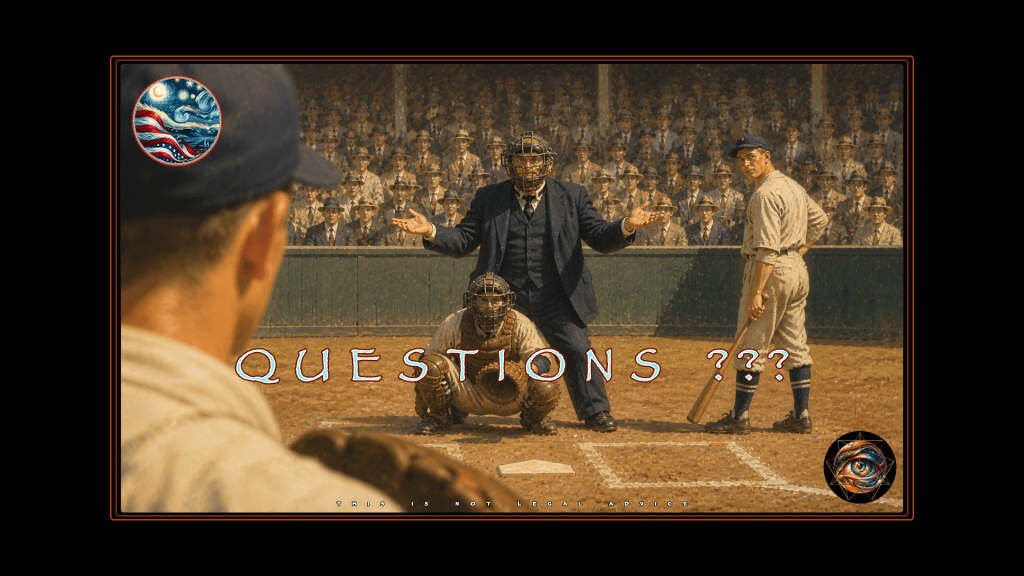
This Court has described its judicial philosophy as balls and strikes: call what you see, apply the rules as written, and let the game’s outcome follow from an accurate account of what happened on the field. That philosophy depends on one condition the proceeding of April 23, 2026 did not satisfy: an accurate account.
Plaintiff threw three pitches whose merits remain unaddressed by any court.
The first concerns the acquaintance and marriage mischaracterizations: Christopher Eldrett swore to Officer John Delehanty of the Natick Police Department that Plaintiff is his acquaintance and that Jamie Eldrett is in a significant dating relationship with Plaintiff rather than a marriage, statements that constitute the defamatory act of which Christopher Eldrett stands accused in this proceeding, and which Delehanty reproduced verbatim in the sworn affidavit that initiated the Massachusetts criminal prosecution against Plaintiff. Christopher Eldrett subsequently repeated those same false characterizations in his sworn declaration filed in this proceeding on January 30, 2026, which defense counsel certified without investigation. Christopher Eldrett is Jamie Eldrett’s brother. Plaintiff has been married to Jamie Eldrett since 2018. The marriage certificate, a government-issued public record discoverable through standard channels, establishes the marriage directly and establishes the brothers-in-law relationship through the combination of the marriage and the family connection, refuting both mischaracterizations simultaneously from a single document that any investigator who pulled it would have found before certifying a motion premised on their truth.
The second pitch concerns the racial identity mischaracterization: Officer Delehanty’s sworn affidavit, which derives its foundational characterizations from Christopher Eldrett’s report, states that Plaintiff is “NOT Hispanic”, a characterization applied to a man whose parents were born in Mexico, a fact also documented on the same marriage certificate, whose contents therefore refute three foundational mischaracterizations across two sworn instruments through a single public records search.
The third pitch is the decade-old firewall between households, instantiated by Plaintiff and verifiable by the Eldrett family themselves, which directly contradicts the good faith the declaration asks this Court to assume and establishes that the false police report was not a reasonable response to a perceived threat but an act of gross retaliation by a timid man who had been kept at a deliberate distance for fifteen years.
None of these three pitches was called, and the field’s condition explains why. Plaintiff held the marriage certificate in hand during the hearing, a government-issued public record whose contents refute three foundational mischaracterizations across two sworn instruments, unable to introduce it in a proceeding whose non-evidentiary character defense counsel had stipulated would make it invisible. The Special Motion for Limited Discovery under ORS 31.152(2)(a), filed in advance of the hearing precisely to address this evidentiary gap, was never ruled upon by this Court before the hearing proceeded, a prerequisite omission whose consequence was a hearing conducted without the judicial determination that would have either corrected the evidentiary vacuum or confirmed it as a deliberate choice. The field was corrupted before the first pitch was thrown: by the non-evidentiary stipulation defense counsel insisted upon, and by the unresolved discovery motion whose ruling would have determined what evidence the hearing could receive. The umpire who does not set the rules before the game begins cannot apply a consistent philosophy to the game that follows.
Defense counsel swung at three pitches with which she could not make contact.
She characterized a photograph without examining what it depicts. She described a fax without reading what it says. She attributed a statement to a witness without asking that witness what she said. Each swing missed on the face of the document it purported to describe, in a proceeding whose non-evidentiary character made real-time correction impossible. While the at-bat was going badly for Plaintiff, resulting directly from the tilted field, counsel further told the umpire that the pitcher was running an “intimidation campaign,” a characterization without evidentiary foundation in a proceeding stipulated to be non-evidentiary, whose transcript will confirm it verbatim. The record establishes the opposite: Plaintiff does not bring this action for money, but for freedom from a persecution that has consumed three years, two states, and four jurisdictions, and whose continuation, in Plaintiff’s potential absence, would fall upon his wife, who is also Christopher Eldrett’s sister, and who has already lost three years of income, a retirement account, and a professional market to the cascade her brother’s false report initiated. The intimidation campaign against her, well documented by the record, runs in the other direction. The inning did not go badly for defense counsel.
It went exactly as she designed it to go. The non-evidentiary proceeding she stipulated prevented the factual record from correcting her misrepresentations in real time. The open court characterizations she delivered were accepted at face value because no evidentiary record existed against which to check them. The ruling followed from an account of the evidence that the proceeding’s architecture made impossible to contest and that the documents themselves directly contradict. What the umpire called correctly, on the information available to him, the slo-mo replay now shows was played on a corrupted field. This motion is the replay.
The sanctions it requests are the correction the replay requires.
VIII. Counsel Is a Necessary Witness to Her Own Conduct and Must Be Disqualified as Advocate in This Proceeding
Oregon Rule of Professional Conduct 3.7 prohibits a lawyer from acting as an advocate at a trial in which the lawyer is likely to be a necessary witness, except where the testimony relates to an uncontested issue, the testimony relates to the nature and value of legal services rendered, or disqualification would work substantial hardship on the client. None of those exceptions applies here.
The ORCP 71 motion filed simultaneously herewith places in direct dispute the factual predicate of counsel’s open court representations on April 23, 2026, the preparation and submission of the proposed instruments on April 27, 2026, the certificate of readiness whose defect counsel acknowledged in her own correspondence, and the investigation she did not conduct despite actual notice of a contradicting witness. Each of those facts is a matter of disputed record that only counsel can testify to from direct personal knowledge. No other witness can establish what counsel knew when she filed the motion, what she knew when she made the open court representations, what she knew when she submitted the proposed instruments, and what she chose not to do when she received Jamie Eldrett’s LinkedIn connection request. Counsel is the necessary witness to each of those facts, and those facts are the subject of contested findings this Court must make in ruling on both the sanctions motion and the ORCP 71 motion.
The substantial hardship exception does not apply because Christopher Eldrett’s exposure in this proceeding is a direct consequence of his own false sworn statements and his counsel’s conduct in certifying and arguing them. A client whose attorney has become a necessary witness to disputed facts arising from that attorney’s own conduct in the proceeding cannot invoke the substantial hardship exception to prevent disqualification, because the hardship is a consequence of the conduct rather than an independent circumstance external to it.
Plaintiff requests that this Court disqualify Lauren M. Butz, OSB No. 214256, as counsel of record for Defendant in this proceeding, effective immediately upon entry of this Court’s order on this motion, and that Defendant be given a reasonable period not to exceed thirty days to retain substitute counsel before any further proceedings are conducted.
VII. Reservation of Supplemental Grounds Pending Transcript Certification
Plaintiff expressly reserves all grounds arising from counsel’s representations in open court at the April 23, 2026 hearing in this matter. Those representations include, without limitation, 1) counsel’s characterization of a photograph conceived, composed, and directed by Jamie Eldrett as depicting a sex act, 2) counsel’s characterization of a fax Jamie Eldrett sent to the Middlesex County District Attorney’s Office as stating that Plaintiff had died, when the fax states the opposite, 3) counsel’s attribution to Jamie Eldrett of a statement she has never made in any forum, in any document, at any time, and 4) counsel’s open court characterization of Plaintiff’s litigation conduct as an intimidation campaign against Defendant, delivered in argument at the April 23, 2026 hearing without evidentiary foundation in a proceeding stipulated to be non-evidentiary, whose transcript will confirm the characterization verbatim. Each of those characterizations is demonstrably false on the face of the documents they purport to describe, as established by the declarations attached hereto as Exhibits F, G, and H.
The certified hearing transcript, once received, will document verbatim what counsel stated in open court on each of those subjects. A supplemental submission incorporating those grounds, and the full fraud upon the court argument under ORCP 71 C and MBNA America Bank v. Garcia, 227 Or App 202, 205 P3d 53 (2009), which held that fraud upon the court can be committed by someone other than a party, including counsel, will be filed upon receipt of the certified transcript.
IX. Relief Requested
Plaintiff seeks no personal compensation. Plaintiff requests that this Court enter the following relief against Lauren M. Butz, OSB No. 214256, counsel of record for Defendant.
First, a finding under ORCP 17 that counsel’s submission of the proposed order and general judgment with a facially defective certificate of readiness, her submission of a proposed order whose language diverges from the oral ruling in a direction that systematically advantages the defense’s appellate posture, her submission of a proposed general judgment whose characterization of the statutory disposition is legally inaccurate under ORS 31.150, and her certification of a defense whose frivolous character was documented in the record before the first motion was filed, constitute filings made without adequate procedural foundation and for an improper purpose within the meaning of ORCP 17.
Second, a finding under the Court’s inherent authority that counsel’s failure to investigate the factual basis of claims she certified, despite actual notice of a contradicting witness who had initiated contact through a professional channel counsel was actively using, constitutes a violation of the duty of candor toward the tribunal under ORPC 3.3 and conduct warranting the exercise of the Court’s inherent sanctioning authority.
Third, a punitive contempt fine under ORS 33.045, payable to this Court rather than to Plaintiff, in an amount equal to the attorney fees counsel has accumulated in this proceeding. Plaintiff requests that counsel be ordered to disclose her accumulated billing in this matter to this Court by sworn declaration within fourteen days of entry of this Court’s order, as a predicate to the Court’s determination of the appropriate fine, so that the sanction is calibrated precisely to the benefit counsel sought to obtain through the conduct described herein.
Fourth, disqualification of Lauren M. Butz, OSB No. 214256, as counsel of record for Defendant in this proceeding pursuant to ORPC 3.7, effective immediately upon entry of this Court’s order, with Defendant afforded a reasonable period not to exceed thirty days to retain substitute counsel or appear pro se, as Plaintiff must.
Fifth, a referral of counsel’s conduct to the Oregon State Bar pursuant to ORS 9.527, for independent review of the conduct described herein and in the supplemental submission to follow.
Plaintiff reserves the right to supplement this motion upon receipt of the certified hearing transcript and to request additional relief proportionate to the conduct the transcript documents.
Dated: May 1st, 2026

Leave a Reply