
Parrhesia’s Price
LANGUAGE is the only tool that can be used against its wielder without him or her noticing when and how the blade was turned. Every other instrument of power leaves a mark. Legal force produces resistance. Economic pressure produces reorganization. Violence produces resentment. A word, bent gradually and with sufficient patience by the methodical hands of one who benefits from its Distortion, produces consent.
Then, the victim ratifies the instrument by signing the warrant—then, the citizen votes for the chain and calls it freedom.
This is not Cynicism in the debased modern sense. The ancient Cynics were the known-world’s most alert philosophers, neither passive nor plaintive. Their modern counterpart is not courage, but capitulation wearing a clever face, an anti-philosophy that declares corruption universal, resistance futile, and the proper response a raised eyebrow with a whiskey chaser. That foul-smelling dog is cynicism’s corpse, performing its undead antics for an audience that has never seen the triumphant living beast.
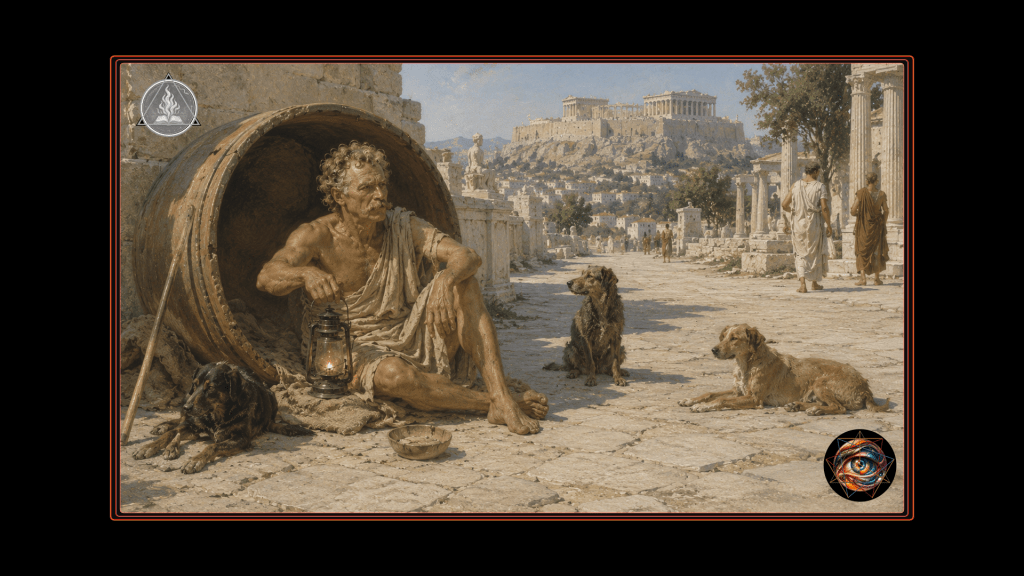
The former slave, Diogenes of Sinope (c. 403 BCE – died c. 320 BCE, probably at Corinth), did not withdraw to a cellar to contemplate the hopelessness of the polis. Instead, he moved into its beating heart, uninvited and unashamed, where he lived in a wine barrel and refused every social convention that substituted signaled virtue for the genuine article. His ideal was not detachment, but deliberate friction, maintained against every institution that confused its own convenience with the good.
Though the heavens might fall, Ambrose Bierce (June 24, 1842, Horse Cave Creek, Ohio – died c. January 1914?, Mexico?) understood and encoded a similar indictment. His Devil’s Dictionary was never a cabinet of clever inversions assembled merely for the amusement of the already-disillusioned. It was a sustained act of frank speech directed at the specific words by which his era’s institutions maintained their grip on what could be thought, said, and therefore done.
Both men—Diogenes and Ambrose Bierce—practiced parrhesia, a volatile speech-act that costs the SPEAKER but changes the potential for everyone present.
Comprehension is merely the private improvement of a single map locked within a lone mind. The uncomfortable skill that my dictionary proposes is to introduce a restored word into live conversation under pressure and alter, by that introduction, the available moves for everyone present. Precision, once audible, does not argue, but forecloses. Any who were sheltering inside a word’s ambiguity must now either engage on new terms or expose, by their resistance, exactly what their ambiguity protects.
The advantage on offer here is therefore more than rhetorical. It is procedural. A restored word enters the room like a witness who cannot be cross-examined into disappearance.
Assumption
LANGUAGE does not degrade. People do. The medium remains available at full precision to any SPEAKER willing to use it correctly, yet the population willing to do so is, in any room, at any moment, smaller than the sum of people present. This is not an unfortunate feature of the human condition that must be accommodated with patient understanding. It is negligence, ordinary and widespread. The entries in my dictionary proceed from that assessment without apology and without the pretense that a softer diagnosis would be more accurate.
Assumption is where negligence begins.
A word enters use carrying apparent stability, and the SPEAKER accepts it without inspection because inspection requires effort. The cost of imprecision will not land on the SPEAKER, at least not immediately, not visibly, and almost never in a way that can be traced back to the moment inspection was declined. This is an inheritance accepted without reading the will. The encumbrances recorded against the property are not accidental omissions from the document. Prior SPEAKERS shaped the word’s apparent meaning to serve their own purposes and left the Distortion in place for successors to inherit. The fast talker who assumes a word’s stability without examination is therefore not a victim of this virus, but its willing host.
What Assumption produces is not communication worthy of the name. It is the performance of communication, sustained by the tacit agreement of SPEAKERS who have decided, each for private reasons, that the cost of precision exceeds the cost of imprecision, at least for now. The performance holds until it fails. The exchange then discovers, too late for comfortable revision, that the word everyone thought they were sharing has been doing different work for different parties since before the conversation began.
From that moment forward the negligence is no longer private, but becomes everyone’s problem, most of all the problem of whoever has the least power to absorb it.
Confusion
Confusion carries its etymology honestly, and nobody reads it. It literally means fusing together what was previously separate. This is what happens when distinct things are forced into contact with enough TIME and pressure to merge. The new mass presents as the original. Nobody in the room can say precisely when the boundary dissolved because the process was too gradual, and the result indistinguishable from what it replaced.
Confusion is more insidious than the brain-fog that rolls in when SPEAKERS stop making effort.
John Carpenter filmed this predicament in his 1982 horror adaptation of “The Thing”. His creature does not invade. It assimilates whatever it touches, and the resulting organism looks correct enough from the outside while something is dangerously wrong within. Confusion inevitably follows when Assumption runs long enough without inspection.
Prior SPEAKERS deposit referents into words through use, need, convenience, institutional pressure, and private advantage. These deposits graft themselves onto the original meaning until the composite presents as natural and obvious. The SPEAKER most likely will not notice or acknowledge the graft. The listener may or may not share the composite. Contemporary speech then proceeds more through fusion than by precise referents, and the result is called communication.
The exchange holds only until the stakes rise high enough to force the issue into the light.
Similarly, the builders at Babel did not lose their sanity. They lost the agreement beneath their words. The sounds continued to circulate, yet produced incongruous images in divergent minds, until cooperation became impossible.
Escalation is an attempt to force The Thing apart through pressure. It tears rather than separates, leaving both parties with pieces that no longer function. Temptation makes visceral sense because pressure feels like action, and action flatters the frightened SPEAKER more than inspection does. Retreat is the opposite failure. It accepts contaminated LANGUAGE as the new normal and calls the accommodation peace.
Confusion does not resolve on its own stage. It presents a problem, not a solution—always a question, never an answer. Live conversation must decide without instruction and in real time what to do with the presentation.
As ever, Confusion itself is as reliably eager to answer every question as it is definitively powerless to solve any problem.

Revelation
A dog does not ask permission, but follows its nose directly to the truth, which is not the civilized face LANGUAGE presents but the tail it has dragged through every context crossed. Dogs read with an unhurried attention that never sacrifices accuracy for social comfort. This is also the method of the Devil’s Dictionary, because history shows that the method works.
People whose words are scrutinized reliably find the inspection unseemly, and the Cynic’s answer to that objection is the same as any dog’s.
What the inspection finds is not meaning, in the cognitive sense, but pheromone. On every word of substance an involuntary record of interest cannot help but leave its trace. A pheromone is not composed, addressed, or sent with conscious intent, but secreted. It is the automatic deposit of a body’s condition into its environment. The animal literate in scent is not interpreting a message, but reading a fact.
A word’s prior SPEAKERS did not intend to leave any record, per se. Handling always leaves a trace, and traces do not share the handler’s interest in remaining unread. The would-be respectable SPEAKER wants the visible word only—its accepted definition or common usage, its social permissions and its polished face in public circulation. The Cynic wants the underbelly, the scent trail of appetite, fear, convenience, territorial claim, and advantage.
Revelation begins when Confusion forces the Thing into view.
A word has continued to circulate, but its original nature has become incompatible under new pressures. When ordinary use can no longer conceal the graft, the SPEAKER returns to the word through etymology, not to recover purity, but to identify the sequence of contact that made the present Distortion feel natural. The word has not changed at that moment; the SPEAKER has.
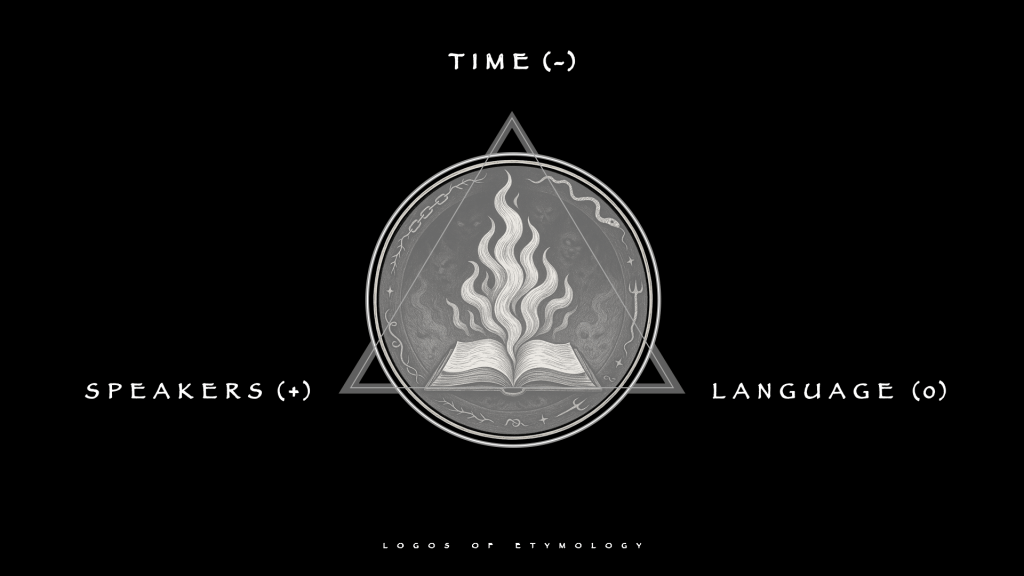
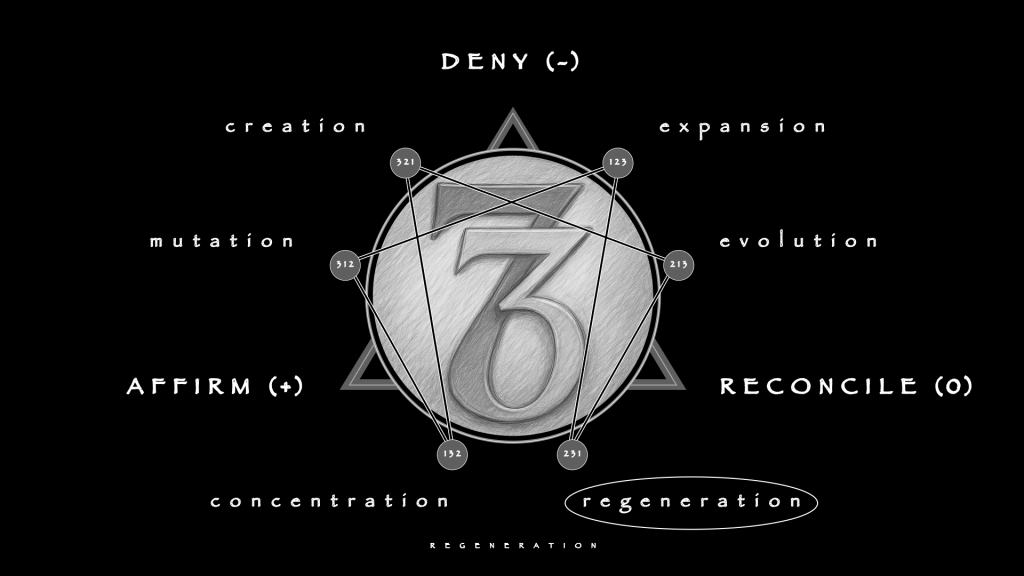
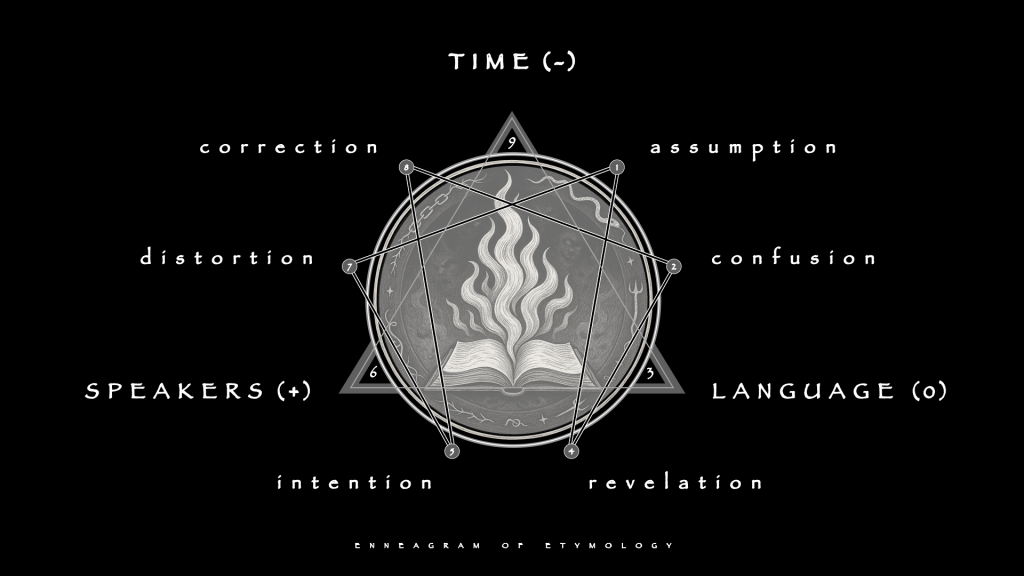
The Logos of Etymology qualitatively maps the three forces of Regeneration:
- TIME (-)
- LANGUAGE (0)
- SPEAKERS (+)
TIME is the denying force (-), the weight of cultural inertia. SPEAKERS inevitably deposit subjective residue. Every variable context obscures original Intention, while the centuries wanton misuse averages out the expectations of those who find precision inconvenient in the moment. LANGUAGE is therefore the reconciling force (0), the medium that permits transmission without guaranteeing fidelity. Over TIME, the medium becomes its own result. Finally, SPEAKERS are the affirming force (+), the sole member of the system with live agency. They aim LANGUAGE toward private ends and accept, evade, or conceal responsibility for that aim.
The record of etymological drift always reveals a pattern of Confusion by Intention:
- What the SPEAKER needed the word to mean (-)
- What the SPEAKER feared the word might mean if left precise (0)
- What claim the SPEAKER encoded inside the word’s ordinary usage (+)
This is not conspiracy. Interests shape LANGUAGE without announcing themselves. The record is involuntary, which is precisely why it’s useful. A composed message can lie. A pheromonal trace cannot, not because it is honest, but because it is not trying to be other than it is. Revelation does not restore the word, but instead reads the word’s history accurately enough for repair to become possible.
There is no original beneath the damage, no clean ancestor waiting under the rubble with its hands folded, only the record of contact.
Intention
In-tendere means to stretch toward, to aim. The SPEAKER who declares an Intention has not merely stated a purpose, but has selected a target and accepted that any deviation reflects on him. Many otherwise civilized SPEAKERS, having read the record and understanding what it holds, find reasons to blur the aim, widen the target, or reduce the force. A word aimed at nothing cannot miss, but one aimed precisely can, and becomes legible in ways imprecision would have prevented.
In practice, Involuntary Agreeability introduces and enforces enough ambiguity to preserve the option of having meant something else if a word lands badly.
The cost of parrhesia would be unbearable if frank speech required total Correction, which it mercifully does not. A SPEAKER need not defeat every Distortion at once, need not purify LANGUAGE as a whole nor redeem all in the room from their laziness. A method too large to carry into conflict is only an ornament for private comprehension.
He has only to deliberately traverse a simple set of steps on a single contaminated word, precisely at the point where that word introduces noticeable harm.
Parrhesia requires a sequence compact enough to survive interruption, ridicule, social pressure, and the sudden arrival of consequences. The method is purely Cynic, in the classical sense. It never trusts the declared meaning of any word. Instead, it noses out the record of contact. A SPEAKER need not carry the whole library into the room. He needs the lamp and a scent trail, his aim and the nerve to let the restored word strike where he points it.
The saving grace of the path is its economy, which makes frank speech affordable:
- Assumption
- Confusion
- Revelation
- Intention
- Distortion
- Correction
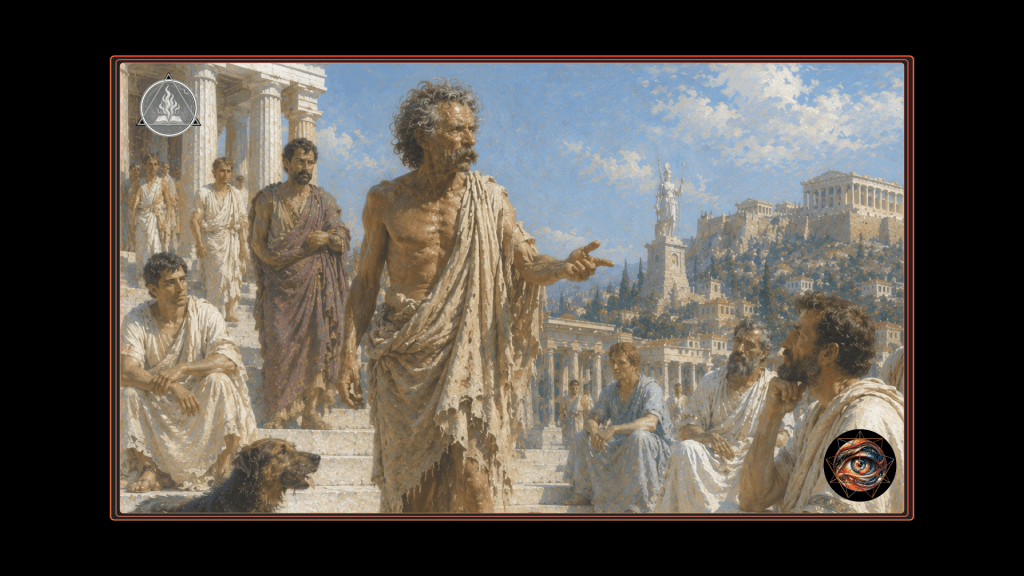
The Cynic does not soften the aim, not because he is brave, but because he finds the softening more trouble than it is worth. Diogenes looked up at Alexander and said, in effect, “Move, man, you’re blocking my sun.” The precision of his aim was the essence of the act. No ambiguity had been preserved for retreat. That is Intention operating at full function.
Alexander could have had Diogenes killed for his impertinence, yet instead he envied him.
This matters because a word aimed with sufficient precision can produce a response that ordinary calculations of power fail to predict. Power expects petition, evasion, or flattery. Intention introduces an unknown, and gives to authority nothing soft to absorb and nothing vague to reinterpret. The dialogue into which a contested word re-enters is never neutral.
The interests that shaped the word’s pheromonal record are still present, and they will meet the restored word with the same resources they brought to the original Distortion:
- Patience, which waits for precision to tire (-)
- Repetition, which makes Distortion feel familiar (0)
- Institutional capacity, which makes imprecision feel like common sense (+)
Intention need not defeat those resources, nor even attack them head-on. It calculates the angle of entry, the only variable the SPEAKER controls before release. A word entering conversation with the right slant gives Correction a runway.
Intention ends the moment the word leaves the SPEAKER’S mouth …
Distortion
Ambrose Bierce spoke to society with his aim declared and his targets named. Society answered with the most efficient defense available. It did not refute him or suppress him. It reclassified him.
Distortion is society’s counter-Intention. When a SPEAKER aims a restored word where needed, society aims back, often without seeming to aim. The listeners themselves agree to bend the word away from the target, then wait for the bend to harden into ordinary use.
Thus, Assumption is recycled Distortion, the observable law by which both strength and weakness propagate.
The Devil’s Dictionary was designed to repair corrupted institutional LANGUAGE, but the room received it as entertainment. Its entries were filed under sardonic wit, admired for their surface texture, and anthologized as the output of a characteristically bitter man. That classification did what open opposition could not have done. It neutralized the act by flattering the performance. A definition received as a joke cannot function as a hinge in a live exchange. It can only be admired and set aside, which is what society does with every precisely aimed word it cannot afford to hear on its own terms.
Recategorization moves the offending word into a safer drawer.
The adjective “Bierceian” is not a tribute, but a sarcophagus. Once the method is named, the reader can admire the flavor without digesting the meat. The work survives, but in quarantine. His dictionary remains available, quoted, loved, and misused, while the average SPEAKER inherits the safe Assumption that its purpose was literary temperament rather than public repair.
Natural Drift and Engineered Distortion operate simultaneously. Natural drift is ambient erosion: the restored word passing through contexts the SPEAKER did not anticipate, its edges blurring without plan or intent. Engineered Distortion is society’s deliberate reply: the interests that shape the pheromonal record recognize the restored word and move against it with the same patience and repetition that produced the original corruption.
Schools teach this to children in the classroom game of “Telephone”.
Ambrose Bierce understood this before he walked into Mexico in 1913. The biographical mystery does not diminish him, it merely denies society the convenience of a settled ending. He, meanwhile, lost nothing in the bargain that was truly his. The loss belongs to those who inherit his dictionary as temperament instead of method.

Correction
Confusion joined things that should have remained distinct, and the entire cycle from Revelation through Intention has been preparation for the one move that Confusion requires: public separation. The cost is higher than mere installation of a correct meaning in the abstract, heavier than the private satisfaction of having read the pheromonal record accurately. To pull fused referents apart in the presence of the people who have been operating inside the fusion threatens the status quo.
Correction must be performed at the point of use, where Confusion is doing its work, before the people for whom its continued operation is most convenient.
Among other things, it costs a man his shelter. He who publicly performs the separation has accepted that people will respond visibly as people who have been discovered rather than as people corrected on a neutral matter of fact. The latter says thank you, or argues the point. Those whose operational shelter has been removed do neither. They contest the method, impugn the motive, invoke authority, and apply the same impatient repetition that produced the original Distortion to the task of restoring it. A fusion that nobody was using would not be so viciously defended.
The Cynic, expecting all this and more, is not deterred, on the grounds that such responses are themselves a form of confirmation.
Confusion invoked a creature assimilating whatever it touched, and presenting its deceptive mass as the original until pressure forced the irreconcilable natures into view. Correction is the blood test administered in the room, with no private exit available, in front of everyone who has been treating the creature as the host. The test does not destroy the creature, but makes it visible, fundamentally changing what the room can do next. No outcome requires anyone’s gratitude and none depends on anyone’s conversion.
Comprehension would have ended at Revelation, satisfied with having read the pheromonal record accurately and improved one mind’s map of the word. Correction goes beyond, and carries the restored word into a live exchange. The room does not become more honest, but one in which dishonesty is a deliberate act rather than an innocent one, and a different liability than accidental imprecision.
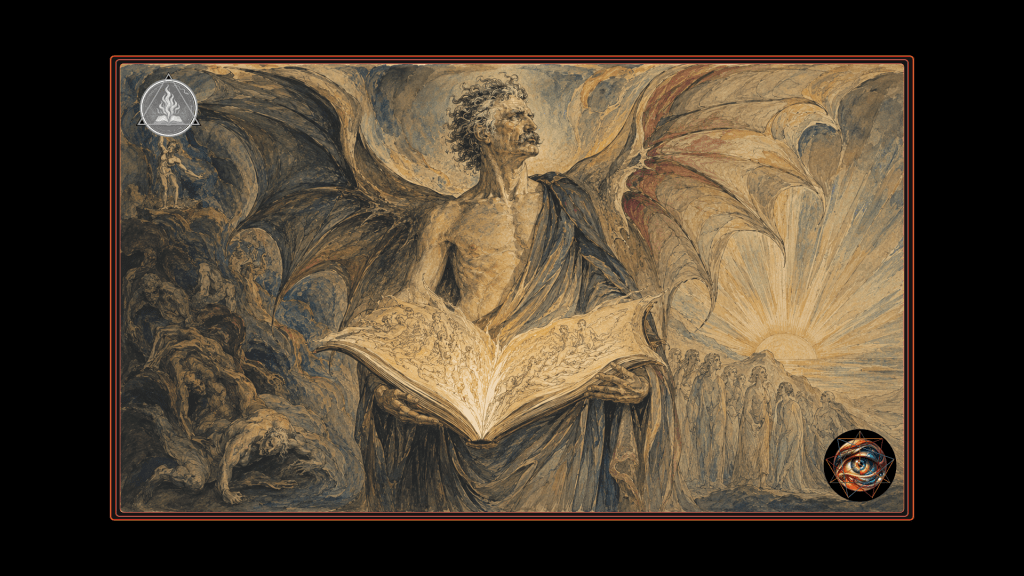
This Illuminated Manuscript . . .
The devil of this dictionary deserves its etymology. He is not the adversarial creature whose function is transgression and whose pleasure is corruption. That lesser imp is a Distortion, useful to every institution that benefits when illumination can be mistaken for malice. The devil this dictionary answers to is the light-bearer, expelled from the prevailing order not because he loves evil, but because he makes concealment unbearable. Light is a grave offense in any space organized to benefit darkness.
Its denizens can endure almost anything except exposure.
Diogenes carried his lamp in broad daylight. The gesture was not an absurdist performance, but the most exact accusation available to him. Ordinary daylight had failed to illuminate anything that mattered, and the honest man, if such a creature existed, would not be found by staring harder in an approved direction. The lamp is not a tool for seeing more, but for proving what others agree not to see.
Ambrose Bierce carried the same lamp into the lexicon of his era. He held it against the words by which institutions preserved their grip on thought, conduct, reputation, and obedience. The room responded as rooms always respond. It reclassified the lamp as style, filed the light-bearer under bitter wit, and restored the darkness by making illumination sound like private taste instead of public necessity.
The entries to follow in this series exemplify this lamp applied to incendiary words.
A word that cannot be named cannot be contested. One that has been named precisely, in public, with its transaction exposed and its Intention made visible, can only be defended by those willing to be seen defending it. The lamp does not guarantee that anyone will look, only that looking is possible. Willful darkness may persist thereafter, but not with any innocence or ambience.

Leave a Reply