
Most legal outcomes are decided before a court examines the evidence, before a jury hears the facts, and before anyone argues what actually happened. The machinery that produces outcomes runs on doctrines too abstract for most people, administered by institutions with strong incentives to keep them obscure, whose product is a gap between the right the Constitution names and the remedy the legal system provides. ‘Before the Merits’ strips down the American legal machine to its component parts one case at a time, for general readers to discover how a precedent-based system is run and maintained.
Before the Merits—City of Grants Pass, Oregon v. Johnson, 603 U.S. 520 (2024)
A city can declare it illegal to close your eyes in public, and the Constitution will not stop it. The law has always drawn a line between what a person is and what a person does, and the side of that line on which a court places you decides whether the government may punish you for existing. In 2024, the Supreme Court surgically drew that line in Grants Pass, Oregon, and now every jurisdiction in the country runs at least one ordinance shaped by the cut. This outcome was not invented for the homeless, but borrowed from a 1968 drug case, which indicates more than this one decision in isolation does. What a court calls “conduct” versus “status” is not a legal discovery but a judicial choice, whose consequences may accumulate and outlast any single ruling. Read on to see why the most important sentence in the opinion may not be in the holding but in the dissent.
Case Header:
- Case Name: City of Grants Pass, Oregon v. Johnson
- Citation: 603 U.S. 520 (2024); 144 S. Ct. 2202
- Court / Jurisdiction: Supreme Court of the United States
- Date Decided: June 28, 2024
- Docket No.: 23-175
Legal Domain(s):
- Primary Issue(s): Constitutional Law / Eighth Amendment / Cruel and Unusual Punishments Clause / Public Camping Ordinances / Homelessness
- Practice Area: Constitutional Law; Municipal Law; Criminal Procedure
- Procedural Posture: Certiorari to the United States Court of Appeals for the Ninth Circuit; reversed and remanded from 72 F.4th 868 (9th Cir. 2023)
Holding (One Sentence Rule):
The enforcement of generally applicable laws regulating camping on public property does not constitute “cruel and unusual punishment” prohibited by the Eighth Amendment, even as applied to homeless individuals who lack access to alternative shelter.
Precedent
The conduct-status distinction did not emerge from constitutional text, but was constructed, piece by piece, to contain a protection the legal system was not prepared to extend.
American municipalities did not inherit the habit of criminalizing visible poverty from neutral legal reasoning. English poor laws carried it to the colonies, which established the practice of treating poverty as a civic management problem rather than a human condition. By the mid-twentieth century, cities from Los Angeles to New York maintained vagrancy codes of breathtaking directness: being unemployed, being found in public without means of support, being a “common drunkard.” These ordinances did not pretend to target conduct. They targeted people not for what they did but for what they were, and the judicial system tolerated the cultural bias for generations.
The first constraint arrived in 1962, narrow and late, when California made it a crime to “be addicted to the use of narcotics.” The Supreme Court struck the statute down on the ground that punishing a person for a condition rather than a choice offended the Constitution’s prohibition on cruel and unusual punishment. The holding was short—the opinion careful not to overreach—but its implications cascaded outward.
If addiction was a status that could not be criminalized, what else might qualify?
What the opinion did not say, and what the dissent noted, is that the conviction may have been supportable on narrower grounds entirely. Robinson’s needle marks evidenced past narcotics use in California, and a court unwilling to reach the constitutional question need not have reached it. The doctrine that would govern homelessness enforcement six decades later was built on a foundation the Court chose to lay, not one it was compelled to pour.
The answer arrived six years later, through a door held barely ajar. Leroy Powell, a chronic alcoholic, challenged his public intoxication conviction in Texas, and the case that bore his name, Powell v. Texas, arrived at the Supreme Court six years after Robinson. Four justices would have extended Robinson‘s protection to compelled public conduct; four would not. A ninth, Justice White, upheld the conviction on the narrowest available ground: the record did not establish that Powell had no home or alternative to being in public while drunk, and without that predicate, no constitutional defense was available. Under Marks v. United States, White’s concurrence controls, meaning the broader plurality reasoning never became binding law, and the gap White left open, a homeless person with no alternative to public presence, remained available for future advocates to exploit.
Advocates spent fifty years working that gap.
The Ninth Circuit, covering nine western states where unsheltered homelessness became dramatically visible during the 2010s, moved through it in 2019. The Martin v. City of Boise panel held that the Eighth Amendment prohibits enforcement of camping bans against a person who has no access to adequate shelter and no other place to be. Lower courts translated that holding into a operational test: count the shelter beds, count the homeless population, and suspend enforcement when the beds run out. The logic was intuitive, the administration was not, and the distance between what Martin said and what courts were being asked to do with it became the pressure point the majority in Grants Pass would later exploit.
The framework was also the next problem waiting to be named. It required courts to define “involuntarily homeless,” to assess what counted as “practically available” shelter, and to manage what was essentially a social-services compliance inquiry dressed in constitutional language. Judges found themselves presiding over hearings on whether a faith-based shelter requiring attendance at religious services counted as accessible to a secular applicant. The protection that the 1962 decision had made possible, the 1968 plurality had narrowed, and fifty years of advocacy had partially recovered, had now produced a machine so technically demanding that the courts administering it were already looking for a reason to hand it back.
Grants Pass supplied that reason.
What the majority framed as a correction of an unworkable framework was also the latest settlement in a cycle that had been running since before the republic’s founding: generate protection only under pressure, contain it as quickly as institutional logic permits, and characterize the containment as neutral legal reasoning rather than a political choice. The distinction between conduct and status had never been discovered in the Constitution’s text. Robinson (1962), Powell (1968), and Grants Pass (2024) now form the trilogy that governs the question: the first forbids pure status crimes, the second holds the line at symptomatic conduct, and the third confirms that sleeping ordinances applied to homeless individuals regulate conduct and do not cross into Robinson territory. It had been built, rebuilt, and selectively applied across six decades, and Grants Pass is best understood not as a new development but as the current installment of a very old pattern.
Doctrine
Courts do not correct mistakes—they reframe conditions. City of Grants Pass, Oregon v. Johnson, 603 U.S. 520 (2024), is best understood as disowning the homelessness problem. The majority opinion, written by Justice Neil Gorsuch and joined by five colleagues, begins with a question that sounds procedural but is in fact deeply substantive.
What is the actual purpose of the Eighth Amendment?
The answer the majority provides is historical and narrow. The Cruel and Unusual Punishments Clause was designed to govern the method of punishment that a government may impose after a lawful conviction, not to govern what a government may choose to criminalize in the first place. The clause targets the rack and the thumbscrew, not the statute book.
This framing permits the majority to sidestep the case that advocates most urgently wanted to invoke. The 1962 addiction decision stands, the majority says, as a prohibition on pure status crimes: laws that punish a person for being an addict, or being homeless, without reference to any act. The Grants Pass ordinances, the majority insists, do not do that. They prohibit camping with bedding on public property, targeting an act rather than a person. A backpacker who sets up a tent in a city park violates the ordinance just as surely as a homeless person who spreads a sleeping bag on a sidewalk. The law is facially neutral and is, in this framing, constitutional.
The dissent, written by Justice Sonia Sotomayor and joined by Justices Elena Kagan and Ketanji Brown Jackson, identifies this framing as a conjurer’s trick: the hand the majority shows you holds a conduct-status distinction, and the hand it does not show you holds the fact that the conduct being prohibited is the only means by which certain people can continue to exist in the jurisdiction.
If a person has no shelter available and the city makes it illegal to sleep anywhere in public, then the city has not prohibited an act, but prohibited the person’s continued presence. The majority countenances the criminalization of status, Sotomayor argues, as long as the city is willing to attach the prohibition to an essential biological function: blinking, breathing, eating, sleeping. The act is inseparable from the being, and the majority’s conduct-status distinction, she writes, “is just another way to ban the person.”
The majority declines to engage this argument at its center. It acknowledges that homelessness is a condition, not a choice, but holds that the Constitution does not therefore excuse every act a homeless person performs out of necessity. The involuntary-conduct theory, advanced in the fractured 1968 decision, was never adopted by a majority of the Court. The majority’s reluctance is not new reasoning; it is Marshall’s 1968 plurality concern, updated and generalized. If courts must adjudicate whether a person’s public conduct was compelled by circumstance before a conviction can stand, every criminal prosecution touching on addiction, mental illness, poverty, or compulsion becomes a threshold inquiry into the boundaries of free will, and no institution operating at the scale of the American criminal system is equipped to conduct that inquiry case by case. Grants Pass formally confirms that the Eighth Amendment will not be made to require it.
States retain the authority to criminalize conduct even when that conduct is compelled by circumstance.
The practical consequence is the abrogation of Martin v. City of Boise, the 2019 Ninth Circuit ruling, without the Court having to say so in quite those terms. Cities no longer need to demonstrate shelter availability before enforcing camping ordinances, and the shelter-bed-counting machinery is dismantled. What replaces it is the democratic process, in which legislatures and city councils, not federal judges, will decide how to balance public-space management against the needs of people with nowhere to go.
Justice Clarence Thomas, concurring separately, went further than the majority. He argued that the 1962 addiction decision should itself be reconsidered, and that the named plaintiffs, who had received only civil fines, lacked standing to bring a constitutional challenge at all. Neither position commanded a majority, but both signal that the legal architecture protecting against status-based criminalization is more fragile than even the majority’s outcome suggests.
Revival
Constitutional doctrine is not a river, but a delta whose channels may appear closed by one decision, yet often continue to flow through others.
The Grants Pass majority did not address every constitutional objection the plaintiffs raised, because it did not have to. The Eighth Amendment’s Cruel and Unusual Punishments Clause was the theory the Ninth Circuit embraced, and the Supreme Court reversed on that theory alone. The Eighth Amendment contains a second clause, however, the Excessive Fines Clause, and the district court had found that the fines imposed by Grants Pass, escalating to nearly three hundred dollars against a person with no income, might violate that separate protection.
The question was remanded, not resolved, and it remains alive.
The Excessive Fines Clause has experienced a quiet renaissance in recent years. In Timbs v. Indiana, 586 U.S. 146 (2019), the Supreme Court held unanimously that the clause applies to state and local governments, not just the federal government, and the operative standard asks whether a fine is grossly disproportional to the gravity of the defendant’s offense. Applying that standard to a fine imposed on a person who slept outside because no shelter existed is not a straightforward exercise, and the standard is historically difficult to satisfy.
Few courts have found fines grossly disproportionate since the decision that established the test. The protection Robinson established is categorical rather than proportional. The question is not whether the punishment fits the offense but whether any punishment is available at all when the act being criminalized is inseparable from the condition. The lower courts must now answer whether the constitutional protection that survived the majority opinion can do what the Punishment Clause could not, and whether the proportionality inquiry has enough flexibility to reach circumstances the drafters of the standard never anticipated.
Due Process arguments also remain available.
Justice Douglas, concurring in Robinson, would have grounded the status-crime protection in due process and equal protection rather than the Eighth Amendment alone, reasoning that laws criminalizing involuntary conditions discriminate against the poor and sick; that argument was never adopted by a majority, but it was never foreclosed either, and Grants Pass did not close it. Courts in other circuits have allowed challenges to enforcement schemes that produce absurd results: fining a person hundreds of dollars for having no money, issuing exclusion orders to people who have no alternative location, and adding criminal charges for each successive violation of an order the recipient had no lawful means to obey. The procedural arbitrariness of escalating penalties applied to people with no ability to comply presents a different constitutional problem than the Eighth Amendment one, and Grants Pass did not foreclose it.
State law adds a third channel.
Oregon, the jurisdiction in which the case arose, had already enacted a statute requiring that local camping regulations be objectively reasonable as to time, place, and manner. That requirement survived the Supreme Court’s ruling because the Court was interpreting the federal Constitution, not Oregon law. Cities in Oregon enforcing camping bans must still satisfy a standard that cities in other states need not, and federalism, which the majority invoked to justify returning homelessness policy to local governments, simultaneously permits states to impose protections that the federal floor no longer requires.
A fourth channel is narrower still and runs directly through Powell v. Texas itself.
White’s controlling concurrence held only that the record before the Court did not establish that Powell had no home or alternative to public presence while drunk; it did not foreclose an Eighth Amendment claim by a plaintiff who could establish exactly that predicate. A future plaintiff who can demonstrate, through medical testimony and documented circumstance, complete loss of volitional control over conduct that is inseparable from a condition, and the total absence of any alternative to public presence, has not been told by any majority of the Supreme Court that the Constitution offers no protection. That plaintiff has not yet appeared with a record strong enough to test the question, but the channel White left open in 1968 was not closed by Grants Pass in 2024.
The 2025 settlement between Disability Rights Oregon and the city of Grants Pass itself illustrates this dynamic. Homeless individuals with disabilities, whose camping may be compelled not merely by poverty but by a protected medical condition, retained a negotiated protection that the Constitution no longer supplied. The case ended one legal conversation and opened several others, and the channels that remain open are less visible, more technical, and potentially more durable than the one that was closed.
Exposure
The decision exposes a cultural assumption that the legal system rarely states directly: not only does the Constitution protect categories, but the category you occupy at the moment of enforcement determines whether its protections reach you.
The conduct-status distinction on which the majority relies is not a neutral observation drawn from the text of the Eighth Amendment. It is a jurisprudential technology, developed across decades, that sorts human beings into those whose circumstances the law will credit and those it will not. The 1968 plurality opinion that refused to extend protection to an alcoholic’s compelled public drunkenness did so because five justices, in different combinations and for different reasons, could not agree on a principled limit to the involuntary-conduct theory.
The fear was not that the alcoholic was undeserving of protection, but that protecting him would require the legal system to adjudicate the boundaries of free will.
That fear, not constitutional text, is what Grants Pass inherits and amplifies. The majority’s decision to return homelessness policy to the democratic process is not simply a federalism holding. The decision is indecision, a conclusion—a capitulation—that the scale of the problem exceeds the capacity of constitutional adjudication to manage it. Gorsuch’s opinion says this almost directly: “Homelessness is complex. Its causes are many. So may be the public policy responses required to address it.” The sentence that follows is the one that matters: “At bottom, the question this case presents is whether the Eighth Amendment grants federal judges primary responsibility for assessing those causes and devising those responses. It does not.”
This framing obscures that the federal courts were not asked to devise responses to homelessness, but to determine whether a specific method of enforcement, criminal punishment, was constitutionally available against a specific class of people who could not comply with the law being enforced. That is precisely the kind of question that constitutional adjudication exists to answer. The majority’s federalism argument converts an enforcement-method question into a policy-design question, and then correctly observes that courts are poor policy designers. The sleight is in the conversion, not the observation.
The dissent names the cost directly.
Sotomayor catalogs what enforcement of these ordinances actually produces: fines imposed on people with no income, exclusion orders issued to people with no alternative location, criminal charges filed against people whose only offense was biological survival. She invokes a line from Robinson v. California (1962), the case that established the status-crime prohibition, and applies its logic to sleeping without a roof. “Even one day in prison would be a cruel and unusual punishment for the ‘crime’ of having a common cold.” The force of that line is categorical, not proportional; Stewart was not arguing that the punishment was too severe for the offense, but that no punishment of any duration is available when there is no act to punish. The majority does not answer this comparison. It acknowledges the hardship and redirects to the legislature.
The reason the majority declines to engage is visible in the case’s own history. The plurality’s 1968 rationale for refusing to extend Robinson rested partly on the absence of medical consensus that alcoholism destroys volitional capacity; that consensus now exists, neuroscience having spent six decades confirming what the Powell dissenters argued from clinical observation alone, and the current Court’s refusal to revisit the question on that basis is not a neutral application of precedent but a decision that the answer, whatever it is, will not come from this institution. Scholars and at least two sitting justices have characterized Robinson itself as an anomaly, a decision that grafted a substantive limit onto a clause the framers designed to regulate methods of punishment rather than the legislature’s power to define crimes. The Court has never squarely addressed that critique; for sixty years it has chosen to distinguish Robinson rather than confront it, and _Grants Pass_continues that tradition. The majority’s evasion of Sotomayor’s categorical argument is not an oversight, but the latest installment of an institutional habit of deferring the hardest question the status-crime doctrine poses.
The exposure the decision produces is not merely doctrinal. It reveals the conditions under which a constitutional protection ceases to function: when the persons who need it most are least capable of organizing politically to demand it, when the conduct being criminalized is indistinguishable from their continued physical existence, and when the institution asked to protect them decides that the complexity of their condition exceeds the institution’s legitimate role.
The decision does not say the homeless deserve what they receive, only that the Constitution cannot be made to prevent it.
Deviation
Roughly 150 cities across 32 states passed, or strengthened, anti-camping ordinances within months of the ruling. California’s governor issued executive orders clearing encampments statewide before the summer ends. Phoenix, Sacramento, and San Francisco resumed enforcement that had been legally paralyzed for years. The machinery started without delay.
Cities that lacked political will to act before now have cover. The ruling does not require criminalization; it permits it. Permission, in municipal politics, does not mandate, per se, but shifts the cost of inaction onto elected officials who must now explain why they chose not to use a tool the Supreme Court handed them. Advocates who had used Martin as a shield discover that the shield is gone, and that the next argument—Excessive Fines, Due Process, state law—requires a longer, slower, more expensive legal campaign to mount.
Encampment residents lose the leverage that shelter-bed counting provided.
Under Martin v. City of Boise, as lower courts applied it, a city that could not demonstrate available shelter beds could not enforce a camping ban. A bed count was something advocates could litigate, document, and contest. The legal tool Martin provided was not invented; it was excavated from the controlling concurrence in Powell v. Texas, which had left exactly that gap open since 1968, when Justice White declined to punish a chronic alcoholic whose record did not establish that he had no home or alternative to public presence. What Grants Pass closes, in other words, is not a doctrinal innovation but a fifty-six-year-old opening. What replaces it is a political process in which people experiencing homelessness are among the least powerful participants, and the democratic process the majority invokes to address homelessness policy is the same process that produced the camping bans in the first place.
Law enforcement agencies adapt quickly. Officers who had received informal guidance that enforcement was legally risky resume citation practices. Prosecutors who had declined to charge camping violations revisit those policies. The escalating penalty schedule—civil fine, exclusion order, criminal trespass charge—begins to move people through the criminal system again.
Criminal records make it harder to obtain housing—difficulty obtaining housing produces more homelessness—the cycle accelerates.
When enforcement resumes, the escalating penalty structure, civil fine, exclusion order, criminal trespass charge, begins moving people through the criminal system again, and the cycle it generates is self-reinforcing: criminal records obstruct housing applications, housing obstruction produces more homelessness, and more homelessness produces more enforcement. Service organizations absorb the secondary damage. Homeless individuals who had clustered in specific locations where outreach workers could find them scatter when citations resume, and dispersal, the intended effect of the ordinances, is simultaneously an operational catastrophe for organizations trying to deliver medical care, mental health services, and housing navigation. The population becomes less visible and less reachable at precisely the moment political pressure intensifies to demonstrate that encampments are being addressed.
The question of what ‘available’ shelter means does not disappear when the Court rules it too complex for federal adjudication. It migrates … into administrative regulations, state statutes, local ordinances, and service contracts, where it is decided by people with no obligation to explain their reasoning to anyone. The faith-based shelter in Grants Pass, the one whose beds the district court deemed not practically available because attendance at religious services was required, continues to operate. Its beds will count, or not count, in whatever calculus any future tribunal applies to whatever future challenge arises, under standards that no longer have a constitutional floor to rest against. The accountability that federal courts provided, whatever its limitations, is not replaced by anything of equivalent reach.
States with stronger statutory protections begin to diverge from states without them. Oregon’s objectively-reasonable standard constrains enforcement; Texas has no equivalent. The map of constitutional protection for unsheltered people becomes a patchwork that reflects not the uniform floor the Eighth Amendment once appeared to provide, but the political geography of state legislatures elected by housed majorities deciding the fate of unhoused minorities.
Remedy
The category of “conduct” is not a description of human behavior. It is a decision about which human circumstances the law is willing to take seriously, and that decision has consequences that accumulate invisibly, because the machinery that produces them is functioning exactly as designed.
Consider a doctor whose patient presents with nicotine dependence. The doctor administers insomnia therapy: stimulus control, sleep restriction, a consistent wake schedule. The protocols are evidence-based, correctly administered, and clinically unimpeachable. The patient continues to smoke.
The treatment record shows full compliance. Nothing in the documentation indicates that the wrong condition was being treated, because the question of whether the condition matched the protocol was never part of the intake assessment. The conduct-status distinction is that protocol. It was developed to treat a specific pathology, statutes that explicitly targeted named conditions on the face of the law, and it performs exactly as designed in those cases.
Applied to homelessness, the protocol is administered with equal precision: the act is identified, the status is distinguished, the constitutional question is answered, and the person sleeping outside goes to jail, not because the legal system malfunctioned but because the treatment was never indicated for this condition in the first place.
The majority’s holding rests on a distinction that is analytically stable in the abstract and functionally unstable in application. Conduct differs from status, the Court says, because conduct involves a choice and status does not. Sleep is conduct, the majority implies, because the law prohibits not sleep itself but the act of maintaining a temporary place to live in public, an act the majority suggests involves an element of decision. The moment you examine the decision being invoked, however, you find that it occurs at a point upstream from the act itself: the decision is not “shall I sleep here” but “shall I exist, and where.” No court has found a constitutional mechanism to protect that upstream decision, and _Grants Pass_confirms that the Eighth Amendment is not the tool.
The existing constitutional vocabulary has already been deployed, and the treatment record is complete. The Eighth Amendment’s Punishment Clause has been foreclosed. The Excessive Fines Clause remains open but operates through a proportionality standard the government usually survives. Due Process arguments are available but slow, expensive, and jurisdiction-dependent. State law provides protection in some places and none in others.
Each protocol was correctly administered. Each produced a documented result. The condition is unchanged. What would be required to address what the treatment record cannot document is a legal concept that does not yet exist in American law in stable form: a right to minimum conditions of physical survival that does not depend on the character of the act through which that survival is pursued. The closest existing analogue, the unconstitutional conditions doctrine, prohibits the government from conditioning the exercise of one constitutional right on the surrender of another. The legal system possesses that tool, has declined to extend it to circumstances in which the condition being penalized is not the exercise of a right but the absence of an alternative, and has made that choice repeatedly and quietly rather than openly.
The medical science the plurality relied on in 1968 to justify refusing constitutional adjudication of compelled conduct has since moved decisively in the other direction.
Neuroscience has spent six decades confirming what the Powell dissenters argued from clinical observation alone: that addiction alters volitional capacity in ways that blur the line between act and condition at the neurological level. The current Court’s refusal to revisit the question on that basis is not a neutral application of precedent. It is a decision that the answer, whatever it is, will not come from this institution, and that the 1968 factual premise will remain load-bearing regardless of what the science now says.
The dissent’s phrase “just another way to ban the person” names the endpoint of the logic the majority’s holding sets in motion: if every act associated with biological necessity can be prohibited as conduct, then the status of being in a condition of necessity is effectively criminalized through accumulation. Justice Thomas’s solo call to reconsider Robinson entirely names what that accumulation eventually produces in its most concentrated form: the elimination of the only categorical protection against status-based criminalization in American constitutional law, accomplished not by overruling a decision but by waiting for the right case, the right court, and the right concurrence to tip the count.
The protection that remains is one vote wide.
A democracy that cannot constitutionally protect biological necessity has made a choice, not a constitutional discovery, and the machinery that produces that outcome is not broken. The treatment record will continue to show full compliance. It is working precisely as the people who built it intended, which is the thing the treatment record was never designed to say.
For Further Examination . . .
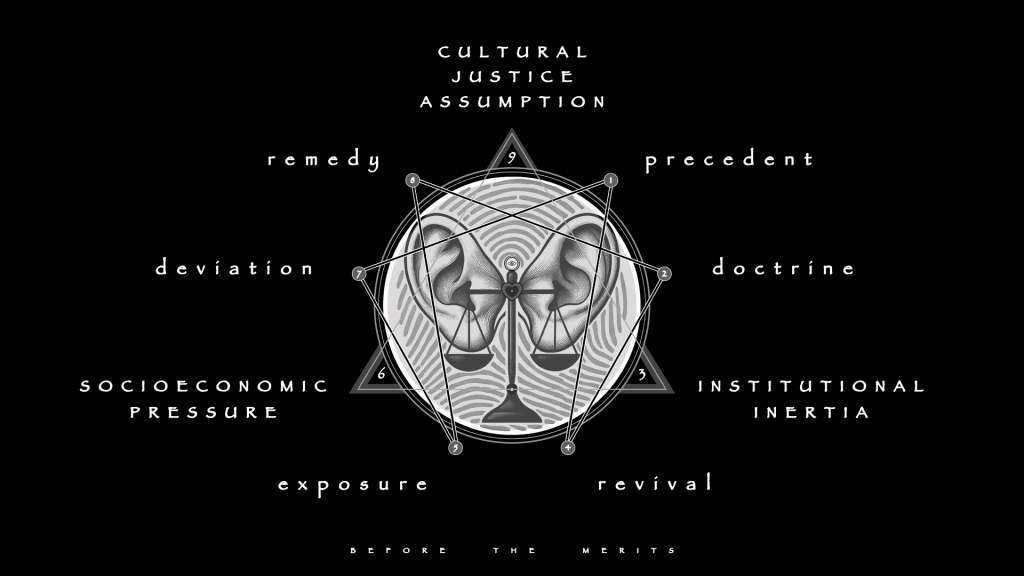
What the settlement forecloses and what the law leaves open are not identical. The gap between them is where the next case will be born. Whatever specific circumstances generate it, the logos of any case has three components, each operating simultaneously as a field condition. Institutional Inertia (+) is already in motion, and Socioeconomic Pressure (-) defines the boundary conditions of that motion. These collide within a Cultural Justice Assumption (0) whose content varies but whose function does not.
Institutional Inertia is the affirming force (+).
Municipal governments under increasing political pressure from the housed majority already have internal incentives that strongly favor visible enforcement over invisible service delivery. A citation issued in public is legible to a constituency; a housing navigation appointment delivered in a service office is not. Municipal governments do not self-correct toward unsheltered populations because unsheltered populations do not vote in proportions sufficient to alter the trajectory, and the bureaucratic architecture of local government, its budget cycles, its performance metrics, its political accountability structures, rewards the production of visible outcomes over the amelioration of invisible conditions.
Socioeconomic Pressure is the denying force (-).
The accumulated consequences of the post-2008 housing affordability collapse arrived in jurisdictions that had never designed infrastructure for visible homelessness. Western mid-size cities, built on assumptions of housing availability that the market had quietly invalidated, found themselves administering a crisis for which no protocol existed, producing the visible encampments that made litigation politically unavoidable. This force does not push toward any particular outcome, but defines the range of responses the institutional inertia already in motion will be permitted to produce, raising the stakes of every other force operating in the field without generating directional momentum of its own.
The Cultural Justice Assumption is the reconciling force (0).
Physical presence in public space is a choice, which can always be attached to consequences. The majority treated this as constitutional common sense The dissent treated it as ideology. The fault line runs precisely through the word “conduct.” The assumption is neither validated nor invalidated by the legal outcome it produces; it is the medium through which institutional inertia and socioeconomic pressure interact, and what makes that interaction legible as justice rather than mechanics.
These forces do not finally resolve with a given case, but reconstitute around the next one. However, a reader who can identify all three next time will find that the following questions transfer. These are the questions this case leaves open rather than the ones it answers.
If the Cultural Justice Assumption that public presence is a choice were to shift, through legislative action, scientific consensus, or a future Court willing to engage rather than distinguish Robinson v. California, which of the three surviving legal channels, the Excessive Fines Clause, the Due Process genealogy Justice Douglas opened in 1962, or the evidentiary predicate Justice White left open in 1968, would be most likely to carry a reconstituted protection, and what would that channel require the next plaintiff to prove that no plaintiff has yet proven?
The post-2008 housing affordability collapse produced the Socioeconomic Pressure that made Grants Pass politically necessary; if a comparable structural disruption, a pandemic-driven eviction wave, a climate displacement event, or a municipal fiscal collapse eliminating shelter capacity entirely, were to raise that pressure beyond the boundary conditions the current Cultural Justice Assumption can absorb, what would the institutional inertia already in motion be forced to produce, and would the legal infrastructure exist to manage it?
If Robinson v. California were overruled and the conduct-status distinction lost its only categorical anchor, what would the Cultural Justice Assumption need to look like in a given jurisdiction, and what socioeconomic pressure would need to be operating against the institutional inertia already in motion, for the distinction to function as something other than a political preference dressed in legal language?

Leave a Reply