
Most legal outcomes are decided before a court examines the evidence, before a jury hears the facts, and before anyone argues what actually happened. The machinery that produces outcomes runs on doctrines too abstract for most people, administered by institutions with strong incentives to keep them obscure, whose product is a gap between the right the Constitution names and the remedy the legal system provides. ‘Before the Merits’ strips down the American legal machine to its component parts one case at a time, for general readers to discover how a precedent-based system is run and maintained.
Before the Merits—Harlow v. Fitzgerald, 457 U.S. 800 (1982)
The most durable shield in American civil rights law was forged not to protect police officers but to protect the men who helped Richard Nixon fire a defense analyst for telling Congress the truth. That origin is almost never mentioned when courts apply the doctrine, which was designed precisely to make its own origins irrelevant. The standard sounds simple and functions as a trap. The design is to replace the messy human question of what an official intended with the clean procedural question of what the law established at the moment the official acted. In any civil rights complaint against a government official, the exact sentence where the case will most likely die, long before any fact-finder ever sees the evidence, will not announce itself. It will arrive dressed as a neutral legal standard, lying in wait since June 24, 1982.
Case Header:
- Case Name: Harlow v. Fitzgerald
- Citation: 457 U.S. 800 (1982)
- Court / Jurisdiction: United States Supreme Court
- Date Decided: June 24, 1982
- Docket No.: 80-945
Legal Domain(s):
- Primary Issue(s): Qualified Immunity / Absolute Immunity / Executive Official Immunity / Presidential Aides
- Practice Area: Civil Rights & Government Liability
- Procedural Posture: Certiorari to the U.S. Court of Appeals for the District of Columbia Circuit; denial of summary judgment on immunity grounds
Holding (One Sentence Rule):
Government officials performing discretionary functions are entitled to qualified immunity and are shielded from liability for civil damages if their conduct does not violate a clearly established statutory or constitutional right of which a reasonable official would have known, evaluated under an objective standard without regard to the official’s subjective intent or malice.
Precedent
The legal history of official immunity in America is the history of a question the law preferred not to answer directly: when a government official violates a citizen’s constitutional rights, who pays? Common law traditions carried from England recognized that sovereign authority required some protection from litigation—a king could not govern if every dissatisfied subject could haul him into court—but the tradition also recognized that individuals acting under governmental authority were, in their personal capacities, answerable for the wrongs they committed. That tension was never resolved. It has since been managed through a set of common law immunities that shielded certain categories of officials from certain categories of suits under certain conditions.
Congress disrupted this equilibrium in 1871, when it enacted a statute creating civil liability for state officials who, acting under color of state law, deprived any person of rights secured by the Constitution. The statute was a Reconstruction measure, designed to provide a federal remedy against the Southern governments that were systematically terrorizing freed people and their allies while state courts looked on with indifference or complicity. It said nothing about immunity. It provided that officials who violated constitutional rights “shall be liable to the party injured.” The language was unequivocal, and the history was urgent: Congress wanted a remedy that state officials could not evade.
The Supreme Court spent the following century quietly installing the escape route that Congress had not provided. Beginning in the early twentieth century and accelerating through the 1960s and 1970s, the Court recognized immunity defenses for officials sued under the 1871 statute, first absolute immunity for legislators and judges performing their core functions, then qualified immunity for executive officials who acted in good faith. The good-faith standard had two components. First, the official had to show both that the law did not clearly prohibit the conduct. Second, the official must not have acted with malicious intent toward the plaintiff.
A plaintiff who could demonstrate that an official knew the conduct was unlawful, or acted out of personal animosity, could survive the immunity defense regardless of how the objective legal question resolved.
Congress had issued a remedy that said “shall be liable.” The Court was quietly counterfeiting the currency, producing instruments that looked like remedies and functioned as refusals. The cumulative effect was visible only when someone tried to spend the currency and found it would not be honored.
This two-part standard created a problem that the Supreme Court, by 1982, found intolerable, not because it was unjust to plaintiffs, but because it was inconvenient for defendants. The subjective component of the good-faith test required inquiry into an official’s state of mind. State of mind inquiries require discovery: depositions, document production, interrogatories, the apparatus of litigation that the immunity doctrine was supposed to prevent. A plaintiff who alleged malicious intent could force the case past summary judgment and into the discovery phase simply by making the allegation, without proving it, merely by raising a genuine issue of fact that could not be resolved without examining what the official knew and felt.
When the Court resolved this inconvenience in 1982, it did so by breaking a principle it had previously maintained: that federal officials should receive no greater immunity than their state counterparts. It then used that break as justification for extending the new standard to state officials as well, creating what one scholar described as a logically circular syllogism that was nonetheless facially unassailable. The currency Congress issued in 1871 was now subject to a redemption standard that the issuing institution had not authorized and could not easily revoke. Whether it would purchase anything in those circumstances was about to receive its most consequential test.
The case that broke this open involved a man named Ernest Fitzgerald, two Nixon White House aides, a congressional hearing, and two billion dollars in missing money.
Doctrine
Harlow v. Fitzgerald, 457 U.S. 800 (1982), is formally a case about whether presidential aides deserve absolute immunity from civil suit. The answer the Court gave to that question was no. That answer, however, has mattered far less than the alternative it supplied.
In 1968, A. Ernest Fitzgerald found approximately two billion dollars in cost overruns and concealed technical failures in the Lockheed C-5A cargo plane program, a weapons system whose price tag had been hidden from Congress and the public. Fitzgerald testified truthfully before a congressional committee in 1969. Within a year, the Air Force eliminated his position in what it characterized as a routine reduction in force. The Watergate tapes later produced President Nixon stating, in terms that left little interpretive room, that he had been personally responsible for the firing. Before the Supreme Court decided the immunity question, Nixon paid Fitzgerald $142,000, with a final $28,000 contingent on losing the immunity ruling; the man who ordered the retaliation considered himself potentially liable at the precise moment the Court was deciding whether he was.
White House aides Bryce Harlow and Alexander Butterfield, who had coordinated with the Air Force and with senior White House staff in the period leading to Fitzgerald’s removal, faced suit for conspiracy to violate his constitutional rights.
The aides claimed absolute immunity, the same total protection from civil suit that the Court had recognized for legislators, judges, and prosecutors performing their core functions. The Court rejected this claim, holding that aides to the President did not occupy positions sufficiently special to warrant blanket immunity, because unlike legislators and judges, presidential aides are not required by the Constitution itself to exercise independent judgment free from the threat of personal liability. This part of the holding, the part the case is named for, is the part that matters least.
What the two decisions decided together matters more than what either decided alone. On the same day Harlow was handed down, the Supreme Court decided Nixon v. Fitzgerald, 457 U.S. 731 (1982). The President himself was granted absolute immunity from civil damages for all acts within the outer perimeter of his official duties.
The immunity hierarchy the two decisions produced was precise and vertigo-inducing.
The President who ordered the retaliation received absolute immunity. The aides who carried it out received a standard described as merely objective. The man who blew the whistle on two billion dollars in concealed defense fraud received, as the currency of his constitutional remedy, the clearly established standard, and that standard produced only what prior courts had already declared unlawful. The standard did not ask whether the conduct was wrong, only whether a prior court had already said so.
What matters is the remedy the Court fashioned for the problem the subjective good-faith standard had created. Justice Lewis Powell, writing for the majority, held that the subjective component of the qualified immunity test would be eliminated entirely. Henceforth, courts would assess immunity on purely objective grounds: had the official violated a right that was “clearly established” at the time of the conduct? The inquiry into malice, bad faith, and subjective awareness closed. The instrument would detect violations of clearly established law and nothing else, not because no other violations were occurring but because the instrument had been calibrated to ignore them.
The majority’s justification was explicit in its priorities and candid about the tradeoff it was making. “The subjective standard of good faith,” Powell wrote, “presents serious problems for public officials.” Those problems were the deterrence of capable people from public service and the risk that juries would punish unpopular decisions made in good faith. Against these institutional costs, the majority weighed the cost to individuals whose constitutional rights had been violated by officials who acted with subjective knowledge of the violation, and found the institutional costs weightier. The decision was a deliberate policy choice. The majority said so, without apology or euphemism.
Justice William Brennan, joined by Justices Byron White and Thurgood Marshall, concurred in the judgment while dissenting from the elimination of the subjective component. Brennan argued that the purely objective standard would immunize officials who intentionally violated constitutional rights, as long as the violation occurred in a factual context not previously litigated to a clear conclusion. He was correct, and the majority’s conclusion reflected not a disagreement but a different weighing: the protection of official discretion was worth that cost.
What neither the majority nor the dissent fully anticipated was the question the new standard left open. Who would decide what “clearly established” meant, and how? The answer would arrive across the following four decades.
The calibration would be progressively tightened in ways that the 1982 majority could not predict, and that the instrument it built could not prevent.
Revival
No doctrine operates alone, and the forty years Harlow has spent in the law have been forty years of other decisions deciding what “clearly established” means, a question the 1982 opinion left open with consequences no one fully anticipated.
The most consequential development was not Harlow itself but the interpretive accretion that followed it. “Clearly established” turned out to be an infinitely elastic phrase. Courts could read it to mean that the general constitutional principle was recognized, or they could read it to mean that the specific conduct under the specific facts had previously been identified as unconstitutional in a published judicial opinion.
The Supreme Court, in a sequence of decisions beginning in 2001 and intensifying after 2018, adopted the latter reading. It then tightened further, requiring that the prior case identify the conduct as unconstitutional at a “high level of specificity.” Under this reading, an officer who commits a constitutional violation in a factual configuration not previously litigated to a published conclusion receives immunity not because the law was unclear but because no prior case happened to address precisely that configuration.
If courts can dismiss cases at the immunity stage whenever the specific facts have not been previously adjudicated, then novel violations never reach verdicts that establish the right clearly.
If the next novel violation of the same kind is equally immune, then the right is never established clearly enough to cost an official anything, and the cycle restarts. Sitting justices have named this dynamic from the bench: Justice Sotomayor identified it explicitly in her dissent in Mullenix v. Luna (2015), and Justice Thomas raised it from a structural separation-of-powers perspective in his concurrence in Ziglar v. Abbasi (2017). Neither observation commanded a majority. The self-perpetuating loop continues.
The 2001 decision in Saucier v. Katz briefly appeared to offer a solution. It required courts to decide whether a constitutional violation occurred before reaching the immunity question. This would, in theory, produce constitutional rulings that could then inform the “clearly established” analysis in future cases.
The mechanism failed in practice. Empirical analysis of the Saucier era found that courts forced to address the constitutional merits first almost uniformly found no violation, producing a body of precedent structurally biased toward officers rather than a body of precedent that expanded constitutional protection. The mandatory sequence did not generate the law-elaboration the Court had anticipated; it generated officer-favorable rulings that deepened the doctrinal wall.
In 2009, the Supreme Court removed even this mechanism.
Pearson v. Callahan, 555 U.S. 223 (2009), held that the Saucier sequencing rule was no longer mandatory. Courts could address the “clearly established” question first and grant immunity without ever deciding whether the conduct was constitutional. This left the doctrinal landscape unchanged and the immunity intact for the next case. Violations passed through undetected, no ruling named them, and the instrument registered nothing because the instrument had been relieved of the obligation to look.
The surviving channel runs through Monell v. Department of Social Services, 436 U.S. 658 (1978), which allows plaintiffs to sue municipalities directly for constitutional violations resulting from official policies or customs, without the immunity defense that shields individual officers. Monell liability does not require proving that a specific officer violated clearly established law; it requires proving that the violation resulted from the institution’s deliberate choices. Qualified immunity does not block it, and after 2014, as video evidence of departmental patterns made institutional violations more documentable, civil rights practitioners shifted toward municipal defendants in precisely those cases where individual immunity would otherwise foreclose recovery entirely.
The Monell channel is a bypass, not a correction.
Reaching it requires demonstrating a pattern of institutional violations rather than a single incident, which means most individual victims of constitutional violations must either find resources sufficient to establish an institutional record or forgo recovery entirely. The filter does not malfunction when a plaintiff reaches Monell; it functions exactly as designed, routing those who cannot establish a pattern away from recovery while leaving the channel open for those who can. The survival of the bypass is evidence that the system has a bypass. It is not evidence that the filter is broken. The distinction is where the constitutional remedy actually lives or dies.
Exposure
Qualified immunity, as developed from Harlow forward, is not a defense to unconstitutional conduct, but a threshold filter that determines which unconstitutional conduct will ever receive legal scrutiny.
The law presents qualified immunity as a balance, protecting officials from litigation harassment while preserving remedies for clear violations, though the balance is not symmetrical. A plaintiff who loses on immunity grounds loses the case entirely, receives no damages, obtains no factual record through discovery, and produces no judicial opinion addressing whether the conduct was unconstitutional. The constitutional violation, if it occurred, leaves no legal residue.
The plaintiff is indistinguishable, in legal outcomes, from a plaintiff who had no claim at all. The immunity dismissal does not produce a finding that the conduct was legal; it produces an absence, which is the system’s most consequential output. What the shredder processes is not discarded as illegal, but as unprocessed. The distinction matters enormously to everyone who needed processing.
An official who wins on immunity grounds while having actually violated the Constitution has received protection not from an unfair lawsuit but from the legal system’s recognition that the conduct was wrong.
The protection is not conditional on good faith, not conditional on the violation being minor, not conditional on the official having made an honest mistake. It is conditional only on the factual novelty of the violation, on whether some prior plaintiff, in some prior case, happened to litigate the identical factual configuration to a published conclusion. The doctrine’s protection of intentional constitutional violations, which Brennan identified in dissent in 1982 as the unavoidable cost of the majority’s choice, is not an edge case. It is a foreseeable feature of the system the opinion built.
Scholars argue that strengthening qualified immunity for federal officials serves as an indirect mechanism for restraining the Bivens regime, the judicially-created cause of action that several justices viewed with increasing skepticism as inappropriate judicial lawmaking. The consequence was a tightening of the noose around the very damages remedy the Court had created a decade earlier, accomplished not by overruling Bivens directly but by making its practical exercise nearly impossible. Such is academia. The gap between those two purposes is where the doctrine’s deepest commitments actually live.
Fitzgerald himself never won a damages judgment against Harlow or Butterfield.
The case was remanded for application of the new standard, and the remand produced no recovery. Nixon had acknowledged firing Fitzgerald on the Watergate tapes. White House memoranda demonstrated that aides had coordinated the retaliation and declined to offer Fitzgerald reemployment on grounds of “loyalty.”
Whether the clearly established law standard, applied to those facts in 1969, would have been satisfied remains a question the legal system never definitively answered. The case illustrates, in miniature, the doctrine’s central irony. The decision that made qualified immunity harder for plaintiffs to defeat was issued in a case where the underlying conduct—retaliation against a government whistleblower at the direction of the President—was precisely the kind of deliberate constitutional violation the 1871 statute was designed to reach.
The filter’s systematic exclusion of individual claims has pushed civil rights plaintiffs toward institutional defendants, because Monell liability bypasses the individual immunity screen. The pressure toward institutional defendants is pressure toward systemic accountability, which means the doctrine designed to insulate officials from individual scrutiny has inadvertently created the conditions under which departments, cities, and agencies face the pattern-based accountability that individual immunity forecloses. The shredder’s output is not only absence, but accumulated institutional pressure, now arriving in the circuits where the filter has operated longest and most aggressively.
The exposure Harlow produces is the disclosure that the legal system built a mechanism for sorting constitutional violations into those that matter and those that do not. It was built precisely so that the sorting criterion—factual novelty—has no relationship to the severity of the violation—the deliberateness of the official’s choice—or to the harm sustained by the person whose rights were violated.
If the protection is stated in objective language, the cost of over-protecting bad-faith actors becomes invisible. The doctrine’s constitutionality is not in question. Its honesty is.
Deviation
Within a decade of Harlow, federal courts were dismissing civil rights complaints at the summary judgment stage at rates that would have been unrecognizable to the lawyers who litigated such cases in the 1970s. The immunity defense is not the only reason. It is simply the mechanism most resistant to case-by-case variation, because it operates as a threshold that many plaintiffs cannot reach regardless of how strong their underlying claim might be.
The doctrine migrates from federal officials to state officials and then to police officers without a Supreme Court opinion specifically authorizing the extension to law enforcement. The courts simply apply it, nobody objects successfully, and the extension hardens into settled practice. By the 1990s, qualified immunity is the central defensive strategy in police-misconduct litigation nationwide. The doctrine designed to protect the discretionary decisions of high-level executive officials, the Harlows and Butterfields who managed congressional relations and executive communications at the White House, now shields patrol officers in routine traffic stops from damages claims when their conduct was unprecedented in its specific configuration. The settlement is complete before anyone formally authorizes it.
The “clearly established” standard tightens with each decade, not because the Supreme Court changes the words but because the Supreme Court changes the application, demanding ever-greater specificity in the prior case that must establish the right. By 2018 and 2019, the Court reverses circuit courts in summary orders, opinions issued without full briefing or oral argument, when lower courts denied immunity to officers whose conduct was arguably unconstitutional but not previously adjudicated in a factually identical case. The message requires no interpretation: the benefit of the doubt runs to the official, and a novel factual configuration is presumptively immune until proven clearly established by a prior decision that the official’s conduct was wrong.
Police departments absorb this structure and build around it.
Risk managers advise that training need not track constitutional boundaries. The gap between what the Constitution permits and what is clearly established is wide enough that officers inside that gap face no personal liability exposure. Legal counsel advising departments on use-of-force policy identifies the immunity framework as a structural feature that reduces the institutional cost of constitutional violations at the individual-officer level. The deterrent function that tort liability is supposed to serve has been attenuated to the point where most violations fall outside the range the instrument was calibrated to detect.
Monell municipal liability becomes the primary vehicle for systematic accountability precisely because it bypasses the individual immunity screen. Cities are not immune. Monell requires proof of an official policy or custom, which means a pattern of violations rather than a single incident, and most individual victims of constitutional violations do not have access to the litigation resources required to establish an institutional pattern. The post-2014 proliferation of documented police killings, made visible by dashcam and body-camera footage, accelerates the Monell shift in the jurisdictions where the footage exists and the civil litigation infrastructure to use it has developed. The gap between what the law theoretically permits plaintiffs to pursue and what plaintiffs can actually prosecute expands with each passing year, and the expansion is visible only where the evidentiary conditions are strong enough to show it.
The migration does not stop at police officers. In 2024, the Supreme Court extended the reasoning of Nixon v. Fitzgerald from civil damages liability into criminal prosecution, holding that a former president has absolute immunity for official acts and presumptive immunity for other official acts within the scope of presidential authority. The doctrine that began as a protection for White House aides from civil suits brought by a whistleblower now shields the office of the presidency from criminal accountability for conduct the Constitution’s framers placed under no such protection.
The settlement that began in 1982 without formal authorization has now covered more territory than any of its original architects announced, and the boundary markers that once seemed fixed have continued moving outward, one extension at a time, each individually defensible and cumulatively transformative.
Remedy
The legal system built the circularity in 1982, and has watched it operate for forty years. It has been invited repeatedly to dismantle it, and has declined. The question worth asking is no longer whether the system can be repaired. Yes, it can be repaired.
The uncomfortable question then is what does this pattern of invitation and refusal reveal about what the system was built to do?
The majority in Harlow was candid about the tradeoff. It said explicitly that eliminating subjective inquiry would immunize some officials who intentionally violated constitutional rights. It concluded that the institutional costs of subjective inquiry, litigation expense, distraction, deterrence of public service, outweighed this loss.
What the majority could not calculate was the magnitude of that loss, because the magnitude depends on how “clearly established” would be interpreted across the following forty years.
The two voices of the doctrine—the immunity from suit and the clearly established requirement—sounded principled in isolation. Played together, they produce a counterpoint that prevents either from resolving: the immunity keeps cases from reaching judgment, the judgment would have established the right, and the right cannot be clearly established without the judgment. The music sounds like two independent melodies. It functions as one loop.
Congress has the authority to modify qualified immunity by statute. The doctrine is a judicial construction, not a constitutional requirement. A statute excluding intentional violations from its protection would be within Congress’s power. Several states have enacted exactly such statutes for state tort claims against state officers. Congress has not. The political economy of that refusal is transparent: the officials who would face expanded liability under a reformed standard are the same officials whose cooperation legislators need for ordinary governance.
The populations most likely to benefit from the reform are the same populations least represented in the legislature’s constituent calculus.
The Supreme Court retains the authority to reconsider the “clearly established” standard’s specificity requirement without abolishing immunity entirely. A court that required only that the general constitutional principle was established, rather than the specific factual application, would preserve much of Harlow‘s protection for officials acting in genuinely uncertain legal territory while eliminating the circularity that immunizes deliberate violations simply because the violation was novel. This is a reform the Court has been invited to make, through petition after petition, and has declined, repeatedly, without providing an opinion explaining the refusal.
The circularity was implicit in the Harlow design from the moment the subjective component was eliminated. Without subjective inquiry, the only remaining check on official conduct is the prior announcement of a clear rule. The mechanism for announcing that rule is the same judicial system whose immunity doctrine prevents most cases from reaching judgment.
The majority built the loop. The Saucier sequencing requirement briefly forced courts to play both voices simultaneously, but the empirical record shows that when courts played them together they almost always resolved in the official’s favor, producing not a counterpoint that developed the law but a counterpoint that confirmed the immunity. Pearson removed even that structural pressure, granting courts discretion to play only the immunity voice and leave the other silent.
The loop was closed in 1982. The brief experiment from 2001 to 2009 did not open it. Nothing since has either.
The Court’s repeated unexplained refusal to reconsider the specificity requirement is not silence, but institutional speech whose content is a preference that the law’s announced purpose and its actual function remain misaligned.
The Court that built the immunity architecture did so partly to constrain the Bivens damages remedy it had created a decade earlier. Reopening the loop would require acknowledging that constraint was intentional. Acknowledgment is costly in a way that congressional inaction is not, because congressional inaction is attributed to politics, while judicial silence on a constitutional question is attributed to principle. The opinion that officials deserve the benefit of the doubt in legal uncertainty applies to the institution as well as to its officials.
The Court, operating in the uncertainty of whether to reconsider the specificity requirement, claims that benefit through a procedural mechanism, the denial of certiorari, that produces no opinion, generates no reasoning, leaves no residue, and is, in this respect, indistinguishable from the immunity dismissal the doctrine it created has been producing for forty years.
For Further Examination . . .
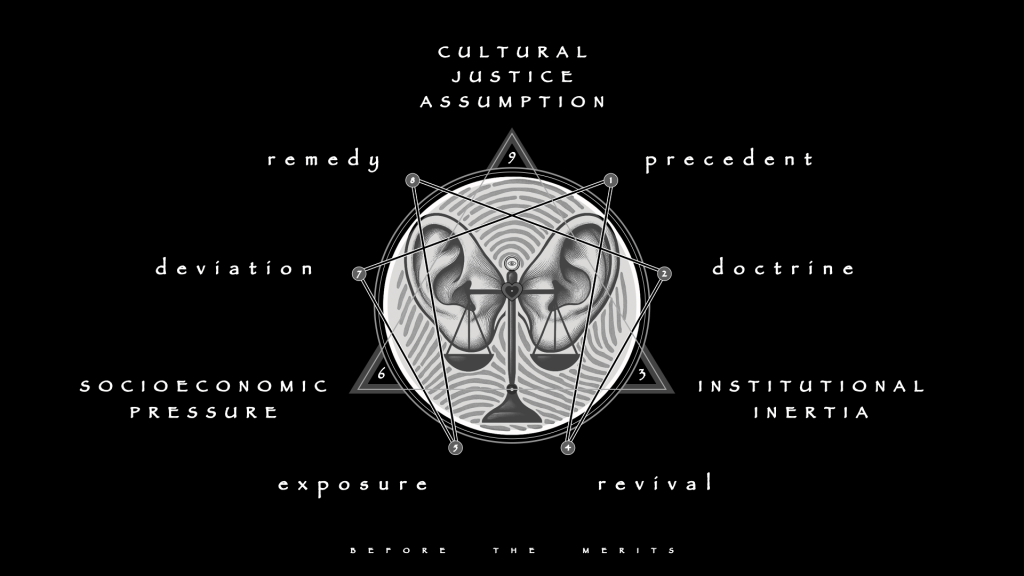
What Harlow v. Fitzgerald forecloses and what the law leaves open are not identical. The gap between them is where the next case will be born. Whatever specific circumstances generate it, the logos of any case has three components, each operating simultaneously as a field condition. Institutional Inertia (+) is already in motion, and Socioeconomic Pressure (-) defines the boundary conditions of that motion. These collide within a Cultural Justice Assumption (0) whose content varies but whose function does not.
Institutional Inertia is the affirming force (+).
Officials who participated in documented constitutional violations faced personal civil liability for the first time under the Bivens doctrine, without the absolute immunity that insulated the President himself. The Court’s internal incentive was to preserve some accountability while limiting institutional damage to executive governance, and the purely objective standard accomplished both by promising accountability in the abstract while making it practically inaccessible in specific cases. The inertia does not require malice; it requires only that the path of least resistance run consistently toward protection, and that the correction arrive, if it arrives, after the fact.
Socioeconomic Pressure is the denying force (-).
The post-Watergate, post-civil rights era collided with a newly aggressive civil rights bar and a federal judiciary concerned that § 1983 litigation was exploding beyond manageable proportions. The 1970s produced a surge of civil rights suits against state and federal officials, many insubstantial, some designed to harass rather than remedy. The Court saw the caseload and responded with a doctrinal tool calibrated to thin it. The timing is not coincidental: Harlow was decided the same day as Nixon v. Fitzgerald, which granted the President absolute immunity, producing a unified doctrine of executive protection at the precise moment the executive branch was most legally vulnerable. This force does not push toward any particular outcome; it defines the range of responses the institutional inertia already in motion will be permitted to produce.
The Cultural Justice Assumption is the reconciling force (0).
Government officials must be protected from the consequences of good-faith mistakes in order to govern effectively, and the cost of over-protecting bad-faith actors is acceptable as long as the protection is framed in neutral, objective language. The majority took pains to present the “clearly established” standard as a protection for honest officials, not a shelter for dishonest ones. Brennan’s dissent named the shelter explicitly. The fault line runs directly through the phrase “clearly established,” and the forty years since have confirmed the dissent’s prediction while the assumption that justified the standard has remained, structurally speaking, beyond contestation.
The three forces operating simultaneously in this case produce not a resolution but a repeating structure, and the questions below are not hypothetical.
If Watergate tapes and a presidential admission could not satisfy the clearly established standard in Harlow, what evidence would, and does the institutional inertia currently in motion contain any mechanism capable of producing it before the cases that would generate it are dismissed?
The post-2014 video proliferation is the only external pressure that has meaningfully constrained the Harlow ruling; if that visibility were degraded, through rollback of body-camera requirements, restrictions on footage admissibility, or selective preservation, what would replace it, and would the Overton Window shatter or stiffen?
Qualified immunity has survived every reform effort mounted against it at the federal level; if the doctrine is formed and reformed in the same democratic process that insulates it from accountability, what would it mean for that process to produce a genuine reckoning with what the doctrine has built, and what external condition would have to obtain?

Leave a Reply