
Constitutional rights have a zip code, which most people learn only after they are already in court. The federal appeals courts divide the country into distinct legal territories—regional, functional, and subject-matter—where the same constitutional guarantee can protect you completely in one state and fail you entirely in the next, not because the law changed, but because the judges did. Presidential appointments, regional political culture, and decades of industrial money have been quietly building these divergences until the gap between circuits is wider now than at any point since the civil rights era. Understanding which circuit governs your state, what it has historically protected, and where its fault-lines are cracking may be the difference between filing a case and winning one. Geography determines the settlement offer, whether the police officer gets away with misconduct, or whether the company pays or walks. These courts have produced distinct legal cultures, and the country has spent a century pretending the map does not matter.
Geography not only locates justice in a literal drawing of courthouse territory, but classifies it, too. Thirteen appellate courts now form the working map: eleven regional circuits, one court of federal machinery, and one court of subject-matter expertise. The current system is a routing diagram that determines which precedent attaches before any facts are heard, whether injuries arrive as constitutional questions or administrative problems, and which are priced out before any judge writes a word. The diagram has no author in the conspiratorial sense; it accumulated through appointments, reversals, retirements, and the slow calcification of regional habit into doctrine. Its effects, however, are indistinguishable from design.
The Second Circuit Orbits Wall Street and Cannot Feel the Pull
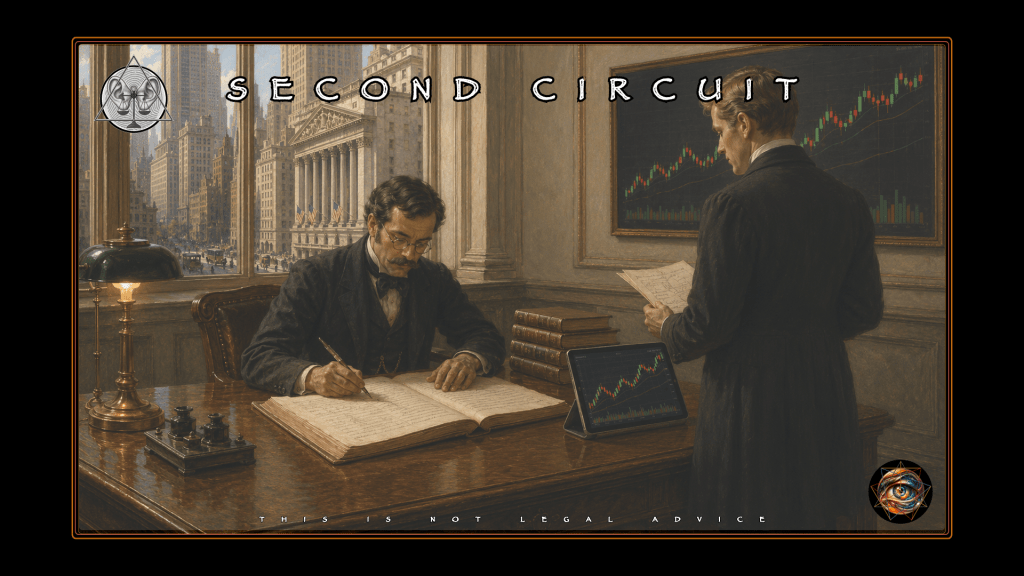
On paper the Second Circuit governs the three states of Vermont, Connecticut, and New York. If that grouping looks arbitrary, the impression is correct. Vermont is a rural and progressive state whose federal docket leans toward environmental disputes and the occasional firearms case. Connecticut is a mid-sized state torn between Hartford’s insurance industry and the wealthy commuter towns that belong, economically, to someone else’s city. New York is the global capital of finance, media, and federal prosecution, and it distorts the circuit the way a massive body distorts the space around it, drawing every smaller thing into its orbit.
What the Second Circuit actually governs, as a working matter, is Wall Street and the wreckage it leaves in its wake.
The hedge funds, the investment banks, the private equity shops, and the public corporations that generate the most complex and highest-stakes civil litigation on earth all appeal their losses, in the end, to a single building at 40 Foley Square. The court has been the financial industry’s highest tribunal below the Supreme Court since Franklin Roosevelt’s appointees rebuilt securities law in the 1940s. A body that has circled the same mass for that long stops experiencing the orbit as motion, and calls it the way things are without any question. The one worth asking is whether the court can ever navigate back to open space.
Territory
One Mass Bends the Orbits of Two Smaller States, Spinning an Entire Body of Law
Vermont and Connecticut are real states with real dockets. Inside this circuit, though, they function as mere satellites. Vermont sends environmental cases and gun cases up from a small and progressive population. Connecticut sends insurance disputes from Hartford and financial matters from towns whose tax base is little more than an extension of Manhattan. Neither state sets the circuit’s character, because neither carries the mass.
New York is the gravitational center. The Southern District of New York, seated a few blocks from the exchanges, generates the securities prosecutions, the fraud trials, and the billion-dollar civil suits that built this court’s name. Everything else in the circuit arranges itself around that center. A securities lawyer in Burlington and a securities lawyer in New Haven both practice, functionally, in New York’s legal weather.
A fitting metaphor is the moon in its synchronous orbit, one face turned permanently toward its governing body, the other never seen. The Second Circuit keeps one eye on the financial industry at all times, and has done so for so long that the turning no longer registers as a choice. A court that cannot feel itself turn is one that stopped asking why it faces where it does.
Reputation
Sophistication as a Service, Priced for a Seller’s Market
Among securities lawyers and white-collar defense attorneys, the Second Circuit holds a reputation as the most technically sophisticated appellate court in the country on financial crime and securities regulation. The reputation is earned. The opinions are careful, the doctrine is intricate, and the judges who write them are genuinely expert in a field most courts handle only occasionally.
Technical sophistication, however, is not the same thing as equal access to it. A court can be a precision instrument and still be calibrated for one kind of hand. The Second Circuit performs with seeming Swiss exactness. Like a Swiss mechanism, it was built by and for those who can afford its upkeep. The clients are the firms with the resources to brief a loss-causation argument across four hundred pages and three appeals.
The court’s nominal politics lean liberal, and the label fits its civil-liberties work far better than its financial-regulation work.
In the securities cases, where the money is, the court has long been hospitable to the institutional interests of the industry it supervises. That hospitality is not a stated allegiance. It is the curvature of the orbit, the direction a body leans when it has circled the same mass for seventy years. The mechanism survives precisely because it does not resemble corruption.
Judges who clerked on the Second Circuit, practiced at the white-shoe firms, and returned to the bench carry the vocabulary of that ecosystem as professional formation rather than as allegiance. The Columbia Law Review article that becomes the precedent-setting brief that becomes the opinion that produces the next generation of clerks is not a conspiracy. It is an ecology, and its grammar is that of the institutional defendant: scienter, reliance, loss causation, market efficiency, the pleading standard, the standing requirement, the jurisdictional hook. The argument is never that no fraud occurred. The argument is that the fraud, if any, cannot be proven at this procedural posture under this doctrinal framework within this statute’s reach. Plaintiffs speak injury. The institutional defendants speak architecture. A court trained by the same ecosystem that produced the architects hears architecture as the more serious language.
The same court, however, is not uniformly defendant-favorable, and the exceptions are worth examining because they reveal where the court’s Overton window is drifting.
In 2024, the court decided Williams v. Binance, reversing dismissal of a putative class action brought by buyers of crypto tokens against a decentralized exchange that claimed no physical headquarters anywhere on earth. The court held that the token purchases plausibly qualified as domestic transactions under Morrison v. National Australia Bank because the orders became irrevocable when matched on servers located in the United States, and that U.S. investors could therefore pursue federal securities remedies despite the platform’s studied statelessness. The decision was plaintiff-friendly, technically innovative, and consistent with the court’s financial-sophistication identity.
The question was not whether Wall Street institutions should answer for their conduct, but whether a new category of market participant, the retail token buyer whose phone sits in Brooklyn while the exchange claims to exist nowhere, falls inside the statute’s reach. The court decided it does. That decision costs the court’s traditional constituency nothing, because decentralized crypto exchanges are not the banks and hedge funds whose vocabulary the court has absorbed over seventy years.
The plaintiff-friendly ruling in Binance and the defendant-friendly architecture of securities class-action doctrine coexist without tension, because they protect different things.
History
The Hand of Industry Preference
The court’s intellectual character was set by Learned Hand, who joined the Second Circuit in 1924, led it as chief judge through the 1940s, and sat until his death in 1961. Hand was no ideologue. He was a pragmatist who believed federal courts existed to produce commercially predictable outcomes in a complicated economy, that statutes should be read for their purpose rather than their letter, and that any judge claiming to derive results mechanically from text was either naive or dishonest. That creed runs through the court’s securities work to this day.
Hand’s framework gave the court permission to build. When Congress left a gap, the Second Circuit filled it, and in the 1960s the court constructed much of the modern architecture of securities fraud, most visibly in its landmark Texas Gulf Sulphur decision on what a company must disclose and when. The work was purposive, economically literate, and confident in its own authority to make law from statutes Congress had left unfinished.
It is worth pausing on what Texas Gulf Sulphur actually was, because the later drift is more damning once the starting point is clear.
The Second Circuit held in 1968 that officers of a mining company had violated insider-trading rules by purchasing stock before the company disclosed a major mineral find. The opinion treated the securities laws as a genuine public accountability project, the institutional expression of a social compact between markets and the citizens who depended on them for honest price discovery. The court that wrote that opinion was not Wall Street’s instrument. It was Wall Street’s regulator, applying laws that Roosevelt’s New Deal had written to impose accountability on a financial system that had betrayed the public in 1929. For roughly two decades the court and the SEC operated as partners in the same accountability project, and the court’s sophistication served that project: complex doctrine in the service of genuine enforcement.
Another great accretion of mass came between 1995 and 2016, when a run of technically gifted but institutionally cautious judges joined the court. These judges were not crude opponents of plaintiffs. They simply applied the procedural doctrines, standing, pleading sufficiency, loss causation, in ways that raised the wall a class-action plaintiff had to climb. Congress passed the Private Securities Litigation Reform Act in 1995 to restrict securities class actions, and the statute found its most demanding, most defendant-friendly reading in this circuit’s hands.
By the time the Supreme Court nationalized a strict pleading standard in Tellabs in 2007, the Second Circuit had already drafted the playbook, and the rest of the country was left to follow.
Implication
Insider-Trading Wars Show a Court Reaching Beyond the Statute … and Financial Gravity Reeling It Back
The court’s most consequential live battleground has long been the boundary of insider-trading liability, fought under both the old Rule 10b-5 and the Title 18 fraud statutes Congress added after the Enron era. The Second Circuit’s instinct in these cases has run toward the sophisticated defendant. Meanwhile, the Supreme Court’s instinct has run toward yanking the doctrine back to its text.
In 2014 the circuit decided United States v. Newman, reversing the convictions of two portfolio managers who sat several steps removed from the original leak. The court held that prosecutors had to prove the insider received a benefit of a pecuniary or similarly valuable nature, a stringent test that ended the campaign Preet Bharara had made the signature of his tenure as Manhattan United States Attorney. The Supreme Court declined to hear the government’s appeal, the Newman defendants kept their freedom, and the Department of Justice quietly abandoned a string of related investigations.
The correction came sideways. Two years later, in a case out of the Ninth Circuit called Salman, a unanimous Supreme Court rejected Newman‘s demand for a pecuniary benefit as inconsistent with older precedent, restoring the rule that a gift of inside information to a trading relative is itself enough. The circuit had bent the doctrine toward the defendant, and a higher gravity had bent it back.
The pattern repeated with confidential government information. In Blaszczak the circuit held in 2019 that nonpublic regulatory data from a federal health agency counted as property under the fraud statutes, and that the personal-benefit requirement did not travel into the Title 18 charges, a reading that handed prosecutors a powerful new weapon against financial defendants. The Supreme Court vacated the decision and sent it back to be reconsidered in light of its Bridgegate ruling, and on remand, in 2022, the circuit reversed its own course, holding that the information was not property at all and letting the convictions fall. The weapon was forged, admired, and confiscated inside of three years.
A parallel fault-line runs not through the prosecution of financial crimes but through the private enforcement that is supposed to protect ordinary investors and retirement savers.
In 2025, in Collins v. Northeast Grocery, Inc., the Second Circuit held that participants in a 401(k) plan lacked both Article III and class standing to challenge the fees or investment performance of funds and share classes in which they had not personally invested, even though all the options at issue sat on the same plan menu and the fee and selection decisions had been made at the plan level. The court held that failure to invest in the challenged fund meant failure to allege individual injury, so the fiduciary oversight claims simply could not proceed. The structural consequence is that a plan menu loaded with high-fee or revenue-sharing funds can persist without judicial review unless a participant happened to select the offending option and has the resources to litigate it.
Collins arrived one year after Williams v. Binance extended federal investor protection to crypto token buyers whose transactions became irrevocable on American servers.
The court that reached across the Morrison boundary to protect a retail investor with a phone found no reaching required when the same retail investor’s pension administrator loaded her retirement account with funds that extracted fees she could not see and could not challenge. The selection criterion is not plaintiff-friendliness. It is which plaintiff the court’s financial-ecosystem orbit has trained it to recognize as a legitimate market participant.
A quieter front runs through disclosure doctrine. Its latest ruling may be the most consequential of all for ordinary investors. In Smith v. The Gap, Inc., decided May 28, 2026, the Second Circuit affirmed dismissal of a securities fraud class action and drew a line that corporate counsel will spend the next decade measuring.
The court held that:
- Generic, industry-wide risk disclosures do not become actionable merely because the disclosed risk is actively materializing
- Repeating boilerplate risk language without flagging a known recurrence is not fraud unless the company has affirmatively portrayed a known risk as merely hypothetical
- Section 10(b) and Rule 10b-5 impose no general duty to disclose all material information
The phrase that will appear in every motion to dismiss filed after 2026 is “boilerplate opacity,” though the court did not use those words. The doctrine licenses a space between disclosure and fraud where the company knows the problem, says nothing actionably new, and the investor has no remedy. The personal jurisdiction cases complete the same picture from a different angle. Since the Supreme Court tightened the rules in Bristol-Myers Squibb in 2017, the circuit’s handling of mass-tort and product-liability suits against pharmaceutical companies has favored the defendant with the means to litigate jurisdiction in a dozen forums at once, which is to say it has favored the pharmaceutical companies.
Access to the courthouse, in these cases, is rationed by legal budget.
Objection
A Textualist Supreme Court Dismantles Tradition
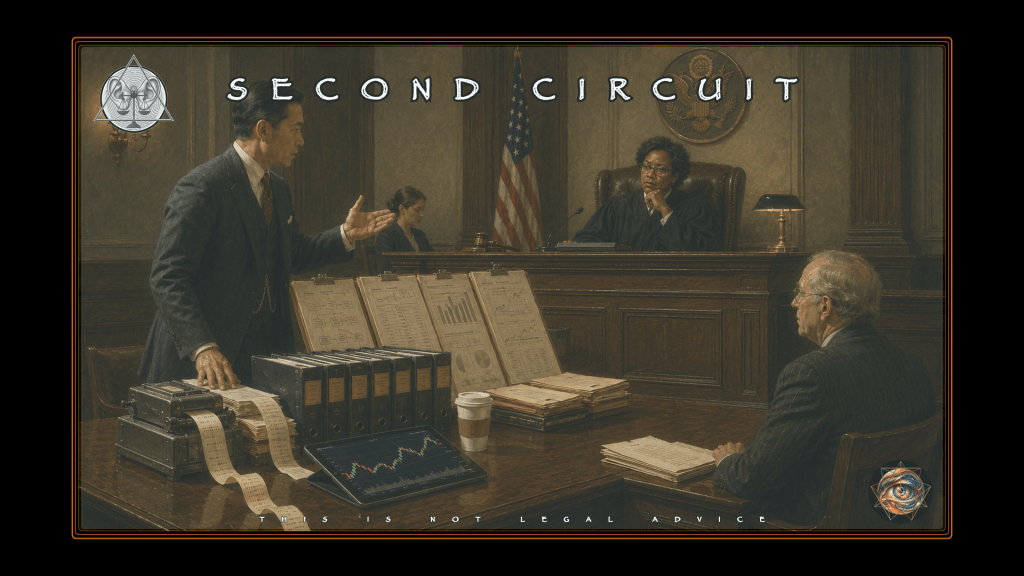
The heaviest question hanging over the Second Circuit is whether federal enforcement of securities fraud, criminal and civil alike, can survive the current Supreme Court intact. In 2023 the Court decided Ciminelli, reversing by a unanimous vote a theory of wire fraud the circuit had leaned on for decades, the so-called right-to-control theory that treated the loss of valuable economic information as a property harm. The Roberts Court will not tolerate prosecutors stretching the fraud statutes past the words Congress actually wrote.
The message arrived again in 2024, when the Supreme Court decided Macquarie Infrastructure Corp. v. Moab Partners and unanimously vacated another Second Circuit judgment. The Court held that pure omissions are not actionable under Rule 10b-5(b), specifically rejecting the circuit’s prior willingness to treat failures to disclose information required by SEC Regulation S-K Item 303 as independently actionable without a misleading statement. The category of claim the Second Circuit had recognized, standalone silence in the face of a regulatory disclosure obligation, was eliminated.
Plaintiffs must now show that the omission turned an existing statement into a half-truth. The new standard requires an affirmative misstatement as the anchor before silence becomes fraud. Two unanimous reversals in the same doctrinal neighborhood, both stripping enforcement tools the Second Circuit had built and both authored by a Court with no patience for purposive gap-filling, constitute a pattern rather than a correction.
The trouble for the circuit is that gap-filling is precisely what it has always done. The purposive tradition that Learned Hand planted, the willingness to read statutes for their aim and to make law in the silences, is the habit the textualist majority now treats as illegitimate. A court built to fill silences faces a high Court that reads silence as a limit.
Two masses now pull on the same body. The financial industry’s gravity still bends the court inward toward the defendant-friendly doctrine of the past, while the Supreme Court’s gravity pulls it outward toward a narrow textualism. A body caught between two gravities does not orbit cleanly, but becomes painfully stretched and possibly distorted.
Verdict
Capture Is Not Corruption, Hence No Cure Need Exist
The Second Circuit is an excellent court in the narrow and real sense that it produces careful opinions, written by intelligent people, applying difficult doctrine to genuinely hard problems.
It is also a court that has spent seventy years too close to the industry it judges to hold the neutral posture an appellate court is supposed to keep. No single ruling proves the point. The insider-trading line, the class-action pleading wall, the slow erosion of personal jurisdiction, the Collins standing barrier, none of them alone is damning, and together they trace a consistent tilt toward the institutional defendant that the statutes themselves do not require.
The tilt is not bought. The judges are not necessarily corrupt, and treating the problem as corruption mistakes its nature entirely. The court leans toward the industry because its whole intellectual ecosystem, the clerkship pipeline, the academic friendships, the bar it drinks with, has been shaped by seventy years of proximity to the largest concentration of money on the planet. The captured watchdog does not take bribes. It simply comes to see the world through the eyes of the thing it was meant to guard.
What makes this form of capture nearly immune to democratic correction is that its most decisive moves occur inside doctrines no ordinary person reads.
The injury is not announced from the bench as a ruling in favor of the bank. It is processed through the pleading standard that prevents discovery, the loss-causation framework that makes damages unprovable, the scienter test that requires intent to be demonstrated before any evidence of intent can be obtained. The Gap case is the sharpest recent illustration. A company that maintains boilerplate opacity, knowing the risk is materializing and saying nothing actionably new, is shielded not by the court’s corruption but by its precision, its careful calibration of the line between what Section 10(b) requires and what it permits. The court did not write The Gap a license. It built a doctrine whose perimeter The Gap’s lawyers measured and stayed inside, and the plaintiff who loses at the motion-to-dismiss stage does not understand that she lost at the moment the doctrine was written, years earlier, in an opinion that cited three law review articles no senator has read and no journalist covered.
What should trouble anyone who hopes the Supreme Court’s corrections will repair the problem is that a corrupt court can be cleaned, but a captured court cannot. Corruption is a thing the court knows it is hiding, but capture feels, from the inside, exactly like good judgment. When the textualist majority strikes down another of the circuit’s expansive doctrines, the judges will not experience the blow as the straightening of a bent body. They will experience it as an assault on law itself, and they will defend the orbit in the sincere belief that they are defending gravity.
The deepest capture is the kind the captured cannot see, because it has long since mistaken the mass it circles for the center of the universe.
What the Second Circuit Teaches, the Third Complicates
If the Second Circuit is a body locked in one predictable orbit, the Third is a wheel of names with no governing mass to steady it. The outcome of a hard case there can be settled the moment three judges are drawn from the assignment wheel, before a brief is read or the law consulted, and the same petition that wins before one panel loses before another on no difference the law would recognize. This is not the failure of a sloppy or corrupt court. The Third is professional, technically excellent, genuinely deliberative, which is what makes the variance so unsettling, because it flows from the design rather than from any defect the design was meant to prevent. A small four-state corridor conceals a corporate and bankruptcy engine that gives its rulings national reach, and an asylum seeker’s survival can turn on which three names the wheel selects.
The deepest stakes show in the career of the judge the circuit is best known for producing. Alito lost the abortion argument inside the Third Circuit and did not win it later by writing a better opinion. He won it by outlasting one bench and waiting for a national reshuffle to deal him a majority. What the profession calls the evolution of doctrine is often a recutting of the deck. Where the Second Circuit cannot perceive the gravity that bends it, the Third lays bare the thing every court works to keep hidden, that the same hand can win at one table and lose at another, and the law was never quite the thing deciding the game.

Leave a comment