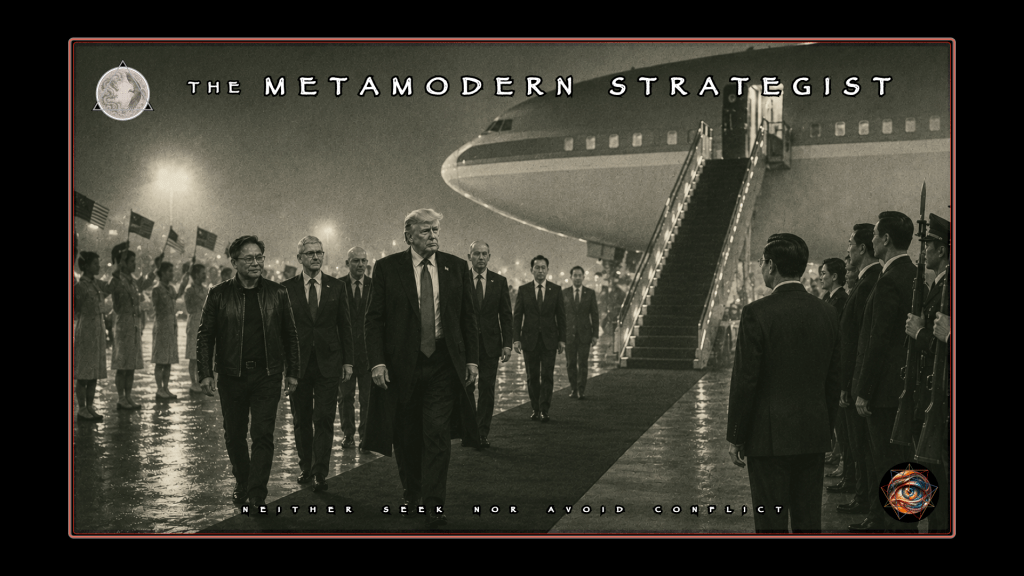
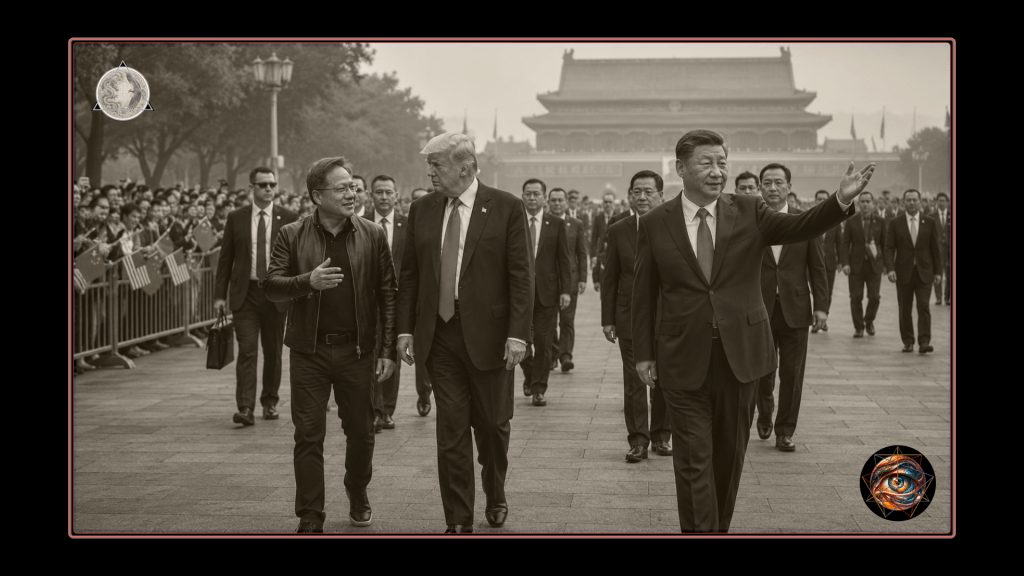
DISPATCH: My first trip to Beijing this past week aboard Air Force One went more or less as expected, leaving mere minutes for private recreation and no time for sleep. Between intense sessions spent answering questions in six languages, I shot the accompanying candid moments with my Apple lapel camera, SpaceX-optimized with the nonpublic Nvidia chip. Coming in over the Northern Pacific route out of Ted Stevens Anchorage International Airport, the most shocking naked-eye surprise to me was not that Asia is bigger than all of Texas, but that China is as colorless as these unaltered photos depict.
Flight Without Landing Gear . . .
The most powerful trade delegation in American history just flew to Beijing and back.
Between the performance of a deal and any substantial resolution of one (i.e. not a failure but the very portfolio on offer) yawns a gap just large enough to trade. Every instrument of leverage available is constrained by the same riddle, all so that the rivalry may persist. Neither government wants—nor can it afford—the peace it pretends to negotiate. China’s credit engine is not in an upswing so much as it is held aloft by fiscal scaffolding. Beijing cannot publicly acknowledge that it’s feigning more strength than it can muster. Strolling Sanlitun Bar Street after dinner, the public experience inverts the standard leverage assumption most Wall Street analysts and Silicon Valley tech bros alike use to price the relationship. Taiwan is the touchy subject where mutual-restraint logic breaks down, where the self-harm calculus that keeps Treasuries, rare earths, and semiconductors in check does not apply. There the summit’s unmentionables reveal how far out in the deep end each player will wade.
If you know how to read the tea leaves, the residue confesses what the communiqué will not. Both governments have industrialized a rivalry too fundamental to reconcile. Three years of “Constructive Strategic Stability” is the timeline they’ve priced to avoid announcing the signs they all silently see.
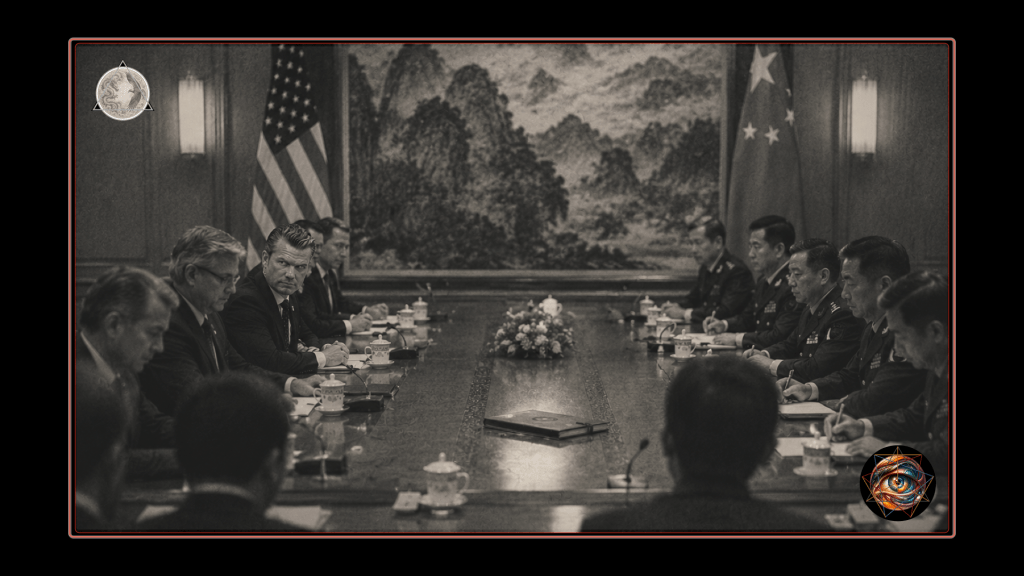
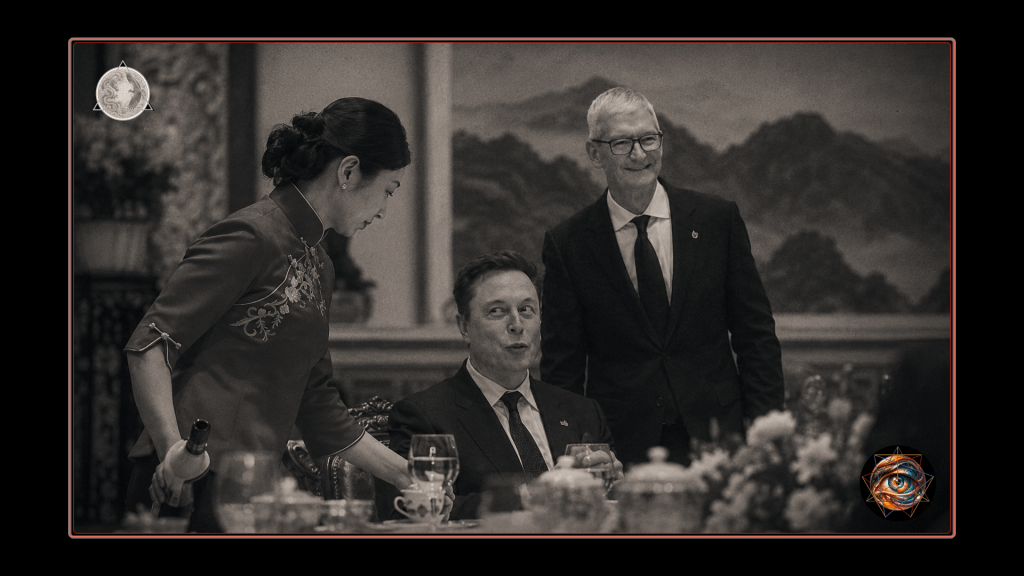
When Jensen Huang boards Air Force One during a last-minute stopover in Alaska, the geopolitical vocabulary has already evolved. The Nvidia chief’s presence on the presidential manifest is not a diplomatic accident, but the regime’s chosen idiom for a merger no longer limited to purely political stakes. Donald Trump’s hand-picked “delegation” (an almost comically inadequate moniker) carried a combined personal net worth exceeding $1 trillion, a sum greater than the GDP of most nations. Tim Cook flew from Cupertino with 80 of his top 100 suppliers already resident in the host country. Secretaries Pete Hegseth, Scott Bessent and Marco Rubio attended whatever negotiation took place in those rooms, whose bilateral architecture is too deeply capitalized to be leveraged cleanly.
Beijing and Washington agreed to something they’re calling “Constructive Strategic Stability”, a phrase which analysts parsed for substance and found only procedure. No new or constructive agreements emerged, only a trade truce, already in place since October 2025, that was extended rather than upgraded. The Big Deal that American executives had flown to Beijing expecting to announce to shareholders by Friday morning did not materialize—not because negotiations collapsed, but because that was never the mission’s objective. The spiciest commodity is time, and both regimes bought more.
Whether that is success or evasion depends on how you measure the alternative outcomes.
Command Performance . . .
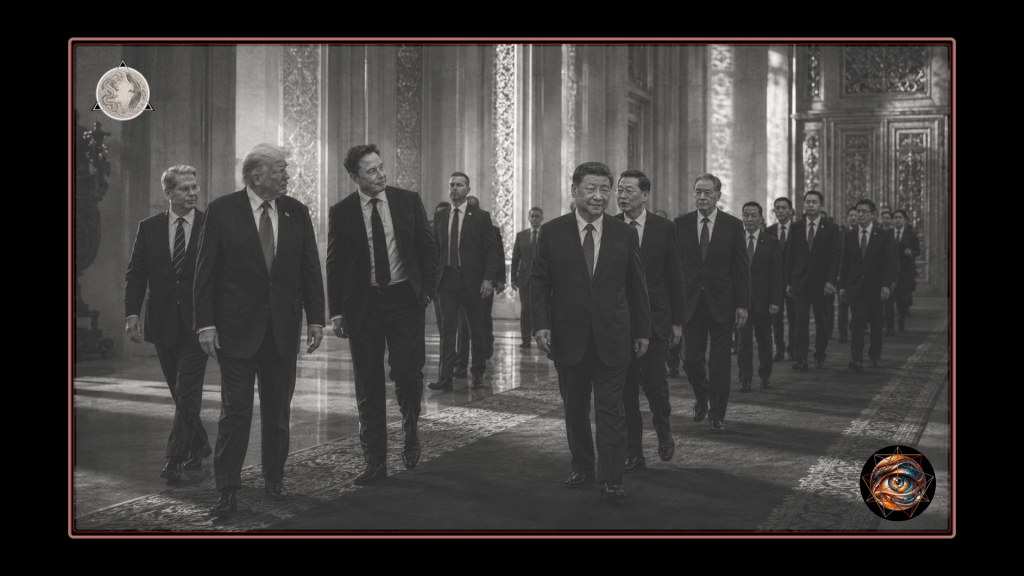
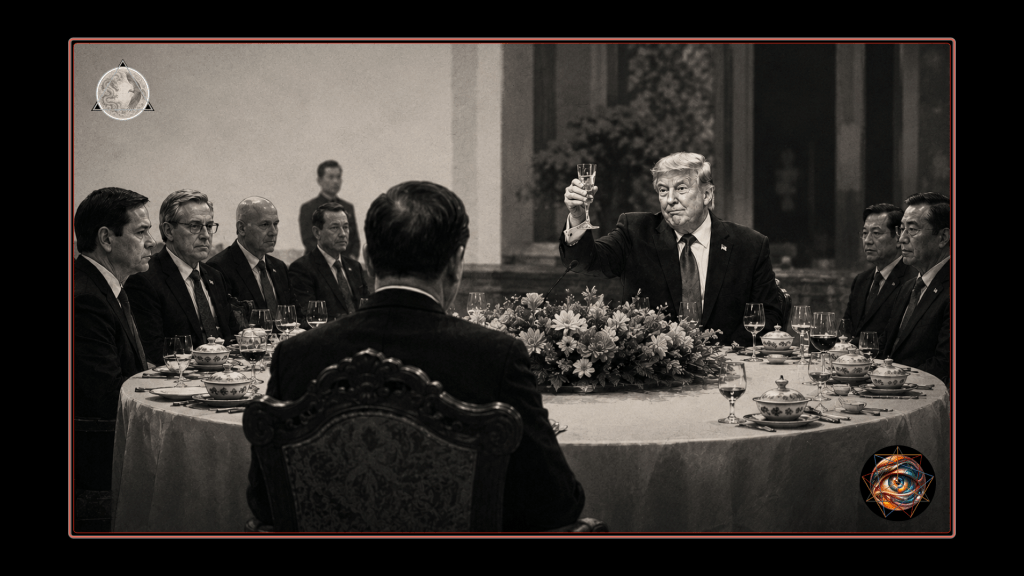
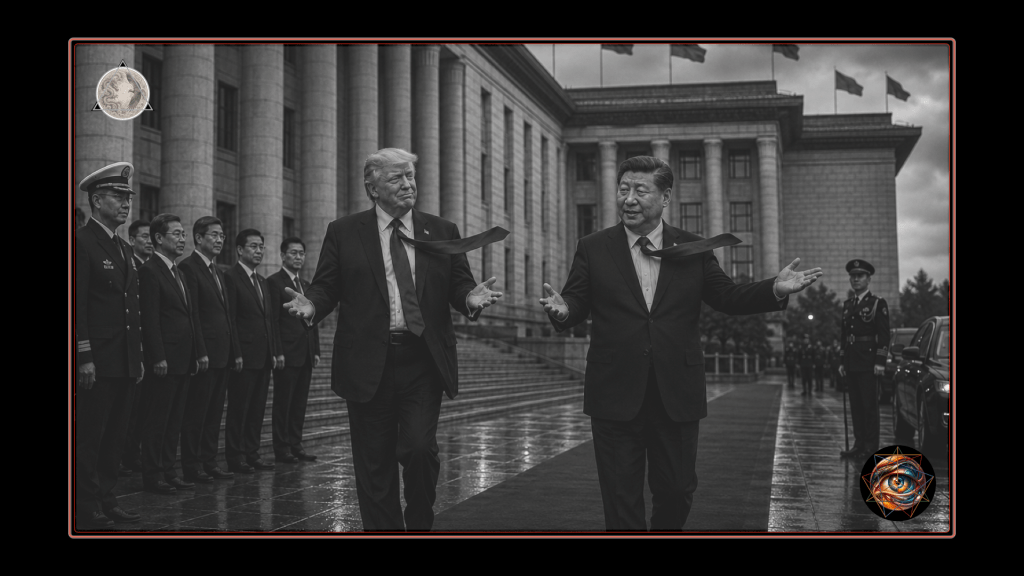
The summit’s pageantry was designed with considerable craft. Donald Trump and his entourage were greeted at Beijing Capital International Airport by Han Zheng, the Vice President of the People’s Republic of China, along with Foreign Minister Ma Zhaoxu in a red-carpet ceremony with a military honor guard and youth waving U.S. and Chinese flags. The meaning of the guest list was legible in every language: these are not men who travel for augury, but for legacy. Xi Jinping later gave a formal head-of-state welcome at the Great Hall of the People.
The implication of bilateral seriousness landed on that narrow strip, plus or minus any cargo.
China announced purchase of 200 Boeing jets, against analyst expectations of 300 to 500. Boeing closed the Thursday session down 5.88%. Before Friday, the analyst community was parsing whether 200 means “narrowbody-only” or “more tranches are coming.” The real parsing is not that an order fell short of elevated expectations, but that an immediate argument followed about what “falling short” means.
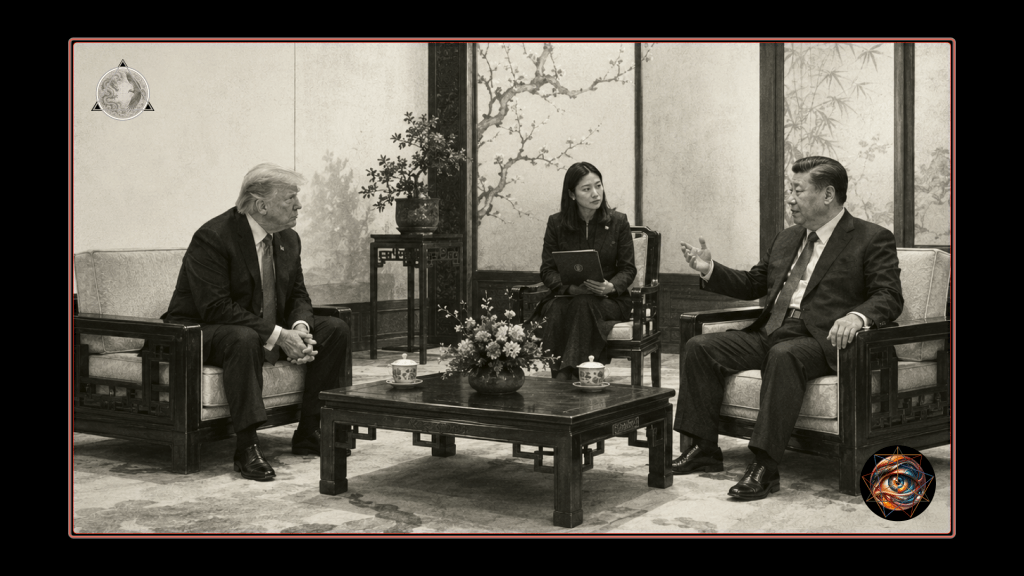
From inside the bubble, the itinerary scrawled on the back of my lipstick-smeared napkin rewards a closer reading, for Xi virtually held Trump’s hand through every event for almost three days.
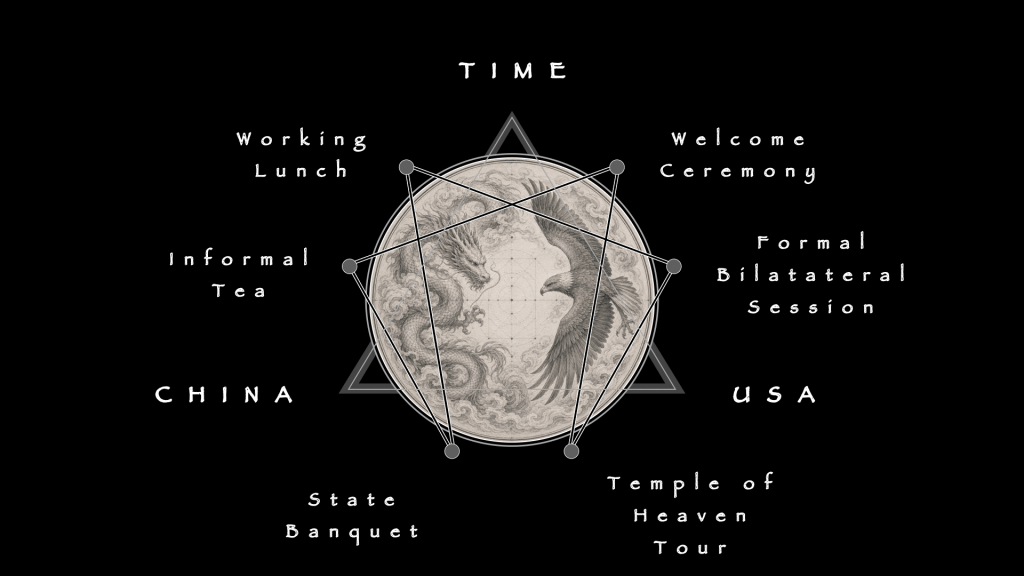
What looked to an adoring public like ceremonial hospitality looks, to the trained eye, more like professional paranoia than an over-exuberant communist drunk on civic pride.
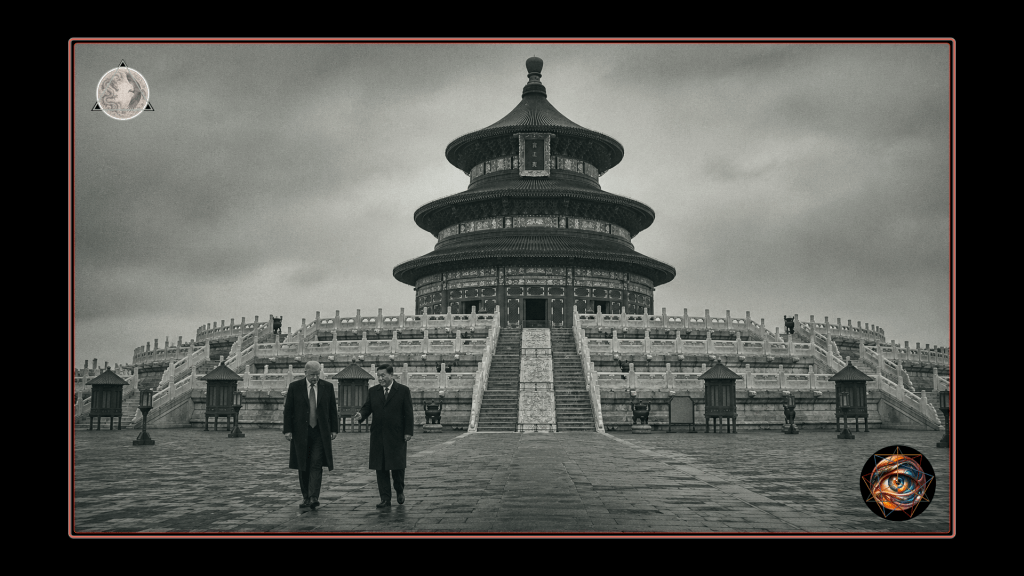
One rogue possibility hints that Xi may have held a secret session with his guest lasting up to 90 minutes within the bowels of the Temple of Heaven complex. No aides were present, only the leader’s daughter, Xi Mingze—Harvard-educated, fluent in English, and unknown to the Chinese public by design—his “illuminating grace”, served as her father’s sole interpreter in a room with half a dozen souls. Whether such a sensitive meeting actually occurred or not, the rumor more than implies that Xi may not trust his own diplomatic apparatus enough to hear a private conversation with POTUS. Even Chinese media coverage is beginning to float this reading without grounding it.
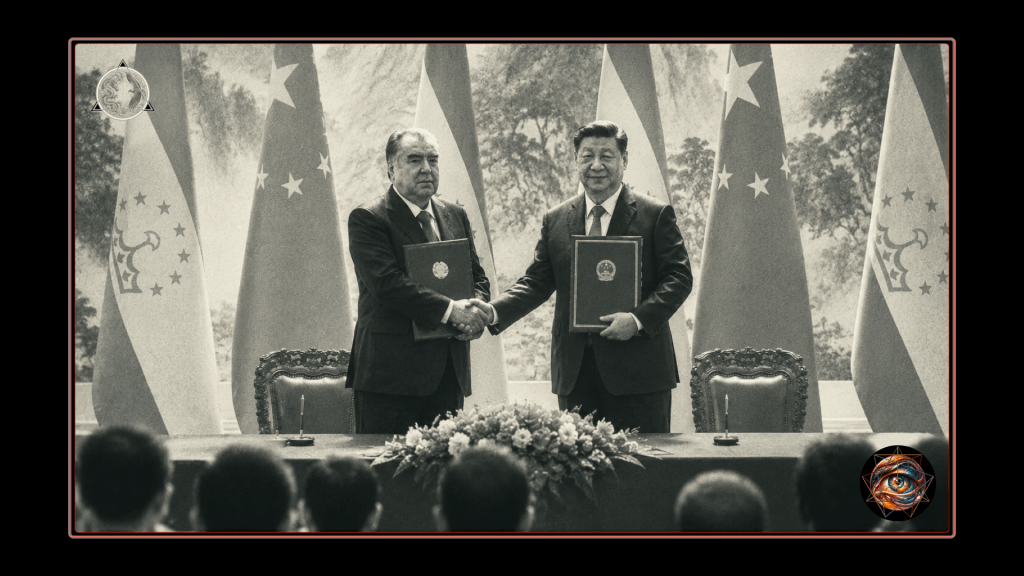
Beijing gave the summit less saturation coverage than earlier American presidential visits. To wit, the Tajik President Emomali Rahmon’s concurrent arrival received prominent treatment beside POTUS’. This was not quite a snub, but Beijing’s preferred mode of communication—an elder’s tacit reminder, delivered through editorial proportion rather than overt statement, that Washington is not the only star in the diplomatic sky.
China signed the Treaty of Permanent Good-Neighborliness, Friendship and Cooperation with Tajikistan during the same week, completing over $647 million in digital cooperation agreements and extending Belt and Road connectivity through a region that American strategic architecture has no comparable framework to contest.
The contemporaneous Global Times editorial is the key for anyone sounding the operative Chinese position beneath the courtesy. While the surface language routinely praises constructive head-of-state diplomacy, its operative message is one of habitual distrust. Presidential consensus matters only when it survives implementation. From Beijing’s vantage, the pattern is that Washington drifts back toward zero-sum containment after the handshake.
China may welcome Trump and negotiate with him, may make transactional concessions with the Eagle, but the Dragon does not assume that Trump, the man himself, beats the broader foreign policy wings that stir whatever storm begins or ends behind closed doors.
A Lever Jerked Hard Enough Eventually Comes Loose . . .
The chief irreconcilable feature of the US-China rivalry that makes it so resistant also makes it so persistent. The obvious weaponizable instruments of coercion available to each side are unsurprisingly self-defeating at the moment of deployment. China holds approximately $693 billion in US Treasuries as of early 2026. The figure sounds catastrophic until measured against a $29 trillion market where it no longer ranks as the largest foreign holder, having been surpassed by Japan and the UK. Rapid liquidation would compress its own reserve value in real time, strengthen the yuan against export competitors, and arrive at a Federal Reserve that has spent decades calibrating backstop mechanisms for precisely this scenario.
This grenade is a fortune cookie with a pin installed on each end.
Rare earths are the mirror image from Beijing’s side. China processes 91 percent of global supply. It deployed that dominance through two waves of export controls in 2025, covering twelve of the seventeen elements, using administrative friction rather than formal embargo. Shipments of magnets to South Korea and Japan dropped more than 90 percent between March and May 2025 without a single announced ban. The strategic ceiling is the same in every domain. Any genuine sustained embargo accelerates the Western mining and processing buildout that Beijing spent two decades preventing. MP Materials completed vertical integration in 2025 under a decade-long Pentagon supply agreement at guaranteed floor prices. Every month China maintains export restrictions, the financial case for Western alternative sourcing grows stronger.
Semiconductors follow identical logic at higher velocity. When the Trump regime restricted H20 chip exports to China in April 2025, Nvidia estimated the cost at $5.5 billion in impaired revenue. The regime reversed the decision in July, approved H200 exports under a capped framework, and China conditionally licensed ByteDance, Alibaba, Tencent, and DeepSeek to purchase over 400,000 chips collectively. As of early May 2026, Nvidia has generated zero revenue from that license.
With its Ascend 910C processors, Huawei is on track to capture the largest share of China’s AI chip market in 2026. Its semiconductor self-sufficiency rate has risen from 33 percent in 2024 to an estimated 50 percent in 2025. Restricting Nvidia’s access to China punishes Nvidia’s revenue, while it may decelerate China’s domestic buildout.
The system oscillates between two forms of self-harm. The options market agrees, pricing the semiconductor sector at the 100th percentile of implied volatility over the past year. A 12-month ATM straddle on the sector at that level requires the index to trade above $690 or below $315 by expiry to be worth the squeeze. The market is not making a directional bet so much as pricing a compression field. Are these parallel readings coincidental, or emergent?
Taiwan is the one theater where symmetric self-punishment calculus does not apply, where instead the weapon and its risk to the wielder can, momentarily and disastrously, decouple.
A Dire Strait . . .
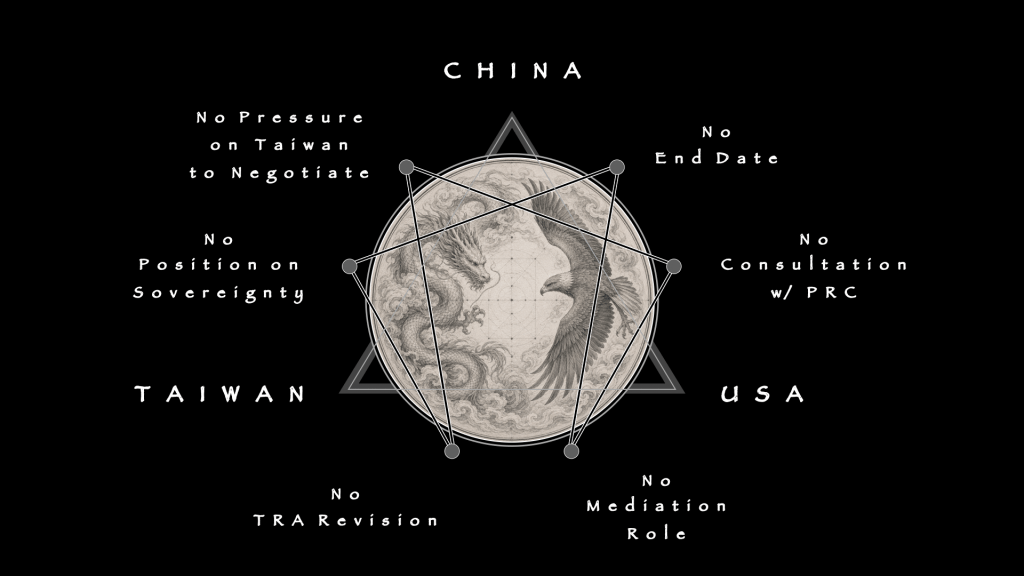
The Taiwan asymmetry is the summit’s most kinetic—and its most underpriced—element. Xi clearly stated that Taiwan ranks highest in Sino-American relations, warning that any mishandling of the island risks open conflict. China’s foreign ministry echoed the warning, the American readout omitted Taiwan entirely, and the divergence was no accident. This is narrative risk management, each side unilaterally broadcasting the most necessary message of the hour to its domestic consumers irrespective of the other’s reading.
As always, consequential developments occur before any summit convenes.
Trump announced in February 2026 that he had discussed Taiwan arms sales with Xi—the first sitting American president to publicly disclose bilateral consultation on the question—prompting bipartisan alarm over violation of Washington’s long-standing pledge not to seek Beijing’s approval for weapons transfers to Taipei. At first privately, in 1982, and later via congressional resolutions in 2016, the doctrine is frequently cited by U.S. officials as a pillar of its Taiwan policy, alongside the Taiwan Relations Act (TRA). Therefore Trump’s public suggestion that he might discuss or consult with Xi about Taiwan arms sales has drawn rhetorical fire.
Specifically, the Six Assurances are policy commitments that the Reagan regime conveyed to Taiwan during negotiations over the Third U.S.–PRC communiqué on arms sales.
After the largest arms package in American history, aimed at Taiwan, was approved by Congressional leadership, it stalled at the White House pending summit optics. Pressure has been building for months. The freeze has a thaw date. When it arrives, defense contractors servicing Taiwan’s military upgrade will be the darlings of demand.
Pete Hegseth’s presence in Beijing foretells the ideal channel for managing the next chapter: military-to-military communication. The long-desired consortium has already been interrupted, reopened, and interrupted for decades, its reliability inversely proportional to whatever momentary rhetorical heat surrounds it. A Secretarial visit at this juncture suggests that both sides want a working back channel before the Taiwan package resumes processing.
The $13 billion question is not whether Taipei eventually gets its money, but whether the delivery timeline affords enough runway to absorb the signal before the pressure exceeds the tolerance of the pipe.
The Credit Engine That Couldn’t . . .
China’s credit contraction is not a demand-side problem that eases when tariff pressure decreases, but a balance sheet problem rooted in the structural collapse of the property collateral system that served as the primary household wealth storage mechanism for two decades, and no trade framework exists with the transmission pathway to reach it. The argument that domestic weakness increases American leverage nurtures an analytical error that becomes more consequential the more confidently it is held. The idea categorically usurps the logic of market economics and applies it to a political system that converts pressure into output through an irreconcilably different mechanism.
The upstream source of China’s weakness is a savings architecture one might describe as choking off ordinary consumption by transferring income away from households and toward the state, manufacturers, and investment channels. Low returns on savings, weak labor power, and currency management elevate the national savings rate by curbing the household share of national income. The plan proves its success because people produce more than they can afford to consume. Of course, the gap must land somewhere, so for two decades China has chosen real estate, then infrastructure, and ultimately industrial capacity that its domestic market could never realistically absorb.
Well past the point of useful investment, concrete keeps pouring, ribbons are cut, and the debt remains. Japan ran this model in the 1980s, studied the invoice, and remitted a copy to Beijing sans cover letter. New RMB loans contracted outright to negative 10 billion yuan in April 2026, against March’s nearly 3 trillion. Total social financing plunged to 620 billion yuan from over 5 trillion the prior month. Government bond issuance is sustaining the aggregate figures through fiscal scaffolding, not through the private risk appetite that would indicate genuine reflation. This is not a cyclical trough. It is the Tokyo Drift playbook on rewind.
Spoiler alert: fiscal substitution deployed for three decades still fails to produce the promised perpetual motion engine.
The surplus China cannot absorb domestically must be absorbed externally. The United States—through no design of its own—is the consumer of last resort by structural compulsion. Its financial markets are deep, liquid, and attractive to global excess savings. Surplus countries generate capital that needs a parking lot, much of which flows into dollar assets. Balance of payments accounting then does its blunt work: foreign capital inflows require a corresponding trade deficit.
The United States did not intend to invite every imbalance. It dug the money pool deep enough to leave no better swimming hole, and the whole world came to party. The irony, almost too neat to be accidental, is that the land that rejected Keynes’s postwar proposal to penalize persistent surplus behavior would spend the next seven decades absorbing surpluses it declined to constrain.
The transmission scheme inverts the leverage assumption precisely because economic pain in a system without electoral accountability never produces concession. The only safe response available to leadership that cannot publicly acknowledge the internal source of its impossible position is a show of resistance. Xi came to this summit not from a position of strength. The military leadership purges of 2023 to 2025, without peacetime precedent, do not readily resolve into consolidation or anxiety. Xi’s unusual inward focus since October, his announced absence from the BRICS summit for the first time, the succession silence that has persisted despite mounting external and internal pressure do not prove incapacity. They are, however, the fingerprints of a system whose information architecture is so thoroughly consolidated that its leadership may no longer rely on the accuracy of signals received from subordinate layers.
A visibly cracking mega-dam is not repaired at the negotiating table, but remotely inspected and declared sound by parties who cannot afford to say otherwise.
The Undiscovered Corridor . . .
The bilateral frame for the summit systematically excludes the geography where China has been most consequential and least interrupted. Belt and Road engagement in 2025 reached a record $213.5 billion in new deals, up 74 percent from the prior year. A corridor traced from the Persian Gulf across the Caspian littoral, through Turkmenistan, Uzbekistan, Tajikistan, and Kyrgyzstan to Chinese railheads in Xinjiang is more succulent than any trade metaphor. It is a physical overture performed since 2013, while American attention wandered. Unhurried and uncontested, the locals twisted geography into alignment the way long acquaintance becomes something neither party thought to name until they were too deeply embedded to withdraw without damaging what they had entered.
The resulting operational dependency resists the financial instruments Washington is most comfortable deploying.
Countries whose power grids, telecommunications networks, and road corridors run on Chinese-built infrastructure need not be forced to the bargaining table. The CSIS analysis published in April 2026 documents this infrastructure dependency trap explicitly, modeled on Moscow’s Soviet-era outcome but executed through commercial rather than military means. Commercial dependency is harder to contest than military presence because it requires the host country to actively destroy its own functioning infrastructure to exit.
The last time Washington paid sustained strategic attention to Central Asian politics was in the immediate aftermath of September 11, 2001. That era lasted barely a decade and then shoved off to chase other dreams. Meanwhile, earnest Chinese investment began around the same time, 2013, and has only grown. The compound effect is the asymmetric influence that now exists in the corridor.
The Iran dimension compounds this geography in ways the summit’s readout cannot honestly address. China has been absorbing Iranian oil throughout the February 2026 conflict period at rates that Scott Bessent characterized as funding terrorism. The Treasury Secretary urged his Chinese counterparts to use their leverage over Tehran to reopen the Strait of Hormuz.
China’s incentive structure runs in the opposite direction: Iranian energy dependency is a hedge against precisely the maritime interdiction that American naval presence could threaten.
Washington and Beijing found nominal common ground on the principle that no nation should impose tolls on international waterways. The formulation carefully acknowledges a shared interest without requiring China to take any action that costs it Iranian energy access. The summit covered chips, tariffs, Taiwan, and military communication channels.
Whatever lies discretely outside the bilateral frame is simply not discussed.
The Management of Discontent . . .
There is a feature of this rivalry that neither government’s official communications dares describe, because naming it would dissolve the discretion that names require. Both regimes depend on the rivalry’s continuation to justify expenditures and policies that would face severe internal pressure without it. American defense authorizations require a peer adversary to sustain political coalitions that would otherwise fail to coalesce around proposed spending levels. Chinese techno-nationalism, capital controls, and industrial subsidies require the American containment narrative to function as domestic political legitimacy.
This corporate hostage-crisis makes the plot legible to TransPacific speculators in real time:
- Apple’s supply chain runs through 80 of its top 100 suppliers in China
- Nvidia’s exposure produced a $5.5 billion impairment estimate in a single quarter
- Boeing has been negotiating a potential order for up to 500 737 MAX jets
BlackRock’s asset management revenues, Goldman Sachs’s advisory relationships, and every institutional equity portfolio holding these companies are material stakeholders in the continuation of a functional bilateral relationship. The executives who flew to Beijing did not arrive as symbols of partnership. They arrived as the visible expression of private capital declaring its dependency in the one language all governments speak fluently.
What neither government has disclosed to its own population—and what the summit’s careful choreography is designed to continue not disclosing—is that a genuine resolution would be more destabilizing than the managed tension it would replace. Washington needs Beijing as the justification for industrial mobilization, chip export controls, and defense appropriations that cannot survive peacetime budget conditions without a peer adversary. Beijing needs Washington’s containment pressure as the legitimacy structure for party discipline, techno-nationalism, and the suppression of dissent that would otherwise require a different account of itself.
The most dangerous output of “Constructive Strategic Stability” is not conflict, but sedation: a status quo so well-administered that the stresses it was purchased to defer become invisible to the markets watching from outside. If allowed to normalize, it may price itself out of the tail distribution precisely at the moment they are accumulating. Both governments have spent the past decade manufacturing the crisis. Three more years of resolving nothing while appearing to try everything is a bargain. Their populations have been trained to read that brand of failure as statesmanship.
In the real world, where decisions are made, the drama’s true audience was never the other population or its rival government.
Every summit communiqué, readout asymmetry, or carefully staged photograph of Xi and Trump shaking hands was composed for viewers who need to believe that a crisis is being managed, if not averted, and that international relations are harmonious because the show-runners understand the plot. In reality, “Constructive strategic stability” is not the dry description of a bilateral relationship, but a fluid message between populations whose governments prefer to remain calm as the dam they reinforce threatens, a little more each year, to finally disgorge.
Six Questions
The following flights of fancy are loose reconstructions of debriefings presupposing a specific institutional perspective, composed between Vladivostok and Jackson Hole. They are not continuous with the foregoing report, but reconstituted after a weekend of sleep, before returning to normal duties. This bolted-on appendix should be read as a separate layer of analytical compression applied to the same field, optimized for public consumption.
Question 1 — POV: A Tajik Infrastructure Minister Briefing His Cabinet on May 18, 2026
Q: What do regional analysts fail to consider when they treat the summit as a bilateral contest between Washington and Beijing, rather than as a three-layer system in which Central Asia, the Persian Gulf, and Taiwan form one continuous corridor of energy, logistics, military signaling, and diplomatic substitution?
A: The Central Asian development corridor is a physical fact that American regional analysis persistently treats as context rather than content. The cost of that treatment is a systematic mispricing of where the actual decisions are made, by whom, and against what alternatives. From Dushanbe, the Trump-Xi summit appears not as a bilateral event between the world’s two largest economies but as one pressure reading inside a distributed system that has been reorganizing itself, continuously and without Washington’s significant attention, for at least fifteen years.
The Belt and Road presence here is not primarily financial.
American analysts who track the BRI through its debt mechanics—loan terms, collateral arrangements, debt trap narratives—are measuring the instrument rather than its objective. The mission is connectivity dependency, which now exists. Tajikistan’s power grid runs on Chinese-built infrastructure. Uzbekistan’s 5G network runs on Huawei equipment. Kyrgyzstan’s primary road corridor to external markets runs through Chinese-financed tunnels and bridges. A country whose critical infrastructure was built by a vested partner does not need to be coerced into diplomatic alignment when credible alternatives might be offered. None has been constructed because the American infrastructure investment climate that might have done so has been chronically underfunded, institutionally fragmented, and strategically inconsistent across regimes in precisely the way Chinese investment has been consistent.
When Beijing hosted President Rahmon alongside President Trump, the signal was not directed at Washington. The audience was every capital along the corridor watching whether Beijing’s management of the American president changed its behavior toward regional partners in any observable way. The resounding answer the ceremony clearly delivered was NO. The message to Tashkent, Almaty, and Bishkek is precise: Beijing’s relationship with Washington is a managed variable, not a governing constraint.
The Trans-Asia Gas Pipeline carries Turkmen gas directly to Chinese industrial consumers through a route that bypasses Russia entirely. It was built as infrastructure and now limits the decision calculus of every government along its route without ever requiring activation. The American pressure on China over Iranian oil purchases is not separable from this corridor, because it hedges against the maritime interdiction that American naval presence would threaten.
Washington prices these as separate policy files, but the corridor connects them physically.
The last time Washington paid sustained strategic attention to Silk Road politics was in the immediate aftermath of September 11, 2001. Forceful attention lasted barely a decade and then withdrew. Chinese infrastructure investment began in earnest in 2013 and never withdrew. The compound effect of that asymmetry is the corridor that now exists.
. . .
Question 2 — POV: A Federal Reserve Senior Economist Who Has Spent Six Months Inside the People’s Bank of China on an Exchange Fellowship
Q: What do American diplomats fail to consider when they assume China’s domestic weakness increases U.S. leverage, and what do Chinese diplomats fail to consider when they assume American institutional fragmentation makes U.S. commitments disposable, given that both assumptions may cause each side to misread constraint as flexibility?
A: Both diplomatic classes have access to information that would correct their error and choose, for explicable reasons, not to apply it. This is not an intelligence failure, but a failure of taste. Each side prefers the misread because accuracy is politically more expensive than the tactical cost of the error, which is the only calculation that domestic accountability systems are designed to optimize.
The American error runs as follows. China’s credit contraction, property market dysfunction, and household confidence collapse are read as pressure accumulation that will eventually force Beijing to the table. The misapplied logic is borrowed from market economics: a distressed counterparty must eventually seek relief, and the stronger party extracts concessions as the price.
The PBOC does not operate the way the Federal Reserve operates, and the difference is constitutional.
Economic pressure in China does not produce electoral pain because there is no body to feel it. It can only rouse social instability, which the party’s internal security apparatus suppresses, and nationalist mobilization, which the party’s propaganda apparatus amplifies. The visitor feels what the institution cannot, which is the specific discomfort of understanding a system more honestly than it understands itself. The American diplomat who reads Chinese credit contraction as leverage misunderstands a variable whose output in the Chinese political system is the opposite of its American counterpart’s.
The deeper error is a misunderstanding of what household credit contraction actually measures—the collapse of the property collateral system that once served as the primary household wealth storage vehicle. Chinese households do not primarily hold equity portfolios or bond funds, but property: the collateral base against which consumption, entrepreneurial risk-taking, and intergenerational wealth transfer coalesce. The destruction of that base is not a confidence problem that eases when tariffs decrease. It is a balance sheet problem that persists until the collateral is repriced and the repricing absorbed.
The Chinese error is constructed from equally specific materials. American institutional fragmentation—the gap between presidential commitment and congressional authorization, between diplomatic assurance and defense establishment behavior—is read as systemic incoherence that makes American commitments unreliable. This conflation produces random outputs with distributed constraints, which are difficult to coordinate, persistent across time, and resistant to central reversal.
What six months inside the PBOC teaches, if it teaches anything that cannot be unlearned, is that both institutions are managing the same fundamental exposure—a gap between what the system can honestly report and what the political climate requires it to say. Each side’s domestic political grammar is precisely the lens that distorts the other side’s signals most severely. The fellowship does not produce understanding, only the recognition of someone who has slept in the same bed and learned, before dawn, which side each party protects.
. . .
Question 3 — POV: A Sovereign Wealth Fund Risk Officer in Abu Dhabi Building a 20-Year Scenario Model
Q: Where do those blind spots converge if China’s credit weakness, America’s alliance-management burden, Taiwan’s symbolic centrality, Iran’s energy leverage, Central Asia’s corridor politics, and corporate dependence on cross-border scale are not separate files but one compression field—and what can neither government name publicly without admitting that the rivalry has become a shared mechanism for postponing domestic reckoning?
A: Portfolio exposure is total, so any model must hold everything at once. A compression field is the best analogy of what happens when multiple high-pressure variables occupy the same space without any of them being acknowledged as components of a unified system. To call the result nonlinear would be like calling King Kong a large primate.
I do not need the luxury of a Silicon Valley analyst’s flashpoint framing or a Lujiazui trader’s sector-by-sector decomposition to admit that liminal events produce periods of apparent stability followed by discontinuous state changes that retrospective analysts will later call “sudden”.
The first hidden variable is the fiscal codependency between the rivalry’s continuation and both governments’ domestic budget posture. American defense spending at current levels requires a peer adversary, while Beijing’s industrial policy subsidization and capital controls face an identical dependency from the opposite direction.
The second is energy corridor dependency. China sources the majority of its industrial energy through sea lanes that American naval presence notionally secures. The country that American strategic doctrine identifies as its primary adversary depends for its industrial survival on infrastructure that American force posture protects. Neither side says this aloud because saying it would require each to acknowledge the depth of the mutual dependency the rivalry narrative is designed to obscure. The status quo prices this as a structural floor beneath the conflict—the thing that prevents the pressure from discharging completely regardless of what either government announces.
A third hidden variable is corporate dependency—the most liquid exposure, and the one most likely to move first in a stress scenario. Apple, Tesla, Boeing, BlackRock, Goldman are all material hostages to the continuation of a functional bilateral relationship. The corporate presence at the summit was private capital arriving in person to remind both governments of the exposure they share, and of the costs they would incur if managed tension transmutes into something less manageable.
The near-term scenario the model assigns the highest probability is not to escalation and not to resolution, but to a low-volatility grind: no rupture and no grand bargain, opportunities priced out of the tail distribution precisely as they accumulate.
Three-year frameworks are designed to produce precisely this outcome. Summits release pressure the way a valve does: locally, temporarily, and without reducing the total system load. No model can tell you when the threshold arrives, only that the pressure distribution makes an arrival inevitable, and that some unlucky player will be appointed to sit at the table when it does.
Tail risk allocation does not decrease; the game is simply played until it isn’t.
. . .
Question 4 — POV: A Japanese Maritime Insurance Underwriter in Tokyo Pricing Indo-Pacific Shipping Risk
Q: What do regional analysts fail to model when they treat Taiwan as the primary flashpoint, while ignoring the possibility that Taiwan is the visible fuse attached to a larger circuit running through Japan, the Philippines, Korea, semiconductors, shipping insurance, undersea cables, and U.S. force-posture credibility across the entire Pacific rim?
A: Taiwan is not the circuit, but the label on the breaker. The actual circuit runs through infrastructure that does not appear on any alliance map, embedded in private commercial networks the way load-bearing walls are embedded in a building whose blueprints have been lost. Military analysts model kinetic thresholds, and insurance underwriters model cascading withdrawal, but those are not the same event, and they do not share a timeline. The second can cause most of the damage associated with the first without a single exchange of fire.
The undersea cable infrastructure is the most consequential and least discussed node. Some 400 cable systems carry roughly 95 percent of international data traffic. Those connecting Japan to Guam, the Philippines to regional financial centers, and Taiwan to the global internet are largely undefended, physically accessible to any actor with a cable ship and a plausible maintenance cover story, and governed by no treaty framework with meaningful enforcement provisions. A coordinated interdiction of four to six segments in the Philippine Sea would not trigger Article 5. It would sever Taiwan’s financial system from global clearing, disconnect Japanese and Korean military command networks from American coordination infrastructure, and create a data blackout the insurance market would price as a total loss event.
The treaty frameworks that American strategic planners regard as the architecture of deterrence contain no provisions for the asset class that actually moves the digital economy.
The shipping insurance withdrawal mechanism is the node that self-executes without any government decision. Article 5 and the Taiwan Relations Act both describe obligations that activate on the far side of a threshold event. The insurance market activates on the near side, at the first credible signal the headlights reveal.
A naval intercept in the Taiwan Strait, a coast guard boarding at Second Thomas Shoal, or a missile test bracketing the eastern defense identification zone would not constitute the casus belli that Article 5 requires. It would constitute an underwriting event. In the Persian Gulf in 2019, insurance premiums spiked 300 percent following tanker incidents that fell well short of open conflict. A comparable signal event in the Taiwan Strait would price smaller operators out of regional routes within weeks, with major container lines following their insurers rather than their governments. The trade disruption that American strategic planners model as the aftermath of kinetic conflict would materialize as a consequence of elevated threat signaling, driven entirely by private market actors responding to actuarial logic.
No government orders this, and no government can stop it.
The semiconductor supply chain’s actual vulnerability map runs through nodes the Taiwan production narrative consistently obscures. TSMC’s fabs are the visible asset. The invisible asset is the ASML extreme ultraviolet lithography machine—irreplaceable on any timeline shorter than a decade—without which the fabs cannot process wafers regardless of who controls the the real estate. That concentration risk exists independently of any political scenario, currently unhedged, uninsured, and absent from every official diplomatic readout of the summit’s technology discussions.
The force posture credibility problem is where the circuit closes. Trump’s willingness to discuss Taiwan arms sales with Xi, publicly, on Air Force One before departure, communicated to every Pacific capital that the alliance arrangement system depends on is a floating variable. Whether any soft targets were penetrated is a question for the foreign ministry. Whether the signaling changed the pricing of tail risk in the insurance market is a question the underwriter has already answered, because the premium adjustment does not wait for implementation.
The circuit does not require kinetic activation to discharge.
The only requirement is that the threshold of a credible threat be sustained long enough for private market actors to act on their contractual right to withdraw coverage. At that point, the economic consequences that American strategic planners paint as the aftermath of conflict will have already arrived, and the diplomatic communiqués that were supposed to prevent them will become the document that preceded them. The underwriter closes the model, updates the tail risk distribution, and does not reduce the war risk premium.
The circuit is still loaded—the cables are still undefended—the formula still holds.
. . .
Question 5 — POV: A Chinese Communist Party Historian Specializing in the Internal Politics of the Late Qing Dynasty
Q: What do American diplomats fail to consider when they read China’s debt, demographics, property collapse, and credit weakness as signs that Beijing must eventually compromise, and what do Chinese diplomats fail to consider when they read America’s polarization, deficit politics, military overreach, and elite incoherence as signs that Washington cannot sustain pressure?
A: The American diplomatic reading of Chinese weakness as eventual compromise has a historical antecedent that should terrify anyone applying it as a policy assumption.
The late Qing court was financially exhausted, militarily degraded, and institutionally fragmented for the final four decades of its existence, yet it did not become more flexible as it weakened. Instead, it became more rigid, more symbolically assertive, and more willing to accept externally catastrophic decisions precisely because internal legitimacy required the performance of resistance even when the strategic calculus was clearly unfavorable. Weakness did not produce accommodation, but symbolic mobilization, which is more dangerous than strategic calculation because it defies rational cost-benefit deterrence.
The Qing parallel is structural, not decorative. The dynasty’s terminal decades were characterized by a recurring pathology. The leadership class understood privately that the correlation of forces was unfavorable and that reform was necessary. Private understanding did not, however, produce reform. It produced the Boxer Uprising—the catastrophic deployment of popular nationalism as a substitute for military capacity, a crowd sent against artillery because the court needed the crowd to believe it was being sent against an enemy rather than toward a slaughter. The decision made perfect sense as a domestic legitimacy management operation, but was strategically ruinous.
The gap between those evaluations then is the same that American diplomacy fails to measure now.
Xi Jinping’s consolidation of party authority, his elimination of term limits, his systematic reduction of technocratic autonomy—these are not the actions of a leader who believes institutional flexibility will produce better outcomes. They are the actions of one who has concluded that the primary risk is internal fragmentation under external pressure, and who has therefore traded adaptive capacity for cohesion.
That trade has a cost. Cohesion purchased by suppressing internal correction means that policy errors propagate before they encounter resistance. The property market collapse was not a surprise to everyone inside the Chinese system, only to the political layer that had insulated itself from the analytical layer delivering the warning. American sanctions on Chinese technology companies did not produce Chinese concession, only domestic chip investment, industrial policy acceleration, and a political narrative in which American containment became the explanation for every economic difficulty.
The Chinese mirror-image reveals the same diplomatic category confusion between political coherence and strategic continuity.
American commitments have survived enormous internal turbulence precisely because the institutional architecture sustaining them does not depend on presidential will. It is embedded in bureaucratic structures, congressional authorizations, allied expectations, and private market arrangements that persist across regimes. Beijing simultaneously believes that Washington cannot maintain pressure because its institutions are fragmented, and that Washington is executing a coordinated containment strategy through those same fragmented institutions.
Each side mistakes the other’s structural condition for a negotiating posture and applies pressure expecting capitulation.
The pressure instead triggers the symbolic mobilization response the rigidity was always primed to produce. The cycle’s terminus is not a negotiated settlement, but either at a face-saving transactional pause—which is what the Beijing summit was—or at an incident that neither side planned but both sides made structurally more likely by persistently mistaking constraint for choice.
The Qing did not fall because its enemies were strong. It fell because its leadership spent the dynasty’s final decades making decisions that were domestically rational and strategically catastrophic, inside an institutional environment that had eliminated the corrective mechanisms that might have interrupted the sequence. A career spent inside those archives teaches that a pause inside a terminal sequence sounds … exactly like this.
. . .
Question 6 — POV: A Political Psychiatrist Studying the Decision-Making Pathology of States in Terminal Legitimacy Stress
Q: Where do those failures converge if both diplomatic classes are mistaking the other side’s internal decay for negotiable weakness, when decay more often produces rigidity, symbolic escalation, and risk acceptance precisely because leadership cannot safely admit the true source of constraint?
A: Both diplomatic classes make the same cognitive error from opposite ends of the same table. Each reads the other’s decay as a sign of approaching flexibility, when the clinical literature on institutional stress under perceived existential pressure shows the opposite pattern with high consistency. States that cannot admit the true source of their constraint do not become more reasonable as constraints tighten. They become more invested in the narrative that the constraint is external, because the alternative is a legitimacy event that no leadership can survive in its current form.
The substitution problem is the most immediate pathology. When a government cannot address the true source of its constraint—a property market that will not reflate, an alliance system that requires constant costly reassurance, a demographic curve that makes every long-term projection unfavorable—it substitutes symbolic performance in the domain where it retains apparent control.
For Beijing, that domain is sovereign assertion. Taiwan framing and the Global Times editorial communicate distrust in the language of diplomatic courtesy. Protocol theater and rare earth signaling are evidence that the leadership is not yielding. None of these actions advances a concrete strategic objective, yet each addresses a domestic audience that requires continuous proof of resistance.
Washington’s substitution operates through a different register of the same logic. The chip export controls, the Taiwan arms sale announcements, the force posture signaling in the Philippines and Japan—these are not primarily calibrated to deter Chinese military action, but to satisfy a domestic political coalition that has decided China is the explanation for American industrial decline, wage stagnation, and technological displacement. The policy does not need to work strategically, only to work narratively. The chip controls accelerated Chinese domestic semiconductor investment rather than retarding it.
Each side’s performance of threat provides the other side’s leadership with the external pressure narrative it requires to justify internal discipline.
Beijing’s assertiveness gives Washington’s defense establishment the justification it needs for Indo-Pacific force posture spending that would otherwise face serious budget pressure. Washington’s containment architecture gives Beijing’s party apparatus the justification it needs for techno-nationalism, capital controls, and the suppression of private-sector actors whose independence threatens party oversight. Both governments co-produce the rivalry that each publicly frames as an external imposition. The rivalry is not a condition they manage, but an output they manufacture jointly, because both production lines depend on it.
The ratchet effect is where the analysis becomes genuinely dangerous, as de-escalation requires explaining to a domestic audience why the threat that justified the original escalation has diminished.
No explanation is available to either leader, because the political climate depends on the threat narrative. Remove it and domestic compliance loses its primary motive. China announced 200 Boeing jets on May 14, against expectations of 500. Boeing fell 5.88%. By the time Air Force One cleared Chinese airspace, analysts were already parsing whether the disappointment was a one-off or a trend.
The clinical record does not require novelty to be damning, only that a pattern be present, and one is. Two leaders, each managing an internal crisis he cannot publicly name, perform a mutual threat so convincingly to their domestic constituents that the threat is now the product, a rivalry become revenue model. The summit has become the annual report—issued not to shareholders who expect returns, but to blocks who require reassurance that the firm still stands.
The annual report looked convincingly serious—the choreography was assuredly impeccable—the bean counters remain underwhelmed.

Leave a Reply