There are words whose etymology is purely decorative. It hangs behind their name like an ancestral portrait, impressive and dateable but doing no actual work. Then there are words whose history remains operative, words that still carry inside ordinary use the outline of an older discipline, the way a fossil carries the outline of a once-living body. Contemplate belongs to the second category, and what it carries has been invisible for so long that most people have stopped suspecting anything is there. To attend to this word seriously is to discover that it once named a procedure before it named a feeling, a recoverable procedure.
Recovery requires discipline in three registers simultaneously. First, the word must be held with the kind of focused attention that refuses to let surface meaning stand as final meaning, an attention that notices the gap between what a term currently does and what its internal structure once required it to do. Second, any inquiry must declare its own limits, committing to what counts as evidence and what does not, excluding plausible but untethered speculation, refusing the comfort of vague historical color. Third, the yield must be interpreted not as a curiosity but as a functional instrument, something that changes what is possible in a live exchange the moment it is introduced. These three requirements are not sequential. They operate together or not at all, the way three legs of a stool do not take turns holding weight.
Time does not corrupt language deliberately; it simply continues, and words spoken in changed contexts accumulate new pressures that the original structure was not built to bear.
The apparatus that once governed a word’s use does not break suddenly, but loosens joint by joint until the word still sounds like itself while doing entirely different work … or none at all. Language holds the record of this loosening in its etymology, not as history but as evidence, like a stress fracture. Between the fracture and the fall, language offers a window that most speakers never open, because the word still circulates, still sounds authoritative, still flatters its user enough that no one demands an inspection.
Speakers who open the window find not a ruin but a technology.
That which was once required to function in a specific way can be required again, if the speaker is willing to assume the obligation the word originally imposed. He who does not open it inherits the credential without the competence, and passes it forward in the same condition, a procedure turned posture across the span of generations.
Contemplation suggests careful thought, patient attention, the cultivated delay before a considered response. None of that is false. More to the point, that reading is not only late but soft, the word’s retirement package rather than its prime, stripped of the apparatus that once gave it a working edge. Those who benefit from this vacancy are not enemies of precision; they are simply speakers who have learned, without knowing they learned it, that the word asks nothing of them.
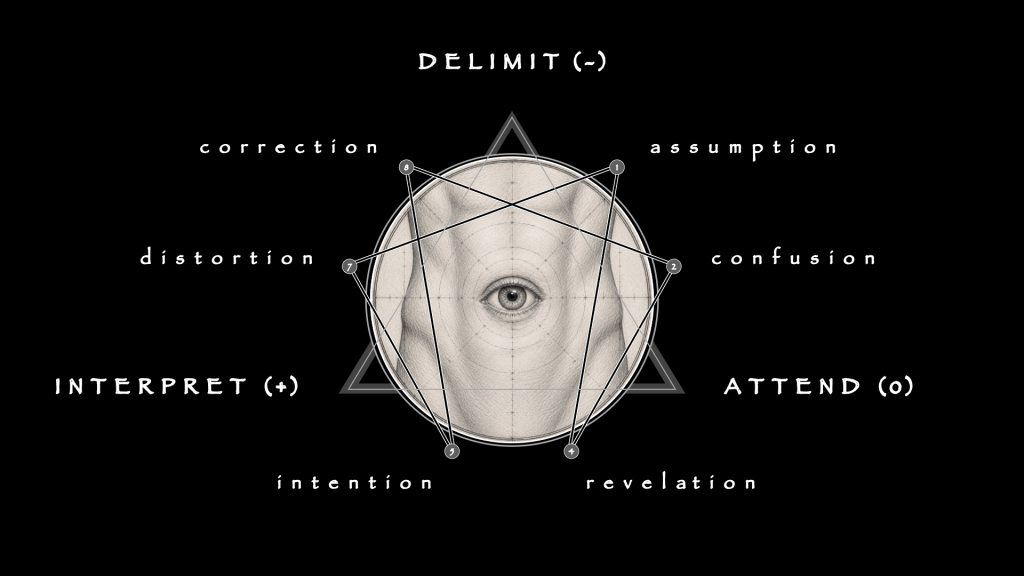
Etymology, handled seriously, is not derivation. The latter traces a word’s lineage the way genealogy traces a family’s, producing a chart that explains the present by mapping the past without, requiring any direct participation of the reader. The former comprises six steps by which that ground is rebuilt, one word at a time, between individuals willing to descend and return.
- Assumption
- Confusion
- Revelation
- Intention
- Distortion
- Correction
What etymology can do, when it is treated as a living discipline rather than an antiquarian one, is closer to exhumation: the deliberate recovery of a body that was interred not by death but by accumulation, covered over by layers of casual use until the original form was no longer visible beneath the deposit. The recovered word is not a museum piece, but a technology returned to working condition, capable of doing in the present what it once did before the layers accumulated, but only for the speakers who performed the recovery together.
For the rest, the word continues as it was: a sound in good standing, circulating freely, available for any use, producing in every exchange the quiet unintelligible variety of what the old story called the confusion of tongues, communities of fluent speakers with no shared operational ground beneath the shared sound.
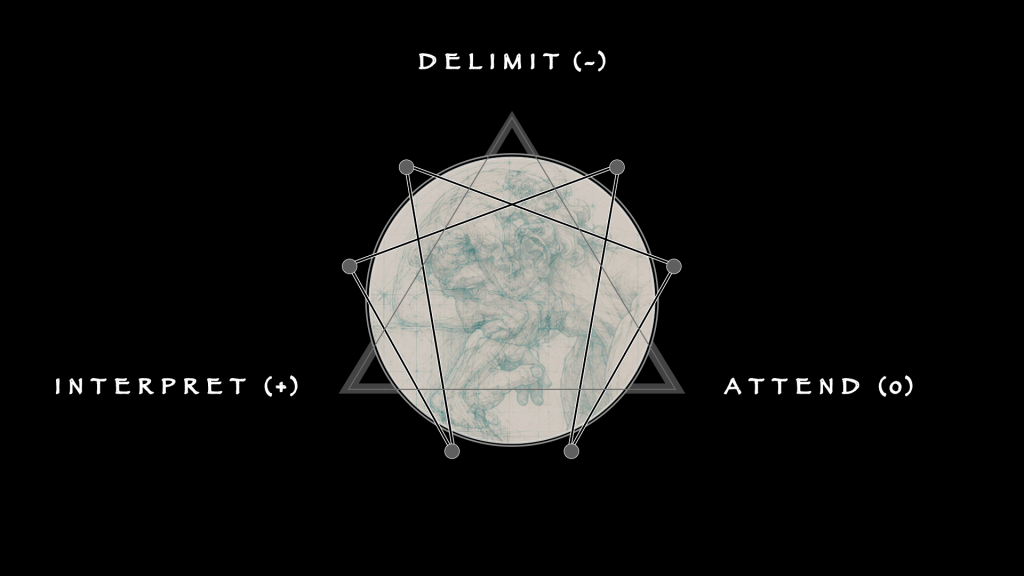
What is recoverable is not the word’s history but its technology, a method of observation that is genuinely consequential rather than merely sincere. The technology has three parts, and understanding any one of them in isolation changes nothing. Only the reader in possession of all three can apply the procedure immediately. Once equipped, he may do so in any domain where attention matters and evidence is contested, which is to say in most of the domains that are worth attending.
The painful limit is that only others who themselves possess all three may fully understand him.
To contemplate is, by the lights of ordinary usage, to think carefully. He who contemplates is measured, serious, unhurried. The word flatters whoever claims it, and signals depth of mind without specifying any obligation that depth must meet. There is no standard by which the depth may be verified, nor any field within which what the mind finds may count as evidence rather than mood. The word circulates without friction.
This comfort feels earned, which is always a problem. Contemplation has a long philosophical pedigree. Aristotle placed theōría, the Greek term that Latin would eventually render as contemplātiō, at the apex of the human intellectual life, the mode of existence most fully aligned with truth. Such elevation imparts genuine authority, for he who contemplates participates, at however modest a distance, in something the tradition considered the highest use of mind. The prestige is real. Those who deploy the word loosely are drawing on a credit account that the word’s philosophical lineage built and that drift has left open, borrowing against a reputation that no longer requires the underlying transaction.
A suspension bridge feels stable when a cable frays, at least at first. The feeling of solidity persists beyond the loss of the structure producing it. Something similar has happened to contemplate: the dignity remains, but the technology that once required something of the observer, that defined a field, fixed its limits, and made some findings admissible and others not, has been removed so gradually that its absence now feels like the natural condition of the word. The question of the moment is what that technology was before anyone thought to remove it, and whether enough precision is available to make the technology work again.
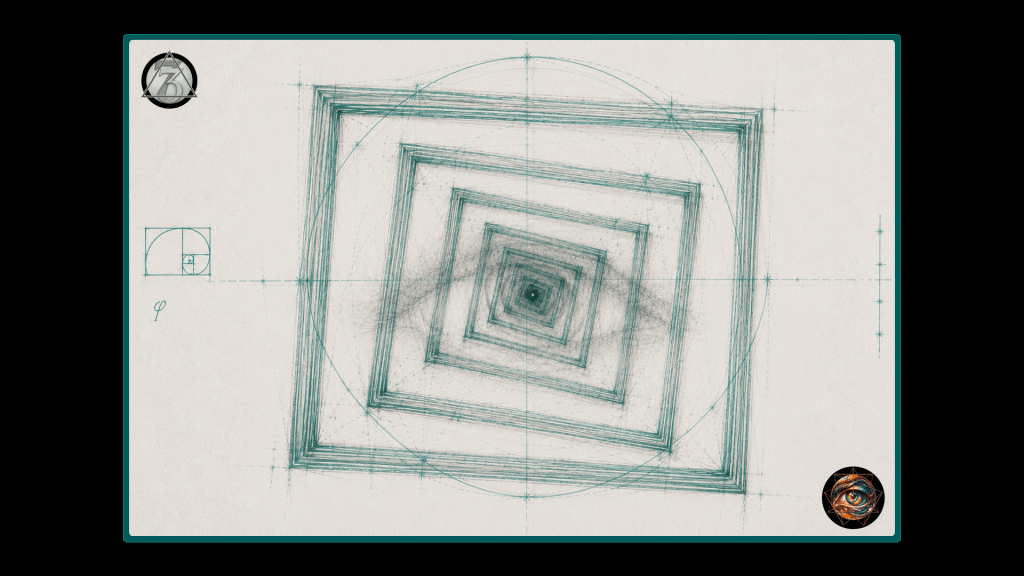
The degraded image of contemplation has a common name. Navel-gazing is usually and rightly deployed as a mild insult, a way of dismissing introspection as excessive and unproductive, but the phrase is nevertheless more instructive than its dismissive tone suggests. It preserves one genuine feature of contemplation while destroying the discipline that made that feature consequential. Understanding what it preserves, and what it destroys, is the shortest path to understanding what the word once required.
Contemplation, in its authentic form, requires a center, a focal point within a declared field. What navel-gazing removes is the field. The gaze turns inward and the center collapses into oneself, which cannot stand outside itself to verify its findings. The observer has no declared limit, no boundary that could make what appears inside it admissible rather than merely present.
Intensity remains—jurisdiction disappears.
The observer in this condition is not passive, per se, or inattentive. The attention is real, sustained, and all-too-often experienced as profound. What is gone missing is the prior act that would have made the sustained attention consequential: the declaration of a field. Without it, one spirals inward with full sincerity, finding only what is already there, confirming only what was already believed, and proudly naming the loop insight.
The structure of the loop is precise: the affirming pressure of genuine desire to understand meets the denying opacity of a surface that cannot stand outside itself, and because no third force enters from outside the system, the two irreconcilable forces do not produce any new state, only recurrence. This is not contemplation, but earnest spinning.
The sincerity of the spin makes it harder, not easier, to recognize as motion in place.
Whether the slide from contemplation to navel-gazing is a moral failure or not, it is a practical one. Something essential has been removed from the procedure, and the excision leaves a scar. Meanwhile, the word retains a patina of dignity, without the weathering of obligation.
To find what was removed is to use etymology not as an antiquarian exercise but as a forensic examination, the way an engineer surveys a failed joint not to admire the original design but to understand exactly what gave way, and whether it can be recut and seated correctly.
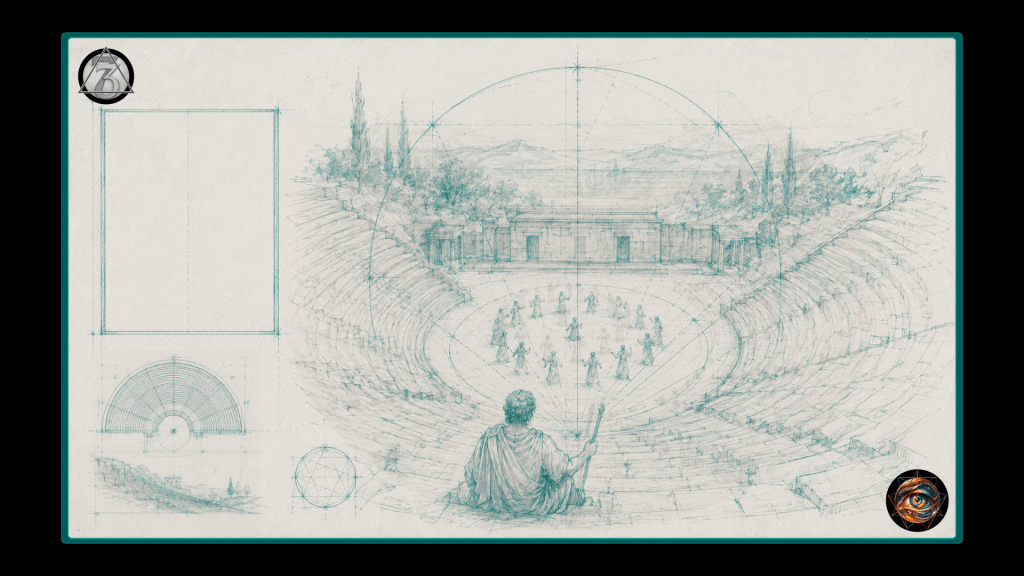
Contemplate descends from Latin contemplārī, and the second half of that verb is templum. The modern reader sees “temple” and pictures a colonnade, a precinct of stone, an architectural enclosure set apart for sacred purposes. That picture is nearly entirely wrong. When the noun inside the verb appears to name a building, the action is subordinate to an object, and the operational content of the verb is gone.
A templum, in Roman usage, was not first a building, but a bounded field, a portion of sky or earth delimited by the augur for the purpose of reading signs.
The architectural meaning is derivative, applied to buildings because they stood within consecrated enclosures, but the stone arrived late. The act of declaration came first, and the act was verbal. The field was spoken into existence by the right words in the right order, its limits fixed by utterance before any physical boundary was erected. This is the moment that most recoveries of the word’s etymology skip, not that templum once meant something different, but that it named a speech act, a performative utterance that created a zone rather than described one.
Varro, writing in the first century BCE, is the witness whose technicality makes paraphrase dangerous. He was too precise to be argued away and too literal to be rescued by reinterpretation. In De Lingua Latina, he defines the terrestrial templum as a place bounded by certain set words for the sake of augury or auspices. The decisive term is finitus, meaning brought to a definite limit, closed off, declared complete. The templum is not merely sacred ground. It is ground whose limits have been verbally fixed, a field that exists as a field only because its edges have been named.
He adds that the augur, when establishing a templum, performs a kind of viewing by which he bounds the sight of the eyes. This is no metaphor. It is Roman technical prose describing a procedure in which the optical and the juridical are a single act. The field is not seen and then declared. It is declared, and therefore available for seeing. What Varro describes is a performative act that creates the conditions of observation rather than responding to them.
The astonishing thing about this source is not that it survived, but that it survived intact, that a text this technically specific was not smoothed into the usual philosophical generalities by the centuries between Varro and today.
The modern temptation is to hear “frame” in a psychological register, as if the point were merely concentration, the way a director’s viewfinder supposedly helps a filmmaker see. The Roman evidence points in a harder direction. A viewfinder focuses by excluding what falls outside it. The templum does something categorically different—it does not merely exclude what falls outside, it strips what falls outside of a particular status, the status of being evidence at all.
In augural practice, a bird that crossed the sky beyond the declared boundary was not an ignored bird; it was an inadmissible bird.
The distinction matters. An ignored bird might still be relevant, merely unnoticed. An inadmissible bird is formally outside the jurisdiction regardless of what it does or how vivid its passage. The frame does not help the observer focus. It governs what counts as a sign at all, the way a court’s evidentiary rules do not merely organize evidence but determine what enters the record. This gives contemplārī a juridical undertone that modern English usually misses, and it explains why ancient discussions of templum stray so readily into constitutional territory.
A senate meeting held in a templum was not simply more dignified. Technically speaking, the setting bore on its lawfulness. If the usual senate house was unavailable, an augur could establish an appropriate templum elsewhere, because what mattered was not the architecture but the declared field. The templum is not a backdrop against which authority operates, but the prior condition under which authority may operate at all. Removing the templum from the senate meeting does not weaken the meeting. It dissolves its standing.
Greek developed a parallel term by another route—theōría.
A theōrós was an official observer or envoy sent by a city to witness a sacred event, and to do so not privately but on behalf of his polis. The root idea is sanctioned spectatorship: the journey, the occasion, and the civic authority under which seeing takes place. Greek foregrounds the qualified observer, and Latin foregrounds the structured field. When philosophical Latin eventually adopted contemplātiō as the standard equivalent of theōría, it did so because the concepts were already doing the same work from opposite directions, like two scaffoldings erected against the same wall.
Contemplātiō was strong enough to survive the removal of its apparatus. Contemplate retains some semblance of seriousness long after the structural demand that justified those connotations had been quietly dropped. The prestige outlasts the discipline, as a compass rose precisely painted on a wall with the exact cardinal marks beautifully rendered cannot tell you where you are. The word contemplate, in its current circulation, is exact enough in its connotations to be mistaken for the real thing, and present enough to occupy the space where the real thing would otherwise live.
The logic of the templum returns with almost startling clarity in the Renaissance workshop, where painting becomes theory. In De Pictura, Alberti instructs the painter:
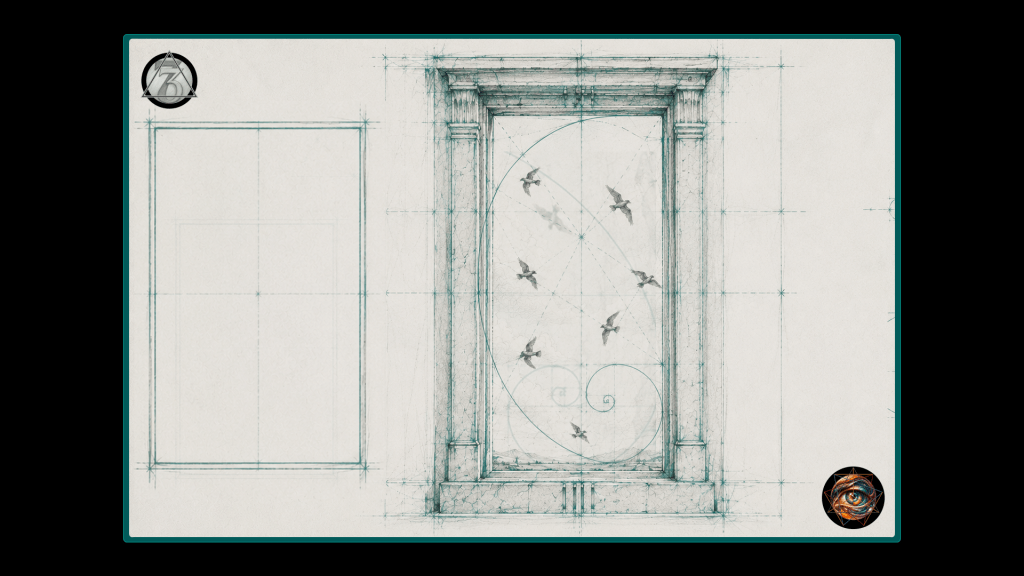
“In qua pingendum sit area, quam amplam velim, quadrangulam rectis angulis describo, quam quidem mihi pro aperta fenestra est, ex qua historia contueatur.”
With some amount of poetic license, this renders as:
“On the surface to be painted, I first inscribe a rectangle of whatever dimension I choose, declaring it an open window, only through the which may the scene be contemplated.”
The verb at the end, contueatur, is the third person singular present subjunctive of contueri, a compound of con (together, thoroughly) and tueri (to look, to watch, to guard). It is a close cousin of contemplārī, sharing the same root act of directed, sustained looking. The subjunctive mood here carries the sense of “through which the scene may be contemplated” or “from which the subject is to be viewed,” with the subjunctive marking the window as the condition of possibility for the seeing, not merely its location.
This sentence is usually introduced as the charter of linear perspective, and so it is. It is also something older in new dress: the establishment of a bounded field within which sight becomes exact, proportions become governable, and a scene becomes possible in the strict sense. Before the frame, as Alberti understands it, there is only undifferentiated visual abundance, the same formless chaos the augur faced before the templum was declared.
The etymological connection is exact and unremarked in the art history literature. Alberti, writing a treatise on painting, chose a verb from the same root family as contemplārī to describe what the painter’s rectangle makes possible. Whether that choice was conscious or simply the natural Latin for disciplined visual attention, the result is that his founding instruction for perspective painting contains, in its final word, the same mechanism of the rectangle as templum.
The augur defines a field in sky or earth and reads the signs within it. Alberti defines a field on the panel and orders what may be seen within it. In both cases, seeing depends upon prior delimitation.
Perspective is not simply a trick for creating depth, but the law that becomes operative only after the field has been bounded. Alberti did not imagine himself a Roman augur. He simply discovered, through the pressure of craft, that intelligible vision depends on prior delimitation. Undeclared abundance is not a richer field but a poorer one, because it produces images rather than evidence. A painter who begins without the rectangle is not working in a larger field, but in no field at all.
The loss here is that the word in its retirement form, once it usurps the only space where discipline can live, actively prevents the discipline’s return. He who uses contemplate to mean earnest inward brooding is not simply using the wrong word. Worse, he uses the right sound to do the wrong work, with enough prestige to make the wrong work feel sufficient.
Philology, when it is more than ancestry research, recovers not what words once meant but what acts words once named. The acts are often more rigorous, more procedural, and more consequential than their softened modern counterparts suggest. Some may even be recoverable, not as nostalgia but as function.
The test is whether the restored meaning can be reinstalled into use, whether it changes what the word can do when spoken into a live situation. One that only improves comprehension has not passed the test. Comprehension is private. It changes the map inside a single mind and ends there. Restored meaning passes the test only when it is introduced into a live exchange and alters what is possible in that exchange.
Contemplate aspires to that test. The working definition that emerges from this recovery is compact and load-bearing: to contemplate is to attend within a bounded field whose declared limits determine what may count as a sign. Each element does specific work. To attend is not merely to look, but to be present as an observer whose presence has been authorized by a prior act of delimitation. The distinction between failing to attract attention and lacking standing is the sharpest edge the word ever had, and which modern usage has most thoroughly rounded off.
He who contemplates in the correct sense is not free to look in all directions with equal openness, for he has already committed to a boundary and accepted its limits. This is a discipline with consequences. A thought that arises outside the declared field is an inadmissible thought, not because it is unwelcome but because it has no standing in the procedure. Findings made within the field carry a different status than impressions gathered without one, and the observer is accountable to the declared limits in a way that the earnest brooder is not.

Leave a Reply