
Elon Musk has spent more of his life thinking on how to escape gravity than perhaps anyone else. The company he built around that obsession demonstrated, in its first week as a public issuer, that gravity always collects on what it is owed—and not always the kind rockets are built to fight. Financial gravity cares not which specific impulse a company quotes in its prospectus, or which thrust-to-weight ratio. Its only care concerns the price of patience. While everyone was watching the rocket instead of the ledger, SpaceX’s own balance sheet spent its first public week discovering how expensive patience may become.
Given the the brevity of its chart, I must treat the price action of Space Exploration Technologies Corp. as a case study rather than as a proper subject, the way a single falling apple was never the subject of any of Newton’s writings. The actual subject is the financing of an artificial-intelligence buildout measured in trillions, arriving at the exact moment capital stopped being free. SpaceX simply happens to be the company that ran every stage of that financing in public, in real time, where the sequence could be watched rather than inferred from a prospectus written months in advance.
Three forces drive everything that follows:
- A rate environment considerably less forgiving than the one that financed the last comparable buildout
- Capital structure assembled by bundling several unrelated businesses under one founder’s control
- A calendar of future dates already fixed regardless of what the macro backdrop looks like when each one arrives.

The Rate Environment as Antagonist
Gravity is famously indifferent to engineering quality. A rocket assembled by the finest team in the industry fights the same force as one bolted together by amateurs. The only variable that matters is how much thrust can be generated against it, and the Federal Reserve runs the financial equivalent of that constant for the entire economy. The Fed held its policy rate near 3.50 to 3.75 percent through a fourth consecutive meeting in June 2026, with ten-year Treasury yields trading near 4.46 to 4.47 percent and reported inflation sitting near 4.2 percent. The backdrop is considerably less forgiving than the near-zero conditions financing the last comparable capital buildout, the telecom fiber rush of the late 1990s, when debt this size could be raised at a fraction of the cost and equity investors treated growth alone as sufficient justification for almost any valuation.
That earlier buildout ended in a wave of defaults when capital stopped arriving faster than the buildout could generate revenue to service it, a sequence worth remembering.
SpaceX’s own ledger makes the point more vividly than any macro table could. A chunk of debt now sitting on the company’s balance sheet, roughly $17.5 billion worth, was originally priced at rates reaching 12.5 percent, a junk-bond rate reflecting genuine credit risk rather than a rounding error. A $20 billion bridge loan refinanced that debt down to an effective rate near 4.58 percent in April 2026, cutting the annual interest bill by roughly half, and a $20 billion investment-grade bond offering—rated Baa1 by Moody’s and BBB-plus and BBB by Fitch and S&P respectively—arrived in June specifically to refinance the bridge loan again ahead of its 2027 maturity. Total long-term debt across the consolidated entity stood near $29.1 billion as of the most recent quarter. Three different prices for the same underlying obligation, inside little more than a year, is not a footnote. It is the entire story of what going public is actually for.
That debt did not originate inside a rocket company. Elon Musk acquired Twitter personally for $44 billion in 2022; the platform later entered xAI; xAI entered SpaceX in a transaction completed in February 2026. The combined entity filed its public registration under a software industry classification rather than aerospace. The same registration leans on a headline addressable-market figure near $28.5 trillion, a number built by stacking three almost entirely unrelated markets, space activity, connectivity under its Starlink wing, and artificial intelligence, into a single sum, a framing choice that only makes sense once the bundling itself is understood as the operating premise rather than as an accounting curiosity. A rocket company therefore spent this spring renegotiating the financing terms of a social media platform and an artificial intelligence lab it had owned for only a few months, a sequence considerably stranger than the interest-rate arithmetic surrounding it, and one with no obvious precedent at this scale.
Rating agencies had to price all of it as a single credit regardless. A satellite-launch business, a low-margin connectivity network, and a capital-hungry AI lab now share one balance sheet, one bond rating, and one set of covenants. Whatever risk premium investors demand for any one of those businesses gets paid, in practice, against all three simultaneously. Sorting unlike risks into one undifferentiated number is not how credit analysis is designed to work, yet it is exactly what three rating agencies did in the same week. The alternative, asking SpaceX to issue three separate bonds against three separate businesses, was apparently not on offer.
The company’s board, operating under Nasdaq’s Controlled Company exemption and therefore under no obligation to maintain an independent majority, was equally unlikely to have demanded a cleaner separation between the three businesses on its own.
The Federal Reserve did not write a single word of SpaceX’s registration statement, and did not need to. It simply set the gravitational constant for the entire economy, and a company financing three different businesses’ worth of ambition off one balance sheet inherited that constant whether its rocket engineers had any say in the matter or not. The same balance sheet, for what it is worth, also disclosed a holding of more than eighteen thousand Bitcoin, acquired for roughly $661 million and marked near $1.29 billion as of the most recent quarter, a detail that fits nowhere in a traditional aerospace credit analysis and everywhere in the broader portrait of a company whose risk profile has stopped resembling any single industry’s.
🧐 QUESTIONS:
- What risk attaches to a single bond rating to price the combined gravitational pull of a rocket company, a satellite network, and an AI lab?
- Why does a capital buildout financed at four and a half percent fall so differently than one financed near zero?
- When three different prices attach to the same debt inside a single year, which gravity is the real one?

The Financing Relay Becomes a Playbook
A multi-stage rocket does not carry its launch tower into orbit. It must shed the heaviest, most spent components stage by stage—empty fuel tanks, first-stage engines, anything that has already done its job—so the remaining vehicle can accelerate faster on whatever fuel is left. Going public performed the identical function for SpaceX’s balance sheet. It let the company shed an expensive private credit rating the moment a rating agency was willing to bless a structure large enough and visible enough to deserve a cheaper one, separating the costly first stage of its financing from everything still ahead of it.
Private companies carrying junk-rated debt have one reliable path to that separation, demonstrating enough scale and disclosure to earn a better rating, and an initial public offering is, among other things, the fastest available staging mechanism for proving exactly that, since a prospectus forces disclosure a private placement never would have required. The order books reportedly exceeded $250 billion against an initial $75 billion raise. Such a margin of demand is large enough on its own to make the case to any rating committee that this particular vehicle had earned its next stage.
SpaceX is unlikely to be the only company running this particular play. Public reporting has placed OpenAI behind this listing, having filed confidentially for a future offering targeting a valuation as high as one trillion dollars, and separate reporting describes Anthropic’s own capital intensity in similar terms, with one account placing quarterly spending near $3.7 billion against quarterly revenue closer to $5.7 billion. Neither company’s financing timeline nor those specific figures have been independently confirmed and both should be treated as developing rather than settled. What is confirmed is the shape of the incentive: any AI-infrastructure company carrying expensive private debt now has a demonstrated, recent example of exactly how to stage that debt into something a bond market will rate near investment grade.
Demonstrated examples, in capital markets especially, tend to get copied quickly once the first mover proves the mechanism works.
A second conversion happens at the same moment, quieter than the debt restaging and easy to miss entirely. Years of paper gains held by employees, early investors, and venture backers become, the instant a public buyer exists, gains that can actually be spent, and the liquidity making that conversion possible has to come from somewhere. In the real world, it comes from whoever is on the other side of the trade.
For the first several months of this listing, the counterparty will be overwhelmingly retail, drawn in by a roughly thirty percent allocation, on the order of $22.5 billion, an unusually generous retail carve-out against reported demand that itself approached $100 billion.
The scale of that conversion is difficult to overstate. The exit this listing handed to its venture backers—a roster including Founders Fund, DFJ, D1 Capital, Fidelity, and Thrive Capital among others, against more than $10 billion raised privately across the company’s history—reportedly exceeds the combined value of every US venture-backed initial public offering completed across the prior decade. Whatever else this listing accomplished, it rewrote what a single liquidity event looks like for an entire industry whose job is finding the next one. It did so by using capital supplied by buyers who had no comparable event of their own waiting on the other side, and who were, in a meaningful number of cases, applying for an allocation rather than negotiating one.
None of this is unique to SpaceX, which is precisely the point. Every company now queued behind it into public markets is shedding the same first stage, cheaper debt for itself, while supplying the same fuel for everyone else’s tanks, liquidity for whoever held its stock first. Again, every buyer arriving after the IPO will be, structurally, financing both conversions without necessarily being told that is what their order is doing.
The prospectus discloses the mechanism in dense, technical language. Lockup tranches, performance triggers, registration rights, are spread across hundreds of pages. Almost nothing in the marketing surrounding the offering translates that language into anything a retail buyer would recognize as a warning. The gap between what gets disclosed and what gets understood is itself a structural feature of how these offerings get sold rather than an accident of any individual buyer’s diligence.
🧐 QUESTIONS:
- What does an IPO actually convert, beyond cash raised at a headline number?
- Why might OpenAI and Anthropic be expected to follow the launch sequence?
- When a liquidity event this large depends on buyers arriving after the fact, what obligation, if any, exists to inform those buyers of their role as fuel?

What the Market Did When the Bill Arrived
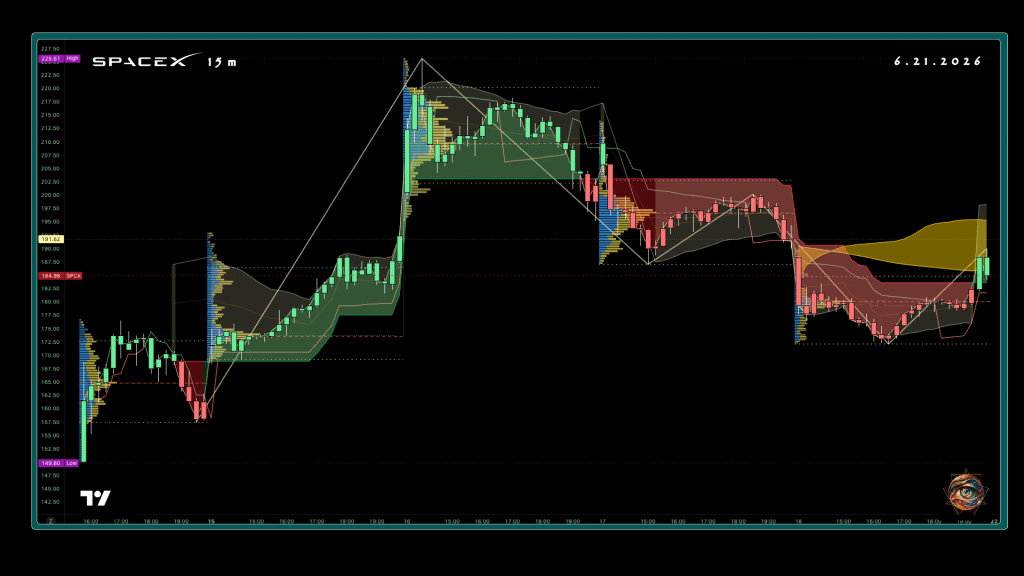
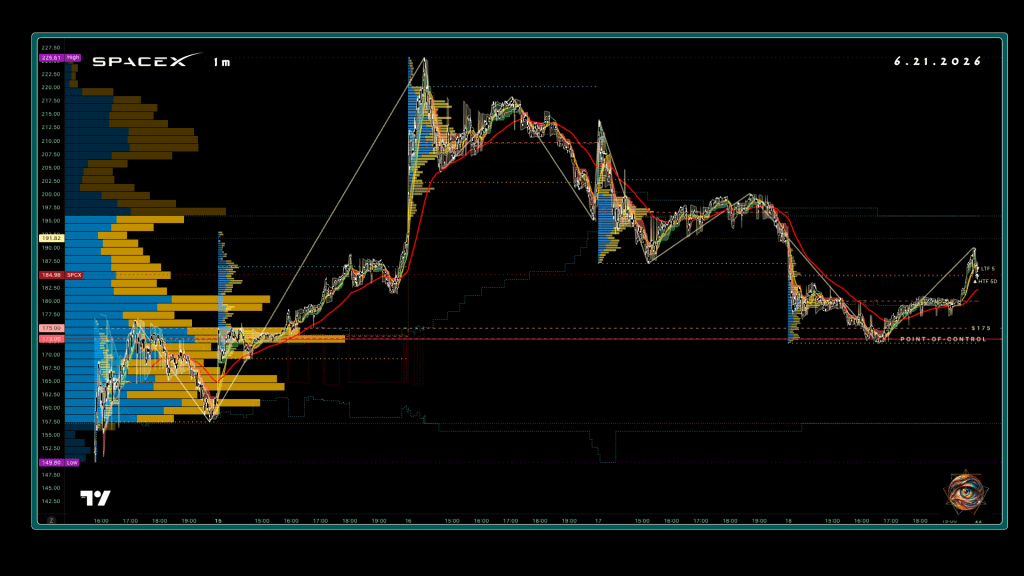
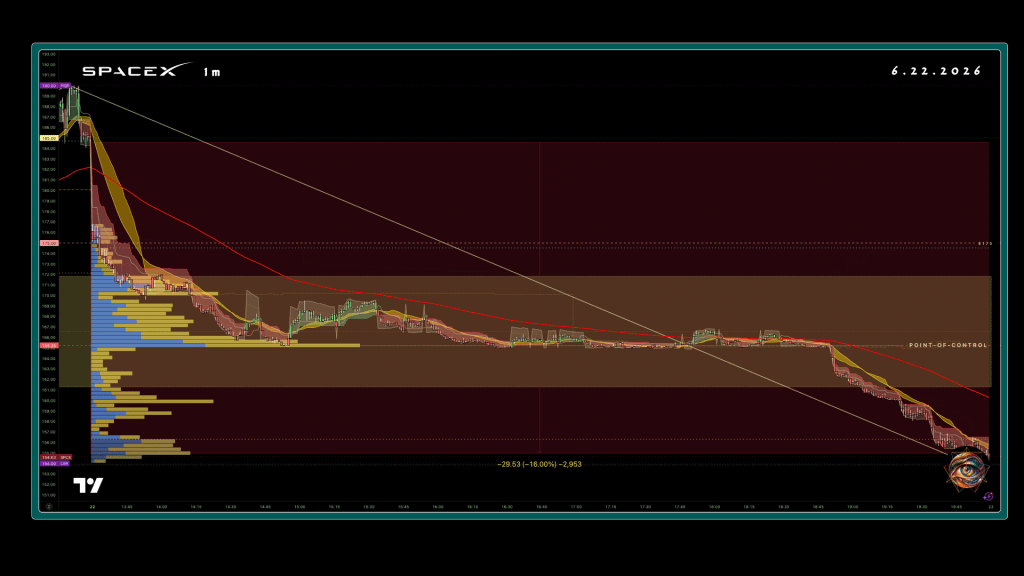
Five days after the offering priced, the market got a chance to answer a question no registration statement can settle on its own: would buyers actually absorb this much new supply and this much new debt at the valuation already on the tape. The trajectory across those five sessions, read the way a flight log reads a launch rather than the way a chart reads a pattern, rose from a low near $149.80 to a peak near $225.61, fell back hard, and stabilized somewhere in the $180s, an ascent, an apex, and a descent compressed into less time than it takes most companies to schedule their first board meeting as a public issuer. Three features of that trajectory are worth naming without dwelling on them: a pitchfork structure anchored off the $225.61 high projected a wide expectation cone that the subsequent decline mostly fell inside of rather than outside of, a weekend gap between Friday’s close and Monday’s open marked a discontinuity the market had to reprice on reopening rather than trade through, and the heaviest single concentration of traded volume across the whole week settled at or near $175, a level that will reappear later in this account for reasons that have nothing to do with technical analysis.
What actually produced the sharpest leg of that ascent deserves more attention than the shape itself, because the mechanism is almost embarrassingly literal once named correctly. Options on the stock launched June 16, and dealers who had sold call contracts needed to hedge their exposure by purchasing the underlying shares as the price climbed, a mechanical requirement that does not pause to ask whether the resulting purchase reflects anyone’s judgment of fair value. That is, with only minor abuse of the term, a gravity assist: a maneuver where a spacecraft gains velocity not from its own engines but by stealing a small amount of momentum from a passing planet’s own orbit, momentum it never generated and will eventually have to give back in some other form once the encounter ends.
The orbital mechanics get more interesting, and more relevant, one layer deeper. The Oberth effect describes why a rocket burn produces more usable energy when performed at high velocity than at low velocity, since kinetic energy scales with the square of speed, which means the single most efficient place to fire an engine is the deepest point of a gravity well, where the spacecraft is already moving fastest. A thin float behaves exactly like a deep gravity well for exactly the same reason: a comparatively modest volume of forced dealer buying, arriving at the moment the stock was already accelerating and the available shares were already scarce, produced a wildly disproportionate change in price, the same fixed quantity of fuel yielding far more velocity than it would have produced against a calmer, better-supplied tape. Nobody scheduling the options launch necessarily intended to fire that particular burn at that particular point in the trajectory. The float being what it was on June 16 made it the optimal point regardless of intent, in precisely the sense an orbital mechanic means optimal.
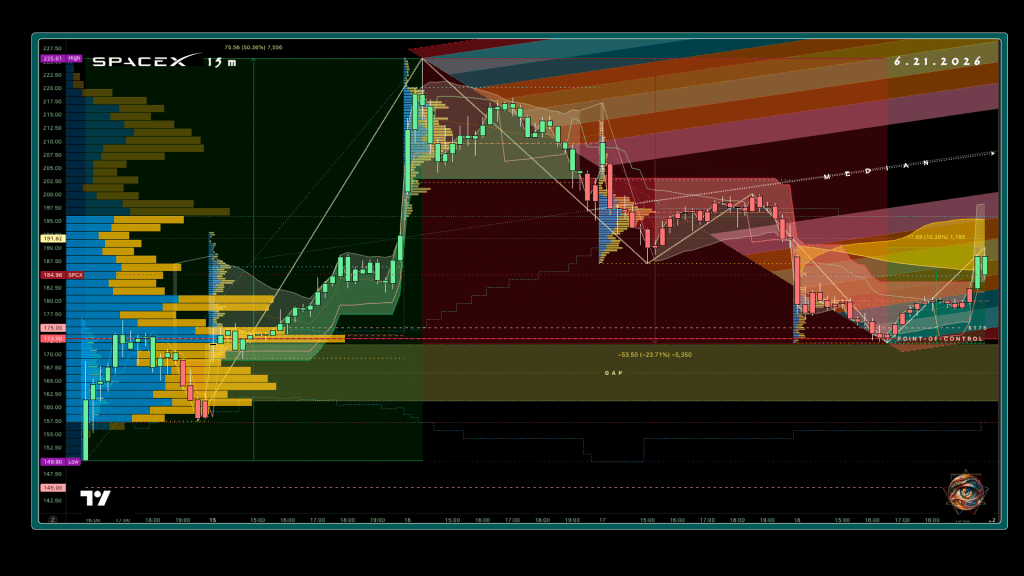
A gravity assist, whatever velocity it adds, never represents propulsion the spacecraft generated itself, and the spacecraft’s relationship to the body that assisted it ends the moment the encounter is over, regardless of how much speed got borrowed in the meantime. The stock’s relationship to whatever was actually pushing it past $200 ended the same way. A meaningful share of the float sold in the offering itself carried no lockup whatsoever, since lockups apply to pre-IPO holders rather than to shares actually distributed in the deal, and some buyers who received that allocation simply sold quickly into a rising tape for a fast, uncomplicated profit. The buyers absorbing that selling, many of them retail, by allocation design, were chasing a trajectory the gravity assist above was simultaneously inflating, paying progressively higher prices to provide exit liquidity for sellers who had bought, in some cases, only days earlier, a transfer of risk that happened entirely inside the open market and entirely within the rules.
None of this required anyone to have planned an outcome in advance.
A bond offering still days from being announced, a derivatives-market mechanism, and an allocation structure that lets some buyers sell before others can are three separate, ordinary features of how modern capital markets work, each individually defensible, each disclosed somewhere in the relevant filings. What they produced together was a textbook distribution event wearing the costume of a celebration, and very few of the buyers cheering the ascent upward seem to have noticed which side of that distribution they were standing on, partly because nothing in the experience of buying a rising stock feels like standing on the wrong side of anything. That shape, ascent, assist, descent, recovery, does not have to stay confined to one trajectory, and none of the mechanics that produced it expire once the week itself ends.
🧐 QUESTIONS:
- What do a celebration and a distribution event across the same five sessions—without anyone necessarily intending either outcome—indicate?
- Why does a mechanism this literal, a real gravity assist rather than a metaphorical one, still surprise people every time a thin float meets a derivatives launch?
- If exit liquidity arrived this early in a company’s life as a public issuer, what does that say about the buyers arriving for the next ones?

The Supercycle’s Math Problem
Step back from SpaceX entirely and the same financing pattern reappears at industry scale. One bank modeled the broader AI infrastructure buildout at roughly $765 billion of capital expenditure in 2026 alone, with a cumulative figure near $7.6 trillion between 2026 and 2031, spanning accelerators, data centers, power generation, and the cooling systems required to keep all of it running. Numbers that size do not get financed out of retained earnings. They did not exist as a financing category at all a decade ago, when the largest capital-intensive technology buildouts still measured themselves in tens of billions rather than trillions. They get financed the way SpaceX just financed its own buildout, through debt that needs restaging and equity that needs a buyer.
SpaceX’s own forward valuation work demonstrates the underlying problem in a form precise enough to be funny once you sit with it. Escape velocity is not a matter of opinion: for a given body, there is exactly one speed, calculated from that body’s mass and the distance you are starting from, below which you fall back no matter how patient you are, and above which you leave permanently. Two mission control rooms calculating different escape velocities for the same launch would mean, at minimum, that they disagree concerning the mass of the planet, the distance to its surface, or both, an error serious enough that any flight director discovering it before liftoff would scrub the mission rather than let two unreconciled numbers anywhere near a countdown clock.
Morgan Stanley, one of the two lead underwriters on the offering, projects SpaceX’s revenue reaching $3.4 trillion by 2040, implying an EBITDA margin near 79 percent that would be unusual for any company built partly around rockets and satellites rather than software alone. Goldman Sachs, the other lead underwriter, projects a more aggressive figure still for the nearer term, roughly $470 billion of total revenue by 2030. Both banks earned underwriting fees on the same deal whose valuation their own research now supports, a conflict of interest plain enough that it should change how much weight either number carries.
Both figures, properly understood, are competing escape-velocity calculations for the identical company, arrived at by two control rooms that would never be allowed in the same building if this were an actual launch.
The size of the disagreement is itself the most informative number in either report, considerably more so than either headline figure on its own. An escape-velocity calculation is only as sensitive as the mass term inside it. In both banks’ models, the AI segment functions as nearly the entire mass of the planet being escaped, which means a relatively small revision to AI-segment growth assumptions swings the entire trajectory by hundreds of billions of dollars. The AI segment that exists today, which reported roughly $3.2 billion of revenue against an operating loss near $6.4 billion in its most recent full fiscal year, loses money at a rate considerably faster than the launch and connectivity segments combined can offset.
The forecasts asking investors to look past that fact are arriving from the same institutions that profit from investors looking past it.
An independent fair-value estimate published separately put the figure closer to $62 per share, a small fraction of the trading price, which at minimum establishes that a third control room, one with no fee riding on the launch succeeding, calculated an escape velocity low enough that the vehicle, in this telling, never leaves the pad at all. Credit markets absorbed SpaceX’s own $20 billion bond offering without apparent strain, but SpaceX is one issuer inside a buildout measured in trillions. Every other AI-infrastructure company running the same playbook will eventually need the same market to absorb its own debt, at the same time, competing for the same pool of investment-grade-seeking capital.
A separate, quieter version of the same concentration concern sits in the launch business specifically, where one company now performs roughly five of every six US orbital launches. The financing relay also attracted its own derivative amplification almost immediately: a leveraged ETF offering twice the daily return of the stock launched within days of the listing, and a separate satellite-communications company holding an equity stake worth tens of billions of dollars at current valuations now functions as an informal public proxy for the same exposure. A supercycle, almost by definition, asks a market to believe a single trajectory will hold steady for longer than any one forecast period can verify.
Meanwhile, the two underwriters financing SpaceX’s piece of that trajectory disagree by hundreds of billions of dollars on a ten-year horizon, which is itself a quiet admission that nobody currently knows the mass of the object whose escape velocity the market is calculating, underwriters included.
🧐 QUESTIONS:
- If two escape-velocity calculations for the identical company differ by hundreds of billions of dollars, what more than math and marketing is needed to pull it off?
- Why does an underwriter’s own revenue projection deserve less trust than an independent analyst’s, even when the independent number looks far less flattering?
- If credit markets eventually need to absorb several companies’ worth of this same financing playbook simultaneously, what happens to the price of patience for all of them at once?

A Dated Test Already on the Calendar
Buried inside SpaceX’s registration statement sits a calendar more telling than anything a trading screen displays this quarter, since every date on it is already fixed and already public, regardless of what the macro backdrop looks like when each one actually arrives. Roughly four to five percent of total shares were tradeable immediately at listing, a deliberately thin float against a company valued near two trillion dollars.
The remaining block releases in stages rather than all at once, a structure built specifically to avoid the single-cliff shock that has historically concentrated an entire year’s worth of selling pressure into one violent session at prior large listings. Rivian crashed that way once its own standard lockup expired and a major shareholder disclosed plans to sell. An all-time low for Uber hit on the exact date its own lockup released
The unlock sequence is:
- 20 percent on second-quarter earnings
- 7 percent tranches across August, September, and October
- 28 percent on third-quarter earnings
- Remaining balance at the standard 180-day mark, December 8, 2026
One of those dates carries a condition rather than a fixed release. It is structured the way an actual launch window is, not a single instant but a defined span, with a pass-fail criterion that does not care about intent, only whether the vehicle, or in this case the stock, was where it needed to be when the span was open. If SPCX closes at or above $175.50, thirty percent over the IPO price, for five of the ten trading days immediately preceding the second-quarter earnings release, an additional 10 percent of insider shares unlocks early, on top of the standard 20 percent.
A launch window closes whether or not the rocket is ready, and this threshold opens or closes the identical way, indifferent to whatever story anyone wants to tell concerning why the stock happens to be trading where it is during those ten days.
Whoever holds shares eligible for that early release has a precise, dated, entirely public reason to want the stock elevated specifically inside that window, a reason with nothing to do with launch cadence or subscriber growth. Whoever buys into that window, meanwhile, occupies the exact position retail occupied during the gravity assist, bag-holders of supply timed to someone else’s calendar rather than to their own conviction, stretched from a single afternoon of dealer hedging into a ten-day span of ordinary trading.
The largest single date on this calendar belongs to Musk alone, and it reads less like a corporate filing a long-duration spaceflight log.
His roughly 6.4 billion shares remain locked for 366 days with no early-release provision, first eligible for sale June 12, 2027, a full year longer than the schedule applied to nearly everyone else who held stock before the public did. This is the financial equivalent of an astronaut launching into one set of conditions and returning to find out what Earth became while he was gone. No relativity is required for the metaphor to work; the calendar alone does it.
A separate group of extended pre-IPO investors unlocks on its own slower schedule into 2027 as well, meaning the combined block still restricted past the standard 180-day mark represents well over half of all pre-IPO shares outstanding.
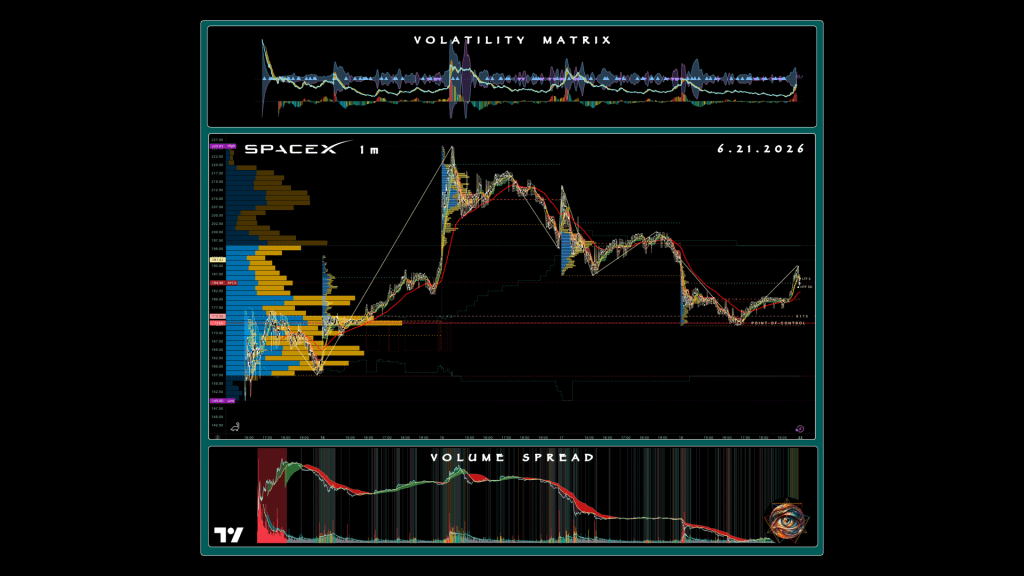
The opening week’s volatility matrix and volume spread, show compression giving way to release and back again across all five sessions, a texture worth a glance for anyone curious what the week actually felt like to trade. The texture itself settles nothing concerning the years-long mission now underway. Lay the whole calendar end to end, regardless, and a familiar shape starts to repeat at a different scale: a conditional test that rewards elevated price in a narrow window, a cluster of larger releases compressing into the back half of the year, and one final, enormous date sitting past the horizon of anything we can verify in advance. The first five trading sessions drew that exact outline once already, in miniature, using nothing but a gravity assist and an allocation structure to do it. The calendar is now proposing to draw it again, larger, slower, and with considerably more capital attached.
🧐 QUESTIONS:
- Why should an unlock threshold depend entirely on macro conditions in a ten-day window still months away, like a launch window on conditions nobody on board controls?
- Why does the buyer occupying a scheduled unlock window face the same structural position as the buyer chasing a derivatives-driven ascent, even though the two events look nothing alike on a chart?
- When the largest single release on this entire calendar sits more than a year out, what is actually being priced today, the company, or the wait?

When Company-Specific Risk Becomes Systemic
None of these problems is unique to SpaceX—the rate environment, the financing relay, the dueling forecasts, the unlock calendar, all exist because a small number of companies are simultaneously trying to finance an AI buildout measured in trillions, using credit markets, equity markets, and retail liquidity that were not originally sized for this particular scale of demand arriving all at once, across multiple issuers, inside the same eighteen-month window.
SpaceX, OpenAI, Anthropic, and the hyperscalers already financing their own AI infrastructure are no longer a handful of separate corporate stories competing for headlines. Collectively, they represent enough new debt and equity issuance that their financing outcomes have started to matter to the instruments measuring credit-market health generally, rather than staying contained to whichever single stock ticker happens to be moving on a given day. A credit desk pricing risk anywhere in this sector now has to price all of it together whether its mandate technically covers one issuer or five.
There is a point past which a sufficiently massive object stops being orbited by the structure around it and starts bending that structure around itself instead. The physics term for it is an event horizon, and the language outlives the metaphor. A genuine financing failure anywhere inside this small group, a bond that does not clear at the assumed spread, an unlock that meets no buyers at the assumed price, would not stay contained to that one company’s shareholders. It would show up as a data point in exactly the credit spreads and risk premiums the Federal Reserve already watches when setting the gravity, which means the rate environment is no longer simply something happening to this buildout. It can become something this buildout eventually happens to, the financial equivalent of the orbited object beginning, however slightly, to pull back on its own orbit.
That feedback loop did not exist five years ago, when the companies financing AI infrastructure were smaller and the rates financing them were lower. It exists now, fully formed. It sits underneath a company whose own first week as a public issuer already demonstrated, in miniature, exactly how quickly a celebration can become a distribution event once the underlying mechanics stop cooperating.
Two separate institutional-investor letters objecting to the governance package, one from the New York City and New York State Comptrollers alongside CalPERS, another from the Council of Institutional Investors, arrived before the offering even priced and changed nothing concerning its terms. This a quiet admission that the same capital markets absorbing this much new debt and equity are not, in practice, demanding much in exchange for it. Starlink’s continued role inside active conflict zones, and the export-control restrictions binding the company’s international operations more broadly, sit as a final layer of risk, entirely uncorrelated with anything a bond rating or an unlock calendar can price.
🧐 QUESTIONS:
- What changes once a handful of companies’ financing needs become massive enough to bend the credit markets around them rather than simply orbiting inside them?
- Why might a rate environment that this buildout once treated as a fixed backdrop start treating the buildout’s own outcomes as an input instead?
- When risk this concentrated finally blows up, why should anyone expect the fallout to stay contained to a single ticker?

Time Is Fractal
One of my trading maxims states that time is fractal. The universe already runs on that principle at every scale physics can measure, a spiral galaxy’s arms trace the same logarithmic curve as a nautilus shell, a planet’s orbit and a satellite’s orbit obey the identical equation regardless of which body is doing the orbiting. Markets it turns out, draw the same shape slower rather than a different shape altogether once the clock measuring it gets longer.
SpaceX’s first week as a public company was never merely a week, but a forecast, delivered by accident, in a register few are equipped to read, written in derivatives mechanics and allocation tables rather than in anything resembling plain language.
Ascent, gravity assist, descent, a stabilizing recovery that has not yet proven itself, that shape took five trading sessions to draw the first time, using nothing but a thin float and a derivatives launch. The unlock calendar is now positioned to draw the identical shape again, across the back half of 2026 and into the middle of 2027, using a conditional launch window, a cluster of scheduled releases, and one enormous long-duration return date in place of a single afternoon of dealer hedging. Scaling the clock up changes nothing concerning the underlying physics of the thing being measured.
The Federal Reserve set the gravity that made this entire structure expensive to build in the first place. Enough capital now depends on this buildout succeeding that its own outcomes have started to feed back into the same credit spreads and risk premiums the Fed watches when deciding what that gravity should be next, a loop with no clean precedent at this scale and no obvious exit once it starts running.
A maxim is not a prediction, nor do I claim to know what SpaceX’s stock, or any other AI-infrastructure issuer’s, will be worth in June of 2027. What the maxim does claim, and what this particular company’s first week already demonstrated once, is that the shape rarely changes just because the clock measuring it gets longer. Whoever is standing on the buying side of this calendar’s largest date, whenever it arrives, will discover whether that shape held.
On that day there will be a far larger crowd than there was on the first day anyone thought to look up.


Leave a Reply