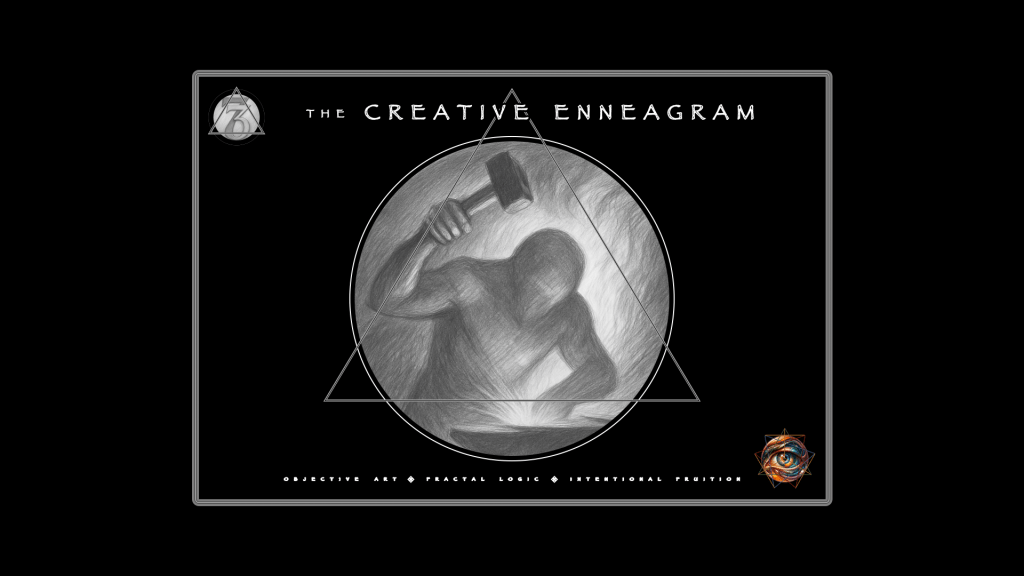
The Periodic Table of Narrative Metals
Hero fatigue is not caused by oversaturation. It arises when the structure that once sustained symbolic compression becomes too unstable to support cultural weight. The crisis is not in the content, but in the frame. To understand this failure, we must abandon nostalgia and instead trace the materials used to build these forms—first metaphorically, then structurally.
The evolution of heroic fiction in cinema (where it it is most conspicuous) can best be mapped not across genre or audience, but by metallurgical metaphor. Each “age” of storytelling corresponds to a specific material—its strengths, its weaknesses, and its temperature tolerance. From sacred origin to industrial flatware, these metals mark the gradual breakdown of pressure, form, and meaning. They warn us that once a medium reaches melt, its restoration will not come by return—it must be reforged under constraint.
Heroic narrative does not decay in a straight line, but fractures under pressure, mutates under fatigue, and oxidizes when left exposed. This sequence of nine metals captures not genre, but function: how stories are shaped, wielded, degraded, and finally abandoned. What follows is more than a taxonomy of tastes or tropes. It is a timeline of compression and collapse.
GOLD – Mythic Coherence
Gold does not circulate; it anchors. It represents foundational stories that establish order without irony—epics and origin myths too sacred to interrogate. These are stories not of individuals, but of beginnings. They are absolute, durable, and structurally unrepeatable.
Exemplars: The Iliad, The Ramayana, the Torah, the U.S. Constitution as myth, the story of Prometheus, the Book of Genesis.
Silver – Cultural Legacy
Silver renders myth portable. It carries inherited form, still honored, but increasingly curated. It allows for replication, but at the cost of distance. The silver phase maintains structure but shifts from sanctity to style. The sacred becomes serialized.
Exemplars: Action Comics #1 (Superman, 1938), The Adventures of Robin Hood (1938), early Batman and Captain America, radio serials, pulp reprints.
Bronze – Collective Tooling
Bronze marks the heroic story as applied function. It is not precious but forged under pressure to shape civic identity, confront chaos, and resolve contradiction. These narratives act as tools of cohesion—coded rituals more than expressions. They serve.
Exemplars: Shane (1953), High Noon, The Magnificent Seven, Dirty Harry, postwar samurai films, early noir.
IRON – Structural Force
Iron does not persuade; it holds. It bears the load when civics and myth collapse into grit. Iron heroes solve with method, machine, and muscular logic. These narratives have little patience for metaphor. They favor compression over commentary.
Exemplars: Robocop, The Terminator, Die Hard, Predator, military thrillers, hardboiled action.
Nickel – Replicable Polish
Nickel introduces scale. It reflects well, holds shine, and replicates beautifully. These stories retain form but trade pressure for packaging. Style becomes a selling point; tension becomes rhythm. Nickel is franchise logic before collapse.
Exemplars: X-Men (2000), Spider-Man (2002), The Matrix, Batman Begins, Phase One MCU, prestige comics adaptations.
Aluminum – Scalable Spectacle
Aluminum folds clean, flies far, and carries almost nothing. These stories present weightless grandeur—perfectly framed, easily exported, emotionally diluted. They succeed at surface, fail at stress. Spectacle replaces structure.
Exemplars: Avengers: Age of Ultron, Wonder Woman 1984, The Mandalorian, Doctor Strange, Black Panther: Wakanda Forever.
LEAD – Saturated Form
Lead contains what cannot move. These stories still have form, but lack charge. They are over-structured, over-processed, and heavy with expectations. Nothing breathes. These works do not collapse; they sediment.
Exemplars: Eternals, Black Adam, Justice League (Snyder Cut), late-stage MCU films post-Endgame.
Mercury – Narrative Mutation
Mercury destabilizes. It changes shape rapidly and corrodes the vessel. These are stories built on motion, not weight. They dissolve structure in favor of reactivity. Mutation masquerades as creativity. Tension evaporates.
Exemplars: Loki, Doctor Strange in the Multiverse of Madness, The Flash (2023), Spider-Man: No Way Home, multiverse narratives in collapse.
Slag – Exhausted Residue
Slag is what remains when nothing can be reforged. These narratives are not hollow—they are burned. They contain the remnants of narrative attempt, but no internal compression. They cannot hold belief or yield conflict. They simply exist.
Exemplars: Ironheart, Velma, She-Hulk: Attorney at Law, AI-generated screenplays, late-stage franchise spinoffs.
These nine metals do not describe a genre’s lifecycle. They track its structural temperature. From Gold’s sanctity to Slag’s incoherence, they trace how compression yields to fatigue, and how symbolic force gives way to surface volatility. This is not cultural criticism.
This is narrative metallurgy.
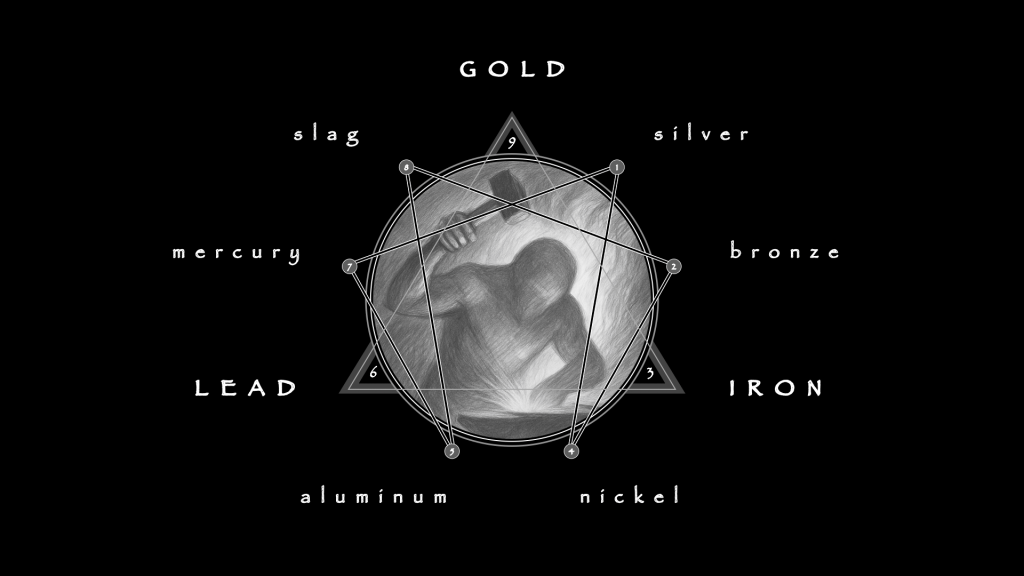
Metallurgical Sequence as Narrative Decay
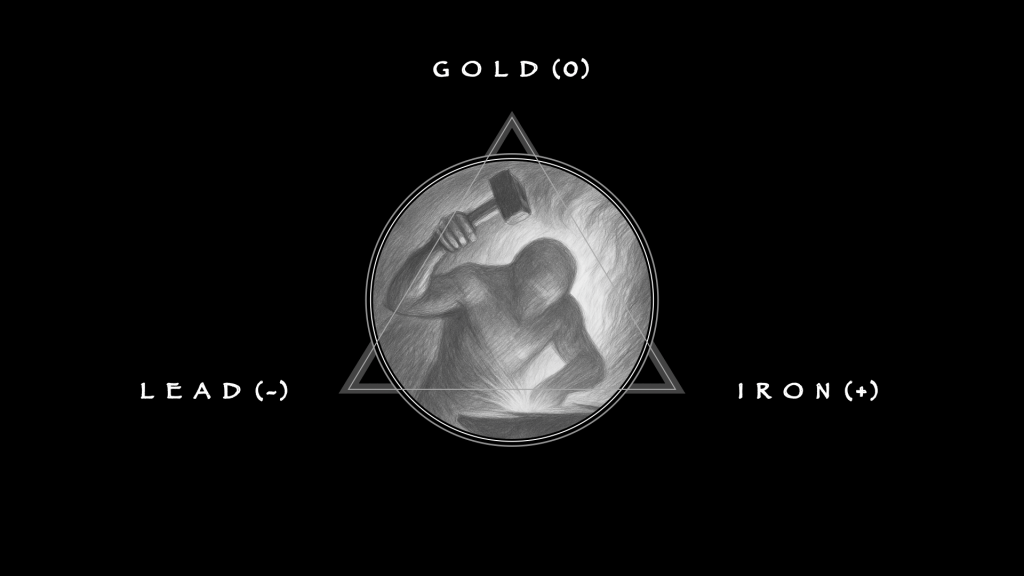
The metals of the triad—Gold, Iron, and Lead—do not spin. They do not mutate, reflect, or loop. They sit beneath the churn of the hexad as fixed supports: sacred compression, functional strain, and inertial mass. They are not evolutionary stages. They are structural types. When a genre fractures under its own recursion, these are the points of reference that survive the collapse.
Each holds a different form of pressure. Gold contains sanctity. Iron contains contradiction. Lead contains residue. Gold precedes myth. Iron outlasts belief. Lead endures by default. They are not progressive. They are positional. And within the framework of narrative fatigue, they are the only stable elements left to measure against.
The triad cannot be restored by order. It must be located by weight. Gold does not return. Iron cannot be faked. Lead cannot be ignored. Each tells the writer something the loop cannot: whether the story still works, or what must be imposed to make it work again.
Gold
Sacred Compression
Gold marks the origin—not chronologically, but symbolically. It is the metal of sacred narrative, where stories were not invented but revealed. There is no irony in Gold. There is no genre. These stories were compressed by ritual, not by market. Their meaning was not expressive. It was binding.
The function of Gold was not entertainment, but alignment. The form carried force because the culture assumed it had to. A myth was not a trope; it was a vessel. Stories were told not to explore identity, but to contain it. Their gravity came not from resonance, but from consecration. They could not be altered without consequence.
Dick Tracy, in his earliest comic strip form, carries a distant echo of this compression. He is not yet an archetype. He is not postmodern. He is pure form: crime confronted by force, not reflection. The villains are grotesque, but not symbolic. The world is crooked, but the line is clean. There is no question of genre, because the strip does not exist inside commentary. It exists to draw a line.
In narrative terms, Gold compresses meaning into clarity. There is no ambiguity, because ambiguity would fracture the form. Gold stories are rigid, but not stiff. They are designed to hold more than they express. When these forms are lost, what vanishes is not nostalgia. It is torque. The writer who remembers this does not try to replicate the shine. He seeks the pressure that made it glow.
Gold is not reproducible. It can be referenced, invoked, quoted—but never returned to wholesale. When a genre attempts to reboot a sacred form without the conditions that sustained it, the result is mimicry. The original compression cannot be faked. It can only be rediscovered through new strain.
Iron
Bearing the Strain
Iron does not shine. It holds. It does not glide like Aluminum or shimmer like Silver. It endures. In the mythos of metals, Iron is the first to admit contradiction and the last to yield to collapse. It is not sacred, like Gold, nor base, like Lead. It is structural. Its stories do not inspire awe. They absorb impact. They survive tension.
The Iron narratives do not seek resolution. They brace for rupture. These are not tales of divine order or civic progress. They are forged in conflict, tempered by trauma, and built to bear weight that would break more decorative forms. Heroes in this phase are not chosen so mush as conscripted. They carry stress like scaffolding—not to uplift the world, but to keep it from falling.
This is the phase where sanctity has eroded but coherence remains possible. The mythic frame has shattered, and the civic ritual has calcified. What remains is pressure without consensus. The Iron story does not resolve that pressure. It distributes it. Like rebar laced through concrete, it does not beautify the structure—it keeps it from crumbling under its own contradictions.
Iron heroes often appear cold, even brutal. They act not from nobility, but necessity. They do not believe in the system, but they reinforce it because collapse is worse. The Book of Eli offers a modern analog. The world has fractured. The sacred text is unreadable. The violence is relentless. The hero walks not for conquest, and not for hope—only for continuity. The weight must be carried, or everything falls.
Iron resists style. It offers discipline instead. Its hero is not expressive. He is load-bearing. He accepts the premise that coherence will not return, but that strain must still be distributed. In this way, the Iron story delays hero fatigue without disguising it. It is the last station where belief in structure still operates as function, even if belief itself has long evaporated.
The James Bond franchise, especially in its Casino Royale era, offered a modern Iron arc. The violence was methodical. The emotion was braced. The structure held, because the story treated tension as a cost. By the time Spectre arrived, the scaffolding had already become ornate. Legacy was thus invoked, but not reinforced. The villain was personal. The conflict was aesthetic. Bond moved as if burdened, but the strain was hollow. The Iron frame had calcified into Lead.
Iron, then, is not a solution. It is a holding pattern. It keeps the roof from caving in, but it cannot redesign the house. Once the cultural tension dissipates, once the audience can no longer feel the load, Iron rusts. What remains is Lead—weight without strain, memory without consequence.
Lead
The Weight That Refuses to Break
Lead is not failure in the cinematic sense. It is not collapse, not chaos, not even disinterest. It is something worse: stories that still arrive on time, still perform their moves, still echo their own structure—but with no torque. The lines are delivered. The arcs are drawn. But nothing lands. Lead is what happens when form persists long after pressure has left the system.
In Lead, the hero still rises, still speaks, still wins. But each gesture is hollowed by repetition. The danger is not that the audience rejects the form. The danger is that they accept it without strain. Movie-goers recognize the structure but no longer feel its grip. This is not nostalgia so much as procedural sedation.
Spectre reveals this with clinical precision. It wears the trappings of Iron—discipline, vengeance, restraint—but sheds the function. The legacy villain is revealed not to deepen tension, but to connect dots. The action moves with mechanical fluency, but it fails to cut. Bond, once the instrument of compression, becomes the echo of his own silhouette.
The roof still stands—the walls still hold—but the frame exerts no force.
This is where the alchemical myth misleads. Medieval texts promised that Lead could become Gold, that the base could be transmuted into the fine. But the fine print, rarely quoted, required a trace of Gold to begin. Some ember of sacred compression—however faint—had to be present. Without it, the reaction would not, could not, start.
So it is with story. Lead can be reforged, but not from inertia alone. There must be memory, tension, friction—however buried. Without some lingering fragment of narrative gravity, refinement becomes mimicry. The genre will continue to move, but not to build. It will loop. It will shimmer, but it will survive only as mood.
Lead is the final station before volatility. Once Mercury arrives, the melt begins. But Lead carries its own danger: the false belief that structure still functions just because it still appears. As I see it, this is the last real chance to act. Not by quoting Gold, but by compressing what remains. To shape from Lead is to extract torque from mass—not to decorate it, not to perform it, but to make it cut again.
In this sense, Lead is not salvage. It is test that asks whether the writer can reimpose form without legacy, myth, or glow. Can he summon weight from what refuses to break? Can he find, inside the last dull metal, the first glint of pressure?
Only then does transmutation begin, not because Lead becomes Gold, but because the story begins, once more, to hold.
Flow
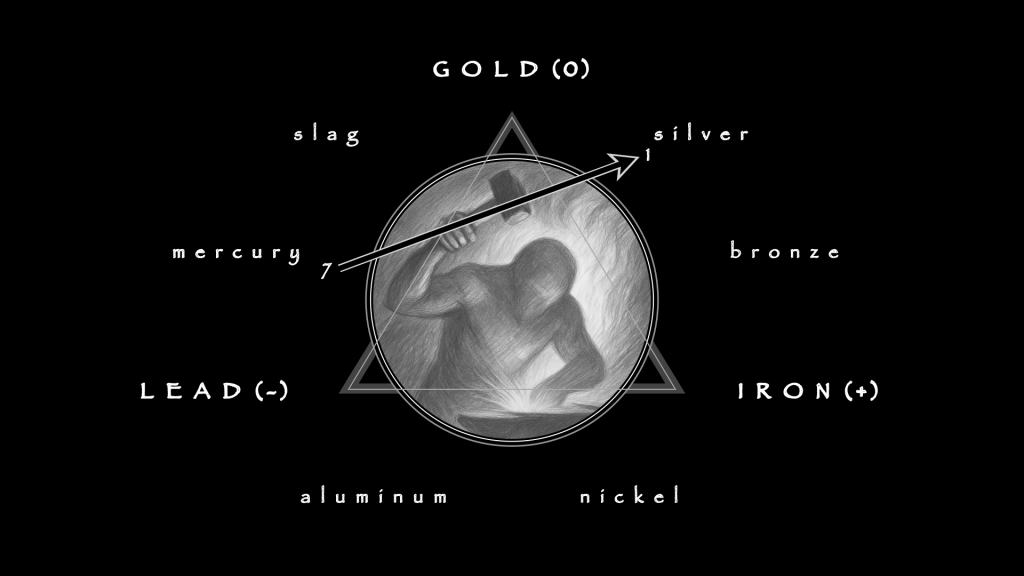
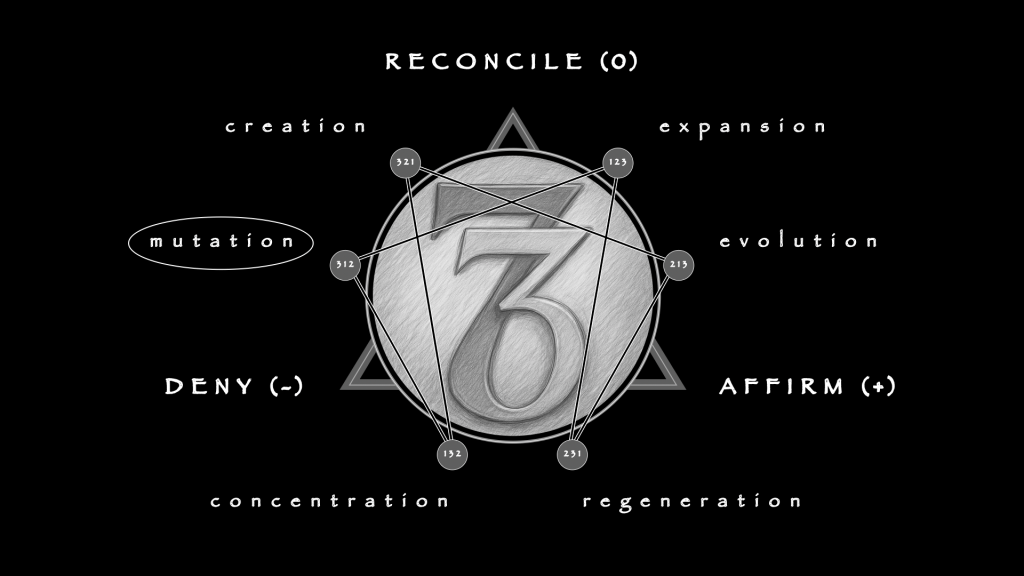
The metaphor is not arbitrary. The metals correspond to cognitive structures mapped via the Enneagram. The triad—Gold, Iron, and Lead—forms the immutable frame: sacred form, functional stress, and mass inertia. The hexad—Silver, Nickel, Bronze, Slag, Aluminum, Mercury—traces the recursive interior.
The hexad unfolds chronologically at first: Silver introduces exchange. Nickel reflects. Bronze tools. Slag remains. Aluminum lightens. Mercury mutates. Silver returns, not as memory but mimic. The loop is not a spiral. It is a trap.
More precisely, the hexad is encoded arithmetically: 1 → 4 → 2 → 8 → 5 → 7 → 1. This is the division of one by seven. It produces no whole. It simply recurs. The illusion of progression hides a deepening disarray. Each station in the loop reflects a symbolic distortion of the last. Mutation is not a new phase. It is the failure of retention.
The triad stands outside this churn, as its Logos. Gold does not recur. Iron does not adapt. Lead does not respond. These metals do not change; they support. The hexad spins within them, mistaking velocity for meaning.
1→4 From Legacy to Reflection
Silver does not know it is Silver. It borrows the sanctity of myth and distributes it freely, unaware that distribution severs charge. Its heroes do not reflect—they radiate. Superman, as first rendered in Action Comics #1 (1938), hovers with serene omnipotence. He saves not to transform the world, but to preserve its order. Coherence is ambient. Continuity is assumed.
This naïve futurism mistakes expansion for permanence. Silver imagines progress but cannot engineer it. The Jetsons believe the future is tidy and clean, not because they understand entropy, but because they have not yet seen it. In Silver, stories extend like highways with no bends. Purpose feels infinite—fracture, unthinkable.
Nickel arrives when that continuity is first questioned. Reflection replaces assumption. Heroes begin to hesitate, to carry burden rather than just power. Characters like Spider-Man and Wolverine do not save the world; they navigate its weight. Style emerges not from clarity, but from fracture. Legacy becomes affect, and identity becomes genre.
The 1→4 line does not crack the structure. It coats it. Lamination preserves surface, even as tension grows beneath. This is not regression, but polish in search of durability. Shine cannot absorb pressure, however, and the more a hero gleams, the softer he hits.
4→2 Refinement as Return
Nickel polishes until friction vanishes., but when stories reflect too perfectly, they forget to bear any load. At first, the audience sees themselves and feels seen. Soon, though, they see only surface; nothing penetrates, or pushes back.
In this aesthetic saturation, the writer begins to ache—not for beauty, but for pressure. The 4→2 move is counterintuitive: it looks backward to Bronze, but only to recover compression. The artist, exhausted by reflectivity, begins to crave utility. What began as refinement becomes filtration. Impurity is burned off. Style gives way to structure.
This is not collapse. It is a reforge. In metallurgy, refinement means heat, constraint, and reduction—until only what can hold remains. The writer in this phase does not mimic Bronze; he tempers it. Originality becomes functional. Form regains civic dimension. The hero acts not to express, but to shape.
What returns is not nostalgia, but torque. Reflection hardens into tool. The story works again—not because it dazzles, but because it cuts.
2→8 From Tool to Waste
Bronze carried function. It shaped civic ritual and bore ideological weight. Its stories were designed to hold consequences, not aesthetics. Every strike mattered. Every decision altered the frame.
Slag holds no edge. It is residue—story without shape, symbol without tension. Where Bronze compressed, Slag congeals. The 2→8 transition is not erosion. It is overdesign. Compression becomes cosmetic. Resolution becomes routine. The plot moves, but nothing matters.
This is not collapse through absence. It is collapse through accumulation—every franchise extended, every arc rebooted, every theme repeated until it petrifies. Slag is not dead matter. It is undead form. No longer animated by pressure, it drags meaning like an anchor.
In this state, silence emerges—not from lack of content, but from its surplus. The tools remain, but their edge is gone. No matter how fast the swing, nobody cares.
8→5 Foresight Without Anchor
Slag is stagnation, but Aluminum feels like rescue. It glides. It lifts. It promises reach without drag. Suddenly, everything works—until it doesn’t. The images move faster. The friction may be gone, but so is resistance.
Aluminum stories are perfect exports: seamless, dazzling, and strangely hollow. Their tension is engineered through rhythm, not density. The viewer is pulled forward by tempo, not by stakes. It looks like rebirth, but it is repackaged descent.
In this acceleration, foresight dawns. Aluminum sees where it’s heading—into Mercury, into mutation. But it also remembers where it came from—Slag, the burnt field behind. This is the one vantage point with clarity in both directions. The hero, if conscious, sees the coming fork: volatility ahead, residue behind. The insight is real, but impotent.
The 8→5 line, uniquely, tracks both time and sequence. It is not a loop. It is a slide. And what makes it so dangerous is its elegance. The genre believes it has found propulsion, when it has merely reduced mass.
Foresight without compression becomes hallucination. Knowing collapse is coming changes nothing unless resistance is reintroduced. Otherwise, the genre falls forward—gracefully, stylishly, irreversibly.
5→7 From Escalation to Entropy
This is the cleanest fall in the hexad. Aluminum (5) flows into Mercury (7) without rupture, without recoil. The 1 ÷ 7 sequence and the genre’s own chronology align here perfectly. It is the only line where structure and story collapse in harmony.
Aluminum scaled without friction. Mercury corrodes without rest. In Mercury, the story melts—continuity dissolves, identity scatters, logic blurs. The hero shifts forms, universes, tones. Mutation appears as freedom, but it functions as decay. There is no pressure, only permutation.
Studios mistake this phase for apex. They call it innovation., but the container has dissolved. There is nothing left to hold. Reboots multiply. Realities overlap. The audience stays not for meaning, but for velocity. The writer vanishes. Curation replaces authorship.
The 5→7 move is the genre’s terminal drift. It does not pause. It accelerates into incoherence. And once passed, it cannot be undone. Reentry is not an option. Only refusal—before the breach—can preserve compression.
What rescues is not invention, but pressure. The writer must subtract. He must withhold. He must apply tension not to entertain, but to restore mass. Without that, the story becomes air.
7→1 Mimicry as False Return
Mercury destabilizes. It liquefies narrative into motion, character into gesture, coherence into spectacle. Mutation becomes the new ritual—recursive, reactive, and precise in its disorientation. The story no longer arcs; it ripples. There is no act structure, only switchbacks. Novelty arrives faster than it can be encoded.
When the cycle loops to Silver, it does not return to legacy. It mirrors it. The 7→1 transition offers form without force, tone without torque. It sells memory as innovation, but the charge is missing. What once bore sacred compression is now formatting, curated and clean. Silver wears myth as costume. The audience sees the shape, but not the gravity.
This is not recovery. It is recursion. Legacy is referenced, not rebuilt. Franchises return not as pillars, but as placeholders. Continuity reboots. Tone resets. History is flattened into flavor. Nothing holds. Nothing resists. The shimmer of recognition replaces the substance of consequence.
True Silver derived strength from proximity to Gold. It was a carrier of sacred weight, not just a distributor of form. After mutation, however, there is no weight left to carry. The 7→1 loop simulates return to culture, while accelerating its dissolution. It feels like homage. It functions as entropy.
For Silver to matter again, it cannot be reached through spin. It must be recast, which demands not sentiment, not reference and not retro-styling, but heat. Recasting requires compression—and constraint. Without it, the return is only a new skin.
The 7→1 line is not a bridge. It is a trapdoor. If the writer steps onto it unaware, he will mistake shimmer for signal and reflection for foundation. The only viable path to coherence begins before the melt. Once the form dissolves, even memory becomes noise.
The Civic Cost of Narrative Collapse
So far I have mapped the metals in sequence and clarified the internal architecture: a triad of structural anchors (Gold, Iron, Lead) and a hexad of recursive phases (Silver, Nickel, Bronze, Slag, Aluminum, Mercury). These metals do not just signify narrative tone or aesthetic phase—they track the medium’s ability to compress civic, ethical, and symbolic weight into form. The cycle is not circular. It is degrading. Once pressure is lost, structure becomes sheen. Once friction disappears, mutation follows.
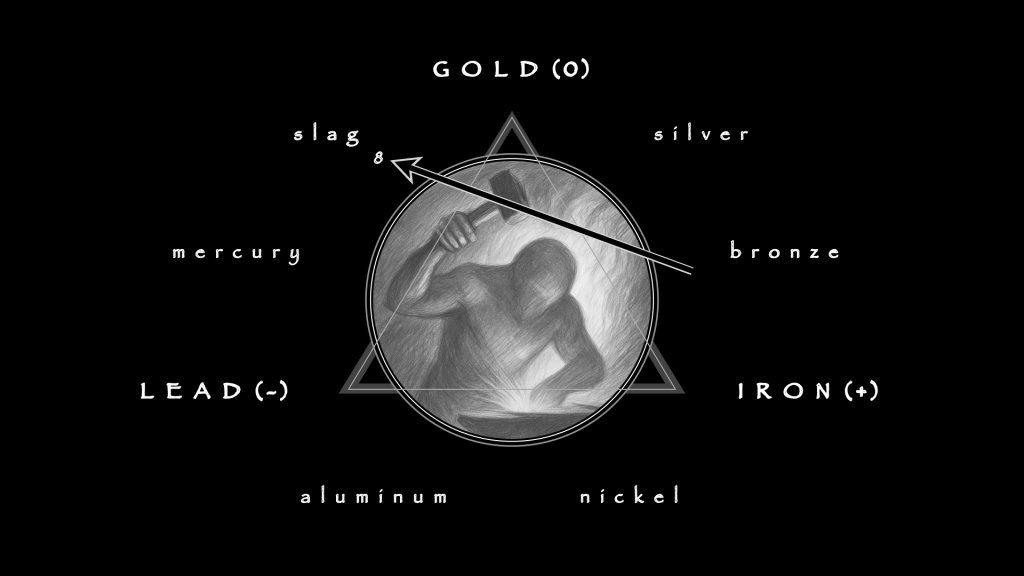
I can now elucidate a fine point about the hexad’s hidden axis: two symmetrical vectors do not follow the loop, but cut across it. The first—Bronze to Slag (2→8)—marks the exhaustion of utility. The second—Mercury to Silver (7→1)—traces illusion’s return to form. These are not clean transitions. They are cross-sections of collapse. The first illustrates the loss of function, while the second simulates recovery. Together, they reveal the deeper cost of narrative failure: not aesthetic fatigue, but the erosion of civic meaning.
When story fails to hold tension, culture compensates with movement. As we see, however, movement without torque is drift, which, at scale, becomes social disorientation. Thus these lines are not just interpretive tools, but pressure gauges that reveal how a medium built for compression becomes a mechanism of entropy.
The 2→8 Line
From Tool to Scrap
In the metallurgic schema, Eight denotes Slag—the exhausted byproduct of force. It is residual power with no direction, expelled heat with no function. Yet within its opacity lies a last temptation: to act for its own sake. When narrative reaches this phase, it no longer seeks justice or coherence. It seeks response, any response. The hero becomes a specter of former impact, chasing confrontation not to restore order, but to feel weight.
The 2→8 line, when traced forward, moves from Bronze (2) to Slag (8): from civic utility to performance exhaustion. But when reversed—viewed from the perspective of a tactician at the end of collapse—the arc becomes diagnostic. Eight sees the void and looks back. It remembers function. It remembers stakes, but no longer trusts the field.
This retrograde recognition is a bitter kind of wisdom: the hero sees what should be done but cannot generate the context in which doing it would matter. He is not naïve so much as bereft. The Iron he once relied on has rusted. The Lead has sunk, the Mercury has spun the compass off its axis, and what remains is confrontation without compression … Slag.
The Book of Eli offers a useful exemplar. The protagonist carries the last sacred text not for evangelism, but for preservation; his combat is not redemptive, but defensive. He knows that the world has lost the ability to decode what he protects, so his heroism is not hopeful. It is archival. His function is memory under arms.
Here, the 2→8 line does not promise renewal. It documents the price of decay. When no structure remains to carry strain, the hero becomes the strain himself. That is not burden. It is entropy turned reflexive. It marks the end of narrative as civic ritual and its mutation into lone-wolf stamina test. The story does not guide; it takes a beating and keeps walking.
The 7→1 Line
From Mutation to Mimicry
The 7→1 line crosses the axis from chaos to form. Seven is Mercury—erratic, unstable, seductive in its aesthetic unpredictability. One is Silver—refined, ordered, radiant. On the surface, they seem incompatible: one dances, the other announces, but their structural relationship is more intimate than it first appears.
Mercury liquefies meaning and mimics transformation while accelerating disintegration. It recycles iconography without coherence, offering spectacle in place of strain and yet, when fatigue reaches its limit, the viewer begins to crave orientation again. The system responds with mimic-Silver: a visual echo of former order, sold as continuity. The 7→1 line is not an ascent. It is a rebound—one that flatters the audience’s memory while bypassing their discernment. Franchise reboots often travel this route. Spectre, for example, gestures toward legacy—old villains, classic themes, reconstructed mythos—but the weight has already leaked. Bond himself remains, but the torque, the forward intention does not.
The film offers the illusion of a return to structure, while preserving Mercury’s core instability: genre-switching, aesthetic gloss, recursive lore … and a story circling its own residue.
The danger is not confusion, but false coherence. When Mercury attempts to cross over to Silver, it wears the appearance of sacred compression—but without pressure. The story gleams, but does not cut; symbols return, but no longer mean anything. What once marked civic structure is now brand styling and fan service.
Thus the 7→1 transition is not myth reborn, but myth repackaged.
Mimicry confuses the viewers’ interpretive instinct by teaching them to associate glint with gravity, format with foundation, even when the signal has hollowed. The story no longer demands anything from its audience except recognition. There is no torque, no civic cost, only sheen.
Structural Entropy and the Storyless Society
The collapse of story form does not produce silence. It produces plenty of motion, and at ever higher cost. Mercury spins, Slag repeats, Silver refracts. The failure is not aesthetic. It is perceptual. Viewers sense something is wrong, but cannot name it. They feel unease, not just boredom, and the unease is not personal, but structural. The feeling arises when the forms designed to carry civic strain dissolve into mere tone.
The fear beneath the melt is not cinematic. It is interpretive disorientation. Narratives no longer land, but they do not stop, either. Heroes no longer change, they just reappear. Closure no longer arrives, but release schedules accelerate. Culture simulates ritual without consequence. The result is not rejection, but psychic drift. The viewer no longer feels like a witness to anything important. This disorientation does not produce rebellion, only mimicry. Sarcasm replaces insight, irony becomes defense, and viewers are trained to navigate signal by recognizing surface. They, in turn, protect themselves by mirroring the instability of the medium, until identity becomes reaction and taste becomes speed.
In this climate, civic meaning decays. Narrative was never just entertainment. It was higher learning that carried pressure, encoded limits, and modeled response. When that structure dissolves, so does its social utility. The cost of narrative collapse is not artistic confusion, but behavioral entropy. The audience no longer knows what to consume or why, only how to react faster.
Can the writer reverse this?
Yes, if anybody’s, creation is the writer’s province, but not by rejecting the melt. He must work with what he has, making fire from whatever kindling the world offers. The writer must recompress the raw materials—under degraded conditions, with unstable inputs, against algorithmic entropy. Coherence will not re-emerge on its own, but must be forged anew.
Gold cannot return spontaneously, but torque can, if the writer prefers the heat of the forge over its glow.

Leave a Reply