“Who is the rebel against law and order, the legislator ordaining or the citizen resisting unconstitutional measures? It is the unprincipled minister who artfully innovates on the custom of governing, the ambitious senator whose self is his God, the faithless magistrate who tramples on rights which he has sworn to protect. These are the men who by perverting the purposes of government destroy its foundation, bring back society into a state of war, and are answerable for its mischievous effects.”
– William Emerson, Sermon, 1802
Nullification is the inherent duty of individuals to invalidate and resist any and every government action shown to be unconstitutional or unjust. This principle is rooted in the belief that all government power derives from the consent of the governed; therefore, when a government oversteps its mandate, individuals retain their sovereignty to act as checks on its authority.
Historically, the idea has been championed by US Presidents Thomas Jefferson and James Madison, for nullification emphasizes that the Constitution represents a compact among the people, any breach of which by the government warrants the rightful resistance of its citizens to protect their intrinsic freedom and its sovereign rights.
This fundamentally American doctrine asserts that the Constitution is NOT an instrument for the government to restrain the people, but one for the people to restrain their government, literally an insurance policy against the hazard that it may unjustly harm or endanger them.
The duty to resist usurpation of power by anyone, in any office, is painfully relevant today, and not because of any election season. We see it on display across several contemporary movements, in varying degrees, as more and more individuals are separately forced to resist overreach.
Consider the array of government misconduct regarding gun control, land management, medical mandates, surveillance and, of course, whistle-blowers.
Tragically, individuals who work in local, state and federal offices inevitably attempt to expand their scope and power. Since, however, nongovernmental civilians hold ultimate sovereignty, it is also necessarily their own inseparable responsibility to nullify unconstitutional actions as the crucial maintenance of their freedom.
If they ignore this, or shrink from it, whether through laziness or fear, then they risk harming many more than just themselves.
The doctrine that arbitrary power must be resisted is the driving force behind individual acts of defiance, both against unjust laws (i.e. those beyond the consent of the governed) and/or those unjustly applied (i.e. lawfare). Notably, individuals across various states have refused to comply with federal gun control measures, asserting their duty to self-defense and its protection under the Second Amendment. This form of resistance is not only a right but a vital obligation to prevent the erosion of fundamental freedoms that are easily lost and only regained at great cost, if ever.
Similarly, resistance to federal healthcare mandates, including the Affordable Care Act, has seen individuals and groups challenge its provisions through legal and grassroots means, emphasizing their duty to safeguard medical autonomy over bureaucrats’ attempts to usurp it.
Moreover, the concept of jury nullification, where jurors acquit defendants despite evidence of legal guilt because they believe the law itself is unjust, underscores the enduring belief in individual duty to resist government actions that overstep constitutional boundaries. This practice allows individuals to directly impact the enforcement of laws they consider oppressive, embodying the principle that upholding justice may sometimes require defying statutory decrees.
The relevance of nullification today underscores a persistent distrust in centralized power and a reaffirmation of individual rights and duties. As local, state and federal government officers openly attempt to usurp power, this principle is a reminder of the necessity for checks and balances, ensuring that power remains ultimately with you, who are otherwise unaffiliated with your government. This enduring principle from the American Revolution continues to inform and inspire modern resistance to government overreach, a living safeguard of individual liberty against institutional (i.e. inhuman) and inhumane threats.
The duty to resist is deeply embedded in the philosophical underpinnings of the American legal tradition. The writings of Thomas Jefferson, James Madison, and other founding figures emphasize that when a government becomes destructive of the ends for which it was established — namely, to secure the unalienable rights of life, liberty, and the pursuit of happiness — it is not just the right but the duty of the people to alter or abolish it. This is not a call for anarchy, but for a vigilant citizenry that holds its administrators accountable as such.
If you survey contemporary society, you will see nullification practiced by those few individuals with the courage to stand up against any laws and regulations that demonstrably infringe on our constitutionally protected rights. From whistleblowers exposing the misconduct of government officials (of any branch or rank) to activists challenging unjust laws, the spirit of nullification is alive, though arguably unwell. Indeed, the fewer individuals volunteer for this duty, the greater the cost and risk they are forced to bear.
Nowhere is this more obvious than in the normalization of criminal plea bargaining, which is almost always evidence that the State has no case … if it could win in a jury trial, then why would it not seek convictions without offering deals instead?
Ultimately, nullification is a suspiciously fragile aspect of American jurisprudence, emphasizing that individuals are the last line of defense of their own freedom. By resisting unconstitutional laws and government actions themselves, they uphold the foundational principles of liberty and justice, ensuring that government remains a servant of the people, not their master.
Habitual critical thinking about law and procedure, as far as self-representation in court, if necessary, uniquely empowers individuals to take control of their own legal matters and to most effectively protect human rights, including their own.
“Let us remember that if we suffer tamely a lawless attack upon our liberty, we encourage it and involve others in our doom.” – Samuel Adams, Boston Gazette, October 1771
Once upon a time, in the shining City on the Hill, a silent Shadow ever so slowly emerged — at first strangling all mirth as it gradually engulfed every edifice and every corner — until at last it boldly threatened to extinguish even the People. It did not ride in resplendent on a pale horse to reap them outright; instead, like a virus it seeped through their screens, a toxic leak latching onto the ever-suggestible and unsuspecting host-minds of their most ardent keyboard warriors. Eventually, historians gave it a name: Cancel Culture.
Imagine being the underdog in a neighborhood boxing ring, challenging a global bully who’s come to your town to seize control of the schools and the hospitals … and the banks. In the red corner, you have government agencies, armed with their regulatory hammers and fiscal carrots. In the blue corner, the tech giants and their army of algorithms stand ready to shadowban your free speech into oblivion. The green corner features academic institutions and NGOs — high priestesses of the postmodern orthodoxy — chanting their incantations of “safety” and “order” while sharpening the knives of censorship.
The stakes are high in this twisted circus … and your opponent?
The more observant among you already recognize the Censorship Industrial Complex, a three-headed hydra spewing control, compliance, and conformity. This unholy trinity of government, corporate, and academic power is Hell Bent for Leather on curating your thoughts and conversations. The rest of you merely sense, involuntarily, that something is lost, never to return.
Could the near future possibly get any more dire?
Before you rush to answer that we can’t get any farther up Shit Creek, don’t forget the yellow corner. Your family and, worse, your family’s family, wields the most insidious weapons of all. As always, the weaker members of a society en masse attacking its stronger members is a leading indicator that it will not survive, and that its population is in mortal peril. The historical precedents of families actively betraying each other in tense times are unsettling, to put it mildly. Such is the domestic vector of how civil rights lead to civil wars and, worse, to cultural revolutions.
Government Agencies: The Surveillance State’s Puppet Masters
Like Erin Brockovich stepping into a town long poisoned by hidden contaminants, picture yourself waking from the American Dream only to find yourself desperate, depressed and clueless. As you ween yourself of the poisons of your private life, you come to find that the true source of the malaise is a pervasive web of public power pushing not only your most sensitive buttons, but others’, too.
Amid the mental fog, government agencies cloak their surveillance operations in the guise of national security and public safety — precisely in order to ensure the opposite, for without a crisis their mandate is obsolete. Thus, by manufacturing evergreen crises, they hope to position themselves as the sole solution bringers. However, the only thing shrinking faster than their ability to monopolize mass media is their actual influence on events.
Although webs are a legitimately messy waste of time, your most precious resource, the actual threat is their maker. Below is an utterly incomplete list of relevant government agencies. For a longer list, you have only to pull on any of these sticky strands and your curiosity will propagate outward to alert the others to your presence … and possibly even acquaint you with the Spider.
Begin your descent with:
Department of Homeland Security (DHS): This creature was hatched in the immediate aftermath of 9-11, as if in anticipation of the 2020s. Since 2018, its newest wing, the Cybersecurity and Infrastructure Security Agency (CISA) has been tasked with understanding, managing, and reducing risks to essential systems. In 2021, CISA assumed control of the .gov top-level domain (TLD) from the General Services Administration, allowing the agency to manage the approval of .gov domains and operate the TLD Domain Name System nameservers. In this era of misinformation, disinformation, and malinformation, CISA also partners with social media companies to develop and promote accurate, “authoritative” information, particularly during elections.
National Science Foundation (NSF): NSF investments have given the world Doppler radar, bar codes, the modern Internet, web browsers, MRI, laser eye surgery, DNA analysis and synthetic biology. Many new technologies, like generative artificial intelligence and wearable sensors, present both risks and opportunities for cybersecurity. The NSF supports the full range of critical and emerging technologies, including the key focal areas of the “CHIPS and Science Act of 2022.” However, cybersecurity requires more than merely strengthening infrastructure. Thus, in order to rapidly transform NSF-funded research done across the U.S. into impactful products, services and solutions, the agency created its first new directorate this century — Technology, Innovation and Partnerships.
State Department: As it strives to appear as the global peacemaker, the State Department pours resources into tools designed to stifle dissent abroad while promoting democracy with the same doublethink that Ms. Brockovich encountered from corporate lawyers spinning toxic sludge into harmless silt. Unless it plans to bribe you or otherwise undermine your sovereignty, the Sunday morning talk-show circuit is as close as you will likely come to hearing from its mouthpieces, which would only be yet another waste of your precious time.
Department of Justice (DOJ) and Local Law Enforcement (DAs & Judges): The DOJ’s increasing involvement in online discourse crafts legal arguments to suppress inconvenient truths under the guise of public safety. In fact, it’s this very wing of the Beast that has recently turned “lawfare” into a household word. Local law enforcement agencies and judicial officers play pivotal parts in these censorship practices. Again, just as Erin Brockovich’s experiences with local judges convinced her to see through the corporate smokescreen and smell the bullshit, if your luck is merely normal, then your turn to do likewise is coming, if it hasn’t already.
The Faceblock/MeTube and LinkedOut/ChubStack Consortia: The “Mean Girls” of the Digital Playground
Social media companies today deploy oodles of algorithms buttressed by battalions of barely human moderators whose day-job it is to shadowban, de-platform and censor those pesky dissenting voices (including yours?) for the sake of “community” standards. Is this plot becoming a bit too familiar, or maybe even annoyingly predictable?
How much do you use and/or depend on the following:
Facebook, 𝕏, YouTube (i.e. Alphabet): These platforms are the modern-day gatekeepers of public discourse. Their opaque algorithms and human moderators enforce the ever-shifting community standards, conveniently aligned with “the Message”. The less you pay to use these platforms, the more you are the product. The more you rely on them to monetize your voice, the less the words will be your own.
LinkedIn, Substack, et al.: LinkedIn is more than just a professional networking site; it’s a platform where discussions on controversial topics are closely monitored and moderated. The annoying echo of tightly controlled corporate communications reminiscent of “Erin Brockovich”, “Michael Clayton”and/or “The Insider” is proof that you are in an echo chamber. Lacking the pretense of professionalism that LinkedIn once had, Substack is no better. Literally anyone can anonymously get you banned from these sites, and have your profile (with potentially years of attached work) removed. What you come to find is a slew of writers promising the moon and stars behind a subscription paywall.
Ask yourself: would you pay YouTube content creators monthly to watch more than the first two minutes of their videos? If not, then the Substack business model is little more than the one-way mirror in an interrogation room, where everything you say can and will be used against you. Admittedly, exceptions exist (here, there and everywhere), but the overwhelming majority of writers are mere opinion jockeys without any technical edge.
Other, smaller tech firms, eager to prove their loyalty to the powerful, are also busy pumping their stock price by developing new tools to sniff out, and snuff out, anything that smells like dissent. Like Ms. Brockovich’s foes, who hid behind corporate obfuscation and legalese, yours have a counter for every objection that you can think (or dare) to raise, and a louder voice, too. There is still a way to fight the good fight, but your tactics must adapt to a world that barely remembers the movie-version of her 20th century exploits, now more than a generation ago.
Universities and Think Tanks: Postmodern Praetorian Guards
Academia and think tanks have, for aeons, been the intellectual vanguards in the gradual war against freedom of speech. Nowadays, these ivory towers provide a patina of pedigree that almost make the Censorship Industrial Complex look respectable on those aged-out late-night comedy shows.
Stanford Internet Observatory: These digital hall monitors collaborate with social media giants to craft strategies for detecting and neutralizing “harmful” content, echoing the experts Ms. Brockovich exposed for their corporate-funded biases.
Atlantic Council’s Digital Forensic Research Lab: This think tank operates like a detective agency that dissects designated disinformation campaigns in the digital engagement space, including those related to the Russia-Ukraine conflict, Chinese expansion strategies, and regional disinformation in places like West Africa and Sudan. By building a network of forensic analysts known as DigitalSherlocks, DFRLab tracks events in governance, technology, and security in order to create a new model of expertise adapted for real-world impact.
World Economic Forum (WEF): The WEF champions global initiatives to regulate online content, promoting policies that blur the lines between protecting public interest and imposing restrictive controls on speech.
Council on Foreign Relations (CFR): Dubbed the “Mothership”, the CFR engages in extensive research and policy recommendations on managing information in the digital age, supporting efforts to combat the free flow of information.
Universities: It is well-known by now, via Noam Chomsky of the Massachusetts Institute of Technology (MIT) and others, that universities are the ovens where the wedding cake of Manufactured Consent is baked. However, even most of the more informed worker bees around the water cooler are unaware of institutions like Syracuse University, or the New School. These hubs for interdisciplinary “research” into misinformation are quietly funded to develop tools for squashing dissent, which goes beyond mere “study” by any stretch.
NGOs: Virtue Signalers of the Social Justice War
In her namesake movie, Erin’s moral compass drives her to fight against corporate Goliaths. In a sly reversal that has duped the mainstream, though, various NGOs today similarly justify a overtly matriarchal censorship agenda. They frame themselves as concerned mother hens, f course, and their cause as a noble crusade to protect society from its own harmful content. Your freedom is merely a line-item expense them.
Electronic Frontier Foundation (EFF): Traditionally a defender of free speech, the EFF now walks a tightrope, endorsing moderation efforts that easily tip into censorship, compromising with powerful interests against the need for public support.
Global Disinformation Index (GDI) and NewsGuard: These watchdogs label and blacklist “misinformation,” guiding advertisers away from non-compliant media outlets, wielding economic power as a censor’s tool, applying financial pressure where needed.
Cyber Threat Intelligence League (CTIL): This group collaborates with government agencies to craft sophisticated moderation frameworks and algorithms, ensuring no “harmful” thought slips through the digital net.
Freedom House: International NGOs that advocate for democracy and political freedom, like their government counterpart the NED, necessarily support policies aligned with censorship, as always under the guise of combating misinformation. Freedom House is no exception, however its name itself is an instance of malinformation, making it worthy of consideration.
This list is incomplete, of course. To extend it, simply subject yourself to (ideally the end of) “informative” programs on public broadcasting (NPR, et. al.) and listen for the list of donors. Civilians can hold these organizations accountable for their influence on public discourse and protect truly free speech only by insisting on it in practice themselves.
Punditry: The Image of Influence
Just as Erin Brockovich faced off against powerful individuals in her fight for justice, there are key figures today who shape and defend the Censorship Industrial Complex, wielding significant influence over public discourse.
Renee DiResta: A pivotal figure in content moderation debates, Ms. DiResta numbers among the coven of high priestesses of digital censorship, advocating for ever stricter controls over online content. Perfectly aligned with her private counterparts’ consensus, she calls misinformation her foe and bridges the gap between academia and government, cementing her role as an influencer in the digital arena.
Rachel Maddow, The View, CNN, etc.: Media personalities and outlets like Rachel Maddow, The View, and CNN often play dual roles in this complex. They have so successfully replaced the Fourth Estate that nowadays many modern folks have never even heard of it. On one hand, they vehemently report on instances of censorship and free speech issues, while on the other, they support censorship efforts that align with their editorial stance even more vehemently. Thus, and not by any accident, they contribute to the suppression of dissenting viewpoints while effectively widening other cultural rifts (health, gender, etc.) in the process.
Iconoclasts: It is increasingly fair to think that targets for cancelation have more newsworthy content to report than most other sources, at least if you prefer to get your news from the frontline and not from analysts severed from events, or from pundits twice removed. Individuals as diverse as Andrew Napolitano and Tucker Carlson, or Bret Weinstein and James Corbett have consistently criticized the growing influence of the Censorship Industrial Complex. Their work and many others’, in its various forms, continues to shed light on the dangers of conflating misinformation with legitimate dissent. Can you see what they have in common, despite their obvious differences and/or their influence on public discourse? It is the most reliable filter to critically engage with and to support those who risk it all to defend free speech.
Industrial Scale Tactics
The Censorship Industrial Complex employs an obscene variety of tactics to maintain its stranglehold on public discourse, blending technology and human oversight in a seamless and unseemly web of control.
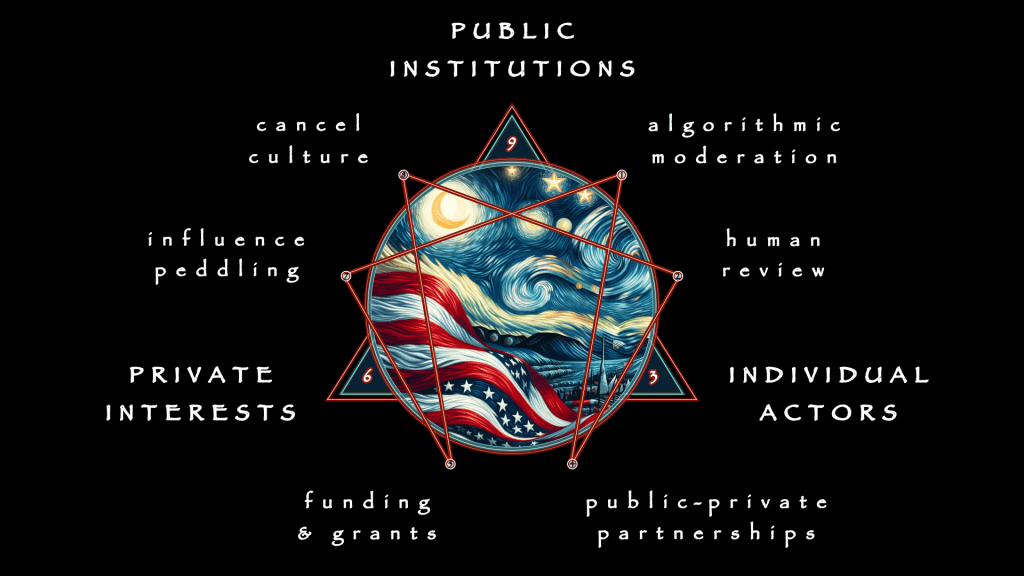
ALGORITHMIC MODERATION: Social media platforms deploy sophisticated algorithms to automatically flag and remove content that violates their guidelines. These digital overseers scan for forbidden keywords and phrases, operating with the loveless, insect-like efficiency of a Kafkaesque patent clerk in an Orwellian nightmare.
HUMAN REVIEW: When algorithms aren’t enough, human moderators step in to assess flagged content. Not your average Rockwell soda slinger, this stultifying human touch adds a veneer of fairness to the narrative’s’ tight leash. The underlying agenda remains the same, and if you just shut up about it already, then we can all get back to work, OK?
PUBLIC PRIVATE PARTNERSHIPS: Programs like CISA foster maternally close collaboration between government agencies and private companies, creating a seamless interface for monitoring and controlling online discourse. These partnerships ensure that resources and expertise flow freely between the public and private sectors.
FUNDING & GRANTS: Government agencies bankroll research and development efforts, guiding a steady stream of innovations to enhance content moderation. This financial backing keeps the wheels of censorship turning smoothly, quietly, and in one direction. Most citizens lack basic financial literacy (i.e. what is money?), and are certainly not “allowed” to know that, thanks to trickle-up economics, they are funding their own suppression.
INFLUENCE PEDDLING: During the recent pandemic, for example, any content questioning the official narratives first on personal protective equipment (PPE) and later on vaccines was swiftly targeted for suppression. Organizations like CTIL used tools like Zetalytics to track and counteract skepticism, painting dissenters as threats to public health.
CANCEL CULTURE: Content critical of government actions, especially if it transcends mere complaint to express alternative political views, is singled out for suppression. These nefarious practices raise grave concerns about the government’s basic mandate amid the erosion of democratic discourse, since dissent is fundamentally a risky act of service that should be protected.
By understanding these ways and means, you can develop strategies first to protect yourself (and your family) and then to challenge unjust censorship practices for the sake of those not yet able to do so for themselves.
The Matrix of Public and Political Pushback
The Censorship Industrial Complex has (finally!) sparked a fierce debate, drawing criticism and support from various quarters. Knowledge and direct action — advocating for transparency and accountability — are the thorny uphill pathway to freedom. Alternatively, you can elect to do the bare minimum, or nothing at all.
Free Speech: Critics argue that the complex’s activities pose a severe threat to free speech, a fundamental pillar of democracy. To suppress dissenting views undermines not only the principles of respectful discourse but, worse, the intellectual freedom necessary to ensure that the best ideas rise to the top in a meritocracy.
Political Manipulation: The growing and reasonable fear that content moderation is being used as a political tool to silence opposition and shape public opinion is only proven by the fact that “lawfare” is now in the mainstream vocabulary. The involvement of government entities in content moderation raises profound legal and ethical questions, particularly regarding the imbalance between the survival of the Deep State (another mainstream term that used to be esoteric), the threats to public safety and the all-important and all-but-forgotten individual rights.
Government Influence: In order to circumnavigate constitutional protections, government agencies blur the line between private action and state censorship. They exert soft pressure on private companies to censor unwanted content on their behalf, effectively bending the law without breaking it.
Legal Scrutiny: Revelations from sources like the “Twitter Files” have led to legal challenges and public outcry, highlighting the murky waters of government-influenced censorship. Meanwhile, recent headlines of presidents and/or their sons becoming felons further erode confidence in the wisdom of the judiciary or the reliability of it procedures.
Transparency: The growing demand for greater transparency in content moderation decisions, including the criteria used and the extent of government involvement, is met first with indifference, then with silence. What comes next is up to whomever takes up the cause.
Accountability: Ensuring fair and consistent content moderation requires robust accountability mechanisms, including but not limited to independent oversight and avenues for appeal. Do not expect any of this to be done for you, nor to exist in future generations if you do not secure it yourself.
Summation: The Cost of Silence
As we witness the systematic manipulation of public opinion, with its collateral erasure of dissenting voices, it’s crucial to become critically aware and increasingly vigilant, and possibly even to upskill for mere survival. The complex web of government agencies, tech giants, academic institutions, and NGOs forms a formidable network that threatens to undermine the very foundations of freedom, and indeed civilization itself. Cancel culture, its most modern manifestation, discourages open dialogue and critical thinking. Instead, it fosters conformity and suppresses the diversity of thought essential for an informed citizenry.
Does that look like a future that you want for your grandchildren, or for theirs?
If not, than it’s imperative that you, yes you, recognize this regime and advocate for transparency, accountability, and the protection of free speech, even if such actions imperil you personally. When the peril finds you, remember to take another look at that yellow corner (family and in-laws), and check for weapons. If you participate in this digital society, then your awareness and engagement are paramount. Only you, not the State, can secure a more informed and resilient society, able to withstand the pressures of censorship and protect its fundamental freedoms, and only by becoming a member of one.
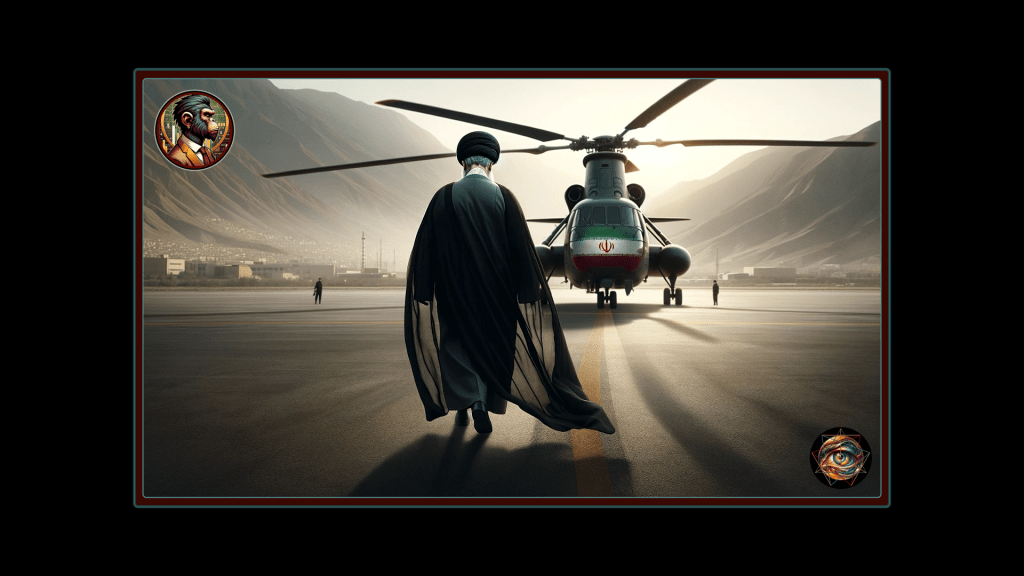
Buckle up for a hard landing, literally, because if this was not an accident, it could just be the Archduke Ferdinand 2.0 moment that none of my readers wants to see. The geopolitical stunt-copter just claimed its latest victim this last week, and the dust has yet to settle. Iranian President Ebrahim Raisi, along with his foreign minister and other key dignitaries, took an unscheduled terminal descent, courtesy of … who knows? Iranian State media confirmed the crash overnight, and the repercussions have been sending shockwaves far beyond the Middle East.
Iran is more than a regional player, or a defunct, backward country of savages; it’s a shadow power with a history spanning millennia.
A stalwart ally of Russia in its Special Military Operation in Ukraine, Iran’s support has been pivotal. From kamikaze drones to military advisers, Iran is bolstering Russia’s capabilities in no small way. This burgeoning Russo-Persian bromance might soon solidify into a military alliance, reshaping regional dynamics and beyond. Many of their other interests align, including peace and regional stability, which poses a threat to those whose interests diverge, particularly the Axis of the USA, the UK and Israel.
Mr. Raisi’s untimely death comes hot on the heels of an assassination attempt on Slovakia’s Prime Minister Robert Fico. Shot at close range, Mr. Fico survived and is in stable condition. According to pro-Western media his attacker, a fervent pro-Ukrainian, targeted Mr. Fico for his Kremlin-friendly stance. Although Slovakia’s split from the NATO cheerleading squad highlights Europe’s internal fractures, those with a more worldly take on things (including Robert Fico himself) attribute it to his opposition to the recent WHO Treaty.
That was clearly a deliberate and premeditated act, whereas this more recent event is quite literally, well, cloudy. Picture this: from a trio of helicopters, the one packed with the high-ranking officials vanishes into the treacherous mountains of East Azerbaijan Province, with no survivors … while the other two land safely at a nearby mine. Officially, Iran is blaming inclement weather.
Unofficially, whispers of foul play are echoing in the corridors of power … and why let a good conspiracy theory go to waste, right?
Iran and Israel have recently been exchanging unpleasantries via missile strikes, ergo Israel had to quickly and loudly deny any involvement. “It wasn’t us,” they proclaim. It might be more accurate for them to say “We want him, and most of the rest of you, dead, and we’re trying to destroy you … just not today.” That is, of course, not how diplomacy works, nor should we expect a complete understanding of these events soon enough to prevent whatever fallout they produce.
On that cynical note, the very public display of ballistics is a fart in the wind compared to recent unconfirmed reports of a thwarted nuclear exchange.
The louder Israel shouts, the more suspicious it gets. In the high-stakes game of international politics, denials are often all the confirmation needed. There has been speculation of an inside job, perpetrated by Azerbaijan, but this seems as plausible as Russia bombing the Nordstream 2 pipeline. Oddly, the verifiable weather is such a credible cause that the denials seem particularly overblown.
While Mr. Raisi was not without his detractors at home, earning him vile monikers among dissidents, this is being exaggerated for effect by a propaganda machine that ignores worse accusations against the Bush and Clinton families, among others. It is not my place to defend any politician’s reputation; my remarks are meant to objectify the perspective rather than to identify with any faction. And yet the public reaction I have observed among Americans, who often trivialize the suffering and death of others, is shameful.
For now the wisest course of action is to watch, and wait for a response, which will be slow and indirect. Westerners tend to be impatient, giving them a significant disadvantage in the information arena of the wars they are waging in Asia, whether with bullets, bullion or bad loans. Another major cultural difference is that Asian nations (including Russia) see victory as imposing the terms of the peace, whereas the Western strategist defines it as the destruction of his enemies.
This also explains their different time horizons in war.
Israel is actively denying involvement ironically because bad weather is its best and only alibi. The question of who benefits from this is complicated, and the answer once again depends on time. In the short run, the disturbance seems to favor Iran’s external enemies, most of whom understand little to nothing about its internal power structure nor the likely successor … not of the President, but of the aging, unelected Supreme Leader into whose slippers Mr. Raisi was poised to step.
Although beyond the present scope, in the long run it is not unlikely that Mr. Raisi will be viewed as more moderate than his successors, and better prepared.
Meanwhile, the International Criminal Court (ICC) continues to flail in the shifting winds of global politics. The Court just issued arrest warrants for Benjamin Netanyahu and Hamas leaders, and in the same 24-hour span. Coincidence? This bored ape thinks not. The Middle East is a powder keg right now, and these events are interconnected. Ironically, the Biden administration, which supported the ICC’s warrant against Vladimir Putin, now claims the court has no jurisdiction over his pal Bibi.
Hypocrisy? Absolutely. Surprising? Not at all.
The Court’s struggles are a leading indicator of the fracturing unipolar world order, a relic of the not-so-good-old-days when the USA called the shots via the preeminence of the Petrodollar. After the Cold War, it briefly stood unchallenged, dictating terms to the rest of the world instead of using its power for the greater good. Those halcyon days of wasted opportunity are now spent.
The geopolitical landscape today is multipolar, with Turkey, Iran, Saudi Arabia and other up-and-comers, not to mention the BRICS nations, challenging the Western Bloc.
Because this event unfolds amidst such global upheaval, whether accidental or not, the many players in the Grand Game will attempt to take advantage of the situation before their rivals do. In this case, even if it is an act of God, the effect is virtually the same as an assassination. Whether the fall of Iran’s president was an accident or not, whatever happens as a result won’t be.
Remember when Pakistan’s first female president suggested Osama bin Laden had died of kidney failure? She was gunned down shortly after, and then the US “found and killed” the fugitive terrorist. Mr. Raisi’s death fits this pattern. There’s a war raging between Israel and Hamas, with Hezbollah and the Houthis also involved. And in the midst of this chaos, someone possibly decided to make a decisive play in this high-stakes game of life-and-death.
So, what does all this mean?
The unipolar dominance of the United States is over, as is the “End of History” that it prophesied in the 1990s. That was never realistic, and within a generation it has been replaced by a multipolar world brimming with rivalries and alliances. Navigating these choppy waters will be hard enough for captains, so be careful which boats you board.
The helicopter crash that claimed Mr. Raisi’s life is more than just unfortunate; it is yet another frightening indicator of risk in these tense times. I keep imagining myself in that chopper, straining to maintain composure and make my peace with God, which only proves that I’m still breathing. In reality, the show is in the early acts, and we’re all along for the unprecedented thrill-ride of human history as this geopolitical helicopter spirals toward chaos in the clouds.
When faced with increasingly pervasive and direct surveillance, how can peaceful individuals turn the tables on predatory practices to safeguard their privacy in an interconnected society?
This essay is the practical sequel to the theory implied in “Four Wolves and a Rabbit”. As stated there, although it can be played on a checker board, it has direct application in the real world. That brief exploration of game theory was an introduction to professional surveillance methods and, more importantly, how to mitigate or evade them. What follows here is an example, drawn from my lived experience.
In an era of increasing technological sophistication, the intersection of privacy rights and surveillance is a touchstone for societal and legal discourse. Although I am a hunter and gatherer of intelligence, my motivation to acquire the skillset was not merely commercial, as it might have been for — shall we say? — a locksmith. Actually, depending on location, business model and client base, most people can make a more comfortable living by installing or defeating physical locks than they can by discovering what is lost and/or hidden by human hearts and minds.
A PREDICAMENT
My interest in the OSINT trade was initially inspired by an affirmative defense of eroding civil liberties but, on account of other skills I’d already acquired over the years, it branched out first toward IoT (internet-of-things) and then to Fintech in its search of commercial application. However, when I noticed a suspicious driver conspicuously following my left flank recently, neither circuit boards nor financial fraud were the first thing to cross my mind.
Indeed, although I was not surprised or scared to be tailed by a fellow Private Investigator (PI, a recurring acronym in this narrative), I was rightfully angry since I was driving my wife’s car … she was the prey!
Naturally, I confirmed the tail before hopping to conclusions. I would not have seen it if I had been the passenger, of course, nor would my wife have recognized the signs if she had been the driver. Yet experience shows that the most interesting things happen precisely where luck collides with preparation.
By degrees, this essay aims to introduce the lay-person to retail counter-surveillance, albeit indirectly, leaving room to run. First, however, unless you or yours have been stalked before, there is a case to be made for enhanced situational awareness in mundane urban environments, which I regret because it’s a case that should make itself. Eventually it will, when its sorry lack claims enough victims.
Let that land …
No matter how urgently one advocates for awareness, though, without help and constant coaxing, average people tend to learn the hard way, and subaverage people make it even harder still. On a more recent occasion, a related circumstance forced us to dip into our Private Insurance (PI) and sell some Krugerrands to pay for emergency Professional Insight (PI), which is never inexpensive. There, too, in the parking lot of the local coin shop, she saw no reason to treat the errand any differently than a trip to Starbucks or Chipotle Grill.
She’s learning, and you can, too.
THE PEN
Although the legal landscape governing surveillance by PIs is complex, and varies by jurisdiction, laws everywhere (in the Western world) generally agree that it must be conducted fairly, transparently and with the subject’s rights firmly protected. Trespassing, harassment, or unauthorized data collection are expressly illegal, and can lead to a range of consequences from civil liability for invasion of privacy to stickier criminal charges.
To adhere to legal boundaries concerning physical surveillance, PIs must first ensure that they have legitimate grounds, and are often required to obtain necessary permissions, especially when monitoring individuals in private spaces or sensitive situations. Trespassing on private property, installing cameras or listening devices without consent, and following individuals too closely can cross into illegal territory, leading to charges of harassment or stalking.
Such tactics can and should result in criminal charges, civil lawsuits for invasion of privacy, and potential professional consequences such as the revocation of a PI’s license. The not-so obvious reason is that, unbeknownst to the public at large, law enforcement personnel are held to the same standard, although their far-too frequent crimes are much more difficult to prove in practice.
Clients who hire PIs also bear responsibility for their ethics and intentions, and are ill-advised to outsource any potential bad deeds of their own, even to the willing. Any negligence (or nepotism) of theirs can compromise the legal standing of private surveillance, and reflect ethically and legally back upon them. As the motive behind the means, they must hire operators who respect both the letter and the spirit of the law.
Fortunately, a higher percentage of PIs respect legal limits than do their counterparts in law enforcement itself, who privately use qualified immunity the way surgeons use disposable gloves.
These are the murky waters of physical surveillance, and PIs lurk online, too. Therefore, arming yourself with the legal tools and technical tactics to dodge their prying gaze means, first, even before understanding your adversary, surveying the battleground itself. In the real world, the advantage goes to whomever uses the terrain best, and the contest is always fluid.
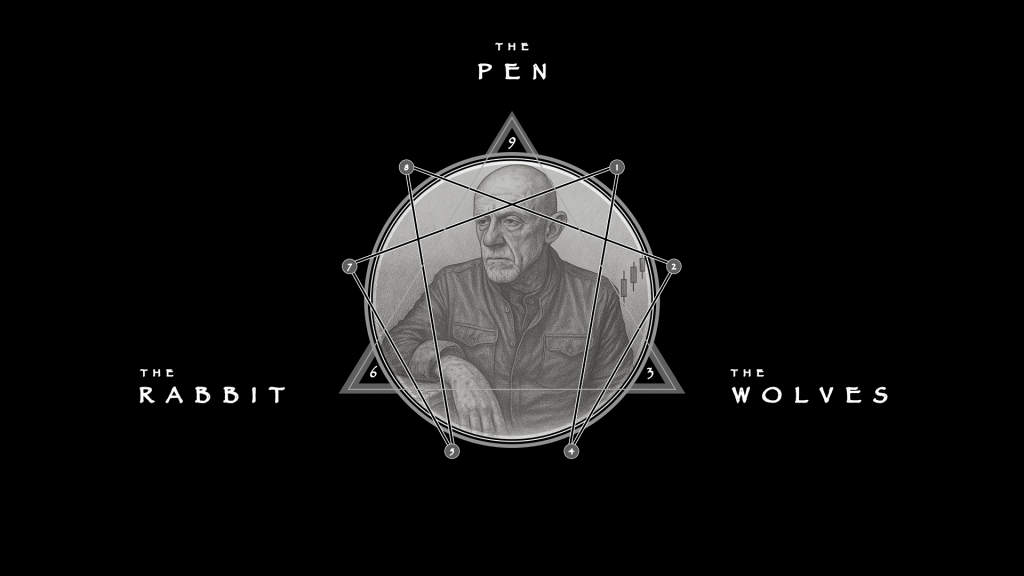
As tempting as it might be to think of this as a game of cat-and-mouse, regular readers of my work already know why I refer to the physical action space of surveillance as The Pen. If your senses leave you feeling cornered, then the feline analogy is a luxury that you cannot afford, since cats don’t hunt in packs.
THE WOLVES
Can you imagine the fabric of your life, your basic everyday hustle and bustle as a vast, sunlit field? If so, then you might be on the menu, for what now appears as a field is, in fact, a Pen. That is how hunters, human or otherwise, see the field, after all, which is to say that victimhood is a voluntary state of mind, regardless of victory or defeat.
How YOU see it is a matter of choice, of course, yet once you verify that you are a target, ignoring the scrutiny upon you can be dangerous since it belies intent, whether or not you know whose.
In effect, PIs are a pack of keen-eyed Wolves that blends seamlessly into the tall grass, foot soldiers in a landscape of surveillance capitalism, each employing their own subtle tactics to track and understand the Rabbit (you, or another) without disturbing the peace in the Pen.
The Wolves are stealthy, though, and don’t just watch, They move, on multiple fronts, quietly and with purpose. These are not isolated incidents but a coordinated pack effort, painting a picture of your habits and secrets.
Telephonic surveillance is not out of the question, of course, and not just during calls. That digital appendage of yours can betray you with each benign buzz and every creepy click, or with those randomly untimely battery drains. Glitches are the whispers hinting that you might have company.
Do not be surprised to find Wolves conducting banter-based surveillance, either — idle strangers with an unhealthy interest in your unremarkable life, casually fishing for tidbits like a well-meaning but senile old aunt at a family reunion. As they purposefully weave through your day, seemingly disguising disinterest, they are “data mining” for flecks of golden dust in your leaden responses … or others’.
And what long noses those Wolves have, too; all the better to sniff around your waste bin.
If documents about yourself that not even your intimates are aware of should return suddenly to haunt you like the Ghost of Christmas Past, then cue the dramatic music and get ready for fight or flight. Those aren’t just any old papers, after all, but the breadcrumbs left by someone piecing together the puzzle of your life, perhaps overstepping those blurry lines of legalese.
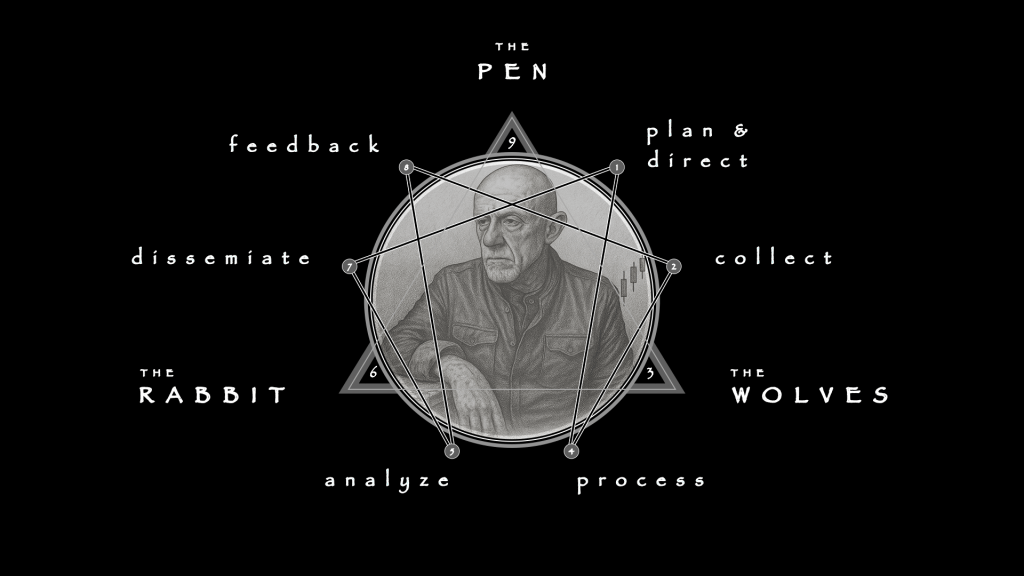
1. PLAN & DIRECT
The first step is to see the Pen for what it is, unapologetically and in its entirety. Understanding every corner where a Wolf might hide. Learn the tools of the trade — the techniques and technologies that they all use to stay upwind from a Rabbit. Don’t worry about evasion or other countermeasures, not yet. Just map the terrain, from the physical to the digital … to the emotional.
2. COLLECT
Next, gather specific environmental cues, i.e. how the local Wolves mark their territory, depending on their specializations. Like you, they leave signs of their presence, and of their passing — droppings, to press the analogy. Oddly situated vehicles are an obvious example. Strangers with an unusually good memory for details may be less obvious, especially if you tend to be agreeable and/or speak too freely. Note every rustle in the grass, every odd reflection of light during the collection phase; no detail is unimportant. Identify the white spaces around you, for they may prove to be the most pivotal of places later.
4. PROCESS
Now, categorize those whispers among the grass, each shadow in the trees. Select and arrange your findings into a coherent guide to the Wolves’ behavior, a Field Manual, if you will. This step involves crafting a clear, accessible depiction of the surveillance ecosystem, from the blunt snout of a camera lens or the pointed tips of a covert microphone to the schedules of your mail delivery, your trash pick up … or that friendly milkman.
5. ANALYZE
Here, the effectiveness of each Wolf, and each method, is evaluated, not just how they hunt, but where … urban jungles, rural expanses, online? What strategies do the Wolves use in their preferred terrain, and how might they react if flushed out? This is where patterns emerge, and the behavior of the pack becomes predictable. Remember those white spaces? Those transitional zones are where evasions are most effective, and where traps are most effectively set.
7. DISSEMINATE
Share your knowledge of lupine lore and of the Pen — pay it forward far and wide. It could be a series of detailed videos or articles, such as this, or a comprehensive guide, depending on how the Rabbits in your network prefer to consume their content-carrots. Not only will you be helping others in need; your own claws will grow to make a better digger of you, and those fabled little Rabbit fangs of yours might sprout, too.
8. FEEDBACK
Finally, figure out if your evaluation of the Pen resonates with other possibly bewildered Rabbits in your network — and even with some of the Wolves. Yes, you read that right. Interviewing a few and, in some cases, possibly even hiring one can only make you a more informed individual. Also, integrating the opinions of legal eagles and the actionable insights from the more seasoned hares can refine and perfect your perspective of the Pen.
THE RABBIT
When you feel the hairs on the back of your neck stand up from the prick of unseen eyes on your skin, you might be the star of your very own spy flick. If so, the stakes are real, and the audience is unfriendly. Congratulations on opening your eyes.
Now what?
First, breathe. Panic is the cologne of the hunted; it smells like shit and it gives you away. Stay cool, stay sharp. From now on, unless and until you are certain that the threat is no more, every move you make must be calculated.
THEY ARE NOT REAL WOLVES — THEY WILL NOT EAT YOU.
Their primary goal is to acquire information, which they cannot do if they are detected. That is their weakness, and your advantage. They, too, are hiding, after all, with both their reputation and their livelihood on the line.
So, document every brush with the bizarre. The unfamiliar SUV that’s a little too fond of your street, or a phone that might listen more than it speaks, these notes are your first line of defense, the rough sketches of your map of the Pen. Gobble up those details and finish that Rabbit’s crash-course Field Manual to dodging (and eventually hunting) Wolves in the wilds of the postmodern surveillance savannah.
Change it up, too, be unpredictable. If you normally grab coffee at 8 AM, throw a curveball — maybe one at noon instead, or a slow breakfast at a cafe you don’t like. Your surveillance detail will sidle up alongside of you, adjusting to your new rhythms. This dance is your chance to flush the Wolves out so, instead of fleeing; zig where you normally zag, and ID your targets.
Electronic eyes and ears might be harder to spot, but they do leave traces. Unusual data spikes are a clue, or rapidly draining batteries. Encryption is your best friend here, your cloak to their dagger. Also, if you haven’t begun already, assume that your devices are listening to you, and be selective (and even dynamically misleading) in your speech.
Reportage is key.
Let the cops know of your unwanted fans. Police can shine the spotlight onto those who shadow you. If a PI turns your hum-drum daytime drama into an episode of a bad detective series, your lawyer might just write them off the show. Nothing scares a Wolf like a sharp subpoena.
Finally, team up (more on that below). There’s safety in numbers, obviously, but greater insight, too. Four eyes can see more than two, and six see even more than four. A wingman or two can dissuade the more opportunistic tails out there and/or give you a perspective on your paranoia, to discern if you’re really a person-of-interest or just over-caffeinated.
No matter what, though, do not ignore your instincts, which you have for a reason — if you feel uneasy, trust yourself that something might be wrong, and act accordingly.
Never forget that the way of Personal Incentive (PI) is as universal as it is unreliable. The superior Way of the Rabbit is run by virtue of Preemptive Initiative (PI). With that as your dagger to their cloak, maybe, just maybe, the Wolves will have bitten off more than they can chew.
COUNTERMEASURES
I discuss the surveillance predicament in terms of the Pen, the Wolves and the Rabbit because it grounds the subject (potentially you) thematically in a contest decided not by strength but by information. The description is static, though, whereas the reality is fluid, ergo some indication of concrete practical steps is needed.
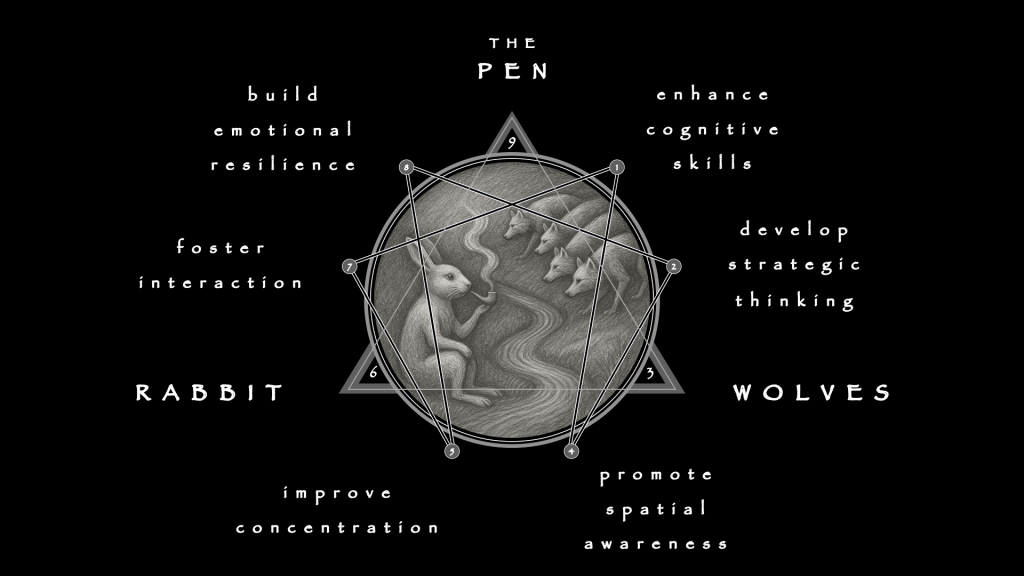
As a flowchart, the enneagram synthesizes dynamism and coalescence, making it useful in this case, too. It unites the disparate elements of a process into a system of three sources — the Logos — and six steps, which I will briefly enumerate.
Again, my purpose here is to instruct Rabbits to counter a certain class of Wolf pack tactics. If instead — let us say — it were to train novice PIs to work together to avoid detection, the six steps would be entirely different, even with a similar Logos.
Furthermore, each particular step is described in broad terms. The treatment is not exhaustive, but suggestive.
The point, as I alluded above, is that each of these is worthy of longer form content, be it a separate post (blog or video), for example, or a chapter of a book. Of course I hope to fill in some of those blanks myself, however the field is a Pandora’s Box. Once opened, your best bet is to go where your curiosity takes you, and not to seek a prescribed path.
My own subjective areas of interest (above) lie more in points 1, 5 and 7, however your own situation may leave you with a different focus or set of needs.
1. SURVEILLANCE DETECTION ROUTES (SDRs)
Vary your schedule as much as possible and avoid convenient navigation; take the long way. Surveillance teams may set up shop along a route that you frequent. By casually altering your habits, your movements become less predictable. I keep mentioning those white spaces for a reason and, depending on your routines, red spaces may also be available to you, filters and bottlenecks that limit your tail’s passage.
One idea is to visit a mundane well-lit, high-visibility location for 10-15 minutes, like a donut shop, then drive in a small circle back to the same place and stay awhile longer. A second idea is to randomly exit and reenter the same freeway … more than once. Yet a third idea is to throw out your trash, especially your paper recycling (pre-shredded, of course) on the morning of collection, not before.
Game it out, and have some fun.
2. DISGUISE & DECEPTION
Conduct a wardrobe change in a secluded place. This could be as simple as ditching a coat, donning on a hat, or changing your shoes … or not. A good surveillance team will note your footwear; now you know. If you think you may need to run, consider wearing sandals to begin and changing into shoes before the chase. Reversible coats are ideal, and wearing removable layers is a fine substitute in many situations.
The challenges of video surveillance are greater and more subtle, especially if you factor in CCTV feeds and sophisticated software. Operators can scroll between locations, or forward and backward in time, and even learn to recognize your stride. Your options will depend on who is watching you. Circumstantial make-up or prosthetics are ill-advised, especially if your tail is official, and only a matter of last resort.
If you have nothing to hide, then standing in plain sight may be your safest choice.
4. ELECTRONIC / DIGITAL FOOTPRINT
“Bugs” emit electromagnetic radiation, usually radio waves. TSCMs (Technical Surveillance Countermeasures) sweep for them with an appropriate detector, a device that measures the strength and direction of their RF signals. If you are a standing target, though, maybe managing a business or other sensitive operation, then SDSs (Surveillance Detection Systems) are your analog to SDRs, digital watchdogs built to warn of potential intrusions by sensing unusual behavior.
Similarly, WIDS (Wireless Intrusion Detection Systems) safeguard wireless networks by identifying unauthorized devices attempting to breach your digital perimeter. Your data is your digital DNA — unique, private, and valuable. Strong passwords, encryption, and secure networks are your digital deadbolts. If needed, signal jammers and lens detectors can further help you to maintain your privacy.
In the digital age, paranoia is the new pragmatism; the less you leave behind, the less there is to find.
5. EVASION
Avoid risky locations, of course, and be more discreet and circumspect than those around you. Common sense will not be enough, though, in the moment of evasion, which is why you made such tasty Wolf jerky from all that raw data. And it is merely a moment that you will have, so plan ahead. Assuming that your tail is working as a team, you will be easily reacquired if you choose your time and place at random … so don’t.
Challenges vary if you are on foot or if you are driving. (Even worse would be if you are a passenger, but that’s a highly specialized problem of its own.) In either case, keep your cards close to your chest, and don’t tell on yourself before you make your move. Meanwhile, use that vast, sunlit field of your basic everyday hustle and bustle as background noise to keep prying eyes and ears at bay.
Even more than risky locations, avoiding risky (i.e. unpracticed) moves is a tactic that should need no explanation.
7. COUNTERSURVEILLANCE
In this game of hide and seek, where your privacy is the prize, winning means ensuring that your private life remains just that—private. Although there are, of course, apps and devices to detect bugs, GPS trackers, or hidden cameras, reliable countersurveillance requires a complete lifestyle adjustment based on situational awareness, and up-to-date knowledge of professional practices. At a minimum, start browsing websites that market such products (but resist the temptation to buy toys that you don’t need), to understand your adversary.
Online forums, privacy advocates and specialized newsfeeds can provide valuable insights and updates on the latest in privacy technology and surveillance tactics. Keeping an open mind will be difficult, but vital; again, map your threat-vectors, especially the emotional. Worse, there is no substitute for initiative here, and laziness is the enemy. Teamwork mitigates the workload, if you are blessed with motivated people in your midst — training your family to care can be a blessing or a curse, depending on how you present it to them. It’s such an unpredictable journey, so full of discoveries (many of them unpleasant), that generalities are the extent of the present survey.
Most importantly, though, remember that the pinnacle of countersurveillance is not mere evasion, but the gathering of intelligence of your own.
8. PROFESSIONAL INSIGHT
If you suspect that more sophisticated surveillance methods are at work against you, then consider fighting fire with a ton of bricks. Hiring a counter-surveillance expert is the unbeatable move, but just as with disguise or evasion, extremes should be avoided. They can equip and train you to detect electronic surveillance devices, and even provide more advanced counter-surveillance services if needed.
Although vetting is a separate subject unto itself, first be prepared for a battery of of tough questions. If you have been filtering your problem through the Intelligence Cycle (have you tested my free Custom AI Tool?), then you should already know a lot about who is watching you, as well as how (as in where and when), and why (what is their definition of success?). The specific Logos will dictate what kind of professional you should seek, and exactly what questions you should be asking each other.
It’s all-too easy here to say “choose wisely”, which is always difficult for lay-persons to do when hiring specialists — of any kind, including plumbers — therefore my advice instead is to figure out your limits in advance to avoid surprises.
Countersurveillance measures are those taken to prevent, detect, and mitigate unwanted surveillance activities. Remember, though, that while these can help you to proactively manage the irritant, you must act within the law and especially avoid causing harm to others.
Once you cross that Rubicon, among other disavowed hazards, then you are no longer practicing countersurveillance, and risk drawing attention to yourself in the process of whatever you’re doing instead.
The one and only aim is to inform yourself, not to remove adversaries. Strictly speaking, the Wolves are not your true opponent; they’re just doing a job. Like plumbers, ironically, they are worthy of every professional courtesy, even if you compete against them. It is their client, after all, who matters.
Most importantly, though, making enemies gives you no new information.
Among traditional games, “Four Wolves and a Rabbit” stands out not just for its entertainment value but also for its potent educational capabilities. This intriguing and cunningly simple checkers variant is particularly suited for those young strategists who revel in intellectual challenges and complex, asymmetric problem-solving. Although it is an excellent choice for parents looking to enrich their children cognitive and strategic thinking skills, it’s also fun for the parents themselves, making the game as interactive as it is educational, enriching more than just the mind.
DESCRIPTION
The game unfolds on a standard 8×8 checkers board renamed “the Pen”, whose 64 squares represent the confined space within which the strategic drama between predators and prey plays out. At one end of the Pen, the Four Black Wolves line up on the dark squares of the back row, poised to strike. Opposite them, a lone White Rabbit contemplates its perilous path, readying to run the gauntlet.
MOVEMENT
Wolves: Limited to a forward march, Wolves can only advance diagonally to an adjacent empty square within the Pen. This movement simulates the Wolves slowly tightening the noose around the rabbit, strategically limiting the Rabbit’s options.
Rabbit: In contrast to the wolves, the Rabbit has the agility to move both forward and backward diagonally. This ability represents the rabbit’s wily attempts to find gaps and dodge between the advancing threats, reflecting its struggle to escape the confines of the Pen.
SURVIVAL
Wolves: The pack aims to completely corner the Rabbit within the Pen, blocking all possible escape routes, effectively confining it to a section of the board. The Wolves cannot eat until the Rabbit runs out of moves.
Rabbit: The Rabbit must dodge the noose by slipping past the Wolves and reaching the freedom that lies beyond the far side of the Pen. Achieving this requires the Rabbit to misdirect through the Wolves.
GAME PLAY
The Rabbit moves first, reflecting its initial dash for freedom. The Wolves follow, each turn representing a calculated move to further restrict their quarry’s options.
The Pen, with its strategically limiting action space, is the medium in which the unfolding chase ensues. There is no capturing, only maneuvering, as each player tries to outwit the other within the confines of the Pen.
The endgame, of course, is reached when the Rabbit manages to break past the Wolves and step out of the Pen, or when the Wolves successfully confine the Rabbit, making any further movement impossible.
Renaming the board as “the Pen,” emphasizes the metaphor of strategic contest for territory and freedom, grounding the thematic experience for players as they engage in this otherwise abstract contest.
STRATEGY
Rabbit: Maintaining a position towards the center of the Pen as long as possible is advisable, maximizing maneuverability and keeping escape routes open. The Rabbit must actively engineer and then exploit a misalignment among the Wolves, using their fixed forward movement to its own advantage.
Wolves: It is critical to advance in a formation that efficiently covers the diagonal paths, slowly shrinking the rabbit’s viable territory within the Pen. Forming a staggered line can be effective, creating a net that eliminates the Rabbit’s options.
BENEFITS OF PLAY
Enhance Cognitive Skills: This game demands foresight and planning. Players must think a few moves ahead, stimulating problem-solving and decision-making skills. Such mental training is invaluable, fostering a mindset that thrives on anticipating outcomes and strategizing accordingly.
Develop Strategic Thinking: Players must continuously adapt their strategies based on the evolving game state. This dynamic encourages a flexible mindset, which is highly transferable to adult challenges.
Promote Spatial Awareness: Manipulating spatial relationships is crucial. Both players improve their ability to visualize movements and consequences, skills that are essential in most STEM fields, and elsewhere.
Improve Concentration: The pace and complexity require undivided attention and patience, valuable virtues in a high-velocity world. Engaging in this game promotes these qualities, which are crucial for achieving more important long-term goals.
Foster Interaction: Despite being a competitive, the game provides a platform for meaningful interaction. It encourages discussing tactics and rules, fostering communicative abilities and patience in listening to others’ perspectives and strategies.
Build Emotional Resilience: Learning to cope with the game’s inherent challenges can help young players develop resilience and adaptability. These experiences teach managing both triumphs and setbacks gracefully.
IMPLICATIONS
Although “Four Wolves and a Rabbit” can be played on an ordinary game board atop a table among friends and family, it has direct application in the real world. Similar remarks have been made of other board games that more overtly simulate war, such as Chess or Gō.
This apparently simpler game finds its ultimate expression in the subtler fields of investigation and intelligence. In short, this brief essay on game theory serves as an introduction to professional surveillance methods and, more importantly, how to mitigate or evade them.
Although I first learned this game in childhood, it was not until I played it as a man, for real, that I fully understood it.
“You may abandon your own body, but you must preserve your honor” – Miyamoto Musashi
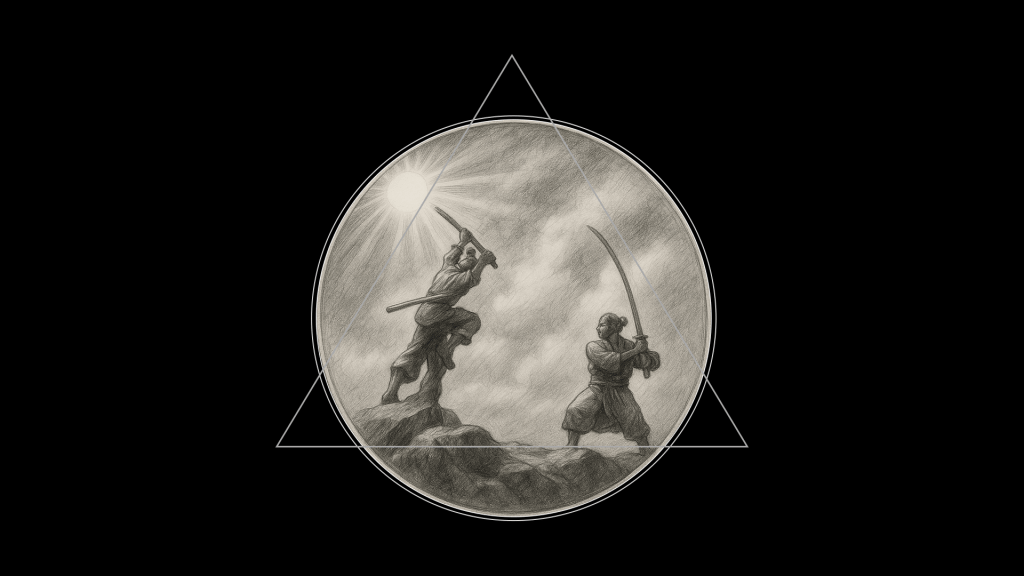
The Dokkodo, or “The Way of Walking Alone,” is more than a testament to the formidable intellect and spirit of Miyamoto Musashi. It is a standard for the solitary warrior in pursuit of individual excellence. Days before his death, instead of contemplating his life’s regrets, or the falling of the cherry blossoms, the undefeated duelist instead wrote the Dokkodo by hand for his closest pupil.
Musashi was writing the first self-help guide for high achievers.
Its 21 short precepts guide us toward and along the path to discipline and self-mastery, to a unique approach to sharp living. They range from the profundity of, “Do not, under any circumstances, depend on a partial feeling”, to the simplicity of, “Do not fear death.”
The vital importance of honor in particular is stressed when faced with the most fearsome of questions. In warrior culture, where the flesh is merely a vessel for Will, the body may fall in battle but honor, once lost, is a citadel forever breached.
The Dokkodo – a Metamodern Reading:
Life is not a cherry-pickers’ buffet
Pleasure is fleeting; chase something better, like victory
Half-hearted efforts lead to half-baked results; go big, or go home
It’s not about you
Desires are like quicksand; stand firm on solid ground
Regrets are for people who won’t level up
Jealousy is a zero-sum game; focus on your own game
Nothing lasts; adapt and move on
Whining is not a strategy; winning is
Emotions are wild horses; learn to ride or be trampled
Preferences are cages; be free
A true warrior can thrive anywhere
Hunger for success, not for snacks
Dump the dead weight
Question everything; blind faith blinds
Travel light; hoarding is for losers
Do not over-train
Fear is a worse enemy than death
Self-reliance is your true deity
Your word is your coin
Above all, serve your purpose
The Dokkodo is an intriguing masterclass in strategy, life, and art that, like William Blake’s “Proverbs of Hell” is as open to interpretation as there is time for reflection. It will not spoon-feed any wisdom to you, and instead demand that you bring your own genuine experience in order to rise to its challenge.
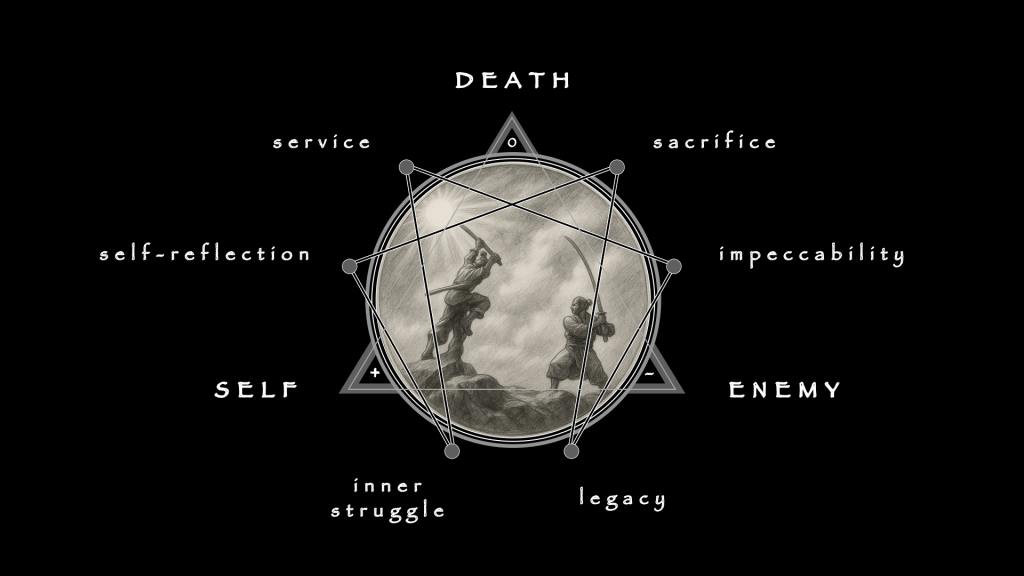
SACRIFICE
The body is but a pawn, a piece inevitably to be surrendered. Honor, however, is the king on the chessboard of virtue.
IMPECCABILITY
Honor guides like the North Star, a constant beacon amidst life’s tumultuous seas, a steadfast companion through the darkest of nights.
LEGACY
History remembers not the details of one’s demise but the legacy left behind. A warrior’s true immortality is etched not in stone, but in the annals of virtue.
INNER STRUGGLE
The greatest battle is fought silently in the valley between your ribs, and in the desert between the ears. Will you stand guard over your honor, even when the enemy is within?
SELF-REFLECTION
To preserve your honor is a testament to Will, a portrait you paint with the brushstrokes of choice and action. In the mirror of life, what do you see — a visage marred by compromise or one radiant with integrity?
SERVICE
Life is a brief quest in pursuit of the highest virtues; outgrow the physical realm, and into the that of Spirit.
Legal defense is no different, though it can involve complex concepts that require a nuanced knowledge of precedent and/or procedure. Often enough, though, one needs only simple discovery tools to challenge the plaintiff’s evidence, and highlight any weaknesses in the allegations.
FACTUAL ALLEGATIONS
Defense must based on concrete facts rather than abstract legal theories. Provide parallel case studies where factual allegations made a significant difference in the defense’s credibility.
EFFECTIVE PLEADING
Defenses must be pleaded with enough detail to inform the plaintiff and the court of the nature of the defense. Show in detail how the plaintiff’s actions contributed to the harm.
AVOID POOR COUNSEL
Beware of relying on unverified sources, including anonymous online legal forums and especially AI. Though not useless, they are not a source of reliably accurate, jurisdiction-specific advice.
DISCOVERY
Use the tools of the trade, such as interrogatories, depositions, and requests for documents to gather supporting evidence. Weaknesses in the plaintiff’s case tend to corroborate the defendant’s claims.
TRANSFORMATIVE SLANT
A well-constructed defense can change the story from the plaintiff’s perspective to the defendant’s, putting the plaintiff on the back foot. Rather than merely negate liability, prepare the ground to assert counterclaims.
ELEMENT-SPECIFIC PROOF
Each defense has unique elements that need specific evidentiary support. For example, defenses like Absolute Immunity, Qualified Immunity or Unconscionability have specific legal criteria that must be met, demanding a thorough understanding and careful argumentation.
Consider developing a comprehensive list of defenses, from Duress and Estoppel to Self Defense in tort cases, and understanding the contexts in which they do and do not apply. How courts have interpreted these elements in past cases is crucial for effectively asserting and proving them.
Adherence to local court rules, such as deadlines for filing certain motions or specifics of evidence presentation, is no less important. Furthermore, each state will have different interpretations and applications of defenses.
The overarching theme is to transform defense into offense. By effectively using affirmative defenses, a defendant can put the plaintiff on the defensive, changing the dynamics of the legal battle.
Have you ever bought or sold stocks or cryptos based on market sentiment? Fear not, for this is no survey; I honestly could not care less what you buy, or why. If I did, as you will see, then there could be no more crude method of learning anything useful.
Since I already keep a finger on the pulse of global capital flow via Tradingview, sentiment occurs to me as an afterthought, despite being its Prime Mover. There are a few key problems with sentiment analysis as the backbone of a trading strategy. Surely the greatest among these are Subjectivity and Delay.
As a tool in behavioral finance and econometrics, sentiment analysis employs a range of sophisticated methods tailored to specific research objectives and data availability. En masse they inform of their underlying principles, mechanisms and applications in divining market sentiment. In this first of a three part investigation, the evolution of sentiment analysis as a crystal ball for predicting market dynamics is met with a healthy degree of skepticism, although its other uses are admitted.
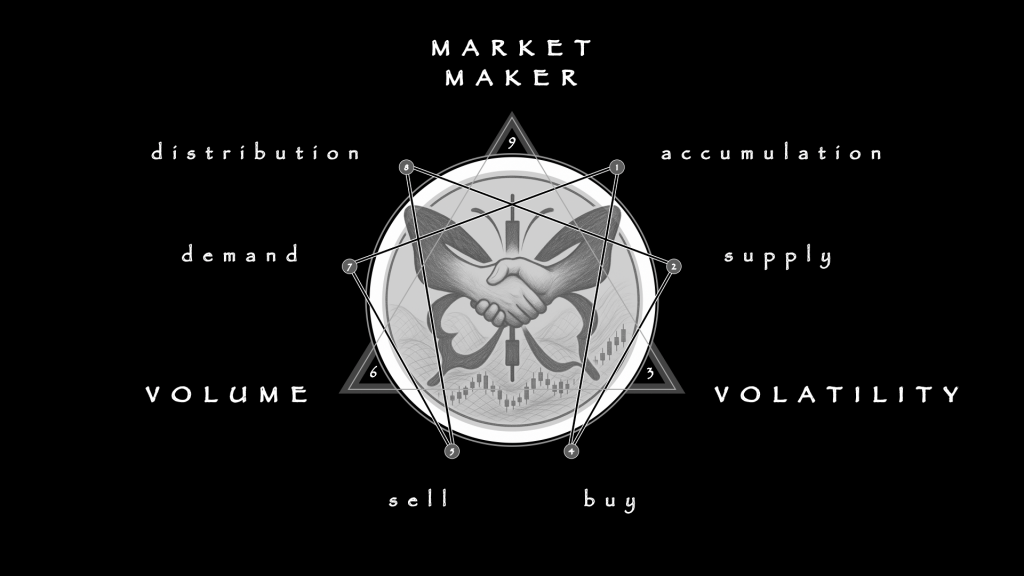
Without further fuss, most large market moves are predicated by the Bandwagon Effect, which is to say that all what we ever “see” is the Dumb Money. The Smart Money is effectively invisible, at least to retail eyes, and requires organs sensitive to VOLUME, VOLATILITY and TREND EXHAUSTION. Fortunately, those three are more reliably lured into the light of measurement than real-time order flow.
In other words, rather than sympathize with the majority, who are always late to the party, I strive to align with the Market Maker.
Of course I did not arrive at that idea early. Worse, my trading career began with crypto after the Covid Crash of March 2020, which is to say that it was a time when the fundamentals exploded and sentiment was “divided”, to put it mildly. There has probably never been a worse time in human history to learn to read price charts and dabble in swing trading.
Nowadays I perform a spontaneous ad hoc sentiment analysis by simply scanning the thumbnails in social media without actually clicking any of the bait … laser eyes tell a lot, most of it misleading. As it turns out, I am practicing what specialists call Principal Component Analysis (PCA), the blended smoothies at the data analytics bar. In the hands of a pro, such clever concoctions are supposed to coax the spirit of the market’s mood swings, giving traders the buzz they need to make those big bets.
Your mileage may vary …
Composite sentiment indices amalgamate various metrics into a single supposedly “robust” indicator to reduce dimensionality and extract key features from the data. The idea is to sharpen the tool by integrating diverse measures, thereby constructing an index that selects sentiment-related variables and validates its predictive power and relevance to market conditions.
The typical finished product, the retail eye-candy that every Noob sees, is some version of the Fear and Greed Index, originally created by CNN.
Now that I have developed my own trading Edge, my informed opinion is that it is deliberately designed to part the Dumb from their Money. To my eye, at least, the scale is presented backwards — with Fear at 0 in red and Greed at 100 in green — more as if to induce sentiment than to gauge it.
For exactly that reason, I and other experienced traders tend to avoid those colors in price charts altogether, at least for the candlesticks. Mine, in fact, are coded not to show price action as “bullish” and “bearish” (which are not strictly defined anyway) merely by rising and falling, but instead to show cycles of Accumulation and Distribution, in yellow and blue respectively.
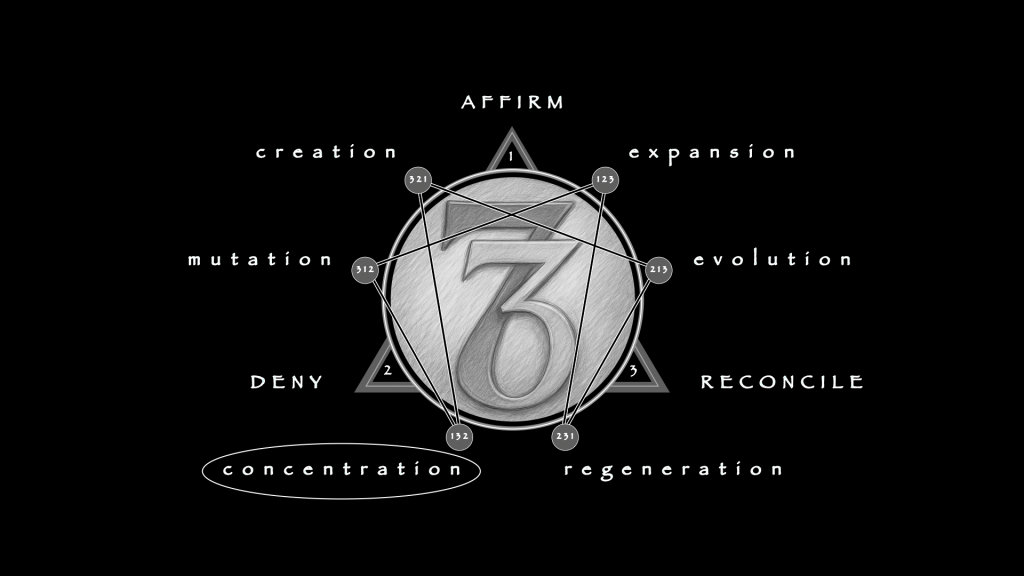
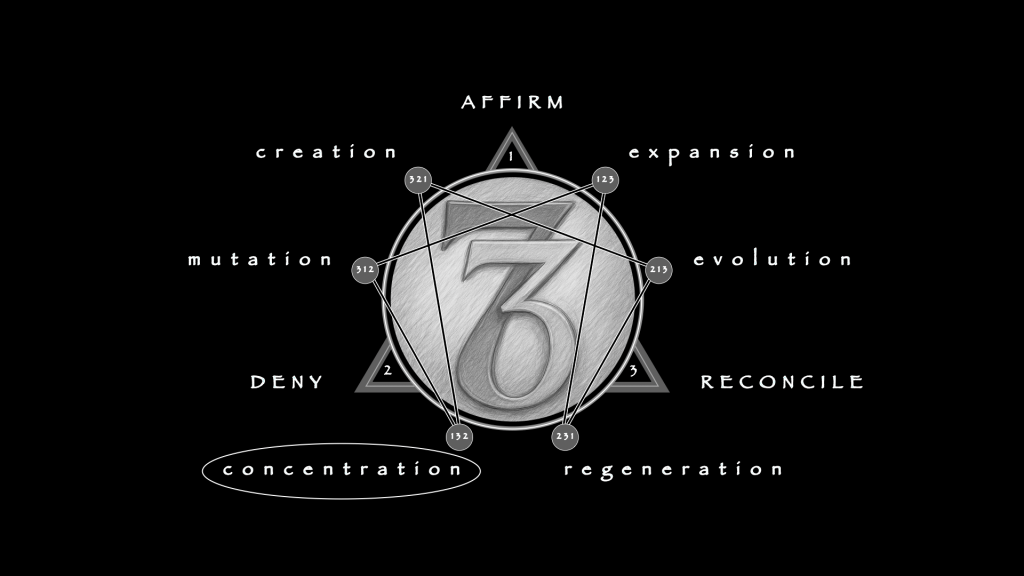
With all the throat-clearing done, the recipe for the Secret Sauce now follows, with its three ingredients and six steps.
Surveys and Questionnaires
As I mentioned, surveys are a vintage method, very old school, but a charming fine wine for the right occasion. It has a recipe of its own, of course, which is beyond my present scope. The process is bit more complex than straight up asking people, “How do you feel about the market today,” but not much.
Then, with a pinch of psychometrics and a dash of factor analysis, these sentiments are distilled into a potent brew that ostensibly can predict market waves — though beware, it might sometimes taste a bit off due to stale data! Because a greater hazard arises from relying on unqualified opinions, this method is best reserved for where the stakes are lowest.
There are a few key technical challenges of effective survey writing itself. Overcoming them will not only make you a better data harvester, but a better analyst, too.
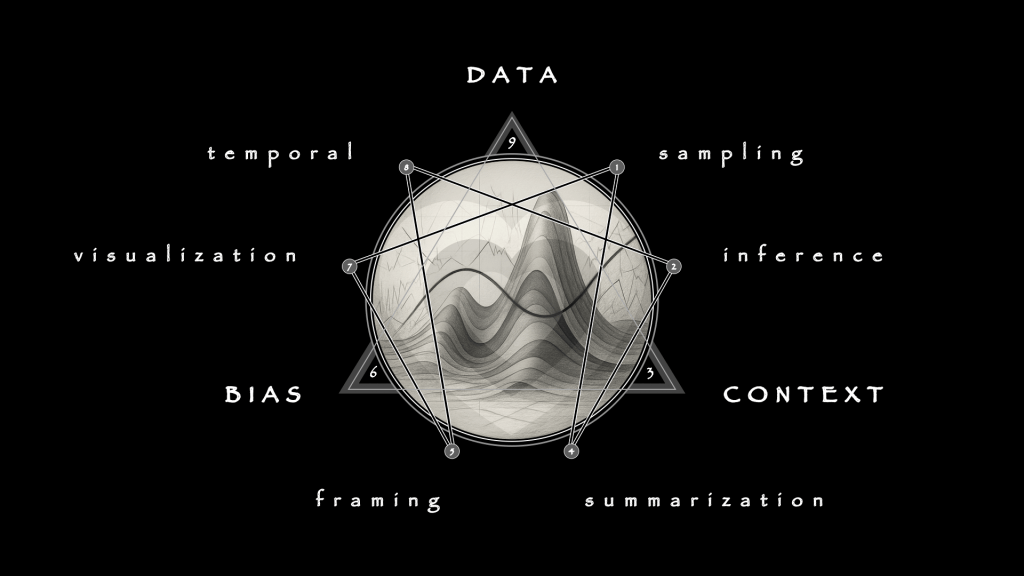
The first hurdle involves accurately capturing a diverse range of opinions without bias. Getting a representative sample size can be problematic, especially if quality matters. The greatest challenge is to manage the temporal gap between the expression of some sentiment and its subsequent analysis.
Good data has a shelf life. Ironically, the best thing about spoiled data is the shitty smell, because otherwise you might consume it. Even bad data has its uses, as we will see.
Lexicon-Based
Imagine designing a trading strategy (or a marketing campaign, for that matter, or one for political office) on the more solid foundation (… NOT!) of emojis!
Following the taster flight of bland surveys comes the hipster of sentiment analysis, as the lexicon aims to assign a score to a variety of predefined sentiments with its own private handy-dandy dictionary.
Techniques such as the VADER (Valence Aware Dictionary and sEntiment Reasoner) algorithm blend quantitative and qualitative methods to dynamically score words. It can adjust for grammatical rules and syntactical context like sentence structure, of course, and even basic word modifiers.
While highly interpretable, the algorithm is confounded by context and flat out fails with polysemy, which is a fancy way to say that VADER is helpless in the face of puns or double-entendre.
Machine Learning
If the lexicon is not a Sith Lord but a glorified protocol droid, like C-3PO, then the next level of functional sophistication would be R2D2, or machine learning.
Like the bouncers at the club, deciding which emotions pass through the velvet rope into the prediction models, from the quaint Naive Bayes to the swanky deep learning architectures like Long Short-Term Memory (LSTM) networks, these are the droids you’re looking for to spot more subtle mood swings in financial narratives.
Additionally, feature extraction techniques like bag-of-words and TF-IDF (Term Frequency-Inverse Document Frequency) are used to convert raw text into structured formats that these droids can process, with LSTMs and CNNs (Convolutional Neural Networks) focusing on capturing sequential and spatial dependencies in the data.
Now that I have developed my own trading Edge, my informed opinion is that it is deliberately designed to part the Dumb from their Money. To my eye, at least, the scale is presented backwards — with Fear at 0 in red and Greed at 100 in green — more as if to induce sentiment than to gauge it.
For exactly that reason, I and other experienced traders tend to avoid those colors in price charts altogether, at least for the candlesticks. Mine, in fact, are coded not to show price action as “bullish” and “bearish” (which are not strictly defined anyway) merely by rising and falling, but instead to show cycles of Accumulation and Distribution, in yellow and blue respectively.
With all the throat-clearing done, the recipe for the Secret Sauce now follows, with its three ingredients and six steps.
Surveys and Questionnaires
As I mentioned, surveys are a vintage method, very old school, but a charming fine wine for the right occasion. It has a recipe of its own, of course, which is beyond my present scope. The process is bit more complex than straight up asking people, “How do you feel about the market today,” but not much.
Then, with a pinch of psychometrics and a dash of factor analysis, these sentiments are distilled into a potent brew that ostensibly can predict market waves — though beware, it might sometimes taste a bit off due to stale data! Because a greater hazard arises from relying on unqualified opinions, this method is best reserved for where the stakes are lowest.
Where machine learning was the R2D2 of the pack, the HAL-9000s of this Space Odyssey are the Deep Learning Models. BERT (Bidirectional Encoder Representations from Transformers) and his cousin FinBERT, a financial sector-specific adaptation, are savvy enough to select the not-so-secret cues buried in technical reports. No nuance is too minor, no inference too intricate.
These Market Moriartys leverage transformer architectures that prioritize pure context.
Pretrained on extensive text corpora and fine-tuned for specific applications including sentiment analysis, BERT and FinBERT are built to interpret complex language and contextual subtleties in investor communications as well as quantitative data, enabling them to analyze intricate financial documents. The chances are fairly good that if you subscribe to a uniform daily report such as Newsquawk or Bloomberg, then you are already reading FinBERT output, possibly unbeknownst.
Natural Language Processing
We are fully through the Looking Glass now, where everything just might be a simulation after all. Next-generation Natural Language Processing (NLP) creations can quickly crunch numbers and even passably parse speech to rapidly extract even the emotional undercurrents from rivers of text. One of the musical price action forecasts on my YouTube channel features a humorous example of the process … for mature audiences.
This slide reproduces the thumbnail, and also functions as a link. Please watch it and leave critical feedback.
“Ex Machina” is a fine fictional example, albeit a bit hyperbolic, of an algorithm that can turn the raw data in financial news, social media, and corporate disclosures into market insights as smoothly as turning grapes into wine … or truth into bullshit, choose your own adventure. Sentiment is then “extruded” through approaches ranging from simple frequency counts of sentiment-indicative words to more complex syntactic constructions that consider negations and modifiers, further enhancing the depth of the analysis.
Statistical Methods
Nothing can be more sophisticated than NLP, making mere statistical methods (even advanced specimens) seem perhaps a bit anti-climatic by contrast. The essential difference, however, is qualitative, in that they require no 21st century technology and their results are transparent and reproducible, at least in theory.
The statistical methods of sentiment analysis vis-a-vis price action and volatility forecasting rely heavily on Regression Analysis, particularly Vector Autoregression (VAR) and Error Correction Models (ECMs), to predict how sentiment will influence market outcomes. Regression models manage the dynamic relationships between time series data, such as sentiment scores and stock prices, and can reveal causality and the lag effects of sentiment on market movements.
There it is … full spectrum sentiment analysis, encapsulated within a simple enneagram!
Statistically, it is no accident that I rely more heavily on the enneagram for discretionary data analysis than I do on anything containing a microchip. Having proven itself in both psychometric and mechanical domains, its experimental use in behavioral finance pattern recognition is so far bearing juicy fruit indeed, especially in one key competency, being correlative analysis.
Browse my growing body of uniquely original work on the enneagram if you are curious.
Of course, there are other methods, which are more properly hybrids and/or tangents. Notably, VOLATILITY modeling (subscribe for more content on this obscure discipline) and Granger causality tests quantify relationships and assess the predictive power of sentiment indicators on financial variables, supposedly validating the effectiveness and reliability of sentiment measures. Again, though, these may be considered PCAs (Principal Component Analysis), which brings us full circle.
With that, it is time to close this out, however the next installments will continue this line of inquiry, with increasing focus on technical trading. First, in part two, I will demonstrate how the enneagram can guide the construction of better surveys, and unravel how CNN’s well-known Fear & Greed Index is made. Finally, in part three, I will survey and evaluate some of the available technical indicators on Tradingview that visually display Fear & Greed on live price charts.
Anyways, speaking of statistical methods, since predicability bores me, in lieu of a summary I will close out with an amusing and relevant sidebar.
“How to Lie with Statistics”, by Darrell Huff, serves as a timeless reminder that numbers, while seemingly objective, are as malleable as Play-Doh in the hands of those with an agenda. Published in 1954, it’s a must-read for anyone looking to sharpen their critical-thinking skills against the spin doctors of statistics.
Far from a dull academic text, it’s more of a sprightly guide through the murky swamp of statistical manipulation, spruced up with breezy illustrations and enough dry wit to leave you with a satisfied smirk. Huff, a journalist rather than a mathematician, was the ideal rogue to unveil how statistics become twisted. His book explores various tricks of the trade, such as confusing correlation with causation — i.e. blaming roosters for the sunrise — or using creative graphics to exaggerate minor differences to absurd proportions.
It was the go-to staple in my college days, perhaps because it teaches skepticism, a critical skill when wading through the modern data deluge. The switch from Irving Geis’ original illustrations to Mel Calman’s cartoons in the UK edition adds a layer of intrigue, suggestive of a shift in how statistics’ deceptive powers were viewed from one side of the pond to the other — less formal, more accessible, and pointedly humorous. Today, the book’s living lessons are more relevant than ever, proof that while figures never lie, liars often figure.
The Enneagram’s original purpose as a universal language transcends personality types to reveal fundamental laws governing reality. From cosmology to daily challenges, the interplay of affirming, denying, and reconciling forces influence every process and foster intentional transformation. How ancient educational principles illuminate the path to inner freedom, helping to decode life’s complexities through structured thought and authentic expression, is discussed herein.
Whenever and wherever we survey the natural world, around us or within us, we see nonrandom patterns at work, not only in objects but also in events. There have always been individuals among us consumed by the wish to understand these patterns, to be able to gaze upon the world and read its laws plainly, in effect to know the future. You might even be one of those individuals yourself.
Attempts to understand these patterns comprise the foundation of learning since time immemorial, with mixed results. The Law of Three — a fundamental principle in countless traditions — describes the evolution of mutually opposing forces. In the context of inner being, it reminds us that every challenge (affirmation) meets its obstacle (denial), and through their interaction, a new way (reconciliation) emerges. This idea equips us with the foresight to anticipate the flow of life’s challenges and enable us advantageously to navigate inevitable conflicts.
The Enneagram is inarguably the most useful tool to any teacher or any student, no matter the discipline. One of my aims is to prove just that. Through this lens, the ‘what, how and why’ of anything you care to observe comes into surprising focus. Tragically, however, many modern misunderstandings have arisen since the symbol was re-introduced to the public approximately a century ago, chief among them that the enneagram is a system of personality types.
It is best to look on it and think of it as the fundamental hieroglyph of a universal, objective language.
At first, this complicated diagram may be daunting or imposing. Comprising three geometrical figures – a circle, a triangle and an irregular hexad – each element symbolizes a universal law. When these laws are known and understood, what once looked random will look orderly, even trivial.
Trivial?
I use the word in its medieval sense of ‘rudimentary’ since it fits the context so perfectly. Method and guidance, each, are indispensable to correct education. In order to demonstrate this, I will apply the classical method of the three-way path, known by its Latin name, the Trivium.
GRAMMAR – LOGIC – RHETORIC
The laws informing the construction of the enneagram are the Law of One, the Law of Three and the Law of Seven. As a whole, it symbolizes the union of these three laws. I will defer for another time a detailed discussion of the Law of Seven.
For now, the Law of One may be stated thus:
ALL IS ONE
Unity is not something that our sense organs are designed to perceive. We naturally distinguish one thing from another, although we seldom, if ever, ponder the laws on which this division is based. As a result, many of our perceptions and impressions are effectively random.
This alone inspires a need for method, hence my choice of the Trivium. The relevant Wikipedia article includes Sister Miriam Joseph’s description, although I do not consider it to be a primary source, per se, reads:
“Grammar is the art of inventing symbols and combining them to express thought; logic is the art of thinking; and rhetoric, the art of communicating thought from one mind to another, the adaptation of language to circumstance.”
Of course I have my reservations and additions to these formulations, which are for most intents and purposes decent enough for a start. Thus I will use them as a point of departure, not arrival. So, while my application of these three Latin concepts to the Law of Three may seem overly informal, I doubt it will inspire controversy.
GRAMMAR
The Grammar of the Law of Three is straightforward. By convention, the Law of Three is depicted by a triangle, usually equilateral. One advantage of symbols over words is that — by design — they transmit the ideas of unity and the laws of its division across cultures and over time with minimal distortion. Some amount is virtually inevitable, though.
Another advantage is that, by means of symbols, some of the inevitable distortion may be deciphered and decoded, so to speak.
Attempts to codify such impressions and ideas are nothing less than a striving to perceive a nonrandom world and exist there. This is where Intentional Fruition meets method. Indeed, if we knew and understood the laws of Creation, our best wishes, more often than our worst ones, might well become realities.
Grammar may be trivial, yet Creation is not. Any tool that enables accurate depiction of the ‘what, how and why’ of the unfolding of any process is a treasure. A Grammar of the Law of Three is only one among several.
Grammar, in the context of individual transformation, acts as the foundation for understanding the symbols and signs that populate our inner and outer worlds. It is the code, if you will, for recognizing patterns and narratives we tell ourselves, and the narratives told by society. By identifying these symbols — be they emotions, thoughts, or external cues — we begin to understand the battlefield of our own existence. This understanding is crucial, for it allows us to navigate through life’s complexities with logic.
LOGIC
The Logic of the Law of Three is also straightforward, if less apparent. Meanwhile, the proposed description of logic as the ‘art of thinking’ is made of entirely undefined terms.
It may not be wrong exactly, but in a world where trash may pass for art and daydreams pass for thought, it may not necessarily be right, either. With grammar comes the ability to symbolize ideas and combine them – with logic, the ability to analyze impressions and relate them.
And yet what is logic, the thing itself?
I would not presume to have the final word on the subject or to spoil the mystery even if I could, but even that much is a good start – the WORD. Experience tells me that logic is roughly the same as having ‘access to the LOGOS’, which translates as more than merely WORD. LOGOS is the law – the proposition, the statement of how things are – for a start.
The triangle is the symbol of the LOGOS within the enneagram, a sign denoting that some force of law is at work. Scholars have always struggled to formulate a concise statement of this otherwise simple Greek word, LOGOS. Whereas it is challenging enough to compare the merits of someone else’s attempts, the real pay-off results when you try to do so yourself.
Since it is relevant, tangential and trivial (an unusual coincidence of adjectives in praise), I shall paraphrase Heraclitus:
1. “The LOGOS is eternal yet humanity proves unable to understand it, both before hearing of it and even after the first telling. All things agree with the LOGOS, yet men and women are like babes when they experience my words and deeds, though I distinguish each by its nature and tell exactly how it is. They fail to notice what they do when they are awake as fully as they forget themselves when asleep.”
2. “Although the LOGOS is universal, most individuals live as if they had their own private understanding.”
3. “Do not take my word for it. The LOGOS says that all things are one. It is wise to agree.”
I intend to build my telling of the Law of Three on a similar foundation. I, too, have three impressions to share. Mine are concerned with the ‘what, how and why’ of processes as they arise and unfold in the real world, on any and all scales.
Processes are a union of three distinct, though complementary forces, which are Affirming, Denying and Reconciling. Staying true to the method of the Trivium, I will employ a symbol to denote each, respectively.
The use of symbols is preferred over the use of names since the latter change with context and depth of focus, among other variables. The former may be applied universally and at any time. Also, the practice reminds the seeker to look for all three forces in any process, which may be more opaque to some than others – especially the third, or Reconciling.
As the examples become more specific, the relativity of names becomes less confusing. Generally speaking, mankind is born ‘third-force blind’. So, too, is the rest of the animal kingdom, for that matter.
This cognitive hurdle may be surpassed with proper preparation and instruction. The same may not be said of the rest of the animal kingdom. No amount of method and guidance will impart rhetorical ability to an animal.
How and why this is so is connected to the Law of Three and may be explained by it, but that is another story for another day.
Again, the forces themselves may be described by different names. Common synonyms for Affirming include positive and active, or, even, Yang or the Father. For Denying, other common names include negative and passive, or even, Yin or the Son.
The experience of these two forces, Affirming and Denying, whether internally or externally, is known to anything that breathes, whether animal or vegetable. At a minimum, we, the living, tend to notice the difference between pleasant and unpleasant – sometimes even the polarizing effect this has on our attention and our efforts, too. In practice, though, the assumption that pleasure is positive and pain is negative, this presumptive confusion of terms, may be tragically misleading.
A more complete perspective includes a third point of reference, without which the linear existence limited to positive and negative is literally flat, two-dimensional. In general, the elusive third force is manifest in the medium or in the result of a process or product under consideration.
This ‘third dimension’ introduces relativity, without which positive and negative forces may be difficult to distinguish correctly. No less important to the cause of Human Potential and Intentional Fruition is the experimentally verifiable fact that without some other force at work, positive and negative impulses tend to cancel one another out, producing nothing. Synonyms for the third, or Reconciling, force include ‘Neutralizing’, ‘Harmonizing’ and ‘The Holy Spirit’.
This idea of three forces may be described otherwise, based on a slightly different observation, on a slower, possibly atemporal frame of reference – as more of a snapshot.
Products and predicaments are triadic. They unfold from exactly three interdependent sources. With the right method, all three may be recognized.
By now, though, some simple and concrete examples are necessary.
Because we often try to ‘do’ things, to exert our will to rearrange the world, we notice that the world pushes back. This is obvious when we try to make, or break, any habit. Suppose that most nights you tell yourself to get right out of bed tomorrow when your alarm clock rings but then, instead, each morning you ‘snooze’ for 20-30 minutes.
How can you free yourself from the cycle and make a new habit? Or, suppose you wish that you could quit smoking or drinking alcohol. How can you free yourself from the cycle and break the old habit?
Can you see what is missing? The wish to change, no matter how powerful it may be, will not exceed the force of inertia. At most, it will be equal to the resistance (and even that is unlikely) and will yield only temporary and/or illusory gains.
The wish is spent overcoming the inertia.
Without introducing a third force, nothing new will result. In practice, that third force may be one of several things, depending on the circumstances. One possibility is to work with a partner to overcome the impasse.
Options vary, especially if you know of them.
An altogether different example might help to clarify the cooperation of the three forces. Consider a hammer and a nail – the hammer constitutes an active force in relation to the passive nail. Furthermore, they could easily be a rock and a wooden peg, or power drill and a lag screw, even a stapler and a staple; the principle is the same.
The objects in question are irrelevant to studying how the law operates – their relation to one another is what matters, which may be codified by the symbols (+)and (-).
Can you see what is missing?
In this case it is wood (or possibly paper, where staples are concerned). Without it, the other elements would have no medium (0) to join them and make them useful. The complete triad may be pictured as:
HAMMER (+), NAIL (-), WOOD (0)
Once more, an altogether different example might help. This time consider an ordinary game, from Mahjong to Monopoly or from billiards to baseball; which one makes no difference. Any game may be triadically pictured as:
PLAYERS (+), EQUIPMENT (-), RULES (0)
From the partial (i.e. subjective) point of view of one of the players, it might seem that “I” am the active, or positive, force and that my opponent, “the other”, is the negative force. Heraclitus might call this perspective out as ‘having one’s own private understanding’. Not to put too fine a point on it, but the Greek word for that predilection is idiot.
Any player (+) is active, whether in a game of solitaire or king-of-the-hill. The equipment (-) may be a tile or a table, a ball or a stick –- that which is ‘acted upon’, the “direct object” in grammatical terms -– it might be a basement or a stadium. The result is determined by the rules (0), which impart form and meaning to the players’ (+) actions.
Logic serves as our strategy, the method by which we organize our thoughts and plans to engage with the challenges we face. It’s about applying critical thinking to dissect problems, to see beyond the surface and understand the underlying mechanisms at play. This strategic approach enables us to anticipate challenges, formulate solutions, and move forward with purpose and clarity. It’s the spear that pierces through illusion, guided by the shield of our discernment.
RHETORIC
Information and language may be served by logic and grammar, however something more is needed for the expression of will. Here, too, “the art of communicating thought from one mind to another, the adaptation of language to circumstance”, has merit but still fails to satisfy.
Rhetoric is the volatile art of effective communication, the means by which we express our inner findings and influence the world. This is especially evident whenever its techniques and practice are reserved for specially designated classes. It is about presenting our ideas, desires, and boundaries authentically and persuasively. It is an almost magical endowment, but without virtue it leads to untruth, slavery and ruin, eventually but predictably.
The Law of Three clarifies the situation.
Triads are of finite variety and may be qualified by the order of the application of forces. The variety of triads, or of processes, is independent of their magnitude. You can find instances of growth or decay on any scale, from the smallest to the largest, and they will unfold nonrandomly.
Growth and decay are not the only types of process that occur, of course. This may come as a surprise to readers who assume that the enneagram is a set of personality types and think no more about it. Processes, too, are typical, in accord with the LOGOS.
There are exactly six permutations of three forces. The implications of this idea to the study of Human Potential and Intentional Fruition are as subtle as they are enormous. I can only reparaphrase Heraclitus: Do not take my word for it.
Ultimately, whether large or small, partial or impartial, only six types of events ever really happen. If you are wondering what those six types may be, then you might have a taste for mystery and benefit from subscribing for more, and asking questions. I promise not to disappoint. After all, your questions are an ideal framework for any description of the six processes that I can offer.
Meanwhile I wish to relate the Law of Three to the Law of One, which was stated above, even if only by analogy. What joins these domains to our own and others is the idea of scale.
Unity is too vast to encompass from a lowly frame of reference such as ours. Similarly, the Law of Three is almost imperceptible and only slightly denser. Our frame is even denser and grittier still, as are the even lower layers.
Unity is so opaque to our senses that we do not notice how we constantly carve it up or even where we come from. At the top, so to speak, there is one law, and it applies from top to bottom. Below, there are more laws, but they ramify only downward.
Take a few moments to fully digest this, for it bears directly on Human Potential: Where there are more laws there is less freedom, and there are fewer laws ‘Above’. I will add that true Creation is rare and, unlike Evolution, it is not a bottom-up process. Rather, it is the ultimate (or perhaps primordial) and purest form of Freedom.
The foregoing are impressions, echoes of the Law of Three, but not an explicit statement. Nevertheless they bear repetition. This much has been established for ‘worlds’ of different sizes:
1. Processes are a union of three distinct, though complementary, forces, equal in magnitude and opposite in direction, which are Affirming (+), Denying (-) and Reconciling (0); mankind is born ‘third-force blind’.
2. Products and predicaments unfold from exactly three interdependent sources; with the right method all three may be recognized.
3. Triads are of finite variety and may be qualified by the order of the application of forces; there are exactly six permutations of three forces.
The statement of the Law of One indicates how the laws in one ‘world’, so to speak, might ramify and operate in another, might cross pollinate, ultimately creating ‘worlds within worlds’. Triads are a vector, though, and a consequence of cognitive fragmentation, not a law unto themselves. The statement of the Law of Three that connects it to the foregoing and to the Law of Seven (forthcoming) may be made thus:
THE HIGHER AND THE LOWER
BLEND IN ORDER
TO ACTUALIZE THE MIDDLE
To master ourselves and our passing place in the world through these principles, we may begin by mapping our internal landscape with the grammar of our psyche, using logic to strategize our path forward, and eventually employing rhetoric to manifest a vision into reality. The Law of Three teaches the structure of action and adaptation, but NOT the rhythm. Being a universal flowchart, the Enneagram is a compass that can guide one through complexities … if you can read it.
The true conquest is not over the outside world, but over the limitations and conflicts within. The ultimate aim is self-mastery, leading to a state of harmonious knowledge, being and action. With method and guidance, one can learn not only to read the enneagram, but to write with it … literally to compose scenarios of intentional fruition in the real world.
I know because I have done so myself.
The reason I endeavor to set all this down is threefold. First, it will hopefully clarify, if not ‘trivialize’ other soliloquies and designs in my future writing(s). Second, it establishes a practical method. Third, these data are tragically absent from nearly all instruction of the enneagram, to my curious consternation.