The Leading Indicator

beauty is an attribute of truth

  • Yoon, Dessert Planet … the Spice Must Flow!

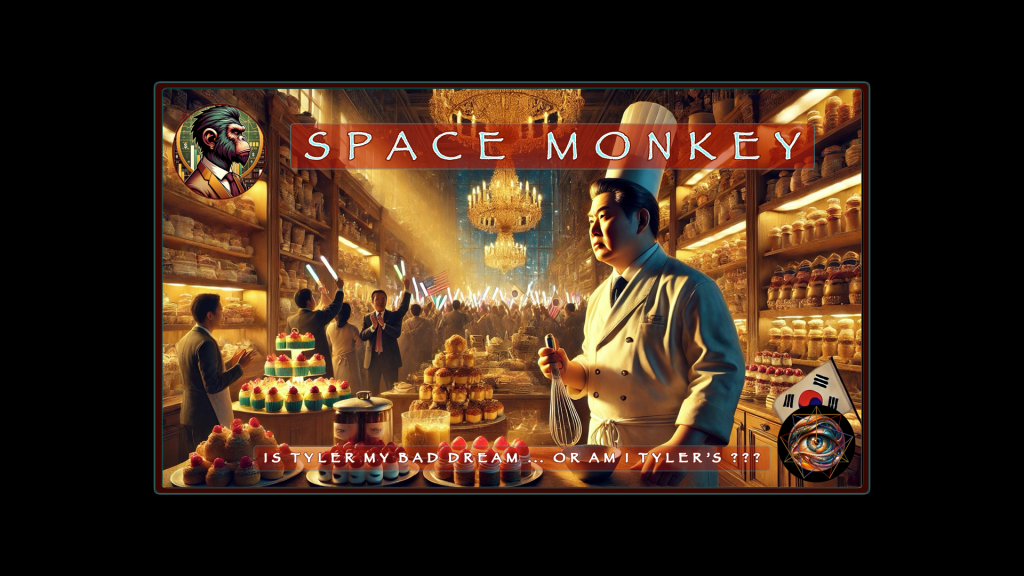
    On the Korean peninsula, economic stability has been the spice that keeps the ovens of progress aflame and the frosting of democracy glossy. A delicate blend of exports, chaebol-driven ingenuity, and geopolitical finesse has turned the country into a showcase of resilience. But like any intricate recipe, it only takes one clumsy chef to ruin the batter. Enter President Yoon Suk-yeol, who thought he could rewrite the menu by declaring martial law, only to serve macroeconomic indigestion with a chaser of geopolitical flatulence.

    It wasn’t just a bad bake; it was a a desperate attempt to save a collapsing soufflé.

    On December 3, Yoon—now suspended and stewing in his own juices—with the audacity of a baker who’s mistaken salt for sugar, ordered that tanks roll into Seoul and troops storm Parliament. He then declared martial law to combat so-called “anti-state forces.” Even this bored ape sat up and set down his banana creme applicator long enough to send out a sweet and sour smoke signal on the matter.

    Parliament promptly vetoed the decree, impeached Yoon on December 14, and sent the political sous chefs scrambling to turn the mess into something edible. Prime Minister Han Duck-soo, next in line, didn’t fare much better. His refusal to sign off on key judicial nominations got him impeached just days later, leaving acting President Choi Sang-mok holding the whisk. Choi, a finance minister with the charisma of plain boiled rice, has since been tasked with steadying the Dessert Planet’s crumbling kitchen.

    While Choi mops up caramel spills, Yoon remains bunkered in the Blue House—now a chaotic patisserie surrounded by his diehard supporters. These aren’t your typical political activists.

    Imagine glowstick-waving rave enthusiasts, fueled by nationalist YouTubers and conspiratorial fervor. The street outside his residence has become a dessert theater of the absurd, where chants of “Stop the Steal” mix with American flag-waving and cries of communist plots.

    To these loyalists, Yoon isn’t a disgraced leader; he’s the last honest pâtissier in a kitchen overrun by saboteurs.

    Meanwhile, the Corruption Investigation Office (CIO) sharpens its knives. Armed with an arrest warrant for Yoon on insurrection charges, they’ve vowed to act before the warrant expires on January 6.

    Yet history is a cautious chef—Yoon’s supporters have blocked investigators before, and the optics of a forced arrest could prove as disastrous as an underbaked meringue.

    The standoff outside the Blue House mirrors the political chaos inside. Yoon’s lawyers argue that his residence is off-limits due to its military secrets, a claim as dubious as it is desperate. But the Constitutional Court remains the ultimate arbiter.
    With only six sitting judges out of nine, the court must decide whether Yoon’s impeachment will stand. The stakes couldn’t be higher: a single dissenting vote could see Yoon walk free, his reputation battered but his grip on the spice unbroken. In the broader context, the real spice of South Korea isn’t Yoon or the Constitution—it’s the chaebol.

    These sprawling conglomerates, monopolizing the nation’s economic lifeblood, are the Dessert Planet’s equivalent of spice guilds.

    Samsung, Hyundai, LG—these aren’t just companies; they’re empires. Like the CHOAM Corporation, their influence extends beyond business, shaping politics and society to ensure the spice flows exclusively through their pipelines. Samsung alone contributes over 20% of South Korea’s GDP, a behemoth too big to fail yet too dominant to foster innovation.

    Born from Cold War dollars and state planning, the chaebol are indispensable yet corrosive. Corruption scandals swirl around them like desert storms, but their leaders often escape justice under the guise of “national interest.” The 2022 pardon of Samsung heir Lee Jae-yong serves as a stark reminder: accountability is negotiable when profits are at stake.

    The chaebol’s stranglehold stifles competition and concentrates wealth, leaving the rest of the economy brittle. The KOSPI, South Korea’s financial barometer, is testament to this fragility. Once a symbol of resilience, the index has slipped into bearish territory, its charts reflecting the uncertainty gripping the nation.

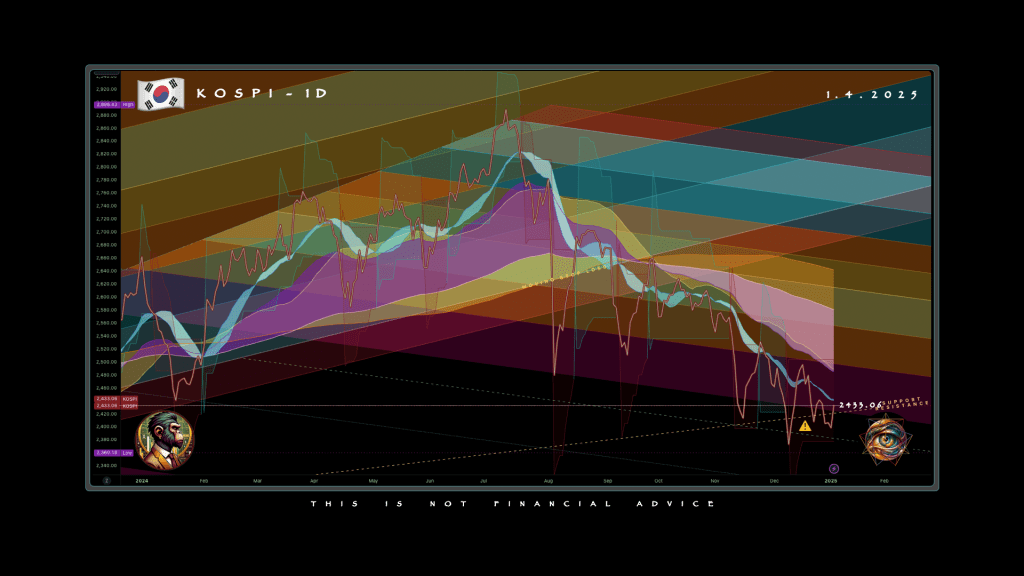
    Yoon’s martial law gambit sent ripples through South Korea’s markets, shaking investor confidence. The KOSPI, which historically weathered political storms, now shows cracks. Daily and hourly charts reveal heightened volatility, with key support levels breached and panic replacing rational adjustments.
    This isn’t just a sugar crash; it’s the market questioning whether South Korea’s economic ovens can stay hot. Rising competition from China erodes dominance in both the semiconductor and shipbuilding industries, while youth unemployment and an aging population weigh on long-term productivity.

    The chaebol’s monopolistic grip exacerbates the problem, leaving the Dessert Planet ill-prepared for shocks.

    Acting President Choi Sang-mok’s stabilizing efforts—primarily through judicial appointments—are yet to reassure investors. The Constitutional Court holds Yoon’s fate in its hands, but the process feels more like juggling eggs over a lit stove.
    If the court fails to uphold impeachment, the consequences could curdle the nation’s democratic cream filling.

    Meanwhile, the United States, South Korea’s long-time ally and the Bene Gesserit of global politics, watches uneasily. For Washington, the Dessert Planet is a critical node in its Indo-Pacific strategy. Stability here isn’t just preferred; it’s essential. But America’s influence has its limits. It can nudge South Korea toward resolution, but it can’t bake the cake itself.

    South Korea now stands at a critical juncture. The spice—the economic vitality sustained by exports and technological innovation—must continue to flow. But the current recipe, dominated by chaebol monopolies and political infighting, is unsustainable.

    The KOSPI’s decline signals that the markets no longer buy the illusion of stability. Reform is imperative. Will South Korea spread the spice more equitably and confront its systemic flaws? Or will it rely on brittle scaffolding, hoping the ovens don’t collapse? The answer will determine whether the Dessert Planet’s cake holds or crumbles.
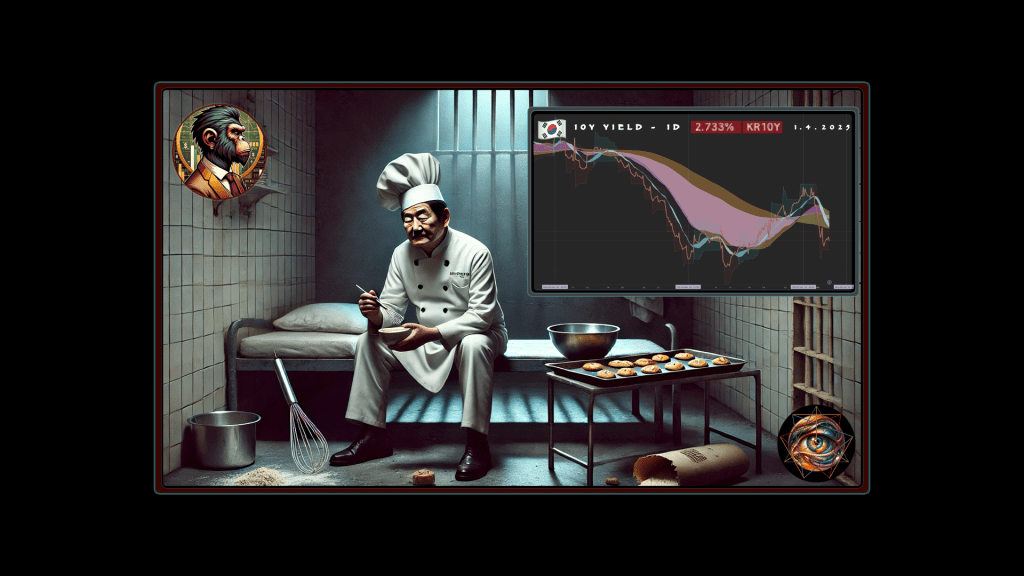
    In South Korea, chaos isn’t just a crisis—it’s a flavor profile.

    The markets, the economy, and the people have weathered enough political drama to know that no single leader can derail the recipe for long. The spice must flow, and it will. Whether it’s Choi Sang-mok cautiously mopping up caramel spills or Washington nudging from the wings, the ovens will keep churning.

    For now, Yoon’s story serves as a cautionary tale: overreach, over-season, and you’re left with nothing but a burnt crust.

  • How shall I put it? Um, the industrial crown jewel of Germany is barreling toward a cliff with failing brakes in a crisis that could punch a hole in the entire nation’s economy. For the first time in its 87-year history, Volkswagen is considering factory closures in Germany—ground zero for its workforce and symbolic heart.

    The source of this chaos? Volkswagen is choking on its EV pivot. With profits down 11.4%, margins crumbling to 5.6% for 2024 and a €17 billion price tag merely to stabilize, CEO Oliver Blume is running out of road. Meanwhile, over 120,000 workers are staring down 10% pay cuts, sparking protests that have already shut down production.

    Volkswagen is primarily listed on the Frankfurt Stock Exchange, but it’s also available to American investors through American Depository Receipts (ADRs).

    Volkswagen’s ticker symbol, VWAGY, represents the company’s ordinary shares trading over-the-counter (OTC) in the United States. For U.S. investors, VWAGY or VWAPY are likely the most straightforward options and/or via its holding company.

    • VWAGY: Represents ordinary shares with voting rights
    • VWAPY: Represents more liquid preference shares w/o voting rights
    • POAHY: Represents Porsche Holding Co., Volkswagen’s majority shareholder

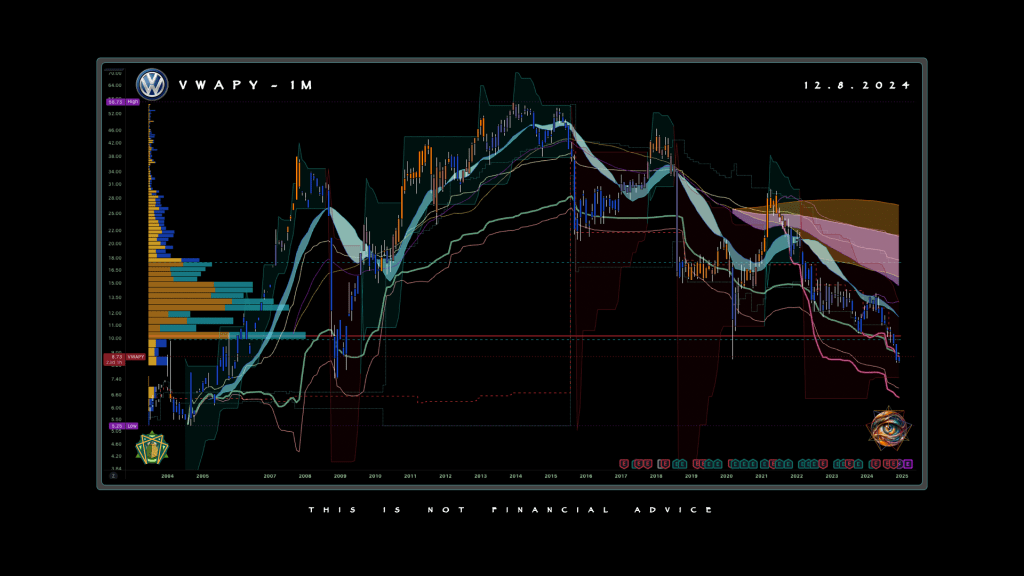
    The monthly chart for VWAPY indicates a prolonged bearish trend. Price action is firmly below the Triple Differential MA Braid, as well as prior accumulation ranges, indicating more downward momentum to follow. Anchored VWAPs highlight the stepwise decline to the volume profile’s point-of-control. The widening gap between the moving averages underscores accelerating bearish sentiment. The volume profile teases potential support, but sustained weakness could lead to an irrecoverable breakdown. The lack of upward momentum suggests limited recovery in the short term, barring any major fundamental catalyst. Forecast: Continued downside could trigger a sharper decline toward multi-decade lows.

    Volkswagen doesn’t have an electric “People’s Car,” and demand for EVs is falling short of rosy projections. Worse, producing EVs is a margin killer compared to their gasoline ancestors. Add Germany’s climate mandates—65% emissions cuts by 2030 and 15 million EVs on the road—and you’ve got a company stretched thinner than its profit margins.

    Then there’s the China problem. Volkswagen is getting its teeth kicked in by Chinese EV makers who churn out cheaper, subsidized models while eating VW’s market share both at home and abroad. Germany’s big tariffs on Chinese imports? A band-aid on a gunshot wound when your core markets are eroding.

    Trend Exhaustion pitchforks on the monthly chart reveal accumulation and distribution ranges coinciding with long-term anchored VWAP levels. Successive lower highs show bearish control, while price remains locked in a steep descending channel. Fibonacci color coding projects potential downside price and time target. Forecast: Given the persistent selling pressure, price is likely to retest $9 in the coming months.

    The granularity of the daily chart reveals heightened volatility along a significant Euler range of the Trend Exhaustion (purple channel). The price is retesting the 21D moving averages, yet the liquidation events suggested by volume spikes at higher price points create a false sense of support. Forecast: Intraday bounces will tempt permabulls, but a sustained reversal is unlikely; daily volatility can increase, leading to sharp but short-lived moves.

    The political fallout is already lighting fires. The IG Metall union is ready to turn protests into an industrial revolution, and Lower Saxony—a key Volkswagen shareholder—is panicking over the potential economic collapse of Wolfsburg. Factory closures would gut entire communities, turning stable jobs into ghost towns.

    This isn’t just Volkswagen circling the drain. This is Germany’s auto sector—17% of its GDP—facing an existential reckoning. Blume’s only options? Reinvent the wheel or watch Germany’s industrial engine seize. Either way, it’s going to be messy.

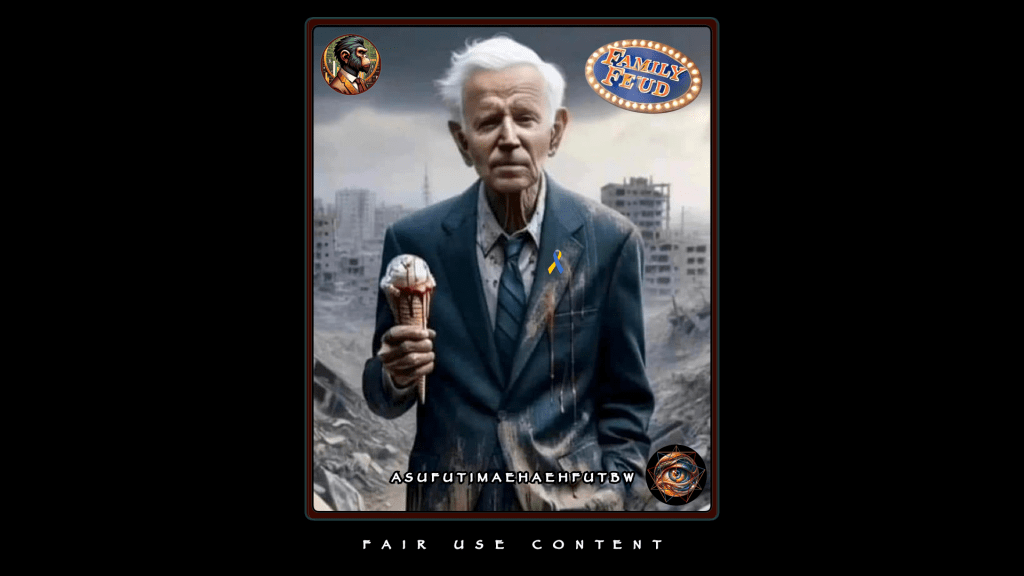
  • Family Feud: Oval Office Redemption Round

    Welcome to Family Feud: Chief Executive Edition, where the contestants aren’t merely families—they’re dynasties. Last Sunday’s evening game featured the Bidens squaring off against their eternal rivals, the Grand Old Party. The stakes, if they’re unworthy of Justice (much less of Qualified Immunity), may be worth at least the last frayed nerves of the American public. Ready or not, let’s play!

    The prompt: “Name something a President would sacrifice to protect their legacy.”

    Joe wakes and slams the buzzer, affirming, “Everything.” Survey says…?


    Round One: Scandal in the Room

    As the buzzer sounds in what feels like overtime, Joe Biden delivered what might be his ultimate wildcard—a Sonny Boy Sweetheart Pardon that covers (i.e. erases) over a decade of “potential” sins. Day 1 of 2014, the effective start date and the year the U.S. government started playing geopolitical Jenga in Ukraine, is coincidentally when Hunter began stacking his blocks of influence.

    With one hand in Burisma’s till and the other dabbling in viral research through Metabiota, he and/or his closest associates “might” have made a killing, for all we will ever know.

    The choice of 2014 as the starting line is like a game-show cheat code: a big glowing arrow pointing to when the family’s Ukrainian adventures really took off. Think of it as a DVR rewind button for investigators. “Oh, you want to know where to look? Here’s the timestamp.”

    For years, Republicans have buzzed in with variations of the same answer: “Hunter Biden’s laptop!” They’re now giddy as Steve Harvey when a contestant blurts out something absurd. This time, they’re slobbering like Richard Dawson over a midwit daughter-in-law hoping land one on the scoreboard. The laptop, previously dismissed as a conspiracy theory, almost “resurfaced”.

    If the DOGE jockeys have their way, the records will be memory-holed in the name of efficiency for another half-century or more.

    Double Jeopardy: The Treaty Trap

    Joe is betting the farm on this one, and swinging for the fences. The Constitution gives the President sweeping pardon power, but treaties like the Biological Weapons Convention are considered the supreme law of the land. Violating it comes with a specific penalty.

    So, can a president pardon a violation of a treaty?

    That’s a question for the Supreme Court, assuming they don’t start laughing (or nodding off) halfway through the opening arguments. Imagine the Chief Justice leaning into his microphone: “So, let me get this straight. You want us to decide if a pardon can erase international war crimes?”

    Cue a collective nervous grin from Joe’s legal defense as the camera cuts to the successor, lounging in the audience with a bucket of popcorn, nodding sagely.

    The Opponent’s Podium

    Meanwhile, at the GOP’s podium, the buzzer is getting more action than a casino slot machine. Every time Hunter’s name comes up, Republican laser-eyes light up with easy answers like “two-tiered justice system!”

    And then there’s Orange Julius himself, normally the main character in this type of melodrama. Unironically, he already floated the idea of pardoning Hunter himself, calling it “what a great father would do.” It’s a signature move for him, to turn a rival’s act of loyalty into an opportunity to make himself look magnanimous.

    What could be more on-brand than making someone else’s scandal your own campaign ad, free of charge?

    Final Round: The Kyiv Connection

    Now comes the category so loaded, it might as well be titled, “Reasons Hunter’s Pardon Isn’t About Hunter.”

    The buzzer hits, and answers like “Burisma,” “Bioweapons labs,” and “10% for the Big Guy” light up the board like a Christmas tree. Burisma wasn’t just a paycheck for Hunter; it was a liability with a direct line to his father’s vice-presidential office.

    The bioweapons narrative is a geopolitical hand-grenade waiting to make a mess. And Joe’s role? Let’s just say his claim of never discussing business with his son plays like a contestant refusing to admit their buzzer doesn’t work. Unlike before, when Joe proudly announced that, “America is a country that can be summed up in a single word …“, the audience isn’t laughing anymore.

    With $ Billions in U.S. aid flowing into Ukraine and cries of corruption growing louder, the pardon is the equivalent of Joe flipping the game board over and declaring himself the winner. But audacity is the name of the game for those who live above the law, where the rules are suggestions and the consequences are optional.

    Congress, of course, will milk this scandal for every drop of political theater it can. Subpoenas will fly, hearings will drag on, and laughing news anchors will feast like hyenas. But the real stakes are far more existential. This is not a question of Hunter Biden dodging accountability, but a reflection of a deeper, darker truth.

    Survey Says: Americans on Edge

    In this round of Family Feud, the scoreboard isn’t just tilted—it’s in another dimension altogether. For those watching from the cheap seats, the game is not as entertaining as it is infuriating. Whatever the survey says, everybody already knows who will win and who will lose. What they’re less than ready to admit is that no matter which end of the political spectrum you might favor, there is only one forbidden word …

  • 🇰🇷 South Korea’s political crisis unfolds like a Tae Kwon Do showdown outside Seoul’s swankiest rooftop bar, but the real stakes aren’t the fighters—it’s the ever fragile and seldom self-aware Will of the People. She is the proverbial unimpressed hot chick standing in the middle of the fray, wondering why everyone’s duking it out over her when she never even wanted to be here. The brawlers are drunk on power and grievance, and it’s becoming clear that what’s on the menu isn’t her benefit—it’s a cocktail of self-interest, served shaken and with a twist of instability.

    🛡️ President Yoon Suk-yeol kicked things off by declaring martial law, claiming to defend the Will of the People from shadowy “anti-state forces” and the perennial North Korean bogeyman. But everyone knows the real enemy isn’t Pyongyang—it’s Yoon’s collapsing popularity, bruised by April’s electoral defeat and compounded by scandal. His gambit to invoke martial law was less about safeguarding the people and more about shielding himself from political extinction. The National Assembly saw through the charade, flipped Yoon onto his back, and reminded him that the Will of the People doesn’t tolerate drunk punches.

    🎊 Then come the party mates—Yoon’s supposed allies—acting like sparring partners who’ve turned their gloves inside out. They’re urging him to step away from the fight altogether while circling the defense minister, who sheepishly offers his resignation like a peace token to an angry mob. Meanwhile, the opposition’s got the Will of the People in a bear hug, yelling, “We’ll save her!” as they slap impeachment papers on the table. Across the alley, labor unions are ready to crash the fight entirely, promising industrial strikes that could cripple the economy unless Yoon steps down. Will of the People, meanwhile, stands by, unamused, as it becomes evident that no one is actually fighting for her benefit—they’re just scrambling to claim her favor.


    🥊 The Prize Fighters:

    • President Yoon Suk-yeol: Yoon’s martial law move was a Hail Mary disguised as a flying sidekick, but it reeked of desperation. He’s the guy who started the fight and now can’t even hold his stance. His party is abandoning him, the opposition is coming for his head, and even the Will of the People looks ready to disown him. Sentiment: Cornered 📉.
    • The National Assembly: Like a referee gone rogue, they blocked martial law unanimously and are now considering whether to let the ruling party bleed out or stabilize the situation. Sentiment: Strategic 🧐.
    • Ruling Party: These fair-weather friends are calculating how far they can distance themselves from Yoon without looking like traitors. Verdict: Politically bankrupt 📉.
    • Opposition Party: They’ve got impeachment papers in one hand and the Will of the People in the other, playing hero in the narrative while secretly eyeing the next election. Sentiment: Opportunistic 📈.
    • Labor Unions: They’re not here to fight—they’re here to shut the whole place down. With strikes scheduled for December 11, they’re a ticking time bomb 💣 in an already explosive situation. Sentiment: Unrelenting 🌊.

    🌏 Geopolitical Spectators:

    • 🇺🇸 The U.S. expressed “grave concern”, reiterated its “ironclad” alliance, and made it clear they were blindsided by Yoon’s antics.
    • 🇯🇵 Japan watches like a nervous neighbor, fearing spillover instability.
    • 🇰🇵 North Korea plays it close to the chest.

    🦈 The Market Crowd:

    The financial sharks aren’t in the fight—they’re nervously watching for scraps from the sidelines while the BoK plays bartender. “Here, take some liquidity,” they say, serving up a KRW 10 trillion stabilization fund and loosening repo collateral rules to calm the FX jitters. Yet, the Bank of Korea governor insists on no rate cuts despite the chaos, dropping the line, “Political certainty may have actually increased.” This otherwise strangely sage sentiment in a room that’s about to implode may actually be the smart money.

    • 📈📉 KOSPI: Took a hit, dropping 2% at the open before recovering to close down 1.3%. Like a seasoned street fighter, it knows how to roll with the punches.
    • 💸 KRW: Staggered on news of martial law but clawed back some dignity by midweek. USD/KRW ~1,412.10 on Wednesday, a far cry from Tuesday’s panic peak of 1,443.40.
    • 🏦 BoK: The bartender everyone loves to ignore, signaling stability measures while refusing to overpour on rate cuts. Sentiment: Overwhelmed but determined 🎯.

    📉 What’s Really on the Menu?

    The Will of the People, theoretically the guest of honor, is being served up as a prop in everyone else’s act. Yoon’s flailing leadership has made her a prize to be claimed rather than a principle to be upheld. The opposition sees her as their ticket to power, while unions frame their strikes as her liberation. The markets are the only ones openly admitting that her benefit isn’t on the menu—they’re just trying to keep the kitchen from burning down entirely.

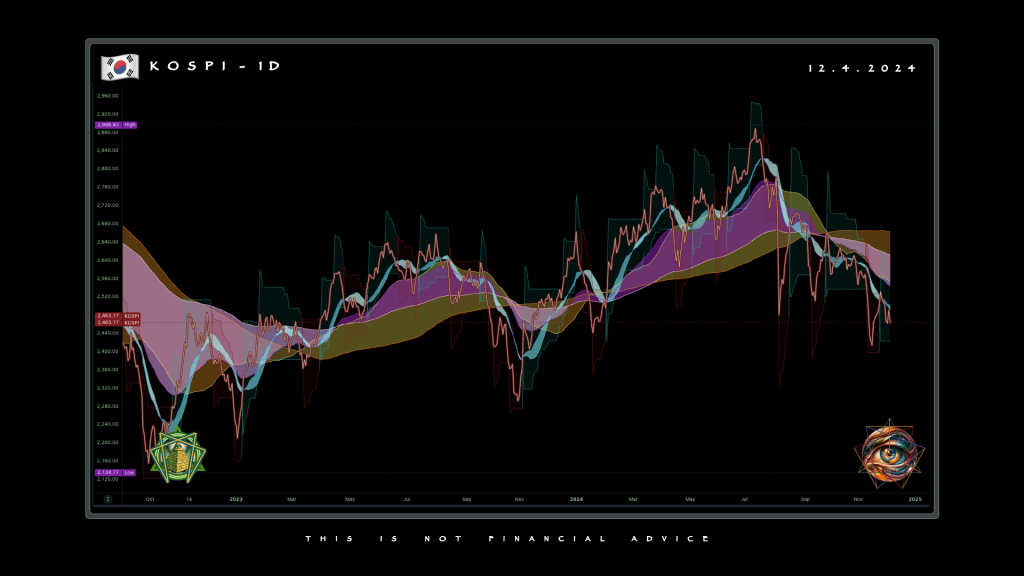
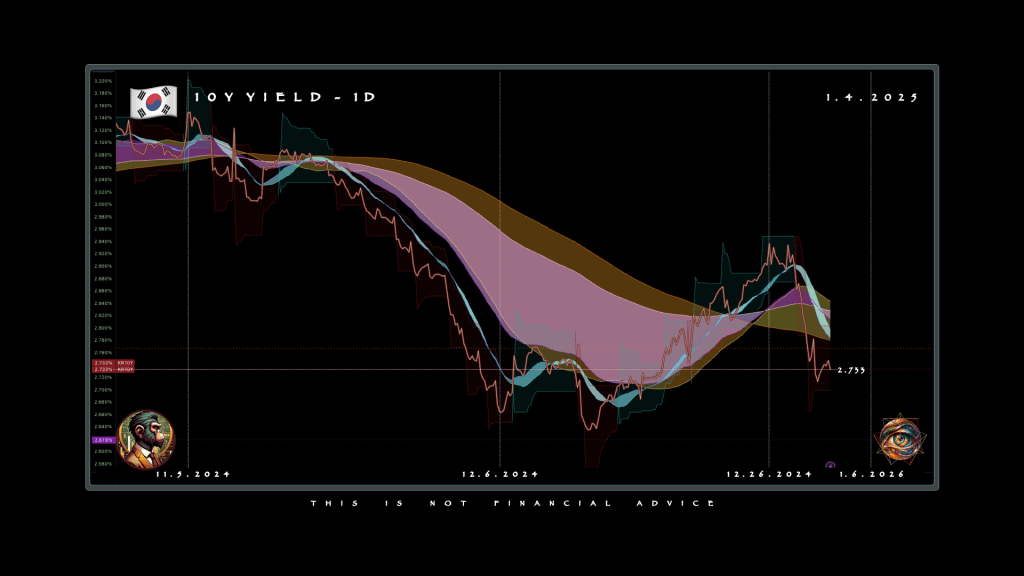
    The daily chart of the KOSPI grapples along a persistent downtrend. Price action has been slammed down and held below major moving averages. The political backdrop creates the perfect storm for risk aversion. The chart screams instability, with little in the way of immediate relief.

    The index’s 2% intraday plunge, followed by a partial recovery to close at -1.3%, is less a sign of resilience and more a reflexive twitch as investors brace for further chaos. Panic in the currency markets mirrors this: the KRW briefly hit 1,443.40 per USD before the Bank of Korea’s interventions calmed the waters.

    The brawl isn’t about democracy or even stability—it’s about survival. Yoon is fighting for his political life, the opposition for dominance, and the unions for relevance. The Will of the People is stuck in the middle, watching with disillusionment. Regional democracies seem resilient, but they’re being stress-tested in ways that could scar them long after this fight is over.

    📈 Cointegration:

    The weekly chart (not shown) hums a different tune: an exhaustion of bearish momentum and the potential for a technical floor. In the end, the real victor may be apathy. If the Will of the People feels ignored long enough, she might just leave the bar altogether, leaving South Korea to clean up a mess of its own making.

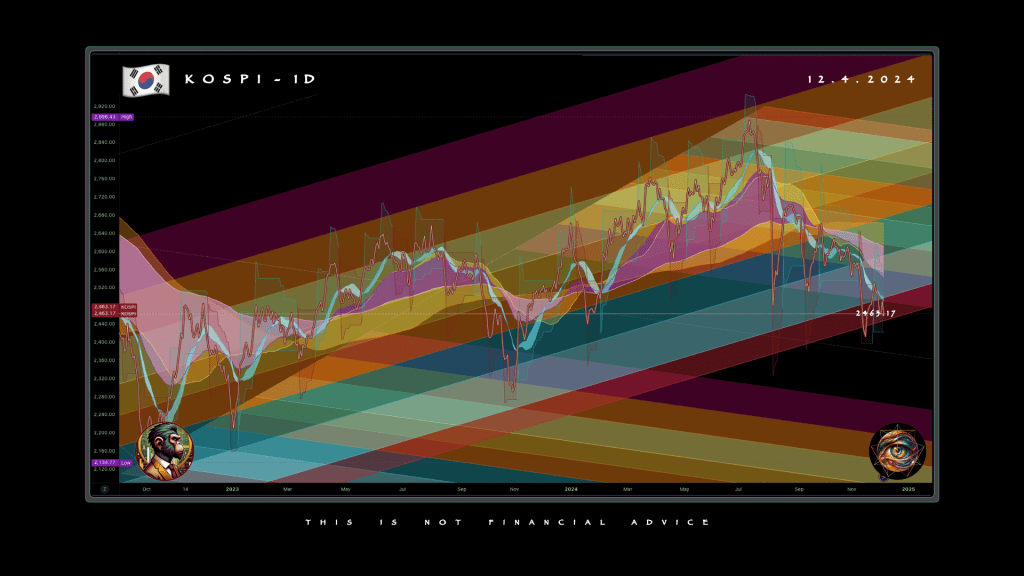
    The enhanced chart, with its intricate overlays of Fibonacci pitchforks, takes a nuanced view of Trend Exhaustion. Underlying structures from the weekly timeframe reveal a clash between long-term uptrend support against the inertia of recent declines.

    The ominous slide toward the red channel’s lower boundary hints at a potential downside breakout. Yet this dark area of confluence, where key levels and trendlines separate like the upper jawbone of a gaping maw, also serves as a probable support zone. The overlapping pitchforks suggest that the KOSPI may be nearing the tail end of its descent, poised either for stabilization or even a recovery.

    🧐 If the red channel holds as firm support, the KOSPI might transition from despair to cautious optimism. However, a failure at this level would open the trapdoor to further declines, especially if external shocks—think North Korea or a deeper-than-expected economic slowdown—add to the pressure.

    The daily chart screams urgency, political uncertainty and investor anxiety. Yet the market appears to have priced in the chaos. The Bank of Korea’s liquidity injections and the stabilization of the KRW suggest that systemic risk is being managed, even as short-term nerves remain frayed.

  • At Palantir, the power isn’t distributed—it’s consolidated in a way that transforms shareholders into serfs. The company’s three-tiered stock structure serves as a near-perfect parallel to Saruman’s domination of Rohan. Here’s how the pieces fit:

    • Class A Shares: These are the “common folk” of Palantir’s hierarchy, akin to Theoden’s soldiers—brave, hopeful, and ultimately irrelevant. Public investors wield one vote per share, a token gesture meant to mimic democracy without ever delivering it.
    • Class B Shares: Reserved for the insiders—founders, directors, and select venture capitalists—these shares are Wormtongue’s whispered manipulations in corporate form, granting 10 votes per share. They carry enough weight to outvoice the masses and secure a stranglehold on decision-making.
    • Class F Shares: Here lies the true power, held exclusively by CEO Alex Karp, President Stephen Cohen, and Palantir co-founder Peter Thiel. Like Saruman himself, these three wield nearly 50% of the company’s voting power. They’ve pledged to vote as a single entity, ensuring that no hostile takeover—or shareholder rebellion—can dethrone them.

    Let’s do the math. Even if the founders’ collective ownership dips below 100 million shares, the Class F voting rights remain intact. This isn’t governance; it’s an unbreakable spell.

    The Palantír and the Public’s Illusions

    The company’s namesake isn’t just for show. Like the seeing stones of Tolkien’s legend, Palantir’s technology enables surveillance, prediction, and control. Governments and corporations rely on its data analytics to peer into everything from global security threats to consumer behavior. But just as Saruman used his Palantír to manipulate and mislead, Palantir’s founders have weaponized their stock structure to keep the public blind to their machinations.

    Investors might feel they’ve joined a fellowship, united in a grand vision of long-term growth. In reality, they’re like Theoden under Wormtongue’s spell: technically in charge, but practically powerless. Major decisions—from corporate strategy to governance policies—are made by three men behind the curtain, immune to the accountability mechanisms that public markets were designed to uphold.

    Why This Structure Should Terrify You

    Palantir’s voting system is more extreme than the typical dual-class setups used by other tech giants. Companies like Google or Facebook might concentrate power among their founders, but Palantir’s triple-layer feudalism eliminates even the illusion of shareholder influence. Here’s why this matters:

    1. Accountability Vacuum 

    With voting power locked away in the hands of Karp, Cohen, and Thiel, the public has no recourse for poor decision-making or ethical lapses. If Palantir’s leadership decides to pursue controversial partnerships or expand its data collection practices into murkier waters, there’s nothing shareholders can do to stop them.

    2. Market Inefficiency 

    Institutional investors like BlackRock and Vanguard are already wary of Palantir’s governance. The structure discourages long-term investment, as it prioritizes founder control over market-driven checks and balances. This could stifle innovation and harm shareholder value in the long run.

    3. Cultural Precedent 

    Palantir isn’t just a company; it’s a blueprint. If its founders successfully wield this structure to dominate public markets while sidelining investors, other tech firms could follow suit. Founder feudalism might become the new normal, and Wall Street could find itself overrun by a new generation of Wormtongues.

    Is There a Gandalf in the Wings?

    The story of Theoden didn’t end with his enslavement. Gandalf rode in, broke Saruman’s hold, and restored balance to Rohan. But in this modern allegory, where’s the White Wizard? Institutional investors have tried to play that role, pushing back against extreme multi-class structures like Palantir’s, but so far, their efforts have been fruitless. Regulators, too, seem unwilling—or unable—to intervene.

    And so, the public remains in stasis, mesmerized by the promise of long-term growth while their ability to influence Palantir’s destiny is stripped away.

    A New Dark Tower

    The true tragedy of Palantir’s governance isn’t just its disregard for shareholder democracy; it’s the broader message it sends. In a world where data is power, the founders of Palantir have positioned themselves as unchallengeable lords of their domain. The company’s stock structure isn’t just a mechanism for control—it’s a signal that in the age of Big Tech, even the illusion of public accountability is an anachronism.

    For investors still clinging to their Class A shares, remember this: Theoden woke up eventually, but only after a lot of damage was done. Don’t wait for your Gandalf.

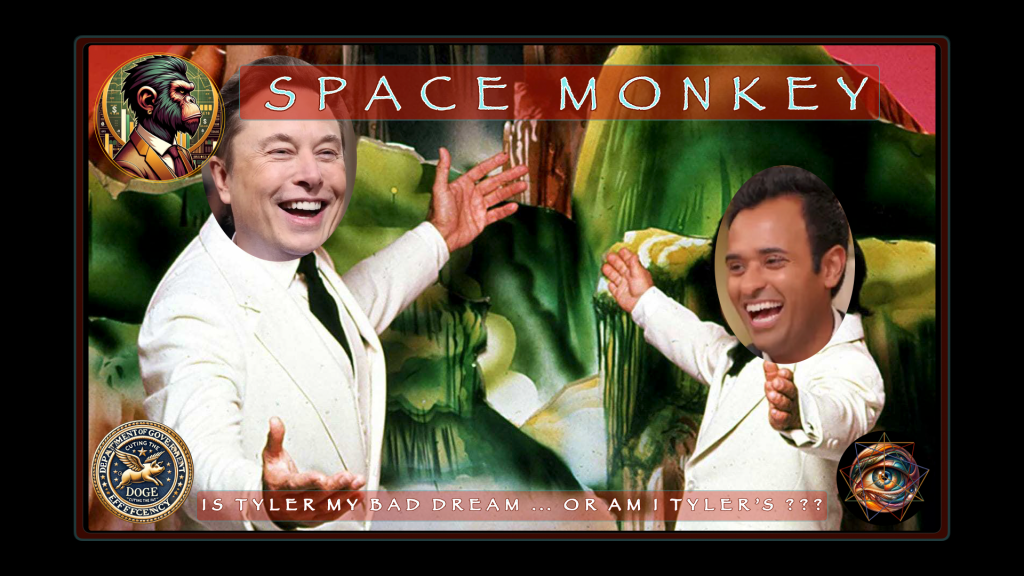
  • The seaplane buzzes low over the cerulean waters, its engine sputtering triumphantly as it arcs toward the lush shores of Fantasy Island. Waiting at the dock, arms crossed in his signature “visionary” stance, stands Elon Roarke, the enigmatic steward of the island, his crisp white suit gleaming in the sun. Beside him, practically vibrating with enthusiasm, is Tatu Ramaswamy, gesticulating wildly at the descending aircraft.

    “De plane! De plane!” Tatu cries, hopping on the balls of his feet.

    Elon Roarke, his piercing eyes hidden behind a well rehearsed smile, faintly chuckles. “Yes, Tatu, our guest has arrived. A man with a dream—or a fantasy—depending on how delusional you think he is.”

    As the plane touches down, none other than Donald Trump steps out, his red tie flapping in the breeze like a ceremonial flag. He adjusts his MAGA hat with a flourish, scanning the landscape as if looking for a golf course.

    “Welcome to Fantasy Island, Mr. Trump,” Roarke says with a slight bow. “I understand you’ve come to fulfill a bold fantasy. You wish to cut $2 trillion from the federal budget. An admirable dream.”

    Trump puffs out his chest, his face beaming like a man who just declared bankruptcy and got away with it. “That’s right, Elon. The government’s too fat. It’s inefficient. Bigly inefficient! I want less waste, fewer regulations, more winning. And I hear you’re the guy who can make it happen.”

    Tatu chimes in, flashing a toothy grin. “At Fantasy Island, every dream is possible, Mr. Trump. But as you know, every dream comes with a cost.”

    Act I: The Forest of Red Tape

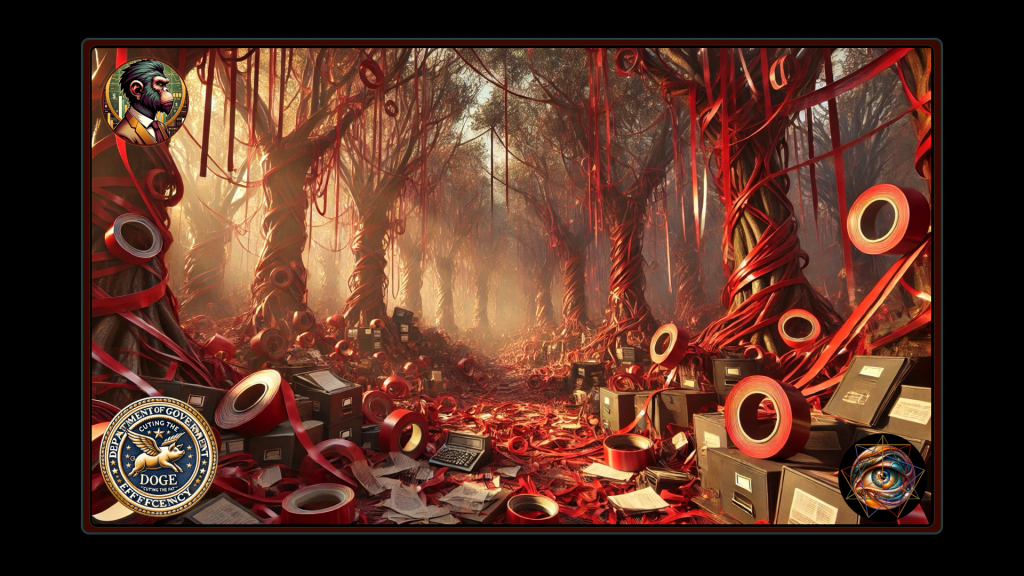
    Roarke and Tatu lead Trump through the Forest of Red Tape, where bureaucratic vines twist around ancient government buildings, each labeled with the names of federal agencies: “Department of Education,” “Environmental Protection Agency,” “FDA.” The air smells faintly of printer ink and coffee left out too long.

    “Here we house the discretionary spending programs,” Roarke explains as they step over piles of tangled regulations. “Defense, education, transportation. All ripe for cuts.”

    Trump claps his hands together. “Perfect! Let’s chop, chop, chop!”

    “Patience, Mr. Trump,” Roarke cautions. “The island doesn’t bend to simplistic solutions. Look deeper.”

    He gestures toward a towering oak tree, its bark etched with the phrase Mandatory Spending. “Entitlements like Social Security and Medicare are the true titans here—65% of all government spending. If you wish to save $2 trillion, you’ll need to fell this tree.”

    Trump recoils. “What? No way. Social Security? Medicare? Those are untouchable. I campaigned on protecting them! That’s like—like taking fries away from a burger. You can’t do it.”

    Tatu raises a finger. “Ah, but Mr. Trump, without addressing mandatory spending, you’ll have to cut nearly every other program to the bone. Or worse, to nothing.”

    Roarke leans in closer, his voice soft but commanding. “The island listens, Mr. Trump. It hears your intentions. But it also knows the limits of your ambition.”

    Trump grumbles, adjusting his hat. “Fine. Let’s look at the other stuff.”

    Act II: The Discretionary Desert

    The trio arrives at the Discretionary Desert, where mirages of tanks, schools, and bridges shimmer in the heat. Each mirage represents a budget item, glowing faintly with its price tag: $874 billion – Defense, $137 billion – Transportation, $68 billion – Education.

    Trump points at the defense mirage. “I’ll cut that!”

    “Bold,” Roarke replies. “You’d be the first president to pull it off. But defense spending is… sticky. Touch it, and you’ll find your fingers glued to an army of lobbyists, contractors, and voters who think you’re weak on national security.”

    “And Space Force!” Tatu adds enthusiastically. “Can’t forget Space Force! Didn’t you call it your ‘big, beautiful baby’?”

    Trump waves dismissively. “Fine, leave defense. What about… the EPA? They clean stuff up, right? Can’t we cut that?”

    Roarke arches an eyebrow. “Certainly. But consider this: millions of Americans rely on the EPA to manage lead contamination, clean water, and pollution. The island will ask, Mr. Trump—do you value clean air and water?”

    Trump shrugs. “I’ll tweet something about it. Blame Biden. Next!”

    Act III: The Cavern of Conflicting Interests

    The mood darkens as they descend into the Cavern of Conflicting Interests, where stalactites drip with glowing subsidies and federal contracts. In the dim light, Trump notices Tesla logos glowing ominously.

    “Hey, Elon,” Trump says, narrowing his eyes. “Aren’t those your contracts? NASA? Defense? How much government money are you getting, anyway?”

    Roarke, ever composed, smirks. “Fantasy Island has its ironies, Mr. Trump. Yes, my enterprises benefit greatly from federal contracts. Nearly $15 billion, in fact. But you see, that’s the genius of the island. It forces us to confront our hypocrisies. Could you really cut government spending without cutting programs you yourself created?”

    Tatu laughs nervously. “The island doesn’t like easy answers, Mr. Trump. It loves irony.”

    Trump, for once, is speechless.

    Act IV: The Chinese Puzzle Garden

    The final stop on the tour is the Chinese Puzzle Garden, a maze of bamboo and mirrors. The deeper they go, the more distorted their reflections become. Trump stumbles upon an image of himself, flanked by Elon and the Chairman of the CCP, shaking hands in the shadow of Tesla’s Shanghai factory.

    “What’s this?” Trump demands.

    Tatu speaks softly. “China controls half of Tesla’s production, Mr. Trump. Their influence on Elon’s empire is significant. Should they choose, they could shut it all down. The island reminds us that no one is free of entanglements.”

    Elon, now visibly sweating, tries to lighten the mood. “It’s all part of the fantasy, right? A little… creative tension?”

    Trump mutters under his breath. “I don’t like this place anymore.”

    Act V: Judgment Day, or The End of the Party

    As the sun sets, the three men gather on the beach. The waves lap at the shore, and the plane waits in the distance.

    “So, Mr. Trump,” Roarke says, his tone unusually serious. “Have you found your $2 trillion solution?”

    Trump looks down, fiddling with his tie. “Maybe cutting government isn’t as easy as I thought. But hey, at least we tried, right?”

    Tatu chimes in, ever the optimist. “It’s not about the destination, Mr. Trump. It’s about the journey—and what you learn along the way.”

    Roarke chuckles softly. “Indeed, Tatu. Every guest on Fantasy Island leaves with a lesson, even if it’s not the one they hoped for.”

    As Trump boards the plane, he looks back at Roarke and Tatu, a rare glimmer of humility crossing his face. “You know, Elon, maybe you’re not so bad after all. And you, Tatu… keep an eye on this guy. He’s dangerous.”

    The plane roars to life, taking off into the twilight. Roarke watches it disappear, hands clasped behind his back.

    “What’s next, boss?” Tatu asks eagerly.

    Roarke smiles faintly. “The island never rests, Tatu. There’s always another fantasy to fulfill—and another lesson to teach.”

    Take-Aways from the DOGE Manifesto

    Musk and Ramaswamy’s Razor: DOGE isn’t a government agency—it’s a budget-slashing Austerity Cult disguised as a think tank, spearheaded by Elon Musk and Vivek Ramaswamy under Trump’s watch.

    $2 Trillion or Bust: The mission? Ax $2 trillion in federal spending, targeting bloated regulations and inefficiencies. The problem? Most of the fat is marbled into mandatory programs like Social Security and Medicare, which account for 65% of the federal budget.

    The Untouchables: Tackling Social Security and Medicare is like detonating a political grenade in a nursing home. Everyone agrees reform is needed, but no one wants to pull the pin.

    Musk’s Double Game: Critics are sharpening their knives over Musk’s conflicts of interest, with $15 billion in government contracts and subsidies flowing through his companies, plus his deep ties to China. Can the butcher cut himself out of the carcass?

    History Isn’t Encouraging: The Grace Commission, Thatcher’s efficiency reforms—sure, waste has been trimmed before, but not without blood, protests, and political martyrdom.

    Doom or Discipline?: Supporters hail DOGE as a necessary fiscal intervention; detractors warn it could dismantle critical services. The truth? Probably both.

    Small Wins, Big Blind Spots: Musk has Twittered about minor inefficiencies—misused office chairs, redundant agencies—but the trillion-dollar elephants remain untouched.

    The Real Battle: DOGE’s success hinges on surviving an onslaught of lobbyists, political egos, and institutional inertia while delivering real cuts without torching the republic.

    DOGE isn’t just a cost-cutting experiment—it’s a high-stakes game of financial Jenga, and the tower’s already leaning.


  • In the sterile world of corporate America, Denise Prudhomme’s 60 years of life did not rise to the level of tragedy, and her passing was briefly barely more than a dark sitcom. At around 7 a.m. on the morning of August 16th, Denise scanned her badge at Wells Fargo, for the last time very much as she had countless times before, and entered Tempe’s local Temple of Corporate Finance, a sprawling labyrinth of cubicles and glass partitions. There, perhaps with a warm cup of coffee in one hand and a cool mouse in the other, as she settled in for her daily toil, she died.

    And nobody noticed.

    For four days, until the 20th, Denise’s lifeless body slumped across her desk, burning the midnight oil so to speak. The office building hummed with mechanical whirrs and the faint echoes of remote work for, alas, the physical presence of employees had been reduced to a trickle following 2020’s biohazard of mysterious origin. Three floors above the heart and major arteries of office life, the anonymity of corporate existence reached its anticlimax.

    Wells Fargo — a titan among Wall Street banks — navigates through crises, regulatory scrutiny, and market fluctuations with singular focus: profitability. If anything, Ms. Prudhomme’s dedication to onsite retirement may prove to be a leading indicator of the sacrifices more American workers can be expected to make before this decade ends. Beneath the bank’s stalwart exterior lies a heroic story of the drive for efficiency irrespective of any human cost, a story of the bottom line above all.

    Indeed, Wells Fargo’s impressive stock performance since the beginning of 2023, a (+/-) 42% bump, is no accident.

    Rather, it proves the strategic acumen of the board and executive management in these tense times. For example, the divestiture of its commercial real estate loan servicing unit to Trimont is a stroke of genius. The pivot streamlines operations and reduces exposure to volatile markets to refocus on more profitable core areas. By shedding non-core assets and personnel to concentrate on the high-margin divisions instead, Wells Fargo’s leadership is not merely surviving, but thriving.

    The appointment of Alex Douklias as Vice Chair of Corporate Banking is another example of this brand of forward-thinking. With an eye on expanding services for large corporate clients, Douklias cements the bank’s leadership in this lucrative sector. For shareholders, these moves signal a commitment to delivering long-term value while maximizing profits.

    Operational excellence is not just a buzzword at Wells Fargo; it’s the lifeblood of the bank. Consider the weekly chart of the stock price. My custom indicator, the Triple Differential Moving Average Braid, shows a well-established uptrend, with shorter-term averages consistently above their longer-term cousins. Such an alignment suggests bullish momentum.

    However, as the stock price approaches overbought territory, indicated by the shrinking gap between the moving averages, the potential for a downside Mean Reversion rises. The more recent Point-of-Control of the Volume Profile, established by the 2021 lows, currently aligned with the bottom of the Braid, makes an obvious technical target.

    While the boardrooms buzz and the stock market rewards the executives’ vision, Denise Prudhomme reflects the quiet desperation necessary to that sustain these titans. Her almost unnoticed departure is not a bug in the system, but a feature. A corporation as vast as Wells Fargo must focus on the greater good: the profitability and efficiency of the entire operation. Sometimes, this means that individuals are overlooked.

    It’s not negligence, as some employees have asserted, but the reality of operating at scale decade after decade for over a century and a half.

    The daily chart presents a zoomed-in perspective on the same story, with the indicators appearing slightly different on account of the lower time-frame. While the Braid still looks bullish, the shorter-term averages are converging and even crossing, signaling a potential consolidation, correction or even trend exhaustion. The daily Volume Profile suggests a heavy resistance at the high, making the recent move more significant to long term investors. The Point-of-Control again makes a juicy medium term-target for short-sellers, who of course will have tactics of their own for such trades.

    In other words, a retracement near to the current daily Point-of-Control should surprise no one, and even be expected before any further price appreciation. Yet, such a move might also be a stutter step down to the potential Mean Reversion on the weekly timeframe, shown above, and last correspondingly longer.

    The fact that Wells Fargo’s operations continued seamlessly, however, even with this blip in the news cycle unfolding on local channels nationwide, is a testament to its fixture status in the financial scenery. The machine kept running, profits kept flowing, the bank continued to deliver value to its shareholders, and nothing skipped a beat.

    Again, the divestiture of the CRE loan servicing unit — along with nonessential personnel — admirably exemplifies this proactive belt-tightening. Employees are not the only ones making sacrifices, either. For their part, the board and the executive team fearlessly face market volatility, angry customers and spooked employees to make those tough calls that keep Wells Fargo not just competitive, but profitable.

    Of course, there will always be those who argue that the human cost is too high, that the focus on efficiency and profitability comes at the expense of the people who make it all possible. Yet others argue the opposite, that the focus on people over profit is ultimately unaffordable, and indeed many can be profitably automated away. If anything, it’s a reminder that in the pursuit of growth, not every worker ant is supposed to have a happy ending.

    Ergo, the trend of on-site retirements may therefore be expected to increase in coming years, especially as the ever-louder return-to-work imperatives grow teeth.

    As expected, the company’s response was generously stoic: “We are deeply saddened by the tragic loss of our colleague at our Tempe office. Our thoughts and prayers are with their family and loved ones during this difficult time. Counselors, through our Employee Assistance Consulting service, are available to support our employees. We are fully cooperating with the Tempe Police Department in their investigation and will direct all further questions to them.”

    Further, since disinfecting the air literally erases the stench of death, they assured their upset employees that the office had been “thoroughly cleaned.” Considering that it was the smell, not the sight or sound and not the undelivered work-product, that first attracted employees’ attention, the gesture is not only humane, but professional. Of course, no amount of bleach will wipe away those profits.

    Despite investor satisfaction, though, several employees were quick to bemoan their supposed sour grapes. One even said “It’s really heartbreaking and I’m thinking, ‘What if I were just sitting there? No one would check on me?’”, adding, “To hear she’s been sitting at the desk like that would make me feel sick … and nobody did anything. That’s how she spent her last moments.”

    Such self-importance will have a short shelf-life as the economy forces these entitled social insects to show their real instincts for what they are. Let’s not forget that the 16th was a Friday … it’s not as if the building was even open most of the time in question. Surely if the complainers had noticed something fishy in Denmark sooner, so to speak, the local money changers would have hosed down the stalls that much quicker. The math is simple; bodies are bad for business.

    When it comes to employees’ list of wishes, let’s just say: Fear the Working Dead!

    To be sure, Denise’s unceremonious exit was a product of corporate culture, where human beings are routinely reduced to ID numbers and email addresses, where presence is measured by a green dot on a screen rather than by genuine interaction. Then again, considering how much time these so-called human beings spend on their phones talking to nobody, the loss can be measured as a fraction of Ms. Prudhomme’s relatively insignificant annual income; the company will probably save money, even after expenses. Her passing was almost perfectly unobtrusive, unimportant until it became a logistical problem to solve, a line item on a corporate report. Her workload will be surreptitiously distributed between her erstwhile colleagues, if it hasn’t been already, and her position, though advertised, will most likely go unfilled.

    Wells Fargo is not a small-fry podunk bank for dust farmers, but an institution with millions of stakeholders and billions of dollars in assets globally. Decisions made in its boardrooms affect not just employees, but shareholders, clients and even the financial markets. Denise’s flash-in-the-pan rise to temporary fame is not the story of the bank. The Wells Fargo story is one of resilience, strategic foresight, and relentless pursuit of profit. It’s the story of a bank that continues to adapt, to evolve, and to thrive, even in the face of death.

    As the proverb says: “The Dog Barks; the Caravan Moves On.”


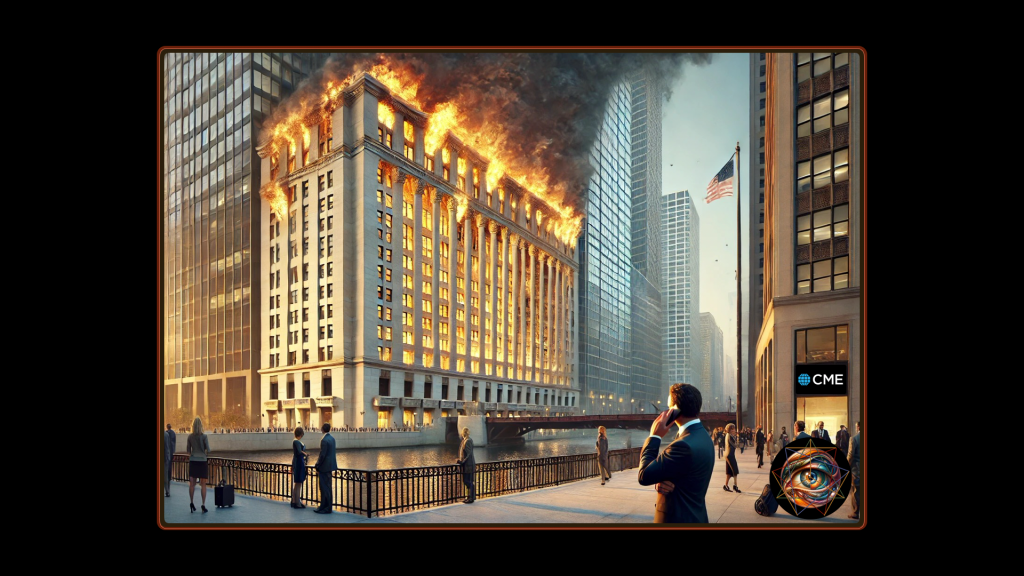
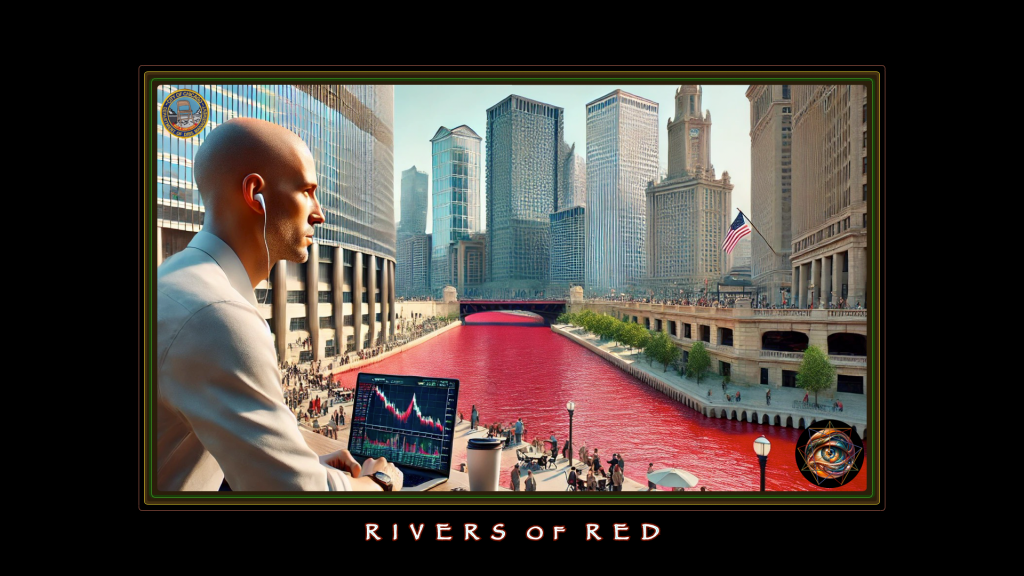
  • As the postmodern Babel of the Midwest, Chicago sits precariously at the edge of a profound and irreversible paradigm shift. Once a city of ambition and industry, today its towering achievements cast long, wavering shadows over streets marred by decay and desperation, fueled — let’s be truthful, shall we? — by over a century of corruption. At the heart of this unraveling metropolis stands the Chicago Mercantile Exchange, or CME. Founded in 1898 as the Chicago Butter and Egg Board, the exchange is the last link to the financial might of this city nearly stripped of its fast fading glory. A symbol of Chicago’s past dominance, it remains (for now) a key player in the global financial arena, even as the city that birthed it furiously digs an illiquid grave beside Lake Michigan.

    From inner Winnetka to outer Wilmette, the decline has been no overnight affair. Looking back on the unhallowed Covid Project, Chicago was among several perfect targets for a global tremor that could shake loose its foundation stones locally, already hollowed as it was by years of neglect and mismanagement.

    Whereas the global fallout from the pandemic fracas was predictably severe, it was the city’s “irresponse” — for what else can it be called? — that set the stage for its final act. Having invited a mixed migrant army within their sphere of association, Chicago’s leaders then funneled hundreds of millions of dollars into subsequent social services suspiciously missing measurable ROI targets that left a plentiful lack of much-needed money either for the crumbling infrastructure or its resident institutions that had long been its financial spine. The coffers, already a tinny sounding tummy, now ring dangerously dry.

    At a time when more conservative cities would shore up their defenses, Mayor Brandon Johnson’s administration — wrestling a $30 billion pension shortfall and a city circling the drain — instead proposes an $800 million tax hike. It’s a bold move that certainly threatens to drive out the very businesses keeping the city’s economy commodified. The CME, although not the only institution feeling the pressure, surely sticks out in this game of business brinksmanship.

    If the Exchange joins the exodus of firms fleeing the Windy City, the shock wave could not only blow Beverly from the Loop to South Lawndale, but reverberate statewide to boot … and a potential CME departure is but one ingredient in a more complex stew of volatility.

    Chicago’s streets, since before Capone the very setting of opportunity and promise, now tell a different story — one of public disillusionment. The pandemic bugaloo laid bare the city’s already torn social fabric. As quasi-organized crimes from scams and scandals to violence and property destruction surge and evolve, Chicago’s defenses crumble and residents are left wondering if there is any leadership upstanding enough to pull it back from its beleaguered brink.

    The city’s financial woes are merely the outer skin of a pungent woke onion that, the more your vexed peeling stings it, viciously bites back at investigation. Long-time residents feel abandoned by a system more concerned with political optics than with lasting tangible solutions to their genuine problems. The humanitarian crisis created by their leaders, ostensibly to expand their influence ahead of growing no-confidence among erstwhile constituents, exacerbates the feelings of neglect.

    Resources that could have been used either to repair the infrastructure or to fund essential services were instead diverted to support the influx of newcomers. While the moral argument for aiding those in need is undeniably strong, the inevitable buyer’s remorse of socialism is arguably stronger, considering its well-documented toll. The practical implications leave Chicagoans questioning the city’s priorities, when they could instead simply have answers if they thought for themselves. They were intentionally miseducated to begin with, however, and trained to outsource their thinking. As surely as ROI is fractal, opportunity costs compound.

    Indeed, this tragic tension between ideals and reality is nothing new for Chicago. The city has always been a microcosm of the broader American experiment, a place where the best and worst of the nation’s ambitions collide. The 1968 Democratic National Convention in Chicago was the epicenter of political and social unrest, as the city turned into a battleground. The streets ran with the same tension and anger that pulses through them today, with scenes of chaos broadcast across the country.

    Mayor Richard J. Daley, with his iron-fisted approach, sought to maintain order by any means necessary, and in doing so deepened the divide between the government and the governed. The “Battle of Michigan Avenue” became a symbol of the era, a moment when the American dream looked ready to buckle under the weight of its contradictions. Inside the convention hall, the Democratic Party was fracturing, unable to reconcile its internal divisions over the Vietnam War and civil rights … i.e. the age-old free-lunch problem. Outside, the city was burning, both literally and figuratively, as once again, a generation of young Americans was duped into marching to demand change instead of making it themselves.

    Fast forward to today, the eve of the 2024 Democratic National Convention as I write this, and while the faces and issues have changed, the underlying tensions are eerily similar. Tensions from global warming to outright hot war in the Middle East echo the unrest of 1968, albeit through a postmodern lens. Security is at a fever pitch, pallets of bricks have been discovered and removed, while nearby business have wisely boarded-up their windows in advance of advertised unrest. Social media, a largely misunderstood digital battleground, is poised to amplify any grievance and turn every local outburst into a meme or movement if possible.

    While the tools of dissent and control have evolved, the world watches as Chicago and the DNC alike struggle to figure themselves out. Amid the madness, the CME remains a cool-headed player, though its role as a commodities arbiter is easily overlooked by laypersons. So, while the city burns around it like the premonition of a Fire Sale, the venerable exchange operates within, and even imposes some amount of order upon, the rising volatility. It is the leading indicator to watch.

    Unlike the street-side dysfunction, CME Globex, the exchange’s trading interface, transacts with the precision and speed that modern market makers demand. Yet, this pillar of stability is not immune to such historic stressors. The proposed tax hikes, coupled with the ongoing descent into disorder, threaten to drive the CME away from the city that has been its home for over a century. If the CME leaves, it won’t just be a loss for Chicago—it will be a sign that the city’s best days are truly past.

    While the exit of other major firms like Citadel and Guggenheim has already shaken the financial ecosystem, the loss of the CME would be the death blow that signals to the world that Chicago is effectively closed for business. The ripple effect would be felt from O’Hare to as far as Traverse City, Bad News Bears for all as otherwise uncorrelated local economies heretofore unknowingly reliant on high earners in commodities and derivatives trading collapse and leave behind cityscapes of desolate storefronts and empty offices reminiscent of Seattle or Santa Monica.

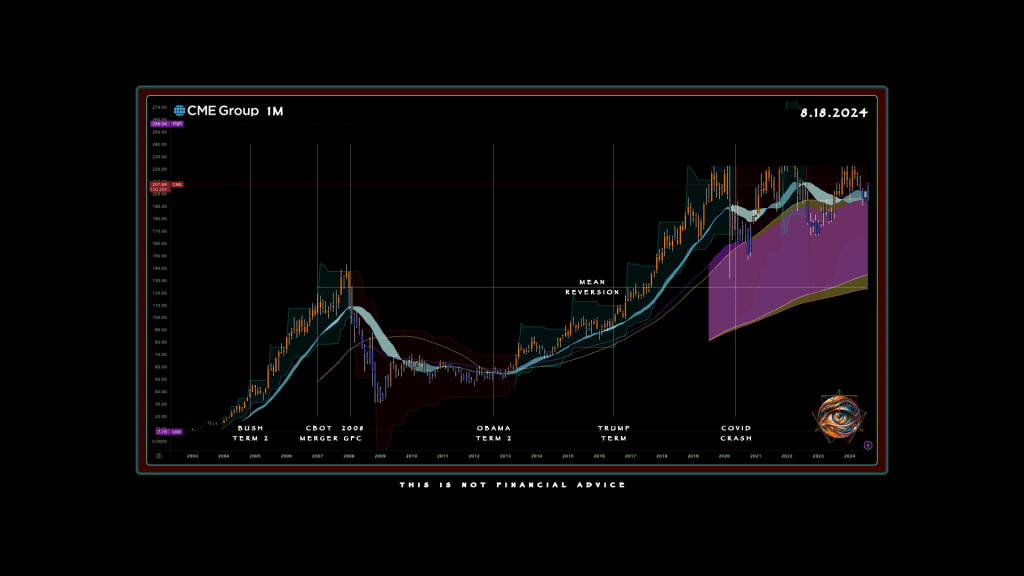
    Protests against Mayor Johnson’s policies seemingly echo the Israelites’ cries in the wilderness — voices rising in desperation as they confront a leadership either unwilling or unable to guide them to safety. The CME, though largely insulated from the daily turmoil, is not untouched by the direction the city’s leadership takes. My lower timeframe chart-work suggests that decisions made in the coming months will determine the future of the exchange and, in turn, of Chicago itself.

    As traders are wont to say, “Show me the chart and I’ll tell you the news!”

    The parallels between 1968 and today are striking, with the critical difference being the stakes’ unprecedented hight. While in 1968 the battle was for the ideals of a nation, today it is for the city’s very survival. The CME, while not on the frontline of the battle, per se, remains a key player, its fate tied to that of its namesake host. Decisions made by the city’s leaders in the coming months will doubtlessly determine whether Chicago can pull back from the brink, or if it joins the ranks of history’s fallen city-states.

    Verily, the departure of the CME would be a major economic blow. As one of the world’s largest financial exchanges, it is a massive employer and contributor to Chicago’s economy. Any actual relocation will lead to job losses, not just directly from CME but from related financial services firms and support industries. The speculative impacts of a CME relocation to Texas would also include further erosion of tax revenues for both Chicago and Illinois in favor of the new host state, while cementing the latter’s growing reputation as a business-friendly financial hub.

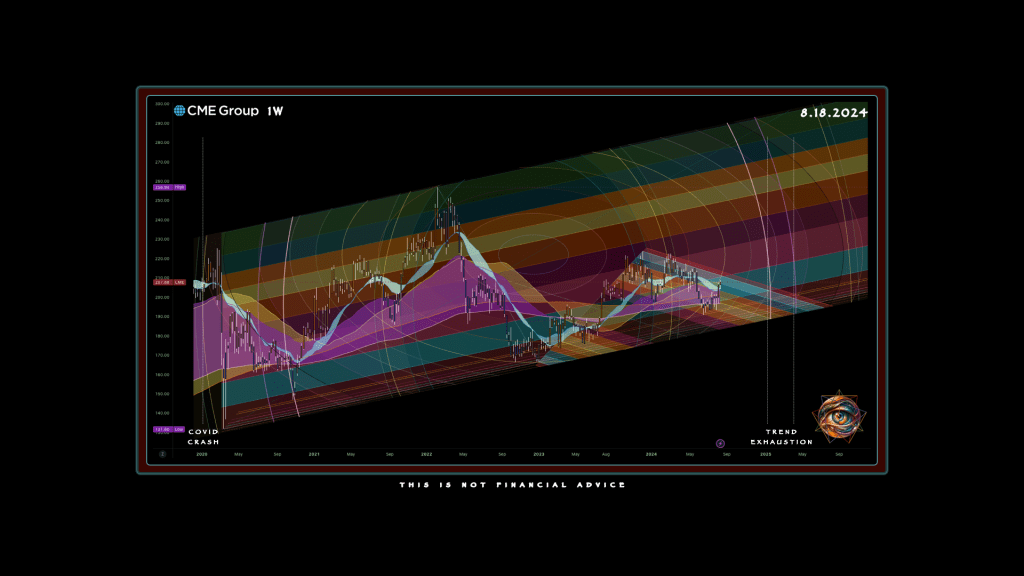
    While Texas Governor Greg Abbott has expressed bemused interest in CME Group relocating to Texas — who wouldn’t, right? — note that as of now, this angle is purely speculative. The CME has not announced any plans to move, officially or unofficially. Although my charts of CME Group’s stock price indicate trend exhaustion and a potential mean reversion, any actual relocation in the real world would be a complex, multi-year process involving many stakeholders, as well as careful consideration of the impacts on the company and the broader financial markets.

    The future of Chicago, like that of the CME, hangs in the balance. The choices made in the coming weeks will determine whether the city, and indeed the region, can reclaim its status as a beacon of American ingenuity and resilience, or whether it will fade into obscurity, a relic of a bygone era. The CME, the last great pillar of a once-mighty edifice, may yet stand firm — but only if the citizens find the courage to support leaders who challenge them instead of promising easier living. Chicago’s ultimate fate remains uncertain, but its unwritten future is rapidly shrinking and sooner than later we will know which way the wind blows.

  • Money laundering is the process by which criminal actors disguise the illicit origin of funds in order to funnel them into the legitimate banking system, increasing transferability and flexibility while reducing the risk of prosecution, seizure, or theft from other criminals. As financial infrastructure evolves and regulations tighten, the elusive figures behind money laundering operations continually adapt and innovate to stay ahead. However, throughout the processes and schemes engineered by Professional Money Launderers (PMLs), Open-Source Intelligence (OSINT) investigators can still uncover suspicious transactions, relationships, and other indicators of illicit behavior.

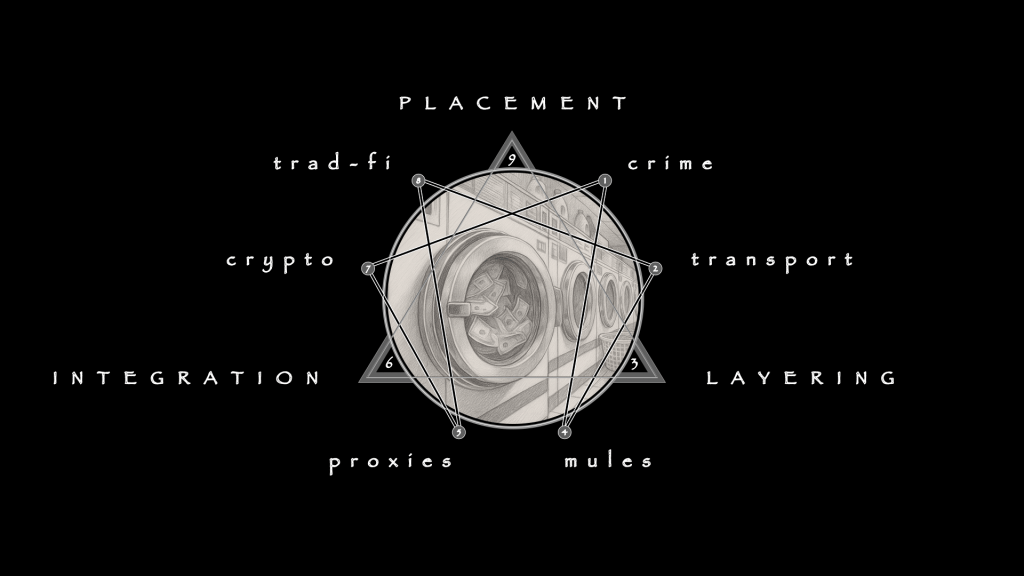
    The secretive world of money laundering employs a variety of mechanisms and networks to conceal the spoils of criminal actors. This brief analysis of PMLs describes the methods they use to thrive as well as key tools and approaches to expose and stop them. Although money laundering schemes are often complicated, they always involve a Logos of three core inputs, or sources:

    1. PLACEMENT – money obtained through criminal activity is moved into the legitimate financial system.
    2. LAYERING – the origin of the money is disguised by moving it between multiple accounts.
    3. INTEGRATION – the money is redelivered to the criminal in such a way that it appears legitimate.

    In much the same way that traditional businesses rely on accountants, Organized Crime Groups (OCGs) rely on third-party professionals to handle their illicit funds. As a service, PMLs launder the proceeds of their crimes for a commission or fee. Criminals, whether working solo or in union, may rely on PMLs either due to a lack of in-house expertise or to put distance between themselves and their funds.

    Apathetic to, or deliberately ignorant of, the origin of the funds, PMLs tend to launder money through multiple jurisdictions on behalf of their “elite clientele”, being anyone with the motive and sufficient funds. To do so, PMLs rely on their own specialized knowledge and expertise to exploit legal loopholes, and they find other opportunities and venues for diversification as well, ultimately to preserve the proceeds from illegal enterprises and legitimize them for use in legal ones.

    The many and varied techniques of laundering illicit funds have made it difficult, historically, for investigators to follow their movement, and therefore to prosecute offenders. Investigating money laundering poses puzzles and problems to “white hats” across such industries as law enforcement, government, and traditional finance (“trad-fi”) . To successfully disrupt laundering operations, they require the technical tools to get the right intelligence to ensure that they understand how money flows, and the legal tools to take timely enforcement action.

    The number of people who effectively understand the first tool-set is small, the number who understand the second set is arguably smaller (especially when you factor in corruption, see below), and their cross-section is almost nonexistent, given the speed at which the competition innovates.

    PMLs (be they black, grey … or off-white) market themselves almost exclusively through word of mouth and utilize shadow accounting systems that contain detailed records with code names. PMLs may work on their own, or as part of a Professional Money Laundering Network (PMLN). Moving up the food chain, a consortium of such networks is known as a Professional Money Laundering Organization (PMLO), which you can expect to see at the transnational level.

    A detailed example is given in the piquant anecdotes in my video Currency Racketeering & The Bullish Case for CBDCs, adapted from “Shantaram” by Gregory David Roberts . Although it’s highly stylized, like all my videos, it is nevertheless worth watching for serious students of transnational capital flow via black markets and/or fans of “Monkey Thieves”. For whatever reason, it’s banned in India, despite falling under YouTube’s Fair Use clauses.

    PMLs use whatever mechanisms, organizations, and networks they require to move funds, usually during the placement and layering stages of the laundering cycle. These include transport, “Mules”, virtual currencies and proxies. Tracking capital flow through these mechanisms, however, is a resource-intensive effort. In recent years, heavy investment by investigators in AI and ML-driven tools aims to alleviate manual burdens by automating many of the key steps.

    TRANSPORT

    Money transport and cash controller networks assist criminals that generate substantial amounts of cash. These controller networks receive and transfer illicit funds internationally while charging a processing fee. Cash controllers substitute illicit proceeds for legitimate goods through an account settlement system for many OCGs.

    Cash controller networks orchestrate the laundering of the proceeds of crime for multiple OCGs, with unwitting customers’ bank accounts being used to swap illicit funds for their legal funds. Alternatively, funds may be transferred in physical cash and channeled into the financial system through the purchase of goods like second-hand vehicles, spare parts, and equipment. When working internationally, accounting settlement systems may be used to balance money amongst several customers and keep money in the same jurisdiction to avoid riskier cross-border transfers.

    MULES

    PMLs recruit networks of money “Mules”. These individuals are paid to transfer money through their personal bank accounts and wire it to other accounts. Mules are typically recruited unknowingly through job advertisements for positions like “transaction managers,” or knowingly through social media under the guise of get-rich-quick schemes. PMLs may manage their Mule network themselves or employ a manager, known as a “Herder”.

    When dealing with physical cash, Mules are frequently recruited from underserved communities or countries with struggling economies. They are incentivized with cash payments and free travel. Besides my video on the Indian Rupee, the Gold Mafia docuseries produced by Al Jazeera in 2023 is another excellent deep dive into the human sea of operatives and physical incentives.

    On the other hand, when washing money digitally, herders seek Mules who appear legitimate, such as students and young employees with established bank accounts. While a single Mule transferring a small amount of funds may appear to be a low-level offender, OCGs can tap into networks of hundreds of them to move significant sums of cash. The bank scene in Denis Villeneuve’s 2015 film “Sicario” briefly features a high-level Mule-hunt, beyond the scope of any OSINT investigator but narratively useful to understanding the potential scope and scale. Mule networks have even been known to establish companies that appear as legitimate businesses but exist only to employ at scale, as well as to facilitate the sale of illicit goods through online stores.

    VIRTUAL CURRENCY

    With many criminals looking to cryptocurrencies for “work-arounds”, PMLs also create “off-ramps” that enable them to cash out their proceeds into fiat currency. The latter are those issued by governments (literally “by decree”) that is not supported by any tangible asset (i.e. gold), including the euro, the British pound, and the US dollar. While cryptocurrency, by contrast, has been a Wild West so far, the long arm of the law is coming to town.

    PMLs transfer essentially virtual currencies through a chain of so-called “digital wallets” for layering. The funds may be split up during transfer, mixed with other illicit funds, and sometimes legitimate funds, too, to hide the trail. With the digital trail masked, funds can be sent to their final digital wallet destination, liquidated, and transferred to exchanges and banks to be withdrawn in cash. The bank accounts used commonly belong to recruited Mules who then redistribute the funds among various criminals.

    PROXIES

    Some PMLs utilize proxy networks, a banking service that relies on multi-layered transfers to obfuscate the trail of the financial flows heading to their final destination. Proxy networks develop multiple layers of shell companies in many jurisdictions, which exist purely to redistribute and mix funds from a myriad of sources in order to make a client’s funds untraceable. PMLs identify loopholes and other possible purposes for payments that provide a veneer of legitimacy to the transactions.

    During the proxy network processes, funds are transferred to accounts opened in the name of shell companies, often using legal entities. If the illicit proceeds were cash, controllers deposit it into the shell companies’ accounts. Such funds are then moved through a complex chain of accounts and mixed with other clients’ funds. From there, they are transferred under fictitious contracts, loan agreements, consultancy services, or investments to other companies controlled by the PML. Finally, the funds are returned to accounts controlled by the PML’s clients, or else goods and services are otherwise purchased on their behalf.

    PMLs not only manage funds, many also facilitate large-scale tax evasion schemes, leveraging several layers of shell companies between the importer and the producer of goods. At the final stage, funds are transferred to corporate bank cards, followed by subsequent cash withdrawals. The number of shell companies and personal bank accounts involved may exceed several thousand, limiting detection and diversifying possible losses.

    It is estimated that roughly $2 trillion US dollars are laundered every year and that institutions spend hundreds of billions each year on financial-crime compliance and investigations. To make an impact on money laundering at scale, investigators, whether in government, journalism or private practice increasingly leverage automated tools to investigate those with suspected links to illicit funds.

    Perhaps the greatest challenge to those affected by finance-sector OCGs, namely the legitimate daily users of a currency, are the lawmakers themselves, many of whom have not only the motive and the opportunity, but even unique means of malfeasance.

    While corruption is beyond the scope of money laundering techniques, per se, a number of the tools in use by law enforcement are becoming more widely available to investigative journalists, with and without accredited degrees. One notable example is The Pandora Papers , the 2021 leak of almost 12 million documents by the International Consortium of Investigative Journalists (ICIJ). The details, worthy of a look as they may be, more generally indicate that governments will always need oversight from nongovernment actors.

    THE OSINT ANGLE

    Money laundering is an ever-pervasive plague upon governments and other financial institutions, internally and externally, across the globe. Besides the vast human networks involved in money laundering, the overwhelming transaction volumes make manual investigation techniques unfeasible. They can no longer keep pace with the velocity and scale of bad actors. The emergence of AI/ML-driven automated OSINT solutions, however, opens new doors, providing investigation teams with the platform tools they need to detect and disrupt money laundering activities in real time.

    One way is to incorporate automated fraud and risk signaling solutions that assess public data in individuals’ and businesses’ digital footprints. By building this functionality into existing systems via an Application Programming Interface (API), investigators are identifying patterns and anomalies that otherwise go unnoticed by legacy methods.

    The automated pattern-recognition abilities of Large Language Models (LLMs) and other cybersecurity-related tools make it possible to comb through a vast array of public data, such as consumer records and social media, and to quickly generate comprehensive, court-ready reports on high-risk individuals and businesses.

    Investigators are no longer constrained by labor-intensive research involving internet searches for data like business filings or social media content. Instead, they can target the most relevant information, allowing them to reach more informed conclusions much faster. The elimination of manual processes enables investigators to optimize their inquiries and to concentrate on detecting the leading indicators of money laundering.


  • Give me your sneaky, your sly,
    Your huddled masses yearning to pay no taxes,
    The artful dodgers of Justice’s watchful eye.

    Send these, the undocumented, tracks redacted to me.
    I wink my lamp beside the hidden door.

    Here, in the shadows where the wild cards play,
    Where identities shift like desert sand,
    They stand, a nation of the no-work visa,
    Bribing patrol squads with a silent, swift hand.

    “[redacted],” they whisper, ‘twixt fence-links woven tight,
    Nurtured by the watchful drones that by night do creep.

    Seeking shadows in the vast and starry night,
    They dream of lands where they can safely sleep,

    While, beyond crumbling alleyways, the statue of [redacted],
    Mere survival is a game played with corruption and luck.

    Here, they navigate the new urban kingdom.
    On crooked streets leading nowhere they run, yet often amuck.

    So come, ye crafty, to this land so broad, so wide,
    Where the brave may hide, and in hiding, forget to rise.

    Here they stand in a shadowed, shifting tide,
    Till dawn or justice find them, and they meet their compromise.

The Leading Indicator

beauty is an attribute of truth

Skip to content ↓