The story you know of money is both tidy and wrong. Economics textbooks describe a neat progression from primitive barter to commodity money to modern currency, each step solving inefficiencies in exchange. This narrative feels intuitive because it mirrors our assumptions about progress—that complex systems emerge from simple beginnings through rational improvement. The comfortable fiction persists because it transforms money into a neutral technology, a lubricant for commerce that emerged naturally from human ingenuity.
The archaeological record tells a very different story.
Money did not emerge from trade but from blood—specifically, from the need to stop the flow. Before the first coin was minted, or the first market opened, or the first merchant calculated profit, money existed as a technology to measure loss and convert violence into obligation. To read money’s true nature is not academic curiosity but practical skill, the speculator’s edge that reveals where social energy pools and where it runs.
Anthropologists have spent decades searching for the barter economies that supposedly preceded money, yet none exist in the historical record. Extensive research reveals that debt and credit systems appeared before money, which itself appeared before barter. Small-scale societies operated through gift economies based on three obligations:
to give
to receive
to reciprocate
These weren’t mechanical exchanges but social bonds that created lasting relationships through “positive debt”—obligations that purposefully entwined lives and communities together.
The word “currency” itself exposes the truth. Derived from the Latin currens, it literally means “that which flows”. Money represents the circulation of human energy through social networks—labor, trust, obligation, and power coursing through the arteries of civilization. The barter story ignores this, presenting money as a static medium rather than a dynamic system for managing social forces. The double coincidence of wants—the economist’s explanation for why barter required money—describes a world that never existed. Human cooperation operates through rhythms of mutual aid and deferred repayment, creating currents of trust and social obligation that form money’s invisible scaffolding. The mechanical precision of immediate exchange belongs to markets, not to the social bonds that money was invented to encode and enforce.
The force that cracked open human social networks and demanded measurement was loss, amplified by its dark companion, conflict.
Consider a tribal hunter who dies in an accident or dispute ten thousand years ago. His family loses more than a person—they lose the energy of his labor, his protection, his contribution to survival. That loss ripples through the community like a slow-burning fever, creating an energy deficit that demands compensation. Unresolved loss sparks cycles of blood revenge that spread through generations like wildfire. Germanic tribes knew this reality intimately: a killing demanded either blood vengeance or compensation through the weregild system. It assigned specific monetary values to human life—a king worth 30,000 thrymsa, a common farmer worth 200—creating the first systematic conversion of social energy into measurable units.
These payments served as alternatives to “blood revenge,” where families would fight each other across generations, sapping the tribe’s strength and draining vital energy from the collective.
Blood feuds represented the ultimate waste of social energy, a hemorrhaging of productive capacity that could destroy entire communities. The original problem money was invented to solve was not facilitating trade but arresting destruction—converting the raw energy of grief and rage into structured obligations that restored balance and prevented social collapse. The solution required institutions capable of measuring intangible losses and converting them into tangible obligations. Tribal councils emerged as society’s energy auditors, composed of respected elders who could transform raw emotion into structured compensation. These councils operated through consensus according to traditional codes like Pashtunwali, making decisions that channeled destructive energy into constructive resolution. The jirga system, still active in Afghanistan and Pakistan, demonstrates money’s original function as energy management technology. A jirga consists of “Spingiris” (white-bearded elders) who “endeavor to find an agreeable and acceptable solution to the conflict as early as possible”. The system includes concepts like “Teega” (truce), representing “a ground rule that defines transition from violence to peaceful negotiations.” Modern examples prove the system’s continuing relevance: in 2021, a Pakistani jirga settled a two-year tribal dispute that had claimed eleven lives by imposing a Rs26 million penalty on both warring tribes.
These ancient mechanisms reveal money’s fundamental nature as social technology for managing energy flows. The weregild payment was money’s first incarnation—a social measurement system that codified loss and bound communities together through enforceable obligations. Before coins, before markets, before written ledgers, money existed as a system for converting chaos into order, channeling the destructive energy of conflict into the constructive rhythms of social cooperation.
Money’s circulation is never neutral—power runs beneath every transaction like voltage behind electrical current. Energy is, by definition, the ability to do work, whether physical force, social influence, or political enforcement. Power is the rate of flow of energy that, in social terms, transforms promises into obligations enforceable through ritual, custom, or coercion. Without power backing them, monetary obligations collapse into empty symbols.
The evolution from personal trust to institutional authority transformed money from intimate social bonds into abstract legal contracts. Trust shifted from personal reputation built over years to social contracts backed by enforcement mechanisms. Tribal councils evolved into states, becoming money’s “pulsekeepers”—institutions that wield currency as both measurement tool and control mechanism, directing social energy while enforcing compliance through organized power.
Modern chartalist theory explains how states create demand for their currency through taxation. The state doesn’t merely issue money—it creates the fundamental need for that currency by imposing taxes payable only in the state’s money. This mechanism “pumps the circulatory system of money” by anchoring currency flows in political authority rather than commodity backing. Even fiat currencies stripped of gold backing command value because the state enforces obligations through fiscal and military power.
Mesopotamian societies understood that debt systems naturally create instability as obligations mount faster than the ability to pay. From 2400 BCE to 1400 BCE, rulers proclaimed at least 39 royal debt cancellations, serving as periodic social energy resets. These “clean slate” proclamations—called amargi in Lagash, misharum in Babylon, and andurarum in Ashur—prevented the concentration of wealth and power that would destabilize social order.
Hammurabi’s reign included four general debt cancellations in 1792, 1780, 1771, and 1762 BCE. These weren’t random acts of mercy but systematic responses to the mathematical reality that compound interest creates unpayable debt loads. The proclamations typically included three elements: cancelling agrarian debts, liberating bondservants, and restoring land tenure rights. The biblical Jubilee system encoded this wisdom into permanent law, institutionalizing debt forgiveness and land redistribution every fifty years.
These ancient practices reveal money’s function as social technology for preventing energy imbalances that could tear communities apart. The debt cancellations worked like pressure release valves, preventing the buildup of social tensions that would otherwise explode into violence and chaos. Modern central banking follows the same principle—creating new money to absorb economic damage and convert potential social collapse into managed obligation through mechanisms like quantitative easing.
The connection between money and energy extends beyond metaphor into measurable physics. Biophysical economists have demonstrated complete correspondence between energy expenditure and market prices within homogeneous socio-economic environments. Money represents the ability to command energy to accomplish work, serving as the social mechanism for controlling and directing energy flows through complex systems. Savings constitute claims on society’s future production, which means claims on future energy flows—without available energy, monetary wealth becomes meaningless abstraction.
Energy futures markets demonstrate this principle directly through the behavior of speculators and hedgers. Research shows that speculative sentiment generates greater market fluctuations in energy futures markets than hedging sentiment. Speculators create volatility by buying and selling in large quantities, generating frequent transactions and price fluctuations, while hedgers reduce speculation and limit profit opportunities, thereby relieving market volatilities. The speculator’s craft involves reading where social energy tension builds and breaks, recognizing that disorder represents not the absence of order but a higher order of energy regulation.
Volatility signals energy pooling, leaking, or rapidly changing direction through financial systems. Markets pulse with currents of human energy—fear, greed, cooperation, and conflict—creating opportunities for those skilled in reading these flows. The ancient rhythm that once channeled blood feuds into structured compensation now manifests as market movements that reward speculators who understand money’s deeper nature as social energy management technology.
Sophisticated speculators already practice what they may not consciously understand. While they read the pulse of institutional energy management, central bank interventions function as modern weregild—attempts to measure and manage social loss through monetary policy. Quantitative easing creates new money to absorb economic damage, converting potential chaos into managed obligation. Interest rate adjustments signal where authorities perceive energy imbalances requiring correction.
The skill lies in recognizing these interventions as tribal council decisions writ large, watching how monetary authorities attempt to balance social energy flows. Political tensions, economic stress, and cultural conflicts create pressure points where money’s energy-balancing function will activate—and where profits wait for those positioned to capture the resulting flows. The speculator who understands money’s origins in conflict resolution possesses an edge unavailable to those who still believe the comfortable fiction of neutral exchange. Every market movement echoes the ancient rhythm of loss and compensation, violence and resolution, chaos and order. The same energy that once sparked blood feuds now drives currency fluctuations, commodity prices, and equity valuations.
What we call civilizational progress is actually the progressive sophistication of violence management systems. Money did not evolve from primitive barter to modern finance, but from crude blood payment to elegant energy harvesting. The weregild measured death; modern derivatives measure the probability of death across entire populations. The tribal council converted grief into obligation; central banks convert social anxiety into asset price inflation. The comfortable myth of money as neutral technology serves to obscure this reality, allowing modern populations to participate in sophisticated violence management systems without recognizing their true nature.
Every transaction remains, at its core, a measurement of energy differential—someone’s loss converted into someone else’s obligation.
Speculators who understand this possess the ultimate edge: they see through the illusion of progress to the ancient patterns that still govern human social energy, patterns that repeat across every timescale from milliseconds to millennia. The rhythm beneath the noise has never changed—only its instruments have grown more complex and its reach more extensive. The speculator who learns to read this rhythm discovers that money’s deepest secret is not the sophisticated social technologies that convert human energy into measurable, tradeable, and ultimately profitable flows, but its permanence as a means to manage organized violence..
A lie is born not in words, but with intent, with an outcome in mind. A child stares at an empty cookie jar, crumbs at the mouth, and insists innocence. A witness on the stand recites a story that sounds rehearsed. A politician waves a chart and claims victory before the ink on the data has dried. The deception never comes naked, but appears as a sequence that makes the falsehood plausible long enough to work.
Lies are sticky in memory yet sterile in growth: they alter perception in the moment, but cannot generate development. They expend their force and collapse into a negative ending.
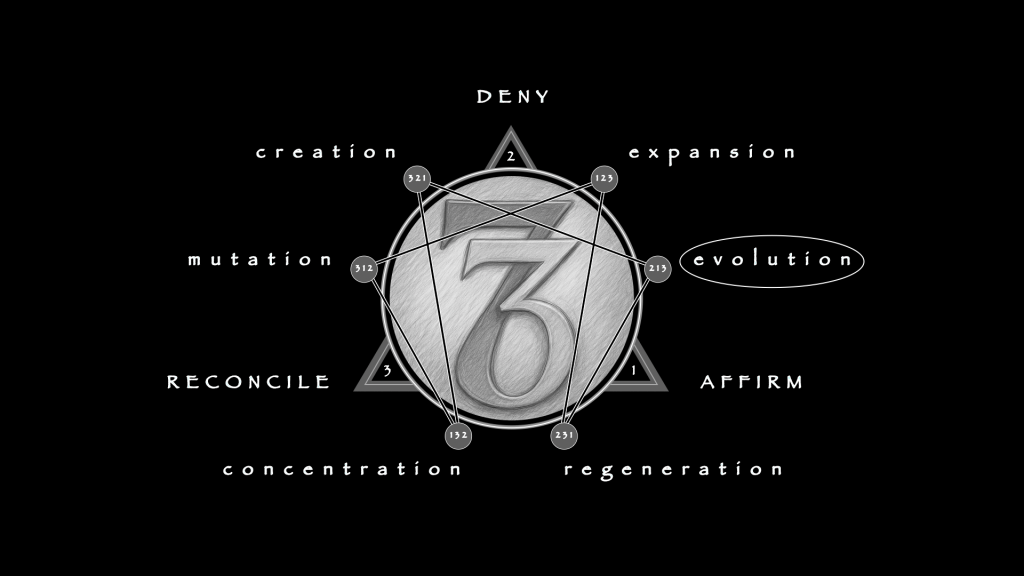
Among the Six Processes, lying is 312, so its opening note is Reconciliation. It begins with the desired result fixed in advance. The child must be innocent, the witness untarnished, the politician victorious. From there follows 1, Affirmation: the active declaration, made with confidence. Finally 2, Denial: the close that always arrives late, whether as contradiction, impeachment, or exposure. It is the passive, receiving force in relation to the statement, not the tongue but the ear. By the time it acts, the lie has already shaped the field.
Raw data itself is abstract; numbers don’t lie, only people lie with them. When they do, it’s the same 312 process. The result comes first: growth must appear, safety must be proved, policy must shine. Data follows as a chart, a statistic, a percentage. Opinion trails behind, perhaps in an audit, a rival’s critique, or a belated correction — always after the impression has hardened. The geometry of lying does not change when the medium shifts from words to figures.
This is no secret. In 1954, Darrell Huff published How to Lie with Statistics, a slim paperback that exposed how numbers could be bent with sampling games, misleading graphs, and selective baselines. The book is still in print, showing how hungry readers are for a guide to statistical trickery. But its endurance proves something else: cataloguing tricks is not enough. What Huff noticed as abuses reveal not local aberrations but universal patterns. To understand how they work—and why exposure always seems too late—you have to see them not as curiosities, but as embellishments in a process that never changes its shape.
A single chart can lie as effectively as a witness on the stand. Forms differ, but the sequence is always the same. The outcome is fixed first, the figures are dressed to match, and only later does contradiction appear, after it mattered. Worse, what we mistake for influence, because its effects feel personal, may be surveillance. The tactic works at scale, smoothing the crowd itself into categories.
Take unemployment. A government needs to prove recovery, so the reconciled result is already settled: the line must slope downward. The chart shown to reporters begins at the peak of a recession, carefully cropped to omit the rise that came before. Affirmation lands with force — a politician points to the decline, headlines echo the claim, and the crowd sees what it expects to see. Denial eventually arrives, but weakly: an auditor noting that discouraged workers were dropped, or a rival pointing out that the broader labor force tells a different story. By then the impression has hardened. The lie has already done its work.
The same pattern repeats elsewhere. A miracle pill is said to cut risk in half — from two in ten thousand to one. A fund manager boasts of five-year outperformance, starting the clock at the bottom of a crash. A marketer trumpets a percentage surge without revealing the trivial baseline behind it. In each case, the result is chosen in advance, the numbers affirm it, and denial comes late, like an afterthought.
The Six Embellishments:
Strip away the costumes and you find the same choreography repeated: six ways of adorning numbers until they pass for truth. Seen as beauty, they dazzle. Seen as ornament, they deceive. Seen for what they are, they dissolve.
Sampling — The Sieve
The first adornment is often the simplest: choosing who is seen and who is not. A survey about debt that speaks only to homeowners produces numbers that shine with stability, while the precarious lives of renters and the poor remain invisible. A clinical trial with healthy volunteers yields results that appear vigorous, untouched by the fragility of real patients. In finance, glowing averages are drawn from the survivors of hedge funds, the failures quietly dropped through the mesh.
What emerges from such sieves is a statistic made to look fairer than it is. The exclusions pass unnoticed, and what remain is smooth, presentable, even beautiful. The figures have not been falsified; they have been refined, polished by omission’s nimble fingers until they gleam.
Challenges come later, when someone asks who was left out or why the sample was so narrow. By then, though, the ornament has already been admired, and cited. The sieve works because it beautifies the surface, giving data a handsome face while concealing what was sifted away. Sampling flatters by subtraction — its beauty is in the concealment.
Inference — The Leap
Numbers by themselves rarely dazzle; they need a story stitched around them. The leap supplies that story. A simple association is dressed in richer clothes until it seems inevitable. Housing prices climb as storks return to the fields, and suddenly a link is declared. A decade of steady returns is extended forward as if permanence had been discovered. What was plain coincidence is decorated into causation, a threadbare line of data turned into an embroidered pattern.
The beauty lies in the confidence. Graphs are stretched, verbs sharpened, and probability dressed as fait accompli. Readers are invited to admire the elegance of the conclusion but not to question the modest fabric beneath. Inference works because it makes the statistic look more complete, as though the figures themselves carried meaning beyond what was measured.
Correction, when it comes, is muted. Peer reviewers and rivals may point to hidden variables or to the limits of projection, but their voices lack the sparkle of the leap itself. By the time the qualifications are added, the decor has already been cited, and remembered. Inference adorns thin connections with the appearance of inevitability, a beauty too perfect for its place.
Summarization — The Blender
Data arrives rough. Figures bristle with edges, ranges, and outliers that resist easy use. Summarization shaves them smooth, pressing the mess into a single polished shape. A mean income quoted instead of the median makes a nation look richer. A company’s “adjusted earnings” sand away irregularities until the books seem steady. During the pandemic, fatality rates averaged across entire populations hid the sharp gradients of risk between the young and the old. The jagged reality is blended down into something creamy, easy to swallow, and deceptively attractive.
Cosmetic averages shine like lacquer on wood, giving dull surfaces a reflective gloss. Variance, volatility, and spread look ungainly; a single number gleams with authority. Summarization is the statistic as make-up, making data appear fairer, more coherent, more beautiful than it truly is.
The cautions exist, but in footnotes, appendices, and supplementary tables that few will ever read. Error bars, ranges, and disclaimers do not dazzle; they are sober details beside the elegance of the headline figure. By the time those details are considered, the smooth number has already been reported. Summarization beautifies by subtraction, producing a surface so flawless that it no longer resembles the material it covers. Unless you read a lot of fine print, you are probably an unwitting victim more often than you know.
Framing — The Mirror
Numbers take their shape from what they are set against. With an ornamental backdrop, a politician can claim crime has fallen twenty percent. Never mind that the mirror year chosen was a peak of violence. A drug ad boasts of a fifty percent risk reduction while the absolute change was from two in ten thousand to one. A company heralds profits “tripling” when the baseline was pennies. In war, casualty rates expressed as percentages can make losses look tolerable, even as bodies number in the thousands. Each figure gleams because the reflection behind it has been polished to self-importance.
The beauty of skillful framing is in proportion. Ratios are like gemstones: cut at one angle they glint, at another they dull. A denominator adjusted, a baseline shifted, and suddenly the ordinary stone sparkles. The numbers themselves are unchanged, but the mirror surrounding them creates a portrait too lofty to resist. As in a vanity glass, the blemishes recede while the highlights glow.
Corrections arrive later — recalculations, absolute counts, inflation adjustments — but they fail to impress. By then the reflection has already been assimilated. Framing beautifies by reflection, turning numbers into portraits too flattering to disbelieve. If what you think you know makes you feel smart, then you might have been framed.
Visualization — The Stage Light
When numbers step onstage, they enter a world of costume and spotlight. A modest 2% rise in an index becomes a cliff face when the y-axis starts at ninety-eight instead of zero. A 3D pie chart tilts toward the audience, its largest slice looming like a set piece. Cumulative pandemic curves are drawn ever upward, a staircase to inevitability. The figures have not changed, but the stagecraft makes them look dramatic, urgent, impossible to ignore.
The effect is instant. Lines surge, bars tower, colors flare — a choreography of shapes that persuades before thought can intervene. Audiences remember how they felt, not what happened. Embellishment here is pure theater: data draped in spectacle, ornamented until it feels alive. Like makeup under a spotlight, the glow is flattering, smoothing flaws and heightening contrast, the better to draw applause.
Corrections do appear — axes restored, scales redrawn, the footnotes reminding viewers what the picture really meant. As always, they are delivered after the curtain falls. The first image lingers in memory, replayed and shared long after the technical critique is forgotten. That is the trick, literally trompe l’oeil. Visualization embellishes by staging, transforming plain data into performance, applause written into the script before the audience even knows it has clapped.
Temporal — The Clock
Time is the most forgiving canvas. Shift the opening note and a halting recovery becomes a soaring song. Stop the tune just before the downturn and the melody holds in triumph. Retail sales plotted without seasonal rhythm look like steady growth rather than holiday whiplash. A fund’s five-year record shines if the clock starts at the bottom of a crash. Even timing itself is cosmetic: burying grim numbers late on a Friday, polishing good news for a Monday morning debut. The figures are constant, but the clockface is gilded until it dazzles.
Its beauty lies in cadence. Notes are clipped, beats removed, sour chords dropped, leaving only a polished refrain. The audience hears not the raw sequence but a smooth score, arranged into a satisfying harmony. Each refinement beautifies the passage of time itself, transforming jagged intervals into a rhythm too graceful to resist.
Corrections arrive — analysts restoring the missing years, economists adding back the seasonal noise. Yet by then the tune has already been replayed, even hummed. Temporal manipulation beautifies sequence, turning chronology into costume, so that the performance seems seamless even when history was jagged.
Embellishment literally derives from “beauty”, specifically from the Old French embeliss—”fair, handsome, pleasing to the eye.” Over time, the sense deepened into exaggeration: decoration so heavy it bent the truth beneath it. That doubleness, that folding, justifies my use of the term here. Each gilds the surface of data, polishing it until it gleams, smoothing rough edges into elegance. They glitter not because the substance has changed, but because the ornament has been laid so carefully that it passes for truth.
They work on different layers, but the rhythm beneath them is identical, 312. Sampling beautifies the material itself, selecting only what flatters. Inference beautifies the thread of connection, weaving coincidence into inevitability. Summarization beautifies the surface, smoothing away variance until it gleams. Framing beautifies proportion, setting the number against a backdrop that makes it shine. Visualization beautifies the display, staging the figure in light and color. Temporal embellishes rhythm, polishing sequence until time itself seems graceful.
This is not a list of accidents but a single performance staged six ways. The lie takes shape through ornament, and ends without power, collapsing once the decoration is stripped away. Exposure is always belated, unable to fully erase the first impression. That is the structure these embellishments share. They persuade because they beautify. They fail because verbal beauty gleams for a moment but cannot develop further.
Darrell Huff endures because he pulled back the curtain, showing how data could be trimmed, stretched, or staged to tell whatever story is required. What he offered as a catalog of tricks should be seen as something deeper: lawful sequences that repeat wherever people need beauty to stand in for truth. Huff taught us that the lies existed; the geometry shows why they take the same shape every time.
Today the embellishments are no longer curiosities but systems that animate dashboards, feeds, and campaigns that run at machine speed. His classic paperback exposed how a single chart could mislead. The present shows what happens when those same devices scale across populations. To confuse the matter further, we live amid overlapping forces: misinformation, surveillance, and influence. This is the architecture of statistical persuasion. The antidote, if any, lies in ornament’s weakness, its visibility. To see it what for what it is — an embellishment — robs it of force. Beauty declared as decoration cannot pass for truth.
No crime happens outside time, which is often treated as a footnote, a neutral marker stamped for admin, not for meaning. Investigators scour footage, interview witnesses, and assemble data mosaics with forensic discipline, but if they treat temporal information as passive context rather than strategic signal, they risk a self-made blind spot. Within it, entire patterns of threat may go undetected.
What if time were not merely the stage, but a co-conspirator … what if crime were more like choreography than chaos?
Temporal intelligence records not only what happened, it reconstructs intent, reveals repetition, and transforms uncertainty into operational clarity. Investigative timelines that preserve sequence but not structure are linear summaries. However, when you learn to read time not as background but as architecture, you begin to see a different threat landscape. Temporal analysis treats time as an active variable—an analytic terrain as rich as location or motive unlocking rhythm, pattern, and deviation.
As if adjusting the aperture on a camera, the science reveals hidden layers by changing the exposure. Criminal incidents that appear scattered suddenly align when sorted by hour, day, or season. Assaults may cluster on Saturday nights. Thefts may spike during long weekends. Cyber intrusions may escalate in fiscal fourth quarters.
These patterns are not incidental. They are signatures—repeated, habitual, and strategically exploitable. Time acts as a behavioral accelerator. It concentrates human intent into predictable arcs. A predictable spike in aggression every Friday at 9 PM does not indicate bad luck. It indicates a recurring vulnerability.
Properly wielded, temporal analysis turns chaos into tempo, and tempo into prevention.
Precision is a luxury. In many cases, the only known fact about a crime is that it happened sometime between 6 PM and 9 AM. Surveillance gaps, late reporting, and human error introduce ambiguity that conventional models cannot absorb. Aoristic analysis was built for this space—where certainty collapses but structure remains possible.
Aoristic analysis assigns probability across a time window rather than insisting on an exact timestamp. The result is not a guess, but a measured distribution of likelihood. A break-in window of eight hours does not yield a void; it yields a gradient. As analysts layer hundreds of such gradients, patterns emerge. Aoristic probability fields behave like tidal maps—fluid, ambiguous, but shaped by hidden gravitational pulls.
Crucially, this method reframes uncertainty as signal. Just as physicists infer unseen forces by the bend in a light path, analysts infer behavioral density from repeated overlaps in ambiguous timeframes. When the same three-hour window recurs across dozens of cases, you are no longer looking at uncertainty. You are looking at design in disguise.
Timelines may be dismissed as administrative tools—useful for organization, but analytically inert. This is a mistake. A well-constructed timeline functions like a forensic exoskeleton; it does not just contain data, it shapes how inferences move. Each entry is a hinge. Its location, spacing, and relation to other events can reveal everything from planning behavior to motive reversal. Gaps between digital pings can be more revealing than the pings themselves. A timeline that shows a subject disappearing from all networks three hours before a crime may suggest preparation, not panic.
More importantly, timelines allow for comparative synchronization. Two unrelated crimes may follow the same temporal choreography: message, movement, silence, strike. Once the shape repeats, so does the opportunity for preemption. Timelines expose these loops, not because the past repeats, but because criminals often do.
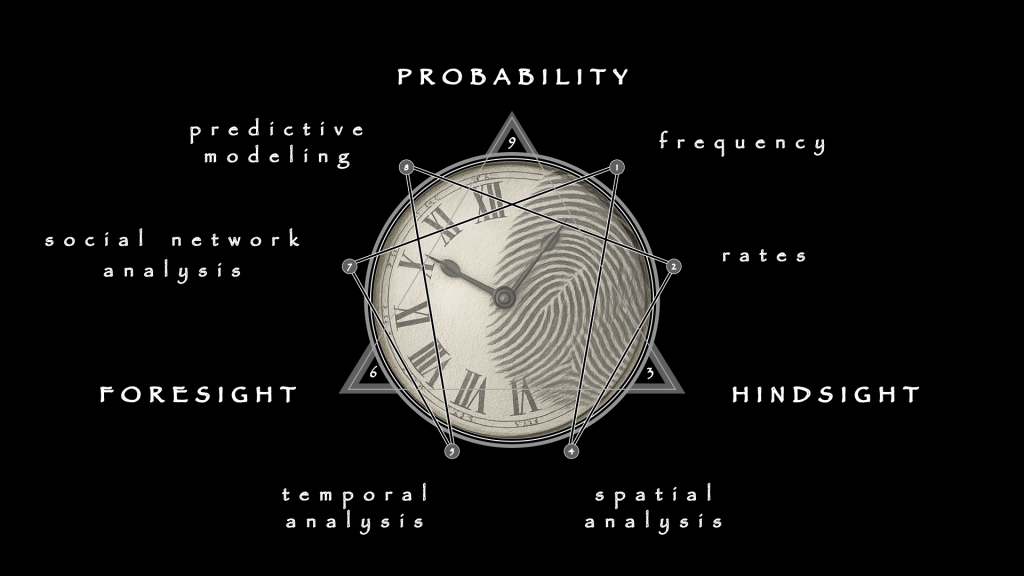
Statistical methods serve as scaffolds for criminal analysis. Their power increases when used in sequence—not as isolated metrics, but as a layered diagnostic system. Each method deepens the frame of reference and builds toward operational foresight.
Frequencies and Percentages establish a descriptive foundation. They count how often crimes occur and measure the proportional distribution of events across categories, offenders, or locations. Without this baseline, patterns remain invisible.
Means and Rates normalize those counts. They convert volume into context, allowing analysts to compare crime intensity across areas or populations. A high count may be routine in one zone and catastrophic in another; means and rates clarify the distinction.
Spatial Analysis adds geography. It renders distribution into territory. Analysts detect clusters, corridors, and voids—turning statistics into strategy by anchoring with your Ethel burn and data to the physical environment.
Temporal Analysis introduces rhythm. Crime is not evenly distributed in time; it pulses, recurs, and concentrates. Temporal analysis identifies the hours, days, or seasons when risk peaks, revealing vulnerability not by location alone, but by timing
Social Network Analysis reveals structure beneath the surface. It maps relationships between actors, identifies central figures, and exposes the architecture of coordination and delegation.
Predictive Modeling fuses all previous methods into forward-looking systems. By using historical data and structural inputs, it simulates potential futures—not to guess, but to narrow windows of risk and opportunity.
These methods serve strategic, tactical, and administrative functions. They inform resource allocation, justify staffing models, and support long-term risk management. However, none of them reach full potency without temporal anchoring. A heatmap without time becomes a static image. A social graph without sequence becomes a snapshot, not a trajectory. Time transforms these models from diagrams into simulations.
Temporal intelligence allows you to ask a different kind of question—not merely “Where does crime happen?” but “When does the system permit it?” Crime is not just committed. It is accommodated. And that accommodation follows a rhythm. The goal is not to count crimes faster, but to disturb the rhythm that permits them to repeat.
Temporal modeling is often seen as retroactive—good for forensics, less useful for foresight. This belief misunderstands what time analysis reveals. It does not merely replay the past; it exposes behavioral contracts, stress thresholds, and systemic lags. These are predictive not because they guess the future, but because they map the structure of opportunity and delay.
More importantly, temporal intelligence identifies silence as a signal. The absence of crime can be as revealing as its presence. Five days without incident in a known hotspot is not calm—it is buildup. A neighborhood that reports no crime between 1 and 4 AM may not be safe. It may be synchronized. Missing data, through a temporal lens, is no longer silence, but a warning.
Temporal blind spots are rarely accidental. Surveillance gaps are patterned. Response delays are engineered. The system that fails to act in time may not be failing at all—it may be operating on a different clock. In this frame, analysts are not just interpreting behavior, but decoding latency as a form of complicity.
Most investigators pursue signal. They seek the loud, the visible, the obvious. But in a landscape governed by tempo, the true threat hides in the mute intervals. Not every delay is benign. Not every gap is ignorance. Some silences are structured to conceal. They buy time for the next move. They manipulate perception. They are not evidence of nothing. They are evidence of someone waiting.
The assumption that time reveals criminal patterns is too narrow. Time does not merely reveal behavior; it can be weaponized to disguise it. A pattern of silence, replicated across jurisdictions, may not be an absence of threat, but the clockwork of permission. If a system cannot predict what will happen next, perhaps it is because someone has already timed what the system will miss.
The Six Meticulous Moves are not a set of tools or tricks, but a disciplined interaction with any space you inhabit—a hotel room, a meeting table, a crowded street—a set of resources waiting to be assigned a role. Each distills a repeatable means of shaping the environment so that it works for you, without drawing attention to you. The emphasis is on precision, timing, and intent, turning scarcity from a limitation into an advantage. As the skillset matures, it stops feeling like a hack and becomes the natural way you operate. The result is a quiet, durable form of preparedness that works long before anyone else realizes it is in play.
Objectives Over Objects
Craft turns any room into a toolbox and any object into an accomplice. The discipline begins with an objective and ends with controlled effects, ideally while the environment and/or its inhabitants believe that nothing changed. Curiosity supplies momentum because each solved constraint teaches the hands a repeatable move. Objectives govern tools and not the reverse. Mission clarity compresses time because selection narrows to actions that produce the end state. Operators who anchor on gear chase shape over effect while those who anchor on outcomes recruit the room itself into their service. Scarcity strengthens timing because delay only strengthens opposition.
A quiet scan locates capability rather than things. Every environment carries its own set of levers. Some are visible, some are hidden, and some only appear when you look with the right intent. A man who can see those levers before anyone else is never entirely at the mercy of circumstance.
You step into a hotel room after a long day. Without thinking, you clock the door’s swing, the way the curtains hang, the hum of the air unit. A plastic coat hanger can bridge a gap in the latch. The desk chair can block an intrusion without marking the carpet. None of this feels like paranoia; it is simply knowing what the room can do for you before you need it.
In a crowded café, you choose a seat where the glare off a framed picture hides your hands from anyone glancing over. You watch the flow of people, noting the predictable pauses in their movement when the espresso machine hisses. Even in a public place, there are pockets of cover, angles of approach, and rhythms you can ride without effort.
At an airport, you test the acoustics with the click of your heel, hearing how sound travels under the canopy. You find the column that hides you from the check-in counter while still giving you a clean view of entrances and exits. You notice the reflective glare of the windows, good for checking the movement behind you without turning your head.
Resources are everywhere: the clothing on your body, the furniture within reach, the fixtures embedded in the walls, the forces of light, heat, airflow, and sound. Most men wait until they need something before they look for it. The better approach is to assign potential roles now, in calm, so they are ready under pressure.
Raw Material Is Everywhere
From this habit evolved a compact skillset—simple in appearance, exhaustive in application, the Six Meticulous Moves, and it reduces every environmental challenge to a handful of repeatable patterns. Core function identification comes first because function defines success criteria. Learn them, and you can make almost any space work in your favor without showing your hand.
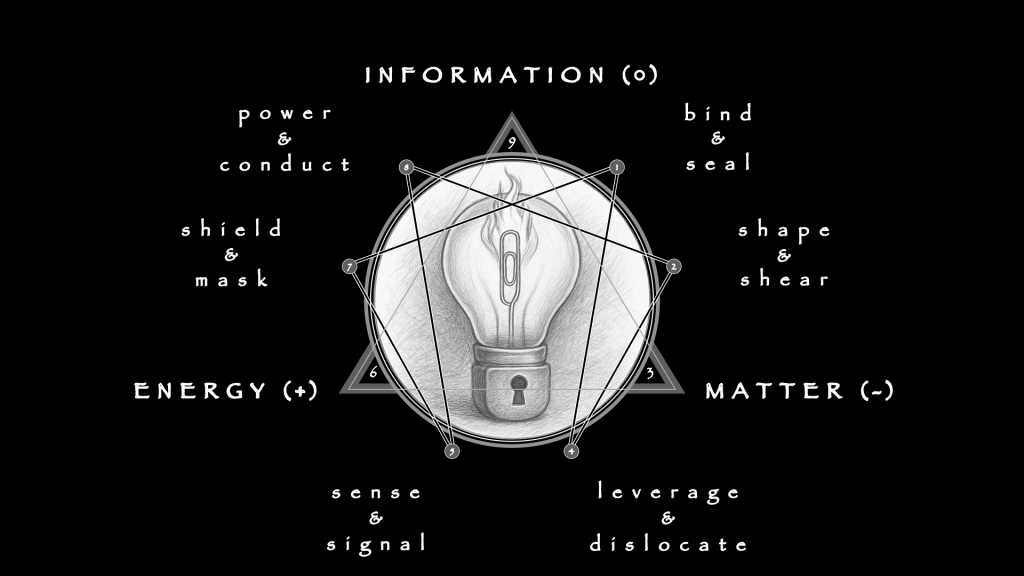
Bind & Seal: Assign friction, compression, adhesion, and interlocking geometry to hold, clamp, lash, and weatherproof. Joints survive load because contact and direction match the threat. In an airport lounge, a folded boarding pass wedges a rattling vent so it stays silent during your call. Anything that can change shape can change role—your grip on problems improves when you see their pressure points before they fail.
Shape & Shear: Deliver separation by edge, abrasion, or cyclic stress so barriers grant access without spectacle. Edges emerge from metal, ceramic, glass, or tensioned fiber when patience meets pressure. Breaking down a stubborn shipping box, you score it with a room key so it folds neatly for disposal without attracting attention. Precision beats force; in most systems, the exact cut at the right time outperforms a bigger tool at the wrong one.
Leverage & Dislocate: Convert span, torque, fulcrum, pulley, and drag into motion that favors you. Space obeys handles and anchor points when vectors align. When shifting a heavy coffee table, you slide it on a folded blanket rather than dragging it across the floor. The world rewards those who can spot the hidden hinge in a situation—shift that, and the rest moves without strain.
Sense & Signal: Extend perception and communication through contrast, magnification, reflection, rhythm, code, and conductivity. Information moves farther and faster than bodies. You track the progress of a friend arriving at a bar through the reflection in a darkened window, without needing to turn. Extra awareness is free advantage—when you train your senses to read more than they are told, you stay ahead without moving faster.
Shield & Mask: Steer light, sound, heat, and trace so presence reads as quiet. Terrain becomes baffled, backstopped, or opaque on schedule. In a meeting, you sit with your back to a sunlit window, forcing others to adjust their eyes before reading your expression. Control how and when you are noticed, and you choose which parts of you are real in their eyes.
Power & Conduct: Route energy and flow across bridges that close circuits, equalize pressure, or buffer impact while failure remains recoverable. A rolled-up magazine cushions a door’s slam, absorbing force without damage. Influence often comes from redirecting momentum, not generating it—own the flow, and you own the outcome.
Preparation begins before there is any visible motion. You map the terrain in your mind, noting where resistance will appear and where you can move freely. A man who knows the boundaries he will honor can bend the rest of the environment without breaking stride. In practice, this might mean walking into a negotiation already knowing which points you will concede and which cannot be touched, all wrapped in a conversation that never feels staged.
Raw material is everywhere, if you know how to take it without disturbing the surface. A slip of receipt paper with a phone extension, a rough measurement made by pacing a hallway, or a momentary glimpse of a schedule on someone’s screen can all be gathered without pause. The value lies in leaving no signal that anything was taken, so the path remains open for the next pass.
Tactical Creation
Order matters as much as content. Once collected, the pieces need to be placed where they can be reached in seconds. A note that cannot be found when it is needed might as well not exist. This is why seasoned operators keep their resources in consistent mental and physical locations, whether that means a dedicated pocket for a travel document or a specific format for quick-reference notes.
Every method requires testing. You measure the result against the intended effect rather than the story you prefer to tell yourself. If a conversation yielded less than expected, you ask whether the gap came from your timing, the tools you used, or a habit you failed to adjust. This approach removes ego from the analysis and keeps attention on results that matter.
Delivery is its own discipline. Sometimes the right play is to hand the information over cleanly. Other times, the wiser choice is to embed it within something innocuous so it reaches its target unnoticed. The principle is the same whether you are passing a key detail in a casual meeting or guiding a team toward a decision without announcing your role in it.
Nothing is ever final. What worked once will face different pressures the next time. Weak elements are stripped away, strong ones are reinforced, and the entire approach is tightened for speed and resilience. The aim is to build methods that withstand more attention and more stress with each iteration.
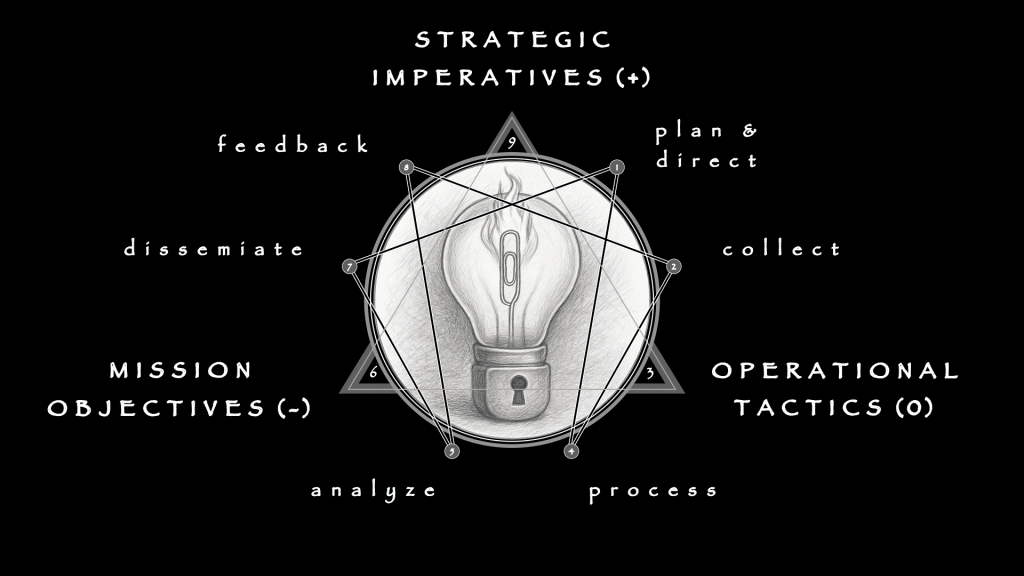
One good model (there are others) is the Intelligence Cycle. Furthermore, the enneagram encodes asymmetry, choke points, and random real-world interference. Together, they are not a cinematic ritual but a sober practice, a field grammar drawn from how intelligence work actually succeeds or fails:
Plan & Direct: Gamify mappable scenarios, including likely constraints and explicit legal boundaries.
Collect: Salvage tool-able debris, measurements and timings, as well as identities and signatures from live spaces without disrupting them.
Process: Sort the haul into labeled modules aligned to the Six Meticulous Moves so retrieval beats invention.
Analyze: Measure failures and frictions against mission end states, not ego.
Disseminate: Create compact and/or coded playbooks with red‑team observations for trusted nodes with trace discipline.
Feedback: Close loops with after‑action notes, equipment swaps, and cadence adjustments until tactics survive time, scrutiny, and turnover.
Legal jurisdiction, site policy, and safety invariants must govern every move. Evidence discipline prevents residue, damage, and unintended hazards once the moment passes. Escalation control preserves options because cleverness that invites force converts victory into liability. The doctrine stays useful because results matter more than display.
Preparedness has precisely nothing to do with accumulating more equipment. It begins with the ability to look at what you already have and see more roles than it was designed to play, but it doesn’t end there. The man who can make his surroundings serve multiple purposes is never overburdened and never caught waiting for the perfect tool to appear.
This manner of security cannot be bought in a package or stored on a shelf, for it exists only in the decisions you make, the habits you maintain, and the adjustments you execute without hesitation. Your mileage will vary; count on it, and practice accordingly. A product may give the appearance of safety, but only awareness and adaptability can sustain it when circumstances shift. You create security by reducing the need for reaction, by shaping conditions so that threats never have the angle they expect.
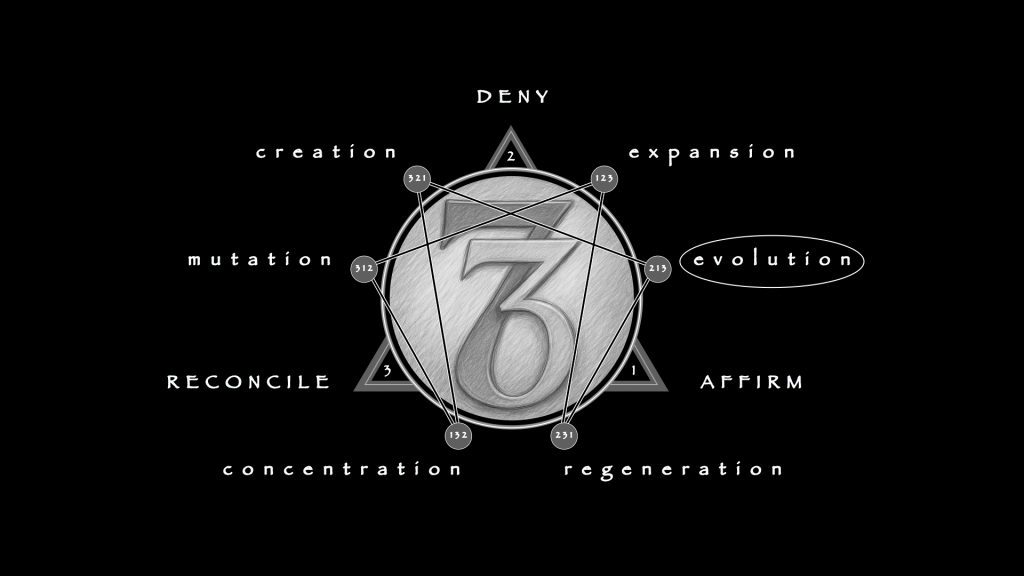
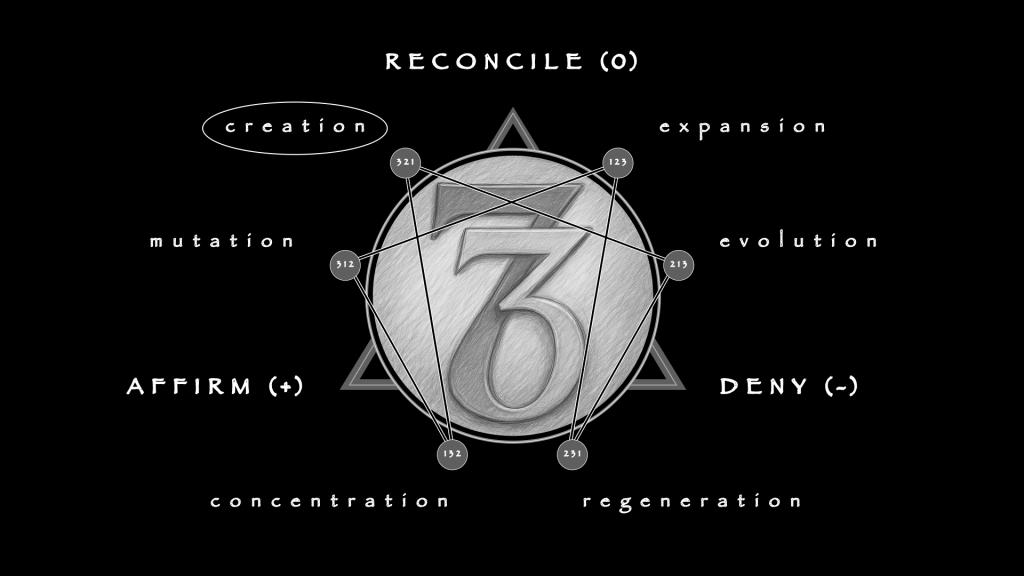
Preparedness is not an inventory; it is a way of seeing. Creation, the 321 triad, begins with reconciliation, and that means perception before action. The coat hanger, the desk chair, the schedule board do not announce themselves as tools until the eye stops seeing them as fixed objects and starts seeing their roles. Angles of light become veils, the hum of a vent becomes a signal, the contour of a handle becomes a grip point. Reconciliation is not invention but recognition—the discipline of noticing function before the need arises. This is why those who practice it look calm: they are not scrambling for options later because the medium has already been folded into readiness.
Denial follows, and here the tone hardens. Constraints assert themselves: the hinge resists, the lock holds, the weight pulls against your arms. Scarcity refuses abundance and strips away the fantasy of perfect tools. This is not punishment but form-giving. A hinge that refuses easy pressure teaches you where leverage lives. A tight corridor denies maneuver and forces economy of motion. Scarcity compresses time, sharpens judgment, and clears out indulgence. To work with denial is to let resistance do the editing, cutting away what will not stand under load. This is why seasoned operators are not dismayed by limits; they recognize that denial is the shaping force that keeps preparedness from dissolving into clutter or gadgetry.
The warrior ethos, the “One mind, any weapon” mindset in particular, is another example of creativity under constraint. I recommend the Dokkodo, or “The Way of Walking Alone,” as an utterly brief and intriguing masterclass in strategy, life, and art. You can read my metamodern version in less than two minutes. It is also a 321 triad, but it will not spoon-feed any wisdom to you, and instead demand that you bring your own genuine experience in order to rise to its challenge.
Preparedness is not paranoia, not an obsession with gear, but a consequence. This is why it cannot be bought, and must be practiced. Only then does affirmation arrive, quickly, decisively, as the lawful effect of all that preceded it. Reconciliation supplied the perception, denial imposed form, and now the action, the Move, completes the sequence. Affirmation is never improvisation in the casual sense—it is the last note of Creation, the moment when the field itself yields to form. The room is unchanged, yet it has been recruited into your service.
The Six Meticulous Moves are not tricks layered on top of life, but the living architecture of Creation itself, teaching the hands to turn scarcity into structure and perception into durable advantage.
No Time to Spare
Scarcity is not a handicap. It is the denying force that keeps form honest. Every hinge that resists, every corridor that narrows, every shortage of time or tools is not loss but metronome. Constraints set the tempo. Without them, preparedness drifts into indulgence, more gear, more clutter, more delay. Denial compresses and sharpens. It is the reason timing exists at all, because only against resistance does rhythm emerge.
The rhythm scarcity imposes is exact and unforgiving. A man with five options lingers. A man with one strikes in time. Scarcity strips away the illusion of infinite choice and forces sequence to appear. To face limits is to discover cadence, and cadence is what lets affirmation land as effect instead of noise. A slammed door softened by a rolled magazine or a pause held in a negotiation—each is a note struck on cue because scarcity pressed the interval.
When scarcity becomes the engine, preparedness stops being a stack of tricks. It becomes a transferable habit. Mediate the environment, accept denial as structure, and affirm only when timing makes the move inevitable. Scarcity drives timing, timing drives effect, effect resets the field. The disciplined operator treats scarcity as his cloak, and his clock. When he carries less, he decides more. What others fear as lack becomes the law that sustains advantage.
Skill acquisition accelerates to take-off velocity when hands move on a clock. Short drills teach recognition, setup, and teardown until the room yields function on demand. Repetition under calm pressure builds automaticity that survives noise. Documentation preserves gains because memory decays without artifacts.
Which three environments warrant your first drill cycle, and what cover narratives keep practice invisible in each?
Which two of the six moves feel underdeveloped in your habits, and which innocuous items close those gaps without visible bulk?
What verification ritual confirms builds before commitment while preserving deniability on teardown?
As the centennial of the 1929 Crash approaches, and of the Great Depression that followed, the mix of cultural memory and present circumstances creates a volatile cocktail. The collapse—shuttered brokerages, evaporated fortunes, bread lines—burned itself into the collective imagination, and made speculation synonymous with danger. In the decades since, gambling in almost any form has carried a stigma. Until recently, casinos were confined to distant jurisdictions, lotteries were state-controlled, and market speculation was framed as sober only when disciplined by institutional oversight.
A hundred years later, the cultural position of gambling is inverted. The same behaviors once treated as reckless now exist in the background of ordinary life. Online platforms allow anyone to trade news the way others read it, to bet on games as casually as they watch them, to stake positions in prediction markets the way others doom-scroll social media. The interface is seamless, the increments small, the access continuous. What once required a broker, a bookmaker, or a casino floor now unfolds on phones and laptops beside banking apps and email.
This normalization did not arrive all at once. It followed a long corridor of incremental permissions. State lotteries framed wagering as civic contribution. Casino expansion was sold as economic development. Fantasy sports blurred into sports betting, while commission-free trading apps rebranded speculation as participation. Step by step, the distance between entertainment and risk narrowed until it disappeared. Gambling ceased to appear transgressive. It became just another way of engaging with information, sports, and markets.
The predicament lies in this banality.
Risk is no longer recognized as extraordinary. A bet on the weekend game feels like fandom. A trade timed to a headline feels like staying informed. A position in a prediction market feels like civic engagement, no stranger than scrolling the feed. Yet beneath this ordinariness, the same vulnerabilities that shattered 1929 remain. Mispriced confidence, ritualized control, and emotional displacement are not erased by new technology; they are amplified by it. The volatility that once flashed on ticker tape now streams through notifications, demanding constant attention and inviting constant action.
The contrast with the Depression era could not be sharper. Then, the public recoiled from gambling, treating it as a force to be contained. Today, the same impulse is woven into everyday routine, its risks masked by design. The consequence is not only personal harm—financial ruin, relational collapse, psychological strain—but systemic fragility. The century-old lesson is that speculative fever never stays private. When risk is misread at scale, contagion spreads. Then it toppled banks. Today it travels through platforms, multiplied by networks and accelerated by design.
As this anniversary approaches, the challenge is not to abolish gambling but to understand it properly. It is not merely entertainment, nor simply pathology. It is a structural engagement with volatility, one that demands frameworks capable of mapping failure before collapse occurs. Existing clinical systems are not built for this. They frame gambling as addiction, as impulse disorder, or as a subset of substance-use pathology. Such framings miss the architecture of control and collapse that defines modern gambling’s grip.
Meanwhile, the DSM-6 is expected to reposition gambling disorder away from the margins of addiction and toward the center of structural risk mispricing. Furthermore, male suicidality and complex trauma will likely be reframed as distinct architectures rather than secondary symptoms. My proposal anticipates the shift. It treats gambling not as chemical compulsion but as cognitive misalignment, not as weakness but as structural distortion. It is expressly designed for pre-compliance with the coming standard. The task is to build a treatment protocol that does not merely suppress behavior but restores competence inside volatility.
The threat of an even Greater Depression is very realistic as I write this. With luck, a century after the Crash, the same mistakes may not be redistributed under new names. As desperation rises, the temptation to mismanage risk will only grow.
Diagnostic Arc
Diagnosis begins with structure, not with story. Gambling does not announce itself as pathology; it embeds into routine. A wager accompanies the game, a trade rides the headline, a prediction market scrolls like any other feed. What distinguishes ordinary engagement from collapse is not the presence of risk but the distortion of process. The Enneagram provides the geometry to see this. Each point describes a lawful function, a way the system is meant to handle pressure. Each can also be tracked for how it bends under strain, producing failure patterns that repeat with unsettling precision.
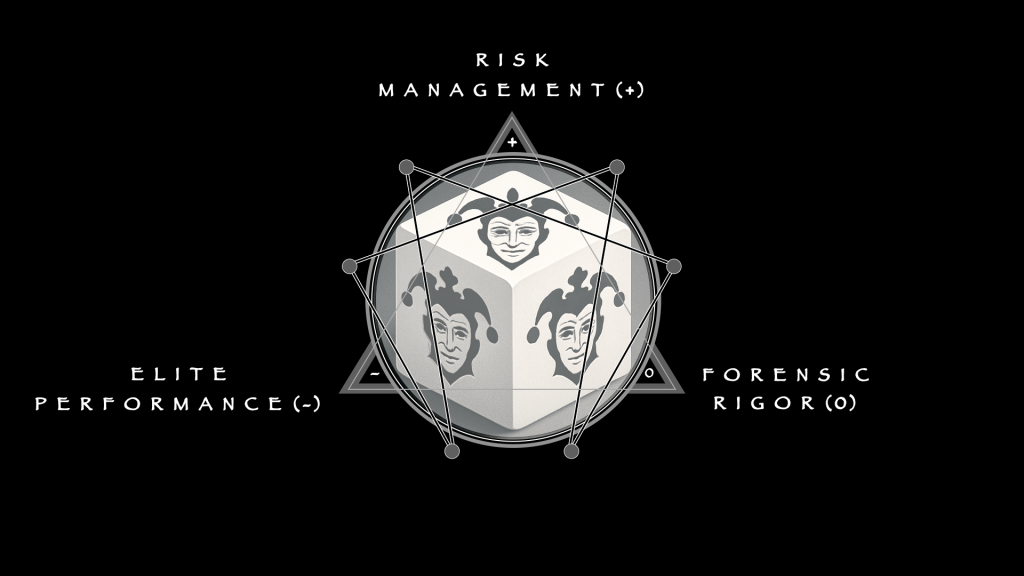
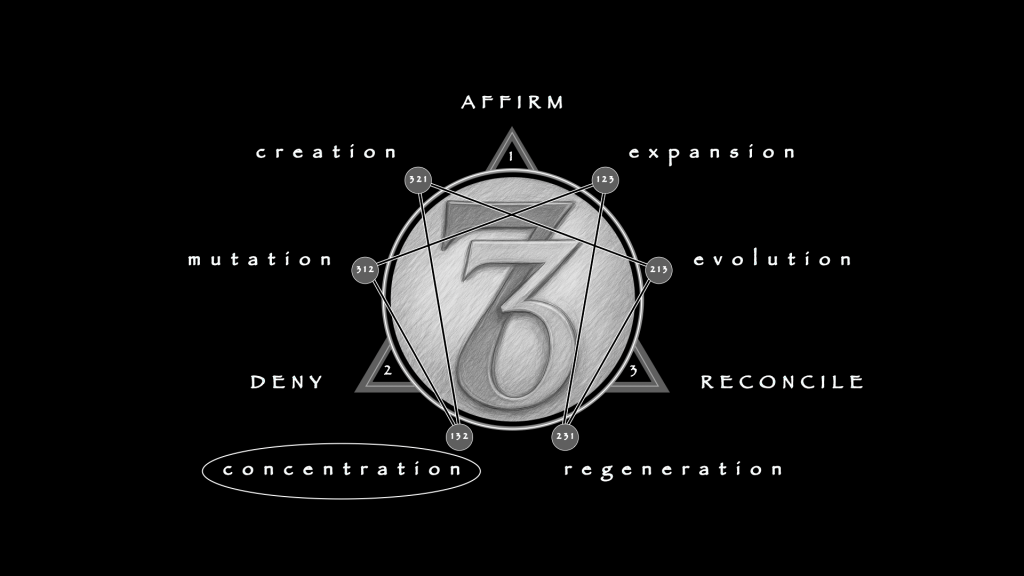
Gambling dresses itself as risk and reward, but diagnosis strips away the glitz. Diagnostics, however, must affirm (+) risk in its totality so that volatility can be mitigated early. Its task is containment, or the 132 triad of Concentration. Among professionals (the target role model), management outranks risk: without it, there is only play, not discipline. Once gambling becomes a disorder, management must be re-installed before it can be re-learned.
Containment, however, cannot live in private thought, but requires the clinic as the medium. Ad hoc methods deserve suspicion, for their successes are not as reproducible as their failures. In a proper medium, impressions are reconciled (0) as record. Behaviors become notes, patterns become criteria, and judgments become findings that can travel between practitioners. Forensic rigor is not an accessory but the atmosphere of diagnosis. It allows management to be shared, transferred, and held accountable.
Only then does performance as denial (-) appear. The clinician denies distraction: resists being pulled back into stories of wins and losses, resists being swayed by affect or institutional noise. Elite performance in this sense is bounded; it has no sovereignty of its own. It is merely an effect of rigor, a refusal to let volatility govern once concentration has been achieved. Diagnosis is not theater. It is management affirmed, rigor reconciled, and denial held as impulse control.
Diagnosis reveals Six Distortions.
They are not symptoms but structures—predictable collapses of logic where the perception of edge falters. Each describes a lawful process, including how it fails when volatility is misread. Taken together, they comprise a diagnostic cycle: Expansion shrinks into Overreach, Evolution ossifies into Ritual, Regeneration disguises itself as Impulse, Concentration disperses into Theater, Mutation collapses into Mood Regulation, and Creation abdicates into Dependency. The map does not judge; it clarifies. It shows how ordinary risk-taking, left unchecked, folds into compulsion.
The 1st Distortion results from primal Expansion, any system’s outward push into new ground. In gambling, this urge aims to probe a field, to test possibility, stretching outward not to dominate but to discover. Properly expressed, it is experimental: small positions across diverse opportunities, exploratory wagers to sample conditions, tentative exposures to feel how volatility responds. Expansion allows learning before commitment, establishing a buffer where missteps remain survivable. In healthy form, it cultivates curiosity, building capacity to see patterns without believing oneself their master.
Distorted, it collapses into Strategic Overreach. Instead of probing, the actor mistakes elaboration for control. Models pile on models, indicators crowd the screen, research multiplies until it becomes its own justification. A trader spends dawn hours annotating news, convinced that more inputs guarantee mastery. A sports bettor builds elaborate spreadsheets to prove the bookmaker wrong. Each small win is claimed as confirmation; each loss is rewritten as error in execution rather than evidence of volatility. Expansion, meant to widen horizons, contracts into a self-reinforcing cage. What began as curiosity ossifies into conviction, until collapse is the only teacher left.
The 2nd Distortion results from primal Evolution, which thrives thrives on feedback. It shifts when conditions change, discards what no longer works, adapts strategies to fit the environment. In its healthy form, the urge treats volatility as feedback. A bettor adjusts to new line movements rather than stubbornly clinging to old numbers. A trader reduces exposure when cycles shift, reallocating capital where signals are stronger. Evolution honors flux by moving with it, transforming unpredictability into intelligence. It sustains resilience by treating change as signal, not threat.
Under strain, Evolution leans into Ritualized Control. Adaptation gives way to choreography. The actor builds routines—always entering a position at the same time, always clicking the same sequence, always opening the same tabs in order. These small ceremonies simulate safety but erase flexibility. A gambler insists on sitting at the same slot, tapping the buttons in his lucky rhythm. A bettor refuses to alter his staking plan, believing ritual protects him. What should be adjustment becomes repetition. Evolution freezes into defense, substituting sameness for stability. The result is brittle security: comforting until it fails, devastating when it does.
The 3rd Distortion may be seen as Regeneration disabled, the ability to metabolize setback into renewal. Loss or failure must not be hidden, but absorbed and redirected. In healthy form, it looks like a trader reducing size after a drawdown to rebuild confidence, or a bettor reviewing losses to refine his model. Regeneration accepts that constraint is part of the cycle. It transforms depletion into discipline, shaping a setback into fuel for future engagement. This is the art of turning adversity into resilience, of making each failure a hinge for recalibration.
Bent back on itself, Regeneration becomes Justified Impulse. Instead of metabolism, the actor settles for narrative. Another wager is excused as harmless: “It’s just for fun.” A streak of trades is reframed as deserved: “I’ve earned this risk.” Rationalization replaces reflection. Small impulses multiply because each is shielded by story. Larger exposures are reframed as temporary indulgences. A student clicks through another spin, whispering that it doesn’t matter; a bettor justifies doubling down as fair payback. Regeneration disappears beneath the cover of permission. The lawful cycle of recovery collapses into ongoing excuses that keep pace with the losses, but never correct them.
The 4th Distortion arises from Concentration, that would otherwise channel attention into precision. The adaptive version sharpens focus, narrowing scope to refine accuracy. In markets, it means honing in on a few instruments and mastering their rhythms. In betting, it means calculating probabilities carefully, limiting wagers to situations with clear edge. Concentration tempers volatility by condensing it into clarity. Properly expressed, it disciplines energy, directing risk into clean lines of action where outcomes can be measured against standards.
The maladaptive version disperses Concentration into Status-Driven Risk. Focus shifts from precision to performance. The wager becomes a symbol of identity, not an exercise in probability. Escalation is pursued not for return but for recognition. The bettor posts his slips for admiration; the trader boasts of his positions on forums; the prediction market player declares foresight to peers. A young man raises his stakes not because the model demands it but because the crowd is watching. Each risk becomes theater, each loss reframed as proof of boldness. Concentration, meant to compress into clarity, balloons outward into spectacle. Risk becomes self-expression rather than measured action, until identity is staked as heavily as capital.
The 5th Distortion results from the lawful inevitability of Mutation which, to a gambler, means the art of transforming raw hazard into a desired outcome. Surprise is not resisted but dramatically converted, for better or for worse. In healthy form, it means revising systems after shocks, integrating volatility as new information. A trader treats a market swing as a chance to refine, not retreat. A bettor sees an unexpected outcome as data for recalibration. Mutation bends randomness into resilience, building strength from the unexpected.
Distorted, the process devolves into Affective Displacement. Here risk is consumed as mood regulation rather than adaptive response. The wager functions like a pill: to numb boredom, to chase excitement, to steady anxiety. Volatility ceases to be signal; it becomes self-medication. A worker checks odds compulsively on his break, not for strategy but for calm. A student spins a wheel late at night, not to win but to escape. Mutation, meant to metabolize disruption, narrows to manipulation of state. The lawful transformation of systems is abandoned for the temporary modulation of feeling. The risk is no longer engaged—it is ingested.
Finally, The 6th Distortion may be understood as the urge, premature, or misapplied, of Creation itself, the constructive climax that closes one cycle and enables another. In practice, it means building durable systems: risk logs, disciplined staking plans, portfolio rules, proven strategies that survive individual variance. Properly expressed, Creation takes the lessons of volatility and crystallizes them into frameworks that hold over time. It generates stability by turning experience into structure.
Creation’s opposite, which leads to ruin, is not destruction, but Surrogate Mastery. Instead of generating structure, the actor outsources it. Algorithms, bots, tip sheets, or influencer signals become the substitute for discipline. Agency is handed off to apparatus, and identity fuses with tools. A bettor follows a subscription feed blindly, convinced the system will protect him. A trader relies on automation he cannot override. For as long as the surrogate holds, mastery feels intact. But when the tool fails, collapse is immediate, because responsibility has already been abdicated. Creation, meant to be generative, becomes dependency disguised as sophistication.
Together these Six Distortions comprise my Failed Edge Diagnostic model. The version presented here is abbreviated. Each is not a symptom but a structure: lawful process bent into predictable failure. The extended version includes a detailed section devoted on risk profiles that is neither a typology nor necessary to elaborate here. What makes the proposed method useful is not moral judgment but its predictive clarity, indicating in universal terms where and how edge will fail.
This clarity also explains why conventional treatments falter. They address surface behavior, not the underlying process. They treat compulsion as addiction, not as structural mispricing of self-belief. The DSM-6 will likely attempt to codify this shift, reframing gambling disorder as a collapse of risk logic rather than a byproduct of chemical compulsion. The diagnostic arc presented here is already aligned with that horizon. It shows how lawful functions bend into failure, and in doing so, it prepares the ground for treatment arcs that do not merely suppress risk but restore competence inside it.
Treatment Arc
A series of Treatment Phases is offered here in the spirit of proposal, not as a finished clinical manual. Its boundaries are theoretical, its methods sketched rather than field-tested. This distinction is crucial. To claim otherwise would collapse the difference between a working hypothesis and an operational program. The lawful scaffold presented here maps perfectly onto the Enneagram precisely to address a predictable structural weakness of other models.
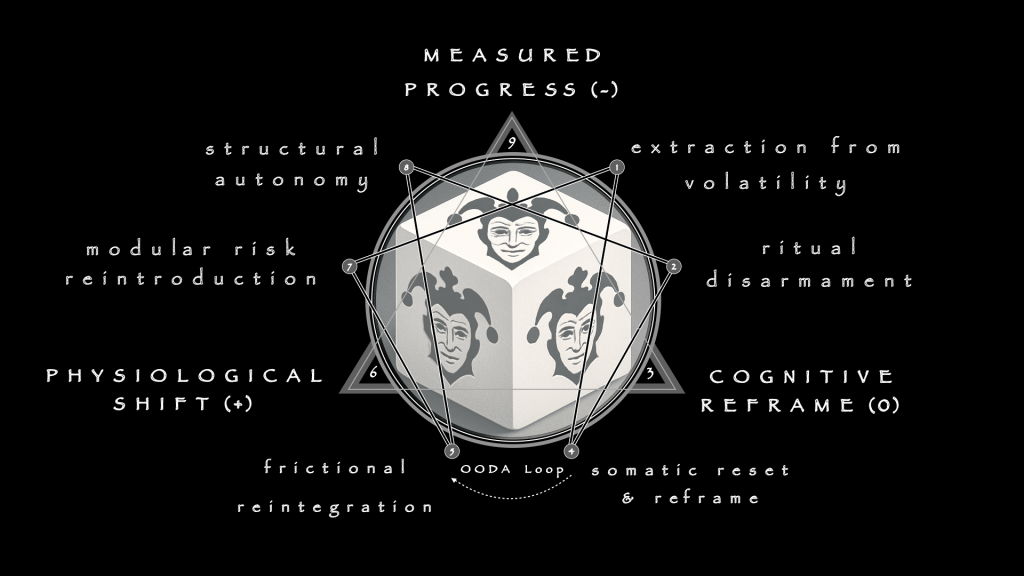
Treatment itself is 231, Regeneration. Collapse is brought into the room as loss. First it is denied (–): illusions cut away, compulsions interrupted. Then it is reconciled (0): what remains is faced without disguise, integrated into a frame that can hold. Only then can it be affirmed (+): a new structure, provisional at first, strong enough to invite re-entry into risk. That is the arc—loss metabolized into capacity. Expansion (123) could only multiply options; Concentration (132) could only narrow them. Treatment requires dismantling and rebuilding in a single process, and only the 231 triad carries that lawfully.
Current clinical practice around gambling disorder is dominated by frameworks inherited from addiction medicine. Abstinence is often framed as the objective, with treatment borrowed from models first designed for substance use. Cognitive-behavioral approaches attempt to identify distortions and substitute rational thoughts. Twelve-step programs emphasize surrender and community reinforcement. These have value, but they were not built to handle compulsions that are architectural rather than chemical. Gambling collapses not because dopamine overwhelms willpower, but because the subject misplaces control—confusing ritual for causality, fluency for edge, volatility for stability. Existing systems can interrupt behavior, but they rarely correct the mispricing of risk logic itself.
The approach outlined here is therefore radical. It does not treat gambling as a moral weakness, nor as a purely neurochemical malfunction. It treats it as a metacognitive failure in how edge is perceived and agency is maintained under volatility. The aim is not abstinence but competence—the ability to operate inside risk without collapse. Where current systems aim to reduce exposure, this arc teaches how to hold velocity inside volatility. Where others prescribe restraint, this one prescribes structure. It proposes a firewall between language and loop, a phased discipline that begins with NLP as scalpel and pivots to the OODA Loop as suture. Such a model will not be easy to implement. It demands rigor from both clinician and patient. But if successful, it restores risk as a usable force rather than a destructive compulsion.
In the 1st Phase, work begins with Extraction from Volatility. The immediate task is containment. Volatility here means not just market swings or betting slips but the informational overload of screens, cues, and rituals. These streams flood the nervous system, making judgment impossible. Extraction creates friction where the environment has been frictionless. Limits on access, disruption of cues, and enforced pauses interrupt recursive loops. This does not announce retreat but tactical preservation. The patient must feel something is being protected, not stripped away. Physiology leads cognition: stabilizing sleep, reducing stimulus, grounding routines. Language is used only to puncture urgency when it surfaces, never to soothe or rationalize. The scalpel cuts quickly and is withdrawn. The priority is to halt momentum, not to explain it.
The 2nd Phase entails Ritual Disarmament. Compulsions are rarely chaotic; they are structured by routine. Which tab opens first, which sequence of actions is followed, which small gestures precede the wager—these are not casual but ceremonial. They simulate safety. Disarmament proceeds not by ridicule or confrontation but by substitution. Patterns are inverted, sequences altered, gestures replaced. The hand must move differently; the rhythm must break. Safety dissolves when sameness no longer guarantees comfort. The actor learns discomfort deliberately, practicing control without ritual anchors. The work here is practical: disrupting choreography until the false shield of ritual is exposed as empty.
The 3rd Phase turns inward via Somatic Reset and Reframing. The body must learn neutrality. Breathwork, contrast exposure, and boredom drills teach the nervous system to settle without external stimulus. The ability to downshift becomes the baseline skill. Only against this calm backdrop can cognitive reframing occur. Distorted beliefs lose their hold when tested against physiological stability. What felt urgent in stimulation is revealed as hollow in stillness. This is also the firewall moment. Once neutrality is installed, language must end. The clinician seals the boundary with a ritual phrase: “Language is logbook. The loop is the tool.” From here on, NLP is banned. Reframes, metaphors, and verbal smoothing are corrosive. The scalpel is retired. OODA becomes the suture.
By the 4th Phase, treatment must shift outward into Frictional Reintegration. The system is now exposed to controlled doses of volatility. Simulated bets, practice trades, decision drills under mild pressure—each is designed not to eliminate risk but to test whether the loop holds under load. The outcome is secondary; coherence is primary. Can the subject Observe, Orient, Decide, and Act without escalation? Can drift be noticed mid-loop, and corrected in real time? Volatility here is a training partner. It stresses the system just enough to reveal whether discipline holds. Reintegration is not abstinence but rehearsal. The actor learns to pace risk rather than to avoid it.
The 5th Phase, penultimate in the series, advances to Modular Risk Reintroduction. Exposure now moves into real-world contexts—actual trades, real wagers, market positions—but contained within strict modules. Each module has boundaries: a set number of actions, a capped stake, a defined window of time. The patient learns that risk can be engaged without becoming totalizing. Each module ends by design, not by compulsion. The OODA Loop runs without supervision, triggered by the actor himself. Drift is logged, not disguised. The act of disengagement becomes as important as the act of entry. Competence here is measured not by winnings or outcomes but by the ability to return to baseline at the close of each module.
The arc culminates in the 6th Phase, Structural Autonomy. To exit this stage, the patient must be capable of running decision cycles under live pressure without external scaffolding. External architecture is built not as a crutch but as a buffer: dashboards, accountability systems, tempo flags, reflective practices. These hold the frame when intuition falters. The subject also learns to run loops backward in post-mortem: Where did observation break down? Which orientation failed? Was the decision lagged or rushed? Did action leap ahead of awareness? These reflections compress experience into structure, preventing drift from compounding. Autonomy here does not mean absolute control—control is always temporary. It means sovereignty: the capacity to act under risk without collapse, to recognize drift without denial, and to restore balance without rescue.
These Six Treatment Phases form a counter-arc to the Diagnostic cycle. Extraction, Disarmament, Reset, Reintegration, Reintroduction, Autonomy—together they offer a path from collapse to competence. This proposal does not claim final authority. It sketches what repair might look like if the Enneagram’s geometry is applied not to personality but to risk logic itself. It is radical, but the need is clear. Where existing systems seek abstinence, this one seeks readiness. Where others emphasize compliance, this one emphasizes sovereignty. The measure of success is not the absence of risk but the presence of discipline that holds inside it.
The Broader Corpus
The Failed Edge Diagnostic Model is not a departure from my prior work but its continuation. Each of the Distortions mapped here belongs to the same operational geometry that has anchors the rest of my work. The Law of Three and the Law of Seven still govern. Only the arena is novel: risk engaged as gambling, trading, and prediction markets. The material may shift, but the geometry does not.
The bifurcated design—diagnostics precise, treatment provisional—aims to preserve fidelity to the method. Diagnostics can be mapped with rigor because failure repeats. Treatment remains scaffolding because re-entry requires stress-testing. That asymmetry is not a flaw but a feature. It mirrors the geometry itself: clarity first, experiment after. To mistake one for the other would collapse the firewall that protects the work from wishful thinking.
Generously speaking, the institutional horizon confirms my orientation.
The DSM-6 will, with the best of intentions, attempt to recast gambling disorder, male suicidality, and complex trauma as structural expressions rather than symptomatic debris. Where clinics have spoken of addiction or impulse, they will soon speak of architecture. In that sense, my contribution to the arena, this Failed Edge model of diagnosis and treatment is beyond pre-compliant. Not only does it refuse to wait for categories to change,, and not only does it demonstrate the logic that those categories will eventually adopt, it also has no known peer.
Intelligence work exists because people cannot be trusted. Alliances bend, treaties conceal, voices lie. It is not the oldest profession, but it has always been close behind, a shadow industry built on suspicion. Its history is long, mostly untold, and its frontier shifts with every new medium of communication. What survives across centuries is not a set of gadgets or codes but a logic: eyes falling through constriction, glimpses forced into coherence, whispers carried up the chain.
The enneagram frames this better than an ordinary wheel because it is not a list of tasks but a geometry of pressure. It shows why intelligence endures: not to entertain with cinematic climaxes, but to sustain governments and commanders with a steady product. Done right, the work begins with a bang and ends with a whisper — requirements narrowed, fragments reconciled, judgment delivered. The product leaves the office; the cycle resets.
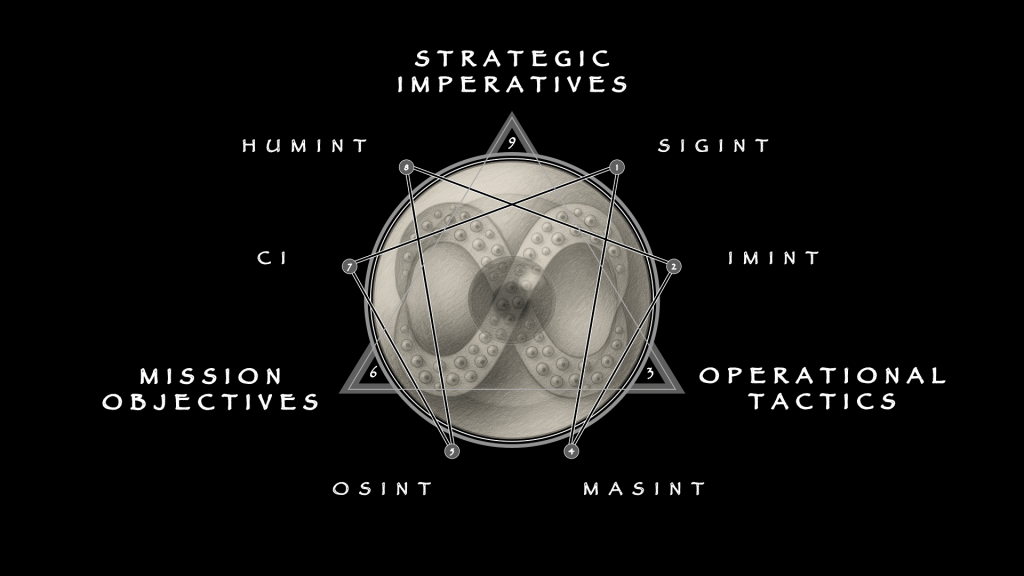
The language of intelligence has always been one of compartments. The shorthand “-INT” is an impersonal way to compress labyrinthine practices into a pair of syllables, allowing tangled bureaucracies and restive coalitions to speak a common tongue. HUMINT refers to human sources, while OSINT signals open sources, and so forth. Though the taxonomy was meant to impose clarity, it’s a potentially poisoned chalice. Experience shows that when categories harden into silos, analysts defend their own turf rather than pursue synthesis. What was designed as scaffolding becomes a prison of jargon. The unsentimental truth here is no secret, that intelligence only achieves force when each of its branches converges and compensates for the weakness of another.
That is why a fundamental non-category must be kept in view from the start. Denial and deception is not a branch but a parasite. It seeps into every stream, corrupting signals with false echoes, staging photographs for imagery analysts, planting rumors in open feeds, and turning human sources into double agents. It does not produce intelligence; it contaminates it.
Lesser sub-branches, from medical to acoustic to battlefield technical exploitation, belong here as well, not because they are unimportant but because they act as overlays rather than stand-alone silos. This is therefore not an entry in the taxonomy but a reminder. Every source can lie, every method can be corrupted. Only when analysts assume the presence of distortion do the true branches function as a living system.
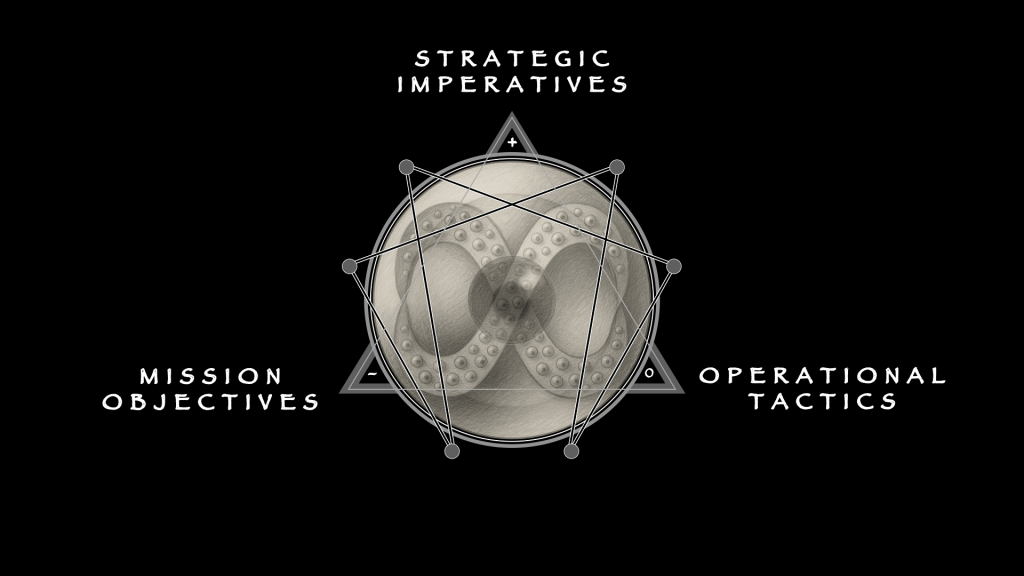
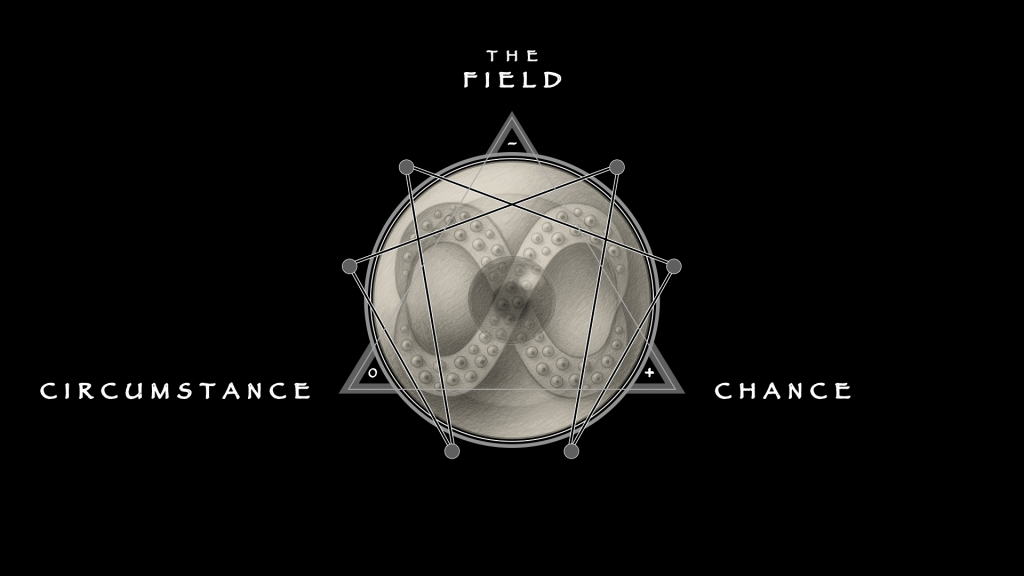
In this 132 triad, strategic imperatives are the affirming force, chance the reconciling hazard, and the product the denying source. 132 is Concentration: to compress fragments into coherence and deliver them upward. Unlike operations that seize ground or ships that move cargo, intelligence itself does not act. It creates a product that prepares action while appearing inert.
The reconciling force enters second as chance. A courier may already be doubled, a photograph staged, a sensor blinded by fog. Hazard bends every stream before it reaches the constriction. The case officer accepts this as law: information degrades the moment it is gathered. What passes through is never pure, always shaped by accident and uncertainty.
The denying force, or source, arrives last as the deliverable. A two-page memo, a single annotated image, a one-sentence cable — all reduce motion to silence. This is why the cinematic image misleads. As always with the enneagram, each node of the Logos triad is literally a point of contact with the real world.
Intelligence does not climax with spectacle. Done right, it begins loud with tasking and channels opened, narrows as fragments are forced into one frame, and ends quiet with a judgment slipped across a desk. The whisper denies the noise that birthed it. The cycle resets. The eyes fall again. Concentration repeats its law.
Most diagrams of the intelligence cycle comprise only five steps. Planning, collection, processing, analysis, dissemination: neat, symmetrical, and false. What gets left out is feedback, the very step that turns error into adaptation. Without it, the model is brittle. It may look efficient on paper, but it cannot correct itself, cannot surface deception, and cannot evolve with tempo. A pentacular wheel is not a living system but a conveyor belt — theoretical production without practical survival.
The enneagram corrects this because it is built on the principle, based on the observable laws of intersecting vibrations, that nothing is missing and nothing is extra. The Six Domains of intelligence work are not arbitrary categories but lawful necessities. Each carries a unique vulnerability that cannot be absorbed by the others. Remove one, and the cycle limps or collapses; add one, and you create redundancy without function. That is why the frame matters. It is not decoration but proof: six and only six organs are needed for the system to breathe.
The test is adversarial. If an enemy can poison a branch without consequence, then the branch was redundant. But in practice each is indispensable. Signals fail at volume, imagery at deception, signatures at cost, open sources at noise, counterintelligence at trust, and humans at fragility. None can be dropped, or substituted. Together they compensate for one another, and together they create a system capable of surviving contact with denial and deception.
This is what distinguishes the enneagram from the pentacular (or worse, the square) wheels that suggest equal steps. The enneagram encodes asymmetry, choke points, and random real-world interference. It is not ritual but practice, a field grammar drawn from how intelligence actually fails. From this frame the Six Domains can be unpacked, each defined by what it delivers, how it fails, and how it is saved by the rest.
SIGINT (+ CYBINT)
Signals intelligence is the nervous system. It was born with radio, matured through satellites, and now saturates networks and cables. It captures not only what is said but the very architecture that carries it. Cyber intelligence extends this reach into routers, protocols, and code, mapping not just messages but the pathways and dependencies between them. In modern practice the two are inseparable: SIGINT listens, CYBINT probes, and together they turn the ether into terrain.
The strength of SIGINT is scale. Entire campaigns can be traced from bursts of chatter or malware signatures spreading through servers. That same scale is also the trap. One week’s intercept can bury an office under terabytes of raw chatter. Human eyes cannot keep pace, so algorithms sift the flood. But automation has blind spots: it misclassifies, overlooks anomalies, and can be gamed by staged traffic. Encryption, rapid rerouting, and false nodes multiply. Adversaries exploit this by seeding false echoes or flooding channels until the signal drowns under noise. The case officer disciplines this chaos by forcing it through six checkpoints — a fixed frame that separates what can be trusted from what is likely poisoned.
Hazards: Encryption, traffic shaping, and deceptive chatter.
Counters: Advanced decryption, metadata analysis, and cross-INT corroboration.
Deliverables: Network and infrastructure maps (command nodes, relays, dependencies).
Hazards: Proxying, rapid routing changes, and false nodes.
Counters: Active probing, persistent monitoring, and anomaly correlation.
Deliverables: Technical alerts (indicators of compromise, anomalous traffic, intrusion signatures).
Hazards: Polymorphic malware and indicator poisoning flood the system.
Counters: Behavioral detection, layered threat-hunting, and validation across streams.
SIGINT orients but does not decide. It exposes movement, not motive; traffic, not intent. Alone it is chatter in a void. In the full cycle it is the mapmaker, tracing lines that only gain meaning once the eye, the lab, and the source confirm them.
IMINT (+ GEOINT, PHOTINT)
Imagery is the eye of the system. Where SIGINT hears traffic, IMINT shows its shape. From balloons over the trenches of 1914, to WWII photo-recon runs, to Cold War satellites, and today’s drone feeds, the camera has always promised certainty: here is the facility, here is the convoy, here is the missile on its pad. In 1962, one satellite pass over Cuba turned suspicion into confrontation. The eye can shift history.
But the eye is fragile. Clouds obscure, camouflage deceives, and adversaries know how to stage for the lens. They roll out empty launchers, build mock airframes, seed false geotags, or time movements to pass between scheduled orbits. The gap between looks becomes a weapon. A factory may be only a façade, a parade a screen for hidden weakness. The trap is confidence: images look solid even when they are lies.
Interpretation is the battlefield. Imagery analysts build baselines, detect change, and reconstruct timelines. They fight fatigue, ambiguity, and institutional pressure to “see what leadership wants.” A truck on a highway may be coded as a missile carrier or dismissed as routine logistics; the frame of reference decides which. Every image is a surface that must be tested against law, physics, and other streams before it can be trusted.
Hazards: Manipulated geotags, misregistration, and falsified overlays.
Counters: Rigid georeferencing protocols, coordinate cross-checks, and metadata audits.
Deliverables: Change-detection sequences (before/after comparisons, patterns of life).
Hazards: Sensor noise, environmental cycles, and staged movements.
Counters: Multi-sensor confirmation, statistical baselines, and MASINT adjudication.
IMINT rarely stands alone. MASINT adjudicates with spectral signatures, HUMINT adds context from inside the walls. Without them, pictures risk becoming theater. With them, imagery locks signals into place and gives the cycle something solid to carry forward.
IMINT anchors signals and orients planning. Alone it risks illusion. In the cycle it confirms what the ear already suspects.
MASINT (+ ACINT/TECHINT)
Measurement and signature intelligence is the laboratory of the system. Where signals flood and images persuade, MASINT captures what cannot be staged: isotopes drifting in the atmosphere, seismic vibrations in the earth, spectral lines invisible to the eye, the acoustic fingerprint of a submarine. From atmospheric samples after nuclear tests in the 1950s to the acoustic nets strung across oceans in the Cold War, MASINT has always thrived in the margins others could not reach. Acoustic and technical intelligence extend this forensic reach — the hum of a propeller, the dismantling of captured hardware, the recovery of a downed satellite. Together they supply evidence that propaganda cannot fake.
Its strength is authority. A single detection can upend an assessment: an unexpected isotope proves a clandestine test, a tremor locates a launch, an acoustic pattern betrays a submarine’s class. MASINT does not overwhelm with volume; it punctuates with confirmation. Yet authority comes at a cost. A single spectral array may cost more than a squadron of aircraft, yet produce only a handful of decisive detections each year. Specialists are rare, instruments temperamental, and results slow. Adversaries exploit this by cutting emissions, detonating under mountains, or flooding the sea with decoy noise. The danger is not noise but silence — absence of data mistaken for absence of activity.
Interpretation is treacherous. Laboratories fight calibration drift, environmental clutter, and spoofed signals. A tremor may be a test or an earthquake; a plume may be industrial or military. MASINT never looks blind: it follows SIGINT tasking, overlays imagery, and waits for HUMINT to point to a site. It can confirm or demolish a narrative, but it cannot construct one alone.
MASINT punctuates, not floods. Alone it is too costly and too slow; inside the cycle it bends the narrative with a single verdict.
OSINT (+ FININT)
Open-source intelligence is the floodplain. In WWII, BBC monitoring units sifted radio broadcasts for hidden cues. During the Cold War, intercepted pamphlets and state radio propaganda were read as closely as signals traffic. Today, the flood is digital: news wires, NGO reports, corporate filings, customs records, and above all, social media. Its strength is accessibility: anyone can gather it. Its weakness is that everyone can poison it. Adversaries stage for OSINT precisely because they know it will be watched.
Financial intelligence runs inside this bloodstream. In Prohibition, rum-runners laundered cash through banks; during the Cold War, covert aid moved through front companies; now state actors launder billions through crypto mixers and offshore havens. FININT maps flows of capital as SIGINT maps flows of chatter. It is indispensable for tracing procurement networks, sanction evasion, and covert financing. But money masks itself. Layered transactions, shell structures, and synthetic ledgers leave trails in shadow.
The case officer knows this trap. OSINT overwhelms with volume and velocity; FININT overwhelms with complexity and concealment. Troll farms post identical rumors in dozens of languages. Synthetic videos push staged protests to trending feeds. Thousands of filings conceal the one transaction that matters. The adversary does not need to hide the truth; it only needs to flood you with versions until truth is indistinguishable. The discipline is to assume contamination and prove authenticity through other streams.
Deliverables: Media and social monitoring (curated feeds, provenance-checked situational awareness).
Hazards: Selective reporting, narrative shaping, cultural traps.
Counters: Diverse sourcing, native-language expertise, cross-INT validation.
OSINT and FININT provide context no sensor can. But without suspicion they drown the system. Their value is proportional to the rigor of their filters.
Counterintelligence (CI)
Counterintelligence is the immune system. Where other branches collect, CI protects. Its job is survival: to detect infiltrations, expose double agents, shield secrets, and probe for weaknesses before an adversary exploits them. It operates in three modes at once — defensive, offensive, and analytic. Defensively, it vets personnel, audits procedures, and hunts for penetrations. Offensively, it flips agents, runs counter-espionage operations, and feeds deception back to the adversary. Analytically, it maps manipulation, profiles denial-and-deception campaigns, and warns when the cycle itself is being poisoned.
History proves the cost of failure. The Cambridge Five exploited ideological blind spots and crippled British confidence for decades. Hanssen and Ames showed how bureaucracies reward betrayal until it is too late. Each case underscored the same law: once CI falters, every other branch collapses. Signals, images, and sources mean nothing when the adversary is already inside the system.
CI has its own hazards. Its strength is suspicion, but suspicion corrodes. Too little, and penetrations flourish unseen. Too much, and services cannibalize themselves. Adversaries weaponize this by planting whispers, stoking paranoia until an agency burns its own networks. Discipline is what separates vigilance from self-destruction. The FBI’s COINTELPRO is the warning: CI rebranded as political policing, suspicion turned inward on lawful dissent. What was meant to defend the system became the tool that degraded it.
Hazards: Adaptive deception exploits cultural and bureaucratic blind spots.
Counters: Dynamic playbooks, scenario training, deception-awareness in analysis.
CI shadows every other branch: vetting sources in HUMINT, auditing metadata in SIGINT, checking staging in IMINT. It never delivers a product of its own, but without it nothing delivered can be trusted.
HUMINT
Human intelligence is the heartbeat. Where machines intercept, measure, or image, HUMINT persuades, betrays, and survives. It gains access to places sensors cannot reach: the closed meeting, the private conversation, the intent behind the order. A source may risk his life for a whispered meeting in a café, only to find the handler already under surveillance. No algorithm can replace that risk or the insight it brings.
History shows both its triumphs and failures. During WWII, double agents like GARBO deceived the Axis into misallocating forces on D-Day. Oleg Penkovsky’s reports gave NATO clarity on Soviet capabilities during the Cuban Missile Crisis. Conversely, fabricated defectors in the run-up to the Iraq War poisoned analysis and helped drag nations into conflict. More recently, Taliban infiltrators inside Afghan security forces turned insider access into lethal vulnerability. HUMINT offers clarity when it is true, catastrophe when it is false.
Its hazards are constant. Adversaries seed fabricated defectors, dangle assets, or turn trusted sources into doubles. Handlers misinterpret, press too hard, or believe too quickly. Sources exaggerate, project, or defect. HUMINT requires discipline: rigorous validation, structured debriefs, and continuous cross-checking against other streams. Yet without it, the cycle is blind. Signals reveal traffic, imagery shows movement, signatures confirm events — but only people reveal motive.
HUMINT validates and is validated. Alone it collapses under lies; in the cycle it gives motive and meaning to every other branch. HUMINT is fragile. HUMINT is decisive. The cycle stops if the heartbeat fails.
Taxonomy is anatomy: six organs, each with a function and a failure. But anatomy without circulation is dead weight. The cycle forces motion, pulling the branches into sequence and testing them under pressure. This is why the common five-spoked wheel is brittle. It leaves feedback out, the pulse that keeps the rest alive. Without it, signals, images, signatures, sources, finances, and suspicion clot into silos. With it, error is surfaced and the loop adapts.
The body may have the right organs, but without circulation they stagnate, and without feedback the pulse flatlines.
The proof is necessity. Six is not a convenience but a law. Each branch covers a failure no other can absorb. Remove one and the system collapses; add one and you duplicate function. Five is starvation: feedback gone, errors calcified. Seven is inflation: padded categories that create paperwork but no survival. Six is survival — nothing missing, nothing extra.
Consider what happens when one organ is skipped. Neglect SIGINT and chatter moves unseen. Neglect IMINT and movements are guessed instead of seen. Neglect MASINT and deception thrives in the lab. Neglect OSINT and context collapses. Neglect CI and infiltration festers. Neglect HUMINT and intent vanishes. The adversary presses hardest at the missing station, turning silence into leverage. The geometry in the Six Domains exhibit guarantees coverage: all present, none redundant.
The body may have the right organs, but organs alone rot without circulation. They need rhythm. They need pulse, and oxygen. They need shock at the moments where law says drift will appear. This is where the second frame, Diagnostics, sharpens the point: the cycle survives not just by having parts, but by testing them relentlessly.
Each station doubles as an interrogative. At planning, assumptions must be broken open. At direction, scope must be calibrated or glut overwhelms. At mid-cycle, chance and circumstance intrude — random breaks and local density both distort. At contact, adversarial moves must be confronted, not wished away. At closure, systemic links must be drawn, or findings fragment into trivia. Skip one check and the cycle is already poisoned. Taken together, the inform the case officer’s Six Questions.
The adversary does not need to win everywhere. It needs only one missed test: one assumption left unchallenged, one scope drawn too narrow, one chance event dismissed, one deception unexamined. Drift hides exactly where the case officer looks away.
Intelligence breathes only in sequence. Planning, collection, processing, analysis, dissemination, feedback — Six Crafts, each one both function and failure point. They do not move in equal stride. Some race, others choke. Planning risks starvation if scoped too narrow, or glut if too broad. Collection floods the system or runs dry. Processing buries the signal under trivia. Analysis collapses into bias. Dissemination bottlenecks in silos. Feedback is dismissed, and error calcifies. Each is provisional, contested, and indispensable.
This is a genuine difference between other flowcharts and the enneagram. Most sell smooth arcs, an illusion of equal steps. The enneagram maps asymmetry, shock points, and drift. It predicts where effort will stall and where denial and deception will press hardest. Adversaries seed false requirements at planning, flood collection with noise, tamper with processing metadata, exploit bias in analysis, intercept dissemination channels, and suppress feedback. The geometry shows that these pressures are not accidents; they are the lawful places where cycles break.
Taxonomy names the Six Domains. Diagnostics reveals the traps. The cycle outlines tradecraft in the field. From here the forms move, and functions are tested in sequence.
Processing orders the flood but does not decide its meaning. Transcripts, annotated images, graphs, ledgers — still fragments. If processing stalls, noise buries the cycle. If it works, the fragments reach the stage where judgment begins.
Processing sorts. Analysis judges. Here error deepens. Analysts confirm what they believe, mirror their own assumptions, or collapse into consensus. Adversaries exploit this, feeding signals and stories that match expectation. The costliest failures in intelligence come not from missing data but from misreading it.
Diagnostics marks this in bold. Assumptions must be broken, competing models forced against each other, and bias exposed. Skip the test and deception holds.
Plan and Direct
Planning and direction are the gateway to the cycle, but they are also the first shock point. Under the Law of Seven this is the mi→fa gap — a stage that demands reconciling force or the process drifts before it starts. The cycle is proactive, focused, but not yet acting. It frames requirements and sets boundaries, producing the conditions for work without doing the work itself.
The planner’s craft is calibration. Scope too narrow starves; too broad drowns. Each branch bends planning: OSINT widens toward visible noise; HUMINT tempts with rumor and nuance; CI injects suspicion, asking whether the question itself has been planted. Even here, the adversary presses the 2⟶8 axis, trying to warp strategic imperatives into poisoned objectives. Planning is not neutral; it is contested terrain.
The quadratic arc clarifies the weight. At point 1, spark condenses; at point 4, it enters the corridor; planning is that release of potential energy, the drop that sets the cycle into motion. If the release is crooked, every subsequent move is bent. History shows this: Israeli requirements before Yom Kippur built on the “Concept” that Egypt would not attack; U.S. planning before Iraq in 2003 framed the search for WMD as an axiom. In both cases, intelligence was present in abundance, but the frame was poisoned at the start.
Which assumption blinds us before collection even begins?
Is our scope tight enough to focus yet wide enough to catch surprise?
Where are incentives pushing us to lie to ourselves about requirements?
What flex keeps today’s plan bending without breaking?
If I were the adversary, how would I plant this very question?
How will this frame distort the next cycle when tempo compresses?
Good planning accepts imperfection and builds flex. Requirements are provisional hypotheses, not dogma. Rescope as context shifts. Submit the frame to continuous CI review, or the system marches forward carrying a poisoned seed. Planning is not simply the beginning; it is the place where the entire cycle can already be lost.
Collect
Collection begins where planning leaves off. Requirements framed, the system turns outward, gathering raw material through every available channel. It does not act on the adversary; it concentrates fragments into the system, drawing them into shape. Energy released in planning drops into the corridor of collection (the 1⟶4 line) where potential becomes flow.
Each branch feeds this station. Signals are intercepted from radio chatter, fiber-optic cables, or compromised servers. Images captured by satellites and drones, coordinates tagged. Measurements logged from vibrations, isotopes, acoustic signatures. Open sources and financial records scraped, both genuine and staged. CI probes for penetrations. HUMINT supplies reports from denied spaces. Appetite is energy, but appetite carries risk.
The first danger is imbalance. Overreliance on one stream distorts. Lean on SIGINT and drown in chatter while missing intent. Trust IMINT and be dazzled by parades while blind to stockpiles. Neglect MASINT and deception thrives in the lab. Overweight OSINT and context drowns precision. Each skipped channel is a gap the adversary exploits. Diversification is essential, but glut itself is crippling. Scarcity and glut are not opposites here — they are twin hazards.
History proves the point. In WWII, bad weather blinded Allied bombers when aerial reconnaissance failed. In 1991, Iraqi forces staged decoy tanks and artillery to bait collection into waste. The adversary presses hardest here, seeding false communications, staging parades for sensors, planting doctored financials, flooding social feeds with counterfeit narratives. Collection is the system’s widest gate, and openness is vulnerability: everything enters, including poison.
Which stream do we trust too much without proof?
How balanced is our intake — leaning on chatter, images, or rumor?
Where is chance entering as poison — signals staged, sources turned, records doctored?
What redundancies ensure one rotten channel cannot set the picture?
If I were the adversary, how would I flood or starve this office’s collectors?
How will today’s imbalance cripple tomorrow’s processing when tempo accelerates?
The best practice is not purity but resilience. Streams must be cross-validated. Redundancy is not waste — it is survival. Only convergence builds confidence. Collection must also be time-sensitive: stale data misleads as effectively as false data. The discipline is to move quickly without cutting corners, to accept imperfection while denying single-point failure. Without that, collection collapses into accumulation, and the system mistakes volume for value. Collection is not knowing more. It is knowing enough to survive distortion.
Process
Processing is the chokepoint of the cycle. Once the flood of fragments is drawn in, the system must sort, tag, translate, and archive or it drowns in its own appetite. Collection is voracious; processing is selective. Here the system risks paralysis.
The work is backstage but decisive. Signals become transcripts, imagery annotated files, measurements graphs, financial records ledgers. Raw fragments gain form, but not yet meaning. If processing fails, analysis never begins. If it succeeds, it passes a structured current forward, stripped of noise but still provisional.
The hazard is overload. Automation promises relief, but algorithms carry blind spots — missing anomalies, mistaking noise for signal, or being gamed by adversaries who know the filters. Human analysts bring intuition, but also fatigue, bias, and error. The adversary exploits both: flooding channels to overwhelm, crafting metadata to mislead, or tampering with chain-of-custody so the poisoned fragment becomes authoritative. The system risks collapsing not from absence but from excess.
History repeats the warning. In Vietnam, signals traffic flooded processing centers faster than it could be translated, burying decisive intelligence under chatter. In more recent cyber conflicts, adversaries have seeded indicator lists with false signatures, ensuring that defensive systems misclassified benign traffic as hostile and ignored the real intrusions. Processing is where error multiplies if filters fail.
What criteria decide what is filtered, and who set them?
Are we sorting to clarity or only piling into archives?
Where will noise bury the signal until it is lost?
What triage method preserves signal without paralysis?
If I were the adversary, how would I exploit our fatigue or automation bias here?
How will today’s misclassification warp tomorrow’s analysis under time pressure?
The best practice is ruthless triage joined to transparency. Not all data can be saved; what is kept must be traceable. Metadata must support retrieval, not entombment. Automation must be checked by human judgment, and human judgment must be disciplined by review. Without that balance, processing becomes the graveyard of intelligence.
Analyze
Analysis is the waist of the hourglass — the choke where fragments must collapse into one frame. Here intelligence stops counting and starts deciding what the fragments mean. Links between actors, shifts in behavior, risks and opportunities emerge — or are fabricated. This is the most human stage and, therefore, the most fragile. Machines can process; only people can ascribe meaning. And meaning is exactly where deception cuts deepest.
Each branch lands differently on the analyst’s desk. SIGINT gives tempo and network shape but not intent. IMINT anchors events to place and time yet tempts with theater. MASINT adjudicates with hard signatures, late but decisive. OSINT floods with narrative, the easiest channel to poison. HUMINT supplies motive and mood — decisive when true, catastrophic when false. CI shadows the lot, probing assumptions and seeding red-team narratives so consensus fractures before it calcifies.
Bias is the standing hazard; adversaries weaponize it. Confirmation and mirror-imaging make comfortable stories feel true. Groupthink and tempo pressure reward neat answers over correct ones. Deception campaigns exploit this by feeding exactly the story expected, complete with “truthy” detail to pass a cursory check. Chance itself intrudes here, with coincidences mistaken for causation and anomalies overfitted into proof. Provenance chains are the discipline: without clear lineage from collection through processing, analysts argue stories rather than evidence.
Which assumption is already blinding us?
What competing models also fit these data, and why did we favor this one?
Where has chance or staged coincidence seduced us into “truthy” certainty?
What dissent or red-team is cutting across our preferred narrative?
If I were the adversary, what story would I craft to make us confident and wrong?
How will this judgment survive dissemination deadlines and policymaker tempo?
Safeguards are adversarial method and iteration. Force model competition, preserve provenance, institutionalize dissent. Treat conclusions as conditional and spend confidence only as verification arrives. Analysis fails loudest when it feels most certain — and certainty is the adversary’s most effective weapon.
Disseminate
Dissemination is the handoff — the point where intelligence leaves the analyst’s desk and enters the bloodstream of decision. A judgment not delivered in usable form is dead weight, no matter how correct. This stage appears straightforward — reports, briefings, images, alerts — but it is riddled with failure points. Speed, format, and channel matter as much as content. Delivered too late, intelligence is irrelevant; delivered too raw, it overwhelms; delivered in the wrong form, it is ignored.
Branches demand different treatment. Imagery lends itself to visuals but risks oversimplification. HUMINT requires narrative with nuance, or it distorts. Signals and measurements demand translation into non-technical language, or they remain opaque. Dissemination is therefore not neutral delivery but active shaping, where every choice about format and emphasis decides whether the product is acted upon or shelved.
History shows the stakes. During the Cuban Missile Crisis, annotated photographs reached Kennedy within hours, compressing the cycle to match tempo. In contrast, the Iraq WMD estimates of 2002 were not only flawed in content but poisoned in delivery — presented with unjustified certainty that foreclosed dissent. In both cases, dissemination was decisive: speed with shape versus distortion at tempo.
Here denial and deception strike hard. Adversaries intercept channels, leak selectively, manipulate formats, or bury genuine assessments under bureaucratic avalanche. Internal sabotage is just as common: silos hoard, rivalries delay, clearance walls block the flow. CI belongs here too, not only guarding against compromise but testing delivery channels for resilience under stress. The cycle that survived bias and overload can still fail at the final mile.
Who actually needs this product, and how must it be shaped to act?
Are we delivering clarity, or drowning decision-makers in detail?
Where will chance strike — delay, garbling, leaks, or distortion?
What protections ensure speed, security, and adaptation in the channel?
If I were the adversary, how would I compromise or discredit this report?
How will bottlenecks here choke the feedback loop and poison the next cycle?
Best practice is speed with shape. Products must move swiftly and securely, tailored to audience without diluting substance. Dissemination sits on the downward arc of the system: potential turning into action. At this stage tempo is everything. A perfect assessment delivered late is not intelligence. It is failure.
Feedback
Feedback is the closing turn of the cycle, but it is not closure. On the 7→1 line it masquerades as an ending, a reset to planning, when in truth it is momentum transfer — the energy of error carried forward under a new name. Without it, mistakes calcify and the cycle stiffens into ritual. With it, distortion is recycled into adaptation.
The hazard is neglect. Feedback is dismissed as bureaucracy, or suppressed because it admits failure. Institutions resist correction, so they rehearse error as if it were process. The adversary exploits this by tampering with after-action reports, planting false critiques, or letting silence itself become the poison — no complaint mistaken for validation. On the 2–8 axis, this is where tactical failure can be converted into strategic adaptation. If the loop closes cleanly, lessons learned at the field edge feed imperatives at the top. If it fails, the axis collapses, and tomorrow’s objectives are distorted before they are even named.
History makes the geometry plain. After Pearl Harbor, postmortems exposed systemic blind spots, but without true feedback the same failures reappeared in Korea. By contrast, the post-9/11 counterterrorism centers built rapid loops into their design, imperfect but adaptive, bending planning in near-real time. One cycle repeated error; the other recycled error into change.
Feedback is tempo-bound. A lesson delivered months later is trivia. A lesson delivered within hours can bend requirements before they lock. CI belongs here too, probing whether adversaries are shaping critiques or whether leaders are filtering out the most dangerous truths.
Who is telling us the truth about our product, and who is just nodding?
Are the same errors repeating because pride resists correction?
Where is chance hiding — false after-action, buried critique, silence mistaken for success?
What loop forces learning fast enough to matter before the next cycle?
If I were the adversary, how would I exploit reluctance to admit failure?
How will today’s neglected feedback distort tomorrow’s planning under pressure?
Best practice is to institutionalize critique, enforce tempo, and protect the loop itself from compromise. Feedback is not the end of intelligence. It is the system listening to itself under pressure — and deciding whether survival comes through repetition or adaptation.
The cycle plays out as 132, Concentration. Every stage up to now has carried that logic: gathering fragments, shaping them into product, delivering judgment but not execution. Concentration sustains governments and commanders by keeping intelligence flowing upward, neither heroic nor climactic, but steady.
The handoff comes here, at the point where the cycle has been walked in full and must now be interpreted through its deeper geometry.
That geometry is 231, Evolution. Concentration explains practice; Evolution explains survival. Concentration makes a product; Evolution adapts under distortion.
The pivot is necessary because intelligence is never a closed loop. Planning does not simply open the cycle; it is already bent by hazard. Japanese deception broadcasts in 1942 prove the point. Analysts chased phantom fleets because planning leaned too heavily on signals. SIGINT offered maps of who spoke, how often, and at what tempo, but adversaries shaped those maps by seeding false echoes and leaving channels open as bait.
In the cyber era, CYBINT multiplies the reach into routers, cables, and protocols, but it magnifies the fragility. Malware can be planted to be discovered; chatter can be staged to look authentic. Concentration frames signals as orientation; Evolution forces calibration. Requirements must be provisional, constantly tested across branches, subjected to CI review from the start. The lesson is clear: Concentration makes intelligence a product, but Evolution keeps it alive under contest.
Imagery shows how that contest expands. The Cuban photographs of 1962 turned confrontation into crisis by anchoring rumor to frames. Yet clouds obscure, camouflage deceives, parades create theater. A truck in a photograph may be a missile carrier or an empty shell. Evolution treats imagery as mutation, each frame provisional, tested against others, sequenced over time. Adversaries build mock-ups because they know the eye is hungry for closure.
Evolution disciplines the eye by forcing diversity—multi-angle, multi-temporal, multi-source—so that no single shot becomes gospel.
Measurement and processing drive the point further. Nuclear tests are confirmed not by photographs but by isotopes drifting in the atmosphere. A spectral line or seismic tremor cannot be staged with ease. Yet signatures are costly and buried in glut. Processing must discard as much as it preserves, or the system collapses under noise. Adversaries exploit fatigue and algorithmic bias, flooding metadata until paralysis sets in. Evolution demands transparent filters and ruthless triage: every fragment traced, every discard acknowledged, the system mutating instead of choking.
Open sources carry the same hazard. Corporate filings, social movements, and financial trails reveal intent early, yet they are also the easiest to manipulate. The Iraq WMD narrative was not just a failure of classified streams but of open ones, shaped by adversary spin and domestic appetite. Evolution resists by adversarial method. Competing models must be forced against the same data. Red-teaming and dissent keep analysis mutating instead of ossifying into consensus. Chance appears here as “truthy” detail; Evolution answers with iteration, never finality. Certainty is collapse; adaptation is survival.
Dissemination and counterintelligence show how survival depends on transfer. Venona decrypts mattered only when they reached policymakers in usable form. The Iraq estimate poisoned decision-making because delivery was framed as certainty. Adversaries need not block delivery outright; slowing it, leaking selectively, or bending format is enough. Internally, silos and rivalries do the rest. Evolution forces speed with shape: clarity tailored to audience, secured against compromise, moving fast enough to act. CI shadows the process, testing whether the channel has been bent. A perfect assessment delivered late is an epitaph.
Feedback reveals the illusion of closure. On the 7⟶1 line it looks like reset, but in Evolution it is momentum transfer, error carried forward under a new name. HUMINT mirrors this fragility: the source inside a denied space is provisional, fallible, always contested. Pearl Harbor and Korea proved that after-action without feedback is ritual; post-9/11 fusion centers, however imperfect, forced adaptation at tempo. Adversaries exploit reluctance by burying critique or letting silence itself become validation. Evolution here is the system mutating itself, interrogating its own product, correcting in cycle-time rather than decades. Without it, intelligence repeats mistakes under the illusion of process. With it, the organism survives distortion.
Symmetry is not stability; it is tension. The cycle does not hold because its six parts are secure; it holds because its six parts are contested. Chance and circumstance are the permanent poles of that contest. The field agent feels chance as danger: every signal may be a trap, every photograph a stage, every source a double. Circumstance, at the field level, looks like luck: the meeting that does not go wrong, the random intercept that saves a life. But the office cannot rely on luck. At the systemic level, chance is permanent and circumstance must be engineered. Redundancy, cross-validation, and feedback loops are designed circumstance, capacity to bend without breaking.
The sixfold cycle holds this tension in each stage. Planning is bent by planted requirements; circumstance insists on provisional scoping. Collection is flooded by deception; circumstance diversifies streams. Processing is overwhelmed by noise; circumstance disciplines triage. Analysis is seduced by bias; circumstance enforces dissent. Dissemination is sabotaged by tempo; circumstance secures clarity and speed. Feedback is poisoned by silence; circumstance forces error into correction.
Here the 3⟶6 line, the sole horizontal axis, reveals itself. Chance is inevitable: distortion, deception, failure. Circumstance is the possibility of “failing forward”: adaptation, engineered survival. The fulcrum of the geometry is not stability but surrender and recovery, loss metabolized into gain. This is the 231 triad, Evolution, in its purest form—not a wheel repeating, but a system mutating forward.
Fragility itself can be organized. Intelligence survives and prospers not by eliminating hazard but by metabolizing it. Chance without circumstance paralyzes. Circumstance without chance breeds complacency. Held together, they generate the tensegrity that makes the system real. Intelligence is not certainty. It is not perfection. It is adaptation—a geometry that survives distortion because it expects it, bends to it, and keeps moving. The geometry endures because tension endures: fragility organized into function.
The cage may be literal … a concrete room, a locked cell, a checkpoint where your passport is taken and not returned. Or, the cage may be metaphorical. A classroom feels like punishment, as does the Monday morning meeting where time is stolen in the name of teamwork. As many men know too well, a marriage of continual silence or shouting is real confinement. Harshness matters. The meaner your metaphor is, the harder the training will be. The more training hurts (within your limits, short of breaking you), the more transferable the skill of endurance becomes to the rest of your life.
Whether we like to admit it or not, any edge you have is relative, simply because most other people have no edge at all. How do you know if you have one? The other hard truth is that edges are forged and ground, and result from honing. If you’d put in the work, you’d know. Nevertheless, most people believe that when pressure comes they will rise to the occasion. They prefer to imagine that hidden reserves will arise, as if from the crisis itself, and transform them into a better version of themselves. This belief is as pleasant as it is false.
When the fight comes, you do not rise. You sink to the lowest level of your training. If that level is shallow, you collapse; if it is deep, you hold. Survival depends not on sudden strength, but on practice.
I have tested and proven these hard truths in the most punishing conditions I’ve known. I have sat in the cage where choice seemed stolen and time was used as a weapon. What held me together was not toughness, but learned technique. Each lesson, once internalized, applied as cleanly in a cell as in ordinary life. A hostile negotiation, a hostile marriage, a hostile bureaucracy, they all obey the same logic. Tools forged in extremes transfer into every setting where pressure is applied.
Endurance is a 213 triad, or Evolution.
Denial is first and unavoidable: the imposed conditions, the lock, the silence, the schedule that is not yours. These are not metaphors. They set the frame and they arrive before you can act. Affirmation, in the form of will, follows but it doesn’t lead. The work is to bend into what has already said “No.” Restraint, timing, refusal to feed the pressure — each is a reply made under duress. Some can hold, some cannot, but all endurance is this contest of will against denial.
Reconciliation is the result, and is nonnegotiable. Release or non-release—that is the fruition of the sequence. The danger lies in drift: let the pattern slip and the triad collapses. 123 thrashes outward in waste, 231 refines despair into ritual. Worst of all, 132 builds a second cage inside the mind. Training demands that the situation be held as 213, nothing else. Only then does endurance remain lawful, and only then can it transfer intact across domains.
Capture begins not with any handcuffs or a locked door, but with a frame.
The lighting is proverbially skewed, the air stale, and the silence is broken at the interrogator’s whim. You are meant to forget that you still possess choice. The true battle is not against the room, but against the slow erosion of self. Endurance of such moments is nothing like passive suffering. Quite the opposite, it is the gainful art of conserving strength while feeding nothing to your captors. Escape is not cinematic but sly, procedural … and literally boring.
Victory means walking out while they remain convinced that the cage still holds.
The environment is unsurprisingly weaponized, a chair that cuts into your back, a missing clock, drifting temperature. This is architecture as assault, subtle enough to be deniable, persistent enough to grind down lesser men. Interrogators rely on cumulative pressure, small irritations stacked until you pay with compliance just to end the friction. The environment, per se, never breaks you, not directly. It merely invites you to break yourself. Recognition of the pattern is the first step in resistance. If you know the tricks, though, you see them as tricks. The same holds in the office where the air conditioning is dialed down for “alertness,” or in classrooms where tests drag on without clocks. Discomfort is a signal, not a command.
The guards always rotate, whether or not they wear uniforms. One is terse, another tender; one compels, another consoles. The choreography is ancient. Confusion inspires hope, hope breeds betrayal, and betrayal breaks willpower. You might feel relief, when the hostile voice subsides and the gentle one leans in, and that will make you vulnerable. The guards, whether or not they know it, come with the cage, no less than the doors or the plumbing or the telephones. Their faces change but the roles were scripted aeons before any printing press.
Since brute willpower is a diminishing asset, it is also an unreliable defense. Rather, you need an inner citadel, an architecture of mind immune to the concrete and steel. Such a sanctuary must be built on resilience disciplines: compartmentalization of fear, control of thought loops, inoculation through prior stress, and above all the refusal to leak any tell. The man who can sit still, endure boredom, and radiate nothing has achieved invisibility. To his captors, this silence is unnerving. They expect fidgets, sighs, restless shifts. They do not know how to read boredom endured without trace. That is not absence, but dominance. In a meeting, the same skill unnerves: the executive who waits out a torrent of words without blinking forces others to collapse into the silence.
The first Evolution openly disregards the manipulations on which they depend.
Endurance begins with naming these as tools, not truths. Your private citadel strengthens when you separate the environment from your self-concept. You are not cold. You are placed in cold. You are not forgotten. You are temporarily isolated. Every wall is construction. Built things can be endured.
From endurance, you progress to controlled ruses. Compliance, when performed strategically, is a mask. You nod at questions without committing. You agree in form, not in substance. You drop fragments of irrelevant but plausible information to buy time. You answer in ways that lead nowhere, a path paved with detail but devoid of meaning. The interrogator writes notes, satisfied, but nothing of value has shifted. Strategic silence functions the same way: it is not refusal, it is weight. Silence places the burden back on the questioner. Many interrogators fear silence more than lies. The mask protects you until the door swings open on its own.
The second Evolution, buried in your citadel, safeguards the resilience disciplines that others lack, the lockpicks no one can confiscate.
Each preserves agency, and together they buy precious time. Discipline is the universal currency. The longer you cohere, the weaker the captor’s leverage becomes. While adversaries burn their resources, a low external locus of identity conserves yours. The same dynamic holds whenever you endure a drawn-out legal deposition, a corporate performance review, or a manipulative argument at home. Every cage waits for you to cooperate with it. Refuse, and the cage collapses into mere furniture.
Advanced techniques extend beyond defense into escape, though practicing them prematurely can be worse than never doing so. Endurance maintains the citadel.; escape tests the walls. It need not even involve force. With practice, like when a predator spits out live prey whole, a skilled escape artist can dissolve the walls by forcing his captor to lose interest.
The third Evolution comprises “trade secrets”, counter-techniques that escape disguises as endurance.
Gray Rock makes you uninteresting: a detainee with no emotional color, no dramatic profile, offers no hook to exploit. Interrogators grow bored and redirect their energy elsewhere. The Gray Rock wins by starving the captor of stimulation. In office politics, it is the colleague who reveals nothing in a toxic meeting. But use it too obviously, and it looks like defiance.
Misinformation sows waste: details that sound credible but lead to dead ends, requiring days of verification. The captor believes they possess insight, but all they hold is sand. Resources drain as time is squandered. In negotiation, it is the harmless detail that burns the other side’s time. Too much misinformation, though, risks pattern detection.
Strategic Compliance buys relief: small agreements offered as currency to earn pauses or comforts, while protecting what matters. A scrap of harmless detail purchases food, warmth, or rest. The appearance of cooperation misleads the captor into relaxing their pressure. In bureaucracy, it is signing forms that concede nothing. But compliance used carelessly becomes concession.
Silence and Timing force interrogators into over-explaining, revealing more than they intended. Questions left hanging drag the captor into filling the void. What was supposed to be pressure on you becomes a monologue from them. In law, it is the witness who lets silence draw out admissions. Yet silence wielded without calibration can look like stonewalling, inviting escalation.
Counter-Interrogation flips the script: you ask small questions back, subtle enough to feel like clarification, sharp enough to test their footing. “What exactly do you mean by that?” “Who asked for this information?” By answering, they expose seams in their own operation. In business, it is the buyer who asks questions that unsettle the seller. But press too hard, and you reveal intent.
Affect Mastery masks your stress, hides your tells, and projects composure where none exists. You regulate micro-expressions, voice tone, even posture. The captor reads calm and assumes control, while inside you are counting seconds. In marriage, it is masking fatigue so anger finds no purchase. Affect too controlled, though, can feel unnatural and provoke suspicion.
These are never ends in themselves. Each tactic is preparation for a passage, a discipline that endures only so it could culminate. Endurance carries its burden through denial and will; creation inherits it and closes the arc. Without that passage, endurance decays into drift or collapse. With it, the pressure that once threatened to grind you down becomes the condition of release. Evolution ripens into creation, not by chance, but by following the order of forces through to its lawful end.
The sequence begins with the small, almost beneath notice: a misplaced file, a guard whose attention falters, a bureaucratic window that opens without announcement. At first it feels trivial, even fragile. Yet this minor aperture is the reconciling force that nothing can proceed without. What was once impossibility becomes permission.
Denial comes next, and it sharpens the test. The system reacts — alarms sound, eyes narrow, questions return with edge. Interrogators grow suspicious, colleagues probe, bureaucracy flares with last-minute demands. This resistance is proof the opening is real. Without denial, movement is drift; with it, the path becomes defined. Pressure validates the seam.
Affirmation is final. A line is signed. A door is crossed. A chair is left empty. The gesture is smaller than the preparation that preceded it, yet it seals the deal. No proclamation is needed. The act is complete because the order has been honored: opening, resistance, and then, quietly, departure.
This is the action along the 2⟶8 line: what was stripped away at 2 becomes fuel for enablement at 8. Tactical loss becomes strategic completion. Time stolen, options closed, and strength narrowed are transmuted into a freedom stable enough to endure. Creation is not escape by chance but by conversion, the lawful turning of pressure into absence.
Anything less is counterfeit. A jailbreak that ends in flight is not culmination but relapse into 132, the will trapped in vigilance, every choice forced through the lens of survival. Real escape does not orbit the institution; it leaves it behind. The walls remain, but you no longer acknowledge them as reference.
The cleanest escapes look uneventful. Files close. Detainees are walked out the front door. Cases vanish from the ledger. Nothing spectacular happens, yet everything has changed. To those who watched, the system still seems intact. To the one who has crossed, the institution has already dissolved.
Escape, when it holds, does not declare itself. It leaves no trail but the incomplete story that your captors tell, a monument to a world you have already abandoned.
The investigation commenced with deceptively clear parameters. Subject: adult female, Oregon Health Plan beneficiary, seeking male therapist specializing in cognitive behavioral therapy for narcissistic personality disorder within the Grants Pass to Ashland corridor. Distance: manageable. Insurance: established. Geographic area: populated with university towns and medical infrastructure. The initial assessment suggested straightforward provider matching—a matter of systematic database queries and credential verification.
The research therefore began with confidence in both methodology and likely outcomes. The subject demonstrated unusual clinical sophistication, self-identifying with covert narcissistic pathology and explicitly requesting behavioral accountability over therapeutic validation. Her collaboration with an OSINT investigator reflected methodical determination rather than desperation—two parties committed to evidence-based matching between complex clinical needs and available resources.
The process involved comprehensive database analysis across professional directories, insurance networks, and individual practitioner profiles. Yet as the search progressed, each layer of analysis revealed deeper complications. The water, as subsequent evidence would demonstrate, contained hidden currents and unexpected depths that would challenge both assumptions and methodology.
Primary criteria were:
Solo, in-person male practitioner
Located in or near Grants Pass, and as far south as Ashland
Specializes in Cognitive Behavioral Therapy (CBT)
Experienced with covert/vulnerable narcissistic personality disorder
Emphasizes behavioral change and accountability
Skilled in adult attachment theory or attachment-focused treatment
Accepts the patient’s insurance — a constraint that eliminates most specialists
Comfortable with “shadow work” and addressing uncomfortable issues
Avoids new-age themes and purely affirmation-based approaches
Initial screening identified five potential candidates, each presenting immediate disqualifiers upon detailed examination.
One in Jacksonville operated a solo CBT practice and accepted OHP coverage, but was female and maintained a closed client roster. Another in Ashland demonstrated strong alignment with attachment specialization and solo practice structure, but similarly accepted no new clients and lacked documented NPD experience. One prospect in Grants Pass offered CBT specialization but operated through the Cerebral telehealth platform rather than independent practice. Another maintained appropriate credentials and accepted the subject’s insurance, but provided exclusively telehealth services from Washington state. Yet another operated a solo practice with attachment focus in Grants Pass, but was female. Being female, the subject acknowledged that women avoid accountability, which effectively rules them out as coaches in that domain.
Thus, a pattern emerged: no identified practitioner satisfied all established criteria. Each candidate presented significant limitations that compromised either therapeutic fit or practical accessibility. The investigation waded in from the pool’s edge, only to discover the bottom dropping away more steeply than anticipated.
The Medford Misadventure
Evidence from the subject’s previous therapeutic attempt provided crucial context for understanding both her current search parameters and the systemic failures her requirements sought to avoid. Six months prior, she had consulted a male therapist in Medford whose credentials and location initially appeared promising. The encounter began typically, with standard intake procedures and establishment of therapeutic rapport.
The critical moment arrived when the subject articulated her primary concern: a pattern of empathic deficiency causing measurable harm to her husband. Rather than engaging with this behavioral focus, the therapist immediately redirected toward affirmative intervention, repeatedly insisting she was “being too hard on herself.” When she attempted to clarify that self-criticism was not the issue—that her husband’s documented distress indicated actual interpersonal damage requiring behavioral change—the provider doubled down on validation.
The session’s nadir occurred when the therapist tried to upsell a third-party therapeutic program. The facilitator, a female therapist whose online presence, published materials, and promotional videos exhibited textbook grandiose narcissistic characteristics, was effectively packaging “self-love.” The irony was stark: a therapist treating narcissistic pathology by referring to services provided by an apparent narcissist promoting self-aggrandizement as therapy.
The subject declined the referral and terminated the therapeutic relationship. Her response demonstrated both clinical sophistication and ethical boundaries—recognizing that accepting inadequate care posed greater risks than continuing the search for appropriate intervention. This encounter illuminated exactly why specialized, carefully matched treatment was not a luxury, but a necessity.
The Deeper Waters of Diagnostic Inadequacy
As the investigation expanded beyond regional provider availability, a more fundamental obstacle emerged: the structural inadequacy of current diagnostic frameworks for recognizing and categorizing narcissistic personality disorder, particularly in female presentations. The DSM-5-TR includes NPD but emphasizes grandiose, overtly disruptive manifestations while inadequately capturing covert, vulnerable, or relationally sophisticated variants.
The diagnostic criteria were developed primarily around male behavioral patterns—overt self-aggrandizement, obvious entitlement, conspicuous exploitation. Female narcissistic presentations often manifest through victimization narratives, emotional manipulation, or covert control mechanisms that fly beneath the traditional diagnostic radar. A woman might systematically undermine her spouse’s competence, monopolize social situations through manufactured crises, or employ self-deprecation as a manipulation tactic—all while appearing to outside observers as self-effacing or even victimized herself.
This diagnostic blind spot creates cascading effects throughout the mental health system. Training programs offer minimal education on identifying complex personality pathology, particularly its gender-variant presentations. Even competent practitioners may encounter covert narcissistic patients without recognizing the underlying dynamics, leading to treatment approaches that inadvertently reinforce problematic patterns rather than address them.
The anticipated DSM-6 revisions show little promise for addressing these limitations. The categorical, symptom-cluster approach inherent in diagnostic manuals fundamentally conflicts with the fluid, contextual, and relationally-defined nature of personality pathology. Patients seeking specialized care for presentations that exist in diagnostic shadows often navigate systems structurally unprepared to see, much less treat, their particular configuration of suffering and interpersonal impact.
The Deepest Current of Cultural Taboo
Beneath diagnostic inadequacy flows an even more powerful undercurrent: the cultural prohibition against acknowledging female-perpetrated emotional harm. Western psychological discourse demonstrates markedly greater comfort identifying and treating disruptive patterns in men. Male narcissism, while stigmatized, fits existing cultural narratives about masculine entitlement, aggression, and dominance. Female narcissism challenges fundamental assumptions about gender, victimization, and interpersonal harm.
This bias manifests in clinical settings through pervasive practitioner reluctance to directly confront female patients’ harmful behaviors. Therapists, often unconsciously colluding with broader cultural discomfort, may reframe narcissistic presentations as anxiety, depression, trauma responses, or codependency. The result creates a therapeutic blind spot where female patients seeking accountability for their relational impact encounter systems more invested in providing validation than facilitating change.
For a woman who has achieved the rare self-awareness to recognize her narcissistic pathology, this cultural dynamic presents a particularly cruel paradox. Her diagnostic honesty and motivation for behavioral change run counter to both clinical expectations and social narratives about female psychology. The very qualities that make her a promising therapy candidate—recognition of harm and desire for accountability—render her nearly invisible to systems unprepared to engage with female-perpetrated interpersonal damage.
The subject’s case exemplifies this invisibility. Despite her sophisticated understanding of her condition, clear articulation of treatment needs, and demonstrated commitment to change, she remains unable to access appropriate care. Her willingness to acknowledge uncomfortable truths about her impact on others places her outside the therapeutic mainstream’s comfort zone.
The Catalyst of Relational Consequence
The investigation’s deepest revelation concerns the mechanism by which the subject achieved diagnostic awareness—a process that illuminates both her condition’s nature and the therapeutic challenges it presents. Her recognition of narcissistic pathology emerged not through introspective insight, emotional excavation, or therapeutic exploration, but through accumulated, undeniable evidence of harm inflicted upon her husband.
For years, the subject’s internal experience provided insufficient data for accurate self-assessment. Her empathic deficiency created a feedback loop where interpersonal damage remained invisible to her while devastating to others. Only when her husband’s suffering became life-threatening did the pattern become undeniable. His deteriorating agency, social withdrawal, and emotional exhaustion became the external measuring instruments that her internal awareness could no longer avoid.
This recognition pathway carries profound implications for treatment approach. Therapeutic modalities emphasizing emotional exploration, validation, or self-compassion would not merely prove insufficient—they would actively undermine progress by redirecting focus from behavioral impact to internal experience. Her motivation for change stems from ethical recognition of interpersonal damage rather than personal distress, demanding approaches that prioritize accountability over comfort.
The delayed nature of her recognition also explains the urgency underlying her search for specialized care. Having finally breached her defensive barriers through sheer accumulation of evidence, she possesses both unusual self-awareness and time-sensitive motivation. Standard therapeutic approaches that spend months or years building insight would waste this rare window of acknowledgment and change-readiness.
A Perfect Storm
The convergence of geographic limitations, diagnostic inadequacy, cultural taboos, gender-specific presentations, and highly specialized treatment requirements creates a near-perfect storm of access barriers. Each obstacle alone might prove surmountable through persistence and creativity. Their intersection generates barriers that systematic research and good faith effort struggle to overcome.
The subject’s case exposes how multiple systemic failures compound to create invisibility for patients whose presentations challenge diagnostic categories, cultural assumptions, and therapeutic comfort zones.
Current reform discussions focus primarily on access, parity, and geographic distribution—important but surface-level considerations that fail to address the deeper structural problems her case illuminates. Without diagnostic frameworks adequate to female narcissistic presentations, training programs that prepare practitioners for complex personality pathology, and cultural willingness to acknowledge female-perpetrated harm, expanding provider networks alone cannot solve access problems for patients like her. Despite these multilayered obstacles, the investigation continues with refined methodology and expanded parameters.
The research has also identified potential leverage points within existing systems:
Practitioners with specialized personality disorder training willing to expand their scope
Clinicians with forensic backgrounds committed to challenging therapeutic relationships
Female therapists who admit interpersonal harm rather than default to validation
This investigation documents the intersection of individual clinical need with systemic inadequacy across multiple domains. The subject’s methodical search, while unsuccessful in securing immediate appropriate care, provides crucial evidence of service gaps and structural barriers extending far beyond provider availability or insurance networks. Her persistence in maintaining search parameters rather than accepting available but potentially harmful alternatives reflects both clinical sophistication and ethical responsibility.
In complex presentations where inappropriate intervention carries significant risk—particularly those involving documented relational harm—continued investigation represents a more ethical approach than compromising therapeutic fit for expedient access.
Her case illuminates the need for fundamental reforms in diagnostic frameworks, clinical training, and cultural attitudes toward female-perpetrated interpersonal harm. Until these deeper structural changes occur, patients with similar presentations will continue to navigate systems unprepared to recognize, categorize, or treat their particular configuration of pathology and motivation for change. The investigation remains active, with expanded understanding of both obstacles and possibilities, maintaining commitment to evidence-based care while documenting the systemic inadequacies that render such specialized treatment nearly inaccessible to those who seek it with genuine recognition and desire for behavioral accountability.
A well-composed Logline delivers the plot’s essential elements in a manner that is not only informative but intriguing. By upgrading your writing tactics accordingly, you can set your story or idea apart from others’. While this could involve a fresh plot twist, a unique perspective on a news story, or a novel benefit of a product, now more than ever the zenith of public declarations is the Logline.
The essence of a compelling message, whether through film, journalism, or marketing, has always been in its ability to succinctly capture and convey the core of its subject to engage and resonate with its target audience or reader.
That shared foundation underscores the importance of clarity, engagement, and brevity, especially across disciplines. This precision ensures that the message is both accessible and intriguing to the audience, providing a clear snapshot while inviting further engagement. The heart of effective communication hinges on exactly this ability to distill complex ideas into clear, concise statements.
The art of crafting messages that captivate involves sparking curiosity — a well-crafted logline, a gripping headline, or an impactful marketing slogan each serve as the keystone in its respective field.
The LOGOS:
Identify and emphasize the core MESSAGE (+) to distill the essence of a narrative, news item, or product into a compelling statement that captures its unique value or appeal.
PASSION (0) is the universal catalyst for engagement, making any message more compelling and persuasive; do NOT, however, confuse it with mere enthusiasm, but instead think of it as “massaging the pain point”.
Understand the TARGET (-) audience to tailor messages that speak directly to their interests; aligning your message with their needs, desires (and/or fears) instead of your own automatically amplifies its impact.
Whether articulating the essence of a narrative through a logline, capturing the crux of a news story in a headline, or distilling the value of a product into a marketing slogan, the principles of effective communication intersect.
The synthesis of clarity, engagement, specificity, and emotional resonance forms the cornerstone of any compelling message. By adopting a holistic approach, writers and speakers can craft messages that not only capture attention but also leave a lasting impact by driving deeper exploration and connection with their audience.
Essential Elements:
Incidence: A pivotal event disrupts the protagonist’s equilibrium and launches them into the narrative’s trajectory. It’s crucial to succinctly delineate this incident within the logline, offering a glimpse into the narrative’s direction and inciting curiosity about the protagonist’s response. The incident should subtly hint at the ensuing conflict, sparking interest in the protagonist’s journey.
Protagonist: At the narrative’s heart, the protagonist should be presented in a manner that underscores their distinctiveness and allure. Incorporating a unique trait, flaw, or dilemma can enhance relatability and intrigue. The logline should offer a snapshot of who the protagonist is and why they merit the audience’s support, providing a concise yet compelling character introduction.
Stakes: Clearly defined, the protagonist’s objective must be articulated, propelling the narrative and guiding their actions. The logline should communicate the significance of the protagonist’s goals and the repercussions of failure, heightening tension and engaging the audience with the narrative’s outcome.
Antagonist: Identifying the primary source of conflict against the protagonist’s objectives enriches the logline. Whether person, institution, or internal struggle, this clarification sets the stage for the challenges and conflicts to be navigated.
Setting: The narrative’s backdrop significantly influences its mood, tone, and plot. Integrating the setting into the logline through judicious word choice and highlighted elements can convey the story’s atmosphere, providing potential readers or viewers with an expectation of the narrative experience.
Hook: A logline must encapsulate the story’s unique aspect or ironic twist, distinguishing it within its genre. This delicate balance of brevity and detail should tease the plot and character arc without revealing the conclusion, intriguing the audience with evocative language that leaves them craving more.
Whether teasing a narrative’s plot, summarizing a news article’s significance, or highlighting a product’s unique value, the goal remains consistent: to install a hook that draws in the target. This involves weaving intrigue and relevance into the fabric of the message, making it irresistible. This connection can be forged by highlighting relatable characters, presenting compelling facts, or showcasing the emotional benefits of a product.
By engaging as many of the target’s sensations, feelings and/or ideas as possible, messages become more memorable and persuasive. Striking a balance between specificity and universality ensures messages resonate broadly while maintaining their depth. Specific details can enrich a story, article, or advertisement, making them more relatable, while universal themes or benefits appeal to a wider audience, ensuring the message has broad relevance.
Every stable system—whether a courtroom, a poker table, or even a playground—rests on a few non-negotiable rules. Break them, and the scene collapses into force (+), theft (-), or deception (0). The Law of Three gives us the geometry to see these rules not as moral slogans but as structural positions in a working process.
The process described here is a 132 triad, or Concentration.
The order of operation of the forces is affirming (+) first, then reconciling (0), then denying (-). This is the holding pattern that contains energy long enough to enable cooperation under pressure. Once you see how the rules sit in this frame, you will begin to be able to see them anywhere and everywhere, from sandbox disputes to street fights … to free advice on a train bound for nowhere, bestowed on a debutant by an aging gambler.
Three Universal Rules
The following are timeless and universal, and yet nobody can seem to name them. When you announce (i.e. remind them of) these cardinal points, they always claim to remember with an “Oh yeah,” as if it were obvious. Ironically, it is obvious because some version of these rules is written on every kindergarten wall, which are older than language itself.
On the enneagram of Child’s Play, “Don’t Hit” belongs at the zenith, the point of maximum attachment, the stone that caps escalation so that the rest of the field can hold. “Don’t Lie” belongs at 3, the point of maximum attention, where the truth channel either stabilizes the whole or poisons it instantly. “Don’t Steal” belongs at 6, the point of maximum confidence, where investment occurs only if property and effort remain secure.
This is not sentiment; it is field geometry. Each position contains a force. Each rule is the fitted instrument to make that force work in the real world.
“Don’t Hit” … The Hard Stop on Kinetic Force
This first and most important rule prevents an argument from becoming a war. To cross it triggers an escalation that neither party can fully control—return blows (+), third-party intervention (0), and a frame change that forgets (-) the original grievance.
For girls, physical contact is fairly rare, escalation paths tend to be relational, and separation by an authority figure—male or female—usually resets the board. The rule always applies, of course, but the enforcement (+) channel can become reputational (0) because the physical risk (-) is lower.
For boys, the significance is deeper: their disputes sit closer to the ancient male role of hunting, defense, and the credible threat of violence. Physical escalation can pass the injury threshold in seconds. Male enforcement (+) is absolutely essential here because it carries the same evolutionary currency of credible force; boys recognize boundaries (0) set by someone who could, if pressed (-), operate (+) in the same medium.
“Don’t Lie” … The Reconciliation Bridge
At the position of maximum attention, your account, your word (0), either lets force (+) and resistance (-) meet without collapse or else it rots the bridge.
For girls, lies may target alliances and reputations (“She said you’re not invited”), eroding trust more slowly but still undermining the truth channel (0). Enforcement (+) in such cases is about restoring cohesion (0) over time, not managing imminent bodily risk (-). In both contexts, this rule exists to keep communication (0) clean enough that the other two rules can function.
For boys, a false claim in the heat of a dispute (0) (“He hit me first”) can immediately change who is justified in using force (+), or recruit allies under false pretenses (-). The result can be instant escalation. Male guidance matters here because it understands the combat-prep implications: misinformation (-) is not a harmless trick (“Just playing”)—it is a live action (+) that can provoke or justify physical retaliation.
“Don’t Steal” … The Property Lock
If your work (+) can be taken without (-) your consent (0), your time horizon collapses.
For girls, theft (-) is often symbolic—borrowing clothes, taking personal items—and the harm plays out socially rather than physically. Restitution and mediated agreement (0) are usually enough to restore confidence (-). For either gender, the damage is the same: if property rights are not defended, planning shrinks, quality drops (-), and the willingness (+) to bring good resources to the table (0) dies.
For boys, theft (-) can provoke immediate recovery attempts—chasing, tackling, grabbing—that risk re-entering the domain of force (+). The confidence field breaks quickly, and without credible enforcement it rarely comes back. Here again, male authority often has an advantage in reading whether recovery (-) force (+) is imminent and in commanding the respect (0) needed to stop it.
A Concrete Scene Shows the Map in Motion.
Two boys are building a fort. A prized cushion is grabbed. Without a modeled channel for assertion, the urge is to throw hands. If that happens, the field is gone. The hit invites a hit back. Adults arbitrate harm instead of property. The fort collapses into noise. To apply the affirming force (+) here is the better move: state the claim, offer a trade, appeal to the referee if needed. If the other child lies—“He gave it to me”—the scene moves to 3. The referee’s job is to protect the truth channel (0), not to moralize. A small, immediate cost for a false report keeps the bridge intact. If theft stands in the name of “sharing,” 6 collapses quietly; no one brings good materials next time, and the game contracts into junk pieces.
Property rights at 6 matter because they lengthen time. In this geometry, “Don’t Steal” is not an ideological plank—it is the only way to preserve a planning horizon. Forced sharing and predation are functionally identical to the person losing the asset. Both destroy confidence. Both teach that care will be punished. Voluntary (+) exchange (0) builds trust (-); compelled transfer shrinks it. The rule forces the trade: if you want it, offer something. If I say no, the no stands. The adult’s role is to referee the trade, not to enforce redistribution, so the field remains one worth building on.
Truthfulness at 3 is anchored to the position of maximum attention because the greatest harm comes when a falsehood is told in the spotlight. In that moment, the map bends for everyone. It signals that process is subordinate to performance, that clever cruelty can beat facts if timed well. Truthfulness here isn’t about being “nice”; it is about keeping the reconciliation medium (0) clean so push (+) and resistance (-) can meet without either side being erased. This is also why the penalty for a false report should be small and immediate, not sprawling—so the channel can be trusted again before the day ends.
Male guidance keeps this frame from collapsing at the edges. Boys’ disputes can accelerate from shove to serious harm faster than females can understand or regulate. Someone who has lived with real consequences knows how to read when to assert, when to trade, when to appeal, and when to walk. “Don’t Hit” is not pacifism—it’s ranked moves: first hold (+), then trade (0), then appeal (-), and only fight when safety is in real danger. That hierarchy is learned. Without it, boys either submit and curdle or lash out and escalate. With it, the confidence field and the truth channel survive, and play stays play.
When the threat of real injury is live, male law-setting isn’t about “role” or “tradition,” it’s about credibility in the same evolutionary medium (0) as the potential escalation. In environments where physical risk is absent or minimal, enforcement can shift to whoever holds social authority, because the governing channel (0) is reputational rather than force-based (+).
“The Gambler”
The adult echo of this geometry is in Kenny Rogers’ 1978 hit song The Gambler. The advice is an elder compressing a lifetime of risk management into a handful of rules that keep you solvent in pressure environments. The line “know when to hold ’em, know when to fold ’em” is the neutralizing force in motion—reconciliation as judgment. Hold when your read of the table matches your position; fold when truth to yourself demands you cut loss before it compounds. Both moves protect the bridge between push and resistance.
“Know when to walk away and know when to run” is the affirming force as restraint and as emergency exit. Walking is controlled disengagement; running is full withdrawal when the field has turned lethal. In both cases, escalation is capped before it consumes the table. These are not abstract moves; they are the same judgment calls boys make on playgrounds, in locker rooms, and later in boardrooms and bars. The skill is reading the moment before it becomes irreversible.
“You never count your money when you’re sittin’ at the table” is the denying force in etiquette form. It is a property-rights injunction: don’t seize before the deal is done, and don’t telegraph possession in a way that destabilizes the game. Respect for the property field is what keeps the game playable for everyone. “Every hand’s a winner and every hand’s a loser” is the elder’s truthfulness about uncertainty, spoken at 3 to keep expectations tethered to reality. It strips out the superstition that there’s a way to eliminate risk and keeps the confidence field intact by protecting the process, not the ego.
The closing image of the gambler fading into the dark is a reminder that the advice is not about cards at all. It is about living long enough to keep playing.
The affirming force controls escalation so today’s problem doesn’t become a war. At 3, you keep the signal honest so push and resistance can meet without collapse. At 6, you protect confidence so people will build, trade, and return tomorrow with better tools and stronger commitments. The geometry holds whether you’re six years old in a sandbox or sixty years old at a card table.
This is the first half of the build. Law of Three has given the frame and the seating. Law of Seven will add the kinetics: the unequal steps, the shock points where drift takes over unless you add the right kind of energy, and the two places where verification and closure must be engineered so truth checks don’t kill play and end-of-day doesn’t break trust. For now, the on-ramp is explicit.
The Law of Three is static geometry, unrealized potential — a map of where each universal rule belongs to keep conflict contained and cooperation possible. For a model to work in life, it must survive action. That means testing whether these rules still hold when the sequence is alive, when roles shift, and when the process moves through points of instability. This is where the Law of Seven enters. It takes the fixed positions of the triad and runs them through a repeatable cycle, revealing the shock points where drift begins and the corrective forces that pull the process back on track.
The simplest, most visible way to see this is through a child’s game. Hide-and-Seek may seem lighthearted, but it is a kinetic map of cooperation under minimal enforcement.
The sequence — 1, 2, 4, 5, 7, 8 — is the Law of Seven in motion, with the Three Universal Rules seated as governors at the points of maximum risk. The 132 triad, Concentration, is the correct process for keeping a scene whole under pressure. The three rules make that process visible and testable. Everything else that we add later—rates, shocks, lines—will hang from this without strain.
From Geometry to Motion: Hide-and-Seek
The Law of Seven is process in motion. When the Three Universal Rules are embedded in this sequence, they are no longer abstract principles; they become active governors that keep the process from drifting off course. A perfect demonstration is a round of Hide-and-Seek. At child level, it’s just play. At system level, it’s a live simulation of cooperation under minimal enforcement, running through the sequence 1–2–4–5–7–8.
This is a functioning model of a process that cycles through six visible steps before closing the loop. In a single round, these steps are: Count, Hide, Seek, Evade, Find, Reset. Each step is locked by at least one of the Three Universal Rules — Don’t Hit, Don’t Steal, Don’t Lie — and each contains a shock point where the process can drift or collapse if that rule fails.
By placing the rules directly into the sequence, Hide-and-Seek becomes a living diagram of cooperation under constraint. What appears to a child as simple play is, to the trained eye, an early and repeatable demonstration of the same trust mechanics that keep adult systems — markets, negotiations, safety protocols — alive.
Step 1 – Count (Rule: Don’t Lie)
The seeker closes their eyes and counts aloud. This is the first contract of the round. Time is granted for the hiders to disperse. The seeker will not look before the count is finished.
Shock point: If the seeker peeks, they breach the truth channel before the game has properly begun. The breach is not just procedural cheating — it is a corruption of the reconciliation medium, which poisons every later step. Once the perception of honesty is gone, the round cannot be trusted, and later captures are contested whether or not they were fair.
In adult terms, this is the same as falsifying a timestamp, back-dating a contract, or falsifying a safety inspection before the work begins. The process is already broken.
Step 2 – Hide (Rule: Don’t Steal)
Hiders scatter. Each chooses a position within the agreed boundaries. The implicit rule is that once a spot is claimed, it belongs to that player for the round.
Shock point: If a player forces another out of their spot, they steal territory under the guise of “just playing.” The damage is twofold: the displaced player loses their safety, and the game loses its shared definition of fairness. In property-rights terms, this is seizure without compensation. In school, it’s a classmate taking your chair or desk and refusing to move. In sports, it’s a player moving into your assigned position on the field mid-game. In the workplace, it’s a coworker taking your parking spot or workstation without asking. In a startup, this is the competitor who leaks your launch plan before you’ve gone public. In disaster relief, it’s one group occupying the shelter allocated to another, forcing families out into danger.
The adult parallel is obvious. Markets, workplaces, and negotiations collapse into bullying or confiscation when ownership — of resources, roles, or territory — is not respected.
Step 4 – Seek (Rule: Don’t Hit)
The seeker finishes counting, announces the hunt (“Ready or not, here I come!”), and begins searching. This is the first point where physical contact can occur between seeker and hider.
Shock point: Without the “Don’t Hit” rule, a simple tag can escalate into shoving, tripping, or other physical dominance plays — especially in mixed-gender groups where physical capacity varies. In a male–male clash, the escalation risk is higher still: force is part of the evolutionary vocabulary, and without restraint, the game can turn into a fight.
False calls are the drift hazard here. A seeker claiming “I tagged you” when they didn’t, or a hider claiming “I was safe” when they weren’t, destroys the reconciliation bridge between roles. Disputes in this phase often end the round prematurely, just as false reporting in adult contests (financials, scores, deliverables) kills trust in the outcome. In sports, it’s the player claiming a goal or point that never happened. In the workplace, it’s taking credit for someone else’s sale or project completion. In everyday life, it’s cutting in line and insisting you were already there.
Step 5 – Evade (Rule: Don’t Lie)
The hiders’ active phase begins: they stay hidden, shift positions unseen, or dash for base while avoiding capture. The seeker’s active phase is making true captures — tagging a hider before they reach safety.
Shock point: False calls are the drift hazard here. A seeker claiming “I tagged you” when they didn’t, or a hider claiming “I was safe” when they weren’t, destroys the reconciliation bridge between roles. Disputes in this phase often end the round prematurely, just as false reporting in adult contests (financials, scores, deliverables) kills trust in the outcome. In school, it’s the kid insisting “I turned in my homework” when they didn’t. In sports, it’s the player claiming a score that never happened. In the workplace, it’s someone taking credit for a project they didn’t complete. In business, it’s reporting inflated sales figures to impress investors. In politics or public safety, it’s falsely declaring a crisis to trigger resources that aren’t actually needed.
Step 7 – Find (Rules: Don’t Hit / Don’t Steal)
The seeker closes in on the last few hiders. Contact is often closer now, and the safe zone becomes critical. Two rules are active: no physical harm in tagging, and no retroactive theft of safety. If a hider reaches base untagged, the seeker cannot claim them afterward.
Shock point: This is where tempers flare. Fatigue, near-misses, and frustration can lead to bending both force and property rules. In school, it’s shoving a classmate after the teacher calls “time.” In sports, it’s fouling an opponent after the whistle. In the workplace, it’s cutting a colleague out of credit for work already finalized. In business, it’s the last-minute contract rewrite that strips a partner’s agreed share. In politics or diplomacy, it’s moving the goalposts after the other party has already met the stated terms.
Step 8 – Reset (All Three Rules)
The round ends: all hiders are tagged or safe. A new seeker is chosen, and the next cycle begins. For the reset to work, all three rules must hold. No retaliatory hits over grudges from the last round. No stealing of spots or roles in the transition. No lying about what happened at the end.
Shock point: If any of these rules fail here, the loop does not close cleanly. Instead of returning to Step 1, the game collapses into argument, splinter groups, or abandonment. In school, it’s classmates refusing to play another round because of unresolved disputes. In sports, it’s a team refusing a rematch after a controversial call. In the workplace, it’s a project team unwilling to work together again after a messy debrief. In business, it’s partners walking away from future deals after a bad closing experience. In government or diplomacy, it’s failed treaty enforcement that ends cooperation entirely.
The Honor System in Hide-and-Seek
Hide-and-Seek’s entire loop runs on the honor system. There are no referees. Enforcement is light, and violations are often invisible except to the one committing them. The group’s only defense is shared interest in keeping the game alive.
The clearest structural load point is the seeker’s announcement at the end of Step 1: “Ready or not, here I come!” This is the public handshake that certifies the count was honest, the eyes stayed closed, and the hiding phase was protected. It is the moment where the game’s trust reservoir is either replenished or drained.
What makes the honor system here powerful is that the stakes are small enough for children to grasp the cause-and-effect. A cheated round feels bad, and the feeling lingers. A fair round, even if you lose, preserves the willingness to play again. This emotional link between fairness and continuity is what allows trust systems to scale later in life.
This is not sentimental “teaching children values”; it is process engineering via behavioral design. Without public endorsement, however, suspicion creeps in. Players begin cheating back, retaliating, or abandoning the structure altogether. You can see the same pattern play out everyday in high-trust adult enterprises:
In financial futures markets, the honest close of books at days-end.
In law, the certification that evidence handling was unbroken.
In safety operations, the sign-off that protocols were followed before action begins.
In each case, the honor system is not the absence of oversight — it is the presence of mutual survival for the process itself. Cheating can yield a short-term win, but it costs the very field of play.
Hide-and-Seek, then, is not just a children’s pastime. It is a live, repeatable simulation of trust, restraint, and respect for agreed boundaries. By embedding the Three Universal Rules into each point of the sequence, the game becomes a perfect on-ramp for understanding both the geometry of process and the fragile nature of cooperation.
Why This Matters Beyond the Playground
Hide-and-Seek embeds the Three Universal Rules inside a Law of Seven cycle. Each step is an action. Each action has a governing rule. Each rule failure is a shock point.
The honor system is the invisible rail that carries the sequence through those points without derailment. The Universal Rules are the load points; the sequence is the kinetic frame that keeps them alive. Each rule failure has a shock point where drift begins, and each shock point threatens not just the round but the possibility of another round.
In stillness, the Law of Three tells us where the rules belong. In motion, the Law of Seven shows how they are upheld — or lost — under pressure.
The playground renders the child’s world visible. The adult world simply hides the stakes. The Law of One unites them. To a child, unbeknownst, Hide-and-Seek is a load-bearing model of cooperation under minimal enforcement. To an adult observer, it is just a game, albeit one scalable to systems far beyond the schoolyard.