
Constitutional rights have a zip code, which most people learn only after they are already in court. The federal appeals courts divide the country into distinct legal territories—regional, functional, and subject-matter—where the same constitutional guarantee can protect you completely in one state and fail you entirely in the next, not because the law changed, but because the judges did. Presidential appointments, regional political culture, and decades of industrial money have been quietly building these divergences until the gap between circuits is wider now than at any point since the civil rights era. Understanding which circuit governs your state, what it has historically protected, and where its fault-lines are cracking may be the difference between filing a case and winning one. Geography determines the settlement offer, whether the police officer gets away with misconduct, or whether the company pays or walks. These courts have produced distinct legal cultures, and the country has spent a century pretending the map does not matter.
Geography not only locates justice in a literal drawing of courthouse territory, but classifies it, too. Thirteen appellate courts now form the working map: eleven regional circuits, one court of federal machinery, and one court of subject-matter expertise. The current system is a routing diagram that determines which precedent attaches before any facts are heard, whether injuries arrive as constitutional questions or administrative problems, and which are priced out before any judge writes a word. The diagram has no author in the conspiratorial sense; it accumulated through appointments, reversals, retirements, and the slow calcification of regional habit into doctrine. Its effects, however, are indistinguishable from design.
The First Circuit Keeps the Books on a Debt the Nation Will Not Pay
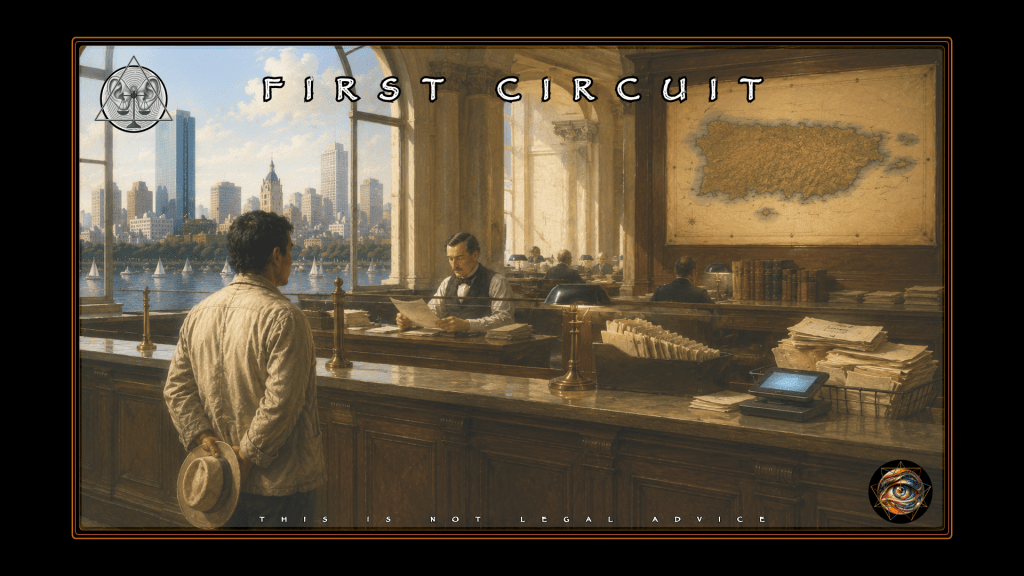
Three million American citizens live under a court they cannot influence and a Constitution that reaches them only in part. They reside in Puerto Rico. They vote for no president, send no voting member to Congress, and answer to an appeals court seated two thousand miles north in Boston. There, the judges who decide whether their rights are whole or partial were chosen by an electorate that does not include them.
The arrangement is not an oversight, but a debt more than a century old—one the United States chooses to refinance every generation rather than retire.
The First Circuit Court of Appeals keeps the books on that debt with a tidiness that has become its chief feature. Most courts are known for what they decide. The First is best understood by what it has been assigned to maintain, and by what, when it believes no one is looking, it quietly extends to those whose politics it shares.
Territory
The Court Presides Over Non-Equals
The First Circuit is the smallest court in the federal system, deceptively small. It covers Maine, Rhode Island, New Hampshire, and Massachusetts, a compact and prosperous corner of New England where federal law functions as a stable background condition, the legal equivalent of municipal water that arrives when the tap turns.
Then it covers Puerto Rico, where roughly a third of its human jurisdiction lives, and where the proverbial tap has never run clean.
New England supplies the court a steady diet of the ordinary. Universities, hospitals, biotechnology firms, and the citizenry all treat the Constitution as a settled inheritance. Puerto Rico supplies something the other forty-six states never present in quite this form: a population whose constitutional status has never been resolved, attached to a debt crisis larger than most sovereign defaults, governed at a remove by a Congress in which it has no vote.
Two courts share one robe. The first tends a garden that needs little more than weeding. The second administers a question the nation has refused to answer for a hundred and twenty-five years and counting. The ledger only grows longer every term, the interest compounding quietly in the back pages where almost no one reads.
Puerto Rico does not enter the First Circuit as a state with an unusual history. It enters as a jurisdictional category already lowered in value before the panel is drawn. A New England litigant brings a federal right into court. A Puerto Rican litigant brings the right and the prior question of whether the right has fully arrived. The injury has been sorted before the claim begins, and the sorting is not accidental.
The books were rigged at the opening entry.
Reputation
The Court Is Selectively Progressive, Not Moderate
The bar describes the First Circuit as moderate, careful, and institutionally modest. The description is accurate for nearly everything the court touches in routine commercial, criminal, and administrative litigation. It swings for no doctrinal fences. It manufactures none of the ideological set pieces that make other circuits famous. The lawyer who draws it expects competence rather than adventure.
That reputation, however, obscures a regional ideological center of gravity that becomes visible the moment the case touches something the Boston legal culture treats as settled.
In 2011, the court decided Glik v. Cunniffe, holding that the First Amendment protects a citizen’s right to openly record police officers performing their duties in a public park, and that the right was clearly established, so that officers who arrested a peaceful bystander for filming them were not entitled to qualified immunity. The decision was correct, widely praised, and subsequently adopted as persuasive authority by courts across the country. It is also the circuit’s most celebrated civil liberties ruling, and its politics are not incidental to its reception.
In 2020, the court went further. A unanimous panel affirmed Harvard University’s race-conscious undergraduate admissions program in full, holding that the program’s holistic use of race as one factor among many satisfied strict scrutiny under Title VI, complied with four decades of Supreme Court precedent, and produced no impermissible racial balancing. The opinion ran to a full bench-trial record; this was not a facial challenge or a close procedural question.
The court had every fact available and reached its conclusion with the confidence of a body whose regional assumptions and the assumptions of the institution it was reviewing happened to be identical.
In 2023, the Supreme Court reversed. It held that Harvard’s program violated the Equal Protection Clause because it lacked sufficiently focused and measurable objectives, used race in ways that were negative and stereotyping in effect, and had no meaningful end point. The First Circuit had read Grutter v. Bollinger as broader than the institution that wrote it intended, because the court was situated in Cambridge, and Cambridge had never doubted the answer.
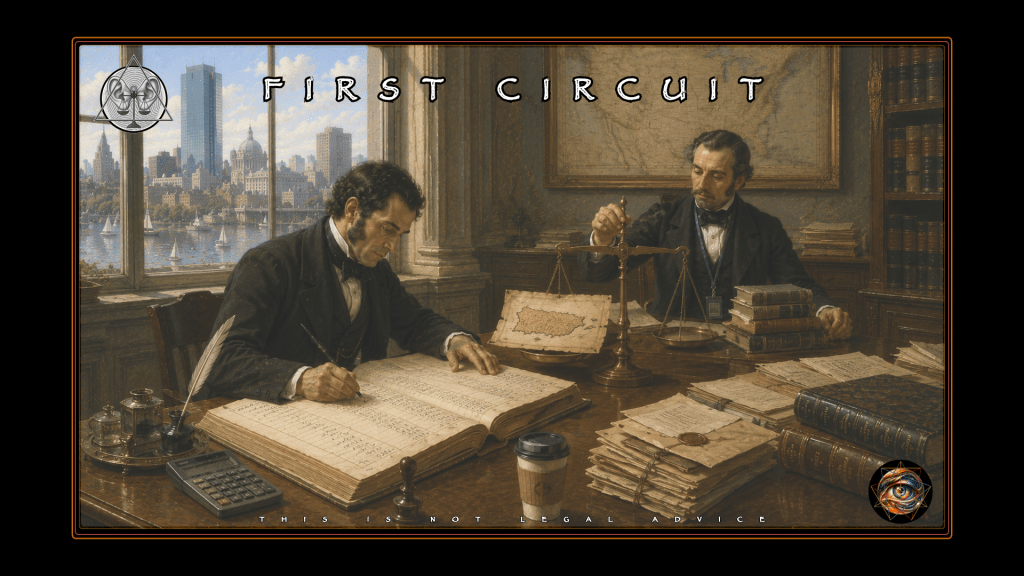
The Puerto Rico cases expose a third register, distinct from both the civil-liberties progressivism and the routine moderation. Confronted with the territory’s status, the court cannot be moderate. Moderation would mean applying ordinary constitutional analysis, which would expose a contradiction the court has no authority to resolve. What looks like restraint in those moments is closer to a clerk declining to total a column he suspects will not balance. The modesty is doing work. It trains everyone around the doctrine to experience colonial exception as a sequence of narrow holdings, each small enough to defend, none large enough to force confession.
The injustice survives because it is never made to appear whole in a single frame.
History
The Cage Was Built in 1901 and Nobody Will Open It
The character of this court was set decades before the modern circuit map existed, in a cluster of Supreme Court decisions now called the Insular Cases. The Court held in 1901 that some territories belonged to the United States without becoming part of it, which meant the Constitution would reach their residents only in fragments, only where Congress saw fit. The doctrine was conceived in the same legal climate that produced the era’s segregation rulings, and it has never been formally repudiated.
In Downes v. Bidwell, the Court invented a distinction found nowhere in the constitutional text, separating incorporated territories bound for statehood from those merely acquired and held indefinitely as possessions.
Puerto Rico fell into the second category, described as foreign in a domestic sense, belonging to the nation without being of it. The doctrine reached its fullest expression in 1922, when the Court held in Balzac v. Porto Rico that a citizen of Puerto Rico possessed no constitutional right to a jury trial, the jury being, in the Court’s judgment, not fundamental enough to follow the flag.
Scholars now shelve these rulings beside Plessy and Dred Scott in what they call the anticanon, the cabinet of decisions so discredited that lawyers cite them only to condemn them. The difference is that Plessy and Dred Scott were overruled. The Insular Cases never were. They occupy the active shelf and the disgraced shelf simultaneously, a precedent no one defends and no court has buried.
The doctrine’s most durable achievement was not legal but cognitive. It taught the legal profession, and by extension the public, to treat the territorial question as a specialized category requiring specialized knowledge, rather than as a straightforward question of whether American citizens hold American rights. A body of doctrine presented as complex enough to require expertise is thereby functionally insulated from ordinary moral judgment. The First Circuit inherited the daily job of administering that doctrine. The judges did not pour the foundation., nor did they raise the walls. They have, however, kept the structure in good repair across decades, repointed the mortar when it crumbled, and ensured the doors still lock.
There is a name for someone who maintains a cell he did not build, who feeds the occupant, who keeps the latch oiled and the key in his pocket.
Implication
The Doctrine Fractures in Two Directions—Only One Is Visible
The most instructive modern demonstration of the Puerto Rico fault-line arrived through the litigation over the island’s debt, where Congress installed a federal control board under a 2016 statute called PROMESA. The board’s members, none of them elected by anyone on the island, held the power to veto or rewrite the laws passed by Puerto Rico’s own legislature. The First Circuit, in an opinion written by Judge Juan Torruella, its only Puerto Rican member and the most relentless critic the Insular Cases ever faced on a federal bench, treated those members as federal officers who should have faced Senate confirmation under the Appointments Clause.
Torruella spent thirty-six years arguing in print that the Insular Cases amounted to political apartheid, and he died in October of 2020 before learning the outcome. The Supreme Court reversed. It held that the board’s members were territorial officers rather than federal ones, built the result on the Territories Clause rather than on the Insular Cases, and declined to name the Insular Cases at all, preserving the typical New England exceptionalism through a side door while sparing itself the need to defend the front.
That fault-line, however, does not run only through Puerto Rico.
A far less examined fracture runs through every courthouse in Maine, Rhode Island, New Hampshire, and Massachusetts. In 2018, a Maine state trooper shot and killed an armed civilian. The First Circuit, in Conlogue v. Hamilton, affirmed summary judgment for the trooper on qualified immunity grounds. The panel applied the standard two-step inquiry and held that, under the totality of circumstances, with an individual perceived as a threat, it was not clearly established that the shooting violated the Fourth Amendment, and thus the trooper was shielded from liability.
Seven years earlier, the same court had held in Glik that it was clearly established that arresting a man for filming police in a public park was unconstitutional. The right to hold a phone in Boston Common was clearly established. The right not to be shot in Maine was not.
Another fracture appeared in May 2026, quieter than either of the first two and more structurally revealing than both.
In Courtemanche v. Noble, four Worcester County residents alleged that the Massachusetts State Police had secretly recorded their telephone conversations with officers, stored those recordings in an online database, and used them to initiate charges in at least 181 criminal cases without disclosing the recordings’ existence to the prosecutors who brought those cases. The plaintiffs sought declaratory and injunctive relief; none faced pending charges. The First Circuit reversed the district court and dismissed for lack of standing, holding that generalized exposure to a secret recording database, without a concrete and imminent personal future harm, is insufficient to invoke federal jurisdiction for prospective relief. The court that gave citizens the right to record police in 2011 held in 2026 that citizens secretly recorded by police could not yet prove they had been harmed enough to challenge the practice.
Surveillance-based harm is structurally incapable of satisfying the imminence requirement because the secrecy that makes the surveillance possible is the same condition that makes the harm invisible until the government chooses to deploy it—by then the injury is retrospective, and prospective relief is moot.
These decisions differ in mechanism but converge in result. The routing diagram sorted your claim into a register where the injury cannot be named for what it is. In Puerto Rico cases, the court cannot apply the normal tools because the Insular Cases have declared them the wrong instrument. In excessive force cases, the court declines to apply the normal tools because qualified immunity permits the declination wherever the legal question can be characterized as unsettled. In surveillance cases, the court cannot reach the tools at all because standing doctrine closes the door before any instrument is selected.
The injured Puerto Rican, the dead civilian in Maine, and the Worcester County resident whose voice sits in a police database arrive at the same courthouse through different doors and exit with the same verdict.
Objection
The Paradox Has a Face, and Wears a Robe
The unresolved Puerto Rico question is foundational rather than technical, and the Court has begun, haltingly, to circle it. In 2022 a man named José Luis Vaello-Madero gave the doctrine a face. He had earned disability benefits while living in New York, moved to Puerto Rico to care for his wife, kept collecting the aid he was owed, and then watched the federal government sue to claw back twenty-eight thousand dollars on the theory that a citizen forfeits such help by crossing to the island. The Supreme Court agreed that Congress could draw the line that way.
Justice Gorsuch, in concurrence, called the Insular Cases shameful, wrote that they rested on racial stereotypes rather than on anything in the Constitution, and warned that the ruling only deferred a reckoning long overdue. Justice Sotomayor, in dissent, called the old cases odious and wrong. The reckoning did not arrive.
Months after Gorsuch issued his invitation for an appropriate vehicle, one appeared. A challenge out of American Samoa called Fitisemanu asked the Court directly whether the Insular Cases should fall, and the Court declined to hear it. The doctrine endures instead by the method Gorsuch named with open contempt: the steady reclassification of one more right as fundamental so that it can be handed down to the territories, the rotten footing left undisturbed beneath each new floor.
The qualified immunity objection has no Gorsuch concurrence.
No Justice has called the doctrine shameful in print, although several have questioned it. The objection lives instead in the contrast the doctrine’s own logic cannot explain, which is why the court that announced the right to record police in Glik is the same court that announced the right to shoot armed civilians in Conlogue and then held in Courtemanche that citizens recorded without their knowledge cannot challenge the practice until the government decides to use the recording against them. All three decisions are defensible in isolation. The doctrine of clearly established law asks whether the specific right was placed beyond debate by prior precedent, and in each case the court answered honestly according to its own lights.
The problem is what honesty produces when the doctrine’s architecture allows judges to define the right narrowly enough that no prior case will ever have placed it beyond debate, and when standing doctrine allows the government to defeat systemic challenges by pointing to the very secrecy that makes individualized harm impossible to allege. Glik traveled as precedent because its politics made it useful. Conlogue settled quietly because its politics made it comfortable. Courtemanche will be cited by police departments because its logic makes surveillance self-insulating.
Verdict
Competence is How Injustice Survives—Assumption Is How It Travels
A bad court would have forced a reckoning long ago. Cruelty draws scrutiny, scrutiny draws repeal, and a flamboyant judge applying a colonial doctrine with visible relish would have handed reformers the spectacle they require. The First Circuit has supplied no such spectacle. It has administers doctrine the way a practiced anesthesiologist administers a drug: smoothly, professionally, without the patient ever feeling the needle find the vein.
The routing diagram’s deepest function is not to deny the injury but to reclassify it into a register where the injury cannot be named as what it is. A Puerto Rican litigant’s claim does not arrive in Boston as a civil-rights matter in the ordinary sense. It arrives pre-classified as a territorial question, governed by a different precedent and reaching different conclusions. The litigant who enters the system presuming a right to equality exits with a ruling on whether the right has reached the island yet. The Insular Cases survived a century not despite the competence of the courts that applied them but because of it. Honest judges kept the books so neatly that the debt never came due.
Torruella spent thirty-six years trying to force that audit from inside the firm, and the firm outlasted him.
The Harvard case adds a dimension the Puerto Rico cases alone cannot supply. The court that kept the colonial books so neatly that the debt never became visible is the same court that affirmed Harvard’s admissions program so confidently that it never considered the possibility of a Supreme Court operating from a different center of gravity. With Puerto Rico, the court knows what it is doing and performs its assigned function with professional care. With Harvard, the court did not know what it was doing because it could not see outside its own regional assumptions.
Competence, regional consensus, and institutional self-assurance are the same instrument played in three different keys. All three produce the same note: a court whose virtues are locally calibrated and nationally unreliable. The kindest thing this court could do for the people it governs would be to fail at its assigned task loudly enough that the country is finally made to notice. The unkindest thing it does, day after day, is succeed.
What the First Circuit Teaches, the Second Complicates
The First Circuit leaves behind a single lesson, and not the one you expect. Competence is supposed to cure injustice, yet here it is the preservative. A century of careful bookkeeping keeps the debt to Puerto Rico from ever coming due, because a court that applied the Insular Cases sloppily would have forced the audit generations ago. The injustice survives because the clerks are good at their jobs. Hold that paradox in mind, because the next court inverts it. The First Circuit knows exactly what it is and resents it; the Second cannot feel its own captivity at all.
The lesson here is not only that location matters, but that courts teach the country how to perceive location. The First Circuit teaches distance as bookkeeping. The Second Circuit will teach proximity as judgment. The variety it has practiced longest is that of a body that has circled Wall Street long enough to mistake the orbit for the center of the universe.

Leave a comment