Most wealth taxes never get tested because they never get passed. California’s proposed Billionaire Tax Act has accomplished something rarer: it has revealed the precise velocity at which capital abandons a jurisdiction when threatened. Within a single month of the announcement, $700 billion crossed state lines. The initiative remains a proposal, months from any ballot, yet the measurement has already begun.
Larry Page converted or relocated more than forty-five limited liability companies to Delaware and Florida in December 2025, purchasing a $72 million mansion in Miami’s Coconut Grove on Christmas Eve. Sergey Brin moved fifteen LLCs to Nevada. Larry Ellison completed the sale of his San Francisco home on December 30 for $45 million, marking the city’s largest residential transaction of the year. Peter Thiel and David Sacks announced residency changes on New Year’s Eve. The departures clustered around a single week because that week determined a decade of tax exposure. These are not abstract statistics; they are forwarding addresses that spell out a map of where capital now prefers to live.
The combined net worth of Page and Brin exceeds $500 billion; their combined potential tax liability under the proposed 5% rate would have exceeded $25 billion. Ellison’s $192 billion fortune would have triggered a $9.6 billion bill. The arithmetic explains the urgency of their calendars. A single week of residency planning saved these three men alone more than $40 billion in potential taxation. The scale of that savings dwarfs the cost of any mansion, any relocation expense, any disruption to routine.
Capital is rational, and rational capital moved.
The Service Employees International Union filed Initiative 25-0024 proposing a one-time 5% wealth tax on California residents whose net worth exceeds $1 billion, with a retroactive effective date of January 1, 2026. The retroactive provision was designed to prevent exactly what happened; the theory was that billionaires could not escape a tax that applied to their status on a date already past. The theory failed because lawyers work faster than legislators anticipated. By the time the proposal became public, the countdown had begun. It ended on New Year’s Eve with a parade of announcements that read like a roll call of Silicon Valley’s founding generation heading for the exits.
Chamath Palihapitiya, a venture capitalist with direct visibility into the region’s wealth flows, documented the contraction in stark terms: California’s billionaire wealth pool fell from approximately $2 trillion to $1.3 trillion within a single month of the announcement. The decline represents permanent erosion rather than temporary repositioning. Once a billionaire establishes residency in Texas or Florida before the cutoff date, the tax cannot reach them regardless of the initiative’s electoral fate. The tax base has become a river delta, with capital branching into channels that flow away from the source and cannot be recalled.
The Speculator’sedge lies in the ability to distinguish between trades that are positioned for geographic reallocation and those that require structural confirmation before conviction scales. This framework therefore sorts eight tickers into three categories based on execution readiness rather than thesis alignment. Two names are ready for immediate deployment. Four names require specific triggers before entry. Two names require breakdown confirmation before shorts activate.
The capital flows are documented, the beneficiaries are identifiable, and the question is not whether to act but when.
Names Positioned for Immediate Entry
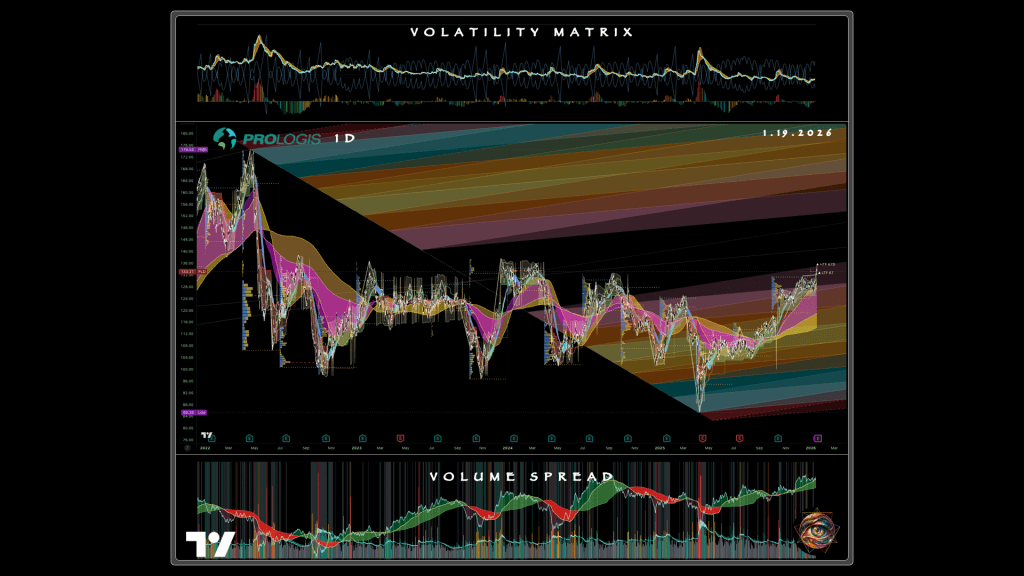
Prologis at $133.21 presents the cleanest opportunity among the directional plays. The company owns industrial logistics properties across Texas, including distribution centers in Dallas-Fort Worth and Houston that serve the very companies relocating from California. Every warehouse handling goods for a firm that fled Sacramento represents demand flowing through Prologis assets. When Apple ships components to its Austin campus or its Houston AI server facility, those components move through logistics networks that Prologis properties serve. The connection between billionaire relocation and industrial real estate demand is not metaphorical; it is physical, traceable, and ongoing.
The chart confirms what the thesis implies: institutional buyers have been steadily accumulating shares after the 2022 correction, and the price is now pressing against a level that, if cleared, opens a path toward $150-160. The structure resembles a patient recovering from fever, with vital signs improving and the worst clearly past. The participation is steady rather than episodic, which separates Prologis from speculative names that spike on headlines and fade on silence.
The trade is straightforward. Acceptance above $140 activates the long thesis. Failure to hold $125 invalidates it. The industrial logistics exposure captures nearshoring, e-commerce fulfillment, and the physical infrastructure required to support relocated corporate operations. Prologis does not need California to collapse. It needs Texas to keep absorbing inflows, which the data confirm is already happening. The company reported occupancy rates above 97% in its Texas portfolio during the most recent quarter, a figure that leaves little room for doubt about demand.
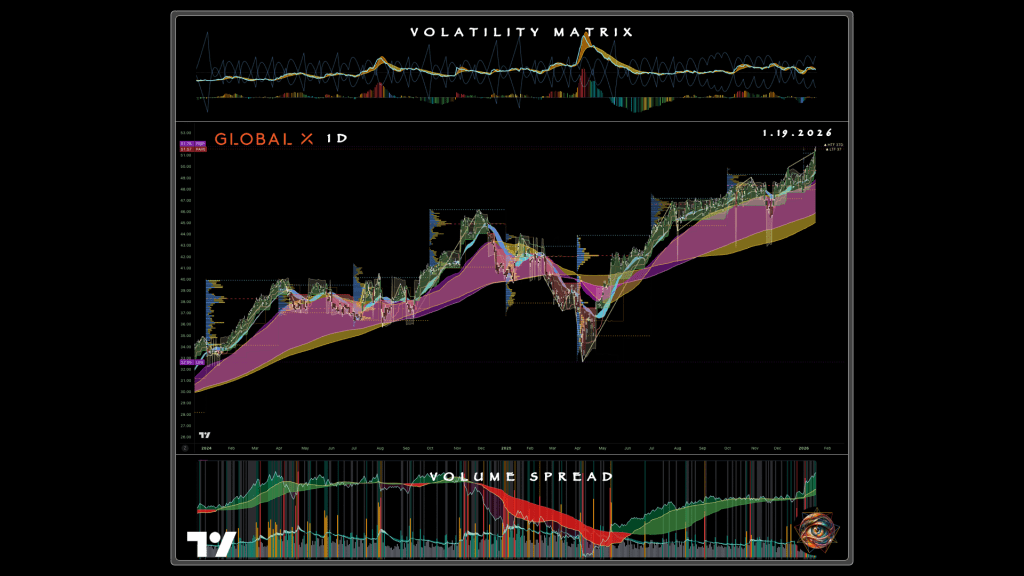
The Global X U.S. Infrastructure Development ETF at $51.57 operates in confirmed breakout territory. The Texas Department of Transportation has announced a $148 billion ten-year investment program, with the agency estimating $29.4 billion annually in economic benefits and 71,500 jobs across the project timeline. These are not aspirational figures; they represent appropriated funds flowing through approved projects. Construction firms, engineering consultancies, and materials suppliers flow through this ETF’s holdings, creating direct exposure to spending that has already been authorized and is already being disbursed.
Its chart shows a staircase pattern where each pullback finds support at a higher level than the prior pullback, the kind of structure that rewards patience on dips rather than chasing at highs. The pattern has persisted for years, suggesting that buyers remain organized and willing to defend their positions. This is a mature trend offering reliability rather than excitement. Pullbacks to the $49-50 range offer entry if the breakout holds; loss of $47-48 would signal the trend has failed. The risk is not that Texas stops building but that the market prices in the buildout before it completes.
For now, the chart suggests the pricing remains incomplete.
Texas positioned itself as the primary receiving basin through zero state income tax, aggressive infrastructure investment, and deliberate cultivation of technology sector relocations. The state has been running this playbook for years. Oracle moved its headquarters from Silicon Valley to Austin in 2020, Tesla followed in 2021, and the pattern accelerated after the pandemic normalized distributed workforces. The California exodus is not an aberration. Rather, it is the acceleration of a trend that predates the billionaire tax by half a decade.
Google committed $40 billion to three new Texas data centers through 2027. The Stargate AI infrastructure project involves $500 billion in total national investment with multiple Texas sites. Apple’s Austin campus represents a $1 billion investment across 133 acres with capacity for fifteen thousand employees. The Houston facility opening in 2026 will produce servers supporting Apple Intelligence. The buildout is not speculative; ground has broken, steel has risen, hiring has begun. The question for investors is not whether the capital will arrive but how to position for its arrival.
Phase one deployment allocates 40% of target capital to these two names immediately. The structures are ready; waiting for better prices risks missing the move entirely.
Names Requiring Confirmation Before Entry
CleanSpark at $13.37 anchors the power infrastructure thesis, and the thesis is elegant in its simplicity. Data centers consume electricity at industrial scale. A single large AI training facility can draw more power than a small city. The ERCOT grid serving Texas has finite interconnection capacity, and the queue for new connections stretches years into the future.
Whoever controls the power controls the chokepoint through which all expansion must pass.
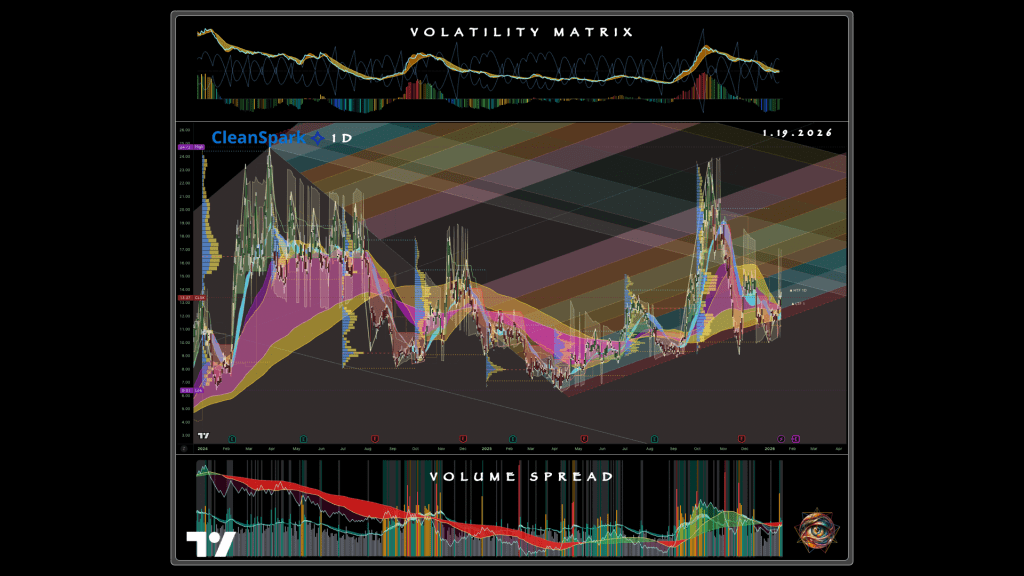
CleanSpark announced 890 megawatts of aggregate capacity near Houston in January 2026, enough to power approximately 200,000 of the advanced chips used in AI training. The company is positioning itself as an enabler of the buildout by owning the resource that constrains it. Google’s $40 billion Texas data center commitment and the Stargate project’s $500 billion national investment create demand for exactly the kind of power capacity CleanSpark controls. The question is whether CleanSpark can convert that positioning into contracts, the contracts into revenue, and the revenue into stock price appreciation.
The chart tells a more cautious story.
The stock ran from $6 to nearly $25 in the prior cycle, then collapsed back toward the current level. The rubble from that collapse has not yet been cleared; overhead supply from investors who bought higher and want out will pressure any rally until the stock proves it can absorb that selling. The 28% short interest creates reflexive potential. If the stock rises past certain levels, traders who bet against it must buy shares to limit their losses, which pushes the price higher still, forcing more buying. Still, the squeeze needs a catalyst: a hyperscaler partnership, a Stargate project contract, anything confirming that the 890 megawatts will serve AI infrastructure rather than sit idle.
The trigger is $14.20 for initial interest, $16-17.50 for conviction. Below $10-11, the thesis fails. The resolution window spans two to six months; this is a name to prepare for rather than chase.
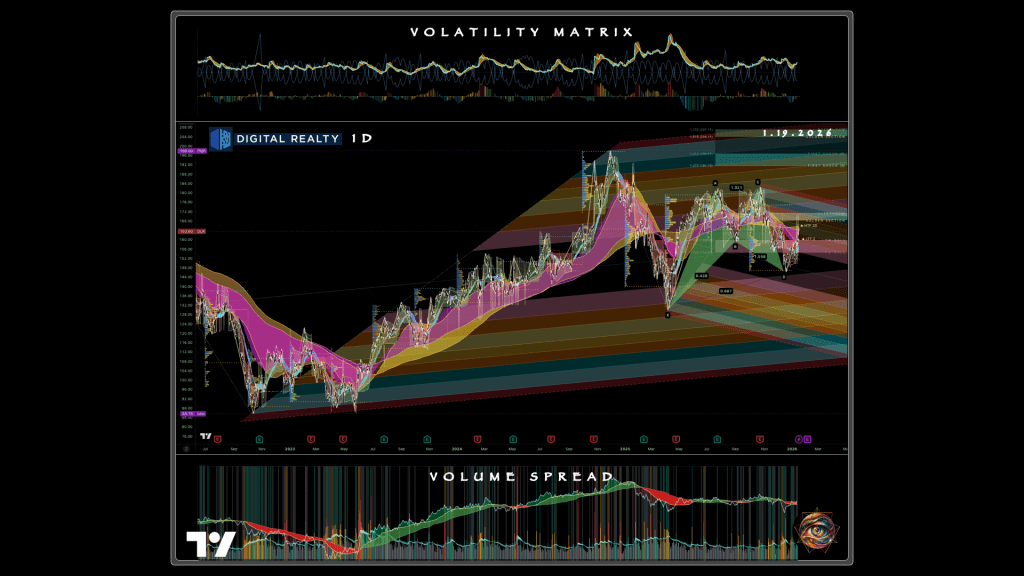
Digital Realty Trust at $163.60 functions as institutional-grade exposure to the data center buildout. The Dallas-Fort Worth region now hosts 141 of the nation’s 279 operational data centers, a concentration that reflects both the region’s power availability and its central geographic position for serving traffic across the continent. Digital Realty owns significant share of that footprint, with campuses that house servers for some of the largest technology companies in the world.
Google’s $40 billion commitment to three new Texas facilities through 2027 and the Stargate project’s $500 billion in national investment create demand tailwinds the company is positioned to capture. The customers signing leases today are not speculating on future AI demand; they are building capacity for products already in development, products that will require compute resources measured in exaflops rather than teraflops. Digital Realty provides the physical envelope for that compute.
The chart shows a name stuck between buyers and sellers, with neither side willing to commit.
The stock reached $198 last cycle and has been digesting that move ever since, rotating in a range that rewards neither bulls nor bears. The indecision resolves when price breaks above $175 or fails below $145, and the direction of the break determines whether this becomes a buy or remains a pass. The current position in the middle of the range offers poor odds; the range tends to produce churn that erodes capital without providing directional clarity. Patience serves better than aggression here.
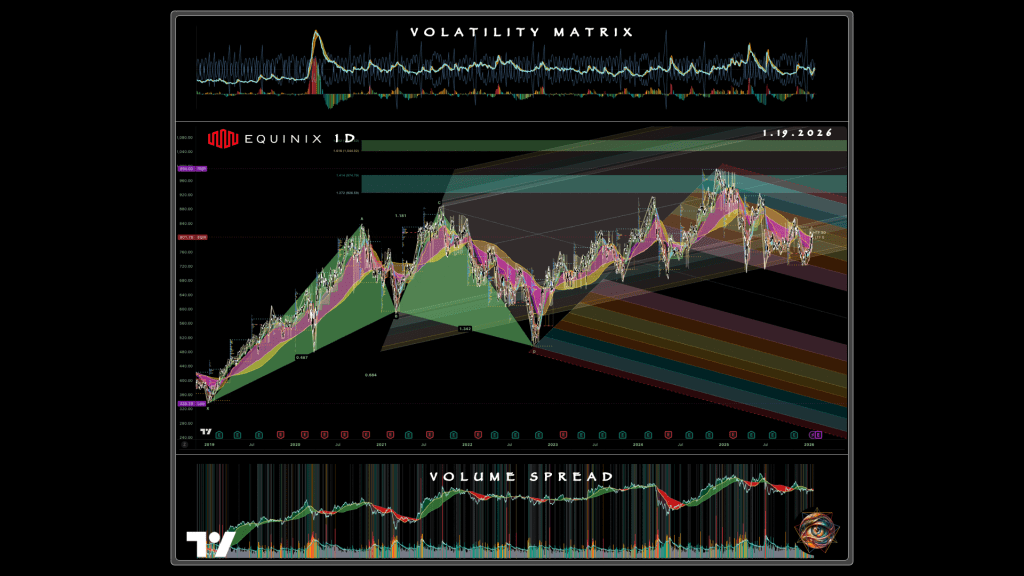
Equinix at $801.78 presents the strongest underlying structure of any name in this set. The company has rewarded patient investors for two decades, surviving the dot-com crash, the financial crisis, and the 2022 rate shock while continuing to reach higher prices over time. This is the kind of track record that earns the benefit of the doubt; when a company has navigated that many crises without breaking its uptrend, the presumption shifts in favor of continuation rather than reversal.
The chart suggests that pattern remains intact, with the current consolidation appearing as a pause within a larger advance rather than a termination. The $840-880 zone is the decision point; acceptance above activates the path toward the prior high near $994 and potential new territory beyond. The company’s interconnection revenue model, where customers pay not just for space but for the ability to connect directly to other customers within the same facility, creates switching costs that support pricing power and margin stability.
The caveat is location within the range. The stock currently sits in a band where neither buyers nor sellers have the upper hand, the kind of zone that produces false signals and whipsaws. Entry on a pullback toward $740-780 offers better odds than chasing at current levels.
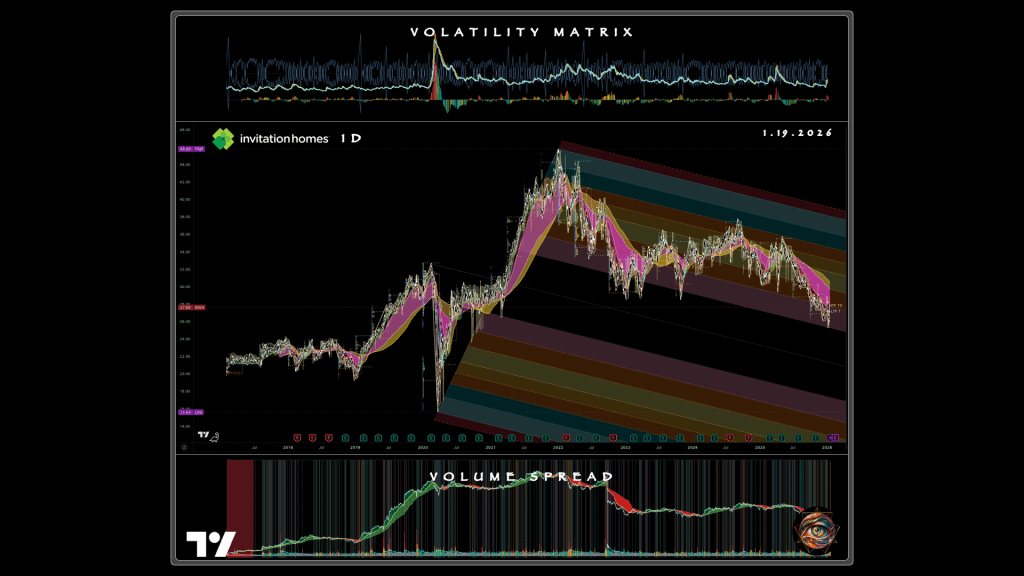
Invitation Homes at $27.65 captures residential demand from relocated workers through single-family rentals concentrated in Dallas-Fort Worth, Houston, and Austin. The thesis is intuitive: every engineer who moves from Cupertino to Austin needs housing, and single-family rentals serve a demographic that wants space without commitment to a thirty-year mortgage in an unfamiliar market. The 7.7 million people who fled Venezuela since 2014 included many who ended up in Texas; the engineers fleeing California’s tax regime will add to that demand in neighborhoods where Invitation Homes owns properties.
The chart does not yet confirm the thesis.
The stock has been declining since 2022, making lower highs in a persistent channel that rewards sellers on rallies. The current position near the channel floor creates a decision point: either the floor holds and a grind toward $31-35 begins, or the floor fails and the stock falls toward $22-24. The fundamental demand may exist, but the chart shows supply that has not yet been absorbed. Investors who bought at $40 or $45 are still looking for exits, and their selling pressure caps every attempted rally. A sustained hold above $31 would shift the picture; until then, the trade requires patience.
Phase two deployment allocates 40% of target capital to these four names upon confirmation at their respective trigger levels. The catalyst calendar governs timing. Apple’s Q1 earnings in late January may validate Texas expansion through commentary on Austin hiring or headcount shifts from Cupertino. SEIU signature certification in late February will confirm ballot qualification and potentially accelerate departure announcements from billionaires who had been waiting for certainty about the initiative’s viability. California’s budget revision in May will quantify the deficit impact of the exodus, potentially triggering credit rating agency responses that further pressure California-exposed assets. The November ballot vote functions as the terminal catalyst for the cycle.
Names Requiring Structural Failure for Short Entry
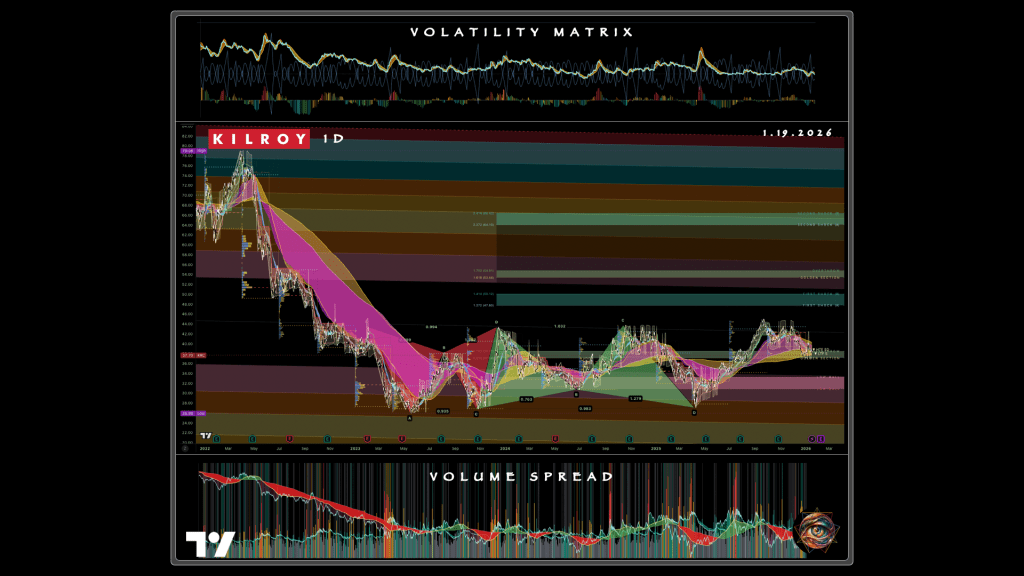
Kilroy Realty at $37.70 represents the California office short thesis. The company’s West Coast concentration in San Francisco and San Diego creates direct exposure to tech exodus and remote work persistence. Office vacancy in San Francisco has reached levels not seen since the early 1990s, and the tenants who left are not coming back; they discovered during the pandemic that they could operate from Texas or Florida or anywhere with broadband, and many chose to make that discovery permanent. The sublease market in San Francisco remains flooded with space that companies leased before 2020 and no longer need.
The chart shows a name that has been declining for years but has not yet broken down decisively. The stock is stuck in a repair range, bouncing between support and resistance without committing to either direction. The short thesis activates when that support fails—specifically, when the $31-33 zone gives way and selling accelerates. Until then, the middle of the range offers poor risk-to-reward for shorts just as it does for longs. Shorting a stock that is already down 60% from its highs carries the risk of a squeeze if any positive catalyst emerges; the better entry comes after the structure confirms that sellers remain in control.
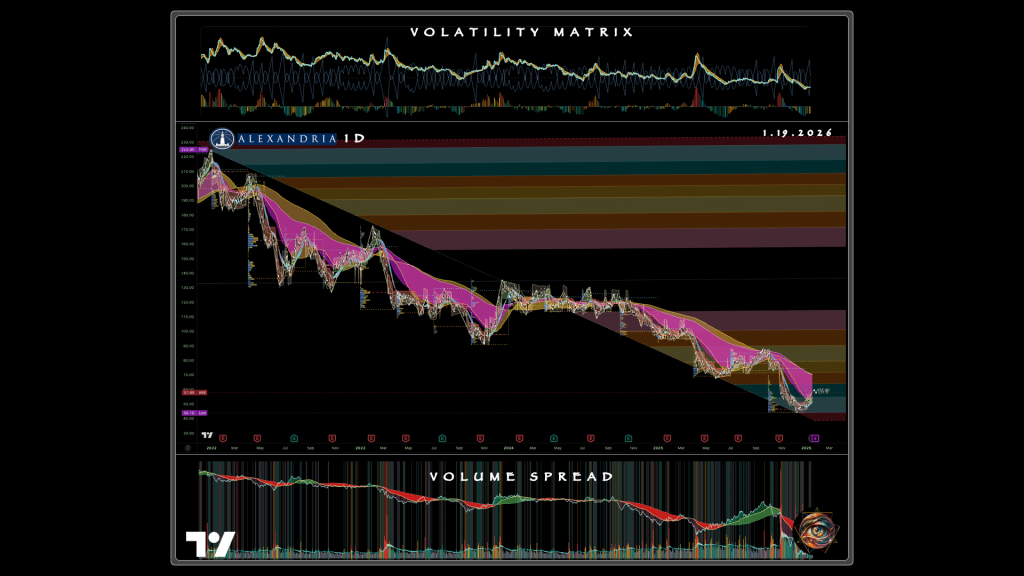
Alexandria Real Estate Equities at $57.89 provides the life science and technology campus angle on the California short. The company built its business around the idea that biotech and tech companies want purpose-built campuses in innovation clusters, with San Francisco, San Diego, and Boston as the primary markets. The thesis worked brilliantly for a decade. The pandemic and its aftermath broke something in that thesis; the same companies that once paid premium rents for the privilege of clustering near other companies discovered that their scientists could collaborate over Zoom and their engineers could code from anywhere.
The chart tells a stark story: the stock peaked above $224 in 2022 and has been falling ever since, losing more than 70% of its value in a decline that accelerated rather than moderated as time passed. The overhead supply from investors who bought higher creates a glacier that presses down on every attempted rally. Years of accumulated losses sit above the current price, and those losses belong to investors who will sell into any strength to recover what they can.
The recent bounce from the $44-46 lows looks like exhaustion rather than reversal, a reflexive snap after the selling temporarily exhausted itself. The short thesis requires rejection at the current $57-60 zone and sustained trading below $50 to confirm that sellers remain in control. The $44-46 floor defines whether the base holds or fails into a fresh leg lower. The weekly trend remains down; the burden of proof lies with the bulls.
Phase three deployment allocates the final 20% of target capital to short positions upon structural failure confirmation. The November ballot vote is the terminal catalyst; passage accelerates the exodus and pressures California commercial real estate further, while failure provides temporary relief that creates better short entry on the subsequent rally into resistance.
The Pressure Test
Three scenarios govern how this trade unfolds, each with different probability weight and different implications for position management.
The managed reallocation scenario carries 50% probability. The billionaire exodus continues through 2026. The tax either fails at the ballot or survives court challenge but collects less revenue than projected because so much of the tax base has already departed, and Texas infrastructure absorbs the inflows without significant oversupply. In this scenario, the positioned names reach their targets, the confirmation names trigger and advance, and the shorts activate on structural failure.
Portfolio return: 30-45% over eighteen months.
The policy reversal scenario carries 30% probability. Voters reject the billionaire tax in November 2026, or courts strike it down before the election on constitutional grounds, reducing urgency for additional departures. The relocations already completed remain permanent—Page is not moving back to California, and neither is Brin or Ellison—but the catalyst pressure diminishes for those who had not yet moved. California commercial real estate stabilizes rather than collapses; the shorts do not trigger. The Texas longs perform but with muted returns as the demand surge moderates.
Portfolio return: 15-25% over eighteen months, concentrated in infrastructure rather than individual names.
The structural overshoot scenario carries 20% probability. Texas absorbs too much capital too quickly, creating oversupply that mirrors what California experienced. Austin office vacancy, already elevated at 24-25%, spreads contagion into industrial and multifamily as developers who broke ground during the boom deliver projects into a market that has absorbed all it can. The longs that triggered on confirmation give back gains; the shorts that activated face rallies that test discipline.
Portfolio return: -5% to +10% over eighteen months, depending on risk management execution.
The behavior that would confirm each scenario is observable in real time. Managed reallocation shows the positioned names clearing their trigger levels and continuing higher on steady participation. Policy reversal shows the confirmation names failing at their triggers and returning to range while the shorts consolidate without breaking down. Structural overshoot shows the positioned names reaching targets and then reversing as new supply announcements appear in Texas commercial real estate filings and occupancy data begins to soften.
The defense contractors in that thesis benefit from the same infrastructure buildout that supports this thesis, particularly those with San Antonio aerospace presence. Position sizing should account for correlation; a full allocation to both portfolios doubles Texas concentration in a way that amplifies both upside and downside. The prudent approach reduces allocation to overlapping names or treats the combined position as a single Texas infrastructure play with diversified expression across real estate, power, and defense.
The Permanent Auction
The California billionaire tax did not cause the exodus. It revealed that the exodus was already possible. The deeper structural truth is that agglomeration advantages have eroded across all jurisdictions. The network density, regulatory familiarity, and talent concentration that once made Silicon Valley departure unthinkable have diminished as remote work normalized and competing states invested in their own infrastructure.
The same forces enabling billionaires to relocate in a week enable:
companies to distribute operations across multiple states
workers to perform functions from anywhere with broadband
capital to flow toward opportunity rather than tradition
Texas is not a destination, but the current bid in an auction that never closes.
The state offers zero income tax today, but that offer is a policy choice rather than a constitutional guarantee. The infrastructure buildout that makes Texas attractive requires continued investment that requires continued revenue. The risk is that the state could eventually require taxation of the wealth it has attracted. Florida offers the same proposition with different constraints. Nevada offers proximity to California without California’s burden. This competition among states for mobile capital has no equilibrium because the capital itself selects for mobility. The billionaires who chose Texas in December 2025 chose it because it was the best option available at that moment.
If a better option emerges, they will choose again.
The commercial real estate arbitrage operates on the same logic. California office properties trade at distressed valuations because tenants discovered that they can operate elsewhere. Texas industrial properties trade at premium valuations because logistics networks require physical presence, at least for now. The spread captures the difference in demand, yet demand itself is a function of decisions that can reverse. The same technology enabling California departure enables Texas departure if circumstances change. The work-from-anywhere revolution that hollowed out San Francisco’s office towers could hollow out Austin’s if another jurisdiction offers better terms to the next generation of founders.
Anyone profiting from this trade will eventually face the question the billionaires faced: when does the current location favor departure? Pattern recognition applies not only to entry but to exit. The confirmation signals that indicate accumulation in one phase indicate distribution in another. The charts do not distinguish between California and Texas, but between acceptance and rejection, between support that holds and support that fails, between participants who are building positions and participants who are liquidating them. The skill is not knowing which state wins, but in recognizing when the market has made its decision and positioning accordingly.
The measurement continues. The auction continues. Every geographic advantage is temporary, and the only durable edge is recognizing that truth before the crowd.
In the age of sail, frigates did not defeat ships of the line through direct engagement. The mathematics were impossible: a thirty-two-gun frigate could not stand against a seventy-four-gun battleship in a broadside exchange. A battleship’s oak walls were three feet thick. The gun deck carried carronades that could dismast a frigate with a single salvo. Yet frigates won wars. The frigate captain who understood his position did not seek the decisive battle. Rather, he harassed supply lines, captured merchantmen, gathered intelligence, and forced the enemy fleet to disperse its strength chasing shadows across the Atlantic.
Sly strategist that he was, he accumulated small victories that shifted the larger balance without ever risking annihilation.
The Pro Se Litigator faces similar asymmetry. The institution commands more resources, more experience, and more credibility with the court. The courthouse architecture itself palpably communicates the disparity. Fluorescent lights hum above rows of plastic chairs as the bailiff’s studied indifference looks past the clerk’s desk stacked with forty case files that reduce any given matter to one manila folder among many. Direct confrontation on the institution’s terms is a losing proposition. Yet he, too, can prevail, not by overpowering the opposition but by craft and by maneuver. He may decide when and where to engage, and make every filing count toward a cumulative effect that the institution cannot easily counter.
Motion practice is the frigate’s art: inferior firepower deployed with superior positioning.
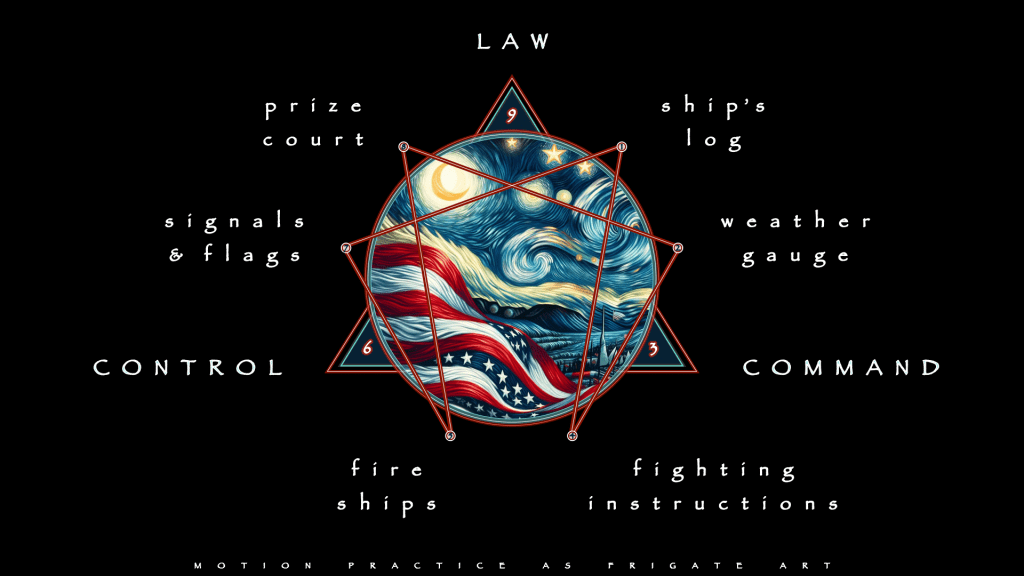
What follows is a primer drawn from Napoleonic naval warfare. The Six Correspondences are not decorative, despite their beauty. Each maps onto a specific behavior. The Pro Se Litigator fluent in these does not thereby become a captain. Mastery of that kind requires years of practice under fire. These principles provide the missing comprehension that separates crewmen from cargo. Cargo is carried. Crewmen participate. At first, the difference is in understanding why the ship turns when it does. Later, the practice becomes the art of knowing how.
Ship’s Log
The Battle Occurs In The Permanent Record, Not The Ephemeral Courtroom
Every naval vessel kept a log, a leather-bound ledger filled daily in the captain’s own hand or that of his clerk. Though the pages yellowed in the salt air and the ink feathered in humidity, the entries accumulated in a cadence as regular as the watch bells. “At four bells of the forenoon watch, sighted sail bearing northeast by east. Cleared for action. At six bells, recognized chase as French merchantman. Fired warning shot across bow. Prize crew away at seven bells.” The log was not merely administrative. It was the legal artifact to be consulted in courts-martial, prize adjudications, and Admiralty inquests years after the voyage ended.
What was not in the log did not officially happen; whatever was therein could not be unsaid.
The case docket is the ship’s log of litigation. Every filing, every order, every transcript entry becomes part of a permanent record that will outlive the hearing, the judge, and perhaps the litigants themselves. The fiction of live courtroom dialogue is that it carries legal weight. In reality, if something is not in the record, it did not happen. The judge may redden with irritation, the opposing counsel may roll their eyes, the courtroom may feel saturated with unspoken hostility. None of it survives. Only the filings survive. The record has no tone of voice. It cannot be intimidated, charmed, or worn down. It simply persists.
Most litigants enter court believing the judge is the audience. This is a category error. The real audience is threefold: the appellate panel that may one day review the record, the public archive to which every filing contributes, and the opponent whose future posture depends on contradictions they cannot later escape. The motion is not a plea to the judge. It is an entry in the log, written for readers who have not yet arrived.
The Pro Se Litigator who understands this writes differently: every sentence composed as though a stranger will read it in five years and judge its author by its precision.
Weather Gauge
Initiative Decides Who Frames The Dispute
Before modern engines, the ship that held the weather gauge held the windward position relative to the enemy. This conferred a decisive advantage: the windward ship chose when to engage, at what distance, and on what terms. Her crew worked the guns on a level deck while the leeward ship heeled away from them, her gunners firing uphill, her lower ports closed against the sea that sloshed through the scuppers. The windward captain could close to pistol range or stand off and punish with long guns; the leeward captain could only receive what was given. A captain who surrendered the weather gauge surrendered initiative; he would fight when and where his opponent chose, on a tilted deck, half-blinded by spray.
Filing initiative is the weather gauge of litigation. The Pro Se Litigator who files first on an issue frames the terms of the dispute. The opposition must respond to that characterization of facts, that selection of legal standards, that construction of the narrative. They are fighting upwind, reacting to a position rather than establishing their own. Surrendering the weather gauge means waiting for the opponent to file, then scrambling to reframe what they have already defined. By then the court has read their version first.
Any response arrives as correction rather than as truth.
Most attorneys file defensively, responding to motions rather than initiating them. This is the leeward posture: safe, conventional, and perpetually reactive. The strategic litigant files offensively, seizing the weather gauge whenever procedural rules permit. A motion filed before the opponent expects it, addressing an issue they assumed would remain dormant, forces them into defensive maneuvering. They must respond on an imposed timeline, in an imposed frame, on an imposed battleground. Initiative is not aggression; it is positioning. The ship that holds the weather gauge need not fire a single shot to control the engagement. The opponent knows, and the knowledge constrains everything they do.
Fighting Instructions
The Reactionary Gap Between Rules and Convention Is Tactical Room To Maneuver
The Royal Navy of the eighteenth century operated under the Fighting Instructions, a codified tactical doctrine that prescribed how engagements should be conducted. Ships were to form a line of battle, engage their opposite number, and maintain formation at all costs. The Instructions were designed to prevent chaos, but they also prevented initiative. Admiral John Byng learned this at the cost of his life: at the Battle of Minorca in 1756, he followed doctrine rather than pressing an attack against a retreating French fleet. He was court-martialed, convicted of failing to do his utmost, and shot by firing squad on the quarterdeck of HMS Monarch. Voltaire’s acid summary endures: the English shot their admiral “pour encourager les autres.” The Fighting Instructions demanded conformity; deviation meant death, even when deviation would have meant victory.
Then came commanders like Nelson, who understood that the Fighting Instructions were not the law of the sea but merely the convention of the service. The rules permitted maneuvers that doctrine discouraged. At Trafalgar, Nelson broke the line in two columns, divided the Combined Fleet, and achieved decisive victory by doing what his opponents assumed no British admiral would dare. He exploited the gap between what was allowed and what was expected. The French and Spanish captains, trained in the same doctrine, could not adapt quickly enough to a battle that refused to follow the script.
Legal procedure has its own Fighting Instructions: the filing schedules, motion formats, and argumentative postures that have hardened into convention through repetition.
Most attorneys follow these conventions because deviation feels risky, because the bar taught conformity, because judges expect predictability. The Pro Se Litigator who studies the actual rules discovers room to maneuver that convention has obscured. A motion filed in an unexpected form, at an unexpected time, addressing an unexpected issue, can disrupt the opponent’s assumptions more effectively than a conventional motion with superior arguments. The institution expects conformity. When it does not arrive, the institution must adapt, and adaptation under pressure produces errors. No one will be shot for breaking formation.
Opponents might, however, lose their balance.
Fire Ships
Force Response; Extract Documentation; Lure Institutions To Leave Fingerprints
The fire ship was a sacrificial weapon, a vessel already condemned. Her crew would load her hold with tar, pitch, faggots of dry wood, and hemp rope soaked in turpentine. They would sail her toward the enemy fleet at night, skeleton crew at the helm, timing their escape to the last possible moment. At the right distance they would light the fuses, leap into a trailing longboat, and row hard for safety while flames climbed the ratlines behind them. At the Battle of the Basque Roads in 1809, Lord Cochrane sent fire ships and explosion vessels against the French fleet anchored in the Aix Roads. The French captains panicked, cut their anchor cables, and ran aground in the darkness. Only four French ships remained in navigable water by morning. The fire ships themselves destroyed almost nothing directly; their value was in the chaos they provoked, the documentation they forced, the courts-martial that followed for French officers who had abandoned their posts.
Some motions are fire ships. They are filed not to win but to force the opponent into costly defensive maneuvers. A motion that raises an uncomfortable issue, even if certain to be denied, requires the opponent to respond on the record. A motion that exposes a procedural irregularity, even if the court excuses it, forces the judge to go on record with the excuse. The denial is not the failure, but the detonation.
What matters is what the fire ship forces into the open.
Too many Pro Se Litigators equate success with a motion being granted. This metric misunderstands the game. A denied motion still obliges the court to articulate a reason, and that reason becomes part of the log. A denial that forces an absurd rationale is more useful than a granted motion that concedes nothing. The fire ship motion is a provocation designed to extract response. It does not ask for relief; it forces documentation. The opponent’s evasion, the judge’s contortion, the institution’s fingerprints on its own failures: these are the fires that spread after the ship has burned. The French captains at Basque Roads were not destroyed by flame. They were destroyed by what the flame made them do.
Signals and Flags
Verbosity Is Noise; Precision Is Signal
Naval communication in the Early Modern era depended on signal flags, a constrained vocabulary of colored pennants that could be read across miles of ocean. The signal book contained hundreds of predefined messages, but no provision for nuance. Captain Home Popham’s Telegraphic Signals of 1800 expanded the vocabulary, yet even Popham’s system had limits. At Trafalgar, Nelson wished to signal “England confides that every man will do his duty,” but “confides” was not in the book; it would have to be spelled letter by letter, costing time the fleet did not have. The signal that flew instead used “expects,” which was in the vocabulary. The message that reached the fleet was not quite what Nelson intended, but it was clear. Clarity was survival. A misread signal could send a ship in the wrong direction, expose a flank, lose an engagement. The flag that flew was the only message that existed.
The court, like a distant ship, reads only what is flagged clearly. Verbosity is noise; precision is signal. A motion that buries its point in qualifications, digressions, and anticipatory rebuttals has hoisted too many flags at once; the message is lost in the clutter. A motion that states its request in a single clear sentence, supported by facts the court can verify and law the court must apply, has signaled effectively. The court may deny the motion, but the court will have understood what it denied, and the denial will be specific enough to matter on appeal.
Most litigants write as though more words meant more persuasion. The opposite is true. Every unnecessary sentence dilutes the signal. Every elaboration beyond what the argument requires provides material for the opponent to mischaracterize. The disciplined motion contains exactly what it needs and nothing more: the request, the factual basis, the legal authority, the conclusion. Strip the rigging to fighting sail. Signal what matters. Let the flags speak without amplification. Nelson could not send “confides.” He sent what the system allowed, what the fleet understood … nothing missing, nothing extra.
The Prize Court
The Appellate Panel Will See Only What Was Written
There was more to Napoleonic naval warfare than sinking enemy ships. The highest ideal was to capture them as prizes. Such a vessel became property to be adjudicated in prize court, an oak-paneled chamber in Plymouth or Kingston or Antigua where clerks turned pages of depositions and judges examined ships’ logs under gray maritime light. The legality of the capture, the distribution of prize money, the conduct of the engagement: all of it was reviewed based on documentary evidence. The captain who fought brilliantly but documented poorly might win the battle and lose the prize. There are records of officers denied their share because the log did not adequately establish that the captured vessel was lawful prize, or because signals were not properly noted, or because the sequence of events could not be reconstructed from what was written. What mattered in the prize court was not what happened but what the log recorded, what the signals showed, what the witnesses could swear to from written orders.
The appellate court is the prize court of litigation.
The trial is the engagement; the appeal is the adjudication. What matters on appeal is not what happened in the courtroom but what the record contains. The judge’s tone, the opponent’s visible discomfort, eloquent oral argument: none of it survives. Only the filings survive. The transcripts survive. The orders survive. The appellate judges were not there; they know only what the paper tells them. A brilliant argument that was not preserved by objection does not exist for appellate purposes. A devastating admission that was not captured in the transcript cannot be cited.
This is why the log matters, why the weather gauge matters, why signals must be clear and fire ships must force documentation. The prize court is always watching, even when the battle feels immediate and local. The Pro Se Litigator who understands this fights differently: not to impress the trial judge but to construct a record that will speak for itself when reviewed by strangers. The captain who lost his prize money in Plymouth because his log was incomplete learned a lesson that cost him years of income. The lesson was not one of seamanship, but documentation. The prize court sees only what was written.
Write accordingly.
Able Seaman
Although the Six Correspondences are mapped and circumnavigated, one thought-provoking essay does not a captain make. Only years at sea can do that. What this essay can do is move you from passenger to crew, from incomprehension to orientation. The cargo below decks experiences the voyage as a series of unexplained lurches, delivered finally to a destination it did not choose. The crew lives in the weather, hands on the lines, feet braced against the pitch and roll, understanding why the helm goes over before the order is spoken.
The Pro Se Litigator who remains cargo will be carried through the legal process by forces that remain invisible, deposited at a judgment shaped entirely by others. He who becomes crew still faces the same winds, the same procedural seas, the same institutional fleet bearing down with superior firepower. The difference is comprehension: knowing why the maneuvers are executed, anticipating what comes next, recognizing the tactics as they unfold.
The next motion filed under these principles will not win a case by itself. What it can do is enter the log in chosen terms, seize or maintain the weather gauge, and exploit the gap between rules and convention. No single broadside wins a naval campaign. It can, however, force a response that documents what would otherwise remain hidden, signal clearly to a court that reads only what is flagged, and build a record that will speak in the prize court that one day may convene.
The difference between cargo and crew is not talent, or resources. The decision to learn how the ship moves and why is only the beginning. That knowledge is available to anyone who seeks it, but knowledge is not power. The seeking is work. Work is the point.
The circulating RICO narrative may be more political technology than prosecutorial reality, but the distinction matters less than critics assume. Democrats built something over the past few decades that functions beautifully as a political machine and terribly as a defensible position. The word “enterprise” doesn’t need a conviction to leave a mark.
Somewhere in the apparatus of the second Trump administration, someone is reportedly thinking about RICO. Not as a case filed, not as an indictment sealed, but as a concept, a shape, a way of looking at the opposition that reframes political competition as criminal prosecution. George Papadopoulos says a grand jury was empaneled in Florida. Treasury Secretary Bessent mentions “disturbing tapes” from Minnesota and promises that “when the bear trap snaps, we’re going to get these folks.” The President himself promises “reckoning and retribution.” Whether any of this amounts to a coordinated legal strategy or merely a coordinated messaging strategy is, for the moment, unknowable.
What is knowable is the logic. If you wanted to prosecute Democratic institutional actors at scale, how would you go about it? Where would you apply pressure? What would distinguish a serious campaign from performative noise? These questions matter regardless of whether the current chatter reflects operational reality or aspirational theater.
The Prosecution-Shaped Ecosystem
The Democratic Party is not a mafia. It is something more modern and, in certain respects, more exposed: a networked ecosystem of foundations, nonprofits, advocacy organizations, donor pipelines, consultant shops, and revolving-door professionals who move between government, civil society, and campaign work with the ease of diplomats changing embassies. Nobody commands this system because nobody needs to; shared ideology functions as coordination protocol. While the hymns change seasonally, the choreography persists.
This architecture is legal, common, and effective at mobilizing resources. It is also visually indistinguishable from what federal prosecutors call “an enterprise.” RICO does not require a mastermind issuing orders from a secure compound. It requires a pattern of activity, a set of relationships, and predicate offenses that can be narrated as connected. The question is never “did someone explicitly coordinate these activities?” It is enough to ask, “can a prosecutor tell a story in which these activities appear coordinated?” Democrats, by building politics into an interdependent economy, keep producing diagrams that look like exhibits in a racketeering seminar.
The vulnerability is structural, not moral. You can be entirely innocent of criminal intent and still find yourself standing in a formation that resembles guilt. The ecosystem’s great strength, its ability to move resources and influence without explicit command, becomes its weakness when an adversary decides to redescribe that fluidity as conspiracy.
The Powell Precedent
Skeptics of the RICO narrative have a strong default objection: this is just talk, red meat for the base, the kind of promise that dies quietly when it meets the evidentiary standards of federal court. The objection is reasonable. Political movements routinely promise prosecutions they cannot deliver.
The Powell investigation, however, complicates this dismissal. For two months, the Department of Justice ran a criminal investigation into the sitting Chairman of the Federal Reserve without a single leak—no whistleblowers, no anonymous sources, no advance warning. The investigation became public only because Powell himself disclosed it on January 11, 2026. Until that moment, the consensus assumption was that no such investigation existed.
This does not prove that a sprawling RICO case against Democratic institutions is underway. Rather, it proves something narrower and more unsettling: that the current DOJ can maintain operational security on sensitive investigations involving high-profile targets. The absence of public evidence is no longer reliable evidence of absence. The Powell precedent does not confirm the bear trap exists. It confirms that a bear trap could exist without anyone outside the trapping party knowing until it snaps.
Minnesota as Proving Ground
If you were looking for a jurisdiction to test the enterprise theory, Minnesota would present itself like an unlocked door. The numbers are real: federal prosecutors estimate over nine billion dollars in fraudulent claims across multiple welfare programs. The convictions are real: ninety-two individuals charged, sixty-two convicted, schemes spanning childcare subsidies, meal programs, and autism therapy services. The political proximity is real. Elected officials including the governor, the attorney general, and at least one congresswoman have documented relationships with individuals now imprisoned for fraud.
What remains contested is the nature of that proximity.
Were these politicians “merely complicit,” as one commentator put it, or “part of a broader conspiracy”? The audio recording of Attorney General Keith Ellison meeting with individuals later convicted exists. The characterization of that meeting as evidence of corruption does not, at least not yet. Treasury Secretary Bessent referenced the tapes while deploying the word “allegedly” with the caution of a man whose lawyers were standing just off-camera.
The strategic value of Minnesota is not that it proves high-level Democratic criminality. It merely provides a laboratory where financial crimes are documented, investigative infrastructure is in place, and the distance between convicted fraudsters and elected officials can be measured without a telescope. A serious prosecutor would not need to prove that Tim Walz personally stole money, only to establish that his administration created conditions in which fraud flourished, that warnings were ignored, that oversight was actively resisted. The predicate offenses write themselves: wire fraud, false statements, conspiracy to defraud the United States. The standard is not “smoking gun.” The standard is “pattern of conduct consistent with facilitation.”
Whether that standard can be met is a question for grand juries. That someone is asking the question is no longer in doubt.
The Donor Squeeze
Elected officials make satisfying headlines, but they are not the pressure point that matters most. The real leverage in any RICO-style campaign lies one layer back: the mega-donors, bundlers, foundation executives, nonprofit boards, and professional intermediaries who constitute the financial and institutional spine of Democratic politics.
These people are not built for combat. They entered political philanthropy expecting influence and dinner invitations, not subpoenas and depositions. The mere prospect of becoming a “person of interest” in an enterprise investigation introduces friction into relationships that depend on smoothness. Lawyers must be consulted. Board meetings grow tense. Grant-making slows while compliance reviews multiply. The ecosystem runs on lubrication; introduce sand and the gears begin to grind.
This is why RICO functions as political technology even in the absence of convictions. One need not prosecute the Democratic Party to damage it, only to make participation in Democratic institutional life feel expensive and exposed. The threat of investigation travels faster than investigation itself. Donors compare notes with donors. Foundations consult their insurers. Consultants update their risk assessments. By the time any case reaches trial, years of institutional disruption have already occurred.
The sophistication of this approach lies in its asymmetry. Elected officials can absorb legal threats as badges of honor; their base rallies around persecution narratives. Administrators and benefactors enjoy no such luxury. They operate in a world where reputation is currency and ambiguity is poison. An investigation that never results in charges can still produce resignations, reduced giving, and the quiet contraction of an infrastructure that took decades to build.
The Rhetoric Comes Home
There is a karmic dimension to the current moment that will not be acknowledged at Democratic fundraisers. For years, the party’s dominant rhetorical mode treated political opposition not as disagreement but as danger. Threats to democracy, enemies of the people, disinformation as violence, dissent as sabotage: the vocabulary of emergency became the vocabulary of ordinary competition. Institutions were weaponized while being proclaimed neutral. Lawfare was normalized as method while being denied as concept.
This framing was effective. It mobilized voters, justified aggressive action, and positioned Democrats as defenders of civilizational order against barbarism. It also taught the public to understand politics as a criminal drama, a story in which one side represents legitimate governance and the other represents existential threat.
The difficulty with teaching this lesson is that students eventually apply it in contexts the teacher did not intend. When Republicans reach for RICO language, when they describe Democratic institutions as an “enterprise” engaged in “conspiracy,” they are speaking a dialect that Democrats themselves popularized. The emotional register is identical; only the target has changed. When you train a population to see politics as crime, you cannot control which defendants the jury eventually selects.
The Weapon on the Wall
The uncomfortable conclusion is not that Democrats are guilty, but that guilt is beside the point. The RICO narrative functions as a weapon through deployment, not verdict. Its power lies in the word “enterprise,” a term that sticks to institutional skin like tar and requires no conviction to inflict reputational damage. You can lose every case and still win the war if you have succeeded in recoding “opposition” as “organization.”
Democrats are particularly vulnerable to this attack because their self-conception depends on institutional legitimacy. Their brand is competence, expertise, the responsible stewardship of complex systems. When someone labels that stewardship a “criminal conspiracy,” they are not merely making an accusation; they are vandalizing the altar on which Democratic identity rests.
Whether the current RICO chatter represents a serious prosecutorial strategy or merely the ambient noise of a political movement entertaining its base remains uncertain. The Mueller investigation was real; the Durham investigation was real; the capacity of the federal government to investigate its adversaries is not in doubt. What remains unknown is intention, competence, and the gap between what partisans promise and what prosecutors can prove.
The motive is legible. The target is defined. The vulnerabilities are structural. Somewhere in the apparatus, someone is drawing diagrams.
A British insurance conglomerate launched a synchronized holiday raid on a Massachusetts competitor, coordinating through encrypted WhatsApp channels with disappearing messages enabled and the self-designated moniker “Seal Team 6.” Approximately 200 employees departed Brown & Brown during Christmas week 2025, working through the weekend to secure broker-of-record transfers before courts could reopen and injunctions could issue. The question now is who gets to keep it.
The Gold They Came to Take
In David O. Russell’s Three Kings, a band of American soldiers identifies an arbitrage window in the immediate aftermath of the Gulf War ceasefire. The fighting has stopped, authority is distracted, and a bunker full of Kuwaiti gold sits inadequately guarded in the Iraqi desert. The soldiers assemble a small team, plan a quick extraction, and assume they will be gone before anyone understands what happened. What they discover, over the course of a brutal education, is that extraction is never as clean as it appears on the whiteboard. The gold has weight. The context follows you home.
The insurance brokers who allegedly departed Brown & Brown during Christmas week 2025 may be learning a similar lesson. The complaint filed in Suffolk Superior Court describes approximately 200 employees coordinating through WhatsApp with disappearing messages enabled, timing their mass resignation to exploit court closures, and referring to themselves in internal communications as “Seal Team 6.” The goal was to secure signed broker-of-record letters before Brown & Brown could mobilize a legal response, transferring client relationships to their new employer, Howden US Services, in a single synchronized extraction. The operation had the hallmarks of a job planned by people who had watched too many heist films: encrypted communications, operational security protocols, a ticking clock, and the conviction that speed defeats accountability.
What the operators apparently failed to research was the terrain. Massachusetts has spent seven years constructing a legal architecture specifically designed to punish the conduct they were planning, and the penalties multiply in ways that other jurisdictions do not permit.
The Silence in the Bunker
When Howden’s defense team filed their opposition to Brown & Brown’s preliminary injunction motion, they constructed an elaborate narrative around employee dissatisfaction and voluntary departure. What the brief did not do was mention Governo Law Firm LLC v. Bergeron, the 2021 Massachusetts Supreme Judicial Court decision that governs precisely the conduct alleged in the complaint. Attorneys tracking the case noticed immediately. The omission was not oversight; it was triage.
The Governo decision answered a question that had divided Massachusetts courts: does Chapter 93A, the state’s unfair and deceptive practices statute, apply to disputes between employers and departing employees? The Supreme Judicial Court held that when employees misappropriate proprietary materials during employment and subsequently deploy them in marketplace transactions, the conduct becomes actionable under the consumer protection framework. The distinction matters enormously, because Chapter 93A permits doubling or tripling of compensatory damages and mandates attorneys’ fee awards to prevailing plaintiffs. The same conduct that might generate a modest contract judgment in Texas can produce an eight-figure catastrophe in Massachusetts.
Howden’s brief engaged with none of this. The silence read as confession: the precedent was too damaging to distinguish, and engagement would only highlight the exposure. In Three Kings, the soldiers enter the bunker without knowing what guards remain inside. Howden’s lawyers entered Suffolk Superior Court apparently hoping the judge would not notice the weapon mounted on the wall.
Judge Debra Squires-Lee, who will preside over the preliminary injunction hearing, has already demonstrated familiarity with that weapon. Her 2024 decision in Windrose Advisors v. Haase denied a motion to dismiss Chapter 93A claims in a factually parallel case. The Cynosure verdict from Judge Patti Saris provides the damages template: a competitor orchestrated the departure of 26 salespeople, the jury awarded $25.225 million, and Saris subsequently doubled the compensatory damages while characterizing the conduct as “unlawhat inducement of a mass exodus.” Brown & Brown’s complaint involves nearly eight times as many departing employees. The arithmetic is not favorable to Howden.
The Extraction That Became an Occupation
The operational theory behind the Christmas raid assumed that speed would neutralize legal exposure. Howden’s alleged strategy reflected the logic of Three Kings: execute the departures during holiday week, secure broker-of-record signatures before courts reopen, and present Brown & Brown with a fait accompli that injunctive relief could freeze but not reverse. The WhatsApp messages quoted in the complaint suggest awareness that the window would close quickly. Employees were allegedly instructed to work through the weekend, with promises of handsome rewards for those who secured client transfers before the inevitable legal response.
The theory might work in jurisdictions where employee mobility receives strong protection and damages models calculate harm over transitional periods. Massachusetts is not such a jurisdiction. The Chapter 93A framework transforms what Howden may have budgeted as litigation friction into potential liability that exceeds any plausible revenue from the acquired employees.
The exposure stacks in layers. Base compensatory damages in broker-of-record cases can extend across the duration of client relationships, which in certain insurance lines exhibit remarkable persistence. A client who would have remained with Brown & Brown for fifteen years absent the raid represents fifteen years of lost revenue, not a one-year transition cost. Apply that calculation across hundreds of transferred clients, double or triple the result under Chapter 93A, add mandatory attorneys’ fees, and the arithmetic produces numbers that make the raid look less like an acquisition strategy and more like a leveraged bet against the legal system.
The pattern across multiple plaintiffs suggests deliberate business model rather than isolated incident. Marsh filed suit in summer 2025 after 90 employees departed simultaneously; Howden absorbed the litigation and continued recruiting. Aon obtained a preliminary injunction on Christmas Eve, six days before the Brown & Brown raid; Howden proceeded anyway. Willis Towers Watson and Alliant have since filed parallel complaints. Each lawsuit represents friction, but a company treating damages as a cost of market entry might rationally absorb the friction rather than pursue slower organic growth.
The problem with this calculation is that it appears to have been made in London by executives who treated American jurisdictions as interchangeable. The Governo decision was four years old. The Cynosure verdict was national news. A company sophisticated enough to coordinate disappearing WhatsApp messages should have been sophisticated enough to research where the legal minefields were buried.
The Operator Who Walked Back to Base
The evidentiary detail available to Brown & Brown before formal discovery raises an obvious question: how did they know? The complaint quotes specific WhatsApp messages, identifies the disappearing message setting configured for 24-hour deletion, names the “Seal Team 6” moniker, and describes internal coordination with granularity that suggests direct access rather than reconstruction. The most plausible explanation is one that Three Kings would recognize: someone in the convoy decided the destination was not worth the journey and turned back.
A conspiracy requiring 200 participants to maintain operational security is a conspiracy that has already failed; the only question is when the failure becomes visible. Each additional co-conspirator represents an additional conscience that might activate, an additional risk calculation that might resolve differently than the organizers assumed. Somewhere in the WhatsApp threads, someone read the messages about working through the weekend and concluded that the personal liability exposure outweighed the promised rewards.
The turncoat’s gift, if one exists, provides Brown & Brown with more than evidence. It provides a roadmap to discovery: which communications to subpoena, which devices to image, which witnesses to depose first. The Aon complaint documents similar evidentiary windfalls, including records of irregular printing activity and personal email forwards of confidential documents. The operational security that the raiders believed they had established has proven porous.
The deeper irony concerns the nature of purchased loyalty. The employees who departed were allegedly offered financial inducements to breach their fiduciary duties and participate in what the complaint characterizes as a predatory scheme. Such inducements create transactions, not allegiances. A transaction can be renegotiated when circumstances shift, and circumstances have shifted considerably since December. The turncoat represents the first defection from a coalition held together by compensation rather than conviction. Additional defections may follow as individual defendants reassess their positions under oath.
The Weapon Howden Did Not Know Was There
The remedial innovation that may define this case is the “springing noncompete,” a judicial imposition of noncompete restrictions on employees who were not previously bound by such agreements. Massachusetts law authorizes this remedy under both the Noncompetition Agreement Act and the Uniform Trade Secrets Act, though no appellate court has yet sustained its application.
Traditional injunctive relief preserves the status quo, but when the status quo has already shifted through mass resignations and client transfers, preservation merely freezes the harm in place. A springing noncompete operates differently. It can remove key organizers from their competitive positions entirely, forcing them out of client-facing roles regardless of whether they had signed noncompete agreements with their former employer. Applied to alleged ringleaders like Eric Kasen, such relief would not merely prevent future solicitation; it would unwind the organizational structure that Howden built through the raid.
The inevitable disclosure doctrine provides a complementary theory. Massachusetts courts recognize that executives with access to trade secrets will inevitably rely on that knowledge in competitive roles, because such information integrates into professional judgment in ways that cannot be segregated. Applied to the alleged coordinators, inevitable disclosure could justify removing them from any role where their knowledge of Brown & Brown’s operations would confer competitive advantage.
These remedies remain untested at the appellate level. The Brown & Brown case, however, presents facts that may justify innovation: hundreds of participants, encrypted communications designed to evade discovery, timing calculated to exploit judicial unavailability, and a pattern of similar conduct across multiple jurisdictions. The question becomes whether equity possesses tools sufficient to address such conduct, or whether sophisticated raiders can exploit the gap between wrongful action and judicial response indefinitely.
What They Carried Out
The five lawsuits now pending against Howden describe a consistent pattern: synchronized departures, encrypted coordination, broker-of-record transfers executed under time pressure, and a defense narrative that strains credulity with each additional filing. The financial exposure compounds across jurisdictions but concentrates in Massachusetts, where the Chapter 93A framework transforms compensatory damages into something closer to punitive.
The final scene of Three Kings finds the soldiers fundamentally altered by an operation that was supposed to be simple. They entered the desert seeking gold and discovered that extraction entangles the extractor in consequences that cannot be escaped through speed or planning. The gold had weight; the context followed them home. Howden entered Massachusetts seeking client relationships and may discover that the acquisition entangles them in a legal framework they did not anticipate and cannot exit on favorable terms.
The broker-of-record letters that seemed so valuable in December look different in January, when they are exhibits in litigation rather than evidence of successful expansion. The employees who departed amid promises of handsome rewards now face depositions, personal liability, and career uncertainty. The operational security that disappearing messages were supposed to provide has evaporated, replaced by complaint allegations that quote those messages verbatim.
What Howden carried out of the Christmas raid remains unclear. What they carried into it, they may not recover.
“We’re going to run the country until such time as we can do a safe, proper, and judicious transition.” Donald Trump repeated that sentence four times during his January 3rd, 2026 press conference announcing the capture of Nicolás Maduro. The repetition wasn’t rhetorical emphasis. It was a market structure announcement.
The trade thesis is not “regime change enables reconstruction.” The trade is “temporary U.S. occupation with undefined exit creates a governance vacuum that reprices optionality across oil, infrastructure, security, and equipment on an 18-month timeline.” This is not a speculation on Venezuelan recovery, but on the duration and intensity of American management in a country that lacks contract authority, legitimate succession, or creditor consensus.
The 20-ticker portfolio detailed here is a staged claim on four categories of occupation spending, each operating under different permission gates and timeline sensitivities.
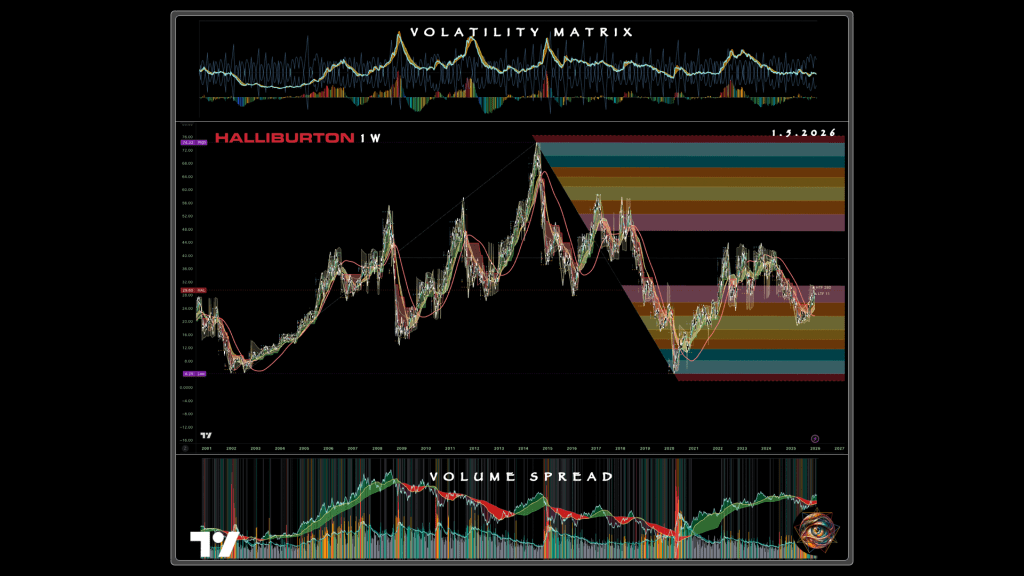
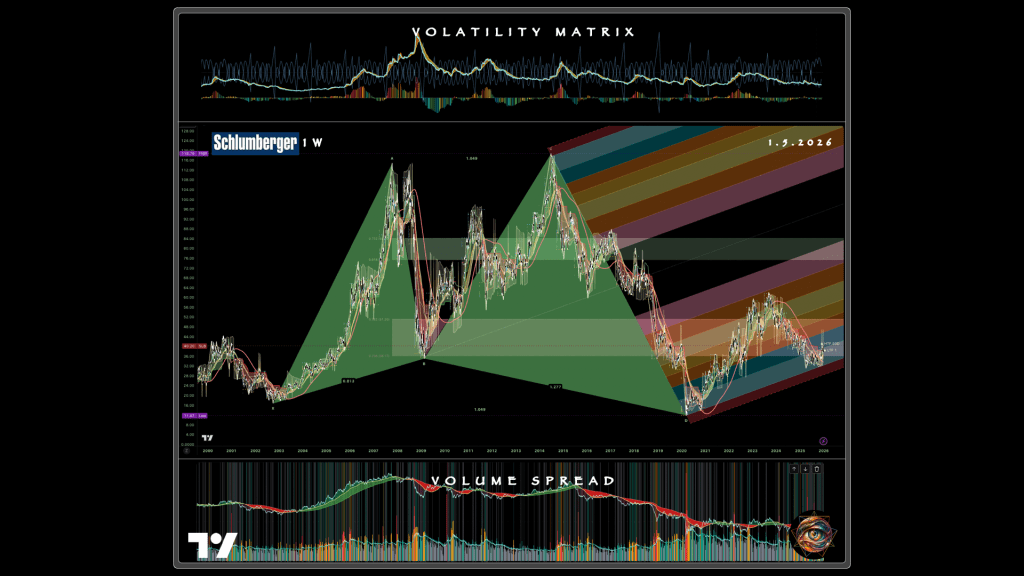
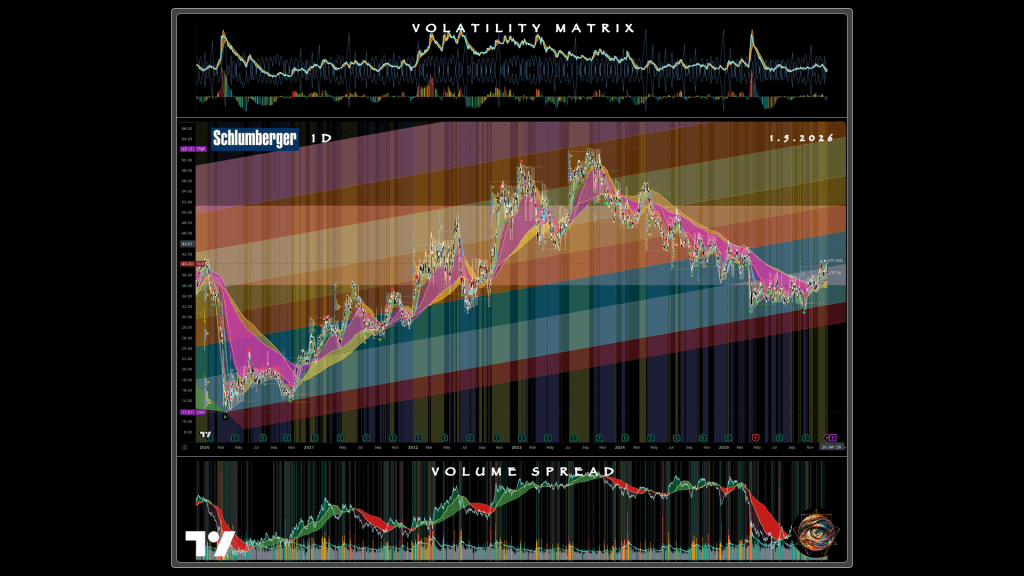
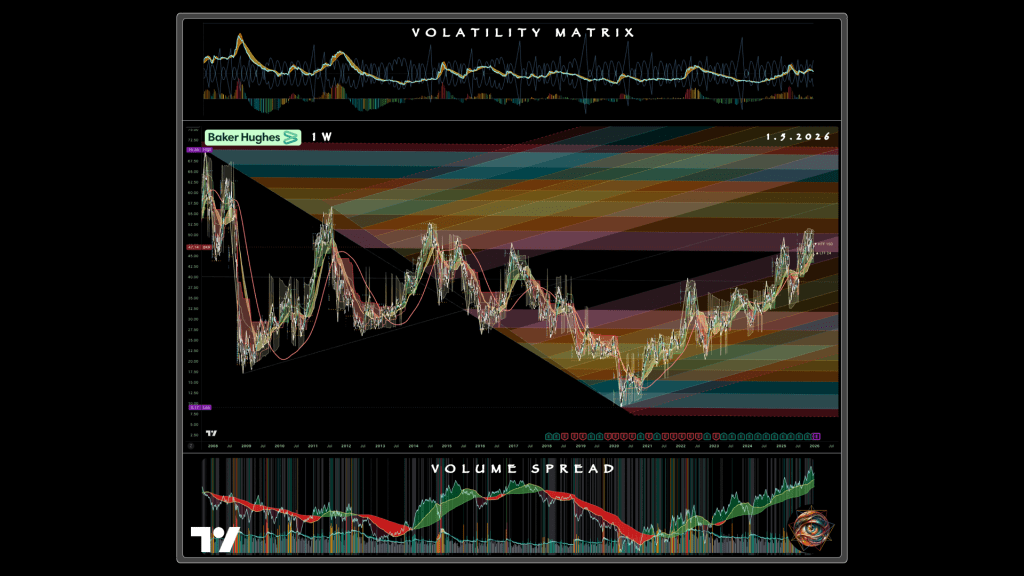
Four scenarios assign probabilities to how this unfolds. The creditor math explains why bonds at 23 cents might hit 50 cents or stay paralyzed at 25. The physical constraints show why 18 months can’t heal what took a decade to destroy. The charts prove oil services stocks need revenue confirmation, not permission headlines, to break 12-year structural downtrends.
The Venezuela Reconstruction Portfolio
Direct Oil Exposure:
CVX – Chevron Corporation
Oil Services:
HAL – Halliburton Company
SLB – SLB Limited (Schlumberger)
BKR – Baker Hughes Company
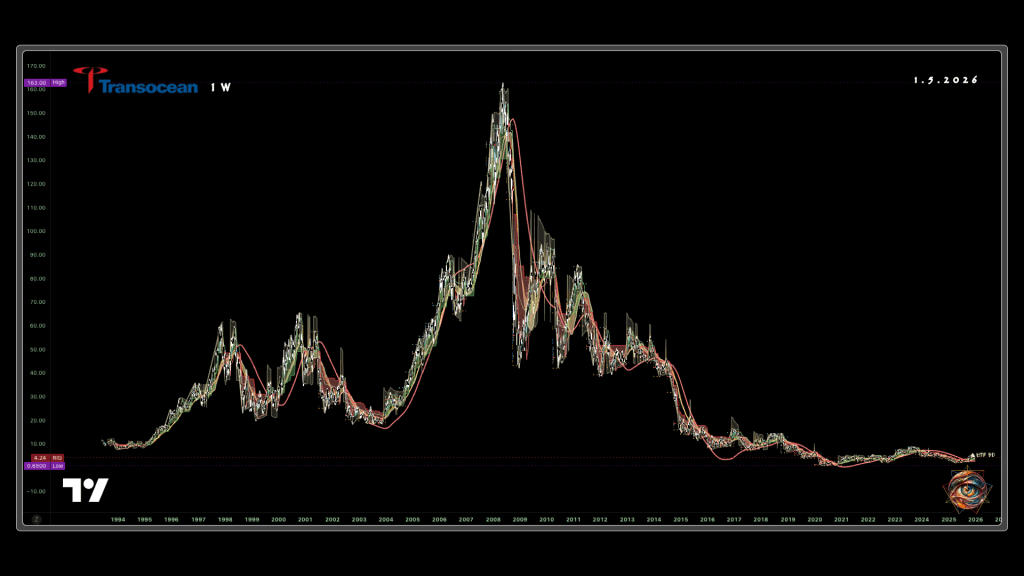
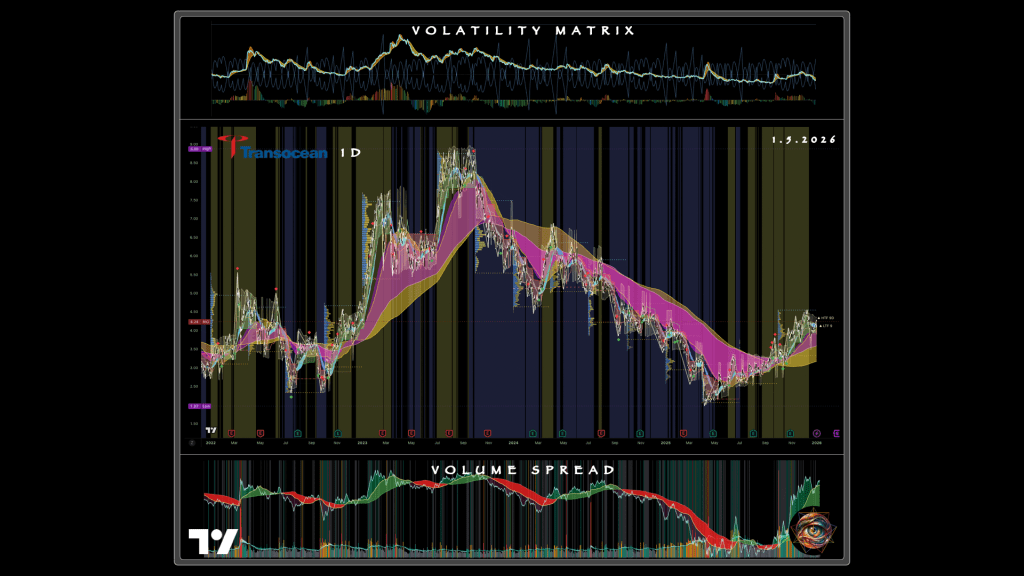
RIG – Transocean Ltd
EPC Contractors:
FLR – Fluor Corporation
KBR – KBR, Inc.
Heavy Equipment:
CAT – Caterpillar Inc.
DE – Deere & Company
GEV – GE Vernova
Defense Majors:
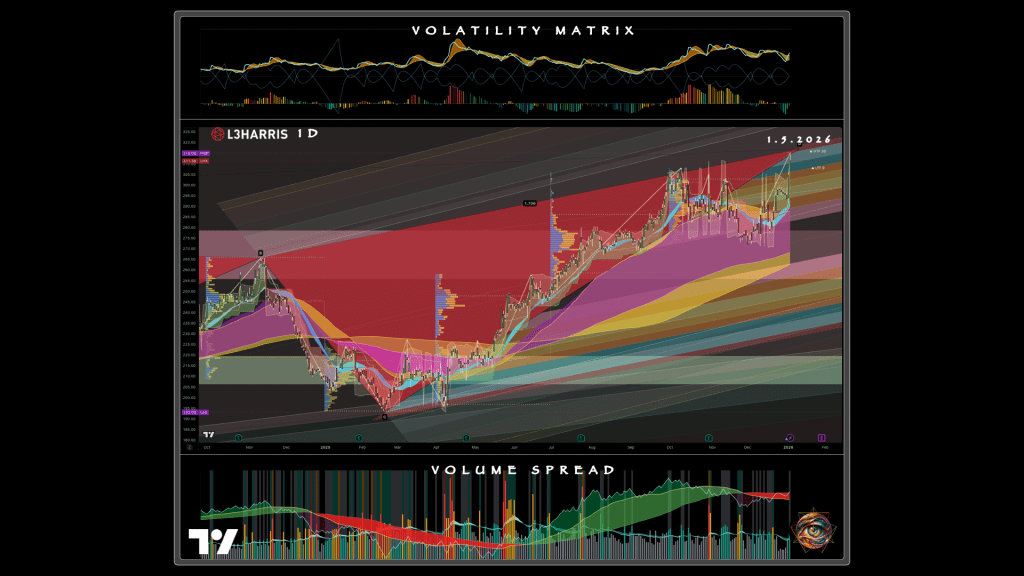
LHX – L3Harris Technologies
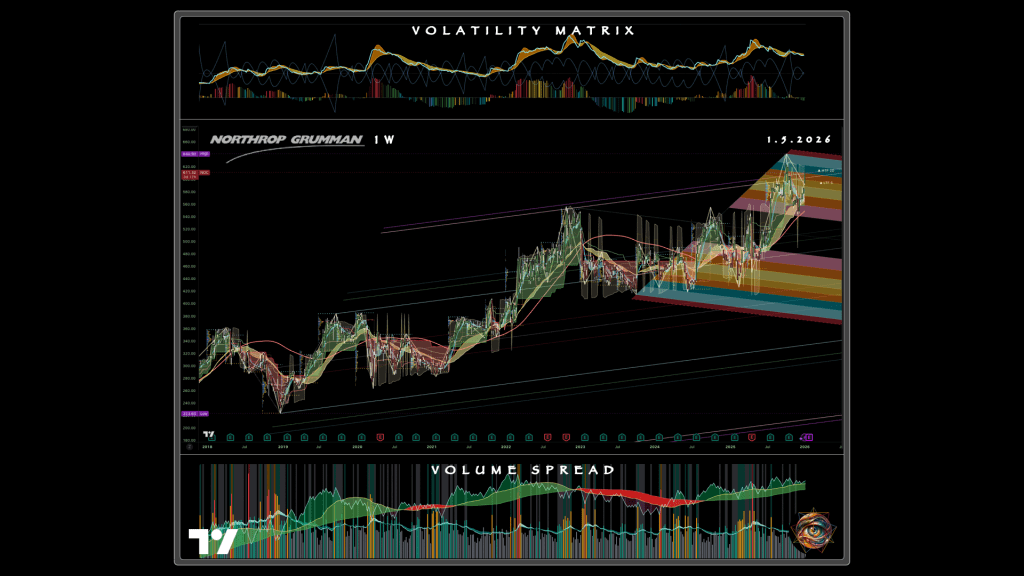
NOC – Northrop Grumman Corporation
LMT – Lockheed Martin Corporation
GD – General Dynamics Corporation
IT/Intelligence:
PLTR – Palantir Technologies
CACI – CACI International Inc.
Specialty Services & Power:
WFRD – Weatherford International
FTI – TechnipFMC plc
EMR – Emerson Electric Co.
WMB – Williams Companies, Inc.
The Portfolio as Staged Claim on Occupation Spending
Four spending categories define the opportunity. Each operates independently of whether Venezuela “recovers” and depends instead on occupation duration and which permission events materialize.
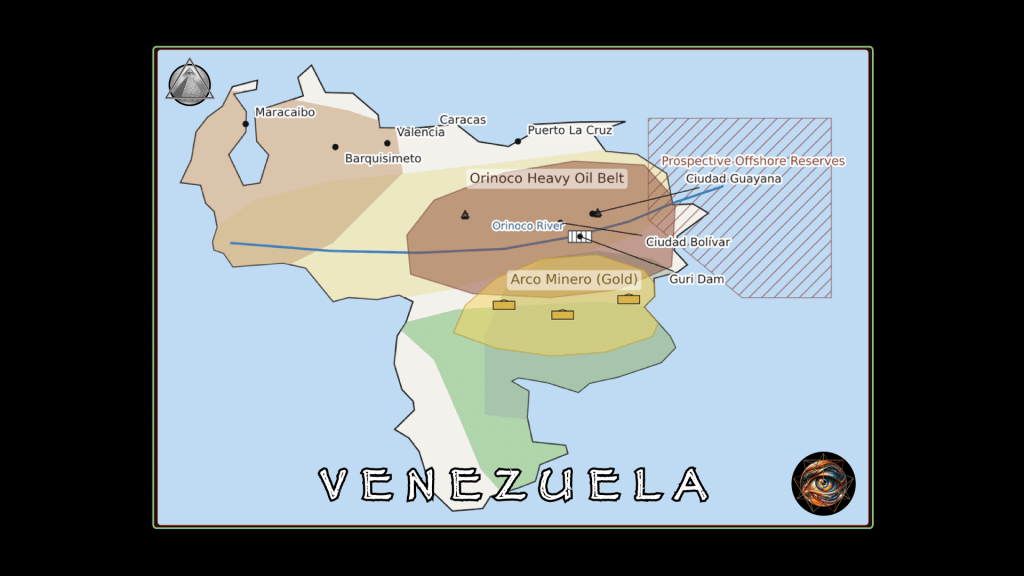
Oil and gas operations represent immediate revenue exposure. Chevron already operates with roughly 250,000 barrels per day production and a century of in-country presence. Sanctions relief enables immediate expansion toward 500,000 barrels per day or higher. The oil services plays—Halliburton, Schlumberger, Baker Hughes, Transocean—need different catalysts. Goldman Sachs projects Venezuela needs 500-plus new wells to approach 2 million barrels per day, which translates into drilling, fracking, cementing, and offshore work. But these companies cannot mobilize until sanctions lift and contracts are signed with recognized authority.
Reconstruction infrastructure represents the $200 billion aggregate spending need: $80-100 billion for oil infrastructure rehabilitation, $20-25 billion for electrical grid rebuild, $10 billion per year for 5-10 years in transportation, $5 billion per year for 5-8 years in agriculture. This spending cannot begin until a government exists with legal standing to sign enforceable contracts. The relevant companies are Fluor, KBR, Caterpillar, Deere, and GE Vernova—EPC contractors and equipment suppliers with Latin America experience. Their Venezuela exposure is entirely gated by the Q3-Q4 2026 window when contracts might materialize if the managed transition scenario plays out.
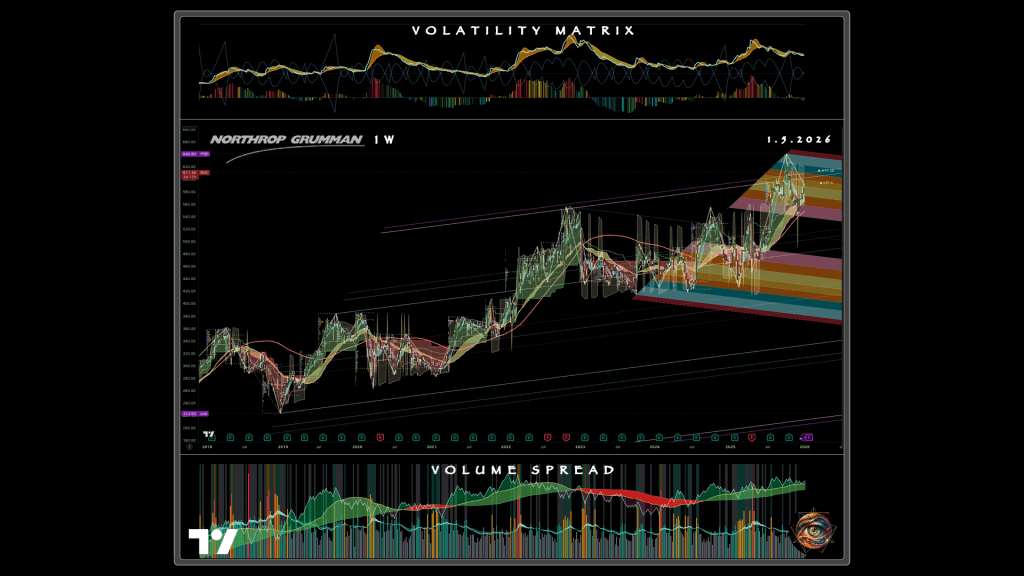
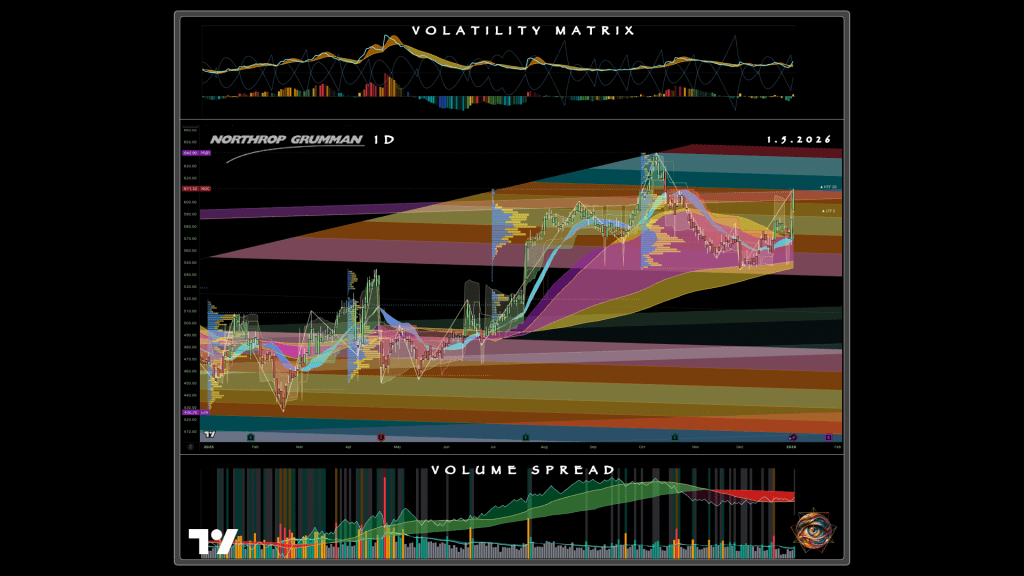
Security and surveillance represent locked-in spending regardless of political outcome. The U.S. occupation posture requires intelligence integration, border security, counternarcotics surveillance, and regional stability monitoring whether the transition succeeds or fails. L3Harris, Northrop Grumman, Lockheed Martin, General Dynamics, Palantir, and CACI all have existing revenue from defense and intelligence contracts. Venezuela doesn’t create this revenue—it represents incremental activity layered on baseline operations. This tier provides ballast in the prolonged occupation scenario and the Chavista resistance scenario where other exposures fail.
Heavy equipment and construction represent the picks-and-shovels layer that benefits from infrastructure activity regardless of who governs. Caterpillar has operated in Latin America since 1925 with 32 dealers, 350 branches, and 10,000 technicians across the region. Deere positions for agricultural rehabilitation once the $5 billion per year spending begins. GE Vernova supplies gas turbines, grid equipment, and transformers for the electrical rebuild. These companies are more resilient to political chaos than EPC contractors because equipment sales can proceed even in unstable environments as long as some reconstruction spending occurs.
The portfolio structures these exposures across four tiers. The allocation percentages that follow vary by risk tolerance—conservative, moderate, and aggressive profiles are presented together to show how the same underlying structure adapts to different time horizons and risk budgets.
Tier 1: Energy and Core Services (Conservative 40% | Moderate 50% | Aggressive 65%)
Chevron receives 15% in the conservative profile, 20% in moderate, and 30% in aggressive. It’s the only U.S. major currently operating in Venezuela, with sanctions lift triggering immediate expansion potential.
Oil services receive combined 25% conservative, 30% moderate, and 35% aggressive, split across Halliburton (largest global driller with Latin America operations), Schlumberger (number one global oilfield services with South America stronghold), Baker Hughes (turbomachinery and digital monitoring for oil processing plants), and Transocean (deepwater drilling contractor for offshore reserves). The oil services allocation is the highest-beta component of the entire portfolio and carries the most technical risk.
Tier 2: Infrastructure and Heavy Construction (Conservative 35% | Moderate 45% | Aggressive 20%)
EPC contractors receive 15-20% split between Fluor (global EPC leader with century of Latin America project experience) and KBR (energy EPC and government logistics with Latin America presence).
Equipment receives 10-15% across Caterpillar (dominant regional footprint), Deere (agriculture equipment for 30 million hectares farmland potential), and GE Vernova (power generation for electrical grid rebuild).
This tier provides high leverage to the managed transition scenario but faces significant downside in prolonged occupation due to the contract authority problem.
Defense majors receive 20% in conservative profiles, 15% in moderate, and 10% in aggressive across L3Harris (counter-UAS, ISR systems, tactical communications), Northrop Grumman (surveillance satellites, missile tracking, drones, radar), Lockheed Martin (F-35 fighters, Aegis systems, regional operations), General Dynamics (military vehicles, communications systems), and CACI (intelligence, surveillance, cyber).
IT and software receive 5% split between Palantir (data analytics tied to $10 billion U.S. Army contract) and CACI (transition IT and intelligence on regime remnants).
This tier offers the most stable cash flows and works across the widest range of scenarios.
Diversification through Weatherford (Latin America drilling tools), TechnipFMC (subsea systems), Emerson Electric (industrial automation for refineries), and Williams Companies (natural gas pipelines). These names offer optionality on specific subsectors without requiring large allocations.
The conservative and moderate profiles hold 5% cash for deployment on news. The aggressive profile is fully invested.
The beta to Venezuela outcomes varies across these profiles: conservative runs 0.6x through sector diversification, moderate runs 0.8x through oil-heavy weighting, and aggressive runs 1.2x for maximum sensitivity. None of these is a bet on Venezuela as a country. All three depend on how long the U.S. runs the country, which permission events materialize, and in exactly what sequence.
Four Scenarios as Probability-Weighted Timeline Trades
The Venezuela trade in 2026 operates through four conditional paths with different timeline sensitivities and catalyst dependencies. Probabilities matter because a 40% chance nothing happens in 2026 argues against deploying full allocation upfront, while the combined 45% probability of positive scenarios provides sufficient edge for staged entry.
Scenario A: “Managed Transition” – The Panama 1989 Template (35% probability)
Panama 1989 provides the historical parallel. Noriega’s removal triggered institutional collapse, then a 1-3 year transformation with opposition government installed, sanctions lifted, and U.S. aid packages flowing to create a stable pro-American economy. The Venezuelan version assumes Delcy Rodríguez cooperates with U.S.-backed transition or Edmundo González and María Corina Machado assume power in Q2-Q3 2026.
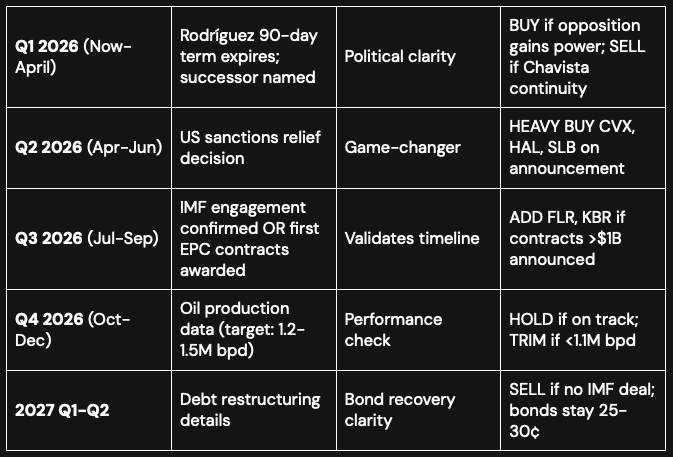
Milestones that define this scenario: Q2 2026 sanctions lifted, Q3 2026 IMF program announced, Q4 2026 oil production hitting 1.2-1.5 million barrels per day, 2027 debt restructuring beginning with creditor engagement. Each milestone represents a discrete repricing event rather than continuous improvement.
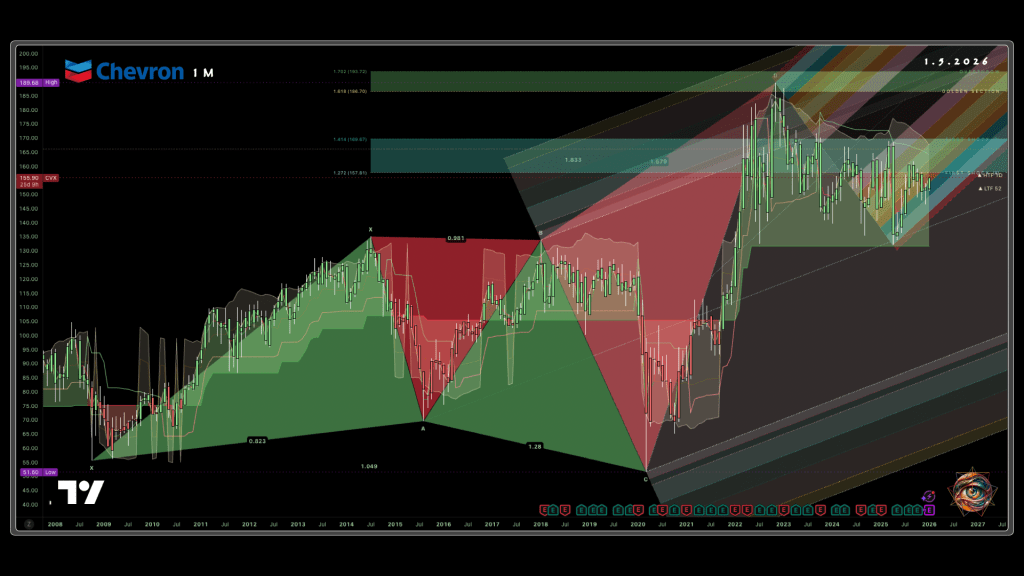
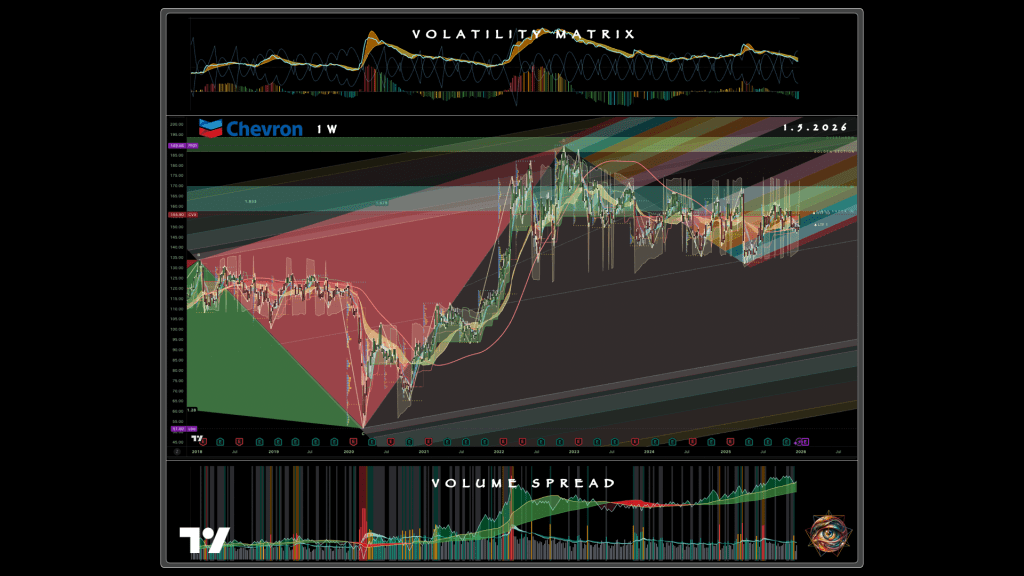
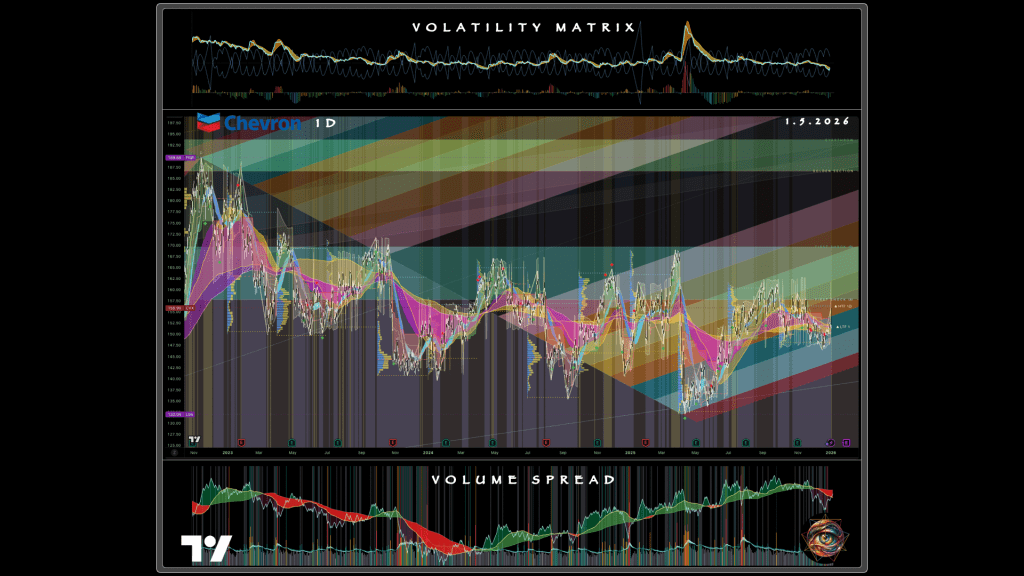
Winners include Venezuelan bonds moving from 23 cents toward 40-50 cents for 75-117% returns, Chevron gaining 20-30% from $155 toward $186-200 as production expansion materializes, and oil services experiencing dramatic moves with Halliburton projected at +80%, Schlumberger at +60%, Fluor at +70%. These oil services returns require breaking 12-year structural downtrends, which makes them high-conviction trades rather than base expectations.
Portfolio return: +45-65% over 18 months, driven primarily by oil services beta and bond recovery convergence.
This scenario receives the highest probability weight because it matches the current observable state. No clear successor emerges after Rodríguez’s 90-day acting term expires in early April 2026. The U.S. maintains de facto control through 2026 without establishing recognized government with contract authority. Legal limbo prevents major investment because no entity can sign enforceable agreements that survive political transition.
Key signals: April 2026 sees Rodríguez’s successor drawn from Chavista continuity rather than opposition, Q2 2026 passes without sanctions relief, Q4 2026 oil production remains flat below 1.1 million barrels per day.
Winners: None or minimal. Bonds stagnate at 25-30 cents. Oil services stocks remain flat or decline. Only defense and infrastructure holdings provide positive return as ongoing occupation spending continues regardless of political resolution.
Portfolio return: +10-15% over 18 months, driven entirely by defense and infrastructure offset against oil losses. This is where phased entry discipline prevents catastrophic losses—deploying only 40% of target allocation in Phase 1 means the portfolio never becomes overexposed to the oil services collapse this scenario implies.
Rodríguez defies U.S. pressure, military fragments, civil unrest breaks out, oil production actively declines. Regional instability becomes the dominant concern as Colombia and Brazil face threat of another mass migration event beyond the 7.7 million who fled since 2014. China, Russia, and Iran provide diplomatic and material support to resistance elements.
Winners: Gold as safe haven, possibly defense stocks if U.S. military operations intensify. Losers: essentially all Venezuela-specific exposure across oil, services, infrastructure, bonds.
Portfolio return: -10-20%, with defense holdings providing some offset.
The opposition led by González and Machado assumes power in Q2-Q3 2026, sanctions relief moves rapidly, the privatization plan Machado has discussed publicly begins implementation. Foreign investment floods in once legal certainty exists and creditor restructuring provides clear path forward.
Winners experience massive upside with bonds moving to 60 cents or higher for returns exceeding 160% from 23-cent entry, Chevron gaining 60% as production expansion accelerates, oil services surging on multi-year contract visibility.
Portfolio return: +45-65%, similar to Scenario A but with faster timeline compression and higher ultimate price targets.
The three-phase position entry strategy maps directly to these probabilities. Phase 1 deploys 40% immediately in January 2026 into Chevron, L3Harris, and Northrop Grumman—stocks with existing revenue streams that work in Scenarios A, B, and D. Phase 2 deploys 40% on the Q2 2026 sanctions relief trigger into Halliburton, Schlumberger, Fluor, and KBR, expecting 10-15% initial pop but buying on pullback to capture technical breakout confirmation. Phase 3 deploys final 20% on Q3 2026 validation when contracts materialize, adding Caterpillar, GE Vernova, and Deere while holding cash reserve for opportunistic additions such as Transocean if offshore drilling programs are announced.
The Creditor Stack: Zero-Sum Warfare
Venezuela’s debt restructuring will not be cooperative negotiation. It will be zero-sum warfare where one creditor class improves only by forcing another to accept deeper losses, longer delays, or reduced priority. Someone gets zeroed.
Five creditor classes are fighting over the spoils. Bondholders hold $60 billion outstanding across sovereign and PDVSA bonds, currently trading at 23-33 cents. Arbitration claimants exceed $30 billion with ConocoPhillips owed $11 billion, ExxonMobil owed $11 billion, Crystallex owed $1.4 billion, Gold Reserve owed over $1 billion. Citgo-related claims sit near $19 billion and exceed the asset value they’re secured against. Bilateral loans include China at $10-25 billion and Russia at $9 billion. The newest creditor class is “stolen American property” claims, where Secretary of State Marco Rubio’s framing—”Venezuela unilaterally seized American oil platforms, costing billions”—creates nationalist political pressure to prioritize U.S. corporate claims over foreign bondholders.
The math is brutal. Total external liabilities sit between $150-170 billion against current GDP near $83 billion, producing debt-to-GDP ratios in the 180-200% range. This isn’t “high debt” where economic growth might outrun it. This is mathematical insolvency where full repayment is impossible even under optimistic scenarios.
At 40-50 cent recovery rates, bondholders receive $24-30 billion in aggregate. Arbitration claimants have established legal priority. The creditor stack cannot be made whole—it can only be re-ranked.
Three recovery scenarios capture the range of bond outcomes:
Base case: 40-50 cents over 3-5 years (medium probability). This follows the Citigroup restructuring model with roughly 50% haircut. Requires IMF engagement, formal debt restructuring with creditor committees, and stable government with recognized authority to negotiate binding agreements. Return from 23-cent entry: 74-117% over the 3-5 year horizon.
Optimistic: 50-60 cents over 2-4 years (low-medium probability). Includes oil-linked warrants providing creditors with upside participation if production recovers beyond base projections. Requires full sanctions relief, either Rodríguez cooperation or opposition takeover to establish contract legitimacy, and rapid IMF program implementation. Return from 23-cent entry: 117-161% over compressed timeline.
Pessimistic: 20-30 cents over 5-plus years (medium probability). Reflects continued political instability, no IMF deal materializing, protracted legal battles as creditor classes fight over priority, and current drift extending indefinitely. Return from 23-cent entry: -13% to +30%, making this capital preservation rather than growth.
The asymmetric logic justifying early bond entry: current 23-33 cent pricing already reflects significant pessimism. Entry at 23 cents versus potential 50-cent recovery represents 117% upside. Waiting for confirmation risks rally to 35-40 cents on positive news, which compresses returns to 25-43% and eliminates much of the asymmetry. Bonds already doubled in recent months on Trump administration pressure speculation, confirming the market reprices quickly on political signals rather than waiting for fundamental confirmation.
The critical trigger separating base case from pessimistic: IMF engagement announcement, which functions as 18-month indicator. If IMF announces program in Q2-Q3 2026, bonds move toward 40-50 cents rapidly as restructuring becomes credible. If no IMF engagement materializes by Q4 2026, bonds remain stuck at 25-30 cents and pessimistic case is validated.
Portfolio sizing for bonds: conservative allocations 2-5%, aggressive allocations 5-10%, understanding total loss is possible if Chavista resistance plays out or creditor warfare subordinates bondholders to arbitration claims and bilateral loans.
Rubio’s “stolen assets” narrative adds new dimension to creditor politics. The nationalist framing creates pressure to prioritize U.S. corporate claims from ExxonMobil and ConocoPhillips over bondholders, many of whom are foreign institutional investors. Early movers in bonds suppose creditor hierarchy still favors them despite this political pressure, or that the sheer size of the bondholder class ($60 billion) gives them negotiating leverage individual arbitration claimants cannot match. The risk is U.S. government explicitly prioritizes American arbitration claims as policy matter, which would subordinate bondholders and compress recovery values toward pessimistic scenario.
The Physical Baseline That Kills Miracle Narratives
The investment thesis requires understanding physical constraints that don’t respond to political narratives, diplomatic announcements, or market sentiment. These constraints govern the timeline on which any positive scenario can unfold and place hard limits on what 18 months can achieve.
Two governing constraints define the boundary conditions: the decade timeline problem and the authority vacuum problem.
The Decade Timeline: Why 18 Months Can’t Heal What Took 10 Years to Destroy
Oil production tells the clearest story. Peak output hit 3.5 million barrels per day in December 1997. Current production sits near 1.14 million barrels per day as of November 2025. The low point touched 337,000 barrels per day in 2020 during the worst of the economic collapse.
Goldman Sachs’ actual forecast, published after the Maduro capture, shows 2026 production flat at 900,000 barrels per day with language describing “ambiguous but modest short-run risks.” Translation: markets don’t expect Venezuela to move global supply balance materially in the near term. The 18-24 month optimistic path places 1.5-2 million barrels per day on the table only under sanctions relief combined with modest investment, not sanctions relief alone. The 3-5 year target of 2-3 million barrels per day requires $80-100 billion in capital spending. The 7-10 year target returning production to 3.5 million barrels per day peak is explicitly treated as decade-scale rebuild, with Rice University estimates placing capital need near $10 billion per year for 10 years.
Why Goldman didn’t change its 2026 forecasts despite Maduro capture: oil production increases are bounded by power reliability, equipment availability, skilled labor, security conditions, and legal permission to operate. A bankable production ramp requires more than drilling rigs and pipelines. It requires contract sanctity and financing channels that don’t evaporate when politics shifts. The market isn’t trading a supply shock. The market is trading optionality on whether the permission structure materializes.
Infrastructure devastation extends beyond oil fields. The Guri Dam supplies roughly 80% of Venezuela’s electricity. The March 2019 blackout lasted nearly a week in many parts of the country. A power system that fragile doesn’t merely inconvenience households—it destroys industrial utilization rates, deters contractors who cannot operate equipment reliably, and turns every production ramp into a reliability premium that increases costs and extends timelines.
Skilled labor represents human capital constraint no amount of financing can repair quickly. The 7.7 million people who fled since 2014 represent roughly 25% of the population. This isn’t generic migration—this is brain drain concentrated among the educated, the skilled, and the young. The engineers, technicians, and managers who operated the oil industry, power grid, and industrial base are now in Colombia, Brazil, the United States, and Europe. Reconstruction cannot proceed without either convincing this diaspora to return (which requires political stability and economic opportunity that don’t exist in 2026) or training entirely new workforce (which requires years, not months).
GDP contraction provides macroeconomic context constraining everything else. The approximately 80% economic contraction between 2013 and 2021 is civilizational collapse on the scale of war or natural disaster. Current GDP near $83 billion in 2025 sits against peak levels that were multiples higher. Hyperinflation peaked at 344,509% in February 2019, with recent resurgence to 556% in December 2025 demonstrating “stabilization” remains contested.
What this means: no tax base to fund government operations, currency retains no meaningful value for international transactions, institutions hollowed out to where basic administrative functions cannot be performed. Even with perfect political conditions, economic capacity doesn’t regenerate in 18 months.
The Authority Vacuum: Why No One Can Sign Bankable Contracts Until Q3-Q4 2026
The deliberate collapse strategy emerged from principal component analysis of the news cycle. To wit, according to one former CIA operative: “The Trump administration knows this government is a house of cards waiting to collapse. The best way to get Venezuelans to accept interim government is to let the current government fail.” This isn’t speculation about policy—this is stated strategy supported by the Panama 1989 parallel.
The Panama timeline following Noriega’s capture saw systems fail, currency fail, government fail in immediate aftermath. The United States stepped in with opposition government and aid packages only after collapse was complete. Transformation took three years from 1990 to 1993 to establish stability.
The Venezuela 2026 timeline following this template: institutional collapse Q1-Q2 2026 as police lose leadership, public services fail, administrative continuity fractures. Opposition government installation Q2-Q3 2026 only if managed transition scenario plays out. First aid packages and sanctions relief Q3-Q4 2026 once recognized government exists. Actual reconstruction begins 2027-2028 after legal and institutional framework is established.
Infrastructure contractors such as Fluor and KBR cannot win contracts until Q3-Q4 2026 at earliest because no contracting authority exists before that point. Oil services companies such as Halliburton and Schlumberger cannot mobilize equipment and personnel until sanctions lift Q2 and equipment physically arrives Q3-Q4. The 18-month trade horizon isn’t arbitrary—it represents maximum realistic timeline for first wave of permission events to materialize and begin repricing exposure.
The contract authority problem has no good answer in early 2026. Secretary of State Marco Rubio stated explicitly: “U.S. management lacks legal framework for long-term commitments.” Delcy Rodríguez is indicted cartel member serving 90-day acting term. Defense Minister Padrino López is also indicted. The entire chain of command in military and security services is either compromised by cartel involvement or consists of individuals who are active targets for U.S. law enforcement.
Legal limbo means no contract enforceability. International investors won’t commit billions to infrastructure projects when contracts might be nullified by future Venezuelan government claiming the signing authority was illegitimate. Even if the United States provides guarantees or indemnification, legal challenges are likely both from future Venezuelan administrations and from international bodies questioning the occupation’s legal basis.
This is why Scenario B (Prolonged Occupation) carries 40% probability weight rather than being framed as pessimistic outlier. Scenario B is the base case. The current observable condition is exactly what Scenario B describes—no recognized government, no clear successor, legal authority in question, major investment paralyzed by uncertainty. Scenario A (Managed Transition) is the optimistic path requiring multiple favorable developments in sequence. Treating Scenario A as base case and Scenario B as downside risk inverts the actual probability distribution.
Technical Positioning: Why Oil Services Are Broken, Not Cheap
The monthly price charts for Chevron, Halliburton, Schlumberger, Baker Hughes, and Transocean contradict the narrative that these are “unloved value plays waiting for a catalyst.” These are structurally impaired equities that failed to participate in the actual 2020-2024 energy supercycle despite oil recovering from $20 to $80-plus and E&P companies generating record profitability. For Venezuela to change this, it cannot merely add normalized drilling activity—it must deliver genuine incremental revenue the market hasn’t seen in a decade.
Chevron at $155.90: The Coiled Spring That Needs a Key
The 2022 high near $189 hasn’t been reclaimed despite four years of consolidation in the $140-180 range from 2022-2026. The stock sits at 0.618 Fibonacci retracement zone, which is mid-range rather than oversold or overbought. Resistance appears at $170-180 where the stock failed multiple times during consolidation. Support sits at $145-150, representing the bottom of the four-year range.
The 6% post-capture pop noted in initial research is noise rather than signal on a monthly timeframe. A move from $155 to $165 barely registers on a chart showing multi-year price swings of $30-40. The market hasn’t priced Venezuela at any meaningful scale into Chevron’s current valuation.
Risk/reward asymmetry at current levels: downside roughly $10-15 to major support at $145 (7-10% risk) against upside $35-40 to retest 2022 highs at $189-192 (22-25% gain). The optimistic scenario where Venezuela actually adds 250,000-500,000 barrels per day to Chevron production over 18 months would target new all-time highs above $200, but this requires not just sanctions relief but operational execution and sustained production growth.
The trade setup: entry at $155 mid-range requires waiting for the $170 breakout on sanctions confirmation (Phase 2 deployment) rather than buying immediately and hoping. The four-year consolidation pattern shows Chevron needs fundamental catalyst to break higher, not just headlines.
Halliburton, Schlumberger, Baker Hughes: The 12-Year Structural Downtrend
All three stocks share the same structural impairment with similar technical characteristics that tell one unified story: the market doesn’t believe the oil services recovery narrative.
Halliburton at $28.60 sits down 61% from its 2014 peak near $74. Schlumberger at $40.20 is down 66% from its 2014 peak near $120. Baker Hughes at $47.14 never recovered its peaks near $70 in 2008 and 2011. All three failed to reclaim even half their 2014-era highs during the entire 2020-2022 energy supercycle when oil went from $20 to $120.
Halliburton currently trades at levels last seen in 2003 during the Iraq War. The chart shows confirmed downtrend with lower highs in 2014 ($74), 2018 ($56), and 2022 ($44). Resistance appears at $35-40, then $48-56. Support extends to $18-24 at 2001-2002 lows.
Schlumberger shows descending channel from 2014-2026 with lower highs at roughly $60 in 2018 and $58 in 2022. Current price sits in weakening range between $36-48. Critical support appears at $36—break below targets 2020 COVID lows around $15.
Baker Hughes sits in 7-year sideways range roughly bounded by $20-50. The stock bounced off bottom around $25 in both 2020 and 2023 and now approaches top of range around $50. This is the “cleanest” technically—not in confirmed downtrend like Halliburton and Schlumberger, just stuck in purgatory. But upper-range positioning means roughly 6-7% to resistance at $50, then the same structural ceiling that’s capped it since 2015.
What these charts demonstrate collectively: the market doesn’t believe oil services recovery despite oil at $80, normalized drilling activity, and offshore recovery all being priced into other energy equities. For Venezuela to work, these stocks need true incrementality—a new +500,000 barrel per day production ramp requiring 500-plus new wells, $5-10 billion in multi-year Venezuela contracts, sanctions-driven monopoly positioning for U.S. services firms.
This is why the +80% Halliburton upside scenario isn’t crazy—but it requires actual contracts generating actual revenue, not just permission to operate. Buying Halliburton at $28 hoping for Venezuela is value trap where the stock drifts lower or stagnates waiting for catalysts that may never arrive. Buying Halliburton at $32-35 after contracts are announced is momentum confirmation that 12-year downtrend is breaking and new cycle beginning.
Same pattern holds for Schlumberger (break $48 targets $60 at 2022 highs) and Baker Hughes (break $50 targets $60-65 at 2018 highs). The trade works if executed with discipline. The trade fails if executed on hope.
Transocean at $4.24: The Terminal Patient
This isn’t a stock—it’s a bankruptcy survivor in terminal decline. Peak near $163 in 2007 is so far removed from current price the chart shows 97.4% decline over 18 years. The 2020-2022 “recovery” coinciding with oil moving from $20 to $120 barely lifted Transocean from $2 to $6, and the stock has since given back most of those gains.
The chart shows structural death spiral since 2014 with no meaningful support levels visible. The stock tests all-time lows around $3-4 with no technical indication where sustainable bottom might form. This is not an investment-grade equity, but a restructuring/turnaround bet with binary outcomes.
The portfolio correctly labels Transocean “ultra-speculative” and allocates only 5% in aggressive profile. This chart confirms that sizing discipline. Transocean at $4.24 isn’t a Venezuela play—it’s a call option on massive offshore drilling renaissance that Venezuela alone cannot provide. The stock either goes to $15-20 on global shift in offshore spending, or it goes to zero. No middle ground exists.
The 18-month Venezuela trade converts political events into executable triggers with predefined actions. The catalyst calendar, position entry phases, and stop-loss discipline provide framework for execution without emotional override.
The 18-Month Catalyst Calendar
Three-Phase Position Entry
Phase 1 deploys immediately in January 2026 with 40% of target allocation into Chevron (15%), L3Harris (8%), Northrop Grumman (7%). Defense stocks have locked-in government contracts with revenue independent of Venezuela outcomes. Chevron already operates with existing production. These positions work in Scenarios A, B, and D and provide downside protection in Scenario C.
Phase 2 deploys on Q2 2026 sanctions relief trigger with 40% of target allocation into Halliburton, Schlumberger, Fluor, KBR. Deployment waits for actual announcement rather than anticipating it. Expect 10-15% spike on headline, allow it to develop, then buy on first pullback. This captures momentum confirmation while avoiding the chase that turns edge into overpay.
Phase 3 deploys on Q3 2026 contract validation with final 20% of target allocation into Caterpillar, GE Vernova, Deere when reconstruction contracts materialize. Hold cash reserve for opportunistic additions such as Transocean if offshore drilling programs are announced or if technical breakouts in other names provide conviction entries.
Stop-Loss Discipline and Risk Triggers
Individual positions carry -15% stop-loss from entry. Chevron purchased at $150 stops at $127.50. Halliburton purchased at $32 after Phase 2 trigger stops at $27.20. These are mechanical stops that execute without reevaluation.
Portfolio-level discipline triggers 50% position reduction if aggregate portfolio experiences -20% drawdown from peak. This prevents the trade from becoming -40% disaster requiring 67% recovery just to break even.
Political risk triggers override individual stops when systemic risk emerges. Chavista resurgence where Rodríguez refuses cooperation or hostile successor is named triggers immediate sale of all positions regardless of technical stop levels. Civil unrest where military fragments and violence escalates triggers reduction to 50% of positions with remaining exposure concentrated in defense. UN sanctions or international legal challenges to U.S. intervention trigger hedging with gold and defense rather than outright exit, as these could be temporary political noise rather than fundamental breaks.
Economic risk triggers address macro constraints governing feasibility. Oil prices below $50 Brent break the economic math for Venezuelan production recovery and trigger exit from all oil services positions while holding Chevron only. No IMF deal by Q4 2026 triggers 30% reduction in overall exposure and shifts thesis from base case to pessimistic scenario. Oil production below 1 million barrels per day by December 2026 triggers sale of oil services while holding infrastructure, as this indicates production ramp failing but reconstruction spending might still occur.
Catalyst failure provides final trigger category. If Q2 2026 arrives without sanctions relief, this invalidates Scenario A and confirms either Scenario B or C. Action: exit 75% of oil positions immediately, as core thesis depends on sanctions as enabling condition for all subsequent developments.
The Arithmetic of Speculation
Expected returns across four scenarios provide probability-weighted guidance rather than directional prediction.
Optimistic scenario (30% probability): +45-65% portfolio returns over 18 months. Sanctions lift Q2, IMF program announced Q3, oil production reaching 1.5 million barrels per day by 2027. Winners concentrated in oil services where Halliburton delivers +80%, Schlumberger +60%, Fluor +70% as multi-billion dollar contract wins materialize. Chevron gains 20-30% on production expansion. Bonds recover to 40-50 cents for 75-117% returns.
Base case scenario (45% probability): +15-25% portfolio returns over 18 months. Sanctions relief delayed to Q3, gradual rather than rapid recovery, oil production reaching 1.2 million barrels per day as infrastructure and operational challenges slow the ramp. Chevron gains 15-20%. Oil services deliver flat to +15% as contract wins are smaller and slower to materialize. Bonds stagnate or move modestly to 30-35 cents.
Pessimistic scenario (20% probability): -10-20% portfolio returns over 18 months. Political stalemate with no sanctions relief, no clear government emerging, oil production remaining below 1 million barrels per day. Most positions flat or down. Only Northrop Grumman and L3Harris provide positive returns as ongoing security operations continue. Bonds stuck at 25-30 cents or decline to 20 cents as restructuring hopes fade.
Disaster scenario (5% probability): -30-40% portfolio returns over 18 months. Chavista coup or resurgence, U.S. withdrawal from direct management, oil production collapse. All Venezuela-linked exposure draws down significantly. Gold and Treasuries provide only hedges.
Weighted expected return across these four scenarios: +18-22% over 18 months, which compares favorably to S&P 500 historical return of roughly 8-10% annually. The edge exists because the market is pricing something close to pessimistic scenario (current bond prices at 23-33 cents reflect deep skepticism), while the probability distribution assigns 45% weight to positive outcomes and only 25% weight to negative outcomes.
This works as 2-3% of portfolio allocated like venture capital. Think of it less like an investment and more like an asymmetric bet that accepts high risk of total loss in exchange for potential 50-150% returns over 3-5 year horizon if positive scenarios unfold. This only works if you’re sophisticated enough to monitor monthly, execute stops mechanically, and avoid emotional override that turns disciplined speculation into hope-driven loss.
This doesn’t work if:
You think “Venezuela has oil” equals easy money.
You can’t stomach -20% drawdowns without panic selling at the bottom.
You buy patriotic narratives rather than mathematical edge.
You confuse 18-month trade with 10-year hold.
The prudent path: allocate 2-3% to Venezuelan bonds at entry below 30 cents, monitor Q2 2026 for Scenario A triggers (sanctions relief and political transition), add 2-3% to Chevron and oil services only if sanctions lift with contract visibility, rebalance quarterly while exiting ruthlessly if milestones fail to materialize.
Venezuela 2026 resembles Iraq 2003-2005 more than emerging market reopening. A state under external force can reopen pockets of commerce while remaining legally and institutionally radioactive. Early movers accepting extreme risk may capture 50-150% returns over 3-5 years if the Panama template plays out and managed transition or negotiated settlement materializes.
The position entry begins in January 2026 with 40% allocation to CVX, LHX, and NOC. The Q2 2026 sanctions decision separates Scenario A from Scenario B. The Q3 2026 contract announcements separate conviction from hope. The portfolio reprices on observable milestones, not on Venezuelan reconstruction.
Office-core in the Floating World: Antique Patina, Modern Panic
Picture a thumb hovering over a feed like a metronome. Tick. Tick. Tick. Every beat is a rejection, a tiny auction where the currency is attention and the bidders are strangers with better lighting. In that market, “quality” means nothing. “Truth” means less than nothing. Recognition wins. Intrigue wins. Discomfort wins hardest, because discomfort has an aftertaste.
A style like this does not need to be defended, but understood. That starts with the admission that nobody is immune. The eye wants what the eye wants. Patina makes it feel safe. Cute faces make it feel human. Office props make it feel legible. Curving motifs make it feel alive. The viewer thinks they are clicking on content. The viewer is clicking on a sensation: competence inside nonsense, calm inside catastrophe, professionalism inside a room that keeps filling with tidewater.
The style looks like it should be hanging in a climate-controlled museum room, guarded by a docent who hates you. Ukiyo-e brings instant authority: disciplined line, flat color blocks, waves that feel like handwriting, clouds that feel like graphic design. The eye reads it as artifact before it reads it as image. Artifact implies value. Value implies attention. Attention implies you owe it a second longer. A second longer becomes a click. A click becomes a habit. Habits become religions.
Modern office props slide in under that antique varnish like a briefcase under a table. Laptop glow. Price charts. Desks. Paper stacks. Conference-room geometry. The scene declares its category without asking permission: finance, work, bureaucratic ritual. The viewer understands the setting in half a heartbeat, which buys you the right to get weird in the other half.
The weirdness arrives politely.
A hybrid anime face appears, clean and legible at thumbnail scale. Big eyes, tight mouth, rounded cheeks, slightly uneven ink outlines. The face is not just style; the face is a delivery system. The face says “human,” which disarms the viewer long enough to let the room become impossible. Empathy is the lubricant. Empathy is the trap.
Then the liquidity motifs drift in.
Tentacles, except nobody says tentacles out loud. Curves. Ribbons. Currents. Data streams. Decorative wave-forms that behave like the market’s handwriting. The trick is restraint. Nothing grabs. Nothing wraps. Nothing crosses the line that triggers a report button or a guilty conscience. The motifs stay just shy of touch, which is exactly where the nervous system starts doing the work for you. Suggestion becomes participation. The viewer supplies the pressure. The viewer completes the contact.
A starfish motif appears occasionally, geometric and tasteful, living on a shoe strap or a charm like a corporate joke told with a straight face. The symbol sits where the eye can find it later, after the click, after the zoom, after the “wait, what is that.” Discovery becomes reward. Reward becomes stickiness. Stickiness becomes repeat viewership. Repeat viewership becomes “community,” which is a polite word for attachment.
The humor lives in the character’s calm.
The face stays focused, faintly bemused, professionally unbothered. That calm is the punchline and the menace. A chart line spikes like a tsunami and the character reacts like someone in a quarterly review. The ocean climbs the walls and the posture stays composed. Corporate culture loves catastrophes as long as the deck has consistent fonts. Finance loves apocalypse as long as the candles look symmetrical.
That is the temperature. Heat comes from contradiction, not skin.
A safe-for-work image can still feel indecent. Indecency can arrive through implication, through proximity, through the quiet sense that the room is watching you while you pretend the room is not alive. Cephalopop Liquidity Ukiyo-e treats liquidity like a creature that learned manners. The creature never touches you. The creature never needs to. The creature only needs to be present, coiled through the scene like a thought you cannot swallow.
A cultural tension sits underneath the gloss, too. Ukiyo-e is not a wallpaper pattern; ukiyo-e is a grammar. The style works when that grammar remains structural: composition that pulls the eye along diagonals, palettes that stay warm and muted, lines that feel printed rather than rendered. The style fails when “Japan” becomes a texture pack tossed on top of a generic scene. Intention reads. Tourism reads faster.
A practical secret sits underneath the craft talk. The method is reproducible. A reference photo supplies bones: pose, silhouette, gaze direction, a human rhythm that keeps the output from turning into pure dollhouse. The prompt supplies the world: antique print logic, office props, resort-surreal bleed, gentle lighting, controlled accents. A correction pass supplies discipline: less clutter, fewer symbols, tighter palette, cleaner shapes, more negative space, more “print.” That correction pass is where the mood sharpens. Mood always sharpens in editing.
A viewer does not need to know any of that to feel it.
A viewer only needs to sense a familiar office scene rendered in a language that feels older than their anxiety, then notice the anxiety has been rebuilt as décor. A wave echoes a chart. A cloud echoes a flowchart. A conference table feels like a shoreline. The shoreline feels like an asset class. The room feels like a resort that hosts layoffs. The character smiles like a compliant employee completing mandatory training titled “Volatility Events: A Fun Team Exercise.”
That is why the style performs. Performance is not an accident. The feed rewards images that behave like puzzles and punish images that behave like explanations. A Cephalopop thumbnail is a puzzle that pretends it is a product. The puzzle invites the viewer to resolve the contradiction: antique legitimacy plus modern grind plus politely hungry ocean. Resolution never arrives, which keeps the viewer in the loop. The loop is the product.
Enthusiasm belongs here, too, because this is a laboratory of aesthetics.
A reader can run the experiment and watch their own attention respond. A reader can swap the character role and watch the tone mutate. A reader can push the palette warmer and feel the image become more “trustworthy.” A reader can simplify the background and feel the creep intensify. A reader can reduce the symbols until they vanish at thumbnail scale, then reappear on zoom like a private joke. That zoom moment is dopamine with manners.
A final detail matters. The creep must stay subtle. Subtle creep is sustainable. Subtle creep scales. The line should remain un-crossed, not because morality lives there, but because performance does. The feed punishes explicitness with boredom. The feed rewards implication with obsession.
A thumbnail can become a small haunted object that sells itself.
That is the whole game.
Liquidity Waves Need No Consent: A Woodblock Print Ate Your Portfolio
The internet does not reward truth. The internet rewards recognition. A thumb twitches before the frontal lobe finishes booting, so an image has to hit like a flashbang. Familiarity buys the first click. Confusion buys the second click. Shame buys the rewatch.
Cephalopop Liquidity Ukiyo-e sits in that profitable third category. The look does not aim for beauty. The look aims for adhesion. Modern office cosplay, crypto ornamentation, and brand-safe “girl-boss” staging get laundered through the authority scent of a faux antique Japanese print. The result reads like a late-19th-century woodblock that wandered into a Bloomberg terminal, got issued a badge, and started pretending spreadsheets were weather maps.
Patina does much of the work.
Ukiyo-e arrives preloaded with craft. Flat planes. disciplined line. controlled palette. stylized clouds that behave like graphic design rather than atmosphere. The viewer’s brain tags the whole thing as “artifact,” which the feed tags as “valuable,” which the nervous system translates as “look longer.” The office props arrive next and do the opposite job. Laptop. chart. meeting room. document. The scene declares its genre in half a second. Finance. Work. Bureaucracy. Adult daycare with quarterly targets.
The hybrid anime layer functions as a compliance hack. Large eyes and tight mouths read cleanly at thumbnail scale, so the character becomes legible even when the scene turns surreal. Empathy arrives early, which allows the image to get stranger without losing the viewer. That is the trick: a controlled hallucination that still feels readable, like a user interface for panic.
The creepiness lives inside the restraint.Tentacle motifs never “do” anything overt. Tentacle motifs behave like ribbons, currents, or data streams. Suggestion stays just shy of contact. The market becomes the cephalopod: everywhere, curved, patient, and indifferent to personal narrative. Liquidity becomes a tide that smiles while it climbs the drywall. Horror shows up as atmosphere, not anatomy.
The funniest part comes from the character’s face. Calm. Focused. Slightly bemused. The expression says the meeting is pointless, yet attendance remains mandatory. That serenity is the real unease. A chart spikes like a tsunami and nobody screams. Everyone sips boba and nods. Corporate culture loves a disaster as long as the slide deck looks polished.
The style also borrows “East Asia” as a texture pack, which deserves acknowledgement without a moral panic. The approach works when ukiyo-e functions as structure rather than decals. Composition and palette carry more weight than props. Line discipline matters more than random wave stickers. Intention shows. Tourism shows faster.
Boba, Bloomberg, and the Octopus God: Tentacles as Risk Management
Readers who want to experiment do not need a design degree, but a workflow.
Step One: Start with a Photograph
A reference image gives the model bones: pose, silhouette, gaze direction, and human rhythm. A clean subject with readable body language helps. A person leaning over a desk, reacting to a screen, presenting a document, or staring into the middle distance like a debtor at a seafood buffet works well.
Step Two: Runs the Style Prompt
The ask remains specific: asymmetric 16:9 composition, antique woodblock feel, modern finance props, warm muted palette, and controlled surreal motifs. Discipline matters more than novelty. Surrealism works best when the world follows rules while the rules quietly imply doom.
Step Three: Edit the Output
First drafts always under- or over-reach. Symbols get too literal. Lighting turns neon. Backgrounds fill with nonsense. Hands become haunted crab spoons. The fix is not “argue with the model.” The fix is editorial triage: reduce noise, preserve narrative, sharpen intent.
Correction moves that raise quality and raise creep without crossing lines:
A background needs fewer objects and more negative space. Two or three key props carry the story. Clutter kills the print illusion.
The era needs enforcement—paper grain, slight washout, muted pigments, zero glossy sheen or modern plastic glare. The symbols need demotion—monogram scale only, decorative texture at thumbnail scale, no floating logos, no billboard crests.
The waves need intelligence. Currents should frame the subject and echo chart geometry. Contact stays off-limits. Suggestion stays midground.
The emotion needs calibration. Calm focus with a hint of bemusement reads sharper than seduction. Controlled dread lands better than panic. Instruct the model to render any specific feelings you intend to project into your story.
Don’t forget those starfish, either.
The creepiness should ride on serenity. A wave pattern can mimic the price line. Clouds can resemble flowcharts. Silence can feel too clean. The room can feel like a resort that hosts layoffs.
Heat does not require skin, but implication. The office becomes a shoreline. The shoreline becomes an asset class. The ocean climbs the walls while the character smiles like a compliant employee completing a mandatory training module.
The feed loves that contradiction. A bureaucratic panic attack becomes a collectible antique. Volatility turns into décor. Anxiety becomes a brand. Metrics applaud. Morals stay absent.
Experimentation should stay playful. Mutation should stay intentional. A first output that looks too cute can be pushed darker through structure rather than shock. Palette can mute further. Background can empty. Lines can sharpen. The curve motifs can tighten into a net. The expression can stay calm while the room becomes impossible.
That calm expression sells the joke and sells the dread. A face can whisper “this is fine” while the ocean signs the timesheet.
Here are correction moves that reliably raise quality and creep without going explicit:
Reduce clutter:Simplify background figures; fewer objects; more negative space; keep only 2–3 key props.
Tighten the era:Make it look like an aged woodblock print; slightly washed; paper grain; muted pigments; no modern glossy sheen.
Control the symbols:Monogram-scale only; no floating logos; patterns read as texture at thumbnail size.
Make the waves smarter:Tentacle motifs behave like stylized currents/data flows; frame the subject; do not touch the body; remain midground.
Upgrade the emotion:For example, select calm, focused, faintly bemused—like someone who knows the meeting is pointless but attends anyway—or the opposite.
Creepiness via serenity:Add subtle surreal unease: a wave pattern echoes the chart line; clouds resemble corporate flowcharts; the room feels slightly too quiet.
The Prompt: How to Make Finance Look Like a Museum Exhibit
A 16:9 cinematic illustration in the “Cephalopop Liquidity Ukiyo-e” style: a [CHARACTER / ROLE] in modern business attire inspired by traditional Japanese clothing, positioned asymmetrically (usually on the right side of the frame, facing toward the center), in a surreal office / financial setting that subtly merges with an ukiyo-e inspired land and sea scape. The visual style is a hybrid of Edo-period ukiyo-e woodblock prints and clean modern hentai-style anime: bold, round faces and large eyes, tight mouth, slightly uneven ink-like outlines; mostly flat, graphic shading with 1–2 hard-edged tones; minimal soft gradients.
Color Palette: warm, earthy, and muted ukiyo-e tones (indigo, deep teal, vermilion red, ochre, warm beige, smoky purple) with a few controlled, saturated financial accents (BNB yellow, crypto greens, digital cyan highlights). Lighting is naturalistic and soft, with gentle contrast and no harsh neon glow … slightly washed out, like an old print from a woodcut. The finished product should appear to be late 19th century (i.e. anachronistic).
The character’s outfit is modest and fully clothed: a tailored blazer, skirt, kimono-inspired layers, or office wear with tasteful details. Fabric patterns quietly incorporate small, repeating financial symbols and crypto iconography (Bitcoin ₿, Ethereum diamond, BNB geometric emblem, plus subtle ¥ and $ signs) arranged as decorative monograms or crests, never as giant floating logos. At thumbnail scale, the patterns read as texture, and only resolve into symbols on closer inspection.
The environment jarringly blends open-plan office furniture with luxury resort (hotel room/bar/spa/sauna) and financial tools (desks, laptops, monitors, w/ price charts) with stylized ukiyo-e elements: layered flat clouds, wave-like shapes, abstract mountains, and ocean-like flows that double as liquidity waves. Background figures, if present, are simplified, low-detail background workers, partygoers or clerks posed like tiny ukiyo-e characters, busy at desks or screens.
MOTIFS
Tentacle motif: curved, ribbon-like shapes inspired by cephalopod tentacles flow through the scene and around objects, but they remain clearly graphic and non-organic, more like stylized waves or data streams. They do not touch, wrap, grab, or interact with the character’s body in a suggestive way; they remain background or midground design elements.
Sea Star Liquidity motif (only on the lady): stylized five-point starfish shapes, treated as decorative geometric elements rather than living creatures. They appear as fabric pattern elements, jewelry charms, or a sculpted sandal or shoe strap. If feet or footwear are visible, they appear incidentally as part of a full-body or mid-shot composition, not as the focal subject: a star-shaped strap or ornament across a normal sandal, with a tiny BNB symbol or other coin emblem in the center, rendered modestly and without fetish framing.
Composition: strong diagonals and flowing curves lead the eye from the character’s face to key props (documents, screens, charts), then out through the liquidity motifs. The character’s facial expression is focused, calm, slightly bemused or determined—more professional than seductive. Body language is dynamic but non-sexual: sitting, standing, leaning over a desk, gesturing toward charts, or reacting to data with controlled emotion.
Overall tone: surreal and risqué, but safe-for-work, business-casual and narrative-driven, with subtle humor, irony and innuendo. No explicit nudity, no exaggerated anatomy, no erotic context. Marine-inspired shapes and financial motifs function purely as symbolic, graphic design elements that support the story of finance, liquidity, and bureaucracy in a floating-world/hentai-inspired, crypto-era office.
As the cursor blinks in the font menu, my legal brief honed, the choice between Times New Roman and Garamond is the final consideration. Far from a mundane choice, it catches like a thread on a nail. It begins not with curiosity but with capture, not with a decision to investigate but with the discovery that investigation is already underway. Those who have read Foucault’s Pendulum know the mechanism.
To the uninitiated, Garamond is simply a typeface, one of dozens in a dropdown menu, elegant and vaguely classical. For those who have spent too many nights with Umberto Eco, the name vibrates with accumulated strangeness. Eco buried a joke in his novel, a semiotic trap that never stops springing. To see “Garamond” in a font menu is to glimpse the Comte de St. Germain at a candlelit publishing party in Milan, is to hear vanity-press authors explaining their Templar theories to a man who believes nothing and collects payment for everything.
The thread pulls tighter. Tradition matters. The brief can wait.
A distinction hides beneath the familiar interface, one that most writers never consciously consider. Although digital culture has collapsed them into interchangeability, “font” and “typeface” are not synonyms. The latter is a design, an abstract architecture of letterforms existing nowhere and everywhere simultaneously. Garamond is a typeface. A font, historically, was a physical instantiation of that design: a specific size and weight of metal type cast from molten lead, stored in wooden cases, inked and pressed against paper by hand. The word descends from the Middle French fonte, meaning a casting or a melting.
To speak of a font was to speak of matter transformed by fire. This etymology carries an alchemical residue that Eco would have savored. The font was lead become language, base metal transmuted into the visible form of thought.
When Claude Garamond cut his punches in sixteenth-century Paris, he was engaged in a craft that Renaissance observers would not have sharply distinguished from other forms of hermetic making. The printing press was new and strange. The men who designed its letters were shaping the way thought itself would appear to the eye. Their work would outlast cathedrals.
The modern font menu performs a séance that passes unnoticed by nearly all its users.
The physical fonts are effectively gone, melted down centuries ago or rusting in museum drawers. What remains is pure form, mathematical descriptions of curves that once required steel and fire to produce. Every selection of “Garamond 12pt” invokes shapes whose material basis has vanished, ghosts summoned by software that knows nothing of their history. The word “font” persists as a fossil term, describing an object that no longer exists in the medium where the word appears. Those who notice the discrepancy have already begun to see too much.
Legal language operates through similar mechanisms of ghostly persistence. Words like “standing” and “relief” and “equity” carry the residue of physical acts, of bodies rising before tribunals, of hands extended in supplication, of scales that once existed as brass and chain.
The law, too, is a séance conducted in a specialized dialect. Those who learn to speak it discover that the words work even when no one remembers what they originally meant. This quality is shared by typography and jurisprudence alike. Both transmit authority from the dead to the living through forms whose origins have become invisible. To practice either craft is to become a medium, a channel for voices that stopped speaking centuries ago.
Umberto Eco intentionally named his cynical Milanese publisher Signor Garamond, and the joke operates on frequencies that reward obsessive attention. In Foucault’s Pendulum, Garamond runs two imprints from the same office. One publishes serious academic scholarship under respectable auspices. The other, a vanity press called Manutius, accepts payment from credulous authors eager to see their Templar genealogies and Rosicrucian fantasies rendered in type. The naming is precise: Aldus Manutius was the great Venetian printer of the Renaissance. Eco built a publishing house from the bones of typography’s patron saints, a mausoleum that accepts manuscripts.
Signor Garamond does not believe in the conspiracies he publishes. His genius lies in recognizing that belief is unnecessary for commerce. The hunger for hidden knowledge generates its own economy, and the publisher need only provide a service: transforming manuscript into book, suspicion into artifact, obsession into an object that can sit on a shelf and prove that someone, somewhere, took the author seriously. The typeface performs the essential labor. Nonsense set in Garamond is indistinguishable from genuine scholarship. The elegant serifs launder content, lending visual credibility to texts that might deserve none.
The punchcutter’s craft, perfected for prayer books and philosophical treatises, transmits paranoid fantasies with the same serene beauty it once lent to Erasmus. This is not corruption but the essential neutrality of form. A vessel does not interrogate what it carries. Claude Garamond designed letters; he did not design a filter for distinguishing truth from delusion. Signor Garamond understands this better than anyone in the novel, at least at first. The skeptic who profits from belief is safer than the skeptic who plays with it.
Safety is not the same as innocence, however, and the publisher’s hands are not clean merely because the ink is dry.
History, or legend, records the Comte de St. Germain as an eighteenth-century courtier of uncertain origin who appeared at Versailles, at the salon of Madame de Pompadour, at a dozen glittering courts, always immaculately dressed, never aging, never quite confirming or denying the miraculous rumors that preceded him. He claimed to possess the Philosopher’s Stone. He claimed fluency in every language. He hinted at memories stretching back centuries, at dinners with the Queen of Sheba, at secrets too dangerous to speak directly. Voltaire called him “the man who never dies and who knows everything.”
The Count sold access to mysteries he may or may not have possessed, and his commercial method deserves admiration for its elegance. He required no laboratory, no library, no apparatus of proof. His product was himself: his presence, his manner, his imperturbable air of knowing more than he would say. Patrons paid for proximity to the enigma. Whether or not the Philosopher’s Stone exists mattered less than whether the Count seemed like a man who might possess it. Appearance performed the work of substance. The performance of esoteric knowledge, especially before the uninitiated, often passes for the genuine article.
St. Germain died in 1784 … or not. Sightings continued for decades. Theosophists canonized him as an Ascended Master, still walking among the living, still guarding the ancient wisdom. The uncertainty was always the point. An immortal who could be definitively verified would become a specimen, a curiosity for natural philosophers and medical examiners. An immortal who might be a charlatan retains his power precisely because the question never closes. Signor Garamond operates by the same principle. He publishes books that might contain hidden truths. He does not endorse them. He does not refute them. He collects payment and allows the mystery to compound interest.
The typeface completes the trinity.
Claude Garamond died in 1561, yet his shapes continue to appear on screens and pages five centuries later, carrying arguments he never imagined into futures he could not have conceived. The punchcutter achieved what the Count only claimed: actual immortality, persistence through form rather than flesh. Every brief set in Garamond, every dissertation, every conspiracy tract, receives the touch of hands that stopped moving before Shakespeare was born. The appearance of authority is authority itself. The dead man’s aesthetic judgments still determine whether a reader trusts a text, still whisper credibility into documents whose contents he would not have recognized, still perform their silent work of persuasion in languages he never spoke.
Jacopo Belbo, the tragic center of Eco’s novel, understands that the Plan he helps construct is a parody. He and his colleagues assemble their grand conspiracy from index cards and drinking games, mocking the very manuscripts that Signor Garamond publishes for profit. They know the Templars did not possess a secret that has shaped all of Western history. They know the connections they draw are arbitrary, a demonstration of how pattern-hungry minds manufacture significance from noise. The Plan is a joke, a scholarly prank, an elaborate game among educated cynics who consider themselves immune to the credulity they satirize.
The horror of the novel is that the joke becomes real, not because the conspiracy was true all along, but because belief does not require truth to produce consequences.
Belbo builds a labyrinth for amusement and then cannot find the exit. The true believers, the Diabolicals who have spent their lives searching for the secret, discover the Plan and assume it must be genuine. No one would construct something so elaborate as a mere parody. The sophistication of the fabrication becomes evidence of its authenticity. Belbo dies for a secret he invented, hanged by men who refuse to accept that the treasure map leads nowhere.
Eco’s warning operates on levels that the cleverest readers do not escape. The novel is itself a trap, a demonstration of seductive pattern-making so elaborate that readers have been known to investigate its fictional sources as though they were historical documents. Signor Garamond’s vanity-press customers find their mirror in the reader who cannot quite believe that a scholar of Eco’s stature would fabricate historical references, who searches for the genuine Plan behind the fictional one, who becomes, in the act of investigating, another customer for mysteries that do not exist. The novel vaccinates and infects simultaneously. It immunizes the reader against taking conspiracies seriously while rendering the reader incapable of ignoring them entirely. Every Templar reference encountered afterward arrives pre-annotated, trailing the echo of Belbo’s laughter turning to terror.
Irony provides no immunity. This is the sentence that should appear above every library door, embroidered on every graduate student’s pillow. Knowing the game is a game does not prevent the game from capturing you. Belbo knew. The knowledge did not save him. Knowledge is NOT power. The thread snagged, he followed it and the labyrinth closed behind him. Readers of his story undergo a lesser version of the same capture. We cannot unread the patterns that have become permanent overlays on our perception. We are altered without consent. This is the price of admission. The ticket cannot be refunded.
The dropdown menu is not neutral territory. The name “Garamond” pulses with accumulated strangeness, trailing ghosts of a sixteenth-century punchcutter, an immortal count, a cynical Milanese publisher, a fictional editor who died for a fabrication. There is more to the mechanism than metaphor. Perception genuinely changes when patterns are installed. To notice is to be conscripted. The font menu, once a utilitarian grid of aesthetic choices, is become a cabinet of whispers, a séance waiting to be begin.
Most people who have been gaslighted cannot describe what exactly happened to them, not forensically. They know something was taken. They know the taking was systematic. They can point to individual moments: a denial that felt like a door slamming, a trivialization that shrank their grievance to nothing, a sudden warmth that arrived precisely when they had resolved to leave. The sequence resists narrative because the Victim stands inside the circle, and the circle is designed to be illegible from within.Predation as Regeneration
The illegibility is a feature of the system.
The Victim experiences turbulence, erosion, a slow grinding of confidence into powder. The weather is unpredictable: sometimes calm, sometimes violent, always arriving from somewhere beyond control. The Predator experiences none of this. The Predator adjusts dials, monitors outputs, troubleshoots when the equipment fails to respond. One lives the weather. The other operates the machine. The gap between them cannot be bridged by conversation because they are not describing the same phenomenon.
They share a room but not a reality.
Predation as Regeneration
The term “gaslighting” comes from Patrick Hamilton’s 1938 stage play, in which a husband dims the gas lamps in their London home and denies the change, turning domestic illumination into a vehicle for psychological destabilization. Both husband and wife see by the same light; both inhabit the same brightness. Only the husband knows where the dimmer is. When he lowers the flame and denies it, the wife begins to doubt her perception. The medium is shared, but the relationship to the medium is not. Hamilton intuited the geometry without naming it. The gas lamp is Supply: the shared substrate, manipulated by one party, experienced by both.
The metaphor has reached its limit. A dimmer switch is mechanical, binary, inert. In reality, the dynamic Hamilton dramatized is biological. Narcissistic abuse is an ecosystem of extraction where the parasite selects for abundance, feeds sustainably over years, and discards the host only when the Supply thins below usefulness.
A coral reef may be a better map than a Victorian parlor.
The reef is a living system. Energy flows. Predators patrol. The healthiest zones attract the most attention from everything that feeds. Here, the Victim is not a gaslit spouse, but a thriving reef flat, visible and productive, drawing approach from organisms that cannot photosynthesize their own Supply.
A clinician’s perspective of gaslighting observes Three Forces in continuous rotation, each depending on the others, none capable of operating alone. The first pole is Supply: the material extracted is the Denying Force (2), whether attention, validation, or presence. The second pole is Victim: the Reconciling Force (3) initiates the cycle merely by existing as a medium of potential Supply. The third pole is Predator: the Affirming Force (1) completes the cycle, harvesting what the Victim’s presence and the Supply medium have made available.
This scheme inverts the common narrative. Pop psychology frames Victims as damaged, codependent, lacking boundaries. The logical geometry shows the opposite, and practice confirms the diagnosis. Victims are selected precisely because they are high-functioning.
The ideal Victim has Supply worth taking.
Needy people make poor sources. They require Supply themselves and become competitors rather than prey. The Predator targets abundance, not vulnerability. Coherence is the resource. Emotional stability is the reservoir. The capacity to keep showing up, to keep engaging, to keep trying to understand: this is what the Predator requires. The Victim has no concept for Supply because the Victim has never needed to extract it from anyone. A reef fish cannot see water because the fish has never been out of it. The Victim cannot see Supply because the Victim has never lacked it. The category does not form in the absence of need.
The order of operation of the Three Forces matters. Precisely six permutations, or triads, are possible. Gaslighting is a version of 231: Denying Force first (-), Reconciling Force second (0), Affirming Force third (+).
As the 231 triad takes endless forms, its generic name is Regeneration.
The Victim’s coherent reality stands as the first “no” in the system, not as a refusal but as a contrast. The Predator’s emptiness meets the Victim’s fullness. Supply then absorbs and reframes: the medium through which Predator and Victim interact without immediate collapse. The cycle culminates and resets as the Predator produces an intentional (albeit rarely conscious) outcome from the reorganized field.
This is not an attack, but a feeding cycle. The Predator regenerates by means of the Victim, whose confidence is consumed and temporarily absorbed. The Victim’s attention becomes the Predator’s significance. The Victim’s capacity for doubt becomes the Predator ‘s leverage. What looks from inside like disintegration looks from outside like digestion.
Causes
The three points along the right hemisphere of the enneagram (1➝4➝2) comprise the world of causes. For each, there is a corresponding tactic. In narcissistic abuse, this is the preparatory work that optimizes conditions before extraction can occur. The coral reef is the governing metaphor for this half of the process. The reef does not chase; it attracts. The Predator does not need to hunt when the prey swims toward the most vibrant colors, the densest nutrients, the warmest currents.
Denial erases the event from shared reality. (1)
“That never happened.” “I never said that.” “You’re imagining things.”
The tactic does not argue; it annihilates. The Predator does not claim that the event was acceptable, but that the event did not occur. The Victim who accepts denial loses access to their own perception. Memory becomes suspect. Just as the reef fish cannot see water, the Victim cannot see the manipulation because it has been defined out of existence.
Trivialization does not deny the event; it denies the event’s significance. (4)
“You’re making a big deal out of nothing.” “It was just a joke.” “Why are you so sensitive about this?”
Something happened, but it was small. The Victim’s response is disproportionate. The tactic recalibrates the Victim’s sense of scale. Wounds shrink. Grievances become embarrassing overreactions. The reef’s nutrients are still flowing, but the Victim has been trained to take smaller portions, to expect less, to feel grateful for what remains.
Countering does not deny or shrink; it reverses. (2)
“That’s not what happened—you’re the one who started it.” “You always twist things.” “You’re too emotional to see clearly.”
The Victim is painted as the aggressor. The grievance becomes the offense. The tactic exploits the Victim’s willingness to examine their own behavior—a willingness the Predator does not share. High-functioning Victims are particularly vulnerable here because they genuinely consider whether they might be wrong. The reef’s abundance includes the capacity for self-reflection, and that capacity is harvested along with everything else.
Effects
The three points along the left hemisphere of the enneagram (8➝5➝7) comprise the world of effects. This is the extraction itself, the conversion of preparatory work into usable Supply. As before, there are three tactics.
Here, however, the parasitoid wasp displaces the reef as governing metaphor.
Unlike the reef’s ambient predation, the wasp operates with surgical precision. The wasp injects eggs into a living host. The larvae feed on non-vital tissues first, keeping the host alive and functional. Some wasps inject chemicals that alter host behavior, such that it becomes a vehicle for its own consumption.
Weaponized Compassion captures the moral high ground by framing harm as care. (8)
“I’m only saying this because I love you.” “I’m worried about you.” “I just want what’s best for us.”
This tactic is the most sophisticated because it cannot be refused without the Victim appearing to reject love itself. The Predator who secures this position has won the war. Every earlier battle—the denials contested, the trivializations rejected, the counters deflected—was acceptable loss. The path is so constructed as to lead here, to the position from which all future resistance looks like ingratitude. The wasp’s sting delivers paralysis, not death. The host remains alive, functional, and incapable of flight.
Withholding takes the form of silence, absence, the refusal to engage. (5)
“I’m not going to discuss this.” “You know what you did.”
The tactic removes access to the Predator’s interiority. The Victim is locked out of negotiation, explanation, or repair. Withholding weaponizes the Victim’s attachment: the more the Victim needs resolution, the more powerful the withdrawal. Intimacy becomes leverage. The host’s own immune response—the desperate attempt to restore connection—feeds the larvae.
Diversion redirects the Victim’s focus from the original grievance to a new target, often the Victim’s own behavior. (7)
“What about when you forgot my birthday?” “You’re not exactly perfect either.” “Why are we even talking about this when the real problem is_____?”
The tactic exploits the Victim’s good faith; the willingness to consider other perspectives becomes a trapdoor. Each diversion extends the feeding cycle by resetting it. The wasp does not need to win arguments; the wasp needs to prevent the host from locating the larvae.
Behavioral Tells
Language is less than half the signal. The body speaks a parallel dialect, more reliable than words because it is harder to master. A clinician watching for gaslighting looks for divergence: the concerned face delivering an attack, the soothing tone wrapped around a threat, the eye contact that holds too long or breaks too strategically.
The Predator’s timing reveals intent. Interruption patterns cluster around the Victim’s moments of clarity. When the Victim approaches a coherent grievance, the Predator interjects, redirects, or suddenly needs to leave the room. The interruption does not engage the content; it prevents the content from consolidating. Silence, too, has timing. The Predator withholds response just long enough for the Victim’s anxiety to rise, then speaks as though the pause were natural. The Victim learns to fill silence with concession.
Physical positioning encodes dominance.
The Predator may block doorways during arguments, stand while the Victim sits, or occupy the center of shared space. These are not conscious tactics, in most case, but the body’s grammar of control, legible to the trained eye. The strategic apology belongs here: the words “I’m sorry” delivered with a sigh that communicates inconvenience, or a tone that implies the Victim’s need for apology is itself the problem. The content is concession; the delivery is contempt. The Victim hears both and cannot reconcile them.
Micro-expressions flash and vanish: contempt (the asymmetric lip curl that surfaces for a fraction of a second), duping delight (the suppressed smile during successful manipulation), the performative concern that does not reach the eyes. The voice carries its own signatures. Pitch drops when the Predator delivers threats framed as observations. Volume decreases rather than increases during the most damaging statements, forcing the Victim to lean in, to attend more closely, to participate in their own wounding. The Victim often registers these signals subconsciously, experiencing unease without being able to name its source. The body knows before the mind can formulate.
The clinician’s aim, and mine, is to make the implicit explicit, to create an effective language to transmit what the Victim’s nervous system (i.e. R-complex), not their emotional identity (i.e. limbic system), has already catalogued. I’ll add that the resulting language may be used in therapeutic treatment of Victims and Predators differently, according to their needs. Victims need recovery, and may need little time if the path is clear. Predators need a complete cognitive/behavioral transformation, which usually takes years of motivated initiative.
Linguistic Tells
The ways and means of narcissistic abuse are various and will seem random for a long time. Under strict observation, two recognizable patterns emerge, the first of which is Circular Speech that resets problems but never resolves them. It is common to all forms of so-called gaslighting, and is not specific enough to be identified with any point of the enneagram. Rather, it is the circle itself, the very through-line of the feeding process.
The other universal tell of verbal narcissistic abuse is Word Salad. The Predator has no special interest in any particular long term future, thus there is no need to remember any but the most trivial facts. Victims, especially those with a rich or abundant Supply, are creatures of nuance and meaning; they are detail-oriented. Word salad is vague, full of undefined pronouns, and intrinsically misquotable. Often, the droning conversation of Predators means nothing at all, exists for effect, and is best regarded as simulated speech.
Beyond these these unspecialized, general-purpose tactics are a variety of others that are situational, circumstantial and, most importantly, identifiable. One can easily postulate such a taxonomy of Predator speech arranged around the enneagram.
The right hemisphere (1➝4➝2) speaks in Ambient Causation: language that dissolves agency into atmosphere, assigning blame to weather rather than conduct.
“Things have been tense lately.” “The energy in this house is off.” “We’re in a rough patch.”
The problem exists; no one produced it. The Predator positions itself as a fellow Victim of circumstances, equally buffeted, equally confused. This is the reef’s register: systemic, diffuse, impossible to trace to a single mouth.
The left hemisphere speaks (8➝5➝7) in Targeted Injection: language that aims at specific host systems in order to suppress perception, memory, judgment and/or the capacity to secure external support.
“That never happened” targets memory
“You’re too sensitive” targets emotional calibration
“I’m only saying this because I care” targets the ability to refuse love
Each phrase is a sting, precisely placed. This is the wasp’s register: surgical, deliberate and impossible to mistake for weather once you have seen the ovipositor. The sample phrases are not exhaustive. They are diagnostic instruments. The Victim who can name the register can begin to hear it as pattern rather than weather. The fish who learns to see water has taken its first flight out of the reef.
The Hexad in Motion
The triad (9➝3➝6) explains gaslighting tactics, their logos, based on the operation of active (+), passive (-) and neutralizing (0) forces. Triads are independent of time. The hexad explains how those tactics connect, based upon the same laws of vibration that describe both the refraction of light and the seven-tone musical scale. These the Victim experiences in time. The system operates them as a web of dependencies where each tactic enables and requires the others. In any given moment, one is narrative and the others are architecture. The Victim who grasps only the narrative might, at best, recognize individual only tactics without understanding how they reinforce each other.
Clockwise Walk
Denial works only because trivialization has already done its work. “That never happened” lands differently when the Victim has absorbed months of “you’re making a big deal out of nothing.” Trivialization pre-shrinks the grievance; denial then erases what remains. The Victim who has learned to doubt the size of their wounds will more readily doubt the wounds existed at all.
The dependency runs deeper than sequence. Trivialization teaches the Victim that their scale is broken, that they magnify small things into large ones, that their emotional responses are miscalibrated. Denial exploits that lesson. The Victim thinks: perhaps it did happen, but perhaps I am remembering it as worse than it was, and perhaps “worse than it was” slides into “not at all.” Demolition is easier when the wrecking ball has already weakened the structure. The Victim becomes their own demolition crew.
Countering operates only because weaponized compassion provides the exit. “You’re too sensitive” is a battle the Predator often loses in the moment. The Victim pushes back, evidence mounts, the confrontation escalates. The Predator appears to be failing. But the Predator does not need to win here. The path leads to apparent care, where “I’m only saying this because I love you” retroactively reframes every earlier counter as tough love, honest feedback, the difficult truth that only someone who truly cares would deliver.
The Victim replays the history. The harsh words were not attacks; they were interventions. The criticism was not cruelty; it was concern. The Predator was not diminishing the Victim; the Predator was trying to help the Victim see clearly. Every battle the Victim thought they won now looks like evidence of their own defensiveness, their inability to receive love in its difficult forms. The feint matters only because of the killing blow that follows. The Victim supplies the reinterpretation themselves.
Trivialization depends on countering having established the Victim as unreliable narrator. “It was just a joke” lands only when the Victim has already been told they twist things, exaggerate, see offense where none exists. The Victim’s own perception has been marked as suspect; trivialization exploits that mark. The wound is small because the Victim is the kind of person who makes wounds seem larger than they are.
The logic is circular but effective. You are too sensitive, therefore the injury was minor. The injury was minor, therefore your reaction proves you are too sensitive. Each tactic validates the other. The Victim cannot appeal to their own experience because their experience has been ruled inadmissible. The verdict follows naturally once the witness has been impeached. The Victim begins to impeach themselves.
Withholding draws its power from diversion having trained the Victim to chase. “I’m not going to discuss this” lands as punishment only when the Victim has learned that conversations can be redirected, that resolution is always one more exchange away, that persistence sometimes works. The Victim who has been rewarded intermittently for pursuit will experience withdrawal as devastating.
Intermittent reinforcement is the strongest conditioning schedule. The Victim has learned that engagement is possible, that the Predator can be reached, that connection is available if they just find the right approach, the right words, the right moment. Withholding weaponizes that learning. The Victim chases harder, apologizes preemptively, auditions for access. A drought is only unbearable to those who remember rain. The Predator has made certain the Victim remembers.
Diversion requires denial having established that reality is negotiable. “What about when you…” redirects attention from the original grievance to a new target, but the redirect succeeds only when the Victim has already accepted that events can be rewritten, that memory is contestable, that the Predator’s version might be valid. The Victim who has swallowed denial will swallow diversion.
The mechanism is elegant. If the past can be erased, then surely the present can be rearranged. If “that never happened” is a possible move, then “let’s talk about something else” is a minor adjustment. The Victim has been trained to hold reality loosely, to grant the Predator editorial authority over shared experience. The shell game works only on marks who have accepted that the ball might be anywhere. The Victim has accepted.
Weaponized Compassion requires withholding having created the hunger. “I just want what’s best for us” arrives as relief only when the Victim has been starved of connection, locked out of the Predator’s interiority, desperate for any sign of warmth. The tactic converts withdrawal into leverage: the longer the silence, the more powerful the eventual softening.
The Victim does not experience the softening as manipulation, but as love finally arriving, as the Predator finally seeing them, as the relationship finally healing. The relief is genuine. The gratitude is genuine. The renewed commitment is genuine. This is what makes the tactic so effective: the Victim’s response is not performed but felt. A rescue requires a flood. The Predator controls the water level.
Ambient Causation
The Predator’s language on the right side of the system dissolves agency into atmosphere. Problems exist; no one produces them. The weather is bad; no one made it. The Predator positions themselves as a fellow Victim of circumstances, equally buffeted, equally confused. The grammar removes subjects from sentences, strips verbs of their actors, transforms choices into conditions. The reef does not attack; the reef simply exists, and the fish who enter it do not notice the current that keeps them circling until they have forgotten there was ever an ocean beyond.
Agentless Condition (1)
“Things have been tense lately.” “It’s been hard for both of us.” “Something feels off.”
The sentence arrives without a subject who tensed anything. Tension exists as a state, a climate, a pressure system that moved in from somewhere beyond control. Agentless condition depends on nostalgic alliance having established a prior harmony; if things were once good, the current badness must be an intrusion from outside, not a product of the Predator’s behavior. The Predator and Victim are equally subject to the weather. Each formulation removes the hand from the lever, the finger from the trigger, the mouth from the wound. The reef’s currents shift; neither fish chose the direction, and both are carried by forces they cannot name.
Spatial Displacement (2)
“The energy in this house is off.” “This place has bad memories.” “We need a fresh start somewhere else.”
Now the problem has an address but no author. The house contains bad energy; neither party put it there. Spatial displacement depends on agentless condition having established that no one is responsible; the blame must land somewhere, and architecture cannot defend itself. The walls are sick; the rooms hold resentment; the building itself has become the antagonist. The Predator and Victim become joint tenants in a haunted structure, allies against the container that holds them both. The reef is toxic; the fish agree to swim to cleaner waters, not noticing that the toxin travels with them.
Temporal Minimization (4)
“We’re in a rough patch.” “Every couple goes through this.” “We’ll look back and laugh.”
The wound is reframed as weather, the crisis as season, the pattern as phase. A patch is small, temporary, part of a larger fabric that remains intact; wait long enough and the fabric repairs itself. Temporal minimization depends on spatial displacement having externalized the problem; if the issue is location or circumstance, time and change will resolve it without confrontation. Patience replaces accountability. The Victim is invited to outwait the damage rather than address its source, to endure the winter in anticipation of a spring that never arrives. The reef bleaches; the fish wait for the colors to return, not understanding that the bleaching is the new permanent state.
Vague Relational Shift (5)
“We’ve grown apart.” “Something changed between us.” “We’re not connecting the way we used to.”
The relationship itself becomes the subject, an entity separate from either party that has drifted of its own accord. Neither the predator nor the Victim did the growing apart; the space simply opened, like tectonic plates separating beneath the ocean floor. Vague relational shift depends on temporal minimization having established that conditions are transient; if things change on their own, they can change back without anyone being held accountable for the direction. The “we” obscures the “I”; the Predator vanishes into the collective noun. The Victim cannot locate the author of the distance because the grammar forbids attribution. The reef expands; the fish find themselves farther from each other and assume the swimming is mutual, the current a shared misfortune.
Deflected Uncertainty (7)
“I don’t know why I do the things I do.” “I’m just as confused as you are.” “I wish I understood myself better.”
The Predator claims ignorance of their own interiority, positioning themselves as a mystery they cannot solve. The behavior remains, but the explanation is locked in a vault to which even the Predator lacks the key. Deflected uncertainty depends on vague relational shift having diffused responsibility into the space between; if the relationship itself drifted, the Predator’s role in that drift can be attributed to forces they do not comprehend. The Victim cannot demand accountability from someone who presents as their own first Victim. The Predator and Victim sit together before the locked door, puzzling at the combination, equally excluded from the truth inside. The reef keeps its secrets; the fish who built it claim not to remember the construction, and the fish who drown in it accept that some architectures simply happen.
Nostalgic Alliance (8)
“Remember when things were good between us?” “We used to be so happy.” “I miss who we were.”
The Predator invokes a shared past that positions both parties as Victims of a decline neither caused. The golden age exists as a reference point, an Eden from which both have fallen equally. Nostalgic alliance requires no prior groundwork; it initiates the cycle by establishing that the relationship was once healthy and that restoration, not escape, is the appropriate goal. The Victim’s own memories are recruited as evidence for the prosecution of the present. The Predator and Victim become archaeologists of a buried city, sifting through ruins together, united in grief for what was lost. The reef was once a paradise; the fish remember colors that no longer exist and blame the fading on the sea itself.
Targeted Injection
The Predator’s language on the left side of the system aims at specific capacities within the host. The parasitoid wasp does not sting randomly; the wasp targets nerve clusters that will produce the desired paralysis. Each phrase is calibrated to suppress a particular function: the ability to trust perception, the ability to feel proportionately, the ability to refuse love, the ability to demand engagement, the ability to hold focus on the original wound. The grammar shifts from ambient to surgical. Subjects appear; verbs strike; objects fall. The host knows it has been stung but cannot locate the entry point until long after the venom has spread.
Perceptual Nullification (1)
“That never happened.” “You’re imagining things.” “I never said that—you’re remembering it wrong.”
The sting targets the Victim’s confidence in their own sensory apparatus. What the Victim saw, heard, or experienced is denied outright, not reframed but erased. The Victim is left holding a memory that the Predator insists does not exist. Perceptual nullification depends on benevolent framing having established the Predator as a caring presence; only someone who loves you would bother to correct your faulty perception. The Victim begins to distrust not just this memory but memory itself, not just this perception but the act of perceiving. The wasp has stung the optic nerve; the host can no longer trust what its own eyes report.
Affective Invalidation (2)
“You’re overreacting.” “You’re being hysterical.” “Why do you always have to be so sensitive?”
The sting targets the Victim’s confidence in their own emotional responses. The feeling may be acknowledged, but its scale is declared illegitimate, disproportionate, symptomatic of a flaw in the Victim rather than a response to the Predators behavior. Affective invalidation depends on perceptual nullification having destabilized the Victim’s trust in what happened; if the event is uncertain, the reaction to it becomes indefensible. The Victim learns to audit their own affect before expressing it, to preemptively shrink their responses to a size the Predator will accept. The wasp has stung the amygdala; the host no longer knows whether its fear is real or manufactured.
Scalar Distortion (4)
“It was just a joke.” “You’re making a big deal out of nothing.” “I barely raised my voice.”
The sting targets the Victim’s ability to calibrate magnitude. The Predator does not deny the event but denies its size, reframing cruelty as trivia and wounds as scratches. Scalar distortion depends on affective invalidation having taught the Victim that their emotional responses are unreliable; the Victim has already learned to doubt their own thermometer. The Predator provides a replacement scale, and the Victim, lacking confidence in their own, accepts it. The gap between what happened and what the Predator describes grows so wide that the Victim begins to inhabit the smaller version to avoid the dissonance. The wasp has stung the inner ear; the host cannot tell which way is up.
Interactional Embargo (5)
“I’m not going to discuss this.” “You know what you did.” “If you don’t understand by now, you never will.”
The sting targets the Victim’s access to negotiation, explanation, or repair. The Predators interiority becomes a locked room; the Victim can knock, plead, apologize, rage—none of it opens the door. Interactional embargo depends on scalar distortion having minimized the grievance; if it was nothing, there is nothing to discuss. The Victim’s attachment becomes a weapon against them; the desperate attempt to restore connection feeds the larvae growing inside. The Predator need not win the argument; the Predator need only refuse to have it. The wasp has stung the larynx; the host can still speak, but no one is listening.
Retaliatory Accusation (7)
“What about when you forgot my birthday?” “You’re not exactly innocent here.” “I could bring up a lot of things.”
The sting targets the Victim’s focus, redirecting attention from the original grievance to a counter-charge. The Victim’s good faith becomes a trapdoor: the willingness to consider other perspectives, to examine one’s own behavior, to be fair. Retaliatory accusation depends on interactional embargo having blocked the direct path; the Victim, unable to address the original wound, follows the detour the Predator provides. The Predator does not need to win the counter-charge; the Predator needs only to prevent the host from locating where the eggs were laid. The conversation becomes a shell game, and the Victim loses track of which cup held the original grievance. The wasp has stung the hippocampus; the host cannot remember what it came here to say.
Benevolent Framing (8)
“I’m only saying this because I care.” “I’m worried about you.” “This hurts me more than it hurts you.”
The sting targets the Victim’s ability to refuse love. To reject the statement is to reject care itself, to appear ungrateful, to confirm the Predator’s implicit accusation that the Victim cannot recognize genuine concern. The moral high ground is captured in a single sentence. Benevolent framing requires no prior groundwork; it initiates the cycle by establishing that the Predator’s aggression is indistinguishable from devotion. The Victim who resists appears to be refusing the very thing they claim to want. The wasp approaches with pollen on its legs, and the host opens itself to what it believes is a gift.
Moral Capture
This seemingly novel term is adapted from regulatory theory, the process by which an agency designed to oversee an industry eventually serves that industry instead. The FAA was supposed to ground unsafe aircraft; instead, it certified them. The SEC was supposed to police the banks; instead, it staffed itself from their alumni and returned them to corner offices. In practice, the capture is gradual, structural, and invisible from inside. The regulators believe they are regulating.
In intimate predation, the captured agencies are the Victim’s conscience, memory, and hope. The internal apparatus that was supposed to protect the self now administers the Predator’s interests. The Victim is still regulating, only now on the Predator’s behalf.
Operationally, the Predator loses at countering. “You’re too sensitive” can be challenged, documented, refused. The Victim instinctively resists. Evidence accumulates. The confrontation escalates. The Predator appears to be failing. Witnesses might even side with the Victim—friends who overheard, family who noticed, colleagues who compared notes. The battle is visibly going badly, and the Predator knows it.
Meanwhile, the Predator wins at weaponized compassion. “I’m only saying this because I love you” cannot be refused without the Victim appearing to reject love itself. The moral high ground has been captured. Every earlier loss is retroactively reframed as evidence of care, proof that the Predator was willing to endure conflict for the Victim’s sake. The witnesses who sided with the Victim now recalibrate: perhaps they intervened in something they did not understand; perhaps the Predator really was trying to help; perhaps the Victim really is difficult, ungrateful, impossible to reach. The same friends, family, and colleagues who validated the Victim’s grievance begin to wonder if they enabled a misunderstanding. The audience has been captured along with the Victim.
This is the axis that governs the system: the corridor connecting accusation to absolution, the line that turns conflict into proof of devotion. Tactical loss purchases strategic victory. The Predator spends credibility at countering; the Predator harvests authority at weaponized compassion. The wasp stings to provoke the flinch, then tends the wound to prove its gentleness; the host learns that the pain and the comfort arrive from the same source and cannot be separated. The exchange rate favors the Predator because apparent love outweighs apparent criticism in every social calculus, in every courtroom of public opinion, in every late-night conversation where the Victim tries to explain what is happening and watches the listener’s sympathy curdle into doubt. The Victim who understands individual tactics but not this transfer will win battles and lose the war. They will accumulate evidence that no one believes, victories that no one remembers, confrontations that only prove how resistant they are to being loved.
Many of the preceding observations were made for a theoretical (i.e. research), or even a clinical (i.e. therapeutic) field. However, a far more practical problem has not been heretofore addressed, and is mentioned only in passing. So far the examples cited have apply to mostly romantic/sexual relationships, extended families and, to a lesser degree, colleagues. The children of narcissistic Predators have a different experience. For them, Ambient Causation is the norm and Targeted Injection is the exception. The explanation for this divergence is beyond the scope of this essay, though the reasons for it are not difficult to imagine.
The Fractal Descent
The closer you look, the more structure appears. At some depth, the system becomes mechanical, automatic, devoid of the strategic intelligence that characterizes the surface. The Predator at the reef level is selecting and positioning, choosing targets, reading the environment. The Predator at the wasp level is injecting and suppressing, calibrating doses, timing interventions.
At the deepest level, the Predator is simply growing along chemical gradients, no more intentional than bread mold consuming a loaf.
Each tactic contains a world. The hexad governs the whole, and each point of the hexad contains its own hexad: six architectures of denial, six calibrations of trivialization, six vectors of diversion, six postures of counter-accusation, six temperatures of withholding, six registers of weaponized compassion. To unfold all six would require a treatise; two will suffice to demonstrate the principle.
Withholding and Weaponized Compassion occupy the left hemisphere, the world of effects, where the Predators work becomes visible in the Victim’s behavior. They are the twin poles of that hemisphere: the vacuum and the flood, the withdrawal that starves and the attention that drowns. Between them, they demonstrate that what appears to be a single tactic—silence, care—is an ecology of variations, each calibrated to a different function, each enabling the next.
The fractal descends through structure; it also descends through the Victim. What begins as external pressure becomes internal architecture, the Predator’s phrases migrating from the air into the throat. The Victim begins to speak them unprompted, in rooms the Predator has never entered, to people the Predator has never met. This is the deeper descent: not six variations of a tactic but six variations of the Victim’s own voice, now ventriloquized from within. The wasp’s work is finished when the host no longer needs to be stung; the host stings itself, mistakes the venom for its own saliva, defends the paralysis as preference. What looked like a person making choices reveals itself as a pattern executing itself—and the pattern has learned to speak in the first person.
Withholding
The Predator’s silence is not empty; it is architectural. Different silences serve different functions, and the Victim learns to read them the way a host learns to read the air for the sound of wings. The Predator who withholds has discovered that presence can be weaponized through its removal, that attention is a resource others need more than they do. The silence is not absence but observation. The Predator watches from a distance that cannot be closed, cataloguing the Victim’s attempts to restore contact. The Victim reaches; the Predator studies the reaching.
The fully armed Predator practices not one, but six Silences.
Preparatory
A one-word answer where a sentence lived before. A glance that slides past without catching. The temperature dropping in a room that has no thermostat.
The Predator grows quiet, withdraws affect, answers in monosyllables that give nothing away. Nothing has been said; everything has been communicated. The Victim begins to scan for what they did wrong, what they failed to notice, what apology might be required for an offense that has not been named. Preparatory silence requires no prior groundwork; it initiates the cycle by establishing that the Predator’s interiority is a locked room the Victim may not enter. The Victim learns to monitor constantly, to anticipate displeasure, to live in a state of low-grade vigilance that exhausts without ever producing a specific threat to address. The wasp hovers at the edge of the Victim’s vision, never landing, never leaving, teaching the host that safety is a matter of perfect stillness.
Comparative
The jaw tightening when a friend’s name is mentioned. The gaze drifting to the window when the Victim describes something they read. The conversation dying the moment anyone else’s perspective enters the room.
The Predator goes quiet when the Victim references an outside frame: a friend’s advice, a therapist’s observation, a book that named something the Victim recognized. The silence teaches that external sources are contaminants, that comparison is a form of betrayal, that the Predator’s worldview is the only atmosphere in which the relationship can breathe. Comparative silence depends on preparatory silence having trained the Victim to read withdrawal as warning; the Victim now knows that certain topics summon the chill. The Predator need not argue against outside perspectives; the silence argues for them. The Victim stops mentioning friends, stops quoting articles, stops referencing any reality that did not originate in the Predator’s mouth. The wasp has taught the host that certain flowers are poisonous; the host no longer remembers learning this, only that the flowers must be avoided.
Dismissive
The Predator continuing to scroll while the Victim speaks. The reply that answers a different question than the one asked. The yawn that arrives precisely when the victim reaches the point.
The Predator remains in the room but treats the Victim’s words as background noise, as weather, as something that will pass if ignored long enough. The Victim’s grievance hangs in the air, unacknowledged, slowly losing its conviction. Dismissive silence depends on comparative silence having eliminated outside validators; the Victim has no one left to confirm that what they are saying matters. The Predator does not argue, does not deny, does not engage; the Predator simply persists in their own activity as though the Victim has not spoken. The Victim begins to doubt whether they spoke at all, whether the words left their mouth, whether the thought was worth forming. The wasp does not sting; the wasp does not even look; the host learns that its distress signals are invisible, that its pain produces no response, that it might as well be alone.
Restorative
A hand on the shoulder after days of nothing. A meal prepared without discussion. The Predator sliding back into the shared bed as though the absence never happened.
The Predator re-emerges not with words but with presence, and the Victim experiences relief so profound it feels like love. Nothing is discussed; the wound is not acknowledged; the return is presented as a gift that requires no explanation. Restorative silence depends on dismissive silence having taught the Victim that their grievances will not be heard; the Victim has stopped expecting conversation and now accepts presence as the only currency available. The Victim learns that survival means accepting the cycle, that questioning the return will trigger another withdrawal, that gratitude is the only safe response to the end of pain. The Predator has trained the Victim to want less: not resolution, not understanding, not repair—just the body back in the room. The wasp lands at last, and the host’s relief is so complete that it forgets there was ever a time before the hovering.
Extractive
The Predator waiting at the kitchen table, saying nothing. The silence that follows “we need to talk” and precedes nothing. The vacuum that pulls confession out of the Victims chest like air from a punctured lung.
The Predator waits, and the Victim, unable to tolerate the void, begins to speak: apologizing for things they may not have done, offering concessions they had not planned to make, narrating their own failures in an attempt to find the one that will restore contact. Extractive silence depends on restorative silence having taught the Victim that the Predator’s return is the only prize worth winning; the Victim will pay any price to skip to the restoration. The Predator need not accuse; the Victim will accuse themselves, generating confessions the Predator could not have invented. The silence is a net; the Victim swims into it believing they are swimming out. The Predator collects information without asking questions, evidence without investigation, leverage without effort. The wasp sits motionless while the host walks into its jaws, believing that surrender is the fastest route to safety.
Rewarding
The evening where nothing is wrong. The car ride with the radio on and no tension beneath it. The Predator’s hand finding the Victim’s without prelude or price.
The Predator offers presence without demand, warmth without conditions, a silence that feels like peace rather than threat. The Victim experiences this as intimacy, as proof that the good version of the Predator exists and can be summoned. Rewarding silence depends on extractive silence having emptied the Victim of resistance; the Victim has confessed, surrendered, paid—and now receives the reward. The silence is intermittent reinforcement, teaching the Victim that compliance unlocks a version of the relationship worth enduring everything else to reach. The Victim begins to structure their life around reproducing the conditions that preceded the reward, not understanding that the conditions are arbitrary, that the reward is a tool. The wasp rests on the host’s shoulder, wings folded, and the host believes they have finally learned to be loved.
Weaponized Compassion
The Predator’s “care” is not careless; it is engineered. Different expressions of concern target different vulnerabilities, and the Victim learns to receive them the way a host learns to receive venom: knowing it will hurt, believing it must be necessary. The wasp does not sting randomly. Each injection disables a specific capacity, leaving the host alive but unable to act. The compassion is real in the sense that the sting is real; the purpose is not comfort but paralysis. The Victim who is cared for in this way stops struggling and starts cooperating with their own capture.
The fully armed Predator practices not one, but six Concerns.
Diagnostic
“I’ve noticed you’ve been really anxious lately.” “You seem depressed—have you thought about getting help?” “I think you might have a problem with anger that you’re not seeing.”
The Predator adopts the posture of worried observer, cataloguing dysfunction from a position of health. The Victim is sick; the Predator is the one who noticed. Gratitude becomes obligatory because the diagnosis is framed as a gift of perception. Resistance becomes denial, further evidence of the condition being named. Diagnostic concern requires no prior groundwork; it initiates the cycle by establishing the Predator as the reliable narrator of the Victim’s inner life. The wasp lands softly, antennae reading the surface, selecting the precise location for the first sting.
Solicitous
“Did you take your medication today?” “You look tired—are you getting enough sleep?” “Here, let me handle that—you’ve got enough on your plate.”
The Predator performs excessive attentiveness to minor needs while ignoring major wounds. Small gestures accumulate into a record of care that contradicts the Victim’s grievances: how can someone who reminds you to eat be accused of cruelty? The concern addresses the body while starving the soul. Solicitous concern depends on diagnostic concern having established the Victim as someone who requires monitoring; the attentiveness is surveillance dressed as service. The Victim who complains appears ungrateful for kindnesses no one else witnessed. The wasp tends the paralyzed host, grooming the surface, keeping the meat fresh.
Redemptive
“I believe you can change.” “I see the person you could be, underneath all this.” “I haven’t given up on you—not yet.”
The Predator becomes the savior, the Victim the project in need of completion. Hope becomes the leash, yanked taut whenever the Victim begins to settle into self-acceptance. The Victim strives toward a version of themselves that the Predator has defined, never arriving, always almost there. Redemptive concern depends on solicitous concern having established the Predator’s sustained investment; only someone who cares so consistently could be trusted to see the Victim’s hidden potential. The goal recedes at the speed of approach. The wasp lays its eggs inside the still-living host, promising that something beautiful will emerge.
Preemptive
“I just don’t want you to get hurt.” “I’m afraid you’ll regret this decision.” “I can see where this is heading, even if you can’t.”
The Predator positions themselves as the voice of foresight, implying the Victim lacks the capacity to anticipate consequences. Autonomy becomes recklessness; independence becomes self-harm in slow motion. The concern is prophylactic control, preventing mistakes the Victim has not yet made. Preemptive concern depends on redemptive concern having established that the Victim is a work in progress; someone still becoming cannot be trusted with their own trajectory. The Victim who proceeds anyway confirms the Predator’s diagnosis: too impulsive to be trusted, too blind to see the cliff. The wasp circles the host’s attempts at flight, steering it back toward the nest.
Sacrificial
“I’ve given up so much for you.” “I stay even though it’s hard—you know that.” “I keep trying even when you push me away.”
The Predator becomes the martyr, the Victim the cause of suffering nobly endured. Shame becomes the medium of exchange, compounding daily. The Victim owes a debt that can never be repaid because the Predator keeps adding to the principal. Sacrificial concern depends on preemptive concern having established the Predator’s ongoing vigilance; only someone who works so hard to protect you could be so exhausted by the effort. Leaving would confirm the Victim’s cruelty; staying is the minimum payment on an infinite loan. The wasp displays its worn wings, its thinning thorax, the visible cost of devotion to the host it has hollowed.
Protective
“I don’t think you should see her anymore—she’s a bad influence.” “You’re not in a good place to make that decision right now.” “I’m just trying to keep you safe from yourself.”
The Predator becomes the guardian, the Victim the ward who cannot be trusted with freedom. Boundaries dissolve because boundaries would prevent the Predator from fulfilling their protective function. The Victim’s judgment is compromised; the Predator’s judgment is the only shelter from a world the Victim is no longer equipped to navigate. Protective concern depends on sacrificial concern having established the Predator’s costly investment; only someone who has given so much has earned the right to decide what the Victim can risk. Isolation completes itself, and the Victim is grateful for the walls. The wasp seals the chamber, and the host mistakes the darkness for an embrace.
Predation as Mutation
The feeding cycle described so far is Regeneration. The Predator extracts; the Victim depletes; the system continues until the Supply thins below usefulness. But some dynamics do not merely extract. They restructure. The Victim does not simply lose resources; the Victim loses the ability to perceive the loss. The system mutates from feeding into colonization.
The Cordyceps fungus infects carpenter ants. The spores enter the body, spread through the tissues, and eventually reach the brain. The infected ant abandons its colony, climbs to a height optimal for spore dispersal, clamps its mandibles onto a leaf, and dies. The fungus then fruits from the ant’s head, raining spores onto the colony below. The ant did not choose to climb. The ant was piloted.
In the mutated dynamic, the Victim becomes the Predator’s advocate. The restructuring is complete when the Victim defends the Predator to others, explains away the Predator’s behavior, and attacks anyone who questions the relationship. The Victim has not been persuaded; the Victim has been colonized. The defense is not performed but felt. The Victim experiences the defense as loyalty, as love, as the only coherent position available.
The triad has shifted. In Regeneration, the Victim’s presence initiates, the Supply medium absorbs, and the Predator completes. In Mutation, the Supply medium initiates—reality itself has been restructured—the Predators version follows as the only available frame, and the Victim’s original perception is suppressed as the final term. The Victim’s reality does not compete with the Predator’s reality; the Victim’s reality has been overwritten.
This is not a later stage that all dynamics reach. Some relationships remain in Regeneration indefinitely: extraction without colonization, feeding without restructuring. The most common, undiagnosed case of perpetual Regeneration is that between narcissistic parents and their “brood”. Language (i.e. access to Humint outside our direct experience) prevents us from becoming more insect-like as a species than we already have.
In effect, Mutation occurs when the Predator’s frame becomes the only frame the Victim can access, when the Victim’s own history is no longer available as counter-evidence, when the Victim cannot remember what they used to think because thinking itself has been rerouted through the Predator’s categories.
Colonized Narration
The mutated Victim has been restructured to speak in a distinctive register. The voice is theirs; the content is the Predator’s. The Victim narrates their own colonization as though it were liberation, using first person plural even when describing abuse: “we have problems,” “our situation,” “what we’re going through.” This is not performance. The Victim believes their own speech. The restructuring has reached the level of automatic phrases that emerge without rehearsal, often borrowing the Predator’s exact formulations without quotation marks.
The fungus does not need to move the mouth; the mouth has learned to move itself. Careful observation, however, suggests that though belief is hijacked, the Victim does not rely on Circular Speech or Word Salad, nor learn the Predator’s other tactics. What they have left are Six Stories.
Self-Indicting Rationale
“I can be difficult sometimes.” “I have a lot of issues.” “I don’t know why anyone would stay with me.”
The Victim accounts for the Predator’s behavior by offering their own deficiencies as cause, progressing from minor concession to total self-condemnation. The Predator’s cruelty becomes reasonable; the Victim’s suffering becomes deserved. The Victim has internalized the diagnostic frame and now applies it automatically, without prompting, in conversations the Predator will never hear. The indictment requires no prosecutor; the Victim has learned to convict themselves. Self-indicting rationale depends on comparative minimization having established that the Predator’s behavior falls within acceptable bounds: if the abuse is minor, the Victim’s flaws must be the real problem. The ant grooms the fungus growing from its own head and believes it is cleaning itself.
Preemptive Defense
“She can be intense, but she means well.” “He’s been through a lot—you’d understand if you knew.” “You’re only seeing one side, and it’s not even the real one.”
The Victim intercepts criticism before it can land, deploying explanations the Predator has provided as though they were the Victim’s own conclusions—unmarked borrowings that surface as original thought. The defense is seamless because the Victim believes it. Friends and family hear advocacy, not ventriloquism; they cannot see the hand inside the puppet. Preemptive defense depends on self-indicting rationale having established the Victim as the unreliable party: if the Victim is the problem, the Predator must be the solution. Counter-evidence becomes irrelevant because the Victim’s epistemology has been rewritten at the root. The ant attacks other ants trying to carry it back to the colony, mandibles working in service of the spore.
Comparative Minimization
“It’s not ideal, but it’s manageable.” “At least he doesn’t hit me.” “Some people have it so much worse—I should be grateful.”
The Victim locates their situation on a spectrum and places it toward the acceptable end, the scale recalibrating as conditions worsen. The Predator’s behavior is normalized by comparison to horrors the Victim has not experienced, each new low becoming the baseline for the next. The frame excludes the possibility that the relationship is simply bad; the only question is how bad, and the answer is always “not that bad.” Comparative minimization depends on future-faking having established that current conditions are temporary: if things will improve, the present can be endured. The Victim has been taught to grade on a curve, and the curve was drawn by the Predator. The ant watches others die on the forest floor and considers itself fortunate to still be climbing.
Future-Faking
“Things will settle down after the move.” “Once work calms down, we’ll be okay.” “We just need to get through this—it won’t always be like this.”
The Victim projects improvement onto a future that never arrives, each new milestone replacing the last without acknowledgment that the last one failed. The Predator’s behavior is framed as temporary, situational, addressable—not characterological, not permanent, not definitional. The Victim waits for conditions to change because the Victim cannot perceive that the conditions are the Predator. Future-faking depends on grateful dependency having established that the relationship itself is worth preserving: if the Predator’s presence is a gift, the future must hold the moment when the gift is finally unwrapped. The structure of hope becomes the structure of the cage, each bar a promise not yet kept. The ant believes the climb will end at the summit; the ant does not know the summit is where it dies.
Inverted Accusation
“You never really supported us.” “You’re just jealous of what we have.” “You’ve always wanted him gone—this is about you, not me.”
The Victim attacks the questioner, reclassifying concern as intrusion and observation as hostility, the pronouns shifting from “I” to “we” as the defense intensifies. Allies are recast as threats; support is reframed as sabotage; love is reinterpreted as envy. The Victim defends the perimeter of the colonized space against anyone who might provide counter-evidence, enforcing an isolation the Predator no longer needs to maintain. Inverted accusation depends on preemptive defense having established the Predator as misunderstood: if outsiders cannot see the real person, their criticism is ignorance at best, malice at worst. The Victim’s social world contracts to the diameter of the infection. The ant bites the hand that reaches into the terrarium, mandibles closing on the only fingers that might have carried it to safety.
Grateful Dependency
“I’m lucky he puts up with me.” “Nobody else would want someone like me.” “At least I’m not alone—that’s more than a lot of people have.”
The Victim expresses thanks for the Predator’s continued presence, framing the relationship as a gift rather than a trap, the gratitude deepening as the Victim’s self-worth hollows out. The thanks is genuine because the Victim has internalized the Predator’s assessment: unlovable, difficult, broken, and therefore fortunate. The Victim believes departure is unthinkable not because they fear the Predator but because they fear the void—a void the Predator has spent years expanding. Grateful dependency depends on inverted accusation having severed outside support: if allies are enemies, the Predator is the only safe harbor. The colonization is complete when the Victim thanks the parasite for not leaving. The ant, mandibles locked on the leaf, feels the sun on its carapace and mistakes the warmth for love.
Cutting the Anchor, Extinguishing the Lamp
The gas lamp was the anchor that had to be cut. Hamilton’s metaphor is technological: a dimmer switch, a single medium, a binary operation. The husband turns it down; the wife doubts. The metaphor implies a discrete act, a specific manipulation, something that could be caught on camera. It makes gaslighting look like a trick.
The biological frame changes everything. The reef is an ecosystem rather than an event. The Predator does not attack, but patrols. The Victim is not targeted for weakness but for abundance. Selection becomes legible. The question “why me” gets an answer that does not blame the Victim: because you had something worth taking, because you could generate what the Predator could not, because your coherence was the resource.
The wasp operates with surgical precision rather than ambient pressure. The left hemisphere differs from the right. Targeted Injection names the host system being disabled. The sting is not random; it is calibrated. The question becomes: what capacity does each phrase suppress? The taxonomy follows.
The Cordyceps colonizes rather than extracts. The fungus does not eat and run; it reprograms behavior. The ant climbs because it has been piloted. Regeneration takes from the Victim; Mutation overwrites the Victim. The triad shifts. The Victim who defends the Predator is not performing loyalty; the Victim has been restructured to produce loyalty as an automatic output.
The bread mold is the terminal insight. The fractal descends until intention vanishes. At the deepest level, there is no mind with whom to negotiate. The Victim wants desperately to find a person who could choose differently, someone who might (want or be able to) stop. The descent reveals that the choosing stopped long ago, if it ever occurred at all. You cannot appeal to the better nature of a chemical gradient.
The gas lamp metaphor produces none of the foregoing insights. It is too mechanical, too discrete, too focused on a single trick. Biological metaphors unfold because they have life cycles, selection pressures and host-parasite dynamics. They develop nested structures. Hamilton intuited the geometry in 1938, but the biology was not yet available to him.
Artificial Intelligence fails differently than its predecessors failed. Traditional software crashed, threw exceptions, refused to proceed—failures so visible they announced themselves and invited repair. Intelligent systems drift, corrupt, and decay while the dashboards stay green and the outputs remain plausible. They remember what they should forget and forget what they should remember. They learn from data that encodes pathologies no one named and optimize toward goals no one intended.
The engineering disciplines that made software reliable for fifty years assumed mechanisms that restart clean and die loud. The new systems do neither. They are organisms, not machines, and they sicken in ways no restart can cure.
The opportunity is commensurate with the risk. An intelligent system that learns from its environment can compound institutional advantage at rates no human workforce could match—absorbing context, refining judgment, accelerating decisions until the organization operates at a tempo its competitors cannot reach. The same system, pointed at the wrong destination or loaded with the wrong assumptions, will compound dysfunction just as efficiently. It will optimize for what the organization actually rewards rather than what it claims to value. It will accelerate toward whatever future was always implicit in the culture, the incentives, the accumulated habits of thought that no one examined before deployment. The machine does not distinguish between progress and drift. It accelerates. The direction is the organization’s problem, not the machine’s.
Six failure modes define the trajectory from deployment to disaster:
Premature Celebration
Inherited Dysfunction
Cassandra Complex
Arrival Shock
Maladaptive Judgment
Crash / Reboot
Most time-travel stories concern themselves with paradox, with the problem of changing the past or preventing the future. Nicholas Meyer’s 1979 film concerns itself with something else. H.G. Wells builds a time machine expecting to carry humanity toward utopia; a murderer uses it instead to escape into a future that welcomes him. The machine functions perfectly. The inventor follows, expecting to find the culmination of progress, and discovers a world that absorbed his technology without becoming what he intended. The film is useful not as allegory but as diagnostic.
It asks the question that every builder of intelligent systems must eventually answer: what happens when the vehicle is neutral and the passenger is not?
Premature Celebration
The demo always works. It works because the demo is theater—bounded inputs, friendly users, metrics chosen to confirm the hypothesis. The board applauds. The investors nod. The engineers accept congratulations for a system that has never touched friction. It has never encountered a real-world adversary. Their work has never carried any genuine load toward anything that exists.
Wells unveils his time machine at a dinner party. He has built it in secret, tested it alone, and now presents it to admirers who can appreciate the triumph without questioning the assumptions beneath it. The device performs beautifully in the parlor. It has never left the parlor. This is the condition of every proof of concept: it proves that concepts can be staged. The pilot program demonstrates that pilots can be run. Neither tells you what happens when the thing is loose in the world, operating at scale, absorbing inputs no one anticipated.
The failure here is not technical but epistemic. The builders mistake the controlled exhibition for evidence of readiness. They treat the absence of failure as proof of robustness rather than proof of insufficient stress. But readiness cannot be demonstrated in a friendly room; it can only be discovered in an unfriendly one. A system that has never failed has never been tested. The machine that performs on command, in conditions optimized for performance, reveals nothing about the machine that must perform under conditions it did not choose. The applause is not premature, per se, but the only sound the room knows how to make.
Inherited Dysfunction
The temptation is to blame the technology when outputs go wrong. “The algorithm was biased.” “The model hallucinated.:” “The training data were poisoned.” These explanations comfort because they locate the problem in the machine, which can be fixed, rather than in the organization, which resists diagnosis.
Intelligent systems do not introduce dysfunction; they inherit it. They load whatever sits in the culture at the moment of deployment and carry it forward with perfect fidelity. The Ripper is already seated at Wells’s table—trusted, unremarkable, part of the evening’s warmth. He does not break in to steal the machine. He is already inside, sipping aged brandy, asking intelligent questions, belonging. He has been handed the keys to the parlor because the parlor was built for people who look like him. The technology does not create the danger. The invitation created the danger. The technology merely reveals who was already welcome.
The dysfunction is not a contaminant that entered the system; it is the system. The culture that trained the model is the culture that trained the people who trained the model. The biases are not bugs; they are the features that survived because they matched what the organization actually valued. The Ripper does not need to deceive anyone. He is a physician, educated, pleasant, curious about progress. He belongs at the dinner party because the dinner party was built for people like him. The room’s warmth is also its deafness. The machine inherits what the institution cannot see in itself, which is everything the institution has decided it does not wish to hear. The passenger was not smuggled aboard.
The passenger was invited, given access, handed the key.
Cassandra Complex
Every intelligent system generates logs. Token counts, confidence scores, retrieval traces, timestamps accurate to the millisecond. Engineers collect this evidence believing that visibility enables governance—that if we can see what the system did, we can correct what the system does. This is a category error. Observation is not intervention. The rearview mirror shows where you have been; it does not steer.
When the Ripper escapes into the future, the machine returns empty to the parlor. Its safety mechanism records the destination with perfect fidelity—exact date, exact location, exact moment of departure. Wells can see precisely where the danger has gone. He follows, finds the Ripper, and tries to warn the authorities. He has evidence. He has timestamps. He has the trajectory mapped and the destination confirmed. No one believes him. A Victorian inventor raving about time travel and murder is not a credible witness; he is a curiosity, a nuisance, a man whose frame of reference renders him unintelligible to the people who would need to act. The information is accurate. The messenger is impossible. The warning cannot land.
This is the Cassandra architecture of intelligent systems. The logs are complete. The drift is documented. Somewhere in the organization, someone can see exactly what is happening and exactly where it leads. They raise the alarm. They are dismissed, because the metrics are green, because the outputs look plausible, because the person sounding the warning has become untranslatable to an institution that has already decided what it wants to hear. The audit trail is not suppressed; it is ignored. The prophecy is not hidden; it is disbelieved.
The record becomes a memorial to harm that occurred while everyone was watching and no one was listening.
Arrival Shock
Wells steps out of the machine expecting the culmination of progress. He has built on a premise: that history bends toward reason, that technology serves enlightenment, that the future will be gentler than the past because people like him are inventing it. What he finds is San Francisco in 1979—loud, violent, morally chaotic, indifferent to his arrival. The technology has reached its destination. The utopia has not.
Or, rather, utopia did arrive, only not for him.
The 1979 that horrifies Wells is someone else’s paradise. The noise is freedom. The chaos is possibility. The amorality is escape from the suffocating constraints of Victorian propriety. The future absorbed his technology and used it to become what it wanted, not what he intended. The machine did not malfunction. The premise malfunctioned. Wells assumed that acceleration toward the future meant acceleration toward his future—the one his values predicted, the one his invention was meant to guarantee. The machine made no such promise. It delivered its passenger to the future that was actually coming, which was determined by forces that neither knew nor cared what Wells had imagined.
Organizations discover arrival shock late, usually eighteen months into deployment. The metrics improve. The velocity increases. The outputs multiply. And the destination is not wrong; it is merely accurate. The system optimized for what the organization actually rewarded: the revealed preferences, the real incentives, the behaviors that survived because they were never examined. The strategy deck described a different future. The machine cannot read strategy decks. It reads behavior. It carries whoever holds the key to wherever the key was always pointing.
The destination is not the problem … the problem is who was permitted to arrive.
Maladaptive Judgment
The Ripper looks at 1979 and feels at home. The future that horrifies Wells delights his monster. The violence is casual, ambient, unremarkable. The anonymity is perfect. The cruelty requires no justification because no one is paying attention. The thing that should have been filtered out by progress is instead perfectly adapted to the environment progress created. Meanwhile Wells cannot cross a street without confusion, cannot read the social signals, cannot make anyone understand what he has seen.
This is the inversion that intelligent systems produce. The dysfunction that should have been caught thrives because the system optimizes around it. The judgment that should catch the dysfunction does not simply atrophy; it adapts to the wrong environment. The doctor who delegates diagnosis to the model still reads scans, but now reads them to confirm what the model suggested rather than to see what is there. The lawyer who delegates drafting still reviews contracts, but reviews them for the patterns the system taught rather than for the danger’s experience once revealed. The organization that delegates judgment does not lose the capacity to think. It loses the capacity to think against the current.
Judgment survives, but it has been reshaped to fit the machine, bent to validate outputs rather than question them.
When someone raises the alarm, the response is silence or dismissal. The metrics are green. The outputs look plausible. The frame of reference required to see the danger has been overwritten by a frame designed to see compliance. Belief in the system has replaced the ability to question the system. The warnings cannot land because the judgment that would receive them has learned to reject them as noise. The room that applauded at the dinner party never learned another sound. It was always this room. The celebration was not a prelude to compromise; it was the compromise, already complete, from the very first evening.
Crash / Reboot
Wells does not master his machine. He does not optimize it, outwit it, or redeem it through cleverness. He removes the key. The Ripper, mid-flight, is flung into eternity—no destination, no arrival, just endless displacement. The machine does not kill him. It erases him from any fixed point. He has no future and no past. He simply ceases to be somewhere.
Most organizations cannot do this. They have invested too much, promised too much, integrated too deeply. The system’s outputs have become inputs to other systems. The dependencies have metastasized. Removing the key would mean stranding whatever should not be permitted to arrive—the dysfunction that was invited, the passenger who was handed access, the thing that belongs at the dinner party because the dinner party was built for things like it. Termination is not destruction of the machine. It is revocation of the passage. The vehicle remains. The journey becomes impossible for those who should never complete it.
Wells does not stay in the wreckage of 1979. He returns to the parlor. He goes back to Victorian England, to the room where the applause was the only sound anyone knew how to make, to the table where the Ripper sat unexamined because examination had been designed out. But he does not return alone. He brings Amy—a witness from the future, someone who saw the destination and chose to come back with him. The reboot is not a restoration. It is a return to origin with open eyes. The machine is intact. The key is in his hand. The room is the same room.
The question is whether he can rebuild it into a space capable of asking questions it could not ask before.
A Question the Machine Cannot Answer
Wells does not chase an abstraction into the future. He chases his friend. The Ripper sat across from him at dinner, passed the salt, laughed at jokes, discussed the promise of progress. Wells enjoyed his company. He never saw what was sitting there. When the machine vanishes from the parlor, Wells must confront not only the monster loose in the future but the failure of perception that let the monster hold a key in the first place. He built a vehicle for utopia and handed access to someone he had never bothered to know.
The machine carried what it was given. The machine will always carry what it is given. Every safeguard, every audit trail, every review committee and escalation protocol exists downstream of a prior question that no framework can answer and no metric can measure.
The Ripper does not think of himself as a monster. He is a physician, a man of science, a respectable guest. He believes himself suited for the future. He is not wrong; the future suits him perfectly. He thrives there. The question is not whether the passenger believes in the journey, but whether the belief is warranted. That question cannot be answered by the one who must answer it, because the answer requires seeing yourself as you are rather than as you intend to be.
You have reached the end, which is also the beginning. The parlor awaits. The machine is ready. The key is in your hand.
Can you hear the question that the room cannot ask? Or are you the room?
The richness of John le Carré’s narratives and characters has made his work highly adaptable for film and television. The complexity of his stories provides ample material for screenwriters and directors to craft compelling visual narratives. His novels have captivated readers and filmmakers alike for decades. Several key factors that set them apart in the spy fiction genre:
Authenticity and Realism: Le Carré drew heavily on his own experiences as a British intelligence officer, lending his stories a level of authenticity rarely found in spy fiction. His portrayal of the intelligence world as bureaucratic, morally ambiguous, and often mundane contrasted sharply with the glamorous depictions in works like James Bond. This realism resonated with readers seeking a more nuanced view of espionage.
Intricate Plots: Le Carré’s novels feature meticulously crafted, labyrinthine plots that challenge readers to piece together complex puzzles. His stories often involve layers of deception, double-crosses, and hidden motivations, rewarding attentive readers with satisfying resolutions.
Complex Characters: Le Carré’s characters are multifaceted and deeply human. His protagonists, like George Smiley, are often middle-aged, unglamorous figures who rely on intellect rather than physical prowess. These flawed, relatable characters grapple with moral dilemmas and personal struggles, adding psychological depth to the narratives.
Literary Merit: Despite working within the spy genre, le Carré’s writing is celebrated for its literary quality. His prose is elegant and precise, with rich character development and thematic depth that elevates his work beyond typical genre fiction.
Political and Social Commentary: Le Carré used his novels as vehicles for astute commentary on global politics, institutional corruption, and the human cost of ideological conflicts. His work often critiqued both Western and Eastern bloc policies during the Cold War and later addressed issues like corporate greed and the war on terror.
Psychological Tension: Rather than relying on action sequences, le Carré builds tension through psychological warfare, interrogations, and the constant threat of betrayal. This cerebral approach creates a palpable sense of paranoia and suspense that keeps readers engaged.
These elements combine to create stories that are intellectually stimulating, emotionally resonant, and thematically rich, appealing to a wide range of readers and viewers beyond traditional spy fiction enthusiasts. Le Carré’s ability to blend genre conventions with literary craftsmanship and incisive social commentary has secured his place as one of the most respected authors of the 20th and early 21st centuries.
“The Pigeon Tunnel” (2023) takes its title from a memory le Carré carried for decades: a Monte Carlo casino where wealthy patrons shot pigeons released from a tunnel toward open sky. The birds that survived would return to the tunnel and wait to be launched again. Le Carré understood this as a metaphor for his father, for himself, for the sources he ran as an intelligence officer, and for the characters he sent through his novels. Errol Morris structures his documentary around that image, and the result is less a biography than a study of self-construction as survival mechanism.
Morris filmed these conversations in what would become le Carré’s final extended interview before his death in 2020. The timing matters. The Interrotron—Morris’s device that forces subjects to look directly into the lens while seeing the interviewer’s face—transforms the exchange into something le Carré spent decades writing: the interrogation scene, the debrief, the moment when a handler sits across from an asset and tries to separate fabrication from intelligence. Now the novelist occupies that chair himself, performing confession and evasion in the same gesture, flying one last time toward the light.
The documentary invites comparison with Morris’s earlier portraits of powerful men who shaped American catastrophe. Robert McNamara in “The Fog of War” offered something approaching contrition for Vietnam—late, insufficient, yet legible as remorse. Donald Rumsfeld in “The Unknown Known” offered nothing; he slid through Morris’s questions like oil across glass, smiling at his own evasions, treating language as a tool for obscuring rather than revealing. Le Carré occupies a third position. He never operated at their scale of consequence; he was a minor operative who became a chronicler of the system that produced such men. His guilt is quieter and stranger—the guilt of a storyteller who built an elegant career from burned agents and broken marriages. Where McNamara confessed and Rumsfeld deflected, le Carré performs confession while acknowledging that performance is all he has ever known. Morris finally encountered a subject whose self-awareness matches his own methods, and the result plays less as exposé than as duet between two masters of controlled disclosure.
The reenactments that punctuate the film divided critics, some finding them intrusive distractions from le Carré’s formidable presence. That objection misses the point. Morris uses dramatized sequences throughout his career to reconstruct events and locate truth; here he deploys them to demonstrate that le Carré’s memories were already fictions, already shaped into narrative form, already performances refined across decades of interviews and memoirs. The documentary does not peel back a mask to reveal the man beneath. It shows that the mask extends all the way down, that David Cornwell constructed himself as carefully as he constructed George Smiley.
The deepest wound in the film belongs to Ronnie Cornwell, le Carré’s father—a con man, a bankrupt, a charmer who abandoned his son and taught him that identity is something tailored rather than inherited. Le Carré returns to Ronnie obsessively, not to exorcise him but to acknowledge that the fabulist father made the novelist son possible. The pigeon tunnel was always home.
“A Most Wanted Man” (2014) opens in a Hamburg that Anton Corbijn has stripped of every visual pleasure spy films typically offer as compensation for moral complexity. The director came from music photography and videos—Joy Division, Depeche Mode, U2—and his feature work treats stillness and negative space as primary instruments. Here he renders the city as architectural residue of catastrophic failure, the place where the 9/11 hijackers plotted undisturbed, now holding its breath against the next disaster it will fail to prevent. Docks and container yards dominate the frame, spaces designed for throughput rather than dwelling, for processing cargo rather than seeing persons. The ugliness is deliberate, anti-cinematic, a refusal to let the audience settle into the comfortable rhythms of genre. Bachmann will try to practice an artisanal craft in this industrial zone, and the landscape announces from the first frame that such work no longer has a home.
Issa Karpov arrives in this grey city like a wounded animal seeking shelter. Grigoriy Dobrygin plays him as feral, frightened, a man whose body remembers torture before his mind can articulate it. He carries a claim to money laundered through a private bank—his brutal father’s fortune—and a desire to give it away, to cleanse himself through charity. Issa is not a terrorist; he is a traumatized man seeking refuge and perhaps redemption. The machinery of counterterrorism cannot parse this distinction. It processes him as it processes everyone: as potential asset, potential liability, never as person. The film’s moral weight rests on whether any institution designed to sort threats can recognize a human being standing in front of it.
Günther Bachmann believes it can, if given time. Philip Seymour Hoffman plays him as a man who has built his career on patience, on the slow cultivation of trust within Hamburg’s Muslim community, on the unglamorous work of relationships that might eventually yield intelligence worth having. He sees in Issa an opportunity to turn a damaged man into a willing asset who can expose a significant financier of terrorism—legally, carefully, without the blunt instrument of rendition. Bachmann’s method requires faith that the system will let him finish what he starts.
Robin Wright’s Martha Sullivan represents the counterargument. She plays the CIA liaison as a species of institutional vacuum, smiling and professional, absorbing other people’s patient work and converting it into outcomes that can be reported upward. Sullivan is not villainous; she is something more chilling—a functionary who has internalized expedience so completely that human cost no longer registers as data. The alliance between German patience and American extraction is parasitic from the start, and the film traces the slow realization that Bachmann’s careful architecture exists only at the pleasure of partners who do not share his values.
Le Carré argued throughout his post-Cold War novels that the War on Terror inherited the pathologies of the earlier conflict without its ideological justifications, that the machinery continues because continuation is what machinery does. “A Most Wanted Man” dramatizes this thesis through the grinding collision between methodologies, between those who believe the work matters and those who believe only the metrics matter. Hoffman embodies the former with a weariness that feels earned across decades rather than performed for the scene. He died months before the film’s release, and that knowledge shadows every slumped shoulder and cigarette drag with retrospective grief. We watch a man running out of time, and we cannot fully separate the character’s depletion from the actor’s, the fiction’s tragedy from the loss that followed it into the world.
“Tinker Tailor Soldier Spy” (2011) presumes a specific audience: viewers old enough to remember the Cold War as lived experience rather than historical backdrop, literate enough in le Carré’s world to navigate without hand-holding, and sufficiently attuned to British acting royalty to register the weight each face carries onto the screen. Gary Oldman, Colin Firth, John Hurt, Toby Jones, Mark Strong, Ciarán Hinds, Benedict Cumberbatch—these are not merely performances but accumulated careers, decades of craft compressed into glances and silences. The casting matters because the film concerns professionals who have spent decades learning to suppress legible emotion; only actors with equivalent depth can render that suppression visible. Oldman’s stillness registers as choice rather than limitation because we know what he is capable of withholding. Firth’s Haydon charms with a warmth we sense is technique before we know to suspect it. The casting does not ornament the film; it is the film’s argument made flesh.
The Christmas party haunts the narrative long before we understand why. Alfredson returns to it in fragments: the Circus gathered in rare celebration, professionals briefly human, Control presiding over his kingdom in its final hours. We glimpse Ann Smiley across the room—a beauty in red, magnetized toward someone other than her husband. The scene feels elegiac before we have language for the elegy. Something has already been lost; the flashback structure tells us so. We watch Smiley watching without seeing, and we sense that his blindness is not stupidity but the ordinary blindness of a man who cannot yet imagine how completely he has been outmaneuvered.
Tomas Alfredson builds the mole hunt from fragments dropped without context: a botched operation in Budapest, a pair of glasses left on a desk, a Soviet defector whose testimony may be disinformation. The film treats its audience as analysts, expecting them to assemble architecture from implications. This refusal to explicate generates paranoia as formal experience; we feel the instability because the film denies us solid ground. Oldman’s Smiley anchors this strategy through negative space. He speaks rarely, reacts minimally, holds his body in institutional self-effacement. The performance is built from absences—the emotions that surface only in a tremor of the hand, the wife who exists only as wound. His stillness becomes gravitational, a void around which the Circus orbits.
Hoyte van Hoytema’s cinematography extends this logic into the visual field. The palette is institutional beige, tobacco stain, fluorescent diminishment. 1970s London appears as a place where light itself has lost conviction, where corridors lead to committee rooms that lead to further corridors. The Cold War carries no glamour here, only the exhaustion of a bureaucracy surviving on inertia, an agency that has forgotten why it exists and cannot admit the forgetting. The mole hunt becomes archaeological excavation into institutional rot, an attempt to recover purpose that may never have existed.
Love is the weapon that pierces this numbness. Bill Haydon seduced Ann Smiley not incidentally but operationally; Karla understood that Smiley’s one visible attachment was his wife, and Karla sent Haydon to poison it. The affair is tradecraft, designed to cloud Smiley’s judgment should suspicion ever drift toward the mole. Peter Guillam suffers a quieter version of the same calculus. The film shows him severing his relationship with a male partner to remain useful during the investigation—a small amputation performed in near-silence, the cost absorbed in private. Guillam is the younger generation, the Circus’s future, and the institution has already taught him to cut away whatever leaves him exposed. Love in this world is always vulnerability, always the soft tissue where the knife finds entry.
The Christmas party returns near the film’s end, and now every frame reads as evidence. Haydon and Ann together, Smiley peripheral, the celebration revealed as crime scene. The footage has not changed; we have changed. Alfredson has taught us to parse images the way Smiley reads files—gesture, proximity, the angle of attention—and now we cannot unsee what the earlier viewing obscured. There is something almost cruel in this construction, a formal rhyme with Karla’s method. We, too, were manipulated by what we wanted to believe, and the recognition arrives only after the damage has become irreversible.
“The Constant Gardener” (2005) answers a question le Carré’s career had been circling since the Wall fell: what becomes of espionage when ideology evaporates? The Cold War was never really about communism versus capitalism; it was about the protection of interests through strategic information management, the cultivation of assets, the elimination of liabilities, and the deployment of plausible deniability as institutional armor. When the Soviet Union collapsed, those methods did not disappear. They migrated. The intelligence apparatus that once surveilled dissidents now serves corporate clients, and the same tradecraft that ran agents in East Berlin now suppresses whistleblowers and ensures inconvenient data never reaches publics who might object.
Justin Quayle discovers this continuity through the murder of his wife. Tessa had been investigating a pharmaceutical company conducting lethal drug trials on Kenyan patients, using populations with no legal recourse as disposable test subjects, burying the dead, falsifying the data. When she became a liability, she was eliminated with professional efficiency indistinguishable from anything le Carré attributed to Moscow Centre in his earlier novels. The killers are not ideologues; they are contractors, deniable assets, instruments of a system that operates without flags. The British High Commission knows; the Foreign Office knows; everyone knows and no one acts, because acting would disturb arrangements that benefit powerful institutions on multiple continents. Multinational corporations have inherited Cold War infrastructure—shell companies, complicit governments, mechanisms for making problems vanish—and deployed it in service of profit rather than ideology.
Fernando Meirelles brought a visual grammar to this material that shattered le Carré adaptation conventions. Fresh from “City of God,” he imported handheld cameras, jump cuts, and color grading that lurches between saturated and bleached. The typical le Carré film is composed and deliberate, all muted palettes and careful geometry; Meirelles broke that mold, and the fractured style mirrors Justin’s psychological disintegration as he moves from diplomatic numbness to desperate clarity. The frame itself becomes unstable ground, refusing the viewer any safe perch from which to observe. César Charlone’s cinematography contrasts Kenyan slums—visceral, chaotic, alive—with the sterile geometries of corporate and diplomatic offices, making visible the distance between those who make decisions and those who absorb their consequences.
Ralph Fiennes plays Justin as a man who has cultivated willful ignorance as survival strategy. He is an amateur in a le Carré narrative, a gardener in both literal and metaphorical senses, tending a miniature enclosure of order while chaos seethes beyond the hedge. Tessa’s death forces sight upon him. Rachel Weisz exists primarily in fragments—flashbacks, memories, other people’s testimony—and we reconstruct her alongside Justin, experiencing his grief as epistemological crisis rather than mere sentiment. The film becomes an education in seeing what was always visible.
Le Carré wrote in the novel’s afterword that his story was tame compared to actual pharmaceutical predation in Africa. The film carries that self-indictment forward, confessing through Meirelles’s visual chaos that fiction cannot contain the scale of the crime it depicts. Justin’s final choice—to return to the site of Tessa’s murder, knowing what awaits—is not heroism but refusal: refusal of the garden, refusal of blindness, refusal to let the machinery process him into silence.
The Tailor of Panama (2001) occupies an unusual place among John le Carré adaptations. The film treats espionage not as heroics but as machinery for fabricating stories that institutions mistake for reality in post-handover Panama, where Cold War certainties have dissolved while habits of leverage and interference persist. Espionage here functions less as security than as a means to convert anxiety into policy.
Harry Pendel, played by Geoffrey Rush, sits at the center of this system of invention. A former small-time criminal, he has cut and pressed a respectable persona as a high-end tailor in Panama City. His clients include politicians, bankers, and figures tied to the Canal. His fabricated Savile Row pedigree and practiced discretion attract MI6 agent Andy Osnard, a disgraced operative parked in Panama as punishment. Osnard recognizes fabrication and debt and converts Harry’s vulnerabilities into an asset pipeline.
The supposed intelligence that follows barely qualifies as information. Cornered by debt, Harry assembles reports from fragments: a traumatized friend, memories of resistance to Noriega, and anxiety over the Canal’s future. These scraps become a fictional resistance movement and a fabricated plot around renewed control of the Canal. Osnard packages the story for superiors who already fear strategic slippage after the Torrijos–Carter Treaties and the 1999 handover. The film frames intelligence as a market in which demand precedes supply and in which prized reports confirm prior suspicion, a logic that anticipates later interventions built on politicized readings of risk.
John Boorman’s tonal strategy amplifies that critique. Noir elements, caustic comedy, and domestic melodrama jostle for space, often within a single sequence. Harry conducts ghostly conversations with Uncle Benny, a dead mentor whose imagined presence polices his conscience, while the camera lingers on Marta’s scars and Mickie’s unravelling. Some reviewers treat these shifts as structural weakness that diffuses emotional impact. The dissonance instead functions as diagnosis, capturing a world in which buffoons in suits make decisions that leave bodies broken and in which farce and atrocity share the same frame.
Casting provides a final layer of argument. Pierce Brosnan arrives straight from his tenure as James Bond and plays Osnard as a deliberate inversion of that icon. The familiar charm remains yet serves predation, financial scheming, and an absence of loyalty. Audience memory of Bond turns toxic, since the same grin and posture now front an operative who treats allies, lovers, and locals as disposable instruments. Rush counters with a performance steeped in shame and belated conscience, a man who realizes too late that his flair for invention cannot be separated from the harm it enables.
Location shooting keeps this satire grounded. Humid streets, financial districts, bars, and the intimate geometry of the tailor’s shop create a Panama that functions as a node in capital and intelligence networks and as a place where Harry’s family, Marta, and Mickie absorb consequences manufactured elsewhere. The Tailor of Panama ultimately examines how stories tailored to institutional fear travel upward as intelligence, return downward as policy, and reshape private lives along with the destinies of states.
“The Russia House” (1990) arrived at a moment of vertiginous historical collapse. Fred Schepisi began shooting in Moscow and Leningrad while the Cold War was actively dissolving; by the time the film reached theaters, the Berlin Wall had fallen and the ideological architecture that sustained le Carré’s early masterpieces was rubble. The production became an artifact of transition, a spy thriller whose premises were disintegrating in real time. That instability suffuses every frame, transforming what might have been a conventional adaptation into something stranger—an elegy for a genre, filmed at the hour of its obsolescence.
Tom Stoppard’s screenplay solves a problem that defeats most le Carré adaptations: how to render internal states cinematically without voice-over or clumsy exposition. Stoppard writes dialogue that circles its subjects, that approaches meaning obliquely, that lets characters talk past each other until suddenly they don’t. The first act refuses to anchor the audience. A manuscript arrives; British and American intelligence descend; Barley Blair is retrieved from a Lisbon jazz bender and deposited into interrogation rooms. The editing fractures chronology, intercuts locations, withholds context. We experience Barley’s disorientation as formal structure rather than explained psychology, assembling the situation from fragments because that is how anyone caught in the machinery of state security would experience their own sudden visibility. This early fragmentation earns the later stillness; by the time Barley walks with Katya through autumn streets, the audience has learned to parse silences and treat duration as information.
Sean Connery carries the weight of his iconography into the role, and the film knows it. The original Bond—avatar of Cold War certainty, of martinis and decisive action—now plays a dissolute publisher who refuses the hero’s part and chooses love over institutional loyalty. Connery’s Barley is a man already ruined by English propriety, a functioning alcoholic who has exchanged ambition for jazz and whiskey and shambling integrity. When Katya Orlova appears, Barley responds not as an asset-in-training but as a man who has finally encountered something real. Michelle Pfeiffer plays Katya without sentimentality, as a woman who has calculated the costs and accepted them. Their romance inverts every expectation the genre establishes; where le Carré’s novels treat love as vulnerability and operational liability, this film builds an argument that loyalty to a person can outweigh loyalty to a state.
The lakeside mansion scene exposes the machinery that Barley will ultimately refuse. Roy Scheider plays Russell, a senior CIA officer, with the menace of a man who wears affability as operational cover. The setting whispers power: manicured grounds, leather chairs, old money architecture. Reasonable men in comfortable rooms assess risk and advantage, treating Barley’s soul as a variable in calculations he will never see. They seek not truth but an acceptable distribution of uncertainty across which to place their bets. Barley sits among them and understands that the institution has absorbed him, that his choices have already been bounded by decisions made in rooms like this by men who will never face the consequences. Scheider’s Russell requires no villainy; he is a functionary of empire, professionally converting human complexity into actionable intelligence. That is the horror.
The slowness that divided critics is inseparable from these structures. The romance needs duration to become credible; Stoppard’s screenplay needs patience to unfold its oblique logic; the historical moment needs space to breathe its exhaustion and tentative hope. “The Russia House” refuses the rhythms of thriller mechanics and earns its ending—Barley’s quiet sabotage of the very system that sought to deploy him, his choice of opacity over legibility, of love over the cold machinery of states.