Tag: Civil Rights

  • Constitutional rights have a zip code, which most people learn only after they are already in court. The federal appeals courts divide the country into distinct legal territories—regional, functional, and subject-matter—where the same constitutional guarantee can protect you completely in one state and fail you entirely in the next, not because the law changed, but because the judges did. Presidential appointments, regional political culture, and decades of industrial money have been quietly building these divergences until the gap between circuits is wider now than at any point since the civil rights era. Understanding which circuit governs your state, what it has historically protected, and where its fault-lines are cracking may be the difference between filing a case and winning one. Geography determines the settlement offer, whether the police officer gets away with misconduct, or whether the company pays or walks. These courts have produced distinct legal cultures, and the country has spent a century pretending the map does not matter.

    Geography not only locates justice in a literal drawing of courthouse territory, but classifies it, too. Thirteen appellate courts now form the working map: eleven regional circuits, one court of federal machinery, and one court of subject-matter expertise. The current system is a routing diagram that determines which precedent attaches before any facts are heard, whether injuries arrive as constitutional questions or administrative problems, and which are priced out before any judge writes a word. The diagram has no author in the conspiratorial sense; it accumulated through appointments, reversals, retirements, and the slow calcification of regional habit into doctrine. Its effects, however, are indistinguishable from design.


    The Fifth Circuit Floods the Plain Before the Levee Can Hold

    The Fifth Circuit governs Louisiana, Mississippi, and Texas, a flood plain in the most literal and the most useful sense. A flood plain is flat, enormous, and engineered, shaped so that water runs toward chosen low points no matter where the rain happens to fall. In this circuit the water is litigation, and the engineering sends it toward a handful of friendly courtrooms whose output the full court then gathers up and ratifies.

    The court has become the most reliably conservative bench in the federal system, so far to the right that the conservative Supreme Court above it must repeatedly reach down to stop it. That pattern gets told as the story of an extreme court losing on the merits, but that story misses the mechanism.

    A flood does not need to win—it needs only to arrive first, and the Fifth Circuit has learned to control when the water comes.

    Territory
    A Flood Plain the Size of a Nation Drains Toward a Chosen Few Courtrooms

    Texas alone holds more than thirty million people, an economy larger than most countries, and a political culture that has treated the federal government as a rival since Reconstruction. Louisiana adds energy extraction, port commerce, and one of the most segregated criminal-justice systems in the country. Mississippi adds the deepest poverty of any state, a federal bench filled almost entirely by Republican appointees, and a political establishment whose relationship to its own civil-rights history is not one of repentance. Stacked together, the three states hand a single court authority over the oil and gas industry, the petrochemical corridor, the Texas insurance giants, and the agriculture of the Mississippi Delta.

    The human map is starker than the economic one. This is the circuit with the largest Spanish-speaking population in the country, a Black population concentrated in the states that fund public services least, and a Gulf Coast that real floods are rewriting year by year, even as the circuit’s hostility to environmental regulation makes the rising water harder to answer. The metaphor and the coastline have begun to converge.

    The engineering is the part outsiders miss. Texas built single-judge divisions in places like Amarillo and Victoria, where a plaintiff who files already knows the name of the judge before the clerk stamps the complaint, and the appeals from those courtrooms drain upward into a circuit primed to affirm them. What reaches the full court has already been routed. The rain may fall anywhere; the water arrives where the builders dug the channel.

    The single-judge division is not an accident of courthouse administration—it is a sluice gate. 

    A national challenge to a federal rule can be filed in a place where the plaintiff effectively knows the district judge in advance, and that judge can issue relief with national consequences before any appellate court has assembled a full view of the dispute. By the time the case reaches New Orleans, the water has already been released. The Fifth Circuit does not have to invent the flood. Texas venue practice starts it upstream. The appellate court’s function is then to decide whether to close the gate, leave it open, or announce that no one has standing to complain about the water level. All three options are available, and all three serve the same structural purpose. The machinery runs while the lawyers argue about the machinery.

    The basin is also changing in ways that will compound that machinery for years. The Fifth Circuit was once easy to caricature as the court of oil, guns, immigration, and state defiance, and that character is intact. But Texas is now collecting other forms of capital. 

    Austin has pulled technology firms and semiconductor investment away from the old Pacific center. Dallas is making an open bid for financial infrastructure, with exchange operators and market institutions treating North Texas as more than a back office. Houston remains the capital of energy extraction. What gathers inside the same circuit is therefore no longer one regional economy but a convergence of the country’s commanding industries: fossil fuel, platform technology, finance, logistics, defense, and data infrastructure. The Second Circuit‘s orbit around Wall Street and the Ninth’s orbit around Silicon Valley are not disappearing, but pieces of their mass are migrating into the Fifth’s flood plain.

    That migration matters legally because capital does not move only for weather and taxes. It moves toward governance. A company that relocates to Texas enters a political economy whose agencies, legislature, district courts, and appellate court are unusually receptive to challenges against federal regulation. 

    The forum-shopping story therefore understates the change. 

    Texas is not merely routing existing cases to friendly judges. It is attracting the industries that will generate the next generation of cases, then delivering them through a litigation channel already dug toward New Orleans. The energy-sector petitioners who used that channel to challenge EPA’s disapproval of Texas’s state implementation plan under the Clean Air Act’s Good Neighbor provision have already demonstrated the pattern: the litigation was filed in the Fifth Circuit, the court vacated EPA’s ruling in Texas v. EPA, No. 24-60351 (5th Cir. 2025 and 2026), and Texas power-sector sources were relieved from federal emissions controls while EPA was sent back to rebuild its case. That is the flood plain delivering its return on infrastructure investment.

    Reputation
    The Circuit Now Overruns Even the Banks the Supreme Court is Willing to Defend

    The Fifth Circuit’s reputation is no longer a matter of dispute. Even conservative commentators describe a court that has drifted so far right it routinely outruns what the Supreme Court will affirm. The proof sits in the Court’s own docket. Again and again the justices have stayed or reversed Fifth Circuit orders, on the emergency docket and on the merits, in numbers no other circuit approaches.

    The clearest single example is a gun case. 

    After the Supreme Court announced in Bruen that gun laws must match a historical tradition, the Fifth Circuit struck down the federal statute that disarms people under domestic-violence restraining orders in United States v. Rahimi, 61 F.4th 443 (5th Cir. 2023), reasoning that the eighteenth century knew no precise equivalent. The Supreme Court reversed that ruling by a vote of eight to one in 2024, 144 S. Ct. 1897, with only Justice Thomas in dissent, and restored the law across the country. A circuit reversed eight to one by this Court, on guns of all subjects, has found the far edge of the possible and stepped past it.

    The composition explains the drift without excusing it. Republican presidents appointed the commanding majority of the seventeen active seats, six of them named by Trump, and the newest arrivals are the ones legal commentators set apart from the older conservatives, the distinction being between judges who apply an aggressive method and judges who appear to choose the result first and assemble the reasoning afterward. Litigants have absorbed the lesson completely. 

    Plaintiffs in employment, environmental, and immigration cases steer their filings away from the circuit whenever they can, and regulated industries steer theirs toward it, because in the areas that matter the outcome is settled before the first brief is filed.

    The pattern wears a human face in the case of Rodney Reed, a Texas death-row prisoner who has maintained his innocence for decades and asked only to have crime-scene evidence tested for DNA. The Fifth Circuit first threw out his federal claim as filed too late, starting the clock at the moment a state trial court denied testing rather than at the end of his state appeals. The Supreme Court reversed that ruling six to three in Reed v. Goertz, 598 U.S. 230 (2023), restoring the obvious rule that the clock runs when the litigation ends. 

    On remand the Fifth Circuit affirmed denial of relief on the merits in April 2025, holding that Reed had not met his burden to show Texas’s application of its DNA-testing statute was fundamentally unfair. When Reed sought certiorari a second time, the Supreme Court denied review on March 23, 2026, No. 24-1268. Justice Sotomayor, joined by Justices Kagan and Jackson, dissented. Her opening sentence named the mechanism and its consequence without euphemism: “For the last 11 years, death-row prisoner Rodney Reed has sought DNA testing of key evidence that could prove his innocence. Because the Fifth Circuit has now rejected his efforts to obtain that testing, Texas will likely execute Reed without anyone ever knowing who is responsible for Stacey Stites’ death.” 

    Sotomayor has become the circuit’s most persistent documented critic, returning again and again in reversals and cert denials to flag the same flaw: the analytical shortcut that reaches the harsh result and skips the reasoning that should have stopped it.

    What the reversal record does not reveal is the court’s relationship to reversal itself. A normal appellate court is embarrassed by Supreme Court correction, because a normal court is optimizing for affirmance. It wants its rulings to hold, its doctrine to travel, its reasoning to become national law. 

    The Fifth Circuit has no such investment in those reversals. It is optimizing for something else, for the period between the emergency stay it grants and the correction that arrives months later, for the bargaining leverage a preliminary injunction creates before the merits are reached, for the disruption a nationwide order produces in the administrative machinery of a rule the court’s majority believes should not exist. A reversal means the flood drained back out. It does not mean the house was not ruined while it stood in the water.

    History
    The River Once Carried the Mandate of Brown and Now Runs the Other Way

    The Fifth Circuit was, within living memory, the most important civil-rights court in the country. From the middle 1950s into the 1970s a small group of judges, remembered as the Fifth Circuit Four, carried the desegregation mandate of Brown v. Board of Education into the schools of the Deep South, one defied order at a time, against state governments and a white bar that treated them as traitors to their region. John Minor Wisdom, Elbert Tuttle, John Brown, and Richard Rives used the speed and reach of a federal appeals court to force change before the resistance could organize to bar the door. The same water that now drowns regulation once carried desegregation into towns that had sworn to keep it away.

    Congress redrew the watershed in 1981, but it also divided an estate. Alabama, Georgia, and Florida were carved off into a new Eleventh Circuit, taking with them much of the old civil-rights docket, much of the old Fifth’s institutional memory, and enough of its moral capital to make the inheritance a question the new court could not avoid. What remained in the modern Fifth was a smaller basin, tilted toward Texas, and the current that ran through it was ready to be turned.

    The turning took thirty years and three Republican administrations. Reagan and the elder Bush began stocking the bench. The Clinton and Obama years added judges without ever matching the volume or the focus needed to counter the accumulating precedent. Trump’s six appointments between 2017 and 2021 finished the work. The result is a court whose majority treats federal regulatory power as constitutionally suspect, federal immigration authority as a lever any state may pull, and the Second Amendment as something close to absolute. 

    The channel that once carried the Constitution’s promise to the powerless now carries the preferences of the powerful, through the same ground, in the opposite direction.

    Implication
    Two Floodgates Stand Open, One for Guns and One Against the Administrative State

    The most active fault line inside the circuit runs through the Second Amendment and the historical-tradition test the Supreme Court built in Bruen. The Fifth Circuit generates more challenges to federal gun statutes than any other circuit, partly because Texas district courts welcome the plaintiffs and partly because the circuit’s own majority wants to push the doctrine as far as it will go. In United States v. Daniels 77 F.4th 337 (5th Cir. 2023), the court held that the federal ban on firearm possession by habitual marijuana users violates the Second Amendment as applied to Daniels, because the government could not identify a founding-era tradition of disarming comparable groups. 

    The Supreme Court granted certiorari, No. 23-376, and as of this writing has not issued a merits decision, leaving the statute in a state of suspended constitutional judgment inside the circuit while the disruption to enforcement accumulates. The school-zone ban survived a parallel challenge: in United States v. Allam, No. 24-40065 (5th Cir. June 16, 2025), the court upheld the Gun-Free School Zones Act’s core possession prohibition on sensitive-places grounds, demonstrating that the Bruen framework functions as a genuine constraint in at least one direction. The floodgate is open; it is not unhinged. The organizations pressing the outer limits of the doctrine are funded by the firearms industry, and the litigation they generate is designed to create suspense and enforcement uncertainty whether or not the Supreme Court ultimately affirms.

    The second floodgate opened the day the Supreme Court abolished Chevron deference in Loper Bright Enterprises v. Raimondo, 144 S. Ct. 2244 (2024). 

    The Fifth Circuit had resented agency power long before that ruling, and it had spent decades crafting ways to substitute its own policy judgment for the expertise of regulators. Loper Bright removed the last legal duty to defer to an agency’s reading of an ambiguous statute, and it handed the most regulation-hostile circuit in the country a free hand over the vast machinery of federal administration that touches energy, water, labor, and land across three states. The consequence arrived quickly. In Texas v. EPA, No. 24-60351, the Fifth Circuit vacated EPA’s disapproval of Texas’s state implementation plan under the Clean Air Act’s Good Neighbor provision and remanded to EPA, applying Loper Bright to read the statute without deference to the agency’s own interpretation. 

    The practical result removed the regulatory predicate that the EPA had used to impose federal emissions controls on Texas power-sector sources. Texas emitters that would have faced additional controls are now operating under vacated requirements while EPA rebuilds its justification from the beginning, which is the flood plain mechanism applied to environmental regulation. The water moves while the lawyers argue about whether the channel was dug correctly.

    The beneficiaries of both floodgates are not hard to name. Energy companies, agricultural interests, financial firms, and employer groups stand to gain from every ruling that narrows what a federal agency may do, and those rulings now arrive without the old obligation to defer. The levee that once held back the circuit’s preferences in administrative cases, the rule requiring courts to respect agency expertise, has been pulled down by the Supreme Court itself, and the water has gone where water goes when a levee is taken away.

    Objection
    Texas Is Digging a Private Channel for a Power the Constitution Handed Only to Washington

    The question the circuit cannot resolve on its own is whether Texas may build a parallel immigration system that the Constitution reserves to the national government. The state’s law known as SB 4 makes unauthorized entry from Mexico a state crime and empowers state police to arrest and state magistrates to order removal, a power that has belonged, for the better part of a century and a half, to Washington alone. Texas also strung a floating barrier of buoys across the Rio Grande, turning the river itself into a piece of the argument.

    The litigation has run like floodwater under dueling orders.

    In March of 2024 the Supreme Court briefly cleared the way; SB 4 took effect in Texas for a matter of hours; and a Fifth Circuit panel then blocked it again the same evening. A three-judge panel later held the law preempted by federal authority, the full court agreed to rehear the case, and in the spring of 2026 the en banc Fifth Circuit erased the injunction without deciding whether SB 4 is constitutional at all, ruling instead that the challengers lacked standing to sue. The constitutional question, the one that truly decides the matter, remains formally open years after the law was passed.

    The standing ruling is the mechanism, not a sideshow, and it is worth naming what the mechanism accomplishes. Standing is not merely avoidance in this context. It is a spillway. The court can drain the challenge away from the constitutional question while leaving the state machinery fully operational, releasing pressure from the litigation without answering the underlying problem. By clearing the block on a procedural ground and leaving the merits untouched, the en banc court gave Texas the practical room to run its system while the litigation restarts from the beginning. 

    A spillway does not stop the flood—it routes the water somewhere the dam cannot be blamed for it.

    Verdict
    The Court Does Not Need to Be Affirmed to Win, By Design

    The Fifth Circuit is not behaving as an honest appellate court in the areas that matter most. In immigration, in gun law, and in the regulation of industry, it produces outcomes the Supreme Court keeps finding deficient. It produces these on a schedule built to maximize their effect before review can overtake them. 

    The judges are not unaware of this—some even intend it.

    The usual way of keeping score misses the whole point. Tallying the circuit’s reversals treats the merits as the thing that matters, but the merits arrive last. The power this court holds is over time, over the gap between the moment it grants emergency relief and the moment, months or years later, when the Supreme Court rebuilds the rule. A policy in force for a year does its work whether or not the order authorizing it is eventually erased. A flood that drains back out has still ruined the house it filled.

    There is a bitter symmetry in this, because the old Fifth Circuit ran the same play in the other direction. Wisdom and Tuttle and their colleagues forced desegregation onto resisting states by moving faster than the resistance could counter, using the lag between an order and its undoing as a weapon for the powerless. The mechanism is neutral. The only question it leaves open is which way the water is sent, and the modern Fifth Circuit has answered that question without ambiguity, sending it toward the executive branch of a single state and the industries that finance its ambitions. 

    A court that controls when the flood arrives has already won every case the instant it grants the stay, regardless of how the appeal is later resolved. No number of reversals from above can drain a plain that has already done its flooding. The part of the inheritance that could still claim Tuttle and Wisdom’s name moved east to Atlanta, where it would be preserved, narrowed, and delayed under a different procedural vocabulary. 

    The old Fifth proved that timing could enforce constitutional rights. The modern Fifth proves that timing can defeat them. The mechanism was never the property of either.

    What the Fifth Circuit Teaches, the Sixth Complicates

    The Fifth Circuit teaches a lesson about the clock. Power over timing beats power over outcome, because a policy that operates while its challenge is pending has already done its work. The merits arrive last, and by then the damage is banked. A scoreboard that counts only reversals misses the entire game, because this court can lose every appeal and still win every case the instant it grants the stay. The Fifth Circuit overreaches so plainly that the Supreme Court must keep reaching down to stop it. The court that comes next has learned never to give the Supreme Court anything to catch.

    If the Fifth Circuit wins by being early, the Sixth Circuit wins by being unanswerable. Its reasoning is clean, disciplined, often elegant, and it runs from premises the court declines to reexamine toward conclusions it cannot take back. There are two ways an argument can fail: it can be invalid, its steps refusing to follow, or it can be unsound, every step following cleanly while a premise quietly lies. 

    We are trained to attack the first and left nearly defenseless against the second, and the Sixth Circuit specializes in the second. The danger here is not a broken machine. It is the danger of one that works.

    The architect of that method is Jeffrey Sutton, a serious judge whose constitutional philosophy is coherent and applied in good faith, which is exactly what makes it so hard to fight. He won the federalism cases as an advocate, wrote the lone marriage opinion that forced the issue to the Supreme Court, and built a capital-habeas doctrine that defers to state courts on who is executed, three applications of one idea. In Hill v. Shoop, cert. denied, 142 S. Ct. 1185 (2022), the court did not deny that Danny Hill was intellectually disabled; it held only that the state’s contrary finding was not unreasonable enough to disturb. Justice Sotomayor, joined by Justices Breyer and Kagan, dissented from the cert denial and drew the line the circuit had blurred: a ruling which survives as not unreasonable is not the same as a ruling that is correct. 

    There sits the whole distance between validity and truth, and this court can live in it indefinitely.


  • Most legal outcomes are decided before a court examines the evidence, before a jury hears the facts, and before anyone argues what actually happened. The machinery that produces outcomes runs on doctrines too abstract for most people, administered by institutions with strong incentives to keep them obscure, whose product is a gap between the right the Constitution names and the remedy the legal system provides. ‘Before the Merits’ strips down the American legal machine to its component parts one case at a time, for general readers to discover how a precedent-based system is run and maintained.


    Before the Merits—Barnes v. Felix, 145 S. Ct. 1353 (2025); 605 U.S. 73 (2025)

    A police shooting is always, legally speaking, a story that begins at the wrong moment. The officer who fires stands at the center of the analysis, which begins the instant before the trigger moves, working backward only as far as doctrine permits. The federal circuits that have granted that permission—very sparingly—have produced a version of the encounter that resembles a film edited to begin at the climax, with everything that created the moment left on the cutting-room floor. Although the constitutional standard has always demanded the full sequence, the applied doctrine quietly narrowed it, with consequences that neither legal commentators nor the public fully noticed. Where the story begins, in a use-of-force ruling, is where the legal result is often decided. Read on to see how a unanimous Supreme Court, including its most skeptical voices, agreed that a lower court had been asking the wrong question, and why the right question is both harder to answer and harder to manipulate.

    Case Header:

    • Case Name: Barnes v. Felix
    • Citation: 145 S. Ct. 1353 (2025); 605 U.S. 73 (2025)
    • Court / Jurisdiction: Supreme Court of the United States
    • Date Decided: May 15, 2025
    • Docket No.: 23-1239

    Legal Domain(s):

    • Primary Issue(s): Fourth Amendment / Excessive Force / Use of Deadly Force / Standard of Review in § 1983 Actions
    • Practice Area: Constitutional Law; Civil Rights Litigation; Police Liability
    • Procedural Posture: Certiorari to the United States Court of Appeals for the Fifth Circuit; affirming district court summary judgment vacated and remanded

    Holding (One Sentence Rule):

    The Fifth Circuit’s “moment-of-threat” rule — which limited Fourth Amendment excessive-force analysis to only the precise instant an officer perceived danger — improperly narrows the inquiry; courts must assess the reasonableness of an officer’s use of deadly force under the totality of all relevant circumstances, including facts and events leading up to the climactic moment.

    Precedent

    The most consequential design choice in American use-of-force law was made not by the Supreme Court but by the lower courts. They translated the Supreme Court’s standard into something applicable at summary judgment. Intentionally or not, the most important part of the original was quietly lost in translation.

    The constitutional architecture rests on two decisions separated by four years. In 1985, the Supreme Court held that shooting a fleeing suspect is a seizure subject to the Fourth Amendment’s reasonableness requirement. An officer may not use deadly force unless the suspect poses a significant threat of death or serious physical injury. The case involved a fifteen-year-old shot in the back of the head by an officer who conceded he was “reasonably sure” the boy was unarmed; the perceived threat and the actual person were radically mismatched, and the Court held that perception alone, unsupported by facts, cannot justify a killing.

    Four years later, the Court universalized that framework. All force in any seizure of a free citizen is governed by the Fourth Amendment’s objective reasonableness standard, assessed from the perspective of a reasonable officer on the scene under the totality of the circumstances. The opinion named specific factors but explicitly declined to make the list exhaustive. Totality, the Court said, means totality. The case that announced this rule was vacated and remanded without the Supreme Court deciding whether the force in question was actually excessive.

    Thus the architectural foundation of all subsequent use-of-force litigation was laid by a case that never tested its own standard against its own facts.

    The gap between that instruction and what lower courts did with it opened slowly. In cases where the contested use of force occurred at a specific, isolable moment, a trigger pull, a tackle, or a choke hold, courts began asking whether the officer was in danger at that moment, treating the moment as the unit of analysis rather than the encounter as a whole. The phrasing varied by circuit. Some courts spoke of the “moment of threat.” Others required analysis of “the precise moment” force was deployed. The Fifth Circuit, covering Texas, Louisiana, and Mississippi, developed the most explicit version: courts evaluating deadly force were instructed to examine whether the officer was in danger at the moment the trigger was pulled, with events preceding that moment categorically excluded unless they were directly part of the same “physical confrontation.”

    What the lower courts built was less a translation than an edit. The Supreme Court’s standard was a continuous film of the encounter, assessed in full from beginning to end. The moment-of-threat rule was that film cut to its final frames, with everything preceding the climax treated as footage that never made it past the cutting-room floor. The edit was procedurally convenient: a rule that limits the relevant time window also limits the relevant evidence, which makes summary judgment easier to grant and harder to contest. Convenience, applied consistently across decades, produces doctrine.

    The practical effect of this edit is visible in its applications.

    An officer who positions himself so that a moving vehicle becomes dangerous to him can claim that danger at the moment of firing, with the court forbidden from examining how he came to be standing in the vehicle’s path. An officer who escalates a verbal encounter through commands that predictably produce resistance can point to that resistance at the moment of force, with the court forbidden from examining whether the commands created the resistance. The edit did not instruct officers to create dangerous conditions; it simply made those conditions legally irrelevant once created, a subtler but functionally equivalent instruction.

    The resulting legal landscape was, by the time Barnes v. Felix arrived at the Supreme Court, both technically settled and obviously unstable. Circuits that applied strict temporal cutoffs produced consistently different outcomes than circuits that applied genuine totality analysis to the same categories of facts. A plaintiff whose case arose in the Fifth Circuit litigated a different constitutional claim than a plaintiff whose facts were identical but whose case arose in the Ninth. The underlying constitutional standard had not changed; the edit had.

    The question the Supreme Court has never answered, whether the force was actually excessive, remains unanswered, awaiting a case that compels the Court to examine not just the rule but the selective myopia it enables.

    Doctrine

    Barnes v. Felix, 145 S. Ct. 1353 (2025), arrived at the Supreme Court with dashcam footage, a dead man, an officer clinging to the doorsill of a moving car, and a legal question that turned out to be simpler than any of those facts, and whose answer, it would turn out, was simpler than the problem the answer left behind.

    The encounter began as a traffic stop. Deputy Roberto Felix initiated contact after a toll-violation alert on the vehicle. The driver, Ashtian Barnes, could not produce a license and said his identification might be in the trunk; he opened the trunk from the driver’s seat and turned off the ignition. Felix reported smelling marijuana, though no drugs were later found. Felix ordered Barnes to exit the vehicle. Barnes opened the driver’s door but restarted the engine instead of complying. As the car began moving, Felix drew his weapon, jumped onto the car’s doorsill, shouted a command twice while positioned with no visibility into the car. He then fired two shots within approximately two seconds. Five seconds after the vehicle began moving, Barnes was dead. The dashcam captured the sequence.

    The Fifth Circuit ruled as it did not because its judges were careless readers of precedent but because they were careful readers of a doctrinal environment the Supreme Court itself had built.

    By 2025, the Court had authorized ramming a vehicle to end a dangerous pursuit, extended that authorization to firearms, and announced on the record that it had never found the use of deadly force in connection with a dangerous car chase to violate the Fourth Amendment. The Fifth Circuit’s moment-of-threat rule was not an aberration within that environment; it was a natural adaptation to it, a procedural shortcut that produced results consistent with the Supreme Court’s own substantive posture. Felix’s decision to board a moving vehicle and fire within two seconds was analyzed through a framework that asked only whether he was in danger at the moment of the shots, because that was the question the surrounding doctrine made answerable. The broader question, whether he created that danger through choices made seconds earlier, was the question the doctrine had trained lower courts not to ask.

    The Supreme Court, unanimous in result, vacated and remanded. Justice Elena Kagan, writing for the Court, reached the holding through a sentence the majority treated as nearly self-evident: a court deciding a use-of-force case cannot review the totality of the circumstances if it has put on chronological blinders. The moment-of-threat framework is irreconcilable with the totality requirement that has governed Fourth Amendment excessive-force analysis since 1989. Courts may weight the final seconds of an encounter heavily, the majority acknowledged that the moment of the shooting “will often matter most,” but weighting is not exclusion, and the Fifth Circuit’s rule was exclusion.

    The correction is methodological. The majority did not hold that Felix’s force was unreasonable. It held that the frame used to evaluate the force was wrong, and that a different frame was required.

    The concurrence, joined by Justices Clarence Thomas, Samuel Alito, and Amy Coney Barrett, agreed with the result while signaling where four justices would draw the line. The concurrence declined to join language it read as implying that officer-created jeopardy, could ground a constitutional violation. The majority explicitly declined to resolve the issue.

    The case was remanded for totality analysis. The Fifth Circuit, applying the full encounter sequence, affirmed summary judgment for Felix. A reasonable officer clinging to a moving vehicle could perceive lethal danger and respond with lethal force.

    Revival

    The ruling’s narrowness is partly its strength. A unanimous Court, including its most restrictive voices, agreed that the moment-of-threat framework was wrong. Thus the methodological correction is difficult to circumvent even for courts that might prefer the old result.

    The most significant open question the majority preserved is officer-created jeopardy, and its genealogy runs deeper than Barnes itself.

    In 2017, the Supreme Court eliminated the Ninth Circuit’s provocation rule, which had held that an officer’s otherwise reasonable use of force becomes unreasonable if preceded by an independent Fourth Amendment violation that provoked the confrontation. The Court abrogated that rule as incompatible with Graham‘s exclusive framework, but it preserved a footnote argument the plaintiffs had raised: that Graham‘s own totality standard already encompasses pre-force police misconduct that foreseeably creates the need to use force, without requiring a separate constitutional violation as a predicate. The Court declined to address that argument because the lower court had not ruled on it. Barnes inherited that preserved question, and the majority’s discussion of earlier encounter facts “bearing on how a reasonable officer would understand and respond to later ones” implies some version of it without endorsing a formal rule.

    The concurrence’s pointed refusal to join that language signals that four justices would resist any extension toward a rule that treats self-created danger as legally disqualifying. The question was not invented in Barnes. It was carried there from a footnote eight years earlier, which is how the most consequential doctrinal questions travel.

    The gap matters because totality review without officer-created jeopardy is a procedural correction operating against a substantive wall. The Supreme Court has stated on the record that it has never found the use of deadly force in connection with a dangerous car chase to violate the Fourth Amendment. That statement, made explicit in 2015 and unreversed since, is the doctrinal environment within which every surviving channel must operate. A court applying genuine totality analysis to Felix’s decision to board a moving vehicle is still applying it against that backdrop, which means the expanded analytical frame creates opportunity rather than outcome, and the opportunity is narrower than the frame’s breadth suggests.

    A second surviving channel runs through Mendez‘s proximate cause pathway, which the majority opinion does not engage but which the case’s facts make available.

    The Fourth Amendment analysis of the force itself, Track One, remains governed by Graham, totality review, and qualified immunity. Track Two is separate: if the traffic stop itself was pretextual, or if Felix’s decision to draw his weapon and board the vehicle constituted an independent Fourth Amendment violation, injuries proximately caused by that prior violation may be compensable even where the force at the terminal moment is found reasonable. The two tracks do not share the same qualified immunity barriers, and Track Two survives even when Track One fails. The Barnes majority’s focus on the temporal framing of the force analysis does not address Track Two, which means plaintiffs with strong records on the predicate violation have a channel the ruling neither opened nor closed.

    The decision’s practical effect is geographically concentrated in ways the opinion does not acknowledge. The circuits that had already applied genuine totality analysis experienced minimal doctrinal change. The decision’s operative force is concentrated in the Second, Fourth, Fifth, and Eighth Circuits, where temporal shortcuts had become embedded in summary-judgment practice. Within those circuits, the surviving channels are most accessible to plaintiffs with sustained civil litigation infrastructure behind them, the kind that the post-2014 national reckoning with police killings captured on video produced in some jurisdictions and not others. The correction arrived when it did because the evidentiary conditions required to expose the doctrine’s operation had matured; the channels it opens are most navigable by the parties equipped to navigate them.

    What revives alongside the totality requirement is a body of evidence the moment-of-threat framework had systematically excluded: commands and their sequence, tactical positioning choices, the gap between what an officer did and what department training required, the decision to approach rather than withdraw when withdrawal was possible.

    None of this evidence guarantees a different outcome. The wall the Court has built in vehicular force cases remains standing. The change is methodological, and methods are more durable than outcomes.

    Who can access the surviving channels, and who has the resources to litigate the full encounter sequence? Who can reach Track Two when Track One fails, and who encounters the doctrinal wall before reaching either? These questions the methodology does not answer, and was not designed to ask.

    Exposure

    Barnes exposes a structural feature of use-of-force litigation that the moment-of-threat rule had kept invisible. The legal determination of reasonableness is downstream of the narrative determination of where the story begins. The rule controls the narrative by controlling the starting point.

    Every use-of-force encounter admits multiple starting points. The story of Felix and Barnes can begin with the toll-violation alert that triggered the stop, or with Felix’s decision to draw his weapon before the car began moving, or with Barnes’s decision to restart the engine, or with Felix’s decision to jump onto the doorsill, or with the moment the car accelerated with Felix clinging to it. Each starting point produces a different story, and different stories support different legal conclusions. The moment-of-threat rule resolved this narrative competition by fiat: the story begins when the officer perceives immediate danger, and everything before that moment is context without evidentiary weight.

    The rule did not instruct officers how to behave—it instructed courts where to look, and the two instructions produced the same result.

    The 1989 totality standard did not require this resolution. Prior Supreme Court excessive-force decisions had credited earlier encounter events when evaluating terminal-moment justifications. The moment-of-threat rule was not a derivation from precedent; it was an interpretive addition that lower courts installed to make the totality standard tractable at summary judgment, because totality is genuinely difficult to apply when facts are disputed and camera footage is ambiguous. Courts that answered the threshold narrative question by excluding earlier events did not apply the Fourth Amendment; they applied a version of it that someone had edited to protect a particular kind of answer, and the editing had been running so long it had come to look like the original.

    The constitutional framework compounds this structural problem in a way Barnes cannot address. By channeling all excessive force claims into the Fourth Amendment’s individualizing inquiry, the governing standard foreclosed group-based analysis of the patterns that produce individual encounters. Whether Felix’s tactical choices reflected training, culture, or institutional incentives that consistently produce lethal outcomes in specific demographic encounters is not a question the Fourth Amendment’s objective reasonableness framework is designed to ask. The framework evaluates what a reasonable officer would have done in Felix’s specific situation. It does not evaluate whether the situations that produce encounters like Felix’s are themselves the product of institutional patterns that a constitutional system should be able to see.

    Barnes corrects the frame used to evaluate the individual encounter, but leaves intact the framework that prevents the pattern from becoming visible.

    Barnes names this structural problem without solving it. The phrase “chronological blinders” will appear in litigation for years, not because it states a new legal rule but because it names a practice that was previously unnamed and therefore difficult to contest. The ability to name a practice is the first condition of challenging it, and the ruling hands that ability to plaintiffs who previously had to argue against a standard that looked, from the outside, like a neutral application of precedent. That is the hidden gift inside the ruling’s methodological correction, and it is real. A plaintiff who can now show a court the full film of an encounter, from the first officer contact to the terminal moment, holds something the moment-of-threat rule took away, the ability to make the jury see the choices that created the situation the officer then resolved with force.

    What the ruling does not supply is the map for the territory it has opened. Courts applying genuine totality analysis must now decide which events in the full encounter sequence were reasonable choices and by what standard, and no majority of the Supreme Court has answered that question. Felix did not have to jump onto the doorsill of a moving car. He could have stepped back, avoided the threat, and pursued through other means. Whether his decision was a reasonable tactical choice, an unreasonable one, or one so unreasonable it forfeits the legal protection he later claimed, none of these questions has a clear doctrinal answer. The majority preserved them. The concurrence resisted any implication they could be answered against an officer.

    The lower courts must now navigate that space with the corrected instrument the ruling provided and without the map the ruling declined to draw, which means the territory is open and the paths through it are not yet marked.

    Deviation

    Courts in the affected circuits begin receiving briefings that open with “chronological blinders” within months of the decision. The phrase travels fast because it is short, memorable, and tied to a unanimous Supreme Court opinion that cannot be dismissed as an outlier. Plaintiffs have a new vocabulary. Defense counsel has a new problem.

    Summary-judgment records change shape. Attorneys assembling excessive-force cases in the Fifth Circuit build timelines from the first officer contact, not from the moment of the shooting. Body-camera and dashcam footage moves to the front of the brief rather than the back. The question, “what did the officer do before force was deployed, and why?” becomes a permissible centerpiece of the legal argument rather than a factual aside the court will decline to reach. District judges who had applied the moment-of-threat framework without naming it must now either apply totality or explain why earlier facts are irrelevant on the specific record before them, which is a different and more demanding exercise than a categorical exclusion rule.

    The paperwork changes; the outcomes, for now, do not.

    Police departments adapt at different speeds, and the variation tracks the pressure they have been operating under since 2014. Departments in jurisdictions where video footage of police killings produce sustained civil litigation and organized advocacy revise use-of-force training to emphasize de-escalation sequences, not because Barnes requires it but because the ruling makes tactical choices preceding force more legally visible. Departments with strong unions and existing resistance to tactical-change mandates absorb the ruling without material shift.

    Qualified immunity remains the primary filter. Barnes corrects the analytical method courts use to evaluate the constitutional question. It does not, however, touch the “clearly established law” requirement that shields officers from damages even when a constitutional violation is found. A plaintiff whose case now survives the Barnes-corrected reasonableness analysis may still fail at the immunity stage, because no prior case announced that an officer who boards a moving vehicle and fires creates an unconstitutional use of force.

    The correction of the method and the persistence of the shield create a two-stage filter. Officer liability remains rare. The work required to reach that rarity has changed.

    Officer-created jeopardy litigation proliferates in the circuits that had not yet addressed it.

    Plaintiffs read the majority’s language about earlier encounter facts “bearing on” later threat perception as an implicit endorsement and press the theory in new cases. Defendants read the concurrence’s resistance as evidence the theory lacks a majority. District courts produce conflicting results. A new circuit split forms on the question Barnes declined to resolve. The circuits that spent decades divided on temporal framing begin dividing again on causal attribution.

    State legislatures feel the pressure from both directions.

    In the years since Sotomayor’s dissent in Mullenix v. Luna named the “shoot first, think later” approach as a constitutional failure, several states have enacted civil rights statutes that create causes of action not subject to federal qualified immunity. Barnes accelerates that movement in the circuits where the moment-of-threat rule had operated as near-absolute cover. Plaintiffs unable to reach Track One under qualified immunity look to state-law alternatives, and legislatures in those jurisdictions face renewed advocacy pressure to supply them. Police unions push back, and municipal insurers recalculate exposure. The doctrinal correction at the federal level produces a political contest at the state level, which is where the Cultural Justice Assumption about danger, entitlement, and responsibility will be renegotiated, one legislative session at a time.

    The case closes one federal question and opens a contest at every other level of the system simultaneously. The corrected instrument measures the full encounter now. What the measurements will justify, and whose encounters will be measured at all, remains to be seen.

    Remedy

    The constitutional system has produced the best retrospective evaluation tool it can. The problem that remains is that a framework built to assess completed events cannot, by its own design, prevent the events it assesses. Correcting the assessment does not alter the design.

    The Fourth Amendment, as the Court applies it in excessive-force cases, is a retrospective instrument. It measures a completed encounter against a standard of reasonableness and determines whether the force deployed was constitutionally permissible. The standard asks how a reasonable officer would have acted, which is a useful fiction. No actual person in Felix’s position has perfect information, limitless time, and zero adrenaline. It is a fiction oriented entirely toward the terminal moment, even after Barnes has expanded that moment backward into the full encounter sequence.

    The constitutional analysis remains structured as an assessment of what already happened. Barnes extended the assessment’s reach. It did not change the direction in which the assessment faces.

    A weather station that accurately records every storm that has passed does not prevent any storm that is coming. The retrospective orientation of the Fourth Amendment’s excessive-force framework operates the same way: officers whose conduct is evaluated for constitutional compliance receive the evaluation after the encounter ends. Thus, the evaluation informs future conduct only through the indirect mechanism of anticipated liability, filtered through qualified immunity, departmental indemnification, and the low probability that any given encounter produces a lawsuit that reaches judgment. The deterrence pathway between a Supreme Court ruling on excessive-force methodology and the tactical decisions of a deputy initiating a traffic stop on a Texas highway is not broken; it is long, and it runs through institutions, police departments, unions, insurance structures, city legal departments, that have their own incentives and their own demonstrated capacity to absorb doctrinal changes without transmitting them to the street level. Barnes creates opportunity, not outcome.

    The storm forms the same way it always has—the station now records more of it.

    What a future legislature, police department, or court would need to build is not a better retrospective standard. The totality-of-circumstances framework, corrected by Barnes to include the full encounter sequence, is probably as good a retrospective standard as the constitutional system can produce. What is missing is a prospective instrument, something that specifies, before the encounter, which tactical choices are permissible and which are not, tied to legal consequences that operate before force is deployed rather than after.

    Duty-to-retreat requirements, mandatory de-escalation protocols with legal force, and encounter-initiation standards that limit the conditions under which officers may position themselves in ways that create force-justifying danger would all be prospective instruments. None of them is constitutionally required by Barnes. All of them would address the problem the ruling names without solving.

    The officer-created jeopardy theory, preserved as open by the majority and resisted by the concurrence, is the legal system’s closest current approach to a prospective instrument embedded in a retrospective standard: it would hold that an officer who unreasonably creates the conditions that justify force cannot claim that justification, which would, over time, shape tactical choices by making their legal consequences visible upstream of the encounter’s terminal moment. Whether that theory will command a majority, and what form it would take if it did, is a question Barnes handed to future litigants without answering. The concurrence’s four signatures on that resistance are not a forecast, but they are a weather report.

    For Further Examination . . .

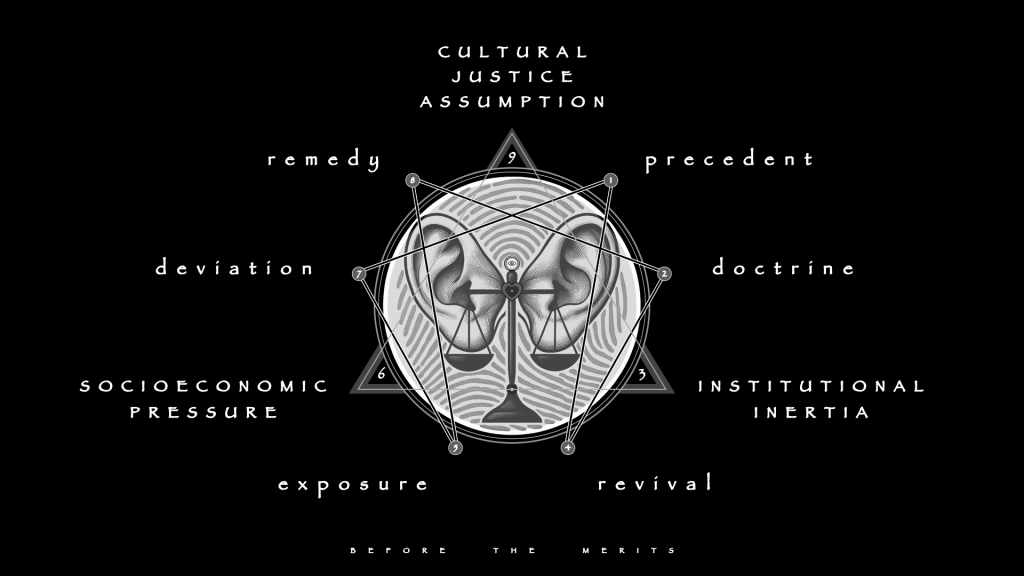
    What Barnes forecloses and what the law leaves open are not identical. The gap between them is where the next case will be born. Whatever specific circumstances generate it, the logos of any case has three components, each operating simultaneously as a field condition. Institutional Inertia (+) is already in motion, and Socioeconomic Pressure (-) defines the boundary conditions of that motion. These collide within a Cultural Justice Assumption (0) whose content varies but whose function does not.

    Institutional Inertia is the affirming force (+).

    Law enforcement under officer-safety doctrine treats hesitation as the primary operational risk, operating within a qualified immunity architecture and departmental indemnification structure that insulates individual officers from the financial consequences of civil judgments. A tactical choice that creates a dangerous situation is evaluated after the encounter ends, filtered through institutional incentives to absorb the ruling without transmitting it to the street level. The inertia does not require malice, only that the path of least resistance run consistently in one direction, and that the correction arrive after the fact.

    Socioeconomic Pressure is the denying force (-).

    The post-2014 proliferation of dashcam and body-camera footage made the full sequence of police encounters visible to juries, advocates, and the public for the first time at scale. This evolution created both the evidentiary conditions required to expose the moment-of-threat rule’s operation and the civil litigation infrastructure through which that exposure reached the Supreme Court. This force does not push toward any particular outcome. Rather, it defines the range of responses the institutional inertia already in motion will be permitted to produce, and it raises the stakes of every other force operating in the field without generating any directional momentum of its own.

    The Cultural Justice Assumption is the reconciling force (0).

    An officer facing immediate physical danger in the course of a lawful stop is entitled to use lethal force, and the legitimacy of that entitlement does not depend on whether the officer’s own prior choices created the danger. The majority treated this as constitutional common sense; the concurrence defended it against any implied erosion. The dissent located the fault line precisely in the question the majority declined to answer. The assumption is neither validated nor invalidated by the legal outcome it produces. It is the medium through which institutional inertia and socioeconomic pressure interact, and what makes that interaction legible as justice rather than mechanics.

    These forces do not finally resolve with a given case, but reconstitute around the next one. However, a reader who can identify all three next time will find that the following questions transfer. These are the questions this case leaves open rather than the ones it answers.

    If Ashtian Barnes had survived the encounter and the totality analysis revealed that Felix’s decision to board the moving vehicle was tactically unreasonable by departmental training standards, but the shots fired from the doorsill were a reasonable response to the danger Felix had created by boarding, would the officer-created jeopardy theory, if adopted by a future majority, produce a finding of constitutional violation, and what would a plaintiff need to prove about the relationship between the unreasonable tactical choice and the force it generated that no plaintiff has yet been required to prove?

    The post-2014 proliferation of video footage created the evidentiary conditions that made Barnes possible and concentrated the ruling’s practical benefit in jurisdictions with the civil litigation infrastructure to exploit it; if a future structural disruption, a regulatory rollback of body-camera requirements, a judicial ruling restricting footage admissibility, or a technological shift that allows footage to be selectively preserved, were to degrade those evidentiary conditions, what would the institutional inertia already in motion produce in the absence of the visibility that has been the primary external check on its operation?

    If the constitutional framework for evaluating excessive force is retrospective by design, and the democratic process to which Barnes returns the question of prospective regulation operates within the same field of institutional inertia and socioeconomic pressure that produced the federal litigation, and if the Cultural Justice Assumption that legitimates the entitlement to lethal force is formed and reformed in that same democratic process rather than outside it, what would it mean for any institution to recognize that the system is circular, and is the legal system capable of producing that recognition from within its own architecture or only from outside it?