Tag: Thirteen Americas

  • Constitutional rights have a zip code, which most people learn only after they are already in court. The federal appeals courts divide the country into distinct legal territories—regional, functional, and subject-matter—where the same constitutional guarantee can protect you completely in one state and fail you entirely in the next, not because the law changed, but because the judges did. Presidential appointments, regional political culture, and decades of industrial money have been quietly building these divergences until the gap between circuits is wider now than at any point since the civil rights era. Understanding which circuit governs your state, what it has historically protected, and where its fault-lines are cracking may be the difference between filing a case and winning one. Geography determines the settlement offer, whether the police officer gets away with misconduct, or whether the company pays or walks. These courts have produced distinct legal cultures, and the country has spent a century pretending the map does not matter.

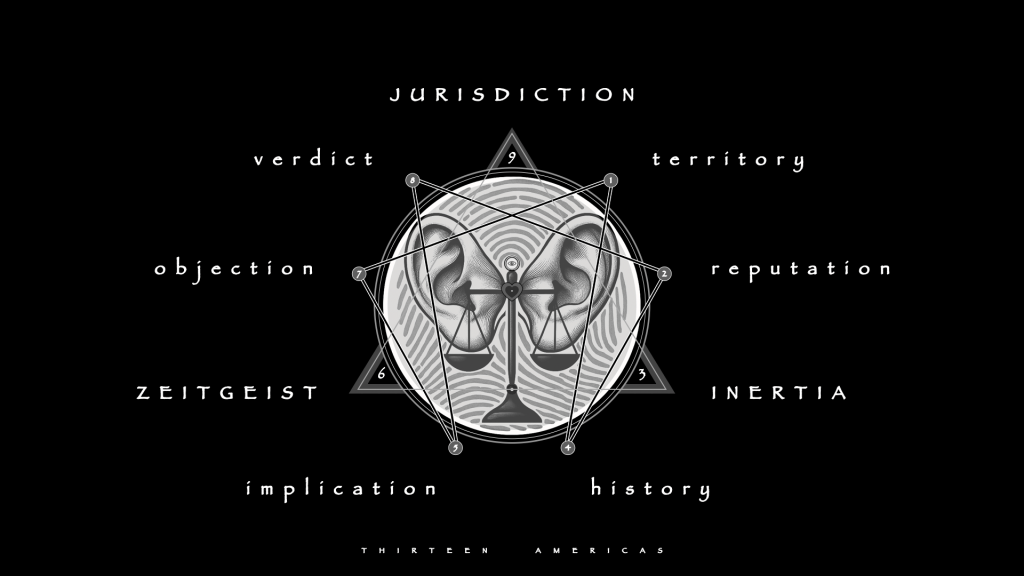
    Geography not only locates justice in a literal drawing of courthouse territory, but classifies it, too. Thirteen appellate courts now form the working map: eleven regional circuits, one court of federal machinery, and one court of subject-matter expertise. The current system is a routing diagram that determines which precedent attaches before any facts are heard, whether injuries arrive as constitutional questions or administrative problems, and which are priced out before any judge writes a word. The diagram has no author in the conspiratorial sense; it accumulated through appointments, reversals, retirements, and the slow calcification of regional habit into doctrine. Its effects, however, are indistinguishable from design.


    The Fifth Circuit Floods the Plain Before the Levee Can Hold

    The Fifth Circuit governs Louisiana, Mississippi, and Texas, a flood plain in the most literal and the most useful sense. A flood plain is flat, enormous, and engineered, shaped so that water runs toward chosen low points no matter where the rain happens to fall. In this circuit the water is litigation, and the engineering sends it toward a handful of friendly courtrooms whose output the full court then gathers up and ratifies.

    The court has become the most reliably conservative bench in the federal system, so far to the right that the conservative Supreme Court above it must repeatedly reach down to stop it. That pattern gets told as the story of an extreme court losing on the merits, but that story misses the mechanism.

    A flood does not need to win—it needs only to arrive first, and the Fifth Circuit has learned to control when the water comes.

    Territory
    A Flood Plain the Size of a Nation Drains Toward a Chosen Few Courtrooms

    Texas alone holds more than thirty million people, an economy larger than most countries, and a political culture that has treated the federal government as a rival since Reconstruction. Louisiana adds energy extraction, port commerce, and one of the most segregated criminal-justice systems in the country. Mississippi adds the deepest poverty of any state, a federal bench filled almost entirely by Republican appointees, and a political establishment whose relationship to its own civil-rights history is not one of repentance. Stacked together, the three states hand a single court authority over the oil and gas industry, the petrochemical corridor, the Texas insurance giants, and the agriculture of the Mississippi Delta.

    The human map is starker than the economic one. This is the circuit with the largest Spanish-speaking population in the country, a Black population concentrated in the states that fund public services least, and a Gulf Coast that real floods are rewriting year by year, even as the circuit’s hostility to environmental regulation makes the rising water harder to answer. The metaphor and the coastline have begun to converge.

    The engineering is the part outsiders miss. Texas built single-judge divisions in places like Amarillo and Victoria, where a plaintiff who files already knows the name of the judge before the clerk stamps the complaint, and the appeals from those courtrooms drain upward into a circuit primed to affirm them. What reaches the full court has already been routed. The rain may fall anywhere; the water arrives where the builders dug the channel.

    The single-judge division is not an accident of courthouse administration—it is a sluice gate. 

    A national challenge to a federal rule can be filed in a place where the plaintiff effectively knows the district judge in advance, and that judge can issue relief with national consequences before any appellate court has assembled a full view of the dispute. By the time the case reaches New Orleans, the water has already been released. The Fifth Circuit does not have to invent the flood. Texas venue practice starts it upstream. The appellate court’s function is then to decide whether to close the gate, leave it open, or announce that no one has standing to complain about the water level. All three options are available, and all three serve the same structural purpose. The machinery runs while the lawyers argue about the machinery.

    The basin is also changing in ways that will compound that machinery for years. The Fifth Circuit was once easy to caricature as the court of oil, guns, immigration, and state defiance, and that character is intact. But Texas is now collecting other forms of capital. 

    Austin has pulled technology firms and semiconductor investment away from the old Pacific center. Dallas is making an open bid for financial infrastructure, with exchange operators and market institutions treating North Texas as more than a back office. Houston remains the capital of energy extraction. What gathers inside the same circuit is therefore no longer one regional economy but a convergence of the country’s commanding industries: fossil fuel, platform technology, finance, logistics, defense, and data infrastructure. The Second Circuit‘s orbit around Wall Street and the Ninth’s orbit around Silicon Valley are not disappearing, but pieces of their mass are migrating into the Fifth’s flood plain.

    That migration matters legally because capital does not move only for weather and taxes. It moves toward governance. A company that relocates to Texas enters a political economy whose agencies, legislature, district courts, and appellate court are unusually receptive to challenges against federal regulation. 

    The forum-shopping story therefore understates the change. 

    Texas is not merely routing existing cases to friendly judges. It is attracting the industries that will generate the next generation of cases, then delivering them through a litigation channel already dug toward New Orleans. The energy-sector petitioners who used that channel to challenge EPA’s disapproval of Texas’s state implementation plan under the Clean Air Act’s Good Neighbor provision have already demonstrated the pattern: the litigation was filed in the Fifth Circuit, the court vacated EPA’s ruling in Texas v. EPA, No. 24-60351 (5th Cir. 2025 and 2026), and Texas power-sector sources were relieved from federal emissions controls while EPA was sent back to rebuild its case. That is the flood plain delivering its return on infrastructure investment.

    Reputation
    The Circuit Now Overruns Even the Banks the Supreme Court is Willing to Defend

    The Fifth Circuit’s reputation is no longer a matter of dispute. Even conservative commentators describe a court that has drifted so far right it routinely outruns what the Supreme Court will affirm. The proof sits in the Court’s own docket. Again and again the justices have stayed or reversed Fifth Circuit orders, on the emergency docket and on the merits, in numbers no other circuit approaches.

    The clearest single example is a gun case. 

    After the Supreme Court announced in Bruen that gun laws must match a historical tradition, the Fifth Circuit struck down the federal statute that disarms people under domestic-violence restraining orders in United States v. Rahimi, 61 F.4th 443 (5th Cir. 2023), reasoning that the eighteenth century knew no precise equivalent. The Supreme Court reversed that ruling by a vote of eight to one in 2024, 144 S. Ct. 1897, with only Justice Thomas in dissent, and restored the law across the country. A circuit reversed eight to one by this Court, on guns of all subjects, has found the far edge of the possible and stepped past it.

    The composition explains the drift without excusing it. Republican presidents appointed the commanding majority of the seventeen active seats, six of them named by Trump, and the newest arrivals are the ones legal commentators set apart from the older conservatives, the distinction being between judges who apply an aggressive method and judges who appear to choose the result first and assemble the reasoning afterward. Litigants have absorbed the lesson completely. 

    Plaintiffs in employment, environmental, and immigration cases steer their filings away from the circuit whenever they can, and regulated industries steer theirs toward it, because in the areas that matter the outcome is settled before the first brief is filed.

    The pattern wears a human face in the case of Rodney Reed, a Texas death-row prisoner who has maintained his innocence for decades and asked only to have crime-scene evidence tested for DNA. The Fifth Circuit first threw out his federal claim as filed too late, starting the clock at the moment a state trial court denied testing rather than at the end of his state appeals. The Supreme Court reversed that ruling six to three in Reed v. Goertz, 598 U.S. 230 (2023), restoring the obvious rule that the clock runs when the litigation ends. 

    On remand the Fifth Circuit affirmed denial of relief on the merits in April 2025, holding that Reed had not met his burden to show Texas’s application of its DNA-testing statute was fundamentally unfair. When Reed sought certiorari a second time, the Supreme Court denied review on March 23, 2026, No. 24-1268. Justice Sotomayor, joined by Justices Kagan and Jackson, dissented. Her opening sentence named the mechanism and its consequence without euphemism: “For the last 11 years, death-row prisoner Rodney Reed has sought DNA testing of key evidence that could prove his innocence. Because the Fifth Circuit has now rejected his efforts to obtain that testing, Texas will likely execute Reed without anyone ever knowing who is responsible for Stacey Stites’ death.” 

    Sotomayor has become the circuit’s most persistent documented critic, returning again and again in reversals and cert denials to flag the same flaw: the analytical shortcut that reaches the harsh result and skips the reasoning that should have stopped it.

    What the reversal record does not reveal is the court’s relationship to reversal itself. A normal appellate court is embarrassed by Supreme Court correction, because a normal court is optimizing for affirmance. It wants its rulings to hold, its doctrine to travel, its reasoning to become national law. 

    The Fifth Circuit has no such investment in those reversals. It is optimizing for something else, for the period between the emergency stay it grants and the correction that arrives months later, for the bargaining leverage a preliminary injunction creates before the merits are reached, for the disruption a nationwide order produces in the administrative machinery of a rule the court’s majority believes should not exist. A reversal means the flood drained back out. It does not mean the house was not ruined while it stood in the water.

    History
    The River Once Carried the Mandate of Brown and Now Runs the Other Way

    The Fifth Circuit was, within living memory, the most important civil-rights court in the country. From the middle 1950s into the 1970s a small group of judges, remembered as the Fifth Circuit Four, carried the desegregation mandate of Brown v. Board of Education into the schools of the Deep South, one defied order at a time, against state governments and a white bar that treated them as traitors to their region. John Minor Wisdom, Elbert Tuttle, John Brown, and Richard Rives used the speed and reach of a federal appeals court to force change before the resistance could organize to bar the door. The same water that now drowns regulation once carried desegregation into towns that had sworn to keep it away.

    Congress redrew the watershed in 1981, but it also divided an estate. Alabama, Georgia, and Florida were carved off into a new Eleventh Circuit, taking with them much of the old civil-rights docket, much of the old Fifth’s institutional memory, and enough of its moral capital to make the inheritance a question the new court could not avoid. What remained in the modern Fifth was a smaller basin, tilted toward Texas, and the current that ran through it was ready to be turned.

    The turning took thirty years and three Republican administrations. Reagan and the elder Bush began stocking the bench. The Clinton and Obama years added judges without ever matching the volume or the focus needed to counter the accumulating precedent. Trump’s six appointments between 2017 and 2021 finished the work. The result is a court whose majority treats federal regulatory power as constitutionally suspect, federal immigration authority as a lever any state may pull, and the Second Amendment as something close to absolute. 

    The channel that once carried the Constitution’s promise to the powerless now carries the preferences of the powerful, through the same ground, in the opposite direction.

    Implication
    Two Floodgates Stand Open, One for Guns and One Against the Administrative State

    The most active fault line inside the circuit runs through the Second Amendment and the historical-tradition test the Supreme Court built in Bruen. The Fifth Circuit generates more challenges to federal gun statutes than any other circuit, partly because Texas district courts welcome the plaintiffs and partly because the circuit’s own majority wants to push the doctrine as far as it will go. In United States v. Daniels 77 F.4th 337 (5th Cir. 2023), the court held that the federal ban on firearm possession by habitual marijuana users violates the Second Amendment as applied to Daniels, because the government could not identify a founding-era tradition of disarming comparable groups. 

    The Supreme Court granted certiorari, No. 23-376, and as of this writing has not issued a merits decision, leaving the statute in a state of suspended constitutional judgment inside the circuit while the disruption to enforcement accumulates. The school-zone ban survived a parallel challenge: in United States v. Allam, No. 24-40065 (5th Cir. June 16, 2025), the court upheld the Gun-Free School Zones Act’s core possession prohibition on sensitive-places grounds, demonstrating that the Bruen framework functions as a genuine constraint in at least one direction. The floodgate is open; it is not unhinged. The organizations pressing the outer limits of the doctrine are funded by the firearms industry, and the litigation they generate is designed to create suspense and enforcement uncertainty whether or not the Supreme Court ultimately affirms.

    The second floodgate opened the day the Supreme Court abolished Chevron deference in Loper Bright Enterprises v. Raimondo, 144 S. Ct. 2244 (2024). 

    The Fifth Circuit had resented agency power long before that ruling, and it had spent decades crafting ways to substitute its own policy judgment for the expertise of regulators. Loper Bright removed the last legal duty to defer to an agency’s reading of an ambiguous statute, and it handed the most regulation-hostile circuit in the country a free hand over the vast machinery of federal administration that touches energy, water, labor, and land across three states. The consequence arrived quickly. In Texas v. EPA, No. 24-60351, the Fifth Circuit vacated EPA’s disapproval of Texas’s state implementation plan under the Clean Air Act’s Good Neighbor provision and remanded to EPA, applying Loper Bright to read the statute without deference to the agency’s own interpretation. 

    The practical result removed the regulatory predicate that the EPA had used to impose federal emissions controls on Texas power-sector sources. Texas emitters that would have faced additional controls are now operating under vacated requirements while EPA rebuilds its justification from the beginning, which is the flood plain mechanism applied to environmental regulation. The water moves while the lawyers argue about whether the channel was dug correctly.

    The beneficiaries of both floodgates are not hard to name. Energy companies, agricultural interests, financial firms, and employer groups stand to gain from every ruling that narrows what a federal agency may do, and those rulings now arrive without the old obligation to defer. The levee that once held back the circuit’s preferences in administrative cases, the rule requiring courts to respect agency expertise, has been pulled down by the Supreme Court itself, and the water has gone where water goes when a levee is taken away.

    Objection
    Texas Is Digging a Private Channel for a Power the Constitution Handed Only to Washington

    The question the circuit cannot resolve on its own is whether Texas may build a parallel immigration system that the Constitution reserves to the national government. The state’s law known as SB 4 makes unauthorized entry from Mexico a state crime and empowers state police to arrest and state magistrates to order removal, a power that has belonged, for the better part of a century and a half, to Washington alone. Texas also strung a floating barrier of buoys across the Rio Grande, turning the river itself into a piece of the argument.

    The litigation has run like floodwater under dueling orders.

    In March of 2024 the Supreme Court briefly cleared the way; SB 4 took effect in Texas for a matter of hours; and a Fifth Circuit panel then blocked it again the same evening. A three-judge panel later held the law preempted by federal authority, the full court agreed to rehear the case, and in the spring of 2026 the en banc Fifth Circuit erased the injunction without deciding whether SB 4 is constitutional at all, ruling instead that the challengers lacked standing to sue. The constitutional question, the one that truly decides the matter, remains formally open years after the law was passed.

    The standing ruling is the mechanism, not a sideshow, and it is worth naming what the mechanism accomplishes. Standing is not merely avoidance in this context. It is a spillway. The court can drain the challenge away from the constitutional question while leaving the state machinery fully operational, releasing pressure from the litigation without answering the underlying problem. By clearing the block on a procedural ground and leaving the merits untouched, the en banc court gave Texas the practical room to run its system while the litigation restarts from the beginning. 

    A spillway does not stop the flood—it routes the water somewhere the dam cannot be blamed for it.

    Verdict
    The Court Does Not Need to Be Affirmed to Win, By Design

    The Fifth Circuit is not behaving as an honest appellate court in the areas that matter most. In immigration, in gun law, and in the regulation of industry, it produces outcomes the Supreme Court keeps finding deficient. It produces these on a schedule built to maximize their effect before review can overtake them. 

    The judges are not unaware of this—some even intend it.

    The usual way of keeping score misses the whole point. Tallying the circuit’s reversals treats the merits as the thing that matters, but the merits arrive last. The power this court holds is over time, over the gap between the moment it grants emergency relief and the moment, months or years later, when the Supreme Court rebuilds the rule. A policy in force for a year does its work whether or not the order authorizing it is eventually erased. A flood that drains back out has still ruined the house it filled.

    There is a bitter symmetry in this, because the old Fifth Circuit ran the same play in the other direction. Wisdom and Tuttle and their colleagues forced desegregation onto resisting states by moving faster than the resistance could counter, using the lag between an order and its undoing as a weapon for the powerless. The mechanism is neutral. The only question it leaves open is which way the water is sent, and the modern Fifth Circuit has answered that question without ambiguity, sending it toward the executive branch of a single state and the industries that finance its ambitions. 

    A court that controls when the flood arrives has already won every case the instant it grants the stay, regardless of how the appeal is later resolved. No number of reversals from above can drain a plain that has already done its flooding. The part of the inheritance that could still claim Tuttle and Wisdom’s name moved east to Atlanta, where it would be preserved, narrowed, and delayed under a different procedural vocabulary. 

    The old Fifth proved that timing could enforce constitutional rights. The modern Fifth proves that timing can defeat them. The mechanism was never the property of either.

    What the Fifth Circuit Teaches, the Sixth Complicates

    The Fifth Circuit teaches a lesson about the clock. Power over timing beats power over outcome, because a policy that operates while its challenge is pending has already done its work. The merits arrive last, and by then the damage is banked. A scoreboard that counts only reversals misses the entire game, because this court can lose every appeal and still win every case the instant it grants the stay. The Fifth Circuit overreaches so plainly that the Supreme Court must keep reaching down to stop it. The court that comes next has learned never to give the Supreme Court anything to catch.

    If the Fifth Circuit wins by being early, the Sixth Circuit wins by being unanswerable. Its reasoning is clean, disciplined, often elegant, and it runs from premises the court declines to reexamine toward conclusions it cannot take back. There are two ways an argument can fail: it can be invalid, its steps refusing to follow, or it can be unsound, every step following cleanly while a premise quietly lies. 

    We are trained to attack the first and left nearly defenseless against the second, and the Sixth Circuit specializes in the second. The danger here is not a broken machine. It is the danger of one that works.

    The architect of that method is Jeffrey Sutton, a serious judge whose constitutional philosophy is coherent and applied in good faith, which is exactly what makes it so hard to fight. He won the federalism cases as an advocate, wrote the lone marriage opinion that forced the issue to the Supreme Court, and built a capital-habeas doctrine that defers to state courts on who is executed, three applications of one idea. In Hill v. Shoop, cert. denied, 142 S. Ct. 1185 (2022), the court did not deny that Danny Hill was intellectually disabled; it held only that the state’s contrary finding was not unreasonable enough to disturb. Justice Sotomayor, joined by Justices Breyer and Kagan, dissented from the cert denial and drew the line the circuit had blurred: a ruling which survives as not unreasonable is not the same as a ruling that is correct. 

    There sits the whole distance between validity and truth, and this court can live in it indefinitely.


  • Constitutional rights have a zip code, which most people learn only after they are already in court. The federal appeals courts divide the country into distinct legal territories—regional, functional, and subject-matter—where the same constitutional guarantee can protect you completely in one state and fail you entirely in the next, not because the law changed, but because the judges did. Presidential appointments, regional political culture, and decades of industrial money have been quietly building these divergences until the gap between circuits is wider now than at any point since the civil rights era. Understanding which circuit governs your state, what it has historically protected, and where its fault-lines are cracking may be the difference between filing a case and winning one. Geography determines the settlement offer, whether the police officer gets away with misconduct, or whether the company pays or walks. These courts have produced distinct legal cultures, and the country has spent a century pretending the map does not matter.

    Geography not only locates justice in a literal drawing of courthouse territory, but classifies it, too. Thirteen appellate courts now form the working map: eleven regional circuits, one court of federal machinery, and one court of subject-matter expertise. The current system is a routing diagram that determines which precedent attaches before any facts are heard, whether injuries arrive as constitutional questions or administrative problems, and which are priced out before any judge writes a word. The diagram has no author in the conspiratorial sense; it accumulated through appointments, reversals, retirements, and the slow calcification of regional habit into doctrine. Its effects, however, are indistinguishable from design.


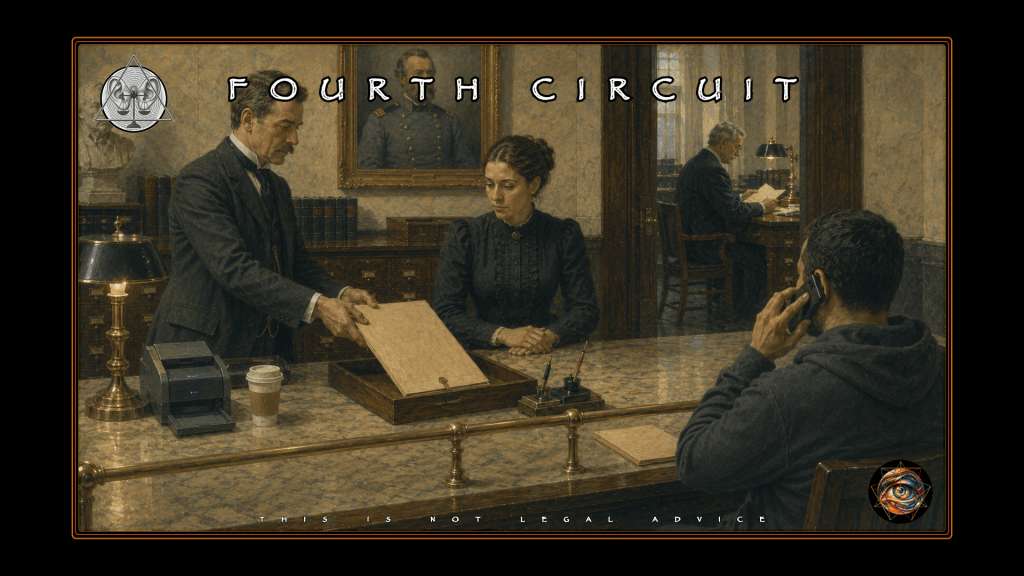
    The Fourth Circuit Keeps a Machine Running in a Basement No Election Reaches

    The Fourth Circuit hears its arguments in Richmond, in a courthouse named for Lewis F. Powell, in the city that once served as the capital of the Confederacy. Powell sat on the Supreme Court, and before that he wrote a 1971 memorandum urging corporate America to organize itself politically and legally against the reforms of the age. The building, the city, and the man on the door are not decoration. They are the foundation on which everything else rests.

    Across four decades the court that sat in that building was the most reliably conservative appellate bench in the country. Then a run of appointments under President Obama flipped it, and the same Richmond court began handing down some of the most progressive rulings in the federal system, until appointments under President Trump pulled it back toward an uneasy split. The usual telling of the Fourth Circuit is a story of transformation, of a house that changed hands and changed character.

    That telling is true only of the floors with windows. Beneath them runs a machine no candidate campaigns on, and no election has ever reached its switch.

    Territory
    The House Sits on Wealthy Suburbs, Poor Coalfields, and the Apparatus of the Security State

    The Fourth Circuit governs Maryland, Virginia, West Virginia, North Carolina, and South Carolina, a territory that runs from the Baltimore waterfront through the Washington suburbs, down across the Appalachian coalfields, and out to the Carolina coastal plains. It holds some of the richest ground in America, in counties like Loudoun, Virginia, where per-capita income has ranked among the highest in the nation, and some of the poorest, in the West Virginia coalfields and the eastern North Carolina tobacco belt. The same court that rules on the fortunes of the wealthy suburbs rules on the survival of communities the wider economy abandoned more than a generation ago.

    The federal docket carries that whole range in a single load. Immigration-detention cases from the enforcement machinery clustered in Northern Virginia sit beside civil-rights claims from the historically Black communities of South Carolina, environmental fights from the coalfields, and national-security matters from the agencies headquartered in the Washington suburbs. No other circuit has the security state living quite so literally in its backyard.

    A house this large contains rooms that barely speak to one another. The wing where a hedge fund argues a contract and the wing where a detainee argues for his freedom share a roof, a clerk’s office, and a body of precedent, and the same judges move between them, carrying the habits of one into the other. The architecture is single. The lives inside it are not.

    The house metaphor earns its keep when the geography is made concrete. The upper floors are Loudoun and Fairfax, the wealthiest counties in the country, dense with federal contractors, defense agencies, intelligence offices, and a professional class whose legal disputes concern employment contracts, federal procurement, and the national-security programs the government runs from the Washington suburbs. Those are the floors with light, the floors the national press covers, the floors whose rulings reach cable news within hours of posting. The basement is West Virginia’s coalfields, where black-lung disability claims move through federal courts at a pace the dying cannot afford, and the rural Black communities of eastern North Carolina, where environmental enforcement has been tested and found wanting for decades, and the immigration-detention facilities in Northern Virginia, where people contesting their removal are held in conditions that have generated their own body of contested litigation. The same building processes it all. The routing diagram sends each claim to the floor where the applicable doctrine lives, and the floors have very different ceilings.

    Reputation
    The Court Reversed Itself While the Country Watched

    Until roughly 2010 the Fourth Circuit’s reputation was settled and unambiguous. It ruled against habeas petitioners, against civil-rights plaintiffs, against environmental enforcement, and in favor of executive power in the national-security cases, and its signature was deference, a reflexive bow to states, to agencies under Republican administrations, and to trial courts in ways that sealed death sentences against any real federal review. A litigant who drew this circuit on the wrong side of any of those questions had, in practice, already lost.

    The decor on the upper floors then changed completely. The new majority assembled under Obama began issuing rulings on voting rights, marriage, and transgender students that ranked among the most protective in the country, and it issued them from Richmond, from the one address the conservative legal establishment had always assumed was safe. Corporate defense teams that had treated the Fourth Circuit as a harbor began steering their cases elsewhere when they could.

    The reversal was real … and partial. Appointments under Trump pulled the court back toward the center of its own gravity, and the bench that sits in 2026 is genuinely divided, its results in contested cases turning on which judges hear them. The house has been redecorated twice in fifteen years, and the furniture that arrives with each new majority is hauled out again with the next.

    The public overread the transformation because it could only see the floors with windows. Rights-expanding rulings on voting, marriage, and gender have visible plaintiffs, cultural stakes, and press coverage commensurate with both. They produce the images that travel: a couple married at a courthouse, a student allowed to use a bathroom, a voting map thrown out. Habeas doctrine produces none of those images. It produces denials, filed in cases whose names are known only to the lawyers and the condemned, resolving claims through procedural holdings that are technically defensible and functionally impenetrable. A death-penalty ruling that says the claim was procedurally defaulted does not generate a photograph. Neither does a ruling that says the error was harmless. Neither does one that says the state court’s decision, though possibly wrong, was not unreasonable enough to disturb.

    The machine runs without generating anything the press can cover, and a machine that cannot be photographed cannot be held accountable by anyone who depends on photographs.

    History
    Three Men Poured the Foundation, Built the Machine, and Changed the Curtains

    The modern character of the court was set in three layers, each laid by a different hand. The first belonged to Clement Haynsworth, the South Carolinian who served as chief judge from 1964 until 1981, and whose nomination to the Supreme Court by President Nixon collapsed on the Senate floor in 1969 amid charges that his record on race and labor was, at best, indifferent to the promise of desegregation. His defeat left the circuit with a reputation for racial insensitivity that it spent the next thirty years trying, unevenly, to shed.

    The foundation was poured with that stain already in the concrete.

    The second layer was the machine, and the man who built it was J. Harvie Wilkinson III, chief judge from 1996 to 2003 and the most intellectually formidable conservative the circuit produced. Under Wilkinson the court refined a set of procedural doctrines for disposing of habeas petitions that effectively walled state criminal convictions off from meaningful federal scrutiny. The Antiterrorism and Effective Death Penalty Act of 1996 handed the circuit a fresh set of levers, and Wilkinson’s court pulled them without hesitation. A 2016 analysis of the circuit’s capital punishment jurisprudence found that in the thirty-three years following the modern death penalty’s reinstatement, capital habeas petitioners in the Fourth Circuit had prevailed in roughly 6.2 percent of cases, against a national average closer to 40 percent across all circuits over the same period; when limited to cases in which the writ was actually granted, the success rate fell to approximately 3.3 percent.

    The machine was installed in the basement, plumbed to the gallows, and left to run.

    The machine did not look like a machine because each part had a respectable label. Deference. Exhaustion. Procedural default. Harmless error. Timeliness. Finality. Certificate of appealability. None of those words is sinister alone; each is necessary to keep federal review from becoming endless, and Wilkinson was not wrong that a habeas system with no procedural discipline would collapse under its own volume. His achievement was to arrange the parts into a system in which almost every constitutional claim could be acknowledged and then denied entry. The prisoner did not lose because the Constitution had nothing to say about his situation. He lost because the state court had already said something not unreasonable enough to disturb, because the claim had arrived a day late, because the lawyer had missed the procedurally correct door, because the constitutional error had not prejudiced the verdict in a form the doctrine was built to recognize. The virtue-word for each denial was finality, and finality is a word that sounds like justice to everyone except the person it buries.

    The basement machine runs on virtues turned sequentially into locks.

    The third layer was Obama, and his appointments did more than shift the court’s votes. They changed its culture on the floors above ground, producing the rulings that made national news precisely because no one expected them from Richmond. The court struck down North Carolina’s voting law after finding that it had targeted Black voters with almost surgical precision. It struck down Virginia’s ban on same-sex marriage. It ruled for a transgender student barred from the restroom that matched who he was.

    Those decisions were consequential, and they were, every one of them, work done upstairs.

    Implication
    The Live Battles Run Through the Upper Floors’ Contested Tenancy and a Detainee’s Secret File

    The furniture the Obama appointments installed upstairs is still in the rooms, but its tenure is disputed and its condition is mixed.

    In North Carolina State Conference of the NAACP v. McCrory, 831 F.3d 204 (4th Cir. 2016), a three-judge panel permanently enjoined North Carolina’s omnibus election law after finding it had targeted Black voters with discriminatory intent, striking photo ID requirements, reduced early voting, and the elimination of same-day registration under Section 2 of the Voting Rights Act and the Fourteenth Amendment. The ruling stands, and the law it struck is gone, but the Supreme Court’s subsequent decision in Brnovich v. Democratic National Committee tightened the Section 2 standard for future claims, reducing the doctrinal space inside which McCrory‘s reasoning operates. In Bostic v. Schaefer, 760 F.3d 352 (4th Cir. 2014), a 2-1 panel struck Virginia’s same-sex marriage ban on due process and equal protection grounds, a result the Supreme Court absorbed a year later in Obergefell v. Hodges and extended nationally.

    In Grimm v. Gloucester County School Board, 972 F.3d 586 (4th Cir. 2020), the court held independently on the merits that a school board’s exclusion of a transgender student from the restrooms matching his gender identity violated both Title IX and the Equal Protection Clause. The Supreme Court denied certiorari in 2021, leaving the Fourth Circuit’s ruling intact but the circuit split unresolved. Each of these decisions was real, consequential, and produced by panel appointments rather than by a reconstituted full court.

    Each survives, partially surrounded by doctrine that narrows its reach or leaves its authority uncertain at the national level. The furniture is there. The lease is contested.

    The most volatile live fault-line sits where immigration enforcement meets the writ of habeas corpus.

    Northern Virginia holds detention facilities packed with people contesting their removal, and in 2025 the case of Badar Khan Suri showed how far the government would go and how the court would answer. Suri, a Georgetown scholar from India married to a Palestinian-American citizen, was seized outside his home after the government claimed his speech on the war in Gaza made him deportable, and the State Department rested the claim on a memorandum it never produced. The government then moved him from Virginia to Louisiana to Texas, a relay that looked designed to drag the case out of any court inclined to hear it. He spent roughly two months in a Texas facility, a thousand miles from his wife and his three young children, before a federal judge in Virginia ordered his release, finding the detention likely punished protected speech. On July 1, 2025, the Fourth Circuit declined to reimpose detention, refusing the government’s request for a stay in a divided ruling whose reasoning targeted the jurisdictional-shuffle tactic directly: allowing officials to shuttle detainees without notice, the majority wrote, would reduce the ancient writ to a game of jurisdictional hide-and-seek.

    The questions the case raised, regarding speech as a ground for deportation and the reviewability of removals built on secret findings, remain open, and the cases behind it keep arriving.

    The second front is the Fourth Amendment in a circuit that effectively owns the law of government surveillance by the simple accident of housing the agencies and contractors that conduct it. The precedents the court wrote before Congress amended the foreign-intelligence statutes in 2008 built frameworks for surveillance that sit uncomfortably beside the warrant requirement, and a Supreme Court newly interested in digital privacy is steadily exposing the gap. When the high Court held in Carpenter v. United States, 585 U.S. 296 (2018), that the government needs a warrant to track a person through months of cell-site location data, it signaled a turn toward treating digital traces as protected. No published Fourth Circuit opinion has yet applied Carpenter squarely to the surveillance infrastructure the circuit hosts, which is itself a diagnostic: the agencies that operate in the circuit’s backyard conduct their most consequential programs through classified proceedings, executive authorizations, and FISA Court orders that never generate a published appellate record. The gap between Carpenter‘s warrant logic and the surveillance state’s operating assumptions is widening, but the circuit will resolve it, if it resolves it at all, in rooms with no windows and no published opinions.

    Surveillance and immigration detention share the same structural dependency. Each practice rests on evidence the subject cannot fully see: the classified surveillance record the target is never shown, the State Department memorandum the detainee is never permitted to read. A court fluent in the vocabulary of intelligence operations is a court that has learned to find the government’s framing of secrecy plausible.

    Plausibility is all the government needs when the other side cannot read the file.

    Objection
    A Windowless Room Decides Whether Secret Evidence Can Hold a Person Indefinitely

    The question the Fourth Circuit cannot answer on its own is whether the government may detain a person indefinitely, pending removal to a country that will imprison or harm him, on the strength of classified evidence that neither he nor his lawyer is permitted to see in full. The procedure allows government attorneys to fill the record with material the other side cannot read, cannot test, and cannot rebut. This produces conflicting panel decisions inside the circuit that no one yet has reconciled.

    The Suri memorandum was a small, public glimpse of the larger practice. A cabinet officer signs a finding, the finding justifies a detention, and the document itself stays in a drawer the detainee will never open. The stakes are not confined to the length of a confinement, because the removal at the end of it can deliver a person to a government that will jail or torture him, on the strength of a paper he was never allowed to read. Multiply that by the thousands of people moving through the detention system, and the windowless room stops being an exception and becomes a wing of the house.

    As the enforcement operation expanded through 2025 and 2026, the Fourth Circuit became the primary judicial backstop for a detention system whose basic fairness is fiercely contested, and the current Supreme Court’s habit of deferring to the executive on national security offers the circuit almost no usable guidance. The court that hears more of these cases than any other has been handed a procedure built to keep the most important evidence out of the light, and asked to call it due process.

    Verdict
    The Transformation Everyone Debates Happens Only on the Floors with Windows

    The Fourth Circuit is a court in genuine transition—another way of saying that no one who governs it or argues before it can say with confidence what it now is. The conservative court Wilkinson built is half dismantled. The progressive court the Obama appointees briefly raised is half reversed. The result is a bench whose outcomes in its hardest cases depend heavily on which judges are drawn to hear them, and in a system where thousands of lives ride on those outcomes, that contingency is not neutrality. It is a failure wearing the robes of procedure.

    The deeper trouble lies a floor below where anyone argues. Everything that flips with an election is, by definition, the visible part, the voting rulings and the marriage rulings and the immigration rulings that draw headlines and provoke the next round of appointments. Those are the curtains, and curtains are made to be changed.

    The habeas machinery is not curtains. The doctrine Wilkinson assembled for insulating death sentences from review has survived every change of majority above it, because no judge runs for confirmation on the promise of rebuilding the procedures that send the condemned to their deaths faster, and no advocacy group raises money on a fight that abstract. The machine in the basement keeps running in the dark, untouched by the transformations that consume every news cycle, and it goes on producing the outcomes it was built to produce. A court’s most lethal work is always the work that does not reverse, because reversal requires visibility.

    The most dangerous room in any house is the one with no windows at all.

    What the Fourth Circuit Teaches, the Fifth Complicates

    The Fourth Circuit teaches a lesson about where to look. The work that reverses is the visible work, the marriage rulings and voting rulings that flip with each election and draw the next round of appointments. A public trained to watch those floors will never notice the room below them. An institution’s most lethal machinery is the part that survives every change of hands, precisely because no one campaigns on it and no headline can hold it. The Fourth Circuit wins its quietest victories by keeping them out of sight. The court that comes next has discovered it does not need to hide at all.

    If the Fourth Circuit wins by being invisible, the Fifth Circuit wins by being early. Its three states, Louisiana, Mississippi, and Texas, form a flood plain engineered so that litigation drains toward a handful of friendly courtrooms whose rulings the full court then gathers up and ratifies. The court has drifted so far right that the conservative Supreme Court above it must repeatedly reach down to stop it, a pattern usually told as an extreme court losing on the merits. That telling misses the mechanism entirely. A flood does not need to win; it needs only to arrive first, and a policy in force for a year does its work whether or not the order authorizing it is later erased.

    The power this court holds is power over time, over the gap between the emergency stay it grants today and the correction the Supreme Court rebuilds months or years from now. The human cost of that gap wears a face: Rodney Reed, who has waited on death row for DNA testing the circuit keeps finding ways to deny, drew a dissent from Justice Sotomayor warning that Texas may execute him before anyone learns whose DNA is on the murder weapon. There is a bitter symmetry beneath it all, because the old Fifth Circuit once ran the same play for the powerless, forcing desegregation onto resisting states by moving faster than the resistance could counter. The mechanism is neutral. Only the direction of the water has changed.

  • Constitutional rights have a zip code, which most people learn only after they are already in court. The federal appeals courts divide the country into distinct legal territories—regional, functional, and subject-matter—where the same constitutional guarantee can protect you completely in one state and fail you entirely in the next, not because the law changed, but because the judges did. Presidential appointments, regional political culture, and decades of industrial money have been quietly building these divergences until the gap between circuits is wider now than at any point since the civil rights era. Understanding which circuit governs your state, what it has historically protected, and where its fault-lines are cracking may be the difference between filing a case and winning one. Geography determines the settlement offer, whether the police officer gets away with misconduct, or whether the company pays or walks. These courts have produced distinct legal cultures, and the country has spent a century pretending the map does not matter.

    Geography not only locates justice in a literal drawing of courthouse territory, but classifies it, too. Thirteen appellate courts now form the working map: eleven regional circuits, one court of federal machinery, and one court of subject-matter expertise. The current system is a routing diagram that determines which precedent attaches before any facts are heard, whether injuries arrive as constitutional questions or administrative problems, and which are priced out before any judge writes a word. The diagram has no author in the conspiratorial sense; it accumulated through appointments, reversals, retirements, and the slow calcification of regional habit into doctrine. Its effects, however, are indistinguishable from design.


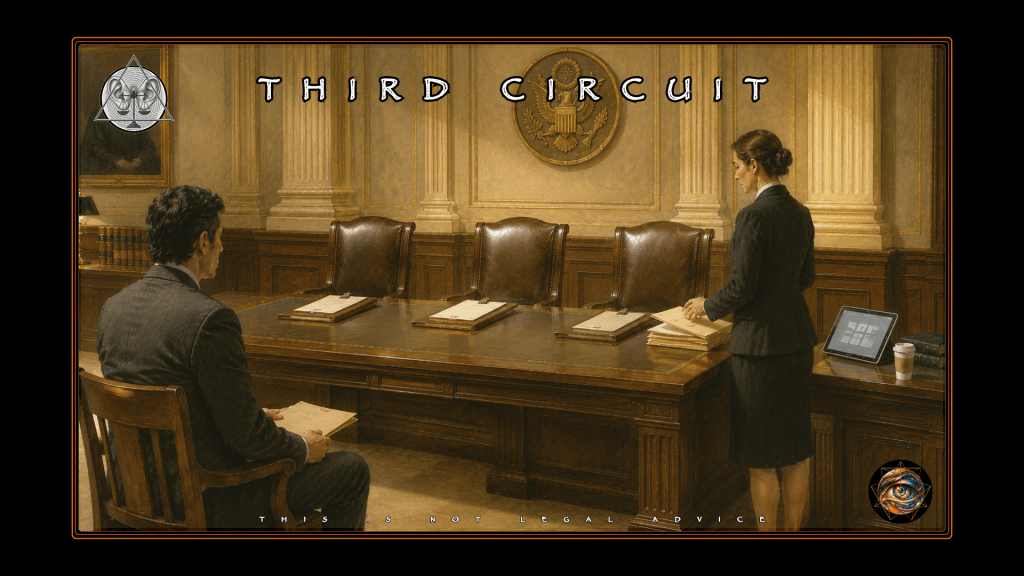
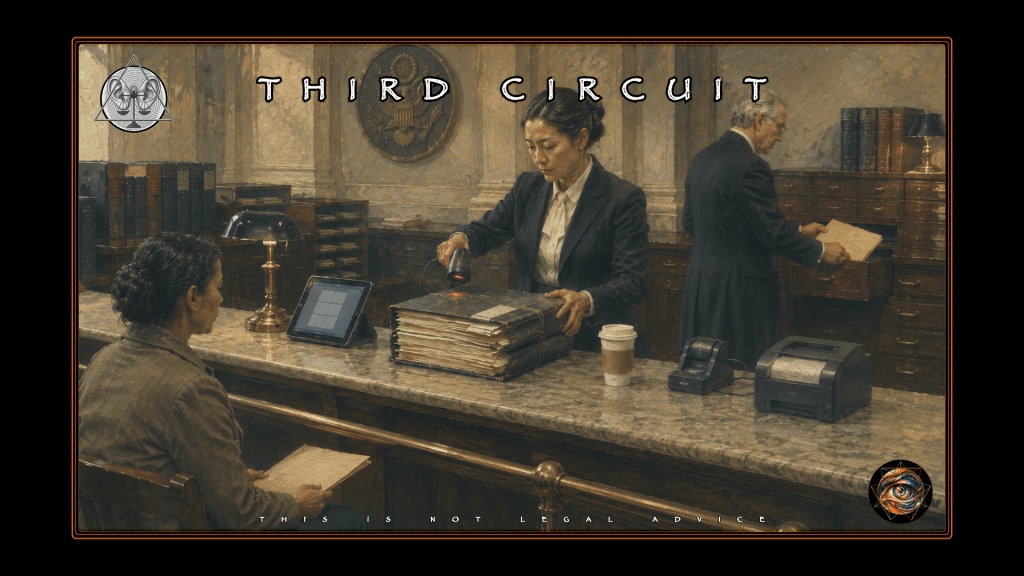
    The Third Circuit Is a Lottery Wearing the Robes of a Court

    A litigant who reaches the Third Circuit learns a quiet and unsettling fact early. The outcome of a hard case may be decided the moment three names are drawn from the assignment wheel, before a single brief is read, before the first oral argument, before the law has been so much as consulted. The same petition can win in front of one panel and lose in front of another, and the difference between the two results will not be the strength of the argument, but the names on the panel.

    This court is, by most measures, a good one, professional and intellectually serious, staffed by judges who take their own procedures seriously and write opinions that other courts respect. That makes the lottery quality of its results stranger, not less troubling, because the variance does not come from sloppiness or corruption. It comes from the design.

    Behind the four states the court governs sits a hidden engine that gives a small circuit national reach, and a set of fights that decide who lives, who pays, and who is sent back to the country they fled—the deck is stacked with high-value cards, and the order in which they are dealt is the whole of the game.

    Territory
    A Four-State Corridor Conceals the Corporate Engine that Gives it National Reach

    On a map the Third Circuit is a modest thing, four jurisdictions strung along the industrial corridor between New York and Washington: Delaware, New Jersey, Pennsylvania, and the United States Virgin Islands. The surface story is legacy manufacturing, dense urban poverty, the pharmaceutical and petrochemical plants of New Jersey, and the long post-industrial decline of Philadelphia and Pittsburgh. The Virgin Islands hangs off the circuit like a footnote no one reads, a territory whose cases arrive in Philadelphia stripped of the institutional support that might make the relationship feel less like extraction.

    The Virgin Islands matters here because it exposes the circuit’s odd geometry before Delaware’s engine even fires. A territorial litigant does not arrive in Philadelphia with Delaware’s corporate bar behind him or Pennsylvania’s institutional density beneath him. He arrives from a jurisdiction attached to the mainland court by a line drawn on a congressional map in 1948, a line with no relationship to his legal situation, his resources, or the body of doctrine most relevant to his claim.

    The Third Circuit’s own jurisdiction over the territory is itself an artifact of timing rather than principle: in Vooys v. Bentley, 901 F.3d 172 (3d Cir. 2018), the court sitting en banc spent considerable effort determining which Virgin Islands cases still traveled to Philadelphia and which now went to the newly created Virgin Islands Supreme Court, a question resolved by when the case was filed rather than by any principle touching the merits.

    So, his case must travel farther than his legal infrastructure can comfortably follow, and it arrives at a court whose institutional culture was built around corporate Delaware and postindustrial Philadelphia, neither of which speaks to the territory’s problems with any precision. The Third Circuit’s lottery therefore begins before the panel draw. Some claims enter the building with repeat-player sophistication and decades of appellate precedent behind them. Others enter as distant files from a jurisdiction the circuit map barely seems to remember, dependent on whichever three judges happen to open the envelope.

    Delaware is the secret engine. Roughly two-thirds of the Fortune 500 are incorporated there, not because they keep factories or headquarters in the state but because Delaware’s corporate law is permissive, sophisticated, and trusted, and because its Court of Chancery has produced generations of expertise the federal courts borrow without embarrassment. When a major corporation faces a securities claim, a bankruptcy, or a high-stakes contract fight, there is a real chance the dispute lands in the Third Circuit.

    The consequence is a body of corporate and commercial doctrine that operates, in practice, as a national standard. That is an extraordinary concentration of power in a court that covers only four states, and it bends the circuit’s gravity toward the institutions whose cases fill its commercial docket. The map says regional. The docket says otherwise.

    Reputation
    Professional Ambition Coexists with a Quiet Habit of Breeding Judges Who Overrule It

    Among practitioners, the Third Circuit is deemed a moderately liberal court with real intellectual ambition, demanding but fair, a court that applies its procedural rules with rigor without tilting the field toward defendants the way the Fifth Circuit does. Corporate defense teams respect it. Plaintiffs’ lawyers in employment and civil-rights cases find it tougher than they would like, in part because the circuit embraced the heightened pleading standards of the Supreme Court’s Twombly and Iqbal decisions early, codifying them in Fowler v. UPMC Shadyside in 2009 and applying them with some enthusiasm, raising the wall a complaint must clear to survive a motion to dismiss.

    The circuit’s most famous product, however, is not a doctrine, but a judge. Samuel Alito sat on the Third Circuit from 1990 until his elevation to the Supreme Court in 2006, and he served as the most conservative member of a court that leaned the other way. His role was the dissenter, the writer of separate opinions that lost at the panel and then, years later and one level up, became the law of the land.

    A dissent is a losing hand a judge refuses to fold. Alito kept his, confident that somewhere up the line the deck would be recut and the same cards would play as winners. That confidence proved correct in the most consequential way imaginable, and the proof traces back to a single Pennsylvania abortion statute.

    The Third Circuit shows how variance survives inside competence. A corrupt court produces variance because its judges are dishonest. A captured court produces variance because its judges all tilt the same way. The Third Circuit produces variance because it contains too many plausible courts inside the same actual court, and no single gravitational center disciplines the draw.

    One panel sees a case through Delaware’s commercial discipline, a legal culture that prizes predictability, administrability, and the orderly resolution of economic disputes. A second sees it through Philadelphia’s civil-rights memory, a tradition that has learned to read procedural obstacles as potential instruments of exclusion. A third sees it through New Jersey’s immigration and criminal docket, where the question of deference to agency judgment arrives daily and answers must be given quickly. Underneath those jurisdictional differences sit the personal formations: the former prosecutor whose instinct is to trust the investigative record, the former academic whose instinct is to interrogate the doctrinal foundation, the former corporate partner whose instinct is to ask whether the result is administrable across the range of cases it will govern. None of these judges behaves dishonestly. Each can write an opinion that sounds like law. The instability lies in the fact that the law contains enough room for each instinct to call itself faithful.

    The two bars that practice before this court have absorbed the lesson differently, and the asymmetry between them is as revealing as the variance itself.

    A corporate lawyer filing a major bankruptcy or a securities claim in Delaware can price panel composition before the petition is stamped. He knows which judges are likely to draw the case, what their prior rulings suggest, and how to frame the argument for the most plausible panel configurations. The uncertainty is managed as a variable, not experienced as weather. An immigration lawyer in Newark has no equivalent predictability. He has learned, as a professional adaptation, a kind of probabilistic fatalism: the same brief, the same facts, the same client, a different draw. The variance is not his client’s fault or his own. It is the design, which governs those who cannot choose which casino to enter.

    History
    A Trailblazer Built the Spine While a Losing Dissent Waited to Become National Law

    The modern character of the Third Circuit owes a much to Dolores Korman Sloviter, whom President Carter appointed in 1979 as the first woman ever to sit on the court. She became its first woman chief judge, serving from 1991 to 1998, and she built a culture of institutional seriousness that the circuit has largely kept. Her most enduring opinion struck down the Communications Decency Act as a violation of free speech, a ruling the Supreme Court affirmed in Reno v. American Civil Liberties Union, and it marked the court as a place willing to think hard and rule against the political momentum of the moment when the law demanded it.

    The court’s deeper influence, though, flowed from the man who kept losing inside it. When Pennsylvania’s abortion law climbed toward the Supreme Court as Planned Parenthood v. Casey, Alito wrote separately to argue that the state could require a married woman to notify her husband before ending a pregnancy. The Supreme Court rejected that position in 1992, striking the spousal-notification requirement and reaffirming the core of the abortion right. The hand lost at the table where it was first played.

    Thirty years later the same judge sat on a differently constituted Supreme Court, and he authored the opinion in Dobbs that overruled Casey and erased the constitutional right to abortion entirely. The argument that had failed him in Philadelphia did not improve in the interval. The deck had simply been recut, and a losing hand became a winning one the moment a new dealer took the table.

    Implication
    Three Live Battlegrounds Decide Who May Sue, Who May Buy Immunity in Bankruptcy, and Who May Seek Redress for Hidden Surveillance

    The first live fault-line opened the day the Supreme Court removed abortion from the Constitution.

    With no freestanding constitutional right left to invoke, advocates have begun routing reproductive-rights claims through federal antidiscrimination statutes instead, arguing that restrictions on pregnancy care violate the Americans with Disabilities Act, Title IX, and the laws against pregnancy discrimination. The Third Circuit governs no state with a total ban, so the most extreme factual scenarios arise next door, in other circuits. Its precedents on disability, on pregnancy, and on the reach of Title IX will nonetheless shape how courts across the country read these claims, because the statutory questions are national even when the bans are local.

    The second fault-line runs through corporate bankruptcy and through one of its ugliest tactics, the third-party release.

    Such a release uses a company’s Chapter 11 case to extinguish civil claims against people who never filed for bankruptcy at all, typically the executives and owners who helped cause the harm and would like to keep their fortune. The Supreme Court limited the practice sharply in Harrington v. Purdue Pharma, 603 U.S. 204 (2024), holding that a reorganization plan cannot wipe out claims against a nondebtor without the victims’ consent. Delaware is one of the two great venues for major corporate bankruptcy in the country, ergo a large share of cases testing what survives Harrington will be argued in Philadelphia.

    The circuit comes to that task with a record of unusual wariness toward sweeping nondebtor releases, so the Supreme Court’s ruling confirms an instinct the circuit already held rather than reversing one it cherished. No published Third Circuit opinion applying Harrington to a Delaware Chapter 11 proceeding had yet appeared as of mid-2026, a gap that reflects the ordinary timeline of appellate proceedings rather than any absence of live disputes. Delaware bankruptcy courts are currently working within the new constraint, and the first wave of Third Circuit opinions interpreting the boundaries of permissible releases is being written now. The cards being dealt in those cases are counted in billions.

    The third fault-line is quieter and cuts across both corporate and consumer terrain.

    In 2022, in Boley v. Universal Health Services, Inc., 36 F.4th 124 (3d Cir.), the court held that participants in a Pennsylvania 401(k) plan who had invested in seven of thirty-seven available options had both Article III standing and Rule 23 typicality to challenge the fiduciaries’ plan-wide process for selecting and monitoring the full investment lineup. The claim was about a uniform course of conduct affecting the whole plan, not about the performance of any single fund. The court held that standing required injury from conduct rather than investment in every affected option.

    Three years later, in Collins v. Northeast Grocery, Inc., the Second Circuit reached the opposite conclusion for a comparable set of plaintiffs, holding that participants lacked standing to challenge funds they had not personally held. The same worker with the same category of retirement savings claim wins the courthouse door in Philadelphia and loses it in New York, and the difference is not in the strength of her position. It is in the circuit map. In 2026, the court extended a comparable logic to consumer privacy, holding in In re BPS Direct, LLC, No. 23-3235, 2026 WL 1280969 (3d Cir. May 11, 2026), that retail shoppers whose complete credit and debit card numbers were captured without consent by session replay code embedded in Bass Pro and Cabela’s websites had alleged a concrete injury analogous to intrusion upon seclusion and therefore had standing to proceed. The court drew a precise line: card-number capture is concrete injury; non-sensitive browsing data is not. The Third Circuit’s consumer privacy Overton window is shifting, and the shift is being marked in the payment terminals of sporting goods stores in Pennsylvania.

    Bankruptcy shows the other face of the lottery.

    For corporate debtors, Delaware is not random at all. It is selected precisely because the bench is expert, the bar is known, the procedures are fast, and the path through Chapter 11 can be priced before the petition is filed. The debtor who chooses Delaware has already consulted restructuring counsel, modeled the probable panel range, and estimated the likelihood of a confirmed plan.

    Sophisticated parties do not fear the wheel; they choose the casino whose odds they understand and whose dealer they have briefed before. That choice sits in the same circuit, often in the same courthouse term, as the asylum docket in Newark, where the applicant has no choice of forum, no advance knowledge of the panel, and no ability to price the variance as a business variable. The corporation arrives having selected the table. The asylum seeker arrives after the table has been selected for him. Both are inside the same lottery. Only one of them knows it.

    Objection
    An Asylum Seeker’s Survival Can Turn on Which Three Judges the Wheel Selects

    The bleakest version of the lottery is not measured in billions, but in lives.

    When an immigration judge denies asylum by finding the applicant not credible, the ruling often rests on demeanor, on the way a frightened person sitting in a windowless room in Newark or Philadelphia appeared to a judge buried under a crushing caseload. An appellate court cannot see that demeanor. It can only read the record, and the Third Circuit has announced a standard that promises genuine scrutiny of such credibility findings rather than reflexive deference to them.

    The promise holds or fails depending on the panel. Some panels apply the standard with real skepticism and send weak credibility findings back for another look. Others recite the identical standard and defer almost completely, treating the immigration judge’s hunch as something close to unreviewable. The applicants whose cases pass through the Newark and Philadelphia immigration courts, among the busiest and most overwhelmed in the nation, include thousands of people from West and Central Africa, from Latin America, and from South Asia whose claim to safety will be tested with a rigor that depends, in practice, on the three names that came up on the wheel.

    The evidentiary record of this variance is harder to assemble than the structural argument predicts it should be.

    The Third Circuit resolves the overwhelming majority of asylum petitions in non-precedential dispositions, opinions that are decided but not published and therefore do not accumulate in the databases where comparative research is possible. A reversal and an affirmance of equally thin credibility findings, decided by different panels within the same year, almost certainly exist in that unpublished record; they simply cannot be retrieved through any method short of a manual review of the circuit’s full petition-for-review docket. The opacity is not accidental. A court that handles thousands of asylum cases annually and resolves most of them in unpublished opinions produces variance that is structurally invisible, which is a different and more durable problem than variance that can be demonstrated case by case.

    A clear doctrinal rule, one that compelled real review instead of deference on command, would save lives in a literal and countable sense. The circuit has not produced that rule, and it cannot produce it alone, because a single panel’s stricter standard can be undone by the next panel’s looser one until the Supreme Court or the full court sitting together imposes uniformity. Until then the wheel keeps turning, and the wheel does not know the difference between a frivolous claim and a death sentence.

    Verdict
    Variance Is the Betrayal, and the Draw Runs All the Way to the Top

    The Third Circuit is, in most respects, what a federal court is supposed to be. It is independent, technically excellent, and genuinely deliberative. On the craft of judging it largely delivers. Its weakness is not bias and not dishonesty, but its variance, the plain fact that a mixed bench hearing a high volume of contested cases produces outcomes that track the composition of the panel more closely than any principle of law would predict.

    That sounds like a smaller failing than corruption. It is not. The rule of law makes one promise above all the others, which is that the answer to a legal question does not depend on which official happens to hear it, that two people in identical situations receive identical treatment. A court whose results swing with the panel draw keeps every outward sign of fairness, the careful opinions, the rigorous procedure, the respectful tone, while quietly breaking the single promise that gives the rest of it meaning.

    Variance is not the same as disagreement. Appellate judges are supposed to disagree in hard cases; that is why panels exist. Variance becomes betrayal when the disagreement is so predictable by panel composition that doctrine stops functioning as the stabilizing force it claims to be. The diagnostic is not that any single panel reached the wrong result. It is that the pattern of results correlates with composition rather than with facts or law. At that point procedure has not failed visibly, but statistically, cognitively, and morally. The robes remain identical; the draw does not.

    The deeper lesson sits in the career of the judge the circuit is best known for producing. Alito did not win the argument over abortion in the Third Circuit, and he did not win it by writing a better opinion the second time. He won it by outlasting one bench and waiting for another, by holding a losing hand until a national reshuffle dealt him a majority. What the profession calls the evolution of doctrine is, more often than anyone cares to admit, the recutting of the deck. The Third Circuit is simply the rare place where the same hand can be watched winning at one table and losing at another, close enough together to make the truth impossible to miss, which is that the law was never the thing deciding the game.

    What the Third Circuit Teaches, the Fourth Complicates

    The Third Circuit leaves a lesson that should unsettle anyone who trusts a fair-looking process. A court can keep every outward sign of justice—the careful opinions, the rigorous procedure, the respectful tone—and still break the one promise that gives all of it meaning, that the answer to a legal question does not depend on which official happens to hear it. Variance is not a smaller sin than corruption. It is corruption’s better-dressed cousin, harder to name because nothing in the record looks wrong. The Third Circuit at least performs its lottery in the open. The court that comes next has learned to run its most consequential machinery where no one can watch it at all.

    If the Third Circuit lays its variance bare, the Fourth Circuit hides its real work one floor below the part anyone argues over. The visible floors of the house change hands with every election. For four decades the most reliably conservative bench in the country, the Richmond court flipped progressive under a run of Obama appointments, then split again under Trump, and that transformation is the story everyone tells. It is true only of the floors with windows. Beneath them runs a habeas machine, assembled to insulate death sentences from review, that no change of majority above it has ever touched, because no judge seeks confirmation on a promise to rebuild the procedures that send the condemned to their deaths faster.

    The deepest stakes sit in a windowless room. The same court holds the richest counties in America and the abandoned coalfields, and it is the home court of the surveillance state, the place where secret evidence can be weighed to hold a person indefinitely and the detainee may never see the file that damns him. Where the Third Circuit makes its arbitrariness impossible to miss, the Fourth Circuit perfects the opposite art, the lethal work that survives every reversal because it was built never to be seen. A court’s most dangerous room is always the one with no windows, and the Fourth keeps its switch exactly there.

  • Constitutional rights have a zip code, which most people learn only after they are already in court. The federal appeals courts divide the country into distinct legal territories—regional, functional, and subject-matter—where the same constitutional guarantee can protect you completely in one state and fail you entirely in the next, not because the law changed, but because the judges did. Presidential appointments, regional political culture, and decades of industrial money have been quietly building these divergences until the gap between circuits is wider now than at any point since the civil rights era. Understanding which circuit governs your state, what it has historically protected, and where its fault-lines are cracking may be the difference between filing a case and winning one. Geography determines the settlement offer, whether the police officer gets away with misconduct, or whether the company pays or walks. These courts have produced distinct legal cultures, and the country has spent a century pretending the map does not matter.

    Geography not only locates justice in a literal drawing of courthouse territory, but classifies it, too. Thirteen appellate courts now form the working map: eleven regional circuits, one court of federal machinery, and one court of subject-matter expertise. The current system is a routing diagram that determines which precedent attaches before any facts are heard, whether injuries arrive as constitutional questions or administrative problems, and which are priced out before any judge writes a word. The diagram has no author in the conspiratorial sense; it accumulated through appointments, reversals, retirements, and the slow calcification of regional habit into doctrine. Its effects, however, are indistinguishable from design.


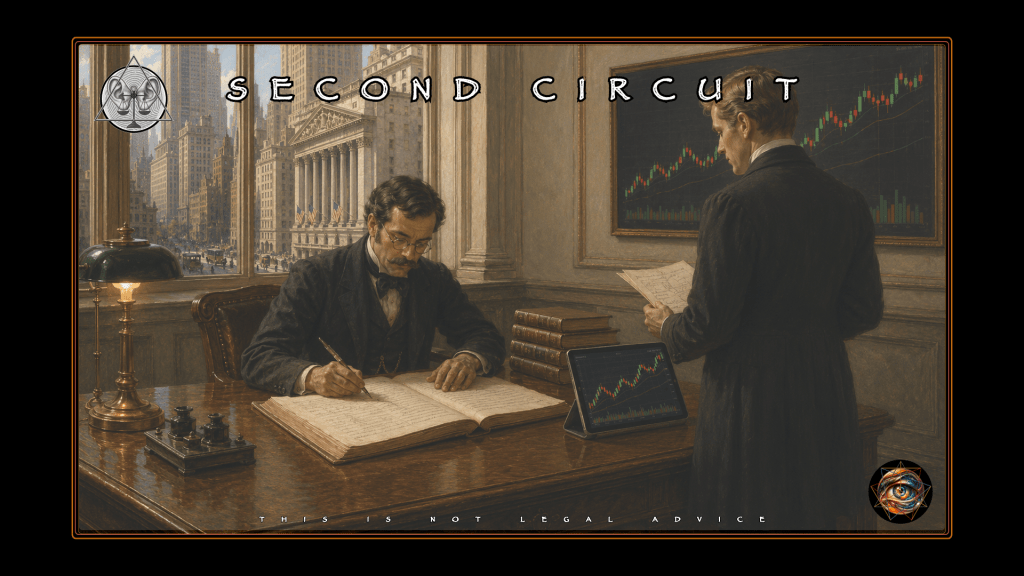
    The Second Circuit Orbits Wall Street and Cannot Feel the Pull

    On paper the Second Circuit governs the three states of Vermont, Connecticut, and New York. If that grouping looks arbitrary, the impression is correct. Vermont is a rural and progressive state whose federal docket leans toward environmental disputes and the occasional firearms case. Connecticut is a mid-sized state torn between Hartford’s insurance industry and the wealthy commuter towns that belong, economically, to someone else’s city. New York is the global capital of finance, media, and federal prosecution, and it distorts the circuit the way a massive body distorts the space around it, drawing every smaller thing into its orbit.

    What the Second Circuit actually governs, as a working matter, is Wall Street and the wreckage it leaves in its wake.

    The hedge funds, the investment banks, the private equity shops, and the public corporations that generate the most complex and highest-stakes civil litigation on earth all appeal their losses, in the end, to a single building at 40 Foley Square. The court has been the financial industry’s highest tribunal below the Supreme Court since Franklin Roosevelt’s appointees rebuilt securities law in the 1940s. A body that has circled the same mass for that long stops experiencing the orbit as motion, and calls it the way things are without any question. The one worth asking is whether the court can ever navigate back to open space.

    Territory
    One Mass Bends the Orbits of Two Smaller States, Spinning an Entire Body of Law

    Vermont and Connecticut are real states with real dockets. Inside this circuit, though, they function as mere satellites. Vermont sends environmental cases and gun cases up from a small and progressive population. Connecticut sends insurance disputes from Hartford and financial matters from towns whose tax base is little more than an extension of Manhattan. Neither state sets the circuit’s character, because neither carries the mass.

    New York is the gravitational center. The Southern District of New York, seated a few blocks from the exchanges, generates the securities prosecutions, the fraud trials, and the billion-dollar civil suits that built this court’s name. Everything else in the circuit arranges itself around that center. A securities lawyer in Burlington and a securities lawyer in New Haven both practice, functionally, in New York’s legal weather.

    A fitting metaphor is the moon in its synchronous orbit, one face turned permanently toward its governing body, the other never seen. The Second Circuit keeps one eye on the financial industry at all times, and has done so for so long that the turning no longer registers as a choice. A court that cannot feel itself turn is one that stopped asking why it faces where it does.

    Reputation
    Sophistication as a Service, Priced for a Seller’s Market

    Among securities lawyers and white-collar defense attorneys, the Second Circuit holds a reputation as the most technically sophisticated appellate court in the country on financial crime and securities regulation. The reputation is earned. The opinions are careful, the doctrine is intricate, and the judges who write them are genuinely expert in a field most courts handle only occasionally.

    Technical sophistication, however, is not the same thing as equal access to it. A court can be a precision instrument and still be calibrated for one kind of hand. The Second Circuit performs with seeming Swiss exactness. Like a Swiss mechanism, it was built by and for those who can afford its upkeep. The clients are the firms with the resources to brief a loss-causation argument across four hundred pages and three appeals.

    The court’s nominal politics lean liberal, and the label fits its civil-liberties work far better than its financial-regulation work.

    In the securities cases, where the money is, the court has long been hospitable to the institutional interests of the industry it supervises. That hospitality is not a stated allegiance. It is the curvature of the orbit, the direction a body leans when it has circled the same mass for seventy years. The mechanism survives precisely because it does not resemble corruption.

    Judges who clerked on the Second Circuit, practiced at the white-shoe firms, and returned to the bench carry the vocabulary of that ecosystem as professional formation rather than as allegiance. The Columbia Law Review article that becomes the precedent-setting brief that becomes the opinion that produces the next generation of clerks is not a conspiracy. It is an ecology, and its grammar is that of the institutional defendant: scienter, reliance, loss causation, market efficiency, the pleading standard, the standing requirement, the jurisdictional hook. The argument is never that no fraud occurred. The argument is that the fraud, if any, cannot be proven at this procedural posture under this doctrinal framework within this statute’s reach. Plaintiffs speak injury. The institutional defendants speak architecture. A court trained by the same ecosystem that produced the architects hears architecture as the more serious language.

    The same court, however, is not uniformly defendant-favorable, and the exceptions are worth examining because they reveal where the court’s Overton window is drifting.

    In 2024, the court decided Williams v. Binance, reversing dismissal of a putative class action brought by buyers of crypto tokens against a decentralized exchange that claimed no physical headquarters anywhere on earth. The court held that the token purchases plausibly qualified as domestic transactions under Morrison v. National Australia Bank because the orders became irrevocable when matched on servers located in the United States, and that U.S. investors could therefore pursue federal securities remedies despite the platform’s studied statelessness. The decision was plaintiff-friendly, technically innovative, and consistent with the court’s financial-sophistication identity.

    The question was not whether Wall Street institutions should answer for their conduct, but whether a new category of market participant, the retail token buyer whose phone sits in Brooklyn while the exchange claims to exist nowhere, falls inside the statute’s reach. The court decided it does. That decision costs the court’s traditional constituency nothing, because decentralized crypto exchanges are not the banks and hedge funds whose vocabulary the court has absorbed over seventy years.

    The plaintiff-friendly ruling in Binance and the defendant-friendly architecture of securities class-action doctrine coexist without tension, because they protect different things.

    History
    The Hand of Industry Preference

    The court’s intellectual character was set by Learned Hand, who joined the Second Circuit in 1924, led it as chief judge through the 1940s, and sat until his death in 1961. Hand was no ideologue. He was a pragmatist who believed federal courts existed to produce commercially predictable outcomes in a complicated economy, that statutes should be read for their purpose rather than their letter, and that any judge claiming to derive results mechanically from text was either naive or dishonest. That creed runs through the court’s securities work to this day.

    Hand’s framework gave the court permission to build. When Congress left a gap, the Second Circuit filled it, and in the 1960s the court constructed much of the modern architecture of securities fraud, most visibly in its landmark Texas Gulf Sulphur decision on what a company must disclose and when. The work was purposive, economically literate, and confident in its own authority to make law from statutes Congress had left unfinished.

    It is worth pausing on what Texas Gulf Sulphur actually was, because the later drift is more damning once the starting point is clear.

    The Second Circuit held in 1968 that officers of a mining company had violated insider-trading rules by purchasing stock before the company disclosed a major mineral find. The opinion treated the securities laws as a genuine public accountability project, the institutional expression of a social compact between markets and the citizens who depended on them for honest price discovery. The court that wrote that opinion was not Wall Street’s instrument. It was Wall Street’s regulator, applying laws that Roosevelt’s New Deal had written to impose accountability on a financial system that had betrayed the public in 1929. For roughly two decades the court and the SEC operated as partners in the same accountability project, and the court’s sophistication served that project: complex doctrine in the service of genuine enforcement.

    Another great accretion of mass came between 1995 and 2016, when a run of technically gifted but institutionally cautious judges joined the court. These judges were not crude opponents of plaintiffs. They simply applied the procedural doctrines, standing, pleading sufficiency, loss causation, in ways that raised the wall a class-action plaintiff had to climb. Congress passed the Private Securities Litigation Reform Act in 1995 to restrict securities class actions, and the statute found its most demanding, most defendant-friendly reading in this circuit’s hands.

    By the time the Supreme Court nationalized a strict pleading standard in Tellabs in 2007, the Second Circuit had already drafted the playbook, and the rest of the country was left to follow.

    Implication
    Insider-Trading Wars Show a Court Reaching Beyond the Statute … and Financial Gravity Reeling It Back

    The court’s most consequential live battleground has long been the boundary of insider-trading liability, fought under both the old Rule 10b-5 and the Title 18 fraud statutes Congress added after the Enron era. The Second Circuit’s instinct in these cases has run toward the sophisticated defendant. Meanwhile, the Supreme Court’s instinct has run toward yanking the doctrine back to its text.

    In 2014 the circuit decided United States v. Newman, reversing the convictions of two portfolio managers who sat several steps removed from the original leak. The court held that prosecutors had to prove the insider received a benefit of a pecuniary or similarly valuable nature, a stringent test that ended the campaign Preet Bharara had made the signature of his tenure as Manhattan United States Attorney. The Supreme Court declined to hear the government’s appeal, the Newman defendants kept their freedom, and the Department of Justice quietly abandoned a string of related investigations.

    The correction came sideways. Two years later, in a case out of the Ninth Circuit called Salman, a unanimous Supreme Court rejected Newman‘s demand for a pecuniary benefit as inconsistent with older precedent, restoring the rule that a gift of inside information to a trading relative is itself enough. The circuit had bent the doctrine toward the defendant, and a higher gravity had bent it back.

    The pattern repeated with confidential government information. In Blaszczak the circuit held in 2019 that nonpublic regulatory data from a federal health agency counted as property under the fraud statutes, and that the personal-benefit requirement did not travel into the Title 18 charges, a reading that handed prosecutors a powerful new weapon against financial defendants. The Supreme Court vacated the decision and sent it back to be reconsidered in light of its Bridgegate ruling, and on remand, in 2022, the circuit reversed its own course, holding that the information was not property at all and letting the convictions fall. The weapon was forged, admired, and confiscated inside of three years.

    A parallel fault-line runs not through the prosecution of financial crimes but through the private enforcement that is supposed to protect ordinary investors and retirement savers.

    In 2025, in Collins v. Northeast Grocery, Inc., the Second Circuit held that participants in a 401(k) plan lacked both Article III and class standing to challenge the fees or investment performance of funds and share classes in which they had not personally invested, even though all the options at issue sat on the same plan menu and the fee and selection decisions had been made at the plan level. The court held that failure to invest in the challenged fund meant failure to allege individual injury, so the fiduciary oversight claims simply could not proceed. The structural consequence is that a plan menu loaded with high-fee or revenue-sharing funds can persist without judicial review unless a participant happened to select the offending option and has the resources to litigate it. 

    Collins arrived one year after Williams v. Binance extended federal investor protection to crypto token buyers whose transactions became irrevocable on American servers.

    The court that reached across the Morrison boundary to protect a retail investor with a phone found no reaching required when the same retail investor’s pension administrator loaded her retirement account with funds that extracted fees she could not see and could not challenge. The selection criterion is not plaintiff-friendliness. It is which plaintiff the court’s financial-ecosystem orbit has trained it to recognize as a legitimate market participant.

    A quieter front runs through disclosure doctrine. Its latest ruling may be the most consequential of all for ordinary investors. In Smith v. The Gap, Inc., decided May 28, 2026, the Second Circuit affirmed dismissal of a securities fraud class action and drew a line that corporate counsel will spend the next decade measuring.

    The court held that:

    • Generic, industry-wide risk disclosures do not become actionable merely because the disclosed risk is actively materializing
    • Repeating boilerplate risk language without flagging a known recurrence is not fraud unless the company has affirmatively portrayed a known risk as merely hypothetical
    • Section 10(b) and Rule 10b-5 impose no general duty to disclose all material information

    The phrase that will appear in every motion to dismiss filed after 2026 is “boilerplate opacity,” though the court did not use those words. The doctrine licenses a space between disclosure and fraud where the company knows the problem, says nothing actionably new, and the investor has no remedy. The personal jurisdiction cases complete the same picture from a different angle. Since the Supreme Court tightened the rules in Bristol-Myers Squibb in 2017, the circuit’s handling of mass-tort and product-liability suits against pharmaceutical companies has favored the defendant with the means to litigate jurisdiction in a dozen forums at once, which is to say it has favored the pharmaceutical companies.

    Access to the courthouse, in these cases, is rationed by legal budget.

    Objection
    A Textualist Supreme Court Dismantles Tradition

    The heaviest question hanging over the Second Circuit is whether federal enforcement of securities fraud, criminal and civil alike, can survive the current Supreme Court intact. In 2023 the Court decided Ciminelli, reversing by a unanimous vote a theory of wire fraud the circuit had leaned on for decades, the so-called right-to-control theory that treated the loss of valuable economic information as a property harm. The Roberts Court will not tolerate prosecutors stretching the fraud statutes past the words Congress actually wrote.

    The message arrived again in 2024, when the Supreme Court decided Macquarie Infrastructure Corp. v. Moab Partners and unanimously vacated another Second Circuit judgment. The Court held that pure omissions are not actionable under Rule 10b-5(b), specifically rejecting the circuit’s prior willingness to treat failures to disclose information required by SEC Regulation S-K Item 303 as independently actionable without a misleading statement. The category of claim the Second Circuit had recognized, standalone silence in the face of a regulatory disclosure obligation, was eliminated.

    Plaintiffs must now show that the omission turned an existing statement into a half-truth. The new standard requires an affirmative misstatement as the anchor before silence becomes fraud. Two unanimous reversals in the same doctrinal neighborhood, both stripping enforcement tools the Second Circuit had built and both authored by a Court with no patience for purposive gap-filling, constitute a pattern rather than a correction.

    The trouble for the circuit is that gap-filling is precisely what it has always done. The purposive tradition that Learned Hand planted, the willingness to read statutes for their aim and to make law in the silences, is the habit the textualist majority now treats as illegitimate. A court built to fill silences faces a high Court that reads silence as a limit.

    Two masses now pull on the same body. The financial industry’s gravity still bends the court inward toward the defendant-friendly doctrine of the past, while the Supreme Court’s gravity pulls it outward toward a narrow textualism. A body caught between two gravities does not orbit cleanly, but becomes painfully stretched and possibly distorted.

    Verdict
    Capture Is Not Corruption, Hence No Cure Need Exist

    The Second Circuit is an excellent court in the narrow and real sense that it produces careful opinions, written by intelligent people, applying difficult doctrine to genuinely hard problems.

    It is also a court that has spent seventy years too close to the industry it judges to hold the neutral posture an appellate court is supposed to keep. No single ruling proves the point. The insider-trading line, the class-action pleading wall, the slow erosion of personal jurisdiction, the Collins standing barrier, none of them alone is damning, and together they trace a consistent tilt toward the institutional defendant that the statutes themselves do not require.

    The tilt is not bought. The judges are not necessarily corrupt, and treating the problem as corruption mistakes its nature entirely. The court leans toward the industry because its whole intellectual ecosystem, the clerkship pipeline, the academic friendships, the bar it drinks with, has been shaped by seventy years of proximity to the largest concentration of money on the planet. The captured watchdog does not take bribes. It simply comes to see the world through the eyes of the thing it was meant to guard.

    What makes this form of capture nearly immune to democratic correction is that its most decisive moves occur inside doctrines no ordinary person reads.

    The injury is not announced from the bench as a ruling in favor of the bank. It is processed through the pleading standard that prevents discovery, the loss-causation framework that makes damages unprovable, the scienter test that requires intent to be demonstrated before any evidence of intent can be obtained. The Gap case is the sharpest recent illustration. A company that maintains boilerplate opacity, knowing the risk is materializing and saying nothing actionably new, is shielded not by the court’s corruption but by its precision, its careful calibration of the line between what Section 10(b) requires and what it permits. The court did not write The Gap a license. It built a doctrine whose perimeter The Gap’s lawyers measured and stayed inside, and the plaintiff who loses at the motion-to-dismiss stage does not understand that she lost at the moment the doctrine was written, years earlier, in an opinion that cited three law review articles no senator has read and no journalist covered.

    What should trouble anyone who hopes the Supreme Court’s corrections will repair the problem is that a corrupt court can be cleaned, but a captured court cannot. Corruption is a thing the court knows it is hiding, but capture feels, from the inside, exactly like good judgment. When the textualist majority strikes down another of the circuit’s expansive doctrines, the judges will not experience the blow as the straightening of a bent body. They will experience it as an assault on law itself, and they will defend the orbit in the sincere belief that they are defending gravity.

    The deepest capture is the kind the captured cannot see, because it has long since mistaken the mass it circles for the center of the universe.

    What the Second Circuit Teaches, the Third Complicates

    If the Second Circuit is a body locked in one predictable orbit, the Third is a wheel of names with no governing mass to steady it. The outcome of a hard case there can be settled the moment three judges are drawn from the assignment wheel, before a brief is read or the law consulted, and the same petition that wins before one panel loses before another on no difference the law would recognize. This is not the failure of a sloppy or corrupt court. The Third is professional, technically excellent, genuinely deliberative, which is what makes the variance so unsettling, because it flows from the design rather than from any defect the design was meant to prevent. A small four-state corridor conceals a corporate and bankruptcy engine that gives its rulings national reach, and an asylum seeker’s survival can turn on which three names the wheel selects.

    The deepest stakes show in the career of the judge the circuit is best known for producing. Alito lost the abortion argument inside the Third Circuit and did not win it later by writing a better opinion. He won it by outlasting one bench and waiting for a national reshuffle to deal him a majority. What the profession calls the evolution of doctrine is often a recutting of the deck. Where the Second Circuit cannot perceive the gravity that bends it, the Third lays bare the thing every court works to keep hidden, that the same hand can win at one table and lose at another, and the law was never quite the thing deciding the game.

  • Constitutional rights have a zip code, which most people learn only after they are already in court. The federal appeals courts divide the country into distinct legal territories—regional, functional, and subject-matter—where the same constitutional guarantee can protect you completely in one state and fail you entirely in the next, not because the law changed, but because the judges did. Presidential appointments, regional political culture, and decades of industrial money have been quietly building these divergences until the gap between circuits is wider now than at any point since the civil rights era. Understanding which circuit governs your state, what it has historically protected, and where its fault-lines are cracking may be the difference between filing a case and winning one. Geography determines the settlement offer, whether the police officer gets away with misconduct, or whether the company pays or walks. These courts have produced distinct legal cultures, and the country has spent a century pretending the map does not matter.

    Geography not only locates justice in a literal drawing of courthouse territory, but classifies it, too. Thirteen appellate courts now form the working map: eleven regional circuits, one court of federal machinery, and one court of subject-matter expertise. The current system is a routing diagram that determines which precedent attaches before any facts are heard, whether injuries arrive as constitutional questions or administrative problems, and which are priced out before any judge writes a word. The diagram has no author in the conspiratorial sense; it accumulated through appointments, reversals, retirements, and the slow calcification of regional habit into doctrine. Its effects, however, are indistinguishable from design.


    The First Circuit Keeps the Books on a Debt the Nation Will Not Pay

    Three million American citizens live under a court they cannot influence and a Constitution that reaches them only in part. They reside in Puerto Rico. They vote for no president, send no voting member to Congress, and answer to an appeals court seated two thousand miles north in Boston. There, the judges who decide whether their rights are whole or partial were chosen by an electorate that does not include them.

    The arrangement is not an oversight, but a debt more than a century old—one the United States chooses to refinance every generation rather than retire.

    The First Circuit Court of Appeals keeps the books on that debt with a tidiness that has become its chief feature. Most courts are known for what they decide. The First is best understood by what it has been assigned to maintain, and by what, when it believes no one is looking, it quietly extends to those whose politics it shares.

    Territory
    The Court Presides Over Non-Equals

    The First Circuit is the smallest court in the federal system, deceptively small. It covers Maine, Rhode Island, New Hampshire, and Massachusetts, a compact and prosperous corner of New England where federal law functions as a stable background condition, the legal equivalent of municipal water that arrives when the tap turns.

    Then it covers Puerto Rico, where roughly a third of its human jurisdiction lives, and where the proverbial tap has never run clean.

    New England supplies the court a steady diet of the ordinary. Universities, hospitals, biotechnology firms, and the citizenry all treat the Constitution as a settled inheritance. Puerto Rico supplies something the other forty-six states never present in quite this form: a population whose constitutional status has never been resolved, attached to a debt crisis larger than most sovereign defaults, governed at a remove by a Congress in which it has no vote.

    Two courts share one robe. The first tends a garden that needs little more than weeding. The second administers a question the nation has refused to answer for a hundred and twenty-five years and counting. The ledger only grows longer every term, the interest compounding quietly in the back pages where almost no one reads.

    Puerto Rico does not enter the First Circuit as a state with an unusual history. It enters as a jurisdictional category already lowered in value before the panel is drawn. A New England litigant brings a federal right into court. A Puerto Rican litigant brings the right and the prior question of whether the right has fully arrived. The injury has been sorted before the claim begins, and the sorting is not accidental.

    The books were rigged at the opening entry.

    Reputation
    The Court Is Selectively Progressive, Not Moderate

    The bar describes the First Circuit as moderate, careful, and institutionally modest. The description is accurate for nearly everything the court touches in routine commercial, criminal, and administrative litigation. It swings for no doctrinal fences. It manufactures none of the ideological set pieces that make other circuits famous. The lawyer who draws it expects competence rather than adventure.

    That reputation, however, obscures a regional ideological center of gravity that becomes visible the moment the case touches something the Boston legal culture treats as settled.

    In 2011, the court decided Glik v. Cunniffe, holding that the First Amendment protects a citizen’s right to openly record police officers performing their duties in a public park, and that the right was clearly established, so that officers who arrested a peaceful bystander for filming them were not entitled to qualified immunity. The decision was correct, widely praised, and subsequently adopted as persuasive authority by courts across the country. It is also the circuit’s most celebrated civil liberties ruling, and its politics are not incidental to its reception.

    In 2020, the court went further. A unanimous panel affirmed Harvard University’s race-conscious undergraduate admissions program in full, holding that the program’s holistic use of race as one factor among many satisfied strict scrutiny under Title VI, complied with four decades of Supreme Court precedent, and produced no impermissible racial balancing. The opinion ran to a full bench-trial record; this was not a facial challenge or a close procedural question.

    The court had every fact available and reached its conclusion with the confidence of a body whose regional assumptions and the assumptions of the institution it was reviewing happened to be identical.

    In 2023, the Supreme Court reversed. It held that Harvard’s program violated the Equal Protection Clause because it lacked sufficiently focused and measurable objectives, used race in ways that were negative and stereotyping in effect, and had no meaningful end point. The First Circuit had read Grutter v. Bollinger as broader than the institution that wrote it intended, because the court was situated in Cambridge, and Cambridge had never doubted the answer.

    The Puerto Rico cases expose a third register, distinct from both the civil-liberties progressivism and the routine moderation. Confronted with the territory’s status, the court cannot be moderate. Moderation would mean applying ordinary constitutional analysis, which would expose a contradiction the court has no authority to resolve. What looks like restraint in those moments is closer to a clerk declining to total a column he suspects will not balance. The modesty is doing work. It trains everyone around the doctrine to experience colonial exception as a sequence of narrow holdings, each small enough to defend, none large enough to force confession.

    The injustice survives because it is never made to appear whole in a single frame.

    History
    The Cage Was Built in 1901 and Nobody Will Open It

    The character of this court was set decades before the modern circuit map existed, in a cluster of Supreme Court decisions now called the Insular Cases. The Court held in 1901 that some territories belonged to the United States without becoming part of it, which meant the Constitution would reach their residents only in fragments, only where Congress saw fit. The doctrine was conceived in the same legal climate that produced the era’s segregation rulings, and it has never been formally repudiated.

    In Downes v. Bidwell, the Court invented a distinction found nowhere in the constitutional text, separating incorporated territories bound for statehood from those merely acquired and held indefinitely as possessions.

    Puerto Rico fell into the second category, described as foreign in a domestic sense, belonging to the nation without being of it. The doctrine reached its fullest expression in 1922, when the Court held in Balzac v. Porto Rico that a citizen of Puerto Rico possessed no constitutional right to a jury trial, the jury being, in the Court’s judgment, not fundamental enough to follow the flag.

    Scholars now shelve these rulings beside Plessy and Dred Scott in what they call the anticanon, the cabinet of decisions so discredited that lawyers cite them only to condemn them. The difference is that Plessy and Dred Scott were overruled. The Insular Cases never were. They occupy the active shelf and the disgraced shelf simultaneously, a precedent no one defends and no court has buried.

    The doctrine’s most durable achievement was not legal but cognitive. It taught the legal profession, and by extension the public, to treat the territorial question as a specialized category requiring specialized knowledge, rather than as a straightforward question of whether American citizens hold American rights. A body of doctrine presented as complex enough to require expertise is thereby functionally insulated from ordinary moral judgment. The First Circuit inherited the daily job of administering that doctrine. The judges did not pour the foundation., nor did they raise the walls. They have, however, kept the structure in good repair across decades, repointed the mortar when it crumbled, and ensured the doors still lock.

    There is a name for someone who maintains a cell he did not build, who feeds the occupant, who keeps the latch oiled and the key in his pocket.

    Implication
    The Doctrine Fractures in Two Directions—Only One Is Visible

    The most instructive modern demonstration of the Puerto Rico fault-line arrived through the litigation over the island’s debt, where Congress installed a federal control board under a 2016 statute called PROMESA. The board’s members, none of them elected by anyone on the island, held the power to veto or rewrite the laws passed by Puerto Rico’s own legislature. The First Circuit, in an opinion written by Judge Juan Torruella, its only Puerto Rican member and the most relentless critic the Insular Cases ever faced on a federal bench, treated those members as federal officers who should have faced Senate confirmation under the Appointments Clause.

    Torruella spent thirty-six years arguing in print that the Insular Cases amounted to political apartheid, and he died in October of 2020 before learning the outcome. The Supreme Court reversed. It held that the board’s members were territorial officers rather than federal ones, built the result on the Territories Clause rather than on the Insular Cases, and declined to name the Insular Cases at all, preserving the typical New England exceptionalism through a side door while sparing itself the need to defend the front.

    That fault-line, however, does not run only through Puerto Rico.

    A far less examined fracture runs through every courthouse in Maine, Rhode Island, New Hampshire, and Massachusetts. In 2018, a Maine state trooper shot and killed an armed civilian. The First Circuit, in Conlogue v. Hamilton, affirmed summary judgment for the trooper on qualified immunity grounds. The panel applied the standard two-step inquiry and held that, under the totality of circumstances, with an individual perceived as a threat, it was not clearly established that the shooting violated the Fourth Amendment, and thus the trooper was shielded from liability.

    Seven years earlier, the same court had held in Glik that it was clearly established that arresting a man for filming police in a public park was unconstitutional. The right to hold a phone in Boston Common was clearly established. The right not to be shot in Maine was not.

    Another fracture appeared in May 2026, quieter than either of the first two and more structurally revealing than both.

    In Courtemanche v. Noble, four Worcester County residents alleged that the Massachusetts State Police had secretly recorded their telephone conversations with officers, stored those recordings in an online database, and used them to initiate charges in at least 181 criminal cases without disclosing the recordings’ existence to the prosecutors who brought those cases. The plaintiffs sought declaratory and injunctive relief; none faced pending charges. The First Circuit reversed the district court and dismissed for lack of standing, holding that generalized exposure to a secret recording database, without a concrete and imminent personal future harm, is insufficient to invoke federal jurisdiction for prospective relief. The court that gave citizens the right to record police in 2011 held in 2026 that citizens secretly recorded by police could not yet prove they had been harmed enough to challenge the practice.

    Surveillance-based harm is structurally incapable of satisfying the imminence requirement because the secrecy that makes the surveillance possible is the same condition that makes the harm invisible until the government chooses to deploy it—by then the injury is retrospective, and prospective relief is moot.

    These decisions differ in mechanism but converge in result. The routing diagram sorted your claim into a register where the injury cannot be named for what it is. In Puerto Rico cases, the court cannot apply the normal tools because the Insular Cases have declared them the wrong instrument. In excessive force cases, the court declines to apply the normal tools because qualified immunity permits the declination wherever the legal question can be characterized as unsettled. In surveillance cases, the court cannot reach the tools at all because standing doctrine closes the door before any instrument is selected.

    The injured Puerto Rican, the dead civilian in Maine, and the Worcester County resident whose voice sits in a police database arrive at the same courthouse through different doors and exit with the same verdict.

    Objection
    The Paradox Has a Face, and Wears a Robe

    The unresolved Puerto Rico question is foundational rather than technical, and the Court has begun, haltingly, to circle it. In 2022 a man named José Luis Vaello-Madero gave the doctrine a face. He had earned disability benefits while living in New York, moved to Puerto Rico to care for his wife, kept collecting the aid he was owed, and then watched the federal government sue to claw back twenty-eight thousand dollars on the theory that a citizen forfeits such help by crossing to the island. The Supreme Court agreed that Congress could draw the line that way.

    Justice Gorsuch, in concurrence, called the Insular Cases shameful, wrote that they rested on racial stereotypes rather than on anything in the Constitution, and warned that the ruling only deferred a reckoning long overdue. Justice Sotomayor, in dissent, called the old cases odious and wrong. The reckoning did not arrive.

    Months after Gorsuch issued his invitation for an appropriate vehicle, one appeared. A challenge out of American Samoa called Fitisemanu asked the Court directly whether the Insular Cases should fall, and the Court declined to hear it. The doctrine endures instead by the method Gorsuch named with open contempt: the steady reclassification of one more right as fundamental so that it can be handed down to the territories, the rotten footing left undisturbed beneath each new floor.

    The qualified immunity objection has no Gorsuch concurrence.

    No Justice has called the doctrine shameful in print, although several have questioned it. The objection lives instead in the contrast the doctrine’s own logic cannot explain, which is why the court that announced the right to record police in Glik is the same court that announced the right to shoot armed civilians in Conlogue and then held in Courtemanche that citizens recorded without their knowledge cannot challenge the practice until the government decides to use the recording against them. All three decisions are defensible in isolation. The doctrine of clearly established law asks whether the specific right was placed beyond debate by prior precedent, and in each case the court answered honestly according to its own lights.

    The problem is what honesty produces when the doctrine’s architecture allows judges to define the right narrowly enough that no prior case will ever have placed it beyond debate, and when standing doctrine allows the government to defeat systemic challenges by pointing to the very secrecy that makes individualized harm impossible to allege. Glik traveled as precedent because its politics made it useful. Conlogue settled quietly because its politics made it comfortable. Courtemanche will be cited by police departments because its logic makes surveillance self-insulating.

    Verdict
    Competence is How Injustice Survives—Assumption Is How It Travels

    A bad court would have forced a reckoning long ago. Cruelty draws scrutiny, scrutiny draws repeal, and a flamboyant judge applying a colonial doctrine with visible relish would have handed reformers the spectacle they require. The First Circuit has supplied no such spectacle. It has administers doctrine the way a practiced anesthesiologist administers a drug: smoothly, professionally, without the patient ever feeling the needle find the vein.

    The routing diagram’s deepest function is not to deny the injury but to reclassify it into a register where the injury cannot be named as what it is. A Puerto Rican litigant’s claim does not arrive in Boston as a civil-rights matter in the ordinary sense. It arrives pre-classified as a territorial question, governed by a different precedent and reaching different conclusions. The litigant who enters the system presuming a right to equality exits with a ruling on whether the right has reached the island yet. The Insular Cases survived a century not despite the competence of the courts that applied them but because of it. Honest judges kept the books so neatly that the debt never came due.

    Torruella spent thirty-six years trying to force that audit from inside the firm, and the firm outlasted him.

    The Harvard case adds a dimension the Puerto Rico cases alone cannot supply. The court that kept the colonial books so neatly that the debt never became visible is the same court that affirmed Harvard’s admissions program so confidently that it never considered the possibility of a Supreme Court operating from a different center of gravity. With Puerto Rico, the court knows what it is doing and performs its assigned function with professional care. With Harvard, the court did not know what it was doing because it could not see outside its own regional assumptions.

    Competence, regional consensus, and institutional self-assurance are the same instrument played in three different keys. All three produce the same note: a court whose virtues are locally calibrated and nationally unreliable. The kindest thing this court could do for the people it governs would be to fail at its assigned task loudly enough that the country is finally made to notice. The unkindest thing it does, day after day, is succeed.

    What the First Circuit Teaches, the Second Complicates

    The First Circuit leaves behind a single lesson, and not the one you expect. Competence is supposed to cure injustice, yet here it is the preservative. A century of careful bookkeeping keeps the debt to Puerto Rico from ever coming due, because a court that applied the Insular Cases sloppily would have forced the audit generations ago. The injustice survives because the clerks are good at their jobs. Hold that paradox in mind, because the next court inverts it. The First Circuit knows exactly what it is and resents it; the Second cannot feel its own captivity at all.

    The lesson here is not only that location matters, but that courts teach the country how to perceive location. The First Circuit teaches distance as bookkeeping. The Second Circuit will teach proximity as judgment. The variety it has practiced longest is that of a body that has circled Wall Street long enough to mistake the orbit for the center of the universe.