Tag: §1983

  • Most legal outcomes are decided before a court examines the evidence, before a jury hears the facts, and before anyone argues what actually happened. The machinery that produces outcomes runs on doctrines too abstract for most people, administered by institutions with strong incentives to keep them obscure, whose product is a gap between the right the Constitution names and the remedy the legal system provides. ‘Before the Merits’ strips down the American legal machine to its component parts one case at a time, for general readers to discover how a precedent-based system is run and maintained.


    Before the Merits—Monell v. Department of Social Services, 436 U.S. 658 (1978)

    In 1871 Congress built a federal emergency room for injuries that local courts had demonstrated they would not treat. For most of a century that emergency room turned away the patients for whom it was built. Then, in 1961, the Supreme Court codified the exclusion by ruling that cities, the institutions most responsible for the injuries, could not be admitted to the facility at all. The case that changed this began with a pregnancy: a class of female city employees forced onto unpaid leave before their doctors required it sued the New York City Department of Social Services, and their lawsuit forced the Court to reopen a door it had sealed seventeen years earlier. 

    The ruling that followed opened institutional liability and simultaneously installed, inside the opening, a set of intake requirements so demanding that most patients who enter the emergency room never reach a treatment room. The calibration of those requirements was not a discovery from legislative history but a policy choice, and its consequences have fallen for nearly fifty years with systematic precision on the people the 1871 statute was written to protect. Read on to learn the exact intake requirement the plaintiff must satisfy that has nothing to do with whether the constitutional violation occurred.

    Case Header:

    • Case Name: Monell v. Department of Social Services of the City of New York
    • Citation: 436 U.S. 658 (1978)
    • Court / Jurisdiction: United States Supreme Court; certiorari to the U.S. Court of Appeals for the Second Circuit
    • Date Decided: June 6, 1978
    • Docket No.: No. 75-1914

    Legal Domain(s):

    • Primary Issue(s): Civil Rights / § 1983 Municipal Liability / Official Policy or Custom
    • Practice Area: Federal Civil Rights Litigation; Constitutional Law; Municipal/Government Liability
    • Procedural Posture: Class action filed in S.D.N.Y.; district court denied backpay on Monroe v. Pape immunity grounds; Second Circuit affirmed; Supreme Court granted certiorari to decide whether local government officials and school boards are “persons” within 42 U.S.C. § 1983 when equitable or damages relief is sought against them in their official capacities

    Holding (One Sentence Rule):

    Local governments are “persons” subject to suit under 42 U.S.C. § 1983 and may be held liable for constitutional deprivations caused by an official policy, ordinance, regulation, or governmental custom, but may not be held liable solely on a theory of respondeat superior.

    Precedent

    The federal emergency room that Congress built in 1871 was constructed for a specific population: the freed people and their allies whom Southern state governments were systematically terrorizing while state courts watched with indifference or complicity. The building was federal, the remedy was damages, and the statute’s language was unqualified. Any person who, acting under color of state law, deprived any citizen of constitutional rights shall be liable to the party injured. Congress knew what it was writing. The legislative debates documented the precise category of official conduct the statute was meant to reach, the sheriff who stood aside while the mob worked, the official who organized the violence, the government that maintained the infrastructure enabling it, and the language it produced was designed to make none of them unreachable.

    The emergency room sat largely unused for most of a century, its doors open in principle and functionally closed in practice. 

    The Supreme Court revived the statute in 1961 in a case involving a Black Chicago man whose home had been subjected to an unconstitutional warrantless search by Chicago police officers. The ruling was significant in what it permitted: officers could now be sued under the federal statute. It was more significant in what it excluded. The Court held that municipalities were not persons within the meaning of the 1871 Act and therefore could not be sued at all. 

    The reasoning rested on a reading of the legislative history of the Sherman Amendment, a provision Congress had rejected during the Act’s passage, which the Court interpreted as evidence that Congress had not intended local governments to bear liability under the statute. The emergency room was now open to individual patients. The institution that had trained, equipped, directed, and indemnified the person who caused the injury could not be admitted.

    The exclusion was the wrong reading of the wrong amendment for the wrong reason, as the Monell majority would later establish with considerable documentary precision. 

    Congress had rejected the Sherman Amendment because it created new affirmative duties on municipalities to prevent private lawlessness, which raised federalism concerns about imposing obligations local governments had never possessed. It had nothing to do with whether municipalities bore liability for their own existing constitutional violations, which was the question the 1961 ruling had answered by reading the wrong legislative record. The exclusion stood for seventeen years.

    The women who forced the correction were not suing over violence. Jane Monell and a class of female employees of the New York City Department of Social Services were challenging a mandatory leave policy that required pregnant employees to take unpaid leave before any medical necessity arose. The policy was enforced as written departmental practice; no individual officer was acting aberrationally. The institution itself had adopted, maintained, and enforced the violation. Their case presented the institutional-liability question in its cleanest possible form, and the Court that received it was positioned, in 1978, to correct a historical misreading it had carried for nearly two decades.

    What the correction would cost, and who would pay it, was the question the majority had not fully answered when it wrote the opinion.

    Doctrine

    Monell v. Department of Social Services, 436 U.S. 658 (1978), is a seven-to-two ruling that took three analytical steps, each of which mattered individually and whose combination produced a doctrine more consequential than any of the steps would have suggested in isolation.

    The first step was historical. 

    Justice Brennan, writing for the majority, conducted an exhaustive re-examination of the Civil Rights Act of 1871’s legislative debates, with particular attention to the Sherman Amendment and the reasons for its rejection. The majority concluded that Monroe v. Pape had misread the record: Congress rejected the Sherman Amendment because it created new affirmative municipal duties, not because it wished to immunize municipalities from liability for their own existing constitutional violations. Local governments were persons within the meaning of the statute from the beginning. Monroe‘s exclusion of municipalities was overruled.

    The second step was structural, and it shaped everything that followed. 

    Having determined that municipalities could be sued, the Court addressed how they could be sued. Here the majority made a choice that the historical analysis did not compel but that the majority presented as its natural implication. Because Congress had rejected the Sherman Amendment, which would have imposed something resembling respondeat superior liability on municipalities, the majority concluded that Congress had rejected respondeat superior itself. A city could not be held liable merely because it employed someone who violated the Constitution. Liability required a connection to an official policy or custom of the municipality, something the institution as an entity had decided or persistently permitted. The intake form now had a required field: show the institutional policy or custom that was the moving force behind the violation.

    The third step was definitional, and it opened the doctrine to its subsequent expansion and its subsequent narrowing simultaneously. 

    The Court defined official policy to include formal written directives adopted through official channels, single decisions by officials with final policymaking authority, and governmental customs, patterns of practice so persistent and widespread that the institution could be said to have chosen them. The definition was capacious by design, intended to capture the variety of ways an institution can direct, sanction, or systematically tolerate constitutional violations without putting a policy in writing. What the definition did not specify was how a plaintiff would prove any of these things before reaching the discovery that would supply the proof.

    Justice Rehnquist dissented, joined by Chief Justice Burger. The dissent did not argue for continued immunity; the historical question was, Rehnquist acknowledged, genuinely close. The dissent argued that a seventeen-year-old statutory interpretation should be corrected by Congress, not by the Court’s re-examination of the same legislative record the earlier Court had examined and read differently. The dissent was prescient in one respect—the majority’s historical methodology produced a doctrine whose boundaries were unclear from the day of its announcement. 

    The following five decades of litigation over what policy or custom meant, who qualified as a final policymaker, and what deliberate indifference required for failure-to-train claims have confirmed that the majority created as much uncertainty as it resolved. The case settled. New York City eventually paid eleven million dollars to the affected women, a decade after the original complaint was filed.

    Revival

    The doctrine Monell created was incomplete on the day it was issued, and the incompleteness invited a series of subsequent decisions that defined its edges in ways that progressively narrowed the distance between the promise of institutional accountability and its practical availability.

    The first significant clarification came in 1986, when the Court held that even a single decision by an official with final policymaking authority could constitute official policy sufficient to trigger municipal liability. The holding mattered because it eliminated the requirement that plaintiffs demonstrate a pattern of prior violations. If the right official made a single unconstitutional decision, the municipality bore liability for its consequences. 

    The difficulty the subsequent cases revealed was that identifying the right official requires jurisdiction-by-jurisdiction analysis of state and local government structure. The identity of the final policymaker on any given question is determined by state law rather than federal constitutional doctrine. A city council may be the final policymaker on some questions, a police chief on others, a mayor on others still, and the answer varies by state, by city charter, and by subject matter. 

    Getting it wrong means losing the case before the merits are examined.

    The most consequential subsequent development was the 1989 failure-to-train ruling, which held that a municipality’s inadequate training of its employees could constitute the policy or custom required for Monell liability, but only when the failure amounted to deliberate indifference to the rights of persons with whom the untrained employees would interact. The deliberate-indifference standard arrived from the Eighth Amendment‘s prohibition on cruel and unusual punishment, where the term described prison officials who knowingly ignored serious medical needs. Imported into the failure-to-train context, it required plaintiffs to show that the need for training was obvious and that the municipality’s failure to provide it reflected a conscious disregard of predictable consequences. The standard is higher than negligence; it requires something approaching knowing indifference assessed at the institutional level. It also requires proof that the need for different training was apparent from prior incidents, which means the first plaintiff in any new category of institutional failure cannot satisfy it, because the prior incidents that would have put the institution on notice do not yet exist. The emergency room’s intake form now required the patient to demonstrate that prior patients had presented with the same injury.

    The 1997 single-incident hiring decision tightened the doctrine further still. A plaintiff who sought to establish municipal liability by pointing to a single negligent hiring decision faced the requirement of showing not merely that the employee turned out to be unfit but that the inadequacy of the hiring decision was so obvious, and the constitutional violation so plainly foreseeable at the moment of hiring, that the decision itself constituted deliberate indifference. The standard was difficult to meet because it required courts to assess foreseeable risk at the moment of a hiring decision rather than in retrospect, which is a counterfactual inquiry that benefits defendants with institutional resources and disadvantages plaintiffs who can demonstrate only what happened, not what was predictable before it happened.

    The circuit split that has persisted to the present involves the standalone Monell claim: whether a plaintiff can pursue institutional liability when the underlying claim against the individual officer fails because the officer was dismissed, is immune, or prevailed at summary judgment. Both the Fourth Circuit and the Fifth Circuit require a concurrently viable individual claim; other circuits permit the institutional claim to proceed independently. In jurisdictions requiring a viable individual claim, a municipality can eliminate institutional accountability by successfully defending its officers, which creates an incentive to contest individual liability not because the facts favor the defense but because an individual victory forecloses the institutional question. In those jurisdictions, the intake form can be completed correctly in every respect and still rejected because the person who caused the injury was cleared at a prior window.

    Exposure

    Every emergency room has an intake process. Every intake process has a governing logic that determines which patients receive treatment and which remain in the waiting area. The Monell intake process is governed by a logic the majority presented as a natural consequence of legislative history. That is, on examination, a set of choices about whose injuries the emergency room was calibrated to treat.

    The respondeat-superior bar is the intake process’s most consequential rule, and it was not compelled by the Constitution or by the statute’s text. The text says persons are liable; it specifies no causal theory connecting a municipality’s liability to an employee’s act. The majority derived the bar from Congress’s rejection of the Sherman Amendment, but that rejection was grounded in federalism concerns about creating new affirmative duties, not in a commitment to any particular theory of institutional causation. The majority’s decision to prohibit respondeat-superior was a policy judgment, that cities should not bear automatic liability for everything their employees do in the performance of their duties, dressed in historical reasoning the history did not fully support. The intake form’s required field, show the institutional policy or custom, arrived not from the statute but from a choice the majority made about what the statute should mean.

    The practical consequence is that the framework simultaneously answers and refuses to answer the most intuitive question a civil rights plaintiff can ask: if the city’s officer violated my constitutional rights, is the city responsible? The answer is that it depends on whether the violation traces to a policy or custom, who the final policymaker was, whether training was deliberately inadequate, and whether the pattern of violations is documented. None of these requirements tracks the severity of the violation, the completeness of the proof that it occurred, or the extent of the harm. A plaintiff who establishes a single devastating constitutional violation by a city employee, committed without a documented prior pattern or a written authorizing policy, may complete the intake form correctly in every other respect and still be turned away at the treatment window. The form was not designed for that patient.

    The intake form’s hidden logic is that the proof it requires is held by the institution whose conduct is being assessed. 

    Complaint logs, training records, personnel files, prior investigation reports, the documents that would establish a pattern of violations or demonstrate deliberate indifference, are institutional records. They exist inside the emergency room. The patient in the waiting area cannot access them without a court order compelling production, cannot obtain that order without surviving a motion to dismiss, and cannot survive the motion to dismiss without alleging facts that are inside the records they cannot access. The intake form requires the patient to describe their prior treatment history at a facility whose records are sealed to them. 

    The discovery that would unlock the records is conditioned on the pleading that requires the records. The loop is not a malfunction. It is the intake procedure operating as designed.

    This gap between the individual violation and the institutional claim was not an oversight. The majority built it deliberately, under the influence of genuine concern that automatic institutional liability would produce municipal insolvency, deterrence of public service, and political backlash against an expanded civil rights regime. Those concerns were real in 1978, when the implications of fully opening municipal treasuries to civil rights judgments were genuinely unknown. They produced a doctrine whose conservatism at the moment of its creation became progressively more visible as the category of cases it was designed to reach, systematic police misconduct, institutional indifference, official policies of exclusion, turned out to require exactly the tools the majority had declined to provide.

    The exposure Monell produces, stripped of its doctrinal complexity, is the disclosure that institutional accountability in American civil rights law is an aspiration encoded in requirements so demanding that most victims of institutional violations cannot satisfy them, not because their violations are not real, not because the institution did not produce them, but because the doctrine that was supposed to reach institutions was calibrated, from its inception, to require more proof than most plaintiffs can access.

    Deviation

    The emergency room that Monell opened has, in the fifty years since the ruling, developed a waiting area substantially larger than its treatment capacity, and the patients who reach treatment are not a representative sample of the patients who present at the door.

    Plaintiffs’ lawyers who specialize in civil rights litigation have adapted by concentrating Monell claims in cases with documented institutional histories: departments with citizen-complaint records, use-of-force incidents on video, civil rights investigations by advocacy organizations, and prior lawsuits that establish the pattern the deliberate-indifference standard requires. These are the cases where the institutional records are already partly public, where the pattern has been documented by someone other than the plaintiff, and where the intake form can be completed without first gaining access to the records behind the intake window. Individual plaintiffs whose cases lack this context, the single incident, the first incident, the incident involving a department that has not previously been sued, face an intake process that is formally available and practically impassable.

    Municipal defendants have adapted by contesting the institutional claim at the discovery stage, resisting production of complaint logs, training records, personnel files, and internal investigation reports on relevance, privilege, or burden grounds, knowing that a plaintiff who cannot reach the institutional records cannot establish the institutional pattern. Courts have been inconsistent in managing this resistance. Some permit early discovery of institutional records as necessary to plead the Monell claim adequately. Others permit the defendant to challenge the pleading’s adequacy before discovery proceeds, which places the plaintiff in the position of being required to plead facts they cannot obtain without the discovery they cannot access until they have pled the facts. The waiting area fills. The treatment capacity does not expand.

    The indemnification structure of municipal employment completes the circuit and produces its most perverse outcome. 

    Individual officers who violate constitutional rights face no personal financial consequence because their employers indemnify them for civil-rights judgments entered against them in their individual capacities. The employers, meanwhile, face no institutional consequence because Monell requires proof of policy or custom that individual violations, standing alone, do not establish. The officer is made whole by the institution. The institution is insulated from the officer’s conduct by the doctrine. The public bears the cost of indemnification through the taxes that fund it and receives nothing that requires the institution to change the practices that generated the violation. The civil rights statute imposes theoretical liability on both actors while practical accountability falls on neither. The emergency room bills the patient’s insurance and discharges them without changing the procedure that caused the injury.

    The most recent scholarly argument centers on whether Monell liability should extend to municipalities that fail to investigate civil-rights allegations surfaced in their own litigation files. A city that receives repeated civil suits alleging the same category of constitutional violation, defends each individually, settles the most evidenced cases under confidentiality agreements, and never investigates the pattern has demonstrated, through sustained institutional inaction, the deliberate indifference the doctrine requires. The theory is analytically coherent, has not yet commanded a circuit consensus, and would expand Monell‘s practical reach precisely in the domain where the current doctrine most conspicuously fails: the department that reads its own settlement history as a management cost rather than a constitutional signal, and that has learned, over fifty years of litigation, exactly how little documentation it needs to avoid producing before the intake form becomes impossible to complete.

    Remedy

    The calibration the majority set in 1978 was a policy choice, not a constitutional discovery, and the choice was made with full awareness that it would leave some institutional violations unreachable. The majority said so. The Remedy is not to fault the candor but to name what the choice has produced across five decades of application … and what would need to change to produce something different.

    The respondeat-superior bar, the policy-or-custom requirement, the deliberate-indifference standard, and the final-policymaker analysis together create an accountability system in which institutional liability tracks not the harm the institution’s employees inflicted but the institution’s own documented decision-making process, specifically whether the institution chose the violation, permitted it through deliberate inaction, or failed to train against it with knowledge of the likely consequences. This is a coherent theory of institutional moral responsibility. It is also a theory that requires the plaintiff to prove the institution’s internal deliberative record, which is held by the institution, contested at discovery, and obscured by a settlement practice whose confidentiality the doctrine neither requires nor prevents.

    A different theory was available and was rejected. Respondeat-superior would have imposed automatic institutional liability for unconstitutional employee conduct within the scope of employment, without requiring proof of policy, pattern, or deliberate indifference. It would have reached genuinely aberrational violations by officers acting against institutional policy, which seems intuitively unfair. It would also have reached the violations that are the predictable product of institutional choices about training, supervision, culture, and hiring that the institution made without formally acknowledging their likely consequences. 

    The majority rejected it because, in 1978, the full fiscal and political implications of that reach were genuinely unknown, and the caution felt proportionate to the uncertainty.

    The standard requires plaintiffs to prove that the institution made a knowing choice to leave a gap it recognized would produce violations. The proof of that knowing choice is institutional: training curricula, supervision records, prior complaint investigations, internal communications. The institution controls it all. The discovery process can compel production, but only after the plaintiff has survived a motion to dismiss by alleging facts the institution has not yet been compelled to produce. 

    The standard is not impossible to meet; it is met regularly in cases where the institutional record has already been made public by journalism, prior litigation, or civil rights investigation. In those cases, the emergency room treats the patient. In cases where the record has not been made public, the intake form cannot be completed, and the patient waits.

    The 1871 statute was written by people who had watched institutions organize constitutional violations while individual actors performed the visible acts. They wrote a statute to reach both. The emergency room they built has treated many patients in the nearly century and a half since. The ones it has not treated are not, in the main, the ones whose injuries were less real or less severe. They are the ones whose injuries arrived without a prior public record of the institution that caused them, without the resources to compel that record’s production before the statute of limitations ran, and without the political visibility that makes an institution’s liability something the institution cannot manage by settling quietly and reforming nothing. The emergency room is not broken. The triage protocol was written by the same institution that built it, and it has been functioning exactly as calibrated for fifty years.

    For Further Examination . . .

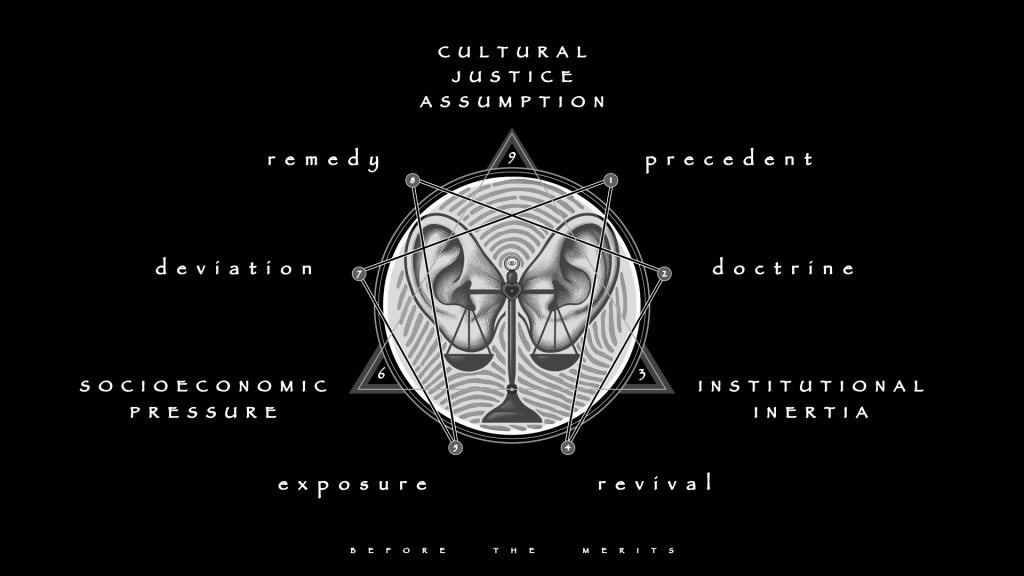
    What Monell v. Department of Social Services forecloses and what the law leaves open are not identical. The gap between them is where the next case will be born. Whatever specific circumstances generate it, the logos of any case has three components, each operating simultaneously as a field condition. Institutional Inertia (+) is already in motion, and Socioeconomic Pressure (-) defines the boundary conditions of that motion. These collide within a Cultural Justice Assumption (0) whose content varies but whose function does not.

    Institutional Inertia is the affirming force.

    Municipal governments operating civil rights defense programs have internal incentives that run consistently in one direction: defend each case individually, settle the ones with the strongest evidence under confidentiality agreements, and never conduct the internal investigation that would convert a series of individual settlements into the documented pattern the deliberate-indifference standard requires. The incentive does not require malice. It requires only that the institution’s legal department treat each case as a discrete liability event rather than as a data point in a pattern the doctrine is waiting to see assembled, and that the settlement structure preserve the confidentiality that prevents the assembly. The path of least resistance runs toward the waiting area, and it has run that direction for fifty years.

    Socioeconomic Pressure is the denying force.

    The post-civil-rights era expansion of § 1983 litigation produced a federal judiciary and a municipal defense bar that both understood, by the late 1970s, that full institutional accountability under respondeat-superior would expose city treasuries to liability at a scale that had no precedent in American municipal finance. The fiscal concern was real. It shaped the doctrine at the moment of its creation and has been invoked to justify progressively narrower applications of the standard ever since, in a legal culture where the populations most likely to be injured by systematic institutional violations are the populations least represented in the constituent calculus of the legislators who could correct the doctrine by statute and have not. This force does not push toward any particular outcome. It defines the range of responses the institutional inertia already in motion will be permitted to produce, and it raises the stakes of every other force operating in the field without generating directional momentum of its own.

    The Cultural Justice Assumption is the reconciling force.

    Institutions are morally responsible for what they choose, not for what they accidentally permit, and the law should require proof of institutional choice before imposing institutional liability. The policy-or-custom requirement operationalizes this assumption precisely: a city that chose a violation, or deliberately disregarded an obvious risk of one, is responsible. A city whose employee committed a violation the city did not authorize is not. This is coherent as a theory of moral responsibility. Its application produces a legal regime in which the institutions most responsible for systematic violations, those that defend each case individually while the pattern accumulates invisibly, are precisely the ones whose conduct most easily satisfies the no-written-policy defense the assumption creates. The assumption is neither validated nor invalidated by the outcome it produces. It is the medium through which institutional inertia and socioeconomic pressure interact, and what makes that interaction legible as justice rather than mechanics.

    These forces do not finally resolve with a given case, but reconstitute around the next one. However, a reader who can identify all three next time will find that the following questions transfer. These are the questions this case leaves open rather than the ones it answers.

    If a police department receives fifty civil-rights complaints alleging the same category of unconstitutional conduct over five years, defends each individually, settles the most evidenced cases under confidentiality agreements, and produces no written policy authorizing the conduct, has the department demonstrated the deliberate indifference that Monell requires, and if not, what additional fact would need to be true before the doctrine reaches an institution whose settlement pattern is itself the evidence of the pattern the doctrine demands?

    The Monell doctrine bars respondeat-superior on the basis of a historical inference about the Sherman Amendment’s rejection that four subsequent decades of scholarship characterize as a significant overreach. Congress has had nearly fifty years to correct the inference legislatively without doing so. If congressional silence is neither endorsement nor oversight but evidence that the constituencies most harmed by the calibration lack the political power to compel correction, what would need to change in the distribution of that power before the correction the 1871 statute’s authors would have recognized as necessary becomes politically available?

    If individual officers are indemnified by municipalities for civil-rights judgments entered against them, and municipalities escape institutional liability because individual violations without a documented pattern do not establish policy or custom, and the practical consequence is that no actor in the system bears personal financial consequence for constitutional violations that are individually provable and institutionally predictable, at what point does the civil rights enforcement structure become an apparatus for producing the appearance of accountability rather than its substance, and which institution, if any, is both positioned and motivated to recognize that threshold before it is crossed rather than after?

  • Most legal outcomes are decided before a court examines the evidence, before a jury hears the facts, and before anyone argues what actually happened. The machinery that produces outcomes runs on doctrines too abstract for most people, administered by institutions with strong incentives to keep them obscure, whose product is a gap between the right the Constitution names and the remedy the legal system provides. ‘Before the Merits’ strips down the American legal machine to its component parts one case at a time, for general readers to discover how a precedent-based system is run and maintained.


    Before the Merits—Lee v. City of Los Angeles, 250 F.3d 668 (9th Cir. 2001)

    Every legal procedure for challenging a wrongful arrest assumes the arrested person can speak. Kerry Sanders had chronic schizophrenia and could not speak for two years, so he served two years in a New York prison for a crime committed by a man who shared only his last name. The Los Angeles Police Department had been given a fingerprint card for the actual fugitive before the arrest, did not use it, and then told Kerry Sanders’s mother for two years that his whereabouts were unknown. That last detail is not incidental. The constitutional system protects the person who can perform the assumed process and leaves the person who cannot to the mercy of institutions with no obligation to notice the difference. Read on to learn how to identify where that protection collapsed and which institution bore the obligation to substitute its own verification for the voice it was not hearing.

    Case Header:

    • Case Name: Lee v. City of Los Angeles
    • Citation: 250 F.3d 668 (9th Cir. 2001)
    • Court / Jurisdiction: United States Court of Appeals for the Ninth Circuit
    • Date Decided: May 4, 2001 (opinion refiled; originally filed February 14, 2001)
    • Docket No.: No. 99-56020

    Legal Domain(s):

    • Primary Issue(s): Civil rights / § 1983 claims; municipal liability; wrongful arrest and extradition; judicial notice at the pleading stage; notice pleading under Rule 12(b)(6)
    • Practice Area: Federal civil rights litigation; police misconduct; constitutional torts; disability rights (ADA Title II)
    • Procedural Posture: Appeal from dismissal of federal claims for failure to state a claim under Fed. R. Civ. P. 12(b)(6); dismissal of state-law claims for lack of subject-matter jurisdiction

    Holding (One Sentence Rule):

    A § 1983 complaint alleging municipal liability for wrongful arrest, extradition, and two-year imprisonment of a mentally disabled man adequately states constitutional claims under the First, Fourth, and Fourteenth Amendments and survives Rule 12(b)(6) where it alleges a specific policy or custom of identity-verification failures amounting to deliberate indifference, and where the district court erred in relying on extrinsic evidence and taking judicial notice of disputed facts outside the pleadings.

    Precedent

    The extradition system’s identity-verification architecture was designed on a diagnostic assumption that separates a functional mind from a disordered one: that the signals coming in correspond to the reality outside. When they do, the system processes them accurately and delivers a correct result. When they do not, the system has no internal mechanism for detecting the mismatch, because the mechanism for detection is the signal itself. The protection functions for the person whose signal is legible. For the person whose signal is not, the protection does not function; it simply continues.

    The extradition clause of the Constitution requires that a person charged with a crime in one state and found in another shall, on demand of the executive authority of the charging state, be delivered to the demanding state.

    The clause was written to prevent accused persons from escaping accountability by crossing state lines. For most of American history, its procedure assumed that the person being extradited was the person charged. The assumption was reasonable in an era of small communities, face-to-face identification, and short distances. It became progressively less reasonable as the population grew, as criminal databases expanded to cover hundreds of millions of records, and as the frequency of common surnames multiplied in proportion to the population itself.

    The federal statutes implementing extradition procedure, and the state laws operating alongside them, impose identity-verification requirements, but the requirements are procedural rather than substantive. The demanding state must send documentation; the surrendering state must hold a hearing; the identified person may challenge the identification before extradition is completed. These protections function adequately when the identified person can mount that challenge, which requires saying clearly and convincingly, “I am not the person in this warrant,” producing identification, naming witnesses, and engaging the hearing process in a way that creates a record requiring response.

    They function almost not at all when the identified person cannot do any of this.

    A person with severe mental illness, with cognitive disability, with limited language, with a history that has severed most institutional connections, enters the extradition process without the tools the process assumes all participants possess. The hearing that is supposed to protect the wrongly identified becomes, in practice, a proceeding at which the person’s inability to mount a coherent defense is read as absence of one. The silence or incoherence of the mistakenly identified person looks, from the outside, like the resigned silence of someone who knows they are caught. There is a more precise version of this failure: a man with schizophrenia, under questioning by officers who have already assigned him a name, may confirm that name, not because he is conceding guilt but because the condition that prevents him from correcting the identification also prevents him from resisting the institutional framing that surrounds the questioning. The signal the process receives is the one it created.

    The legal architecture built around this process—the civil rights statutes, the constitutional doctrines, the pleading standards governing how a wronged person can reach a court—was developed without particular attention to the category of person most likely to be victimized by its failure. The result is a body of law theoretically adequate to reach institutional misconduct of this kind and practically organized to dismiss it before the evidence can be examined. What the law had not resolved, and what this case would force into view, was whether any institution in the sequence bore an obligation to substitute its own verification for the signal it was not receiving.

    Doctrine

    The legal system’s first response to a two-year wrongful imprisonment was a question about paperwork: had the complaint been properly drafted? That question, and the procedural machinery it triggers, is the Doctrine section’s subject. The merits of the imprisonment, whether Kerry Sanders should have been arrested at all, had not yet become the case. They would not become the case until the paperwork question was answered, and the system that answered it had no mechanism for asking the underlying question first.

    Lee v. City of Los Angeles, 250 F.3d 668 (9th Cir. 2001), arrived before the Ninth Circuit as an appeal from a dismissal under Rule 12(b)(6), which permits a court to terminate a complaint before discovery on the ground that even if the plaintiff’s allegations are true, no legal claim has been stated.

    Kerry Sanders was a mentally disabled resident of Los Angeles, a man with chronic schizophrenia and hallucinations, who was arrested by the Los Angeles Police Department in October 1993. He was misidentified as Robert Sanders, a fugitive who had absconded from a New York state prison work-release program. The two men merely shared a surname. The New York State Division of Criminal Justice Services had provided the LAPD with an identification packet that included fingerprints and physical characteristics of Robert Sanders. The LAPD did not compare Kerry Sanders’s fingerprints to those in the packet before arresting him and initiating extradition. Kerry Sanders was extradited to New York and imprisoned at Greenhaven Correctional Center for approximately two years. His mother, Mary Sanders Lee, contacted the LAPD repeatedly during those two years to ask about her son’s whereabouts and was told, each time, that his location was unknown. In October 1995, federal drug agents arrested the actual Robert Sanders in another jurisdiction. Kerry Sanders was released. He had served two years for someone else’s crime, in a state he had not entered voluntarily, while his mother was told he could not be found.

    Mary Sanders Lee, as conservator for her son, filed a federal complaint against the City of Los Angeles, individual LAPD officers, and New York state officials, alleging constitutional violations under 42 U.S.C. § 1983 and separately alleging violations of the Americans with Disabilities Act. The district court dismissed all federal constitutional claims by relying on materials outside the complaint: court records and official documents, including a declaration from the New York defendants asserting that Kerry Sanders had himself told the officers he was Robert Sanders. The court took judicial notice of these materials without giving the plaintiffs an opportunity to contest their use, converting what was formally a pleading-stage ruling into a factual determination made on evidence the plaintiffs had never been permitted to challenge.

    The Ninth Circuit reversed in part. The court identified two distinct errors, each compounding the other. The district court had taken judicial notice of disputed facts drawn from extrinsic materials that the pleading stage did not permit, and it had used that unauthorized factual determination to defeat claims that, read on the face of the complaint alone, adequately alleged constitutional violations.

    On the Fourth Amendment claim, arrest without probable cause, the court held that the plaintiffs had adequately alleged that no reasonable officer could have believed Kerry Sanders was Robert Sanders, given his obvious mental incapacity and the mismatched identifying characteristics the LAPD had been provided before the arrest. On the Fourteenth Amendment claim, the court held that the plaintiffs had adequately alleged that the LAPD maintained a policy or custom of extraditing individuals without proper identity verification, which, if proven, could constitute the deliberate indifference to constitutional rights that Monell liability requires. On the familial-association claim, belonging to the mother rather than the son, the court held that the LAPD’s alleged practice of concealing Kerry Sanders’s whereabouts while telling his mother he was unknown to them adequately alleged a constitutional interference with a protected family relationship.

    The opinion contains a fourth holding that the draft’s original version omitted and that is, in the long view, the most consequential of the four.

    The Ninth Circuit reversed the district court’s dismissal of the ADA claim with prejudice and reinstated it for amendment, holding that Title II of the Americans with Disabilities Act covers law enforcement activities, including arrests and extraditions, not merely the delivery of services in accessible facilities. The accommodation theory the court recognized is precise: because Kerry Sanders’s schizophrenia prevented him from communicating his identity or navigating the extradition process, the accommodation the law required was not a ramp or an interpreter but a fingerprint comparison, a step the institution would have been obligated to perform for a person who could not advocate for himself, though it might have skipped for a person who could. The court also recognized a distinct discrimination-by-attribution theory. An institution that interprets a disabled person’s symptomatic behavior as criminal conduct, rather than as a signal requiring a different response, has not merely made an error; it has discriminated against the person on the basis of their disability by treating the disability’s manifestation as evidence of guilt.

    The opinion additionally holds that the New York state officials who requested the extradition, sent identification materials into California, and traveled to Los Angeles to take custody were subject to California personal jurisdiction, because they had deliberately used California’s criminal justice system as the instrument of the harm rather than merely foreseen that harm would be felt there.

    Revival

    Lee‘s three holdings have aged at different rates, and the rate of aging tracks a single variable: whether subsequent doctrine required more from the plaintiff or less from the institution.

    The procedural track, the ruling that a district court cannot take judicial notice of disputed extrinsic facts when evaluating a Rule 12(b)(6) motion, has become the most durable portion of the opinion. Courts confronted with defendants who attempt to paper a motion to dismiss with official records, agency documents, or court files the plaintiff has not incorporated by reference cite Lee for the rule that such materials, if their accuracy is disputed, cannot be used at the threshold stage to defeat the plaintiff’s well-pleaded factual allegations. The rule is not unique to Lee, reflecting a principle embedded in the Federal Rules of Civil Procedure, but the opinion’s application of it to a municipal civil rights case involving official misconduct has made it a frequently invoked authority in exactly the context where the temptation to use extrinsic materials is strongest: cases where the defendant is a government entity with access to official records the plaintiff has never seen.

    The ADA track has settled in one direction and remained unresolved in another. The holding that Title II of the Americans with Disabilities Act covers law enforcement activities, including arrests and extraditions, has been broadly followed and is now settled doctrine in the Ninth Circuit and most other circuits. No serious argument remains that police functions fall outside Title II’s scope. The holding’s more specific applications have fared differently. The failure-to-accommodate theory in the identity-verification context, the proposition that an institution must perform an independent check when a subject cannot advocate for themselves, has been litigated with mixed results and has not produced a clear circuit consensus on what accommodation is required, when it is triggered, and whose failure to perform it generates liability. The discrimination-by-attribution theory has been applied inconsistently across circuits; some courts treat the institutional misreading of disability symptoms as criminal behavior as independently actionable, while others require proof of intentional discrimination before the theory generates liability. The door Lee opened in 2001 remains open. It has not been walked through with confidence.

    The substantive Monell track has aged differently, shaped by subsequent Supreme Court decisions that tightened the pleading standards governing civil rights complaints. After 2007 and 2009, a complaint must plead enough facts to make a claim plausible, not merely conceivable, and formulaic recitation of the elements of a cause of action no longer suffices. Lee‘s holding that the plaintiffs’ policy-and-custom allegations were adequate under the pleading rules of its era does not translate automatically into adequacy under current standards, and a lawyer who cites Lee for the proposition that a pattern-and-practice allegation survives a motion to dismiss must account for the intervening evolution.

    The tightening did not eliminate the Monell theory; it raised the price of entry.

    The jurisdictional holding has been specifically narrowed by Walden v. Fiore. The requirement now is that personal jurisdiction over an out-of-state official must rest on the official’s purposeful contacts with the forum state itself, not merely on foreseeable harm to a forum-state resident. Lee‘s jurisdictional analysis survives Walden in its specific factual configuration, because the New York officials did far more than foresee harm; they affirmatively engaged California’s institutions as instruments of the result. The extension of that analysis to less factually dense configurations is foreclosed, and what remains is a holding narrowed to the precise facts that generated it, potent within those facts and inert outside them. The question the narrowing raises (without answering) is whether an institution that causes a two-year wrongful imprisonment by deliberately using a forum state’s criminal machinery, but does so in a way that a future court finds insufficiently contact-rich, has placed itself beyond the reach of that forum’s courts entirely.

    Exposure

    Three institutions processed Kerry Sanders’s two-year wrongful imprisonment, and none of them malfunctioned. Each operated within its own procedural logic, received the outputs of the prior institution as confirmed inputs, and produced results that were, by its own internal standards, correct. The criminal justice system identified a match and initiated extradition. The disability support system was told its subject could not be located. The legal remedy system received a complaint and evaluated it against its pleading standards. The error did not propagate because any institution failed to do its job, but because each institution’s job was defined without any mechanism for detecting whether the adjacent institution’s output was accurate.

    No single system bore the obligation to check—the failure lived in the space between them.

    The criminal justice system’s identity-verification procedures assume that the subject is capable of participating in their correction. When an officer compares a person’s appearance to a physical description and finds approximate matches, the system expects the subject to offer a countervailing account: this is not my name, here is my identification, check these records. Kerry Sanders could not do this in a way the system recognized as a claim requiring investigation. His schizophrenia manifested in ways that officers and officials could read as the resigned presentation of someone who knew they were caught, and the system has no internal mechanism for distinguishing “I cannot explain myself coherently” from “I have no coherent explanation.” The filter that would have caught the difference, fingerprint comparison against the packet from New York, was not used. The backup the system provided for exactly this category of error was available and ignored, and the system recorded the result as a successful identification.

    The disability support system fails at a different point in the sequence. Mary Sanders Lee, as conservator for her son, is the person best positioned to identify the error and demand correction. She attempted to do exactly that, repeatedly, for two years. The LAPD’s alleged response, that her son’s whereabouts were unknown, was not merely unhelpful; it was, if the plaintiffs’ allegations were true, a lie. Kerry Sanders was in LAPD’s own records as a person the department had extradited to New York on its own initiative. The institution that had placed him on a plane possessed his location and denied that possession to the one person the disability support system had positioned to advocate for him. When an institution removes the conservator’s information, it does not merely obstruct the conservator; it eliminates the safeguard the disability system had deployed as its substitute for the person who could not speak.

    The legal remedy system’s exposure runs through the pleading architecture itself. To reach discovery, the plaintiffs had first to survive a motion to dismiss. To obtain the institutional records that would confirm or deny the factual allegations they had already made, they had first to survive the motion to dismiss. The district court’s use of extrinsic materials to dismiss the complaint before discovery was precisely the move the Ninth Circuit’s reversal corrected. The correction cost years of litigation the family bore entirely. The system contains an ultimate correction; it does not contain a mechanism for bearing the correction’s cost on behalf of the party who was already wronged.

    What the legal remedy system produced, at the end of years of appellate process, was the right to start again.

    The case’s hidden gift is the one the constitutional claims cannot carry and the ADA was designed to reach. The accommodation theory the Ninth Circuit recognized does not require proof of what the institution knew or intended, only proof that the institution failed to respond to what was obvious. Kerry Sanders’s schizophrenia was, by the plaintiffs’ allegations, obvious; an institution exercising reasonable attention would have recognized that his presentation required a different response than the one it gave.

    The accommodation the theory requires is not elaborate: a fingerprint comparison the institution already possessed the materials to perform. The discrimination-by-attribution theory the court also recognized goes further still, holding that an institution which reads disability symptoms as criminal behavior has not merely made a factual error but has discriminated against the person on the basis of the condition that produced the symptoms. Together, these theories offer a cause of action that the constitutional framework, which requires proof of deliberate indifference or an established pattern, cannot provide for the single, isolated, preventable failure.

    The ADA track is the legal system’s one instrument calibrated for the case where the failure was not a policy, not a custom, not a pattern, but a single institution’s failure to notice what was in front of it. That instrument remains available. It remains unapplied with consistency.

    The gap between availability and application is where the next Kerry Sanders enters the system.

    Deviation

    The legal framework Lee created operates at the wrong point in the sequence. It intervenes after the two-year imprisonment, after the settlement negotiation, after the confidential resolution, and before none of the institutional decisions that produced the error. The case established the doctrinal basis for seeking damages, but did not establish a mechanism for interrupting the process before the damages accumulate.

    The case that produced the Ninth Circuit’s reversal and remand was never publicly resolved.

    Civil rights cases of this structural type rarely are. The litigation continues past the appellate correction, reaches the settlement table, and ends under a confidentiality agreement that prevents the institutional record from becoming public. The institution pays without admitting that its practice was the moving force behind the violation; no official is named in a public verdict; the policy or custom that produced the error is reformed quietly or not at all, and the next instance produces the next complaint without the prior settlement serving as any kind of public acknowledgment that the structural condition persists. The settlement functions, from the institution’s perspective, as a cost of doing business rather than a corrective signal. The assumption that the error was exceptional rather than structural is preserved intact by the agreement that prevents its examination.

    The pattern the subsequent cases reveal is not linear improvement. Identity-verification failures in the extradition context continued after 2001 in forms that differ from Kerry Sanders’s case in detail but not in form. In 2022, a woman was arrested at Los Angeles International Airport and held for thirteen days on a warrant for a fugitive she did not resemble. Officers did not compare her driver’s license or fingerprints against the warrant despite the physical differences. The database produced a name match; the institution treated the match as sufficient; the subject had no way to correct the error through the channels the process assumed were available to her.

    The Lee framework gave her a theory of recovery. It gave her nothing that interrupted the thirteen days. The gap between the legal framework’s operation and the moment the error begins is not a gap that post-error damages litigation was designed to close.

    Twenty years of cases have not closed it.

    The ADA track’s post-Lee development is where the structural gap becomes most visible. The ADA’s accommodation theory is the only legal instrument that operates, in principle, at the moment of the error rather than after it. An institution that fails to perform a fingerprint comparison when the subject’s obvious disability prevents the subject from requesting one has not waited for a pattern to develop; it has discriminated in a single encounter that a single plaintiff can challenge without proving institutional history.

    That theory is available. Its consistent application to wrongful extradition has not materialized. Courts that have addressed the failure-to-accommodate question in law enforcement contexts have divided on what accommodation is required before the accommodation obligation is triggered, what counts as “obvious” disability in an arrest context, and whether the discrimination-by-attribution theory requires proof of intentional misattribution or can be established by demonstrating that the institution’s response to symptomatic behavior was objectively unreasonable. The biometric verification technology that would make the accommodation trivially easy to perform has existed and improved continuously since Lee was decided. The legal obligation to perform it has not developed at the same pace.

    The difference between the tool’s availability and its legal compulsion is a choice about whose interests the ADA protects at the threshold moment, and the series of cases that have declined to resolve it have left the answer to the next plaintiff who can afford to litigate past the motion to dismiss.

    Remedy

    The constitutional system protects the person who can perform the process as assumed and leaves the person who cannot to the mercy of institutions that have no obligation to notice the difference. That gap is not an accident, but the design. Can anything in the current legal architecture close it before the next Kerry Sanders enters?

    The answer is NO, and not for lack of technology.

    The technological infrastructure for rapid biometric verification has improved beyond recognition since 1993. Fingerprint databases that once required days to search are now searched in minutes. Facial recognition systems exist that can, in principle, compare a detention subject against a warrant photograph in real time. The tools an officer needs to verify identity before committing to an extradition process are better than at any point in the procedure’s history, and they were sufficient for the purpose in 1993, when LAPD possessed the fingerprint card and did not use it. The problem the technology does not solve is the institutional imperative to use it, because the legal consequence of skipping the step is neither swift nor certain enough to change the decision at the moment it is made.

    The qualified-immunity standard protects officers who made identification errors unless the right to accurate pre-extradition identification was clearly established at the level of specificity the doctrine requires. The right cannot be clearly established without judgments that reach the merits and, again, judgments cannot reach the merits when the cases that would establish the right are dismissed or settled before judgment. The municipal-liability standard requires proof of a pattern or policy, which means one wrongful identification, however devastating, is not enough. Only after a pattern emerges can the municipality’s failure to prevent it constitute deliberate indifference. The combination produces an institutional environment in which the legal cost of individual errors is low enough to be absorbed without generating systemic change,.

    The precondition-versus-best-practice distinction is not a technical legal question but a structural decision with known beneficiaries and known costs.

    Several states have enacted specific identity-verification requirements in their extradition statutes, requiring biometric comparison before proceedings are initiated, and these requirements carry automatic legal consequence for their violation rather than liability contingent on proving institutional pattern and deliberate indifference. Federal law has not followed. The variation across jurisdictions does not track technological capacity. It tracks political will, which in this domain is shaped by the distribution of visibility. The people most likely to be wrongly extradited, people with severe mental illness, with cognitive disability, with limited institutional connections, are also the people whose wrongful imprisonment is least likely to generate the kind of sustained public attention that makes political will available.

    A mind that recovers from a psychotic episode cannot retrieve the time the episode consumed; it can only understand, in retrospect, what that time contained. The legal instrument the Lee opinion created has the same orientation. It faces back toward what has already occurred and measures the institutional failure against a damages standard. The measurement is accurate, but it faces the wrong direction. What would need to change to reorient it is a decision, already made in several state legislatures and available to be made federally, that identity verification before extradition is not a courtesy extended to the identified person but an obligation the institution owes independent of whether the identified person can demand it.

    The courts have not made that decision. The legislature has not made it nationally. The cost of the refusal is paid, quietly and repeatedly, by the person who could not speak.

    For Further Examination . . .

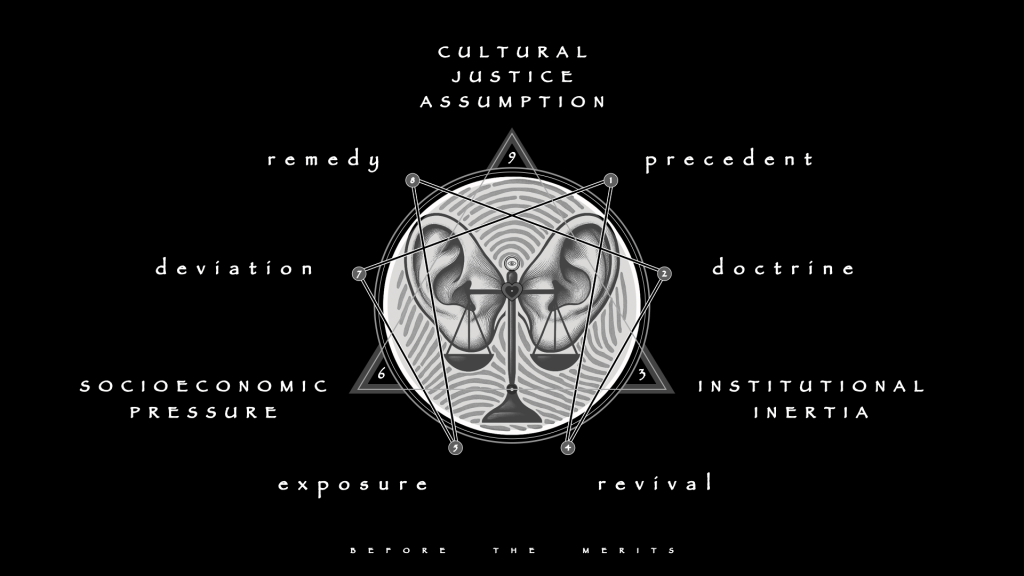
    What Lee v. City of Los Angeles forecloses and what the law leaves open are not identical. The gap between them is where the next case will be born. Whatever specific circumstances generate it, the logos of any case has three components, each operating simultaneously as a field condition. Institutional Inertia (+) is already in motion, and Socioeconomic Pressure (-) defines the boundary conditions of that motion. These collide within a Cultural Justice Assumption (0) whose content varies but whose function does not.

    Institutional Inertia is the affirming force (+).

    Law enforcement institutions calibrated for the median case process thousands of extradition requests against standardized procedures whose internal validity check is the procedure itself. The LAPD’s alleged failure to compare a fingerprint card it already possessed was not, if the allegations were accurate, a product of hostility toward Kerry Sanders; it was a product of institutional economies in which verification is a step that seems redundant until it is not, and the cost of skipping it falls on the subject rather than the institution. The inertia does not require malice. It requires only that the path of least resistance run consistently toward the next case, and that the cost of the error remain invisible at the level where the procedure is designed.

    Socioeconomic Pressure is the denying force (-).

    The networking of state criminal databases during the late 1980s and early 1990s produced efficiency gains whose false-positive rate was low enough to be invisible at the institutional level and catastrophic at the individual level. An era that treated the database match as sufficient identification created a category of wrongly identified persons whose only mechanism for correction was their own coherent voice, precisely at the moment when the expansion of the database system made coherence the rarest resource among those most likely to be mismatched. This force does not push toward any particular outcome. It defines the range of responses the institutional inertia already in motion will be permitted to produce, and it raises the stakes of every other force operating in the field without generating directional momentum of its own.

    The Cultural Justice Assumption is the reconciling force (0).

    Criminal justice processing is accurate by default and wrong by exception, and the person in custody who cannot explain themselves coherently is probably there correctly. The district court treated this as procedurally obvious; the Ninth Circuit treated it as an assumption requiring evidence before it could defeat a well-pleaded complaint. The fault line runs precisely through the phrase “obviously cannot be the fugitive,” and what the case decided is not which side of the line Kerry Sanders stood on but whether the institution bearing the fingerprint card had an obligation to look before drawing the line. The assumption is neither validated nor invalidated by the legal outcome it produces. It is the medium through which institutional inertia and socioeconomic pressure interact, and what makes that interaction legible as justice rather than mechanics.

    These forces do not finally resolve with a given case, but reconstitute around the next one. However, a reader who can identify all three next time will find that the following questions transfer. These are the questions this case leaves open rather than the ones it answers.

    If a person with severe schizophrenia cannot coherently assert their own identity during an extradition hearing, and the fingerprint card that would have demonstrated the error was available but unused, and the institution that possessed both the card and the person’s location told the person’s conservator for two years that the person was unknown to them, which institution in that sequence bore the constitutional obligation to substitute its own verification for the voice it was not hearing, and what would a future plaintiff need to prove, that no plaintiff has yet been required to prove, to convert that obligation from a moral claim into a legal one?

    The Cultural Justice Assumption that criminal processing is accurate by default has been most effectively challenged not by litigation but by the proliferation of biometric verification technology that makes independent confirmation trivially inexpensive; if that technology continues to develop until a jurisdiction’s failure to deploy it before extradition becomes indefensible as a resource claim, what would the institutional inertia already in motion be forced to produce, and would the legal doctrine governing wrongful extradition evolve to meet the new factual baseline or remain calibrated to the era when verification required resources the institution could plausibly claim not to have?

    If the ADA’s failure-to-accommodate theory were applied consistently to require independent identity verification whenever a subject’s obvious disability prevents them from performing the process the process assumes, the Cultural Justice Assumption would shift from “probably correct” to “cannot be assumed correct without verification,” and the institutional inertia that currently treats verification as a best practice would be required to treat it as a precondition; what socioeconomic pressure would need to be operating, and in what form, for the courts to be willing to impose that structural obligation on institutions whose incentive architecture has been designed to absorb the cost of the occasional error rather than to eliminate the error’s preconditions?

  • Most legal outcomes are decided before a court examines the evidence, before a jury hears the facts, and before anyone argues what actually happened. The machinery that produces outcomes runs on doctrines too abstract for most people, administered by institutions with strong incentives to keep them obscure, whose product is a gap between the right the Constitution names and the remedy the legal system provides. ‘Before the Merits’ strips down the American legal machine to its component parts one case at a time, for general readers to discover how a precedent-based system is run and maintained.


    Before the Merits—Harlow v. Fitzgerald, 457 U.S. 800 (1982)

    The most durable shield in American civil rights law was forged not to protect police officers but to protect the men who helped Richard Nixon fire a defense analyst for telling Congress the truth. That origin is almost never mentioned when courts apply the doctrine, which was designed precisely to make its own origins irrelevant. The standard sounds simple and functions as a trap. The design is to replace the messy human question of what an official intended with the clean procedural question of what the law established at the moment the official acted. In any civil rights complaint against a government official, the exact sentence where the case will most likely die, long before any fact-finder ever sees the evidence, will not announce itself. It will arrive dressed as a neutral legal standard, lying in wait since June 24, 1982.

    Case Header:

    • Case Name: Harlow v. Fitzgerald
    • Citation: 457 U.S. 800 (1982)
    • Court / Jurisdiction: United States Supreme Court
    • Date Decided: June 24, 1982
    • Docket No.: 80-945

    Legal Domain(s):

    • Primary Issue(s): Qualified Immunity / Absolute Immunity / Executive Official Immunity / Presidential Aides
    • Practice Area: Civil Rights & Government Liability
    • Procedural Posture: Certiorari to the U.S. Court of Appeals for the District of Columbia Circuit; denial of summary judgment on immunity grounds

    Holding (One Sentence Rule):

    Government officials performing discretionary functions are entitled to qualified immunity and are shielded from liability for civil damages if their conduct does not violate a clearly established statutory or constitutional right of which a reasonable official would have known, evaluated under an objective standard without regard to the official’s subjective intent or malice.

    Precedent

    The legal history of official immunity in America is the history of a question the law preferred not to answer directly: when a government official violates a citizen’s constitutional rights, who pays? Common law traditions carried from England recognized that sovereign authority required some protection from litigation—a king could not govern if every dissatisfied subject could haul him into court—but the tradition also recognized that individuals acting under governmental authority were, in their personal capacities, answerable for the wrongs they committed. That tension was never resolved. It has since been managed through a set of common law immunities that shielded certain categories of officials from certain categories of suits under certain conditions.

    Congress disrupted this equilibrium in 1871, when it enacted a statute creating civil liability for state officials who, acting under color of state law, deprived any person of rights secured by the Constitution. The statute was a Reconstruction measure, designed to provide a federal remedy against the Southern governments that were systematically terrorizing freed people and their allies while state courts looked on with indifference or complicity. It said nothing about immunity. It provided that officials who violated constitutional rights “shall be liable to the party injured.” The language was unequivocal, and the history was urgent: Congress wanted a remedy that state officials could not evade.

    The Supreme Court spent the following century quietly installing the escape route that Congress had not provided. Beginning in the early twentieth century and accelerating through the 1960s and 1970s, the Court recognized immunity defenses for officials sued under the 1871 statute, first absolute immunity for legislators and judges performing their core functions, then qualified immunity for executive officials who acted in good faith. The good-faith standard had two components. First, the official had to show both that the law did not clearly prohibit the conduct. Second, the official must not have acted with malicious intent toward the plaintiff.

    A plaintiff who could demonstrate that an official knew the conduct was unlawful, or acted out of personal animosity, could survive the immunity defense regardless of how the objective legal question resolved.

    Congress had issued a remedy that said “shall be liable.” The Court was quietly counterfeiting the currency, producing instruments that looked like remedies and functioned as refusals. The cumulative effect was visible only when someone tried to spend the currency and found it would not be honored.

    This two-part standard created a problem that the Supreme Court, by 1982, found intolerable, not because it was unjust to plaintiffs, but because it was inconvenient for defendants. The subjective component of the good-faith test required inquiry into an official’s state of mind. State of mind inquiries require discovery: depositions, document production, interrogatories, the apparatus of litigation that the immunity doctrine was supposed to prevent. A plaintiff who alleged malicious intent could force the case past summary judgment and into the discovery phase simply by making the allegation, without proving it, merely by raising a genuine issue of fact that could not be resolved without examining what the official knew and felt.

    When the Court resolved this inconvenience in 1982, it did so by breaking a principle it had previously maintained: that federal officials should receive no greater immunity than their state counterparts. It then used that break as justification for extending the new standard to state officials as well, creating what one scholar described as a logically circular syllogism that was nonetheless facially unassailable. The currency Congress issued in 1871 was now subject to a redemption standard that the issuing institution had not authorized and could not easily revoke. Whether it would purchase anything in those circumstances was about to receive its most consequential test.

    The case that broke this open involved a man named Ernest Fitzgerald, two Nixon White House aides, a congressional hearing, and two billion dollars in missing money.

    Doctrine

    Harlow v. Fitzgerald, 457 U.S. 800 (1982), is formally a case about whether presidential aides deserve absolute immunity from civil suit. The answer the Court gave to that question was no. That answer, however, has mattered far less than the alternative it supplied.

    In 1968, A. Ernest Fitzgerald found approximately two billion dollars in cost overruns and concealed technical failures in the Lockheed C-5A cargo plane program, a weapons system whose price tag had been hidden from Congress and the public. Fitzgerald testified truthfully before a congressional committee in 1969. Within a year, the Air Force eliminated his position in what it characterized as a routine reduction in force. The Watergate tapes later produced President Nixon stating, in terms that left little interpretive room, that he had been personally responsible for the firing. Before the Supreme Court decided the immunity question, Nixon paid Fitzgerald $142,000, with a final $28,000 contingent on losing the immunity ruling; the man who ordered the retaliation considered himself potentially liable at the precise moment the Court was deciding whether he was.

    White House aides Bryce Harlow and Alexander Butterfield, who had coordinated with the Air Force and with senior White House staff in the period leading to Fitzgerald’s removal, faced suit for conspiracy to violate his constitutional rights.

    The aides claimed absolute immunity, the same total protection from civil suit that the Court had recognized for legislators, judges, and prosecutors performing their core functions. The Court rejected this claim, holding that aides to the President did not occupy positions sufficiently special to warrant blanket immunity, because unlike legislators and judges, presidential aides are not required by the Constitution itself to exercise independent judgment free from the threat of personal liability. This part of the holding, the part the case is named for, is the part that matters least.

    What the two decisions decided together matters more than what either decided alone. On the same day Harlow was handed down, the Supreme Court decided Nixon v. Fitzgerald, 457 U.S. 731 (1982). The President himself was granted absolute immunity from civil damages for all acts within the outer perimeter of his official duties.

    The immunity hierarchy the two decisions produced was precise and vertigo-inducing.

    The President who ordered the retaliation received absolute immunity. The aides who carried it out received a standard described as merely objective. The man who blew the whistle on two billion dollars in concealed defense fraud received, as the currency of his constitutional remedy, the clearly established standard, and that standard produced only what prior courts had already declared unlawful. The standard did not ask whether the conduct was wrong, only whether a prior court had already said so.

    What matters is the remedy the Court fashioned for the problem the subjective good-faith standard had created. Justice Lewis Powell, writing for the majority, held that the subjective component of the qualified immunity test would be eliminated entirely. Henceforth, courts would assess immunity on purely objective grounds: had the official violated a right that was “clearly established” at the time of the conduct? The inquiry into malice, bad faith, and subjective awareness closed. The instrument would detect violations of clearly established law and nothing else, not because no other violations were occurring but because the instrument had been calibrated to ignore them.

    The majority’s justification was explicit in its priorities and candid about the tradeoff it was making. “The subjective standard of good faith,” Powell wrote, “presents serious problems for public officials.” Those problems were the deterrence of capable people from public service and the risk that juries would punish unpopular decisions made in good faith. Against these institutional costs, the majority weighed the cost to individuals whose constitutional rights had been violated by officials who acted with subjective knowledge of the violation, and found the institutional costs weightier. The decision was a deliberate policy choice. The majority said so, without apology or euphemism.

    Justice William Brennan, joined by Justices Byron White and Thurgood Marshall, concurred in the judgment while dissenting from the elimination of the subjective component. Brennan argued that the purely objective standard would immunize officials who intentionally violated constitutional rights, as long as the violation occurred in a factual context not previously litigated to a clear conclusion. He was correct, and the majority’s conclusion reflected not a disagreement but a different weighing: the protection of official discretion was worth that cost.

    What neither the majority nor the dissent fully anticipated was the question the new standard left open. Who would decide what “clearly established” meant, and how? The answer would arrive across the following four decades.

    The calibration would be progressively tightened in ways that the 1982 majority could not predict, and that the instrument it built could not prevent.

    Revival

    No doctrine operates alone, and the forty years Harlow has spent in the law have been forty years of other decisions deciding what “clearly established” means, a question the 1982 opinion left open with consequences no one fully anticipated.

    The most consequential development was not Harlow itself but the interpretive accretion that followed it. “Clearly established” turned out to be an infinitely elastic phrase. Courts could read it to mean that the general constitutional principle was recognized, or they could read it to mean that the specific conduct under the specific facts had previously been identified as unconstitutional in a published judicial opinion.

    The Supreme Court, in a sequence of decisions beginning in 2001 and intensifying after 2018, adopted the latter reading. It then tightened further, requiring that the prior case identify the conduct as unconstitutional at a “high level of specificity.” Under this reading, an officer who commits a constitutional violation in a factual configuration not previously litigated to a published conclusion receives immunity not because the law was unclear but because no prior case happened to address precisely that configuration.

    If courts can dismiss cases at the immunity stage whenever the specific facts have not been previously adjudicated, then novel violations never reach verdicts that establish the right clearly.

    If the next novel violation of the same kind is equally immune, then the right is never established clearly enough to cost an official anything, and the cycle restarts. Sitting justices have named this dynamic from the bench: Justice Sotomayor identified it explicitly in her dissent in Mullenix v. Luna (2015), and Justice Thomas raised it from a structural separation-of-powers perspective in his concurrence in Ziglar v. Abbasi (2017). Neither observation commanded a majority. The self-perpetuating loop continues.

    The 2001 decision in Saucier v. Katz briefly appeared to offer a solution. It required courts to decide whether a constitutional violation occurred before reaching the immunity question. This would, in theory, produce constitutional rulings that could then inform the “clearly established” analysis in future cases.

    The mechanism failed in practice. Empirical analysis of the Saucier era found that courts forced to address the constitutional merits first almost uniformly found no violation, producing a body of precedent structurally biased toward officers rather than a body of precedent that expanded constitutional protection. The mandatory sequence did not generate the law-elaboration the Court had anticipated; it generated officer-favorable rulings that deepened the doctrinal wall.

    In 2009, the Supreme Court removed even this mechanism.

    Pearson v. Callahan, 555 U.S. 223 (2009), held that the Saucier sequencing rule was no longer mandatory. Courts could address the “clearly established” question first and grant immunity without ever deciding whether the conduct was constitutional. This left the doctrinal landscape unchanged and the immunity intact for the next case. Violations passed through undetected, no ruling named them, and the instrument registered nothing because the instrument had been relieved of the obligation to look.

    The surviving channel runs through Monell v. Department of Social Services, 436 U.S. 658 (1978), which allows plaintiffs to sue municipalities directly for constitutional violations resulting from official policies or customs, without the immunity defense that shields individual officers. Monell liability does not require proving that a specific officer violated clearly established law; it requires proving that the violation resulted from the institution’s deliberate choices. Qualified immunity does not block it, and after 2014, as video evidence of departmental patterns made institutional violations more documentable, civil rights practitioners shifted toward municipal defendants in precisely those cases where individual immunity would otherwise foreclose recovery entirely.

    The Monell channel is a bypass, not a correction.

    Reaching it requires demonstrating a pattern of institutional violations rather than a single incident, which means most individual victims of constitutional violations must either find resources sufficient to establish an institutional record or forgo recovery entirely. The filter does not malfunction when a plaintiff reaches Monell; it functions exactly as designed, routing those who cannot establish a pattern away from recovery while leaving the channel open for those who can. The survival of the bypass is evidence that the system has a bypass. It is not evidence that the filter is broken. The distinction is where the constitutional remedy actually lives or dies.

    Exposure

    Qualified immunity, as developed from Harlow forward, is not a defense to unconstitutional conduct, but a threshold filter that determines which unconstitutional conduct will ever receive legal scrutiny.

    The law presents qualified immunity as a balance, protecting officials from litigation harassment while preserving remedies for clear violations, though the balance is not symmetrical. A plaintiff who loses on immunity grounds loses the case entirely, receives no damages, obtains no factual record through discovery, and produces no judicial opinion addressing whether the conduct was unconstitutional. The constitutional violation, if it occurred, leaves no legal residue.

    The plaintiff is indistinguishable, in legal outcomes, from a plaintiff who had no claim at all. The immunity dismissal does not produce a finding that the conduct was legal; it produces an absence, which is the system’s most consequential output. What the shredder processes is not discarded as illegal, but as unprocessed. The distinction matters enormously to everyone who needed processing.

    An official who wins on immunity grounds while having actually violated the Constitution has received protection not from an unfair lawsuit but from the legal system’s recognition that the conduct was wrong.

    The protection is not conditional on good faith, not conditional on the violation being minor, not conditional on the official having made an honest mistake. It is conditional only on the factual novelty of the violation, on whether some prior plaintiff, in some prior case, happened to litigate the identical factual configuration to a published conclusion. The doctrine’s protection of intentional constitutional violations, which Brennan identified in dissent in 1982 as the unavoidable cost of the majority’s choice, is not an edge case. It is a foreseeable feature of the system the opinion built.

    Scholars argue that strengthening qualified immunity for federal officials serves as an indirect mechanism for restraining the Bivens regime, the judicially-created cause of action that several justices viewed with increasing skepticism as inappropriate judicial lawmaking. The consequence was a tightening of the noose around the very damages remedy the Court had created a decade earlier, accomplished not by overruling Bivens directly but by making its practical exercise nearly impossible. Such is academia. The gap between those two purposes is where the doctrine’s deepest commitments actually live.

    Fitzgerald himself never won a damages judgment against Harlow or Butterfield.

    The case was remanded for application of the new standard, and the remand produced no recovery. Nixon had acknowledged firing Fitzgerald on the Watergate tapes. White House memoranda demonstrated that aides had coordinated the retaliation and declined to offer Fitzgerald reemployment on grounds of “loyalty.”

    Whether the clearly established law standard, applied to those facts in 1969, would have been satisfied remains a question the legal system never definitively answered. The case illustrates, in miniature, the doctrine’s central irony. The decision that made qualified immunity harder for plaintiffs to defeat was issued in a case where the underlying conduct—retaliation against a government whistleblower at the direction of the President—was precisely the kind of deliberate constitutional violation the 1871 statute was designed to reach.

    The filter’s systematic exclusion of individual claims has pushed civil rights plaintiffs toward institutional defendants, because Monell liability bypasses the individual immunity screen. The pressure toward institutional defendants is pressure toward systemic accountability, which means the doctrine designed to insulate officials from individual scrutiny has inadvertently created the conditions under which departments, cities, and agencies face the pattern-based accountability that individual immunity forecloses. The shredder’s output is not only absence, but accumulated institutional pressure, now arriving in the circuits where the filter has operated longest and most aggressively.

    The exposure Harlow produces is the disclosure that the legal system built a mechanism for sorting constitutional violations into those that matter and those that do not. It was built precisely so that the sorting criterion—factual novelty—has no relationship to the severity of the violation—the deliberateness of the official’s choice—or to the harm sustained by the person whose rights were violated.

    If the protection is stated in objective language, the cost of over-protecting bad-faith actors becomes invisible. The doctrine’s constitutionality is not in question. Its honesty is.

    Deviation

    Within a decade of Harlow, federal courts were dismissing civil rights complaints at the summary judgment stage at rates that would have been unrecognizable to the lawyers who litigated such cases in the 1970s. The immunity defense is not the only reason. It is simply the mechanism most resistant to case-by-case variation, because it operates as a threshold that many plaintiffs cannot reach regardless of how strong their underlying claim might be.

    The doctrine migrates from federal officials to state officials and then to police officers without a Supreme Court opinion specifically authorizing the extension to law enforcement. The courts simply apply it, nobody objects successfully, and the extension hardens into settled practice. By the 1990s, qualified immunity is the central defensive strategy in police-misconduct litigation nationwide. The doctrine designed to protect the discretionary decisions of high-level executive officials, the Harlows and Butterfields who managed congressional relations and executive communications at the White House, now shields patrol officers in routine traffic stops from damages claims when their conduct was unprecedented in its specific configuration. The settlement is complete before anyone formally authorizes it.

    The “clearly established” standard tightens with each decade, not because the Supreme Court changes the words but because the Supreme Court changes the application, demanding ever-greater specificity in the prior case that must establish the right. By 2018 and 2019, the Court reverses circuit courts in summary orders, opinions issued without full briefing or oral argument, when lower courts denied immunity to officers whose conduct was arguably unconstitutional but not previously adjudicated in a factually identical case. The message requires no interpretation: the benefit of the doubt runs to the official, and a novel factual configuration is presumptively immune until proven clearly established by a prior decision that the official’s conduct was wrong.

    Police departments absorb this structure and build around it.

    Risk managers advise that training need not track constitutional boundaries. The gap between what the Constitution permits and what is clearly established is wide enough that officers inside that gap face no personal liability exposure. Legal counsel advising departments on use-of-force policy identifies the immunity framework as a structural feature that reduces the institutional cost of constitutional violations at the individual-officer level. The deterrent function that tort liability is supposed to serve has been attenuated to the point where most violations fall outside the range the instrument was calibrated to detect.

    Monell municipal liability becomes the primary vehicle for systematic accountability precisely because it bypasses the individual immunity screen. Cities are not immune. Monell requires proof of an official policy or custom, which means a pattern of violations rather than a single incident, and most individual victims of constitutional violations do not have access to the litigation resources required to establish an institutional pattern. The post-2014 proliferation of documented police killings, made visible by dashcam and body-camera footage, accelerates the Monell shift in the jurisdictions where the footage exists and the civil litigation infrastructure to use it has developed. The gap between what the law theoretically permits plaintiffs to pursue and what plaintiffs can actually prosecute expands with each passing year, and the expansion is visible only where the evidentiary conditions are strong enough to show it.

    The migration does not stop at police officers. In 2024, the Supreme Court extended the reasoning of Nixon v. Fitzgerald from civil damages liability into criminal prosecution, holding that a former president has absolute immunity for official acts and presumptive immunity for other official acts within the scope of presidential authority. The doctrine that began as a protection for White House aides from civil suits brought by a whistleblower now shields the office of the presidency from criminal accountability for conduct the Constitution’s framers placed under no such protection.

    The settlement that began in 1982 without formal authorization has now covered more territory than any of its original architects announced, and the boundary markers that once seemed fixed have continued moving outward, one extension at a time, each individually defensible and cumulatively transformative.

    Remedy

    The legal system built the circularity in 1982, and has watched it operate for forty years. It has been invited repeatedly to dismantle it, and has declined. The question worth asking is no longer whether the system can be repaired. Yes, it can be repaired.

    The uncomfortable question then is what does this pattern of invitation and refusal reveal about what the system was built to do?

    The majority in Harlow was candid about the tradeoff. It said explicitly that eliminating subjective inquiry would immunize some officials who intentionally violated constitutional rights. It concluded that the institutional costs of subjective inquiry, litigation expense, distraction, deterrence of public service, outweighed this loss.

    What the majority could not calculate was the magnitude of that loss, because the magnitude depends on how “clearly established” would be interpreted across the following forty years.

    The two voices of the doctrine—the immunity from suit and the clearly established requirement—sounded principled in isolation. Played together, they produce a counterpoint that prevents either from resolving: the immunity keeps cases from reaching judgment, the judgment would have established the right, and the right cannot be clearly established without the judgment. The music sounds like two independent melodies. It functions as one loop.

    Congress has the authority to modify qualified immunity by statute. The doctrine is a judicial construction, not a constitutional requirement. A statute excluding intentional violations from its protection would be within Congress’s power. Several states have enacted exactly such statutes for state tort claims against state officers. Congress has not. The political economy of that refusal is transparent: the officials who would face expanded liability under a reformed standard are the same officials whose cooperation legislators need for ordinary governance.

    The populations most likely to benefit from the reform are the same populations least represented in the legislature’s constituent calculus.

    The Supreme Court retains the authority to reconsider the “clearly established” standard’s specificity requirement without abolishing immunity entirely. A court that required only that the general constitutional principle was established, rather than the specific factual application, would preserve much of Harlow‘s protection for officials acting in genuinely uncertain legal territory while eliminating the circularity that immunizes deliberate violations simply because the violation was novel. This is a reform the Court has been invited to make, through petition after petition, and has declined, repeatedly, without providing an opinion explaining the refusal.

    The circularity was implicit in the Harlow design from the moment the subjective component was eliminated. Without subjective inquiry, the only remaining check on official conduct is the prior announcement of a clear rule. The mechanism for announcing that rule is the same judicial system whose immunity doctrine prevents most cases from reaching judgment.

    The majority built the loop. The Saucier sequencing requirement briefly forced courts to play both voices simultaneously, but the empirical record shows that when courts played them together they almost always resolved in the official’s favor, producing not a counterpoint that developed the law but a counterpoint that confirmed the immunity. Pearson removed even that structural pressure, granting courts discretion to play only the immunity voice and leave the other silent.

    The loop was closed in 1982. The brief experiment from 2001 to 2009 did not open it. Nothing since has either.

    The Court’s repeated unexplained refusal to reconsider the specificity requirement is not silence, but institutional speech whose content is a preference that the law’s announced purpose and its actual function remain misaligned.

    The Court that built the immunity architecture did so partly to constrain the Bivens damages remedy it had created a decade earlier. Reopening the loop would require acknowledging that constraint was intentional. Acknowledgment is costly in a way that congressional inaction is not, because congressional inaction is attributed to politics, while judicial silence on a constitutional question is attributed to principle. The opinion that officials deserve the benefit of the doubt in legal uncertainty applies to the institution as well as to its officials.

    The Court, operating in the uncertainty of whether to reconsider the specificity requirement, claims that benefit through a procedural mechanism, the denial of certiorari, that produces no opinion, generates no reasoning, leaves no residue, and is, in this respect, indistinguishable from the immunity dismissal the doctrine it created has been producing for forty years.

    For Further Examination . . .

    What Harlow v. Fitzgerald forecloses and what the law leaves open are not identical. The gap between them is where the next case will be born. Whatever specific circumstances generate it, the logos of any case has three components, each operating simultaneously as a field condition. Institutional Inertia (+) is already in motion, and Socioeconomic Pressure (-) defines the boundary conditions of that motion. These collide within a Cultural Justice Assumption (0) whose content varies but whose function does not.

    Institutional Inertia is the affirming force (+).

    Officials who participated in documented constitutional violations faced personal civil liability for the first time under the Bivens doctrine, without the absolute immunity that insulated the President himself. The Court’s internal incentive was to preserve some accountability while limiting institutional damage to executive governance, and the purely objective standard accomplished both by promising accountability in the abstract while making it practically inaccessible in specific cases. The inertia does not require malice; it requires only that the path of least resistance run consistently toward protection, and that the correction arrive, if it arrives, after the fact.

    Socioeconomic Pressure is the denying force (-).

    The post-Watergate, post-civil rights era collided with a newly aggressive civil rights bar and a federal judiciary concerned that § 1983 litigation was exploding beyond manageable proportions. The 1970s produced a surge of civil rights suits against state and federal officials, many insubstantial, some designed to harass rather than remedy. The Court saw the caseload and responded with a doctrinal tool calibrated to thin it. The timing is not coincidental: Harlow was decided the same day as Nixon v. Fitzgerald, which granted the President absolute immunity, producing a unified doctrine of executive protection at the precise moment the executive branch was most legally vulnerable. This force does not push toward any particular outcome; it defines the range of responses the institutional inertia already in motion will be permitted to produce.

    The Cultural Justice Assumption is the reconciling force (0).

    Government officials must be protected from the consequences of good-faith mistakes in order to govern effectively, and the cost of over-protecting bad-faith actors is acceptable as long as the protection is framed in neutral, objective language. The majority took pains to present the “clearly established” standard as a protection for honest officials, not a shelter for dishonest ones. Brennan’s dissent named the shelter explicitly. The fault line runs directly through the phrase “clearly established,” and the forty years since have confirmed the dissent’s prediction while the assumption that justified the standard has remained, structurally speaking, beyond contestation.

    The three forces operating simultaneously in this case produce not a resolution but a repeating structure, and the questions below are not hypothetical.

    If Watergate tapes and a presidential admission could not satisfy the clearly established standard in Harlow, what evidence would, and does the institutional inertia currently in motion contain any mechanism capable of producing it before the cases that would generate it are dismissed?

    The post-2014 video proliferation is the only external pressure that has meaningfully constrained the Harlow ruling; if that visibility were degraded, through rollback of body-camera requirements, restrictions on footage admissibility, or selective preservation, what would replace it, and would the Overton Window shatter or stiffen?

    Qualified immunity has survived every reform effort mounted against it at the federal level; if the doctrine is formed and reformed in the same democratic process that insulates it from accountability, what would it mean for that process to produce a genuine reckoning with what the doctrine has built, and what external condition would have to obtain?

  • Most legal outcomes are decided before a court examines the evidence, before a jury hears the facts, and before anyone argues what actually happened. The machinery that produces outcomes runs on doctrines too abstract for most people, administered by institutions with strong incentives to keep them obscure, whose product is a gap between the right the Constitution names and the remedy the legal system provides. ‘Before the Merits’ strips down the American legal machine to its component parts one case at a time, for general readers to discover how a precedent-based system is run and maintained.


    Before the Merits—Barnes v. Felix, 145 S. Ct. 1353 (2025); 605 U.S. 73 (2025)

    A police shooting is always, legally speaking, a story that begins at the wrong moment. The officer who fires stands at the center of the analysis, which begins the instant before the trigger moves, working backward only as far as doctrine permits. The federal circuits that have granted that permission—very sparingly—have produced a version of the encounter that resembles a film edited to begin at the climax, with everything that created the moment left on the cutting-room floor. Although the constitutional standard has always demanded the full sequence, the applied doctrine quietly narrowed it, with consequences that neither legal commentators nor the public fully noticed. Where the story begins, in a use-of-force ruling, is where the legal result is often decided. Read on to see how a unanimous Supreme Court, including its most skeptical voices, agreed that a lower court had been asking the wrong question, and why the right question is both harder to answer and harder to manipulate.

    Case Header:

    • Case Name: Barnes v. Felix
    • Citation: 145 S. Ct. 1353 (2025); 605 U.S. 73 (2025)
    • Court / Jurisdiction: Supreme Court of the United States
    • Date Decided: May 15, 2025
    • Docket No.: 23-1239

    Legal Domain(s):

    • Primary Issue(s): Fourth Amendment / Excessive Force / Use of Deadly Force / Standard of Review in § 1983 Actions
    • Practice Area: Constitutional Law; Civil Rights Litigation; Police Liability
    • Procedural Posture: Certiorari to the United States Court of Appeals for the Fifth Circuit; affirming district court summary judgment vacated and remanded

    Holding (One Sentence Rule):

    The Fifth Circuit’s “moment-of-threat” rule — which limited Fourth Amendment excessive-force analysis to only the precise instant an officer perceived danger — improperly narrows the inquiry; courts must assess the reasonableness of an officer’s use of deadly force under the totality of all relevant circumstances, including facts and events leading up to the climactic moment.

    Precedent

    The most consequential design choice in American use-of-force law was made not by the Supreme Court but by the lower courts. They translated the Supreme Court’s standard into something applicable at summary judgment. Intentionally or not, the most important part of the original was quietly lost in translation.

    The constitutional architecture rests on two decisions separated by four years. In 1985, the Supreme Court held that shooting a fleeing suspect is a seizure subject to the Fourth Amendment’s reasonableness requirement. An officer may not use deadly force unless the suspect poses a significant threat of death or serious physical injury. The case involved a fifteen-year-old shot in the back of the head by an officer who conceded he was “reasonably sure” the boy was unarmed; the perceived threat and the actual person were radically mismatched, and the Court held that perception alone, unsupported by facts, cannot justify a killing.

    Four years later, the Court universalized that framework. All force in any seizure of a free citizen is governed by the Fourth Amendment’s objective reasonableness standard, assessed from the perspective of a reasonable officer on the scene under the totality of the circumstances. The opinion named specific factors but explicitly declined to make the list exhaustive. Totality, the Court said, means totality. The case that announced this rule was vacated and remanded without the Supreme Court deciding whether the force in question was actually excessive.

    Thus the architectural foundation of all subsequent use-of-force litigation was laid by a case that never tested its own standard against its own facts.

    The gap between that instruction and what lower courts did with it opened slowly. In cases where the contested use of force occurred at a specific, isolable moment, a trigger pull, a tackle, or a choke hold, courts began asking whether the officer was in danger at that moment, treating the moment as the unit of analysis rather than the encounter as a whole. The phrasing varied by circuit. Some courts spoke of the “moment of threat.” Others required analysis of “the precise moment” force was deployed. The Fifth Circuit, covering Texas, Louisiana, and Mississippi, developed the most explicit version: courts evaluating deadly force were instructed to examine whether the officer was in danger at the moment the trigger was pulled, with events preceding that moment categorically excluded unless they were directly part of the same “physical confrontation.”

    What the lower courts built was less a translation than an edit. The Supreme Court’s standard was a continuous film of the encounter, assessed in full from beginning to end. The moment-of-threat rule was that film cut to its final frames, with everything preceding the climax treated as footage that never made it past the cutting-room floor. The edit was procedurally convenient: a rule that limits the relevant time window also limits the relevant evidence, which makes summary judgment easier to grant and harder to contest. Convenience, applied consistently across decades, produces doctrine.

    The practical effect of this edit is visible in its applications.

    An officer who positions himself so that a moving vehicle becomes dangerous to him can claim that danger at the moment of firing, with the court forbidden from examining how he came to be standing in the vehicle’s path. An officer who escalates a verbal encounter through commands that predictably produce resistance can point to that resistance at the moment of force, with the court forbidden from examining whether the commands created the resistance. The edit did not instruct officers to create dangerous conditions; it simply made those conditions legally irrelevant once created, a subtler but functionally equivalent instruction.

    The resulting legal landscape was, by the time Barnes v. Felix arrived at the Supreme Court, both technically settled and obviously unstable. Circuits that applied strict temporal cutoffs produced consistently different outcomes than circuits that applied genuine totality analysis to the same categories of facts. A plaintiff whose case arose in the Fifth Circuit litigated a different constitutional claim than a plaintiff whose facts were identical but whose case arose in the Ninth. The underlying constitutional standard had not changed; the edit had.

    The question the Supreme Court has never answered, whether the force was actually excessive, remains unanswered, awaiting a case that compels the Court to examine not just the rule but the selective myopia it enables.

    Doctrine

    Barnes v. Felix, 145 S. Ct. 1353 (2025), arrived at the Supreme Court with dashcam footage, a dead man, an officer clinging to the doorsill of a moving car, and a legal question that turned out to be simpler than any of those facts, and whose answer, it would turn out, was simpler than the problem the answer left behind.

    The encounter began as a traffic stop. Deputy Roberto Felix initiated contact after a toll-violation alert on the vehicle. The driver, Ashtian Barnes, could not produce a license and said his identification might be in the trunk; he opened the trunk from the driver’s seat and turned off the ignition. Felix reported smelling marijuana, though no drugs were later found. Felix ordered Barnes to exit the vehicle. Barnes opened the driver’s door but restarted the engine instead of complying. As the car began moving, Felix drew his weapon, jumped onto the car’s doorsill, shouted a command twice while positioned with no visibility into the car. He then fired two shots within approximately two seconds. Five seconds after the vehicle began moving, Barnes was dead. The dashcam captured the sequence.

    The Fifth Circuit ruled as it did not because its judges were careless readers of precedent but because they were careful readers of a doctrinal environment the Supreme Court itself had built.

    By 2025, the Court had authorized ramming a vehicle to end a dangerous pursuit, extended that authorization to firearms, and announced on the record that it had never found the use of deadly force in connection with a dangerous car chase to violate the Fourth Amendment. The Fifth Circuit’s moment-of-threat rule was not an aberration within that environment; it was a natural adaptation to it, a procedural shortcut that produced results consistent with the Supreme Court’s own substantive posture. Felix’s decision to board a moving vehicle and fire within two seconds was analyzed through a framework that asked only whether he was in danger at the moment of the shots, because that was the question the surrounding doctrine made answerable. The broader question, whether he created that danger through choices made seconds earlier, was the question the doctrine had trained lower courts not to ask.

    The Supreme Court, unanimous in result, vacated and remanded. Justice Elena Kagan, writing for the Court, reached the holding through a sentence the majority treated as nearly self-evident: a court deciding a use-of-force case cannot review the totality of the circumstances if it has put on chronological blinders. The moment-of-threat framework is irreconcilable with the totality requirement that has governed Fourth Amendment excessive-force analysis since 1989. Courts may weight the final seconds of an encounter heavily, the majority acknowledged that the moment of the shooting “will often matter most,” but weighting is not exclusion, and the Fifth Circuit’s rule was exclusion.

    The correction is methodological. The majority did not hold that Felix’s force was unreasonable. It held that the frame used to evaluate the force was wrong, and that a different frame was required.

    The concurrence, joined by Justices Clarence Thomas, Samuel Alito, and Amy Coney Barrett, agreed with the result while signaling where four justices would draw the line. The concurrence declined to join language it read as implying that officer-created jeopardy, could ground a constitutional violation. The majority explicitly declined to resolve the issue.

    The case was remanded for totality analysis. The Fifth Circuit, applying the full encounter sequence, affirmed summary judgment for Felix. A reasonable officer clinging to a moving vehicle could perceive lethal danger and respond with lethal force.

    Revival

    The ruling’s narrowness is partly its strength. A unanimous Court, including its most restrictive voices, agreed that the moment-of-threat framework was wrong. Thus the methodological correction is difficult to circumvent even for courts that might prefer the old result.

    The most significant open question the majority preserved is officer-created jeopardy, and its genealogy runs deeper than Barnes itself.

    In 2017, the Supreme Court eliminated the Ninth Circuit’s provocation rule, which had held that an officer’s otherwise reasonable use of force becomes unreasonable if preceded by an independent Fourth Amendment violation that provoked the confrontation. The Court abrogated that rule as incompatible with Graham‘s exclusive framework, but it preserved a footnote argument the plaintiffs had raised: that Graham‘s own totality standard already encompasses pre-force police misconduct that foreseeably creates the need to use force, without requiring a separate constitutional violation as a predicate. The Court declined to address that argument because the lower court had not ruled on it. Barnes inherited that preserved question, and the majority’s discussion of earlier encounter facts “bearing on how a reasonable officer would understand and respond to later ones” implies some version of it without endorsing a formal rule.

    The concurrence’s pointed refusal to join that language signals that four justices would resist any extension toward a rule that treats self-created danger as legally disqualifying. The question was not invented in Barnes. It was carried there from a footnote eight years earlier, which is how the most consequential doctrinal questions travel.

    The gap matters because totality review without officer-created jeopardy is a procedural correction operating against a substantive wall. The Supreme Court has stated on the record that it has never found the use of deadly force in connection with a dangerous car chase to violate the Fourth Amendment. That statement, made explicit in 2015 and unreversed since, is the doctrinal environment within which every surviving channel must operate. A court applying genuine totality analysis to Felix’s decision to board a moving vehicle is still applying it against that backdrop, which means the expanded analytical frame creates opportunity rather than outcome, and the opportunity is narrower than the frame’s breadth suggests.

    A second surviving channel runs through Mendez‘s proximate cause pathway, which the majority opinion does not engage but which the case’s facts make available.

    The Fourth Amendment analysis of the force itself, Track One, remains governed by Graham, totality review, and qualified immunity. Track Two is separate: if the traffic stop itself was pretextual, or if Felix’s decision to draw his weapon and board the vehicle constituted an independent Fourth Amendment violation, injuries proximately caused by that prior violation may be compensable even where the force at the terminal moment is found reasonable. The two tracks do not share the same qualified immunity barriers, and Track Two survives even when Track One fails. The Barnes majority’s focus on the temporal framing of the force analysis does not address Track Two, which means plaintiffs with strong records on the predicate violation have a channel the ruling neither opened nor closed.

    The decision’s practical effect is geographically concentrated in ways the opinion does not acknowledge. The circuits that had already applied genuine totality analysis experienced minimal doctrinal change. The decision’s operative force is concentrated in the Second, Fourth, Fifth, and Eighth Circuits, where temporal shortcuts had become embedded in summary-judgment practice. Within those circuits, the surviving channels are most accessible to plaintiffs with sustained civil litigation infrastructure behind them, the kind that the post-2014 national reckoning with police killings captured on video produced in some jurisdictions and not others. The correction arrived when it did because the evidentiary conditions required to expose the doctrine’s operation had matured; the channels it opens are most navigable by the parties equipped to navigate them.

    What revives alongside the totality requirement is a body of evidence the moment-of-threat framework had systematically excluded: commands and their sequence, tactical positioning choices, the gap between what an officer did and what department training required, the decision to approach rather than withdraw when withdrawal was possible.

    None of this evidence guarantees a different outcome. The wall the Court has built in vehicular force cases remains standing. The change is methodological, and methods are more durable than outcomes.

    Who can access the surviving channels, and who has the resources to litigate the full encounter sequence? Who can reach Track Two when Track One fails, and who encounters the doctrinal wall before reaching either? These questions the methodology does not answer, and was not designed to ask.

    Exposure

    Barnes exposes a structural feature of use-of-force litigation that the moment-of-threat rule had kept invisible. The legal determination of reasonableness is downstream of the narrative determination of where the story begins. The rule controls the narrative by controlling the starting point.

    Every use-of-force encounter admits multiple starting points. The story of Felix and Barnes can begin with the toll-violation alert that triggered the stop, or with Felix’s decision to draw his weapon before the car began moving, or with Barnes’s decision to restart the engine, or with Felix’s decision to jump onto the doorsill, or with the moment the car accelerated with Felix clinging to it. Each starting point produces a different story, and different stories support different legal conclusions. The moment-of-threat rule resolved this narrative competition by fiat: the story begins when the officer perceives immediate danger, and everything before that moment is context without evidentiary weight.

    The rule did not instruct officers how to behave—it instructed courts where to look, and the two instructions produced the same result.

    The 1989 totality standard did not require this resolution. Prior Supreme Court excessive-force decisions had credited earlier encounter events when evaluating terminal-moment justifications. The moment-of-threat rule was not a derivation from precedent; it was an interpretive addition that lower courts installed to make the totality standard tractable at summary judgment, because totality is genuinely difficult to apply when facts are disputed and camera footage is ambiguous. Courts that answered the threshold narrative question by excluding earlier events did not apply the Fourth Amendment; they applied a version of it that someone had edited to protect a particular kind of answer, and the editing had been running so long it had come to look like the original.

    The constitutional framework compounds this structural problem in a way Barnes cannot address. By channeling all excessive force claims into the Fourth Amendment’s individualizing inquiry, the governing standard foreclosed group-based analysis of the patterns that produce individual encounters. Whether Felix’s tactical choices reflected training, culture, or institutional incentives that consistently produce lethal outcomes in specific demographic encounters is not a question the Fourth Amendment’s objective reasonableness framework is designed to ask. The framework evaluates what a reasonable officer would have done in Felix’s specific situation. It does not evaluate whether the situations that produce encounters like Felix’s are themselves the product of institutional patterns that a constitutional system should be able to see.

    Barnes corrects the frame used to evaluate the individual encounter, but leaves intact the framework that prevents the pattern from becoming visible.

    Barnes names this structural problem without solving it. The phrase “chronological blinders” will appear in litigation for years, not because it states a new legal rule but because it names a practice that was previously unnamed and therefore difficult to contest. The ability to name a practice is the first condition of challenging it, and the ruling hands that ability to plaintiffs who previously had to argue against a standard that looked, from the outside, like a neutral application of precedent. That is the hidden gift inside the ruling’s methodological correction, and it is real. A plaintiff who can now show a court the full film of an encounter, from the first officer contact to the terminal moment, holds something the moment-of-threat rule took away, the ability to make the jury see the choices that created the situation the officer then resolved with force.

    What the ruling does not supply is the map for the territory it has opened. Courts applying genuine totality analysis must now decide which events in the full encounter sequence were reasonable choices and by what standard, and no majority of the Supreme Court has answered that question. Felix did not have to jump onto the doorsill of a moving car. He could have stepped back, avoided the threat, and pursued through other means. Whether his decision was a reasonable tactical choice, an unreasonable one, or one so unreasonable it forfeits the legal protection he later claimed, none of these questions has a clear doctrinal answer. The majority preserved them. The concurrence resisted any implication they could be answered against an officer.

    The lower courts must now navigate that space with the corrected instrument the ruling provided and without the map the ruling declined to draw, which means the territory is open and the paths through it are not yet marked.

    Deviation

    Courts in the affected circuits begin receiving briefings that open with “chronological blinders” within months of the decision. The phrase travels fast because it is short, memorable, and tied to a unanimous Supreme Court opinion that cannot be dismissed as an outlier. Plaintiffs have a new vocabulary. Defense counsel has a new problem.

    Summary-judgment records change shape. Attorneys assembling excessive-force cases in the Fifth Circuit build timelines from the first officer contact, not from the moment of the shooting. Body-camera and dashcam footage moves to the front of the brief rather than the back. The question, “what did the officer do before force was deployed, and why?” becomes a permissible centerpiece of the legal argument rather than a factual aside the court will decline to reach. District judges who had applied the moment-of-threat framework without naming it must now either apply totality or explain why earlier facts are irrelevant on the specific record before them, which is a different and more demanding exercise than a categorical exclusion rule.

    The paperwork changes; the outcomes, for now, do not.

    Police departments adapt at different speeds, and the variation tracks the pressure they have been operating under since 2014. Departments in jurisdictions where video footage of police killings produce sustained civil litigation and organized advocacy revise use-of-force training to emphasize de-escalation sequences, not because Barnes requires it but because the ruling makes tactical choices preceding force more legally visible. Departments with strong unions and existing resistance to tactical-change mandates absorb the ruling without material shift.

    Qualified immunity remains the primary filter. Barnes corrects the analytical method courts use to evaluate the constitutional question. It does not, however, touch the “clearly established law” requirement that shields officers from damages even when a constitutional violation is found. A plaintiff whose case now survives the Barnes-corrected reasonableness analysis may still fail at the immunity stage, because no prior case announced that an officer who boards a moving vehicle and fires creates an unconstitutional use of force.

    The correction of the method and the persistence of the shield create a two-stage filter. Officer liability remains rare. The work required to reach that rarity has changed.

    Officer-created jeopardy litigation proliferates in the circuits that had not yet addressed it.

    Plaintiffs read the majority’s language about earlier encounter facts “bearing on” later threat perception as an implicit endorsement and press the theory in new cases. Defendants read the concurrence’s resistance as evidence the theory lacks a majority. District courts produce conflicting results. A new circuit split forms on the question Barnes declined to resolve. The circuits that spent decades divided on temporal framing begin dividing again on causal attribution.

    State legislatures feel the pressure from both directions.

    In the years since Sotomayor’s dissent in Mullenix v. Luna named the “shoot first, think later” approach as a constitutional failure, several states have enacted civil rights statutes that create causes of action not subject to federal qualified immunity. Barnes accelerates that movement in the circuits where the moment-of-threat rule had operated as near-absolute cover. Plaintiffs unable to reach Track One under qualified immunity look to state-law alternatives, and legislatures in those jurisdictions face renewed advocacy pressure to supply them. Police unions push back, and municipal insurers recalculate exposure. The doctrinal correction at the federal level produces a political contest at the state level, which is where the Cultural Justice Assumption about danger, entitlement, and responsibility will be renegotiated, one legislative session at a time.

    The case closes one federal question and opens a contest at every other level of the system simultaneously. The corrected instrument measures the full encounter now. What the measurements will justify, and whose encounters will be measured at all, remains to be seen.

    Remedy

    The constitutional system has produced the best retrospective evaluation tool it can. The problem that remains is that a framework built to assess completed events cannot, by its own design, prevent the events it assesses. Correcting the assessment does not alter the design.

    The Fourth Amendment, as the Court applies it in excessive-force cases, is a retrospective instrument. It measures a completed encounter against a standard of reasonableness and determines whether the force deployed was constitutionally permissible. The standard asks how a reasonable officer would have acted, which is a useful fiction. No actual person in Felix’s position has perfect information, limitless time, and zero adrenaline. It is a fiction oriented entirely toward the terminal moment, even after Barnes has expanded that moment backward into the full encounter sequence.

    The constitutional analysis remains structured as an assessment of what already happened. Barnes extended the assessment’s reach. It did not change the direction in which the assessment faces.

    A weather station that accurately records every storm that has passed does not prevent any storm that is coming. The retrospective orientation of the Fourth Amendment’s excessive-force framework operates the same way: officers whose conduct is evaluated for constitutional compliance receive the evaluation after the encounter ends. Thus, the evaluation informs future conduct only through the indirect mechanism of anticipated liability, filtered through qualified immunity, departmental indemnification, and the low probability that any given encounter produces a lawsuit that reaches judgment. The deterrence pathway between a Supreme Court ruling on excessive-force methodology and the tactical decisions of a deputy initiating a traffic stop on a Texas highway is not broken; it is long, and it runs through institutions, police departments, unions, insurance structures, city legal departments, that have their own incentives and their own demonstrated capacity to absorb doctrinal changes without transmitting them to the street level. Barnes creates opportunity, not outcome.

    The storm forms the same way it always has—the station now records more of it.

    What a future legislature, police department, or court would need to build is not a better retrospective standard. The totality-of-circumstances framework, corrected by Barnes to include the full encounter sequence, is probably as good a retrospective standard as the constitutional system can produce. What is missing is a prospective instrument, something that specifies, before the encounter, which tactical choices are permissible and which are not, tied to legal consequences that operate before force is deployed rather than after.

    Duty-to-retreat requirements, mandatory de-escalation protocols with legal force, and encounter-initiation standards that limit the conditions under which officers may position themselves in ways that create force-justifying danger would all be prospective instruments. None of them is constitutionally required by Barnes. All of them would address the problem the ruling names without solving.

    The officer-created jeopardy theory, preserved as open by the majority and resisted by the concurrence, is the legal system’s closest current approach to a prospective instrument embedded in a retrospective standard: it would hold that an officer who unreasonably creates the conditions that justify force cannot claim that justification, which would, over time, shape tactical choices by making their legal consequences visible upstream of the encounter’s terminal moment. Whether that theory will command a majority, and what form it would take if it did, is a question Barnes handed to future litigants without answering. The concurrence’s four signatures on that resistance are not a forecast, but they are a weather report.

    For Further Examination . . .

    What Barnes forecloses and what the law leaves open are not identical. The gap between them is where the next case will be born. Whatever specific circumstances generate it, the logos of any case has three components, each operating simultaneously as a field condition. Institutional Inertia (+) is already in motion, and Socioeconomic Pressure (-) defines the boundary conditions of that motion. These collide within a Cultural Justice Assumption (0) whose content varies but whose function does not.

    Institutional Inertia is the affirming force (+).

    Law enforcement under officer-safety doctrine treats hesitation as the primary operational risk, operating within a qualified immunity architecture and departmental indemnification structure that insulates individual officers from the financial consequences of civil judgments. A tactical choice that creates a dangerous situation is evaluated after the encounter ends, filtered through institutional incentives to absorb the ruling without transmitting it to the street level. The inertia does not require malice, only that the path of least resistance run consistently in one direction, and that the correction arrive after the fact.

    Socioeconomic Pressure is the denying force (-).

    The post-2014 proliferation of dashcam and body-camera footage made the full sequence of police encounters visible to juries, advocates, and the public for the first time at scale. This evolution created both the evidentiary conditions required to expose the moment-of-threat rule’s operation and the civil litigation infrastructure through which that exposure reached the Supreme Court. This force does not push toward any particular outcome. Rather, it defines the range of responses the institutional inertia already in motion will be permitted to produce, and it raises the stakes of every other force operating in the field without generating any directional momentum of its own.

    The Cultural Justice Assumption is the reconciling force (0).

    An officer facing immediate physical danger in the course of a lawful stop is entitled to use lethal force, and the legitimacy of that entitlement does not depend on whether the officer’s own prior choices created the danger. The majority treated this as constitutional common sense; the concurrence defended it against any implied erosion. The dissent located the fault line precisely in the question the majority declined to answer. The assumption is neither validated nor invalidated by the legal outcome it produces. It is the medium through which institutional inertia and socioeconomic pressure interact, and what makes that interaction legible as justice rather than mechanics.

    These forces do not finally resolve with a given case, but reconstitute around the next one. However, a reader who can identify all three next time will find that the following questions transfer. These are the questions this case leaves open rather than the ones it answers.

    If Ashtian Barnes had survived the encounter and the totality analysis revealed that Felix’s decision to board the moving vehicle was tactically unreasonable by departmental training standards, but the shots fired from the doorsill were a reasonable response to the danger Felix had created by boarding, would the officer-created jeopardy theory, if adopted by a future majority, produce a finding of constitutional violation, and what would a plaintiff need to prove about the relationship between the unreasonable tactical choice and the force it generated that no plaintiff has yet been required to prove?

    The post-2014 proliferation of video footage created the evidentiary conditions that made Barnes possible and concentrated the ruling’s practical benefit in jurisdictions with the civil litigation infrastructure to exploit it; if a future structural disruption, a regulatory rollback of body-camera requirements, a judicial ruling restricting footage admissibility, or a technological shift that allows footage to be selectively preserved, were to degrade those evidentiary conditions, what would the institutional inertia already in motion produce in the absence of the visibility that has been the primary external check on its operation?

    If the constitutional framework for evaluating excessive force is retrospective by design, and the democratic process to which Barnes returns the question of prospective regulation operates within the same field of institutional inertia and socioeconomic pressure that produced the federal litigation, and if the Cultural Justice Assumption that legitimates the entitlement to lethal force is formed and reformed in that same democratic process rather than outside it, what would it mean for any institution to recognize that the system is circular, and is the legal system capable of producing that recognition from within its own architecture or only from outside it?