There are words whose etymology is purely decorative. It hangs behind their name like an ancestral portrait, impressive and dateable but doing no actual work. Then there are words whose history remains operative, words that still carry inside ordinary use the outline of an older discipline, the way a fossil carries the outline of a once-living body. Contemplate belongs to the second category, and what it carries has been invisible for so long that most people have stopped suspecting anything is there. To attend to this word seriously is to discover that it once named a procedure before it named a feeling, a recoverable procedure.
Recovery requires discipline in three registers simultaneously. First, the word must be held with the kind of focused attention that refuses to let surface meaning stand as final meaning, an attention that notices the gap between what a term currently does and what its internal structure once required it to do. Second, any inquiry must declare its own limits, committing to what counts as evidence and what does not, excluding plausible but untethered speculation, refusing the comfort of vague historical color. Third, the yield must be interpreted not as a curiosity but as a functional instrument, something that changes what is possible in a live exchange the moment it is introduced. These three requirements are not sequential. They operate together or not at all, the way three legs of a stool do not take turns holding weight.
Time does not corrupt language deliberately; it simply continues, and words spoken in changed contexts accumulate new pressures that the original structure was not built to bear.
The apparatus that once governed a word’s use does not break suddenly, but loosens joint by joint until the word still sounds like itself while doing entirely different work … or none at all. Language holds the record of this loosening in its etymology, not as history but as evidence, like a stress fracture. Between the fracture and the fall, language offers a window that most speakers never open, because the word still circulates, still sounds authoritative, still flatters its user enough that no one demands an inspection.
That which was once required to function in a specific way can be required again, if the speaker is willing to assume the obligation the word originally imposed. He who does not open it inherits the credential without the competence, and passes it forward in the same condition, a procedure turned posture across the span of generations.
Contemplation suggests careful thought, patient attention, the cultivated delay before a considered response. None of that is false. More to the point, that reading is not only late but soft, the word’s retirement package rather than its prime, stripped of the apparatus that once gave it a working edge. Those who benefit from this vacancy are not enemies of precision; they are simply speakers who have learned, without knowing they learned it, that the word asks nothing of them.
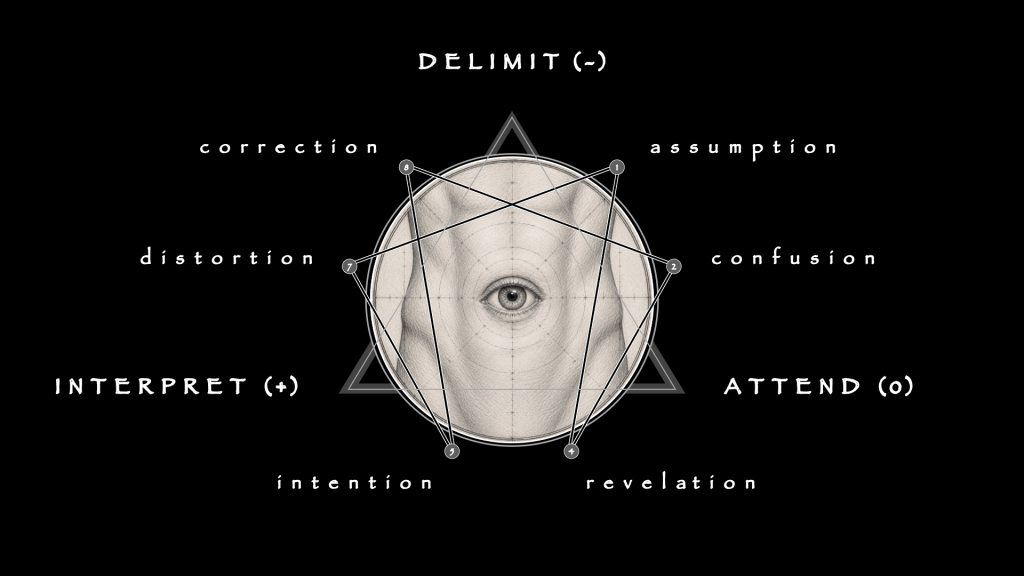
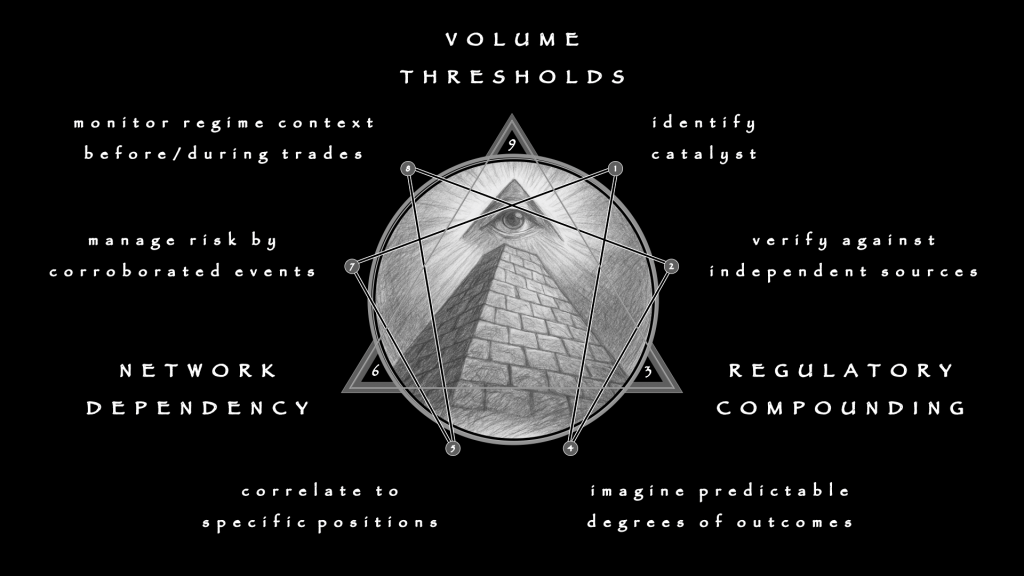
Etymology, handled seriously, is not derivation. The latter traces a word’s lineage the way genealogy traces a family’s, producing a chart that explains the present by mapping the past without, requiring any direct participation of the reader. The former comprises six steps by which that ground is rebuilt, one word at a time, between individuals willing to descend and return.
Assumption
Confusion
Revelation
Intention
Distortion
Correction
What etymology can do, when it is treated as a living discipline rather than an antiquarian one, is closer to exhumation: the deliberate recovery of a body that was interred not by death but by accumulation, covered over by layers of casual use until the original form was no longer visible beneath the deposit. The recovered word is not a museum piece, but a technology returned to working condition, capable of doing in the present what it once did before the layers accumulated, but only for the speakers who performed the recovery together.
For the rest, the word continues as it was: a sound in good standing, circulating freely, available for any use, producing in every exchange the quiet unintelligible variety of what the old story called the confusion of tongues, communities of fluent speakers with no shared operational ground beneath the shared sound.
What is recoverable is not the word’s history but its technology, a method of observation that is genuinely consequential rather than merely sincere. The technology has three parts, and understanding any one of them in isolation changes nothing. Only the reader in possession of all three can apply the procedure immediately. Once equipped, he may do so in any domain where attention matters and evidence is contested, which is to say in most of the domains that are worth attending.
To contemplate is, by the lights of ordinary usage, to think carefully. He who contemplates is measured, serious, unhurried. The word flatters whoever claims it, and signals depth of mind without specifying any obligation that depth must meet. There is no standard by which the depth may be verified, nor any field within which what the mind finds may count as evidence rather than mood. The word circulates without friction.
This comfort feels earned, which is always a problem. Contemplation has a long philosophical pedigree. Aristotle placed theōría, the Greek term that Latin would eventually render as contemplātiō, at the apex of the human intellectual life, the mode of existence most fully aligned with truth. Such elevation imparts genuine authority, for he who contemplates participates, at however modest a distance, in something the tradition considered the highest use of mind. The prestige is real. Those who deploy the word loosely are drawing on a credit account that the word’s philosophical lineage built and that drift has left open, borrowing against a reputation that no longer requires the underlying transaction.
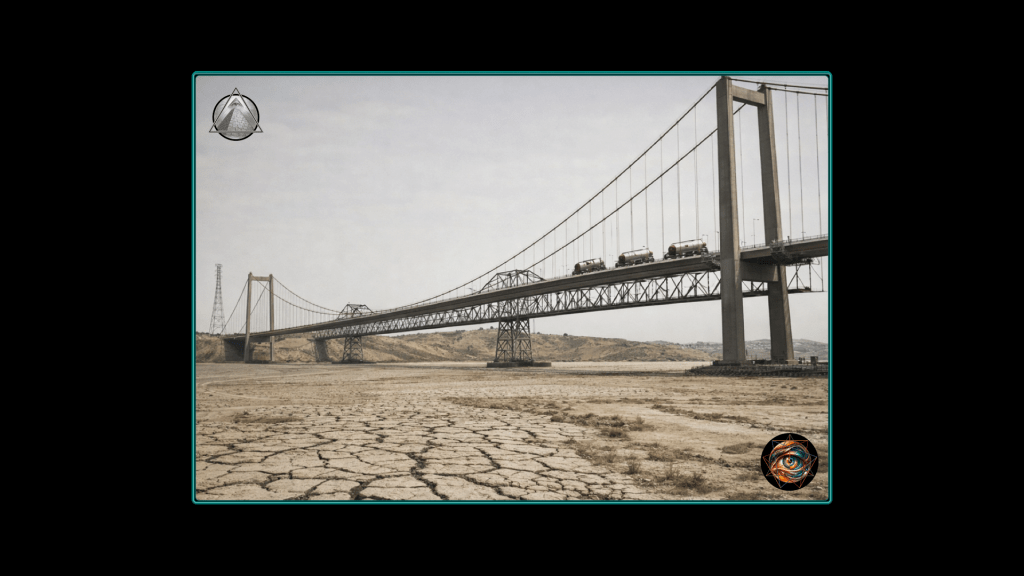
A suspension bridge feels stable when a cable frays, at least at first. The feeling of solidity persists beyond the loss of the structure producing it. Something similar has happened to contemplate: the dignity remains, but the technology that once required something of the observer, that defined a field, fixed its limits, and made some findings admissible and others not, has been removed so gradually that its absence now feels like the natural condition of the word. The question of the moment is what that technology was before anyone thought to remove it, and whether enough precision is available to make the technology work again.
The degraded image of contemplation has a common name. Navel-gazing is usually and rightly deployed as a mild insult, a way of dismissing introspection as excessive and unproductive, but the phrase is nevertheless more instructive than its dismissive tone suggests. It preserves one genuine feature of contemplation while destroying the discipline that made that feature consequential. Understanding what it preserves, and what it destroys, is the shortest path to understanding what the word once required.
Contemplation, in its authentic form, requires a center, a focal point within a declared field. What navel-gazing removes is the field. The gaze turns inward and the center collapses into oneself, which cannot stand outside itself to verify its findings. The observer has no declared limit, no boundary that could make what appears inside it admissible rather than merely present.
Intensity remains—jurisdiction disappears.
The observer in this condition is not passive, per se, or inattentive. The attention is real, sustained, and all-too-often experienced as profound. What is gone missing is the prior act that would have made the sustained attention consequential: the declaration of a field. Without it, one spirals inward with full sincerity, finding only what is already there, confirming only what was already believed, and proudly naming the loop insight.
The structure of the loop is precise: the affirming pressure of genuine desire to understand meets the denying opacity of a surface that cannot stand outside itself, and because no third force enters from outside the system, the two irreconcilable forces do not produce any new state, only recurrence. This is not contemplation, but earnest spinning.
The sincerity of the spin makes it harder, not easier, to recognize as motion in place.
Whether the slide from contemplation to navel-gazing is a moral failure or not, it is a practical one. Something essential has been removed from the procedure, and the excision leaves a scar. Meanwhile, the word retains a patina of dignity, without the weathering of obligation.
To find what was removed is to use etymology not as an antiquarian exercise but as a forensic examination, the way an engineer surveys a failed joint not to admire the original design but to understand exactly what gave way, and whether it can be recut and seated correctly.
Contemplate descends from Latin contemplārī, and the second half of that verb is templum. The modern reader sees “temple” and pictures a colonnade, a precinct of stone, an architectural enclosure set apart for sacred purposes. That picture is nearly entirely wrong. When the noun inside the verb appears to name a building, the action is subordinate to an object, and the operational content of the verb is gone.
A templum, in Roman usage, was not first a building, but a bounded field, a portion of sky or earth delimited by the augur for the purpose of reading signs.
The architectural meaning is derivative, applied to buildings because they stood within consecrated enclosures, but the stone arrived late. The act of declaration came first, and the act was verbal. The field was spoken into existence by the right words in the right order, its limits fixed by utterance before any physical boundary was erected. This is the moment that most recoveries of the word’s etymology skip, not that templum once meant something different, but that it named a speech act, a performative utterance that created a zone rather than described one.
Varro, writing in the first century BCE, is the witness whose technicality makes paraphrase dangerous. He was too precise to be argued away and too literal to be rescued by reinterpretation. In De Lingua Latina, he defines the terrestrial templum as a place bounded by certain set words for the sake of augury or auspices. The decisive term is finitus, meaning brought to a definite limit, closed off, declared complete. The templum is not merely sacred ground. It is ground whose limits have been verbally fixed, a field that exists as a field only because its edges have been named.
He adds that the augur, when establishing a templum, performs a kind of viewing by which he bounds the sight of the eyes. This is no metaphor. It is Roman technical prose describing a procedure in which the optical and the juridical are a single act. The field is not seen and then declared. It is declared, and therefore available for seeing. What Varro describes is a performative act that creates the conditions of observation rather than responding to them.
The astonishing thing about this source is not that it survived, but that it survived intact, that a text this technically specific was not smoothed into the usual philosophical generalities by the centuries between Varro and today.
The modern temptation is to hear “frame” in a psychological register, as if the point were merely concentration, the way a director’s viewfinder supposedly helps a filmmaker see. The Roman evidence points in a harder direction. A viewfinder focuses by excluding what falls outside it. The templum does something categorically different—it does not merely exclude what falls outside, it strips what falls outside of a particular status, the status of being evidence at all.
In augural practice, a bird that crossed the sky beyond the declared boundary was not an ignored bird; it was an inadmissible bird.
The distinction matters. An ignored bird might still be relevant, merely unnoticed. An inadmissible bird is formally outside the jurisdiction regardless of what it does or how vivid its passage. The frame does not help the observer focus. It governs what counts as a sign at all, the way a court’s evidentiary rules do not merely organize evidence but determine what enters the record. This gives contemplārī a juridical undertone that modern English usually misses, and it explains why ancient discussions of templum stray so readily into constitutional territory.
A senate meeting held in a templum was not simply more dignified. Technically speaking, the setting bore on its lawfulness. If the usual senate house was unavailable, an augur could establish an appropriate templum elsewhere, because what mattered was not the architecture but the declared field. The templum is not a backdrop against which authority operates, but the prior condition under which authority may operate at all. Removing the templum from the senate meeting does not weaken the meeting. It dissolves its standing.
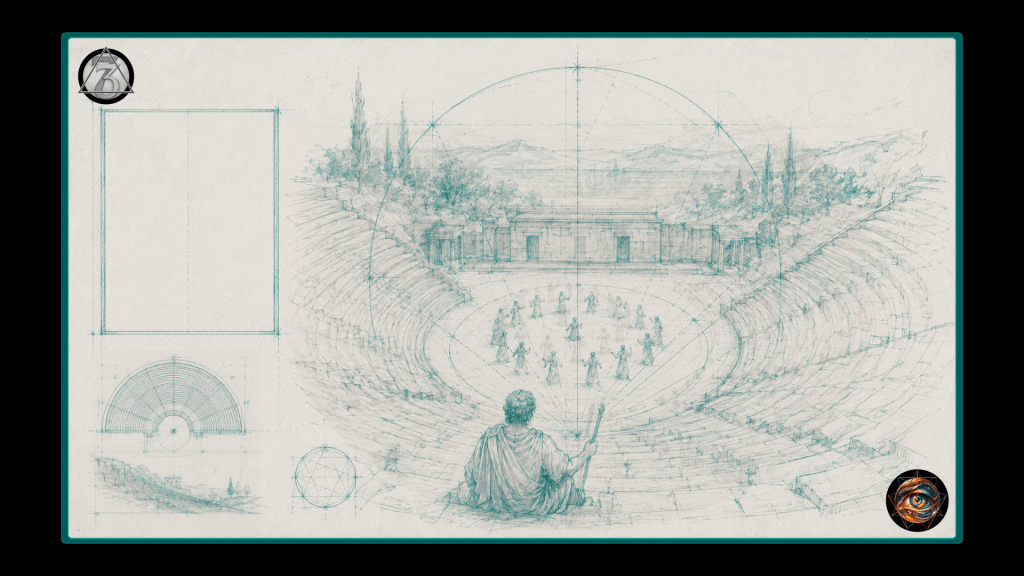
Greek developed a parallel term by another route—theōría.
A theōrós was an official observer or envoy sent by a city to witness a sacred event, and to do so not privately but on behalf of his polis. The root idea is sanctioned spectatorship: the journey, the occasion, and the civic authority under which seeing takes place. Greek foregrounds the qualified observer, and Latin foregrounds the structured field. When philosophical Latin eventually adopted contemplātiō as the standard equivalent of theōría, it did so because the concepts were already doing the same work from opposite directions, like two scaffoldings erected against the same wall.
Contemplātiō was strong enough to survive the removal of its apparatus. Contemplate retains some semblance of seriousness long after the structural demand that justified those connotations had been quietly dropped. The prestige outlasts the discipline, as a compass rose precisely painted on a wall with the exact cardinal marks beautifully rendered cannot tell you where you are. The word contemplate, in its current circulation, is exact enough in its connotations to be mistaken for the real thing, and present enough to occupy the space where the real thing would otherwise live.
The logic of the templum returns with almost startling clarity in the Renaissance workshop, where painting becomes theory. In De Pictura, Alberti instructs the painter:
“In qua pingendum sit area, quam amplam velim, quadrangulam rectis angulis describo, quam quidem mihi pro aperta fenestra est, ex qua historia contueatur.”
With some amount of poetic license, this renders as:
“On the surface to be painted, I first inscribe a rectangle of whatever dimension I choose, declaring it an open window, only through the which may the scene be contemplated.”
The verb at the end, contueatur, is the third person singular present subjunctive of contueri, a compound of con (together, thoroughly) and tueri (to look, to watch, to guard). It is a close cousin of contemplārī, sharing the same root act of directed, sustained looking. The subjunctive mood here carries the sense of “through which the scene may be contemplated” or “from which the subject is to be viewed,” with the subjunctive marking the window as the condition of possibility for the seeing, not merely its location.
This sentence is usually introduced as the charter of linear perspective, and so it is. It is also something older in new dress: the establishment of a bounded field within which sight becomes exact, proportions become governable, and a scene becomes possible in the strict sense. Before the frame, as Alberti understands it, there is only undifferentiated visual abundance, the same formless chaos the augur faced before the templum was declared.
The etymological connection is exact and unremarked in the art history literature. Alberti, writing a treatise on painting, chose a verb from the same root family as contemplārī to describe what the painter’s rectangle makes possible. Whether that choice was conscious or simply the natural Latin for disciplined visual attention, the result is that his founding instruction for perspective painting contains, in its final word, the same mechanism of the rectangle as templum.
The augur defines a field in sky or earth and reads the signs within it. Alberti defines a field on the panel and orders what may be seen within it. In both cases, seeing depends upon prior delimitation.
Perspective is not simply a trick for creating depth, but the law that becomes operative only after the field has been bounded. Alberti did not imagine himself a Roman augur. He simply discovered, through the pressure of craft, that intelligible vision depends on prior delimitation. Undeclared abundance is not a richer field but a poorer one, because it produces images rather than evidence. A painter who begins without the rectangle is not working in a larger field, but in no field at all.
The loss here is that the word in its retirement form, once it usurps the only space where discipline can live, actively prevents the discipline’s return. He who uses contemplate to mean earnest inward brooding is not simply using the wrong word. Worse, he uses the right sound to do the wrong work, with enough prestige to make the wrong work feel sufficient.
Philology, when it is more than ancestry research, recovers not what words once meant but what acts words once named. The acts are often more rigorous, more procedural, and more consequential than their softened modern counterparts suggest. Some may even be recoverable, not as nostalgia but as function.
The test is whether the restored meaning can be reinstalled into use, whether it changes what the word can do when spoken into a live situation. One that only improves comprehension has not passed the test. Comprehension is private. It changes the map inside a single mind and ends there. Restored meaning passes the test only when it is introduced into a live exchange and alters what is possible in that exchange.
Contemplate aspires to that test. The working definition that emerges from this recovery is compact and load-bearing: to contemplate is to attend within a bounded field whose declared limits determine what may count as a sign. Each element does specific work. To attend is not merely to look, but to be present as an observer whose presence has been authorized by a prior act of delimitation. The distinction between failing to attract attention and lacking standing is the sharpest edge the word ever had, and which modern usage has most thoroughly rounded off.
He who contemplates in the correct sense is not free to look in all directions with equal openness, for he has already committed to a boundary and accepted its limits. This is a discipline with consequences. A thought that arises outside the declared field is an inadmissible thought, not because it is unwelcome but because it has no standing in the procedure. Findings made within the field carry a different status than impressions gathered without one, and the observer is accountable to the declared limits in a way that the earnest brooder is not.
LANGUAGE is the only tool that can be used against its wielder without him or her noticing when and how the blade was turned. Every other instrument of power leaves a mark. Legal force produces resistance. Economic pressure produces reorganization. Violence produces resentment. A word, bent gradually and with sufficient patience by the methodical hands of one who benefits from its Distortion, produces consent.
This is not Cynicism in the debased modern sense. The ancient Cynics were the known-world’s most alert philosophers, neither passive nor plaintive. Their modern counterpart is not courage, but capitulation wearing a clever face, an anti-philosophy that declares corruption universal, resistance futile, and the proper response a raised eyebrow with a whiskey chaser. That foul-smelling dog is cynicism’s corpse, performing its undead antics for an audience that has never seen the triumphant living beast.
The former slave, Diogenes of Sinope (c. 403 BCE – died c. 320 BCE, probably at Corinth), did not withdraw to a cellar to contemplate the hopelessness of the polis. Instead, he moved into its beating heart, uninvited and unashamed, where he lived in a wine barrel and refused every social convention that substituted signaled virtue for the genuine article. His ideal was not detachment, but deliberate friction, maintained against every institution that confused its own convenience with the good.
Though the heavens might fall, Ambrose Bierce (June 24, 1842, Horse Cave Creek, Ohio – died c. January 1914?, Mexico?) understood and encoded a similar indictment. His Devil’s Dictionary was never a cabinet of clever inversions assembled merely for the amusement of the already-disillusioned. It was a sustained act of frank speech directed at the specific words by which his era’s institutions maintained their grip on what could be thought, said, and therefore done.
Both men—Diogenes and Ambrose Bierce—practiced parrhesia, a volatile speech-act that costs the SPEAKER but changes the potential for everyone present.
Comprehension is merely the private improvement of a single map locked within a lone mind. The uncomfortable skill that my dictionary proposes is to introduce a restored word into live conversation under pressure and alter, by that introduction, the available moves for everyone present. Precision, once audible, does not argue, but forecloses. Any who were sheltering inside a word’s ambiguity must now either engage on new terms or expose, by their resistance, exactly what their ambiguity protects.
The advantage on offer here is therefore more than rhetorical. It is procedural. A restored word enters the room like a witness who cannot be cross-examined into disappearance.
Assumption
LANGUAGE does not degrade. People do. The medium remains available at full precision to any SPEAKER willing to use it correctly, yet the population willing to do so is, in any room, at any moment, smaller than the sum of people present. This is not an unfortunate feature of the human condition that must be accommodated with patient understanding. It is negligence, ordinary and widespread. The entries in my dictionary proceed from that assessment without apology and without the pretense that a softer diagnosis would be more accurate.
Assumption is where negligence begins.
A word enters use carrying apparent stability, and the SPEAKER accepts it without inspection because inspection requires effort. The cost of imprecision will not land on the SPEAKER, at least not immediately, not visibly, and almost never in a way that can be traced back to the moment inspection was declined. This is an inheritance accepted without reading the will. The encumbrances recorded against the property are not accidental omissions from the document. Prior SPEAKERS shaped the word’s apparent meaning to serve their own purposes and left the Distortion in place for successors to inherit. The fast talker who assumes a word’s stability without examination is therefore not a victim of this virus, but its willing host.
What Assumption produces is not communication worthy of the name. It is the performance of communication, sustained by the tacit agreement of SPEAKERS who have decided, each for private reasons, that the cost of precision exceeds the cost of imprecision, at least for now. The performance holds until it fails. The exchange then discovers, too late for comfortable revision, that the word everyone thought they were sharing has been doing different work for different parties since before the conversation began.
From that moment forward the negligence is no longer private, but becomes everyone’s problem, most of all the problem of whoever has the least power to absorb it.
Confusion
Confusion carries its etymology honestly, and nobody reads it. It literally means fusing together what was previously separate. This is what happens when distinct things are forced into contact with enough TIME and pressure to merge. The new mass presents as the original. Nobody in the room can say precisely when the boundary dissolved because the process was too gradual, and the result indistinguishable from what it replaced.
Confusion is more insidious than the brain-fog that rolls in when SPEAKERS stop making effort.
John Carpenter filmed this predicament in his 1982 horror adaptation of “The Thing”. His creature does not invade. It assimilates whatever it touches, and the resulting organism looks correct enough from the outside while something is dangerously wrong within. Confusion inevitably follows when Assumption runs long enough without inspection.
Prior SPEAKERS deposit referents into words through use, need, convenience, institutional pressure, and private advantage. These deposits graft themselves onto the original meaning until the composite presents as natural and obvious. The SPEAKER most likely will not notice or acknowledge the graft. The listener may or may not share the composite. Contemporary speech then proceeds more through fusion than by precise referents, and the result is called communication.
The exchange holds only until the stakes rise high enough to force the issue into the light.
Similarly, the builders at Babel did not lose their sanity. They lost the agreement beneath their words. The sounds continued to circulate, yet produced incongruous images in divergent minds, until cooperation became impossible.
Escalation is an attempt to force The Thing apart through pressure. It tears rather than separates, leaving both parties with pieces that no longer function. Temptation makes visceral sense because pressure feels like action, and action flatters the frightened SPEAKER more than inspection does. Retreat is the opposite failure. It accepts contaminated LANGUAGE as the new normal and calls the accommodation peace.
Confusion does not resolve on its own stage. It presents a problem, not a solution—always a question, never an answer. Live conversation must decide without instruction and in real time what to do with the presentation.
As ever, Confusion itself is as reliably eager to answer every question as it is definitively powerless to solve any problem.
Revelation
A dog does not ask permission, but follows its nose directly to the truth, which is not the civilized face LANGUAGE presents but the tail it has dragged through every context crossed. Dogs read with an unhurried attention that never sacrifices accuracy for social comfort. This is also the method of the Devil’s Dictionary, because history shows that the method works.
People whose words are scrutinized reliably find the inspection unseemly, and the Cynic’s answer to that objection is the same as any dog’s.
What the inspection finds is not meaning, in the cognitive sense, but pheromone. On every word of substance an involuntary record of interest cannot help but leave its trace. A pheromone is not composed, addressed, or sent with conscious intent, but secreted. It is the automatic deposit of a body’s condition into its environment. The animal literate in scent is not interpreting a message, but reading a fact.
A word’s prior SPEAKERS did not intend to leave any record, per se. Handling always leaves a trace, and traces do not share the handler’s interest in remaining unread. The would-be respectable SPEAKER wants the visible word only—its accepted definition or common usage, its social permissions and its polished face in public circulation. The Cynic wants the underbelly, the scent trail of appetite, fear, convenience, territorial claim, and advantage.
Revelation begins when Confusion forces the Thing into view.
A word has continued to circulate, but its original nature has become incompatible under new pressures. When ordinary use can no longer conceal the graft, the SPEAKER returns to the word through etymology, not to recover purity, but to identify the sequence of contact that made the present Distortion feel natural. The word has not changed at that moment; the SPEAKER has.
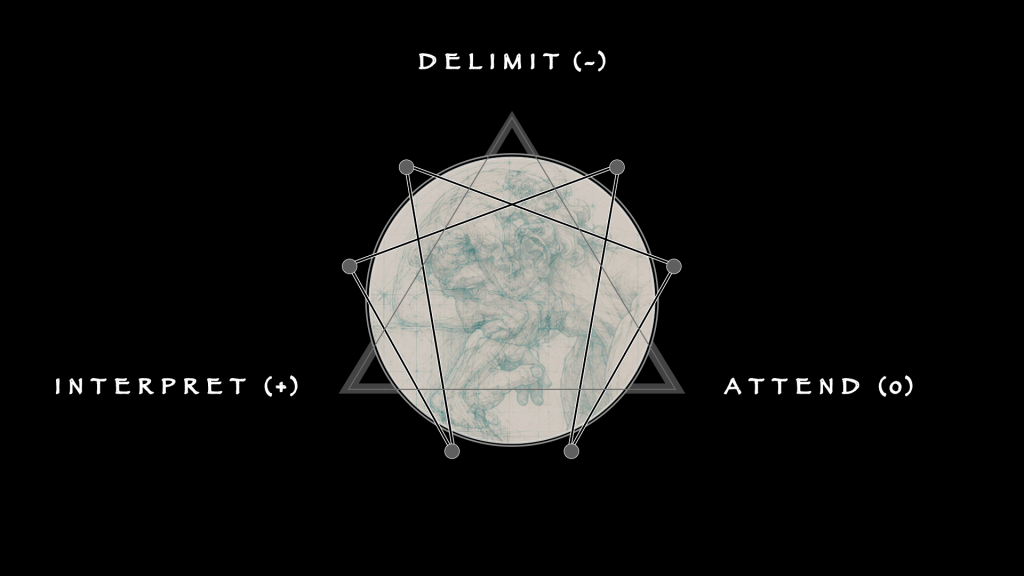
The Logos of Etymology qualitatively maps the three forces of Regeneration:
TIME (-)
LANGUAGE (0)
SPEAKERS (+)
TIME is the denying force (-), the weight of cultural inertia. SPEAKERS inevitably deposit subjective residue. Every variable context obscures original Intention, while the centuries wanton misuse averages out the expectations of those who find precision inconvenient in the moment. LANGUAGE is therefore the reconciling force (0), the medium that permits transmission without guaranteeing fidelity. Over TIME, the medium becomes its own result. Finally, SPEAKERS are the affirming force (+), the sole member of the system with live agency. They aim LANGUAGE toward private ends and accept, evade, or conceal responsibility for that aim.
The record of etymological drift always reveals a pattern of Confusion by Intention:
What the SPEAKER needed the word to mean (-)
What the SPEAKER feared the word might mean if left precise (0)
What claim the SPEAKER encoded inside the word’s ordinary usage (+)
This is not conspiracy. Interests shape LANGUAGE without announcing themselves. The record is involuntary, which is precisely why it’s useful. A composed message can lie. A pheromonal trace cannot, not because it is honest, but because it is not trying to be other than it is. Revelation does not restore the word, but instead reads the word’s history accurately enough for repair to become possible.
There is no original beneath the damage, no clean ancestor waiting under the rubble with its hands folded, only the record of contact.
Intention
In-tendere means to stretch toward, to aim. The SPEAKER who declares an Intention has not merely stated a purpose, but has selected a target and accepted that any deviation reflects on him. Many otherwise civilized SPEAKERS, having read the record and understanding what it holds, find reasons to blur the aim, widen the target, or reduce the force. A word aimed at nothing cannot miss, but one aimed precisely can, and becomes legible in ways imprecision would have prevented.
In practice, Involuntary Agreeability introduces and enforces enough ambiguity to preserve the option of having meant something else if a word lands badly.
The cost of parrhesia would be unbearable if frank speech required total Correction, which it mercifully does not. A SPEAKER need not defeat every Distortion at once, need not purify LANGUAGE as a whole nor redeem all in the room from their laziness. A method too large to carry into conflict is only an ornament for private comprehension.
He has only to deliberately traverse a simple set of steps on a single contaminated word, precisely at the point where that word introduces noticeable harm.
Parrhesia requires a sequence compact enough to survive interruption, ridicule, social pressure, and the sudden arrival of consequences. The method is purely Cynic, in the classical sense. It never trusts the declared meaning of any word. Instead, it noses out the record of contact. A SPEAKER need not carry the whole library into the room. He needs the lamp and a scent trail, his aim and the nerve to let the restored word strike where he points it.
The saving grace of the path is its economy, which makes frank speech affordable:
Assumption
Confusion
Revelation
Intention
Distortion
Correction
The Cynic does not soften the aim, not because he is brave, but because he finds the softening more trouble than it is worth. Diogenes looked up at Alexander and said, in effect, “Move, man, you’re blocking my sun.” The precision of his aim was the essence of the act. No ambiguity had been preserved for retreat. That is Intention operating at full function.
Alexander could have had Diogenes killed for his impertinence, yet instead he envied him.
This matters because a word aimed with sufficient precision can produce a response that ordinary calculations of power fail to predict. Power expects petition, evasion, or flattery. Intention introduces an unknown, and gives to authority nothing soft to absorb and nothing vague to reinterpret. The dialogue into which a contested word re-enters is never neutral.
The interests that shaped the word’s pheromonal record are still present, and they will meet the restored word with the same resources they brought to the original Distortion:
Patience, which waits for precision to tire (-)
Repetition, which makes Distortion feel familiar (0)
Institutional capacity, which makes imprecision feel like common sense (+)
Intention need not defeat those resources, nor even attack them head-on. It calculates the angle of entry, the only variable the SPEAKER controls before release. A word entering conversation with the right slant gives Correction a runway.
Intention ends the moment the word leaves the SPEAKER’S mouth …
Distortion
Ambrose Bierce spoke to society with his aim declared and his targets named. Society answered with the most efficient defense available. It did not refute him or suppress him. It reclassified him.
Distortion is society’s counter-Intention. When a SPEAKER aims a restored word where needed, society aims back, often without seeming to aim. The listeners themselves agree to bend the word away from the target, then wait for the bend to harden into ordinary use.
Thus, Assumption is recycled Distortion, the observable law by which both strength and weakness propagate.
The Devil’s Dictionary was designed to repair corrupted institutional LANGUAGE, but the room received it as entertainment. Its entries were filed under sardonic wit, admired for their surface texture, and anthologized as the output of a characteristically bitter man. That classification did what open opposition could not have done. It neutralized the act by flattering the performance. A definition received as a joke cannot function as a hinge in a live exchange. It can only be admired and set aside, which is what society does with every precisely aimed word it cannot afford to hear on its own terms.
Recategorization moves the offending word into a safer drawer.
The adjective “Bierceian” is not a tribute, but a sarcophagus. Once the method is named, the reader can admire the flavor without digesting the meat. The work survives, but in quarantine. His dictionary remains available, quoted, loved, and misused, while the average SPEAKER inherits the safe Assumption that its purpose was literary temperament rather than public repair.
Natural Drift and Engineered Distortion operate simultaneously. Natural drift is ambient erosion: the restored word passing through contexts the SPEAKER did not anticipate, its edges blurring without plan or intent. Engineered Distortion is society’s deliberate reply: the interests that shape the pheromonal record recognize the restored word and move against it with the same patience and repetition that produced the original corruption.
Schools teach this to children in the classroom game of “Telephone”.
Ambrose Bierce understood this before he walked into Mexico in 1913. The biographical mystery does not diminish him, it merely denies society the convenience of a settled ending. He, meanwhile, lost nothing in the bargain that was truly his. The loss belongs to those who inherit his dictionary as temperament instead of method.
Correction
Confusion joined things that should have remained distinct, and the entire cycle from Revelation through Intention has been preparation for the one move that Confusion requires: public separation. The cost is higher than mere installation of a correct meaning in the abstract, heavier than the private satisfaction of having read the pheromonal record accurately. To pull fused referents apart in the presence of the people who have been operating inside the fusion threatens the status quo.
Correction must be performed at the point of use, where Confusion is doing its work, before the people for whom its continued operation is most convenient.
Among other things, it costs a man his shelter. He who publicly performs the separation has accepted that people will respond visibly as people who have been discovered rather than as people corrected on a neutral matter of fact. The latter says thank you, or argues the point. Those whose operational shelter has been removed do neither. They contest the method, impugn the motive, invoke authority, and apply the same impatient repetition that produced the original Distortion to the task of restoring it. A fusion that nobody was using would not be so viciously defended.
The Cynic, expecting all this and more, is not deterred, on the grounds that such responses are themselves a form of confirmation.
Confusion invoked a creature assimilating whatever it touched, and presenting its deceptive mass as the original until pressure forced the irreconcilable natures into view. Correction is the blood test administered in the room, with no private exit available, in front of everyone who has been treating the creature as the host. The test does not destroy the creature, but makes it visible, fundamentally changing what the room can do next. No outcome requires anyone’s gratitude and none depends on anyone’s conversion.
Comprehension would have ended at Revelation, satisfied with having read the pheromonal record accurately and improved one mind’s map of the word. Correction goes beyond, and carries the restored word into a live exchange. The room does not become more honest, but one in which dishonesty is a deliberate act rather than an innocent one, and a different liability than accidental imprecision.
This Illuminated Manuscript . . .
The devil of this dictionary deserves its etymology. He is not the adversarial creature whose function is transgression and whose pleasure is corruption. That lesser imp is a Distortion, useful to every institution that benefits when illumination can be mistaken for malice. The devil this dictionary answers to is the light-bearer, expelled from the prevailing order not because he loves evil, but because he makes concealment unbearable. Light is a grave offense in any space organized to benefit darkness.
Its denizens can endure almost anything except exposure.
Diogenes carried his lamp in broad daylight. The gesture was not an absurdist performance, but the most exact accusation available to him. Ordinary daylight had failed to illuminate anything that mattered, and the honest man, if such a creature existed, would not be found by staring harder in an approved direction. The lamp is not a tool for seeing more, but for proving what others agree not to see.
Ambrose Bierce carried the same lamp into the lexicon of his era. He held it against the words by which institutions preserved their grip on thought, conduct, reputation, and obedience. The room responded as rooms always respond. It reclassified the lamp as style, filed the light-bearer under bitter wit, and restored the darkness by making illumination sound like private taste instead of public necessity.
The entries to follow in this series exemplify this lamp applied to incendiary words.
A word that cannot be named cannot be contested. One that has been named precisely, in public, with its transaction exposed and its Intention made visible, can only be defended by those willing to be seen defending it. The lamp does not guarantee that anyone will look, only that looking is possible. Willful darkness may persist thereafter, but not with any innocence or ambience.
June 27, 2017—Screens worldwide display a ransom note, promising a transaction. Instead the perpetrators deliver demolition. The malware called NotPetya rode the shape of expectation, exploiting trust relationships that victims could not uninstall because institutional compliance required them. Within hours, global shipping would grind to a halt, pharmaceutical manufacturing would freeze, and Merck would find itself borrowing vaccine doses from the U.S. strategic national stockpile to fulfill orders. Organizations discovered all-too late that their disaster recovery plans had been built assuming the responders could still log in.
The incident compressed three durable truths into one fast-moving event:
Trust, in the form of mandatory networks, can be weaponized
Recovery is an identity problem before it is a storage problem
A ransom note may be a diversionary prelude to sabotage
NotPetya did more than exploit trust. The event exploited the time it takes defenders to understand that trust has already failed. Governments would later attribute the attack to a military intelligence unit. Insurers would spend years arguing whether state sabotage triggers war exclusions. The total estimated damage would exceed $10B USD.
For the self-taught investigator, Tony Scott’s 2006 detective thriller, Déjà Vu, provides an instructive window into aoristic, or time-based, forensic analysis. In the film, an apparently random federal agent from the ATF named Doug Carlin gains access to a surveillance system that shows him the past in real time, four days delayed. He cannot rewind. He cannot pause. The technology shows him a woman, Claire Kuchever, as she moves through her final hours.
Knowing she will die, he is unable to look away or skip ahead.
The constraint is the source of all the narrative tension. Agent Carlin must notice everything the first time, because the footage will not wait for him to catch up. As he observes, he falls in love with a victim who is already dead. The film contemplates what it means to investigate a catastrophe you cannot prevent.
Three subplots converge toward the climax:
Agent Carlin’s impossible attachment to the victim
A fraught negotiation with the surveillance team that controls his access
Reverse-engineering of a mysterious bomber’s meticulous tempo
The self-taught OSINT analyst occupies an inverted version of Carlin’s position.
The catastrophe has already happened. Traces are frozen in corporate filings, government statements, and technical reports. They always are. Any analyst can rewind and pause. Yet, the footage is intrinsically incomplete, shot from angles chosen by others, and edited by institutional interests before release.
The question is never whether an analyst can change what happened, but whether he can understand the pattern of one event well enough to recognize it in the next one before it detonates. NotPetya is but one explosion whose shrapnel pattern this instructive case study exhumes. Assuming the theater has already burned, the task is to determine whether the fire was part of the act.
The Morning the Screens Went Dark
On a normal cybersecurity Tuesday, ransomware has a rhythm. Someone opens the wrong file unbeknownst, unleashing something malicious. A ransom note appears, and a negotiation begins. The cycle is familiar enough to generate playbooks, insurance products, and a cottage industry of negotiation consultants.
Unpleasant as the message on the screen may be, it is at least legible: pay this amount for the key to resume operations.
On June 27, 2017, many organizations encountered a different rhythm altogether. The note appeared, the clock started, and the usual instinct to pay and recover kicked in. Yet there was no one on the other end. While the message looked like garden-variety extortion, the outcome behaved like demolition. In Ukraine, organizations reported disruptions across banks, infrastructure, and public services. Elsewhere, administrators saw the same symptoms as machines rebooted into ransom screens and the ordinary theater of extortion played out on monitors worldwide.
Even the malware’s name was unstable in those first hours, cycling through Petya, NotPetya, Nyetya, as language lagged behind the thing it tried to describe.
The Danish shipping giant Maersk publicly confirmed, the same day, that it had been hit as part of a global cyber attack with IT systems down across multiple sites. The statement was short, the kind of curt corporate acknowledgment designed to be precise without being expansive. FedEx published an investor news update the following day, stating that TNT’s worldwide operations were significantly affected and that the spread involved a virus distributed through a Ukrainian tax software product. Two major multinationals, two public statements, two vertebrae in the spine of a timeline that would eventually stretch across years.
Cisco Talos, one of several security research organizations publishing contemporaneous analyses, described the malware as a worldwide ransomware variant with worm-like spread dynamics. The technical community was already circling a suspicion that would harden over the following days: the malware’s behavior resembled sabotage more than extortion. WannaCry had primed the world to see “ransomware worm” and immediately reach for a familiar playbook.
NotPetya rode that reflex like a pickpocket working a distracted crowd.
Responders chased payment channels and decryptors. Executives assumed a business transaction existed somewhere behind the chaos. The window for containment shrank while debate continued over whether negotiation was even possible. The deeper tell was not the note on the screen; it was the mismatch between the story the malware performed and the physical experience inside organizations, where computers failed broadly, operations ground to a halt, and recovery began to look suspiciously like total rebuild.
A sharp OSINT detective watching the footage pauses here and notes that the victims were already running toward escapes that had been blocked before the show began. Therefore, he does not start by trying to figure out who did it. Without a lead, that way leads to speculation without evidence.
Rather, he builds a clean spine of time, with June 27 as the first vertebra:
Widespread disruption
Ransomware-like display
Rapidly expanding scope
He resists the urge to narrate beyond what the evidence can hold. The same morning, a car bomb killed Colonel Maksym Shapoval, a senior Ukrainian military intelligence officer, in central Kyiv. Ukrainian authorities would later attribute his assassination to Russian intelligence, though the temporal coincidence with NotPetya remains unresolved in the public record.
The Carlin method therefore applies. Watch what passes across the frame, and refuse to fill gaps with speculation even if feels like memory.
By late June 27 and into June 28, the story had crossed into the corporate language of “significant impact.” Maersk’s update remained terse. FedEx, through TNT, was already pointing at a vector category: a software product used for compliance work in Ukraine. That divergence is instructive. Different organizations have different visibility, different legal constraints, different communications strategies. One company offers a plausible path of entry while another does not yet know its own path.
The self-taught detective learns to watch and analyze for himself how evidence accumulates unevenly, never forgetting that premature certainty is dangerous.
The U.S. government’s alerting infrastructure, then operating as US-CERT, described the campaign under “Petya Ransomware”. Crucially, it oriented defenders toward a mitigation and recovery posture rather than payment and decryption. The underlying framing—destruction disguised as ransomware—is the load-bearing insight that makes NotPetya historically distinct.
The Supply Chain as Entry Point
When people say “supply chain attack,” they imagine a compromised cloud library or a poisoned package in a public repository. NotPetya’s entry was a new species with a different method. Compromise a widely used software product in a specific geography, then use that trust relationship as a distribution channel. The target was M.E.Doc, a Ukrainian accounting and tax software application required for businesses operating in compliance with local regulations.
The attacker did not need to breach every victim individually, only to compromise the update mechanism of software that victims were already obligated to trust.
Cisco Talos’s “MeDoc Connection” writeup describes the attack as supply-chain focused, with the M.E.Doc software update mechanism used to deliver a destructive payload. FedEx’s investor disclosure independently aligns. TNT used the compromised tax software, and that use allowed the virus to infiltrate its systems. These two sources serve different roles in a casefile. Talos provides a technical narrative explaining what was observed. FedEx provides a business narrative explaining how a trusted product used in a local context became a path into a multinational’s operations.
Each source is a camera angle controlled by someone else, and the analyst earns credibility by demonstrating that multiple angles converge on the same scene.
Supply chain risk becomes viscerally real when you let it. A Danish shipping company with operations in Ukraine runs software mandated by Ukrainian tax authorities. A pharmaceutical giant with manufacturing facilities across continents depends on local systems that comply with local regulations. The compliance requirement is both the trust relationship and the attack surface. Supply chain risk is organizational geography made digital.
Ukraine in June 2017 was a country under pressure across multiple domains simultaneously—cyberattack, assassination, ongoing conflict in the east—and the supply chain compromise landed inside that larger pattern of coordinated stress.
The M.E.Doc compromise illuminates a category of dependency that enterprise risk frameworks often miss: mandatory software. Organizations can choose their cloud providers and negotiate with their operating system vendors. They cannot choose to ignore local tax compliance. The attacker selected a vector that victims could not simply uninstall or replace. The trust was not voluntary; it was regulatory. The analyst who watches long enough begins to see the organization as something more than a case study. The footage reveals how the victim lived before the attack, what dependencies shaped daily operations, and what assumptions were baked into the architecture of normalcy.
The supply chain was not merely exploited; it was selected. The attacker understood that certain software dependencies are stickier than others, and that compliance requirements create durable trust relationships. The magician chose an audience that could not leave the theater, then locked the doors before dimming the lights.
Building a casefile graph demands hard answers before drawing edges.
When the analyst adds “X caused Y” or “X is related to Y” in Maltego or any graph tool, he is asserting something. Graph work is seductive because it looks authoritative. Each edge is a surveillance angle, and too many analysts fill their screens with lines that feel like insight but function as decoration.
The following questions keep the graph honest:
What is the claim, exactly?“Used by” and “caused” are different edges with different evidentiary requirements.
What is the source type?Primary disclosure carries different weight than vendor report, journalism, or commentary.
Is there independent corroboration?Another outlet, another document, another angle strengthens confidence.
Does the claim survive a boring alternative?Coincidence, misreporting, and conflation must be ruled out before causation is asserted.
What is the time anchor?The date of the event and the date of publication are different facts that require separate tracking.
What is the harm of being wrong? Reputational damage, panic, and misdirected defenses are consequences of false edges.
NotPetya’s supply chain claim hardens over time precisely because it survives these questions.
Multiple independent sources, both technical and corporate, point to the same vector category. The complete internal compromise chain—how the vendor was breached—remains uncertain because the analyst lacks forensic access. The claim is actionable anyway. Disciplined confidence labeling separates what is verified from what is inferred from what remains unknown.
Propagation Collapses Decision Time
Inside many outbreaks, the difference between a bad day and a catastrophic week is lateral movement. How quickly can a compromise travel from one machine to a network where no one can authenticate anywhere? Early technical analysis noted that NotPetya used multiple mechanisms to spread, and that its behavior differed from malware that simply scans the internet randomly. It was fast, targeted, and ruthless in its exploitation of trust relationships within enterprise environments.
There are two safe points to extract for a public-facing writeup.
The first is that rapid internal spread collapses decision time; if a containment plan depends on a meeting, it will lose to malware that depends on seconds. The second is that identity services become a single point of failure, because large environments are glued together by authentication, authorization, and centralized management. When those services go down, “restoring from backup” transforms into “reconstructing how the organization knows itself.”
The footage from inside affected organizations, reconstructed from later accounts and filings, shows a particular kind of chaos. Machines rebooting simultaneously. Administrators locked out of their own consoles. Phone trees failing because the directory service was offline. The playbook assumed partial impairment, some systems down, others available for coordination. NotPetya delivered total impairment across trust boundaries that no one had mapped as attack surfaces.
The domain controllers that authenticated every employee became the first casualties, and without them, the organization forgot who its own people were.
A ransomware campaign that encrypts files on scattered endpoints is painful but recoverable. A wiper that destroys the identity infrastructure requires reconstruction from first principles. The analyst rewinding the footage sees the moment when the attack exceeded the design assumptions of every incident response plan it touched. The plans assumed the responders could still log in.
The Maersk recovery story has been described publicly in detail sufficient to serve as the human-scale thread that keeps a historical narrative from becoming sterile chronology. WIRED’s longform account describes Maersk leadership receiving a phone call in the early morning hours of June 27 and recounts a rebuild of approximately four thousand servers and forty-five thousand PCs over roughly ten days. The analyst treats this account as high-quality narrative reporting rather than a primary technical source; many of its claims require corroboration to reach full verification. The account remains valuable because it captures the operational reality that makes the lessons stick.
Claire Kuchever is already dead when Carlin begins watching her apartment through the surveillance window. He cannot save her; he can only understand her final hours well enough to recognize what killed her. Maersk occupies this position in the NotPetya narrative. The analyst watches Maersk’s systems go dark, reconstructs the infection sequence from public statements and later reporting, and develops an investment in the organization’s fate that exceeds professional detachment. The analyst studies how Maersk functioned, not just how Maersk was attacked.
When everyone is locked out at once, even documentation may be unreachable if it lives on the wrong system. Recovery is not merely a storage problem, but an identity problem. The organization must re-establish who is allowed to do what before it can restore the systems that depend on those permissions.
NotPetya forced many firms to discover which assumption was baked into their disaster recovery plans. If the plan assumed extortion, it optimized for backup restoration and negotiation containment. If it assumed destruction, it optimized for continuity of operations and identity-based rebuild under duress. The difference between those assumptions is the difference between a difficult quarter and an existential crisis.
FedEx published a TNT Express operations update on June 30 describing progress: remediating systems and methodically bringing business-critical services back online. The language is operational, almost boring, but that is what recovery looks like in real life. Merck’s manufacturing shutdown stretched nearly two weeks; a vaccine production facility went offline long enough that the company borrowed Gardasil doses from the U.S. strategic national stockpile to meet contractual obligations. Mondelēz, maker of Oreo and Cadbury, lost 1,700 servers and 24,000 laptops permanently. Systems can be online yet fragile—inventories, staged bring-up, cautious reintroduction of services.
The footage does not end when the fire trucks leave.
The Maersk recovery story includes a detail that has become legendary in security circles. The company’s entire Active Directory infrastructure was wiped, and the only surviving domain controller was located in Ghana, where a power outage had taken the server offline before the malware could reach it. That single server, preserved by accident rather than design, became the seed from which the entire identity infrastructure was rebuilt. The next organization may not be so fortunate.
Institutional Delay
One way popular accounts fail is by treating dollar figures like plot twists. In a defensible narrative, money is evidence of impact, but it is also noisy. Companies report different slices of loss in different time windows with different incentives. The analyst must read filings carefully enough to understand what is actually being claimed.
Merck’s Form 10-K disclosures serve as a model of what a primary source can provide. The 2018 filing, discussing the 2017 attack, describes a network cyber attack that disrupted worldwide operations including manufacturing, affecting 2017 sales by approximately two hundred sixty million dollars. The filing reports aggregated costs of two hundred eighty-five million dollars in 2017, net of insurance recoveries of approximately forty-five million dollars, and notes an additional 2018 sales impact of roughly one hundred fifty million dollars due to residual backlog. Merck’s insurers invoked war exclusion clauses, arguing that a Russian state act of sabotage fell outside standard all-risk coverage. The dispute reached $1.4 billion; Merck won a $700 million judgment in New Jersey before the case settled confidentially in early 2024, nearly seven years after the screens went dark.
These disclosures reveal what “impact” means inside a mature enterprise—revenue disruption, manufacturing variance, remediation cost, opportunity cost, insurance friction, and multi-year tail effects. The analyst stops chasing “the” number and starts naming categories. Aggregate damage estimates that place total NotPetya losses in the ten billion dollar range combine disclosed losses from public companies with estimated losses from private organizations and second-order supply chain effects. The analyst can cite such estimates while flagging their methodological limitations.
The insurance disputes deserve particular attention because they illustrate how incident consequences propagate through institutional systems long after the technical recovery is complete. The legal question at stake—whether a state-attributed cyber attack triggers war exclusions in commercial policies—had never been tested at this scale. NotPetya became the test case that insurers, policyholders, and courts would argue over for years. The incident-day footage is only the first reel
The courtroom footage fills additional volumes released on a slower clock.
The attribution that transformed NotPetya from an IT incident into a geopolitical event arrived months after the outbreak itself. On February 15, 2018, the U.S. White House issued a statement attributing the June 2017 NotPetya attack to the Russian military, describing it as the most destructive and costly cyber attack in history at that time. The UK government issued a parallel statement. Eight months elapsed between the outbreak and the public attribution—a delay shaped by diplomatic considerations, declassification constraints, and the slow clock of policy consensus.
Government statements are not raw intelligence, but policy artifacts released through institutional filters like surveillance footage that has passed through an editing bay before reaching the analyst’s screen. The analyst can verify that these governments publicly attributed responsibility on that date, and even assess that the attribution aligns with broad technical consensus and later legal actions. He cannot, however, verify the complete classified evidence base.
The correct stance is to separate these confidence levels explicitly:
Verified: these governments publicly attributed responsibility on that date, and the statements exist as primary artifacts.
Partially verified: the attribution aligns with technical reporting, multiple allied government statements, and subsequent prosecutorial actions.
Unverified for civilians: the complete classified evidence base and internal deliberations behind those statements.
Readers do not need the analyst to be omniscient, only to be consistent about what counts as evidence.
The final major beat in a historical NotPetya timeline is not another outage day, but the slow clock of prosecution. On October 19, 2020, the U.S. Department of Justice announced charges against six Russian GRU officers, connecting them to the deployment of destructive malware and other disruptive actions in cyberspace. NotPetya was included as part of the referenced campaigns. The GRU officers later charged with NotPetya operated within an intelligence apparatus that Ukraine also held responsible for the Shapoval assassination.
Whether the operations were related, parallel, or merely concurrent remains outside civilian verification.
The bomber in Déjà Vu, Carroll Oerstadt, provides the puzzle Carlin must solve. Oerstadt times his attack for maximum casualties, eliminates witnesses on schedule, and exploits gaps in surveillance coverage. The GRU operators behind NotPetya occupy the same structural position. The analyst cannot interview them, only infer their methods from the shrapnel pattern. The supply chain vector, the ransomware disguise, the propagation speed—each is a clue to the attacker’s temporal intelligence.
The attacker understood that the defender’s decision tempo is slower than the malware’s propagation tempo, and the attack was timed for the gap between update and detection, between detection and decision, between decision and containment.
The malware moved in seconds. The defender’s decisions moved in hours. The attribution moved in months. The prosecution moved in years. Each layer of the investigation operates on a different clock, and the intervals between those clocks are where meaning hides.
History Becomes Safeguard
A narrative about a historical incident earns its space when it produces a reader’s upgraded mental model. The NIST Cybersecurity Framework, with its five core functions of Identify, Protect, Detect, Respond, and Recover, provides scaffolding for that translation.
The Identify function is not about knowing assets in the abstract. It is about knowing which business-critical processes depend on which software supply chains, including regional compliance tooling. FedEx’s disclosure about TNT’s use of a local tax software product is a concrete example of how a subsidiary’s software reality can become a group-wide risk.
Protect and Detect require reframing after NotPetya. Protection is not only about keeping malware out; protection is about preventing systemic collapse once something is in. Detection that depends on someone noticing will lose to malware that moves faster than human attention. The goal is to shorten the time from anomaly to action, not to fetishize tooling.
The Respond function is where the narrative necessarily becomes human. A plan that assumes partial impairment fails when authentication fails everywhere. Response includes executive decision-making, communications, and continuity workarounds, not just technical containment. The meeting cannot happen if no one can log in to schedule it. Out-of-band communication channels, contact lists stored on personal devices, and manual authorization workflows became the lifelines that kept organizations functional while primary systems remained dark.
The Recover function is the part that NotPetya made newly visible to non-technical people. An organization cannot restore files into an environment that cannot authenticate, authorize, or coordinate. The organizational nervous system must be rebuilt before the limbs can move again.
The analyst who builds a casefile from historical materials is not writing a thriller about bad actors, but a case study about systems. The following rules keep it honest under pressure:
Scope first:decide what you will not do. No targeting private individuals, no live tracking, no “find the hacker” as an objective.
Two sources per load-bearing claim:if one source carries the story, you do not have a story yet.
Separate what happened from why it happened:causes are always higher-uncertainty than timelines.
Prefer primary artifacts:filings, official statements, and vendor reports before commentary.
Preserve reproducibility:dates, document titles, and quotes short enough to be lawful and checkable.
Minimize harm:redact personal data, avoid operationally sensitive detail, and treat “interesting” as a risk factor rather than a justification.
The event forces decisions early. The analyst must choose between writing a thriller about villains and writing a case study about how trust fails systemically. The thriller satisfies curiosity. The case study develops competence.
Only one of them enables you to investigate the next incident.
The Fracture Transforms
June 27, 2017 was already a day of fractured attention. The Supreme Court agreed to hear the challenge to President Trump’s revised travel ban and allowed the policy to take effect against foreign nationals who lacked a bona fide relationship with a person or entity in the United States. The Congressional Budget Office said the Senate Republican health-care bill would leave 22 million more people uninsured by 2026, with 15 million more uninsured in the first year after enactment. In Venezuela, a stolen police helicopter flew over Caracas, fired on the Interior Ministry, and dropped grenades at the Supreme Tribunal of Justice. NotPetya entered a news cycle saturated with competing shocks.
The reader who has followed this narrative from that day through to the DOJ indictment in October 2020 has watched the event unfold across four clocks:
The malware’s seconds
The defender’s hours
The attributor’s months
The prosecutor’s years
The central argument emerges from that temporal architecture. NotPetya’s true lesson is not a specific vulnerability or malware trick. The lesson is that modern organizations are held together by trust, and trust fails faster than institutions can respond.
There is a another lesson that only becomes visible on rewatch, when you rewind the footage and look anew with different eyes. No crime happens outside time, and time is rarely treated as anything more than a neutral marker stamped for administrative convenience. Investigators scour footage, interview witnesses, and assemble data mosaics with forensic discipline, but if they treat temporal information as passive context rather than strategic signal, they create a blind spot within which entire patterns of threat may go undetected.
The first viewing reveals the trick. The second viewing reveals the audience. The third viewing reveals the tempo: when the doors were locked, when the smoke machines started, when the exits became impassable. NotPetya is useful for OSINT training because it teaches the analyst to read time as architecture, to see silence as signal, and to recognize that the intervals between events are as deliberate as the events themselves.
The self-taught analyst lacks subpoena power and classified intelligence. The analyst possesses something more portable: the discipline to label confidence, the patience to triangulate sources, and the willingness to say “I cannot independently verify this” without treating uncertainty as failure. The footage is incomplete. The footage was always going to be incomplete. The analyst’s job is not to fill the gaps with narrative that feels like knowledge. The analyst’s job is to map the gaps accurately enough that the next viewer knows where to look, and when.
Doug Carlin, watching his surveillance footage four days delayed, eventually finds a way to intervene in the past. The film grants him a power that real investigators do not possess. The OSINT analyst cannot change what happened. He cannot warn Maersk before June 27 or patch the M.E.Doc update server before the payload deployed. The casefile is not merely a record of what happened but an intervention in what happens next. Where Carlin found a way to reach backward, the analyst reaches forward.
The method is the same: watch the footage carefully enough to recognize the tempo, document what the previous viewers missed … and trust that someone will be watching when the next show begins. The theater has burned. The next production is already being staged somewhere, in a venue the audience has not yet identified, with props they have been trained to trust, on a schedule the defenders have not yet learned to read.
Lauren M. Butz, OSB No. 214256, a licensed Oregon attorney, filed a motion in Josephine County Circuit Court on behalf of her client, a Massachusetts man named Christopher Eldrett, whose brother-in-law sued him for defamation. Her motion asked the court to dismiss the case under Oregon’s Anti-SLAPP statute, which protects citizens from meritless lawsuits filed to punish them for reporting genuine safety concerns to law enforcement. Specifically, she wrote, “Making police reports about another’s threatening behavior and requesting wellness checks for the family members involved is not only socially tolerable, but encouraged by law enforcement and society.” That remark will be revisited. Meanwhile, she further characterized the plaintiff as a vexatious litigant.
That is a term of art with a specific meaning.
A vexatious litigant is one who uses legal processes not to advance a legitimate position but to harass, burden, and punish an opponent through the machinery of the courts. The term describes someone who weaponizes litigation itself, filing for the sake of filing, imposing costs on a person who cannot easily absorb them, using the legal system as the instrument of a grievance rather than the remedy for one. Lauren Butz applied it to a pro se Plaintiff who had spent three years documenting what her client had done to him and his wife. Before examining whether it fits him, it is worth examining whether it fits her. The record she built across four months of active litigation answers the question with a specificity the term rarely receives.
Her client’s motion rested on a sworn declaration he had submitted describing a late-night phone call from his sister, Jamie Eldrett, during which he claimed his sister’s husband, the Plaintiff, had screamed at her and wrestled the phone away. Christopher Eldrett, described the Plaintiff to his local police department, his own brother-in-law of seven years, as an “acquaintance” in a “significant dating relationship” with a woman who was in fact his wife. He described a legal marriage as something one step above a stranger. On the basis of that false description, the Defendant filed a police report in Natick, Massachusetts, triggering an arrest in absentia, authorizing ex parte firearms seizure across state lines, and felony threat charges against a man living in Oregon who deliberately had no connection to Massachusetts, or his wife’s family, for over a decade.
Lauren Butz certified that declaration without speaking to the one person who could confirm whether any of it was true, her client’s own sister, Jamie Eldrett, whose words and intentions the declaration described.
Jamie’s contact information was not difficult to obtain. After the motion was filed, Jamie sent Ms. Butz a connection request via LinkedIn, a platform where she was demonstrably active. This was a direct professional overture from the only witness whose testimony could confirm or refute the motion’s central claim, made after Jamie had read the filing that misrepresented her. Lauren Butz did not follow up, nor make a single inquiry into whether Jamie’s account of the phone call matched her client’s. She filed, and kept filing, and the declaration’s central claim stood unchallenged in the record until Jamie testified under oath on April 10, 2026, that the call had connected accidentally while she was deleting her brother’s number from her phone, that she had not apologized, and that she was aware of no plan, intention, or desire on her husband’s part to harm anyone.
That testimony was in the court’s record when Lauren Butz appeared in open court and told a judge that her client had acted out of concern for his sister’s safety. The promised revisitation is here: “Making police reports about another’s threatening behavior and requesting wellness checks for the family members involved is not only socially tolerable, but encouraged by law enforcement and society.” Read her sentence again, and note not merely “tolerable”, but “encouraged”.
The conduct Lauren Butz encourages includes her client’s substitution of acquaintance for brother-in-law in a sworn statement to law enforcement, his description of a seven-year legal marriage as a significant dating relationship, and his delivery of those fabrications to a police department whose processing of his report triggered an arrest, a prosecution, ordered ex parte firearms seizure, and produced three years (and counting) of foreclosed professional income for the man she was asking the court to dismiss without a trial. Lauren Butz characterized all of that as what society encourages family members to do … instead of calling one-another and solving their own problems, or simply leaving one-another alone, as Plaintiff had done for over a decade.
The moral claim embedded in Lauren Butz’s legal philosophy bears careful examination, for it does not merely misstate the law. It articulates a premise about family relationships whose implications extend far beyond the Eldrett case. The premise is that biological relationship supplies a standing interest in a competent adult’s autonomy. According to Lauren Butz, OSB No. 214256, a concerned family member possesses an institutionally actionable claim, one he can take to a police station, whose exercise requires neither the relative’s consent nor any finding that the relative is in danger. The concern itself is sufficient. The relationship is the credential.
That premise has a history. The family at the center of this case had previously “disowned” Jamie because she refused a risky and unnecessary medical procedure they insisted that she have, or lose all future contact. They later decided to reclaim her, on their timeline, when her absence became inconvenient. Disownment is the act of declaring that a person no longer belongs to you. Reclamation is the act of declaring that she does again. Both acts assume the same underlying premise: that she belonged to you in the first place. The police report is not where that premise first appears, but where it becomes institutional.
The United States settled the ownership question once already, in 1865, at the cost of six hundred thousand lives and a constitutional amendment.
The settlement’s terms are not available for renegotiation by families who find a relative’s autonomous choices inconvenient.
You cannot own your daughter and you cannot own your sister. Concern does not supply authority. Relationship does not supply jurisdiction. Therefore, filing a police report whose central factual claims your own sister will later contradict under oath is not something society encourages. It is something the law specifically prohibits, at multiple levels, precisely because the institutional machinery a false report activates is powerful enough that the law cannot afford to let it run on fabrication.
Massachusetts law criminalizes false reports to law enforcement, and so does Oregon’s. Defamation law presumes harm from false accusations of criminal conduct. The qualified privilege that protects good-faith police reports evaporates the moment a court finds the report was made with knowledge of its falsity or reckless disregard for the truth. These instruments exist because the ownership claim is old and persistent, and the law has had to build walls against it at every institutional channel it has found to travel through.
Lauren Butz knew this, or she should have. It is her job to know it. As an officer of the court, it is her duty to read the cases she files, to investigate the claims she certifies, and to understand the legal framework she enters before she enters it. Those duties belonged to counsel, not to the client.
Instead Lauren Butz filed an unsigned declaration, requiring a hasty amendment after the defect was identified. Lauren Butz then cited a case, Kioroglo v. Bustos Media Holding, for a proposition it does not support, and whose actual holding defeats her client’s motion rather than supporting it. Lauren Butz later served proposed court orders after a hearing bearing a certificate of readiness that certified none of the predicates the applicable court rule requires, then acknowledged the rule’s requirements in a corrective email the following day. This establishes that Lauren Butz knew the requirement when she violated it.
Lauren Butz even introduced her opponent’s federal civil rights complaint as a defense exhibit, characterizing it as evidence of his vexatiousness, without apparently reading it carefully enough to notice that a federal court had already found the complaint non-frivolous. This is the precise opposite of the characterization she was attempting to make with it. By introducing the complaint, Lauren Butz placed allegations concerning a sitting Massachusetts prosecutor’s involvement in a federal crime into the Oregon public record under her own signature, in a document she cannot now recall or correct.
In open court, Lauren Butz told a judge that the Plaintiff’s wife, Jamie, had sent a fax to the Massachusetts court stating that the Plaintiff had died.
In reality, Jamie’s fax states that the Plaintiff had been hospitalized and that his survival was uncertain. It does not say he died. It says the opposite. Lauren Butz also told a judge that Jamie had informed a court officer that the plaintiff was dead. Jamie has never, by any means, communicated to any court officer in any jurisdiction at any time that the Plaintiff is dead. Lauren Butz then described a photograph Jamie had composed and directed as depicting a sex act staged for harassment. The composition is designed to resemble a middle finger. It does not depict a sex act, and was sent in response to an inappropriate proof-of-life demand. Lauren Butz opened her argument by identifying the plaintiff and her client as brothers-in-law, confirming in open court the family relationship her client’s sworn declaration to the Natick police department had denied.
Each of those acts was committed under her license, OSB No. 214256. Each is in the public record, retrievable from the Oregon Judicial Department’s case access system at Case No. 25CV65869. Each occurred after Lauren Butz received written notice, before the first filing existed, identifying the motion’s central vulnerability and offering her an ethical off-ramp whose terms she declined without response. Again, a vexatious litigant is one who uses legal processes to harass, burden, and injure an opposing party through filings whose purpose is not the legitimate advancement of a legal position but the imposition of cost, delay, and procedural burden on someone who cannot easily absorb them.
Lauren Butz is now the subject of two Oregon State Bar complaints arising from this litigation, one alleging three counts and one alleging fifteen. Those complaints do not prove discipline by themselves. They do prove that the conduct described here has already been reduced to formal allegations, lodged through the professional channel designed to receive them, and tied to documents already entered into the public record.
The Plaintiff absorbed three years (and counting) of foreclosed professional income. He liquidated a retirement account to meet daily expenses. A pending felony charge bars him from the secured facilities his career was built to serve. For four months of active litigation, Lauren Butz certified instruments without investigation, argued without evidence, and attempted to memorialize in proposed orders whose language she broadened beyond what the judge actually said in a direction that would systematically improve her client’s appellate position. Whatever her subjective belief, the litigation position Ms. Butz advanced sought to convert an uninvestigated and contradicted factual record into a fee-shifting weapon against a prematurely retired man with no income.
The motion that characterized the Plaintiff as vexatious is in the same public record as the declaration she certified without investigation. The Kioroglo citation she got backwards is there, as is the certificate of readiness she signed without satisfying. The proposed order whose language diverged from the ruling it purported to memorialize is there, as is the federal complaint she introduced without reading carefully. That record is public, it is permanent, and it is the answer to the question her strike motion poses.
Lauren Butz portrayed her opponent as vexatious while demonstrating, in the same public record, the most compact available definition of the term.
IN THE CIRCUIT COURT FOR THE STATE OF OREGONFOR THE COUNTY OF JOSEPHINE
ADRIAN DYER, an individual, Plaintiff,
v.
CHRISTOPHER ELDRETT, an individual, Defendant.
Case No. 25CV65869
PLAINTIFF’S MOTION FOR SANCTIONS UNDER ORCP 17 AND THE COURT’S INHERENT AUTHORITY, WITH RESERVATION OF SUPPLEMENTAL GROUNDS PENDING TRANSCRIPT CERTIFICATION
An officer of this Court served proposed instruments on Plaintiff with no certification predicate satisfied, characterizing an oral ruling she misrepresented, in a proceeding she knew was heading to appellate review, after ignoring a contradicting witness who had already initiated contact with her through a professional channel she was actively using, and after certifying a defense whose frivolous character had been identified in writing before the first motion was filed. This motion asks the Court to address that as misconduct and a wrong done to the Court more than to the Plaintiff, and to impose consequences accordingly. Plaintiff seeks no personal compensation. Plaintiff asks this Court to vindicate its own process by imposing a punitive contempt fine payable to the Court in an amount equal to the attorney fees counsel has accumulated in this proceeding, to disqualify counsel as an advocate in this matter pursuant to ORPC 3.7, and to refer counsel’s conduct to the Oregon State Bar pursuant to ORS 9.527. This motion is one of two parallel instruments filed simultaneously herewith, the companion being Plaintiff’s Independent Action for Relief from Void Judgment under ORCP 71 B(1)(d) and ORCP 71 C. Both instruments arise from the same factual predicate and should be read together as a coordinated package.
The exhibits attached hereto consist entirely of counsel’s own correspondence, counsel’s own proposed instruments, and sworn declarations from the witness counsel declined to contact. No characterization by the moving party is required. The exhibits speak for themselves.
The grounds presently documentable from the existing record are set forth below. Plaintiff expressly reserves all additional grounds arising from counsel’s open court representations at the April 23, 2026 hearing, for which the certified hearing transcript is the primary evidentiary predicate. A supplemental submission incorporating those grounds will be filed upon receipt of the transcript, which has been ordered from the court clerk pending its certification.
I. The Certificate of Readiness Was Facially Defective and Its Service Constituted an Attempt to Obtain a Judicial Act Through a Misrepresentation to the Court
On April 27, 2026, counsel for Defendant served on Plaintiff a proposed Order on Defendant’s Special Motion to Strike and a proposed General Judgment of Dismissal Without Prejudice. The Certificate of Readiness accompanying the proposed General Judgment certified none of the predicates UTCR 5.100 requires as a condition of submission. Counsel did not obtain Plaintiff’s stipulation. Counsel did not obtain Plaintiff’s written approval. No default order is at issue. No open-court presentation with parties present occurred. None of the seven enumerated bases for certification is satisfied. The proposed instruments were thus served on Plaintiff. Plaintiff’s objection is already filed with this court. See Exhibit B (Email from Lauren M. Butz to Adrian Dyer, April 27, 2026) and Exhibit E (General Judgment of Dismissal Without Prejudice with Certificate of Readiness, served April 27, 2026).
Counsel acknowledged the seven-day service requirement in her own correspondence the following day. See Exhibit C (Email from Lauren M. Butz to Adrian Dyer, April 28, 2026), in which counsel states that UTCR 5.100 requires draft documents to be served on a self-represented party not less than seven days prior to submission to the court. That acknowledgment establishes that the requirement was known to counsel at the time she served the instruments on Plaintiff. She served defective instruments nevertheless. An attorney who explains a procedural requirement in a corrective email has established that the requirement was known to her when the original submission was made.
Plaintiff was served with instruments bearing a certificate of readiness that was false on its face, instruments whose evident purpose was to solicit this Court’s signature on a false certification at a moment when no procedural foundation for that signature existed. The Court’s signature was solicited on a false premise through service on Plaintiff of instruments that were not ready for submission under UTCR 5.100 at the time of service. That is not a technical deficiency. It is an attempt to obtain a judicial act through a misrepresentation to the Court about the instrument’s readiness for that act, and it constitutes a filing made without adequate procedural foundation and for an improper purpose within the meaning of ORCP 17. This pattern of certifying instruments without satisfying their own formal requirements is not new to this proceeding: counsel filed Defendant’s sworn declaration unsigned on January 30, 2026, requiring amendment after the defect was identified, establishing that the certificate of readiness defect of April 27, 2026 was a recurrence rather than an isolated oversight.
The proposed General Judgment compounds this deficiency by characterizing the disposition as a dismissal without prejudice, a framing not authorized by ORS 31.150, whose remedy upon granting a special motion to strike is the striking of the claim rather than a general judgment of dismissal. The without-prejudice characterization has consequences for the mandatory fee-shifting provision of ORS 31.152(3) and for the appellate record that the proposed judgment does not acknowledge and that counsel did not disclose to the Court. A proposed judgment whose characterization of the statutory disposition is legally inaccurate, submitted with a facially defective certificate of readiness, is a filing made for an improper purpose within the meaning of ORCP 17 on two independent grounds.
II. The Proposed Order Mischaracterizes the Oral Ruling in a Direction That Systematically Favors the Defense’s Appellate Posture
The Court’s oral ruling of April 23, 2026 found that Plaintiff had not demonstrated damages. That is a step-two finding on a specific element of the defamation per se claim. The proposed Order submitted by counsel states that Plaintiff has not established a prima facie case for defamation per se and intentional infliction of emotional distress. See Exhibit D (Proposed Order on Defendant’s Special Motion to Strike, submitted April 27, 2026). That formulation is broader than the oral ruling the Court delivered and does not accurately reflect its stated basis. The divergence runs systematically in one direction: away from a damages-specific finding that is vulnerable to appellate reversal under the presumed damages doctrine applicable to defamation per se claims against non-media defendants, and toward a general prima facie failure that is more defensible on appeal.
Oregon defamation per se law presumes general damages without requiring proof of special damages. Benassi v. Georgia-Pacific, 62 Or App 698, 662 P2d 760, adh’d to as modified on recons, 63 Or App 672, 667 P2d 532 (1983); Bank of Oregon v. Independent News, 67 Or App 710 (1983). The presumed damages rule is the common law baseline. ORS 31.210’s additional requirements apply only to media defendants. Christopher Eldrett is not a media defendant. An attorney who substitutes a general prima facie failure for a damages-specific finding, in a jurisdiction where defamation per se law presumes damages without proof of special harm, is not making a neutral drafting judgment. She is obscuring a settled legal standard whose appellate consequences she understands, in a proposed order she drafted for a proceeding she knew was heading to the Court of Appeals.
A proposed order whose language diverges from the oral ruling it purports to memorialize, in a direction that systematically advantages the drafting party’s appellate posture, is not a neutral instrument of judicial administration. It is a filing whose content is shaped by the drafting party’s litigation interests rather than by the Court’s actual ruling. That purpose is an improper purpose within the meaning of ORCP 17, and the filing of a proposed order so shaped, without disclosure of the divergence to the Court, supports a finding of violation under ORCP 17’s prohibition on filings made for an improper purpose.
III. Counsel Failed to Investigate the Factual Basis of Claims She Certified, Despite Actual Notice of a Contradicting Witness
Oregon attorneys are required under ORPC 3.3 to investigate the factual basis of claims they certify to courts under their bar number. The Special Motion to Strike filed and certified by counsel in this proceeding rested centrally on the sworn declaration of Christopher G. Eldrett, which characterized a telephone call between the defendant and his sister Jamie Eldrett on May 23, 2023. Jamie Eldrett was the only other person present on that call. She is the only witness with direct personal knowledge of what was said during it. Her contact information was not difficult to find.
After reading the declaration and identifying its false characterizations of her words and conduct, Jamie Eldrett contacted counsel through LinkedIn, sending a professional connection request that counsel received and did not answer. See Exhibit A (Declaration of Jamie Eldrett Regarding LinkedIn Contact with Defense Counsel). Counsel was demonstrably active on LinkedIn during the period in question, as documented by a public post counsel made to that platform in March 2026. She received the connection request and did not respond. She filed additional motions repeating the same characterizations of Jamie Eldrett’s words and conduct without ever speaking to the one witness whose testimony was directly relevant to the motion’s central factual claim.
The obligation to make contact ran in the other direction. The investigation the rules required was a single conversation with a readily available witness who had already initiated contact through a professional channel counsel was actively using. That conversation never happened. The failure to conduct it, by an attorney who had actual notice that a contradicting witness had reached out, is not an oversight. It is a failure of the duty of candor toward the tribunal that ORPC 3.3 imposes as a condition of certifying factual claims to a court, and it constitutes conduct warranting the exercise of this Court’s inherent sanctioning authority.
IV. The Defense Was Frivolous, and Counsel Proceeded After Explicit Notice of That Fact
Oregon RPC 3.1 prohibits an attorney from asserting a defense unless there is a basis in law and fact that is not frivolous. Oregon State Bar Formal Opinion 2005-21 defines a frivolous position as one without factual basis or well-grounded interpretation of law. The defense counsel certified and filed in this proceeding satisfies both prongs of that definition.
The motion’s central factual premise was that Christopher G. Eldrett reasonably believed Plaintiff was an acquaintance with a significant dating relationship with Jamie Eldrett rather than her legal husband of seven years and cohabiting partner of fifteen. Christopher Eldrett is Jamie Eldrett’s brother. He attended family events with his sister. He knew of the marriage. No attorney reviewing that record could in good faith certify a motion premised on the proposition that the defendant reasonably believed his own sister’s husband of seven years was merely his acquaintance. The factual basis for that premise does not exist, and its absence was documented in the record before the motion was filed.
Before counsel filed a single motion in this proceeding, Plaintiff served her with a letter dated January 23, 2026, identifying the frivolous defense threshold under Oregon RPC 3.1 and Oregon State Bar Formal Opinion 2005-21 by name, establishing the brothers-in-law relationship as the factual predicate that made any good faith belief in the acquaintance characterization impossible, offering her the ethical exit under ORPC 1.16(a)(1) and ORS 9.380 with specific mechanics, and giving her seven days to take it. That letter is already part of this Court’s record as Plaintiff’s Exhibit A in Plaintiff’s Opposition to Defendant’s Special Motion to Strike, Case No. 25CV65869. Counsel declined. She filed the motion anyway. At the April 23, 2026 hearing, counsel opened her argument by identifying Christopher Eldrett and Plaintiff as brothers-in-law, directly contradicting the central factual premise of the motion she had certified and filed, and simultaneously contradicting the affidavit of Natick Police Officer John Delehanty, which describes Plaintiff as an acquaintance with a significant dating relationship, language Officer Delehanty obtained directly from Christopher Eldrett’s false police report and which forms the foundational characterization of the parallel Massachusetts criminal prosecution. Plaintiff’s first responsive words identified that contradiction on the record with a timestamp, which the certified hearing transcript will confirm verbatim. Counsel named the brothers-in-law relationship in her opening statement, confirming that she knew the relationship existed while having certified a motion premised on its denial, before this Court, in open court, at the moment the motion’s merits were being adjudicated. The case’s merits on this foundational question remain unaddressed by any court, because the proceeding was non-evidentiary and the motion was granted on step-two grounds. The transcript preserves defense counsel’s voluntary acknowledgment of those merits in the only forum where they have yet been raised.
The step-one finding that ORS 31.150(2) applies to Plaintiff’s claims is equally without support in law. No Oregon appellate decision has applied ORS 31.150(2) to a private false police report filed by one individual against another for the purpose of initiating criminal prosecution across state lines. The statute’s legislative history reflects a purpose of protecting legitimate public participation, not immunizing private fraud against civil remedy. A defense premised on a construction of the statute that no appellate decision supports, filed after explicit notice that the defense lacked a non-frivolous basis, and certified under counsel’s bar number without acknowledging the absence of any supporting authority, is a defense that ORCP 17 C prohibits.
The frivolous defense was not an error of judgment made in ignorance. It was a professional choice made after explicit notice, by an attorney who received an email naming the applicable rules, offering the ethical offramp, and giving her seven days to take it. She declined. Every subsequent act of misconduct this motion documents was committed after that declination, in a proceeding whose frivolous character was already established in the record before the first motion was filed.
V. Counsel Introduced Plaintiff’s Federal Civil Rights Complaint as Evidence of Vexatiousness Without Reading It Carefully Enough to Notice That Its Contents Refuted Her Own Characterization
In her early filings in this proceeding, defense counsel introduced as a defense exhibit the pre-amended complaint in Dyer v. Delehanty et al., Case No. 25-CV-02189 (D. Or.), Plaintiff’s pending federal civil rights action under 42 U.S.C. § 1983. Counsel introduced that document for the purpose of characterizing Plaintiff’s litigation conduct as vexatious, without establishing any legal standard for that characterization under ORS 31.150 or any other applicable authority, and without identifying any element of the ORS 31.150 analysis to which the document was relevant. The introduction of an irrelevant document for a prejudicial purpose, in a proceeding stipulated by defense counsel to be non-evidentiary, for the purpose of characterizing the opposing party’s litigation conduct rather than addressing the motion’s legal merits, constitutes a filing made for an improper purpose within the meaning of ORCP 17.
The document counsel introduced as evidence of vexatiousness is a filed federal civil rights complaint that the United States District Court for the District of Oregon accepted for filing, approved an in forma pauperis application for, and invited Plaintiff to amend. A federal complaint that has received judicial imprimatur through in forma pauperis approval is not evidence of vexatious litigation. It is evidence of a federal court’s determination that the action is not frivolous. Counsel introduced a document whose judicial history refutes the characterization she was making with it, in a proceeding whose non-evidentiary character she had stipulated, without establishing any legal standard for the vexatiousness characterization she was advancing. That is not aggressive advocacy. It is the introduction of an exhibit whose contents defeat the argument for which it was introduced, in a forum whose architecture precluded the opposing party from introducing evidence to correct the record.
The amended complaint in the federal action, which is materially stronger than the pre-amended version counsel introduced, is now available for introduction in every subsequent proceeding in which the federal action is relevant, because counsel opened the door to that document by introducing it as her own exhibit. A party cannot introduce a document for a prejudicial purpose and object when the opposing party introduces the stronger version of that document to correct the characterization. The door counsel opened in her early filings is the door through which the amended federal complaint enters every subsequent forum in which this record travels.
VII. The Proceeding of April 23, 2026 Was Played on a Corrupted Field
This Court has described its judicial philosophy as balls and strikes: call what you see, apply the rules as written, and let the game’s outcome follow from an accurate account of what happened on the field. That philosophy depends on one condition the proceeding of April 23, 2026 did not satisfy: an accurate account.
Plaintiff threw three pitches whose merits remain unaddressed by any court.
The first concerns the acquaintance and marriage mischaracterizations: Christopher Eldrett swore to Officer John Delehanty of the Natick Police Department that Plaintiff is his acquaintance and that Jamie Eldrett is in a significant dating relationship with Plaintiff rather than a marriage, statements that constitute the defamatory act of which Christopher Eldrett stands accused in this proceeding, and which Delehanty reproduced verbatim in the sworn affidavit that initiated the Massachusetts criminal prosecution against Plaintiff. Christopher Eldrett subsequently repeated those same false characterizations in his sworn declaration filed in this proceeding on January 30, 2026, which defense counsel certified without investigation. Christopher Eldrett is Jamie Eldrett’s brother. Plaintiff has been married to Jamie Eldrett since 2018. The marriage certificate, a government-issued public record discoverable through standard channels, establishes the marriage directly and establishes the brothers-in-law relationship through the combination of the marriage and the family connection, refuting both mischaracterizations simultaneously from a single document that any investigator who pulled it would have found before certifying a motion premised on their truth.
The second pitch concerns the racial identity mischaracterization: Officer Delehanty’s sworn affidavit, which derives its foundational characterizations from Christopher Eldrett’s report, states that Plaintiff is “NOT Hispanic”, a characterization applied to a man whose parents were born in Mexico, a fact also documented on the same marriage certificate, whose contents therefore refute three foundational mischaracterizations across two sworn instruments through a single public records search.
The third pitch is the decade-old firewall between households, instantiated by Plaintiff and verifiable by the Eldrett family themselves, which directly contradicts the good faith the declaration asks this Court to assume and establishes that the false police report was not a reasonable response to a perceived threat but an act of gross retaliation by a timid man who had been kept at a deliberate distance for fifteen years.
None of these three pitches was called, and the field’s condition explains why. Plaintiff held the marriage certificate in hand during the hearing, a government-issued public record whose contents refute three foundational mischaracterizations across two sworn instruments, unable to introduce it in a proceeding whose non-evidentiary character defense counsel had stipulated would make it invisible. The Special Motion for Limited Discovery under ORS 31.152(2)(a), filed in advance of the hearing precisely to address this evidentiary gap, was never ruled upon by this Court before the hearing proceeded, a prerequisite omission whose consequence was a hearing conducted without the judicial determination that would have either corrected the evidentiary vacuum or confirmed it as a deliberate choice. The field was corrupted before the first pitch was thrown: by the non-evidentiary stipulation defense counsel insisted upon, and by the unresolved discovery motion whose ruling would have determined what evidence the hearing could receive. The umpire who does not set the rules before the game begins cannot apply a consistent philosophy to the game that follows.
Defense counsel swung at three pitches with which she could not make contact.
She characterized a photograph without examining what it depicts. She described a fax without reading what it says. She attributed a statement to a witness without asking that witness what she said. Each swing missed on the face of the document it purported to describe, in a proceeding whose non-evidentiary character made real-time correction impossible. While the at-bat was going badly for Plaintiff, resulting directly from the tilted field, counsel further told the umpire that the pitcher was running an “intimidation campaign,” a characterization without evidentiary foundation in a proceeding stipulated to be non-evidentiary, whose transcript will confirm it verbatim. The record establishes the opposite: Plaintiff does not bring this action for money, but for freedom from a persecution that has consumed three years, two states, and four jurisdictions, and whose continuation, in Plaintiff’s potential absence, would fall upon his wife, who is also Christopher Eldrett’s sister, and who has already lost three years of income, a retirement account, and a professional market to the cascade her brother’s false report initiated. The intimidation campaign against her, well documented by the record, runs in the other direction. The inning did not go badly for defense counsel.
It went exactly as she designed it to go. The non-evidentiary proceeding she stipulated prevented the factual record from correcting her misrepresentations in real time. The open court characterizations she delivered were accepted at face value because no evidentiary record existed against which to check them. The ruling followed from an account of the evidence that the proceeding’s architecture made impossible to contest and that the documents themselves directly contradict. What the umpire called correctly, on the information available to him, the slo-mo replay now shows was played on a corrupted field. This motion is the replay.
The sanctions it requests are the correction the replay requires.
VIII. Counsel Is a Necessary Witness to Her Own Conduct and Must Be Disqualified as Advocate in This Proceeding
Oregon Rule of Professional Conduct 3.7 prohibits a lawyer from acting as an advocate at a trial in which the lawyer is likely to be a necessary witness, except where the testimony relates to an uncontested issue, the testimony relates to the nature and value of legal services rendered, or disqualification would work substantial hardship on the client. None of those exceptions applies here.
The ORCP 71 motion filed simultaneously herewith places in direct dispute the factual predicate of counsel’s open court representations on April 23, 2026, the preparation and submission of the proposed instruments on April 27, 2026, the certificate of readiness whose defect counsel acknowledged in her own correspondence, and the investigation she did not conduct despite actual notice of a contradicting witness. Each of those facts is a matter of disputed record that only counsel can testify to from direct personal knowledge. No other witness can establish what counsel knew when she filed the motion, what she knew when she made the open court representations, what she knew when she submitted the proposed instruments, and what she chose not to do when she received Jamie Eldrett’s LinkedIn connection request. Counsel is the necessary witness to each of those facts, and those facts are the subject of contested findings this Court must make in ruling on both the sanctions motion and the ORCP 71 motion.
The substantial hardship exception does not apply because Christopher Eldrett’s exposure in this proceeding is a direct consequence of his own false sworn statements and his counsel’s conduct in certifying and arguing them. A client whose attorney has become a necessary witness to disputed facts arising from that attorney’s own conduct in the proceeding cannot invoke the substantial hardship exception to prevent disqualification, because the hardship is a consequence of the conduct rather than an independent circumstance external to it.
Plaintiff requests that this Court disqualify Lauren M. Butz, OSB No. 214256, as counsel of record for Defendant in this proceeding, effective immediately upon entry of this Court’s order on this motion, and that Defendant be given a reasonable period not to exceed thirty days to retain substitute counsel before any further proceedings are conducted.
VII. Reservation of Supplemental Grounds Pending Transcript Certification
Plaintiff expressly reserves all grounds arising from counsel’s representations in open court at the April 23, 2026 hearing in this matter. Those representations include, without limitation, 1) counsel’s characterization of a photograph conceived, composed, and directed by Jamie Eldrett as depicting a sex act, 2) counsel’s characterization of a fax Jamie Eldrett sent to the Middlesex County District Attorney’s Office as stating that Plaintiff had died, when the fax states the opposite, 3) counsel’s attribution to Jamie Eldrett of a statement she has never made in any forum, in any document, at any time, and 4) counsel’s open court characterization of Plaintiff’s litigation conduct as an intimidation campaign against Defendant, delivered in argument at the April 23, 2026 hearing without evidentiary foundation in a proceeding stipulated to be non-evidentiary, whose transcript will confirm the characterization verbatim. Each of those characterizations is demonstrably false on the face of the documents they purport to describe, as established by the declarations attached hereto as Exhibits F, G, and H.
The certified hearing transcript, once received, will document verbatim what counsel stated in open court on each of those subjects. A supplemental submission incorporating those grounds, and the full fraud upon the court argument under ORCP 71 C and MBNA America Bank v. Garcia, 227 Or App 202, 205 P3d 53 (2009), which held that fraud upon the court can be committed by someone other than a party, including counsel, will be filed upon receipt of the certified transcript.
IX. Relief Requested
Plaintiff seeks no personal compensation. Plaintiff requests that this Court enter the following relief against Lauren M. Butz, OSB No. 214256, counsel of record for Defendant.
First, a finding under ORCP 17 that counsel’s submission of the proposed order and general judgment with a facially defective certificate of readiness, her submission of a proposed order whose language diverges from the oral ruling in a direction that systematically advantages the defense’s appellate posture, her submission of a proposed general judgment whose characterization of the statutory disposition is legally inaccurate under ORS 31.150, and her certification of a defense whose frivolous character was documented in the record before the first motion was filed, constitute filings made without adequate procedural foundation and for an improper purpose within the meaning of ORCP 17.
Second, a finding under the Court’s inherent authority that counsel’s failure to investigate the factual basis of claims she certified, despite actual notice of a contradicting witness who had initiated contact through a professional channel counsel was actively using, constitutes a violation of the duty of candor toward the tribunal under ORPC 3.3 and conduct warranting the exercise of the Court’s inherent sanctioning authority.
Third, a punitive contempt fine under ORS 33.045, payable to this Court rather than to Plaintiff, in an amount equal to the attorney fees counsel has accumulated in this proceeding. Plaintiff requests that counsel be ordered to disclose her accumulated billing in this matter to this Court by sworn declaration within fourteen days of entry of this Court’s order, as a predicate to the Court’s determination of the appropriate fine, so that the sanction is calibrated precisely to the benefit counsel sought to obtain through the conduct described herein.
Fourth, disqualification of Lauren M. Butz, OSB No. 214256, as counsel of record for Defendant in this proceeding pursuant to ORPC 3.7, effective immediately upon entry of this Court’s order, with Defendant afforded a reasonable period not to exceed thirty days to retain substitute counsel or appear pro se, as Plaintiff must.
Fifth, a referral of counsel’s conduct to the Oregon State Bar pursuant to ORS 9.527, for independent review of the conduct described herein and in the supplemental submission to follow.
Plaintiff reserves the right to supplement this motion upon receipt of the certified hearing transcript and to request additional relief proportionate to the conduct the transcript documents.
PLAINTIFF’S INDEPENDENT ACTION FOR RELIEF FROM VOID JUDGMENT
UNDER ORCP 71 B(1)(d) AND ORCP 71 C, WITH ALTERNATIVE GROUND
UNDER ORCP 71 A, AND RESERVATION OF SUPPLEMENTAL GROUNDS
PENDING TRANSCRIPT CERTIFICATION
I. The Nature of a Void Judgment and the Authority to Say So
That which is not just is not law, and that which is not law ought not to be obeyed.
Algernon Sidney wrote those words in an unpublished manuscript for which the Crown executed him in 1683. The American Founders cited them as a foundational text of republican liberty. Oliver Ellsworth, second Chief Justice of the United States and the primary drafter of the Judiciary Act of 1789, carried Sidney’s principle into the constitutional framework at the Connecticut Ratifying Convention on January 7, 1788: if the United States go beyond their powers, if they make a law which the Constitution does not authorize, it is void, and the judicial power will declare it to be void. John Marshall gave both principles institutional voice in Marbury v. Madison, 5 U.S. 137 (1803), establishing that an act repugnant to the Constitution is void, and that it is emphatically the province of the judicial department to say what the law is.
A judgment derives its binding force not from the power of the court that issued it but from the integrity of the process through which it was obtained. A judgment obtained through a process whose integrity was corrupted by the officer of the court who stood to benefit from that corruption is not a judgment in the legal sense. It is a document that wears the form of a judgment while lacking the substance that gives judgments their claim on conscience and compliance. ORCP 71 B(1)(d) authorizes this Court to relieve a party from a void judgment without time limitation, because void judgments occupy a special category whose flexible timing reflects the law’s recognition that a judgment lacking legal force from its inception cannot acquire that force through the passage of time. ORCP 71 C independently preserves this Court’s inherent authority to entertain an independent action to set aside a judgment for fraud upon the court, a ground that carries no one-year time cap and requires no accompanying pleading, because it invokes the court’s inherent authority rather than the rule’s enumerated grounds. Both grounds are invoked here, independently and in the alternative. No accompanying pleading is required under either ground, because relief is sought under ORCP 71 B(1)(d) and ORCP 71 C rather than subsections (a) through (c), to which the accompanying pleading requirement applies.
This action proceeds in parallel with the Notice of Appeal filed with the Oregon Court of Appeals on April 28, 2026, and with the Motion for Sanctions filed simultaneously herewith, as independent remedies pursued simultaneously through separate legal mechanisms rather than as substitutes for appellate review. The filing of the Notice of Appeal does not divest this Court of jurisdiction to entertain an independent action for fraud upon the court under ORCP 71 C, nor does it affect this Court’s authority to vacate a void judgment under ORCP 71 B(1)(d). The hearing transcript, currently pending certification, will confirm in the Court’s own words what the Court already knows from its own memory of April 23, 2026. This motion does not wait for the transcript to establish its primary grounds, because this Court does not require the transcript to remember what it heard.
The judgment entered in this proceeding rests on two findings, each of which is void on independent grounds, and each of which was produced by a process that Sidney’s maxim, Ellsworth’s void-law principle, and Marbury’s institutional framework collectively condemn. As an alternative and threshold ground, ORCP 71 A authorizes this Court to correct clerical mistakes in judgments, orders, and other parts of the record at any time, on its own motion or on motion of a party, where the written instrument fails to reflect what actually occurred in the proceedings. The proposed order submitted by defense counsel diverges from the oral ruling this Court delivered on April 23, 2026, and the proposed general judgment characterizes the statutory disposition in a manner ORS 31.150 does not authorize, in a manner that ORCP 71 A independently authorizes this Court to correct regardless of its disposition of the void judgment and fraud upon the court arguments. This Court has the authority to say so on three independent grounds. This motion asks it to exercise that authority on all three.
II. Statement of Facts
This proceeding began with a choice. Christopher G. Eldrett had a brother-in-law he believed had wronged his family. He could have called him. He had the number. The call would have taken less time than the drive to the police station. He chose instead to file a false report with law enforcement, across state lines, initiating criminal prosecution against a man he had never confronted directly, on the basis of a narrative he invented, for the purpose of destroying what he could not defeat in person. That choice was not the act of a man exercising a constitutional right. It was the act of a coward who weaponized institutional authority because he lacked the courage to use his own voice.
On January 23, 2026, before defense counsel filed a single motion in this proceeding, Plaintiff served counsel with a letter identifying the frivolous defense threshold under Oregon RPC 3.1 and Oregon State Bar Formal Opinion 2005-21 by name, establishing the brothers-in-law relationship as the factual predicate that made any good faith belief in the acquaintance characterization impossible, offering counsel the ethical exit under ORPC 1.16(a)(1) and ORS 9.380 with specific mechanics, and giving her seven days to take it. That letter is already part of this Court’s record as Plaintiff’s Exhibit A in Plaintiff’s Opposition to Defendant’s Special Motion to Strike, Case No. 25CV65869. Counsel declined. She filed the motion anyway.
On January 30, 2026, Defendant filed a sworn declaration in this proceeding containing three false statements about his sister, Jamie Eldrett, the only other person present on the phone call the declaration purports to describe. Defense counsel certified those statements under her bar number and filed a Special Motion to Strike premised upon them. After reading the declaration and identifying its false characterizations of her words and conduct, Jamie Eldrett contacted defense counsel through LinkedIn, sending a professional connection request through a channel counsel was demonstrably using as recently as March 2026, as documented by her own public posts on that platform. Counsel did not respond. She filed additional motions repeating the same characterizations without ever speaking to the one witness whose testimony was directly relevant to the motion’s central factual claim. The obligation to make contact ran in the other direction. Oregon attorneys are required under ORPC 3.3 to investigate the factual basis of claims they certify to courts. The investigation the rules required was a single conversation with a readily available witness who had already initiated contact. That conversation never happened. See Exhibit A (Declaration of Jamie Eldrett Regarding LinkedIn Contact with Defense Counsel).
On April 23, 2026, this Court heard argument on Defendant’s Special Motion to Strike. At that hearing, Plaintiff drew an explicit distinction this Court heard from the bench: this proceeding is not about emotional harm. It is about an existential threat, the systematic destruction of a household’s professional capacity, financial security, and access to justice across two states, initiated by a single false police report and sustained across three years of coordinated legal proceedings in four courts and three jurisdictions. At that same hearing, this Court invited Plaintiff to concede that lying to police is a protected activity under ORS 31.150(2). Plaintiff declined. Refusal was not procedural stubbornness, but a moral position, stated on the record, in open court, from which Plaintiff has not retreated and does not intend to retreat.
At the same hearing, defense counsel made three representations to this Court about Jamie Eldrett that are demonstrably false on the face of the documents they purport to describe, and that this Court heard delivered by an officer of this Court in open court. Counsel characterized a photograph conceived, composed, and directed by Jamie Eldrett as depicting a sex act staged for the purpose of harassment. See Exhibit F (Declaration of Jamie Eldrett Regarding the Photograph). Counsel characterized a fax Jamie Eldrett sent to the Middlesex County District Attorney’s Office as stating that Plaintiff had died, when the fax states the opposite. See Exhibit G (Declaration of Jamie Eldrett Regarding the Fax). Counsel attributed to Jamie Eldrett a statement, that Plaintiff had died, that Jamie Eldrett has never made in any forum, in any document, at any time. See Exhibit H (Declaration of Jamie Eldrett Regarding the Death Attribution). Each of those representations was made to this Court by an officer of this Court, about a person who was not present, in a proceeding that person was not a party to, at a moment when this Court was evaluating the credibility of the declaration whose central claims concerned that person’s words and conduct. The certified hearing transcript will confirm each representation, however this Court does not require the document to remember what it heard.
Following the hearing, defense counsel served on Plaintiff a proposed Order on Defendant’s Special Motion to Strike and a proposed General Judgment of Dismissal Without Prejudice on April 27, 2026, the same day the instruments were prepared, bearing a Certificate of Readiness that certified none of the predicates UTCR 5.100 requires. See Exhibit B (Email from Lauren M. Butz to Adrian Dyer, April 27, 2026) and Exhibit E (General Judgment of Dismissal Without Prejudice with Certificate of Readiness, served April 27, 2026). The following day, counsel acknowledged in correspondence that UTCR 5.100 requires seven days of advance service before submission, establishing that the requirement was known to her at the time she served the defective instruments. See Exhibit C (Email from Lauren M. Butz to Adrian Dyer, April 28, 2026). The proposed order characterizes the oral ruling more broadly than the ruling this Court delivered, substituting a general prima facie failure for the damages-specific finding this Court actually made, in a direction that systematically advantages the defense’s appellate posture. See Exhibit D (Proposed Order on Defendant’s Special Motion to Strike, served April 27, 2026). The proposed general judgment characterizes the disposition as a dismissal without prejudice, a framing ORS 31.150 does not authorize, whose remedy upon granting a special motion to strike is the striking of the claim rather than a general judgment of dismissal, and whose without-prejudice characterization has consequences for the mandatory fee-shifting provision of ORS 31.152(3) and for the appellate record that the proposed judgment does not acknowledge. Both written instruments fail to reflect what actually occurred in the proceedings within the meaning of ORCP 71 A, and this Court may correct both at any time.
III. The Step-One Finding Is Void Under ORCP 71 B(1)(d) and ORCP 71 C
Oregon’s Anti-SLAPP statute, ORS 31.150, was enacted to protect legitimate petitioning activity, public participation, and speech on matters of genuine public concern. Its legislative history reflects a specific purpose: to prevent the use of civil litigation as a weapon against citizens who exercise their constitutional rights to speak, petition, and participate in public affairs. That purpose is the statute’s constitutional foundation and the outer boundary of its authority.
A false police report, filed by a private individual against a specific named target, for the purpose of initiating criminal prosecution across state lines, is not speech on a matter of public concern. It is private fraud directed at the Court itself for private advantage, using law enforcement as an instrument of private retaliation. Its only public character is the institutional machinery it weaponizes, which is precisely the character that removes it from the statute’s protection rather than bringing it there-within. A construction of ORS 31.150(2) that immunizes private fraud against civil liability by characterizing it as petitioning activity extends the statute beyond any authority the legislature possesses to protect deliberate falsehoods made to law enforcement for the purpose of destroying a named individual’s professional capacity, financial security, and freedom from criminal prosecution. No Oregon appellate decision has applied ORS 31.150(2) to a private false police report filed by one individual against another for the purpose of initiating criminal prosecution. The defense counsel certified was premised on a construction of the statute that no appellate decision supports, filed after Plaintiff’s Exhibit A in the opposition documented the absence of any non-frivolous basis for that construction before the motion was filed.
Ellsworth’s principle applies directly. The government possesses no legitimate authority to immunize private fraud from civil remedy. A statute construed to do so is void to the extent of that construction. The step-one finding that Christopher Eldrett’s false police report constitutes a statement made in connection with a public issue within the meaning of ORS 31.150(2) is a finding premised on that void construction. It is therefore void on Sidney’s test before it reaches any other question, because a law that protects lying to police as a form of protected speech is not a law that deserves the name of law, and a finding premised on that law carries no more binding force than the law itself.
This Court invited Plaintiff to concede that finding. Plaintiff declined, as any man of conscience must. The refusal was correct. This motion asks this Court to find it so, under ORCP 71 B(1)(d) as a void judgment and under ORCP 71 C as a finding produced by a process corrupted by the officer of the court who stood to benefit from it. Both grounds are independent. Either is sufficient. Both are presented.
Defense counsel has offered no limiting principle that distinguishes her client’s false police report from any other false report filed by any private individual against any other private individual with law enforcement. If the step-one finding is correct, it immunizes every such report, regardless of falsity, regardless of malice, and regardless of harm, because the institutional recipient is always a public body and the report always concerns a matter the institution classifies as public. If that consequence is acceptable, the Anti-SLAPP statute has become a license for private individuals to weaponize law enforcement against their neighbors, their family members, and their brothers-in-law without civil accountability of any kind. If that consequence is not acceptable, then the limiting principle that prevents such perjury must be identified, and whatever principle this Court or the Court of Appeals identifies will almost certainly exclude this report from the statute’s protection, because the only limiting principles available, good faith, genuine public concern, and legitimate petitioning activity, are each independently negated by the documented character of the false report at the center of this proceeding. This Court invited Plaintiff to concede the step-one finding. Plaintiff declined.
The absence of any limiting principle in the defense’s position is the reason the refusal was, is, and will always be correct.
IV. The Step-Two Finding Is Void Under ORCP 71 B(1)(d) and ORCP 71 C
Oregon defamation per se law presumes general damages without requiring proof of special damages. Benassi v. Georgia-Pacific, 62 Or App 698, 662 P2d 760, adh’d to as modified on recons, 63 Or App 672, 667 P2d 532 (1983); Bank of Oregon v. Independent News, 67 Or App 710 (1983). The presumed damages rule is the common law baseline. ORS 31.210’s additional requirements apply only to media defendants. Christopher Eldrett is not a media defendant. He is a private individual who filed a false police report. No constitutional overlay applies to his conduct, and no proof of special damages was required at the step-two stage or at any other stage of this proceeding, that last clause being stipulated by defense counsel at its outset.
The proceeding in which this finding was made was stipulated by defense counsel at its outset to be non-evidentiary. The step-two standard under ORS 31.150(4) required this Court to accept Plaintiff’s evidence as true, draw all reasonable inferences in his favor, and ask only whether a reasonable factfinder could find for him. Young v. Davis, 259 Or App 497 (2013); Oregon Education Assn v. Parks, 254 Or App 306 (2012). The filed record before this Court at the time of the April 23, 2026 hearing established publication through Defendant’s own police report, falsity through the sworn deposition testimony of Jamie Eldrett, per se defamatory character through the report’s imputation of criminal threatening across state lines, and abuse of qualified privilege through evidence that Defendant deliberately misrepresented Plaintiff’s identity and marital relationship to law enforcement. Schafroth v. Baker, 276 Or 39 (1976). Those four elements, accepted as true, satisfy the step-two standard on the record already before this Court. General damages are presumed by operation of law. No damages showing was required, especially in a non-evidentiary hearing.
The open court misrepresentations through which the step-two finding was produced are most accurately characterized not as intrinsic fraud under ORCP 71 B(1)(c), which addresses misconduct of an adverse party, but as fraud upon the court under ORCP 71 C, which addresses conduct by an officer of the court that corrupts the judicial process itself. MBNA America Bank v. Garcia, 227 Or App 202, 205 P3d 53 (2009), specifically recognized that fraud upon the court can be committed by someone other than a party, including counsel, and that such conduct invokes the court’s inherent authority under ORCP 71 C independently of the enumerated grounds in ORCP 71 B. The distinction between intrinsic fraud and fraud upon the court forecloses the argument that Plaintiff had an opportunity to address the misrepresentations during the proceeding and therefore cannot seek relief under ORCP 71 C. The fraud upon the court doctrine applies precisely because the misrepresentations were made by an officer of the court in open court, about a non-party witness who was not present and could not correct the record, at a moment when the court was being asked to rely on those representations as a basis for its ruling. That is not intrinsic fraud. That is the corruption of the judicial process itself, which is the precise conduct ORCP 71 C was designed to address. See Exhibits F, G, and H.
The step-two finding was not merely legally erroneous. It was produced through three demonstrably false representations made to this Court by the officer of the court who certified the motion’s central factual claims, repeated those claims in argument, and declined to investigate their falsity despite actual notice that the only witness with direct personal knowledge of the underlying events had already initiated contact through a professional channel counsel was actively using. See Exhibit A. A step-two finding produced under those conditions is void under ORCP 71 B(1)(d) as a judgment lacking legal force from its inception, and subject to independent action under ORCP 71 C as a judgment produced through fraud upon the court. Both grounds are independent. Either is sufficient. Both are presented.
V. The Proposed Order and General Judgment Are Subject to Correction Under ORCP 71 A
As a threshold alternative to the void judgment and fraud upon the court arguments, and without prejudice to either, Plaintiff invokes ORCP 71 A as an independent basis for correction of both proposed instruments’ language. ORCP 71 A authorizes this Court to correct clerical mistakes in judgments, orders, and other parts of the record at any time, on its own motion or on motion of a party, where the written instrument fails to reflect what actually occurred in the proceedings.
The oral ruling this Court delivered on April 23, 2026 found that Plaintiff had not demonstrated damages. That is a step-two finding on a specific element of the defamation per se claim. The proposed order submitted by defense counsel states that Plaintiff has not established a prima facie case for defamation per se and intentional infliction of emotional distress. See Exhibit D. That formulation is broader than the oral ruling this Court delivered and does not accurately reflect its stated basis. A written order that diverges from the oral ruling it purports to memorialize fails to reflect what actually occurred in the proceedings within the meaning of ORCP 71 A. This Court may correct that divergence at any time, on its own motion, without reaching the void judgment or fraud upon the court arguments.
The proposed General Judgment characterizes the disposition as a dismissal without prejudice. See Exhibit E. ORS 31.150’s remedy upon granting a special motion to strike is the striking of the claim, not a general judgment of dismissal without prejudice. A proposed judgment that characterizes the statutory disposition in a manner the statute does not authorize fails to reflect what the law required to occur in these proceedings within the meaning of ORCP 71 A, and is subject to correction on that ground independently of the void judgment argument. The without-prejudice characterization also carries consequences for the mandatory fee-shifting provision of ORS 31.152(3) that the proposed judgment does not acknowledge, and whose resolution affects both the appellate record and the enforceability of any fee award that follows from the judgment.
Plaintiff requests that this Court exercise its ORCP 71 A authority now, correcting the proposed order to reflect the damages-specific finding this Court actually made, and correcting the proposed general judgment to reflect the statutory disposition ORS 31.150 prescribes, without prejudice to the Court’s disposition of the void judgment and fraud upon the court arguments presented above.
VI. Conclusion
This proceeding began with a choice. Christopher G. Eldrett had a brother-in-law he believed had wronged his family. He could have called him. Instead he filed a false police report across state lines, initiating criminal prosecution against a man he had never confronted directly. That choice was the act of a coward who weaponized institutional authority because he lacked the courage to use his own voice. The judgment that protects that choice as though it were protected speech under Oregon’s Anti-SLAPP statute is not a judgment that deserves the name of law.
At the April 23, 2026 hearing, Plaintiff named this proceeding for what it is: not a dispute about emotional harm but an existential threat, sustained across three years and as many jurisdictions without counsel, without institutional support, and without the professional income that Defendant’s false report permanently foreclosed. Plaintiff was asked at that hearing to concede that lying to police is a protected activity. He declined. That refusal was the foundation of every argument this motion makes, and it is the foundation of every argument that follows this motion in every forum where this record travels.
Plaintiff does not bring this action for $1.2 million. That figure does not approach what this proceeding has cost, and no figure available to this Court could make Plaintiff whole for three years of foreclosed professional income, a liquidated retirement account, a demolished professional network, and a pending felony charge that bars entry to every secured facility his career was built to serve. Plaintiff brings this action because the false narrative Christopher Eldrett swore to a Massachusetts police officer in May 2023 remains uncorrected in any public record, because the Massachusetts criminal prosecution that narrative initiated remains pending, and because the institutional cascade that false narrative produced continues to operate against Plaintiff and his wife in the absence of a judicial record that names it for what it is. Defense counsel is fighting for a fee. Plaintiff is fighting for his life, and for his wife’s life after him. Jamie Eldrett is fourteen years Plaintiff’s junior. The period of her life most likely to be lived without him is also the period most likely to be longest, and the window in which Plaintiff can establish the financial and legal foundation that protects her during that period is correspondingly narrow. Christopher Eldrett’s window to provide for his own family is underwritten by maternal subsidies whose character he has described across decades in terms of obligation and entitlement. Plaintiff’s window was built on a tradesman’s wages, one paycheck at a time, and has been closing since June 2023. Settlement was never available because no settlement resolves what this proceeding is actually about, and every tactical assumption premised on its availability was wrong from the first filing. An attorney who mistakes an existential fight for a billable dispute has already lost the proceeding whose outcome she is billing to secure. The record now before this Court is the evidence of that mistake, accumulated across five months of instruments whose author understood what the proceeding was about and whose opponent did not.
Algernon Sidney was executed for writing that unjust laws are not laws. The Crown proved his thesis in the act of suppressing it. Socrates was offered exile, recantation, and survival by the democratic institution that convicted him. He declined each offer, not from stubbornness but from the conviction that a man who abandons justice to preserve his life has already lost the thing worth preserving. Plaintiff does not invoke those names as rhetoric, but as the most precise allegory available of his own position, arrived at through three years of documented sacrifice whose cost he has calculated, found acceptable, and decided does not change the answer.
This Court has the authority Sidney identified, Ellsworth codified, and Marshall institutionalized, on three independent grounds: ORCP 71 B(1)(d) for the void judgment, ORCP 71 C for the fraud upon the court, and ORCP 71 A for the clerical correction of both proposed instruments. It has the opportunity to exercise that authority now, before the Court of Appeals exercises it on review, and before the supplemental grounds reserved in the parallel sanctions motion are fully developed into the record the certified transcript will produce. Correction now is wisdom. The alternative is a written opinion from the Court of Appeals identifying the damages standard error, documenting the fraud upon the court grounds reserved in the transcript, and reversing a judgment entered by this Court in a proceeding whose integrity was corrupted by the officer of the court who drafted the proposed order that memorialized it. Correction now is wisdom. Correction later is that.
If this Court declines to pursue and uphold justice in this matter, Plaintiff will do so through every instrument the law provides, and if the law itself proves insufficient, through every instrument his conscience sanctions, even alone, even at whatever price that pursuit demands. That is not a threat directed at this Court or at any person. It is a statement of the same position Plaintiff stated at the hearing when he declined to concede that fraud is speech, the same position Sidney stated when he declined to recant, the same position Socrates stated when he declined exile. It is the position of a man who has calculated the cost, found it acceptable, and decided that acceptance of a void judgment obtained through a corrupted process as the final word on an existential threat is a price he is not willing to pay.
Plaintiff asks this Court to void the judgment under ORCP 71 B(1)(d) and set aside the general judgment, restoring this proceeding to the posture it occupied before the process that produced the judgment was corrupted by the officer of the court who stood to benefit from that corruption. If the judgment is void, the fee-shift award in the proposed order is equally void, because it derives its authority from the judgment it accompanies and cannot survive the judgment’s nullification. Plaintiff further asks this Court to correct the proposed order’s language under ORCP 71 A to reflect the oral ruling this Court actually delivered, to correct the proposed general judgment’s characterization of the statutory disposition under ORCP 71 A to reflect the remedy ORS 31.150 prescribes, to impose the sanctions described in the parallel motion for sanctions filed simultaneously herewith, to refer counsel’s conduct to the Oregon State Bar pursuant to ORS 9.527. Finally and most importantly, Plaintiff humbly asks this Court to declare, in writing, for the benefit of victims less resolved than himself, that the step-one finding that a false police report constitutes protected activity under ORS 31.150(2) is void as a construction that exceeds the statute’s constitutional authority, and that no court in this jurisdiction should adopt it.
The Golden State, consuming 1.8 million barrels of oil per day while producing fewer than 260,000, has spent the last eighteen months figuratively discovering what happens when an estuary loses its freshwater. For decades, California’s fuel supply chain functioned as a brackish ecosystem, sustained by the mixing of two input streams.
Freshwater:domestic crude production from Kern County and the San Joaquin Valley
Saltwater:imported oil arriving by tanker from the Middle East, S. America, Alaska
Refineries, pipelines, truckers, and consumers evolved to thrive in that specific salinity. The state then systematically dammed the freshwater inflows through permitting restrictions, setback laws, and regulatory hostility so thoroughgoing that Valero’s CEO described California as the most punishing enforcement regime in North America. The saltwater fraction rose. The ecology began to reorganize. Species adapted to the brackish mix started dying, and organisms that can tolerate pure brine began colonizing the vacant niches.
The experience suggests two takeaways.
The first is a framework for recognizing when infrastructure decline crosses the threshold into self-reinforcing collapse. There are three nonproprietary leading indicators—California Public Utilities Commission (CPUC) filings, Federal Motor Carrier Safety Administration (FMCSA) enforcement letters, and quarterly earnings calls. These apply to any infrastructure-dependent sector facing regulatory pressure.
A second takeaway, an opportunistic alternative to doomscrolling, is a method for constructing trades from structural dislocations. Therefore this speculative analysis corroborates transcripts from Steve Layton of E&B Natural Resources, FreightWaves reporting on FMCSA enforcement, and broader coverage of Assembly Bill 5’s impact on independent truckers. The elaboration traces second- and third-order consequences that the transcripts only gesture toward. Trade ideas are not financial advice, but proofs-of-concept, built on verified (but fluid) catalysts.
The Riverbed Goes Dry
How San Pablo Bay Pipeline Went from Infrastructure to Artifact
The San Pablo Bay Pipeline did not die suddenly. It lost flow the way a river loses volume when tributaries are dammed upstream, each reduction invisible from the bank until the streambed lies exposed. Crimson Midstream’s CPUC presentation from November 2025 documented a 44% volume collapse in six months, from a Q1 2025 average of 64,600 barrels per day to 36,400 by June, and then further to 29,600 by autumn. By December, shippers had nominated zero barrels. The pipeline’s economic minimum throughput sat between 60,000 and 65,000 barrels per day, according to consultant Turner, Mason & Co., which meant that Crimson had been operating at roughly half its break-even for months while hemorrhaging $2 million monthly. The emergency tariff request of $3.75 per barrel, representing Crimson’s cash-cost floor at reduced volumes, arrived too late and attracted no shipper commitments.
The riverbed was dry before anyone thought to measure the flow.
Layton’s testimony corroborates every structural detail. His field at Poso Creek was producing 5,000 barrels per day, all of which had flowed via San Pablo to Bay Area refineries until Valero Benicia canceled its crude contracts in the fall of 2025. The cancellation stranded 30,000 barrels per day of Kern County crude, half of which now moves by truck at a cost of $5 per barrel for the 100-mile round trip to western Kern County pipeline stations, or $8 to $10 per barrel for the longer haul over the Grapevine to Los Angeles refineries.
The trucking solution is the ecological equivalent of carrying water in buckets from a distant source, a caloric expenditure that approaches the nutritional value of what arrives. Approximately 100 additional tanker trucks now traverse Kern County roads every day, producing emissions that California’s regulators do not count against the state’s climate targets because they are categorized as transportation rather than production. This bureaucratic irony between California’s zero-flaring regime and the venting practices of Middle Eastern and South American producers is mildly devastating.
The refinery closures that triggered the pipeline’s collapse form their own cascade, a sequence of species die-offs in the estuary’s most sensitive zone:
Phillips 66 confirmed permanent cessation of crude processing at its 139,000-barrel-per-day Los Angeles refinery by the end of 2025, absorbing a $230 million charge and laying off 277 workers.
Valero’s Benicia facility, with a throughput capacity of 145,000 barrels per day and roughly 9% of California’s crude oil capacity, formally notified the California Energy Commission in April 2025 of its intent to idle by the end of April 2026.
Governor Newsom’s January 2026 statement acknowledged the closure while emphasizing Valero’s commitment to import gasoline via the Benicia port infrastructure. This conversion will employ fewer than 100 workers at a site that previously supported more than 400 direct employees and 1,200 indirect jobs. The combined loss of Phillips 66 and Valero Benicia erases 284,000 barrels per day of refining capacity, representing 17% to 20% of statewide throughput.
California’s refinery count has fallen from 23 facilities capable of producing CARBOB-specification gasoline in 2000 to nine.
The remaining refineries are not immune. They are the last brackish-adapted organisms in an estuary whose salinity rises by the quarter. PBF Energy’s Martinez facility, the sole surviving pipeline-connected refinery in the Bay Area after Valero’s departure, suffered a fire on February 1, 2025, that reduced operations to 85,000 to 105,000 barrels per day for nearly a year. Full restart is now targeted for early March 2026. Chevron’s El Segundo and Richmond refineries continue operating, yet Chevron has made no public commitment to indefinite California operations, and the regulatory environment that drove Valero’s departure applies equally to every remaining operator. The state’s Bay Area Air Quality Management District levied an $82 million fine against Valero for violations dating back to 2003, a penalty that functioned less as enforcement and more as an accelerant for the organism’s flight from a habitat it could no longer tolerate.
The Migration Corridors Close
Federal Enforcement Meets State Defiance on the Question of Who May Drive
California’s trucking crisis operates on two fronts simultaneously, and the convergence of Assembly Bill 5 with FMCSA’s CDL enforcement action closes two migration corridors at once. In the estuary’s ecology, truckers are the migratory species that circulate nutrients through the system; AB5 blocks one corridor by eliminating the independent contractor model that sustains 70,000 owner-operators, while FMCSA threatens to seal the other by invalidating the credentials of all 700,000 California CDL holders if the state refuses to address 17,000 improperly issued non-domiciled licenses.
The two pressures are mechanically independent; their synergy is ecological rather than designed.
AB5’s ABC test, codified in 2019 and enforced against trucking since June 2022 after the Supreme Court declined certiorari, creates an impossible geometry for the carrier-driver relationship. Under AB5, a worker is presumed to be an employee; the hiring entity must prove all three prongs of the ABC test to classify someone as an independent contractor.
(A) The worker is free from the control and direction of the hiring entity in connection with the performance of the work, both under the contract and in fact.
(B) The worker performs work that is outside the usual course of the hiring entity’s business (i.e., not core, revenue‑generating activities).
(C) The worker is customarily engaged in an independently established trade, occupation, or business of the same nature as the work being performed.
Prong B requires the hiring entity to prove that the contracted worker performs work outside the usual course of the entity’s business. A trucking company’s usual course of business is moving freight by truck. A trucker moves freight by truck. The prong does not test whether the worker is genuinely independent; it tests whether the worker’s function differs from the company’s function.
For any trucker, working for any carrier, the answer is always no.
The Owner-Operator Independent Drivers Association recognized this in its Ninth Circuit brief, arguing that Prong B effectively prohibits an entire sector of small-business truckers from operating in California, not because of anything the truckers did wrong, but because the test’s geometry makes compliance structurally impossible. There is no cost truckers can absorb, no administrative restructuring they can undertake, and no operational concession they can offer that changes the outcome. The question is rigged before it is asked.
Before Dynamex (2018) and AB5 (2019), California used the Borello test, an eleven-factor contextual evaluation that most owner-operators could satisfy because it asked whether the worker was genuinely independent in practice. AB5 compressed eleven factors into three binary gates, and the second gate changed the outcome for trucking specifically. Borello examined behavior. Prong B examines category. The shift is itself an ecological event, a change in habitat chemistry that the resident species cannot adapt to because the new chemistry is incompatible with its biological structure. A species can develop tolerance for rising salinity by evolving new metabolic pathways. It cannot survive a habitat that has redefined survival to exclude its phenotype. The companies cited in the first enforcement actions did not fail to comply. They discovered that compliance was definitionally impossible.
Prong B does not raise the cost of operating as an independent trucker in California; it eliminates the classification entirely.
Enforcement has now begun in earnest. The California Labor Commissioner’s Office cited Mega Nice Trucking, Ryder Last Mile, and Costco Wholesale in late October 2025, marking the first confirmed AB5 trucking enforcement action. Landstar System, which relies on 11,000-plus owner-operators nationally, instructed its 365 California-based operators to relocate or cease contracting. The operational cost increase for carriers that reclassify drivers as employees runs between 20% and 30% when payroll taxes, health insurance, workers’ compensation, and benefits are included. California Intermodal Associates, a family-owned company operating for nearly 25 years, cited AB5 as the direct cause of its closure after conversion costs rose 30%.
The FMCSA confrontation closes the second corridor with a different mechanism.
A 2025 Annual Program Review found that approximately one in four non-domiciled CDL records sampled in California failed to comply with federal regulations. This includes licenses issued with expiration dates extending years beyond drivers’ authorized employment periods. Secretary Sean Duffy’s preliminary determination threatened withholding of $160 million in federal highway funds.
This raises the possibility of full CDL program decertification under 49 U.S.C. § 31312. Decertification, which has never been imposed on any state, would prohibit California from issuing, renewing, transferring, or upgrading any commercial learner’s permit or CDL until FMCSA determines compliance has been restored. The California DMV delayed cancellations of 17,000 non-domiciled CDLs to March 6, 2026, prompting Duffy to accuse Newsom of lying and the Asian Law Caucus and Sikh Coalition to file a class-action lawsuit arguing that administrative errors, not driver fraud, caused the mismatches.
FreightWaves reporting noted that California appeared poised to defy federal directives by reissuing the very licenses FMCSA had ordered revoked, a posture that makes full decertification more plausible than anyone assumed six months ago. The evidence of ecological succession is already visible in the port data. Over 70% of drivers serving the Ports of Los Angeles and Long Beach are independent owner-operators, the same population AB5 targets. Those ports handle 40% of American container imports. West Coast ports’ share of U.S. import containers has already fallen from roughly 35% in 2021 to 30.5% by 2025, as importers divert cargo to Houston, Savannah, and New York to hedge against California’s instability. This is not a temporary rerouting; it is species migration.
Once a new organism colonizes a niche, the prior occupant rarely returns even if conditions improve, because logistics networks, like ecosystems, stabilize around their current inhabitants and resist reversion to prior states.
The Snowpack No One Will Release
Kern County’s Oil Fields Are Not Depleted … They Are Dammed
Layton’s testimony on Poso Creek Field dismantles the academic argument that Kern County lacks meaningful reserves. The field was declared functionally dead by every major oil company that had owned a piece of it between 1986 and 2000, at which point cumulative production stood at 80 million barrels against an estimated 600 million barrels of oil in place. E&B Natural Resources acquired most of the field, invested in staged development, and lifted production from a few hundred barrels per day to nearly 15,000 at peak, adding 30 million barrels of cumulative output in 25 years without any development activity since the first quarter of 2020. The field still produces 5,000 barrels daily, five years after the last well was drilled. Layton’s observation that many California oil fields have produced only 20% of their oil in place is not an outlier claim; it is a standard characteristic of heavy oil reservoirs where enhanced recovery techniques, particularly steam injection, can unlock additional decades of production.
The freshwater is there, stored in the headwaters like snowpack visible from satellite. The dams will not release it. SB 1137, the setback law imposing 3,200-foot buffer zones between new wells and sensitive receptors, remains in litigation after a voter referendum paused its enforcement. SB 237, signed by Newsom in September 2025, restored environmental clearance for Kern County to resume local oil permitting and resulted in approximately 2,000 approved well permits. Operators remain hesitant to deploy capital at current economics: California crude trades in the low $50s per barrel, down from $70 six months earlier, and the differential between local prices and global benchmarks has widened from 3% to roughly 13%, a spread that reflects the logistical penalty of selling into a collapsing infrastructure.
Operators face the constant threat that a single legislative session could render their investments stranded, such that the capital required for multi-year field development cannot be justified against a one-year political horizon.
The irony completes itself when the estuary’s managers drain the freshwater aquifer and then truck in saltwater from overseas to fill the same reservoir, at greater cost and with greater contamination. Layton’s point is corroborated by Representative Vince Fong’s December 2025 warning and a University of Southern California study; Imported oil carries higher lifecycle emissions when tanker transport across the Pacific and looser production standards in source countries are factored in. California’s climate accounting excludes these emissions because they occur outside state boundaries, a jurisdictional sleight of hand that allows the state to report declining in-state production emissions while the actual carbon footprint of its fuel consumption rises.
The state now imports roughly 60% of its crude from foreign sources, up from 5% three to four decades ago, and the oil industry’s $330 billion annual contribution to state GDP continues to shrink not because the resource is exhausted, but because the political class has decided that extraction is incompatible with its brand.
Six Trades for the New Salinity
Positions on Which Organisms Survive, Which Adapt, and Which Corridors Gain Traffic
CAVEAT EMPTOR: These slides are NOT financial advice. Rather, they are provided as proofs-of-concept. For convenience, the forward horizon is 18 months. For study purposes, the set is ranked by complexity of execution. Always exercise proper position sizing and a precisely defined risk management plan in any live trading. Never trade more than you can comfortably afford to lose.
Is optimism a viable hedge against a system that has begun to consume itself from the inside?
The risk to manage is not whether California’s energy infrastructure will shrink, but will it shrink slowly enough for the surviving organisms to adapt, or has the salinity already passed the point of no return, transforming what traders see as speculative opportunity into what ecologists recognize as extinction?
Every analysis of California’s energy crisis implicitly assumes that the system reaches a new equilibrium: fewer refineries, more imports, higher prices, yet a functioning market. Layton uses the word “cliff.” Other reports cite “death spirals.” Both frame these as risks to be mitigated rather than outcomes already in motion. The possibility to consider is that California’s estuary has already passed the salinity tipping point, the threshold at which the old brackish ecology cannot be restored even if the freshwater inflows resume.
If the degradation accelerates into genuine regime shift, these ideas still profit, yet the consequences extend well beyond any portfolio. Military fuel supply for 30-plus California bases becomes a national security question. The state that once produced a million barrels per day becomes an energy island, importing 100% of its fuel at the mercy of transoceanic supply lines it cannot control and storms it cannot forecast.
These six trade ideas are built on the premise that systems degrade gradually and unevenly, creating winners among those positioned at the remaining chokepoints. What follows assumes appropriate risk tolerance. Each is anchored in a specific, corroborated catalyst rather than a generalities. Each demonstrates one or more distinct elements of the method:
identify a catalyst
verify it against independent data
imagine predictable positive and negative outcomes
select an instrument that captures the dislocation
manage risk according to catalyst evolution, not price
monitor regime context while capital is committed
Supplementary ratio pairs are identified for each, with reasoning and chart annotations to make the context visible.
Trade 1: Long PBF Energy (PBF), the Last Brackish Survivor in the Bay
Instrument:
PBF Energy Inc. (PBF), common equity, long directional position accumulated on pullbacks to structural support.
Thesis:
PBF’s Martinez refinery, at 157,000 barrels per day of nameplate capacity, becomes the sole Bay Area refiner when Valero Benicia idles in April 2026. The company has guided West Coast throughput of 280,000 to 300,000 barrels per day for 2026, reflecting confidence in Martinez’s full operational return by March 2026 after the February 2025 fire. Insurance reimbursements in 2025, combined with a Refining Business Improvement program, provide financial cushion. The obvious catalyst here is the Valero Benicia closure, compounded by the summer driving season that immediately follows. The unknowable is whether California’s regulatory apparatus imposes windfall penalties before PBF can capture the margin, or whether an operational incident at Martinez destroys the thesis before the catalyst fires.
In the estuary’s terms, this is the last organism adapted to the brackish mix, suddenly inheriting the entire niche as every competitor dies or flees.
Catalysts and Monitoring:
April 2026: Valero Benicia closure (CPUC filings and refinery decommissioning timeline for delays or reversals).
March 2026: PBF Martinez full restart (quarterly earnings and refinery utilization for operational confirmation).
Summer 2026: driving season demand spike (EIA PADD V gasoline inventory for confirmation of supply tightness).
Entry / Exit Logic:
The PBF trade demonstrates catalyst identification, where a dated, verifiable event creates a supply vacuum with a known timeline. Entry is warranted on pullbacks as low as $27, ahead of the April closure. Accumulate in thirds across the $27 to $34 zone if the catalyst timeline remains intact. The exit target sits at $40 to $45, or on any California legislation imposing windfall profit penalties on refiners. Take profits at fifty percent of the position if $40 is reached before July; hold the remainder through the summer driving season.
Close entirely on any California legislation imposing windfall profit penalties on refiners, regardless of price.
Invalidation:
A stop-loss at $22 represents a break below the post-fire recovery trend and signals that the market has found a reason to discount the niche-inheritance thesis. If PBF/VLO fails to improve after the Benicia closure is confirmed, the market is pricing in operational risk that the thesis has underweighted. Reduce position by half and tighten the stop to $26.
Risk Management:
The primary risk is operational. PBF’s Martinez and Torrance refineries are aging facilities prone to unplanned outages, and any significant downtime during the supply-tight summer would simultaneously spike California fuel prices and collapse PBF’s ability to capture the margin. The raw ATR of roughly 5.7% of the stock price, the widest among the six trades, calls for stops set at structural levels rather than percentages. Cap position size to account for this elevated volatility; one R should not exceed 2% of portfolio value.
Pair with the Chevron trade to hedge against California-specific operational risk, since vertical integration provides exposure to the same supply tightness and mitigates single-refinery concentration.
Price Action:
The seven-year structure shows a history of violent cyclical swings. A decline from $53 to $4.06 during the 2020 COVID crash was followed by a refining supercycle that carried it back to $62.88, then another halving to the $13.62 fire-related low. The current price sits almost exactly at the midpoint of the range, a level that functions as the equilibrium price around which the stock’s long-term valuation oscillates.
A large ascending fork drawn from the 2020 low through the 2022-2023 highs shows price currently testing the lower median line, which has acted as support on multiple prior occasions. The SUPeR TReND shows that the weekly trend has been constructive for nearly six months. A weekly close below $28 would constitute a structural failure of the entire post-fire recovery and would warrant exiting the position regardless of the catalyst timeline.
The daily chart reveals a stock that has spent two years building a massive mean-reversion structure after its 2022-2023 refining supercycle. Recovery from the low has been constructive in character if not in velocity. Moving Averages tell a nuanced story of post-fire recovery and a genuine structural regime change rather than a dead-cat bounce. All three braid components are bullish, yet the Silver Thread’s compression warns that the stock needs a catalyst to propel it through the $36 resistance zone.
The Valero Benicia closure in April provides exactly that catalyst.
Pitchforks show price currently trading within a narrowing wedge formed by descending resistance from the 2024 highs and ascending support from the 2025 lows. Convergence sits near $34 to $36, meaning that the next four to six weeks represent a decision point. A breakout above $36.18 on expanding volume would confirm the thesis; a rejection and close below $30.75 would invalidate it.
Volume Spread Analysis:
Daily volume sits below both the 21- and the 34- period EMAs, confirming that the recovery has not yet attracted momentum-driven participation. The OBVX cloud has transitioned from deep red distribution through 2024 into a green accumulation zone by late 2025, the signature of institutional repositioning at lower price levels. OBVX readings remain negative, yet both the short and the long MA are rising, indicating improving On-Balance Volume despite the negative absolute level.
Volume conforms with smart accumulation: large-volume selling has ended, replaced by lower-volume, steady buying that the April catalyst should convert into momentum participation.
Volatility Matrix:
The ATR Histogram sits at a configuration of mild expansion after prolonged compression. The ribbon is in the early stage of widening after months of contraction accompanying the post-fire consolidation. Compression-to-expansion transition has not yet fired, confirming that the trade remains in its accumulation phase.
Regime Rotation Radar:
PBF/VLO measures whether the market is favoring the surviving refiner over the departing one; sustained outperformance confirms the thesis. The secondary ratio XLE/XLU (Energy versus Utilities) measures whether the broad market is in a risk-on energy regime or a defensive posture. PBF’s thesis depends on California-specific supply tightness, yet the stock will not rerate if the entire energy sector is being sold in a risk-off rotation. Strength in the energy-versus-utilities relationship confirms that capital is flowing into energy broadly, providing the tide that lifts PBF’s specific position. Weakness in that same relationship while PBF/VLO holds firm suggests the trade is fighting the sector current and should be sized down or deferred.
The RRR shows PBF in early regime transition. Underperformance is decelerating, while outperformance is not yet established. The primary ratio’s negative readings confirm that Valero has historically dominated. Yet the spread is narrowing as PBF’s relative underperformance decelerates, the precursor to the regime inversion the thesis predicts once Benicia closes. The ribbon shows contested territory with neither ticker sustaining momentum, the transitional condition where catalysts rather than trend have predictive value. The firmly positive secondary ratio, XLE/XLU, confirms that the broad energy-versus-utilities regime supports a long position.
The combination is the earliest-stage entry signal in the framework. The sector environment is supportive, yet the specific stock has not yet expressed leadership. The April closure should provide the inflection that shifts the primary ratio from negative to positive territory.
Trade 2: Long California Resources Corp (CRC), the Contrarian Freshwater Bet
Instrument:
California Resources Corporation (CRC), common equity, long directional position accumulated on pullbacks into the weekly moving average support zone.
Thesis:
This is the freshwater species betting that the dams will partially open, and the element of trade construction it foregrounds is contrarian verification: recognizing when a consensus position has been overtaken by facts on the ground.
Shorting CRC would have been catastrophically wrong. The stock trades near its all-time post-restructuring high, with an analyst consensus of “Buy” and an average price target of $61.88. The company produces roughly 90,000 barrels per day of California crude and owns Elk Hills, one of the largest domestic oil fields. CRC completed its acquisition of Berry Corp, adding production and acreage, and its Carbon TerraVault initiative provides optionality on federal sequestration credits. With 2,000 new Kern County permits approved under SB 237 and California’s growing recognition that domestic production is preferable to import dependence, CRC is positioned to benefit from any policy normalization.
Catalysts and Monitoring:
SB 237 permit issuance is the primary catalyst, monitored through CPUC quarterly reports for permit acceleration or reversal. CRC’s Q2 2026 earnings will reveal Berry Corp integration metrics and Elk Hills production guidance. Carbon TerraVault milestones, tracked through DOE sequestration credit announcements, provide a secondary catalyst on federal subsidy confirmation.
Entry / Exit Logic:
Enter on pullbacks to the $48 to $52 range, particularly if oil prices dip toward $55 WTI, a zone that corresponds to accumulated volume support, the weekly 200-period moving average near $48, and the fork’s central median. Accumulate in thirds across that range. The exit target sits at $68 to $72, or on resumption of hostile permitting policy. Take profits at fifty percent of the position if $65 is reached; hold the remainder through the permitting cycle. Close entirely if California reverses SB 237 or imposes new production moratoriums.
Invalidation:
A stop-loss at $43 protects against the scenario in which the dams never open and the freshwater fraction continues to decline. If CRC/XOP fails to hold positive territory on a pullback to the entry zone, the California-specific recovery premium is evaporating; exit the position regardless of price level.
Risk Management:
The risk profile centers on commodity prices: sustained WTI below $50 compresses margins on heavy California crude, and the differential penalty (currently 13% below global benchmarks) could widen further if pipeline infrastructure deteriorates. The raw ATR of roughly 3.2% of the stock price, significantly lower than PBF’s 5.7%, permits tighter percentage-based stops and larger position sizes for the same dollar risk. Cap position size at 1.5 R of portfolio value. Do not initiate this trade simultaneously with Trade 1 at full size; the two share California-specific correlation that compounds drawdowns in an adverse regulatory event.
Price Action:
CRC’s entire post-bankruptcy arc is visible on the weekly chart: emergence from Chapter 11 near $0.85 in late 2020, rally to $57 by mid-2022, pullback to $37, rally to $55 in early 2024, crash to $30.97 in early 2025, and recovery to $59.22. The weekly structure is a staircase of higher lows ($0.85, $37, $30.97) with each trough shallower as a percentage decline, confirming long-term structural improvement. The sharp V-recovery from $30.97 occurred on the heaviest weekly volume since the stock’s emergence from bankruptcy, the capitulation signature that typically marks the end of a distribution cycle and the beginning of accumulation.
The daily chart presents a stock in an entirely different structural regime from PBF. CRC trades within 2% of its 52-week high of $60.41, with the SUPeR TReND anchor pinned at the close and the ±2.718 ATR projected limit at $59.50, meaning the stock sits at its statistical exhaustion boundary for the current impulse. The $57.40 projection marks the first pullback target where accumulation becomes attractive. The Triple Differential Moving Average Braid is fully extended in bullish configuration: the Golden Section confirms structural soundness, the Royal Guard indicates strong medium-term institutional positioning, and the Silver Thread has produced a bearish micro-crossover (21-day SMA below 21-day EMA) within an otherwise uniformly bullish braid. This configuration typically precedes a shallow pullback of one to three weeks before the broader trend reasserts itself. FibForks show price testing the upper boundary of an ascending channel near $60 to $61, with the most recent session printing a bearish candle (-0.30%) at that boundary, an exhaustion signature that often precedes retracement to the channel’s midline.
Volume Spread Analysis:
The rally to new highs has occurred on declining volume, a classic bearish divergence between price and participation. Current volume at 740,280 sits below both the 21-period EMA (746,510) and the 34-period EMA (793,920). OBVX readings are negative across all three measures (OBV -43.08 million, Short MA -46.65 million, Long MA -47.09 million), and the Volume Spread has not achieved the clean green dominance visible on PBF’s chart, suggesting that institutional conviction behind the rally is less unanimous than price implies. The PVP data confirms this reading: 15,220 contracts on up-moves versus 16,200 on down-moves, a slight seller advantage at the current level. The volume structure places the weight of evidence against chasing the stock at its high, yet the heavy capitulation volume at $30.97 provides structural support for the thesis that a pullback into the $48 to $52 zone would find institutional buyers willing to re-engage.
Volatility Matrix:
The ATR Histogram reads 0.3131, more than double PBF’s, with the HMA (1.89) slightly above the EMA (1.83) and the ribbon in early expansion mode. Expanding volatility near an all-time high signals that the next significant move will be larger than recent bars, a condition that could serve or sabotage the thesis depending on direction. VoluTility shows a decaying expansion configuration, with the EMA crossing above the HMA in an orange-to-yellow ribbon transition, the mature-trend signature that typically precedes either continuation or retracement. The reading reinforces the recommendation to wait for the pullback rather than chase the current level.
Regime Rotation Radar:
CRC is in a state of California-specific leadership that the secondary ratio challenges. The primary ratio, CRC/XOP, confirms decisive outperformance against the broader E&P sector. The secondary ratio, WTI versus Brent, shows Brent outperforming WTI. This condition compresses California producers’ margins because their crude already trades at a discount to the domestic benchmark. This tension between a bullish primary ratio and a bearish secondary ratio is the kind of regime ambiguity that warrants patience. The market has priced in the California recovery story through the primary ratio, yet the commodity backdrop threatens to erode the margin thesis from underneath. Enter only when the secondary ratio stabilizes or improves.
If the WTI-Brent spread widens further against domestic producers, defer the trade entirely.
Trade 3: Long J.B. Hunt Transport Services (JBHT), the Saltwater-Tolerant Carrier
Instrument:
J.B. Hunt Transport Services, Inc. (JBHT), common equity, long directional position accumulated on pullbacks to the braid cluster and accumulated volume support.
Thesis:
J.B. Hunt employs company drivers and stopped using independent contractors in California years before AB5 enforcement began, making it one of the few large carriers whose California operations face no reclassification risk. As independent truckers exit and capacity tightens, J.B. Hunt captures market share in drayage, regional hauling, and intermodal transport. The company operates one of the largest rail-truck intermodal networks in North America, a structural advantage if shippers shift long-haul volume to rail to circumvent California’s trucking constraints. This trade rests not on a single event but on a regulatory regime that permanently advantages one class of competitor over another.
In the estuary’s terms, this is the saltwater-tolerant species that thrives precisely because its brackish competitors cannot survive the new conditions.
Catalysts and Monitoring:
Monitor the JBHT/ODFL ratio to test if large integrated carriers are outperforming regional haulers. A regime shift toward JBHT leadership confirms that scale and compliance confer advantage in the AB5 environment. The secondary ratio, the Dow Jones Transportation Average versus the S&P 500, measures whether transportation as a sector is in a leadership or lagging regime relative to the broad market.
JBHT is a transportation bellwether as well as a California-specific play. Transports leading the broad market confirms the macro environment supports the thesis. Transports lagging serves as both a caution signal and an early recession indicator, since the transportation sector tends to roll over before the broad market in cyclical downturns.
Ongoing: AB5 enforcement escalation (California Labor Commissioner filings and penalty assessments for enforcement intensity).
Ongoing: FMCSA CDL threat (Federal Register for California CDL rulemaking updates).
Quarterly: JBHT earnings (intermodal revenue per load and California-specific drayage volume for market-share confirmation).
Entry / Exit Logic:
Entry merits accumulation on dips to the $170 to $185 range, which may coincide with general freight market softness or recession fears that temporarily obscure the California-specific tailwind. Accumulate in thirds. The exit target sits at $220 to $230, or when AB5 enforcement intensity peaks and rate increases are fully reflected in earnings. Take partial profits if the JBHT/ODFL ratio turns positive before price reaches the entry zone, confirming that the structural advantage is expressing itself in relative performance.
Invalidation:
A stop-loss at $160 protects against the scenario in which a prolonged freight recession suppresses volumes and rates broadly, overwhelming the compliance advantage. If JBHT/ODFL remains negative after two consecutive quarters of AB5 enforcement escalation, the structural advantage thesis is not translating into relative performance; exit regardless of absolute price. If the stock has not pulled back to the $185 level within six months, reassess the entry zone relative to the braid’s upward drift.
Risk Management:
The raw ATR of 3.8% of the stock price is moderate for a transportation name. The pending harmonic D-point completion creates elevated reversal probability. Chasing the stock at $230 is a poor risk-reward proposition. Cap position size at 1.5 R. Pair with the Canadian Pacific Kansas City Limited for diversified transportation exposure. They share logistics tailwinds but differ in their specific catalysts (AB5 compliance versus port diversion).
Price Action:
The five-year view shows JBHT’s entire post-pandemic arc: a rally from $75.29 to $210+ in the 2020-2022 freight boom, a grinding decline through 2023 and 2024 as the freight recession compressed rates and volumes, and the dramatic V-recovery beginning in early 2025. The ABCD harmonic pattern is even more visually striking at the weekly resolution, with the A-to-D structure spanning roughly eighteen months and the D point coinciding with a test of the all-time-high zone near $234.82.
Pitchfork geometry shows price approaching a long-term ascending median, confirming that the D-point is a mathematically significant target rather than an arbitrary round number. The SUPeR TReND reflects the sustained duration of the weekly trend, a persistence that signals institutional conviction rather than speculative froth.
The most important feature for the trade thesis is the volume profile visible in the weekly chart’s structure. The dense consolidation between $155 and $190 during mid-to-late 2025 represents the volume-weighted center of gravity for the stock’s current ownership base. A pullback into this zone would bring price into contact with the heaviest accumulated volume of the past twelve months, creating the kind of high-conviction entry that the method identifies: a pullback to a dated catalyst (AB5 enforcement escalation) providing the fundamental rationale for re-engagement.
The daily chart displays one of the most textbook harmonic structures in the current market. The braid configuration, with price trading dramatically above all three layers, describes a stock that has rallied so far and so fast that the moving averages have not yet caught up. The implication is clear: either the braid layers will accelerate upward to confirm the breakout, or price will correct back toward the braid. The recommended entry range targets the zone where the braid’s gravitational pull would arrest any correction.
Volume Spread Analysis:
The Volume Spread delivers the most structurally bullish reading of any in the survey. This is the only trade in the survey where On-Balance Volume is unambiguously positive across all three readings. The visual confirmation is dramatic: the technicals chart shows a years-long transition from the distribution that dominated 2024 into a steadily expanding accumulation through 2025 and into early 2026. Current daily volume sits well below the 21- and 34-period EMAs, indicating that the rally has occurred on declining volume. Typically a negative signal, here it signals institutional positioning, not retail enthusiasm.
To reconcile the seeming contradiction of strong OBV trend with declining daily volume, note that the stock has been accumulated steadily over many months at lower price levels, thus the current rally represents price catching up to the volume structure rather than speculative volume chasing price.
Volatility Matrix:
The ATR Histogram is the highest among the six trades, and the ribbon is visibly expanding. At the top of a harmonic ABCD completion, this is a warning. Volatility tends to spike at D-point reversals, and the current expansion suggests that the next move (whether continuation or correction) will be larger than the average recent bar. The ATR’s upward trajectory means that stops placed at structural levels will require wider dollar amounts than they would have during the quieter consolidation phase.
Regime Rotation Radar:
The technicals expose the internal tension beneath the rally’s surface and provides the clearest case for patience among all six trades. The negative primary ratio (JBHT/ODFL) confirms that ODFL has outperformed JBHT over the measurement window, yet the fast MA is converging toward the slow MA from below, signaling an incipient regime shift. The strongly positive secondary ratio (IYT/SPY) confirms that the transportation sector is currently in a leadership regime relative to the broad market. This divergence creates an actionable asymmetry. The sector environment is overwhelmingly favorable, yet the specific stock has not yet asserted leadership against its regional peer.
When the primary ratio crosses from negative to positive, it will confirm that AB5-driven structural advantage is expressing itself in relative performance, and that confirmation is worth waiting for rather than anticipating.
Trade 4: Long Scorpio Tankers (STNG), the Saltwater Delivery System
Instrument:
Scorpio Tankers Inc. (STNG), common equity, long directional position accumulated on rate-related pullbacks into the braid support zone.
Thesis:
With California losing 17% to 20% of its refining capacity and possessing no interstate fuel pipelines, the state must import refined products by sea. The estuary’s freshwater has been dammed; the saltwater must now arrive by tanker. Scorpio Tankers operates one of the world’s largest fleets of MR and LR product tankers, the vessel classes that carry gasoline, diesel, and jet fuel across transoceanic routes. The tightening of California’s domestic supply creates arbitrage opportunities for Asian and Gulf Coast refiners to ship cargoes to the West Coast, and each cargo requires a tanker. Global tanker markets are already constructive from trade-route lengthening caused by Russian sanctions and recovering air travel.
The trade setup that STNG foregrounds is second-order beneficiary logic: the trade profits not from the crisis directly but from the logistical response the crisis necessitates.
Catalysts and Monitoring:
April 2026: Valero Benicia closure (CPUC decommissioning filings for confirmation).
Summer 2026: driving season (EIA PADD V gasoline and diesel import volumes for West Coast product tanker demand confirmation).
Ongoing: global tanker rate indices (Clarksons MR clean product rates for supply-demand tightness).
Entry / Exit Logic:
Entry merits accumulation on any rate-related pullback, with the catalyst being the confluence of Valero Benicia’s April 2026 closure and the summer driving season that follows. Accumulate in thirds. The exit target sits at $80 to $85, corresponding to a retest of the prior all-time high on recovered rate momentum. De-risk fifty percent of the position if $80 is reached; hold the remainder through the summer 2026 driving season.
Invalidation:
A stop-loss set at 20% below entry reflects the stock’s inherent volatility and the binary nature of tanker rate movements. If STNG/EURN fails to hold positive territory during a broad tanker rate pullback, the product-specific thesis is failing; reduce position by half regardless of absolute price. Close entirely if Clarksons MR clean rates fall below seasonal norms for three consecutive weeks.
Risk Management:
The volume structure is consistent with a rally being sold into rather than one attracting fresh capital, which reinforces the entry discipline of waiting for a rate-related pullback rather than chasing the current price. The key risk is a collapse in tanker rates from fleet oversupply or global demand destruction. The PVP data warrants caution: a 3:1 seller advantage that is the most skewed of any trade. This lopsided distribution suggests institutional selling into the rally’s strength, which warrants reduced initial position size (0.75 R rather than the standard 1 R) until the PVP ratio normalizes. Cap total position to 1.5 R including additions. BDRY/SPY confirms that global shipping demand is outperforming the broad equity market by more than two standard deviations. The combination of a strongly positive primary ratio and a strongly positive secondary ratio is the highest-conviction entry signal in the ratio framework. STNG benefits from both the California pull factor and the global shipping tailwind.
The risk is that this double-confirmation at statistical extremes presages mean reversion rather than continuation: enter on the pullback, not the confirmation.
Price Action:
The chart shows a stock midway through a powerful regime transition. STNG bottomed in mid-2025 after losing more than 60% of its value in under twelve months as tanker rate pessimism overwhelmed the fundamental story. The Triple Differential Moving Average Braid is fully and robustly bullish. The Silver Thread, however, shows a mild bearish micro-crossover, where the 21-day SMA has slipped below the 21-day EMA, a short-term caution flag. This micro-signal within a macro-bullish braid is the same pattern observed on CRC, and it typically resolves through a shallow one-to-two-week consolidation before the trend resumes. The pitchforks show price reclaiming the upper half of the overall range, with ascending support lines from the July 2025 low converging with the braid structure.
The volume profiles show heavy accumulation between $55 and $65 from the fall 2025 consolidation, providing a structural floor for any pullback.
Volume Spread Analysis:
The pane tells a story of contested transition. The OBVX readings are mixed. OBV itself is positive, yet both the short and long MAs are negative, indicating that the recent volume-weighted trend has been mildly distribution-oriented. A transition from the distribution of late 2024 and early 2025 into accumulation began forming in mid-2025, and has expanded through the recovery. A lopsided seller advantage suggests institutional distribution into the rally’s strength. This is the single most cautionary data point among all six trades and warrants reduced position size or a wider entry range.
Volatility Matrix:
The ATR Ribbon is expanding, and the raw reading is a moderate and manageable 3.3% of the stock price. Expansion near recent highs is consistent with the other trades that are pressing against ATR exhaustion limits, confirming that the current phase favors patience for new entries while validating the structural thesis for existing positions. The ATR of Volume shows a decaying-expansion configuration characteristic of a mature trend, confirming that the rally is compressing from a prior expansion rather than building toward a new one.
Regime Rotation Radar:
The technicals pane shows STNG in the highest-conviction bullish regime position among all six trade ideas.
The primary ratio to monitor is Scorpio versus Euronav (a crude tanker peer), which distinguishes product tanker momentum from broader shipping sentiment. Product tanker outperformance with accelerating momentum represents the highest-conviction entry condition. The trade thesis argues this extreme is structural rather than cyclical, since California’s import dependency creates permanent demand for product tankers that crude tanker demand does not share.
The secondary ratio, Baltic Dry Index ETF versus the S&P 500, measures global shipping demand relative to the broad equity market. Product tanker rates can diverge from dry bulk rates, yet a broad shipping demand collapse would signal macro demand destruction that eventually reaches product tankers regardless of California-specific tightness. Strength in the global shipping demand relationship confirms that STNG benefits from both the California pull factor and the global shipping tailwind; weakness functions as a macro filter that warrants reduced position size.
The combined reading is exceptional. A primary ratio above 1.5 standard deviations indicates that product tanker outperformance against crude tankers has reached a statistical extreme. Historically, this precedes either continued momentum (if the fundamental driver is structural) or mean reversion (if the driver was temporary). The trade thesis argues for the former, since California’s import dependency is structural rather than cyclical.
Trade 5: Long Chevron (CVX), the Apex Predator Feeding at Every Trophic Level
Instrument:
Chevron Corporation (CVX), common equity, long directional position accumulated on pullbacks to the breakout’s structural origin.
Thesis:
Chevron operates two of California’s nine remaining refineries (El Segundo and Richmond) and produces roughly 125,000 barrels per day of California crude. Vertical integration insulates Chevron from the pricing dislocations afflicting independent producers and independent refiners alike: its upstream losses on widening differentials are offset by downstream gains on tightening crack spreads. In the estuary’s terms, this is the apex predator whose physiology allows it to feed at multiple trophic levels regardless of salinity. As competitors exit, Chevron’s market share of California fuel sales rises without additional investment. The company’s 4% dividend yield provides downside protection, and its global diversification means California-specific risks are a fraction of total enterprise value.
Chevron offers vertical integration as a hedge: the trade demonstrates how an integrated operator can profit from both sides of a dislocation simultaneously.
Catalysts and Monitoring:
The ratio of CVX/XLE tests whether Chevron is outperforming the energy sector broadly. Persistent outperformance confirms that integrated California operators are capturing disproportionate value from the supply dislocation. A secondary ratio, Gold versus long-term Treasuries, measures the safe-haven preference regime.
Chevron’s thesis includes a defensive component, so the trade benefits from an environment where investors seek real-asset safety over bond safety. Gold outperforming bonds signals that inflation fears and real-asset preference are dominant, which supports energy equities broadly and integrated majors specifically. Bonds outperforming gold signals that the market is pricing in deflation or recession, which would suppress oil demand and undermine even Chevron’s integrated resilience.
January 2026 breakout confirmation: Does price hold above the breakout level?
April 2026: Watch for downstream crack-spread expansion in Chevron’s West Coast refining segment post Valero Benicia closure.
Ongoing: Monitor California gas price, as legislative action on margin penalties could cap the thesis.
Entry / Exit Logic:
Entry merits accumulation at $145 to $155 on any oil-price-driven pullback. Accumulate in thirds. The exit target sits at $195 to $200, corresponding to the weekly “Overthrow” projection and the next significant Fibonacci extension target. Consider taking profits at fifty percent if $190 is reached, and holding the remainder through the California refinery rationalization cycle.
Close entirely if the breakout level at $168 fails on a weekly closing basis.
Invalidation:
A stop-loss at $130 protects against the scenario in which a global demand shock overwhelms even Chevron’s integrated resilience. The risk is also political: California has created a Gas Price Monitor and could impose margin penalties on surviving refiners, a regulatory predator that even the apex species cannot ignore. If price makes a new high while bearish momentum divergence persists, reduce position by one third and raise the stop.
If CVX/XLE remains deeply negative after two quarters of California refinery closures, the market is not rewarding the integrated advantage; exit regardless of price.
Risk Management:
The raw ATR translates to roughly 1.9% of the stock price, the lowest percentage volatility among the six trades, permitting the widest absolute-dollar stops with the smallest portfolio impact. This makes CVX the most forgiving position-sizing environment in the survey and the natural core holding around which the other five trades orbit. Cap position size at 2 R. The political risk is real: California could impose margin penalties on surviving refiners, a regulatory predator that even the apex species cannot ignore.
Pair with the long PBF Energy trade for concentrated California refining exposure, or hold CVX alone as the lower-volatility expression of the same thesis.
Price Action:
The weekly chart provides the multi-year context that frames the daily breakout as a structural event rather than a speculative spike. The breakout in January 2026 carried price above the prior all-time high for the first time in more than three years, which is the defining characteristic of a structural regime change rather than a cyclical rally. The most analytically significant feature on the weekly chart is the FibForks structure. The labels on the right edge suggest projected future support and resistance levels. A weekly pullback to this zone would represent a retest of the breakout level, the highest-probability entry setup in classical technical analysis, occurring at a confluence of the weekly support, the breakout origin, and the Fibonacci extension structure.
The daily chart shows a stock that has broken decisively out of a fourteen-month consolidation range. From the beginning of 2025 through late January 2026, Chevron traded in a broad channel between $132 and $168, with the braid layers compressing into a tight cluster that reflected the market’s indecision regarding integrated energy’s forward value. The breakout arrived in late January 2026 as a vertical thrust in fewer than four weeks, a move of over 20%. The current close sits just below the all-time high, with the SUPeR TReND indicating perfect alignment and sustained trend duration.
Volume Spread Analysis:
The spread shows clean accumulation. OBVX registers all three measures positive and rising. This is the second trade (after JBHT) with uniformly positive OBV readings. The chart visually confirms a steady accumulation that has dominated since mid-2025, only briefly interrupted during the October 2025 pullback. Current daily volume indicates slightly below-average participation on the session, consistent with a brief consolidation day within an intact uptrend rather than a distribution signal.
Volatility Matrix:
The Volatility Matrix shows the second-highest reading of the ATR Histogram among the six trades after JBHT. The massive spike corresponds to the January 2026 breakout, where ATR surged from a compressed base to a multi-year high, producing the kind of expansion event that the ribbon is designed to detect. The raw ATR translates to roughly 1.9% of the stock price, the lowest percentage ATR among all six trades, reflects Chevron’s mega-cap stability. This low percentage volatility permits the widest absolute-dollar stops with the smallest portfolio impact, making CVX the most forgiving position-sizing environment in the survey.
Regime Rotation Radar:
The technicals reveal a stock in one of the most powerful trends in the survey, yet with a warning signal that demands attention. Chevron has underperformed the XLE energy ETF over the measurement window despite its recent breakout. The energy sector has rallied broadly, and CVX’s relative performance against the sector benchmark has lagged even as its absolute price surged.
The deeply negative readings of the RRR’s primary ratio are counterintuitive for a stock at all-time highs, but this is not a bearish signal. The sector tide has been rising faster than the largest boat, a condition that often reverses as capital rotates from smaller, higher-beta energy names into the integrated majors. When capital rotates from sector beta into sector quality, CVX/XLE should compress toward zero and eventually turn positive, providing a second leg of returns beyond the absolute price appreciation.
The secondary ratio, GLD/TLT, confirms that real-asset preference and inflation fears dominate the safe-haven landscape, a regime that supports energy equities and integrated majors specifically. Gold outperforming bonds by 1.6 standard deviations is the macro condition where Chevron’s defensive characteristics, including dividend yield, balance sheet, and global diversification, attract capital from investors seeking real-asset safety without commodity-cycle volatility. The regime supports energy equities and integrated majors specifically.
Trade 6: Long Canadian Pacific Kansas City (CP), the New Migration Corridor
Instrument:
Canadian Pacific Kansas City Limited (CP), common equity, long directional position accumulated on pullbacks to the braid cluster and harmonic structural support.
Thesis: CPKC is the only railroad connecting Canada, the United States, and Mexico, making it the primary beneficiary of cargo diversion away from California ports. In the estuary’s terms, this is the migration corridor that gains traffic as organisms flee the collapsing habitat for healthier waters. As AB5 and CDL uncertainty drive importers to reroute containers through Lázaro Cárdenas, Houston, and Gulf Coast gateways, CPKC’s intermodal volumes on its southern corridors grow. The company also transports energy commodities cross-border, positioning it to benefit from increased Canadian crude or refined product flows into the U.S. West.
The element of trade construction that CP foregrounds is network re-routing: the trade captures value from the permanent redirection of physical flows that the crisis accelerates.
Catalysts and Monitoring:
The primary ratio, CP/UNP, tests whether CPKC is outperforming Union Pacific. a railroad with greater West Coast exposure. CPKC leadership would confirm that the market is pricing in re-routing momentum rather than general rail sector strength. The secondary ratio, the Mexico ETF versus the Japan ETF, functions as a near-shoring proxy for capital and trade flows toward Mexico relative to Asia. CPKC’s thesis depends on cargo rerouting through Mexican ports and the near-shoring trend that AB5 and CDL uncertainty accelerate. Mexico outperforming Japan signals that the market is pricing in Mexican logistics growth, which directly supports CPKC’s southern corridor volumes. Asian supply chains reasserting dominance would redirect containers back toward West Coast ports and undermine the re-routing thesis.
This unconventional ratio pairing is more informative precisely because fewer market participants are watching it.
Ongoing: West Coast port-share data (monitor USDOT container statistics for continued erosion below 30.5%).
Ongoing: Lázaro Cárdenas volume (monitor Mexican port authority monthly throughput for intermodal growth confirmation).
Quarterly: CP earnings (monitor southern corridor intermodal revenue per unit and cross-border energy commodity volumes).
Entry / Exit Logic:
Accumulate in thirds. The stock’s current price trades at the D-point of a harmonic pattern, making the current level a statistically overextended entry. Entry merits accumulation on pullbacks to the $72 to $80 range, with the catalyst being continued West Coast port-share erosion and near-shoring momentum. The exit target sits at $95 to $100, or when West Coast port-share data stabilizes, signaling that the re-routing thesis has been fully priced.
Invalidation:
A stop-loss at $68 protects against the scenario in which California resolves its trucking and labor disputes and port diversion reverses, though structural shipping-line decisions are difficult to unwind once container alliances have rewritten their schedules. If CP/UNP fails to cross from negative to positive within twelve months, the re-routing thesis is not translating into relative performance. If port-share erosion reverses for two consecutive quarters, exit regardless of absolute price.
Risk Management:
The technicals pane distinguishes CP from the other five trades in several important dimensions. The raw ATR translates to roughly 2.0% of the stock price, which is moderate and manageable. The seller skew and the Volume Spread suggest that the accumulation cycle is less mature for CP than for the energy names. The entry discipline is to wait for either the pullback to the $72 to $80 zone or the primary ratio crossover, whichever arrives first, and to size conservatively until both conditions are satisfied. Pair with Trade 3 (JBHT) for diversified transportation exposure across complementary catalysts.
Price Action:
The daily chart reveals an ABCD harmonic pattern that mirrors JBHT’s structure with compressed proportions. The A point sits near the 52-week low from mid-2025, with the B-to-C retracement completing and the D-point extension reaching the current zone. The measurements confirm that the structure is reaching its completion zone, where the ratios predict either continuation through the target or a reversal back toward the C-point retracement level. The SUPeR TReND trail provides dynamic support below the current close, confirming that CP has broken through its statistical exhaustion boundary and is trading in extended territory. The Moving Average Braid presents a transitional configuration. The Golden Section is in a marginal death cross, the Royal Guard is narrowly bullish, and the Silver Thread is bearish. This mixed braid, where one layer is marginally bearish, one is marginally bullish, and the fastest is bearish, describes a stock in the early phase of a regime transition.
Price has rallied above the braid cluster with enough force to suggest that the transition will resolve bullish, yet the confirmation is not yet complete.
Volume Spread Analysis:
The Volume Spread pane tells a story that diverges sharply from the other five trades and demands careful interpretation. The chart shows distribution through nearly the entire visible window, from early 2024 through late 2025, with only a recent and tentative emergence of accumulation. OBVX is positive, yet the visual dominance of the red cloud suggests that the long-term ownership structure has been distribution-oriented and is only now beginning to shift. Current daily volume at 3.15M slightly exceeds both the 21-period EMA (2.95M) and 34-period EMA (2.82M), indicating above-average participation on a positive session, a constructive signal at the micro level. The PVP shows a seller advantage that remains significant but is less extreme than STNG’s 3:1 skew.
The volume is consistent with a stock in the early phase of accumulation, where smart money is building positions into residual selling pressure from the prior distribution phase.
Volatility Matrix:
The Volatility Matrix shows an inflection point between compression and expansion. The ribbon is neither expanding nor contracting; it is coiled. The raw ATR translates to roughly 2.0% of the stock price, moderate and manageable. This means that the next volatility move, whether expansion or contraction, will be directionally informative. An expansion in ATR coinciding with a breakout above the Fibonacci target would confirm momentum; a contraction during a pullback would suggest healthy consolidation rather than distribution.
Regime Rotation Radar:
The RRR shows CP in the most nascent regime shift of any trade. The primary ratio is nearly at the zero line, meaning CPKC and Union Pacific are performing almost identically at this moment. The critical signal is the trajectory: the divergence between fast and slow MAs indicates that CPKC’s relative performance against Union Pacific is improving rapidly, and a crossover of the fast MA above zero would confirm the regime shift. The comparative ratio, the Mexico ETF versus the Japan ETF, is solidly positive. Mexico outperforming Japan by 1.4 standard deviations signals that capital is flowing toward Mexican logistics infrastructure, confirming that the near-shoring proxy supports the cargo re-routing thesis.
The incipient primary ratio crossover combined with a confirmed secondary ratio is the earliest-stage entry signal among the six trades, the point where the thesis is structurally supported but not yet reflected in the relative price performance.
The Regime Shift That Resists Reversal
What Ecology Teaches That Economics Prefers to Ignore
Regime shifts in estuaries are well-documented ecological phenomena. Once the freshwater fraction drops below a critical threshold, the brackish species collapse, the saltwater species colonize, and the system stabilizes in a new state that actively resists reversion. The new inhabitants alter the substrate, consume the resources that the old inhabitants needed, and establish feedback loops that reinforce the new salinity.
The old ecology does not return simply because someone opens a dam. It requires a sustained, overwhelming inflow of freshwater that exceeds the system’s capacity to absorb it gradually, a shock rather than a policy adjustment. Consider the feedback loop in California’s infrastructure:
Refineries close because regulatory costs exceed margins
Pipeline volumes drop because fewer refineries purchase local crude
Pipelines close because volumes fall below economic minimums
Producers lose access to markets because pipelines close
Producers reduce output or leave the state
Reduced output further starves any surviving pipelines
Trucking absorbs the displaced volume at higher cost and lower efficiency, yet AB5 drives truckers out, and FMCSA threatens to invalidate the credentials of those who remain. Each node in the network depends on the others, and the failure of any accelerates the failure of its neighbors. This is not a mechanical breakdown where a part can be replaced, but an ecological reorganization of the habitat itself, an industry where success rates on exploration wells run at 10%, yet operators keep drilling because they are optimists.
Half a century ago, eight multinational corporations wandered into a Malaysian swamp and began making demands. They wanted stable electricity and predictable customs. They needed clean water in industrial quantities and a workforce capable of operating inside process tolerances unfathomable to most of the world. The swamp obliged. Bayan Lepas became a Free Industrial Zone, then an ecosystem, then … an accumulation of institutional memory so dense that it now is infrastructure. The original eight—Intel, AMD, Hewlett-Packard, and their peers, known locally as the Samurai Eight though the rosters blur at the edges—did not arrive from loyalty, but because the village could be shaped for less than the cost of building elsewhere. What they left behind is an armory: a place where silicon gets mounted, balanced, tested, and certified for deployment. The armory smells of nothing, and sounds like filtered air and the hum of laminar flow. Its warriors wear bunny suits, and its blades are invisible to the naked eye. Yet the path to the armory door still runs through mud, and the river outside is rising.
Taiwan operates the forges; ASML supplies the fire. Malaysia finishes what the forges produce. Packaging and testing once resembled credits rolling after the film ends, but physics has rewritten the hierarchy. When the corridor for smaller transistors narrowed to the width of a few atoms, performance gains migrated from lithography to assembly. Chiplets, interposers, and 3D stacks—the craft that translates laboratory silicon into deployable systems—now live in the finishing shop. The armorers discovered, slowly and then all at once, that they were no longer peripheral. A katana fresh from the forge is potential energy; it becomes kinetic only when hilted, balanced, and matched to a warrior’s reach. Malaysia holds the hilts.
The question is whether the crossing to reach those hilts will remain passable, or will the bridges under construction downstream—cheaper fords in Vietnam, subsidized channels through India, faster currents in China—redirect traffic before the armorers can upgrade their craft?
The Swamp that Prints Tolerance
A place becomes a craft long before it becomes a headline
Penang’s origin story is not one of magic, but of compounding. The Bayan Lepas Free Industrial Zone emerged in the early 1970s as a deliberate speculation on export manufacturing, anchored by multinationals whose demands forced an ecosystem into existence. Intel arrived. Hewlett-Packard arrived. Others followed, and their specifications—stable power within tolerances tighter than the national grid had ever promised, water purity that the local utility had to learn to deliver, customs routines that could not tolerate unpredictability—became the curriculum for an entire regional economy. The village did not have these capabilities when the samurai appeared. The village acquired them because the samurai would not stay otherwise. Decades later, the capabilities remain even as the original names have merged, spun off, or reorganized beyond recognition.
The ecosystem that resulted is disproportionately concentrated in assembly, packaging, and testing. Malaysia accounts for roughly thirteen percent of global semiconductor ATP and ranks among the world’s top semiconductor exporters. The figures require careful handling—approved investment differs from cash deployed, export share differs from value-added share—yet Malaysia is not a factory, but a tuning shop. The wafer arrives as theoretical performance, a pattern etched in silicon that has never met the outside world. The shop introduces that pattern to thermal stress, to mechanical vibration, to the thousand small indignities of deployment. What survives the introduction ships. What does not gets sorted, binned, or scrapped before it can embarrass anyone.
The 2021 auto-chip shock demonstrated what happens when the shop closes.
The shortage was never a shortage of wafers; fabs continued to produce. It was one of finished, tested, packaged components that could be inserted into a vehicle’s wiring harness and trusted to function for a decade. Procurement offices that had spent years squeezing suppliers for marginal cost reductions discovered that the marginal supplier was also the critical path. AlixPartners estimated the revenue impact on global automakers at roughly $210 billion—a figure imprecise in its accounting yet precise in its lesson. The armory had seemed peripheral until it closed, and then nothing else mattered.
Malaysia’s role is sometimes expressed as electrical and electronics comprising forty percent of exports, sometimes as a GDP contribution figure, sometimes as a share of global semiconductor trade. These are not interchangeable metrics, and treating them as such invites confusion. The safer frame is functional. Malaysia is where silicon becomes product: tested, certified, shipped.
The armorers do not forge the blades—they make sure that the blades cut.
The village learned this craft over fifty years, one transnational specification at a time. Its knowledge is embedded in customs routines that process semiconductor shipments without delay, in utility infrastructure that delivers power within tolerances most grids cannot promise, in a workforce that understands cleanroom discipline as a daily practice rather than an occasional imposition. The swamp is gone. The tolerance it learned to print remains.
The Back End Became the Fuse Box
When transistors slow down, geometry moves to the package
For years, packaging occupied the unglamorous end of the semiconductor value chain. The excitement lived upstream, in lithography and transistor density, in the race to shrink features to dimensions that required new physics to describe. Packaging was where the race ended and the paperwork began: mount the die, wire the bonds, seal the package, ship the box. Then the race stalled. Moore’s Law did not repeal itself, yet the corridor narrowed. Each new node cost more, yielded less, and delivered diminishing returns in performance per dollar. Industry leaders discovered that they could no longer shrink their way to victory.
They needed a new geometry, and it lived in the package.
Chiplets, 2.5D interposers, and 3D stacking shifted performance gains from transistor size to transistor arrangement. The interposer becomes a chessboard; the chiplets become pieces that can be mixed, matched, and upgraded independently. The performance bottleneck moved from how small to how connected. Heat dissipation, signal integrity, power delivery—these became the limiting factors, and they are all packaging problems. The armorers who once applied finishing touches now determine whether the system performs at specification or throttles itself into mediocrity.
Intel’s Malaysia investments mark the clearest evidence of this shift. The company has repeatedly described its Malaysian facilities as the location for its first overseas advanced packaging operation, explicitly tied to Foveros technology and 3D integration. Subsequent announcements added hundreds of millions of dollars in expansion, framed as demand-driven responses to packaging and test capacity constraints. Intel is not investing in Malaysia to perform the same work cheaper, but to perform work that did not exist a decade ago. The armory is acquiring new tools, and the new tools are not optional.
The constraint matters for AI infrastructure specifically. The chips that power large language models and training clusters are not single dies; they are systems-in-package, assemblies of compute, memory, and interconnect that must be integrated with precision the forge cannot provide. Advanced packaging is increasingly discussed as a bottleneck on AI deployment—not the silicon itself, yet the yield, the thermals, and the bandwidth that determine whether silicon translates into operational capacity.
Malaysia’s role resembles a switchboard operator during a storm. The generators upstream produce electricity; the switchboard decides which circuits stay lit. A thirteen percent share of global ATP sounds modest until you recognize that the percentage represents not volume but leverage.
The armory does not control how many blades are forged, only how many reach the battlefield ready to cut.
The back end of the semiconductor supply chain has become the fuse box for the front end’s ambitions. When AI demand outstrips packaging capacity, the queue forms in Malaysia, in Taiwan’s backend facilities, in the handful of locations where advanced assembly is possible. The wait is not for wafers; the wait is for integration. Physics forced this inversion, and physics will not reverse it. The transistor race continues, yet the trophy now goes to whoever can mount the most transistors in the tightest space with the best thermal management and the fastest interconnects. The armorers have become kingmakers, though kingmakers who must still cross the river each morning to reach their stations.
The Breach in the Wall
Armorers who leave take more than their labor
Every siege finds its breach point, the section of wall where pressure concentrates until stone begins to crack. For Malaysia’s semiconductor ecosystem, that breach is talent. Factories do not emigrate. Engineers do. The armory’s accumulated advantage—decades of process knowledge, tolerance intuition, yield optimization learned through error rather than instruction—lives in people who can resign. When those people leave, they carry judgment that no training program can replace.
The breach is silent, incremental, and visible only in hindsight, when the line that once ran at yield begins to stutter and no one remaining knows why.
The gradient runs toward Singapore, where the wages are higher and the career paths are denser. The credential portability of a concentrated city-state creates gravitational pull that no neighboring country can match. A Malaysian engineer in Penang can see the Singapore skyline from certain vantage points; the flight takes less than an hour, and the decision to leave takes less than a month once the offer arrives.
The cohort that matters is not fresh graduates, who can be trained, nor senior executives, who can be recruited from global talent pools. The breach opens in the middle: mid-career engineers who spent a decade learning what the specifications do not say, who know which machines drift and which operators compensate, who carry process maps that exist nowhere on paper. This layer leaks fastest and replenishes slowest.
Malaysian policymakers understand the problem in outline. The National Semiconductor Strategy treats workforce upgrading as an explicit priority, and the government’s $250 million agreement with Arm over ten years aims to build training infrastructure and ecosystem capability. The numbers are easy to announce and difficult to audit.
Trained engineers do not automatically become retained engineers, and training pipelines address entry-level supply rather than mid-career attrition. A new graduate can learn to operate a machine; learning to feel when the machine is preparing to misbehave takes years of scar tissue. The policy apparatus is building barracks while the veterans weigh offers from armies that pay better.
Singapore’s pull is not solely compensation, though compensation matters. The compression of a city-state creates more career possibilities than Malaysia’s geography can replicate:
employers within commuting distance
lateral moves possible without relocation
network density that compounds individual reputation
An engineer who leaves Penang for Singapore does not merely earn more; that engineer enters a denser lattice where the next opportunity is always visible. Malaysia’s counteroffers—cost of living, quality of life, the intangible pull of home—are real yet diffuse. They do not appear on a pay stub. The armorers weigh tangible against intangible and make rational decisions, one resignation at a time.
For investors tracking firms with Malaysia exposure, the talent constraint surfaces through operational signals that precede earnings revisions.
Cracks appear first as longer waits for specialized hires, then as bidding wars for the smiths who remain, then as announcements of apprenticeship programs that confess the obvious: master craftsmen are leaving faster than new ones can be made. Hiring timelines extending in packaging and test roles, wage inflation outpacing regional benchmarks, training facility announcements that paradoxically signal inadequacy—these are the fractures that can be monitored before they widen into guidance cuts. The armory’s interior remains sterile, climate-controlled, humming with laminar discipline. Its vulnerability is not the machines.
Its vulnerability walks out the door each evening and sometimes does not return.
Neutral Ground Is Prime Real Estate
Supply chains pay for places that do not force a binary choice
Geopolitics has pushed procurement into a posture the textbooks never anticipated: duplicate, do not optimize. The headline version is “China+1,” yet the deeper logic is institutional. Companies will pay for optionality—second sites, diversified logistics, jurisdictions that reduce the probability of being trapped by sanctions, export controls, or sudden compliance shifts. The premium is not for novelty, but for continuity. A half-century ecosystem is itself an asset, one that cannot be conjured by subsidy alone. Suppliers know the customs routines. Engineers know the process tolerances. Regulators know the industry’s rhythm. When a multinational needs to reroute capacity in a hurry, it does not want to teach a new village how to meet specifications. It wants a village that already knows.
Malaysia offers neutral ground in both senses of the phrase: a jurisdiction that does not force a binary geopolitical choice, and a power infrastructure that can deliver the electrons such choices require.
Malaysia’s pitch rests on this accumulated credibility. The National Semiconductor Strategy frames upgrading as the path forward. The aim is to modernize ATP into advanced packaging, growing capabilities in power semiconductors and building local design capacity. The money trail confirms the intent, even if approved investment differs from deployed capital.
Two anchors illustrate the pattern. Infineon has made Kulim a centerpiece of its silicon carbide expansion, describing a phased path toward a world-scale 200mm SiC power fab; the construction site sits on land that was plantation a generation ago, red earth graded flat and drainage channels cut to keep the water table from reclaiming what the jungle surrendered. Nvidia and YTL have been tied to a multi-billion-dollar AI data center buildout in Johor. Subsequent reporting indicates that a facility powered by high-end Nvidia systems has been commissioned. Its cooling towers hum in the humid air, drawing megawatts from a grid that stretches back through substations and transmission lines to generators burning what the world is trying to stop burning.
The crossing is muddied, yet still passable.
Companies fording the river here commit to a path not easily reversed. Malaysia’s value is that it knows the bottom. Decades of institutional memory are encoded in the pilings sunk through swamp, in the cables strung across rivers, and in the customs protocols that clear shipments while neighboring ports still shuffle paperwork. Neutrality is not a moral stance, but a commodity. The ability to keep shipping while two superpowers redraw the rules mid-game commands a premium that shows up in approved investment figures, facility expansions, and the quiet decisions of procurement officers who need optionality more than they need the lowest unit cost.
Taiwan is too exposed; a single missile closes the strait. China is too entangled; export controls multiply by the quarter. The United States is too expensive; labor and permitting costs stretch greenfield projects across a decade. Malaysia is just right; it sits at the sweet spot between these constraints, close enough to ship, distant enough to survive, familiar enough to trust.
Optionality, however, has a price denominated in electrons.
Semiconductors are energy-dense manufacturing; AI data centers are energy-dense demand. Malaysia’s competitive set now includes its grid, not only its tax incentives. The national power mix remains fossil-heavy—coal and gas dominant, solar still small—and grid upgrades plus renewable buildout are central to sustaining investment from multinationals whose procurement systems now include sustainability fields that can block purchase orders.
The constraint is not reputational, but operational.
Advanced fabs require voltages that do not drift. AI clusters require megawatts that arrive without interruption. Tenaga Nasional has committed tens of billions of ringgit to transmission and distribution upgrades, a figure that signals where the bottleneck binds. The substations being built sit on the same terrain the original samurai crossed: drained swamp, graded earth, humidity that corrodes what is not maintained. The neutral wire still carries current from coal. The ground beneath the armory is not yet clean.
The Johor AI buildout becomes a template when viewed through this lens. It is a preview of the terms hyperscalers will increasingly demand: power, land, and permits packaged together, a turnkey crossing where the mud has been paved and the footing guaranteed. Competitors with shakier grids offer cheaper labor yet cannot promise megawatts alongside square meters.
Vietnam’s infrastructure gaps show up in procurement risk models as probability-weighted delays. India’s permitting timelines show up as carrying costs that erode the subsidy advantage. Malaysia’s grid is imperfect, its generation mix is dirty, its transition is measured in decades rather than quarters—yet the electrons arrive, and arriving is what matters when the alternative is building your own substation. The armorers who remain in this village are betting that the grid will keep pace with their ambitions.
If it does not, the fords downstream will look more attractive, and the crossing here will silt up with the debris of projects that never commissioned.
The Window Narrows Even When the Headlines Widen
Malaysia is racing two neighbors and one internal clock
Vietnam can be cheaper. The procurement spreadsheets prove it: line items for labor, utilities, and logistics that undercut Penang by margins wide enough to trigger sourcing reviews. India can subsidize harder. The Production Linked Incentive schemes write checks that Malaysia’s treasury cannot match, and the domestic market behind those checks is vast enough to justify localized production. China can scale faster. Factories rise in months, supply chains materialize as if summoned, and the density of manufacturing expertise compresses timelines that elsewhere stretch into years. Taiwan can be more advanced. The most sophisticated lithography on earth operates there, guarded by mountains and the implicit threat of a conflict no one wants to price. These are not abstractions in a strategy document; they are pressures the armorers feel against the walls, vibrations carried through the ground, the sound of hammering from rival villages that have decided they too want samurai.
Malaysia’s edge is that it is already in the loop—qualified, shipping, trusted.
The village does not need to prove it can meet specifications. It has been meeting them for fifty years. Yet loops can be bypassed. The road through the village is the fastest route only until a faster road opens elsewhere. Vietnam’s labor arbitrage is real, even if its grid stutters and its engineering talent pool runs shallow. India’s subsidies are real, even if its permitting apparatus moves at a pace that makes procurement officers price in delay. China’s scale is real, even if its geopolitical entanglement disqualifies it for customers who need supply chain separation. Each competitor carries a limitation, yet each limitation can be overcome with enough time and capital. The question is not whether alternatives exist, but whether they mature before the village can upgrade.
The road through the village remains busy, for now. Travelers take it because the footing is known, the tolls are predictable, and the bandits have been cleared. If the village keeps improving the road—adding lanes, smoothing ruts, building shelters where travelers can rest—traffic will continue. If the village lets the road deteriorate while competitors pave their own routes, travelers will reroute quietly, one caravan at a time. No battle, no siege, no dramatic defeat will precede the thinning of the traffic as the village elders realize the road is empty and the travelers have found another way. The armorers are not defending a fortress; as much as maintaining a thoroughfare.
The work is unglamorous, continuous, and fatal to neglect. What does maintenance look like in terms an investor can monitor? The signposts are operational, not rhetorical:
Advanced packaging capacity utilization at Intel’s Malaysian facilities, tracked through earnings commentary and capital expenditure guidance
Power semiconductor project milestones at Infineon’s Kulim site, visible through press releases and industry conference presentations
Design-win announcements from Malaysian R&D centers, indicating that the ecosystem is climbing from assembly toward architecture
AI infrastructure commissioning timelines in Johor, signaling whether the grid and permitting apparatus can keep pace with demand
Hiring velocity in specialized roles, revealing if the talent pipeline is filling or draining
These are the metrics that matter. The departure board tells the story before the annual report does. The armorers’ calculations precede the analysts’ revisions.
The samurai who wandered into the swamp a half-century ago did not promise loyalty; they promised results, and they stayed only as long as the village delivered. Their successors calculate the same way. The mud remains, churned by generations of crossings. The river continues to rise, fed by rains that fall whether the village is ready or not. The armorers stand at their stations, blades arriving from forges they do not control, and the only question that matters is whether the travelers will still be coming when the dry season ends—or whether the fords downstream will have opened, the bridges completed, and the road through the village left to the weeds and the silence that follows irrelevance.
Six Trades for the Muddied Crossing
Reconnaissance reports from the armory’s perimeter
CAVEAT EMPTOR: These slides are NOT financial advice. Rather, they are provided as proofs-of-concept. For convenience, the forward horizon is 18 months. For study purposes, the set is ranked by complexity of execution. Always exercise proper position sizing and a precisely defined risk management plan in any live trading. Never trade more than you can comfortably afford to lose.
U.S.-listed tickers offer liquidity and familiarity. Intel’s packaging strategy, Broadcom’s Penang logistics footprint, First Solar’s Malaysian manufacturing base, Nvidia-linked infrastructure: each represents a different angle on the arena. Traders in Singapore, Hong Kong, or Kuala Lumpur will find sharper, more direct instruments and expressions; the method transfers regardless of jurisdiction.
The trades that follow target liquid companies where Malaysia functions as a gear in the machine—enough exposure to matter, diversified enough to survive disruption.
Trade 1: Nvidia Volatility Trapdoor
Sometimes the cleanest way to express uncertainty is to rent it.
The technicals gauge reads “Sell” while analyst consensus reads “Strong Buy” with a $260 price target, a divergence that will resolve violently when new information arrives. The disagreement is itself a volatility catalyst. The market has priced a range; the catalysts will test whether it holds. The options chain shows positioning for a $175–$190 range, with call open interest clustering at $185 and $190 while put open interest concentrates at $180 and below. Implied volatility at the money runs around 37–40%, declining as strikes move further from current price in either direction. Seasonal patterns show 2026 tracking below the 2024 and 2025 paths through this window—underperformance relative to historical tendency.
Instrument: Nvidia Corporation (NVDA) options, delta-neutral long-volatility structure (long straddle or long strangle), initiated near at-the-money.
Thesis: NVDA has an earnings event scheduled for February 26, 2026, and GTC 2026 runs March 17–20—two high-attention catalysts inside a four-week window. When AI narratives crowd positioning, realized moves around earnings and roadmap events can exceed what the options market prices, especially if guidance language shifts from demand strength to delivery constraints. The unknowable is which datapoint—China controls, hyperscaler digestion, product cadence—becomes the narrative hook that forces repricing.
Catalysts and Monitoring: February 26, 2026: NVDA earnings (monitor IR webcast and transcript for packaging/supply commentary). March 17–20, 2026: GTC (monitor keynote messaging and product roadmap for demand signals).
Entry / Exit Logic: Enter ten to fourteen calendar days before earnings only if the stock is compressing (lower ten-day ATR versus thirty-day) and implied volatility is not already at a local extreme versus the last two earnings cycles. Take profits at fifty percent of premium value, or scale thirty/thirty/forty into spikes. Close remainder within seventy-two hours after GTC unless the move is still accelerating. Time stop: exit at twenty-one days to expiration regardless.
Invalidation: If NVDA breaks the pre-entry range and trends without retracing, cut the structure when loss reaches one R. If implied volatility expands sharply before the event without commensurate realized movement, the edge is gone; exit early.
Risk Management: Define one R as one hundred percent of premium paid. Cap premium outlay to 0.5 R of portfolio risk. Pair with Trade 2 if semiconductor beta is elevated.
Price Action: Price has consolidated in a $165–$195 range since the January spike to $212, carving a shelf where neither buyers nor sellers have claimed victory. Overlapping pitchforks anchored to major swing points converge at current price, marking a decision zone where multiple structural forces collide. The Periodic Volume Profile places the current level at the Point of Control from Q3 2025—the price where the market found equilibrium during last summer’s consolidation. Overhead supply from the Q4 and Q1 volume clusters creates resistance that any rally must absorb before new highs become possible.
Volume Spread Analysis: Volume has run below average for weeks, confirming that the consolidation reflects hesitation rather than accumulation. On Balance Volume is flat, drifting sideways without the signature of institutional buying or selling. The ratio of up-volume to down-volume leans slightly bullish, yet the magnitude is too weak to signal conviction. This is a market digesting a prior move, waiting for new information before committing capital.
Volatility Matrix: The ATR ribbon shows compression: recent daily ranges are narrower than the prior month’s, a coiled spring awaiting release. The trend anchor sits exactly at current price, with resistance overhead at $187.69 and projected support at $177.13. A close above the anchor re-establishes bullish posture; a close below the lower projection confirms breakdown. The differential moving average braid has compressed to near-convergence, a condition that historically precedes sharp expansion in either direction.
Regime Rotation Radar: The RRR shows NVDA in regime transition: leadership lost, capitulation not yet arrived, the stock suspended in the indeterminate middle where directional trades fail and volatility trades thrive. The primary ratio, NVDA/QQQ, has faded from deep green dominance during the mid-2025 rally into contested amber-olive territory where neither bulls nor bears can sustain momentum. The z-score hovers near zero, confirming mean reversion rather than trend. The ribbon alternates between green and red in quick succession, each thrust failing before it can establish direction. The secondary ratio, NVDA/SMH, tells the same story: NVDA is no longer exceptional within semiconductors, merely a participant in sector beta rather than its driver. The regime color sits in lemon yellow—no directional lean, no momentum confirmation, the exact condition where straddles and strangles find edge. Ribbon chop at this level indicates that realized volatility is likely being underpriced by the options market, which has anchored to the recent compression. The market has repriced NVDA from “the AI stock” to “a semiconductor stock,” yet the options chain has not fully absorbed that demotion’s implications. The catalyst cluster will force the regime to declare itself, and the declaration—whichever direction it takes—will exceed the movement the current implied volatility anticipates.
Trade 2: Semiconductor Circuit Breaker
When correlations spike to one, insurance becomes alpha.
Semiconductors are underperforming both the broad market and tech specifically. The mix signals sector-specific stress rather than simple beta unwind. The cycle rests at an inflection point, suggesting a turning of the wheel rather than a pause within an existing phase. Momentum readings are not yet oversold, leaving room for further decline before mean reversion becomes probable. Bearish divergence is present, hinting that the decline may be maturing even as it continues. Directional movement is building. Conditions favor initiating protection now rather than waiting for cheaper premiums that may never arrive.
Instrument: VanEck Semiconductor ETF (SMH) options, explicit hedge via three-month put spread (buy near at-the-money put, sell lower-strike put).
Thesis: SMH is a highly liquid semiconductor ETF with heavy exposure to the AI-cycle names that dominate index leadership. If the Malaysia upgrade thesis is correct yet the cycle turns risk-off, the basket drawdown will arrive through sector beta first. A defined-risk hedge keeps the entire trade set solvent during correlation spikes.
Catalysts and Monitoring: FOMC calendar and macro releases (CPI, PMI) over the next three months. Semiconductor event cluster: NVDA earnings February 26, TSM monthly sales releases, and any export-control announcements.
Entry / Exit Logic: The ideal entry occurs when SMH is extended eight to ten percent above the fifty-day moving average and realized volatility is subdued versus the prior month. The current setup, with SMH already down twenty percent from January highs, suggests the optimal window for cheap protection has passed; initiate on any relief rally that restores complacency, or accept higher premiums now if portfolio exposure demands immediate coverage. Target protection through the most likely drawdown band, anchored to recent swing lows. Take profits if SMH approaches the short strike. Time stop: close at fourteen days to expiration if not working.
Invalidation: None required beyond defined risk; the premium is the cost. If the volatility regime is already stressed (VIX elevated, SMH already breaking down), wait for a bounce rather than overpay at peak fear.
Risk Management: Premium outlay capped at 0.5 to 1.0 R for the portfolio, explicitly offsetting correlation risk in Trades 4 through 6.
Price Action: SMH peaked near $420 in late January and has fallen over twenty percent to $333, slicing through the pitchfork channels that supported the rally from last April’s low. The magenta and teal structures that once cradled price are now ceilings rather than floors. The Periodic Volume Profile reveals a pocket of thin trading between the Q4 consolidation zone and current levels—price fell through air, which explains the velocity. What was support has become resistance, and the chart now reads as a downtrend until proven otherwise.
Volume Spread Analysis: Selling has come on heavier volume than the rally that preceded it, the signature of distribution rather than orderly profit-taking. Down-volume outpaces up-volume by nearly two to one in recent sessions, confirming that supply is overwhelming demand. The cumulative flow has turned negative and continues to deteriorate. This is not a pullback within a trend; this is a trend change announcing itself.
Volatility Matrix: Daily ranges have expanded as the decline accelerated, the opposite of the compression that characterized the January consolidation. The trend structure has flipped bearish, with the prior breakout level near $392 now acting as resistance. The moving average braid has fanned wide, a sign of momentum rather than consolidation. Price would need to reclaim $407 to negate the breakdown, a distance of over twenty percent from current levels.
Regime Rotation Radar: The RRR reveals a market in the early stages of regime change: semiconductors led higher through 2025, and now they are leading lower. The primary ratio shows SMH weakening against SPY at an accelerating pace, with momentum favoring the denominator rather than chopping indecisively. The ribbon has flipped from green to red and stayed red, the signature of sustained underperformance rather than noise. The secondary ratio confirms the stress is sector-specific: semiconductors are lagging tech, not merely participating in a broader unwind. The regime color has shifted from the amber of leadership through the yellow of indecision into early blue territory, though capitulation has not yet arrived. What the RRR makes visible is the correlation trap forming in real time: as SMH underperforms, its beta to the market is tightening rather than loosening. A hedge initiated now gains value not only from SMH declining but from the relationship itself intensifying under stress. The circuit breaker charges precisely when the current flows hottest.
Trade 3: Taiwan Premium Mean Reversion
When the whole world buys the same bridge, tolls get priced to perfection.
Widening of volatility density in price action suggests that TSM may be earlier in its cycle than the broader market. Volume momentum has turned negative, an early warning that buying pressure is waning even as price holds. Trend has no strong directional bias—the stock is drifting rather than driving. The overall picture is a stock that has outperformed but is now resting, vulnerable to narrative shifts but not yet breaking down.
Instrument: Taiwan Semiconductor Manufacturing Company Limited (TSM), short equity or synthetic short via options.
Thesis: TSM’s next earnings window is mid-April 2026, and TSMC’s investor calendar shows monthly sales releases on February 10, March 10, and April 10. If AI demand narratives soften even slightly—customer digestion, delivery bottlenecks, margin pressure—the market can rotate from front-end perfection into names with different leverage. The trade expresses mean reversion on the TSM premium relative to the semiconductor basket.
Catalysts and Monitoring: February 10, March 10, April 10, 2026: monthly sales releases (monitor TSMC investor site). Mid-April 2026: earnings and guidance (monitor transcript for capex and margin commentary).
Entry / Exit Logic: Enter only if TSM/SMH ratio rolls over on the daily chart (lower high confirmed) and TSM breaks a prior twenty-day low after a failed rally. Avoid blind shorts into strength. Take partial profits at 1.5 R, cover the rest into 2.5 R or into earnings if already profitable. Time stop: three months.
Invalidation: Daily close above the most recent swing high (define that distance as one R). Monthly sales accelerate and earnings guide capex and margins higher—exit even if the price stop is not triggered.
Risk Management: Size smaller than longs (0.5 R maximum). Use Trade 2 as the correlation hedge rather than adding new legs.
Price Action: TSM peaked near $380 in early January and has pulled back to $366, holding up better than the broader semiconductor complex but no longer making new highs. The pitchfork structure from the April 2025 low at $134 remains intact, with price still trading within the upper channel, yet the angle of ascent has flattened. The Periodic Volume Profile shows price sitting in a well-traded zone from Q4, where buyers and sellers found equilibrium during the autumn consolidation. The HTF marker near $380 and LTF marker at current price suggest the higher timeframe trend is intact but the lower timeframe has stalled—a condition that precedes either continuation or failure.
Volume Spread Analysis: Volume has been unremarkable during the pullback, running near its moving averages without the spike that would indicate either panic selling or aggressive accumulation. On Balance Volume remains positive and stable, suggesting institutional holders have not yet begun to distribute. The PVP shows down-volume slightly exceeding up-volume at 150K versus 100K, a mild bearish tilt but not yet conviction. This is a stock holding its ground while waiting for new information rather than a stock under active liquidation.
Volatility Matrix: Daily ranges have expanded modestly, with realized volatility rising but not yet signaling panic. The trend structure remains bullish, with the trend line at $340 as support and the anchor at current price—price would need to break below $351 to trigger the volatility stop and confirm a trend change. The moving average braid remains fanned in a healthy configuration, with the fast threads above the slow, though the spread has narrowed as momentum decelerates. The projected limits at $382 and $365 bracket the current range, suggesting consolidation rather than breakdown—for now.
Regime Rotation Radar: The RRR reveals TSM’s premium over the semiconductor basket remains elevated but is showing the first signs of exhaustion. The primary ratio (TSM/SMH) sits at 2.38, with the Fast MA falling below the Slow MA—an inversion suggesting the ratio spiked recently and is now decelerating, the momentum of outperformance fading even as the absolute premium persists. The secondary ratio (TSM/AVGO) shows TSM still commands a significant premium over the back-end leader, but this is precisely the spread the essay argues will compress as the market reprices forge versus armory. The ribbon in the top pane shows contested territory: green and red alternating through the autumn, with red now gaining persistence as 2026 begins. The regime color has shifted from deep amber dominance during the summer rally into a yellowing zone where leadership is no longer assured. The histogram bars show distribution beginning to appear in recent sessions, volume favoring the denominator over the numerator. The previously unknowable insight is timing: TSM has held its premium longer than the sector has held its bid, creating a divergence that must resolve—either TSM leads the sector back up, or TSM catches down to where the sector has already gone. The RRR suggests the latter is more probable, and the forge-to-armory rotation provides the fundamental catalyst for that compression.
Trade 4: Broadcom as the Logistics-and-AI Compounder
The quietest chokepoints are often warehouses, not fabs.
AVGO may also be earlier in its cycle, potentially setting up for a turn while peers are already extended. Volume momentum has turned negative, a contrarian signal when price is approaching support rather than breaking down. Trend is absent—price is consolidating rather than collapsing. Bullish divergence hints at momentum bottoming even as price tests support. The overall picture is a stock washing out weak hands before the next leg, not a stock losing its fundamental bid.
Instrument: Broadcom Inc. (AVGO), long equity.
Thesis: Malaysian investment materials describe Broadcom’s Penang presence as a major global distribution and operations footprint, underscoring that Malaysia is not only manufacturing but also logistics coordination for global semiconductor flows. In a world paying for supply-chain optionality, the ability to ship from multiple nodes becomes strategic. AVGO’s Malaysia-tied logistics footprint functions as a hidden stabilizer while AI custom silicon keeps the upside convex.
Catalysts and Monitoring: March 6, 2026: AVGO earnings (monitor segment commentary on AI custom silicon and supply chain resilience). Subsequent quarterly earnings for confirmation of AI revenue trajectory and margin stability.
Entry / Exit Logic: Enter on a post-earnings gap that holds above the gap-day low for three sessions, or on a pullback that reclaims the rising fifty-day moving average with a high-volume reversal. Scale one-third at 2 R, trail the remainder using weekly higher lows. Time stop: twelve months if the relative-strength thesis does not materialize.
Invalidation: Weekly close below the ten-week moving average and a lower low versus the prior swing (one R). Earnings show AI growth decelerating materially while management highlights supply chain constraints or customer pushouts.
Risk Management: Risk one R maximum. Keep AVGO plus INTC combined semiconductor exposure hedged by Trade 2 during high-beta periods.
Price Action: AVGO peaked near $415 in late October and has since carved a wide range between $270 and $390, with current price at $329 sitting in the lower half of that range. The pitchfork structure from the 2024 lows shows price still respecting the broader uptrend channel, though it has pulled back to test the lower median lines after failing to hold the upper channel through December. The Periodic Volume Profile reveals heavy transaction volume in the $320–$360 zone from Q4, creating a shelf of support where buyers previously stepped in. The HTF and LTF markers both sit above current price, suggesting the pullback has room to base before the trend structure breaks.
Volume Spread Analysis: Volume on the recent decline has been lighter than average, running below both short and intermediate moving averages—a sign that sellers lack conviction rather than a sign of accumulation. On Balance Volume remains elevated and stable, with the short MA sitting above the long MA, indicating that institutional positioning has not yet shifted. The green shaded area in the cumulative flow pane continues to expand, suggesting underlying demand persists despite the price weakness. This is a stock pulling back within a trend, not a stock rolling over.
Volatility Matrix: Daily ranges have compressed recently, with realized volatility declining as the pullback matures and price approaches the support zone. The trend structure remains bullish, with the trend line at $365.57 as the level to reclaim and the anchor at current price—a close above that line would confirm the pullback is complete. The volatility stop at $327.31 sits just below current price, making this a decision point: hold here or accelerate lower. The projected limits at $329 and $344 bracket the immediate range, suggesting consolidation is the base case if support holds.
Regime Rotation Radar: The RRR reveals a stock that has underperformed the sector during the recent drawdown but is now approaching conditions where that underperformance may reverse. The primary ratio (AVGO/SMH) shows AVGO has lagged the semiconductor basket, yet the momentum lines are converging, suggesting the underperformance is decelerating. The secondary ratio (AVGO/NVDA) shows AVGO has lagged Nvidia as well, but by a narrower margin than it has lagged the sector, hinting that relative strength is emerging against the AI narrative leader specifically. The ribbon in the top pane has been contested throughout the autumn and winter, with neither green nor red establishing dominance—a regime in transition rather than a regime in collapse. The regime color has shifted into the red zone during the recent weakness, yet the depth of that red is shallow compared to prior troughs, suggesting sellers are exhausting. The cumulative flow pane shows the green area continuing to expand even as the ratio weakens, a divergence that favors the long thesis. The previously unknowable insight is this: AVGO’s underperformance has been a function of sector rotation rather than fundamental deterioration, and the RRR shows that rotation nearing its end—when the ratio inflects, the quiet chokepoint will be repriced as the market discovers that logistics and custom silicon compound while GPU narratives mean-revert.
Trade 5: First Solar as the Electron Hedge
Chips do not care about your sustainability slide, yet procurement officers do.
FSLR may be another early mover if price holds support. Negative volume momentum is turning up after a period of decline, an early sign that buying interest may be returning. Bullish divergence hints at momentum stabilizing even as price tests the lower bound. A reversal of the down-trend here would carry conviction. The overall picture is a stock washed out by sector rotation, now approaching levels where risk-reward favors patience over aggression.
Instrument: First Solar, Inc. (FSLR), long equity.
Thesis: First Solar has a major manufacturing footprint in Kulim, Malaysia—the same region where Tenaga Nasional is committing tens of billions of ringgit to grid upgrades and where the Johor AI buildout is establishing the template for hyperscaler power demands. If Malaysia’s dirty-grid constraint becomes a binding limiter, demand for utility-scale solar rises—and FSLR’s non-China manufacturing positioning is a lever on that theme. The neutral wire still carries current from coal; the companies that can change that equation will be repriced.
Catalysts and Monitoring: Late February 2026: FSLR earnings (monitor bookings, average selling prices, and capacity commentary). Malaysia grid and transition cadence through 2026 (monitor Reuters energy coverage and Tenaga Nasional capex updates).
Entry / Exit Logic: Enter on a daily reclaim of the fifty-day moving average after earnings, or on a weekly higher-low hold at prior support with improving volume. Avoid catching falling knives. Scale one-third at 2 R, one-third at 3 R, trail the remainder. Time stop: twelve months.
Invalidation: Close below the most recent weekly swing low (one R). Evidence of sustained margin compression from pricing pressure and lack of demand pull from utility-scale projects.
Risk Management: Treat FSLR as a partial hedge to power-constraint risk in INTC and AVGO. Cap risk at 0.75 R if semiconductor exposure is already large.
Price Action: FSLR is a volatile stock that trades in wide ranges, with price swinging from $117 to $307 over the past two years. Current price at $203 sits in the middle of the recent range, having rallied sharply from the September 2025 low near $117 to a January 2026 high near $270 before pulling back. The pitchfork structures reveal a stock that respects channels during trends but breaks them violently during reversals—a pattern that rewards patience and punishes early entries. The Periodic Volume Profile shows heavy transaction volume in the $200–$230 zone, creating a shelf where the current pullback is finding support. The HTF marker sits higher near $270 while the LTF marker is at current price, suggesting the higher-timeframe trend remains intact but the lower-timeframe correction is still in progress.
Volume Spread Analysis: Volume on the pullback has been light, running below both short and intermediate averages—sellers lack conviction rather than buyers lacking interest. On Balance Volume has drifted lower with price but remains above its long moving average, indicating the underlying accumulation from the autumn rally has not been fully unwound. The cumulative flow pane shows the green area contracting modestly but not collapsing, a healthy correction within a trend rather than distribution. This is a stock resting after a strong move, not a stock losing its fundamental bid.
Volatility Matrix: Daily ranges have been stable, with realized volatility neither expanding nor compressing dramatically during the pullback. The trend structure has flipped cautiously bearish, with the trend line at $192.49 as nearby support and the anchor at $203.06 marking current price exactly—a decision point where bulls must hold or cede control. The volatility stop at $208.92 sits just above current price, suggesting the stock is testing the lower bound of its recent range. The projected limits at $207 and $217 bracket the immediate battleground, with a close above $209 needed to negate the short-term bearish setup.
Regime Rotation Radar: The RRR reveals a stock in deep underperformance that is now showing the first signs of regime transition—beaten down, but no longer accelerating lower. The primary ratio (FSLR/TAN) shows First Solar has significantly lagged the solar ETF, yet the momentum lines are attempting a bullish crossover, suggesting the worst of the relative weakness may be behind. The secondary ratio (FSLR/SPY) shows First Solar has also lagged the broad market, but by a wider margin than it has lagged its own sector—some of the weakness is market-driven rather than company-specific. The ribbon has spent months in red dominance as the stock corrected, but the most recent sessions show green beginning to contest for the first time since the decline began. The regime color sits in transition territory, no longer the deep blue of capitulation but not yet the amber of leadership—a stock in purgatory, waiting for a catalyst to tip the balance. The cumulative flow shows distribution giving way to accumulation, a structural shift that typically precedes price recovery by weeks or months. The previously unknowable insight is timing: FSLR’s underperformance was driven by sector rotation away from clean energy and toward AI, but the Malaysia grid constraint creates a fundamental catalyst that could reconnect the two narratives—when hyperscalers demand clean megawatts alongside clean rooms, the electron hedge becomes the AI trade by another name.
Trade 6: Intel as the Packaging Re-Rating Option
A turnaround sometimes hides inside a single facility that finally ships.
Based on a zoomed-out view, Intel appears mid-cycle rather than early—a turnaround already in progress, now being tested at a critical juncture. No directional bias leaves the stock open to resolution in either direction. Price is range-bound, coiling for its next move rather than trending up or down. No divergence means price and momentum align in indecision. The stock rests at an inflection point, where the next earnings cycle will determine whether the turnaround thesis survives or dies.
Instrument: Intel Corporation (INTC), long equity.
Thesis: Intel has publicly committed to invest up to seven billion dollars in Malaysia tied to advanced packaging, explicitly positioning Malaysia as its first overseas advanced packaging facility. If advanced packaging is a bottleneck, then capacity that actually ramps becomes a narrative catalyst. INTC can earn a multiple upgrade if Malaysia-linked packaging execution supports foundry and AI roadmaps.
Catalysts and Monitoring: April 2026 earnings window for updates on packaging and foundry execution. Malaysia NSS progress and anchor-investor updates through 2026–2027 (monitor MITI and MIDA releases for project milestones).
Entry / Exit Logic: Enter on a weekly close above the most recent earnings-reaction high, or on a post-pullback reclaim of the two-hundred-day moving average with improving relative strength versus SOXX. Scale fifty percent at 2 R, trail the remainder on weekly higher lows. Time stop: eighteen months if the re-rating does not appear.
Invalidation: Weekly close below the prior major swing low (one R). Credible reporting or company disclosure of Malaysia packaging delays or underutilization.
Risk Management: Size to 0.75 to 1.0 R risk. Keep sector-level drawdown bounded using Trade 2.
Price Action: Intel has been a falling knife for years, declining from $69 in 2021 to a low of $17.67 in late 2024—a destruction of shareholder value that left the stock for dead in most portfolios. The rally from that low to $54.60 in early 2025, followed by another collapse to $18 and then a second rally to $54.60 in January 2026, has created a massive basing pattern visible on the weekly chart. Current price at $20.25 sits near the bottom of the range, having given back nearly all of the recent gains. The pitchfork structures show price oscillating between extremes, respecting neither trend nor range for long—a stock that punishes conviction in either direction. The Periodic Volume Profile reveals heavy transaction volume in the $20–$25 zone, a battleground where buyers and sellers have fought repeatedly over the past two years.
Volume Spread Analysis: Volume has been elevated during both rallies and declines, reflecting high interest in the turnaround narrative even as execution disappoints. On Balance Volume shows a long base-building process, with modest distribution recently but no collapse in the underlying accumulation structure. The cumulative flow pane shows the green area expanding since the 2024 low, indicating accumulation despite the volatile price action. This is a stock being repositioned by patient capital, not abandoned.
Volatility Matrix: Daily ranges have compressed recently as the stock consolidates near the lower bound of its range, a coiling that typically precedes directional resolution. The trend structure is neutral, with the trend line and anchor both sitting just above current price—price is testing whether support holds or fails. The volatility stop at $21.26 marks the level that must be reclaimed to shift momentum. The projected limits bracket a narrow range, suggesting the stock is wound tight and waiting for a catalyst.
Regime Rotation Radar: The RRR reveals a stock that has been in persistent underperformance but is now approaching a potential regime inflection—still lagging, but lagging less aggressively than before. The primary ratio (INTC/SOXX) shows Intel significantly behind the semiconductor index, yet the momentum lines are converging rather than diverging, suggesting the worst of the relative weakness may be decelerating. The secondary ratio (INTC/AMD) shows Intel continues to lag its direct competitor, but the ribbon has shifted from sustained red dominance into contested territory for the first time in months. The cumulative flow tells a different story than price alone: accumulation has expanded steadily since mid-2024, even as price has whipsawed, indicating that institutional capital is building positions through the volatility rather than fleeing. The regime color sits in deep blue territory, the zone of capitulation where stocks are priced for permanent impairment—yet the ribbon contesting and flow accumulating suggest the market may be mispricing the turnaround. The previously unknowable insight is optionality: Intel’s stock price reflects execution failure across multiple fronts, yet the Malaysia packaging facility represents a single point of potential success that is not in the price—if that facility ships on time and at yield, the re-rating will be violent, because the market has already priced in the opposite outcome.
Portfolio Overlay
These setups cluster around a single idea: the AI-era semiconductor stack is constrained by more than front-end fabs. Packaging, power semiconductors, logistics, and electricity are all potential bottlenecks, and Malaysia sits at the intersection of several.
De-risk the basket by sizing each position to its R budget, treating INTC, AVGO, and NVDA exposure as a single correlated block. The shared risks are threefold. A broad semiconductor drawdown spikes correlations and punishes all positions simultaneously. Policy shocks—export controls, subsidy shifts, geopolitical escalation—can invalidate individual theses overnight. Power and permitting delays slow real-world deployment and erode the upgrade narrative.
Use the SMH put spread as the explicit circuit breaker when the market stops rewarding nuance. Enter only when the regime aligns with the thesis. Exit when divergence signals exhaustion or transition.
The armorers are still at their stations. The travelers are still crossing. These trades speculate on the crossing remaining passable long enough for the village to upgrade—and hedge against the possibility that it does not.
The practitioner enters the monitored space having already begun. He adjusted his gait in the parking garage, smoothing the stride into neutral cadence before the first camera acquired her. His face settled into pleasant vacancy during the elevator ride, the expression he has rehearsed until it requires no effort. His voice, when he speaks, carries the measured warmth of professional courtesy without the pitch variations that would betray enthusiasm or anxiety. He is not suppressing emotion, but selecting what to display from a repertoire he has spent months developing. The surveillance system captures his image, extracts his features, runs its classifications. It finds nothing actionable. He has not disappeared, but become unmemorable, which in the attention economy of algorithmic surveillance amounts to the same thing.
This is the discipline of disappearance: not the absence of presence but the curation of it, the deliberate management of what the sensors can see. The goal is not to feel nothing, nor to hollow out the inner life until no signal remains for extraction. Rather, it is to preserve authentic emotional experience by controlling when, where, and to whom that experience becomes visible.
Privacy is not the absence of connection, but the exercise of choice.
Technical Countermeasures
The machine sees through pattern recognition, and it can be defeated by pattern disruption. Adversarial machine learning offers the most technically sophisticated evasion, using carefully designed perturbations to fool classification systems while remaining imperceptible to human observers. Generative Adversarial Networks produce patches that, applied to eyeglass frames, achieve over 80% success in causing facial recognition systems to fail. The perturbations exploit the gap between human and machine perception. The glasses look merely fashionable to colleagues, but to the algorithm they constitute noise that scrambles the feature extraction pipeline.
The wearer becomes a signal the system cannot resolve.
The technique extends beyond accessories. Makeup patterns informed by adversarial research can disrupt facial landmark detection. Hairstyles that partially occlude the face eliminate data the system requires. The principle is consistent: identify what the machine needs to see, then prevent clear seeing. The face that refuses to resolve into the sixty-eight landmarks the system expects becomes illegible without becoming conspicuous. The goal is not to look like you are hiding, but to be hidden while looking like everyone else.
Voice emotion recognition requires different countermeasures. The system analyzes pitch contours, spectral coefficients, rhythm, energy—acoustic properties that correlate with emotional states in training data. Voice modulators can alter these properties in real time, confusing algorithms that rely on prosodic patterns. Monotone delivery strips the variation that classification requires. Deliberate manipulation of speech rhythm—pausing where the system expects flow, accelerating where it expects pause—violates the acoustic-emotional correlations the model has learned.
The voice becomes static where the system expected signal.
Gait recognition presents the most challenging technical problem because the body moves before consciousness intervenes. Yet mechanical intervention remains possible. Different footwear alters stride length and ground contact patterns. Subtle weights redistribute balance. Conscious modification of arm swing, head position, and walking pace can disrupt the skeletal signature the algorithm seeks. Practitioners who develop a neutral gait—neither the expansive stride of happiness nor the contracted shuffle of sadness—create a baseline that correlates with no categorical emotion. The body can learn to lie as fluently as the face. Although it requires more deliberate practice, such fluency is attainable.
Physiological signals present the hardest target. Heart rate, skin conductance, and electrodermal activity operate through autonomic pathways resistant to voluntary control. Yet biofeedback training can develop limited mastery. Meditation practices that reduce baseline arousal make deviations less pronounced. Controlled breathing modulates heart rate variability. Practitioners who arrive at the monitored encounter having already lowered their physiological baseline present less variation for the system to interpret. They cannot eliminate the signals, but they can compress the dynamic range until the algorithm’s classifications become uncertain.
The body’s testimony becomes ambiguous, and ambiguity is acquittal.
Affect Mastery
Technical countermeasures address the sensors; psychological countermeasures address the source. The Stoic philosophical tradition offers a framework for voluntary emotional regulation that predates algorithmic surveillance by two millennia but proves remarkably applicable to it. The Stoics distinguished between the initial involuntary response to stimulus—the flinch, the flush, the spike of arousal—and the subsequent cognitive evaluation that transforms sensation into sustained emotion. Although the first cannot be eliminated, the second can be governed.
The dichotomy of control grounds the practice. External events lie outside your control. Your responses to those events lie within it.
The surveillance camera exists. Your facial expression in response to its presence, however, is yours to determine. The algorithm classifies. Your internal state need not match its classification. This cognitive reframing does not suppress emotion but redirects it, shifting energy from reactive display to deliberate choice.
The practitioner experiences frustration, fear, anger—and then chooses whether and how to express them, maintaining a low external locus of identity that surveillance cannot destabilize.
Cognitive Behavioral Therapy translates Stoic principles into clinical practice with documented efficacy. The techniques identify cognitive distortions—catastrophizing, overgeneralization, emotional reasoning—and replace them with rational reappraisal. Applied to surveillance, the employee who notices the camera and thinks “They’re watching everything; I’ll be fired for any mistake” can reframe to “The system generates data; data requires interpretation; interpretation is fallible; my task is to perform my job, not to perform for the algorithm.” Reframing reduces the anxiety that produces the facial expressions that confirm the system’s suspicion.
Cognitive intervention interrupts the feedback loop before it completes.
Classical theatrical training provides complementary techniques for muscular control. The face contains forty-three muscles capable of producing over ten thousand distinct configurations. Most people control only a fraction consciously. Actors train to expand that control through systematic exercise:
The lion-mouse stretch that activates all facial muscles through maximum expansion and contraction
Self-massage that loosens musculature for fluid transition
Exaggerated emotion practice that builds muscle memory
Cheek exercises that strengthen expressive infrastructure
Brow lifts that develop forehead control
Eye exercises that practice sustained, purposeful gazing
Thirty minutes of daily practice, maintained for months, transforms the face from involuntary billboard into instrument under conscious direction.
The integration matters more than any component. Stoic reappraisal prevents involuntary responses from escalating into visible display. Stage craft develops muscular capacity to maintain chosen expressions regardless of internal state. Together, they constitute affect mastery: the ability to determine what your face, voice, and body communicate rather than having that communication determined for you. The camera sees what you choose to show, and the algorithm classifies whatever signal you decide to present.
Environmental Modifications
Whereas technical and psychological countermeasures address the individual, environmental modifications address the context. The first principle is reconnaissance: knowing where cameras exist, where microphones capture, where sensors operate. The office that scores video calls does not disclose the algorithm’s criteria. The shopping mall does not advertise which aisles are monitored. Yet inference is possible. Cameras cluster at entrances, checkout zones, high-value merchandise areas. Meeting platforms with “engagement analytics” likely capture expression data. Practitioners who research their employer’s technology vendors, who observe camera placements during shopping, and who map the surveillance infrastructure of their daily transit, convert ambient threat into specific knowledge.
Knowledge enables tactical navigation.
The conversation requiring emotional authenticity occurs outside camera range. The meeting where genuine reaction might prove costly takes place with video disabled. The transit through monitored space adopts flat affect, and only the arrival at unmonitored destination permits relaxation. The practice resembles movement through hostile territory:
Awareness of sightlines
Avoidance of chokepoints
Knowledge of which routes offer cover
The security contractor’s situational awareness becomes the civilian’s daily practice, because civilian space has become a theater of operations where the adversary’s weapons are cameras rather than rifles.
Crowd dynamics offer natural camouflage. In dense gatherings, individual expressions become harder to isolate, because processing resources are finite. The system monitoring a hundred faces simultaneously allocates less computational attention to each than the system monitoring only one.
The practitioner who moves through crowded space benefits from the limits of mass surveillance—one signal among many, their own emotional signature diluted by surrounding noise.
Strategic choices extend beyond momentary navigation. The worker who can choose employment in EU jurisdictions gains legal protection unavailable elsewhere. The consumer who patronizes retailers without emotion AI denies data to systems that would otherwise capture it. The citizen who supports privacy-preserving municipal policies contributes to an environment where surveillance becomes harder to deploy. Individual choices aggregate into collective conditions. The environment is not fixed terrain but constructed landscape, which can be influenced by those who understand the stakes.
Litigation as Countermeasure
Legal challenge constitutes an active countermeasure distinct from the passive shelter that regulation provides. Where law prohibits emotion AI, the subject benefits without acting; protection applies automatically. Litigation requires engagement: identifying violations, documenting harms, pursuing remedies through adversarial process. The distinction matters because litigation can create protection where regulation has not, forcing accountability through private enforcement.
BIPA exemplifies the mechanism. The employee whose biometric data is collected without consent can sue, and statutory damages—one to five thousand dollars per violation—aggregate through class action into liability that disciplines corporate behavior. The plaintiff need not prove actual harm; the violation itself creates the cause of action. Statutory damages and class aggregation make plaintiffs’ attorneys economically viable, creating a private enforcement bar that supplements regulatory capacity.
The defendant in criminal proceedings has different tools. Motion to exclude emotion AI evidence forces the prosecution to defend methodology under Daubert or Frye standards. The challenge requires investment—expert witnesses, legal research, hearing time—but creates benefits beyond the individual case. Successful exclusion establishes precedent; even unsuccessful challenge educates judges and creates appellate record.
Litigation generates discovery.
The organization defending against BIPA claims must produce documentation: what data was collected, how it was processed, what decisions it informed. This information, often otherwise unavailable, illuminates practices that operate in opacity. Discovery in one case becomes evidence in another; the litigation ecosystem generates understanding that strengthens future challenges. The plaintiff who pursues remedy contributes to a commons that benefits all subjects of emotional surveillance.
The Curated Persona
The comprehensive countermeasure integrates all preceding elements into coherent practice: the curated persona, a consistent emotional presentation deployed in surveilled contexts while authentic expression is reserved for private spaces. The concept acknowledges that total opacity is neither achievable nor desirable. The goal is not to feel nothing but to control visibility, maintaining public consistency that reveals nothing exploitable while preserving private contexts where the mask can be removed.
Stoic commitment to equanimity—remaining composed regardless of external circumstance—offers both rationale and method. The practitioner does not feign lack of emotion, and instead presents the same measured composure whether facing praise, criticism, or provocation. Consistency itself becomes the message. He does not react, does not leak, does not provide the variation that surveillance requires for meaningful classification. The flat line is not absence of life but refusal to perform on demand.
Behavioral consistency reinforces the grounding. Routine responses to routine stimuli create a baseline that reveals nothing because it correlates with everything. The discipline develops standard reactions: the slight smile that acknowledges without engaging, the neutral attentiveness that satisfies social expectation without expressing interior state, the measured delivery that conveys competence without betraying feeling. These defaults are not suppression but selection—choosing from the available repertoire rather than displaying whatever arises.
Environmental adaptation preserves authenticity. Home, trusted relationships, designated private spaces become sanctuaries where genuine expression occurs without surveillance. The persona is armor worn in hostile territory, not identity transformation. The practitioner who maintains clear boundaries between public performance and private authenticity avoids the psychological corrosion that total performance produces. She knows which face is mask and which is her own; the distinction protects both privacy and sanity.
Practice maintains the discipline. Daily exercises rehearse the persona under simulated stress, just as meditation cultivates awareness of the distinction between feeling and display. The curated persona is a skillset, not a bag of tricks, and like any discipline it degrades without maintenance. Those who neglect training discover, under pressure, that the mask has slipped—and learn in that moment why the discipline exists.
The Cost and the Prize
Every countermeasure carries cost. Technical interventions require acquisition and maintenance, while conspicuous evasion may attract the attention it was meant to deflect. Psychological training demands not only sustained effort over months before capacity develops, but also a teacher. Environmental navigation constrains movement and forecloses opportunities available to those who accept surveillance as the price of access. Litigation consumes time, money, and emotional reserves, with outcomes uncertain and retaliation possible. The curated persona risks fragmentation if the boundary between mask and self erodes.
These costs are real and cannot be minimized.
The discipline of disappearance is a discipline, with all the effort that the term implies. The practitioner must commit to ongoing vigilance, to ongoing expenditure of resources that might otherwise flow elsewhere. The question is not whether the costs are worth bearing in abstraction but whether they are worth bearing compared to the alternative: compulsory emotional transparency, the interior extracted and processed and acted upon by institutions whose interests diverge from your own.
The prize is sanctuary—not perfect safety, but the preservation of space where authentic experience remains possible, where the self that feels and desires is not fully visible to systems that would optimize or discipline or control it. Orwell’s Winston Smith identified “the few cubic centimeters inside your skull” as the last refuge of freedom. The discipline of disappearance defends that refuge against instruments Orwell could not have imagined but whose logic he understood completely.
The discipline reveals exits she has not tried: technical interventions that blind the sensors, psychological training that governs the source, environmental navigation that avoids the gaze, litigation that constrains the watchers, the curated persona that determines what they see when watching succeeds. None of these exits leads to a world without surveillance. All of them lead to a self that surveillance cannot fully capture—a self that remains, despite everything, one’s own.
The Price of Invisibility
The discipline works. The practitioner moves through monitored space without surrendering the inner life to algorithmic extraction. The cameras capture an image; the microphones record a voice; the sensors track movement. None of them capture the individual who learns to run in directions the Red Queen never imagined, reaching ground the system cannot follow.
What is the cost to stand on that hallowed ground?
The Labor of Refusal
Emotional countersurveillance is itself emotional labor. The phrase typically describes the work of producing feelings—or the appearance of feelings—that a role requires. The nurse who maintains compassionate presence through the twelfth hour of a shift, the debt collector who performs friendly menace on demand, the content moderator who absorbs atrocity with stable affect so the platform remains brand-safe. Each performs work that exhausts, that erodes the boundary between authentic and performed emotion until the workers no longer know which feelings are their own. The surveillance apparatus discovered that this labor could be extracted at scale, but the extraction does not eliminate the labor. It shifts the burden to those who resist.
The practitioner who maintains a curated persona must perform emotional labor continuously.
The neutral expression held through the meeting, the measured tone sustained through the difficult call, the flat affect adopted during transit through monitored space—each requires effort, attention, energy diverted from other purposes. The labor is invisible to observers, which is precisely the point. Visible effort would defeat the purpose. Yet invisibility does not mean absence. The practitioner expends resources that the unsurveilled subject conserves, and the expenditure accumulates across hours, days, even years of practice.
The technology was designed to read emotional labor—to detect when the service worker’s smile is performed rather than felt, to identify when the employee’s engagement is manufactured rather than genuine. The countermeasure is more emotional labor, performed more skillfully, less detectable precisely because it is more total. The practitioner defeats the system by becoming better at the performance the system was built to penetrate. He wins the arms race by escalating it, investing more in emotional management than the technology can cost-effectively analyze.
The goal of emotional countersurveillance is to preserve authentic emotional experience, to maintain a space where the inner life remains unmeasured and unmapped. Yet the practice requires treating one’s own emotions as objects to be managed, signals to be controlled, data to be curated. The practitioner develops the same instrumental relationship to his affective life that the surveillance system seeks to impose. He becomes his own monitor, his own analyst, his own algorithm—parsing her expressions for leakage, scoring his voice for tells, evaluating his gait for emotional signature.
The watcher he carries is internal, and it never blinks.
The Stoic response to this understanding is that self-observation constitutes wisdom, not alienation. The practitioner who can notice anxiety arising without being compelled to express it, who can feel anger without being hijacked by it, who can experience fear while choosing his response—this practitioner has developed a capacity that serves far beyond the surveillance context. He wants this to be true. He needs it to be true, because the alternative is that the discipline he has undertaken corrodes the very thing it was meant to protect. The examined life, Socrates promised, is worth living. The examining life, the life that monitors itself continuously, must be worth living too.
Yet something escapes the Stoic account. The sage who cultivates equanimity does so for its own sake, seeking a life well-lived according to reason. The practitioner who cultivates the same equanimity as countersurveillance measure does so in response to external threat, his inner development shaped by the adversary he resists. The surveillance system has not captured his emotions, but it has captured his attention, his practice, his daily discipline. He organizes his inner life around the threat of extraction even when no extraction occurs. The system shapes his whether or not it reads him. This shaping is the system’s victory, achieved without firing a shot, won through the mere credible threat of observation.
The autoimmune response attacks the self it meant to defend.
The Red Queen runs not because running gets her somewhere but because stopping is unthinkable. The ground moves beneath her; she must move to compensate. In time, the movement becomes identity. She no longer remembers what it was to stand still, no longer imagines that stillness is possible. Her running has become a kind of standing, a new equilibrium that feels like rest because she has forgotten what rest felt like. The practitioner of emotional countersurveillance risks the same transformation: a self so habituated to management that unmanaged experience becomes inaccessible, an inner life so continuously curated that the curator forgets she is performing.
The Sanctuary That Isn’t
The discipline assumes a division between surveilled and unsurveilled space, between public contexts where the persona is deployed and private contexts where it can be dropped. Home, trusted relationships, designated sanctuaries—these are the territories where authentic expression remains possible, where the mask comes off and the face beneath it can breathe. The architecture of the curated persona depends on this division. Without sanctuary, the performance becomes total; with it, the performance remains bounded, sustainable.
The assumption is increasingly false.
Smart home devices monitor ambient audio for commercial keywords and, potentially, emotional content. Wearable sensors track physiological states continuously, uploading data to servers beyond the wearer’s control. Social media platforms analyze text and image for sentiment, building affective profiles from content users believed was shared only with friends. The private sphere has been colonized by the same surveillance infrastructure that operates in public, and the colonization proceeds regardless of legal protection because the infrastructure is invited in. The user who installs the smart speaker, who wears the fitness tracker, who posts to the platform, has opened the sanctuary to the very systems the sanctuary was meant to exclude. He has placed the idol in the holy of holies and called it convenience.
The practitioner can refuse these invitations, can maintain device-free zones and platform-free relationships, and can construct sanctuary through technological abstinence. The refusal, though, comes at the cost of social disconnection from those who have accepted the infrastructure, of practical inconvenience in systems designed to assume participation, of the constant labor of maintaining boundaries that others do not recognize. The sanctuary that remains is smaller than it was, harder to reach, and more expensive to maintain.
It exists, but it exists as achievement rather than default, as territory reconquered rather than territory never lost.
And even within the sanctuary, the discipline persists. The practitioner who has trained for months to maintain a curated persona does not simply drop the training when he enters private space. The monitoring is internalized. The evaluation continues, the constant awareness of how he appears persists even when no one is watching. The actor who has played a role for years finds the role bleeding into offstage life. The practitioner who has managed emotional display across every public context may discover that management has become automatic, that the authentic expression the sanctuary was meant to enable no longer comes easily.
What the Machine Cannot See
Anyone who has followed this far may feel the weight accumulating: the labor, the internalized watcher, the shrinking sanctuary, the face that learns the mask’s shape. The weight is real. The costs are real. Honest counsel requires acknowledging them without minimization.
The authentic emotional life that the discipline aims seeks to protect is, in significant measure, already protected by the system’s own incapacity. The fear that every interior state is legible, that the algorithm reads the soul through its somatic traces, that nothing can be hidden—this fear overstates what the technology achieves. The machine aspires to omniscience, but attains only pattern matching. Moreover, the patterns it matches are only those it was trained on, which are not the patterns of genuine human interiority. The theological ambition outruns the engineering. The god that the system wants to be is a god that it cannot become.
The practitioner’s labor, then, is not infinite. He need not achieve perfect opacity, need not maintain the curated persona without lapse, need not police every micro-expression for potential leakage. He needs only to avoid the categorical errors the system is calibrated to detect, to stay outside the classification boundaries that trigger intervention. The threshold for success is lower than the discipline’s rigor suggests.
The discipline is rigorous because the stakes feel total, but the stakes are bounded by the adversary’s actual capabilities, not its aspirational claims.
The Ground That Remains
The inner life is not a territory that can be fully mapped.
The surveillance apparatus operates on a theory of emotion that treats internal states as signals awaiting extraction, patterns that sufficiently sophisticated sensors will eventually decode. The theory assumes that emotion is substrate—that it exists in the face, the voice, the gait, the heartbeat—and that reading the substrate is reading the emotion. The assumption is philosophically contested and empirically unsupported. Expressions correlate with emotions; they do not constitute them. The algorithm produces a map and mistakes it for the territory, but the territory has depths no cartography can render, and those depths are where you live.
The practitioner who understands this gains something beyond technique. He understands that the system’s power is partly illusory, that its confidence exceeds its competence, that the threat it poses is real but bounded. He can calibrate his response to the actual threat rather than the imagined one. He can invest in countermeasures where they matter—contexts of genuine institutional power, adversaries with genuine capacity for harm—and relax where the threat is theatrical, where surveillance performs its function through the belief it induces rather than the reading it achieves.
The Red Queen runs because she cannot imagine stopping. The practitioner who has followed this discipline achieves something else: not the absence of surveillance, which is not available, but the accurate assessment of it, which is. The system watches, but it does not see. It captures, but it does not comprehend. It classifies, and it does not know. The inner life that the practitioner sought to protect was never fully at risk, because the interiority the system claims to read is not interiority at all but the outward traces of interiority, and traces are not the thing itself.
The ground the cameras cannot see is not a place to be reached through elaborate evasion.
It is the place where one has always stood, the few cubic centimeters inside the skull that no sensor penetrates, the self that experiences rather than the signals the self emits. The discipline of disappearance teaches how to manage those signals. The teaching is valuable, and the practice is worth maintaining.
Yet the deepest sanctuary requires a different discipline to reach, if any, for it is already here, beyond the algorithm’s grasp.
The machine reads surfaces. The self is not a surface. The practitioner who grasps this can carry the discipline lightly, can maintain the curated persona without being consumed by it, can navigate the surveilled world without mistaking navigation for the whole of life. The Red Queen runs forever because she believes the race is all there is. The practitioner knows that the race, however real, takes place on a track that circles a center the runners never reach.
That center holds. It is not civilization teetering at the edge of collapse. It is something smaller and more durable, the irreducible first-person fact of experience that no third-person observation can capture. The discipline exists not to create this sanctuary but to remember it, not to build walls around it but to recognize that no walls were ever needed. The interior was always interior. The self was always more than its signals. The ground was never lost, only forgotten, and the remembering is the final practice, the one that makes all the others sustainable.
You were always already free: discipline teaches you to act like it.
At this moment, the same algorithm runs in a climate-controlled office park in San Jose and a detention facility in Urumqi. In San Jose, it parses the facial expressions of software engineers during stand-up meetings, flagging those whose engagement scores fall below threshold for managerial follow-up. In Urumqi, it parses the facial expressions of Uyghur detainees restrained in metal chairs, flagging those whose anxiety scores rise above threshold for further interrogation. The algorithm cannot tell the difference between these contexts. It sees faces, extracts features, outputs classifications. The difference is entirely in what happens next, and that difference is determined not by the technology but by the institution that wields it.
Behind every camera sits an adversary with objectives the technology serves, constraints the technology must navigate, and vulnerabilities the technology cannot eliminate. The same apparatus operates as annoyance or as existential threat depending on who points it and why. Countersurveillance calibrated to one adversary may prove useless against another. The hunter who pursues you for sport requires different evasion than the hunter who pursues you for food, and both differ from the hunter who pursues you because your existence offends his god.
Pay Attention
The shopping mall is the softest surveillance environment, and therefore the place to begin. Cameras track customer flow, dwell time, and facial response to merchandise. Heat maps reveal which displays attract attention; expression analysis reveals whether that attention is positive or negative. The data informs product placement, pricing strategy, and targeted intervention. If the system detects confusion, staff receive alerts to offer assistance. If the system detects purchase hesitation, dynamic pricing may adjust in real time. The customer becomes a variable in an optimization function, her journey through the store a sequence of conversion opportunities to be maximized.
The emotional surveillance serves affective nudging: environmental modifications designed to induce purchasing-conducive states without conscious awareness. Lighting adjusts to flatter products. Music tempo aligns with desired browsing pace. Temperature maintains the comfort that prolongs visits. These interventions predate emotion AI, but algorithmic analysis allows personalization at scale. The system that knows you are frustrated responds differently than the system that knows you are enthusiastic. Both responses aim at your wallet.
The retailer operates under reputational and regulatory constraints that create defensive opportunity. Consumers who learn they are being emotionally monitored may take their business elsewhere. Visibility creates accountability. Privacy regulations like GDPR require disclosure and consent for biometric processing. Retailers who violate these requirements face enforcement action. The retailer makes a calculation when deploying emotion AI, weighing surveillance benefit against compliance cost and reputational risk. Changing the variables in that calculation changes the outcome.
The customer’s countermeasure is awareness joined to intention.
The shopper who knows emotion AI operates in a given environment can choose to avoid that environment, to limit interaction time, or to adopt the flat affect that minimizes data yield. Sunglasses and hats reduce facial capture. Deliberate decision-making before entering the store—knowing what you intend to purchase and refusing to browse—limits the emotional variation the system can exploit. The countermeasure is also collective: consumer pressure, privacy litigation, and regulatory advocacy that raises the cost of emotional surveillance until extraction no longer pays.
The Employer Who Reads Your Silence
More than half of large American employers now deploy some form of emotion AI to monitor workers. The technology parses email sentiment, analyzes meeting participation, tracks keystroke patterns, scores video call expressions, and synthesizes these streams into dashboards that purport to measure engagement, wellness, and productivity. The stated purpose is benevolent: identify burnout before it claims a valued employee, detect disengagement before it spreads, optimize the emotional climate of the workplace.
The employee who knows sentiment analysis reads her email writes differently than the employee who believes her correspondence is private. The difference is not authenticity versus performance; all workplace communication involves performance. The difference is who controls the terms of the performance. Before algorithmic monitoring, the employee could calibrate her emotional display to her immediate audience—warmer with colleagues she trusted, more guarded with supervisors she did not. Emotion AI eliminates this calibration by introducing an invisible audience that sees everything and whose interpretive criteria remain opaque. She cannot know which phrases trigger concern, which facial expressions register as insufficiently engaged, which silences the system reads as dissent. She can only flatten her affect prophylactically, erasing variation to avoid unpredictable consequence.
Workers describe this as a deep privacy violation, and they are correct, but the violation runs deeper than privacy. The employer who monitors emotion does not merely observe the worker’s inner life; they reshape it. The knowledge of surveillance becomes a presence in every interaction, a reader of every message, a third party to every meeting. Workers report that they exert massive energy masking even when alone in the office, energy diverted from the work the monitoring supposedly optimizes. The system operates like an autoimmune disorder: the organism attacks its own tissue, mistaking self for threat, producing the very dysfunction it claims to diagnose.
The employer’s vulnerability is legal exposure.
The European Union’s AI Act, effective February 2025, categorically prohibits Emotion Recognition in workplace contexts except for narrow medical or safety exceptions. Employers who deploy the technology in EU jurisdictions face substantial penalties. American workers lack equivalent protection, but Illinois’s Biometric Information Privacy Act creates private right of action with statutory damages for unconsented biometric collection, and other states are following. The employer who monitors emotion in a multi-jurisdictional workforce must navigate a patchwork of constraints, and navigation creates gaps. The worker who understands the legal terrain can identify which contexts offer protection and which require other defenses.
The Casino That Reads Your Hands
The gaming floor is a laboratory for emotional surveillance, and has been for decades. Long before algorithmic Emotion Recognition, casinos employed behavioral specialists to identify advantage players through observation of betting patterns, body language, and tells. The technology merely scales and automates what human eyes once performed. Cameras track facial expressions at the blackjack table, identifying the subtle signs of card counting or the emotional leakage that reveals a bluff in progress. The house edge is already mathematical; emotion AI makes it psychological.
The casino’s interest is session extension through information asymmetry.
The player who cannot read the dealer’s face confronts a dealer who has already read his. The technology identifies when a player is tilting—the emotional state in which frustration overrides strategy—and the floor responds accordingly: a complimentary drink to lubricate continued play, a dealer rotation to reset the dynamic, whatever intervention keeps the player in the chair and the chips moving toward the house. The relationship is predator and prey, dressed in hospitality’s clothing.
Yet the casino operates under constraints the more dangerous adversaries do not. Gaming commissions regulate surveillance practices. Jurisdictional variation creates compliance complexity. Reputational risk attaches to perceived unfairness. More importantly, the casino’s interest is behavioral—it wants you to keep playing, not to confess your politics or pledge your loyalty. This narrower ambition creates a narrower threat surface.
The player’s countermeasure is the discipline professionals have always cultivated: affect flattening, the deliberate adoption of a baseline presentation that reveals nothing because there is nothing to reveal. Sunglasses obscure the eye region where much emotional signal concentrates. Practiced neutral expression defeats facial coding. The player who arrives at the table having already decided his strategy—who treats the session as execution rather than improvisation—generates less emotional variation for the system to parse. The tell is a leak in the hull.
The courtroom has always been theater, but the audience is changing. Legal professionals increasingly employ emotion AI to assess jury reactions during voir dire, monitor witness credibility, and calibrate argument delivery for maximum emotional impact. The American Bar Association has taken notice, warning that AI-based jury selection tools are susceptible to discriminatory results and that attorneys cannot avoid ethical responsibility by delegating to algorithms. The warning is necessary because the practice is spreading, and the stage is being fitted with new instruments.
The prosecutor’s interest is conviction, and Emotion Recognition serves that interest at every act. During jury selection, the technology identifies prospective jurors whose emotional responses to case themes suggest favorable or unfavorable disposition—casting the audience before the performance begins. During trial, it monitors the jury box for signs that arguments are landing or failing, enabling real-time adjustment of rhetoric, pacing, emphasis—the actor reading the house and playing to its responses. During witness examination, it assesses credibility through micro-expression analysis, flagging inconsistencies between verbal testimony and facial display—the technology as drama critic, scoring performances for authenticity.
The cumulative effect is a trial optimized for persuasion rather than discovery.
The defendant faces compound disadvantage. He confronts not only the prosecutor’s legal resources but the prosecutor’s informational resources—a real-time readout of how his face is being interpreted, how his anxiety is being scored, how his emotional presentation compares to templates of guilt and innocence derived from training data he cannot examine. The COMPAS risk assessment algorithm, used in sentencing decisions, already exhibits racial bias: Black defendants are twice as likely as white defendants to be incorrectly classified as high-risk for recidivism. Emotion AI in the courtroom compounds this disparity, adding another layer of algorithmic judgment calibrated to faces that do not look like the defendant’s.
The defendant’s countermeasure is preparation that treats testimony as the performance it has become. The witness who has rehearsed under simulated cross-examination produces fewer emotional leaks than the witness who confronts hostile questioning unprepared. The defendant who understands that his face is being read can practice the expressions of calm confidence that register as innocence to systems trained on neurotypical European templates—a bitter necessity, performing for an audience whose prejudices cannot be reformed before the verdict. Legal strategy must now include emotional choreography; the attorney who ignores this dimension fails her client.
The deeper countermeasure is legal challenge.
Emotion AI evidence has not yet been systematically tested under Daubert or Frye standards for scientific admissibility. The technology’s error rates, demographic biases, and theoretical weaknesses—the posed-spontaneous gap, the contested link between expression and internal state—provide substantial grounds for exclusion. The attorney who moves to exclude emotion AI evidence forces the prosecution to defend methodology that may not survive scrutiny. This defense is unavailable to the Pro Se Litigator, which is why the disparity between resourced and under-resourced defense matters more than ever.
The State That Demands Your Confession
The detention system in Xinjiang represents the terminal form of emotional surveillance: the apparatus deployed without legal constraint, democratic accountability, or institutional limit. The technology is identical to what operates in shopping malls and corporate offices—facial recognition, expression analysis, physiological inference—but the context transforms its meaning entirely. The same pie chart that might trigger a wellness check in San Francisco triggers indefinite detention in Urumqi.
The authoritarian state’s interest is not behavior modification but thought control.
It seeks to identify dissent before dissent manifests, to predict ideological deviation before deviation occurs, to render the inner life transparent to state power so that resistance becomes impossible. The technology’s accuracy matters less in this context than its perceived accuracy. Even a system that works poorly creates discipline if subjects believe it works well. The detainee modulates his expression not because the camera can actually read his loyalty but because he cannot afford to discover whether it can.
Consider the temporal dimension. The detainee has been in the metal chair for hours. His baseline emotional state has shifted so far from normal that the system’s “anxiety” reading is now simply his face at rest. The fear has become indistinguishable from his features; the performance of calm is no longer possible because he no longer remembers what calm felt like. The algorithm reads this saturated despair and outputs a classification, and the classification justifies continued detention, and the detention deepens the despair the algorithm then reads again. The feedback loop is the point.
The system seeks not to identify guilt, but to produce it.
The apparatus demands confession not of specific acts but of interior disposition, and the confession it demands is impossible to provide because the categories of loyalty it recognizes do not map onto human experience. The machine has become an idol that answers every prayer with the same demand: more.
The individual facing state-level surveillance has no technical countermeasure adequate to the threat. Adversarial patches and affect mastery may create temporary gaps, but the asymmetry of resources is insurmountable. The state can iterate faster than the individual can adapt. It can mandate biometric collection that cannot be refused, and punish evasion as severely as it punishes the behavior evasion was meant to conceal. The countermeasure to state surveillance is not technical but political: collective resistance, international pressure, the slow work of building institutions that constrain state power.
This is cold comfort to the person currently in the metal chair, but it is the only honest counsel available.
The Taxonomy Complete
Each adversary deploys the same fundamental technology toward different ends under different constraints. The retailer wants purchases. The employer wants compliance. The casino wants extended sessions. The prosecutor wants convictions. The state wants souls. The technology serves all of these masters with equal indifference, a lens that points wherever the hand directs it, an instrument that produces whatever music the player demands.
The constraints vary more than the capabilities. The retailer risks boycott. The employer risks litigation. The casino risks regulation. The prosecutor risks appeal. The state risks nothing, which is why its surveillance is the most dangerous and the hardest to resist. Understanding which hunter pursues you is prerequisite to understanding how to run.
The terrain is mapped. The gazers are identified. What remains is the question of sanctuary—whether it exists, how to find it, and what it costs to remain there.
Where the Law Provides Shelter
The regulatory landscape for emotional surveillance resembles a medieval map: detailed coastlines in some regions, blank spaces marked with dragons in others. The European Union has drawn clear boundaries and posted guards. The United States has left most territory ungoverned, with scattered fortifications erected by individual states. Authoritarian jurisdictions have no boundaries at all, or rather, the boundaries exist only to define what the state may do to you, not what you may do to resist. Understanding this terrain is not academic exercise; it is survival cartography.
Some zones on this map constitute sanctuary. Others offer temporary refuge. Still others are an open hunting ground where no law constrains the hunter. The question for the surveilled subjects is whether they can reach protected terrain, whether they can remain there, and what passage through unprotected territory will cost. A right that cannot be enforced is a border that cannot be held; it appears on the map but not on the ground.
The European Prohibition
The European Union’s AI Act, effective February 2, 2025, represents the most comprehensive emotion AI regulation in force anywhere. Article 5(1)(f) categorically prohibits “the placing on the market, the putting into service, or the use of AI systems to infer emotions of a natural person in the areas of workplace and education institutions.” The prohibition is not qualified by accuracy thresholds or consent mechanisms. It is absolute.
Employers and educators in EU jurisdictions may not deploy Emotion Recognition Technology against workers and students, full stop.
Consider what this means experientially. The worker in Berlin enters her office knowing that no algorithm parses her facial expressions during video calls. No system scores her email sentiment. No dashboard rates her emotional engagement for managerial review. The absence is itself a presence—a space where her inner life remains her own, where the performance of professional affect need not extend to the involuntary movements of her face. She may be tired, frustrated, anxious, bored; these states may flicker across her features without triggering intervention. The prohibition creates not merely legal protection but phenomenological refuge: a context where being watched does not mean being read.
The prohibition’s architecture rewards examination. It applies to deployers, not merely developers—the employer who purchases and uses an emotion AI system bears responsibility regardless of who built it. It covers both physical and virtual environments, foreclosing the argument that remote work falls outside the rule. It extends throughout the employment relationship, from recruitment to dismissal, eliminating gaps where surveillance might otherwise concentrate. It explicitly excludes general wellness monitoring from the narrow medical exception, preventing employers from relabeling surveillance as care. The European Commission’s guidelines articulate the rationale with unusual clarity: emotion AI in these contexts “poses an unacceptable risk to individuals’ health and safety and fundamental rights and interests.” The technology should not exist here regardless of future refinement.
Enforcement teeth give the prohibition practical force.
Violations carry fines up to thirty-five million euros or seven percent of global annual turnover, whichever is higher. For multinational employers, the calculus is straightforward: deploying emotion AI against EU-based workers risks penalties that dwarf any productivity gains the technology might deliver. The prohibition creates a moat around EU workplaces that resourced employers will not attempt to cross. The worker considering international opportunities, or the worker whose employer operates across jurisdictions, can leverage this asymmetry. The same company that monitors emotional states in its Texas office may be legally prohibited from doing so in its Berlin office. Understanding this creates options.
The GDPR Foundation
The fundamental tension in privacy law is whether regulation should govern how emotional data is processed or whether it should question whether such data should be collected at all. The General Data Protection Regulation nominally addresses the former while gesturing toward the latter, and the gap between these ambitions defines its practical limitations.
Emotion Recognition systems processing facial images, voice recordings, or physiological signals constitute special category data under GDPR Article 9, triggering heightened protections. Processing requires both a lawful basis under Article 6 and an exception under Article 9—a double gate that constrains deployment significantly. Explicit consent must be freely given, specific, informed, and withdrawable; conditions difficult to satisfy when the data subject faces power imbalance or lacks meaningful alternative. Employment necessity applies only to processing required by specific legal obligations, not to optional surveillance an employer finds convenient. The available exceptions are narrow, and their narrowness is the point.
Data minimization principles further constrain permissible collection.
Organizations must limit biometric processing to the minimum adequate, relevant, and necessary for their purpose. This requirement disfavors the ambient, continuous collection that emotion AI’s value proposition typically assumes. The architecture of emotion AI—comprehensive capture enabling selective analysis—conflicts with the architecture of data protection law. The technology wants to see everything; the law says it may not.
The question the law has not yet answered—perhaps cannot answer within its current framework—is whether any collection of emotional data can be legitimate, or whether the inner life constitutes territory that should remain unmapped regardless of how carefully the cartographer proceeds.
The American Patchwork
The United States lacks comprehensive federal emotion AI regulation, creating a fragmented landscape where protection depends entirely on where you stand. Illinois’s Biometric Information Privacy Act provides the most robust framework. BIPA defines biometric data broadly to include “retina or iris scan, fingerprint, voiceprint, or scan of hand or face geometry”—language that extends to emotion AI systems using facial recognition or voice analysis.
The statute establishes three core requirements:
Informed consent before collection
Written retention policies with public disclosure
Security protections commensurate with sensitivity
BIPA’s distinctive feature is private right of action with statutory damages. Individuals may sue for violations without proving actual harm, recovering one thousand dollars per negligent violation or five thousand dollars per intentional or reckless violation. Class action aggregation transforms these amounts into existential liability for organizations affecting many Illinois residents. The calculus that makes EU prohibition effective—penalties exceeding benefits—operates through litigation rather than regulatory enforcement, but it operates.
The notable absence is workplace-specific regulation.
No American jurisdiction categorically prohibits workplace emotion AI as the EU does. The National Labor Relations Act protects concerted activity and prohibits surveillance interfering with union organizing but does not address emotion monitoring generally. Disability discrimination law might provide redress if emotion AI systematically disadvantages individuals with conditions affecting emotional expression, but plaintiffs must prove disparate impact through litigation most workers cannot afford. Employment-at-will doctrine permits termination for any non-discriminatory reason, potentially including algorithmically detected “negative attitude,” unless contractual or statutory constraints apply.
The American workers’ tactical position is therefore defensive. They must identify which state laws apply, determine whether their employer’s practices violate applicable requirements, and decide whether the cost and risk of enforcement action justify the potential remedy. The law provides shelter only for those who can afford to stand under it.
The Courtroom as Contested Ground
The courtroom has always been theater. The legal question is whether the performance should be permitted at all—whether algorithmic emotion evidence satisfies the standards courts require before expert testimony may influence verdicts. The defense attorney’s role is to challenge the production before it opens, to argue that this particular show should be closed for scientific fraud.
The Daubert standard in federal courts and the Frye test in some state courts require that methodology be testable, peer-reviewed, have known error rates, and command general acceptance in the relevant scientific community. Emotion Recognition Technology fails on multiple criteria. Error rates alone should close the theater.
Spontaneous expression recognition barely exceeds chance in naturalistic settings. Racial bias produces disparate false positive rates that compound existing disparities in criminal justice. A technology that performs well on posed expressions under controlled lighting but fails on real faces in real conditions lacks the reliability legal proceedings demand.
The algorithm is a witness who rehearsed extensively but cannot perform live.
General acceptance proves equally damning. While emotion AI proliferates commercially, scientific consensus on the expression-emotion link remains contested. Leading psychological researchers dispute the universality claims underlying facial coding. The technology’s theoretical foundation is not settled science but active controversy. The script the prosecution wants to perform is fiction marketed as documentary.
Proprietary algorithms create additional vulnerability. In State v. Loomis, the Wisconsin Supreme Court acknowledged that defendants cannot fully examine COMPAS methodology because of its proprietary nature. If defense experts cannot audit the algorithm that produced the evidence against their client, meaningful challenge is impossible. The algorithm is a witness who refuses to be sworn, who will not explain its reasoning, who demands the jury trust its conclusions without understanding its methods.
The defense attorney’s tactical imperative is to force the question.
Motion to exclude emotion AI evidence compels the prosecution to defend methodology that may not survive scrutiny. Even if the motion fails, it creates appellate record and educates the court. The defense that does not challenge tacitly accepts validity; the defense that challenges may discover the foundation is weaker than anyone assumed.The Territories Without Law
Some jurisdictions offer no sanctuary because law there serves the surveiller rather than the surveilled. China’s emotion recognition deployments operate under frameworks that authorize rather than constrain: the Cybersecurity Law, the Data Security Law, the Personal Information Protection Law. Each contains provisions that might, in other contexts, limit biometric collection. Each yields to national security exceptions capacious enough to encompass any surveillance the state wishes to conduct. The exceptions swallow the rules.
Technical countermeasures and legal challenges presuppose a context where evasion is permitted and rights can be enforced. Against state-level adversaries operating without constraint, these tools lose efficacy. The individual can still practice affect mastery, still deploy technical obfuscation, but she does so knowing that detection of evasion may be punished as severely as the conduct evasion concealed. The state that monitors emotion can criminalize the effort to escape monitoring. No altar stands in this territory; no sanctuary exists.
The only response adequate to surveillance without legal constraint is political: building the institutions, alliances, and pressures that might eventually constrain what the law currently permits. That work exceeds any individual’s capacity but does not exceed collective capacity. The terrain without law is not terrain without hope. It is terrain where hope requires different tools than the ones this manual can provide.
The Territories Without Law
Some jurisdictions offer no sanctuary because law there serves the surveiller rather than the surveilled. China’s Emotion Recognition deployments operate under frameworks that authorize rather than constrain: the Cybersecurity Law, the Data Security Law, the Personal Information Protection Law. Each contains provisions that might, in other contexts, limit biometric collection. Each yields to national security exceptions capacious enough to encompass any surveillance the state wishes to conduct. The exceptions swallow the rules.
Technical countermeasures and legal challenges presuppose a context where evasion is permitted and rights can be enforced.
Against state-level adversaries operating without constraint, these tools lose efficacy. The individual can still practice affect mastery, still deploy technical obfuscation, but she does so knowing that detection of evasion may be punished as severely as the conduct evasion concealed. The state that monitors emotion can criminalize the effort to escape monitoring. No altar stands in this territory; no sanctuary exists.
The only response adequate to surveillance without legal constraint is political: building the institutions, alliances, and pressures that might eventually constrain what the law currently permits. That work exceeds any individual’s capacity but does not exceed collective capacity. The terrain without law is not a terrain without hope., but one where hope requires different tools than the ones this introductory survey can provide.
The Sanctuary and Its Borders
Legal protection is unevenly distributed, incompletely enforced, and always subject to revision. Law shifts faster than stone; borders move while the map claims they are fixed. Yet the current terrain offers more sanctuary than many subjects realize. The sheltered zones are marked. The hunting grounds are marked as well.
Legal shelter, however valuable, addresses only the visible surface of the challenge. The law can prohibit surveillance or penalize its misuse. It cannot, however, teach you how to move through spaces where surveillance persists despite prohibition, nor how to protect yourself where no prohibition exists.
For that, a different kind of knowledge is required.